




Abstract
The competition between platforms supported by digital technology, to a great extent, affects the structure of the whole industry and the fate of individual enterprises in the industry. For related enterprises, it is very important to clarify the influencing factors of platform competition equilibrium. This paper constructs a game model that includes platforms, suppliers, and the final consumers. We analyze the condition and stability of each equilibrium and the impacts of the characteristics of the core and complementary products on the equilibrium by using the method of evolutionary game. Our results show the following: (1) If the two platforms initially have separate advantages in terms of the number of suppliers or consumers, there will be an equilibrium of the coexistence of the two platforms; otherwise, there will be an equilibrium of single platform dominating. (2) The equilibrium of a single platform dominating is more stable than that of the coexistence of multiple platforms. (3) The equilibrium of coexistence is more easily broken by the occasional shock of increasing or decreasing the number of suppliers than by consumers. (4) Platforms with poor core product quality and a high price for core and complementary products can coexist with other superior platforms only if the former has more consumers and suppliers at the beginning of the competition. This paper not only enriches the research content in the field of platform competition, but also provides new ideas for them to develop appropriate competition strategies in combination with their own conditions.
Plain Language Summary
The purpose of this paper is to analyze the equilibrium state of platform competition in a dynamic market from a tripartite perspective of platform-supplier-consumer. This paper constructs a game model that includes platforms, suppliers, and the final consumers. We analyze the condition and stability of each equilibrium and the impacts of the characteristics of the core and complementary products on the equilibrium by using the method of evolutionary game. Our results show the following: (1) If the two platforms initially have separate advantages in terms of the number of suppliers or consumers, there will be an equilibrium of the coexistence of the two platforms; otherwise, there will be an equilibrium of single platform dominating. (2) The equilibrium of a single platform dominating is more stable than that of the coexistence of multiple platforms. (3) The equilibrium of coexistence is more easily broken by the occasional shock of increasing or decreasing the number of suppliers than by consumers. (4) Platforms with poor core product quality and a high price for core and complementary products can coexist with other superior platforms only if the former has more consumers and suppliers at the beginning of the competition. This paper not only enriches the research content in the field of platform competition, but also provides new ideas for them to develop appropriate competition strategies in combination with their own conditions. The limitation of this paper is that it does not consider the possibility of having companies enter or exit the industry.
Introduction
In the past decade or so, platform-based enterprises have risen rapidly. The information search technology with an extremely fast platform has incomparable market efficiency compared with the offline market, which is theoretically closer to the unified perfectly competitive market (Sun et al., 2021). In discussions about the digital platform economy, digitization has more to do with interactions than with the data itself, and the value of the data comes primarily from making interactions between parties more productive or better informed (Juri et al., 2021). The research in the field of platform economy is closely related to the development of electronic communication and Internet, and consumers in the market where platform providers are located have the linkage of demand. Consumers can engage in value co-creation activities on social media platforms that are technically supported by Web 3.0 applications (Moghadamzadeh et al., 2020), as can the supply side such as artisans and entrepreneurs who provide artwork (Dana & Salamzadeh, 2021). This helps to improve the competitiveness of firms in competitive markets (Horst et al., 2021). Consumption upgrades promote the rapid rise of various platforms and increasing competition among platforms (Li et al., 2022), so platform owners are paying more attention to their competitive strategies in the marketplace.
Platform competition is closely related to the platform economy, however it is worth noting that the platform economy is different from the often mentioned sharing economy. Participants in the sharing economy include customers, suppliers, who implement economic activities for valuable products or resources with the initial intention of sharing resources (Lim et al., 2022). The focus is not on the acquisition of ownership, but on the temporary experience of a commodity that requires payment. And the platform economy can be described as a new economic system based on different digital technology support (Juri et al., 2021). The implementation of the sharing economy requires platforms as a carrier to achieve the aggregation and effective distribution of idle resources with the technology of platforms (Lim, 2020; Tham et al., 2022). Or the effective expansion of the sharing economy requires technological support. Thinking from another perspective, exploring the platform economy based on digital technologies can help analyze the key features that facilitate the transaction mechanism in the sharing economy (Tham et al., 2022).
In reality, from a platform economics perspective, platform differentiation is a conventional competitive strategy that can also be influenced by different factors. Considering competition theory from an economic perspective, it can be argued that markets are dynamic and that competition is an uneven and continuous process where the behavior of competitors, suppliers as well as consumers can also influence how the competitive process operates (Hunt & Madhavaram, 2020). In the launch phase of the life cycle, digital platforms prioritize growth through network effects and set their boundaries to enhance transaction opportunities and innovation complementarities across sides (Gawer, 2021). Technology companies have the ability to combine control of the digital infrastructure with new business models using sectoral forms (Anke & Felix, 2021). However, for owners and suppliers of successful platforms, the use of new technologies is not the only important factor in achieving platform economies (Hauke-Lopes et al., 2022).
Of course, there are also factors such as switching costs (Chen & Forman, 2006), partial network effects (Tomochi et al., 2005), and the tolerance of consumers for incompatibilities (Auriol & Benaim, 2000), which can prevent the outcome of “winner-take-all.” Bilateral size is an important factor influencing the competitive strategy of platform-based businesses, and the difference between merchant size and consumer size can affect the profits of merchants with different attributions (Lv et al., 2016). And from an ethical perspective, social trust leads to consumers or suppliers also being influenced by the behavior of their peers to change their own behavior (Donthu et al., 2023; Hunt, 2012). From a business model perspective, a successful digital platform can be copied and applied by a supplier outside the industry to increase the chances of success of the business, but less so if it is a competing platform provider in the same industry (Hauke-Lopes et al., 2022). This means that platform differentiation is important for competition between platforms.
Platforms are products, services, or technologies that support direct interaction between two or more types of users (called platform users) (Hagiu, 2014). For example, video game consoles provide platforms for interaction between the developers of games (supply-side users) and players (demand-side users), and e-commerce websites provide a trading place for the buyers and sellers of commodities. In fact, the competition of platforms is the competition in which the “platform” competes for “supplier” and final consumers (Cennamo, 2021). In a dynamic market, competition between platforms may reach a state of equilibrium. And from an evolutionary point of view, the equilibrium not only between platforms but also between markets can fluctuate due to the volume or cost levels of supply and demand (Ellison & Fudenberg, 2003; Gerber & Bettzüge, 2007).
The most popular theoretical model is that there are two platforms, denoted A and B, providing differentiated products based on different technology. Consumers choose the products of A or B based on their own preferences for a platform (horizontal differentiation) and the scale of the networks. The equilibrium market shares of platforms represent the outcome of the platforms competition. However, a technological ecosystem (Adner & Kapoor, 2016) emerges that surrounds each technology standard, consisting of one or several core companies (producing core products) and a large number of peripheral companies (producing complementary products). Management research has increasingly explored the domains of ecosystems, platforms, and open/user/distributed innovation (Altman et al., 2022), focusing primarily on governance structures that interact with external communities.
There are many literatures on how platform owners achieve market goals through rules, constraints, and antecedents (Chen et al., 2021; Dai et al., 2022; Zhang et al., 2022). Some scholars have explored the service performance of the platform, the service characteristics of suppliers and the characteristics of related shared customers to analyze the impact of service quality on customer satisfaction in collaborative consumption scenarios (Lim et al., 2022). The utility and low cost that a single e-commerce platform can bring are key to enhancing consumer purchase intentions, and consumer choices in the context of emerging information technology are influenced by potential peer effects (Chen et al., 2021). When examining platform competition from an ecosystem complexity perspective, collaborative production between complementary product producers and platform providers is influenced by the design of platform governance. And complementary players can cope with ecosystem complexity through internal capacity building or external capacity search (Chen et al., 2022). Over the past decade, platform ecosystems have gained tremendously in importance. The success of these ecosystems is strongly determined by their complementary products (Carrillo & Tan, 2021). In addition, for platform owners, the openness of platform technology will affect the difference of product complexity between hardware manufacturers and complementary product manufacturers (Chen et al., 2022). To moderately simplify the study, this paper assumes the same level of openness of the competing platforms.
Many literatures only consider the situation in a single platform when analyzing the influencing factors of consumers when choosing a platform. Indicators used include consumer value co-creation behavior (Moghadamzadeh et al., 2020), utility received versus cost paid by consumers (Chen et al., 2021), brand image and price of the platform (Shamsudin et al., 2023), performance expectations, effort expectations, subjective norms, and perceived risk (Lim et al., 2023), etc. Or when analyzing the factors that influence the choice of producers of complementary products between two competing platforms, with indicators such as market share of the application, downloads, etc. (Chen et al., 2022). In contrast, this paper focuses on the equilibrium of platform competition in the ecosystem by combining the perspectives of supply-side utility and profit, and consumer utility and switching costs.
In recent years, scholars who follow the Farrell-Katz’s framework have begun to adopt the analytical methods of the evolutionary game. The model of Tomochi et al. (2005) suggests that not only the network size but also the choices of their neighbors have a profound impact on the utility of consumers who select a technology. From the perspective of evolutionary game theory, Nungsari and Flanders (2020) obtained through experiments that the maximum utility that customers can get depends on the preferences of others in the market. Li and Zhang (2020) use game theory to consider the member prices and the different subsidies or charges for buyers and sellers on platforms, and argue that when one user had exogenous reference prices, the optimal pricing of the other platform would be affected. In short, these studies make the model closer to reality by means of an evolutionary game approach. However, the assumption about participants still adheres to the framework established by Farrell and Saloner (1985) and Katz and Shapiro (1985)—in other words, “production (platform) + consumer,” which leaves no logical outlet for analyzing the behaviors of complementary product providers. Therefore, adding “supply-side users” to the game framework can make the game analysis more realistic. Although the study cannot achieve the realism of a competitive market, the evolutionary game approach can be more relevant to the competitive scenario than a single platform market analysis.
This paper uses the same analytical framework as the literature on platform competition; specifically, the framework includes platforms, supply-side users, and consumers and applies the method of the evolutionary game to study the equilibrium of platforms competition and its influencing factors. Given the initial number of supply-side users and consumers of two platforms (denoted A and B), myopic consumers and supply-side users measure the payoff of choosing A or B according to the initial state and decide whether to change the current status. The choices of consumers and supply-side users establish the dynamic evolutionary mechanism of the platform competition system of the industry and based on this mechanism, the equilibrium (fixed point) can be predicted.
The remainder of this paper is organized as follows. Model Hypothesis section describes the hypothetical situation and functions of platforms competition. The Analysis of Evolutionary Dynamics section is the dynamic mechanism of system evolution. The Equilibrium Point, the Basin of Attraction, and the Stability of the Equilibrium section is the equilibrium solution and stability of platform competition. The Impact of Model Parameters on Game Equilibrium section is the comparative static analysis. Results and Discussion section concludes the paper.
Model Hypothesis
The literature on inter-platform competition (Armstrong & Wright, 2007; Church & Gandal, 1992, 1993) usually builds a four-sided game model that includes platforms A and B (representing two different technology standards), the complementary product providers, and the final consumers. These studies use the concept of the Nash equilibrium to predict the result of the game. As their game model does not consider the initial state and the evolutionary path, these studies usually obtain multiple equilibriums, and it is difficult to identify which equilibrium represents the actual outcome of platforms competition. In view of the above situation, this paper puts forward the following hypothetical model.
Suppose A and B are two types of platforms with mutually incompatible digital technologies —for instance, Apple and Android cellphones (henceforth called platform A and B); they generate value for consumers only when used together with complementary products, such as APP (henceforth called supplier). Supply-side users, based on the current state of the system (distribution of supply-side users and consumers), choose which type of platform to provide complementary products for, 1 and the consumers choose which type of platform and compatible complementary products to purchase.
We normalize the number of supply-side users and consumers to one. At the beginning of period
Consumers’ Choices and Their Utility Functions
The utility function of consumer is derived on the basis of a rigorous argument by Church and Gandal (1992, 1993). Church and Gandal assume that the utility of consumers when purchasing a mix of products

where
Further, Church and Gandal (1992) assume that the consumer’s budget constraint is

The price of supplier has been simplified here, that is,
This paper modifies the assumption of consumer utility in (1), defined as

where
Based on the utility function of (3), solving the utility maximization problem of consumers, we can get the following indirect utility function:

where
In each period, a consumer has two choices when facing the distribution of supplier
Choices of Consumers and Their Utility.

In Table 1,
The Choices of Supply-side Users and Their Profit Function
This section still follows Church and Gandal (1992) to derive supply-side user’s profits function. Given the platform price

In each period, supply-side users also have two options. They can remain in the current platform, or they can switch to another platform. If they decide to switch to another platform, a switching cost
Choices of Supply-Side Users and Their Profits.

In Table 2,
The Analysis of Evolutionary Dynamics
The existing literature has a slightly different application of evolutionary game analysis methods in the empirical part. For example, in Auriol and Benaim (2000), there are two incompatible technologies (products), denoted A and B; the monotonic utility function under the preference of potential consumers will be affected by the current market share of the products; evolutionary game analysis argues that when consumers display an aversion to incompatibility, a single technology standard monopoly will appear. The model of Tomochi et al. (2005) suggests that not only the network size but also the choices of their neighbors have a profound impact on the utility of consumers who select a technology; that is, the model takes local network effects into account. From the perspective of evolutionary game theory, Nungsari and Flanders (2020) obtained through experiments that the maximum utility that customers can get depends on the preferences of others in the market. Li and Zhang (2020) use game theory to model and analyze the member prices and their variable reference prices of the bilateral platforms. Considering the different subsidies or charges for buyers and sellers, they finally determine the optimal pricing strategy for the platforms, and believe that when one user had exogenous reference prices, the optimal pricing of the other platform would be affected. Based on the game framework of the above literature, this study adopts a tripartite analysis framework of “platform + supply-side user + consumer” for evolutionary game analysis, where the supply-side users also include producers of complementary products.
The Evolutionary Dynamics of Consumers’ Distribution (
and
)
We assume that in each period, there are a small number of consumers that reconsider which platform-supplier system to use, thereby causing a small change
Specifically,

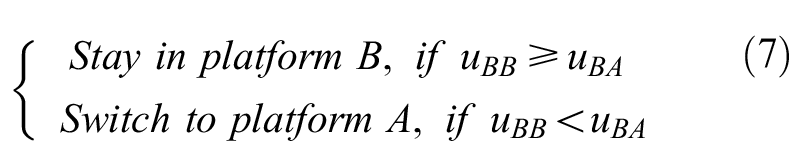
Letting

Assume
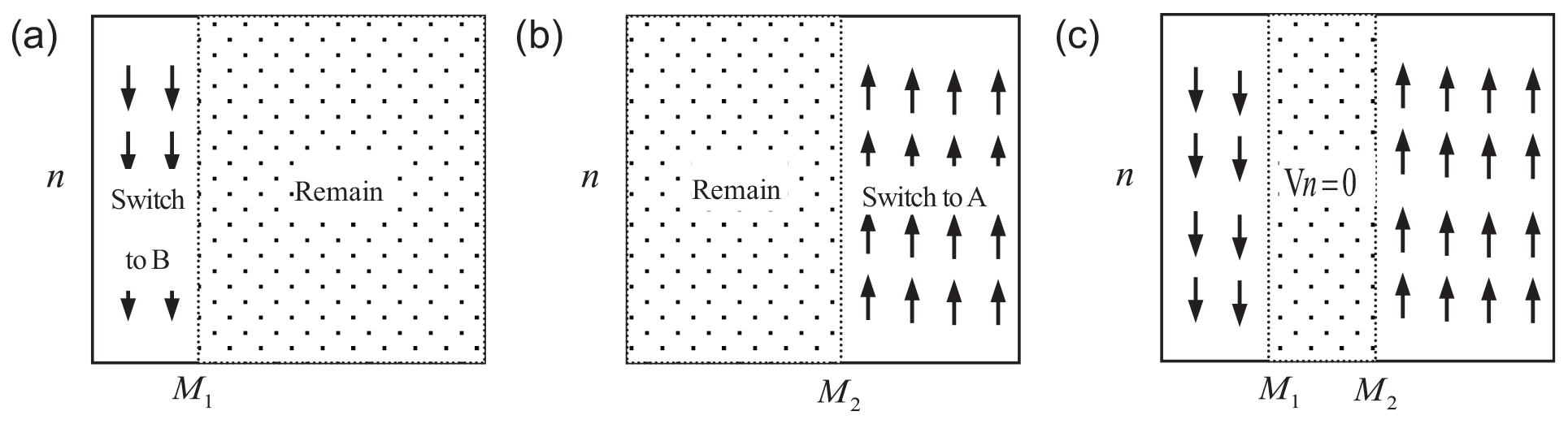
The relationship of consumers’ choices and the current state of the system: (a) the consumers of platform A, (b) the consumers of platform B, and (c) the change of n in the system.
Similarly, letting

Assuming the solution of (9) on
Substituting the
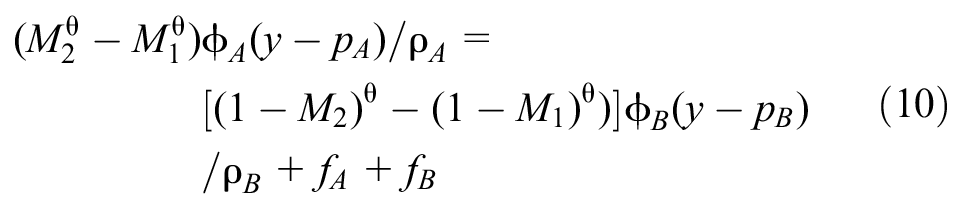
Based on (10), it can be proved that
Given other parameters, the utility of consumers depends on the number of supply-side users in their platform (see Equation 4). The fewer the number of supply-side users, the smaller the utility. Nevertheless, considering that consumers switching to another platform will pay an additional switching cost rather than stay in the current platform, they will change their positions only if the increase of utility coming from switching to another platform exceeds the switching costs.
The Evolutionary Dynamics of Supply-side Users Distribution (
and
)
We assume that in each period there is a small number of supply-side users that reconsider which platform to produce complementary products for, hence causing a small change


Letting

When

In the state space
Similarly, given

or

The graph of (15) or (16) is also a curve whose endpoints are close to points
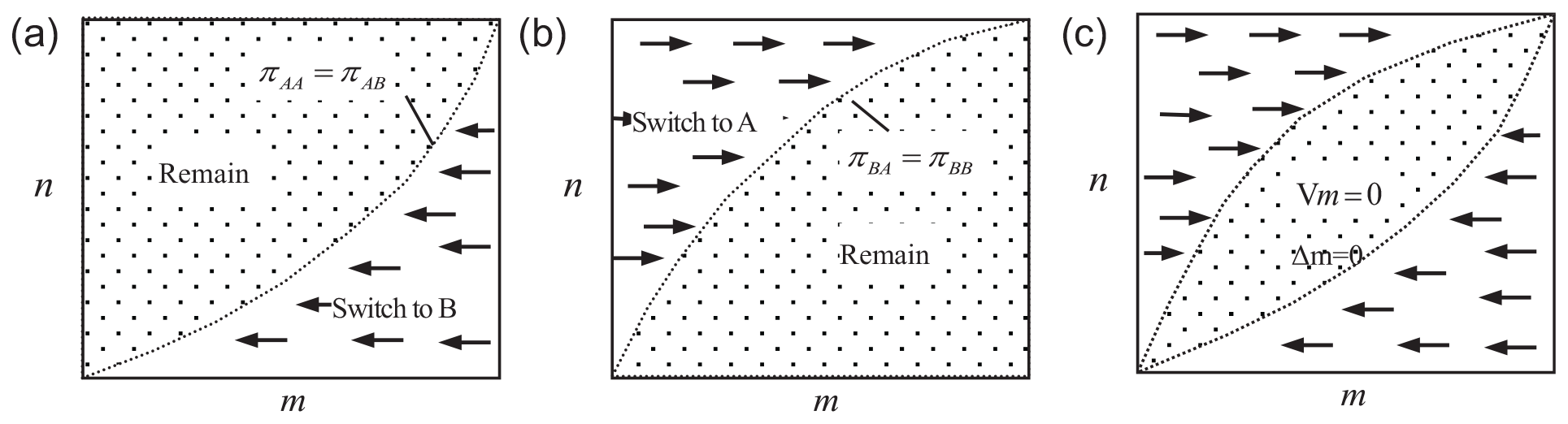
The relationship of supply-side users’ choices and the current state of system: (a) the supply-side users of platform A, (b) the supply-side users of platform B, and (c) the change of m in the system.
Subtracting (14) from (16), we can get the difference of the vertical coordinates between the two critical lines; that is,

The value of (17) is always greater than zero; hence, the critical curve
Given other parameters, the profits of the supply-side users depend on the number of consumers (affecting total complementary products sales) and supply-side users (dividing the total sales) in their platform system (see (5)). The fewer the consumers and/or the greater the number of supply-side users, the smaller the sales (thus, profits) of a single supplier. Nevertheless, considering that supply-side users switching to another platform will pay an additional switching cost rather than stay in the current platform, supply-side users will change their position only if the increase in sales coming from more consumers and fewer competitors exceeds the cost of switching.
The Equilibrium Point, the Basin of Attraction, and the Stability of the Equilibrium
In “The Analysis of Evolutionary Dynamics” section, we discussed how the system’s initial state
By combining Figures 1c and 2c, we can derive the evolutionary dynamics of the whole system. Figure 3 shows how the direction of change in
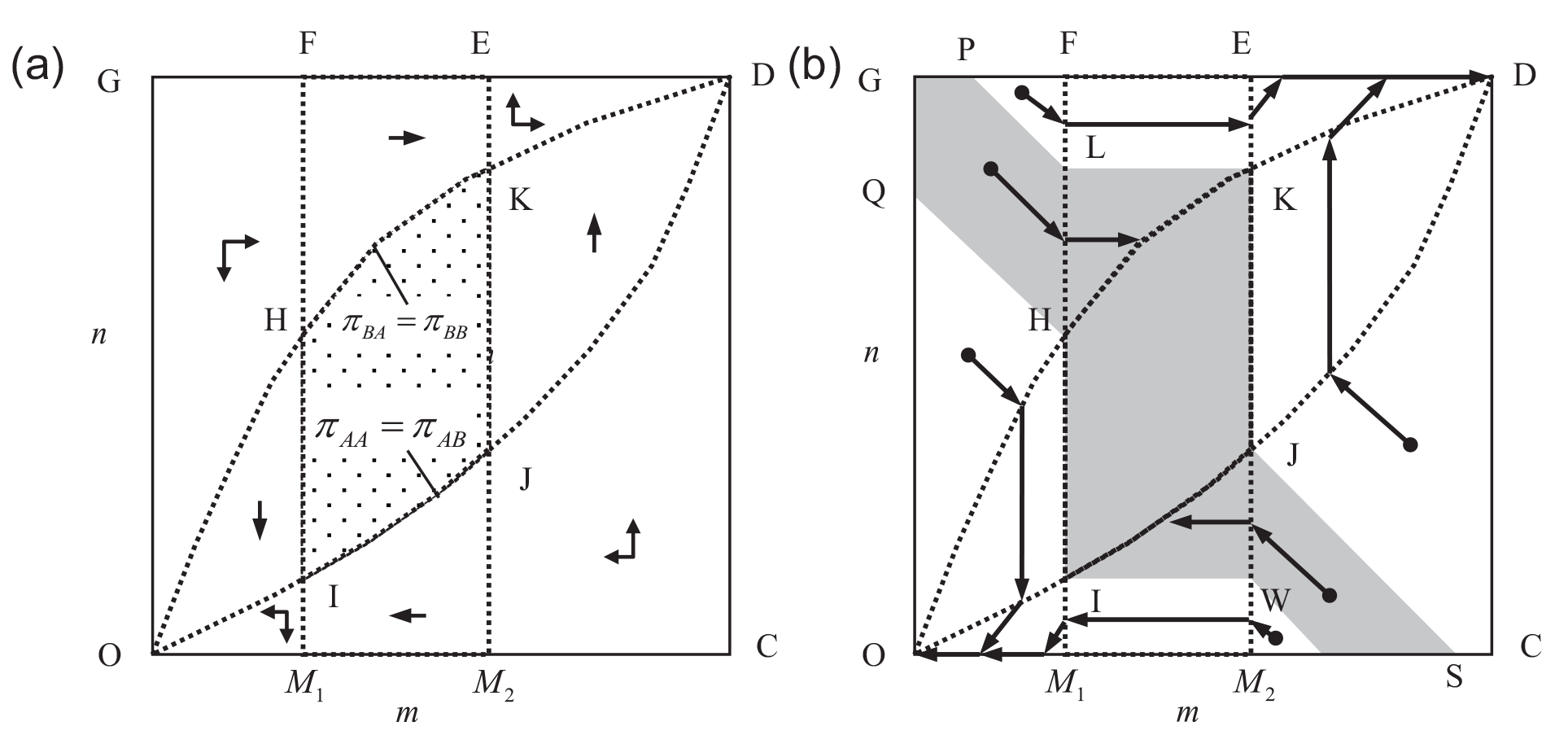
The evolutionary dynamics of system, the equilibrium point, and the basin of attraction: (a) the changing direction of m and n at different initial positions and (b) the basin of attraction of each equilibrium point.
(1) Equilibrium area HKJI. If the system’s initial state is in this area (including the boundary), according to the analysis in the last section,
(2) Equilibrium point O. If the initial state is at this point, this means that all supply-side users and consumers are in platform B
(3) Equilibrium point D. The initial state represented by this point is that all supply-side users and consumers are in platform A
(4) Disequilibrium area OGFH. If the system’s initial state is in this area, according to the analysis presented in “The Analysis of Evolutionary Dynamics” section,
Similarly, the evolution paths of other points in Figure 3b can be deduced as illustrated by the black arrow in the Figure. This shows that only area HKJI, points O and D are fixed points, and the points in other areas would eventually move to the above equilibrium areas (or points) through evolutionary dynamics. Thereby, the “basin of attraction” of each equilibrium area (point) can be derived. In Figure 3c, the shaded area extending from the upper left to the lower right is the basin of attraction of the equilibrium area HKJI, the empty area at the lower left is the basin of attraction of the equilibrium point O, and the empty area at the upper right is the basin of attraction of the equilibrium point D. The division of the basin of attraction indicates that if the initial state of the whole system is one in which platform A is superior in terms of the number of consumers but inferior in the number of supply-side users (the upper left shaded area in Figure 3c), or contrary to the above situation (the lower right shade area in Figure c), namely, the two types of platform A and B have their own advantages and disadvantages, then the final result would be the coexistence of two platforms (equilibrium area FGHI). If the initial state of the system is one in which platform A is inferior in the number of both consumers and supply-side users (the lower-left empty area in Figure c), the result would be that platform A is eliminated and B achieves a monopoly, and vice versa (the upper right empty area in Figure c).
It should be stated that due to the relative value of the parameters
The stability of the equilibrium of the evolutionary game refers to whether the system can return to the equilibrium point through an evolutionary mechanism when the system is subjected to an occasional shock away from the equilibrium point. Measured by this definition, the equilibrium points O and D are stable and the equilibrium area HKJI is unstable. Taking point O as an example, when it is subjected to an occasional, gentle shock, the state points move to the areas OQH, OHI, or OIM1 (in the lower-left corner of Figure 3c). While all these areas are in the basin of attraction of the equilibrium point O, the system will return to point O under the evolutionary mechanism. However, the equilibrium area HKJI shows different features. If the system is subjected to an occasional shock and is away from HKJI to the left (area OQHI) or to the right (area KDCJ), it will eventually move to the equilibrium point O or D through evolutionary dynamics. This difference in stability indicates that the structure of a single platform monopoly is stable while the structure of multiple standards coexisting is fragile. In addition, considering the equilibrium area HKJI, if the occasional shock is an increase or decrease in the number of consumers (e.g., through the competition of platform price), the points will move away from HKJI to the upper shaded area LKH or the lower shaded area IJW, and if the shock is not very large, the state points will still return to area HKJI through evolutionary dynamics. Nevertheless, if the occasional shock is an increase or decrease in the number of supply-side users, as shown above, the system will move further to point D or point O, eventually leading to the collapse of coexistence. The different effects of horizontal and vertical shocks suggest that attracting complementary product providers is more likely to break the existing balance than attracting final consumers.
The Impact of Model Parameters on Game Equilibrium
Our game model incorporates several important parameters: the quality of the platforms
The Size of the Platform Coexistence Area
In Figure 3c, the size of the region HKJI represents the size of the state space where the two platforms, A and B, coexist. Equation 8 shows that the larger the
The Location of the Coexisting Area and the Size of the Basin of Attraction
The location of the platform coexistence area HKJI and the size of the attraction basins of the equilibrium points O and D are actually interrelated. For example, when the HKJI is close to the upper right of Figure 3c, the area of the attraction basins of point O is larger while the area of the attraction basins of point D is smaller. The fact that HKJI is close to the upper right means that, in order to achieve the coexistence, platform A needs to have relatively more supply-side users and consumers in the initial stage, while the small size of the attraction basin of D indicates that standard A will be excluded from the market for most initial states.
The location of the coexisting area and the size of the basin of attraction are affected by the quality and price of the platform and the price of the supplier. Considering a scenario in which
Results and Discussion
This paper focuses on two platforms supported by two digital technologies that are incompatible with each other. Based on the utility and profit model proposed by Church and Gandal (1992, 1993) with appropriate modifications, the evolutionary game model is constructed in which two types of platform (representing different technology standards) compete for supply-side users and final consumers. The number of types of suppliers and final consumers claimed by platform represents its degree of dominance in the condition of equilibrium. By analyzing the correspondence between the initial state and the equilibrium solution and analyzing the influence of parameters such as platform quality and the price of platform and supplier on equilibrium solutions, we arrive at the following conclusion: (1) If the two platforms have distinct advantages in terms of the initial number of supply-side users and consumers, there will be an equilibrium of the coexistence of two platforms; otherwise, there will be an equilibrium of single platform domination. (2) The equilibrium of single platform domination is more stable than that of the coexistence of multiple platforms. (3) The higher the switching costs for consumers and supply-side users, the larger the size of the coexistence region. (4) The equilibrium of coexistence is more easily broken by the occasional shock of increasing or decreasing the number of supply-side users than consumers. (5) Platform with poor core product quality and a high price of core and complementary products can coexist with another superior platform only if it has more consumers and supply-side users at the beginning of the competition.
The literature that explicitly takes platforms competition as the research subject, regardless of whether it adopts the concept of the Nash equilibrium or evolutionary equilibrium, distinguishes only two classes of participants, suppliers, and final consumers, or uses market share to measure the degree of domination (Chen et al., 2021; Dai et al., 2022; Lv et al., 2016). Although this highly abstract model can reveal the essential aspects of network effects, it cannot be used to analyze the influence of complementary assets. In this paper, we divide suppliers into core and complementary product producers, thus reaching the conclusion that a certain platform with a small number of consumers in the initial stage can still achieve coexistence with its competitors if it has more complementary products. This conclusion can easily explain the competitive strategy in the era of business ecosystems, and also enriches the study of supply-side segmentation in the field of platform competition. Moreover, in the platform ecosystem, consumers as well as different groups of producers are mobile, and although their choices are affected by inter-platform competition, there is still multilateral interdependence between groups, which is consistent with the findings of existing studies (Chen et al., 2022).
The literature from the perspective of platform competition usually establishes a framework of multiple participants, which can be used to analyze competitive strategies based on the business ecosystem. However, since the concept of the Nash equilibrium is used to directly identify the equilibrium solution instead of deducing the equilibrium solution from the dynamic evolution process of the system, it is impossible to relate each equilibrium to the corresponding initial state. This paper solves this problem by applying evolutionary game analysis. This paper joins some existing scholars in considering the impact of consumer utility and cost issues on their choices, but unlike studies of user behavior within a single platform (Chen et al., 2021), this study focuses on the choices that consumers make between two competing platforms by comparing their own utility and switching costs.
Some scholars have also explored the profit-sharing mechanism between a leading e-commerce platform and multiple suppliers that can maintain a stable alliance from the perspective of a cooperative game (Dai et al., 2022). This paper continues this line of thought by exploring the choices that suppliers make across different competing platforms, taking into account utility and profit. Furthermore, in order to get closer to the real market competition situation, this paper combines the consideration of different groups of consumers and suppliers, and uses the evolutionary game approach to explore the competitive equilibrium between platforms, consumers, and supply-side users. This study is helpful for platform owners to formulate appropriate competition strategies by integrating the supply and demand sides and their own conditions in the dynamic market competition, which provides a unique idea for platform differentiated competition and a direction for the development of related industries.
Finally, limitations to the analysis should be mentioned. Our model does not consider the entry or exit of the consumers and complementary producers, which means that all participants interacted in a closed system. The reason for this assumption is that the prime purpose of our study is to extend the “supplier + consumer” model to the “core platform + supply-side user + consumer” model and to adopt the evolutionary game to explore the questions mentioned above. If we had considered the issue of entry and exit, the description of the entire platform competition system would have become extremely complicated. From a realistic point of view, the competitive situation described in this paper is equivalent to paradigmatic design phase (Dosi, 1982). At this phase, the competition among incumbents becomes a key point of industry competition. To describe the platform life cycle fully, subsequent models can incorporate the possibility of entering and exiting the industry.
Footnotes
Acknowledgements
The authors would like to acknowledge the scholars who have proposed valuable modifications to the content of this study.
Declaration of Conflicting Interests
The author(s) declared no potential conflicts of interest with respect to the research, authorship, and/or publication of this article.
Funding
The author(s) disclosed receipt of the following financial support for the research, authorship, and/or publication of this article: “Science and Technology Development Plan of Jilin Province: Research on the Effect, mechanism and Policy of Green Innovation in Manufacturing Enterprises driven by digitalization in Jilin Province,” Project No.: 20230601040FG. “National Development and Security Research Project of Jilin University: Food Supply Chain Security Risk Management in the context of Smart Agriculture,” Project No.: GAYZXY04. “This research was funded by Basic Research Expenses of Jilin University: Research on the Impact of Enterprise Network Structure on Income Distribution,” Project No.: 2018QY036.
Ethical Approval
This study does not involve ethical statements.

Notes
Data Availability Statement
Data sharing not applicable to this article as no datasets were generated or analyzed during the current study.