




Abstract
The employment of advanced technology in sustaining South African humanitarian organizations and business logistics firms has been a crucial concern for many years. The aim of this study is to examine the propensity of senior executives to use, diffuse, and adopt Humanitarian Logistics Digital Business Ecosystem (HLDBE) as another future sustainable tool. A PLS-SEM multivariate analysis was conducted using technology innovation theories to understand their perceived interest. The findings indicated that donor/top-level management support (D_TLMS), normative pressure (NP), perceived compatibility (PC), and perceived safety and security concerns (PSSC) served as essential factors that influenced decision-makers decision to use, diffuse, and adopt HLDBE with their noted concerns indicated. An IPMA analysis was also used in assisting executives on important factors to improve. Implications, limitations, and further research directions are therein proposed.
Keywords
As part of Africa’s effort to meet its Agenda 2030 and 2063 goals, several initiatives have been initiated to help facilitate it. Notable among them is the African Humanitarian Agency (AfHA), a means to address its continental humanitarian issues, alleviate poverty, and creation of employments African Union (2019). Apart from government contributions, non-profits and profits organizations also continue to play a significant role in these efforts.
South Africa (SA), the second-largest economy in Africa is estimated to have more than 200,000 registered non-government organizations (NGO’s) serving as another societal supporting system for the government (Kagisco, 2020). Societal sustenance in the form of disaster relief, addressing of socio-economic and environmental issues are a means of supporting community/national development. Particularly, on issues such as earthquake, sinkholes, flash floods, drought, poverty alleviation, and others couple with the present COVID-19 pandemic (Heritage et al., 2015; Knight & Rogerson, 2018; Oosthuizen & Richardson, 2011). Despite NGO’s normal mandates of addressing societal issues, they also serve as supply chain coordinators, negotiators, organizers for-profit organization’s sustainability in the communities they operate in. Firms looking for needed resources, legitimacy, specialized expertise often seek for NGO’s assistance with access to needed local network of stakeholders for endorsement of their brand. A means that promotes logistics firms or other firms socio-economic and environmental image in gaining the trust of prospective customers. Gaining legitimacy in areas of operations, logistics companies operating in South Africa utilize the Broad-Based Black Economic Empowerment (B-BBEE) as another sustaining means for their operations (South African Government, 2014) as is the case of Imperial logistics, Tulsawiz logistics, DACHSER, and others (ALSTOM, 2017; DACHSER, 2020; Imperial Logistics, 2019; Tulsawiz logistics, 2018).
More so, addressing overwhelming disaster or societal issues, multi-stakeholders response effort is encouraged by the government (UNHCR, 2002). According to Soren (2020), logistics response account for 75% of humanitarian response financial funding. Thus, an essential element of relief response. Despite the financial funding, humanitarian logistics actors still face challenges due to the complexity of disaster response thereby prompting business logistics firms support (Jahre et al., 2016; Jiang & Yuan, 2019; Lai et al., 2018; Nurmala et al., 2018; Tofighi et al., 2016; Trunick, 2005; Van Wassenhove, 2006; Zokaee et al., 2016). Where private companies and NGO’s jointly are seen as significant player(s) in minimizing the overwhelming impacts on government response (Ngqwala et al., 2017). Such was the case during the Durban floods in 2019, where resources and expertise were harnessed from multi-stakeholders’ efforts in response to the disasters (Department of Cooperative Governance, 2019). Although important, such collaborative efforts are hampered by issues such as transparency, accountability, data security and risk, information asymmetry, and others which prevent actors in a collaborative multi-stakeholders to lose value and trust in the system they belong (van Niekerk et al., 2018). Thereby hampering the sustainability of humanitarian and business logistics effort in the event of a disaster impact. Advanced technology employment has been described as a mitigating tool for addressing such concerns.
Digital technology has been described as a safeguarding tool for value creation and trust-building among multi-stakeholders in an ecosystem; serving as another preparation tool for any disaster disruption that may hamper humanitarian organizations efforts and business logistics operations efforts in saving lives (Cichosz, 2018; Rice, 2020). For example, South Africa topping the COVID-19 cases in Africa, experts have indicated that investing in the digital economy is an excellent way to reduce the spread of COVID-19 (Prinesha Naidoo, 2020; Saifaddin Galal, 2020; The World Bank Group, 2020). Addressing such concerns, Baffoe and Luo (2020) proposed a humanitarian logistics digital business ecosystem (HLDBE) platform based on a new generational technology in an effort to network different stakeholders under the logistics domain to collectively harness their resources and expertise in response to disasters coupled with the creation of value for their operations. A digital platform proposed for disaster preparation and logistics business support. With the essence of collaboration among South African non-profit organizations and logistics companies and the employment of advance technology in addressing humanitarian and business-related issues, the concern is, humanitarian and business logistics organizations having different conflicting mandates (thus, for profit making in the case of logistics firms and for saving lives in the case of humanitarian organizations), are they willing to collaborate under a collaborative digital business ecosystem such as HLDBE as proposed by Baffoe and Luo (2020)? And what factors will enable them to collaborate in the HLDBE system when in operation? This study seeks to examine from senior executives their propensity to use, diffuse, and adopt HLDBE as their future sustainable tool for their operations and community development.
The purpose of this study was to use PLS-SEM, to ascertain the perceived interest of South African humanitarian logistics and business logistic companies’ decision-makers willingness to diffuse and adopt HLDBE before its implementation, using three technology adoption and diffusion theories. Also, identify essential and non-essential variables (latent and indicators) contributing to senior-level managers to employ a single collaborative digital business ecosystem in South Africa. More so, checking for non-linear quadratic effect of the model. It is anticipated that the findings of this study would provide useful information to digital ecosystem developers in understanding humanitarian organizations and business logistics companies interest for a digital collaborative ecosystem that maybe adaptive to their operational needs, drawbacks of HLDBE diffusion and adoption, use of acquired information to develop HLDBE in meeting sustainable development for users and the South African economy.
Humanitarian Logistics Digital Business Ecosystem (HLDBE)
According to Baffoe and Luo (2020), HLDBE ecosystem platform serves as another collaborative digital platform system which plays an essential role in humanitarian relief and business logistics operations. HLDBE refers to a digital ecosystem using new generational technology (such as big data analytics, predictive analytics, cloud computing, and others) to integrate stakeholders both in the humanitarian logistics (HL) and business logistics company (BLC) domain under a common digital platform serving their mutual interest and benefits. According to Baffoe and Luo (2020), users of this platform are the humanitarian organization, business logistics companies, and government stakeholders. Each user has their strengths, for example, HL familiarity in disaster environments of uncertain demands, supplies, disruption of routes and others serves as a supplement to the deficiencies BLC may encounter in disaster situations and vice visa for HL actors as well. Harnessing a collaborative digital ecosystem platforms as HLDBE, actors are shifted from offline operations to online operations for cost minimization, value creation, technical know-how exchange (Gawer, 2014). Also, with changes in global dynamics of operation, employing advanced technology in HL and BLC sectors may serves as another sustainable means for their operations. Reference to Baffoe and Luo (2020), harnessing each users expertise under a collaborative digital ecosystem platform helps sustain humanitarian and business operations (Jahre et al., 2016; Jiang & Yuan, 2019; Lai et al., 2018; Nurmala et al., 2018; Tofighi et al., 2016; Trunick, 2005; Van Wassenhove, 2006; Zokaee et al., 2016). In that regards, before the inception of HLDBE, the need to examine the perceived interest from the prospective users, experts are crucial to its implementation. Understanding the perceived interest of the users, as is the case of senior level executives in this study, factors derived from technology innovation theories are employed to understand their propensity to use, diffuse, and adopt HLDBE as another future sustainable tool for their operations.
Diffusion of Innovation Theory (DOI)
Diffusion of innovation proposed by Prof. Rogers has been one of the innovative models aiding technology promotion. DOI is a dominant theory for assessing users’ interest in innovation diffusion and adoption as has been applied in industries such as the agricultural, health, financial, transport, logistics, and other sectors for operational improvements (Bogliacino et al., 2012; Lai et al., 2018; Lorentzen, 2010; Lundvall et al., 2011; Zanello et al., 2016). Concurrently, the dimension used in assessing the perceived interest to diffuse and adopt an innovation under DOI are relative advantage, compatibility, trialability, observability, complexity (Rogers, 2003; Rogers et al., 2019). Serving as a useful model, we employed it to examine these variables: perceived trialability (PT), perceived relative advantage (PRA), perceived compatibility (PC), perceived drawbacks (PD), and perceived safety and security concerns (PSSC). See questions in Supplemental Material session for detail.
Technology-Organizational-Environmental (TOE)
TOE also serves as another technology diffusion and adoption framework model developed by Tornatzky et al. (1990) for organization technology adoption. According to Gangwar et al. (2015), TOE aids decision-makers in examining the holistic outlook of the internal (technology and organizational) and external influences (environmental) that may have an impact on their decision to diffuse and adopt an innovation. Also, credited for its benefits in examining technology adoption, value creation, and technology innovation (Gangwar et al., 2015). Due to the advantages in technology adoption assessment for a firm, the decision to adopt, implement, anticipate future hindrance/impacts from both internal and external dimensions, firms/organizations can capture a good overview of the innovations impacts, capacities, and drawbacks for their informed decision (Gangwar et al., 2015; Wang et al., 2007, 2010; Zhu, 2004). Because of its essential nature, the TOE framework model is used as another tool for diffusion and adoption innovation assessment. In that regards, these variables were used in the context of TOE: normative pressure (NP), donor/top-level management support (D_TLMS), infrastructure and expertise (IE). Reference of the dimensions can be found in the Supplemental Material session.
Institutional Theory (Inst. T)
Institutional theory acts as a functional system for examining technology innovation. Propounded by DiMaggio and Powell (1983), serves as an approach utilized in studying institutions found in the economy, politics, and society. Also, employed in examining the micro and macro phenomenon of institutions from the perspective of organizational culture and structure (OCS). A theory that helps to examine homogeneity in a system of different actors. As have been applied in different fields of study. For example, the technology and supply chain field as was done by Dubey et al. (2019). Serving as an essential dimension, organizations can assess their internal resources together with the external relationships and pressures they perceived before making the decision to diffuse and adopt an innovation. Another viable means to improve an organization’s operational performances (Dubey et al., 2019). Two dimension (thus, organizational Culture and Organizational Structure [OCS]) was used based on inst. T.
Conceptual Model Formulation
The study was based on Baffoe and Luo’s (2020) work, and the use of technology adoption and diffusion theories (DOI, TOE, Inst. T). Additionally, essential elements were used in soliciting the opinions of decision-makers on the importance of HLDBE diffusion and adoption in their sustainable operations (Baffoe & Luo, 2020; DiMaggio & Powell, 1983; Lee, 2015; Rogers, 2003; Rogers et al., 2019; Tweel, 2012). See Figure 1 for conceptual framework details. Dimensions used in the hypothesis formulation of the model are explained below:

Conceptual framework for study.
Effects of Perceived Relative Advantage (PRA) on South African Donors/Top-Level Management Support (D_TLMS)
The benefits derived from an innovation over previous technology influences organization/firm diffusion and adoption decision. As asserted by Rogers et al. (2019), the perceived relative advantage (PRA) of an innovation serves as an essential dimension that is seen as providing benefits to its users. Benefits that shifts prospective users from the traditional/unconventional way of operations that result in high variation in lead time, lack of efficient logistics planning, scheduling, transport consolidation, inadequate predictive analytics for supply and demands, waste of capacity and resources, and others posing as a challenge to managers of both humanitarian and business logistics organizations (Choi, 2018; Davenport & Harris, 2008; Govindan et al., 2018; Mishra & Singh, 2018; Shukla & Kiridena, 2016; Waller & Fawcett, 2013a, 2013b; Yu et al., 2018; Zhong et al., 2015). According to Baffoe and Luo (2020), some relative advantage of the HLDBE is the ecosystem platform its create using digital technology to collaborate users in harnessing their resources and know-how to create a robust environment that helps them to sustain and address complex issues that may hamper their operations (Baffoe & Luo, 2020; Järvi et al., 2018; Tsujimoto et al., 2018). Thus, a consensus effort to benefit themselves by saving lives, companies, and economies (Porter, 2013). Based on the essence of the factor, we proposed this hypothesis:
H1: PRA has a positive effect on Donors/Top-level Management Support.
Effects of Perceived Compatibility (PC) on South African South African Donors/Top-Level Management Support (D_TLMS)
Prof. Rogers (2003, p. 240), defines compatibility (DOI dimension) as “the degree to which an innovation is perceived as consistent with the existing values, past experiences, and needs of potential adopters.” Decision-makers inclination to adopt innovation centers on whether the innovation is favorable, consistent, compatible with how value is obtained in their social, economic, and cultural context. Perceived compatibility (PC), has been found by some researchers as an essential dimension for innovation adoption and diffusion (Gangwar et al., 2015; Rogers, 2003; Rogers et al., 2019). Owing to the important nature of senior executives’ inclination to have a system that is compatible to their existing system, an assessment of users perceived opinion on HLDBE been compatible for their operation is crucial an innovation’s diffusion and adoption. Based on that we propose this hypothesis:
H2: PC has a positive effect on Donors/Top-level Management Support.
Effects of Organizational Structure and Culture (OCS) on South African South African Donors/Top-Level Management Support (D_TLMS)
The alignment of different users’ culture and structure under a collaborative ecosystem platform can promote or disrupt the adoption of innovation such as HLDBE. Organizational structure and culture (OCS) attributed to the organizations operating performance and development (Dubey et al., 2019). Organization culture dimensions such as clan, adhocracy, hierarchy, market and organizational structure dimensions in the form of functional, divisional, and matrix well understood and aligned in an innovative ecosystem, value is achieved by its users (DiMaggio & Powell, 1983; Dubey et al., 2019; Ouchi, 1980). Inst. T dimensions aids dynamism, diversity, and minimize the natural complexity among HL and BLC. With its essence, this hypothesis is proposed:
H3: OCS has a positive effect on Donors/Top-level Management Support.
Effects of Normative Pressure (NP) on South African South African Donors/Top-Level Management Support (D_TLMS)
Organizational affiliation, professional, and credential influences are another factor that pressures organizations to adopt and diffuse new technology innovation. According to DiMaggio and Powell (1983), in the modern society of systems where an industry is flawed with professionalism and affiliations organizations compliance to professional standards/affiliation, an organizational body may have an indirect influence on it members to adopt new technologies that helps in their alignment of industrial objects thereby moving toward a homogenous way of doing things (DiMaggio & Powell, 1983). Furthermore, based on the norms in the industry, members may be coerced to comply with the norm to meet with new trends of the industry. Due to the influencing effect, this factor (normative pressure [NP]) was chosen as an element to determine the impact it would have on decision-makers to adopt HLDBE in South Africa.
H4: NP has a positive effect on Donors/Top-level Management Support.
Effects of Infrastructure and Expertise (IE) on South African South African Donors/Top-Level Management Support (D_TLMS)
Firm’s readiness to diffuse and adopt technology such as HLDBE is described by the tangible and intangible resource readiness (Gangwar et al., 2015). Tangible resources such as information and communication infrastructure while the intangible resource such as the expertise to man the innovation are crucial decision elements for adoption and diffusion of innovations such as HLDBE. Despite the financial readiness needed, the infrastructure and expertise (IE) play a role in its usage (Musawa & Wahab, 2012). Based on its essence, this hypothesis are proposed:
H5: IE has a positive effect on Donors/Top-level Management Support.
Effects of Perceived Safety and Security Concerns (PSSC) on South African South African Donors/Top-Level Management Support (D_TLMS)
Transparency and accountability describe donors/top-level managers support (D_TLMS), confidence and trust in utilizing an innovation. Such safety and security values encourage trust, prevention of legal implications, cost-saving, and others tailored toward improving an organizations performance. Meeting such secure environment, creates an avenue where business can be made, as users’ safety and protection can be guaranteed. Donors who support humanitarian operations ascribe to HL operators ability to account, and ensure transparency in the funds provided as is the case of BLC in the business settings with shareholders, consumers, and suppliers (Nurmala et al., 2017). Accounting for the safety and security of users in the proposed HLDBE platform to be examined, perceived safety and security concerns (PSSC), was used.
H6: PSSC has a positive effect on Donors/Top-level Management Support.
Effects of Perceived Drawback (PD) on South African South African Donors/Top-Level Management Support (D_TLMS)
Perceived drawback (PD) factors serve as a determinant in users perceived interest to diffuse and adopt an innovation. Platform competition, ecosystem dominance, data security risk, cost, differences in a business model, laws, corporate culture differences, language diversity, type of information asymmetry, and others are factors that contributes to decision-makers perception on whether to adopt a new technology or not as in the case of HLDBE. According to Moore (1993), dominance and competition effect felt from the development of a business ecosystem can have an impact on other parties in the system which can result in the loss of market share and sales thereby threatening their existence (Gangwar et al., 2015). Also, data security risk possesses a threat to perceived adopters’ interest in subscribing to HLDBE despite its valuable benefits (Shin, 2013). An addendum queue taken from Gann et al. (1998), indicates that a shift in any laws or regulatory policy could affect innovation when it is not easily understood and applicable. Though some of the factors are positive elements in innovation adoption and creation, there seems to be a negative effect on decision-makers for innovation adoption.
Lastly, based on the influencing factors that senior executives who dubbed as donors and top-level management take into consideration prior to committing human resource or financial resource in diffusing and adopt a new technology, we proposed that decision-makers has a positive effect in either to use, implement, diffuse, and adopt an innovation. Also, we sort to examining the propensity of the executives to diffuse and adopt HLDBE as having a non-linear quadratic effect. In that regards the following hypotheses are proposed:
H7: PD has a negative effect on Donors/Top-level Management Support.
H8: Donors/Top-level Management Support (D_TLMS) has a positive effect on senior executives’ decision to diffuse and adopt HLDBE.
H9: Senior executives’ decision to diffuse and adopt HLDBE has a non-linear quadratic effect.
Methods
Study Design
A cross-sectional quantitative survey data was employed using a research instrument developed from the Diffusion of Innovation (DOI) Theory, Institutional theory (Inst. T), and Technology-Organization-Environment (TOE) framework. Additionally, works of (Lee, 2015; Tweel, 2012) also served as a good source for instrument development.
Research Instrument
SurveyMonkey online survey platform was used in the pre and post-test. Checking for face validity, three professors did the pre-test in the logistics and humanitarian domain, with one professor in an epidemiological field as a check for the model followed by four additional logistics and humanitarian field workers to ensure the questionnaires were understandable, simple, lack of respondent burden, logic, content validity, and falls within the study’s scope. Completing the pre-test phase, 10 humanitarian and business logistics respondents post-tested the revised instrument for clarity, coherence, logic, content validity, simplicity, lack of respondent’s burden before checking for the questionnaires item reliability. A Cronbach’s alpha analysis assessed reliability of survey items was performed to ascertain its internal consistency. Thus, PRA (eight items: α = .96), PC (three items: α = .89), NP (three items: α = .80), IE (seven items: α = .85), PSSC (two items: α = .90), PD (seven items: α = .87), D_TLMS (three items: α = .84) all indicating a high internal reliability consistency. Except for OCS, whose items were adopted from Tweel (2012) and Lee (2015), who checked for the construct reliability. In all a Cronbach’s analysis of 0.94 was recorded indicated a high correlation in the survey items used (thus, 38 items: α = .94). Meeting all these requirement, we proceeded to administer the survey to the respective respondents.
Data Collection
A mixed sampling method approach (thus, a simple random sampling and sampling method based on ESOMAR 28) was employed. Adopting a simple random sampling method in collecting data from respondents a confidence level of 95%, margin of error 5%, and a total sample size of 918 used, the calculated sample size needed for the study was 272. After administering the survey, a total response rate of 62 (22.79%) was received, with 163 (59.92%) accounting for respondents opting out of the survey accompanied with bounced mail. A non-response rate of 47 (17.27%) was recorded. We observed that this may be as a result of some respondents switching from previous jobs to a new one, going on retirement, or the current COVID-19 pandemic accounting for the non-response. Of the 62 response received, 27 respondent’s responses were removed from the data upon data screening and any response with 85% missing data for our objective analysis. In all a usable response data of 35 was obtained. Nonetheless, because 35 usable response data were not adequate, additional 100 response data was obtained from SurveyMonkey target audience. Authors ensured that obtained data met the unit of analysis criteria. It was noted that survey sampling and administering obtained from SurveyMonkey audience target was guided by ESOMAR 28 (www.esomar.org). After cleaning the compiled response of 135, a total usable data of 106 was finally used for the study.
The survey was conducted from November 2019 to May 2020. The unit of analysis is the senior level management personnel who work in the domain of logistics/supply chain in the humanitarian organizations or business logistics companies.
Reason for Using PLS-SEM and Data Sampling Assessment
Partial Least Square structural equation modeling (PLS-SEM) a multivariate statistical tool serves as a useful instrument for small sample size data analysis (Hair et al., 2011, 2019; Wong, 2019). Reason for employing PLS-SEM is because it uses small sample size data for objective analysis results. Also, its ability to test for both reflective and formative latent variables and the ability to check for less probabilistic results. It is widely known for its moderation and quadratic effect checking. For example, Anderson et al. (2002), applied PLS-SEM statistical tool to test their ABC model on the US automobile industry using 18 small sample size.
As a rule of thumb, the required sample size for analyzing PLS-SEM results should follow a ten times rule for the maximum pointed path arrow to a specific latent construct in the model (Hair et al., 2013). Nonetheless, they reiterated that using a G*Power analysis gives it an objective view for finding an effect using the right sample size. In the regards, we used G*Power to calculate the required sample size for our study using α = .05, power (1−β) = .80, and a medium effect size of f2 = 0.15 as indicated by (Sawilowsky, 2009) with seven predicators via an F-test linear multiple regression statistical test (Faul et al., 2009). We obtained a required sample size of 103, which meet our total sample size obtained (106) for our study.
Data Analysis
Common-Method Variance (CMV) Bias Test
Following the guidance of (Podsakoff et al., 2003), we used Herman’s single factor test to examine our instruments variables for any common method bias. Using SPSS version 24, the measuring items were inputted into a principal component analysis (PCA) with direct oblimin rotation to identify any sign of single factor from the analysis. The generated outputs reviewed 38 factors accounting for 72% of the total variance with the first rotated factor showing 34% of variance in the analysis. From the results obtained, there was no common-method variance bias observed.
Data Screening and Pre-Analysis
Data were cleaned, processed, and analyzed using Microsoft Excel, IBM SPSS 24, and SmartPLS 3.2.9 (Ringle, 2015). Accounting for outliers, missing values and normality, IBM SPSS 24 with SmartPLS was employed to check for any bias and statistical error that may affect the objective result of the study.
Using multiple outlier techniques check in IBM SPSS 24, we identified influential outliers using box plot, further analysis with Mahalanobis distance values and studentized deleted residuals was employed to substantiate the box plot outliers result but there were no outliers found (Aguinis et al., 2013; Osborne, 2013). A further analysis checking for the reason for influential outliers was hampered as respondents were anonymous, making it difficult to probe on the reason for the outlier. Again, missing values pattern identified was monotone. All missing values were replaced by a median of nearby points in IBM SPSS 24. Normality issues was adjusted using SmartPLS bootstrapping (Hair et al., 2013).
Respondents attributes and analysis relating to their job level, organization/company type, and organization size is displayed in Table 1. It was noted from the data received that job level category for others recorded three respondents as owners of logistics company, a supervisor of transport logistics company, a team leader in a logistics company, an executive manager in international business for a logistics and supply chain company, an NGO consultant, an executive manager, and a senior manager international business in the logistics and supply chain sector. Additionally, for company/organization type, some respondents were found in religious organization caring for the elderly, fleet logistics rail and terminal, and fleet management. See Table 1 for detail.
Demographics Characteristics of Respondents.

Analysis of Measurement Model
Notably from Hair et al. (2013), PLS-SEM has two model approach for model analysis. Thus, formative, or reflective model approach. Because this study sort to explore from humanitarian organizations and business logistics companies decision-makers perceived interest to diffuse and adopt HLDBE for their future operation the formative measurement model was used with eight independent variables (thus Donors and Top-Level Management Support [D_TLMS], Infrastructures and Expertise [IE], Normative Pressure [NP], Organizational Culture and Structure [OCS], Perceived Compatibility [PC], Perceived Drawback [PD], Perceived Relative Advantage [PRA], Perceived Security and Safety Concerns [PSSC]) in measuring Perceived interest to diffuse and adopt HLDBE (Diff_&_Adopt_HLDBE) as the dependent variable.
Noted from Figure 2, D_TLMS and Quadratic Effect 1 substantially explain 68.3% (0.683) of variance for Diff_&_Adopt_HLDBE. It was also observed that PRA, PSSC, IE, OCS, PC, PD, and NP all substantially explaining 72.7% (0.727) of variance for D_TLMS.
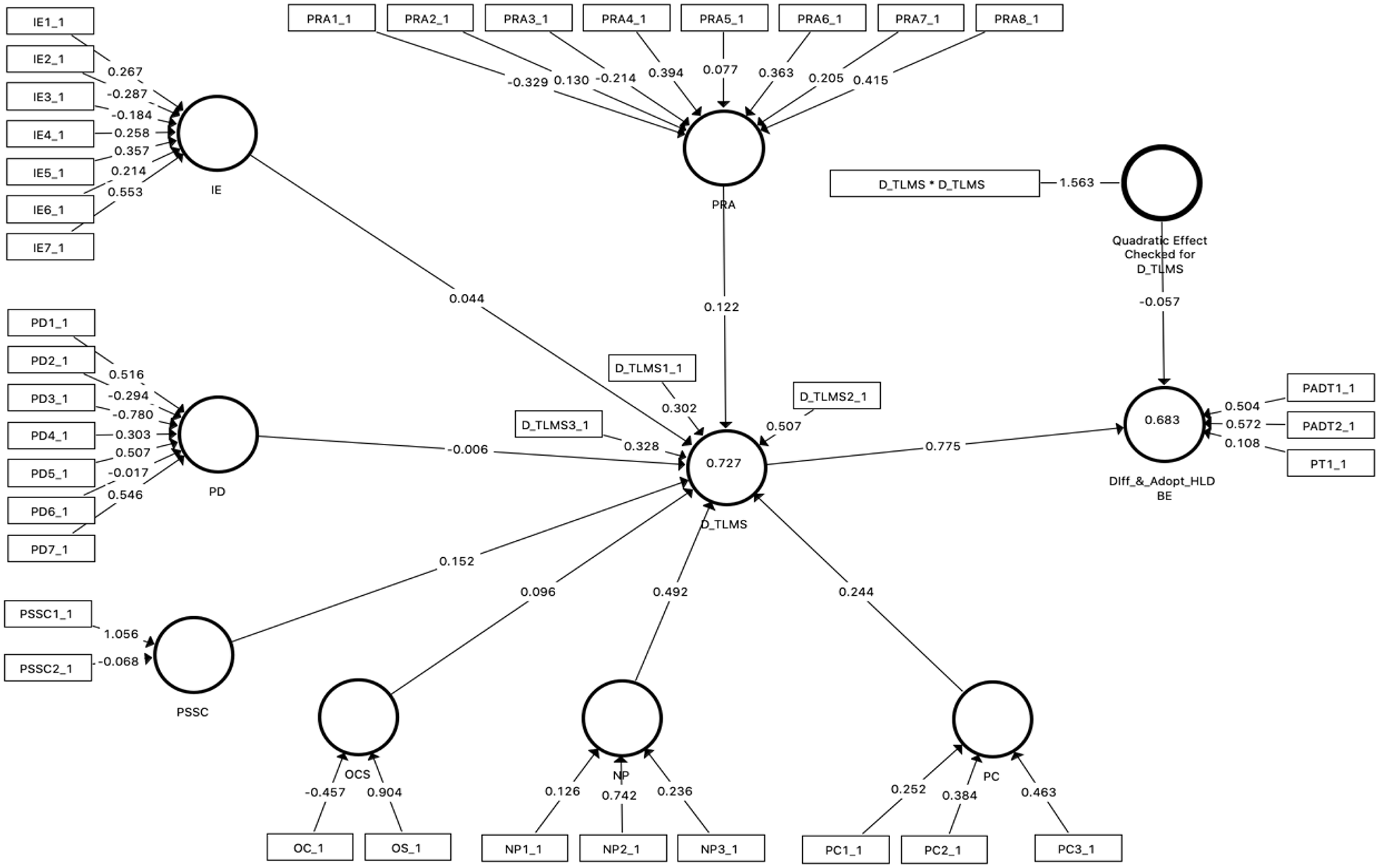
PLS algorithm model results.
Analysis of Formative Measurement Model
Adhering to the guidelines of Hair et al. (2013, 2017), formative measurement model, redundancy analysis, collinearity of measurement model (VIF), significant assessment of indicators should be checked before evaluating variables for the structural model. A redundancy analysis score of 0.82 was recorded for senior-level managers perceived interest to diffuse and adopt HLDBE (Ringle, 2017). See Figure 3 for details.

Redundancy analysis model results.
All indicators weights were assessed for their reliability and validity using their VIF. As noted, any VIF scores > 5 indicate a collinearity issue that needs to be addressed (Hair et al., 2019). All indicators were not having collinearity issues. See Table 2 for more details.
Collinearity Assessment for Formative Indicators.

Source. By the authors using MS Excel and SmartPLS 3.2.9.
Note. Results derived from updated PLS Algorithm testing using 10,000 maximum number of iterations, path weighting scheme used, and seven stop criterions. The bold part indicates VIF score < 5 with no collinearity issues. The symbol * represent the quadratic factor indicator analysed.
Checking for indicators significance, D_TLMS1_1, D_TLMS2_1, D_TLMS3_1, IE7_1, NP2_1, PC3_1, PSSC1_1, PADT1_1, and PADT1_2 all had a significant influence on the perceived influence to diffuse and adopt HLDBE by users. Clearly showing that attention should be placed on them. Indicators results are presented in Table 3.
Significant Results for Formative Measurement Indicators.

Source. By the authors using MS Excel and SmartPLS 3.2.9.
Note. Results from bootstrapping testing using 5,000 samples, 10,000 maximum number of iterations, path weighting scheme used and seven stop criterions, Bias-Corrected and Accelerated (BCa) Bootstrap, significance of .05, and a two-tailed test type. The bold part indicates p-value <.05 a significant path.
Indicates the presence of a Quadratic Effect indicator. Because it only serves as a quadratic effect it does not have a standard deviation which is used to calculate it t-statistics value.
Structure Model Assessment
Accounting for the validity and reliability of the structural model, a VIF assessment should be conducted for any collinearity issues found in the structural model. No collinearity issues were observed as found in Table 4. With no collinearity issue, the R2 was examined. Following (Hair et al., 2011, 2019; Henseler et al., 2009) guiding scale for R2, a variance score with .75 is classified as substantial, .50 (moderate), and .25 (weak). Table 5 shows the detail R2 scores for the model. According to Hair et al. (2019), only using the in-sample predictive power, thus R2 as the only model’s explanatory significance is not wholly adequate. A predictive accuracy Q2 is used to supplement the in-sample explanatory power (R2). Using the rule of thumb for examining path model predictive accuracy, Q2 score with 0 is indicated as small relevance, 0.25 medium relevance, and 0.50 as large relevance predictive accuracy (Hair et al., 2019; Stone, 1974). Please refer to Table 5 for more details on Q2 results all serving as a predictive measurement for Diff_&_Adopt_HLDBE.
Collinearity Assessment for Structure Model Constructs (Collinearity if VIF > ?).

Source. By the authors using MS Excel and SmartPLS 3.2.9.
Note. Results derived from PLS algorithm testing using 10,000 maximum number of iterations, path weighting scheme used, and seven stop criterions. The bold part indicates VIF score < 5 with no collinearity issues.
Significance Testing Results for Structural Path Model Coefficients.
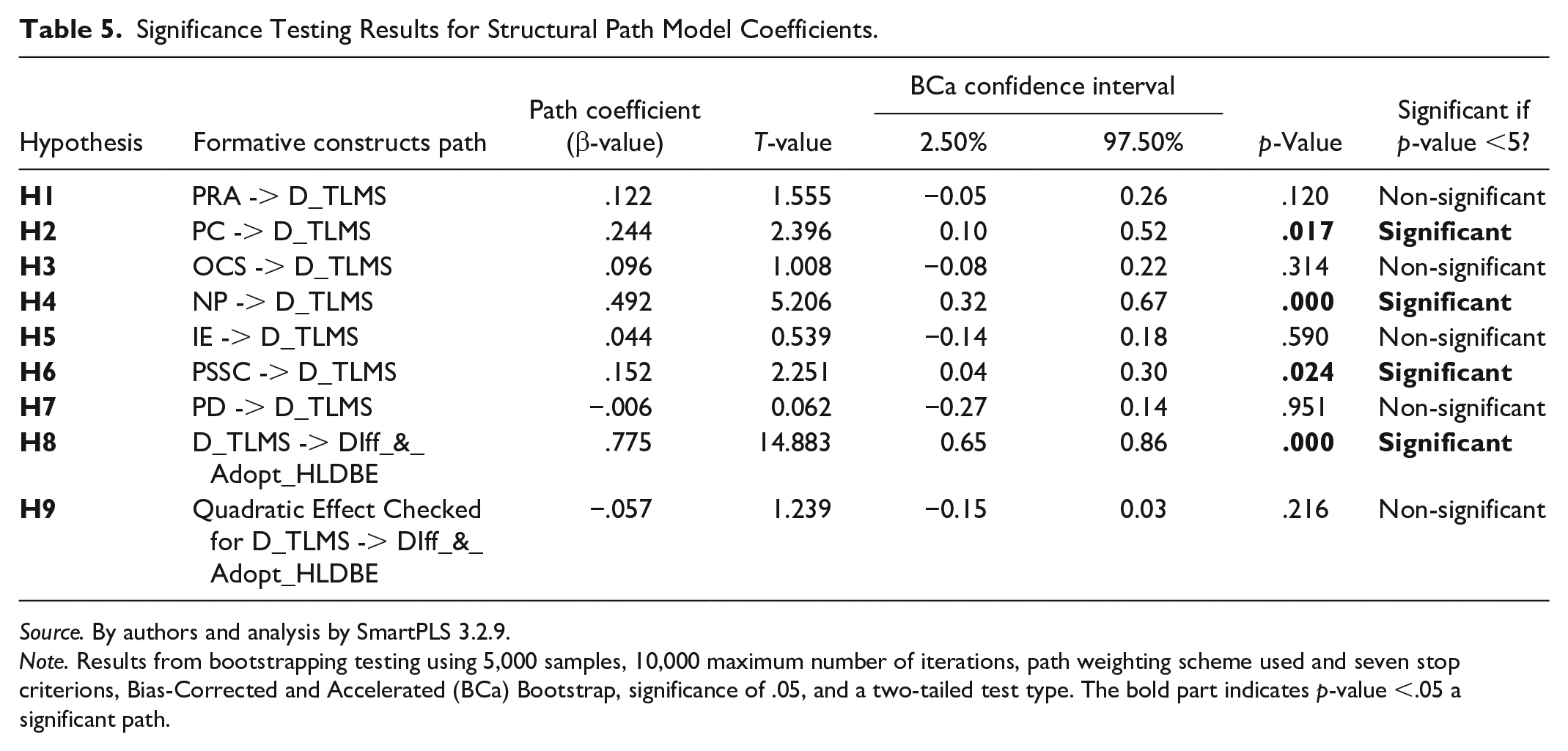
Source. By authors and analysis by SmartPLS 3.2.9.
Note. Results from bootstrapping testing using 5,000 samples, 10,000 maximum number of iterations, path weighting scheme used and seven stop criterions, Bias-Corrected and Accelerated (BCa) Bootstrap, significance of .05, and a two-tailed test type. The bold part indicates p-value <.05 a significant path.
Hypothesis Assessment
After checking for the measurement and structural model measurement for its in-sample predictive power and accuracy, we assessed the significance of the hypothesis. Refer to Table 6 for hypothesis results.
In-Sample Predictive Power and Accuracy Results.
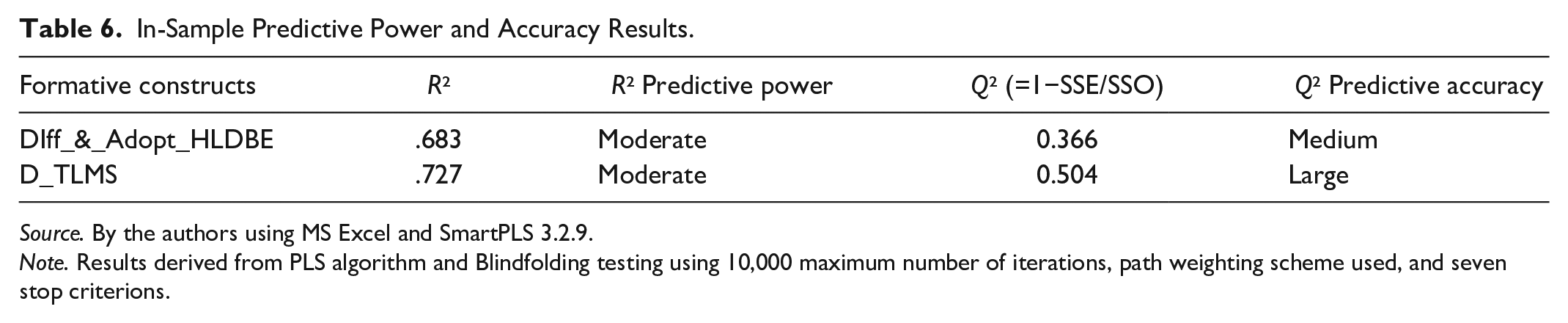
Source. By the authors using MS Excel and SmartPLS 3.2.9.
Note. Results derived from PLS algorithm and Blindfolding testing using 10,000 maximum number of iterations, path weighting scheme used, and seven stop criterions.
Employing a post-hoc power analysis (N = 106, α = .05, f2 = 0.15, No. Predictors = 7), the study recorded an 81.4% statistical confidence of detecting a significant effect of Diff_&_Adopt_HLDBE with a moderate explanatory power of 68.3% (R2 = 0.683) and a medium accuracy power of 36.6% (Q2 = 0.366). The findings show that the relationship between D_TLMS and Diff_&_Adopt_HLDBE (β = .775, t-value = 14.883, p-value = .000) was positive and significant, thereby supporting hypothesis H8. Also, relationship between NP and D_TLMS (β = .492, t-value = 5.206, p-value = .000) was significant and supportive for H4. Concurrently, relationships between PC and D_TLMS (β = .244, t-value = 2.396, p-value = .017), PSSC and D_TLMS (β = .152, t-value = 2.251, p-value = .024) all recorded as positive and significant. The findings supporting hypothesis H2 and H6. Nonetheless, relationship between IE and D_TLMS (β = .044, t-value = 0.539, p-value = .590), OCS and D_TLMS (β = .096, t-value = 1.008, p-value = .314), PD and D_TLMS (β = −.006, t-value = 0.062, p-value = .951), PRA and D_TLMS (β = .122, t-value = 1.555, p-value = .120) all were not significant to senior-level managers decision. Thereby indicating that hypotheses H5, H3, H7, H1 were all not supportive, thereby rejected. Additionally, the analysis results indicate that a linear relationship between Quadratic Effect 1 and Diff_&_Adopt_HLDBE may occur (β = −.057, t-value = 1.239, p-value = .216), thus, showing that H9 is negative and not supportive. Nonetheless, it is too early to say whether when HLDBE is employed it will still stay linear or change with different preferences of stakeholders as decision of human are not always static.
Model’s Predictive Power and Predictive Accuracy Assessment
Following the guidelines of Hair et al. (2019) to assess the out-of-sample prediction, PLSpredict in SmartPLS was performed to assess the Root Mean Square Error (RMSE) and Mean Absolute Error (MAE) for the model’s predictive power. High predictive accuracy was observed from the results. See Table 7 for details.
PLS Predicts Result Summary for Model’s Key Endogenous Constructs.

Source. By the authors using MS Excel and SmartPLS 3.2.9.
Note. Results was derived from testing using 10,000 maximum number of iterations, path weighting scheme used, 10 number of repetitions, and 10 number of folds.
The study’s measurement and structural model with its associated in-sample, out-of-sample predictive power, and accuracy scores were measured and indicated that the model indicates a good measurement for the Diff_&_Adopt_HLDBE model. Accounting for these requirement an IPMA analysis was performed to ascertain the essential variables that can influence decision-makers HLDBE diffusion and adoption decision of employment when operational.
Important-Performance Map Analysis (IPMA) Assessment
Giving managers synopsis for decision-making, the IPMA was developed as an essential tool for assessing the essential constructs and indicators that informs their decision-making (Ringle & Sarstedt, 2016).
Using the IPMA analytical tool, the target construct’s importance for the model is obtained from the predicted effect of its predecessor whiles performance is assessed from the average latent variable scores. According to Ringle and Sarstedt (2016), the essence of the IPMA analysis is to ascertain predecessor’s low performance with high importance measuring the constructs. A unit point increase for a predecessor performance constructs will cause an increase in the performance of the target constructs via it total effects size or importance score (Farooq et al., 2018; Ringle & Sarstedt, 2016).
An assessment of the predictive predecessors (D_TLMS, PC, PD, IE, PSSC, PRA, OCS, NP) was analyze as an important constructs for Diff_&_Adopt_HLDBE in the IPMA results.
Results from the IPMA indicates that D_TLMS recorded the highest importance score of 0.78. A unit increase in D_TLMS’s performance, Diff_&_Adopt_HLDBE target construct for humanitarian logistic and business logistics company’s decision will account for 0.78 increase if all things being equal (ceteris paribus). The study also indicates that PSSC (86.68) had the highest performance score and OCS (26.24) with the lowest performance score. From the findings, an improvement in the lowest performance scores will encourage Diff_&_Adopt_HLDBE usage among its users when it is employed. More details on the importance and performance used in assessing the targeted construct are found in Table 8.
Index and Total Effects for Diff_&_Adopt_HLDBE.

Source. By the authors using MS Excel and SmartPLS 3.2.9.
Note. Results were derived from testing using 10,000 maximum number of iterations, path weighting scheme used, and seven stop criterions. The bold part indicates the highest values for the importance and performance values.
The PLS-SEM analysis for examining Diff_&_Adopt_HLDBE recorded no collinearity issues in both measurement and structural model (Hair et al., 2019). Validating the theoretical model, checking for its significance, predictive power, and accuracy the designed conceptual model for examining Diff_&_Adopt_HLDBE for humanitarian and business logistics company was observed as a good model.
Discussions
Addressing the concern on whether senior executives of humanitarian-business logistics organizations with different operating mandates are willing to collaborate under a common digital business ecosystem such as HLDBE for their future sustainable operations in South Africa, eight latent variables (thus, OCS, IE, PRA, PC, PD, D_TLMS, NP, PSSC) derived from technologies of innovation theories; diffusion of innovation, technological-organizational-environmental (TOE) framework, and institutional theory were used to examine the propensity of executives to diffuse and adopt HLDBE with it non-linear quadratic effect assessment. Additionally, understanding variables that may influence their decision. Examining from the decision-makers their propensity to diffuse and adopt HLDBE, analyzed data findings were obtained from respondents using an online survey data collection and partial least square structural equation modeling (PLS-SEM) multivariate statistical tool.
The analyzed findings indicates that decision-makers of humanitarian-business logistics organizations are willing to diffuse and adopt HLDBE for their future sustainable goal when in operation. Influencing latent variables were donor/top-level management support (D_TLMS), perceived compatibility (PC), perceived safety and security concerns (PSSC), normative pressure (NP) all recording a significant value with it associated supportive hypotheses. Inversely, perceived relative advantage (PRA), infrastructure and expertise (IE), perceived drawbacks (PD), organizational culture and structure (OCS) were all also reported as having non-significant influencing effects, thereby rendering their hypotheses rejected. Refer to Table 5 or hypothesis assessment for summarized PLS-SEM structural analysis results.
Prior studies have been conducted on decision-makers perception to engage in multi-stakeholders collaboration in an effort to minimize logistics cost, improve efficiency and quality service, elimination of waste, sustainability of operations, and others via the employments of new technologies that perform better than previous or current adopted technology used in the humanitarian-business logistics sector. Lian, for example, stresses on the importance of top-level management influence in technology diffusion and adoption (Lian et al., 2014). Nevertheless, such studies have not focused on the perceived influencing effect of a digital business ecosystem like HLDBE from the propensity of senior executive operating in the humanitarian-business logistics organizations in South Africa (SA). This study found that employing, diffusing, and adopting HLDBE for their future operation may give them a significant results. Thus, D_TLMS significantly having a positive effect on South African humanitarian-business logistics organizations executives to diffuse and adopt HLDBE for their future operations. This findings confirms Rogers (2003) indication that, innovations that brings good benefits are easily diffused and adopted by decision makers. A clear indication of subscribing to a system that will help the thousands of NGO’s operating in SA to gain more value from the employment of a collaborative digital business ecosystem when in operation. Possible values such as transparency and accountability a means to establish trust among its donors/businesses to create a financial pool for sustainability. Reduction and access to humanitarian logistics assistance, expertise and resources aid in minimizing operational costs and time during related disasters (Soren, 2020). More so, a means to minimize/alleviate poverty, improve education, and creation of employments most especially in the rural communities. Concurrently, the finding extends (Gupta et al., 2015), assertion that business logistics firms may also benefits from the platform via effectively and efficiently harnessing the assistance of NGO’s expertise of legitimacy, trust, access to local supply chain supplies, and others in the community they operating in. Although this findings report so, it is too early to tell if that may be the case when HLDBE is in operation.
Also, previous works of literature, has acknowledged normative pressure (NP) from industries has an influencing effect on decision-makers to diffuse and adopt and innovation. The results shows that NP had a significant effect thereby indicating the effect it may have on the executives propensity to adopt and diffuse HLDBE when in operation. For example, large industry associations like the South African Association of Freight Forwarders (SAAFF), Truckers Association of South Africa (TASA), The South African National NGO Coalition (SANGOCO), and others who strive to revamp their industry is likely to have a strong effect on its members. The NP significant factor also support the work of Awa and Igwe (2017).
As the growing middle-income class, increase in foreign trade and e-commence in South Africa, the demand for more transportation and logistics service is of the rise (Ken Research, 2019). This demand for more usage of social medias and mobile phones for purchases, senior managements effort to sustain their operations via employment of innovative technologies meeting their current compatible system serves as a priority for change. Our results shows that perceived compatibility (PC) was significant and has an influence on donor/top-level managers propensity to diffuse and adopt HLDBE when operational. With the South African economy gradually moving to digital economy to take advantage of the African Continental Free Trade Agreement (AfCFTA) a means to connect African economies and the self-reliance on addressing it humanitarian related issues, advanced business ecosystem maybe of help in achieving that (South African Government, 2014; The African Peer Review Mechanism [APRM], 2019). The study shows that respondents are open to diffuse and adopt HLDBE for their future use when it is compatible and aligned to its business model, values, business strategy, and operations.
Despite the perceived significance noted from the respondence, concerns were observed from the analyzed results indicating that though the inclination to diffuse and adopt HLDBE is plausible, security and safety concern is something that need to be looked at. This study reported a significant effect of perceived security and safety concerns (PSSC) as negative effect that may promote or prevent the adoption or diffusion of HLDBE. Concerns such as privacy, transparency, cybersecurity, and others. This study (Gcaza & von Solms, 2017), affirms the importance of addressing digital technology safety and security concerns in South Africa, a concern also reiterated by senior executives of the humanitarian-business logistics organizations in this study.
Although, perceived relative advantage (PRA) according to prior research indicate a significant effect on executives’ decision on whether to diffuse and adopt an innovation (Al-Gahtani et al., 2007; Lu, 2005; Teo, 2010). The study findings indicate otherwise, showing a non-significant influencing on donors/top-level management decision to adopt and diffuse HLDBE. This is not surprising as the HLDBE platform is in the diffusion stage and is not operational for the leaders in the humanitarian-business logistics organizations in South Africa to experience it socio-economic and environmental benefits (Lin & Ho, 2011). The obtained responses of senior executives willing to join a digital collaborative business ecosystem like HLDBE for their future operations understanding its tangible and intangible benefits it will give them may prompt its adoption and diffusion. A signal that decision-makers are willing to trial the use of the platform when operational.
Additionally, previous studies on organization/business executives inclination to drawback from joining a collaborative digital ecosystem platform stems from concerns such as ecosystem dominance by big players, platform competition, variation in business model, information asymmetry, and others (Beamon & Balcik, 2008; de Vasconcelos Gomes et al., 2018; Johnson et al., 2018; Kapoor, 2014; Lee, 2015; Nurmala et al., 2017, 2018; Rogers, 1983, 2003; Tweel, 2012). The analyzed results of this study reports a non-significant effect for perceived drawback (PD) latent variable. An indication that PD positively affects senior executives operating in the South African Humanitarian-business logistics sector. This maybe because of the troubling situation of many small and medium enterprise who seeks to gain more value from the resources it may gain in the ecosystem but dominate players taking over may hamper their existence. Most especially SME’s in the rural areas seeking to leverage on technology to improve their services and revenue. A thing that my affect NGO’s who may seek to be independent to maintain their core objectives. This also gives room to the HLDBE platform developers in the South African settings to do a more in-dept study to address such concerns should the HLDBE be operational.
Though notable studies reports on the importance of infrastructure and expertise serving as good determinant for top-level managers to rely on in deciding to whether to diffuse, adopt, and use a technology innovation are positive (Al-Gahtani et al., 2007; Lu, 2005; Teo, 2010), our study also reported a non-significant effect IE on D_TLMS decision to diffuse and adopt HLDBE for their future use. Some concern maybe because of the likelihood of organizations and employees fear of job losses and the huge investment to put into it (Rajagopaul, 2019). Also, making the actual financial cost is not quantifiable, so does the infrastructure and expertise. Nonetheless, organizations/countries that have adopted advanced technology have recorded an improvement in their production efficiency, improvement of skilled labor thereby affecting their GDP and company revenue. Another example taking from the collaborative effort of NGO-business logistics firms assisting with the COVID-19 pandemic effort in SA, using technology and expertise helped in minimizing the increase in cases (Clift & Court, 2020). An addition to what Rice (2020) reiterated as “Developing a cogent supply chain response to the coronavirus outbreak is extremely challenging, given the scale of the crisis and the rate at which it is evolving. The best response, of course, is to be ready before such a crisis hits.” A possible mitigation remedy is harnessing the collaborative effort of both humanitarian organizations and business logistics companies under a common digital ecosystem technology.
The culture and structure adopted by organizations and companies play an essential role in how innovation would be perceived, used, diffused, and adopted. The values, norms, beliefs systems, and communication styles derived from how they perceive each other’s system (thus, for profit and non-profit system) has an essential role in their decision to use, diffuse and adopt HLDBE based on this unique collaborative system. The statistical analysis shows that organizational culture and structure (OCS) had a non-significant effect on donor/top-level management support for HLDBE be diffuse and adoption as a future operational tool in South Africa. Surprisingly as we observed, it may be because of HLDBE not in operation but in its information diffusion stage to ascertain its viability. Nonetheless, following a unique platform culture and decision, the model’s structure encourages a convenient environment to explore the ease of use, diffusion, and adoption of HLDBE as a beneficial tool for achieving their objective and mandates under a shared platform (Schumann-Bölsche, 2018).
Conclusion
This study examined from donors and top-level management in the humanitarian—business logistics organizations operating in South Africa their propensity to diffuse and adopt HLDBE another digital business ecosystem for their future operational use as proposed by Baffoe and Luo (2020). Our findings indicates that senior executives are willing to diffuse and adopt HLDBE when in operation. We observed that perceived compatibility (PC), normative pressure (NP), perceived security and safety concerns (PSSC) are important factors that may influence their decision. Whiles perceived relative advantage (PRA), organizational culture and structure (OCS), infrastructure and expertise (IE), and perceived drawbacks (PD) were all non-significant to prompt their future decision.
Theoretically, donor/top-level management support (with its supportive indicators D_TLMS1_1, D_TLMS1_2, and D_TLMS1_3), normative pressure (NP2_1), infrastructure and expertise (IE7_1), supports dimensions derived from technology-organization-environment (TOE) framework. Furthermore, perceived compatibility (PC3_1), and perceived safety and security concerns (PSSC1_1) indicators also derived from the diffusion of innovation (DOI) theory all contributed theoretically to this study. Another means for academicians to understand, contribute, and address the industrial challenges and concerns of humanitarian organizations and business logistics actors under a digital ecosystem like HLDBE.
As this study serves as an information start point, a more empirical study is needed. Future developers and researchers can take que from the insight provided by the senior executive in South Africa on HLDBE improvement and development. More so, policymakers can rely on such studies to implement policies that may aid in a future value driven collaborative digital business ecosystem for both humanitarian-business logistics organization with different mandates. This also adds to the technology of innovation diffusion and adoption for humanitarian logistics field. Such sustainable ecosystem platform not only helps in saving lives but can also encourage employment, thereby contributing to the economic development of South Africa.
Additionally, our study contributes using the conceptual framework developed to examine the perceived interest to diffuse and adopt HLDBE by prospective users using the South African user’s context.
Due to the limitation of resources, conducting a multi-group analysis on the perspective of business logistics firms and humanitarian logistics organization (e.g., NGO’s) separately (thus accounting heterogeneity) were not possible. Future studies with multi-group analysis would give an in-depth perspective on user’s interest to diffuse and adopt HLDBE. A mixed method research approach is also encouraged, especially from NGO’s and business logistics firms operating in rural areas. We hope this research will be another continuing point for more sustainable research on bringing a business (profit-making firm) and humanitarian organization (non-profit making) under one common digital ecosystem for any uncertainty from disaster impact via a mutual efforts in meeting future sustainable goal.
Supplemental Material
sj-docx-1-sgo-10.1177_21582440211047246 – Supplemental material for South African Executives Propensity to Use, Diffuse, and Adopt the Humanitarian Logistics Digital Business Ecosystem (HLDBE)
Supplemental material, sj-docx-1-sgo-10.1177_21582440211047246 for South African Executives Propensity to Use, Diffuse, and Adopt the Humanitarian Logistics Digital Business Ecosystem (HLDBE) by Benjamin Ohene Kwapong Baffoe and Wenping Luo in SAGE Open
Footnotes
Acknowledgements
We duly acknowledge Asst. Prof. Seth K. A. Baffoe, Mrs. Jessica Baffoe, M.A.; Mr. Joseph E.K. Baffoe and family, Mrs. Yan Yan Baffoe, M.Eng; Dr. Gloria Selorm Akpabla, and all respondents to this study.
Declaration of Conflicting Interests
The author(s) declared no potential conflicts of interest with respect to the research, authorship, and/or publication of this article.
Funding
The author(s) received no financial support for the research, authorship, and/or publication of this article.

Supplemental Material
Supplemental material for this article is available online.
References
Supplementary Material
Please find the following supplemental material available below.
For Open Access articles published under a Creative Commons License, all supplemental material carries the same license as the article it is associated with.
For non-Open Access articles published, all supplemental material carries a non-exclusive license, and permission requests for re-use of supplemental material or any part of supplemental material shall be sent directly to the copyright owner as specified in the copyright notice associated with the article.
