




Abstract
Based on the panel data of 31 Chinese provinces and cities from 2010 to 2019, the study examines the impact of professional degree graduate students on regional innovation human capital and investigated the threshold effect of human capital spatial agglomeration through panel fixed-effects model, GMM dynamic panel model, quantile regression and threshold regression model. It was found that (1) Since 2010, the expansion of graduate education in mainland China has been primarily in professional degree programs, with the proportion of professional degree graduate students increasing from 24% to 58%. (2) The expansion of professional degree graduate programs contributes to the accumulation of innovative human capital in the region, with increasing marginal benefits. (3) The agglomeration effect of human capital is significant; the impact of the expansion of professional degree graduate programs on regional innovative human capital increases with urban population density.
Keywords
Introduction
As global higher education continues to expand, the primary site for knowledge innovation is the graduate level. Graduate education plays a crucial role in cultivating researchers vital to national innovation systems (Liberman et al., 2015). There are two main types of graduate degrees: academic and professional. Academic degrees stem from the higher education mission to preserve, transmit, and create advanced knowledge. The University of Berlin, founded in 1810, marked the emergence of modern degrees. Initially, it offered only the Doctor of Philosophy degree, requiring students to pursue pure academics and the highest truths (Hechler & Pasternack, 2011). Over time, other countries developed their own academic degrees, leading to a consistent perception of these degrees worldwide.
As applied knowledge began to penetrate postgraduate education, “non-academic degrees” emerged independently of academic degrees. The professional degree system is crucial for cultivating high-level innovative talents in developed countries. It is also key to meeting the challenges posed by new technological revolutions and emerging industries. Unlike academic degrees, which focus on advanced knowledge and top-tier talent cultivation, professional degrees emphasize a close connection with social practice, professionalism, research, and creativity (Jones, 2018).
China’s postgraduate expansion during the last decade has been mainly professional degree postgraduates, which have reached 58% of all postgraduate enrollments in China in 2019. As a developing major power, China has seen a rapid expansion in the scale of professional degree graduate programs, resulting in a continuous increase in high-level applied talents. This growth not only directly accelerates economic growth through input factors but also promotes technological innovation and contributes to the accumulation of regional innovative human capital (Yao et al., 2023; Yue, 2024). Therefore, by using the expansion of professional degree graduate programs in mainland China as a case study, this research aims to further understand the impact of higher education expansion—particularly the substantial increase in the scale of professional degree graduate programs—on the accumulation of innovative human capital. It also provides empirical support for the positive policy effects of education system reforms centered on higher education expansion.
However, few studies examined the relationship between the expansion of professional degree graduate students and regional innovative human capital in developing countries, particularly in mainland China. The heterogeneity of this influence process remains underexplored. As developing countries have increased their investment in graduate education since the 21st century, producing graduates with innovative and creative capabilities has become a key quality indicator. This paper hopes to fill this research gap by empirically testing the relationship between the expansion of professional degree graduate students and innovative human capital using a panel data model.
Additionally, research shows that areas with concentrated human capital, such as central cities, possess a stronger economic base, better institutional design, and high market coupling (Zheng & Du, 2020). The concentration of human capital resulting from the global expansion of higher education can generate additional value-added benefits, driving more innovative economic development (Arbia et al., 2010; Cuaresma et al., 2014). Therefore, we also consider the nonlinear relationship between professional degree graduate expansion and innovative human capital, specifically the threshold effect of human capital agglomeration. Our study offers valuable insights for developing countries, especially those expanding their graduate student populations, regarding public education policy design and human capital optimization. Ultimately, our study intends to address three research questions: (1) Does the expansion of professional degree graduate students in mainland China promote the development of regional innovative human capital? (2) Is there any regional heterogeneity in the expansion of professional degree graduate students on innovative human capital development? (3) Is there a threshold effect of human capital agglomeration in the impact process?
Literature Review
Professional Degree Graduate Students in China
Different countries generally agree on the distinction between academic and non-academic degrees, but the division of non-academic degrees varies by country due to the complex and unclear definition of “professional degree.” For instance, in 1935, the Association of American Universities (AAU) proposed differentiating applied or vocational degrees from academic degrees by using a suffix (NCES, 2019). The U.S. degree system includes three categories: academic degrees, professional degrees (such as MBA or EdD), and vocational and technical degrees (such as the First Professional Degree, FPD). While academic and non-academic degrees are generally recognized in the United States, the concept of “professional degree” lacks an official definition, allowing institutions considerable autonomy in naming degree types. For example, Harvard University and Northeastern University explicitly use the term “Professional Degree” in their admissions promotions.
Additionally, the Quality Assurance Agency for Higher Education (QAA) sets quality standards for professional degree programs with various suffixes, such as Master of Engineering or Master of Business Administration. They also distinguish between research-based and taught master’s degrees (Ward, 1991). However, the QAA sets different quality standards for vocational degree programs.
In the Chinese context, the professional degree emphasizes application and vocational orientation, aligning more with the internationally recognized concept of “non-academic degree.” However, significant differences exist between the Chinese “professional degree” and its international counterparts. Internationally, professional degrees often refer to programs closely linked to practice qualifications, such as clinical medicine, law, and teaching, which have professional barriers. In contrast, in China, academic degrees focus on theory and research, primarily training university teachers and researchers in scientific institutions. Meanwhile, professional degrees aim to train high-level, application-oriented talents for specific vocational backgrounds, providing skilled human capital for the regional labor market and driving regional innovative economic development (Vazquez & Lladosa, 2013).
The primary task of professional degree education in China is to supply high-level application-oriented professionals for various economic and societal fields. This means professional degree education should be distinguished from traditional academic degree education and connected to higher vocational education, integrating into the modern vocational education system (Fawns et al., 2021).
The Relationship Between Graduate Education Expansion and Innovative Human Capital
The research on professional degree graduate students focuses on three aspects, one is about the development of a professional degree discipline, such as the development of master’s degree in nursing and pharmacology (American Association of Colleges of Nursing, 2001; Matlib et al., 2011). Second, finishing the course study (Malfroy, 2004) and graduation of professional degree (Massyn, 2018). Third, it is about the employment and labor market application of professional degree graduate students, such as professional degree doctorate in non-academic occupations (Kenzig et al., 2016) and whether professional degree students are adapting to workforce skill needs (Barnacle & Dall’Alba, 2011).
In fact, studies that have directly examined the relationship between professional degree graduate student expansion and regional innovative human capital are scarce, though a small number of studies focused on higher education development and the innovation economy, graduate student expansion and innovation development. For example, Richard’s research found that China has been seeking to transform its traditional industries into an innovative knowledge economy, but due to the limitations of higher education development, China’s higher education has not produced enough talent to support the development of an innovative economy (Florida et al., 2012). Kong et al. found that provinces with more science and technology university graduates produced better innovation outcomes for firms and higher education expansion increased the amount of innovative human capital in firms and boosted their innovative patent (Kong et al., 2022). Some studies also examined the direct contribution of higher education expansion to regional innovative human capital accumulation (X. Zhang & Wang, 2021). Education, as a major channel of human capital investment, is an important consideration in reflecting human capital accumulation. Overall, higher education expansion has a boosting effect on human capital in both the region and country (Khalfaoui & Derbali, 2021).
Numerous international studies have investigated the influence of graduate student populations on innovation outputs. Chellaraj et al. (2008) examined the role of international graduate students in driving the innovation economy in the United States and concluded that an increase in their numbers significantly enhances future patent generation. Specifically, a 10% growth in the international graduate student cohort is associated with a 4.5% rise in patent applications. Conversely, a decline in this group could substantially hinder the country’s innovative activities.
Exploring the underlying mechanisms, Yang et al. (2023) analyzed the impact of expanding graduate admissions on innovation dynamics within high-tech enterprises. Their findings suggest that this expansion contributes to increased employee educational attainment, a higher number of R&D personnel, and an overall improvement in regional innovation capacity. Similarly, Z. Zhang (2024) emphasized that graduate education serves as a vital source of high-level talent cultivation, significantly boosting a nation’s innovative capabilities by supplying the essential human capital needed for the development of both the service and high-tech industries. At the micro level, some researchers have explored the role of universities in fostering engineering graduate students’ innovation competencies. Gates et al. (2021) highlighted that these students, through their specialized training, develop skills that later become a critical asset in enhancing the regional labor market’s innovative human capital upon graduation.
Theoretical Foundations and Research Hypotheses
In the 1960s, Schultz (1961) and Becker (1962) introduced the concept of human capital, emphasizing that investment in people, similar to investment in physical capital, aims to achieve higher economic growth. Solely investing in physical capital is insufficient for sustained returns for nations and enterprises. Thus, human capital theory emerged, positing that investment in human capital, a critical production factor, could lead to long-term national economic growth. Education is the most crucial channel for human capital investment. Recent literature underscores the significance of human capital accumulation, particularly innovation human capital acquired through education and skill enhancement, which ensures sustained and long-term economic growth. A substantial number of highly educated individuals correlate with increased labor productivity and economic development, further implying greater innovative capacity. This innovation human capital is a key driver of technological advancement and rapid economic growth (Aslam et al., 2023; Forrester et al., 2016).
Education is a critical factor in enhancing innovative human capital. Endogenous growth theory emphasizes the role of education in promoting innovative human capital. This theory asserts that economic growth relies not only on external factors such as capital accumulation and labor growth but also on internal factors like technological advancement and the enhancement of innovative human capital. Higher education plays a pivotal role in this process by improving workers’ skills, fostering innovative thinking and capabilities, nurturing entrepreneurial spirit, and promoting technological research and knowledge diffusion, thus enhancing innovative human capital (Grossman & Helpman, 1990; Pan et al., 2020). Graduate education primarily enhances regional innovative human capital through three pathways: first, by cultivating various talents to expand the supply of innovative human capital, meeting the quantitative demand for human capital in regional innovative economic development; second, by improving graduates’ overall quality through innovation and entrepreneurship education and practical activities, promoting information sharing, exchange, and cooperation to enhance the quality of innovative human capital; and third, by attracting international flows of innovative human capital through graduate institutions (Lee et al., 2010). Studies have shown that individuals with higher education are more likely to constitute innovative human capital and contribute to corporate technological innovation (McGuirk et al., 2015). With the development of the digital age, exemplified by the application of digital technologies like ChatGPT, higher demands are placed on the human capital of workers in almost all industries. The formation of the digital economy, encompassing automation, robotics, and digitization in nearly all life domains, means that most jobs in the labor market will require creativity (Khachaturyan, 2022). These developments necessitate the expansion of graduate education to increase innovative human capital. Therefore, we propose:
The expansion of professional degree graduate programs may have differentiated effects on regions with varying levels of innovative human capital. In China, due to the uneven expansion of graduate education and regional disparities in innovative human capital, graduates tend to congregate in economically developed areas (Chan & Zhang, 2021). This may lead to nonlinear impacts of graduate program expansion on different regions. Yao et al. (2023) analyzed the nonlinear impact of graduate education expansion and innovative human capital on Green Total Factor Productivity (GTFP), suggesting varying effects of graduate education expansion on different quantiles of GTFP. This study similarly posits that the expansion of professional degree graduate programs has differentiated effects on innovative human capital across different quantiles, with potentially higher benefits in regions with higher levels of innovative human capital. Urban economics emphasizes the increasing returns brought by the agglomeration of urban innovative human capital, known as agglomeration economies, which are crucial for the development and operation of large, prosperous cities (Thisse, 2018). Thus, professional degree graduates, given their orientation toward enterprise practice, are more likely to generate higher returns on the supply of innovative human capital. Therefore, we propose:
From a specific perspective, validating the agglomeration effect is a key research focus, such as how industrial agglomeration can improve regional labor productivity, enhance residents’ living standards, promote regional technological progress, and boost regional industrial competitiveness (Guo et al., 2024; Rigby & Brown, 2015). Modern economic growth and spatial equilibrium theories (Glaeser & Gottlieb, 2009; Lucas, 1988) emphasize the increasing returns of human capital agglomeration. From a spatial perspective, the differential impact of graduate education expansion on innovative human capital may operate through two pathways: first, the inherent agglomeration effect of space, where regions with dense human resources and economic activities consistently achieve higher productivity, with the most comprehensible urban production externalities arising from knowledge spillovers and resource sharing-induced technological externalities. Population density can lower transaction costs and improve allocation efficiency, generating increasing marginal returns on innovative human capital (Parr, 2002). Second, the migration flow of innovative human capital, where high-quality talent tends to exhibit higher mobility, preferring to move to urban clusters with higher population density. These clusters can extensively aggregate “high-end human capital,” thereby producing high returns on local goods, services, and technological innovation (Faggian & McCann, 2009; Zheng & Du, 2020). Therefore, we propose:
Research Gaps and Contributions
Despite the growing body of literature on professional degree graduates and their role in regional human capital and economic development, several gaps remain. Firstly, existing research primarily focuses on the development and completion of professional degree programs and their immediate employment outcomes. However, there is a dearth of studies directly linking the expansion of professional degree graduate education to the enhancement of regional innovative human capital. Most research tends to focus on the expansion of higher education in general, rather than distinguishing the effects of academic versus professional degree graduates. In fact, professional degree graduates have become the main trend in global graduate expansion, with the proportion of professional degree graduates in China exceeding 60% of all graduates. Secondly, while some international studies highlight the relationship between graduate education and innovation, empirical research specifically examining the Chinese context remains limited. The significant expansion of Chinese graduate education in the 21st century, within a unique socio-economic and educational expansion context, necessitates exploring the role of graduate education expansion, particularly professional degree graduates. Thirdly, existing literature often overlooks the mechanisms through which professional degree graduates contribute to regional innovative human capital. Although some studies mention the increase in education levels and R&D personnel, they do not delve into the nonlinear impacts of professional degree graduates on innovative human capital and the population agglomeration effects involved. In summary, this study addresses these gaps by examining the impact of professional degree graduate expansion on regional innovative human capital in China, filling an important void in the literature. By identifying the effects and mechanisms of professional degree graduate expansion on regional innovative human capital, this study provides policy recommendations for educational planners and policymakers.
Methods and Variables
Data Sources
This study utilizes panel data from 30 provinces and municipalities in China for the period from 2010 to 2019 to investigate the relationship between the expansion of professional degree graduate programs and the development of regional innovative human capital. The expansion refers to the increase in enrollment of professional degree graduate students at the provincial or municipal level. The primary data sources include annual educational statistics reports published by the Ministry of Education of China, covering the relevant years. The analysis focuses on capturing how changes in the scale of professional graduate education contribute to the enhancement of regional human capital in innovative fields.
To measure innovative human capital, this study considers three core dimensions: educational, technological, and economic capital. Educational capital is represented by the average years of schooling for the regional labor force, derived from the China Labor Statistical Yearbook for the given period. Technological capital is assessed using data on regional Research and Development (R&D) expenditures obtained from the China Science and Technology Statistical Yearbook. Economic capital is approximated by the lifetime average income per capita across regions, based on estimates from the China Human Capital and Labor Economy Research Center’s project on “Measurement of China’s Human Capital and Development of Human Capital Index System.” These diverse data sources provide a comprehensive basis for examining the interplay between graduate education expansion and the formation of innovative human capital across China’s provinces.
Variable Selection and Variable Content
Innovative Human Capital as a Dependent Variable
Innovative human capital is often measured using various indicators, such as the average years of education within the labor force, R&D personnel, R&D investment, and lifetime earnings (Christian, 2011; Wang & Wu, 2021; Xu & Li, 2020; Yao et al., 2023). To capture a more comprehensive view of regional innovative human capital, we integrate these indicators. Specifically, we use data on the educational attainment of the workforce, the full-time equivalent of R&D personnel, and average lifetime earnings. The original data are normalized, logarithmically transformed, and combined to construct a composite index. The transformation may result in some negative values, but this does not imply that innovative human capital is negative in those regions; it merely reflects the mathematical operations performed on the data (Yao et al., 2023). This approach ensures that variations across provinces are effectively captured and enables a more accurate assessment of how human capital supports regional innovation.
Core Explanatory Variables
The core explanatory variable of this study is the expansion of professional degree graduate students. The selected indicator is the annual number of professional degree graduate students enrolled in each province and city.
Control Variable
Factors influencing regional innovative human capital include demographic, economic, industrial and market factors, in addition to higher education factors (Xu & Li, 2020). Studies have tended to select urban industry, urbanization process, economic level, population size, and market regulation conditions as relevant control conditions (Carvache-Franco et al., 2022; Su et al., 2021; Wang & Wu, 2020 ). Therefore, the average per capita funding for higher education, the proportion of graduates engaged in R&D, industrial structure, and GDP per capita were selected as control variables in this study.
Threshold Variable
Xin’s study shows that the economic effects of agglomeration generated by China’s urbanization process can significantly increase human capital to enhance the innovative capacity of cities and population agglomeration can strengthen the impact on innovation (Lao et al., 2021). Accordingly, we speculate that the impact of professional degree expansion on innovative human capital accumulation may have a non-linear relationship and may show different characteristics as the regional human capital agglomeration level is in different intervals. Therefore, we choose human capital agglomeration as the threshold variable, which generally uses population density as the measurement indicator.
Table 1 outlines the descriptive statistics of the variables. To provide a clearer interpretation of the relationships between variables and address potential heteroskedasticity, variables exhibiting substantial variation (e.g., innovative human capital, professional degree enrollment, population size, and GDP per capita) are transformed using a logarithmic scale (Yao et al., 2023). This transformation helps normalize the data and improves the stability of the regression estimates. When both independent and dependent variables are log-transformed, the resulting coefficients represent elasticity, indicating the percentage change in the dependent variable for a 1% change in the independent variable. Alternatively, if only the dependent variable is in log form, a one-unit increase in the independent variable corresponds to a percentage change of 100*β% in the dependent variable.
Descriptive Statistics of Variables.

Methods
Panel Regression Model
The study develops the following panel data model. The panel regression model is a statistical method used to analyze the combination of cross-sectional data (data across individuals) and time series data (data across time points) to study the effect of independent variables on dependent variables. In this study, the independent variable is the scale of professional degree graduate students, and the dependent variable is innovative human capital. In the formula, Ln (I_HC) it indicates the logarithm of the region’s level of innovative human capital. Ln (PDG) denotes the logarithm of the size of professional degree graduate students. Additionally, the model incorporates several control variables (CV) that could potentially influence regional innovative human capital. These include the overall higher education student statistics, per capita educational investment, the number of graduates participating in R&D activities, population size, industrial structure, market development index, and regional GDP per capita.

GMM Model and IV Model Robustness Tests
Panel data can overcome the estimation bias caused by single cross-sectional regression to some extent, but endogeneity needs to be considered. The study uses the Generalized Method of Moments (GMM) model and the instrumental variable model for robustness testing. The GMM model introduces lagged explanatory variables to reflect dynamic lag effects, and the study employs the systematic GMM approach for testing. The GMM model explores the relationships between variables while considering the lagged effects of the dependent variable. This inclusion also addresses any specification errors in the model, such as endogeneity. It is one of the most advanced and robust forms of regression analysis in panel data studies. Given the optimal methods available, we employed the two-step system GMM model for empirical analysis.
In addition, the instrumental variable (IV) method is a statistical approach used to address endogeneity issues in regression models. When the explanatory variables are correlated with the error term, traditional Ordinary Least Squares (OLS) estimates can be biased and inconsistent. The IV method resolves this issue by introducing one or more exogenous variables (instrumental variables) that are correlated with the endogenous explanatory variables but uncorrelated with the error term. The area of college buildings in each province and the total number of books printed in the province were selected as instrumental variables. The instrumental variable is selected to meet two important conditions, one is that this instrumental variable and the endogenous core explanatory variables are correlated. The second is that this instrumental variable and the error term are not correlated, which means that the instrumental variable is strictly exogenous. Theoretically, the expansion of professional degree graduate students brings a certain increase in the size of enrolled students, which will also force universities to expand school building area in advance layout, especially the expansion of school building area. But there is no direct link between school building area and human capital accumulation in the province. Also for the total number of books printed in the province is the same, increasing the number of professional books printed in order to meet the increase of professional master course materials, but printing books will not be directly related to innovative human capital. Therefore, instrumental variables satisfy the condition theoretically.
Quantile Regression Model
Quantile regression offers a distinctive advantage by capturing the varying effects of independent variables on different quantiles of the dependent variable distribution, thereby providing a more nuanced understanding of these impacts. This approach allows for the identification of tailored strategies to enhance innovation, optimizing resource allocation based on the differential responses observed at various quantile levels (Yao et al., 2023). To address the heterogeneity in the influence of professional degree expansion on regions with varying levels of innovative human capital, this study employs a quantile regression framework. The model is represented by the following equation, where q indicates the quantile, and y and x denote the dependent and independent variables, respectively.

Threshold Effect Model
To test the above relationship, we adopt the panel threshold model proposed by Hansen (1999) to explore an optimal value of human capital agglomeration with marginal benefits (i.e., threshold). The model equation of threshold regression is as follows. If there is indeed a threshold value of human capital agglomeration, it indicates that there is a nonlinear effect of professional degree graduate expansion on promoting regional innovative human capital and it shows different trends before and after the threshold.

The dependent variable Yi represents regional innovative human capital, while the main independent variable X1i is the professional degree graduate expansion, which is the primary explanatory variable sensitive to the threshold effect. X2i serves as the secondary variable not impacted by threshold dynamics. The estimated threshold value, denoted as φ, is derived through proxy estimation. qi and D(q) are the threshold indicator and the indicative function, respectively. Specifically, when qi ≤ φ, D(qi) = 1; otherwise, D(qi) = 0.
Results
Professional Degree Graduate Development in China
Professional degree graduate education in China began at the end of the 20th century, but it developed slowly in the past 20 years. Professional degree graduate students accounted for only about 10% of the more than 400,000 graduate students enrolled in the country until 2009. However, starting in 2010, China began to pay more and more attention to professional degree education. The emphasis on professional degree graduate training reflects the Chinese government’s concern about the role of professional degree education in nurturing innovative and skilled talents (Lu et al., 2015). The number of professional degree graduate students grew rapidly between 2009 and 2019, as shown in Figure 1. The number of professional degree graduate students enrolled in China was only 150,000 in 2010, occupying 24% of the number of graduate students. But in 2019 the number of professional degree graduate students enrolled rose rapidly to 470,000, occupying 58% of the number of graduate students, which indicates that the expansion of graduate students in mainland China in the past decade has been mainly in professional degree education, especially in cultivating human capital that can promote the improvement of regional scientific and technological innovation capacity.

Expansion trend of professional degree students in mainland China, 2010 to 2019.
The development of professional degrees in China also shows significant differences in regional distribution, as shown in Figure 2 below. The spatial distribution of the number of professional degree postgraduates enrolled in each region of China in 2019 varies greatly. Specifically, the professional degree postgraduates in Beijing, Jiangsu, and Shanghai in the eastern region are much higher than those in other regions. Most provinces in the western and northeastern regions have fewer professional degree postgraduates enrolled. The spatial distribution differences reflect the trend of unbalanced expansion of professional degree research compliance in China. The more economically developed coastal regions, the more obvious the expansion of professional degree postgraduates.
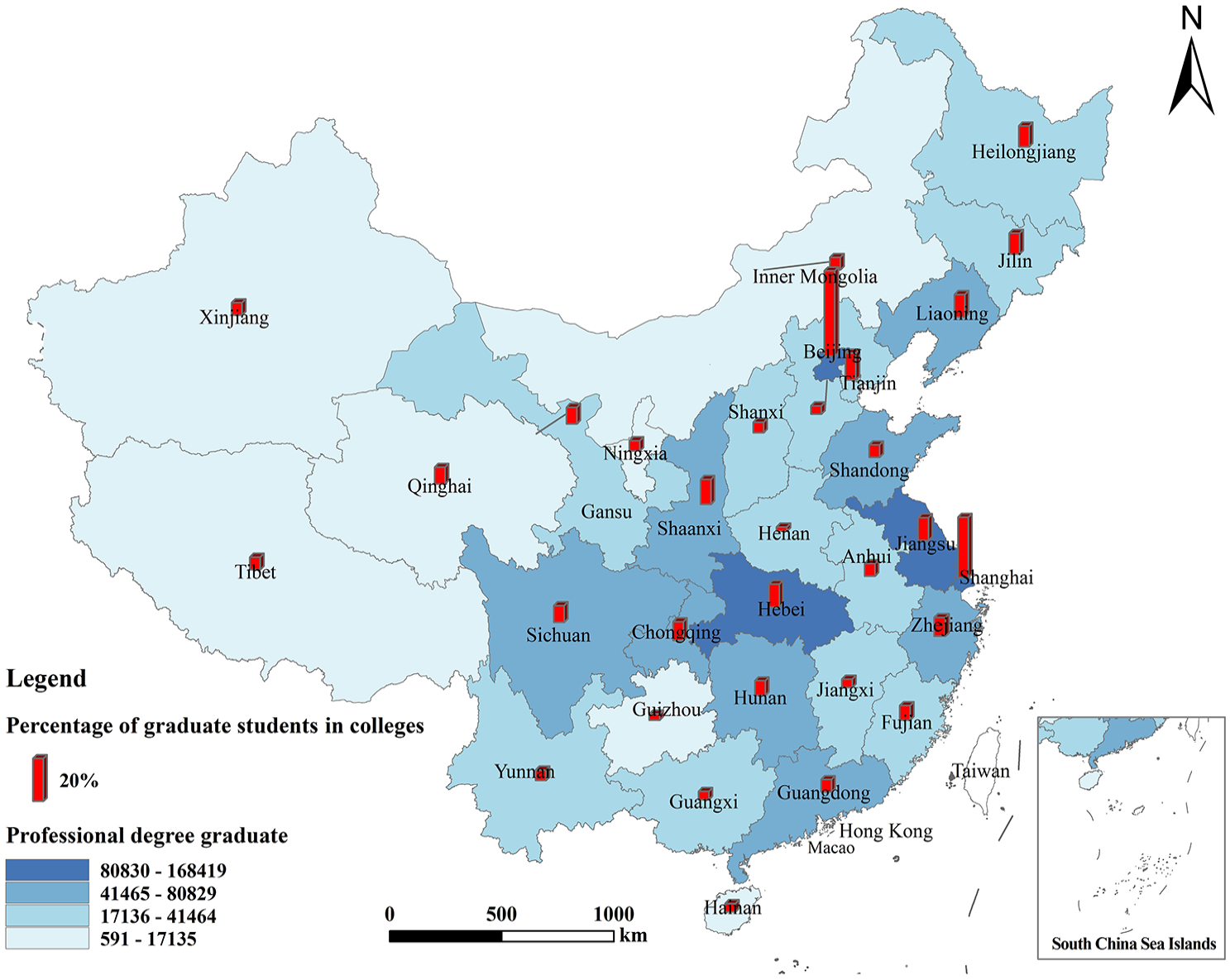
Spatial distribution of the number of professional degree graduate students in mainland China in 2019.
Baseline Panel Regression Model
Figure 3 below presents a scatter plot between professional degree graduate expansion and innovative human capital, which shows that there is a positive association between professional degree graduate expansion and innovative human capital. The level of innovative human capital accumulation is relatively higher in regions with more rapid professional degree graduate expansion. However, we cannot tell whether it is disturbed by external factors such as population size and economic development, so later we will control for the corresponding variables and conduct robustness tests to analyze the net effect of professional degree graduate student expansion on the growth of regional innovative human capital.

Scatterplot of the number of professional degree graduate students and innovative human capital.
To ensure the stability and suitability of the panel data for analysis, a panel unit root test and a cointegration analysis were conducted. The LLC test results indicate that the null hypothesis of “presence of unit root” was rejected for all variables at a 1% significance level (p < .01), confirming the general stationarity of the data. Further, the null hypothesis of “no cointegration” was rejected at a 0.1% significance level (p < .001), validating the existence of a long-term equilibrium among the variables, thus justifying the application of panel regression models for subsequent analysis. In simple terms, this indicates that the data does not show significant long-term trends and is stable enough for further analysis.
The decision between using the random effects model or the fixed effects model was guided by the Hausman test. The random effects model assumes that differences across entities (such as provinces) are random, while the fixed effects model assumes these differences are constant and need to be controlled. As shown in Table 2, The Hausman test results showed no statistically significant difference between the coefficient estimates of the two models, which suggests that the random effects model is generally more efficient. However, because the test result (prob > chi2) rejected the null hypothesis at the p < .01 level, it indicates that the fixed effects model should be chosen instead. In other words, while the random effects model is more efficient theoretically, the characteristics of our data suggest that the fixed effects model better captures the relationships between the variables. Therefore, we use the fixed effects model for further analysis.
Hausman Test Results of Fixed Effect.
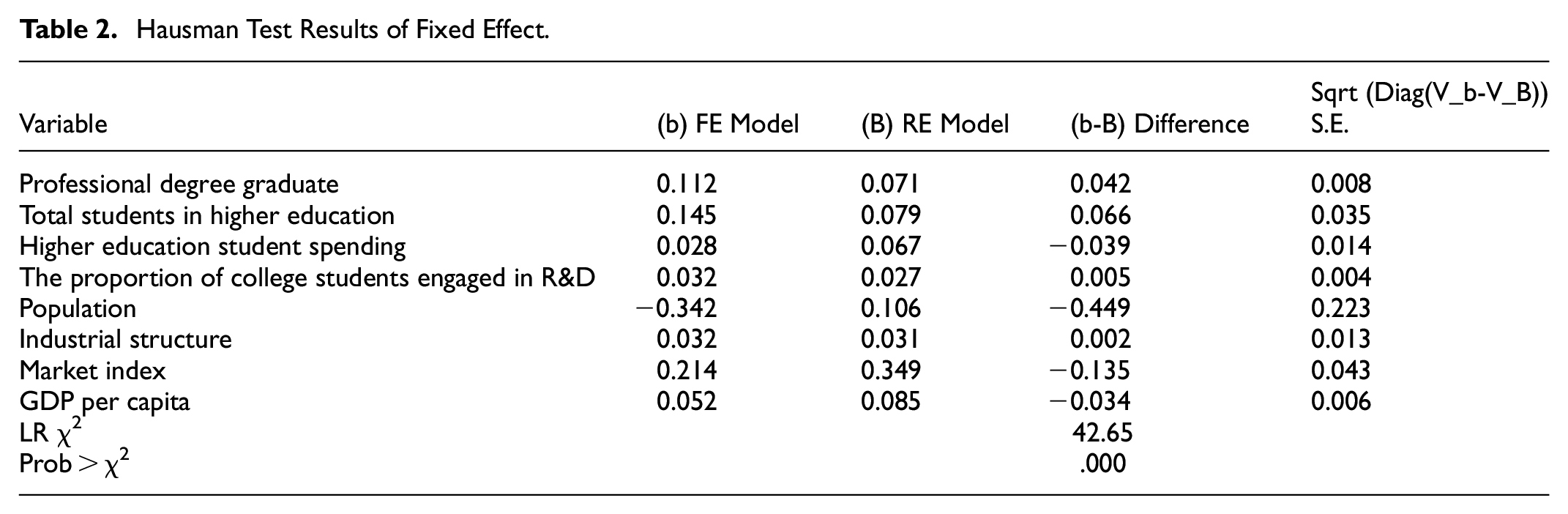
The results of the panel regression are presented in Table 3. The findings demonstrate that the expansion of professional degree graduate programs has a significant positive impact on regional innovative human capital (p < .01), with an elasticity coefficient of 0.112. This suggests that a 1% increase in the number of professional degree graduates leads to a 0.112% rise in innovative human capital within the region. Additionally, control variables such as total higher education enrollment, GDP per capita, and marketability index exhibit a positive correlation with the growth of regional innovative human capital. These outcomes confirm that expanding professional degree education contributes to enhancing innovative capacity, thus supporting the initial hypothesis.
Fixed-Effects Model of the Impact of Professional Master’s Expansion on Human Capital in Science and Technology.

Robustness Tests
The study employs the GMM (Generalized Method of Moments) and IV (Instrumental Variables) models to ensure the robustness of the results, which means that these methods help check if the findings are reliable under different statistical approaches. The GMM model is particularly useful for handling potential biases that can arise from unobserved factors and ensures that the relationships between the variables are accurately estimated. The results of the GMM dynamic panel model are presented in Table 4. One key test within this model is the Ar(2) test, which checks for second-order autocorrelation—essentially, whether the errors in the model are correlated across time. The test results showed that there is no second-order autocorrelation in the error terms, meaning that the errors do not systematically affect each other over time, supporting the assumption that the model’s errors are random and independent.
GMM Model of the Impact of Professional Master’s Expansion on Innovative Human Capital.

The Sargan test is another important check used to determine whether the instrumental variables are valid. Instrumental variables are used to address potential issues of endogeneity, where some variables in the model may be influenced by factors not included in the analysis. The Sargan statistic confirmed that the instrumental variables were appropriately chosen, as it did not reject the hypothesis that these variables are valid and relevant. This indicates that the model does not suffer from over-identification, meaning that the number of instrumental variables is appropriate, and the model is not overly complex. Moreover, the estimated coefficients in the GMM dynamic panel model remained stable, showing both consistency in direction and statistical significance. For example, the coefficient estimate (β = .115, p < .01) suggests a positive relationship between the variables being studied, and this result is statistically significant, meaning that we can be confident that this relationship is not due to random chance.
Table 5 presents the results from the two-stage least squares (2SLS) instrumental variables regression. This method is used to handle situations where the main variables might be influenced by other unobserved factors, which could lead to biased results in a regular regression. The 2SLS approach uses instruments—variables that are correlated with the explanatory variable but not directly related to the outcome variable—to improve the accuracy of the model. First, the diagnostic indicators are presented to verify the validity of the model. The Anderson LM test, with a value of 9.262 (p < .01), shows that the model passes the test for identifiability. This means that the instrumental variables are strong enough to explain the variation in the explanatory variables. The F-value from the first stage of the regression is 14.56 (p < .05), which confirms that the instrumental variables are valid, passing the test for weak instruments. In simpler terms, this indicates that the chosen instruments are appropriate and strong enough to be used in the model. Next, the Sargan test value is 1.674 (p > .1), which indicates that the over-identification test has been passed. This means that there are no issues with having too many instrumental variables, and the instruments are not correlated with the error terms, further ensuring the reliability of the model. Finally, the parameter estimate for the instrumental variable is 0.127 (p < .01), indicating a positive and statistically significant relationship. This result is consistent with the previous estimates, meaning that the results remain stable across different models. In conclusion, the findings from both the GMM and IV methods confirm that the model is robust and the estimates are reliable.
IV Model of the Impact of Professional Master’s Expansion on Innovative Human Capital.

Note.* p < .05, ** p < .01.
Quantile Heterogeneity Test
To explore the variability in the effect of graduate program expansion on innovative human capital, a conditional quantile regression model was employed, using bootstrap sampling 1,000 times to estimate coefficients across nine quantile points ranging from 0.1 to 0.9. The resulting trend graph (see Figure 4) illustrates the differential impacts of expansion on regions with varying levels of innovative human capital. In the standard quantile regression framework, professional degree expansion shows a consistently positive effect across all regions, signifying a general enhancement of innovative human capital regardless of the initial levels.
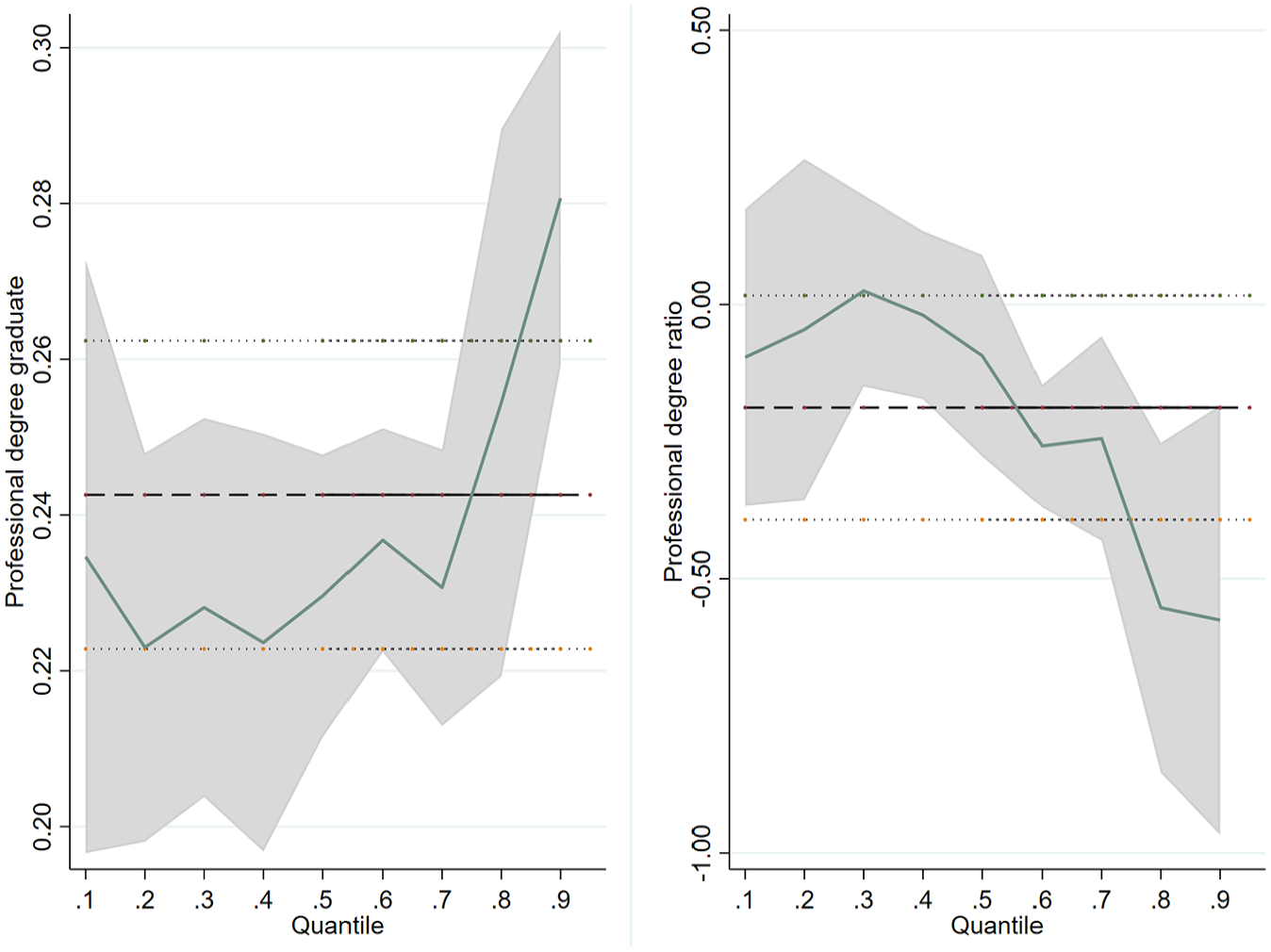
Conditional quantile regression.
The marginal benefit of professional degree graduate student expansion on innovative human capital is satisfying the increasing trend, that is, the effect on innovative human capital increases with the increase of regional innovation level quantile, reaching the highest peak value at the 0.9 quantile. This result also indicates that the more the region boosts the size of professional degree graduate students, the better there is a cumulative effect of the region’s advantage. However, the proportion of professional degree graduate students and the innovative human capital in different quartiles are inverted U-shaped relationships so the proportion of professional degree graduate students to the overall graduate students is not the higher the better. A certain number of academic degree graduate students need to be guaranteed in regions with high innovative human capital. Therefore, hypothesis 2 is supported.
The Threshold Effect of Human Capital Agglomeration
A panel threshold regression analysis was conducted to examine whether a threshold effect exists between human capital and the promotion of innovative human capital through the expansion of professional degree graduates. Figure 5 below illustrates the LR test plot within the threshold confidence interval, where the horizontal dashed line represents the 95% confidence level. The curve corresponds to the search points for each threshold value. The results indicate a significant salient value for the industrial structure, with the single-threshold model passing the test at the 5% significance level. This suggests a single threshold effect of human capital agglomeration, with a threshold value of 300.

Threshold regression LR test plot.
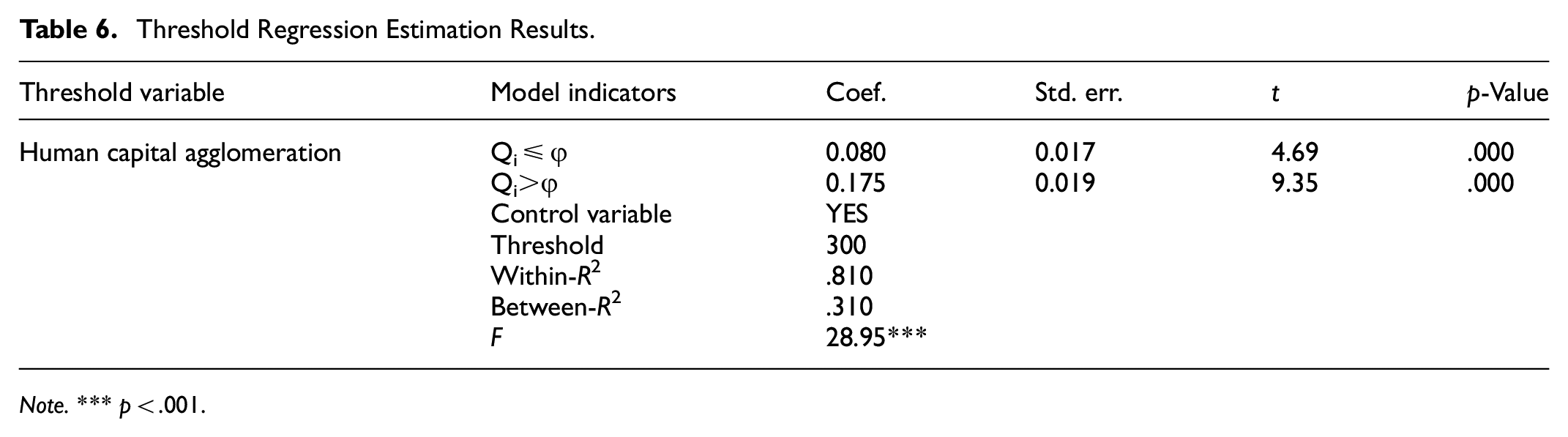
The results of the single-threshold regression estimation for human capital agglomeration are shown in Table 6. In this analysis, human capital agglomeration, which refers to the concentration of educated and skilled individuals in a specific area, is used as a threshold variable. This means we are investigating whether the impact of professional degree graduate expansion on innovative human capital (the ability of a region to innovate) changes depending on how concentrated the human capital is.
Threshold Regression Estimation Results.
Note.***p < .001.
When the human capital agglomeration index is below 300, meaning there is a lower concentration of skilled people in the region, the effect of expanding professional degree graduate programs on innovative human capital is still positive and significant (β = .080, p < .01). This suggests that even in regions with fewer skilled people, increasing the number of professional degree graduates contributes to enhancing innovation. However, when the human capital agglomeration index exceeds 300, meaning that there is a higher concentration of skilled people in the area, the effect becomes much stronger. The coefficient rises to 0.175, and it passes the significance test at the 1% level (p < .01). This indicates that in regions with a more concentrated population of skilled individuals, the benefit of expanding professional degree graduates on innovation is much greater. In other words, the higher the concentration of skilled people in a region, the more effectively professional degree graduates can contribute to boosting innovation.
This demonstrates the existence of a threshold effect for human capital accumulation. Essentially, human capital needs to reach a certain level of concentration for the expansion of professional degree graduates to have the most significant positive impact on innovation. Looking at the data from 31 Chinese provinces and cities in 2021, half of the regions had a human capital agglomeration index below 300. This suggests that in many regions, the current concentration of skilled individuals is not high enough to fully leverage the potential benefits of expanding professional degree graduate programs to enhance innovation. Therefore, hypothesis 3, which proposes a threshold effect, is supported by the data.
Conclusion and Discussion
The study found that the massive expansion of professional degree graduate students began in 2010 in mainland China. From 2010 to 2019, the number of professional degree graduate students enrolled in mainland China rose from 150,000 to 470,000, occupying the proportion of graduate students from 24% to 58%. Professional degree graduate students are severely differentiated at the spatial level, with economically developed regions such as Beijing, Shanghai, Tianjin, and Zhejiang. Meanwhile, the panel model analysis found that the expansion of professional degree graduate students has a positive and significant effect on innovative human capital. For every 1% increase in the level of professional degree graduate expansion, regional innovative human capital can increase by 0.112%. In addition, the heterogeneity test found that the marginal benefits of professional degree postgraduate expansion on innovative human capital are satisfying the increasing trend. The marginal benefits of professional degree expansion are higher in regions with higher innovative human capital instead. The threshold effect of human capital agglomeration exists for professional degree students and human capital agglomeration can promote innovative human capital more effectively.
Expansion of Professional Master’s Programs and Regional Innovation Human Capital
Our study finds that the expansion of professional master’s programs in China significantly promotes the accumulation of regional innovation human capital, consistent with previous research (Li et al., 2013; Adejumo et al., 2021). The human capital formed by professional master’s education can be quickly and efficiently invested in various industries, impacting national innovation capacity through technological and industrial innovation subsystems (Hu, 2021). Some studies have also shown that the expansion of higher education in China has greatly promoted the accumulation of regional innovation human capital (Feng et al., 2022). In fact, for developing countries like China, the most critical aspect of developing national innovation is cultivating high-level innovative talent. To increase the supply of innovation human capital, China implemented a graduate enrollment expansion policy in 2009, which has significantly promoted innovation activities in high-tech enterprises and increased the number of R&D personnel (Yang et al., 2023).
At the same time, differences in the geospatial distribution of professional degree students can lead to differences in the level of innovative human capital accumulation in different regions of China. This echoes the studies of Fraumeni et al. (2019) and Mendoza et al. (2022) that regional differences in the accumulation of innovative human capital are evident across regions with different levels of current economic development in China, including the east, northeast, central, and west, and that regional differences in the expansion of graduate education is important factor.
Heterogeneity in Regions With Different Levels of Innovative Human Capital
Based on the results of quantile regression, it is found that the expansion of professional degree graduate programs yields higher returns in regions with higher levels of innovative human capital. This indicates that in these regions, where the accumulation of innovative human capital is relatively high, the increase in professional degree graduates is more likely to be converted into innovative outcomes.
On one hand, there is a marked uneven distribution of innovative human capital in China, with economically developed regions often accumulating more innovative human capital, which inherently exhibits increasing marginal returns (Xu & Li, 2020). On the other hand, regions with high levels of innovative human capital tend to share certain common characteristics. These regions may possess more developed innovation ecosystems, including prestigious universities and research institutions, ample research funding, strong corporate innovation capabilities, and favorable policy environments (Baycan et al., 2017; Felsenstein, 2011). These features enable these regions to fully capitalize on the benefits brought by the expansion of professional degree graduate programs.
Professional degree graduates also play a unique role in innovative human capital. They typically possess stronger practical abilities and professional skills, allowing them to directly engage in corporate innovation activities (Robinson et al., 2016). In high-return regions, these talents can better align with the innovation needs of enterprises, rapidly converting into innovative productivity, thereby generating higher economic returns
Human Capital Agglomeration Effect
Our research also reveals a threshold effect of human capital agglomeration on the impact of professional master’s program expansion on innovative human capital. This agglomeration can enhance the added value effect of the expansion. The growth pole theory provides an explanation, suggesting that economic growth typically radiates from one or several “growth centers” to other sectors or regions. Given resource scarcity, specific geographic areas should be chosen as growth poles to drive economic development (Dobrescu & Dobre, 2014). The “polarization effect” also leads to regional “human capital agglomeration,” where the migration and flow of human capital should not be artificially restricted. There should be no thresholds set for human capital movement; instead, natural flow should be respected, driven by a cost-benefit analysis. Industries within regions with higher productivity, higher labor returns, and significant demand for high-level human capital (S. N. Fongwa & Wangenge-Ouma, 2015; Rauch, 1993) can offer substantial benefits to human capital, thereby attracting highly skilled professionals and forming human capital agglomerations. This phenomenon amplifies the human capital accumulation and agglomeration effect within a region, leveraging the growth pole’s influence.
In China, innovative human capital tends to concentrate in economically developed regions (Eastern regions) due to their advanced levels of digital, physical, and platform economies. These regions continuously create formal employment opportunities and generate numerous high-tech, well-paying innovation jobs. The industrial agglomeration in these areas further enhances the benefits of human capital agglomeration (Fleisher et al., 2010; Xu & Li, 2020).
Implications and Limitations
The research outcomes present valuable insights for developing nations seeking to enhance their innovative human capital through educational reforms. The findings emphasize the necessity for a strategic expansion of professional degree programs and a balanced restructuring of university enrollment patterns to promote equitable regional development. Currently, the uneven distribution of professional degree programs across Chinese regions, with economically backward areas experiencing minimal growth compared to developed regions, highlights a pattern that likely resonates with other developing economies, such as those in Southeast Asia, Latin America, and Africa (N. S. Fongwa & Marais, 2016; Harloe & Perry, 2004).
This study suggests that a more optimal spatial distribution of professional degree programs, along with the strategic establishment of new higher education institutions, can play a crucial role in reducing regional disparities in human capital development. Additionally, policies should focus on strengthening professional education in less developed regions to prevent a concentration of high-level human capital solely in urban centers. For regions with lower levels of innovative human capital, the expansion of professional degree education could serve as a lever to uplift regional innovation capacities and drive economic growth.
The implications of this research extend beyond China, offering globally applicable recommendations for developing countries seeking to bridge regional innovation gaps. By focusing on applied and practice-oriented graduate programs, countries can align the expansion of higher education with the specific needs of local industries, thus enhancing the adaptability and utility of human capital in the context of emerging technologies and industries. This approach not only contributes to sustainable economic growth but also addresses the broader issue of talent imbalance across regions. Policymakers in other developing nations can draw lessons from these findings to design educational policies that support human capital development and optimize talent distribution. In particular, efforts should be made to integrate professional degree education into national innovation strategies to cultivate a workforce equipped to meet the demands of a rapidly evolving global economy.
Our study has several limitations. First, our sample is restricted to mainland China. The expansion of graduate education in China began significantly in 2009, while many developed countries may have completed this expansion process before the 21st century. Therefore, our research primarily focuses on the benefits of graduate education expansion on the accumulation of innovative human capital in developing countries, which may limit its generalizability to other countries. Future research could compare the effects across different countries to further validate and extend our conclusions. Second, our study concentrates on the relationship between the expansion of professional degree graduate programs and innovative human capital. Although our findings indicate a positive correlation between the two, this relationship may be influenced by other factors such as the quality of education, policy environment, and level of economic development. Future research should consider additional variables to gain a more comprehensive understanding of the impact of professional degree graduate expansion on innovative human capital. Another limitation of this study is that the data collection period is limited to 2010 to 2019. Due to delays in the release of public data, we were unable to obtain more recent data. It is possible that the scale of professional degree graduate expansion or reforms in the education system have undergone further changes since 2019. Future research could incorporate data from 2019 onward to gain a more comprehensive understanding of the long-term impact of the expansion of professional degree graduate programs. Overall, while our study provides valuable insights, further research is needed to validate and refine these conclusions and to explore other factors that may influence the accumulation of innovative human capital.
Footnotes

Ethical Considerations
We do not involve animal and human research, therefore it is not applicable.
Author Contributions/CRediT
All authors listed have significantly contributed to the investigation, development and writing of this article.
Funding
The author(s) disclosed receipt of the following financial support for the research, authorship, and/or publication of this article: National Social Science Fund of China “Research on the Mechanism of Participation of Top Universities in the Construction of World Important Talent Centers and Innovation Highlands” (23CGL060).
Declaration of Conflicting Interests
The author(s) declared no potential conflicts of interest with respect to the research, authorship, and/or publication of this article.
Data Availability
Data from this qualitative study may be shared upon request to the authors.