




Abstract
As a critical driver of transitioning towards a green economy, human capital mainly includes educational human capital and health human capital. The direct conditional pathways and indirect mediating mechanisms by which human capital impacts green total factor productivity (GTFP) have not been adequately addressed through empirical research. This study constructs a nuanced indicator of human capital, amalgamating the dimensions of educational and health human capital, to provide a rigorous examination of the influence and underlying mechanisms through which human capital impels GTFP. The empirical findings elucidate that human capital serves as a catalyst for enhancing GTFP, with green technology innovation and labor force enhancement functioning as the pivotal channels. Furthermore, the burgeoning digital economy is revealed to amplify the beneficial impacts of green technology innovation. Nonetheless, the efficacy of human capital in propelling GTFP is contingent upon certain conditions; notably, the presence of a critical threshold related to industrial structure upgrading, financial development, and GDP per capita emerges as pivotal. The study also uncovers a heterogeneous effect contingent upon natural resource endowments and the distribution of educational resources, a variance primarily ascribed to the disparate effects of health human capital.
Keywords
Introduction
Climate change, water scarcity, land degradation, and biodiversity loss pose severe threats to human society and economic development (Gasper et al., 2011; Hanjra & Qureshi, 2010; J. A. Wang et al., 2022). These issues not only affect the well-being of the current generation but also have the potential to exert irreversible impacts on future generations. As the population grows, urbanization accelerates, and consumption levels rise, the global demand for natural resources such as energy, minerals, and water, continues to increase. However, the limited availability of resources leads to their depletion, price volatility, and supply instability when over-exploited (Xiong et al., 2023). Against this backdrop, enhancing resource utilization efficiency and developing a green economy have become crucial for achieving sustainable development (Mentes, 2024). Since the 1980s, the concept of sustainable development has gradually gained international consensus (Mebratu, 1998). Governments, enterprises, and various social sectors worldwide have incorporated sustainable development goals into their strategic plans, striving to achieve harmonious economic growth, social progress, and environmental protection. To realize sustainable development, academia and governments have begun to focus on the proposal and development of green economy. Green economy emphasizes the simultaneous improvement of economic benefits and reduction of environmental pollution and resource consumption, highlighting the coordinated development of economy, society, and environment (Loiseau et al., 2016; Y. Zhu et al., 2020). Green total factor productivity (GTFP), as an essential indicator for measuring the level of green economic growth, has become a research hotspot.
The formulation and advancement of GTFP represents an expansion of the conventional total factor productivity (TFP) concept. TFP captures the incremental output attributable to factors beyond capital and labor inputs in the production process (Nadiri, 1970). By integrating environmental factors into the TFP framework, GTFP provides a more nuanced measure of economic growth, encapsulating the dual objectives of enhancing resource utilization efficiency, and mitigating environmental degradation (Chen et al., 2021). The adoption of GTFP as a research metric enables a more thorough examination of the quality and efficacy of economic growth, thereby informing policy decisions that promote sustainable development (H. Yang et al., 2022; Feng et al., 2024). The motivation behind this research lies in the need to explore the relationship between human capital and GTFP. Human capital, comprising individual attributes such as knowledge, skills, and health, plays a paramount role in driving green economic growth. By enhancing human capital, firms can accelerate technological innovation, optimize resource allocation, and reduce environmental externalities, ultimately influencing GTFP. A deeper understanding of the impact of human capital on GTFP is essential for unveiling the micro-foundations of green economic growth. Human capital influences GTFP by affecting various dimensions, including technological innovation, production organization, and management practices. Uncovering the underlying mechanisms can inform policy decisions that promote the synergistic development of human capital and green economy.
Human capital, a pivotal driver of economic growth and green transformation, plays a significant role in green total factor productivity (GTFP). Traditional conceptualizations of human capital, as proposed by Schultz (1961) and Becker (1962), encompass educational and health human capital. Educational human capital fosters environmentally conscious and innovative talent, which is essential for the development and application of green technologies. On the other hand, health human capital enhances labor productivity, reduces energy consumption, and mitigates environmental pollution during production (Bloom et al., 2019).
Despite the established importance of human capital, the literature on its relationship with the green economy has predominantly used educational human capital as a proxy for overall human capital (K. Wang et al., 2023; Rehman et al., 2023). This narrow focus not only undermines the comprehensive nature of human capital but may also lead to biased assessments of its impact on green economic development. Therefore, it is imperative to integrate health human capital into the evaluation of human capital’s influence on GTFP. Cheng et al. (2022) introduced educational human capital and health human capital as input indicators contributing to GTFP, rather than constructing a broad concept of human capital. Wang et al. (2024) categorized human capital into educational and health components, serving as moderating variables in the influence of urbanization on GTFP. Wang and Wang (2024) considered the threshold effect of industrial structure upgrading on the impact of human capital on GTFP, but overlooked the potential threshold effects of financial development and GDP per capita. Li and Deng (2023) further accounted for the moderating role of natural resource endowment, yet failed to consider the mediating transmission of green technological innovation and labor force upgrading, as well as the potential moderating role of the digital economy. Moreover, both Wang and Wang (2024) and Li and Deng (2023) narrowly defined human capital as solely educational human capital. Previous studies have not thoroughly examined the pathways or mechanisms through which human capital influences GTFP. Furthermore, the heterogeneity of educational and health human capital under different educational provisions and natural resource endowments remains unaddressed.
This paper offers several marginal contributions to the existing literature: (1) It develops a comprehensive human capital indicator that includes both educational and health human capital, addressing the limitation of previous research that predominantly focused on educational human capital while overlooking the intrinsic value of health human capital. (2) The study investigates both the direct and indirect impacts of human capital on GTFP. It explores the roles of industrial structure upgrading, financial development, GDP per capita, green technological innovation, and labor force upgrading in the influencing mechanism. (3) The paper extends the findings on green technological innovation by uncovering that digital economic development can amplify the role of green technological innovation in the mechanism affecting GTFP. (4) By differentiating between educational and health human capital in the heterogeneity analysis, this study provides insights into the underlying reasons for the observed heterogeneity in the effects on GTFP under varying conditions of educational provisions and natural resource endowments.
Theoretical Analysis and Mechanism Elaboration
Concomitant with the green economy transition, the intrinsic role of human capital in economic growth remains pertinent in the context of green economic growth. As a crucial input factor in the production process, human capital can enhance energy efficiency (L. Yang et al., 2017), facilitate the adoption of new pollution-free methods and technologies (Lan et al., 2012), and reduce environmental costs (Manderson & Kneller, 2012), thereby mitigating carbon dioxide emissions. By investing in and developing human capital, the quality of the workforce can be improved, leading to enhanced recognition and adoption of environmentally friendly technologies, promotion of renewable energy transition (Wiredu et al., 2023), and reduction of carbon dioxide emissions (L.-N. Hao et al., 2021). Educational human capital can enhance the efficiency of laborers in utilizing production resources, including the adoption of more environmentally friendly technologies and processes, and foster technological innovation and knowledge dissemination, all of which are crucial factors in increasing GTFP (M. Wang et al., 2021). Moreover, health human capital serves as a guarantee for improving green production efficiency (Zheng & Chen, 2023). Healthy individuals can better execute green production and sustainable development activities, enhance resource utilization efficiency, and reduce environmental pollution (Holland, 2017; Wan & Tian, 2022). Based on the above analysis, the following hypothesis is proposed:
The upgrading of industrial structure will trigger structural changes in the economy, reducing pollution from pollution-intensive production sectors and increasing production in sectors with lower pollution intensity and green production (Pasche, 2002). Against the backdrop of green development, industries must undergo a low-carbon transformation to achieve green development, necessitating structural upgrading toward high-end, intelligent, and green development. Industrial structure upgrading refers to the gradual shift of the industrial structure from labor-intensive industries to capital-intensive or knowledge-intensive industries (W. Peng et al., 2023). It can be regarded as a signal manifestation of economic transformation and determine the quality of environmental protection, implying the ceaseless replacement from traditional industries to emerging ones, the continuous optimization of resource and factor allocation, and the sustained improvement of green production efficiency, which lead to more effective human capital resource putting into the development and transformation of green economic (Lin & Chen, 2018; Zhang & Zhang, 2023; Q. Zhu, 2023). As the level of industrial structure upgrading increases, human capital will be utilized more fully in the structural changes. When the level of industrial structure upgrading reaches a certain threshold, the green effect of human capital on improving green productivity will become more pronounced (W. Peng et al., 2023; Q. Zhu, 2023).
Financial development refers to the continuous optimization, expansion, and deepening of the overall functions of financial markets, financial instruments, financial institutions, and the financial system. The potent role of financial development lies in facilitating the aggregation of capital for economic development, thereby enabling the realization of scale economies (Ngo et al., 2022; Zhou et al., 2019). Financial development can be seen as a catalyst that enables the effective utilization of human capital in promoting GTFP (Sarwar et al., 2021). In economies with underdeveloped financial systems, the impact of human capital on GTFP may be limited or even negative, because of limited access to credit, inefficient allocation of resources, and higher transaction costs (Ahmad et al., 2022; Ngo et al., 2022; Zhou et al., 2019). However, once a certain threshold of financial development is reached, financial development can provide much access to credit, enabling individuals and firms to invest human capital and green technologies, make resource allocation more efficient, leading to a better allocation of resources and increased productivity of human capital, meanwhile reduce transaction costs for enterprises, making it easier for firms to adopt green technologies and invest in human capital (Cheng et al., 2021; Léon & Weill, 2018; Xu & Tan, 2020). Furthermore, financial development also contributes to environmental protection by providing a comprehensive financial system that supports the government’s environmental conservation plans (Ayayi & Wijesiri, 2022), improves environmental industrial technology, and reduces carbon dioxide emissions (Khan et al., 2022). The higher the level of financial development, the more capable production departments are in allocating resources, thereby more rapidly and effectively promoting green economic growth (Jiakui et al., 2023). This implies that a higher level of financial development enables more effective allocation of human resources, strengthening the impact of human capital on GTFP.
Environmental pollution exhibits regional economic structural differences. With its vast territory, China’s regional economic development levels vary significantly, resulting in substantial disparities in air quality (Song et al., 2020). There exists a nonlinear relationship between GDP per capita and carbon dioxide emissions (Q. Wang & Li, 2021). The accumulation of human capital through education also differs across regions with varying GDP per capita levels. Moreover, mortality rates are correlated with GDP per capita, exhibiting significant differences across regions (Zaki et al., 2023), indicating that health human capital levels also vary with GDP per capita levels. As income levels rise, the demand for green technologies increases, accelerating the development and application of advanced, innovative, and clean technologies, thereby enhancing the green technology effect, driving industrial green transformation, and further accentuating the positive impact of human capital on GTFP. Hence, the direct impact of human capital on GTFP may exhibit non-linearity due to the influence of industrial structure upgrading, financial development, and GDP per capita. Based on the above analysis, the following hypothesis is proposed:
Technology plays a crucial role in both productivity and green productivity. The innovation and application of green technology not only enhance production efficiency, reduce energy consumption, and decrease pollutant and carbon dioxide emissions, but also provide technical support for green consumption (C. Li et al., 2023; Y. Peng et al., 2024; Zeng et al., 2024). Meanwhile, the demand for green consumption drives the supply of green products, prompting production departments to innovate green technology. The impact of green technology innovation on GTFP has been empirically confirmed (Wu et al., 2022; Zhao et al., 2022). As individuals acquire knowledge and professional skills related to green development, they become significant green human capital for green technological innovation. When participating in green technology research activities, these individuals equipped with green skills can play a vital role in the development of green products, green processes, and more. Employers who hire such staff can also gain a competitive edge in an increasingly competitive market (Ni et al., 2023). Investment in human capital creates conditions for green consumption and green production, and provides intellectual and physical support for the application of green technology in green consumption and production cycles. Therefore, human capital may influence GTFP through green technological innovation.
Another pathway for human capital to affect GTFP is through labor force upgrading. The influence of human capital on green economic development frequently manifests through the labor force. The alterations in the structure of the labor force imply changes in the proportion of high-skilled to low-skilled talents within labor-force group. Green technology innovation primarily relies on high-skilled talents, requiring their high-intensity intellectual and physical output. To achieve low-carbon transformation, reduce carbon emissions, and enhance green innovation, production departments will upgrade their labor force structure by hiring more high-skilled workers (Bu et al., 2022; Cao et al., 2023). The labor force upgrading can be defined as the proportion of high-skilled workers to low-skilled workers in the workforce (Z. Hao et al., 2023; Yu, 2025). Once more high-skilled workers are engaged in green production, they can contribute to the realization of the green effect of human capital accumulated by individual workers. Therefore, human capital may also exert an influence on GTFP through labor force upgrading.
The digital economy, carried by the modern internet, is continuously affecting the flow and allocation of factors. The digitalization of production factors in the digital economy will create a siphon effect for human capital, accelerating the flow and aggregation of high-level talents (Dai et al., 2022). At the same time, the digital economy not only enhances innovation vitality and talent reserves, driving green technology innovation (Luo et al., 2023; Pan et al., 2022), providing a human resource guarantee for green technology innovation, but also accelerates the upgrading of the labor force structure (Z. Hao et al., 2023; Yu, 2025). Hence, the digital economy may potentiate the mechanism through which human capital impacts GTFP, specifically via the channels of green technological innovation and labor force upgrading. This suggests that the digital economy likely serves a critical role in catalyzing and magnifying the conversion of human capital into enhanced GTFP.
Based on the above analysis, the following hypothesis is proposed:
In order to show the nexus between human capital and GTFP more intuitively, based on the above theoretical analysis, the following theoretical mechanism framework diagram is constructed (see Figure 1).

Theoretical framework.
Methodology
Research Design
To quantitatively examine whether human capital combined EHC and HHC can improve the GTFP, this paper designs the following baseline model:

Where i and t denote region and year, respectively. GTFP
it
is the explained variable. HC
it
is the human capital. control
it
is a collection of control variables. The term
In order to examine the nonlinear effect of human capital on green total factor productivity, this study constructs a threshold regression model, shown in Model (2). In Formula (2), the Adj it is sequentially substituted by the threshold variables, and I (·) is an indicator function valued 0 or 1.

In order to verify the mediating role of green technology innovation and labor force upgrading, and the moderating role of digital economy respectively, this paper establishes the following equations:



Variable Definition
Core Explanatory Variables
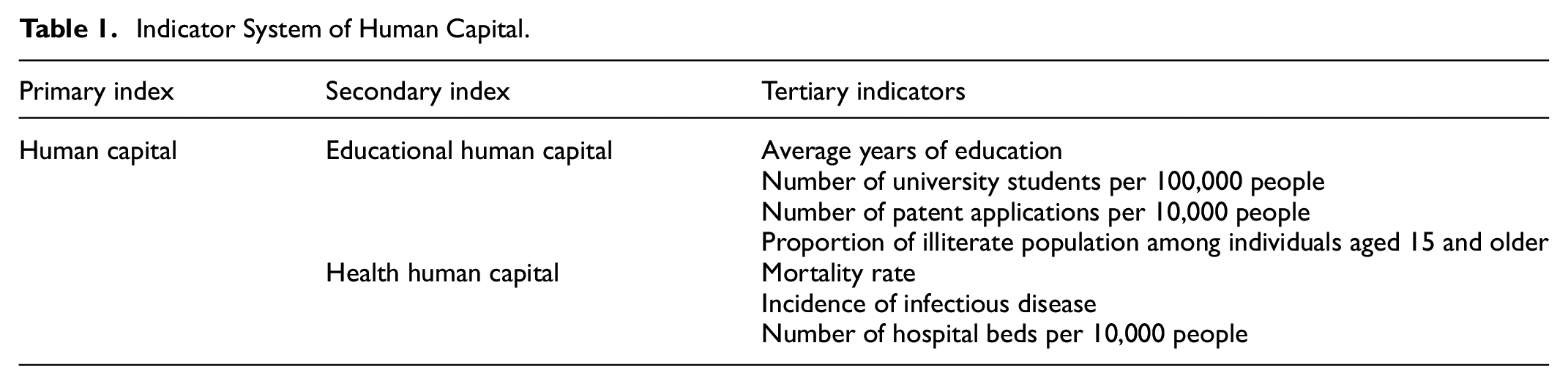
Building upon the framework established by Xuepeng & Jinxiang (2014), this study constructs a composite measure of human capital by integrating indicators of educational and health human capital. The core of educational human capital lies in the knowledge, skills, and innovative capabilities acquired by individuals through education. Patent applications involve the ability to translate theoretical knowledge into practical applications and can reflect the quality of educational human capital to a certain extent. Therefore, building upon the existing literature, this paper incorporates the number of patent applications per 10,000 individuals into the construction of indicators for educational human capital. These indicators are objectively weighted through the application of the entropy method, ensuring a data-driven approach to their relative importance. Since the average life expectancy indicator is calculated based on census data, which is only available every 10 years, following Zhikang and Jing (2020), this paper adopts three inverse indicators that have undergone dimensionless processing to construct the health human capital index using the entropy method. The synthesized health human capital indicator is a positive indicator. The specific indicator system is presented in Table 1.
Indicator System of Human Capital.
Explained Variable
The explained variable in this paper is the green total factor productivity (GTFP). Drawing on the research of Fan et al. (2024), this study employs the Global Malmquist-Luenberger (GML) index, grounded in the super-efficiency Slack-Based Measure (Super-SBM) model, to estimate GTFP (see Table 2).

Indicator System of GTFP.

In this formula,
Threshold Variables
This paper examines the effects of three threshold variables - industrial structure upgrading, financial development and per capita GDP – on the nonlinear influence of human capital on GTFP, respectively. Industrial structure upgrading (industr) is measured by the proportion of tertiary industry added value to the aggregate of secondary and tertiary industry added values. Financial development level (fd) is represented by the ratio of the sum of deposits and loans of banking financial institutions to regional GDP. GDP per capita (pgdp) is measured by the natural logarithm of per capita GDP.
Mediating Variables
This study incorporates two crucial mediating variables: green technological innovation and labor force upgrading. Following the approach of Wu et al. (2022), this paper employs the natural logarithm of the number of green patents licensing (gpl) and the natural logarithm of the number of green utility model patents licensing (gppl) as indicators of green technological innovation. The number of gpl and gppl is from green patent data, which is categorized using the classification method outlined in the China Green Patent Statistics Report (2014–2017) and are obtained through keyword searches on the patent search platform of the National Intellectual Property Administration. The other mediating variable is labor force upgrading (laborup), which is measured by the ratio of labor force with bachelor’s degree or higher education to those with junior college or lower education, representing the proportion of high-skilled labor to low-skilled labor in the workforce. This indicator is inspired by the research of Z. Hao et al.(2023) and Yu (2025). A higher value of this variable indicates a greater degree of labor force upgrading.
Moderating Variable
In this paper, the digital economy is employed as a moderating variable, a policy dummy variable based on the construction of the National Big Data Comprehensive Pilot Zone (NBDCPZ), where regions that have been approved to establish a NBDCPZ in a given year are assigned a value of 1, or 0 otherwise.
Control Variables
The control variables in this study include urbanization level (urban), opening-up level (fdi), green transportation (gtran), population density (pden), government expenditure (gov), and population aging (aging). Urbanization, while driving economic development, may also have negative impacts on GTFP, particularly in terms of resource consumption and environmental stress (Azam et al., 2022). Open development is likely to attract more foreign direct investment, but at the same time, it may lead to a “pollution refuge” effect due to lenient environmental regulations, exacerbating environmental pollution, and damaging GTFP (Chai et al., 2021). The government can implement environmental regulations and provide green incentives through expenditure policies, such as subsidizing eco-friendly technologies and levying pollution taxes. These measures can facilitate more efficient resource utilization and environmental protection, thereby affecting GTFP. However, the effectiveness of these measures is influenced by the structure and purpose of the expenditure. Green transportation promotes the enhancement of energy efficiency and the development of new technologies, such as electric vehicles and the optimization of public transit systems. The application of these technologies helps to reduce pollution emissions, thereby influencing GTFP. However, the effectiveness may be contingent on the level of investment in green transportation and the stage of its development. The population size of a region determines its population density, which, on one hand, affects the ecological environment, and on the other hand, promotes the accumulation of elements and fosters economic development in the region. Population aging has emerged as a demographic trend, with economically developed regions possibly finding it easier to attract young labor due to their aging populations (Jiang et al., 2023). Concurrently, this inexorable trend is likely to drive the advancement of green technology and boost the demand for green products. Specifically, urbanization level (urban) is measured by the urbanization rate; opening-up level (fdi) is represented by the ratio of foreign direct investment to regional GDP; green transportation (gtran) is measured by the number of public transportation vehicles per 10,000 people; population density (pden) is represented by the natural logarithm of the population density of each region; and government expenditure (gov) is captured by the ratio of regional fiscal expenditure to regional GDP; population aging (aging) is measured by the proportion of population aged 65 and older to total population.
Date Sources
The present research utilizes a comprehensive panel dataset encompassing 30 provincial administrative regions in China (excluding Taiwan, Tibet, Hong Kong and Macau) spanning the period from 2004 to 2020. The main data is derived from the China Statistical Yearbook, China Health and Family Planning Statistical Yearbook, China Financial Yearbook, China Regional Economic Statistical Yearbook, China Statistical Yearbook on Environment, and various regional statistical yearbooks. The descriptive statistics are reported in Table 3. The variance inflation factors (VIF) for the key core variables are all less than 5, indicating that the multicollinearity test is passed. The specific test results are presented in Table 4.
Descriptive Statistics.

Multicollinearity Test.

Empirical Results
Baseline Results
In Column (1) to (5) of Table 5, the empirical analysis reveals that, after controlling for region and year fixed effects, the human capital remains a significant positive impact on GTFP. After disaggregating human capital (HC) into two components, namely educational human capital (EHC) and health human capital (HHC), to delve deeper into the individual effects of each indicator dimension on GTFP, as displayed in columns (4) and (5) correspondingly, the findings reveal that EHC and HHC both exhibit positive influence on GTFP. Overall, whether the independent variable is educational human capital, health human capital, or the comprehensive human capital formed by integrating both, there is a significant positive impact on GTFP. Hypothesis 1 is confirmed.
Benchmark Regression Results.
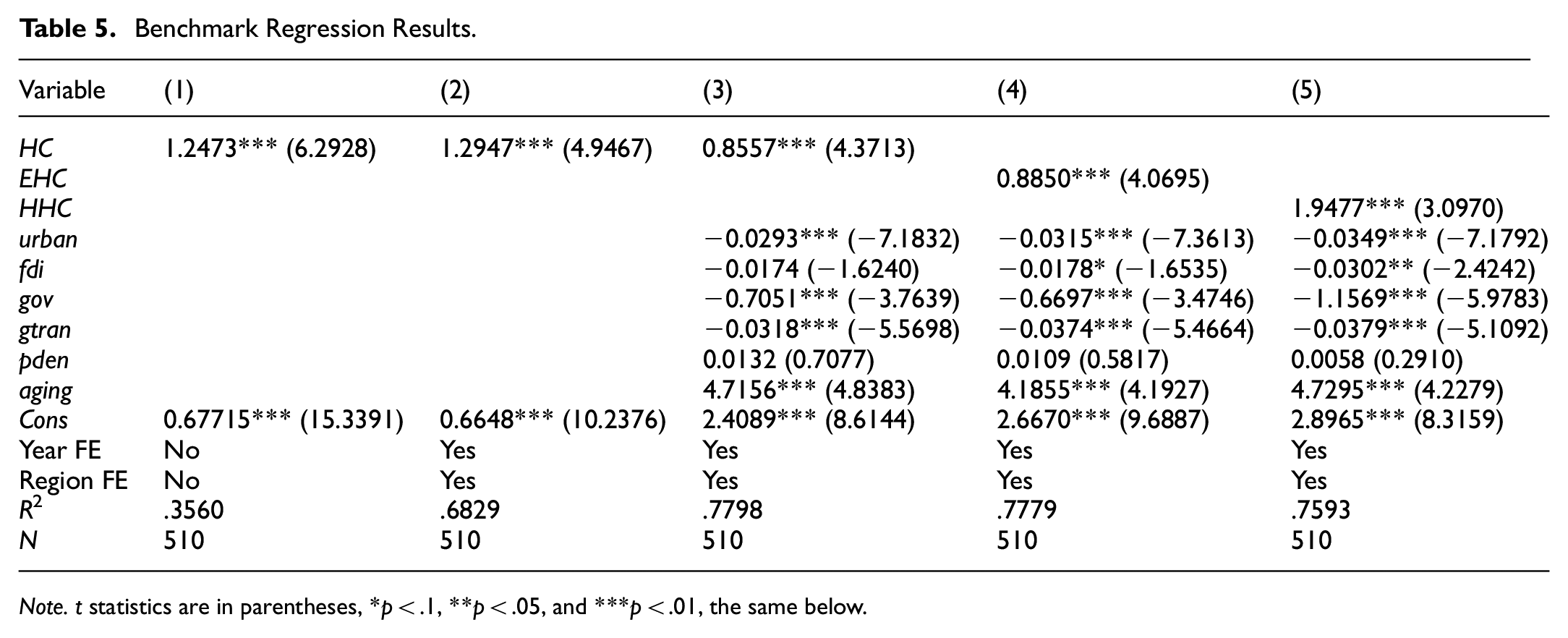
Note. t statistics are in parentheses, *p < .1, **p < .05, and ***p < .01, the same below.
As to the influences of control variables, the empirical analysis demonstrates that most control variables exhibit statistical significance. The estimated coefficient of urbanization (urban) is significantly negative, indicating that green productivity decreases with urbanization level (Fan et al., 2024). The variable of opening-up level (fdi) shows negative impact on GTFP. That may be due to lack of considering the nonlinear effect of opening up and other factors (Tan & Uprasen, 2022). The estimated coefficient of government expenditure (gov) and green transportation (gtran) are significantly negative, presumably related to the structure of fiscal expenditure and launch stage of green vehicles respectively. The variable of population aging (aging) shows a statistically significant positive relationship to GTFP. As population aging progresses, the development of a green consumption structure is changing, and the elderly have higher demands for environmental quality, thereby promoting the development of a green economy (Q. Wang et al., 2022).
Exclusion Test
Existing studies have demonstrated that the digital economy (bigdata), driven by the rapid development of internet and big data technologies, has a positive impact on GTFP, and the establishment of big data pilot zones can significantly enhance GTFP (Lyu et al., 2024). To exclude the influence of this policy, this policy dummy variable is included as a control variable in the benchmark regression model, and the regression results are presented in Table 6. The coefficient of digital economy is significantly positive. When controlling for the policy dummy variable, the estimated coefficients of composite human capital, EHC, and HHC on GTFP remain significantly positive, with minimal changes compared to the benchmark regression results, suggesting that increasing investments in human capital and its sub-indicator, educational human capital and health human capital, can help enhance GTFP, thereby indirectly validating the robustness of the benchmark model.
Exclusion Test Result.

p < .01.
Research also indicates that the low-carbon city pilot policy has a positive impact on GTFP (K.-L. Wang et al., 2022; Yuan et al., 2025). Therefore, based on the regression that incorporates the digital economy variable, a Difference-in-Differences (did) variable corresponding to the provincial level at the timing of the pilot policy implementation was constructed. The regression results show that the coefficients of the policy dummy variable are significantly positive, and the estimated coefficients for HC, EHC, and HHC remain significantly positive, which further enhances the robustness of the baseline regression.
Robustness Tests
To mitigate the potential reverse causality issue in the baseline model, this paper replaces the original explanatory variables with their first-order lagged terms. The results in Columns (1)-(3) of Table 7 show that the lagged terms of human capital, EHC, and HHC all have a significant positive impact on GTFP, consistent with the conclusions drawn from the previous discussion. However, the model may still suffer from endogeneity issues. To further alleviate the impact of endogeneity and validate the research findings, this study employs an instrumental variable (IV) estimation.
Robustness Text Results.

Note. The R2 in Column (5) is centered R2.
p < .01.
The State Council of China launched the “211 Project” in 1995, which aimed to construct around 100 key universities and a batch of key disciplines, having had a significant impact on China’s higher education and human capital accumulation. This study selects the number of universities constructed under the “211 Project” in each region as one component of the IV. The development of the internet has broken down the barriers to information flow across regions, enabling people to quickly and conveniently access knowledge and information from various fields, including economics, society, healthcare, and education, thereby greatly reducing the information acquisition barriers and the huge gap in human capital accumulation caused by regional differences in economic development.
As the economy continues to develop and society progresses, the impact of broadband access on GTFP becomes negligible. Therefore, this study constructs an interaction term as an IV by multiplying the number of universities constructed under the “211 Project” and the number of internet broadband access port in each region for 2SLS regression. Based on the above analysis, it can be seen that the interaction term satisfies the correlation and exclusivity of IV.
As shown in Table 7, from the first stage of regression results, the results in column (4) indicate that the correlation between main explanatory variable and IV is indeed significant positive. The result of the second stage in column (5) show that the Kleibergen-Paap rk LM statistic is significant at the 1% confidence level, and the Kleibergen-Paap rk Wald F statistic is far greater than the 10% critical value of Stock-Yogo, suggesting that the IV passes the overidentification test and the weak instrument test. The results in column (5) also indicate that human capital still exhibits a significant positive impact on GTFP after the addition of the IV, verifying the robustness of previous regression results.
Nonlinear Results
The impact of human capital on GTFP may exhibit a nonlinear relationship due to changes in certain economic conditions. This paper further explores the nonlinear relationship between human capital and GTFP by considering industrial structure upgrading (industr), financial development (fd), and GDP per capita (pgdp) as threshold variables.
Threshold existence test is conducted before the threshold model regression, and the test results, as shown in Table 8, show that industrial structure upgrading, financial development, and GDP per capita all pass the single-threshold test, confirming that the above three variables are all threshold variables for the nonlinear effect of human capital on GTFP. This suggests that the relationship between human capital and GTFP may vary depending on the level of industrial structure upgrading, financial development, and economic growth.
Threshold Model Test Results.

p < .05. ***p < .01.
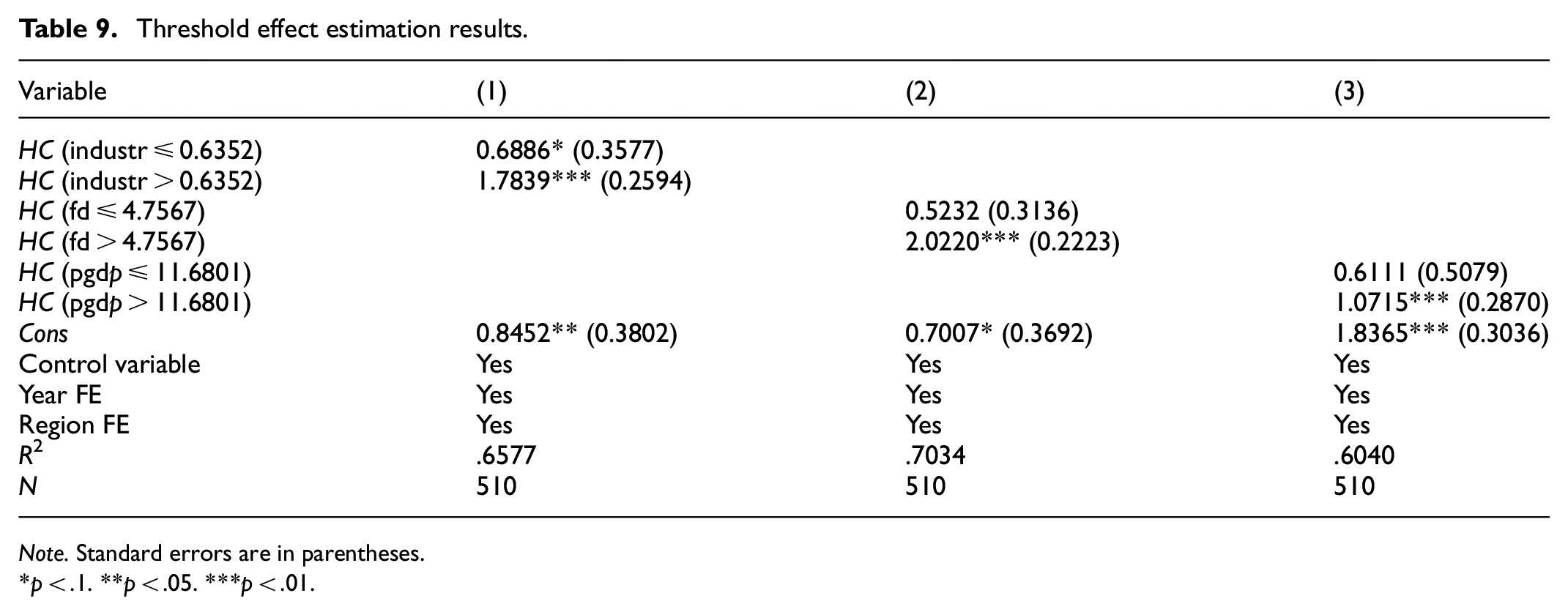
Table 9 reports the threshold effect estimation results of model (2). Results reveal that the impact of human capital on GTFP exhibits significant changes in significance and coefficient values before and after the threshold values of the three threshold variables. When the value of industrial structure upgrading is less than 0.6352, the impact of human capital on GTFP is less significant and positive, whereas when the value exceeds 0.6352, the impact becomes more significant and positive, with a larger coefficient value. As industrial structure upgrading deepens, the demand for green talents increases, and the green effect of human capital becomes more pronounced under the promotion and application of green technology. Hypothesis 2a is confirmed.
Threshold effect estimation results.
Note. Standard errors are in parentheses.
p < .1. **p < .05. ***p < .01.
When the financial development level is below 4.7567, the positive impact of human capital on GTFP is insignificant, but when it exceeds 4.7567, the impact becomes significant, with a larger coefficient value. Financial development enhances the funding capacity for industrial green development, alleviates the liquidity constraints, and thereby increases the impact of human capital investment on industrial green development. Hypothesis 2b is confirmed.
When GDP per capita is below 11.6801, the positive impact of human capital on GTFP is insignificant, but when it exceeds 11.6801, the impact becomes significant and positive, with a larger coefficient value. As GDP per capita continues to rise, people’s desire and demand for green development, green ecology, and green products increase, driving the adjustment and deepening of industrial green development, and promoting the enhancement of human capital’s green effect. Hypothesis 2c is confirmed.
Mechanism Test Results
To investigate the mediating mechanism of green technology innovation in the impact of human capital on GTFP, and considering the potential measurement differences in green technology innovation indicators, green patent licensing (gpl), and green practical patent licensing (gppl) are put into the model as the mediating variables respectively. As shown in Table 10, regardless of whether gpl or gppl are used to measure green technology innovation, human capital significantly promotes green technology innovation. However, the estimated coefficient of green technology innovation on GTFP is insignificantly positive. This may be related to the development stage of green technology application. With respect to the time frame of the sample data, the widespread adoption of green technology might have been hindered by the comparatively late formal proposal of the green development philosophy and the lag in the commercialization of green technology patent achievements (Popp, 2005). China’s green development philosophy was officially proposed in 2015 as one of the five major development philosophies. The transformation efficiency from innovation to application of green technology is also a crucial aspect affecting the impact effect of green technology innovation (Q. Wang & Ren, 2022). The aforementioned factors may influence the significance of the mediating effect on green technology innovation.
Mechanism Test: Green Technology Innovation.

p < .01.
The digital economy, relying on green digital technology, permeates various industrial sectors, driving the development and application of green technology, and ultimately affecting GTFP and promoting green economic growth. Therefore, the interaction terms of the policy variables of digital economy (bigdata) and gpl or gppl are put into the mediating model respectively for further analysis. The regression results show that the coefficients of both interaction terms are significantly positive, indicating that digital economy development significantly facilitates the positive impact of green technology innovation on GTFP. Benefiting from the boost of digital economy development, human capital can exert a positive influence on GTFP through the channel of green technology innovation.
As the role of human capital is exerted more in the form of labor force, therefore, this paper further examines the mediating mechanism of labor force upgrading. As shown in Table 11, the coefficient of human capital on labor force upgrading (laborup) is significantly positive, and the estimated coefficient of labor force upgrading (laborup) on GTFP is significantly positive at the 1% level significance. This finding suggests that labor force upgrading is another important mediating variable through which human capital influences GTFP, and human capital can indirectly promote the improvement of GTFP by upgrading the labor force. Therefore, H3b and H3c is confirmed.
Mechanism Test: Labor Force Upgrading.

p < .1. ***p < .01.
Heterogeneity Analysis
The effect of human capital on GTFP may be influenced by changes in external conditions of the aforementioned threshold variables, but it is also subject to the intrinsic impact of its own endowment characteristics, leading to intergroup differences in estimation results. Considering the development characteristics of China, the impact of human capital on GTFP may exhibit heterogeneity in regions with different natural resource endowments and educational conditions. To test and analyze this heterogeneity, the research sample is divided into high and low groups based on natural resource endowments and educational conditions for grouped analysis.
Heterogeneity Analysis of Natural Resource Endowments
Resource-rich regions possess unique natural resource endowments, which provide them with a comparative advantage in developing and utilizing natural resources to contribute to regional GDP. However, under certain production technology constraints, resource-rich regions may not only create more expected outputs but also tend to emit more undesirable outputs, such as sulfur dioxide and wastewater, during the natural resource development process, thereby causing environmental pollution and damage. The impact of human capital on GTFP may exhibit significant differences due to the distinct natural resource endowment characteristics of the sample. Therefore, this study divides the sample into resource-rich regions (RR) and non-resource-rich regions (NRR) to examine the heterogeneous effects of human capital on GTFP. Specifically, the resource-rich regions refer to the six major resource-rich provinces, Shaanxi, Shanxi, Inner Mongolia, Sichuan, Xinjiang, and Hebei. The regression results, as shown in Table 12, indicate that the significance of the human capital coefficient on GTFP differs between resource-rich regions and non-resource-rich regions. The human capital coefficient is insignificant in the resource-rich regions, but significantly positive in the non-resource-rich regions, with a larger estimated coefficient value.
Heterogeneity Analysis: Natural Resources Condition.

p < .05. ***p < .01.
Further heterogeneity analysis is conducted by decomposing human capital into EHC and HHC. The results reveal that EHC has a significant positive impact on GTFP in both two group. The estimated coefficient of health human capital on GTFP is significantly negative in resource-rich regions, but significantly positive in non-resource-rich regions. This may be attributed to the fact that economic growth in resource-rich regions is primarily driven by the exploitation of natural resources, which has led to environmental pollution and degradation due to the irrational utilization of natural resources. In this context, a higher level of HHC may actually exacerbate the situation by increasing the persistence of this growth model, thereby worsening environmental degradation and suppressing the growth of GTFP.
Heterogeneity Analysis of Education Condition
Higher education plays a crucial role in accumulating and enhancing comprehensive quality, and regional higher education institutions can provide high-quality comprehensive talent to the region. The development of regional higher education in China is influenced by historical cultural endowments and regional economic development, and to a certain extent, the quality of regional higher education can be acted as a reliable indicator of the regional average for the comprehensive quality of talent. Human capital is affected by the educational atmosphere, which is also influenced by the regional cultural endowments. Generally, a region with a stronger educational and cultural endowments tends to have higher cultural quality, and in addition to investing in education, it also places more emphasis on investing in health. Therefore, the impact of human capital on GTFP may differ across regions with varying levels of educational resources. Based on the measurement results of provincial higher education quality by Z. Li and Wei (2018), this paper divides the top 15 regions with high education quality into “education-strong” regions (ESR) and the bottom 15 regions with low education quality into “non-education-strong” regions (NESR; see Appendix). The sample is then divided into two subsamples according to the level of higher education quality, and separate regressions are conducted for each subsample.
The specific regression results are shown in Table 13. The results indicate that, regardless of whether it is an education-strong region or a non-education-strong region, human capital has a significant positive impact on GTFP, and educational human capital also has a significant positive effect on GTFP. The heterogeneous effect is that the estimated coefficient of health human capital on GTFP is significantly positive in education-strong provinces, while it is significantly negative in non-education-strong regions, and remains negative even after excluding resource-rich regions from the non-education-strong region sample. This may be due to the fact that education-strong regions are generally also regions with relatively better economic development, which provides better technical and economic conditions for green development, and people in education-strong regions tend to strengthen their investment in health after their educational needs are met, while investment in health is relatively weaker in non-education-strong regions.
Heterogeneity Analysis: Educational Resources Condition.
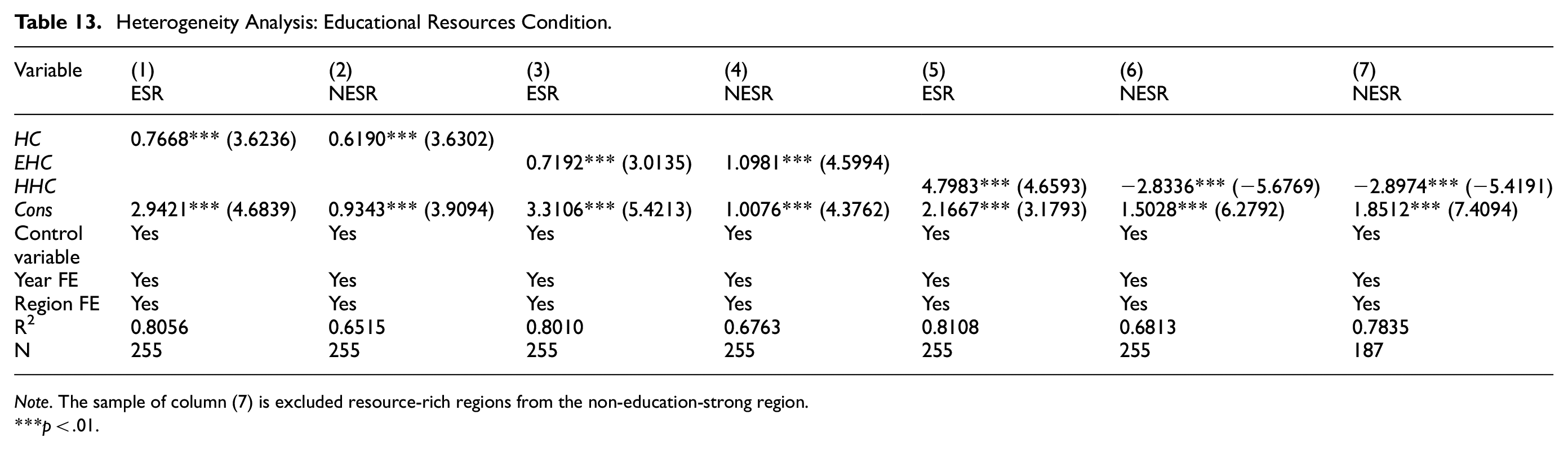
Note. The sample of column (7) is excluded resource-rich regions from the non-education-strong region.
p < .01.
Discussion and Recommendations
Discussion
The findings of this study provide valuable insights into the multifaceted role of human capital in fostering GTFP. The dual components of human capital – educational and health human capital – are both found to be pivotal in driving GTFP. This underscores the importance of a holistic approach to human capital development, which includes not only educational investments but also initiatives aimed at improving population health.
The green effect of human capital on GTFP is influenced by external conditions such as industrial structure upgrading, financial development, and GDP per capita. Changes in the industrial structure cause shifts in human resources across industrial sectors. Financial development offers financial security for the movement of elements within human capital. Sudden structural shifts in per capita income levels trigger corresponding structural changes in the green impact of human capital. In regions where industrial structures are more advanced, financial systems are well-developed, and GDP per capita is higher, the enhancing effect of human capital on GTFP is stronger. This implies that policy interventions aimed at promoting GTFP should be tailored to the specific levels of these moderating factors. At the level of the aforementioned discussion, this paper fills the gaps identified in the research by Wang and Wang (2024).
Green technological innovation and labor force upgrading are two important channels through which human capital influences GTFP. It is noteworthy that human capital may not directly affect GTFP through green technological innovation. On one hand, this could be due to the time required for the commercial application of innovation outcomes. On the other hand, this channel may necessitate substantial external policy support and reinforcement. The digital economy in China has been growing robustly, thanks to technological advancements and strong government backing. Against this backdrop, the role of the digital economy in amplifying the positive effects of green technological innovation is particularly noteworthy. This finding suggests that there is potential for synergy between the digital economy, green technological innovation, and labor force upgrading, which can be harnessed to promote sustainable economic growth. At the level of the aforementioned discussion on mechanisms, this paper addresses the shortcomings identified in the study by Li and Deng (2023).
Endogenous conditions can lead to heterogeneity in the impact of human capital on GTFP, with such conditions including natural resource endowments and educational circumstances. This heterogeneity is primarily manifested in the influence of health human capital on GTFP. The negative impact of health human capital in resource-rich regions is concerning and warrants further investigation. It may be that in these regions, the focus on resource extraction leads to environmental degradation, which health human capital inadvertently exacerbates. Education-strong regions tend to have better economic development conditions and prioritize investments in health, leading to positive impacts on GTFP. In contrast, non-education-strong regions face challenges in promoting green development due to weaker investments in health. This regional disparity highlights the need for targeted policies that address the unique needs of each region to promote green development and improve GTFP.
Research Conclusions
This study confirms that human capital, comprising both educational and health human capital, as well as human capital at the individual levels of education and health, all play a positive role in promoting GTFP. The positive impact of human capital on GTFP is robust and remains significant after accounting for potential policy interventions. Industrial structure upgrading, financial development, and GDP per capita are key threshold variables that moderate the relationship between human capital and GTFP. Green technological innovation and labor force upgrading are the primary channels through which human capital influences GTFP, with the digital economy enhancing this effect. The impact of health human capital on GTFP varies with natural resource endowments and educational conditions. Therefore, targeted policies are needed to promote green development and enhance GTFP.
Recommendations
Based on the findings of this study, the following policy recommendations are proposed to enhance the role of human capital in fostering GTFP: (1) Policymakers should adopt a holistic approach to human capital development, encompassing both educational and health dimensions. This involves investing in quality education and healthcare systems to improve the stock of educational and health human capital. (2) Policies should focus on promoting industrial upgrading, enhancing financial inclusivity, and improving overall economic well-being to create an enabling environment for human capital to effectively contribute to GTFP. (3) Government departments should consider the varying levels of educational and health investments across different regions and implement region-specific policies to promote green economy development and human capital investment. For instance, a tiered policy framework can be adopted to differentiate regions with distinct educational and health investment levels. (4) Governments and enterprises should encourage green technology innovation and labor force upgrading to boost productivity and green economy development. (5) The digital economy presents new opportunities for green technology innovation and green economy development. Therefore, the government should take measures to encourage the fusion of digital economy and green technology to drive green economy growth. (6) Given the regional disparities in the impact of human capital on GTFP, policymakers should design region-specific policies. For resource-rich regions, governments and enterprises should implement special policies to promote sustainable resource utilization and environmental protection, thereby mitigating the negative environmental impacts. Education-strong regions should continue to invest in health to maintain positive impacts on GTFP, while non-education-strong regions need targeted investments in both education and health to promote green development and improve GTFP.
Limitations and Future Outlook
While this study contributes significantly to understanding the role of human capital in fostering GTFP, it is not without limitations. Firstly, the measurement of human capital, particularly in terms of health dimensions, might be subject to biases and limitations of available data. Future research could benefit from more comprehensive and nuanced indicators of both educational and health human capital. Secondly, the study’s focus on regional disparities in human capital investments and their impact on GTFP may not capture the full complexity of these relationships. Additional factors, such as cultural differences, institutional frameworks, and international trade, could also play significant roles. Future research should consider these factors to provide a more holistic understanding of the dynamics at play. Thirdly, the heterogeneity analysis reveals significant regional endowment differences in the impact of human capital on GTFP. However, the mechanisms behind these differences are not fully explained. Future research could delve deeper into the specific contextual factors that drive these regional disparities, including the role of governance, resource endowments, and policy frameworks.
Footnotes
Appendix
In descending order of the measurement scores, the top 15 provinces and municipalities are Beijing, Jiangsu, Liaoning, Shanghai, Shandong, Hubei, Shaanxi, Guangdong, Sichuan, Zhejiang, Heilongjiang, Hunan, Tianjin, Henan, and Anhui; the bottom 15 provinces and municipalities are Hebei, Jilin, Chongqing, Fujian, Jiangxi, Shanxi, Gansu, Guangxi, Inner Mongolia, Xinjiang, Guizhou, Hainan, Ningxia and Qinghai. Tibet ranks last but is not considered in the sample of this paper.
Acknowledgements
None.

Funding
The author(s) received no financial support for the research, authorship, and/or publication of this article.
Declaration of Conflicting Interests
The author(s) declared no potential conflicts of interest with respect to the research, authorship, and/or publication of this article.
Declaration of Generative AI and AI-assisted Technologies in the Writing Process
No AI or generative software was employed in the development of this work.
Data Availability Statement
Data will be provided upon reasonable request to the corresponding author.