




Abstract
Flipped learning’s widespread adoption and multiple meta-analyses notwithstanding, there exists a scarcity of analyses scrutinizing its comprehensive influence on language learning results. This meta-analysis assesses flipped learning’s impact on language learning outcomes vis-à-vis non-flipped instruction, encompassing distinct moderators encompassing study attributes and instructional facets: target language, level of education, school location, treatment duration, classroom activities, and the pre-instructional comprehension check mechanism. Effect sizes were extracted from 70 eligible studies (involving 4,616 students across 19 countries). Cochran’s Q was used to detect moderator variable effects, and post hoc comparisons were performed if significant differences existed among moderator subsets. Results yielded an overall mean weighted effect size (flipped learning vs. non-flipped instruction) of 0.96 under the random-effects model, indicating a large positive effect on student learning outcomes. Treatment duration, school location, and level of education were influential moderators affecting language learning results, while the other three were not. Flipped learning, particularly when implemented for over 6 weeks, consistently yields superior learning outcomes across different educational contexts. Educators are thus encouraged to adopt flipped learning as a versatile pedagogical approach to maximize student learning potential.
Keywords
introduction
Described as a pedagogical practice in which “events that have traditionally taken place inside the classroom now take place outside the classroom and vice versa” (Lage et al., 2000, p. 32), the flipped learning approach inverts the typical cycle of content delivery through face-to-face lectures and knowledge application via homework. With the distinctive feature of maximizing in-class time for more enriching learning tasks, flipped learning thus shifts lecture-based instruction, often teacher-centered, to a student-centered paradigm (Chen Hsieh et al., 2017; Reidsema et al., 2017). Such a perspective shift reflects concerns over the effectiveness of lecture-based teaching practices, and educators have come to realize the importance of deep learning, rather than superficial learning, wherein learners actively engage in the learning process (Archambault et al., 2022; Prince, 2004) and develop abilities through “active and constructive processes” (Ritchhart et al., 2011, p. 7).
Flipped learning transcends the mere rearrangement of instructional activities, emphasizing the inversion of content acquisition and knowledge application (Bergmann & Sams, 2012). in distinguishing itself from other teaching methods, flipped learning encompasses key elements such as pre-class knowledge acquisition by students, enabling valuable class time for elevated guided practice and collaborative endeavors. in stark contrast to traditional instruction, which often features limited guided practice followed by homework checks and lengthy in-class lectures, this pedagogical shift has demonstrated a correlation with heightened student satisfaction, as supported by the meta-analysis conducted by Strelan et al. (2020b).
Nonetheless, limited research has explored the direct connection between flipped learning and language learning, resulting in a dearth of substantial findings regarding the specific pedagogical factors that can enhance language learning outcomes when employing flipped learning compared to non-flipped instruction. Despite the presence of several meta-analyses (L. Cheng et al., 2019; Strelan et al., 2020a; van Alten et al., 2019) and review articles on flipped learning (Bond, 2020; S.-C. Cheng et al., 2020; O'Flaherty & Phillips, 2015), comprehensive investigations focusing on the flipped classroom approach in language learning are still underrepresented, as shown in the content analysis by Filiz and Benzet’s (2018), systematic reviews by Zhong and Abdullah (2023) as well as Turan and Akdag-Cimen’s (2020), and meta-analyses by Shahnama et al. (2021) and Vitta and Al-Hoorie (2020). However, their meta-analyses primarily focused on the effects of flipped learning on English language learning in English as a foreign or second language (EFL/ESL) contexts, and their moderator variables both focused on study type (such as thesis or journal papers) or report source (such as SSCi or Scopus), educational level, and pretest status/form (tested or not, or empirical pretest or pre-existing evaluation). Vitta and Al-Hoorie (2020) suggested future meta-analysis should probe into when and how its effectiveness could be maximized (i.e., investigating more or other possible/potential moderators of flipped learning), in line with Shahnama et al.’s (2021) statement that more evidence specifically regarding instructional design and implementation is required to validate the effects of flipped learning in the EFL/ESL field, thus the purpose of this study.
Background
Research into flipped learning instructional methods suggests that it has benefits and affordances beyond other methods (e.g., Fathi et al., 2023; H. Hung & Yeh, 2023; Strelan et al., 2020a, 2020b). Such evaluations, however, are generalizations and cannot encompass every variation of instruction that does not conform to the definition of flipped learning, some of which have greater strengths and affordances than others. it is, therefore, superficial to broadly say that flipped learning has the potential to be better than other traditional methods. While the existing literature has explored six potential moderating factors through systematic reviews and meta-analyses when comparing flipped learning with conventional approaches (e.g., Ardasheva et al., 2017; Filiz & Benzet, 2018; Zheng et al., 2020), comprehensive insights into pre-instructional comprehension check mechanisms, in-class learning activity design, and instructional time frames remain unclear.
Pre-instructional Comprehension Check
The pre-instructional comprehension check warrants investigation due to its pivotal role in ensuring student engagement and preparation, conditions essential for the successful implementation of flipped learning. As highlighted by Boyraz and Ocak (2017), the successful implementation of flipped learning relies on students recognizing the value of utilizing the teacher as a resource during assignments and actively engaging with instructional materials outside of class (oftentimes at home). By providing easy access to learning materials, flipped learning offers a promising alternative to traditional lecture-based approaches, emphasizing student preparation before class. The level of student engagement in pre-instructional activities significantly impacts the dynamics of subsequent in-person class meetings, as the “simple availability of a learning opportunity (e.g., completion of preparation tasks) does not necessarily translate to a learner completing the required task nor consistency in how the task is approached” (Pardo et al., 2019, p. 2). Additionally, the importance of student accountability, as emphasized by Chen Hsieh et al. (2017), highlights the necessity of identifying and assisting students who may struggle with engaging in flipped learning activities outside of class. Given that student engagement is influenced by the learning environment and available support systems (Martin & Borup, 2022), implementing pre-class comprehension checks—typically executed through verifying students’ access to instructional materials such as videos—has emerges as a critical measure to ensure the efficacy of flipped learning (Zhao & Li, 2021).
Classroom Activities
An investigation into classroom activities during flipped learning is crucial due to its pivotal role in fostering deeper learning experiences for students. Flipped learning methodology expects students to acquire foundational knowledge at home, then facilitating their active engagement in higher-order cognitive tasks during face-to-face class sessions. in-class activities are designed to cultivate critical thinking skills, transcending rote memorization and comprehension to encourage evaluation and creation. Different studies have proposed alternative forms of in-class activities, including individual-based (Chen Hsieh et al., 2017), collaborative (J. Lee & Choi, 2019; Sergis et al., 2018), or mixed approaches (G. Lee & Wallace, 2018; Yu & Wang, 2016). Regardless of the nature of these activities, students are required to demonstrate thinking skills based on their prior knowledge. However, the terminology and definition of “group” or “collaborative” work in previous studies have been vague, and there is no standardized recommendation for group size, making it necessary to investigate the effectiveness of classroom activities in more detail. in other words, the lack of standardized definitions and recommendations regarding group dynamics necessitates a comprehensive examination of the effectiveness of classroom activities. Therefore, further exploration is warranted to establish clear guidelines and optimize the pedagogical impact of these activities within the flipped learning framework.
Treatment Duration of Flipped Learning
investigating the treatment duration of flipped learning is essential to discern its optimal implementation timeframe and its impact on student learning outcomes compared to non-flipped instructional approaches. Studies have explored a spectrum of durations, from longer interventions spanning over 8 weeks (Amiryousefi, 2019; Chen Hsieh et al., 2017) to shorter interventions (Asaka et al., 2018; Tao et al., 2016). Understanding how instructional time impacts student learning outcomes in flipped learning compared to non-flipped modes is crucial for determining the optimal duration for flipped learning, since the precise influence of instructional time on learning outcomes remains unclear. Therefore, a more in-depth examination of the relationship between treatment duration and learning outcomes would provide valuable evidence with the most effective allocation of instructional time within flipped learning frameworks.
Level of Education, Location of Flipped implementation, and Target Languages
This investigation into the level of education, location of implementation, and target languages within flipped learning research is crucial for several reasons. Existing studies have predominantly focused on implementing flipped learning in higher education settings, wherein students are required to engage with pre-instructional online materials and participate in in-class activities that foster critical thinking skills, as evidenced in studies such as O'Flaherty and Phillips’s (2015) scoping review and Brewer and Movahedazarhouligh’s (2018) effectiveness review. However, there is a notable gap in the extant research regarding its application in K–12 education (Lo & Hew, 2017). Addressing this gap is essential to better understand and compare the effectiveness of flipped learning across different age groups and educational levels. Furthermore, while numerous studies have examined the use of flipped learning in English language learning, exemplified by works such as those by Haghighi et al. (2019) and G. Lee and Wallace (2018), there is a significant need for research on its application in other languages. Studies featuring languages other than English, such as Chinese (J. Yang et al., 2018) or Turkish (Özdemir & Açik, 2019) are encouraged, as it is imperative to validate the efficacy of flipped learning across diverse linguistic contexts. Such investigations will not only broaden our understanding of the potential benefits of flipped learning but also contribute to the development of more inclusive and effective language learning strategies worldwide.
The current study fills a research gap by examining three important, yet less frequently studied pedagogical moderators of flipped learning: the pre-instructional comprehension check mechanism, classroom activities, and duration of treatment. These moderators, along with commonly examined factors such as target language, level of education, and school location, provide a comprehensive understanding of the factors that influence language learning outcomes in the context of flipped learning. By exploring these characteristic pedagogical factors, the study offers a unique perspective, particularly in tertiary education, shedding light on the specific conditions and practices that contribute to the effectiveness of flipped learning in language learning. The inclusion of students’ background data also adds to the validity of the research, addressing a potential limitation found in previous studies. Overall, this study aims to enhance our understanding of flipped learning and its impact on language learning outcomes by examining a wide range of moderators and providing valuable insights for educators and researchers in the field. The following research questions guide this study:
What are the overall effects of flipped learning on student language learning outcomes compared with non-flipped instruction?
Do these effects differ by moderating factors such as target language, level of education, school location, treatment duration, classroom activities, and pre-instructional comprehension check mechanism?
Method
We conducted this meta-analysis following guidelines from Chambers (2004) and conducting and reporting procedures from Cooper (2015) and Hu et al. (2021). We also followed procedures for homogeneity testing from Hedges and Olkin (2014).
Gathering Relevant Studies
This study used the following keywords—(flipped learning OR flipped teaching OR flipped classroom OR flipped) AND (language learning) AND (outcome OR performance OR achievement)—to search the extensive social-science database platforms of EBSCOhost (including Academic Search Premier, OpenDissertations, ERiC, OmniFile Full Text Select, Teacher Reference Center), ProQuest (including Education Database Linguistics Database, Psychology Database, Research Library, Social Science Database), and ScienceDirect. Google Scholar (scholar.google.com) was searched with the exact keywords to identify additional literature not included in these databases. We used the resulting article titles and meta description tags to identify other literature not uncovered in the database search, browsing the results pages until all pertinent articles had been identified (i.e., those comparing flipped learning implementation with non-flipped instruction); moreover, we examined the references of the relevant papers to include as many eligible studies as possible.
inclusion and Exclusion Criteria
Two trained research assistants specializing in foreign language learning screened articles for the following inclusion criteria:
Studies must employ an experimental approach (e.g., pretest-posttest or posttest-only equivalent/non-equivalent groups design).
Articles must compare the influence of a flipped learning intervention with that of non-flipped instruction on language learning outcomes. in this meta-analysis, flipped learning was operationally defined as previously stated in the introduction section; non-flipped instruction referred to the pedagogical implementation wherein students acquired new knowledge during class via the instructor’s lecture, then practiced those relevant skills at home via homework. Language learning outcomes refer to the outcomes, performance, and achievement of language learning.
Articles must be in English.
The research assistants selected the articles according to the following exclusion criteria:
Research results are not presented with students’ language learning outcomes as a dependent variable.
Statistical data are insufficient to calculate an effect size; that is, the means and standard deviations, F value(s), or t value(s) for the flipped and non-flipped groups, in addition to the sample sizes are not provided.
Seventy articles were deemed eligible and retained for the meta-analysis, as summarized in the provided PRiSMA flow diagram (see Figure 1). Most of the studies were peer-reviewed journal articles; they included 67 peer-reviewed journal articles (95.7%), two dissertations (2.9%), and one conference proceedings paper (1.4%).
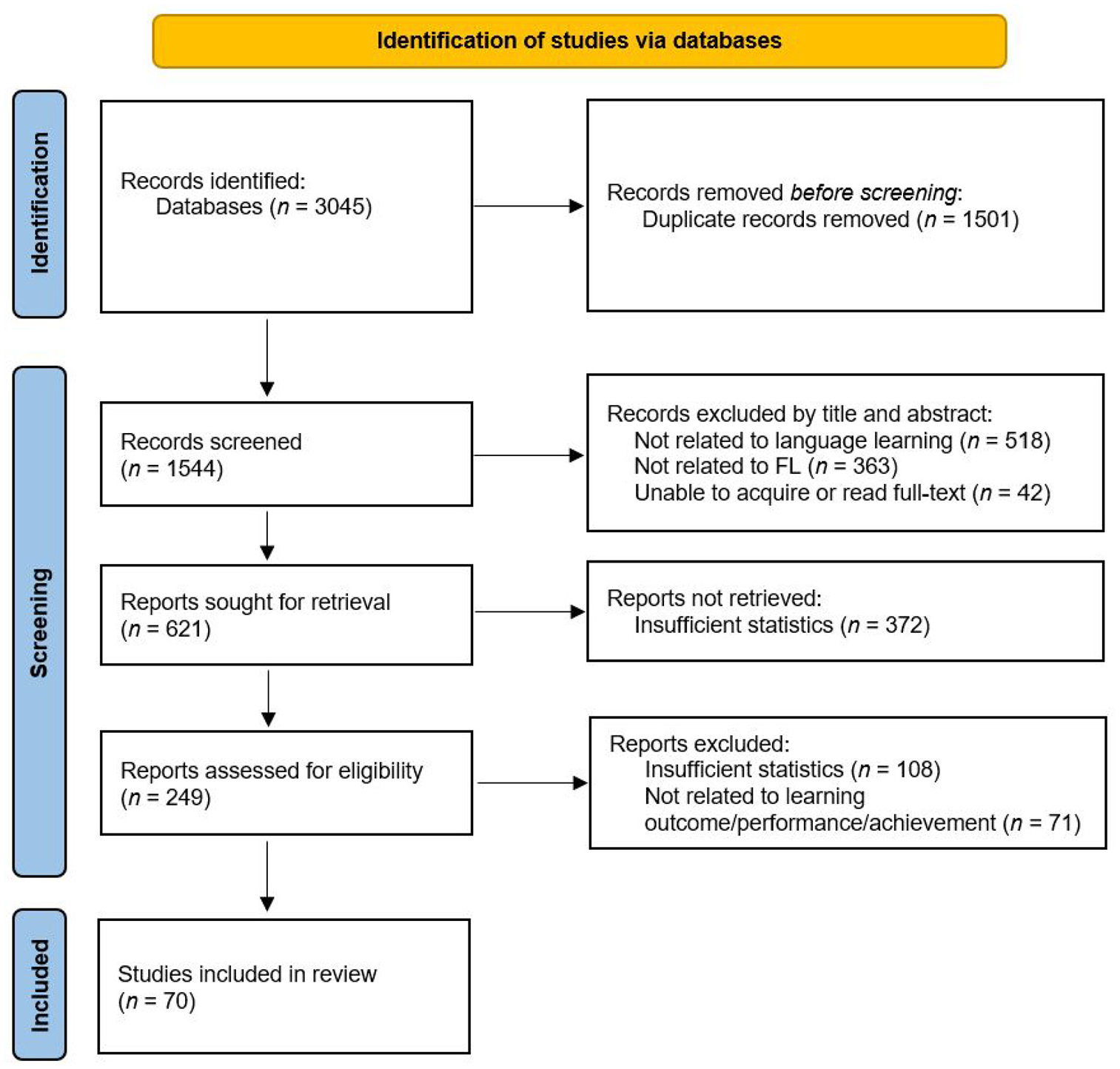
PRiSMA flow chart of the study selection process.
Testing for Publication Bias
This study used Egger’s regression test and the trim-and-fill method to test the publication bias. The result of Egger’s regression test was intercepted = 3.52, SE = 0.96, t = 3.68 (p < .05). This study used the trim-and-fill method (Duval & Tweedie, 2000), which estimates the number of missing studies and also yields an adjusted average effect size by inserting the missing studies on the biased side. As shown in Table 1, under the random-effects model, 13 missing studies were found on the right, and the overall effect in fixed effects was adjusted from 1.08 to 1.19 (p < .05) and random effects from 0.98 to 1.37 (p < .05). The results of the trim-and-fill method showed that the current meta-analysis results are not substantially subject to publication bias.
Results of the Trim-and-Fill Method.

Setting Up Moderators
To determine the influences of potential factors on the effectiveness of flipped learning, six categorical moderator variables (i.e., study features) were set: three represented study characteristics, and three represented activity design characteristics. The six moderators were: (a) target language (English, Chinese and Japanese, Turkish and Arabic, and others); (b) level of education (elementary school, middle school, high school, undergraduate, postgraduate, and mixed); (c) school location (North America, Europe, West Asia, East Asia, Southeast Asia, and others); (d) treatment duration (6 weeks and below, 7–12 weeks, 13–18 weeks, and 19 weeks or more); (e) classroom activities (individual work, group work, and mixed); and (f) a pre-instructional comprehension check mechanism (online comprehension checks, comprehension checks at the beginning of physical class meetings, and unspecified comprehension check mechanisms). The researchers grouped the treatment duration categories based on natural breaks in the treatment lengths of the examined studies, in part resulting from the different semester lengths in various countries.
Coding of Moderator Variables
Before the formal coding, the two trained research assistants independently coded 75% of the eligible studies, more than the percentages (30%–50%) suggested by previous meta-analyses (see Chen & Yang, 2019; Sowislo & Orth, 2013) based on the study features. The assistants agreed on the coding for 91.7% of the 312 codings (52 studies; each study had six moderator variables), with an intercoder agreement of 100% for the target language, 90.4% for the level of education, 94.2% for school location, 90.4% for treatment duration, 90.4% for classroom activities, and 84.6% for the pre-instructional comprehension check mechanism. in cases of discrepant coding, the two assistants examined and discussed the articles until reaching a consensus. One of the assistants then coded the rest of the eligible studies. To ensure coding accuracy, a researcher with extensive experience in conducting educational meta-analyses examined each coding for all studies.
Effect Size Calculation for Each Study
This research adopted the formula that Rosenberg et al. (2000) proposed to calculate each study’s effect size (ES). The t or F values estimated the ES for studies not reporting means and standard deviations. Each ES was weighted based on a sample size to obtain an unbiased ES estimator as Hedges’s g (Rosenberg et al., 2000). The original approximation given by Hedges is

Here N = n1 + n2; n1 refers to the number of subjects in the experimental group, and n2 is the number of subjects in the control group. We multiplied the original ES by (1) and aggregated the weighted ESs to obtain a weighted mean estimator g+ with variance σ2(g+). Finally, the researchers calculated a 95% confidence interval (Ci) for g+ to test for significant differences between learning outcomes in the flipped and non-flipped groups. if zero lay outside the Ci and g+ was positive, the flipped learning group achieved significantly more favorable learning outcomes than the non-flipped instruction group. The researchers used MetaWin 2 (Rosenberg et al., 2000) to run the meta-analysis.
Homogeneity Testing
The researchers followed Hedges and Olkin’s (2014) procedures to test the heterogeneity of outcomes. The formula for the homogeneity test is

When significant differences were discovered, Cochran’s Q was used to detect the effects of moderator variables on the overall study g+. One study (i.e., Li, 2015) was removed in this step to avoid possible hierarchical effects since the study was conducted based on identical research groups or participants. The random-effects model reported the effects on language learning outcomes. The researchers calculated the between-class variance, QB. if QB indicated significant differences among subsets of a moderator with three or more subsets, we performed multiple comparisons post hoc using the Scheffé tests (Chen & Yang, 2019); subsets with only two studies and the subset with not specified studies were eliminated from the post hoc comparisons.
Results and Discussion
Research Question 1. What are the Overall Effects of Flipped Learning on Student Language Learning Outcomes Compared with Non-flipped instruction?
Table 2 presents the weighted effect sizes (ESs) and the numbers of ESs, schools, and students (in the experimental or control group) in the 70 studies. The researchers paid attention to the effectiveness of flipped learning versus non-flipped instruction based on measurements of student learning (including performance, achievement, and cognitive outcomes) in language learning. in addition, the current study referred to Ahn et al.’s (2012) paper regarding the evaluation of included studies in a meta-analysis and summarized information about study designs and controls that contribute to making the quality of the studies more transparent. information concerning study design, teacher and class/school arrangements, analytical method used, types of language learning outcomes, classroom activities employed during flipped learning, student grades, and school location is included in Table 2.
information About the 70 Studies included in the Meta-Analysis.

Note. k = number of effect sizes (i.e., number of comparisons); g = mean weighted ES; pre-post EG = pretest-posttest equivalent groups design; post EG = posttest-only equivalent groups design; pre-post NEG = pretest-posttest nonequivalent groups design; post NEG = posttest-only nonequivalent groups design.
The weeks of treatment duration in these five studies were estimated by each country’s university academic calendars, since these papers report that treatment durations were one semester but do not provide the specific weeks.
The 70 studies represent 165 comparisons and a total sample of 4,616 students (from grade 4 to postgraduate) across 78 schools in 19 countries. The weighted ES was positive for 64 studies (91.4%) and negative for six studies (8.6%). The weighted ESs for individual studies ranged from −0.51 to 2.91, within three standard deviations (g+ < 3.25) (Chen & Yang, 2019; Lipsey & Wilson, 2001, p. 108), from the overall ES; therefore, no studies were excluded from further analysis. According to Cohen (1988, p. 40), ESs of 0.2, 0.5, and 0.8 are considered small, medium, and large effects, respectively. The overall weighted mean ES was 0.96 (95% Ci [0.79, 1.13]) under the random-effects model. Therefore, compared to non-flipped instruction, flipped learning exerted a large positive effect on language learning outcomes, indicating that students instructed through flipped learning learn considerably more effectively than those learning via non-flipped instruction.
The outcomes of the meta-analysis support the positive effects of flipped learning on English as a Foreign Language (EFL) language learning outcomes, consistent with previous research findings (Chuang et al., 2018). A key factor contributing to the significant benefits of flipped learning over non-flipped instruction is the enhancement of pre-instructional preparedness and the promotion of student engagement in interactive and collaborative learning environments. Bergmann and Sams (2012) emphasize that flipping the learning process allows for more efficient use of class time, as students are exposed to instructional materials before attending physical classroom sessions. This enables them to engage in extensive target language practice during face-to-face interactions. By preparing beforehand and ensuring comprehension through teacher guidance, students are empowered to fully grasp the language materials, in contrast to traditional teaching methods where students are expected to practice immediately after learning, often struggling to fully comprehend the knowledge.
Flipped learning is increasingly recognized as a facet of blended learning, as it integrates various teaching modalities, including digital technologies aiming to enhance students’ readiness before instruction and physical instructional sessions to facilitate meaningful in-person interactions. This combination of online and face-to-face learning has been demonstrated to enhance the quality of learning (Rasheed et al., 2020). Consequently, flipped learning, in its expansive scope, immerses learners in online pre-instructional activities that emphasize the pivotal role of digital tools in fostering effective course preparedness and in subsequent in-class tasks that foster deeper interaction and discourse among students, aligning closely with the pedagogical principles of active learning (Q. F. Yang et al., 2021). Pedagogically, by combining pre-class online engagement with in-person interactive sessions, flipped learning enhances the blended learning experience. it allows for a more personalized and flexible approach to learning and promotes active engagement with the material, since it allows students to be familiar with the materials independently at their own pace and according to their individual learning styles. Flipped learning also fosters deeper understanding and critical thinking skills among students, as they are engaged in active learning activities in a physical setting such as discussions, problem-solving exercises, group projects, or hands-on demonstrations. During these in-person sessions, students engage in deeper exploration of the content, apply their understanding, and collaborate with peers under the guidance of the instructor. Moreover, flipped learning empowers instructors to optimize their instructional time by focusing on higher-order learning activities and providing targeted support to students based on their individual needs (M. A. Chen et al., 2019; Reidsema et al., 2017). Overall, flipped learning embodies the essence of blended learning by integrating digital and face-to-face elements to create a dynamic and effective learning environment.
While the findings across many studies show that flipped learning has advantages that non-flipped methods do not offer, or at least do not offer as extensively as flipped methods, the conclusion of a given study positing that flipped learning offers benefits or affordances not offered by non-flipped instruction does not automatically mean that the non-flipped instruction was inherently flawed. it simply means that the flipped learning method offered advantages not provided by the non-flipped instruction used in the study.
Research Question 2. Do These Effects Differ by Moderating Factors Such as Target Language, Level of Education, School Location, Treatment Duration, Classroom Activities, and Pre-instructional Comprehension Check Mechanism?
Homogeneity testing and moderator analysis were adopted to answer research question 2 regarding the moderation effects of diverse factors affecting the overall efficacy of flipped learning on student language learning outcomes compared with non-flipped instruction. Homogeneity testing revealed significantly different language learning outcomes (QT = 491.80, df = 69, p < .001), suggesting that such differences did not result from sampling errors among the same population. Among the six moderators, treatment duration, school location, and level of education were the three significant moderators affecting student language learning outcomes, whereas the other three moderators did not have a significant effect, as shown in Table 3. Nevertheless, as Borenstein et al. (2009, p. 211) cautioned with the use of subgroup analyses, “failure to obtain a statistically significant difference among subgroups should never be interpreted as evidence that the effect is the same across subgroups.” The 95% Cis of many subsets were positive and exclusive of zero, suggesting learning outcomes for students receiving flipped instruction were advantageous in contrast to those of the non-flipped students in those subsets. The subsequent sections discuss the results of moderator analysis and the differences between subsets.
Results of Moderator Analysis.

Note. QB = between-class variance; Ci = confidence interval; Contrast = post hoc comparison. Subsets with only one study were excluded from moderator analysis; subsets with only two studies or a “not specified” subset were eliminated from the post hoc comparisons.
Yousefzadeh and Salimi’s (2015) study has two subsets: one for learning English, and one for learning Arabic.
One study (Khosravani et al., 2020) did not specify the level of education and was therefore eliminated from the analysis.
One study (Afrilyasanti et al., 2016) did not specify the treatment duration and was therefore eliminated from the analysis.
p < .05. **p < .01.
Target Language
QB (5.18) was not significant for target language, yet the examination of ES showed that flipped learning had a greater effect than non-flipped instruction on (in descending order of effect) English, Turkish and Arabic, Chinese, and Japanese, and other indo-European languages including Spanish and Ukrainian.
The meta-analysis revealed that a significant majority of the studies (88.6%) focused on examining the impact of flipped learning versus non-flipped instruction on English language learning outcomes. Overall, positive outcomes were observed, indicating that flipped learning has the potential to enhance English proficiency, especially for foreign language learners. This positive effect could be attributed to the pedagogical design of flipped learning, which includes pre-instructional content knowledge acquisition and in-class problem-solving collaboration (Bergmann & Sams, 2012; Berrett, 2012). it is important to note that although the analysis indicated variations in effect sizes among different subsets, caution should be exercised when interpreting the greater effects of flipped learning for English compared to other languages such as Chinese or Japanese, as the number of studies categorized into these subsets was limited (up to four studies).
The predominant focus of studies on flipped learning has been on English language learning. However, there is a pressing need for additional investigations to determine the benefits of flipped learning for the acquisition of other languages. Only through further research efforts examining languages beyond English can a comprehensive understanding of how flipped learning contribute to language learning be achieved. Moreover, considering the substantial number of comparisons within the English subset (62 studies) and the various factors influencing effect sizes across studies, future research could explore potential differences in the effects of flipped learning within English studies based on moderator variables such as school location or level of education (Kim et al., 2019).
Level of Education
The students involved in the studies examined by this moderator analysis generally ranged from fourth-grade primary/elementary school students to postgraduate students, though one study was conducted with a mix of community college students (Webb & Doman, 2016), and one study was conducted in a language school (Khosravani et al., 2020). The QB (11.08) was significant for levels of education.
The most common study groups were comprised of college and university students, with fewer studies investigating elementary and secondary students. This result echoes Lo and Hew (2017), who found a lack of relevant research in K–12 education. This finding is understandable because most researchers are at universities and thus have easier access to data from college students than from K–12 students. Student accountability is paramount in outside-of-class learning (Chen Hsieh et al., 2017); elementary and lower secondary school students may require additional teacher supervision, whereas it is less needed for older students. Furthermore, those schoolteachers might be concerned about letting their students engage in online learning independently. Nevertheless, since the language learning outcomes in flipped learning were more advantageous compared to those in non-flipped instruction at these educational stages (i.e., high school, undergraduate, and postgraduate), it is thus worth practicing flipped learning from upper secondary to tertiary education.
School Location
QB (16.84) was significant for school location; the observation based on the subset ES found that the relative effectiveness of flipped learning compared with non-flipped instruction varied with school location. The Europe subset (Bueno-Alastuey & Andrés Galar, 2017; Nikitova et al., 2020) and “others” subset (one from Egypt and the other a mix of the U.S. and Macau) of only two eligible studies respectively were not included in the following discussion. The results regarding the ES indicate that the effect of flipped learning in studies located in Southeast Asia (including four studies in indonesia, 2 in Vietnam, 1 in Thailand, and 1 in Philippines) was significantly larger than that in North America and that the effect in West Asia (including 15 studies in iran, 10 in Turkey, 5 in Saudi Arabia, 1 in Northern Cyprus, 1 in iraq, 1 in Qatar, and 1 in the United Arab Emirates) was significantly greater than that of North America (including the U.S.).
The meta-analysis findings reveal that flipped learning is more effective than non-flipped instruction for English learning in major Asian regions, including iran, Turkey, Taiwan, China, Saudi Arabia, indonesia, South Korea, Japan, Thailand, Vietnam, Hong Kong, iraq, Northern Cyprus, Philippines, Qatar, and the United Arab Emirates. The prevalence of studies on flipped learning for English competence in Asia can be attributed to the formal instruction strategies of EFL/ESL teaching in these countries, coupled with limited instructional time. Although huge efforts have been made to improve the existing language teaching/learning educational framework, challenges within teacher-centered instruction still exist, making students less motivated (Wu et al., 2020). Flipped learning, therefore, has emerged as an innovative solution to address the long-standing concern of students’ inadequate preparedness for academic life (K. T. C. Chen, 2017; Phakiti & Li, 2011). However, it should be noted that the greater effects observed in Southeast Asia and West Asia compared to North America do not imply the ineffectiveness of flipped learning practices in North America. This discrepancy may stem from the inclusion of only five U.S.-based studies in this meta-analysis, focusing on Chinese, Japanese, and Spanish as target languages, and potentially impacting the overall effect on students’ language learning outcomes.
Treatment Duration
QB (10.78) was significant for treatment duration; therefore, the weighted ESs differed among subsets. Post hoc comparisons revealed that the relative benefit of flipped learning versus non-flipped instruction was significantly greater when flipped learning was respectively implemented for 7 to 12 weeks, compared to shorter durations of 6 weeks or less. The findings of the meta-analysis suggested that more extended implementations of flipped learning were better than short-term implementation durations.
O'Flaherty and Phillips (2015) found no evidence to support the comparative benefits between flipping the entire course and flipping selected class sessions/modules. However, the analyzed studies in this meta-analysis indicate a preference for longer implementation periods (over 6 weeks), which showed superior effects compared to shorter durations (6 weeks or less) and non-flipped instruction. The clear conclusion from the results is that shorter implementations, such as a single unit, are less preferable. Studies with flipped learning implementation for 7 to 12 weeks and 13 to 18 weeks demonstrate the advantages of more extended usage. One potential explanation for these benefits is the need for students to familiarize themselves with the learning process, which can initially pose challenges, such as acquiring content knowledge independently before class and applying it during class. Because students in flipped learning implementation are engaged in challenging tasks that require a high level of self-regulation (Shyr & Chen, 2018), students thus require considerable time to be guided through learning strategies to ensure pre-instructional delivery of content knowledge and promote in-class interaction and collaboration. Warm-up tasks that help students become familiar with the flipped learning procedure and sum-up activities that enable students to reflect on the whole learning experience are thus recommended. Developing thinking skills, promoted by flipped instruction, requires time and is not easily achieved within a short period. Consequently, it is unsurprising that students require more time to attain thinking skills during in-class learning activities, which demand critical, constructive, and effective thinking and judgment (Phakiti, 2018).
While many of the studies about flipped learning have shown its positive effects on language learning outcomes, some studies have pointed out that not every student prefers flipped learning. As Chen Hsieh et al. (2017) suggested, some students still preferred lecture-based instruction since “it required less work, regardless of the outcomes” (p. 11). They said that in identifying aspects of the student flipped learning experience that are related to successful outcomes, it is essential to consider diverse forces that are rapidly shaping and changing the context of student learning, such as the technology actually used. Therefore, a few weeks of non-flipped instruction, such as during the initial phase of the semester while students are being prepared for flipped methods, or during induction training, might help those who prefer acquiring new knowledge from in-classroom lectures.
Classroom Activities
Many of the studies (29 studies) in this meta-analysis omitted details of the actual pedagogical practices, such as the pre-classroom assignments and tasks expected of the students and the in-classroom activities, making assessing the research’s validity more difficult. The researchers, therefore, relied on the fact that each paper had passed peer review before publication as a determination of validity. Nevertheless, a large number of articles in this meta-analysis mentioned group-based activities, either in a specific group form or a mixed manner, including both individual tasks and group work. Although QB (4.79) was not significant for classroom activities, the weighted ES of flipped studies with mixed activities (including both individual and group work) was larger than that of studies with group work.
Although individual work exerted the biggest ES in this meta-analysis, it should be treated cautiously since only two studies were included in this subset. in general, it can be observed that flipped learning, incorporating mixed activities, yields greater improvements compared to non-flipped instruction, in contrast to flipped learning which is primarily focused on group work. Collaborative learning aligns with the principles of social constructivism, emphasizing active knowledge construction through interactions with others and the development of cognitive structures with external guidance. This collaborative learning can be facilitated through instructional scaffolding, as defined by Wette (2014), wherein instructors or more capable peers provide support for collaborative growth. in learner-centered flipped classrooms, instructors assume the role of facilitators rather than lecturers, guiding students toward active learning (Özdemir & Açik, 2019). Consequently, collaborative tasks within flipped learning foster learners’ social and intellectual development by facilitating interactions and assistance from others (Vikneswaran & Krish, 2016). During class time, individual inquiry as well as collaborative activities enable students to clarify concepts and contextualize content knowledge through higher levels of skills such as application, analysis, evaluation, and creation (Krathwohl, 2002). With ample opportunities to practice what they have learned, students either confirm, adjust, or even reject their assumptions (i.e., their perceived understanding of the content knowledge). Their skills are thus enhanced, strengthened, and reinforced with the help of additional scaffolds (Hall & DuFrene, 2016) in diverse in-class learning activities. Swain (2010) supported this claim by noting that mutual communication helps learners make sense of their learning and enhances their higher-order thinking skills throughout the problem-solving process, reflecting Skyrme’s (2018) conclusion that “establishing in-class processes which encourage mixed peer interaction can contribute to the developing proficiency of the English language learners” (p. 1285).
Pre-instructional Comprehension Check Mechanism
QB (3.86) was not significant for the pre-instructional comprehension check mechanism, yet the observation of the ES of the subsets suggested a difference in learning outcomes between flipped learning versus non-flipped instruction in variation with the chosen pre-instructional comprehension check mechanism. The results show that the effect of flipped learning with online comprehension checks was better than that of flipped learning with comprehension checks at the beginning of physical class meetings and an unspecified comprehension check mechanism (online or in-class).
Although there was no significant difference between different pre-instructional comprehension check mechanisms, over 50% of the articles included in this meta-analysis incorporated a comprehension check mechanism, with the majority (32 articles) utilizing an online check before the physical class meetings and having a large effect (>0.8) compared to non-flipped instruction. A smaller number of articles (eight) mentioned checking comprehension during the in-person sessions. The overall findings highlight the significance of conducting online comprehension checks prior to the face-to-face classes. One possible reason for this is that by assessing comprehension beforehand, instructors can gain insights into students’ level of preparedness (e.g., Amiryousefi, 2019; Haghighi et al., 2019; Wu et al., 2017). This understanding enables instructors to identify areas where students may still struggle or find confusion, and thus tailor their in-class activities accordingly. The articles in this meta-analysis demonstrate that pre-instructional preparation, as measured through online comprehension checks, offers advantages in improving subsequent in-class performance, promoting interactive learning experiences, and enhancing overall academic achievement. As Chen Hsieh et al. (2017) stressed, “the key to success of the flipped instruction is whether the students do the preparation work outside of class. if they do not, the teacher cannot engage them at an advanced level inside the class” (p. 17).
Conclusion
This meta-analysis presents a comprehensive examination of the effects of flipped learning versus non-flipped instruction on students’ language learning outcomes, drawing insights from 70 studies published up to late 2021. By analyzing different influential factors including target language, level of education, school location, treatment duration, classroom activities, and a pre-instructional comprehension check mechanism, this study offers a nuanced understanding of the flipped learning approach. The findings reveal significant moderating effects including school location, level of education, and duration of treatment. Particular attention has been given to flipped learning implementations lasting more than 6 weeks, suggesting a prerequisite of the sufficient time for successful utilization of the flipped learning approach.
Moreover, the results demonstrate that language learners engaged in flipped learning consistently outperform their peers confined to non-flipped instructional practices across various subsets of the moderators. Such findings accordingly foreground the fundamental effectiveness of flipped learning as a pedagogical alternative contributing to superior language learning outcomes. As such, flipped learning holds potential in enhancing comprehension among language learners. Furthermore, this study reinforces the notion that flipped learning transcends geographical and educational boundaries, as it proves to be a versatile approach to language education. Taken together, it has become evident that flipped learning represents a paradigm shift toward more interactive and student-centered learning experiences. Advantages of flipped learning over non-flipped instruction highlight its potential to transform language education, with its inherent strengths serving to foster more effective and engaging language learning.
This examination of studies comparing flipped and non-flipped teaching/learning modes reveals the positive effects of flipped practice in English learning. However, it does not negate the potential benefits of non-flipped instruction for language learning. Educators are encouraged to carefully evaluate both the learning content and the unique needs and prerequisites of their students to determine if flipped learning is the most appropriate instructional strategy. Additionally, in this innovative teaching/learning mode, it is essential for both instructors and students to develop a pedagogical understanding of their new roles. As students are expected to engage in pre-instructional tasks to enhance their preparedness for collaborative in-class activities, fostering and sustaining student accountability in accomplishing these tasks is crucial. instructors should not simply provide materials with the wishful expectation that students would learn independently. instead, the effective integration of resources into the overarching curriculum design is what truly matters (Tucker, 2012).
Although this meta-analysis contributes to the literature by identifying moderating factors leading to the advantages of flipped learning in language education, a few concerns must be addressed in future research to yield a comprehensive validation of the benefits of flipped learning. Firstly, this study only examined the effectiveness of flipped learning in terms of language learning outcomes. Future studies are therefore encouraged to focus on other aspects as well, such as affective factors like motivation, attitudes, and perceptions. Secondly, while this meta-analysis aimed to scrutinize six particular moderating factors in a flipped versus non-flipped comparison, some papers fell short of providing a detailed instructional design, thus limiting the depth of insights into the specific mechanisms through which flipped learning may be advantageous over non-flipped instruction. This paucity of detailed design information impedes a full understanding of the observed effects, potentially introducing uncertainty into the conclusions of researchers.
Footnotes
Acknowledgements
We would like to extend our heartfelt appreciation to Shiera Hsin-Tzu Chiang and Phoebe Fang-Yu Shih for their invaluable contributions to the data collection process and analysis. Their meticulous efforts ensured the accuracy and reliability of our research findings of this meta-analysis paper.

Funding
The author(s) disclosed receipt of the following financial support for the research, authorship, and/or publication of this article: This research was partially supported by the National Science and Technology Council, Taiwan (R.O.C.) under Grant No. MOST 108-2511-H-468-004.
Declaration of Conflicting interests
The author(s) declared no potential conflicts of interest with respect to the research, authorship, and/or publication of this article.
Data Availability Statement
The datasets used and/or analyzed during the current study are available from the corresponding author upon reasonable request.