



Abstract
The flipped classroom method, which could be considered as one of the crucial new generation teaching approaches, is a permutation of the educational activities that are carried out inside and outside of the classroom environment. The main purpose of the present study is to determine the impact of the flipped classroom approach on students’ academic achievement and their attitudes toward programming and methodology at the higher education level. The current study employed a mixed research method as findings were transcribed on the basis of quantitative and qualitative data sets. Academic achievement tests and attitudes toward programming scales were used to collect quantitative data, whereas a semistructured focus group interview was used to collect the qualitative data set. The findings demonstrated that a statistically significant difference existed among the students in the experimental group and students within the control group regarding their attitudes toward programming and academic achievement. The results of the study reported that the experimental group had more positive attitudes and higher levels of academic achievement when compared with the control group. The advantages of the flipped classroom model include the elevated teacher–student interaction, raised independence in terms of accessing courses regardless of time and place, the opportunity to save time particularly during practicing, student-centered structure and increased motivation. This method also has many disadvantages. These include the need for technological requirements, students not watching videos, poor attendance to the course, and the lowered student–teacher interaction, especially outside the classroom.
Introduction
In the evolving and changing world, technology plays a crucial role in human life from now on. This development has also taken place in educational settings and has yielded substantial changes. To be more precise, the introduction of the internet to our lives and the spread of mobile devices have generated opportunities for people to reach all kinds of information regardless of time and location concerns. Taking into account all of these, it can be stressed that learning and teaching processes have evolved and have thus started to take place in different settings outside of the classroom context and usually in the form of online education.
Technology and technological advancements have injected new terminologies into the relevant fields. Digital citizens are one of the new terms derived from technology and technological advancements. Prensky (2001) described the term as members of a new generation who are well informed about technology and prefer to use technology in almost all aspects of their life. It can be articulated that digital citizens are actively dealing with technology, particularly when playing games, building social relationships, completing homework, and conducting research.
It is believed that the new generation might experience challenges when developing high-level skills such as critical thinking, coding, digital literacy, commitment, and problem-solving and they will fail to generate new ideas through listening, reading, and following teachers’ presentation, which is considered as the components of the traditional education method.
Furthermore, it may be articulated that these developments have led to the introduction of new methods that are student-centered and efforts are being made to develop their technological experience. In this context, the “flipped learning classroom method” is considered as one of the popular new generation teaching approaches in educational settings (Lo et al., 2018; Ozer et al., 2018; Roehling et al., 2017).
The flipped class approach is identified as a combination of in-class activities with out-of-class activities and where out-of-class activities to the classroom setting (Bergmann & Sams, 2012; Strayer, 2012). The flipped learning approach has three crucial dimensions: (a) In contrast to the traditional education approach, the flipped learning education method disseminates theoretical knowledge to the students through course-related videos, and infographics in the form of out-of-class activities; (b) High-level teaching-learning activities such as homework and projects that are designed to reinforce the knowledge of the students are completed outside of the classroom context and these high-level teaching and learning activities are revised in the classroom setting with the guidance of the teacher along with active interactions among students themselves and with their teachers; and (c) Out of class activities should be completed to elevate students’ success in-class activities (Abeysekera & Dawson, 2015; Bergmann & Sams, 2012; Limniou et al., 2018; Lo et al., 2018; O’Flaherty & Phillips, 2015; Thai et al., 2017). Furthermore, video creation and monitoring tools, new generation technological elements such as infographics, augmented reality, gamification applications, social media, Object-Oriented Dynamic Learning Environments (Moodle), learning management systems, different Web 2.0 tools, mobile devices, and cloud technologies are actively used in the flipped classroom approach (Lo et al., 2018; Lopes & Soares, 2018; Pellas, 2018; Thai et al., 2017).
Regarding the advantages of flipped learning environments, Serçemeli (2016) stated that flipped learning classroom management is a model that contributes significantly to the negativity, disruptions, and deficiencies experienced in the classroom setting. In addition, it is stated that it facilitates teacher–student and student–student interactions in the classroom (Moore et al., 2014). Also, this method allows the teacher to focus on the students on a one-to-one basis during the learning period, thus giving students time for the implementation of high-level activities in the classroom (Olakanmi, 2017), and providing self-learning opportunities for learners. Therefore, students have the opportunity to participate in active and collaborative learning by taking responsibility for their learning (Nouri, 2016; Roach, 2014). In addition, since the learning part of the process is carried out in an online environment, this method provides suitable opportunities for students who cannot physically attend the course due to various reasons (Gençer et al., 2014). Besides, this method eliminates many problems arising from individual learning differences in traditional settings, as it allows students to learn and repeat as much as they want.
The flipped classroom technique, one of the new generation teaching techniques, is now gaining more popularity. This technique has numerous advantages as well as many limitations. The limitations include difficulties in making the videos, technological needs, students not watching the videos, students being accustomed to the traditional methods, and low participation (Bergmann & Sams, 2012; Simonson, 2017; Talbert, 2012; Touchton, 2015).
Coding skills are very important in the current digital era. However, programming languages are taught using the show-and-apply technique. Theoretical lectures that have been taught by experts are later practiced by the students (Ersoy et al., 2011). According to studies on this subject, students have reported that their attitudes toward programming are either low or medium (Başer, 2013). This will affect both success and learning in programming languages.
The main purpose of this study is to investigate the impact of using the flipped classroom approach on the academic achievement of students in higher education, their attitudes toward programming languages, and their opinions regarding the approach. This study will answer the following research questions:
Literature Review
Related Studies
It is believed that the flipped classroom model, which has recently been applied around the world, can solve the deficiencies and disruptions encountered in modern education systems. Due to the increasing use of this method, numerous scholars have conducted research to inject findings to the relevant field (Lo et al., 2018; Pellas, 2018). In addition, when a search was performed through Google by typing “inverted or flipped classroom” as the keyword, 33,600,000 results were reached. Furthermore, when a search was conducted through Google Scholar on the relevant scope, 127,000 results were reached. In addition, the SCI-EXPANDED, Web of Science, SSCI, AHCI, CPCI-S, CPCI-SSH, ESCI indexes were scanned to search for articles related to the flipped classroom using the “Inverted Classroom” or “flipped learning” keywords. The search found that there were 112 studies published in 2013, 243 in 2014, 559 in 2015, 712 in 2016, 895 in 2017, and 656 in 2018, with a total of 3,150 studies.
Yestrebsky (2015) conducted a study to explore the effectiveness of the flipped classroom model for freshman chemistry classes. She employed an experimental research model to draw findings regarding the impact of the flipped classroom on the academic success of students in chemistry. The research took place in two crowded classes (415 and 320 students, respectively). The results demonstrated that 415 students who learned via the flipped classroom model obtained better academic grades when compared with the 320 students who were educated through the traditional education model. Moreover, the results also implied that the flipped classroom model could be more beneficial for the students. In addition, the scholar employed a questionnaire to identify the course-related perceptions for both groups. The results revealed that the participants who were educated through the flipped classroom model stated that online instruction was much more beneficial.
Chao et al. (2015) designed a study to investigate the attitudes of students toward their courses. The results signaled that students who were educated through the flipped classroom model had positive attitudes toward their courses.
Street et al. (2015) performed a study to investigate the efficacy of the flipped classroom model. The study participants were pre-clinical medical students who were studying physiology. In the study, the participants were divided into two groups. One group was educated through the traditional education model whereas the other group was educated through the flipped classroom model. Results signaled that no statistical significance existed between the two groups in the context of academic achievement.
Turan and Göktaş (2015) performed a study to explore the views of students toward the flipped classroom model. The scholars applied the case study method and employed both semistructured interviews and a student view questionnaire to obtain data for their study. They listed the advantages and disadvantages of the flipped classroom model on the basis of their findings. To be more precise, the results indicated that the advantages of the model included the retention of learning, prevention of memorization, encouragement of students to prepare themselves before coming to class, reduction in problems related to the attention of the students, and the opportunity for students to learn the topics at any time. Conversely, the drawbacks of the flipped classroom model included the lack of technological equipment, the time required, challenges faced during the adaption process, the necessity to watch videos before attending the courses, and finally, not having instant feedback.
Asiksoy and Özdamli (2016) performed a study to discover the impact on the achievement, motivation, and self-sufficiency of students through the flipped learning approach. The scholars employed Keller’s Attention, Relevance, Confidence, and Satisfaction model. The sample of the study consisted of 66 physics students segregated into two classes. Specifically, the first-class learned through the traditional model whereas the flipped classroom model was employed for the second class. The data were collected through a physics concept test, motivation questionnaire, physics self-sufficiency scale, and semistructured interviews. The results of the study indicated that the students in the experimental group achieved better grades when compared with the students in the control group. In addition, the results also showed that the students in the experimental group had higher motivation and self-sufficiency levels. Finally, the semistructured interview results postulated that the students in the experimental group had positive attitudes toward the flipped classroom model.
Aydın (2016) performed a study to determine the impact of the flipped classroom method on academic achievement, homework/task stress levels, and the learning transfer of university students. The scholar also aimed to explore the attitudes of the students toward the flipped learning education model. The author employed an experimental research model to draw findings for the study. The respondents were segregated into two groups named experimental and control. The flipped classroom model was practiced for the experimental group whereas the traditional education model was assigned for the control group. The results showed that the homework/task stress levels decreased for the students in the experimental group. In addition, the results also indicated that students in the experimental group had better academic achievement when compared with the students in the control group, while no statistical significance existed among the two groups in the context of learning transfer. The study concluded that most of the students had positive attitudes toward the flipped classroom model.
Olakanmi (2017) performed a study to explore the impact of the flipped classroom model on academic performance. The study sample comprised 66 first-year secondary school students who were studying chemistry. The scholar employed a pretest and posttest experimental design to collect the data set. Therefore, students were categorized into two groups. The first category was named the experimental group and was educated by flipped classroom model; thus, video lessons and reading materials were given to the students which they could revise at home. However, the second category was designated as the control group and was educated through the traditional education method. The results revealed that positive significant differences existed in all assessments with the flipped class students performing higher on average. Students in the flipped classroom model group benefited by preparing for the course beforehand, and had the opportunity to interact with peers and the teacher during the learning processes in the classroom.
Sezer (2017) performed a study to investigate the impact of a flipped classroom environment enriched by technology on students’ learning and motivation. The author employed a pretest posttest experimental model and a qualitative data technique to transcribe findings. The study was conducted in a public middle school in Turkey for 2 weeks (3 course hours) on students attending a science course. Respondents were divided into two groups named experimental and control groups. Numerous flipped classroom materials were supplied to the students in the experimental group in the form of electronic materials 3 days prior to the courses. Furthermore, before the normal course hour, the main outline of the topic(s) was discussed with the students and problem statements were constructed and the most appropriate suggestions were carried out. This provided the opportunity to concentrate on the topics that the students had experienced difficulties understanding and the interaction among students and teachers reached optimum levels. Results of the study exerted that the flipped classroom model triggered higher levels of academic achievement and motivation when compared with the control group.
Chiang (2017) performed a study to investigate the effectiveness of problem-solving strategies merged with flipped learning contexts. The results revealed that problem-solving strategies were more influential when combined with flipped learning contexts.
Tugun et al. (2017) performed a study to discover the impacts of the flipped classroom model on digital game development and the attitudes of the students. Ninth-grade students who were attending an Information Technologies II course at secondary education constituted the sample of the study. The research design took the form of an experimental study; thus, students were divided into two groups named as experimental and control groups. Students who were in the experimental group were educated through the flipped classroom method whereas the traditional education approach was employed in a laboratory context for the students in the control group. The research concluded that the success in digital game development and the students’ opinions were more favorable among those in the experimental group who were educated through the flipped classroom model.
Lucke et al. (2017) performed a study to investigate the impact of the flipped classroom model on the motivation and participation of the students. A total of 44 students who were taking a Fluid Mechanics course constituted the sample of the study. The results indicated that the participation and motivation of the students were elevated through the flipped classroom model.
Cheng and Weng (2017) performed a study to investigate the key roles that affect the success of a flipped classroom. The research was performed with a questionnaire created from the literature review study. Four hundred and twenty-four valid samples (96.14%) were taken from 441 samples from teachers. The main results of the study were as follows: (a) the main leadership has a positive effect on the student’s learning achievement; (b) basic leadership has a positive effect on the teacher’s attitude toward digital media teaching; (c) the attitude of a teacher to use digital media has a positive effect on the student’s learning success; (d) a teacher’s attitude toward digital media teaching moderates the relationship between basic leadership and student learning success; and (5) parental involvement has a positive effect on student learning success.
Ö. Özyurt and Özyurt (2017) aimed to determine student views on not using the flipped classroom model in programming and algorithm learning. The qualitative research method was used in the study. The semistructured interview form developed by the researchers was used as the data collection tool. The study took place within the scope of the Introduction to Programming and Algorithm course with the participation of 94 students for 14 weeks, and the course was designed and conducted according to the flipped classroom approach. At the end of the semester, 32 volunteering students were interviewed among the students who participated in the study. The data obtained from the study were subjected to content analysis. According to the results of the study, the majority of the students expressed a positive opinion about the flipped classroom approach. According to the findings of the study, it can be said that the inverted classroom approach can be used effectively in programming and coding courses.
Ozer et al. (2018) performed a study to investigate the attitudes of pre-service teachers toward gamification supported by a flipped classroom in the context of a coding course. The scholars employed a mixed research design to collect data from the respondents. Specifically, the qualitative part of the study was shaped by pretest and posttests to assess the attitudes of the participants toward the coding. In addition to these, semistructured interviews were conducted to enhance the understanding of the research topic. It was concluded that the majority of the teacher candidates was satisfied with the activities applied in the gamification supported the flipped classroom method and there was an increase in their motivation.
Steen-Utheim and Foldnes (2018) conducted a research on 12 students in a Norwegian higher education institution in which in-depth interviews were used to inquire about their learning experiences in a two-semester-long mathematics course. The results revealed that the students who were educated in the flipped classroom were more positive toward the learning process and tended to have elevated engagement levels. The results also highlighted seven factors that students reported as being conducive to their learning experience. These categories were commitment to peers, being recognized, feeling safe and instructor relationship, physical learning environment, learning with peers, and using videos to learn new content. The results indicated the impact on student engagement was particularly prominent when students reflected upon learning in the flipped classroom method.
Limniou et al. (2018) conducted a research to explore students’ views about teaching methods practiced by two lecturers under the perspectives of higher-order thinking skills development and their choices in terms of learning materials and activities. First-year psychology students followed either the traditional or flipped-classroom approach delivered by two different teachers. In total, 81 students assessed their experience in social psychology and 119 students in clinical psychology. Although all students had similar preferences in terms of the traditional or flipped classroom approach in both topics, a significant difference existed concerning the students’ views associated with the teachers’ contribution to the teaching approach, students’ higher-order thinking development, and the choice of learning materials.
Lopes and Soares (2018) performed a study to compare the academic achievement levels of students who were taking a financial mathematics course. The results indicated that the students who were educated through the flipped classroom model obtained higher academic achievement when compared with the students who were educated with the traditional education model.
H. Özyurt and Özyurt (2018) analyzed the effects of the flipped classroom model on students’ programming success, attitudes, and self-efficacy in their study. The sample of the study consists of 46 students who took the introduction to programming and introduction to the algorithm for the first time. As a result of the study, the use of the flipped classroom model positively affected the academic achievement and programming self-efficacy levels of the students in the Introduction to Programming and Introduction to Algorithm course. However, it did not affect their attitudes according to programming.
Tomas et al. (2019) conducted a research to discover how the flipped class method influenced learning and engagement in science and sustainability education courses. The study reported that there was a high level of engagement with the videos and students believed that they supported their learning; however, opinions were divided as to whether the flipped classroom was preferred over traditional lectures.
Angelini and García-Carbonell (2019) performed a study to investigate whether simulation-based courses as a component of the flipped classroom model make a substantial contribution to the students’ progress in their written production in the English language. The results indicated that students in the experimental group who were educated by simulation-based courses were more likely to improve their skills at writing in the English language when compared with the students in the control group who were educated through the traditional education model. In addition, the results also revealed that the experimental group performed better than the control group in the contexts of organizing and linking ideas in the English course.
Durak (2020) aimed to reveal the effect of programming education carried out through the flipped classroom model on student achievement in his study with 149 computer science students. According to the results of the study, it has been revealed that the flipped classroom model positively affects academic achievement in programming education.
Etemi and Uzunboylu (2020) performed a study to investigate the effect of the flipped classroom model on students “academic achievement and students” perceptions of the flipped classroom model in the introduction to Java programming. This study was carried out in a university in the Republic of Kosovo for 14 weeks in the fall term of 2018–2019. There are 87 students in the experimental group and 87 students in the control group. According to the findings of the study, it was determined that there is a significant difference between the pre- and posteducation entrance success points of the students in the experimental group who teach the course according to the flipped classroom model. In addition, as a result of the research, it was observed that there was a significant difference in favor of the experimental group between the achievement scores of the students in the experimental group and the success scores of the control group. According to the qualitative data collected, it was concluded that students were mostly satisfied with the flipped classroom model, gave them autonomy in their learning, cooperated better with teachers and classmates, but were a little skeptical and afraid at the beginning of the course.
Many studies have been conducted on the use of the flipped classroom model in educational environments. The effects of the flipped classroom model were investigated in different courses. Most of the studies show that the flipped classroom model increases academic achievement, affects student motivation and attitude positively, and students have positive opinions.
In contrast to these studies, in the relevant literature, some studies have also posited that the flipped classroom model has no positive effect on the academic achievement of students. For instance, Yavuz (2016) performed a study to explore the impact of the flipped classroom model on students’ academic achievement. The scholar divided students into two groups named as experimental and control groups. The findings elicited that no statistical significance existed among the two groups in terms of academic achievement; however; it was found that the students enjoyed the flipped classroom model and it positively influenced their motivation levels. Thus, the students stated that the flipped classroom model should be employed for all courses.
Theoretical Background
The flipped classroom method was first applied in 2007 by two high school chemistry teachers, Jonathan Bergmann and Aaron Sams. The first application aimed to record the video courses and publish them online so that the students who missed the lesson could watch the lesson later. The flipped classroom method became widespread based on the idea that it could be applied to all students at any time with the publication of courses on downloadable online platforms and due to its efficiency in allocating the time required for the teaching of theoretical knowledge in combination with practical study activities in the classroom (Bergmann & Sams, 2012). When the theoretical foundations are examined, one can observe that the flipped learning model is a kind of blended learning model in which the learning takes place according to the students’ own learning levels, at their own pace and the responsibility is transferred to the student. In the literature, it is called blended learning where traditional teaching and technology are used together. In other words, it is a combination of face-to-face (traditional) and online teaching (Staker & Horn, 2012; Yavuz, 2016). In addition, this model is a method that supports problem-based, collaborative, inquiry-based, and active learning theories. It removes the limitations of the learning environment to a certain extent, as in mobile learning theory.
Besides, it is seen that the flipped learning model is based on a social constructivist approach. Social constructivism states that the structuring of knowledge is achieved through social and culturally regulated experiences (Brame, 2013; Hung, 2015; Torun & Dargut, 2015). As shown in Figure 1, the flipped class approach was associated with Bloom’s Taxonomy by Williams (2013) and Brame (2013). Accordingly, the “remembering” and “understanding” steps are explained as the activities through which the teacher conveys the theoretical knowledge outside the classroom, whereas the activities of high-level cognitive learning such as “Applying,” “Analyzing,” “Evaluating,” and “Creating are taught in the classroom.

Bloom taxonomy and flipped learning method relationship.
Method
Research Model of the Study
As previously mentioned, the current research aimed to investigate the impact of the flipped classroom approach on students’ academic achievement, their attitudes toward computer programming as well as the opinions of the students regarding the application and to transcribe findings. Research had appointed quantitative and qualitative research design, therefore, employed mixed research model to interpret findings.
Johnson and Onwuegbuzie (2004) defined the mixed research model as an analysis and interpretation of collected quantitative and qualitative data in a single study. Moreover, one of the reasons for assigning mixed research for the current study is that it compensates for the weakness of one research model by applying the strength of another to obtain more reliable findings (McMillan & Schumacher, 2010)
As postulated in Table 1, in the qualitative design of the study, the impact of the flipped classroom model (as the independent variable) was investigated on students’ academic achievement through a quasi-experimental pattern with the pretest and posttest experimental group method. In addition, the quasi-experimental pattern with pretest and posttest control group method was employed to investigate the students’ attitudes toward programming languages. One of the main reasons for utilizing the quasi-experimental pattern is that the participants in the experimental design were chosen on the basis of statistical analysis rather than being selected randomly (McMillan & Schumacher, 2010).
Research Design and Data Collection Tools.

Before forming the research, a pretest was conducted by the authors to discover whether the experimental and control groups were equivalent in the context of academic achievement. The results of independent sample t-test analysis signify that no statistical significance existed in terms of the academic achievement scores for the students in the experimental and control groups, t(42) = 0.2, p> 05. The focus group interview method was employed to collect qualitative data for the current study.
Study Group
The present study was carried out on 64 students (24 females, 40 males) who had successfully passed the Programming Languages I course and were taking the Programming II course for the first time in the IT department. The sample of the study consisted of 30 students (11 females, 19 males) in the experimental group who were taught the programming language course through the flipped classroom approach and 34 control group (13 females, 21 males) students who took the programming course using the traditional teaching method. The Experimental and Control group consisted of two different groups taking the Programming II course of a university.
Measurement
In terms of data collection tools, the academic achievement test and attitudes toward programming scale were used to collect quantitative data, whereas a semistructured focus group interview was used to collect the qualitative data set.
Pretests and posttests were conducted to determine whether there was a statistical difference between the students in the experimental group who were educated through the flipped classroom approach and the students in the control group who were lectured through the traditional learning method in the context of academic achievement. In this context, an academic achievement test was administered at the beginning of the course to examine whether the groups were equivalent or not, which consisted of a set of 15 questions in the form of 6 multiple-choice questions, 4 open-ended questions, and 5 gap-filling questions. Academic achievement test questions that were prepared for pretesting covered the basic topics related to the introduction to programming languages. The pretest was prepared based on the opinions of five lecturers who were experts in the field and in the light of these opinions, necessary corrections were made and the academic achievement test was finalized.
Aside from these, at the end of the semester, four open-ended practice questions were designed to compare the academic achievements of students in both groups. Learning outcomes and in-class activities that were performed during the teaching process were taken into consideration while designing these questions. Furthermore, these questions were prepared based on the opinions of five lecturers who were experts in the relevant field.
The current study employed the Attitudes toward Computer Programming Scale, which was proposed by Başer (2013) to compare the attitudes of the students in both groups (Experimental–Control) toward computer programming. Data were collected through a five-point Likert-type Scale. Furthermore, the Cronbach’s alpha test was examined to test the reliability of the scale. The Cronbach’s alpha value was computed as 0.947, which indicated that the scale was reliable for data collection.
In terms of the qualitative data collection tool, a focus group interview form was used to collect findings regarding the opinions of the experimental group students about the flipped classroom approach. The focus interview method presents various opportunities to participants such as intensive interactions that can be helpful for drawing conclusions and performing brainstorming. Several scholars have stated that the focus group interview method generates a welcoming and informal atmosphere that can facilitate the collection of respondents’ opinions about the research topic (Finch & Lewis, 2003; Yıldırım & Simsek, 2008).
The researchers designed five open-ended questions for the focus group interview form based on the opinions of lecturers who were experts in the relevant field and more importantly, a pilot study was conducted to verify that the designed questions were easy to understand and could be answered by the respondents. These questions were “How did you get used to the Flipped Classroom Method?, “Can you tell us about the adaptation process,” What would you like to say about the advantages of this method when you compare it with the traditional education method?,” “What are your thoughts about the limitations of this method when you compare it with the traditional education method?,” What was your favorite thing about the flipped classroom model and why? “If you could summarize the flipped classroom method, what would you say about it.”
Data Collection
A pretest was conducted to determine the students’ level at the beginning of the semester then a posttest was carried out in the last 2 weeks of the Programming Languages II course to explore the students’ attitudes toward the course. In addition, the students who took the programming languages II course were invited to participate in a focus group interview through social media. A total of 20 students responded positively to this invitation. Since 20 participants were considered to be excessive for the focus group interview, participants were divided into three groups and the interviews were conducted separately particularly by arranging a time convenient for the participants. Interviews with the participants who voluntarily accepted to contribute to the study were held within the classroom environment. The focus group interviews, in which the students voluntarily participated, took place in the classroom with the researchers. Also, with the students’ permission, audio recordings were made.
Data Interpretation
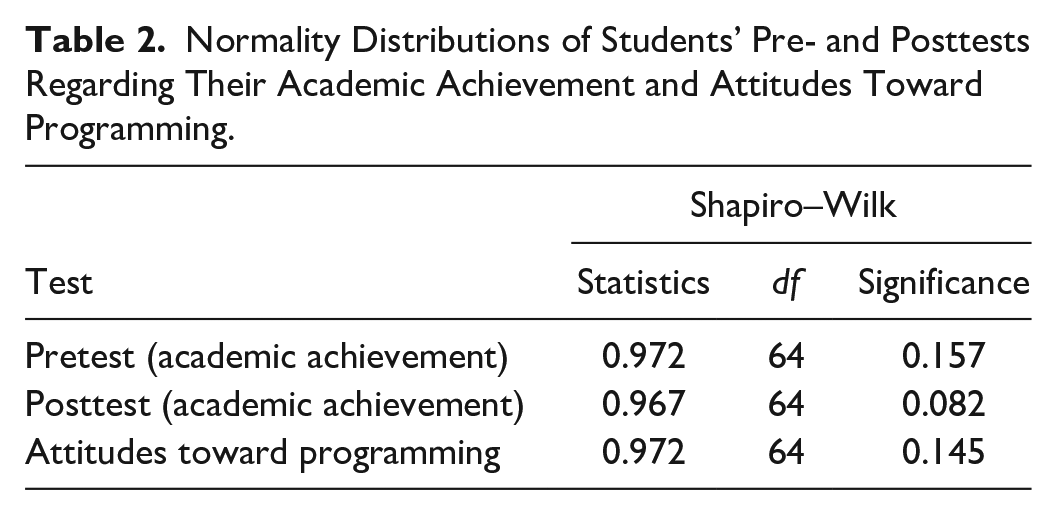
The SPSS 24.0 program was used to analyze both qualitative and quantitative data. The Shapiro–Wilk test was employed to determine whether the data regarding academic achievement for both groups were normally distributed or not in order to ascertain whether parametric or nonparametric analysis should be implemented (Razali & Wah, 2011)
As can be seen in Table 2, the Shapiro–Wilk test results signaled that the students’ attitudes toward programming were normally distributed, p (attitude) = 0.145; p> .05. Therefore, the independent t-test was employed to compare the pretest–posttest academic achievement and attitude toward programming scores for both groups. The results of the analysis were interpreted with a 0.05 significance level.
Normality Distributions of Students’ Pre- and Posttests Regarding Their Academic Achievement and Attitudes Toward Programming.
As can be seen in Table 3 of the result, the independent samples t-test, t(62) = 0.34, p> .05, demonstrated that no statistical significance existed for both groups in terms of academic achievement. These results also imply that the two groups were equivalent to each other before the application of the flipped classroom model.
Independent Samples t-Test Results of Groups—Pretest Academic Achievement.

Content analysis, which is considered as one of the most appropriate methods in qualitative data analysis, was conducted by converting voice recordings gathered from the participants (during the focus interviews) into text format (Barbour & Kitzinger, 1998/1999). Furthermore, the voice recordings that were converted into text format were codified on the basis of the research questions of the study. Then, these codes were compared with each other on the basis of similarity and relationships. Codes that were related or similar to each other were categorized and themes were formed. In addition, while the researchers were analyzing the texts, a scholar that did not actively participate in the current study but is considered as an expert on the relevant field double-checked the themes to ensure the reliability of the present study.
At the end of this process, the Reliability = Consensus / Consensus + Dissensus formula was applied to the coding (Miles & Huberman, 1994). The rate of adaptation among coders was calculated as 79%. The categories created after coding have been listed in a frequency table. In addition, the qualitative data obtained from the focus interviews were transcribed through quotations of the students’ attitudes.
Application
Used Tools
The tools used in the application process of the research are shown below:
YouTube: Creating a YouTube Channel and publishing interactive course videos (https://www.youtube.com/user/ataspolat)
Facebook: Sharing announcements, providing communication, sharing videos
Moodle: Course content sharing and classroom activities.
Kahoot: Preparing motivational questions with video support to motivate students.
Camtasia—Software for recording videos on the computer.
PowerPoint—Presentation preparation software for explaining theoretical information
Java SDK and Eclipse—Java application platform in programming languages course.
Application Process
For the experimental group, which was comprised of a total of 30 students, the course videos were prepared by the instructor using the Camtasia application according to the weekly course plan and the theoretical information about the subject to be taught in that week. The videos were shared with the experimental group at least 3 days earlier via a channel opened on YouTube and a group created via Facebook. At the beginning of the course, teachers asked the students whether there was any information they did not understand from the videos, and the necessary answers were given by the teacher.
Afterward, to provide motivation and encourage students to watch videos and repeat the subject, in-class activities were enriched by media support, and multiple-choice questions were provided by a Kahoot event. The questions prepared by the teacher were projected onto the blackboard in the Kahoot event.
The students answered the questions in a gamification process with their tablets, smartphones, or personal computers. Fast and accurate responders scored higher and students competed with each other. As shown in Figure 2, the leader board consisting of the top five students at the end of the Kahoot event was shared on social media and the winners were recognized. Then, as shown in Table 4, the teacher started the in-class activity of the week, which was either individual or group work. All instructions and other course contents related to the activity of the week were shared with the students via Moodle (Figure 3). During the activity, the teacher guided the students by giving them the tips they needed to do the activities. At the end of the course, the students sent these activities to the teacher via Moodle. The teacher graded the students on the basis of these activities.

Top 5 students in Kahoot event.
7. Weekly Classroom Activities.


Shared course contents on Moodle.
In addition, a discussion platform was created on the Facebook group about the activity to be held in the next course and the students expressed their opinions accordingly, which presented the opportunity to see different perspectives. Taking into account these discussions, the teacher prepared the activity for the next week. Table 5 shows weekly classroom plan.
Weekly Classroom Plan.

The control group students learned the theoretical part of the programming language course with the PowerPoint presentations prepared by the teacher according to the traditional method during the course. After the theoretical lecture, the application covering the topics of the week was done in the remaining time. The course teacher shared the course contents with the students on the website.
Results
The Impact of Flipped Classroom Approach on Students’ Academic Achievement in the Content of Programming
As mentioned earlier, students in the experimental group were educated through the flipped classroom model while students in the control group were lectured by the traditional teaching approach. To measure the impact of the flipped classroom approach on academic achievement in the context of programming, a normality test was conducted by practicing the Shapiro–Wilk test for both groups. The Shapiro–Wilk test findings demonstrated that the posttest results of both groups were normally distributed p(posttest) =.082; p>.05). In addition, to test the existence of statistical significance in terms of posttest results of students’ academic achievement (for both groups), the independent sample t-test was employed. The independent sample t-test results are summarized in Table 6.
Independent Sample t-Test Findings Regarding Both Groups’ Posttest Academic Achievement Scores.

The independent sample t-test results indicate that there was a statistically significant difference between the two groups in the context of their academic achievement in programming. In other words, students in the experimental group were more successful at programming (M = 79.81), t(62) = 3.80, p < .05, when compared with the students in the control group (M = 64.41).
As portrayed in Figure 4, the traditional teaching approach positively influenced the students’ academic achievement. However, the study concluded that the flipped classroom approach, which is accepted as one of the effective new generation teaching methods, had a more significant impact on the students’ academic achievement.
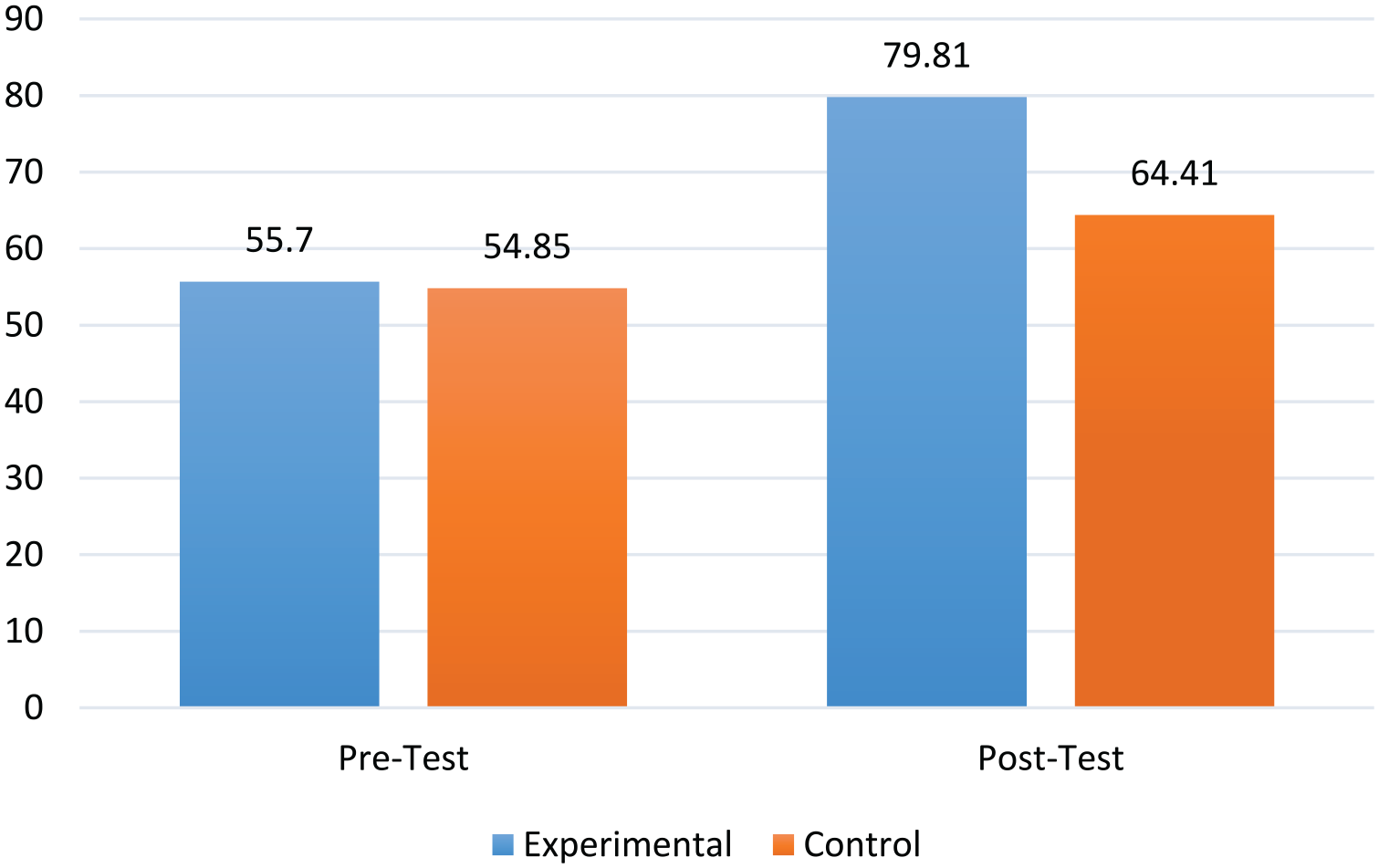
Posttest results of both groups.
As illustrated by Table 7 above, a considerable difference existed between the groups in the context of their pretest and posttest measurements. From this framework, it can be concluded that the students in the experimental group (who were educated through the flipped learning approach) tended to have higher scores when compared with the students in the control group (students who were educated through the traditional education method), F (1–62) = 21.73, p < .01. Thus, it can be stated that the two groups were statistically different from each other.
Repeated Measures of Experimental and Control Groups—Pretest and Posttest Results (Repeated Measures).

Students’ Attitudes Toward Programming Through the Flipped Learning Approach
The Shapiro–Wilk test was employed to determine whether the attitudes of both groups (Experimental and Control groups) toward programming were normally distributed or not. The Shapiro–Wilk test findings demonstrated that the posttest results of both groups were normally distributed, p(attitude)= .145; p>.05. To test the existence of statistical significance in terms of their attitudes toward programming (for both groups), the independent sample t-test was employed. Independent sample t-test results are illustrated in Table 8.
Independent Sample t-Test Results of Students’ Attitudes Toward Programming.

As seen in Table 8, statistical significance existed among both groups in the context of their attitudes toward programming. In other words, the results of the study indicated that the attitudes of the experimental group toward programming were more favorable when compared with the attitudes of the control group, t(62) = 8.24 p < .01. To be more accurate, the results exerted that the attitudes of the students in the control group toward programming were moderate, whereas the students who were studying with the flipped classroom approach in the experimental group had more positive attitudes.
Attitudes of the Students Toward the Flipped Classroom Approach
Students’ attitudes toward the adaption process regarding the flipped classroom approach
The students were asked to identify how the adaptation process took place in the context of the transition from the demonstration approach to the flipped classroom model. Themes were formed in the light of the participants’ responses. Responses were portrayed in Table 9.
Students’ Attitudes Toward Adaption Process Regarding Flipped Classroom Approach.
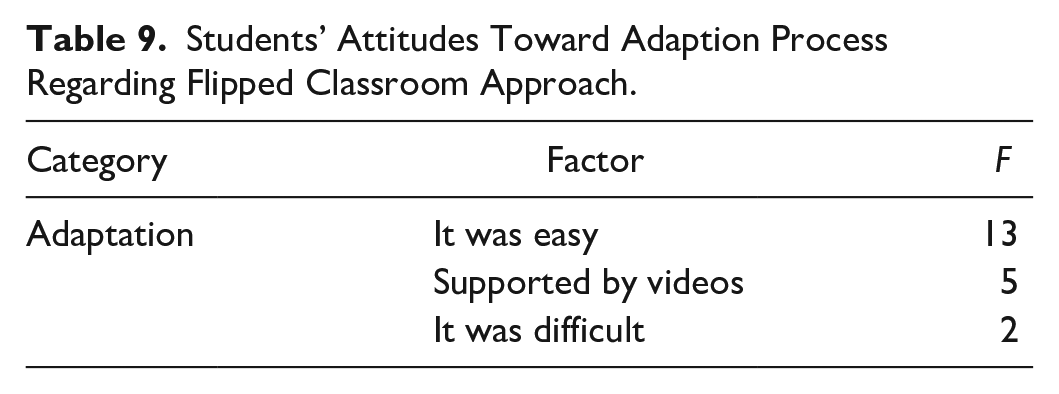
It could be concluded that most of the students expressed that the gamification activities and competitive sphere had facilitated the adaptation process, (f = 13), while the videos and other course-related materials also facilitated the process of adaptation (f = 5). In addition, two students indicated that they encountered some difficulties since they did not experience this type of approach before. Some of the responses obtained from the participants on this topic are as follows: P2: The awards that were provided at the end of in-class- and out-class activities increased my attention towards the approach. Besides these, I used some other sources which were really helpful for expanding my knowledge and advancing my skills regarding the system. P5: At the beginning, I had some worries about the approach, but then the awards that were given at the end of the in-class and out-class activities provided me with a better understanding of the new approach and helped me to make a smooth transition during the adaptation process.
Attitudes of the students regarding the advantages of the flipped classroom approach
Students were asked to compare the traditional education method and flipped classroom approach and then articulate the advantages of the flipped classroom approach. The responses of the participants have been displayed in Table 10.
Attitudes of the Students Regarding the Advantages of the Flipped Classroom Approach.

It can be seen that the students provided various responses regarding the advantages of the flipped classroom approach. The most pronounced response could be depicted as “it helped me to build better communication with my friends” (f = 8). Other responses that were mentioned about the advantages of the approach included “I have the opportunity to watch the course from anywhere that I can connect to the internet” (f = 6), “We have more time to apply what we have learned” (f = 5), “It is student-centered” (f = 5), “It is fueling my motivation” (f = 4), “My attention towards the course is increasing” (f = 4), “It helps us to build better communication with our teacher” (f = 4), “It teaches better” (f = 4).
Some of the responses obtained from participants on this topic are as follows: p10: First, it is time-friendly and it stimulates our motivation as we have covered the topics before coming to class. Moreover, when a student realizes that he/she knows at least something regarding the course, his /her attention towards the course will be increased even if he/she previously was not interested in the course. p8: In the flipped classroom approach, students tend to be more active and since teachers act as counsellors, the student can realize their talents. Besides, the communication that we build with our friends inside the class can continue outside of the class for communicating regarding our courses.
Students’ attitudes toward the disadvantages of the flipped classroom approach
Students were asked to compare the traditional education method and flipped classroom approach and then list the disadvantages of the flipped-classroom approach. The responses of the participants are illustrated in Table 11.
Students’ Attitudes Toward the Disadvantages of the Flipped Classroom Approach.
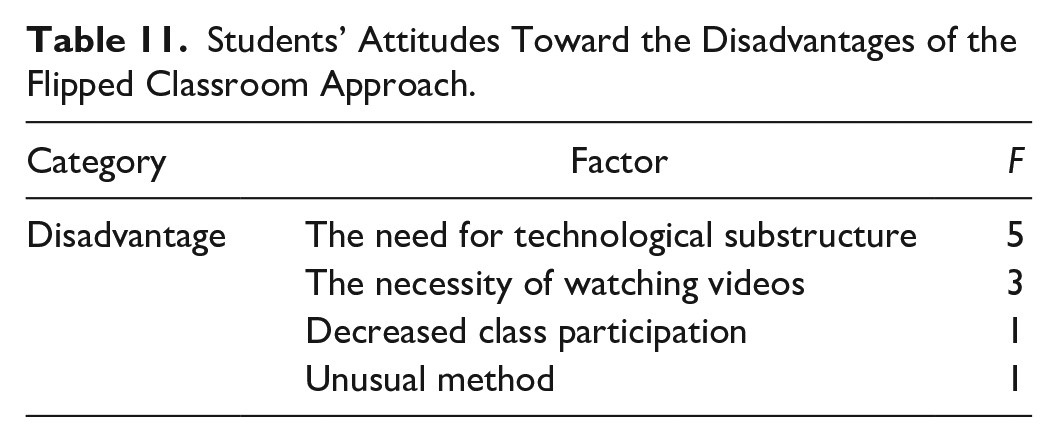
With regard to the flipped classroom approach to the programming course, of the need for a technological substructure (f = 5), the necessity of watching videos (f = 3), decreased class participation (f = 1), and unusual method (f = 1) was accepted as the most significant drawbacks of the flipped classroom approach.
Some of the responses gathered from participants on this topic are as follows: P11: Some students might not have a computer or access to the internet, while watching videos may cause them to exceed their internet limits. P13: To perform activities, we have to watch course-related videos before attending the class. In my opinion, watching course-related videos and the reduced time for relaxation at home could be considered as some of the main drawbacks of the approach.
The most admired features of the flipped classroom approach
The students were asked which of the features of the flipped-classroom approach they admired the most. The themes are presented in Table 12.
The Most Admired Features of the Flipped Classroom Approach.

The findings indicated that the quizzes that were conducted through the Kahoot application (f = 12) in-class activities (f = 8), group work (f = 8), and the competitive atmosphere were the prominent themes that the participants particularly enjoyed during the implementation of the flipped classroom approach. Some of the responses gathered from the participants on this topic are as follows: P13: I really liked the Kahoot activities since they created a competitive atmosphere. I did not really watch the course-related videos in the first weeks of the implementation; however, I and other students began to watch the course-related videos y during the following weeks. P4: I really enjoyed the group work, videos, and in-class activities P1: “I liked having the opportunity to watch the course contents regardless of space and time and since you have an opportunity to watch course-related videos, you can automatically prepare yourself for the course and reinforce your knowledge.
Discussion
According to the findings obtained in this study, the academic success of students in the experimental group who were trained by the flipped classroom model was observed to be higher than those who were taught using traditional methods. This finding of the study corresponds to the findings of Durak (2020), H. Özyurt and Özyurt (2018), Etemi and Uzunboylu (2020) that conducted a study to investigate the effect of the flipped classroom model on students “academic achievement and students” perceptions of the flipped classroom model in programming. Besides, similar effects were observed in the flipped classroom applications performed in different courses (Dill, 2012) and (Ekmekçi, 2014), whereas the results of the current study were not compatible with Marlowe’s (2012) research. To be more precise, Marlowe (2012) designed a study to identify the impact of the flipped classroom approach on the academic achievement of students who were taking an Environmental Systems and Societies course. The findings of the research signified that no statistical significance existed among the experimental and control groups in the context of academic achievement. However, the scholar argued that the experimental group tended to have higher academic achievement scores when compared with the control group. From this perspective, it can be determined that the flipped learning approach had a positive impact on the academic performance of the students in the context of programming languages. The factors that stimulated the academic performance of the students included the opportunity to spend more time on in-class activities and review the course materials whenever they wished, the students could shape their studies based on their own learning speed, as well as the elevated student-teacher interaction.
As can be seen in Table 7, a statistically significant difference existed among both groups in the context of their attitudes toward programming. In other words, the results of the study indicated that the attitudes of the experimental group toward programming were more favorable when compared with the attitudes of the control group, t(62) = 8.24 p < .01. To be more accurate, the results showed that the attitudes of the students in the control group toward programming were moderate, whereas the students who were studying with the flipped classroom approach in the experimental group had more positive attitudes. Therefore, the findings of the present study are in parallel with those reported in Stone’s (2012) and Chao et al.’s (2015) studies. However, the results of the current study were not compatible with H. Özyurt and Özyurt (2018) research. As a result of H. Özyurt and Özyurt’s (2018) study, the use of the flipped classroom model positively affected the academic achievement and programming self-efficacy levels of the students in the Introduction to Programming and Introduction to Algorithm course. However, it did not affect their attitudes in a programming language course. The dynamics of the flipped learning approach such as the opportunity to access enriched course contents easily regardless of time and space, learn theoretical knowledge via out-class activities while also applying the theoretical knowledge through in-class activities, and the role of teachers as coaches who encourage collaborative learning are considered some of the crucial factors that influenced the positive attitudes toward programming.
According to the qualitative results of the study, the students stated that it is easy for them to familiarize themselves with the flipped learning method with the help of the awards and videos. From this framework, the findings signaled that the usage of the gamification technique played a crucial role in contributing to a positive impact during the process of adapting to the flipped learning model that was employed for the programming course.
In addition, the students provided various responses regarding the advantages of the flipped classroom approach. The most pronounced response was that the flipped learning approach increases communication between teachers and students, makes the course contents accessible from anywhere and at any time, saves time for practice, is student-centered, and increases motivation. Several scholars have also articulated that the flipped classroom approach yields better student-teacher communication, facilitates learning and acts as an influential learning tool (Aşıksoy & Özdamlı, 2016; Sarsar et al., 2015; Toğay et al., 2013; Yavuz, 2016). However, some studies have also documented the disadvantages of the flipped classroom approach. For instance, some researchers have mentioned the lack of opportunities to have instant feedback, particularly for the courses with theoretical content, and it is believed that courses take too much time to complete, which could be accepted as crucial limitations of the flipped classroom approach (Stone, 2012; Turan & Göktaş, 2015). Moreover, the progressive perspective, opportunities for high-level cognitive learning, chances to combine the approach with various teaching methods, and a structure that is enriched with technology could be considered as the major characteristics of the flipped classroom approach that influence positive attitudes toward education model.
Students were asked to compare the traditional education method and flipped classroom approach and then list the disadvantages of the flipped-classroom approach. Its limitations include the need for technological requirements, the need for students to watch videos and the fact that students do not need to physically attend the course. Several scholars have conducted studies to explore the disadvantages of the flipped-classroom approach. Their findings revealed that due to the necessity to have a technological substructure, students may not be able to watch course-related videos before attending their classes, which presents challenges when implementing the flipped classroom approach (Talbert, 2012; Touchton, 2015; Yavuz, 2016). The contents and design of the videos, lack of technological substructure in the learning context, and/or students’ lack of technical competency may also cause students to articulate negative comments about the approach.
The students were asked which of the features of the flipped-classroom approach they admired the most. In addition, the majority of students stated that the most admired aspect of the method was the Kahoot application. In a study by Aydın (2016), it was found that the Kahoot application was helpful for increasing the motivation of students who were taught through the flipped classroom approach. Therefore, the findings of the present study are compatible with those of Betül’s (2016) study. The main reasons behind such findings include that the Kahoot application generates an enjoyable, competitive sphere through gaming, and students receive scores from questions that they answer correctly based on timing.
Implications for Research and Practice
This study will shed light on academic studies on the flipped learning class method, gamification, and coding.
The results of this study can be a guide for studies to be carried out with larger samples.
The results of the study will assist teachers when selecting methods for providing coding training and will guide the trainers who will use this method for the first time.
In the learning process applied using the flipped learning class method, it can be said that the activities planned in advance and supported by gamification and collaborative learning activities increase learner success and attitudes.
In this study, it was found that gamification activities such as Kahoot encouraged watching lecture videos. Researches on the support of the flipped classroom method with different gamification applications and teaching approaches can be conducted in large-scale groups.
The results of this study would add to the steadily growing literature of mixed methods, quasi-experimental studies of post-secondary students’ learning in disciplinary fields (computer programming) in terms of “traditional” versus “flipped classroom” approaches.
Conclusion
Today, programming and coding training for all age groups have become increasingly popular around the world. It is necessary to use new methods to increase student’s achievement and attitude in programming teaching. In this study, it was found that the attitudes of the students in the experimental group toward programming were higher than the students in the control group. In addition, it was determined that the achievement levels of the students in the experimental group were higher than the students who were taught with traditional methods. Continuation of courses with a student-centered model, presentation of rich course contents to the students outside the classroom, students’ ability to learn independently from time and place, and spending more time for applications within the classroom all contributed to the students’ positive attitudes toward programming and academic performance.
According to the qualitative results of the study, the students stated that it is easy for students to familiarize themselves with the flipped learning method with the help of the awards and videos. In addition, it was found that the flipped learning approach increases communication between teachers and students, makes the course contents accessible from anywhere and anytime, saves time for practice, is student-centered and increases motivation. Its limitations include the need for technological requirements, the need for students to watch videos and the fact that students do not need to physically attend the course. In addition, the majority of students stated that the most admired aspect of the method was the Kahoot application. In-class activities, group work, competitive learning environment, repetition of course contents and social media integration were identified as additionally favorable features. Furthermore, almost all of the students had positive views regarding the flipped learning classroom method.
Recommendations
It is necessary to try different teaching methods in programming courses and to do more research on these subjects. The learning differences of the students should be taken into consideration and the information should be enriched and presented to the students with materials that will address these differences. More time should be devoted to applications within the classroom for skills that can be gained entirely by application, such as programming. As in every study, this study has some limitations. The most important limitation of the study is that the study was carried out purely with the participation of students who were taking a Programming II course. For further studies, it is recommended that the opinions of students and educators in different coding courses should be taken. In addition, this study is limited to students at the higher education level. However, programming courses are now being taught at the primary school level. Further studies should be conducted with students at different levels. The present study was conducted with students with individual learning responsibilities as an age group.
Footnotes
Acknowledgements
We thank you for your consideration and we look forward to hearing from you. Meanwhile kind regards.
Authors’ Note
We request that you consider this manuscript for possible publication in SAGE Open. The manuscript is original. This work was from the data set of the first author’s doctoral dissertation and its data came from part of a larger project. It will not be submitted to another journal until we hear from you.
Author Contributions
This work was from the data set of the first author’s doctoral dissertation and its data came from part of a larger project. The manuscript is original. All scientific data are available. It will not be submitted to another journal until we hear from you. The second and third authors contributed to this article as doctoral thesis advisors. Expert opinions of other authors were used in every stage of the scientific study. The first author is responsible for literature review, application process of experimental study and data collection processes. The second author contributed to the analysis and findings section. The third author contributed to the conclusions of the article and the merging of all chapters and the necessary corrections.
Declaration of Conflicting Interests
The author(s) declared no potential conflicts of interest with respect to the research, authorship, and/or publication of this article.
Funding
The author(s) received no financial support for the research and/or authorship of this article.
Availability of Data and Material
The manuscript is original. All data and material used in the scientific study are available. These include attitude scale data, academic achievement test results, sbss files, focus interview audio recordings, course plans, course activity materials, and tools.
