




Abstract
In a postgraduate course for teachers of English as a foreign language in secondary school, teacher trainees were introduced to simulations through the use of flipped learning and simulation design. The objective of the present fieldwork was to determine whether designing simulation scenarios based on literature which delves into human rights was effective in introducing teacher trainees to the use of simulations in secondary education. To achieve this, the flipped model was followed, and theoretical considerations of simulations were analyzed on the part of the teacher trainees outside of class whereas practice was done in class. This article presents the findings of the qualitative analysis of postgraduate students’ perceptions with results that show that designing simulation scenarios based on reading texts on human rights can be a powerful tool for their future students. By designing simulation scenarios, the teacher trainees could see simulations potential to use the foreign language purposefully at the time affective learning and empathy were sought through the literary pieces on human rights.
Keywords
Introduction
Today’s demands for highly qualified and versatile teachers in Europe, in accordance with the Bologna Declaration (1999), calls for the development of curriculum design inspired by social-constructivist principles because learners are expected not only to acquire specific knowledge but also to develop generic competences that will enable them to “face the challenges of the new millennium, together with an awareness of shared values and belonging to a common social and cultural space.” (Bologna Declaration, 1999, p. 1) This context justifies the need for a methodological change in teaching practices as stated in the founding of the European Higher Education Area (EHEA). Learning by doing becomes the cornerstone of learning experience that was advocated by Dewey (1938) and the responsibility of teacher training for secondary education to provide the necessary practice and innovation in teaching methods. Teachers need to be trained to become more resourceful professionals, using active teaching and learning methodologies in general and simulations in particular. Despite its relatively short tradition, simulation has taken root as a teaching and learning strategy within the foreign language classroom in line with this change of paradigm in education. Simulation has been defined as “the artificial representation of a real-world process to achieve educational goals via experimental learning” (Flanagan & Nestel, 2004 in Al-Elq, 2010). Simulations foster the development of professional competences such as teamwork, negotiation, decision making, and the development of interpersonal relationships (Ekker, 2004; Ekker & Sutherland, 2009, among others).
Simulations create a complete environment within which students interact to apply previous knowledge and practice skills to real-world issues related to their discipline. They allow teachers at the same time to integrate multiple teaching goals in a single process (Andreu-Andrés & García-Casas, 2011; Angelini, García-Carbonell, & Martínez-Alzamora, 2015; García-Carbonell, 1998; García-Carbonell, Rising, Watts, & Montero, 2001; García-Carbonell & Watts, 2012; García-Carbonell, Watts, & Andreu-Andrés, 2012; Wedig, 2010). Simulations provide opportunities for active participation to develop interactive and communication skills and link knowledge and theory to application (Hertel & Millis, 2002).
It is then precise to distinguish between a simulation and a role-play. Unlike role-play, in which the participants play pre-defined characters and invent a scenario to play, simulations represent systems in which participants have functions. They are provided with key information that enables them to carry out tasks and solve problems. Furthermore, simulations can be norm-based or free-form, creating interactive learning opportunities (García-Carbonell et al., 2001). Simulations may deal with issues such as education, environmental problems, sustainable economies, and human rights. Thus, simulations create a natural context where participants become acquainted with different realities and problems; they interact, debate, and make proposals. In the present study, teacher trainees simultaneously become aware of social problems and develop linguistic creativity and proficiency (Ekker, 2000; García-Carbonell & Watts, 2009; Sutherland, 2000, 2002). Immediate feedback from the other participants indicates to learners if their communication has been successful (Asal & Blake, 2006; Blum & Scherer, 2007; De Garmo, 2006).
The gains of simulation applied to language learning are discussed at length by Crookall and Oxford (1990) and García-Carbonell et al. (2001). Advantages include the immersion in language learning through meaningful situations, immediate feedback through teamwork, constant interaction, and lower anxiety. Empirical research conducted by Angelini (2012), García-Carbonell (1998; García-Carbonell & Watts, 2012), García-Carbonell et al. (2001), and Rising (1999, 2009) supports the effectiveness of simulations in the development of communicative competence in English as a foreign language (EFL).
For example, there is recent qualitative research based on students’ perceptions after a telematic simulation. Watts, García-Carbonell, and Rising (2011) found that students’ motivation increased during the simulation and that their interpersonal skills were reinforced. Andreu-Andrés and García-Casas (2011) found that students had fun while learning. Woodhouse (2011) demonstrated that a computer-assisted simulation greatly helped EFL students to consolidate linguistic structures as well as professional skills such as negotiating, making decisions, and working collaboratively. Angelini and García-Carbonell (2014) also corroborated the effectiveness of simulation and gaming in improving oral proficiency in EFL along with the development of student responsibility and the generic skills mentioned above.
Thus, in view of the need for a methodological shift and in light of the virtues that simulations have to offer, this study poses the following research question:
Following the flipped classroom model, students are first presented with readings on human rights. By flipping the classroom, we invert the traditional teacher-centered method, delivering instruction online outside the class time and moving the traditional homework into the classroom (Strayer, 2007; Tourón, Santiago, & Diez, 2014; Tucker, 2012). In this way, the flipped model uses educational technology to deliver theory and background materials and provides opportunities for learning through activity in class. This paradigm shift brings about a change in the teacher and learner roles. In the flipped model, instructors become facilitators and guides on the side as learners work in groups or teams; learners are then the real participants in the action that takes place in the classroom (Strayer, 2007, 2012).
It is true that some teachers may be already flipping their classes by providing students with material to read or watch outside of class. However, according to the Flipped Learning Network, 1 to engage in the flipped model, instructors must incorporate the following four pillars in their teaching practice: flexible environment, learning culture, intentional content, and professionalism.
Creating a flexible environment involves rearranging the classroom design to meet the needs of the particular action that is going to take place. Teachers create learning spaces, often learning corners in our case, in which students circulate from one corner of the classroom to another to deal with the different tasks. Moreover, teachers who flip their classes must also be flexible in their expectations of student learning style (Hiemstra & Sisco, 1990; Jonassen & Grabowski, 2012). Thus, the flipped model can be aligned with individualized instruction as it offers the opportunity for adequate tutorial guidance by providing scaffolding material to be read or watched outside the class. The flipped classroom model also helps maximize each learner’s potential for success as teachers can move around the classroom, approach individual learners, and identify learning styles, interests, abilities, and difficulties to provide differentiated instruction (Fuller, 2015; Mazur, Brown, & Jacobsen, 2015).
In addition, learning culture develops through learners’ personal involvement in knowledge construction, participation, and reflection on their own learning process. Through the implementation of the flipped classroom, learners’ autonomy and collaboration are expected to be enhanced by doing the theoretical work outside of the class (Bailey, Ellis, Schneider, & Ark, 2013; Bergmann, Overmyer, & Wilie, 2013). Thus, this instructional shift from a teacher-centered to a learner-centered approach provides more opportunities to deal with a variety of topics in class and create a rich learning environment.
In the flipped learning model, teachers select content with a view to making the best possible use of class time. They can carefully choose the active classroom techniques or methods that better support learners’ development of conceptual understanding (Berret, 2012; Musallam, 2014).
Finally, successful implementation of the flipped classroom model demands a high degree of professionalism, as teachers must provide relevant and individualized feedback, carry out ongoing formative assessment, and reflect on their practice to optimize resources and improve classroom management (Bergmann, 2013; Bergmann & Sams, 2012). Also, the professional teacher communicates with other professionals who use flipped classes, exchanges viewpoints, and accepts constructive criticism. Teachers are the principal conductors of the orchestra; thus, it is their responsibility to guide the learning process effectively.
Materials and Method
A group of postgraduate students (N = 103) were asked to respond to a classroom-based experience in teaching EFL and literature. The participants were teacher trainees at the Catholic University of Valencia San Vicente Mártir receiving instruction in the official postgraduate course titled “Didactic Resources for Teaching EFL and Literature in Secondary Schools.” The data were collected from three consecutive courses.
Following the flipped learning model, teacher trainees used text and video materials uploaded to the class intranet to prepare for class sessions. (See the appendix for a list of materials used). Some examples of simulations and simulation scenarios were analyzed in class. In teams of up to five members, teacher trainees worked together on the design of scenarios on the topic of human rights. Scenarios were based on the themes from the literary pieces that may be taught in secondary education in Spain, namely, John Steinbeck’s The Grapes of Wrath, Chinua Achebe’s Things That Fall Apart, and Linda Sue Park’s A Long Walk to Water. The ultimate goal was to develop scenarios, profiles, procedural norms, and debriefing instructions. The procedure followed in the study can be seen in Figure 1.
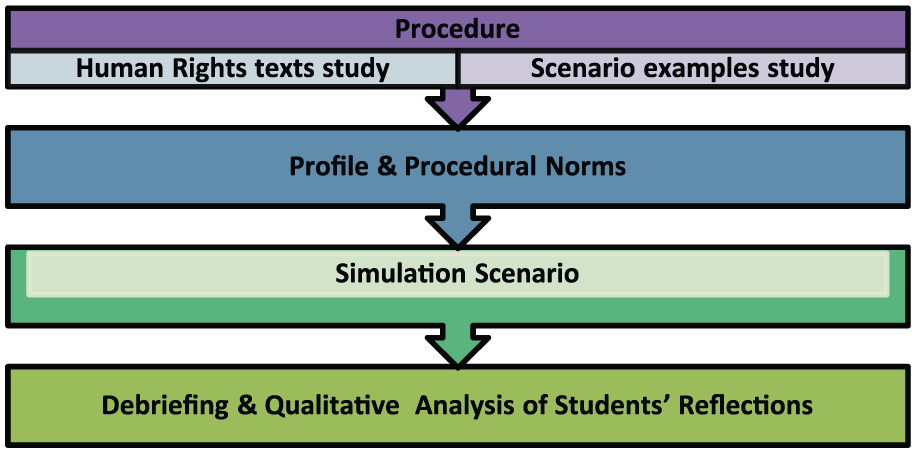
Graphic representation of the procedure followed in the present study.
First, teacher trainees analyzed and selected pieces of literature that might be useful in promoting human rights in secondary school. Second, they were introduced to flipped learning through tasks to be done outside of class. They read about simulations foundations and then analyzed some International Communications and Negotiation Simulations (ICONS) 2 (see example in the appendix). Clear guidelines were also provided on how to design a scenario for a simulation.
As Phase 1 (Briefing) consists of the simulation preparation, the facilitator has to provide all the necessary pieces of information that pave the way for the Phase 2 (Action). In Phase 2, the simulation takes place, and in Phase 3 (Debriefing), participants reflect on the experience, teamwork, their roles, and their learning process. To start with, all our attention centered on Phase 1, because the teacher trainees had to learn about simulations to be able to create one later. They had to
Choose a literary piece to be read by secondary school students about human rights
Identify themes and sub-themes concerning human rights and carry out traditional literary analysis as time permitted (plot, characters, action, themes, setting in time and place)
Write the first draft of a possible simulation scenario based on one of the themes from the text, bearing in mind the following aspects: setting (Where does the action take place? What is relevant to mention about the place?), current situation (What is the problem to be discussed/solved?), personal profiles (Who are the participants who may intervene in the problem-solving situation? Advisable to design profiles from different sectors in society), procedural norms specifying guidelines to help participants know the rules and constraints before the simulation starts (e.g., it is not allowed to interrupt the course of action by any means; all participants must respect the rules during the simulation)
Share the first draft with another team for feedback. Accept or discard suggestions
Hand in a revised draft for correction
Give and receive feedback on scenario proposals
To gain deeper insights into human rights, teacher trainees watched fragments of TED 3 (technology, entertainment, design) speeches outside of class on the importance of including human rights in daily teaching.
Subsequent sessions fostered teamwork and collaborative learning through learning corners in which teacher trainees worked on scenario design, procedural norms, and profiles under the guidance of the instructor. Collaborative intergroup learning gained importance as the teams received their first feedback on their proposals by their peers. The final project involved creating a simulation consisting of a scenario, profiles, the procedural norms, and instructions for debriefing. Teacher trainees were then asked to reflect on the teaching proposal for the course by responding to the following open question in writing: “What are your views on the teaching proposal for the course?” Written responses (N = 103) to the open-ended question were uploaded onto the university intranet platform and later extracted for analysis. A qualitative analysis 4 was conducted in accordance with current qualitative research practice (Casasempere, 2007). Responses were first classified into initial categories and subcategories until saturation of the data with the aid of ATLAS.ti, Version 5.2. Finally, the main conceptual categories were defined.
Results
The teacher trainees’ perceptions on simulation yielded four categories: simulation scenarios as a learning tool, literature to enhance students’ understanding of human rights, students’ spontaneous affective learning, and flipped learning in EFL classes.
As for the first category, simulation scenarios as a learning tool, most teacher trainees had positive feelings toward simulation. Designing scenarios based on reading material intended for secondary school somewhat broadened the teacher trainees’ perspectives of working with literature in class. For some, the issues dealt with in the texts were not new; as several pointed out, reports of human rights issues, such as hunger, deprivation of education, child labor, among many others, are widespread nowadays.
I find it really dynamic and I would like to know more about it. I see a great potential in the method and also teachers may benefit from this to create more active classes. (P2) Some topics are not actually new and students are familiar with them in one way or in another. It’s a method to connect with reality, to make it our own. I think I will use with my students as what they demand is more real practice rather than theoretical classes. (P31) I find that English is enhanced by participating in a simulation. Students will listen to each other, they’ll have to take notes and speak about the situation. (P32)
In contrast to traditional simulation instruction, in our study, the method emerged from the text instead of using a simulation to teach content. The teacher trainees found great potential in applying simulations in their own classes. They felt they could manage a wider range of language-related skills. At the same time, they had participated actively in designing a simulation that they would be able to run with their own students. This activity introduced the teacher trainees to the dynamics of designing simulations.
In the second category, literature to enhance students’ understanding of human rights, the teacher trainees stressed the benefits of the freedom of working with reading texts that will serve as a springboard to introduce the simulation later. In most cases, literature is treated in a conventional way in secondary school: learners read, discuss a setting in time and place, and analyze characters and plot, and so on. In designing a simulation, the teacher trainees discovered that they could go beyond the chosen text and gain a much wider understanding of social issues due to the interactive dimension of the simulation. The fact that they had to work in teams to design scenarios paved the way to a common understanding of their personal views on the subjects. Some found it difficult to reach an agreement because prejudices against race, religion, social status, gender, and so on interfered and led to confrontations. However, only a few participants felt uncomfortable about dealing with these topics.
Thanks for this opportunity. I really foresee the potential of the simulation and how my own students may benefit from it and become more conscious of social problems. Communication is definitely fostered. (P14) I found it rather hard at the time we had to defend some rights. Moral issues and diversity of opinions led to some misunderstandings. I felt bad about that though I experienced some catharsis and real immersion in the discussion; needless to say that I’ve questioned my own position about certain topics as well. (P29) I think it’s hard to speak about some controversial issues as in some religious institutions this may not be seen as “correct.” However, if I just center my attention to language learning, I believe that the simulation may work very well with most of the students. (P83)
Most teacher trainees considered the experience to be fruitful, as they found themselves capable of maintaining meaningful interactions with their peers and reaching agreements. Their reflections suggest that by working with literature before designing and implementing the simulation, they gained insights into both human rights and their own personal positions toward the issues.
The third category that was revealed was students’ spontaneous affective learning. Most of the teacher trainees found the experience very engaging, especially when bearing in mind their future students. They believed that integrating simulations into the classroom and making their own students participate actively in class could result in a more satisfying learning experience.
I think my students will prefer working with simulation to working in a conventional way simply because by means of a simulation they’ll share the workload, they’ll be part of a team and they’ll enjoy the English class more. (P12)
A few participants indicated that controversial topics, such as abuse of women, might not be suitable for certain ages. However, it may be argued that because teachers are responsible for selecting the reading texts to design the scenarios, each teacher has to adapt the classroom material and method, taking into account variables such as student age and ideology.
Simulations must be used carefully as some students may not be ready for some topics as women abuse or other controversial ones. However, I see I may work with them in my school and start building on empathy, so necessary nowadays. (P7) I would use simulations selecting the material to be discussed as my students are 13 to 14 years old. I’m afraid maturity to fully understand the problematic issues is necessary. (P16)
All the teacher trainees, however, acknowledged the power of simulations to understand other people’s feelings, thus awakening empathy through the sensations and feelings that participants experience in response to the emotions of others.
The fourth and final category, flipped learning in EFL classes, brought out reflections on the potential of the model in contrast to the uncertainty it provokes as a rather new teaching strategy in schools in Spain.
Flipped learning seems to be just right for elder students. I believe students can learn more in class by doing something meaningful. It is important to educate students in autonomy and responsibility, though. Young learners may not do their part at home and come to class unprepared. I liked the idea of flipped learning in this course. (P46) I find the flipped classroom very innovative and with lots of possibilities. Students and teachers can use class time in projects or more dynamic activities. In English lessons, students can lean the grammatical rules at home and play games in class. (P67) I like experiencing flipped learning in this course although I may disagree with an abrupt implementation of flipped classroom in schools. I think teachers and students have to receive some training as it is a new method and may not work as expected. Also, teachers are tired of doing courses to innovate in class and unfortunately they continue with the traditional model. (P91)
From the participants’ comments, we can conclude that despite its potential, the successful implementation of the flipped learning model depends mainly on two factors: students’ commitment to self-study, and teachers’ training and dedication to innovation. In addition, some participants highlighted “screen-dependence” as a negative influence on socialization. Some expressed concern that the model might not be totally accepted by parents.
Although I liked the proposal as it was new for me, I feel students will spend much of their time in front of their computers. This is against what we are trying to implement at my school. The dynamics we follow is in line with interaction and project-based instruction in class. (P95) Flipped learning is innovative and teachers must be updated and open to new models. I may like to use it in class but I’m afraid parents would complain at the great exposure students would have in front of a computer. There should be some kind of regulation as to how much work we assign to students. (P102)
To conclude, the concern that flipped learning brings about is evident. Teachers must trust students to watch the lectures and the selected material at home, and there is no way to guarantee students will cooperate with the flipped model. It is up to the teacher’s creativity to motivate students to participate and benefit from the approach. In regard to screen-exposure, some argued that this might have some consequences on the students’ social life. In fact, this is totally understandable. However, the flipped model has gained acceptance in some educational systems because it caters to student’s interests. We all know that students today are digital natives and manage computers naturally. So, instead of having learners play games or just surf the net with no clear purpose, the flipped model has students using technology purposefully.
We agree that the flipped classroom model needs more time to gain acceptance as a hands-on approach to improving student achievement and involving them in their own education.
Conclusion
The teacher trainees’ reflections on using simulations as a learning tool, the use of literature to enhance students’ awareness of human rights, and students’ spontaneous affective learning, show that teachers perceived the potential of simulations as an effective tool to teach language and literature, with the added value of building social awareness. During the process of scenario design, the teacher trainees had the opportunity to express their opinions about several issues using English at all times. The teacher trainees found themselves immersed in the simulation design dynamics. If this were applied to secondary school students, language learning would acquire a different, more promising dimension linguistically speaking. Integrating the flipped learning model and simulation design also facilitated the treatment of literature. Instead of just performing a traditional analysis, we propose to plunge students into a simulation in which they benefit not only linguistically but also culturally and socially. Simulations seem appropriate due to their open-ended nature that engages participants in the action with total freedom of expression. Although successive qualitative and quantitative studies over time and a broader sample may increase reliability in the integration of simulations and flipped classroom in foreign language learning, the results of the present study indicate that the approach can be an effective way to introduce simulations in foreign language classes at secondary education.
Footnotes
Appendix
Declaration of Conflicting Interests
The author(s) declared no potential conflicts of interest with respect to the research, authorship, and/or publication of this article.
Funding
The author(s) received no financial support for the research and/or authorship of this article.