



Abstract
This article assesses the effectiveness of two active learning formats –a fully flipped and a semi-traditional one – for students’ soft skills, such as critical thinking, teamwork, self-efficacy, and learning perception, and for students’ achievement measured in terms of grades. To measure the impact on the soft skills, it uses a Wilcoxon test, with the goal of comparing the evolution of each soft skill in the flipped and semi-traditional formats. To measure the impact on grades, it uses a repeated measures ANOVA with the goal of detecting possible differences in terms of students’ achievement between the flipped and the semi-traditional format. The participants were 45 students enrolled in a Dual Degree in International Relations and Global Communication of a private Spanish university. Our study did not detect a clear tendency in favour of one format or the other in terms of students’ performance with either grades or soft skills. Far from considering this as an indication against implementing active teaching formats, we argue in favour of blending different types of traditional and active learning techniques, instead of prioritising one over the other.
Plain Language Summary
Comparison between the effects of a Flipped and Non-Flippped Political Science class on students’ academic achievement (grades) and soft skills
Keywords
Introduction
Many educators consider traditional teaching formats, mostly based on teacher’s lectures, well-suited for the “transfer of basic knowledge,” or the “memorization of information” (Omelicheva and Avdeyeva, 2008, p. 603). However, these formats are considered less effective for the “development of higher-order reasoning skills” (Elen and Clarebout, 2001, p. 89). According to these views, education should be “collaborative,” that is, capable of teamwork and critical reflection (Kim et al., 2013), “problem-based,” inspired by real-world issues and their possible solutions (Burch, 2000), and adaptable to digital technologies (Collins & Halversont, 2010).
While the use of active learning techniques has been quite common in disciplines such as natural sciences, engineering, or education, their presence is more limited in the field of Political Science (PS) and International Studies (IS). Thus, the twofold goal of this article is to compare the effectiveness of two active learning formats – a fully flipped and a semi-traditional one – in terms of students’ achievement measured in terms of grades, and in terms of soft skills, that is their critical thinking, teamwork, self-efficacy, and learning perception. The two research questions that guide the study are:
Research Question 1 (RQ1): Are students’ soft skills) more likely to be enhanced by a flipped or a semi-traditional format?
Research Question 2 (RQ2): Are students’ grades more likely to be improved by a flipped or a semi-traditional format?
Literature Review
The Flipped Classroom (FC) entails a large redefinition of the teaching time and space. By removing traditional frontal lecturing from the classroom and assigning video-lectures and other materials as activities to be done outside of the classroom, the FC allows to save class time that can be devoted to activities to apply and solve doubts about the knowledge acquired at home (Jenkins, 2015, p. 607). The learning process is, thus, inverted. Students “do the lower levels of cognitive work (remember, understand) outside of the class and, thus, can focus on the higher levels (apply, analyse, evaluate) inside the class under the direction of the instructor and the support of fellow students” (Yamarick, 2019, p. 1).
The first studies on the FC primarily focused on describing and reporting its possible implementations, but they were seldom accompanied by systematic investigations on learning outcomes (Lundin et al., 2018, p. 16). For these reasons, in the last decade, an increasing number of scholars have conducted empirical analyses of the possible impact of the FC on students’ hard and soft skills.
In the field of active learning, academic achievement is usually operationalised as grades. Scholars across different disciplines generally agreed that the FC positively affected students’ grades, when examining studies comparing the effects of traditional and flipped formats on students’ achievement. This was the case, for example, of some successful implementations of the FC in the fields of Education (Flores et al., 2016), or Business (Hsieh et al., 2017) However, a minority of studies found no specific differences between traditional and flipped teaching formats in terms of academic achievement. This was, for example, the case of an implementation of the FC in the field of Pharmacy (Mclaughlin et al., 2013). In the fields of PS and IS, one can find a similar debate. Some scholars discovered an improvement in the performance of students exposed to the FC (Touchton, 2015), while others did not find any clear relation between the type of teaching format and student performance (Lambach et al., 2017).
Soft skills are usually defined as “interpersonal qualities, also known as people skills, and personal attributes that one possesses” (Robles, 2012, p. 453). Four main soft skills are usually studied in the literature on active learning. Critical thinking refers to the capacity “to think reflectively and judge skilfully, so as to decide what information is reliable and what actions should be taken.” (Kong, 2014, p. 3).
Psychologists have defined self-efficacy as “people’s beliefs about their capabilities to produce designated levels of performance.” (Bandura, 1994, p. 2). Thus, self-efficacy tends to be identified with “students’ beliefs about whether they are able to show certain learning behaviour” (Baars and Wijnia, 2018, p. 127). Teamwork is usually associated with several abilities, such as “direct[ing] and coordinat[ing] the activities of other team members” (leadership), “apply[ing] appropriate task strategies” (monitoring), “anticipat[ing] other team members’ needs” (backup behaviour), and “adjust[ing] strategies” (adaptability) (Salas et al., 2005, p. 558–559).
Finally, learning perception has been related to the “cognitive effort required during…learning” (Deslauriers et al., 2019, p. 19251). Although a precise definition is not easy to find, it is frequently associated with the students’ satisfaction (or dissatisfaction) with a specific teaching format.
Among the studies that conducted experiments to test the effectiveness of the FC as compared to other more traditional teaching formats, there is a general consensus that an inverted format has the potential to enhance students’ critical thinking, for example in Business (Hsieh et al., 2017), or High School Education (Kong, 2014). A similar consensus is observable as to the students’ teamwork abilities, for example according to some implementations in the field of Engineering (Karabulut-Ilgu, et al., 2018) or Education (McNally et al., 2017). In contrast, one of the few studies available did not detect any specific benefit of implementing an FC for students’ self-efficacy (McNally et al., 2017).
Results are more mixed in terms of learning perception. Several studies across different disciplines found that a flipped format does not only improve grades but also students’ satisfaction in terms of increased learning. This was the result of an implementation in Biology (Awidi & Paynter, 2019) and of one in High School Education (Chen et al., 2014). Others detected less consistency: despite an improvement in students’ achievement, the FC would not enhance their learning perception, as indicated by a study in the field of Pharmacy (Mclaughlin et al., 2013). In Psychology, Roehling et al. detected a null effect on students’ grades and a negative impact on their satisfaction (2017). In one study, from the field of STEM, students obtained better grades with active learning formats, while simultaneously feeling that they were learning less because they associated the “cognitive effort required during active learning” with “poorer learning” (Deslauriers et al., 2019, p. 19251). Other studies have identified additional challenges in terms of students’ satisfaction with the FC. For example, if watching videos alone and with no possibility of interrupting the class for questions, some students can become bored more easily and more passive in their learning process, as indicated by some studies in the fields of Education (Galindo-Dominguez, 2021) and English Teaching (Han, 2022). Others detected that some students could feel overwhelmed by the flipped format innovation after being accustomed to traditional formats based on frontal-lecture-style teaching (Han, 2022).
In PS and IS, Lambach et al. generally observed a positive impact of the FC on students’ critical thinking (Lambach et al., 2017, p. 556) and teamwork skills (Cit., p. 563), while others found a substantial negative effect on teamwork (Jenkins, 2015, p. 610). While we could not find any political scientist studying the impact of the FC, or any other active learning technique, on self-efficacy, both Lambach et al. and Jenkins reached mixed conclusions in terms of learning perception. The former noted that only half of students preferred the flipped format (Lambach et al.,2017), while the latter reported that students preferred “mixed class sessions” over “having all flipped-class sessions (Jenkins, 2015, p. 610).
Improving Flipped Classroom Studies
The above-mentioned studies are important contributions to assessing the effectiveness of the FC for students’ learning. Nevertheless, many tend to conduct comparisons between fully traditional formats, based on frontal lectures, and flipped formats. The problem is that such formats can sometimes present differences too large to be compared. Comparing FC with traditional, and nowadays highly criticised formats, can lead to unsatisfactory conclusions, such as that “active” is better than “traditional.” For this reason, similarly to other few studies (Betti et al., 2020; Jensen et al., 2015; Lai & Hwang, 2016), we think it methodologically more appropriate to study the effectiveness of the FC by comparing it with other active learning formats.
The increasingly frequent implementation of active learning modalities across many university systems and disciplines calls for comparisons between an FC format and “a control model that uses active learning” (Jensen et al., 2015, p. 11). This can help to “parse out the effects and pinpoint a specific causal factor” (p. 2).
This methodological choice has been gradually included in several studies on the FC. Some discovered that the effectiveness of the FC in improving students’ achievement (grades) is more robust when the flipped format is administered in a self-regulated way, in which students are required to supervise their own learning outcomes (Lai & Hwang, 2016), or when the FC is complemented with teamwork and cooperative activities, as indicated in an implementation in the field of Economics (Foldnes, 2016). Others detected a positive impact of the FC on students’ achievement after comparing it with simulations in a study on College Education (Davies et al., 2013). In PS, after comparing it with an online teaching format, Whitman Cobb discovered that the FC improves student achievement (Whitman Cobb, 2016), while van der Van der Zwan and Afonso observed an advance in students’ grades when the FC is implemented in a blended format, combining offline and online teaching (Van der Zwan & Afonso, 2019).
As to critical thinking, the only studies that we could find, and that we reviewed above, were based on comparisons between traditional and active formats. As to teamwork, one study compared a flipped with other active learning formats, discovering that the flipped format positively affected students’ teamwork skills. This is provided that the FC is integrated with other cooperative learning techniques (Foldnes, 2016). As to self-efficacy, we could find only one study that, after comparing different types of FCs, detected a positive impact on this skill, provided that the flipped format is implemented in a self-regulated way (Lai & Hwang, 2016).
Finally, the studies that focused on learning perception by comparing the FC with other active learning formats revealed a variety of results. For some, the FC can improve both grades and learning perception, especially when it is complemented by other online teaching formats (Tang et al., 2020 for a study from Engineering). Similar conclusions can be found in the field of Computer Sciences, when the FC is integrated with the use of digital platforms, such as Moodle (Nouri, 2016), or other techniques, such as peer-reviewing (Arruabarrena et al., 2019), or when, as indicated by a study in the field of Education, is compared with simulations (Davies et al., 2013). In PS, Whitman Cobb similarly found that the FC can improve both students’ grades and perceptions when compared with online teaching (Whitman Cobb, 2016). In a different way, some studies observed that, while the FC can contribute to improving students’ grades, this does not necessarily mean that students are more satisfied with their learning. For example, in Nursing, Missildine et al. found that students are more satisfied with a lecture capture backup format, in which videos are used to review the contents of each class and not as substitutes for face-to-face classes (Missildine et al., 2013).
Additional problems can emerge in the way teaching formats are compared. Most studies compared the achievement and perceptions of two different groups of students who were exposed to different teaching formats. For example, the teacher taught in the FC style to an experimental group and a traditional non-flipped classroom format to a control group, as experienced in several studies in the fields of Educational Technology (Al-Said et al., 2023; Shen & Chang, 2023) STEM (Idsardi et al., 2023) or Language Teaching (Li et al., 2022).This involves the risk of having too different perceptions or confounding factors among different groups. For example, the group that is administered the flipped classroom could feel more disrupted than the group that is administered a semi-traditional class. Moreover, students from the different groups could exchange opinions about their different teaching formats during the various phases of the experiment, by, for example, sharing information or materials that could bias their perceptions.
For these reasons, some studies preferred to compare the performance of the same group of students in two different teaching formats. For example, some compared a flipped section of a class with another section taught in a traditional way, for example in PS (Van der Zwan & Afonso, 2019) or Economics (Yamarick, 2019). Others preferred not to compare traditional and flipped teaching formats because they could present differences too large to be compared. Rather, they administered to the same group of students an FC section and a different section based on another active learning format, such as online teaching. This was the case of implementations in Education (Wut et al., 2022) and PS (Whitman Cobb, 2016).
Along these lines, and to limit the risk of too different or biased students’ perceptions, we administered two teaching formats that did not present differences too large to be compared – one semi-traditional and the other one flipped – in the same group of students, taught by the same professor.
Methods and Experiment
Research Design
Our goal is to discover whether using a flipped classroom leads to an improvement of students’ soft skills (RQ1) (self-efficacy, teamwork, learning perception, critical thinking) and academic achievement measured in terms of grades (RQ2), as compared to a semi-traditional class.
The participants were 45 students enrolled in a Dual Degree in International Relations and Global Communication of a private Spanish universityThe quasi experiment was administered in two sections of a second-year mandatory core IS class, called Comparative Political Systems. Students were administered the first section of the class, for 7 weeks, through a semi-traditional format. Of the four weekly hours of class, two were dedicated to face-to-face lecturing and the other two to active learning activities, performed in class, such as debates, presentations, and teamwork tasks. The second section of the class, for another 7 weeks, was administered through a fully flipped format. In this second section, frontal lecturing was removed from the classroom and replaced with video-lectures, produced by the professor through Kaltura, and assigned in advance by uploading them in a Moodle platform. All four weekly hours of class were dedicated to active learning activities, such as debates, presentations, and teamwork tasks, directed by the professor and related to the contents of the video-classes. Both sections took place across various class meetings and were part of a larger non-flipped class.
The same active learning class activities were used for both sections. For example, the professor assigned individual and group exercises to be performed in the classroom, on the basis of short YouTube documentaries, related to the contents of the class. The application Poll Everywhere was also used to assign surveys related to the contents. Finally, the professor assigned small research tasks based on case studies, trivia quizzes, word search puzzles, crosswords, and photo find puzzles. The only difference between the two sections was that in the FC all the class time was used for active learning techniques. It is important to remark that students did not have any previous experience with either formats, as they had all been educated through traditional frontal lecturing. The professor had previous experience with both formats.
Participants
All the students enrolled in the Dual Degree and in the class where the experiment took place accepted to participate in the study. There were no significant differences among students in terms of socio-economic status. All students were Spanish nationals, whose age ranged from twenty to twenty-one years old. Being all Spanish, they were all mostly accustomed to a teaching format based on traditional frontal lecturing, that tends to be the norm in Spain, both at the pre-university and university level. None of them had repeated any of their previous school or university years. In this sense, all students were similar in terms of observable conditions. They were selected based on their enrolment in the class where the study took place.
Ethical Considerations
Before the study, students consented to participate by signing a specific form and were fully informed about the research goals. We did not diffuse their personal data. The Teaching Innovation Evaluation Committee of the University (where the experiment took place) had previously approved the ethical aspects of the study, by granting funds for the research project “Teaching Innovation in International Relations: A Comparative Study of the Flipped Classroom and Semi-Traditional Classroom during the academic year 2020 to 21.” The Committee depended on the Teaching Innovation Unit, acting under the responsibility of the Vice-Chancellor of the University. Participation in the study was fully voluntary.
Data Collection
To collect the data for the study, participants completed an anonymous survey administered through Moodle. Upon entering Moodle, students gave their consent to participate and provided their personal information 45 students enrolled in the class, and we collected data from 31 of them (see Table 1). This study was conducted during the Covid-19 pandemic. When data collection took place, students were not locked down and they could attend class. Nevertheless, a part of them could not attend because they had contracted the virus and were obliged to stay in quarantine. Thus, even though all 45 students initially agreed to participate, we could collect the complete data from 31 students.
The Sample.

Soft Skills (RQ1)
Students answered a 25-question survey (Table 2) related to their soft skills before the first section, at the end of the first section, taught through the semi-traditional format, and at the end of the second section, taught through the flipped format. Of the 25 questions, 17 were based on integer values between 0 and 5. The other eight questions were grouped into a single variable based on integer values between 0 and 8. This corresponded to an 8-question test which analyzed students’ critical thinking through a series of cases and situations based on the previous questions. As to teamwork, before the experiment, students had already attended a class of a mandatory diploma in “Development of Personal, Communication, and Professional Abilities, offered by the University where the experiment took place. This class was called “Teamwork.” This class provided them with an initial perception of their teamwork skill. Such starting perception was measured at the beginning of the experiment. We presupposed that this perception was superior to zero, due to the students’ previous attendance of the “Teamwork” class. Upon finalizing the experiment, we again measured this perception, by considering whether it had improved or worsened compared to the initial one.
The Survey.

Academic Achievement (Grades) (RQ2)
Students’ Prior Academic Achievement
To study the data series, we ran a Normality test (Kolmogoro-Smirnov or ShapiroWilk test), and Homoscedasticity (Levene test) to apply parametric and non-parametric tests. The confidence interval used throughout the study to detect the significance was 95%.
To measure the students’ academic achievement prior to this experiment, we took the average of their grades obtained in the Degree in International Relations during their first academic year. During their first academic year, all classes were mandatory. This means that the average was homogenous for the entire sample. We also took the average of their grades obtained in the Degree in Global Communication, with the goal of complementing the study in terms of students’ prior academic achievement. Table 3 shows the main descriptive statistics.
Description of the Scores of the Average of Students’ Grades in the Degrees in International Relations and Global Communications.

Students’ Academic Achievement in the Experiment
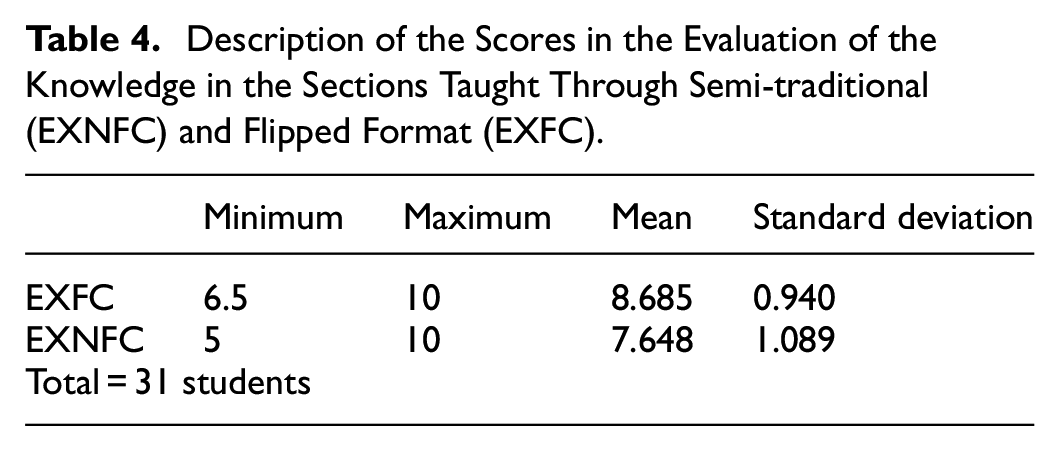
We divided the exam in two parts, one to evaluate the knowledge of the contents of the semi-traditional section and one to evaluate the knowledge of the contents of the flipped section. This way, we obtained two data series that measured the academic achievement of the class divided in two sections. We called them EXNFC (semi-traditional) and EXFC (flipped). Grades went from 0, the worst, to 10, the best, whereas 5 was a “pass.”Table 4 shows the main descriptive statistics.
Description of the Scores in the Evaluation of the Knowledge in the Sections Taught Through Semi-traditional (EXNFC) and Flipped Format (EXFC).
Data Analysis
Soft Skills (RQ1)
We have data analysis in three different phases. In the first, we compared the results of the survey at the start of section “Introduction” (moment 0) and the results at the end of section “Introduction,” that is after administering the semi-traditional format (moment 1). In the second phase, we compared the results of moment 1 and the results at the end of section “Literature Review,” that is, after administering the flipped format (moment 2). In the third phase, we compared the results of the initial moment, that is, the beginning of section “Introduction,” with the results of moment 2, that is after administering both the semi-traditional and the flipped formats. This allowed us to analyze the effects of the semi-traditional format, the effects of the flipped format, and, finally, the effects of the combination of the semi-traditional and flipped formats on students’ soft skills.
To compare the results of the variables in each phase, we compared the mean of each variable in the two moments of each phase. Since the series were not normal, we performed a non-parametric test, in this case a Wilcoxon test, to find out whether the average behaviour of the variable changed between these two moments. To study the data series, we ran a Normality test (Shapiro-Wilk test, for the size of the sample) and Homoscedasticity (Levene test), to apply parametric and non-parametric tests. We rejected the null hypothesis (normality) with a 95% significance in all variables, except for variables X18-25 in moments 1 and 2. Therefore, we conducted non-parametric tests in the following phases of the experiment.
Academic Achievement (Grades) (RQ2)
To analyze the data of the academic achievement in terms of grades, we ran a repeated measures ANOVA to detect whether there were significant differences between prior students’ achievement, measured through their average grades in the Degrees in International Relations and Global Communications, and the grades obtained in the sections of the class taught through the semi-traditional and flipped formats.
Results
Soft Skills (RQ1)
The goal in the first phase was to analyze the impact of the semi-traditional format on the soft skills. Table 5 shows the results.
Results of the Wilcoxon Test in Phase 1.

Of the 18 analyzed variables, only five of them (X1, X5, X7, X13, and X17) presented any significant change in phase 1. In the three variables of self-efficacy in which there was a significant change (X1, X5, X7), this was negative, that is, there was a decrease in their values. This means that students’ perception as to these variables worsened. The same happened with the variable related to the item that measured their learning perception (X17). The other variable that presented a significant change (X13), and that was part of teamwork, showed an improvement. This means that using a semi-traditional format did not lead, generally speaking, to a significant change in students’ soft skills. When such a change took place, in four (X1, X5, X7, X17) of the five variables, their values decreased.
The goal in the second phase was to analyze the impact of the flipped format on the soft skills, taking as the starting point the moment in which the administration of the semi-traditional format ended. With this goal, we compared the average results between moment 1 and moment 2. Table 6 shows these results.
Results of the Wilcoxon Test in Phase 2.
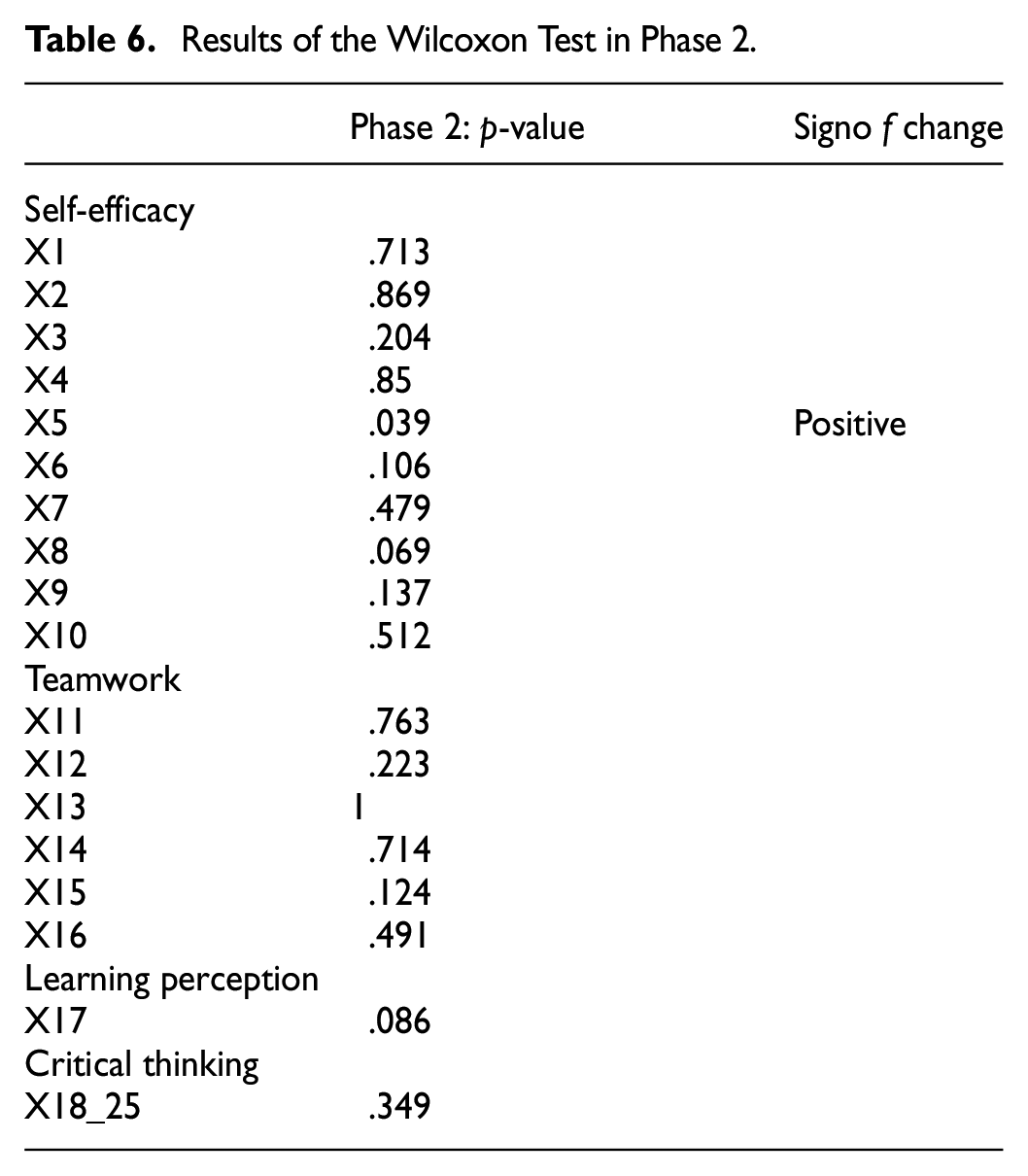
Of the 18 analyzed variables, only one of them (X5) showed a significant change related to the flipped format, which is “I think I can pass the courses quite easily and even get good grades,” which referred to self-efficacy. This variable showed a change in phase 1, even though the sign of change was opposite: in phase 1, the students’ perception worsened, while, after using the flipped format (phase 2), it improved.
The goal in the third phase was to analyze the combined impact of the semi-traditional and flipped formats on the soft skills. Thus, we compared the results obtained at the beginning of the class (moment 0) with those obtained at the end of the second section (moment 2), that is after administering both the semi-traditional and the flipped formats and after concluding the experiment. Table 7 shows these results.
Results of the Wilcoxon test in Phase 3.
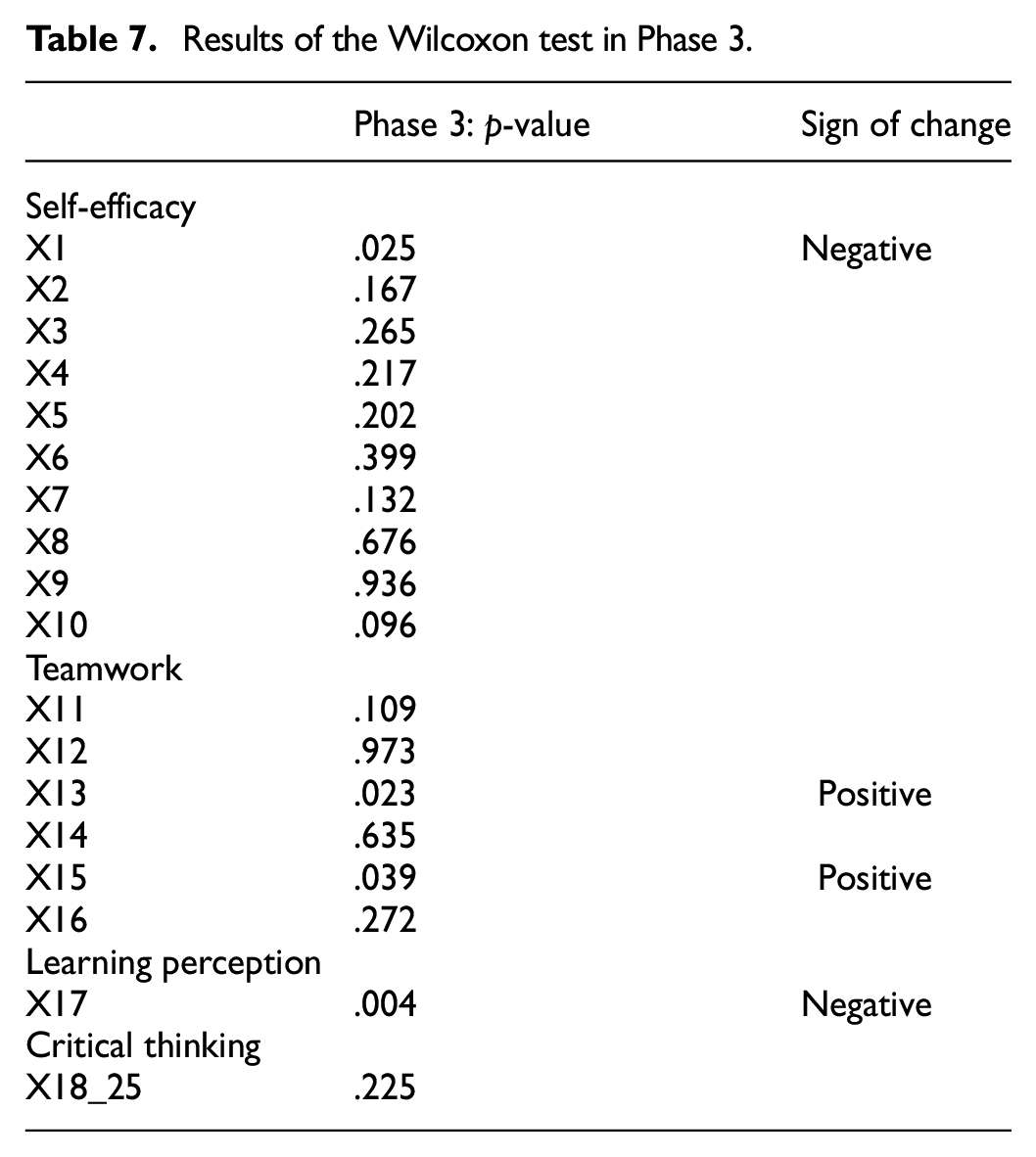
Of the 18 analyzed variables, four of them (X1, X13, X15, and X17) presented a significant change throughout the three phases of the experiment. Specifically, the change observed in variable X1 was due to the semi-traditional format. The same happened with variables X13 and X 17. As to variable X15, its positive change was gradual and not related to any of the two formats because, when observing this variable in phases 1 and 2, the changes were not significant.
Academic Achievement (Grades) (RQ2)
To analyze the effect of the flipped and semi-traditional formats on the academic achievement in terms of grades, we ran a repeated measures ANOVA. Table 8 shows these results.
Results of the Repeated Measures ANOVA.

As can be observed, the average grades were statistically different when comparing the grades of the section taught through the semi-traditional format and those of the section taught through the flipped format, the latter being better than the former. This aligned with the results obtained in the analysis of the soft skills during phases 1 and 2. In phase 1, we observed that the value of variable X5, belonging to self-efficacy and in which students evaluated their expectations about grades, worsened at the end of the section taught with the semi-traditional format. Instead, X5 improved at the end of the section taught with the flipped format (phase 2). In addition, there was a statistically significant difference between the average grades obtained in the section taught with the semi-traditional format and the average grades obtained in the Degree in International Relations. This means that the academic results obtained with the flipped format improved and better reflected their prior academic results when compared to the ones obtained with the semi-traditional format. Finally, after comparing the academic results obtained in the Degree in Global Communication with the results in the flipped format, the results of the flipped format were significantly better.
Discussion
To facilitate the discussion of the results on the soft skills, table 9 shows the combined results of the three phases of the analysis.
Combined Results of the Three Phases.
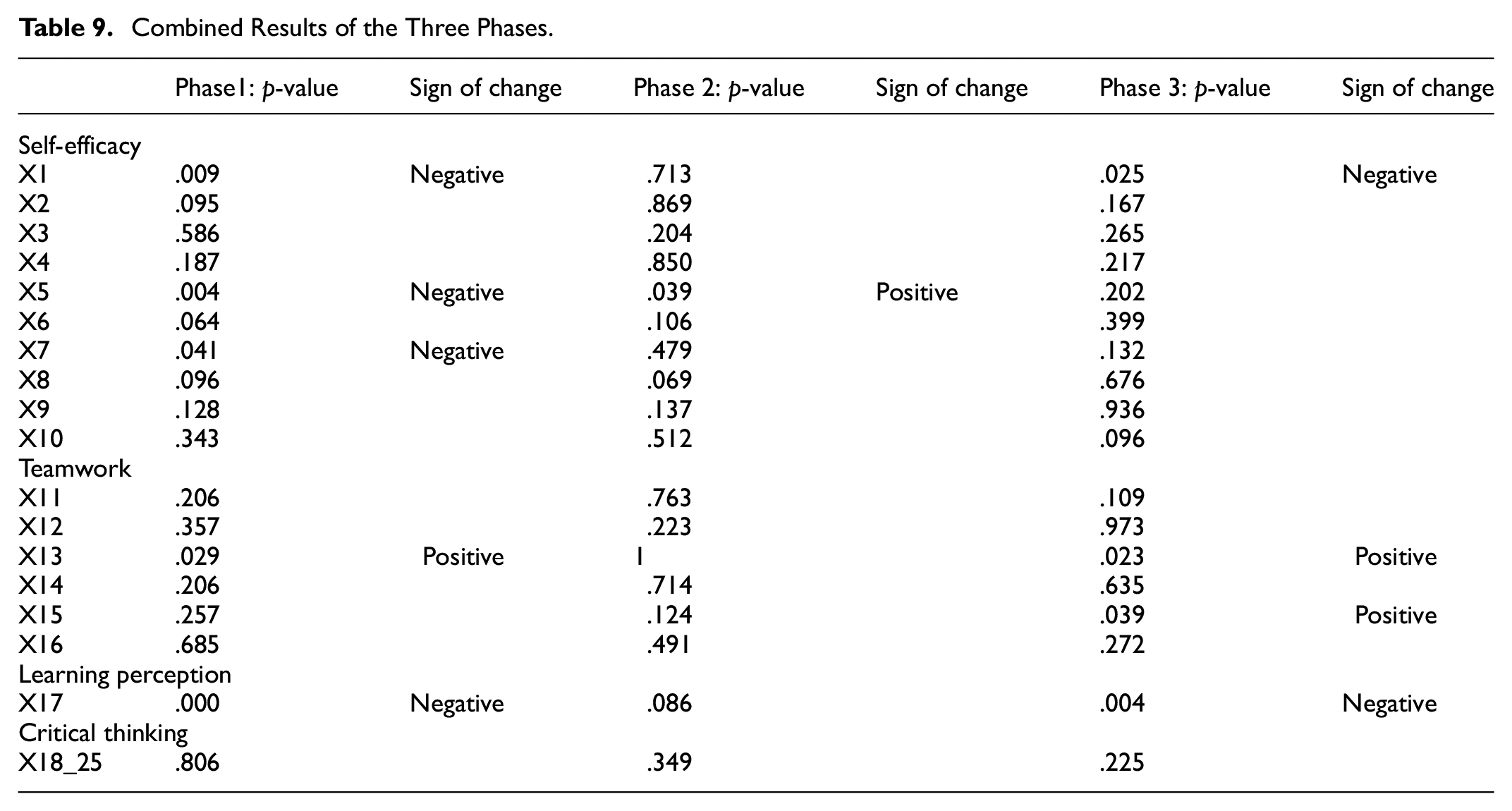
As the analysis showed, the implementation of a semi-traditional teaching format (phase 1), based on a combination of frontal lectures and active learning techniques, such as debates, presentations, and teamwork tasks did not lead to a significant change in students’ soft skills. Among the few changes that could be observed, the semi-traditional format had a negative impact on three items of students’ self-efficacy, related to the expectations to get excellent grades (X1), easily pass the course (X5), and achieve academic success (X7). Very few studies have empirically tested the effects of active learning techniques on self-efficacy. One of these went along a similar line of our results, since it did not find any specific effect of using web-classes on this soft skill (Frederikson et al., 2005). On the basis of this, one could think that, since students are mostly accustomed to traditional teaching, active learning innovations can initially produce a sense of disruption that negatively influences their expectations about what they will be able to achieve.
However, this is not completely in line with the results of the implementation of the FC format in our experiment (phase 2). While in our experiment this application did not produce any significant result in any of the soft skills, it improved one item of self-efficacy (X5), which is the expectation about passing the course and getting a good grade. This would corroborate some of the findings of the literature about the effects of active learning techniques on self-efficacy, which tend to associate the FC with a more individualized learning style and a better time management (Galindo-Domínguez, 2021). These elements are assumed to improve students’ responsibility and autonomy and, as a consequence, their beliefs about their capacities of facing complex challenges, such as succeeding in a university class. Among the studies based on empirical analyses, some compared the effects of the FC with traditional teaching formats on a single group of students finding a positive effect (Werfel & Reynolds, 2020), while others that used two different groups did not find any specific effect (McNally et al., 2017). In the former case, results are in line with our implementation of the FC, while in the latter they are not.
Nevertheless, one can observe a substantially null effect when analyzing our results throughout the three phases of the experiment, after administering both the semi-traditional and flipped formats. In our study, the negative result of the semi-traditional format on the item of self-efficacy related to the expectation to easily pass the course (X5) was neutralized by a positive effect of the FC on the same item, while there were no more effects on the other items of this soft skill. This leads us to thinking that there was not a clear tendency in favor of one teaching format or the other. Rather, it was the combination of the active learning techniques administered in phase 1 and the FC administered in phase 2 that improved the students’ learning experience. This is in line with a previous study that, after comparing the FC with other active learning formats, such as Massive Online Open Course (MOOC), did not detect any specific difference, although this study was based on two different groups of students (Wang & Zhu, 2019). Other studies that compared two different groups of students similarly found a lack of clear differences between teaching formats. This reinforces the conclusion that it is not the FC per se that improves self-efficacy but the integration of the FC format with other active learning elements, such as techniques that can favor student-to-student connectedness (Gong et al., 2020) or the monitoring of their own learning through self-assessment (Lai & Hwang, 2016) or peer assessment (Lin et al., 2019).
The tendency toward a null effect seems even clearer when analyzing the results of our experiment in terms of teamwork. After implementing the semi-traditional format (phase 1), teamwork improved in terms of students’ perceptions about their capacity to face conflicts in the team (X13). This is in line with some of the findings in the literature about the capacity of active learning techniques to favor a more collaborative learning environment (Kim et al., 2013). Empirical studies that compared the effects of traditional and active learning formats on the same group of students found a similar positive effect on this skill (Frederikson et al., 2005). Nevertheless, unlike the studies that compared traditional and FC formats on different groups of students (Mcnally et al., 2017), also in the field of PS (Lambach et al., 2017) or on the same group of students (Karabulut-Ilgu et al., 2018), our study did not find any specific effect of the FC on teamwork (phase 2). On the one hand, this null effect corroborates one study that, in the field of PS, compared traditional and FC formats on the same group of students (Jenkins, 2015, p. 610). On the other hand, the results of our experiment in Phase 3 detected a positive effect on the teamwork items related to facing conflicts (X13) and communicating and acting cohesively in the group (X16). This overall result seems to indicate that the FC can improve students’ teamwork, especially when it is administered in combination with other active learning techniques, such as the ones we used in our semi-traditional format or the cooperative learning strategies used in previous studies (Foldnes, 2016; Sein-Echaluce et al., 2022).
Interestingly enough, in terms of critical thinking, we could not detect any specific effect in any of the three phases of our experiment, either after the implementation of the semi-traditional format, or after the implementation of the FC format, or upon concluding the experiment. This would go against a long tradition of studies that found a positive effect of several active learning techniques on critical thinking (Hussain et al., 2023), such as peer interaction (Lu et al., 2021), collaborative learning (Kim et al., 2013), or team-based learning (Michaelsen et al., 2007). Most FC studies similarly detected a positive effect on critical thinking. This was the case of experiments that compared FC formats with other active learning techniques, such as games, across different groups of students (Huang et al., 2022), or experiments that compared FC formats with traditional teaching formats across two different groups of students (Lambach et al., 2017; Mclaughlin et al., 2013), or experiments that compared FC formats with traditional teaching within the same group of students (Baytiyeh & Naja, 2016; Hsieh et al., 2017). The exploratory nature of our study cannot represent a refutation of such seemingly conventional wisdom. Nevertheless, the substantially null effect of our experiment, regardless of the format that we implemented, leads us to suspect that, once again, the type of teaching format does not seem to make a difference in terms of students’ critical thinking. The main factor behind improved critical thinking, rather, is the combination of the FC with several other active learning techniques. This is in line with other studies that integrated the FC with peer-reviewing (Arruabarrena et al., 2019) or with a guided inquiry approach (Danker, 2015).
To conclude the discussion on the soft skill, our experiment detected a negative effect of the semi-traditional format on students’ learning perception. This does not corroborate a study on the positive impact of webcast lectures on this perception (Traphagan et al., 2010). However, it is in line with several other studies that detected a negative impact of active learning techniques (Deslauriers et al., 2019), such as video-lectures (Jensen, 2011) or problem-based activities (Elen & Clarebout, 2001), although these studies were all based on comparisons with traditional teaching formats across different groups of students. Comparing the effects of traditional teaching with web classes on the same group of students, one study found a null effect (Frederikson et al., 2005). In the FC format (phase 2), our study did not detect any significant result. This is different from studies that, after comparing traditional and flipped teaching formats, both across different groups of students (Zhang et al., 2016) and within the same group (Awidi & Paynter, 2019; Touchton, 2015) found a positive impact on learning perception. However, it is in line with those studies that did not find any specific effect, although they compared the FC with traditional teaching across two different groups of students (Al-Harbi & Alshumaimeri, 2016). Finally, those who compared different types of FC formats across two different groups of students found a positive effect on this perception (Hung, 2015). In our experiment, the negative effect appeared also after comparing the effects of the semi-traditional and flipped formats (phase 3).
Considering these negative effects in terms of students’ learning perception, together with the already discussed negative perceptions about those items of self-efficacy related with their expectations of learning (X1 about grades, X5 about passing the course, X7 about academic success), it is necessary to discuss the relation between such expectations and the reality of students’ academic achievement. Some studies that compared active learning with traditional formats observed that the former can worsen students’ learning perceptions because they tend to associate active learning techniques with an “increased cognitive effort”, even if they actually obtain better grades through such techniques (Deslauriers et al., 2019, p. 19251). Some studies that compared the FC with traditional teaching found a similar incoherence between perceptions and results, in the sense that despite improving their grades, students expressed dissatisfaction with a format that “required more work” (Missildine et al., 2013, p. 599). Interestingly enough, our study did not detect such an incoherence. While students’ perceptions on learning and self-efficacy as to grades worsened with the semi-traditional format, so did their grades. This means that the semi-traditional format that we implemented in the first section of the class, based on active learning techniques to which students were mostly unaccustomed, generated a sensation of disruption (Betti et al., 2020; Han, 2022) that was also reflected in their poorer academic achievement.
Nevertheless, in the second section of the experiment, in which students were administered a flipped format, students’ perceptions and performance were also aligned, but, this time, in a positive way. While their learning perception did not significantly change, expectations about their self-efficacy in terms of passing the course and obtaining good results improved, and so did their grades. This coherence between perceptions and achievement is in line with both those studies that compared the FC with traditional teaching formats (Awidi & Paynter, 2019; Hsieh et al., 2017), also in the field of PS (Touchton, 2015), and those that compared the FC with other active learning techniques (Nouri, 2016; Tang et al., 2020). Our study does not provide sufficient evidence to infer that the FC is better than other active learning techniques in terms of perceptions and achievement. However, the three phases of our experiment can lead to the tentative conclusion that students gradually improve both their learning perceptions and results after receiving different teaching formats, all based on active learning techniques, be they semi-traditional or flipped.
Moreover, in our experiment, students’ perceptions on one item of self-efficacy and on learning perception once again worsened after comparing the results obtained at the beginning of the experiment with those obtained at the end of it, that is after administering both the semi-traditional and the flipped formats. Thus, such changes neutralized each other. This reinforces our conclusion, already presented in the analysis of critical thinking, self-efficacy, and teamwork that there are not clear tendencies in favor of a flipped format or a semi-traditional one integrated with other active learning techniques. No teaching format alone seems to clearly produce better results, in terms of either soft skills or academic achievement (grades). Several studies have similarly observed that positive or negative results can be rather related to the teacher’s competences necessary for the administration of active learning techniques (Jenkins, 2015, p. 610; Murillo-Zamorano et al., 2021; Strelan et al., 2020). Along these lines, rather than viewing traditional and active learning formats in opposition to one other, combining insights and experiences from both seems a more effective strategy.
Blending traditional and innovative teaching formats and different active learning techniques, such as flipped classrooms with gamification techniques (Huang et al., 2022) or with cooperative exercises (Sein-Echaluce et al., 2022), sounds more promising than just implementing one or the other. Previous studies based on focus groups and surveys found that students feel more comfortable with a combination of different traditional and innovative formats (Betti et al., 2020), based on “a flexible methodology that can be adapted to different teaching modes.” This should contribute to universities abandoning “the strict division between teaching modes to allow for more flexible learning” (Fructuoso et al., 2023, p. 167) based on blending different types of traditional and active learning techniques, instead of prioritizing over the other.
Conclusions, Limitations, and Future Research
We are aware of a series of limitations of the study that need to be addressed in future analyses.
Our study was based on two sections within a single class in a single semester. We are aware that this limits the possibility of producing reliable generalizations, which requires to repeat the experiment with larger samples across longer time spans. Nevertheless, we also think that our sample size meets the standards for group comparison and detection of effects (Cohen, 1988). Moreover, this study is part of a series of experiments aimed at generating data about the advantages and disadvantages of implementing active learning techniques in higher education. Such experiments mostly corroborated the conclusions of this study (Betti et al., 2022a; b). Finally, we believe that the methodological decision to compare two different teaching modes within the same group of students can reduce the risk of confounding factors that can bias the perceptions of students subjected to different formats and, as a consequence, the results of the study. However, there is no doubt that to improve the reliability of the study, it is necessary to repeat the experiments and generate more data.
This point leads us to suggesting future lines of research, with the goal of further testing the effectiveness of traditional, flipped and other teaching modalities. For example, it would be important to test the durability of knowledge acquired through active learning and traditional techniques. Most studies, including ours, tend to focus on very instant measurements of knowledge, such as grades and perceptions, while it would be useful to assess how and what different teaching modes can contribute or be detrimental to the retention and acquisition of knowledge in the medium and long run. As to teaching modalities, it would also be important to design studies aimed at understanding what specific components of active learning techniques can be more or less useful for learning. Some recent studies are already going in this direction, for example by trying to single out the teaching elements that can support and expand the students’ learning experience (Jia, 2023; Wut et al., 2022), or by identifying how each teaching modality can better serve the necessities of students with more or less prior experience of a certain subject or with more active or passive learning styles (Wang et al., 2022).
In a similar way, we consider it necessary to put forward a series of recommendations on future actions to be taken to advance scholarship in the use of the FC. First, future research should evaluate the impact of the FC on issues of equity and inclusivity in education, especially in terms of access to technology, socioeconomic disparities, and diverse learning needs. Second, faculties should further develop programs, resources, and collaborative opportunities to support the effective implementation of the FC model, with the goal of empowering educators in integrating FC principles into their teaching practices. Third, students should be encouraged to provide their feedback to continuously evaluate and refine FC implementations and to better identify its strengths, challenges and areas for improvement (Betti et al., 2020). Finally, universities should encourage more discussion, through the creation of interdisciplinary partnerships and knowledge-sharing networks, on the role of technology in supporting FC initiatives, including considerations for selecting appropriate digital platforms, multimedia resources and interactive tools, with the goal of enhancing student engagement and facilitating personalized learning experiences.
Despite its limitations, we think that this study represents a relevant attempt to improve previous research designs on the effects of active learning techniques on students’ learning. Moreover, it stands as a contribution to an ongoing scholarly debate on how to improve teaching in higher education. Finally, it can be seen as a possible caveat to avoid unavailing antagonisms between traditional and innovative teaching formats.
Footnotes

Ethical Considerations And Consent Details
Before the study, students consented to participate by signing a specific form and were fully informed about the research goals. We did not diffuse their personal data. The Teaching Innovation Evaluation Committee of the Pontifical University of Comillas, where the experiment took place, had previously approved the ethical aspects of the study, by granting funds for the research project “Teaching Innovation in International Relations: A Comparative Study of the Flipped Classroom and Semi-Traditional Classroom during the academic year 2020 to 21.” The Committee depended on the Teaching Innovation Unit, acting under the responsibility of the Vice-Chancellor of the University. Participation in the study was fully voluntary.
Funding
The author(s) disclosed receipt of the following financial support for the research, authorship, and/or publication of this article: This work was supported by a grant from the Pontifical University of Comillas ICAI-ICADE-CIHS (Madrid) which funded the research project “Teaching Innovation in International Relations: A Comparative Study of the Flipped Classroom and Traditional Classroom.” The funding body had no role in the study design, data collection, analysis, and writing of the manuscript.
Declaration of Conflicting Interests
The author(s) declared no potential conflicts of interest with respect to the research, authorship, and/or publication of this article.
Data Availability Statement
All relevant data are cited in the manuscript and available in the Supporting Information File.