




Abstract
The aim of this study is to determine the effect of the brainstorming technique on students’ academic achievement and creative thinking. Within the scope of this research, 22 studies were found for academic achievement and 8 studies for creative thinking. Hedges g index was used for effect sizes of individual studies. Effect sizes of individual studies were combined with a random effects model to calculate the overall effect size. As a result of the meta-analysis study, it was determined that teaching based on the brainstorming technique had a “medium” effect size (ES = 0.958, 95% CI: 0.682–1.234) on academic achievement. It was determined that teaching based on the brainstorming technique had a “strong” effect size (ES = 2.267 95% CI: 1.273–3.279) on students’ creative thinking. As a result, it was seen that the brainstorming technique had a “moderate” effect on students’ academic achievement and a “strong” effect on creative thinking. The heterogeneity test performed to determine the significance of the variance between effect sizes was significant (p < .05). Categorical moderator analysis and meta-regression analyzes were performed to determine the source of variance and it was revealed that the identified variables were not significant predictors (p < .05).
Introduction
In the information age, there is a need for individuals who know how to access new information, question it, examine, analyze, and transfer it, and who possess problem-solving abilities as well as creativity and productivity. It is crucial to restructure educational environments to align with 21st-century skills. Innovative teaching methods and ensuring active student participation are of great importance in enhancing the efficiency of learning processes.
With each passing day, people’s desire and curiosity to learn lead to the discovery of different ways, methods, and applications for meaningful learning. Therefore, the methods, strategies, and techniques applied both inside and outside the classroom should facilitate meaningful learning for students and help ensure retention.
In this context, the brainstorming technique is becoming increasingly popular among educators and students. Initially emerging in the advertising industry in the 1940s, brainstorming has gradually been adopted as an effective tool in the field of education as well (Davies, 1971; Diehl & Stroebe, 1987; McFadzean, 1999; Paulus & Dzindolet, 1993).
This technique offers students the opportunity to develop creative thinking skills (Alrubai, 2014; Isaksen & Gaulin, 2005; Masri, 2019; Mengue-Topio et al., 2024; Orlich et al., 1990; Rao, 2007; Taleb et al., 2013), freely generate ideas, and collaborate (Kartika & Siregar, 2023; Mengue-Topio et al., 2024). Through brainstorming, students share their ideas in a non-critical and rich discussion environment, which allows for the emergence of innovative solutions and original ideas (Heslin, 2009; Osborn, 1953; Rawlinson, 1995), thereby supporting active participation (Alrubai, 2014). As a result, when the classroom environment becomes more enjoyable, it has been observed to strengthen in-class communication and contribute to the development of a positive attitude toward the lesson (Mengue-Topio et al., 2024; Rawlinson, 1995). Additionally, this versatile technique aims to develop students’ critical thinking (Khalilii et al., 2015; Lapshina & Radchuk, 2025) problem-solving, and creativity skills, contributing to both their cognitive and affective developmet (Alrubai, 2014; Mengue-Topio et al., 2024).
The critical thinking skill used while applying the brainstorming technique contributes to the creative thinking process. In this context, since creative thinking, by its very essence, focuses on the emergence of different, innovative ideas, it can be said that brainstorming helps this structure by paving the way for students to generate ideas without being criticized (Kartika & Siregar, 2023). Therefore, it can be thought that brainstorming contributes to the development of creative thinking (Lapshina & Radchuk, 2025).
According to Osborn (1953), the use of the brainstorming technique enables students to reach solutions collaboratively and significantly increases both the number and quality of ideas produced. It fosters group culture and promotes latent learning. According to Wosu (2023), this technique enhances students’ group creativity, helps them solve real-life problems, and promotes fair sharing and freedom of expression.
Like many techniques, the brainstorming technique has both advantages and limitations. The advantages of this technique are: it enables students to actively use their cognitive skills, solve problems analytically, support their critical thinking, and think creatively (Afifa, 2024; Hassanein, 2002; Hoing, 2001; Isaksen & Gaulin, 2005; Lapshina & Radchuk, 2025; Mengue-Topio et al., 2024; Mohammad, 2016; Obafemi, 2024). The main purpose of this technique is to enable students to participate more in the lesson (Wosu, 2023), to help them learn more easily (Wahib & Zidane, 2001; Wosu, 2023), to support teamwork (Hassanein, 2002), to facilitate idea generation (Obafemi, 2024), and to make the learning environment enjoyable (Mengue-Topio et al., 2024). With this technique, teaching-learning environments can become more attractive and interesting, and interaction can be increased (Hurt, 1994; Obafemi, 2024; Sulistia, 2023; Wahib & Zidane, 2001).
Its most important advantage in the field of education is that the effective use of this technique is of great importance in increasing students’ academic achievement (Aini, 2022; İbnian, 2011; Odoh, 2013; Zuwanda & Umara, 2021) and supporting creative thinking skills (Alrubai, 2014; Isaksen & Gaulin, 2005; Karatas & Tonga, 2016; Kaya, 2021; Masri, 2019; Mengue-Topio et al., 2024; Rao, 2007; Taleb et al., 2013). It has also been observed that students increase all their skills during language acquisition. Studies show that the brainstorming technique focuses on four skills of students, especially during language acquisition: speaking (Agustina & Kumalarini, 2014; Zuwanda & Umara, 2021), writing (Acharya, 2017; Astuti and Kumalarini, 2013; Gultom & Gurning, 2014; Ibnian, 2011; Pratiwi & Julianti, 2022; Rifa’i et al., 2025; Sianturi, 2019; Sutisna et al., 2022), and reading and listening (Pérez Sánchez, 2023).
At the same time, brainstorming also has its limitations. This technique may not be suitable for some subjects (Karatas & Tonga, 2016). Students who do not attend class may be completely prevented from participating and may become more introverted (Lapshina & Radchuk, 2025; Nijstad & Stroebe, 2006). A large number of groups may create a negative situation (Paulus & Kenworthy, 2019). Considering the limitations of this technique, the ideal number of students in the class is 12 (Rawlinson, 1995, p. 85), and if there are more participants, students may not have the opportunity to speak and may lose motivation. For some students, it may pose difficulties in generating creative ideas (Lapshina & Radchuk, 2025; Rietzschel et al., 2006). Students may not want to work in groups (Diehl & Stroebe, 1987; Lapshina & Radchuk, 2025; Oliva & Elaziz, 2020; Osborn, 1953). In conclusion, while brainstorming offers many advantages in education, it is important to pay attention to its limitations while using the technique.
Theoretical Background
The theoretical background of the brainstorming technique is grounded in creativity theories, cognitive psychology, and social learning approaches. Initially developed by Alex F. Osborn in the 1940s as part of the Creative Problem Solving (CPS) model, brainstorming was designed to enhance the ideation phase of problem solving by encouraging the free flow of ideas without criticism (Kartika & Siregar, 2023; Mengue-Topio et al., 2024; Osborn, 1953). One of the key theoretical foundations lies in Guilford’s (1950) concept of divergent thinking, which emphasizes the generation of multiple and original ideas as a core component of creativity. Additionally, Vygotsky’s (1978) sociocultural theory supports the idea that learning occurs through social interaction, which aligns with the collaborative and communicative nature of brainstorming sessions. From a cognitive perspective, the technique also relates to information processing theory, where the activation of prior knowledge and the association of new ideas promote deeper learning and memory retention (Anderson, 1980). Furthermore, Bandura’s (1986) social cognitive theory underscores the importance of observation, imitation, and social modeling in learning processes that are naturally embedded in group-based brainstorming activities. However, researchers such as Diehl and Stroebe (1987) have also pointed out potential limitations, including production blocking and social loafing, which can hinder the effectiveness of group brainstorming. Despite these challenges, the theoretical grounding of brainstorming supports its value as a tool for fostering creativity, collaborative learning, and critical thinking in educational settings.
In this context, the primary reason for selecting the brainstorming technique within the scope of this research is the belief that this frequently used technique is not sufficiently understood. Despite the fact that numerous studies on this technique have been identified in the literature review (Coskun, 2005; Harari & Graham, 1975; Ibnian, 2011; Islim, 2009; Putman, 2001; Wagbara, 2020; Zuwanda & Umara, 2021), no meta-analysis studies have been conducted. Therefore, the aim of this study is to investigate the effectiveness of the brainstorming technique on academic achievement and creative thinking based on experimental studies conducted between 1981 and 2022. The analyses are expected to contribute to understanding how effective the brainstorming technique is and its applicability compared to other techniques, models, and methods. The findings of this study can help researchers and teachers develop ideas regarding the use and application of the brainstorming technique in classroom activities. All moderators accessible through the necessary data for the meta-analysis were examined. The moderators examined in this meta-analysis are not only accessible characteristics but also theoretically meaningful factors that may influence effect size. Publication type tests for potential publication bias, as peer-reviewed studies tend to report larger effects. Study design relates to process losses such as production blocking and evaluation apprehension, which explain productivity differences between nominal and interactive groups. Education level is important because individuals’ creative thinking capacities may vary with age and cognitive development. Subject area may have an impact due to differences in how various disciplines approach creativity and problem-solving. Sampling method aims to control for the influence of characteristics such as motivation and self-confidence in volunteer participants. Finally, the country or cultural context in which the study was conducted may create significant differences through cultural values such as individualism-collectivism affecting the brainstorming process. Therefore, each moderator was selected based on theoretical mechanisms that could influence the effectiveness of brainstorming.
This study also provides guidance on the moderators related to the publication year, publication type, subject area, study location, study design, sampling method, educational level, duration, and sample size in experimental studies. The problem statements and sub-problems of this study are as follows:
What is the effect of the brainstorming technique on academic achievement? a. Is the effect of the brainstorming technique influenced by moderator variables (publication year, publication type, subject area, study location, study design, sampling method, educational level, duration, sample size in experimental studies)?
What is the effect of the brainstorming technique on students’ creative thinking? a. Is the effect of the brainstorming technique influenced by moderator variables (publication year, publication type, subject area, study design, sampling method, educational level, duration, sample size in experimental studies)?
Methodology
In this study, the meta-analysis method was used to calculate the general effect size of experimental studies on academic achievement and creative thinking of the brainstorming technique. Meta-analysis is defined as the statistical analysis of individual studies conducted in order to integrate the findings through a comprehensive analysis (Glass, 1977, p. 3). Meta-analysis is generally the process of systematically summarizing and evaluating individual studies conducted within the scope of a subject area and is a detailed literature review method.
Search Strategy and Selection Criteria
Studies should aim to be transparent, repeatable, and updatable. For this reason, the research process requires the use of some methodological guidelines, evidence-based methods that have been developed to aid auditability and guide researchers. In this context, in this study, studies were searched using the Preferred Reporting Items for Systematic Reviews and Metaanalyses (PRISMA) 2020 protocol (Page et al., 2021), which is a reporting guide, and a PRISMA flow chart was used to select appropriate studies. PRISMA’s four-stage flow diagram (identification, screening, eligibility, inclusion) was used to guide the selection of eligible studies to describe the actual number of records identified, included and excluded, and the reasons for exclusion. In this study, searches were carried out on certain academic databases. These are: Publish or Perish software (Harzing, 2007), Google Scholar, Web of Science (WoS), ERIC, Scopus, ELSEVIER, Science Direct and Springer. Studies published in journals or theses were eligible for inclusion. The keywords used for the search are: “brainstorming*” then “performance*,”“achievement*” or “brainstorming*” then “performance*,”“outcome*,”“achievement*” or “success*,” the keywords for the second meta-analysis study were “brainstorming*” then “create*,”“creativity*,”“creative thinking*.” The screening started in September 2022 and took its final form as of September 2023. A set of inclusion criteria, presented in Table 1, was used to include studies that were as appropriate as possible to measure the impact of the brainstorming technique on academic achievement and creative thinking.
Inclusion and Exclusion Criteria of Studies.

The inclusion and exclusion criteria of the studies shown in Table 1 were decided by taking into account the principles of the meta-analysis method and the characteristics of this research topic. In each study, experimental studies with experimental and control groups were studied at the k12 level, comparing the effects of the brainstorming technique on students’ academic achievement and creative thinking, with equal pretests, full access, sample size (N), standard deviation (SD) and mean (X). Domestic or international studies written in English or Turkish, using parametric tests, in which the t-test and sample number were specified, and studies conducted between the years 2007 to 2022 (academic achievement) and 2009 to 2021 (creative thinking) were included in the analysis.
Studies in the form of literature review, nonparametric studies, studies published in 2023 (the limit in bibliometric analysis was taken into account), studies written in different languages, studies conducted at the university level were excluded. In the bibliometric analysis, a total of 305 studies covering the years 1981 to 2022 were initially reached regarding the brainstorming technique. The first study was conducted by Forbach and Evans (1981) in Applied Psychological Measurement under the title “The remote associates test as a predictor of productivity in brainstorming groups.” This study is considered the starting point in the field.
Then, the scope was narrowed and a search was made again in line with the keywords obtained as a result of the bibliometric analysis. In this scan covering the years 1981 to 2022, 200 studies were reached. After applying the inclusion and exclusion criteria, 271 studies were excluded through the systematic review stages developed by the PRISMA group, making a total of 22 studies for academic achievement and 8 for creative thinking eligible for review. The flow chart created according to the inclusion criteria is shown in Figure 1.

PRISMA information flow chart going through different stages within the scope of meta-analysis.
Evaluating the Quality of the Studies Included
To evaluate the quality of the primary studies included in this meta-analysis, the assessment system developed by Pluye et al. (2009) was used. In this system, three criteria were determined to evaluate experimental studies. These criteria are: (i) the clear explanation of the implementation process of the experimental procedure, (ii) random assignment of groups (iii) the validity and reliability of the measurement tools used and the absence of data loss. According to the system developed by Pluye et al. (2009), a score is given if the above criteria are met and a zero score if they are not met. Kanadli (2020) suggests giving half a point for studies that partially meet these criteria in the social sciences. The quality score was calculated using the (total score obtained/3)*100 formula. In the context of this study, studies with a quality score of 50% were considered high quality, and studies below this percent were considered low quality (Pluye et al., 2009). All studies included in the meta-analysis were determined to be of sufficient quality. The Article Quality Assessment Table created according to the articles is detailed in Table 2.
Article Quality Evaluation Table (Pluye et al., 2009).
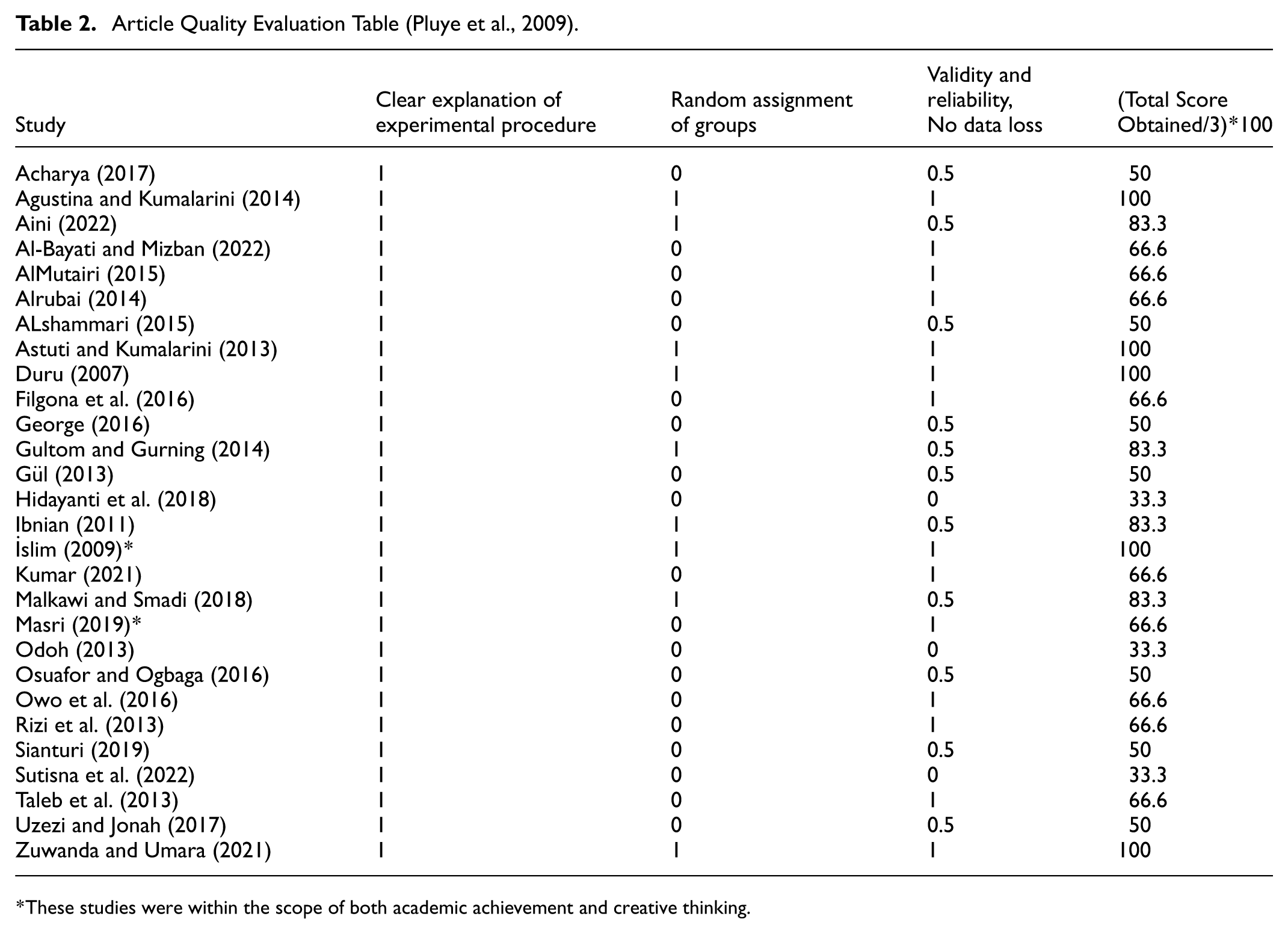
These studies were within the scope of both academic achievement and creative thinking.
Coding the Characteristics of Studies
After the evaluation, the coding phase of the studies to be included in the meta-analysis began. Studies were coded according to specific moderators (type, stage, field, design type, year, duration, sampling method, study location). Before starting the analysis, the studies were examined by two researchers. The scores given to the studies by both researchers were summed separately and quality scores were calculated. Inter-coder reliability agreement rate was calculated using the formula: agreement rate = ([agreed number of studies]/[total number of studies]) × 100 (Orwin & Vevea, 2009). It was determined that the coding was performed with 83% reliability.
Data Analysis Strategies
In this meta-analysis, the effect size index used was Hedges’g. The calculated effect size can be interpreted as “weak” if it is between 0 and 0.20, “small” if it is between 0.21 and 0.50, “medium” if it is between 0.51 and 1.0, and “strong” if it is greater than 1.0 (Cohen et al., 2007, p. 521). The general effect size is calculated by combining the determined effect sizes according to two different models, the fixed and random effects models. If the primary studies are collected from a single field of research, it is recommended to use the random effects model without performing a heterogeneity test (Borenstein et al., 2009, p. 86). Therefore, in this study, the general effect size was calculated according to the random effects model, but the heterogeneity test was also used to determine the presence and magnitude of variance among the studies.
The magnitude of heterogeneity is interpreted according to the I2 index. An I2 value of up to 25% is considered low heterogeneity, up to 50% is considered medium heterogeneity, and up to 75% is considered high heterogeneity (Higgins et al., 2003). Categorical moderator analysis should be performed to find the source of the variance and to determine whether the effect size is affected by the characteristics of the studies (Cooper, 2007). Therefore, in order to determine the source of heterogeneity between studies, categorical moderator analysis was performed according to the variables in Table 3.
Variables and Moderators Related to Categorical Meta-analysis and Meta-regression.
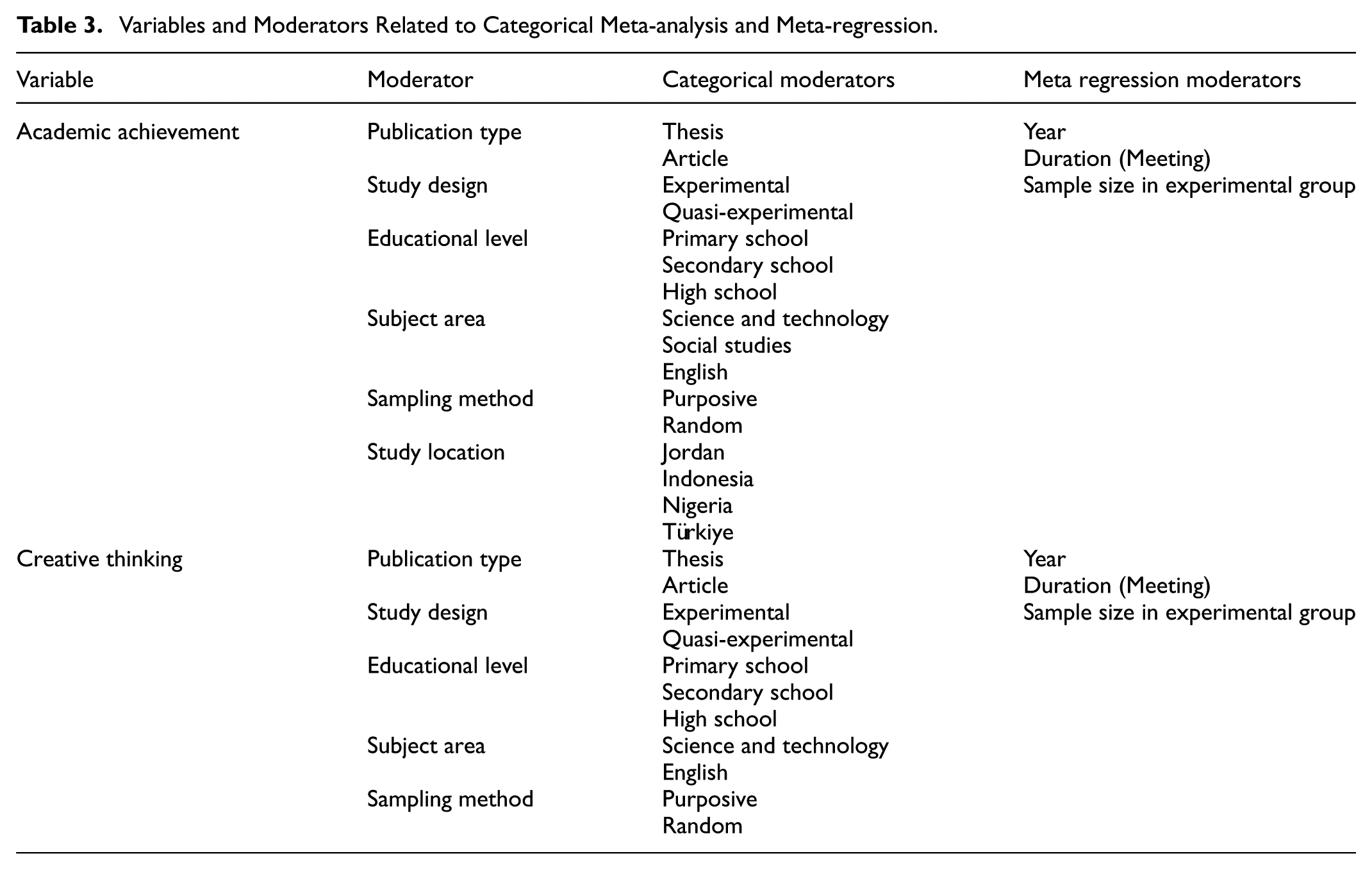
Additionally, meta-regression analysis was conducted to determine whether year, duration, and experimental group sample number were significant predictors. Finally, the funnel plot and Egger’s Trim and Fill Test were used to determine whether there was publication bias in the included studies and its impact, and funnel plot, Egger’s Trimming Test, and Rosenthal’s protected N were performed. In conducting the meta-analysis in this study, CMA 2.0 software, and R package were used.
According to Table 3, studies were excluded from the analysis when at least two values could not be obtained for the moderators. In the meta-analysis study on academic achievement, the moderators “Science and Technology,”“Social Studies,” and “English” were used based on the field, while the study conducted in the field of “Mathematics” (Aini, 2022) was excluded from the analysis. Additionally, within the scope of the design type, categorical moderator analysis was determined as quasi-experimental and experimental, and a study with a “Mixed design” (Gül, 2013) was excluded from the analysis. Six different categorical moderators were determined: type of study (thesis and article), design type (experimental, quasi-experimental), educational level (primary school, secondary school, high school), sampling method (purposive and random), subject area (Science and Technology, Social Studies, English), and study location. In the context of creative thinking, the moderators were determined as type of study (thesis and article), design type (experimental, quasi-experimental), educational level (primary school, secondary school, high school), sampling method (purposive and random), and subject area (Science and Technology, English).
In the meta-regression analysis, the prediction of the change in effect sizes by an independent and continuous variable, and whether the variable included in the analysis is related to the effect size, is determined (Harrer et al., 2021). Within the scope of this study, meta-regression analysis was conducted for both academic achievement and creative thinking considering year, duration (session), and the sample size of the experimental group as categorical and continuous variables. To ensure uniformity in terms of duration, the data in all studies were converted to a common time frame. One session was considered as 45 min and three sessions per week.
Findings
Descriptive analyzes of studies on academic achievement and creative thinking are presented below.
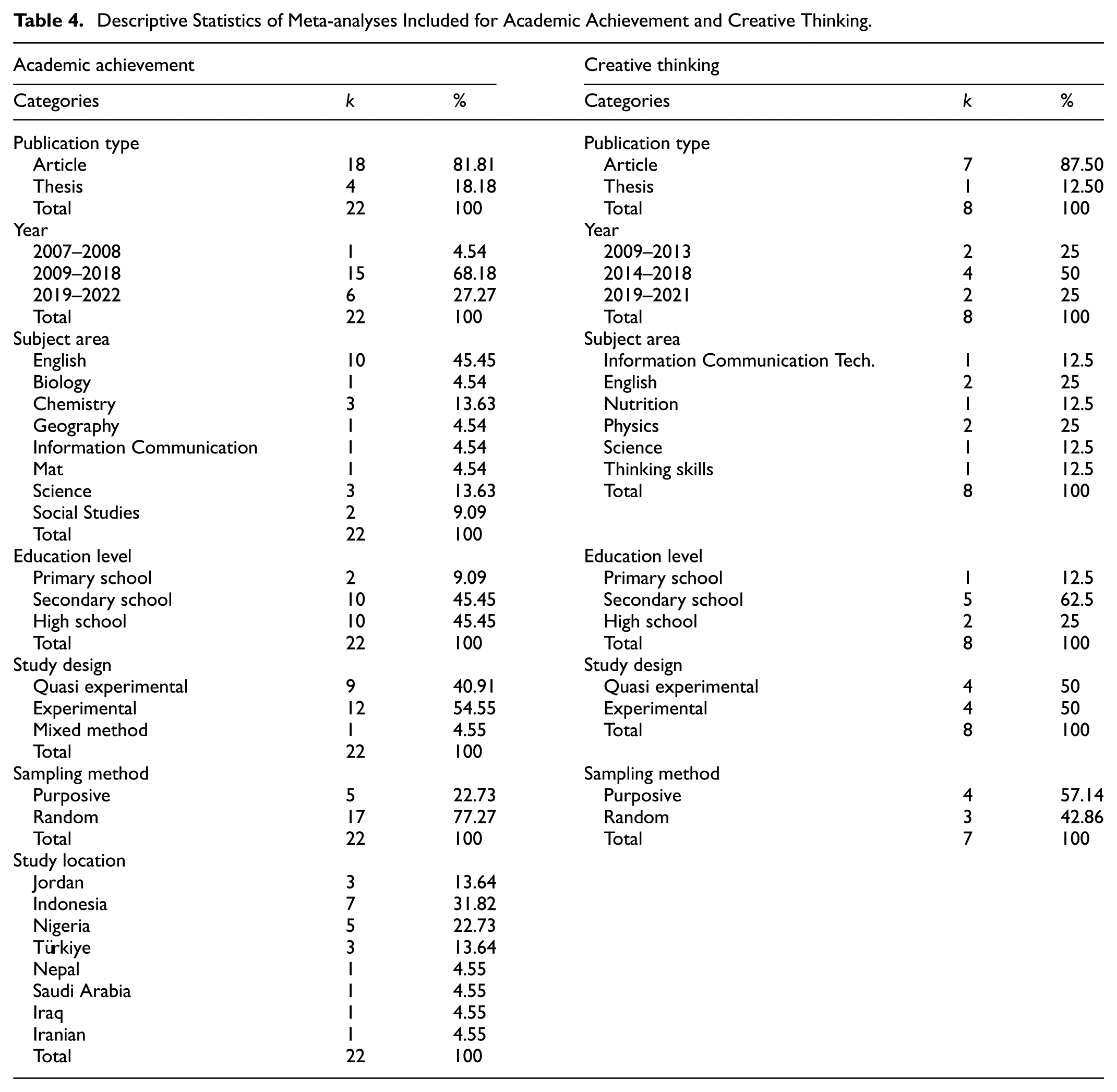
According to Table 4, 81.81% of the studies included for academic achievement were published in journals, while 18.18% were theses. The majority of studies (68.18%) were conducted between 2009 and 2018. Regarding the subject area, most studies (45.45%) focused on the English subject area emphasizing four skills, while three studies were conducted in the fields of Chemistry and Science. These studies were later combined within the context of common subjects to make the categorical moderator analysis more meaningful. To ensure common unity in the field, Science, Biology, Chemistry, Physics, Information, and Communication were categorized as “Science and Technology,” Geography and Citizenship as “Social Studies,” and “English” as a separate category. In terms of educational level, 10 studies (45.45%) were conducted at the middle and high school levels. This rate is 9.09% in primary school. When analyzed by design type, there were 9 quasi-experimental studies (40.91%), 12 experimental studies (54.55%), and 1 mixed design study. Regarding the sampling method, it was analyzed that 5 studies (22.73%) used purposive sampling, and 17 studies (77.27%) used random sampling. In terms of study location, most studies were conducted in Indonesia (31.82%), with five studies in Nigeria, three studies each in Türkiye and Jordan, and one study each in Nepal, Saudi Arabia, Iraq, and Iran. For creative thinking, 87.5% of the included studies were published in journals, while 12.5% were theses. Most studies (50%) were conducted between 2014 and 2018, and 25% of the studies were in the English subject area. In terms of educational level, five studies (62.5%) were conducted at the middle school level. This rate is 12.5% in primary school and 25% in high school. By design type, four quasi-experimental (50%) and four experimental (50%) studies were identified. Regarding the sampling method, seven studies were evaluated. The purposive sampling method was used in four studies (57.14%) and the random sampling method in three studies (42.86%).
Descriptive Statistics of Meta-analyses Included for Academic Achievement and Creative Thinking.
The findings related to the first research question, “What is the effect of the brainstorming technique on academic achievement?” are as follows:
According to Figure 2, When the effect sizes of the 22 studies were combined according to the random effects model, the upper limit of the 95% confidence interval was calculated as 1.234 and the lower limit as 0.682. According to the meta-analysis results, the study with the largest effect size (ES = 2.431) as shown in the forest plot was conducted by Agustina and Kumalarini (2014), while the study with the smallest effect size (ES = −0.340) was conducted by Sutisna and Kustini (2022). The effect size value was found to be 0.958 (g). This can be interpreted as the brainstorming technique having a “moderate” effect on academic achievement (Cohen et al., 2007, p. 521). A 95% confidence interval for true effect sizes is given between −0.344 and 2.260. Therefore, although the common effect size is estimated to be positive, the true effect size may be negative in some studies. Based on these results, it can be said that the true effect size of the studies included in the meta-analysis ranges between −0.344 and 2.260, covering approximately 95% of all populations. If the zero point is considered as the null effect point, 5% of the studies included in the meta-analysis show a negative effect of the brainstorming technique, while 95% show a positive effect. According to this data, it cannot be said that the brainstorming technique will be effective for academic achievement in all populations. Additionally, in some studies, the effect size may be zero. In conclusion, it can be inferred that the majority (95%) of the studies included in the meta-analysis have a varying effect from small to large on academic achievement. Looking at the effect sizes of the studies included in the meta-analysis, 63.63% (n = 14) were statistically significant (p < .05), while 36.36% (n = 8) were not significant (p > .05). The observed effect sizes ranged from −0.340 to 2.431, and all studies except Sutisna and Kustini (2022; n = 21, 95.45%) had positive effect sizes. Overall, the common effect size is positive, and considering the single study with a negative true effect, this study has a negative impact on performance. When the effect sizes of the studies included in the meta-analysis are evaluated according to the classification determined by Cohen et al. (2007), 9.09% (n = 2) have weak, 18.18% (n = 4) have small, 36.36% (n = 8) have moderate, and 36.36% (n = 8) have large effect sizes.

The forest plot of the academic achievement studies included.
When the heterogeneity test results are examined, it is found that the heterogeneity of the studies is significant (Q(21) = 155.46, p < .01) and high (I2 = 86%). These results indicate that the studies are different. When this difference is due to factors other than sampling error, it is recommended to conduct a moderator analysis to determine the source of the variance (Card, 2012). The results of the categorical moderator analysis are presented in Table 5.
Categorical Moderator Analysis for Academic Achievement.

According to Table 5, based on the analysis conducted by type, under the random effects model, the effect size for thesis studies was analyzed as 0.834 [0.5529, 1.1166] and for article studies as 0.9726 [0.6415, 1.3037], with a p-value of .534 (p > .05). In terms of education level; the effect size for the primary school level was found to be 1.0713 [−0.1398, 2.2824], for the middle school level 1.0551 [0.6852, 1.4249], and for the high school level 0.8368 [0.3703, 1.3033]. From this, it can be seen that the highest overall effect size is in the primary school (1.0713) and middle school (1.0551) levels. To determine if there was a significant difference between the effect sizes calculated by education level, the between-groups heterogeneity was examined, and the results were analyzed. From this, Q(df = 2) = 0.54, p > .05. As a result, this moderator is not a significant moderator (p > .05). In terms of sampling method, the overall effect size for the random sampling method was analyzed as 0.9708 [0.6774, 1.2643] and for the purposeful sampling method as 0.8918 [0.1361, 1.6474]. The sampling method is not a significant moderator (p > .05). Prior to the categorical moderator analysis for the field, the single study in the mathematics field (Aini, 2022) was excluded from the moderator analysis as it did not meet the requirement of at least two studies for categorical analysis. Based on the categorical moderator analysis conducted on 21 studies, the effect size for studies in the English field was 0.933 [0.4270, 1.4394], for Social Studies 0.786 [0.5619, 1.0110], and for Science and Technology 1.112 [0.6651, 1.5593]. From this information, it can be said that the brainstorming technique is most effective in the Science and Technology field. Additionally, when examining the p-value, this moderator is not significant (p > .05). Prior to the categorical moderator analysis by study design, the single study using a mixed design (Gül, 2013) was excluded from the design-based analysis. The overall effect size for experimental studies was analyzed as 0.8557 [0.4597, 1.2518], and for quasi-experimental studies as 1.1040 [0.6761, 1.5319], and the p-value was found to be not significant, indicating this moderator is not significant (p > .05). Prior to the categorical moderator analysis by study location, the single-country studies (Acharya, 2017, Nepal; ALshammari, 2015, Saudi Arabia; Alrubai, 2014, Iraq; Rizi et al., 2013, Iran) were excluded from the analysis related to study location, and the results were analyzed thereafter. As a result, it was found that the studies conducted in Nigeria had a stronger effect compared to other studies, and the p-value was not significant, indicating this moderator is not significant (p > .05). Additionally, meta-regression analyses were conducted to explain the variance and determine whether the years, duration (sessions), and sample size in experimental studies predicted effect sizes.
When the results of the meta-regression analysis were examined (Table 6), it shows that the year moderator is not a significant moderator predicting students’ academic achievement (k = 22, Q(1) = 0.8807, p > .05). Meta-regression analysis was conducted to determine whether the duration of experimental procedures (sessions) significantly predicts effect sizes. Four studies that did not specify the duration of the sessions were not included in the analysis (ALshammari, 2015; Gultom & Gurning, 2014; Malkawi & Smadi, 2018; Sianturi, 2019).
Meta-regression Analysis by Years.

When the meta-regression table regarding the number of students in experimental studies was examined (Table 7), it was found to be non-significant with (QM(df = 1)) = 0.2906, p > .05.
Meta-regression Analysis by Duration (Meeting).

The meta-regression analysis results indicate that the number of students (sample size) in experimental studies (Table 8) does not significantly moderate students’ academic achievement (k = 22, Q(1) = 0.1369, p > .05). Upon reviewing all meta-regression analyses, it is evident that brainstorming technique does not serve as a significant moderator predicting students’ academic achievement.
Meta-regression Analysis on the Sample Size in Experimental Group.

Publication Bias
According to Card (2012, p. 257, 262), publication bias is that the probability of publication of studies that do not have a significant or negative impact is lower than the probability of publishing studies that have a positive impact. One of the best methods to detect publication bias is to include unpublished studies in a meta-analysis and test whether effect sizes differ significantly by publication status (dissertation versus article). In this context, if there is no significant difference between the effect sizes (p > .05), it can be said that there is no publication bias (Card, 2012; Harrer et al., 2021). As a result of the moderator analysis, it was determined that the overall effect size did not show a significant difference according to the type of publication (Q(1) = 0.0534, p > .05). Therefore, it can be concluded that there is no publication bias. In order to definitively determine whether there is publication bias, the funnel plot, Egger’s Trimming Test, and Rosenthal’s protected N were examined. The funnel plot for the overall effect size calculated for academic achievement is given below. If there is no publication bias in the funnel diagram, effect sizes are distributed symmetrically around the general effect size (Borenstein et al., 2010). If there is publication bias, studies are often distributed inferiorly and asymmetrically.
According to Figure 3, the effect sizes are not symmetrically distributed around the overall effect size. When the sequence correlation and regression test were examined to determine whether this asymmetry was significant, Egger’s Trimming Test was used. In the absence of publication bias, sensitivity is close to zero, resulting in a regression line with an intercept close to zero. If the value obtained from this test does not differ significantly from zero (p value 2-tailed > .05), it can be said that there is no publication bias (Harrer et al., 2021). Accordingly, it was analyzed that the cut-off value of asymmetry (B0 = 3.391; t = 1.553, p = .136) was not significant (p > .05), indicating no publication bias.
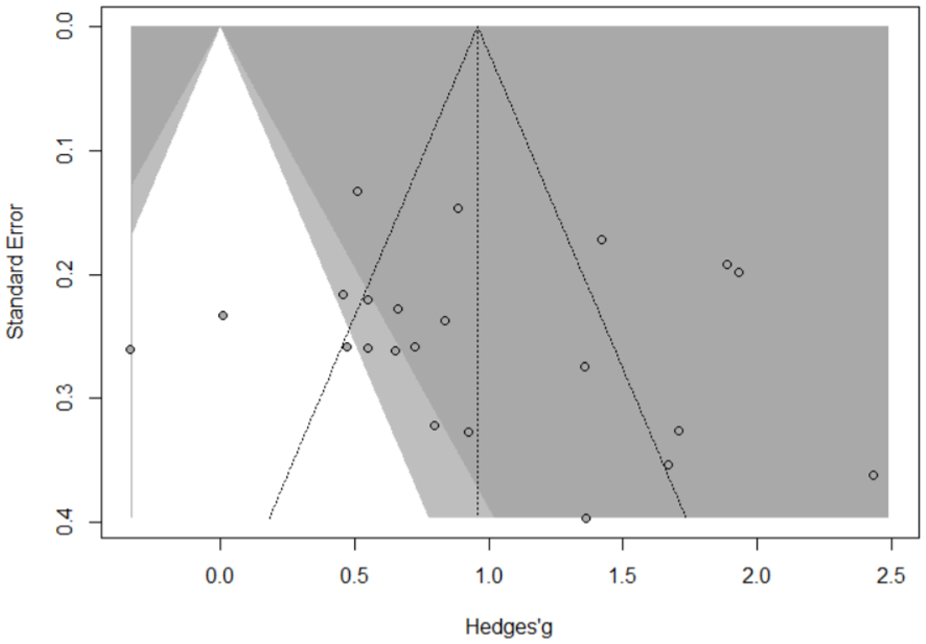
Funnel plot of academic achievement studies.
According to Rosenthal (1979), when the required number of studies exceeds five times the number of studies included in a meta-analysis plus 10 (threshold value = 5k + 10; where k is the number of studies), the calculated overall effect size is robust, indicating no publication bias. In this study, the threshold value for included studies is 120 (5× 22 + 10). Since the required number of studies (1948) far exceeds this threshold value, it can be concluded that the observed effect size is robust and there is no publication bias. With 22 observed studies, it would require 1948 studies with zero effect sizes to render the observed effect size non-significant.
The second problem statement of the study addresses the question: “What is the impact of brainstorming technique on students’ creative thinking?” The findings are as follows:
According to Figure 4, when the effect sizes of eight studies related to creative thinking were combined using the random effects model, the upper limit of the 95% confidence interval was calculated as 3.2790 and the lower limit as 1.2732. The effect size value was found to be 2.2761 (g). This indicates that the brainstorming technique has a “strong” effect on creative thinking (Cohen et al., 2007, p. 521). The 95% confidence interval for the true effect sizes ranges from 1.273 to 3.279. According to these results, it can be said that the true effect size of the studies included in the meta-analysis lies approximately within 1.273 to 3.279, covering about 95% of the population. All values obtained were positive. Therefore, it can be seen that the brainstorming technique is effective for students’ creative thinking across all populations. In conclusion, it can be inferred that the majority of studies included in the meta-analysis (95%) indicate varying degrees of positive effect of the brainstorming technique on creative thinking. Furthermore, based on the meta-analysis results, the overall effect size significantly deviated from zero (z = 4.45, p < .01).

The forest plot of the creative thinking studies included.
From the forest plot of the meta-analysis, the study conducted by Hidayanti et al. (2018) had the largest effect size (ES = 4.372), while the study with the smallest effect size (ES = 0.567) was conducted by George (2016). When examining the effect sizes of studies included in the meta-analysis, 87.5% (n = 7) were statistically significant (p < .05), while 12.5% (n = 1) were not significant (p > .05). The observed effect sizes ranged from −1.395 to 5.948, with all studies showing positive effects. Evaluating the effect sizes according to Cohen’s et al. (2007) classification, it can be stated that 12.5% (n = 1) showed a moderate effect size, and 87.5% (n = 7) showed a strong effect size.
The heterogeneity test results indicated significant (Q(7) = 146.13, p < .01) and high-level heterogeneity (I2 = 95%) among the studies. These results suggest that the studies are different. When heterogeneity arises from factors other than sampling error, moderator analysis is recommended to determine the source of variance (Card, 2012). The results of categorical moderator analysis are presented in Table 9.
Categorical Moderator Analysis for Creative Thinking.

p < .05.
According to Table 9, the effect size of thesis studies was found to be 1.3042 [0.6328, 1.9755], and the effect size of article studies was found to be 2.4171 [1.2993, 3.5350]. This moderator is not a significant moderator (p < .05). When examining the categorical moderator analysis by educational level, the study by Kumar (2021) was excluded from the analysis as it was the only study at the elementary level. The effect size for the middle school level was calculated as 2.4214 [1.0347, 3.8081], and the overall effect size for the high school level was calculated as 1.1256 [0.8348, 1.4163]. As a result, the highest overall effect size is observed at the middle school level, and this moderator is not a significant moderator (p < .05). Before the categorical moderator analysis for the sampling method, the study by George (2016) was excluded from the analysis as it did not specify the sampling method. The overall effect size for the random sampling method was analyzed as 1.6101 [1.1568, 2.0634], and the overall effect size for the purposive sampling method was analyzed as 3.2238 [1.7432, 4.7045]. The sampling method is a significant moderator and explains 1.77% of the variance (p < .05). Before the categorical moderator analysis for the field, the study by AlMutairi (2015), which included creative and critical thinking courses in summer school, and the study by Hidayanti et al. (2018), which conducted research in the field of nutrition, were excluded from the analysis by field as they were the only studies in their respective fields. The effect size of studies in the field of English was 2.4247 [−0.2332, 5.0827], and the effect size of studies in the field of Science and Technology was 1.3342 [0.7062, 1.9621]. Based on this information, it can be said that the brainstorming technique is most effective in the field of English in terms of creative thinking, and this moderator is not significant (p < .05). According to the results of the categorical moderator analysis by study design, the overall effect size of experimental studies was 2.3579 [0.7064, 4.0094], while the overall effect size of quasi-experimental studies was 2.1948 [0.8071, 3.5825], and it is seen that this moderator is not significant as the p-value is not significant (p < .05). Additionally, meta-regression analyses were conducted to explain the variance and determine whether years, duration (meeting), and the number of students (sample size) in experimental studies predict effect sizes.
When examining the meta-regression table related to years (Table 10), the result was found to be insignificant with (QM(df = 1)) = 1.1149, p > .05. Accordingly, years do not explain the heterogeneity among studies.
Meta-regression Analysis Related to Years.

When examining the meta-regression table related to duration (meeting) (Table 11), it was found to be insignificant with (QM(df = 1)) = 1.1209, p > .05. Accordingly, duration does not explain the heterogeneity among studies.
Meta-regression Analysis Related to Duration (Meeting).

According to Table 12, When examining the results of all meta-regression analyses regarding the effect of brainstorming on creative thinking, it is shown that the brainstorming technique is not a significant moderator predicting students’ creative thinking (k = 8, Q(6) = 0.2108, p > .05).
Meta-regression Analysis Related to the Number of Students Involved in Experimental Studies.

Publication Bias
According to Card (2012, p. 257, 262), publication bias is that the probability of publication of studies that do not have a significant or negative impact is lower than the probability of publishing studies that have a positive impact. One of the best methods to detect publication bias is to include unpublished studies in a meta-analysis and test whether effect sizes differ significantly by publication status (dissertation versus article). In this context, if there is no significant difference between the effect sizes (p > .05), it can be said that there is no publication bias (Card, 2012; Harrer et al., 2021). As a result of the moderator analysis, it was determined that the overall effect size did not show a significant difference according to the type of publication (Q(1) = 0.0944, p > .05). Therefore, it can be concluded that there is no publication bias. In order to definitively determine whether there is publication bias, the funnel plot, Egger’s Trimming Test, and Rosenthal’s protected N were examined. The funnel plot for the overall effect size calculated for creative thinking is given below. If there is no publication bias in the funnel diagram, effect sizes are distributed symmetrically around the general effect size (Borenstein et al., 2010). If there is publication bias, studies are often distributed inferiorly and asymmetrically.
According to Figure 5, the effect sizes are not symmetrically distributed around the overall effect size. When the sequence correlation and regression test were examined to determine whether this asymmetry was significant, Egger’s Trimming Test was used. In the absence of publication bias, sensitivity is close to zero, resulting in a regression line with an intercept close to zero. If the value obtained from this test does not differ significantly from zero (p value 2-tailed > .05), it can be said that there is no publication bias (Harrer et al., 2021). Accordingly, it was analyzed that the cut-off value of asymmetry (B0 = 3.6152; t = 2.8460, p = .029) was significant (p < .05), indicating the presence of publication bias.
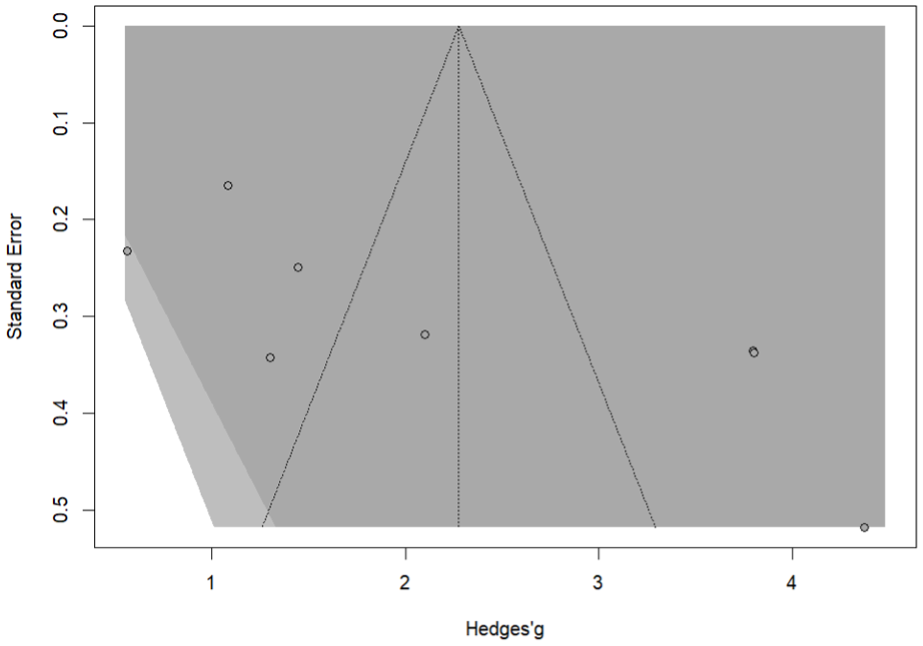
Funnel plot of creative thinking studies.
According to Rosenthal (1979), the threshold value is 50 (5 × 8 + 10) based on the studies included in the meta-analysis. Since the required number of studies (816) is much higher than the threshold value, it can be said that the observed effect size is strong and there is no publication bias. While the observed number of studies is 8, 816 studies with zero effect size would be needed to make the effect size insignificant.
Discussion and Conclusion
This meta-analysis study aims to calculate the general effect size of the brainstorming technique on academic achievement and creative thinking. Regarding the first problem; In the meta-analysis study conducted on academic achievement, the results of 22 studies covering the years 2007 to 2022 were analyzed. It was determined that teaching based on the brainstorming technique had a “medium” effect size (ES = 0.958, 95% CI: 0.682–1.234) on academic achievement (Cohen et al., 2007, p. 521). In addition, the overall effect size differed significantly from zero (z = 6.79, p < .01). Considering that the observed effect sizes varied between −0.340 and 2.431, the common effect size was positive, and the real effect of a single study was negative, this study had a negative effect on performance. As a result, it can be concluded that the majority of the studies included in the meta-analysis (95%) found that the brainstorming technique has a small to large effect on academic achievement. When evaluated in general, the effect of the brainstorming technique on students’ academic achievement is seen as positive (Acharya, 2017; Al-Bayati & Mizban, 2022; Astuti & Kumalarini, 2013; Duru, 2007; Gultom & Gurning, 2014; Odoh, 2013).
According to the analysis results in the forest plot related to academic achievement, the heterogeneity test was found to be significant (Q(21) = 155.46, p < .01), and a moderator analysis was conducted to determine the source of this heterogeneity, with the effect size not being significant for all variables. Although it has the least number of studies in terms of educational level, it is observed that the highest effect size is at the elementary school level. In this context, it is important to increase studies on the brainstorming technique, especially at the elementary school level, as it can impact students’ academic achievement (Al-Bayati & Mizban, 2022). In terms of the categorical moderator analysis for the field, it can be said that the brainstorming technique is most effective in the field of Science and Technology (Odoh, 2013; Osuafor & Ogbaga, 2016; Owo et al., 2016; Uzezi & Jonah, 2017). In terms of study design, the effect size of quasi-experimental studies was found to be stronger than that of experimental studies. As for the categorical moderator analysis related to the location of the studies, it can be said that studies conducted in Nigeria have a stronger effect compared to other studies (Filgona et al., 2016; Odoh, 2013; Owo et al., 2016).
According to the meta-regression analyses, years, the duration of the experimental procedure (meetings), and the number of students in experimental studies (sample size) do not explain the heterogeneity among studies; therefore, these variables are not significant moderators contributing to the variance. In this context, all moderators provided in the studies were included, but no moderator was found that significantly predicted the variance.
According to the publication bias analysis, no publication bias was found when examining the effect sizes on academic achievement, but publication bias was found according to the funnel plot examination. Other tests also indicated no publication bias. Additionally, considering that 18 of the studies were articles and 4 were theses, more studies may be needed to measure publication bias accurately. According to Egger, Duval and Tweedie’s trim-and-fill test, and Rosenthal’s Fail-Safe N, there is no publication bias.
Regarding the first problem, the meta-analysis study on creative thinking determined that teaching based on the brainstorming technique has a “strong” effect size on students’ creative thinking (ES = 2.267, 95% CI: 1.273–3.279; Cohen et al., 2007, p. 521). Additionally, since it does not take a negative value, it can be said that the brainstorming technique is effective for students’ creative thinking across all populations (AlMutairi, 2015; Islim, 2009; Kumar, 2021; Masri, 2019). According to the analysis results in the forest plot related to creative thinking, the heterogeneity test was found to be significant (Q(7) = 146.13, p < 0.01), and a moderator analysis was conducted to determine the source of this heterogeneity, but no definitive result was found regarding the source of the variance. Only the sampling method was a significant moderator for creative thinking, explaining 1.77% of the variance (p < .05). The highest overall effect size was observed at the middle school level in terms of educational level (AlMutairi, 2015; Hidayanti et al., 2018; Taleb et al., 2013). It is possible to say that the brainstorming technique is more effective at the elementary and middle school levels in terms of both academic achievement and creative thinking results. In terms of the sampling method, the purposive sampling method was found to have a more effective overall effect size than the random sampling method (AlMutairi, 2015; Hidayanti et al., 2018; Kumar, 2021; Masri, 2019). In terms of field, although more studies on the brainstorming technique were conducted in the field of Science and Technology, it can be said to be more effective in the field of English (Kumar, 2021; Masri, 2019). This might be due to the fact that more thinking skills applications are carried out in English classes.
According to the meta-regression analyses, years, the duration of the experimental procedure (meetings), and the number of students in experimental studies (sample size) do not explain the heterogeneity among studies; therefore, these variables are not significant moderators contributing to the variance. When examining the results of all meta-regression analyses, it is shown that the brainstorming technique is not a significant moderator predicting students’ creative thinking. In terms of publication bias, there is no publication bias according to the effect size analysis and other tests conducted, but according to the funnel plot, there is publication bias. According to the Egger test, there is publication bias, but according to Duval and Tweedie’s trim-and-fill test and Rosenthal’s Fail-Safe N, there is no publication bias.
Additionally, when evaluating the effect of the brainstorming technique on academic achievement, it appears most effective in the field of Science and Technology (effect size = 1.112 [0.6651, 1.5593]; Al-Bayati & Mizban, 2022; Duru, 2007; Islim, 2009; Odoh, 2013; Osuafor & Ogbaga, 2016; Owo et al., 2016; Rizi et al., 2013; Uzezi & Jonah, 2017). This is followed closely by the English subject area (effect size = 0.933). This situation can be explained by the fact that these fields require more idea generation and solution-oriented thinking processes in learning, as well as the active use of critical and creative thinking skills (Beghetto & Kaufman, 2014; Bybee, 2013; Honey & Hilton, 2011; Masri, 2019; OECD, 2019; Richards & Rodgers, 2014; Saavedra & Opfer, 2012). On the other hand, the lowest effect size of the brainstorming technique was observed in the field of Social Studies (effect size = 0.786). This may be due to the fact that Social Studies lessons generally place greater emphasis on information transfer and rote-based learning processes, with student performance expectations often limited to recalling and interpreting existing knowledge (Celikkaya & Kus, 2009; Martorella, 1996; Polat, 2006). The widespread use of traditional methods such as lecturing and question-answering in Social Studies teaching may also push the development of creative thinking and problem-solving skills into the background (Sunal & Haas, 2011). In this context, it is likely that the content and teaching methods of Social Studies provide less benefit from techniques that promote creative thinking, such as brainstorming. Seefeldt et al. (2014) also highlight the importance of active learning and creative thinking practices in Social Studies but note that existing implementations are predominantly limited to knowledge-based processes.
In terms of creative thinking skills, the brainstorming technique has been found to have the highest effect size in the context of English lessons (effect size = 2.4247 [−0.2332, 5.0827]; Kumar, 2021; Masri, 2019). This can be attributed to the structure of English classes, which particularly include writing, speaking, and idea-generation activities, making them more conducive to developing students’ creative thinking skills. The influence of brainstorming in language teaching is further strengthened by processes such as problem-solving, developing alternative forms of expression, and producing original content.
Overall, when evaluating the use of the brainstorming technique, it is important to note that its origins date back to the 1950s (Isaksen, 1998). It was noticed that while this technique is actively used in the classroom, it is not fully understood in which processes it would develop more efficient learning. Although the examined moderators related to the brainstorming technique were not found to be significant predictors of students’ academic achievement and creative thinking, this does not contradict the overall positive effect of the technique. The findings indicate that, regardless of moderator effects, the brainstorming technique is effective in improving both academic achievement and creative thinking skills. Therefore, while moderator analyses help explain variability across different conditions, the general effectiveness of brainstorming as a teaching strategy is supported by the evidence. As a result, the brainstorming technique shows a “moderate” effect size for academic achievement and a “strong” effect size for creative thinking.
Suggestions
Within the scope of the research results, suggestions for applications and researchers are presented.
Recommendations for Practices
The research results indicate that the brainstorming technique is effective in enhancing both academic achievement and creative thinking. Its implementation in classrooms can promote effective, efficient, meaningful, and active learning, as well as support long-term retention for students.
Professional Development
It is recommended that in-service training be conducted to facilitate the widespread use of this technique. Detailed research should be carried out, and the technique should be implemented systematically in classrooms (Odoh, 2013). This ensures more effective use (Wagbara, 2020) and enables the integration of active classroom practices and appropriate instructional methods (Masri, 2019; Wagbara, 2020; Zuwanda & Umara, 2021), thereby contributing to students’ cognitive and affective development (Alrubai, 2014). Teachers’ professional development should be supported to enhance the applicability of this technique.
Encouraging Creative Environments
It is recommended to establish environments that encourage creative thinking and to apply methods and techniques that foster creativity.
Sharing Best Practices
It is suggested to follow current educational trends and share relevant research and practical examples with other educators and stakeholders to enrich classroom practices.
Literature and Resources
This assessment is based on research indicating that existing educational literature does not provide a comprehensive treatment of the relevant technique. A systematic analysis of current textbooks and reference materials in fields such as educational sciences, instructional design, and creative thinking—including both nationally utilized university textbooks and internationally recognized core works—has revealed that the technique is predominantly addressed in a superficial manner. This finding highlights a significant gap in the integration of the technique into educational practices and emphasizes the need for developing additional scholarly resources on the subject. Therefore, it is recommended that academic sources be reviewed and appropriate instructional materials be developed to support educators in better understanding, applying, and disseminating the technique.
Designing Activities
Activities should be designed to promote higher-order thinking skills and connect learning to real-life contexts.
Supportive Environments
Learning environments should be structured to allow students to express themselves freely, thereby fostering a culture of respect, tolerance, and trust.
Tech-enhanced Brainstorming
It is recommended to integrate technology and AI-supported applications that incorporate brainstorming strategies to enhance classroom interaction, motivation, participation, and diversity.
Diverse Applications
This technique should be applied across various subjects and learning environments to explore its broader effectiveness.
Adult Education
Studies targeting adult learners should be conducted, and their outcomes should be evaluated to determine the technique’s applicability beyond traditional K-12 settings.
Incorporation into Educational Materials
It is recommended that activities involving brainstorming be included in educational books. This can enhance teaching efficiency, support creative thinking (Alrubai, 2014; Isaksen & Gaulin, 2005; Masri, 2019; Rao, 2007; Taleb et al., 2013), and strengthen analysis and problem-solving abilities, contributing to the development of higher-order thinking and metacognitive skills as outlined in Bloom’s Taxonomy.
Recommendations for Researchers
Meta-Synthesis Method: As the source of the variance could not be explained in the meta-analysis, it is recommended that researchers use the meta-synthesis method. This can allow for interpretations regarding the source of the variance through the codes and themes derived from study groups.
Increased Study Quantity: The results indicate that despite the frequent use of the brainstorming technique in educational settings, there is a lack of sufficient studies on this technique. It is suggested to increase the number of studies using mixed methods to enhance understanding and applicability.
Extended Scope: In addition to articles, include theses, papers, books, book chapters, and research projects in the studies to broaden the scope. Utilize databases like ProQuest and the National Thesis Center to compare results.
Flexible Time Frames: Consider varying the time constraints in studies.
Keyword Analysis: Investigate and compare additional keywords beyond academic achievement and creativity.
Exclusion/Inclusion Criteria: Review studies excluded based on criteria and include meta-analysis studies from 2023. Comparing different years’ results can reveal changes in the field.
University-Level Research: Include university-level studies and compare them with k12 levels for various insights.
Multilingual Studies: Review studies written in different languages. Many studies in Arabic have been identified and can be included for comparison across different countries.
Comprehensive Grade-Level Studies: Conduct studies encompassing all grade levels as analysis showed that while few studies were conducted at the primary level, the technique was found to be more effective.
Experimental and Mixed Methods Studies: More experimental and quasi-experimental studies were conducted with fewer mixed-methods studies. Therefore, new studies on the brainstorming technique, supported by quantitative, qualitative, or mixed analyses, are recommended for broader applicability.
Future studies on the brainstorming technique should consider these limitations to contribute to a comprehensive understanding of the field. Despite the mentioned limitations, meta-analysis studies show that the brainstorming technique has a “moderate” effect on academic achievement and a “strong” effect on creative thinking. Therefore, the importance of actively using this technique in classrooms to enhance students’ success and creative thinking should be acknowledged. Teachers can use the brainstorming technique to improve students’ academic success and foster effective learning, and to enhance creative thinking, which is seen as a crucial 21st-century skill. This study is expected to guide future research, contributing to the field.
Footnotes
Authors Note
This study was conducted as part of the doctoral dissertation entitled Social Network Analysis (Bibliometry) and Meta-analysis of the Brainstorming Technique Studies.

Ethical Considerations
“Any research conducted with qualitative or quantitative approaches that require data collection from participants using survey, interview, focus group study, observation, experiment, interview techniques, the use of humans and animals (including material/data) for experimental or other scientific purposes, clinical research conducted on humans, research conducted on animals, retrospective studies in accordance with the law on the protection of personal data require Ethics Committee Permission” according to the text stated, since no data is used for any living being and the data is obtained through a literature review, ethics committee permission is not required.
Author Contributions
Tuğba İnciman Çelik: Conceptualization, Investigation, Methodology, Data Collecting, Curation, Visualization, Validation, Writing—Original Draft Preparation—Reviewing and Editing.
Cenk Akay: Conceptualization, Investigation, Methodology, Writing—Reviewing and Editing.
Funding
The authors received no financial support for the research, authorship, and/or publication of this article.
Declaration of Conflicting Interests
The authors declared no potential conflicts of interest with respect to the research, authorship, and/or publication of this article.
Data Availability Statement
Data sharing is valid for this article because the dataset was created/analyzed during the current study. Meta-analysis data can be shared with interested parties if deemed necessary.