



Abstract
This study examined the effectiveness of teaching phoneme categorization and segmentation to EFL underachievers using songs and rhymes as instructional materials. Two distinct groups of 11th-grade EFL underachievers from Taiwan participated in this quasi-experimental study. The instructional materials consisted of lyrics sourced from online resources of the British Council. The quantitative tool employed in this study was a questionnaire based on National Reading Panel’s Assessment of Phonemic Awareness tool, and qualitative data were analyzed. In terms of results, there was a small positive effect when using song-lyrics instruction to help EFL underachievers understand phoneme categorization, song-lyrics instruction did not significantly improve EFL underachievers’ understanding of phoneme segmentation, and EFL underachievers provided positive feedback on song-lyrics instruction during interviews. This study is likely to encourage educators and researchers to explore the potential advantages of using song-lyrics instruction to enhance learners’ English listening skills.
Plain language summary
This study, using questionnaire data obtained from 26 EFL underachievers in an experimental group and 27 EFL underachievers in a control group, all of whom were 17-year-old high school EFL underachievers in the 11th grade at a public high school in Taiwan, aimed to investigate the effectiveness of using songs and rhymes as instructional materials for teaching phoneme categorization and segmentation among EFL underachievers. We believe that our study makes a significant contribution to the literature because it found that there was a small positive effect when using song-lyrics instruction to help EFL underachievers understand phoneme categorization, that song-lyrics instruction did not significantly improve EFL underachievers’ understanding of phoneme segmentation, and that EFL underachievers provided positive feedback on song-lyrics instruction during interviews.
Keywords
Introduction
According to structural sensitivity theory (Kuo & Anderson, 2010), repeated exposure to song lyrics can significantly enhance phonological awareness among low-achieving EFL learners. However, Taiwan’s existing English education system does not place particular emphasis on learning through singing. Rather, the national curriculum predominantly relies on the use of textbooks and conventional teaching methods (Ministry of Education, Taiwan, 2018). While this traditional approach ensures that learners acquire fundamental linguistic competencies, it is possible that an overemphasis on traditional teaching methods may deprive students of the benefits of multiple auditory stimuli afforded by repeated lyrics, thereby limiting their opportunities to engage with phonemes in a more structured and entertaining way. This research seeks evidence on whether a non-traditional teaching strategy, such as song lyric instruction, could substantially enhance the “phonological awareness” and English language proficiency of EFL underachievers. Given the role of English as a global lingua franca, its significance in connecting with the world further underscores the importance of this endeavor (Graddol, 2006). To provide a solid foundation for this research, we considered key relevant findings, theories, and concepts in the field.
Literature Review
Benefits of Music-Based Learning
Music, particularly song-based instruction, has been recognized as a valuable tool in English education (Murphey, 1992). Music’s effectiveness in language education arises from its capacity for emotional and physical engagement, which helps develop an embodied understanding of linguistic structures (Casas-Mas et al., 2019). Instruction incorporating song lyrics generally outperforms control conditions (Werner, 2020), and in preschool classrooms, music is frequently employed for both academic and socio-emotional development (Kirby et al., 2023). Adult learners of Spanish as a foreign language tend to rely on music more than other media for language practice (Pérez-Carmona et al., 2021).
Music significantly impacts language education by enhancing linguistic abilities, motivating learners, and promoting cultural awareness (Engh, 2013; Mahayanti et al., 2020; Tse, 2015; Wang, 2020). Moreover, song-lyrics instruction, as highlighted by Eken (1996), efficiently identifies and corrects students’ mistakes while maintaining an engaging atmosphere. Musical instruction not only enhances students’ enthusiasm for learning a second language (Paquette & Rieg, 2008) but also fosters a relaxed and enjoyable learning environment. Such enjoyable learning plays a crucial role in boosting memory, comprehension, attention, creativity, and flexible thinking (Pattillo & Itano, 2001). Research has suggested that rhythmic practice can facilitate the acquisition of second language rhymes (Cason et al., 2020).
Recent research indicates that music and technology-enhanced language learning (TELLTM) can positively influence EFL learners’ academic performance, creative thinking, and self-esteem (Chen et al., 2024). Additionally, singing has been shown to improve grammar acquisition and spelling among primary EFL students (Busse et al., 2021).
Bilingualism and EFL
Bilingual learners have demonstrated advantages in EFL pronunciation accuracy compared to monolinguals (Kieseier, 2021). Foreign language learning can also impact native language phonetics, as seen in Portuguese speakers learning English (Osborne & Simonet, 2021). Despite these findings, there remains a need for greater emphasis on listening skills and spoken input in EFL education (Tsang, 2023).
Importance of Phonological Awareness
Phonological awareness plays a crucial role in the early stages of English language learning (Birch, 2007, p. 646). Emphasizing the significance of phonological awareness, a study assessed its impact on third-semester students in an English education program (Sastrawati et al., 2023) with evaluations conducted involving syllable count, phonological aspects, and speaking comprehension, with the aim of revealing how phonological awareness influences reading comprehension. Hismanoglu (2012) focused on prospective EFL teachers, highlighting the paramount importance of phonological awareness in EFL instruction and providing recommendations to bolster it. Targeting adult EFL learners, Hentasmaka et al. (2022) introduced embedded phonological awareness instruction into standard vocabulary classroom settings. The study demonstrated the efficacy of incorporating explicit phonological awareness training into vocabulary lessons, resulting in a substantial enhancement of learners’ phonological awareness skills. Together, these studies underscore the critical role of phonological awareness across different levels of English language education, ranging from student comprehension development to the training of prospective teachers and adult learner instruction. Therefore, this study focuses on the improvement of phonological awareness and listening comprehension of EFL high school students.
Music and Phoneme Categorization
Recent studies indicate that music can foster improvements in tonal perception, pronunciation, and memory in language acquisition (Howe & Baumgartner, 2024; Pino et al., 2023). These improvements operate through neurocognitive pathways shared with language, particularly concerning the hierarchical regulation of syntax (Asano et al., 2021). Melodies, rhythms, and tones in songs contribute significantly to students’ phonetic arrangement and phonological awareness, resembling the role of rhythm, stress, and intonation patterns in spoken language, similar to magic chants (Graham, 1978). Furthermore, the combined use of phonology instruction and song lyric analysis has been found to significantly enhance L2 listening comprehension (Tsang, 2020).
Underachieving EFL Students
Underachieving EFL learners face multiple challenges in English-medium instruction (EMI) contexts, particularly those related to academic language (Kamaşak et al., 2021; Pun & Jin, 2021; Soruç et al., 2021). Such difficulties often vary with learners’ English proficiency, prior EMI experience, and academic discipline (Aizawa & Rose, 2020). Moreover, students with specific learning difficulties (SLDs) may encounter additional barriers to L2 acquisition (Kormos, 2020). The difficulties faced by underachieving EFL students in reading may be related to deficits in their phonological awareness. Therefore, enhancing phonological awareness can improve reading comprehension among EFL learners. Adam and Mohammed (2017) found that “training on phonological awareness skills significantly improved the reading performance” of the EFL students at Najran University. For underachieving English learners, lyrics present a highly organized linguistic format augmented by melody and rhythm, fostering emotional and sensory engagement. Structural sensitivity theory posits that systematic and repeated linguistic input is especially valuable for learners who encounter phonological or phonemic difficulties, as it prompts them to focus on specific sound features and supports more effective phoneme categorization (Kuo & Anderson, 2010). Poor performance among EFL learners has often been attributed to boredom, lack of engagement, and monotonous teaching methods. The use of song lyric instruction can mitigate this issue by making learning more enjoyable.
Research Significance and Objective
Despite the above-listed advantages, lyrics-driven instruction remains underutilized in Taiwan’s mainstream EFL pedagogy, indicating a clear gap between theoretical insights and practical implementation. In order to encourage the integration of songs into EFL classroom instruction, it is necessary to build a body of research on the specific ways in which music and lyric instruction can support language acquisition for under-achieving students. This study aims to contribute to that body of research. While previous studies have reported the benefits of song and lyric instruction for language acquisition, no study has obtained evidence of their effectiveness in providing targeted support to low-achieving EFL students, specifically, in the area of phoneme categorization. This is the gap in the literature that this study attempts to fill.
The primary objective of this study is to examine the impact of song-lyrics instruction, as compared to the direct traditional instruction method, on the phonological awareness and learning experience of EFL underachievers. This objective rests on the belief that music can be a powerful aid in foreign language acquisition, learning engagement, and learning motivation.
Theoretical Framework
Structural sensitivity theory, as proposed by Kuo and Anderson (2010), has provided a valuable framework in the EFL field, particularly in the context of using songs as a teaching tool, therefore, this theory serves as the study’s framework. This theory emphasizes the structural aspects of instructional materials and how they influence the effectiveness of learning. In relation to EFL underachievers and songs, structural sensitivity theory offers several key insights. First, it underscores the importance of content organization within instructional materials, urging educators to consider how lyrics and language elements are structured within songs. An organized and coherent arrangement of lyrics greatly facilitates learners’ comprehension and retention of vocabulary and grammar. Second, the theory highlights the critical role of the presentation format. For EFL underachievers, this involves carefully considering how songs are to be presented, including factors such as pronunciation clarity, tempo, and the use of visual aids, such as lyrics on worksheets. Effective presentation formats, including interactions between teachers and students, or among students, significantly enhance the use of songs in language learning.
Following the principles of structural sensitivity theory, this study used the songs “We’re going to the zoo” and “Animal house” obtained from the British Council (2017) website to help enhance meet the language proficiency levels and meet the learning objectives of EFL underachievers. It utilized two teaching methods, namely, direct instruction and song-lyrics instruction, and incorporated the same songs in both methods as instructional materials.
Incorporating structural sensitivity theory into EFL classrooms can help inform educators concerning appropriate song selection, organization, and presentation. This consideration of song structure can improve the learning environment and help align the materials with the learning objectives more effectively. Academics have emphasized phonological awareness among Taiwanese high school students, highlighting the significance of rhymes for teenagers (Yoshikawa & Yamashita, 2014).
The following guidelines have been shown to enhance phonological awareness of instructional design (Chard & Dickson, 1999):
Instead of stop sounds (such as /p/, /b/, and /k/), start with the sounds /s/, /m/, and /f/, which are simpler pronouns.
When first introducing the task, carefully lay out the instructional framework.
Move from bigger units (onset and rhyme) to smaller ones (independent phonemes).
Move on to more difficult activities, such as phoneme blending and segmentation, from simpler ones, such as practicing intonation.
Employ a variety of techniques to assist those who are struggling with early reading, such as text bingo or specialized items that symbolize voice control.
As noted, structural sensitivity theory served as the theoretical foundation for this study in examining the effectiveness of English song-lyrics instruction compared to direct instruction for EFL underachievers. The research questions were aligned with the core concepts of the theory, aiming to investigate phonological awareness, syllables, onset, and rime among EFL underachievers in the context of the two instructional methods. The research questions were as follows:
(1) Is song-lyrics instruction more successful than direct instruction?
(2) Are there any differences in how EFL underachievers perceive “phoneme categorization” between song-lyrics instruction and direct instruction courses?
(3) Does the way EFL underachievers perceive “phoneme segmentation” change between direct instruction and song-lyrics instruction?
(4) Why does song-lyrics instruction enhance EFL underachievers’ English listening skills?
These four questions were used to evaluate the relative success of song-lyrics instruction versus direct instruction, to identify potential differences in phoneme categorization and phoneme segmentation perception between the two methods, and to determine the factors contributing to the impact of song-lyrics instruction on EFL underachievers’ English listening skills.
Methods
Research Design
This study used a quasi-experimental strategy of including English songs in high school courses to compare the learning impact with that of direct instruction and to track variations in English listening between two groups. The instructor kept a log of every lesson for use in analyzing both the direct and song-teaching methods. Quantitative data from pre- and post-tests were evaluated using Microsoft Excel and JASP software. Semi-structured interviews were conducted to collect feedback. One-on-one semi-structured interviews were conducted after the experiment. The analysis considered relatively positive, relatively negative, and relatively surprising feedback in both the control and experimental groups. To enable EFL underachievers to reveal their true thoughts and feelings, it is important to provide them with an opportunity to express themselves outside a test-oriented context. Qualitative data included short-answer replies, post-it responses, and questionnaires on their prior knowledge of and background in English. The mixed-methods research framework, combining quantitative and qualitative research methodologies, enabled a thorough assessment of the effects of introducing English songs into the high school curriculum, providing both quantifiable evidence and an intricate qualitative understanding derived from the learning experiences of EFL underachievers.
Research Site and Participants
The study participants were students who had performed poorly in English-listening comprehension in the 11th grade (age: 17) at a public high school in Taiwan. Two groups were chosen at random, one as the experimental group and the other as the control group, with a lookup table used to select the participants. The table contained class data, including the number of underachievers in each class, sorted based on selection criteria such as class size and random assignment. The experimental and control groups were chosen from the lookup table to ensure transparency and a systematic participant selection process. There were 26 EFL underachievers in the experimental group and 27 EFL underachievers in the control group. A midterm English listening exam was used to identify underachievers. The average results for the two groups were 28.5% and 24.7%, respectively. This range covers the first quartile. In Taiwan, the Curriculum Guidelines for 12-Year Basic Education, covering elementary, junior high, and upper secondary schools, were recently updated, with the introduction of a new proficiency statement related to listening, “1-V-14 can comprehend the rhythm and rhyming of songs and rhymes,” into The Domain of Language Arts: English (Ministry of Education, Taiwan, 2018, p. 12). This revision intends to improve the learning outcomes considered in this study. In general, underachieving high school students in Taiwan exhibit a greater inclination toward English writing than English listening. In Taiwan, English is taught as a foreign language and listening serves as the primary language input; but if learners do not have adequate exposure to spoken English, they may encounter difficulties in listening comprehension. EFL learners in Taiwan follow diverse methods when studying both Chinese and English. In such a scenario, if elementary and junior high school learners have inadequate English listening comprehension, they might struggle to differentiate between monosyllabic and polysyllabic words or become confused by phonetic combinations. This could lead to a gap between their linguistic skills and their cognitive load as they progress to high school. To ensure effective learning and teaching, teachers need to be aware of their students’ prior knowledge and remain updated with changes in the learning landscape. In the experimental group, some students had parents from other Southeast Asian countries, with four parents being Indonesian citizens and one being Vietnamese. This may have influenced their sensitivity to English due to their upbringing. However, they used Chinese as their primary language. In contrast, in the control group, all the students were Taiwanese. Gender composition was the same in both groups, with each group having seven female EFL underachievers, making up less than one-third of each group. Regarding English learning background, in the experimental group, eight participants received English instruction solely within school, whereas the remaining 18 participants strengthened their English through cram schools and tutoring. In contrast, in the control group, 10 participants had experience with cram schools and tutoring, while the majority (17) learned English solely within the school. Table 1 below provides the background information of the research participants.
Background Data on the Participants.

The students and their parents were requested to sign informed consent forms. To ensure the protection and management of personal data, the researchers adhered to the relevant legal regulations, including the Personal Data Protection Act. The collection of these data was strictly limited to assisting with the purpose of this research and will never be disclosed without the voluntary consent of the individuals involved.
The effectiveness of the two teaching methods, namely, direct instruction and song-lyrics instruction was compared in this study. Each group received three 50 min lessons, totaling 300 min of instruction. The experimental group received song-lyrics instruction and the control group received direct instruction. Both groups used the same teaching content to ensure a thorough exploration of the impact of each method on learning outcomes and to maintain a well-structured study design that minimized potential short-term biases. The control variables for the study sample were the instructional methods—song-lyrics instruction and direct instruction (see Table 2). These instructional methods served as independent variables that were compared to analyze and assess the differences in learning outcomes related to phonological awareness, syllables, onset, and rime among the participants. The dependent variable was the participants’ phonological awareness, which was measured and compared between the two instructional methods.
The Research Variable Framework.

Pre- and post-tests were given to the students in both groups simultaneously, in the same sequence, and with the same staff. The same learning sheets for songs and rhymes were used. However, the teaching strategies varied. Following the teaching strategy presented in Figure 1, song-lyrics instruction utilized song lyrics as the teaching material, whereas direct instruction utilized English rhymes as the teaching material. The central illustration in Figure 1 presents the research framework. This design drew inspiration from musical notes and reflected the study’s emphasis on song lyrics. In the upper right corner, there is an oval shape representing song-lyrics instruction, denoted as “s,” while the oval shape in the lower left corner symbolizes direct instruction, labeled as “d.” On the right side, the three curved lines signify three energetic lessons, while on the left side, the three horizontal lines represent three comparatively tranquil lessons. Both approaches shared similar objectives, including fostering appreciation for the elements of the English language, encouraging interaction, improving phonological awareness, and nurturing positive attitudes toward learning. These aims are consistent with the principles of structural sensitivity theory, which underscores the importance of recognizing linguistic structures in language learning and appreciation. The integration of these teaching methods within this theoretical framework was intended by the researchers to create engaging and effective language-learning experiences that would enhance both phonological awareness and positive attitudes toward learning.

Teaching strategies of direct instruction (d) and song-lyrics instruction (s).
Data Collection
Instruments
The Assessment of Phonological Awareness (National Reading Panel, 2000) tool was used for testing. There were two types of phonological awareness questions in both the pre- and post-tests, with a total of 40 questions each. One type focused on phoneme categorization, whereas the other focused on phoneme segmentation. To categorize the phonemes, onset and rime tests were used, each consisting of 10 questions. The phoneme segmentation questions involved English words with one to five syllables, with four questions for each syllable. The source of the words used in the phoneme categorization and segmentation in this study was the English Reference Vocabulary for Senior High School, published by the College Entrance Examination Center in Taiwan, which covers vocabulary levels one through six. Notably, the post-test was more challenging than the pre-test. The detailed assessment information is presented in Table 3.
Assessment of Question Genres.

Level six is the most challenging.
To assess phonological awareness, the researchers employed a set of researcher-designed tasks that encompassed two primary components: phoneme categorization and phoneme segmentation. In the phoneme categorization task, the participants were presented with a series of 20 multiple-choice questions. Each question consisted of a researcher pronouncing three English words, and the learners were instructed to circle options A, B, or C on their test paper, indicating which word did not belong, based on phonemic characteristics. Importantly, the phoneme categorization task covered both onset and rime categorization, with an equal distribution of 10 questions for each category. For example, a typical question could be: “Which word does not belong: belt, pen, pin?” In response, the EFL underachievers would provide their answer, such as: “‘Belt’does not belong. It does not begin with the /p/ sound.” Only a subset of examples in the assessment is presented in Table 4, labeled the researcher-designed phoneme categorization word list.
The Researcher-Designed Phoneme Categorization Word List.

In the phoneme segmentation task, a researcher pronounced a set of 20 English words sequentially. Each question was repeated twice to ensure clarity. The participants were required to circle the number of syllables (ranging from one to five) on their test papers, indicating the correct number of phonemes in each word. This task included four questions for each syllable unit, for a total of 20 questions. For example, a question in this category might ask, “How many sounds are there in ‘refrigerator’?” The participants would respond by segmenting the word phonemically, noting, “…/re/…/fri/…/ge/…/ra/…/tor/. There are five sounds in ‘refrigerator’.” Only a subset of the questions included in this assessment is presented in Table 5, referred to as the researcher-designed phoneme segmentation word list.
The Researcher-Designed Phoneme Segmentation Word List.

These researcher-designed tasks were carefully constructed to effectively assess the phonological awareness skills of the EFL underachievers, emphasizing both categorization and segmentation aspects. To confirm the validity of the test, a high-school English teacher with 10 years of experience and an expert in English linguistics with 14 years of teaching experience evaluated the questions before the test.
Interviews
This study assessed students’ feelings during teaching activities. Cognitive aspects were evaluated using rhyming test results, and emotional aspects were evaluated using post-it notes, general responses, and semi-structured interviews. The analysis considered relatively positive, relatively negative, and relatively surprising feedback in both the control and experimental groups. The general response questionnaire included both short- and multiple-choice questions, as follows: Question 1: The teaching activity that left the most lasting impression on me was.… Question 2: Through the teaching activities, I discovered (multiple-choice questions): It is easy to remember English vocabulary; I am more willing to speak in English; I have developed a fondness for learning English; English has become more interesting to me; I have gained an understanding of English pronunciation; other: [please specify]. Question 3: I hope to continue learning English in this manner in the future (choose only one answer): strongly disagree, disagree, agree, or strongly agree. The purpose of the general response questionnaire was to ascertain whether students were receptive to song-lyrics instruction. Furthermore, to conduct the semi-structured interviews, three students from the experimental and control groups were selected at random after finishing the 3 week course and invited for discussion during their downtime. In this study, the sampling process for the interviews was appropriately rigorous. Drawing lots involves selecting participants by chance, typically by drawing numbers from a container to secure interviewees. This approach has proved to be practical and transparent, particularly when generating a random sample that can otherwise pose logistical challenges; therefore, it was used in this study. The primary goal was to minimize selection bias and guarantee equitable opportunities for potential participants. We sought to ascertain whether the students’ opinions of English had changed by asking them. In addition to discussing their tastes in music, personalities, and other topics, the conversations focused mainly on how they felt about English. The instructor did not express a preference for teaching methods to the interviewees, nor did the researchers attempt to steer the students’ responses. This study prepared a set of pre drafted interview questions to encourage students to express their opinions freely, as follows:
(a) Did you enjoy learning English in this 3 week course? Why or why not?
(b) How do you feel about your English skills now?
(c) What aspects of this teaching intervention did you like the most? For example, which song did you prefer?
(d) What aspects of this teaching intervention did you like the least? Can you explain the reasons for this?
(e) In addition to learning English, do you enjoy songs in other languages or dialects? If so, why?
(f) Do you have any suggestions or feedback for the course design or content in the future?
Data Analysis
Excel and JASP software were used to perform independent samples t-tests on the pre-test and post-test quantitative data. These tests determined whether there were statistically significant differences in phoneme categorization and segmentation abilities between the experimental and control groups. The t-value, a key component of these tests, measures the magnitude of the difference between group means while accounting for inherent variability. A higher t-value indicates a more significant difference, helping researchers assess the practical impact of the intervention on phonological skills and account for natural performance variations. To provide potential instructional references, this study conducted data analysis to examine the English listening abilities of EFL underachievers through English songs.
Results
The data analysis revealed three study findings, as follows. First, the use of song-lyrics instruction had a small effect on assisting EFL underachievers in understanding phoneme categorization. In this study, the two groups were compared in terms of their phoneme categorization abilities. The experimental group had an average pre-test score of 71.51 out of 100, which increased to 74.03 out of 100 in the post-test, showing an improvement of over 2.5 points. This suggests that the experimental group members were able to improve their phoneme categorization skills. In contrast, the control group had an average pre-test score of 69.63 out of 100, which decreased slightly to 69.44 out of 100 in the post-test, resulting in a drop of nearly 0.2 points. Statistical significance analysis, indicated by p-values exceeding .05, revealed no significant difference in phoneme categorization learning between the experimental and control groups before the intervention. However, after song-lyrics instruction, the experimental group exhibited a notable improvement in phoneme categorization skills, as evidenced by the differences between the pre-test and post-test results. An effect size of 0.28, as per the DATAtab Team (2023) guidelines, indicates a small effect, signifying that while there was a statistically significant difference between the groups, it was relatively modest in terms of practical significance. The independent samples t-test results for phoneme categorization, as shown in Table 6, further supported these findings, with a post-test t-value of 1.01, indicating a significant change compared to the pre-test t-value of 0.37, which initially showed some differences between the groups.
Independent Samples t-Test Results for Phoneme Categorization.

Second, the use of song-lyrics instruction did not significantly assist EFL underachievers in understanding phoneme segmentation. In this study, the impact of instructional methods on the phoneme segmentation abilities of experimental and control groups was examined. The experimental group’s average post-test score, following song-lyrics instruction, was 84.80 out of 100, representing an increase of approximately 6 points from their average pre-test score of 78.85 out of 100. In contrast, the control group had an average pre-test score of 71.85 out of 100, which increased to 83.88 in the post-test, reflecting a gain of more than 12 points. Analyzing the independent samples t-test results for both the pre-test and post-test provided valuable insights into the performance of the experimental group in phoneme segmentation compared to the control group. For the pre-test, the t-test yielded a value of 1.51, indicating a relatively higher difference between the two groups before any instructional intervention. This discrepancy suggests that there were inherent distinctions in the phoneme segmentation abilities between the groups at the beginning of the study. Conversely, the post-test t-test resulted in a value of 0.2, indicating a much smaller difference after the experimental group received song-lyrics instructions and the control group received direct instructions. Considering these findings, it could be inferred that, in this study, the experimental group’s phoneme segmentation performance did not significantly differ from that of the control group. This implies that both song-lyrics instruction and direct instruction had a similar impact on the phoneme segmentation abilities of the two groups. Table 7 provides additional information regarding the independent-sample t-test results for phoneme segmentation.
Independent Samples t-Test Results for Phoneme Segmentation.

Third, the EFL underachievers provided positive feedback on song-lyrics instruction during interviews, which assessed how students felt about the way they were taught. Cognitive aspects were evaluated using rhyming test results, and emotional aspects were evaluated using post-it notes, general responses, and semi-structured interviews. The analysis considered relatively positive, relatively negative, and relatively surprising feedback in both the control and experimental groups. In the post-it notes of the control group concerning English rhyme 1, titled “We’re going to the zoo,”Figure 2 displays the “relatively positive feedback” from control group student 1 (CG1) and CG2, arranged from left to right. CG1 had written “I learned how to pronounce English words by rhyming” (translated student feedback from Chinese to English), suggesting that this student was able to grasp how to use rhyming for learning English words after teaching. CG2 had particularly emphasized “Memorable and enjoyable” (translated student’s feedback from Chinese to English), indicating that the English textbook had fostered a new mindset of independent learning, and that the student was motivated to actively memorize the content.

The relatively positive feedback recorded on post-it notes by control group student 1 (CG1) and CG2.
Figure 3 below illustrates some relatively negative feedback concerning the first song, titled “We’re going to the zoo,” in the experimental group, specifically from experimental group student 1 (EG1) and EG2, arranged from left to right. EG1 had written “They are so noisy” (translated student feedback from Chinese to English), suggesting that this student found the other students to be too noisy, and that instructors need to be concerned about addressing the challenge of maintaining classroom order during song-lyrics instruction, which could affect students’ perception of learning conditions and also their learning efficiency. EG2 had written “I think it is very difficult” (translated student’s feedback from Chinese to English), indicating that EG2 found the learning process challenging, highlighting the variations in individual English proficiency levels.

The relatively negative feedback recorded on post-it notes by experimental group student 1 (EG1) and EG2.
Figure 4, from left to right, displays relatively surprising feedback concerning the first song, titled “We’re going to the zoo,” from EG3 and EG4. Although the students were not required to write their post-it notes in English, EG3 had written, “I’m handsome boy,” and EG4 had written, “Let me no some spend shot is cool, I like is. Thanks, teacher.” Although there were errors in the grammatical structure and spelling, these comments were unexpectedly expressed in English, which underscores the importance of this teaching environment such that some students could spontaneously choose to express themselves in English during song-based instruction. This suggests that students had absorbed English sounds and were capable of directly expressing their thoughts in English.
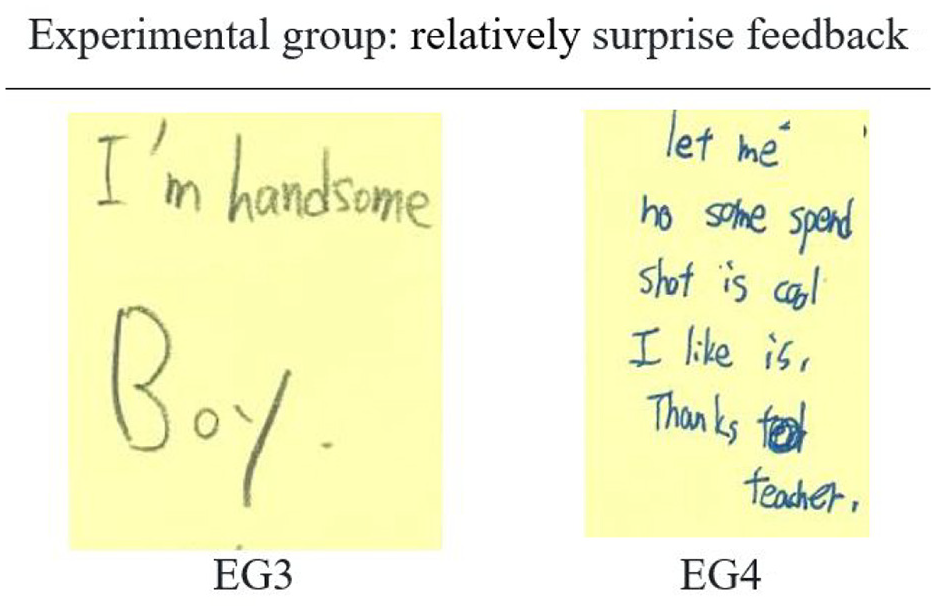
The relatively surprising feedback recorded on post-it notes by experimental group student 3 (EG3) and EG4.
After three lessons of direct instruction, as can be seen in Figure 5, CG3’s general response was characterized by relatively positive feedback. What had impressed CG3 the most was that “everyone read a line in turn, so that everyone could practice reading English, and the content was not too difficult, which was quite simple for me.” (translated student feedback from Chinese to English). From the students’ self-reports, it was evident that they could grasp the overall intention in relation to their individual learning situations. This indicates that the students valued and accepted the interactive and dialogic nature of their learning activities.
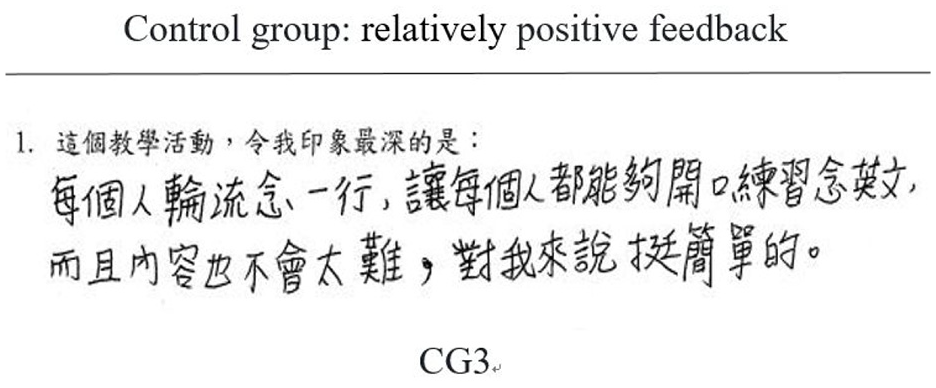
The relatively positive feedback recorded on general responses by control group student 3 (CG3).
As shown in Figure 6, EG5 expressed clear opinions regarding the test. They showed hesitancy in exerting cognitive effort during the test but emphasized the significant role of the teaching method in fostering self-improvement, contributing to a better understanding of English phonetics. They found that listening to music helped in grasping English pronunciation more effectively. Notably, EG5 preferred using singing as a method of learning English. In summary, interview content analysis revealed relatively positive feedback regarding song-lyric instruction.

The relatively positive feedback of experimental group student 5 (EG5) recorded during the semi-structured interview.
Discussion
This study explored the impact of English song-lyrics instruction and direct instruction on the phonological awareness of EFL underachievers, specifically in terms of syllable variation, onset, and rime. Three questions were posed for evaluation. Based on the study findings, they could be answered as follows. First, in relation to question 1 (Is song-lyrics instruction more successful than direct instruction?), it was found that students immersed in song-lyrics instruction scored higher in phoneme categorization than those receiving direct instruction. On the other hand, students who received direct instruction scored significantly higher in phoneme segmentation than students under song-lyrics instruction. Therefore, song lyrics and direct instructions were equally effective in this study, excelling in different aspects. According to Shen (2009, p. 92), engaging with English songs not only prepares EFL learners for real-world English encounters but also simplifies the comprehension and incorporation of phonological rules. In an experimental classroom, students who regularly listened to English songs, as Shen reported, exhibited a heightened focus on pronunciation, phonological guidelines, stress patterns, and intonation. Consequently, they pronounced words more accurately and spoke English with greater fluency than their peers who received direct instruction. This implies that song-lyrics instruction, as noted by Shen (2009), may be more effective than direct teaching. However, our study did not find significant differences between direct instruction and song-lyrics instruction in the phonological assessments and Shen’s claim that song-lyrics instruction was better than direct instruction was not supported. In future studies, different variables (e.g., listening comprehension tests) could be used to investigate the differences between song lyrics and direct instruction. Abdullah (2013, p. 98) emphasized that achieving English literacy through listening involves considerations of language, culture, and educational backgrounds. To enrich the educational experience and ensure success, teaching approaches have been suggested that prioritize students, promote meaningful ESL usage, integrate and build upon students’ language and cultural backgrounds, and employ inventive methods to teach effective listening skills.
Second, in relation to question 2 (Are there any differences in how EFL underachievers perceive “phoneme categorization” between song-lyrics instruction and direct instruction courses?), it was found that song-lyrics instruction had a small but positive effect on improving phoneme categorization skills among EFL underachievers. The experimental group’s pre-test average score was 71.51 points, which increased to 74.03 points after song-lyrics instruction, a nearly 3-point improvement. Conversely, the pre-test average score was 69.63 points, and after direct instruction, it decreased slightly to 69.44 points, indicating a 0.2-point drop. We found that direct instruction may not have provided initial motivation for students to speak English, possibly contributing to the control group’s lower post-test performance. In summary, the experimental group using song-lyrics instruction outperformed the control group in phoneme categorization performance. In Quinones et al.’s (2022, p. 321) study of Japanese high school students, most participants were 17 to 18 years old, studying in grade 12, and had used English at home for 7 to 8 years. The results revealed challenges in phonological awareness skills, with mixed scores in syllable awareness, poor performance in initial sound identification, and a split between medial and final sound identification. Notably, in our study, the initial and final sound identifications, which were equivalent to the rime and onset components, showed similar difficulties. Overall, this finding further highlights the key issue that EFL high school students struggle with English phoneme categorization, particularly in initial and final sound identification. Furthermore, our study found that after song-lyrics instruction, there was a positive change in EFL underachievers’ phonological categorization ability, a novel finding concerning EFL high school students with no prior literature.
Third, in relation to question 3 (Does the way EFL underachievers perceive “phoneme segmentation” change between direct instruction and song-lyrics instruction?), it was found that using song-lyrics instruction did not help EFL underachievers significantly understand phoneme segmentation. The implementation of song-lyrics instruction did not yield better results than traditional direct instruction in terms of the phoneme segmentation skills of EFL underachievers. Most teachers commonly use a direct instruction approach to facilitate students’ understanding and application of new information, with the aim of fostering positive learning attitudes and emotional skills (Ababio & Dumba, 2014, p. 44). In the pre-test, the experimental group averaged 78.85 points, and after song-lyrics instruction, their post-test average reached 84.80 points, indicating an improvement of nearly six points. In contrast, the control group had an average of 71.85 points on the pre-test, which increased to 83.88 points after direct instruction, marking a gain of over 12 points. Two reasons for the score difference can be identified. First, some learners in the experimental group may have struggled to manage English vocabulary syllable counts under song-lyrics instruction compared to the control group’s traditional direct instruction. Second, the control group, which underwent traditional direct instruction, possibly gained a better grasp of the phoneme segmentation skills. Overall, the control group significantly outperformed the experimental group in post-test phoneme segmentation performance. Our study findings closely mirrored the findings of Al-jasser (2008), who emphasized the significance of phonotactic training in second language acquisition. It was observed that nonnative speakers often applied their native language’s phonotactic constraints to English, even when they were not relevant. Therefore, we recommend integrating phonotactic training into second language listening and pronunciation programs. With sufficient practice, EFL learners could overcome phonotactic disparities between their native language and English, thereby diminishing the influence of their native language on auditory processing. Our findings parallel Al-jasser’s (2008) findings on lexical segmentation. While our findings indicated that the improvement in phoneme segmentation within the experimental group was only half of that in the control group, Al-jasser’s (2008) research revealed that the error rate in lexical segmentation remained unchanged. Therefore, teaching and learning phoneme segmentation may require extensive planning and training.
Fourth, in relation to question 4 (Why does song-lyrics instruction enhance EFL underachievers’ English listening skills?), it was found that the use of song-lyrics instruction enhanced EFL underachievers’ English listening skills by making it easier for them to remember English, boosting their confidence in singing, and nurturing a genuine fondness for language learning. After song-lyrics instruction, up to 90% of the EFL underachievers agreed with the following statement in the general response questionnaire: “I hope to continue learning English in this manner in the future.” Therefore, qualitative data analysis suggested that song-lyrics instruction could enhance students’ acceptance of English. In addition, entrenched learning methods seem to require extended periods of instructional research before showing trends toward change. In this study, positive feedback on song-lyrics instruction was offered by the EFL underachievers during semi-structured interviews. EG6 held the belief that song-lyrics instruction, as illustrated in Figure 7, had the capability to liberate a learner from the burden of rote memorization of English vocabulary and, almost unnoticed, could foster an apparently effortless incorporation of words into one’s memory.

The relatively positive feedback recorded in semi-structured interviews by experimental group student 6 (EG6).
After song-lyrics instruction, EG7 commented that “Singing has been consistently pitch-perfect,” (translated student feedback from Chinese to English), expressing that personal singing pitch accuracy was the most unforgettable part of the learning experience, as depicted in Figure 8.

The relatively surprising feedback recorded on the general responses by experimental group student 7 (EG7).
However, EG8, who had received 1 year of English tutoring, had no particular desire to learn English, indicating a lack of motivation. In the general responses, EG8 mentioned “falling behind in singing,” (translated student feedback from Chinese to English), acknowledging the difficulty in keeping up with singing activities, as shown in Figure 9. Faced with this situation, instructors should provide individual assistance through instructional support to students in need of English reinforcement, thereby mitigating individual differences.

The relatively negative feedback recorded on the general responses by experimental group student 8 (EG8).
In Figure 10, in relation to question 2 in the general response questionnaire, EG9 discovered through the teaching activities that “It was easy to remember English vocabulary,”“I developed a fondness for learning English,” and “English became more interesting to me,” which could be categorized as the student having enjoyed song-lyrics instruction. Furthermore, in relation to question 3 in the general response questionnaire concerning whether the student hoped to continue learning English in this manner in the future, EG9 selected “Agree.”

Responses of experimental group student 9 (EG9) in the general questionnaire.
Figure 11 shows that for question 2 in the general response questionnaire, EG10 reported “other: Learn the pronunciation of four more words” (translated student feedback from Chinese to English), which could be categorized as positive feedback on the learning process. Furthermore, in relation to question 3 on whether the student hoped to continue learning English in this manner in the future, EG10 selected “Strongly Agree.”

Responses of experimental group student 10 (EG10) in the general questionnaire.
In summary, while song-lyrics instruction was shown to be effective in various areas, the relatively small effect on phoneme categorization should be understood in the context of a broader phonological awareness skill set. Further research is needed to determine the specific impacts of song-lyrics instruction on different phonological skills and how to optimize its role in enhancing overall English language learning.
Limitations
This study had some limitations. The findings do not directly apply to all EFL learners, and potential bias in student feedback and the small sample size limit the robustness of the findings. The choice of thematic songs as the instructional medium may also have influenced the results.
Conclusion
This study addressed the challenge of enhancing English language instruction in the context of improving phonological awareness and learning outcomes of underachieving students. The practical teaching strategies proposed in this study aim to balance engagement in teaching activities with the pressure of assessment. Recognizing the need to incorporate slightly more complex activities such as rhyming exercises for students engaged in extracurricular English learning is essential. Another key challenge is the implementation of phonological awareness courses in small class settings. This involves addressing individual learning difficulties and ensuring that learning objectives are effectively met. Additionally, this study emphasizes the importance of navigating potential challenges in teaching and learning, including skepticism and scrutiny. Building trust, empathy, and a sense of belonging between teachers and students is essential for overcoming these challenges. Ensuring optimal English language instruction, resolving complexities in teaching activities, tailoring instruction to class sizes, and fostering positive teacher-student and teacher-teacher relationships remain challenging tasks in the pursuit to enhance teaching and research quality in the field. This study contributes to tackling these challenges by expanding the knowledge on phonological awareness and the use of non-traditional and enjoyable EFL teaching methods.
Recommendations and Future Scope
Based on the study findings, we offer several recommendations. First, further research must be conducted to broaden the scope to include a wider range of EFL learners in Taiwan and other groups with varying levels of English proficiency. Additionally, future research should address methodological gaps and explore the long-term effects of using songs in EFL instruction across various linguistic domains. This will provide a more comprehensive understanding of the effectiveness of the song lyric teaching method. Second, the impact of other variables, such as weekly hours of English study and learning environments needs to be investigated in relation to English listening skills and phonological awareness. Finally, exploring diverse teaching methods extending beyond traditional approaches and considering interdisciplinary learning is recommended.
