




Abstract
This study examined word class effects on Yi students’ L2 Chinese word associations. 108 stimulus words, consisting of 36 nouns, 36 verbs, and 36 adjectives, were chosen from Corpus of Modern Chinese, with their frequencies and concreteness being strictly controlled. 80 students from grade 4 and 85 students from grade 10 finished the word association test successfully. The data collected were analyzed under a three-layer framework. The findings show that meaning-based associations seize a predominant position in all the three word classes, among which the semantic network of adjectives develops best. Meanwhile, phonological association is also an important connection mode for the three word classes, although adjectives trigger a relatively lower proportion. All the three word classes can elicit a substantial proportion of encyclopedic associations, with nouns demonstrating the highest triggering rate. As for the subcategories of paradigmatic and syntagmatic associations, nouns are dominated by synonymous, determinative and hierarchical associations, verbs by governing and synonymous associations, and adjectives by determinative, synonymous and antonymous associations.
Plain language summary
How words are stored and connected to each other in our minds has been a hot issue attracting the attention of researchers for decades. From the 1980s onward, the organization of L2 mental lexicon has received growing attention. While much progress has been made, some issues related to the nature of L2 mental lexicon are still unclear. How words from different word classes might influence L2 learners’ word association patterns is an issue worthy of further exploration. This study, adopting free word association test (WAT), investigated word class effects on L2 Chinese word associations. 165 Yi students taking Chinese as their L2 were recruited from one elementary school and one high school in a Yi-inhabited County in China. The 108 stimulus words were chosen from the 9,000 most frequently used words in modern Chinese, consisting of 36 nouns, 36 verbs, and 36 adjectives. Participants were required to write down the first word popping up in their mind when they see the stimulus words. We used a three-layer framework previously used to analyze L1 Chinese to analyze the WAT results. The findings revealed that Yi students’ L2 Chinese word associations share some common features with other L2 learners while particular characteristics of word class effects are also found. These findings are of great significance to L2 Chinese education of Yi students.
Introduction
The mental lexicon, often described as a mental dictionary, is a part of memory that stores information about a word’s meaning, pronunciation, morphology, and syntactic features (Aitchison, 2012). Scholars generally agree that the mental lexicon is stored in a network of interconnected word nodes with varied connection strengths (e.g., Collins & Loftus, 1975). The stronger the connection is, the faster the word activation and retrieval will be. In a word association test (WAT), the first word that comes to our minds has been confirmed to possess the strongest connection strength with its stimulus word (Playfoot & Burysek, 2024). Therefore, WATs have been taken as one of the most important ways to explore the connection mode of the mental lexicon (M. Li et al., 2022).
Since the 1980s, the importance of Second language (L2) acquisition has led to a growing interest in the study of the L2 mental lexicon. It is generally believed that learning L2 can modify one’s brain function associated with not only language processing, but also nonverbal performance (Bialystok, 2017), facilitating one’s executive functions and cognitive abilities, such as working memory capacity, inhibitory control, cognitive flexibility as well as general reading ability (Rafeekh et al., 2021). While much progress has been made, some issues related to the nature of the L2 mental lexicon are still unclear (M. Li et al., 2022). Among them, the effects of word class are of great importance (Fitzpatrick & Thwaites, 2020).
In L1 WATs, a number of studies have demonstrated that words of different word classes are capable of triggering different response behaviors (Fitzpatrick & Thwaites, 2020; Thwaites, 2020). However, the research of word class effects on L2 WATs is limited in number and inconsistent in result (X. S. Li & Wang, 2016; Nissen & Henriksen, 2006; Zareva, 2011; P. Zhang, 2011). This may be due to the complicated nature of L2 acquisition. Many researchers point out that variables such as the concreteness of stimulus words, age of acquisition, school grade, L2 proficiency, etc., all may make a difference (Agustin-Llach, 2022; Fitzpatrick & Thwaites, 2020; M. Li et al., 2022). Moreover, L2 learners’ linguistic background also matters. The mental lexicon structure of different language learners may be quite different from that of English as L1 or L2 learners. However, the vast majority of the existing studies in the mental lexicon now are on learners of English.
How L2 learners’ word association patterns would be affected by the word class of stimulus words in relation to their age and school grade in different linguistic contexts is an issue worthy of further exploration. Previous studies have revealed that minority students in China, who speak their ethnic languages as mother tongues, encounter great obstacles when learning Chinese as their L2 and often fail to achieve a satisfactory score in schools (M. Li et al., 2022; M. Li & Zhang, 2021). Yi students, inhabiting the southwestern part of China, is a particular group experiencing this problem to a large degree. Getting a deeper understanding of their L2 mental lexicon structure and helping them improve learning efficiency has become an urgent issue for the present educators.
M. Li et al. (2022) examined Chinese Yi students’ mental lexicon structure based on a three-layer analytical framework and found uneven growth rates regarding different types of word associations. However, the word class effects on the association patterns have been neglected. As a follow-up work, the present study aims to fill in this gap by exploring the word class effects on Yi students’ mental lexicon association patterns in relation to their grade level and age. It is hoped that the findings will provide a theoretical reference and a practical guide for teaching Chinese vocabulary for Yi students as well as for other ethnic minority students in China.
Literature Review
In the current literature, a three-layer framework is commonly used to categorize the responses of L2 learners’ WATs (Fitzpatrick & Thwaites, 2020; M. Li et al., 2022). Generally, at the first layer, word associations are classified into meaning-based and form-based associations based on their connection type with stimulus words. At the second layer, meaning-based association is subdivided into paradigmatic and syntagmatic associations, and form-based association is subdivided into orthographical and phonological associations. Further, at the third layer, paradigmatic and syntagmatic associations are subdivided into up to more than 10 subcategories in different studies. Although the subdivision is not exactly the same, the categories are roughly analogous. In the following sections, previous studies on word class effects on L2 learners’ association patterns at the three layers will be discussed.
Word Class Effects on Meaning-Based and Form-Based Associations
While till now few studies have examined word class effects on L2 learners’ word association patterns in detail (X. S. Li & Wang, 2016; Navracsics, 2007; Nissen & Henriksen, 2006; Yu & Cai, 2014; Zareva, 2011; S. S. Zhang, 2006; P. Zhang, 2011), a significant effect of word class on meaning-based and form-based associations has been reported.
On the side of meaning-based associations, a majority of studies on L2 learners have found that nouns may trigger the highest percentage of meaning-based associations, followed by adjectives, and verbs may trigger the lowest percentage of meaning-based associations (Nissen & Henriksen, 2006; Yu & Cai, 2014; P. Zhang, 2011). However, the studies on Chinese EFL learners generated inconsistent results. Some studies (Yu & Cai, 2014; P. Zhang, 2011) reported a similar trend with nouns having the highest triggering rate, but X. S. Li and Wang (2016) found in their study that nouns evoked the least meaning-based responses compared with verbs and adjectives. In their study, adjectives had a triggering rate of meaning-based associations as high as 90.2%.
On the other hand, although form-based associations have been found to be far fewer than meaning-based associations in most studies, the word class effects are obvious as well (X. S. Li & Wang, 2016; Nissen & Henriksen, 2006; Yu & Cai, 2014). The findings were inconsistent even for the same population. Some studies on Chinese EFL learners reported verbs triggered the highest proportion of form-based associations (Yu & Cai, 2014), while others found nouns produced more form-based associations than verbs and adjectives (X. S. Li & Wang, 2016).
Till now, few studies have examined how word class may affect L2 learners’ meaning-based and form-based association patterns as their L2 proficiency increases (Zareva, 2011; P. Zhang, 2011). The only two studies we could find showed that noun, verb and adjective stimulus words all triggered more lexical associations for learners with a higher proficiency level than those with a lower level (Zareva, 2011; P. Zhang, 2011). However, are their growth rates balanced or not? Is there any particular word class enjoying a priority in development? These questions are unsolved.
In view of the current situation, more research on how word class may affect L2 learners’ meaning-based and form-based association patterns and how it will develop with the increase of learners’ L2 proficiency is badly needed, especially for L2 learners of languages other than English.
Word Class Effects on Subcategories of Meaning-Based and Form-Based Associations
At the second layer, most studies tend to subdivide meaning-based associations into paradigmatic and syntagmatic associations, and form-based associations into phonological and orthographical associations. The word class effects on paradigmatic and syntagmatic associations have caught most researchers’ attention.
Generally, four types of findings have been reported (Feng, 2014; X. S. Li & Wang, 2016; Navracsics, 2007; Nissen & Henriksen, 2006; Yu & Cai, 2014; Zareva, 2011; S. S. Zhang, 2006; P. Zhang, 2011). Firstly, it is claimed that nouns, verbs, and adjectives all produce more paradigmatic associations than syntagmatic associations (Navracsics, 2007; P. Zhang, 2011). In P. Zhang’s (2011) study on Chinese EFL learners, it was further found that nouns, verbs, and adjectives all had a higher triggering rate of paradigmatic associations than syntagmatic associations in either high language level or low language level groups. When the data in the two groups were combined together, adjectives were found to evoke paradigmatic responses most frequently (43.90%), followed by nouns (39.07%) and verbs (35.51%), while nouns (28.31%) were found to have the highest triggering rate of syntagmatic responses, followed by verbs (21.69%) and adjectives (15.25%). Secondly, some studies have found that nouns, verbs, and adjectives all produce far more syntagmatic associations than paradigmatic associations (Feng, 2014; Nissen & Henriksen, 2006). A predominance of syntagmatic associations was asserted. And adjectives were found to have the highest triggering rate of syntagmatic associations, followed by verbs and nouns (Nissen & Henriksen, 2006). Thirdly, nouns and adjectives have been found to produce more paradigmatic associations than syntagmatic associations, but verbs have been reported to produce an almost equal number of paradigmatic and syntagmatic associations (X. S. Li & Wang, 2016; Yu & Cai, 2014). Lastly, nouns have been found to produce more paradigmatic associations than syntagmatic associations, whereas verbs and adjectives produce more syntagmatic associations than paradigmatic associations (Zareva, 2011; S. S. Zhang, 2006). Anyway, the findings indicate the word class effects on syntagmatic and paradigmatic associations are far from consistent.
Further, the development of L2 learners’ paradigmatic associations also drew some researchers’ attention (Zareva, 2011; P. Zhang, 2011). Paradigmatic associations triggered by different word classes have been found to stay stable (Zareva, 2011) or grow substantially (P. Zhang, 2011) with the increase of L2 learners’ language proficiency.
All these studies suggest that word classes may have different effects on L2 learners’ word association patterns. The varied or even contradictory findings may be due to a range of factors, such as different operational definitions of paradigmatic and syntagmatic responses in different studies, inconsistent variables such as participants’ ages, language proficiency, concreteness, and frequency of stimulus words, etc. Moreover, the neglect of encyclopedic associations may have caused a serious defect of the research findings, especially for the research on Asian students (Billiris, 2011; M. Li et al., 2022; X. S. Li & Wang, 2016; Yu & Cai, 2014). More studies examining the changing word class effects on paradigmatic, syntagmatic and encyclopedic associations simultaneously are badly needed.
Word Class Effects on the Subcategories of Paradigmatic and Syntagmatic Associations
A number of studies have identified different subcategories of paradigmatic and syntagmatic associations as the third layer of the mental lexicon structure (Cremer et al., 2011; Feng, 2014; Fitzpatrick, 2007; Khazaeenezhad & Alibabaee, 2013; Kim, 2013; M. Li et al., 2022; Spätgens & Schoonen, 2020; P. Zhang, 2010). For example, P. Zhang (2010) divided Chinese EFL learners’ paradigmatic associations into five subcategories, that is, synonymous, antonymous, hierarchical, homogeneous and partonymous relations, and syntagmatic associations into seven subcategories, that is, modifier, conforming, complementary, positional, characteristic, instrumental and inclusive relations. In Khazaeenezhad and Alibabaee’s (2013) study on EFL learners in Iran, paradigmatic associations were subdivided into co-ordination, hyponymy/hypernymy and synonymy, while syntagmatic associations were subdivided into lexical, grammatical, and restricted collocations. In addition, although some studies did not follow the paradigmatic and syntagmatic division (Fitzpatrick, 2007; Kim, 2013), subcategories of a similar division were also discussed. In Fitzpatrick’s (2007) study, meaning-based relations, equivalent to paradigmatic associations, were subdivided into defining synonym, specific synonym, lexical set and conceptual associations, and position-based relations, equivalent to syntagmatic associations, were subdivided into consecutive xy, consecutive yx, and other collocation.
As can be seen, previous researchers have not reached a consensus on the subcategorizations of paradigmatic and syntagmatic associations yet. More importantly, few studies have reported and analyzed the number or proportion of each subcategory in detail. To the best knowledge of the authors, no study has been conducted yet to explore the word class effects on the subcategories of paradigmatic and syntagmatic associations. The only related study was Feng’s (2014) study on Chinese EFL learners in a Chinese university, which analyzed the semantic relations between noun stimulus words and the responses. Six types of associations were identified, namely synonyms, antonyms, hyponyms, collocations, semantic neighbors, and semantic remote relatives. However, due to the ambiguity of the relevant definitions, it is hard to re-operationalize it in practice. Moreover, this categorization framework differs significantly from other studies, making comparisons between different studies difficult.
From the literature above, it is not hard to find that the majority of the previous studies related to the structure of L2 learners’ mental lexicon were conducted based on the analysis of EFL learners. Few studies have proposed a feasible framework to categorize the mental lexicon connection of L2 learners of languages other than English (LOTEs). Even fewer studies have been done to explore the word class effects on LOTE learners’ mental lexicon structure. As L2 Chinese learners are one of the major groups of L2 learners in the present world, their mental lexicon structure is worth further investigation.
Methodology
Adopting a WAT, the present study aims to explore the word class effects on Yi students’ L2 Chinese word association patterns and their developmental features. The detailed research questions are as follows:
(1) What are the word class effects on Yi students’ word association categories at the first layer?
(2) What are the word class effects on Yi students’ word association subcategories at the second layer? And what are the developmental features?
(3) What are the word class effects on Yi students’ word association subcategories at the third layer? And what are the developmental features?
Participants
All the participants recruited for this study were native Yi students from one Yi-inhabited County in Liangshan Yi Autonomous Prefecture in Southwest China. As the seventh largest ethnic group in China, with a population of nearly 10 million (the seventh National Census of China), most Yi people today still use Yi language as their mother tongue in their families and local communities. However, as they enter school, Chinese will be a compulsory course for all Yi children. Many of them encounter great problems learning L2 Chinese vocabulary, which eventually affects their academic achievements in school negatively.
To investigate their L2 Chinese mental lexicon structure and its developmental trend, two groups of Yi students, one in the fourth grade of elementary school, one in the 10th grade of high school, were recruited from two Yi-Han bilingual schools. The reasons for choosing these two groups of Yi students are as follows: (1) Most of these Yi students started learning Chinese when they entered kindergarten or preschool. After 4 years of study, it was expected that they had mastered the basic usage of Chinese and could cope with daily communications in Chinese without difficulty. By choosing the fourth graders, we can gain an in-depth understanding of the word association patterns among lower-grade students on one hand, and on the other, assess the efficiency of early-stage L2 Chinese vocabulary teaching. (2) The 10th graders were chosen as the other group because their L2 Chinese proficiency level can stand for the achievement of the 9 years’ compulsory education. The comparison with the fourth graders can help us further determine the efficiency of L2 Chinese education in the higher grades (from grades 4 to 10), providing a teaching guidance for both the junior high school (from grades 7 to 9) and senior high school (from grades 10 to 12) L2 Chinese education in the future.
After a preliminary questionnaire survey about their linguistic background, students who had taken Chinese as their L1 and who were more than 3 years older than the average age of the group were excluded. Finally, 88 fourth graders and 92 tenth graders were invited to take the WAT and finish the Vocabulary Familiarity Test. Eighty fourth graders and 85 tenth graders completed and submitted valid responses. The detailed demographic information for the participants is shown in Table 1.
Demographic Information of the Participants.

Instruments
Stimulus Words
108 two-character Chinese words were chosen from Corpus of Modern Chinese as the stimuli for the present study. Since frequency and concreteness have also been found to be critical mediators in WATs (Lakhzoum et al., 2023; M. Li et al., 2022; Planchuelo et al., 2024), frequency, word class, and concreteness of stimulus words, as three important variables, were strictly controlled. All the words are within the top 9,000 in the Word Frequency Table published by the State Language Affairs Commission of China. For the detailed selecting procedures, please refer to M. Li et al. (2022). Finally, 108 words were selected as stimulus words, of which 36 were nouns, 36 verbs and 36 adjectives, with a 50/50 split between abstract and concrete words.
Vocabulary Familiarity Test
A 7-point Likert scale was used in this study to assess subjects’ familiarity degree with the 108 stimulus words, with “7” meaning “very familiar with the word” and “1” meaning “never seen or heard of the word.” Familiarity degree decreases gradually from “7” to “1.” The results may help researchers determine whether the participants’ familiarity with the stimulus words was in agreement with the word frequencies. It ensured that participants did not have unfamiliar high-frequency words or fairly familiar low-frequency words (P. Zhang, 2010).
Procedures
After getting ethical approval from the researchers’ institution, the researchers contacted the principals of two Yi-Han bilingual schools, one elementary school, and one high school, in a Yi-inhabited county. After getting the principals’ consents, the researchers entered the schools and distributed an information letter to all the students and their parents in grade 4 and grade 10, explaining the purpose of the research. They were assured that they had the freedom to either participate in the research or not, which would not affect their relations with their teachers or schools. They could also withdraw from the research at any point in the research process. Then, a questionnaire regarding their demographic information was distributed to all the students who had consented and whose parents had given their consent for their participation.
Based on their age and linguistic background, 88 fourth graders and 92 tenth graders were recruited for the present study. Then the participants were divided into 44 and 46 students a group and were gathered in classrooms after school. Prior to the formal test, the researchers repeatedly explained the purpose and requirements of the WAT, and conducted a live demonstration of the procedure in order to ensure that the participants should understand it fully and accurately.
The formal test was carried out in two steps. First, the WAT was administered within 30 min. Participants were required to write down the first word popping up in their minds when they saw each stimulus word. If they didn’t know how to write certain Chinese characters, they could use Pinyin instead. Next, after they finished the WAT, the vocabulary familiarity test was taken for each student to rate their familiarity with the stimulus words. For the detailed procedures, please refer to M. Li et al. (2022). Two conditions must be met for their WAT responses to be marked as valid. The first is that responses were given to at least 95% of the stimulus words in the WAT and all the stimulus words were evaluated by the vocabulary familiarity test; the second is that according to the results of the vocabulary familiarity test, students did not have unfamiliar high-frequency words or fairly familiar low-frequency words.
After collecting the valid responses from the two groups, students’ WAT responses were entered into an Excel spreadsheet and crosschecked for accuracy. In total, 8,640 responses were recorded in grade 4 and 9,180 responses were recorded in grade 10. Then the data were cleared according to the following rules:
(1) A response would be judged as OTHERS if it met one of the following conditions: no response at all, merely repeating the stimulus word, a response that could not be recognized as Chinese words, and neither meaning-based nor form-based relation detected;
(2) A response written partially or completely in Pinyin would first be identified as a Chinese word that was semantically related to the stimulus word; if not, then one that had form-based association with the stimulus word would be considered; or else it would be grouped into OTHERS;
(3) A response consisting of an adjective followed by a Chinese character
(4) A response consisting of the stimulus word with other word(s) would be counted as one without the stimulus word;
(5) A response that was spelled incorrectly would be identified as a Chinese word that had meaning-based or form-based association with the stimulus word if the pronunciation was the same, otherwise, it would be grouped into OTHERS.
At last, the data were ready for further analysis.
Data Analysis
The three-layer structure initially proposed by J. Q. Zhang and Chen (2018) to analyze Chinese as L1 was adopted as the analytical framework for the data analysis of the present study. The detailed analytical framework is shown in Table 2.
Classification Framework of the WAT Responses.

Note. Adapted from M. Li et al. (2022, p. 7).
To ensure maximum objectivity in the classification of the response words, all responses were categorized by the two researchers independently. Then comparisons were made between their categorizations. If disagreements occurred and could not be settled after negotiation, retrospective interviews were conducted with the relevant participants within 2 weeks after the WAT. The participants were asked to recall, as much as possible, the mental processes of generating particular response words. Chinese WordNet (similar to WordNet established by Princeton University) established by National Taiwan University of China and the Modern Chinese Corpus established by the State Language Work Committee of China were used as references for the judgment of paradigmatic and syntagmatic associations respectively.
After all the responses had been categorized, the frequencies and percentages of responses in different categories at three layers were calculated by using SPSS 25.0. Two types of Pearson’s chi-squared test were then employed to test whether there was a significant difference in the frequencies between different association categories within the same grade group, and whether there was a significant difference in the frequencies of the same association category between the two grade groups. Firstly, chi-square goodness of fit tests were employed to test whether there was a significant difference in the frequencies between different association categories triggered by the same word class within the same grade group. Then, chi-square tests of independence were performed to compare frequencies of the same association category triggered by three word classes. In order to reduce the probability of committing a Type I error, the partitions of χ2 method was adopted. If there was a significant difference among the three word classes, then the comparisons between two word classes would be conducted, and the test level was adjusted to .017 (α’ = α/3 = .05/3 = .017). When and only when the p-value is less than .017, the difference would be taken as statistically significant. At last, chi-square tests of independence were employed again to determine whether each association category triggered by the same word class demonstrated a significant difference in the frequencies between the two grade groups (Corder & Foreman, 2014).
Results
Word Class Effects on Meaning-Based and Form-Based Associations
The responses of the WAT at the first layer consist of meaning-based associations, form-based associations and others. The number and percentage of responses triggered by the three word classes in each association category were presented in Table 3. The data show that for both the fourth grade students and the tenth grade students, the frequencies of the meaning-based associations in all the three word classes were much higher than those of the form-based associations. Chi-square goodness of fit tests were used to test whether there was a significant difference in the frequencies between meaning-based and form-based associations triggered by the same word class within the same grade group. The results further revealed that the differences in the frequencies between meaning-based and form-based associations in all the three word classes were significant (see Table 4). Therefore, it can be said that Yi students’ L2 Chinese mental lexicon was dominated by meaning-based associations.
Yi Students’ Word Association Categories at the First Layer.

Comparisons of Meaning-based and Form-based Associations in Three Word Classes.

Chi-square tests of independence were employed to explore whether different word classes had different triggering frequencies of meaning-based and form-based associations. If there was a significant difference among the three word classes, then comparisons between two word classes were conducted, and the test level was adjusted to 0.017. The results show that either for the fourth graders or the 10th graders, there was no significant difference in the frequencies of meaning-based associations triggered by nouns and verbs (fourth graders: p = .592; 10th graders: p = .369), but both were significantly lower than those of adjectives. As to the form-based associations, a similar trend can be found although this time it was adjectives that had a significant lower triggering rate than those of nouns and verbs. The triggering rates of nouns and verbs for form-based associations exhibited no significant difference as well (fourth graders: p = .022; 10th graders: p = .206; see Table 5).
Word Class Effects on Meaning-based and Form-based Associations.

Note. “N=V” represents no significant differences exist between nouns and verbs; “N<A” represents adjectives trigger significantly more response words than nouns, etc.
Finally, chi-square tests of independence were performed again to determine whether each association category triggered by the same word class demonstrated a significant difference in the frequencies between two grade groups. The results show that as the participants’ grade level rose, the meaning-based associations increased significantly in all the three word classes, while the form-based associations decreased significantly (see Table 3).
Word Class Effects on Subcategories of Meaning-Based and Form-Based Associations
At the second layer, meaning-based and form-based associations are subdivided into three (paradigmatic, syntagmatic and encyclopedic associations) and two subcategories (orthographical and phonological associations) respectively. The number and percentage of responses triggered by the three word classes in each of the five subcategories are presented in Table 6.
Yi Students’ Word Association Subcategories at the Second Layer.
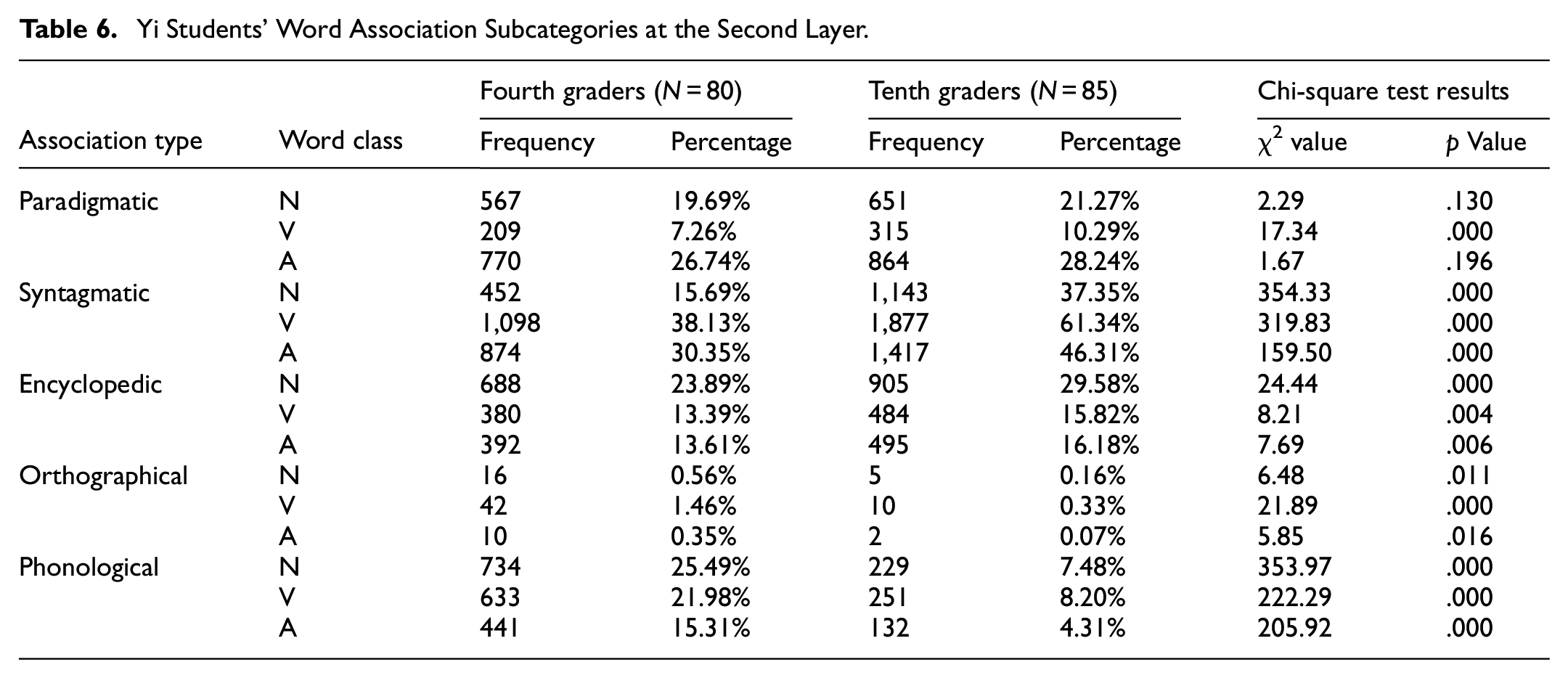
To further determine whether the differences in the frequencies between paradigmatic and syntagmatic associations within each word class were significant, chi-square goodness of fit tests were conducted. The results are shown in Table 7.
Comparisons of Paradigmatic and Syntagmatic Associations in Three Word Classes.

From the data in Table 7, it can be seen that although for the fourth graders, the frequency of paradigmatic associations triggered by nouns was significantly higher than that of the syntagmatic associations, when it comes to the 10th graders, the frequency of paradigmatic associations triggered by nouns was much lower than that of the syntagmatic associations. Combining the data in the two groups, we can still find a significantly higher frequency of syntagmatic associations (1,595 in frequency, and 26.9% in percentage) than paradigmatic associations (1,218 in frequency, and 20.5% in percentage) (χ2 = 50.53, p = .000). Significantly lower frequencies of paradigmatic associations than those of syntagmatic associations triggered by verbs and adjectives can also be found among the two groups of students (see Table 7).
Then, chi-square tests of independence were performed within each of the 5 subcategories to see whether there was a significant difference among the word classes. The same procedure as described in 4.1 was followed. The results are shown in Table 8. It was found that word class effects were obvious in all five association subcategories for both grade groups, except for the orthographical associations of the 10th graders. For the paradigmatic associations, adjectives had the highest triggering rate, followed by nouns and verbs; and for the syntagmatic associations, it was verbs that presented the highest triggering rate, followed by adjectives and nouns. As to the encyclopedic associations, for both groups of students, nouns exhibited much higher triggering rates than those of verbs and adjectives; but there was no significant difference between verbs and adjectives (fourth graders: p = .643; tenth graders: p = .701). Then, when we look at the orthographical and phonological associations, verbs exhibited a significantly higher triggering rate for orthographical associations than those of nouns and adjectives for the fourth graders. Verbs and nouns presented significantly higher triggering rates of phonological associations than those of adjectives for both grade groups (see Table 8).
Word Class Effects on Subcategories at the Second Layer.

Last, chi-square tests of independence were performed to compare the responses of the fourth and the tenth graders in each of the subcategories. The results are shown in Table 6. No significant difference was found in the paradigmatic associations triggered by nouns and adjectives between the two groups (nouns: p = .130; adjectives: p = .196), but the paradigmatic associations triggered by verbs increased significantly. As to the syntagmatic and the encyclopedic associations triggered by nouns, verbs, and adjectives, all of them demonstrated significant increases. Meanwhile, the 10th graders produced significantly fewer orthographical and phonological associations than the fourth graders in all three word classes (see Table 6).
Word Class Effects on Subcategories of Paradigmatic and Syntagmatic Associations
Following J. Q. Zhang and Chen’s (2018) three-layer structure, the paradigmatic and syntagmatic associations were further subdivided into four and six subcategories at the third layer. The number and percentage of responses triggered by the three word classes in each of the 10 subcategories are presented in Table 9. From the data in Table 9, it can be found that among all the 10 subcategories, synonymous associations triggered by all three word classes, determinative associations triggered by nouns and adjectives, hierarchical associations triggered by nouns, governing associations triggered by verbs, and antonymous associations triggered by adjectives, all accounted for a substantial part of Yi students’ L2 Chinese word associations in both grade groups. Meanwhile, the sequential and complementary associations triggered by all three word classes were quite low, with the highest triggering rate being only 1.21%, which proved that these two types of categories might not be the main connection modes for Yi students.
Yi Students’ Word Association Subcategories at the Third Layer.

Note. (1) Synonymous, antonymous, hierarchical and homogeneous associations are subcategories of paradigmatic associations; while indicative, governing, determinative, sequential, complementary and fixed phrase associations are subcategories of syntagmatic associations. (2) In the chi-square test for differences in hierarchical associations triggered by adjectives between the fourth and the tenth graders, the correction formula for the chi-square test was used because two cells (50%) had expected frequencies of less than 5 and a minimum expected frequency of 2.42. (3) In the chi-square test for differences in governing associations triggered by adjectives between the fourth and the tenth graders, Fisher’s exact test was used because two cells (50%) had expected frequencies less than 5 and a minimum expected frequency of 0.97.
To further determine whether there was a significant difference among the triggering rates of different word classes for each subcategory at the third level, chi-square tests of independence were performed. The same procedure as described in 4.1 was followed. The results are shown in Table 10. Due to the fairly low percentages of sequential and complementary associations, their word class effects were not tested.
Word Class Effects on Subcategories at the Third Layer.

Note. (1) In the chi-square test for differences in hierarchical associations triggered by verbs and adjectives for the fourth graders, Fisher’s exact test was used because two cells (50%) had expected frequencies less than 5 and a minimum expected frequency of 0.50. (2) In the chi-square test for differences in hierarchical associations triggered by verbs and adjectives generated for the 10th graders, the correction formula for the chi-square test was used because two cells (50%) had expected frequencies of less than 5 and a minimum expected frequency of 2.00. (3) The percentage of sequential and complementary associations triggered by all three word classes was low for both grades, so their word class effects were not tested.
The data in Table 10 show that of all the 48 pairs tested, only 10 pairs did not have a significant difference, that is, fixed phrase (fourth graders: p = .193; tenth graders: p = .121), antonymous (fourth graders: p = .621; tenth graders: p = .763), and synonymous associations (fourth graders: p = .590; tenth graders: p = .605) produced by nouns and verbs and hierarchical associations produced by verbs and adjectives (fourth graders: p = 1.000; tenth graders: p = .133) in both groups, indicative associations produced by nouns and verbs in the fourth graders (p = .180), and homogenous associations produced by nouns and adjectives in the tenth graders (p = .019). For all the other 38 pairs, the differences were found to be significant. See Table 10 for details.
Last, chi-square tests of independence were performed again to compare the responses of the fourth and the tenth graders in each of the subcategories at the third level. The results are shown in Table 9. It can be found that antonymous, determinative, and fixed phrase associations triggered by all three word classes increased significantly from grade 4 to grade 10. Besides, synonymous associations triggered by verbs, indicative associations triggered by nouns, governing associations triggered by both nouns and verbs, and sequential associations triggered by verbs also increased significantly. One particular case is the synonymous associations triggered by adjectives, which decreased significantly from grade 4 to grade 10. For others, no significant difference was found.
Discussion
After analyzing the data gotten from the WAT of two groups of Yi students, we have a better understanding of Yi students’ L2 Chinese mental lexicon size, connection mode and strength, which are key to L2 lexical activation and retrieval. The word class effects on their association patterns at three layers and the developmental trends from grade 4 to grade 10 depicted a dynamic tridimensional structure of their mental lexicon network.
Word Class Effects on Yi Students’ Word Association Categories at the First Layer
Following the three-layer structure, the results of the WAT were categorized into meaning-based and form-based associations at the first layer. The data show that the meaning-based associations produced by three word classes all seized a predominant position in both grade groups of Yi students. Besides, an apparent increase can be observed from grade 4 to grade 10, which indicates that the semantic connection developed stably in all three word classes and the teaching of L2 Chinese vocabulary for Yi students was generally successful.
However, despite the significant increase, we should also notice that among the 108 stimulus words chosen from the most frequently used 9,000 high-frequency words in modern Chinese, 29.31% of adjectives, 40.73% of nouns and 41.42% of verbs had not established semantic connections with other words by the fourth graders, and 9.28% of adjectives, 11.80% of nouns and 12.55% of verbs had not yet established semantic connections with other words by the 10th graders. These statistics are not very satisfactory compared with other L2 Chinese learners reported in previous studies (G. L. Li & Jiang, 2015; Wu, 2017). In these previous studies, the proportions of semantic connections by Australian and Korean L2 Chinese learners could account for 88.5% and 92% respectively after just 1 to 2 years of Chinese learning. The comparatively lower level of Yi students’ semantic associations for all the three word classes indicated that there was still much room for improvement.
Next, the result of the present study was consistent with the findings of Zareva (2011) and X. S. Li and Wang (2016), all of which revealed that adjective stimulus words produced more meaning-based associations than other word classes. Liu et al. (2012, p. 60) once argued that the proportion of meaning-based associations could predict the developmental level of L2 lexical networks and further revealed learners’ second language proficiency. Based on the findings of the present study, we can infer that the developmental level of Yi students’ adjective network is relatively higher and their mastery of Chinese adjectives is better than that of nouns and verbs. Thus, the learning of nouns and verbs should be emphasized more than adjectives for Yi students. However, whether this result can be generalized to other L2 learners is still a question, since some other studies (Nissen & Henriksen, 2006; Yu & Cai, 2014; P. Zhang, 2011) also found that it was noun stimulus words that produced the most meaning-based associations, followed by adjectives and verbs. Further research in different learning contexts is needed.
Last, form-based associations triggered by words of different classes cannot be neglected, because they also accounted for a considerable part of Yi students’ words associations, ranging from 4.38% to 26.04%. This result, together with Jiang and Zhang (2021) and X. S. Li and Wang (2016), support the “form prominence” hypothesis of the L2 mental lexicon structure. Consistent with X. S. Li and Wang’s (2016) study, the present study found that adjective stimulus words produced the fewest form-based associations. However, in Yu and Cai’s (2014) study, it was noun stimulus words that produced the fewest form-based associations and verbs the most. The contradictory findings reveal that in the context of L2 learning, which class of words establish word-to-word connections more on forms is still unclear. More research is needed to explore this issue further.
Word Class Effects on Yi Students’ Word Association Subcategories at the Second Layer
At the second layer, the data show that both paradigmatic and syntagmatic associations are significant ways of semantic connection for Yi students. For the fourth grade students, nouns triggered significantly more paradigmatic associations than syntagmatic associations, but verbs and adjectives triggered significantly fewer paradigmatic associations than syntagmatic associations. This is in agreement with the findings of Zareva (2011) and S. S. Zhang (2006). When the 10th grade students or all the students of the two grades were considered, paradigmatic associations produced by the three word classes were all significantly fewer than syntagmatic associations. It can then be concluded that overall, syntagmatic associations seized a predominant position in all three word classes. This is consistent with the findings of Feng (2014) and Nissen and Henriksen (2006), but inconsistent with or even contradictory to those of X. S. Li and Wang (2016), Navracsics (2007), Yu and Cai (2014), and P. Zhang (2011). The reasons may well be due to the different L1 and L2 in different studies and the participants’ varied language proficiency levels.
It is also worth noting that word class effects on L1 and L2 vary a lot. Early studies of L1 word associations showed that usually nouns generated more paradigmatic associations, verbs generated more syntagmatic associations, and the rule for adjectives was not so clear (Miller & Fellbaum, 1991; Zareva, 2011; P. Zhang, 2011). Word association of L2 nouns, however, was not always dominated by paradigmatic associations. Among the few related studies we have found on L2, six of them supported paradigmatic predominance (X. S. Li & Wang, 2016; Navracsics, 2007; Yu & Cai, 2014; Zareva, 2011; S. S. Zhang, 2006; P. Zhang, 2011), while the other two (Zareva, 2011; S. S. Zhang, 2006), together with the present study, supported syntagmatic predominance. As for L2 verbs, although the present study, along with four other studies (Feng, 2014; Nissen & Henriksen, 2006; Zareva, 2011; S. S. Zhang, 2006) supported the predominance of syntagmatic associations, some other studies (X. S. Li & Wang, 2016; Navracsics, 2007; Yu & Cai, 2014; P. Zhang, 2011) did not. The same is also true for adjectives. Therefore, whether syntagmatic associations or paradigmatic associations prevail for L2 nouns, verbs and adjectives needs to be explored further.
It was also found that only the paradigmatic associations triggered by verbs grew slowly as the students’ grade level increased (7.16% to 10.29%), while no significant increase was found in the paradigmatic associations triggered by nouns and adjectives. At the same time, the syntagmatic associations triggered by all three word classes increased more rapidly (nouns: 15.69%–37.35%; verbs: 38.13%–61.34%; adjectives: 30.35%–46.31%). This finding does not support the so-called “paradigmatic shift” hypothesis. Some previous studies (Lu & Lim, 2019; Xie, 2009; Zareva, 2007; Zareva & Wolter, 2012) claimed that a shift from syntagmatic associations to paradigmatic associations could be observed among higher proficiency L2 learners. However, the present study, together with M. Li et al. (2022), Nissen and Henriksen (2006) and Séguin (2015), revealed that L2 learners, regardless of their proficiency level, all produced more syntagmatic associations than paradigmatic associations, that is to say, their syntagmatic knowledge developed faster. In Zareva’s (2011) study, it was found that L2 proficiency level had no effect on paradigmatic associations for any word classes. All these suggest that the “paradigmatic shift” hypothesis is not a universal rule that applies to all L2 learners.
Next, the data also revealed that encyclopedic associations are an important type of semantic connection of all three word classes for Yi students. Similar results have also been found in other studies on Asian students (Billiris, 2011; M. Li et al., 2022; X. S. Li & Wang, 2016; Yu & Cai, 2014). It gives us an implication that when we analyze the structure of the L2 mental lexicon, especially for Asian learners, encyclopedic associations should not be neglected. Besides, in the present study, we also found that the frequency of encyclopedic associations produced by nouns was higher than those produced by verbs and adjectives and its growing rate was also a little bit faster (nouns: 23.89% to 29.58%; verbs: 13.39% to 15.82%; adjectives: 13.61% to 16.18%). All these findings suggest that in the later teaching practice, more attention should be given to develop Yi students’ encyclopedic knowledge, not only for nouns, but also for verbs and adjectives.
Lastly, this study found that Yi students produced a very low percentage of orthographical associations compared with their phonological associations. Although the percentages of phonological associations decreased significantly in all three word classes as their grade increased, the lowest percentage still reached 4.31% in the 10th grade students. This is perhaps due to the strict rules observed in the present study to distinguish orthographical and phonological associations. The orthographical associations in our study only referred to the case where the response word and the stimulus word had at least one highly similar Chinese character or at least one character with the same radicals, while those having a common Chinese character were classified into phonological associations. Thus, a large part of the phonological associations are the ones with a common Chinese character, and those with a homophone only made up a very small part. This demonstrates that the phonological associations of Chinese, a hieroglyphic language, are quite different from those of English. Therefore, at the initial stages of teaching L2 Chinese vocabulary to Yi students, especially in the teaching of nouns and verbs, students should be reminded to pay attention to the distinction between different Chinese words containing a common Chinese character, as well as words that are orthographically similar and words that are phonologically the same or similar. By doing so, we can help students establish semantic connections between these words and gradually reduce the proportion of form-based associations. The size and connection strength of their L2 Chinese lexical network can thus be better developed.
Word Class Effects on Yi Students’ Word Association Subcategories at the Third Layer
Analyzing the results at the third layer, it is not hard to find that for Yi students, nouns established semantic connections mainly through determinative, hierarchical, and synonymous associations, while indicative associations were also important for Yi students in 10th grade. The implications we can get from this is that when teaching Yi students who do not have a good grasp of Chinese nouns, more attention could be paid to exposing students to more synonyms, superordinate, and subordinate words, as well as modifier + head phrases (e.g., noun + noun phrases [like English composition, history teacher], pronoun + noun phrases [like my university, his bag], quantifier + noun phrases [like an apple, much money], differentiator + noun phrases [like female teacher, male model], and adjective + noun phrases [like luxury automobile, green forest]), to help students develop synonymous, hierarchical and determinative associations.
As to verbs, governing associations seized a predominant role with synonymous associations following. Therefore, when teaching Yi students who do not have a good grasp of Chinese verbs, we could start by helping them establish governing associations, then synonymous associations, exposing them to more verb + object phrases (e.g., sign a contract, buy a car) and synonymous verbs (e.g., separate vs. divide, strike vs. beat).
The data also reveal that Chinese adjectives were mainly connected by determinative, antonymous, and synonymous associations in both groups, and fixed phrase associations were also important for the 10th grade students. Therefore, the teaching focus for those who do not have a good grasp of Chinese adjectives should be put on these semantic associations first. It is important to expose students to synonyms, antonyms, and modifier + head phrases (e.g., adjective + noun phrases [like fresh vegetable, handsome boy], and adverb + adjective phrases [like very expensive, extremely angry]), to help them develop synonymous, antonymous, and determinative associations (J. Q. Zhang & Chen, 2018). Moreover, it is worth noting that synonymous associations occupied an important position in all three word classes. Thus, special attention should be paid to synonymous associations in particular in teaching.
When we compare the data of the two grade groups, it can be found that homogeneous associations produced by all three word classes did not increase significantly. A further comparison with J. Q. Zhang and Chen’s (2018) study on native Chinese learners revealed that there was a large gap between the proportions of homogeneous associations produced by Yi students in the present study and that produced by native Chinese students in theirs. This should draw our attention. Yi students’ homogeneous associations may not be well developed. Thus, Chinese teachers of Yi students could make more efforts toward this aspect in their further teaching practice. More words that are in the same semantic field and in the same category level (e.g., eye vs. nose, red vs. yellow) can be grouped together as a teaching unit, so as to help students develop their homogeneous associations faster.
Besides, the proportions of indicative associations produced by both verbs and adjectives were low and did not show a significant increase with the increase of students’ grade level either. They are also far lower than that of the native Chinese learners reported in J. Q. Zhang and Chen’s (2018) study. Thus, how to help Yi students establish indicative associations when they are learning verbs and adjectives is also of great importance. Perhaps, students could be exposed to more subject + verb phrases (e.g., rocket fly, customer happy) to help them develop indicative associations of verbs and adjectives faster.
In addition to homogeneous and indicative associations, the synonymous and hierarchical associations produced by nouns did not increase significantly either. But considering that the proportions of the fourth graders’ synonymous and hierarchical associations triggered by nouns were already high compared with native Chinese speakers in J. Q. Zhang and Chen’s (2018) study, we don’t need to worry about it too much. Besides, the frequencies of complementary associations triggered by both verbs and adjectives did not increase significantly. However, the low proportions of complementary associations found in the present study and in J. Q. Zhang and Chen’s (2018) study may indicate that such semantic connections rarely occur in Chinese, so their connection strength in the L2 Chinese mental lexicon is too weak.
Another striking result is that nouns triggered no complementary and sequential associations, verbs triggered no hierarchical associations, and adjectives triggered no governing and sequential associations. Further, the proportion of hierarchical associations triggered by adjectives was also quite low, which can probably be ignored. No occurrence of these types of associations may indicate that there is a low possibility to establish semantic connections by these ways in L2 Chinese. These semantic connections were so scarce in language use that their connection strength in lexical networks is comparatively small.
Finally, adjectives were found to evoke significantly fewer synonymous associations for the 10th graders than for the fourth graders. We thus hypothesize that this is probably due to the increasing connection strength of other subcategories triggered by adjectives, such as determinative and antonymous associations, which might exceed the connection strength of some of the synonymous associations, creating a squeezing effect. This is likely to result in a decrease in the frequency of the synonymous associations. The reason for this phenomenon deserves further study in the future. Maybe social network analysis can be employed in future studies to detect other hidden features of the L2 mental lexicon network, such as density, degree centralization, and degree distribution, etc.
Conclusion
Following the three-layer structure proposed by J. Q. Zhang and Chen (2018) for analyzing the L1 Chinese mental lexicon, this study adopted a WAT to investigate the word class effects on Yi students’ L2 Chinese mental lexicon structure. The major conclusions can be drawn as follows:
(1) At the first layer, the word associations for all three word classes are dominated by meaning-based associations, with form-based associations supplementary. Adjectives triggered the highest percentage of meaning-based associations and the lowest percentage of form-based associations. Form-based associations are largely those sharing a common Chinese character. This is typical for Chinese language learners.
(2) At the second layer, all three word classes triggered a higher percentage of syntagmatic associations than paradigmatic associations and a faster growth rate. This is contradictory to the so-called “paradigmatic shift” hypothesis. For Yi students’ L2 Chinese mental lexicon, encyclopedic associations are also found to be an important way of semantic connection for all three word classes, and the encyclopedic associations of nouns exhibit a higher percentage and growth rate. This can be taken as a particular feature of Asian students’ mental lexicon structure.
(3) At the third layer, the picture is a little complicated. Nouns are found to be dominated by synonymous, determinative and hierarchical associations, verbs by governing and synonymous associations, and adjectives by determinative, synonymous and antonymous associations. However, homogeneous associations of nouns, verbs, and adjectives, as well as indicative associations of verbs and adjectives are low in percentage and stagnant in development. These findings indicate that the semantic connection patterns for different word classes do vary considerably and their developments demonstrate substantial unevenness.
The present study has broadened the scope of the related research by digging into the subcategories of paradigmatic and syntagmatic associations. The comparative results of the two grade groups may also contribute to the theory for developmental patterns of the L2 mental lexicon network. Moreover, it further confirms that the categorization framework proposed by J. Q. Zhang and Chen (2018) is generally suitable for analyzing the L2 Chinese mental lexicon too, but it is worth noting that at the third layer, some types of semantic associations may be absent or account for only a tiny part in some particular word classes. These results all have important implications for teaching Yi students Chinese as their L2. As the connection strength and developmental speed of different types of associations in different word classes are quite different, teachers need to take appropriate measures for the instruction of words from different word classes so as to enhance their teaching quality and improve students’ Chinese proficiency.
However, due to the small sample size in the present study, the results may risk of over-generalization. Future research can target at a larger and more diverse population to enhance the robustness of the conclusions, providing a more accurate understanding of the word class effects on L2 word association patterns. Moreover, the present study does not delve into the subcategories of encyclopedic associations, which can also be a research focus in the future.
Footnotes

Ethical Approval
All procedures performed in the study were in accordance with the ethical standards of the institutional and national research committee. The participants were volunteers who were informed that they had the right to withdraw from the study at any time without penalty. Confidentiality was ensured by omitting participants’ real names during the process of data collection. The data collected was only used for research purposes.
Informed Consent
Written consent for participation was obtained from all individual participants included in the study and their parents.
Funding
The author(s) disclosed receipt of the following financial support for the research, authorship, and/or publication of this article: This study is funded by the National Social Science Fund of China. Project title: “Study on the dynamic network structure of Tibetan students’ Chinese and Tibetan mental lexicon,” [Grant No. 20XYY012]; it is also supported by Digital New Liberal Arts Laboratory of Southwest Jiaotong University.
Declaration of Conflicting Interests
The author(s) declared no potential conflicts of interest with respect to the research, authorship, and/or publication of this article.
Data Availability Statement
The data is available upon request.