




Abstract
This study examines the developmental relationship between L2 Chinese oral fluency and self-repair in Dutch students learning Chinese. In this study, 76 junior Dutch students were split into two different groups based on level and were tested at two time periods (T1 and T2) for L2 Chinese fluency, which included the control variables of repetition repair, expansion, grammar, and phonological repair. The latent growth model was utilized to analyze the data. The predictive effects of the initial level and development rate of L2 oral fluency on self-repair were investigated after controlling for relevant variables. We also used diversity analysis to explore oral fluency. The univariate latent growth model was employed to examine the direction of influence among L2 Chinese oral fluency and the four types of self-repair variables, and the autoregression control model was utilized to analyze the beginner level. Gray relational analysis was used to explore the relationship among the above variables for the more advanced level group. Based on our results, the regression model performed best for predicting the relationship between the variables in the first oral fluency test as well the second. The results showed that the grammar repair skills seen in the first assessment can positively predict oral fluency (B = 0.373, p = .001 < .05) in the second; the first expansion repair (B = −0.250, p = .025 < .05) can negatively predict oral fluency in the second test. Specifically, by analyzing the relationship between self-repair types and second-language oral fluency, our study can enrich the theories related to conversational repair. At the same time, our study is helpful in improving learners’ oral communicative competence, teachers’ adjustment of teaching strategies, and learners’ efficient acquisition of Chinese.
Plain Language Summary
By analyzing the relationship between self-repair types and second-language oral fluency, our study can enrich the theories related to conversational repair. At the same time, our study is helpful in improving learners’ oral communicative competence, teachers’ adjustment of teaching strategies, and learners’ efficient acquisition of Chinese.
Introduction
In everyday conversation, speakers often utilize covert (e.g., pauses, false starts, and hesitations) or overt self-repair to avoid potential misunderstandings and correct errors (Purver et al., 2018). Self-initiated, self-completed repairs achieve this to improve production and the flow of interpersonal communication. For L1 speakers, self-repair plays a fundamental role in developing L2 speakers’ oral fluency.
Prior research has often viewed these behaviors as examples of learners’ self-repair or communicative strategies. Among them, the former is an externalized reaction to L2 oral cognition and a metacognitive strategy, the purpose of which is to promote communication flow. However, it is also a sign of a lack of fluency (Fincher, 2006; Kormos, 1999a; Lennon, 1994; Smith, 2008; van Hest, 1996). Oral production of the second language is a complex cognitive activity, which combines word decoding and meaning construction through into through between the L2 speakers and the activation of background knowledge through word decoding. Due to variations in the development of L2 oral production, the L2 self-repair theory is mostly focused on attaining proficiency in the second language through various communication processes (Segalowitz, 2010). Researchers found interesting implications through their exploration of second language learners’ conversational self-repair, ranging from initiation, classification, communication strategies, influencing factors, cognitive characteristics, and effectiveness.
In addition, Swain and Lapkin (1995) claimed that learners’ repairing behaviors are an integral part of language self-regulation and are necessary for improving fluency. However, to our knowledge, no research thus far has investigated self-repair in relation to L2 Chinese conversation performance and the effects of various types of second language repair on oral fluency. Recently, with the wide application of the latent growth model, many researchers have begun to the relationship between native speakers’ repairing behaviors and the speed of spoken language development (Cheng et al., 2017; Kim, 2020). However, to the best of our knowledge, no studies have been conducted on these behaviors and their respective effect on the fluency of L2 Chinese speakers. Therefore, in the context of natural communication, the current study was guided by the following overarching research questions (RQs):
RQ1: What are the types of L2 Chinese self-repair?
RQ2: How do these types of L2 Chinese self-repair influence L2 Chinese oral performance and the development of production ability?
RQ3: What is the developmental relationship between L2 Chinese oral fluency and self-repair?
We hope that this empirical study can provide some empirical evidence for Chinese as second language acquisition and other foreign language education so as to improve the oral expression ability of second language learners.
Theoretical Framework and Related Literature
In second language acquisition, the notion of “self-repair” is a principal topic of academic discourse, featuring prominently in research concerned with the mechanisms and processes involved in language learning and use. According to E. A. Schegloff et al. (1977), self-repair, an integral part of oral communication processes, is an externalized aspect of L2 oral cognition and a metacognitive strategy that researchers to comprehensively understand learners’ oral communication skills. By utilizing this framework, researchers have found that self-repair is a critical indicator of spoken language development and plays an important role in children’s language proficiency and oral assessment of the second language (for more on L2, see Kormos, 2000; Zuniga & Simard, 2019; for more on L1, see Levelt, 1989). A related summary of self-repair and L2 oral Chinese fluency is presented below.
Self-Repair in L1 and L2 Acquisition
Scholars have focused on understanding the intricate language acquisition process, aiming to shed light on the varying trajectories of first and second language learning. (Dörnyei, 2005; Ellis, 2008; Gass & Selinker, 1992; B. Schwartz & Sprouse, 1994; B. D. Schwartz & Sprouse, 1996; Sprouse, 2006; Yuan, 1994, 2007a, 2007b, 2014). A general agreement focuses on the differences between first and second language acquisition. Gass and Selinker (1992) suggested that feedback and interaction play a crucial role in L2 acquisition, perhaps a different role than in L1 acquisition. In particular, they have highlighted the importance of “negotiation of meaning,” where learners and their interlocutors work together to ensure understanding, promoting L2 learning. Ellis (2008) noted that while there are similarities in the developmental sequences of L1 and L2 acquisition, there are also important differences. He suggested that these differences may be due to the cognitive processes involved in second language learning, which are more complex and involve conscious learning strategies. Based on scholars’ viewpoints on the differences between first and second languages, this paper explores the differences between L1 and L2 self-repair in language learning. Conversation self-repair, which has become a vital element in the study of L1 and L2 acquisition, was first proposed by E. A. Schegloff et al. (1977) who distinguished it from “correction.” While the latter involves fixing language errors, the former is not limited to this, even if there is no error that can be “repaired.”Swain and Lapkin (1995) contended that when L2 learners tinker with their interlanguage to enhance the comprehensibility of information, they create language structures that enable them to change their patterns of accessing knowledge, thus promoting second-language acquisition.
E. A. Schegloff et al. (1977) pointed out that when adults encounter communication challenges, they inherently use repair strategies to solve problems with speech and understanding. Furthermore, adults’ reliance on and preference for self-patching dominates other forms of this strategy. Postma et al.’s (1990) research not only supports this conclusion but has also determined that opportunities to use it appear earlier than others. A repair can solve misunderstandings and clarify the speaker’s intention (Albert et al., 2018; Healey et al., 2018; Purver et al., 2018). Scholars have examined the cognitive functions and classification of self-repair in the daily conversations of L1 speakers because of their attention to the content of their own language and their response to communication needs (e.g., E. V. Clark & Andersen, 1979; H. H. Clark & Wasow, 1998; Comeau et al., 2007; D. Forrester et al., 2008; M. A. Forrester & Cherington, 2009; Karmiloff-Smith et al., 1993; Levelt, 1989; Levy, 1999; Nooteboom, 1980; Tomasello et al., 1990).
The L2 self-repair theoretical model is concerned with the scientific classification of this strategy. Previous scholars (e.g., Levelt, 1989) divided it into covert and overt repair. Levelt (1989) separated it into five categories, Category D (different repair), Category A (appropriate repair), Category E (error repair), Category C (repetition repair), and Category R (rest of repairs). In the 1990s, Postma and Kolk (1993) defined intra-utterance repair as occurring before the sound is produced, generally referring to the repetition of words and phrases, syllables, the suspension of non-filler words and other factors. Similar to Levelt and van Hest (1996) divided verbal repairs into four categories: D (different repair), A (appropriate repair), E (error repair), and R (remaining repairs). More recent classifications and models (Schegloff, 2007; Simard et al., 2017) have focused on a blend of communicative interaction and monitoring, often called self-initiated repair structures. Patching is seen in categorizing processes first and then determining the type within each process. The former is divided into explicit (lexical, phonetic, and grammar levels) and implicit language classification (discourse repair and context repair). The repair of discourse content takes place in the supplementing and restatement of discourse content, while the repair of context requires extensive language knowledge.
Self-Repair and L2 Oral Fluency
Fluency is generally regarded as an essential criterion for investigating L2 oral proficiency, covering various ways of measuring fluency. It includes speech rate (e.g. number of syllables per minute of speech), length of run, pause length, silence, false starts, repetitions, and reformulations (Skehan, 1996). Under the constraints of reviewability and revisability, self-repair is an important pointer in the mental representation of discourse relationships because L2 speakers have little time to process speech coherently.
There are also many definitions of fluency in the literature. Fillmore (1979) first provided definitions of language fluency of the first language from four aspects; of relevance to L2 oral fluency are the second and third items. From a language input standpoint, the second item states that oral fluency not only includes the ability to communicate without hesitation but also that the message is delivered in a coherent, reasoned, and “semantically dense” manner. According to the third item, a person is fluent if he/she can communicate freely in various contexts. Several other studies have built on the third one. Based on the definition of fluency in first language studies, the oral aspect has long been recognized as a critical factor for assessing general target-language fluency. For L2 learners, oral fluency is also an important criterion to judge the language level of second language learners, but at present, the criterion of oral fluency is unclear. A majority of scholars define L2 oral fluency from multiple perspectives. (see Derwing et al., 2009; Guillot, 1999; Koponen & Riggenbach, 2000; Kormos & Dénes, 2004; Riggenbach, 1991). For example, Pawley and Syder (1983) describe it as native-like such that speakers are able to “produce fluent stretches of discourse.” This is based on their understanding of L1 oral fluency. Lennon (1990) defined fluency as “an impression on the listener’s part that the psycholinguistic processes of speech planning and speech production are functioning easily and efficiently” (p. 391) and recommended that it needs to be evaluated by professionals. In addition, Fillmore claimed that “fluency reflects the speaker’s ability to focus the listener’s attention on his/her message by presenting a finished product, rather than inviting the listener to focus on the working of the production mechanisms” (pp. 391–392). Schmidt (1992) refined Lennon’s (1990) definition by incorporating the role of oral fluency in speech production, which “is automatic, not requiring much attention or effort” (Schmidt, 1992, p. 358).
Just as defining fluency has been challenging, so too has been determining the factors influencing fluency. Moreover, research findings have an ambiguous tendency to demonstrate the relationship between repetition, restart, and repair factors that influence disfluency. In some exploratory studies of L2 learner’s oral fluency (Bardovi-Harlig et al., 1998; Chen, 1990; E. V. Clark, 2020; Fincher, 2006; van Hest, 1996), researchers have compared the phenomenon of self-repair in the oral production of both L1 and L2, while other scholars have combined these variables with their investigations of the psycholinguistic perspective (e.g. van Hest, 1996; Van Hest et al., 1997).
Chen (1990) identified a strong connection between the frequency of students’ L2 self-repairs and their proficiency level. Specifically, Chen (1990) examined the association of self-repairs with a conversation among high and low-proficiency L2 English learners in mainland China. The results showed that the variations in the effectiveness, style, and frequency of each individual’s self-repair behaviors indicate proficiency. Similarly, Fincher (2006) found that this behavior explained variance in the foreign language classroom. In a recent study, E. V. Clark (2020) found that the repairs made by adults in conversations with children guide the youngsters’ language acquisition. In this way, self-repairs were found to be uniquely associated with language fluency and proficiency.
To our knowledge, three studies have directly investigated the temporal direction of the relationship between self-repairs and fluency in oral production (Al-Harahsheh, 2015; Bardovi-Harlig et al., 1998; Buckwalter, 2001; Kormos, 2000; Segalowitz, 2016; Zuniga & Simard, 2019). However, the results were mixed. One study found a correlation between self-repair and fluency, while the other found no such relationship. In a study of L2 oral production in which the students were highly aware of their self-repairing behavior, Segalowitz (2016) noted that the relationship between oral fluency and self-repair has received by far much attention because it is the easiest way to explain repair and breakdowns dependent variables by quantitative analysis. Furthermore, self-repair frequency predicted unique variance in L2 oral production. Moreover, the reverse was also found in that the frequency of self-repairs positively influenced the accuracy and grammatical complexity of L2 oral production with the autoregression controls. However, there is still a positive connection between self-repair and L2 proficiency. Studies have shown contradictory results regarding the levels of L2 learners’ abilities to self-repair and the frequency of use of various self-repair forms. Simpson et al. (2013) assessed the English-speaking L2 Chinese learners who were taking a 90-minute class three times a week. Using the data collected from classroom interactions and prompted recall interviews, the authors found that the participants’ ability to attain oral proficiency was not related to their awareness of making self-repairs. Moreover, as previous research has confirmed, some instances of self-repair do not reflect actual oral fluency but are related to perceptual ability, although most of the other instances are related to oral proficiency. In their (2019) assessment of 58 adult L2 English speakers of various proficiency levels, Zuniga and Simard used the autoregression control model to determine that fluency was not a significant predictor of L2 self-repair behavior.
The inconsistencies in the results of the three studies prompted further research to reach a more convincing conclusion. In addition, it is unclear whether the reciprocal relationship found by de Bot (1992) extends to L2 Chinese learners. As language proficiency increases, grammatical coding knowledge becomes automatic and consistent, which results in an increase in fluency and subsequent lexical repair as well as an increase in the cognitive resources available for discourse cohesion and coherence processing and subsequent conceptual recombination (see Kormos, 2000). This interpretation, which is based on a wide variety of cognitive needs, raises questions about the role of variation in second language learners’ attentional control and ability to information transformation to aid in second language self-repair.
Summary
Previous studies have mostly used monologue corpora (Derwing et al., 2009; Kormos, 2000; Segalowitz, 2010); moreover, the frequency of self-repair in second language output and its effect on second language fluency has not been discussed. Therefore, our study aimed to explore the developmental relationship between all subcategories of self-repair and the fluency of oral production among Chinese L2 learners in the context of casual conversations. Several control variables, such as repetition repair, expansion, phonological and grammar repair, were included in our study to minimize the possibility that any unexplored relationships would result from extraneous variables.
Sparks (1994) classified the types of self-repairs of native English speakers as expansion, hesitation, repetition, replacement, abort and restart, abort and abandon, insert, delete, meta-repair, and modify order. In the present study, we analyzed the structure of self-repairs in L2 oral Chinese and investigated the developmental relationship between these factors with regard to beginning level and more advanced learners. Juniors majoring in Chinese language at the University of Applied Technology in the Netherlands were selected to participate in this study in which their progress would be tracked for 2 years.
Students at this level are expected to have mastered basic Chinese grammar and vocabulary and to have reached the stage of “segmental expression,” during which their oral fluency, word decoding skills and deeper understanding of the language develop rapidly.
To explore the purely bidirectional predictive relationship between oral fluency and self-repair, we used statistical controls to account for the relevant variables that may significantly affect both of the elements under study. There are four types of repairs utilized by Chinese second-language learners: repetition, expansion, phonetic repair, and modification of syntax order in which the new word order replaces the repaired word order. Please note that this factor is also referred to as “grammar repair” in this article.
Materials and Methods
Participants
Seventy-six college students who attended a university in the Netherlands were recruited for this study. All were native Dutch speakers whose foreign language was Chinese (36 males; 40 females, with an average age of 21.7 years). Due to the epidemic’s impact, Dutch students had no opportunity to come to China to learn Chinese, so the entire data collection was obtained in the Netherlands. This study mainly focuses on the relationship between conversational self-repair and oral fluency of learners of Chinese as a foreign language. Besides Chinese, Dutch students also learn other foreign languages. Second language learning belongs to the broad category of foreign language learning. On average, they began learning Chinese during their first year of college; however, their daily use of the language varied widely: 63% reported never speaking Chinese, 28% reported speaking it less than 1 hr per day, and only 9% of the participants whose families immigrated from China spent 3 to 4 hr per day speaking Chinese.
The aim of the present study was to investigate the difference in the frequency of self-repair among beginning and more advanced level learners of Chinese and the relationship between oral fluency and self-repair. Experts divided the participants into beginning-level and more advanced-level groups to study the frequency of repair between these two groups. The measured data was also standardized via SPSS software.
Measures and Procedure
In this study, the independent variables were the participants themselves. There were two types of statistical objects: the more advanced group and the beginners. The dependent variables were the four types of repairs: repetition, expansion, grammar, and phonetics. To investigate the effects of self-repair on oral fluency, we conducted two targeted assessments: the oral fluency and the natural conversation test.
Oral Fluency Test
The first test incorporated the reading of text, a 286-word narrative essay, and a 225-word argumentative essay, both deemed appropriate for the more advanced level students. The participants were required to read the materials aloud accurately and quickly. Then the reading times and the number of repairs were recorded. Next, we divided the number of correctly read words (excluding patched words) in each article by the reading time to obtain the number of Chinese characters read correctly per minute. The mean value of the two articles was taken as the indicator of fluency for long-passage reading. At T1 and T2, the average accuracy rate was 63% and 76%, respectively, and the correlation between the two passages was .87 and .72, respectively.
Natural Conversation Test
There are difficulties in developing an entirely realistic natural conversational environment to test the effectiveness of conversational self-repair in communication. Measures currently available, such as the Functional Communication Profile (Sarno, 1969), the Communication Abilities in Daily Living (Holland, 1980), and the Edinburgh Functional Communication Profile (Skinner et al., 1984), tend to be primarily interview-based to test second language acquisition. Hence, the range of realistic natural conversation tests is limited. According to Walters (2009), our research attempts to create a Chinese environment where interactive communication on selected topics can be carried out. To mimic the natural conversation environment, the participants were asked to have a casual conversation about a topic of interest to them (e.g., discuss travel, food, hobbies, etc.). For 30 min, the researcher left the room to avoid influencing the participants. After the test, the researcher came back to collect the recordings. A total of 1,498 self-repairs were found in these 30-min conversations, and the data included 10 hr of recorded conversations of approximately 57,000 words.
A vocabulary definition task was incorporated into the conversations (Li et al., 2009), which consisted of 32 two-word phrases that were either easy or difficult to arrange, such as “courage,”“enthusiasm,” and “carefully”. As a typical non-pinyin script, the Chinese language does not have a systematic and definite rule of morpho-phonetic conversion. Regarding second language acquisition, the cognitive ability of spoken vocabulary reflects the learner’s second language level and speech production ability (Fuchs et al., 2001). Fluency also reflects the learner’s ability to produce a second language. Different from alphabetic words, the vocabulary definition task test is used to test the connection between Chinese character shapes and Chinese character sounds and to test second language learners’ ability to use the corresponding knowledge of form sounds. Færch and Kasper (1984) noted that second-language fluency includes semantic, lexical, syntactic, and articulation flow profit degree. The vocabulary definition task test is used to measure semantic fluency and lexical, syntactic fluency. Therefore, in acquiring Chinese as a second language, vocabulary definition in gaining fluency is an essential foundation for self-repair and testing of fluency relationships for conversations. The vocabulary was presented orally. Then, the learner was required to explain it orally and records the number of times. Two trained raters graded the data independently on a scale of one–five, with a consistency coefficient of 0.94 and an internal consistency α coefficient of 0.72.
Self-Repair in L2 Chinese Learners
Repetition Repair
Repetition repair can be an intentional repair made for explanatory purposes or an unintentional repair made by the speaker’s habit. Bada (2010) found that this technique includes both vocalized fillers and self-repair. Repetition repair occurs. When a speaker wants to produce his or her words accurately, he or she often repeats a morpheme, a word, a phrase, or even the whole utterance to correct or clarify his or her intended message. (Hieke, 1981). Example 1&2 includes word and sentence repetition.
Example 1
F1: Vanessa, I have a headache and a slight fever, and I want to go home. In today’s class, I didn’t understand, I didn’t understand it, really……really, I didn’t understand.
F2: ↓Well, have a good rest. Do you have anyone at home to take care of you?
F1: I……want to go home, but there is nobody at home, want to go home.
Example 2
F3: Where did you travel in China?
F4: I went to Shanghai.
F3: ↓Oh, you went to Shanghai? What scenic spots did you go to? Right, right, scenic spots?
F4: The Bund, Yu Garden, Jing ‘an Temple, and Jade Buddha Temple.
F3: ↑Oh, what temple is it? You seemed to enjoy visiting it.
F4: ↑Yes, yes, yes, the Jade Buddha Temple, the Jade Buddha Temple. Because I can……I can learn Buddhism.
Expansion Repair
A speaker uses this repair strategy to clarify concepts previously mentioned in the conversation by offering more explanations or examples. In this study, there were 510 instances of expansion repair, which accounted for approximately 34% of the total number of self-repairs. The most common phrase associated with this technique used by native Chinese speakers was “I mean” or “I said.” According to Schiffrin (1987) the phrase “I mean” has both pragmatic and semantic functions, “the basic meaning being to forewarn of upcoming adjustments.” In addition, Zong (2012) summarized the following four subjective modal functions of “I mean”: emphasis function, complement, repair and delay function. Specifically, within second-language communication, this phrase is often used when a speaker is asking for clarification or explanation. When a conversation partner notices that the other does not follow what is being said, he or she may use expansion repair, which usually begins with “I mean” or “I said” to clarify any misunderstandings, as indicated by the following examples.
Example 3
F7: Our classmates all say Hangzhou is“Tiantang”.
F8: (0.5)What kind of “Tiantang”? What is “Tiantang”?
F7: I mean, the place we’re going to in China is beautiful.
F8: I mean, what is“Tiantang” in English?
F7: Paradise.
Example 4
F11: I feel like I haven’t spoken Chinese in a while, and then what?
F12: Is it difficult to speak Chinese?
F11: No, no, I mean, speaking Chinese for the first time, what do you need?
F12: Need knowledge.
F11: What else? A new word we learned in our textbook.
F12: Oh, oh, courage, Is it right?
In example 3, after F7 said the word “Tiantang”, F8 was silent for 0.5 s and then repeated “Tiantang” to express his difficulty in hearing or understanding what F7 had said. F7 then replied with “I mean” to explain the preceding sentence; however, his explanation did not fully answer F8′s question, so he repairs it on his own with “I mean” to further emphasize his query. In this case, the main function of “I mean”, “I said” was to repair and clarify what was previously said. In example 4, the students are playing a word-guessing game. F12 interpreted “I feel I haven’t spoken Chinese for a long time” to mean that Chinese is very difficult. F12 is confused, which causes F11 to make a repair.
Grammar Repair
This is another essential self-repair strategy in which speakers tend to interrupt themselves when they become aware of a grammatical mistake in the order of their utterances. They tend to stop the conversation to rearrange word order or correct grammatical errors so their speech will be more like that of a native speaker. We found 171 cases of grammar repair, which accounted for 11.41% of the self-repairs implemented by the participants.
Example 5
F20: If you have a cold, drink more hot water.
F21: ↓en…en…
F20: (0.5) If you catch a cold, you should more drink hot water.
The use of “more” as an adverb placed before a verb is a common grammar error of L2 Chinese learners. It can be seen from example 5 that F20 stops for 0.5 s before expressing the next thought and then cuts off the discourse to repair.
Example 6
F25 this afternoon have an appointment with a Chinese friend.
F26: ↑Oh, really? Where are you going?
F25: ʔa……h No, I this afternoon with a Chinese friend have an appointment. (The correct order in Chinese grammar.)
Phonological Repair
When a speaker realizes that there is a pronunciation mistake, he or she will utilize phonological repair. There were 113 cases of this technique among our participants, which accounted for 7.5% of the total number of self-repairs, as shown below:
Example 7
F27: ní dăsuàn qù zhōngguó chī shēnme fàn?
F28: Wŏ bù zhīdào chī shénme fàn.
F27: o……chī shénme fàn.
F27′: What do you want to eat in China?
F28′: I don’t know what to eat.
F27′: Oh……What to eat.
Experimental Analysis
Descriptive Statistics
In this section, we will use statistical tools, such as mean, variance, and standard deviation to analyze the differences in oral fluency between the more advanced and beginning groups of participants in the two tests from horizontal and vertical aspects. After the standardization of the raw data, the following analysis results were obtained:
Horizontal comparison (Table 1) shows that the difference in oral fluency in the two tests was still obvious (p = .001 < .05). It is worth noting that with the passage of time and the increased knowledge of Chinese, the average score of oral fluency increased from 0.62 to 0.73, showing an obvious growth trend.
Comparison of Differences Between the Oral Fluency Tests at T1 and T2 for the Beginners Group.

Note. *p < 0.05, **p <0.01, p <.001. Same for below.
Based on longitudinal comparisons (Tables 2 and 3), we found that in both TI and T2, the more advanced group (control group), scored significantly higher than the beginners (experimental group; p = .000 < .05).
Comparison of Differences Between the Oral Fluency Tests at T1 and T2 for thE More Advanced Group.

Comparison of the Oral Fluency Tests at T1 and T2 Between the Two Groups.

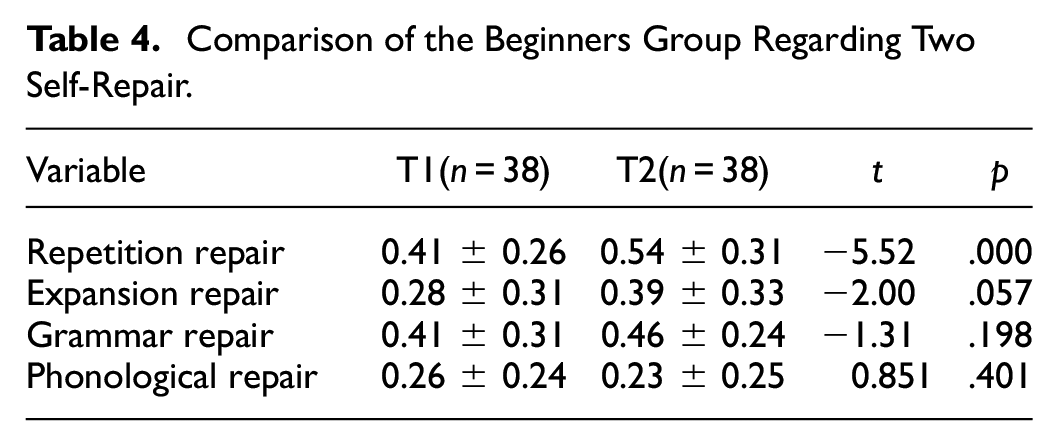
Difference analysis of the explanatory variables (repetition repair, expansion, grammar, and phonetic repair) in the two oral fluency tests between the beginners and the more advanced group (Table 3), showed that the tests had a significant impact on the participants with the exception of repetition repair (p = .000 < .05). Other types of repairs were not significant (p > .05). In other words, during the T1 test, participants were not affected by expansion repair, grammar, and speech repair. Article restricted. However, with the passage of time or the change of articles chosen for T2, the participants used fewer speech repair tactics, (indicating a downward trend) with the mean value dropping from 0.26 to 0.23, while other repetition repair, expansion and grammar repair showed an upward trend, which was consistent with the structure of the articles and the number of words in each.
In the longitudinal comparison (Table 4), with regard to the mean, except for the speech repair of the first article and the grammar repair of the second article, the more advanced group (control group) undoubtedly had the main reason for this result for the students who are lower than the low-level group (experimental group) is that it has a close relationship with the content of the article. A 286-word narrative essay with relatively simple vocabulary that is easy to pronounce was easier to grasp. Students in the more advanced group knew how to correct their pronunciation mistakes in order to read the essay more fluently. The more difficult 225-word argumentative essay required students to have a better awareness of grammar. In order to more fully understand the content of the essay, students in the more advanced group were more inclined to make grammar repairs. It is worth mentioning that the difference between the first and second articles was very significant (p < .05) with regard to repetition repair, expansion, grammar, and speech repair (Table 5).
Comparison of the Beginners Group Regarding Two Self-Repair.
Comparison of the T1 and T2 Self-Repair Tests for the More Advanced Group.

Correlation Analysis
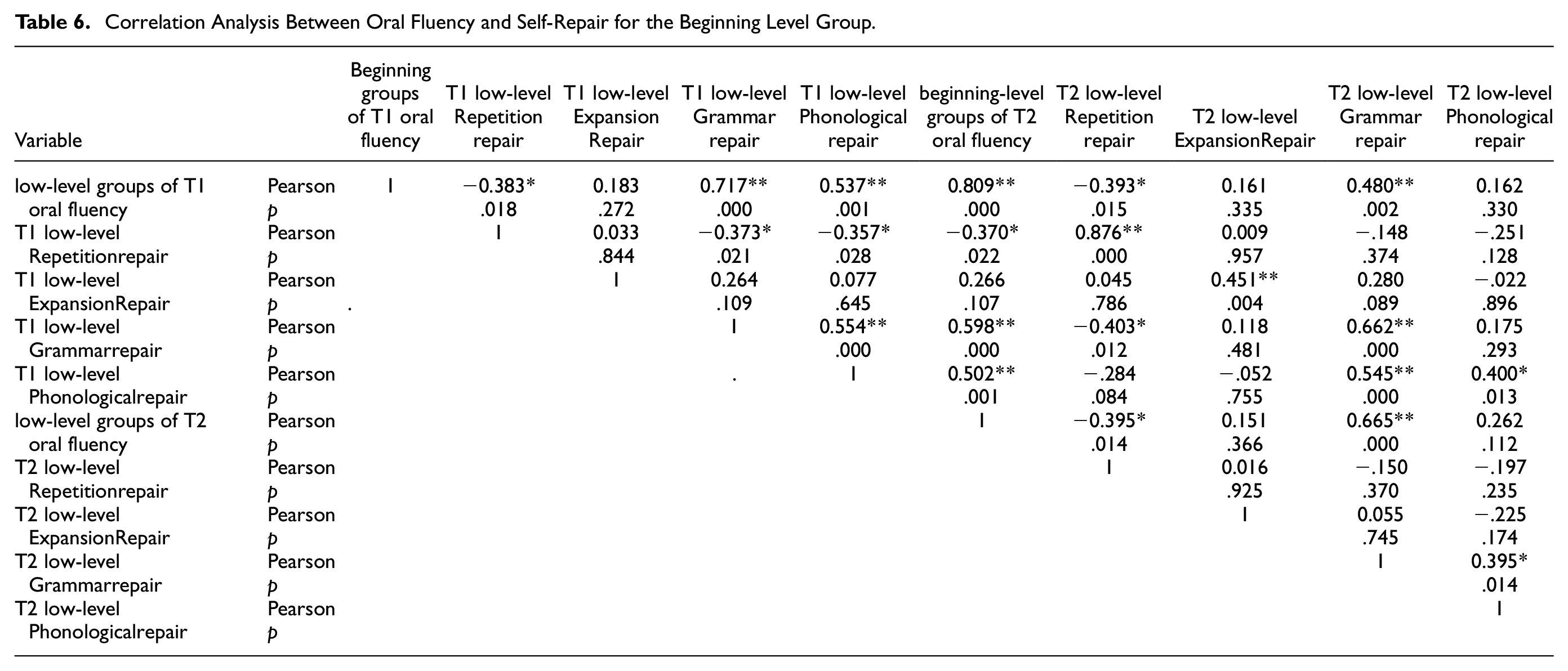
To verify the degree of correlation between variables, we conducted a Pearson’s correlation analysis. The closer the absolute value of the correlation coefficient is to one, the stronger the correlation. Specifically, we explored the correlations between the independent variable (oral fluency) and the dependent variables (repetition repair, expansion, grammar, and phonological repair) among the more advanced and beginning levels.
As seen in Table 6, there was an obvious correlation between oral fluency and self-repair for the beginning-level students. At T1, with the exception of expansion repair (p = .272 > .05), the other variables (repetition repair, p = .018; grammar, p = .000; phonological repair, p = .001) were all correlated with oral fluency. There was a negative correlation between repetition repair and oral fluency (R = −.383), and a positive correlation between grammar repair (R = .717) and phonological repair (R = .537). At T2, there was no correlation between either expansion repair or phonological repair to oral fluency, while repetition repair (R = −.393, p = .015 < .05) and grammar repair (R = .480, p = .002 < .05) were correlated with oral fluency.
Correlation Analysis Between Oral Fluency and Self-Repair for the Beginning Level Group.
Given that the variable collinearity occurred because the standardized data of the more advanced group was too small, the correlation analysis was not repeated.
Univariate Latent Growth Modeling
According to the classification of L2 Chinese self-repair, an univariate potential growth model was constructed to test the linear relationship between oral fluency and self-repair, which included a comparative fit index (CFI), a Tucker–Lewis index (TLI), root mean square error of approximation (RMSEA), and standardized root mean square residual (RMSR). A Latent Growth Model (LGM) is a statistical model used to analyze how one or more variables change over a period of time. Wu et al. (2013) states that a high-performance model should have CFI and TLI values larger than 0.90. In our study, the RMSEA and SRMR values were lower than 0.05, indicating a good fit.
The univariate latent growth model was used in this study to predict the effects of oral fluency on repetition repair, expansion, grammar, and phonological repair. As is customary in latent growth modeling, the intercept loadings of the observed variables were set to one before running the model. The initial model fit poorly because GFI, RMSEA, NFI, TLI, IFI, CFI, and SRMR all fell short of their targets. After revising the model, we were able to obtain the paths and indicators, as shown in Figure 1 and Table 7.
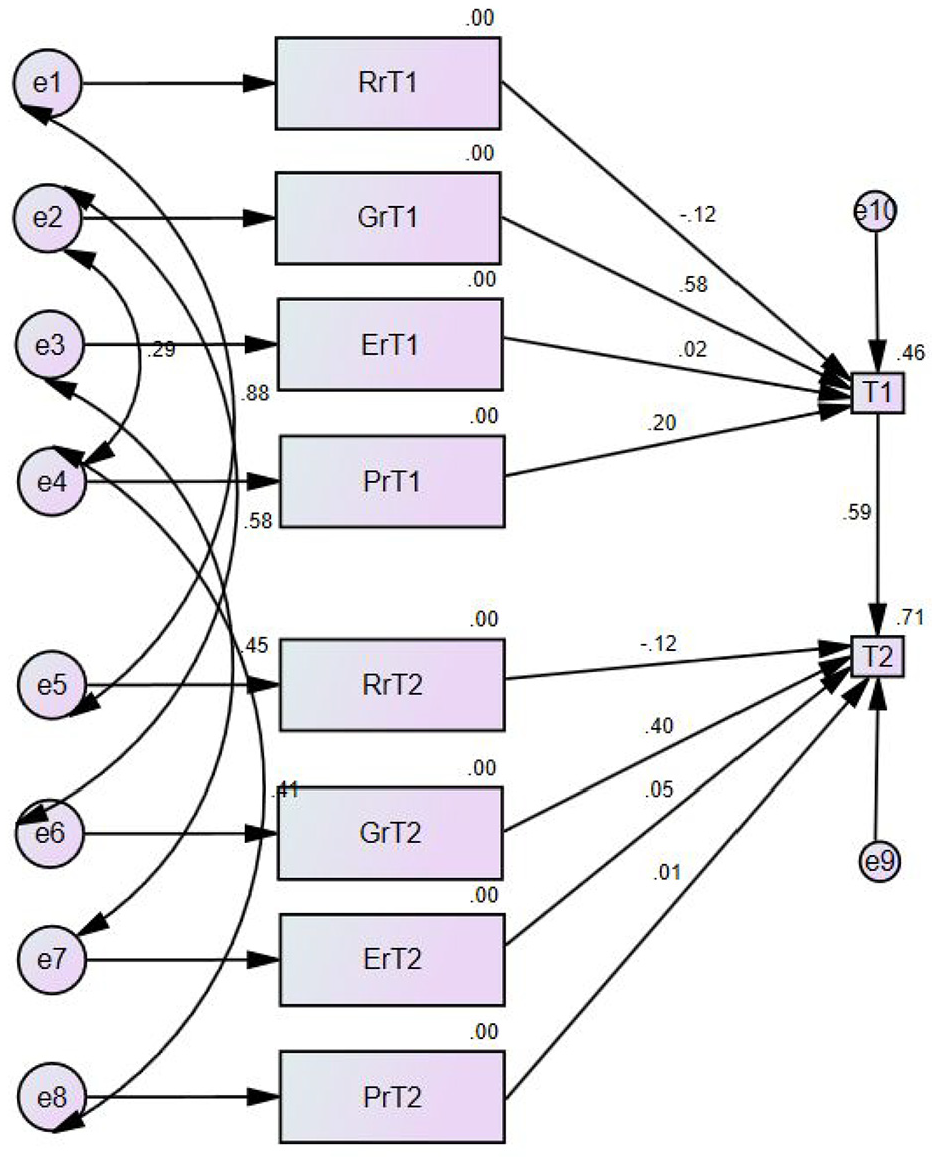
Path diagram of univariate potential growth model of the more advanced group.
Model Fit Index.

The path coefficient in Figure 1 shows that the beginning-level students who were tested for oral fluency, whether in the first or in the second test, and the repetition repair had a negative linear relationship with oral fluency. Grammar repair, capacity expansion repair, and phonological repair all had a positive impact on oral fluency. At the same time, we found that the results from the first oral fluency test positively affected the second one (r = .59).
Given that collinearity occurred because the standardized data for the more advanced group was too small, based on Chan and Tong (2007) research methods, we applied Gray relational analysis to understand better the relationship of the above variables in this group.
First, we calculated the degree of correlation to determine the reference number of columns and the comparison number. In this study, the first oral fluency assessment was used as the reference series, and the remaining variables were the comparison series. Next, we calculated the absolute difference between the comparison series and the reference series using the equation below:

Then, we determined the sum of the second minimum and maximum difference. The Gray correlation coefficient was then calculated by the formula below:

where the resolution coefficient is ρ, the value range of the resolution coefficient is (0,1). The lower the ρ value, the greater the difference between the resolution coefficient and the stronger its differential ability. For real-world application, the value of ρ was 0.5. We utilized the Gray correlation coefficient formula to calculate the comparative series of g. Finally, the correlation degree of the last reference and comparison columns were determined by the Gray calculation formula:

The degree of correlation for the reference and comparison columns, R, is shown in the table below:
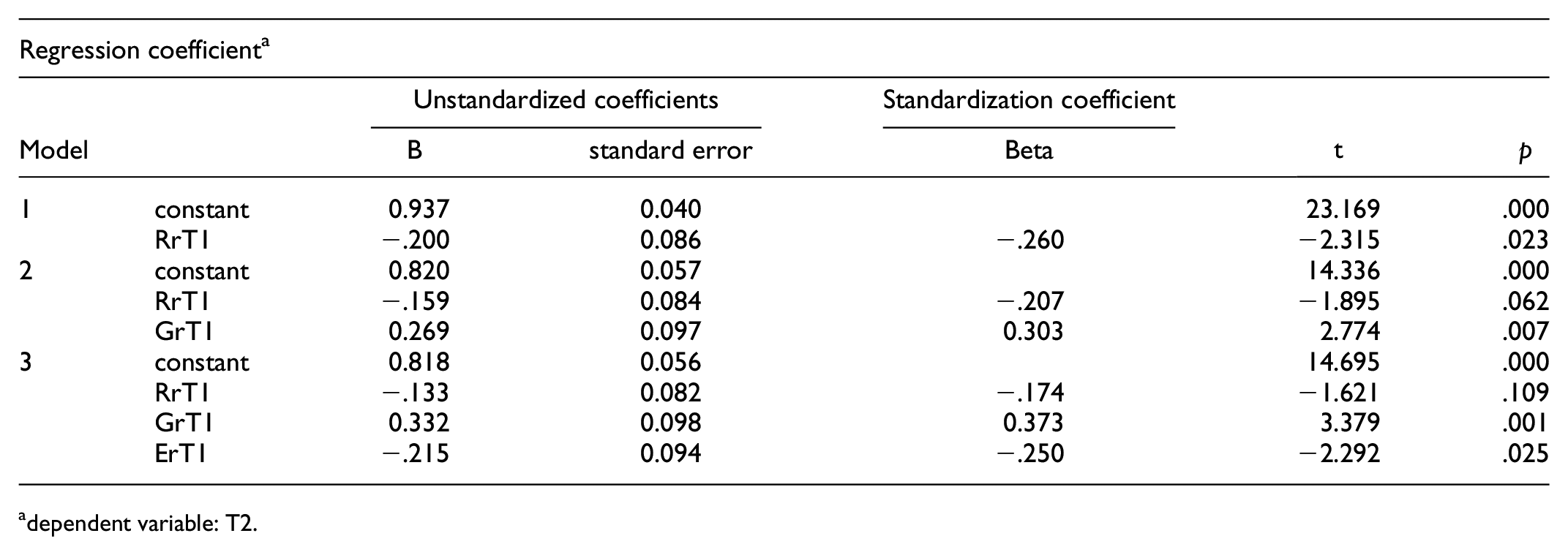
When determining the relationship between the more advanced group’s oral fluency at T1, shown in Table 8, and each variable, we found that the former was not only related to the various repair dimensions of T1 but also to those of T2. T1 had the highest correlation with the oral fluency of T2. In other words, the higher the oral fluency at T1, the higher the oral fluency at T2. Therefore, based on the above conclusions, we determined that the self-repair skills shown at the first assessment (T1) had a predictive effect on oral fluency shown at the second assessment (T2). Therefore, with repetition repair, expansion, grammar, and phonological repair at T1 utilized as independent variables, fluency was used as the dependent variable to build a regression model. Given that the high-grouped prediction study did not exclude the issue of collinearity, we used a stepwise approach for the regression analysis. Regression prediction models help us understand a positive or negative correlation between variables and independent variables. Regression prediction models were used to predict which types of conversational self-repair are most closely associated with fluency. The results of which are shown in Table 9:
Gray Correlation Degree.

The Predictive Effect of -Repair at T1 on the Oral Fluency at T2.

predictive variable: constant, RrT1.
predictive variable: constant, RrT1, GrT1.
predictive variable: constant, RrT1, GrT1, ErT1.
dependent variable: T2.
According to the analysis above, grammar repair at T1 can positively predict oral fluency at T2 (B = 0.373, p = .001 < .05); the first Expansion repair (B = −0.250, p = .025 < .05) can negatively predict oral fluency at T2.
Discussion and Implication
The purpose of this study was to explore the developmental relationship between L2 Chinese oral fluency and self-repair in Dutch students learning Chinese. Although some scholars have found a relationship between oral fluency and self-repair, no studies have been done on the influence path between these two factors. In light of our objective, we recruited 76 Dutch college students who are studying Chinese and had experts divide them into beginner and more advanced groups. We then performed variance analysis, correlations, path analysis, and multiple regression analyses. We not only analyzed the differences within and between the groups but also the correlations between the variables. Based on path analysis, we obtained the results of the regression model and studied the mechanisms of action for the study variables.
This study was an in-depth exploration of the developmental relationship between oral fluency and self-repair utilizing an innovative design, which helps to deepen the understanding of the relationship between second language oral fluency and self-repair. We found that the relationship between these elements became cumulatively reciprocal. Meanwhile, by combining the results of the univariate potential growth model (LDM), Gray association analysis, and the regression prediction model, we discovered that in the first assessment, grammar repair can positively predict oral fluency in the second assessment (B = 0.373, p = .001 < .05); while extended repair in the first assessment (B = −0.250, p = .025 < .05) can negatively predict the oral fluency in the second assessment. Throughout this process, learners adjust the content, grammar, and structure of language output through self-repair (i.e., grammar repair and extension repair), which is actually an external manifestation of their advancing cognition. In this way, they expand their internal knowledge and skills to achieve fluency. By studying the relationship between Chinese self-repair subcategories and oral fluency among second language learners, we found that the second aspect of language self-repair is more common and important, especially for less advanced students.
We hope this study will provide Chinese evidence for understanding the relationship between various types of conversational self-repair and L2 oral fluency in different language systems. Although previous studies have examined the impact of relevant variables on English as a second language fluency, there has been no systematic investigation of which type of conversational self-repair has the greatest impact on L2 oral fluency, nor has a tracking paradigm been used to systematically investigate the relationship between conversational self-repair and L2 oral fluency with the improvement of Chinese proficiency. This study not only enriches the research on L2 oral fluency and self-repair but also clearly acknowledges the influence of repetition repair, grammar, and phonological repair, which will be of great help to L2 Chinese learners. The correlation coefficients of the path model and regression models provide a quantitative explanation for the challenges faced by students regarding oral fluency and self-repair.
In Chinese as a foreign language classroom, conversational self-repair often occurs when teachers and students interact. This means of communication can improve learners’ Chinese expression ability and help teachers achieve teaching goals more efficiently with the help of the relationship between students’ repair types and fluency. This study can provide some suggestions for teaching Chinese as a foreign language. First of all, in classroom teaching, teachers should pay attention not only to the training of Chinese decoding accuracy but also to the training of Chinese decoding speed. Teachers can improve their decoding speed through vocabulary definition exercises so as to improve their oral fluency. Secondly, it is found that there is a significant positive correlation between grammar repair and oral fluency of second language learners. Therefore, grammar teaching should not be neglected in oral teaching. By designing diversified grammar teaching activities, learners’ accuracy of oral Chinese output can be improved so as to improve their oral fluency. Finally, teachers can combine oral practice and grammar practice in the primary stage so that learners can master the structure of Chinese grammar and improve their grammatical construction ability from the perspective of perception and output practice. With regard to internal factors, teachers may reduce their students’ anxiety by providing an encouraging environment that can alleviate the repair problems, and encourage them to speak and practice more (Toyama & Yamazaki, 2021). Teachers may also provide real-world communicative contexts in which to practice. During these sessions, he or she may pay attention to the accuracy of vocabulary, errors of output, word and sentence segmentation, whether the emotions are appropriate to the context of the conversation, etc. This will encourage students to communicate in the L2 language among themselves. Collaborative activities such as these promote fluency in spoken language. On the other hand, more advanced students need to develop a deeper understanding of conversation topics and incorporate their own life experiences, which will increase comprehension and promote oral fluency.
Our study is not exempt from limitations. First, it was only a cross-sectional qualitative study to investigate L2 Chinese oral fluency. O’Brien et al. (2007) found a link between phonological memory, the capacity to retain phonological information in its order of occurrence (p. 558), and fluency development, which suggests that it, interacts with self-repair behavior as well. Likewise, Kormos (1999b) suggests that there is no denying that language aptitude still plays a key role in second language acquisition. Finally, his research proposed to investigate the accuracy and fluency of second language self-repair behavior from two dimensions of psychological traits and affective variables. In the future, researchers might wish to examine the relationship between language anxiety and self-repairing behavior. All these studies contribute to the establishment of a more comprehensive second language spoken repair output model. Second, although this study supports findings that self-repair could influence L2 Chinese oral fluency, we did not address the impact of multilingualism on cognitive, affective, and sociocultural factors in L2 Chinese oral performance. Future researchers may consider exploring this aspect in more detail. Last, the speaking skills of multilinguals L2 Chinese learners was self-diagnosed, which may not accurately reflect their language proficiency. In addition, tests could be developed to measure learners’ actual L2 speech skills to be used in future research.
Footnotes
Author Contributions
The Author Contributions section is mandatory for all articles, including those by individual authors. If an appropriate statement is not provided upon submission, a standard one will be inserted during the production process. The Author Contributions statement must describe the contributions of individual authors, who will be referred to by their initials and, in doing so, all authors agree to be accountable for the content of the work.
Declaration of Conflicting Interests
The author declared the following potential conflicts of interest with respect to the research, authorship, and/or publication of this article: All financial, commercial, or other relationships that might be perceived by the academic community as representing a potential conflict of interest were disclosed.
Funding
The author disclosed receipt of the following financial support for the research, authorship, and/or publication of this article: This work was supported by the Chinese National Funding of Social Sciences (20BYY123) and Zhejiang Province’s “14th Five-Year” graduate Education reform project.

Data Availability Statement
The original contributions presented in the study are included in the article. Further inquiries can be directed to the corresponding author.