




Abstract
Chinese character learning requires various reading subskills, such as radical awareness and character knowledge. Radical awareness refers to learners’ ability to identify, analyze, and apply semantic radicals in compound characters. Previous studies have shown that radical awareness and character knowledge facilitate learning semantically transparent characters. Yet, little is known regarding whether radical awareness plays an active role in the meaning retention for nontransparent characters. The meanings of transparent characters, such as “河” (river) containing the radical “氵” (water), are related to the semantic category of the radicals within the characters, whereas the meanings of nontransparent characters, such as “淑” (kind and gentle) with the same radical “氵,” are not directly related to the radicals. To fill these gaps, this study included 39 L2 Chinese learners at one American university. They completed one character-learning session, and five radical-related and character-related tasks. The results suggested that radical awareness did not positively affect the meaning retention for nontransparent characters when learners’ character knowledge was controlled. In addition, character knowledge was a moderator, which shaped the relationship between radical awareness and character retention. Pedagogical implications for the understanding of L2 Chinese compound character learning are discussed.
Introduction
Chinese is a language with a morphosyllabic orthography, which has a two-level graphomorphological writing system (i.e., the radical level and the character level; see Taft et al., 1999). This unique orthographic system is unfamiliar to Chinese learners who speak English as a first language (L1) and character learning becomes one of the most difficult parts in learning Chinese at the college level (e.g., Chen, 2019a; C. Ke et al., 2001). To solve this difficulty of learning characters, one possible solution is to make use of radicals in retrieving and inferring meanings of unfamiliar compound characters because radicals could provide partial semantic information (e.g., Ho et al., 2003; Lü et al., 2015; Shen & Ke, 2007; X. Xu & Padilla, 2013).
More than 80% of modern characters are semantic–phonetic compound characters (abbreviated as compound characters hereafter) that comprise a semantic component (radical) which offers information on the semantic category and a phonetic component providing a pronunciation clue (see details in Shu, 2003). Compound characters with an identical semantic radical would represent a similar semantic category. For instance, the characters “妈” (/mā/, mother), “姐” (/jiě/, elder sister), and “妹” (/mèi/, younger sister) share the same radical “女,” and the meanings of these three characters relate to the meaning of “女” (/nǚ/, female). Learners’ understanding of the role of semantic radicals was called radical awareness (W. Li et al., 2002), which is operationalized as learners’ ability to identify, analyze, and apply semantic radicals in compound characters (e.g., Shen & Ke, 2007). Numerous previous studies have supported that radicals and radical awareness can facilitate second language (L2) learners’ character learning (e.g., Chen, 2019a; Lü et al., 2015; X. Xu & Padilla, 2013).
However, radicals cannot always provide reliable information about meanings of characters during the character-meaning retrieval and inference (Shu et al., 2003). Over centuries of use, many meanings of Chinese compound characters have changed, which are unrelated to the meanings of their radicals, or only indirectly related. These characters are called semantically semitransparent, semiopaque, and opaque compound characters (see details in Shu et al., 2003), all of which are termed nontransparent characters in this study. For example, nontransparent characters containing the radical “氵” (/shuǐ/, water), such as “活” (/huó/, to live), “演” (/yǎn/, to evolve), and “淑” (/shū/, kind and gentle), whose meanings are not directly related to “water.”
According to proactive interference, which refers to “previously learned materials hurting our memory for more recently learned items” (M. C. Anderson & Neely, 1996, p. 246), L2 learners may suffer the difficulty of the meaning retention when they learn nontransparent characters (e.g., J. Zhang et al., 2016), particularly for learners with higher levels of radical awareness. On the other hand, learners’ character knowledge and orthographic knowledge (i.e., the sensitivity to internal structures within compound characters) may positively affect the meaning retention for nontransparent characters because the orthographic familiarity can improve learners’ memorization for unfamiliar characters (e.g., Rosenthal & Ehri, 2008). In addition, character knowledge, a key facet of linguistic knowledge, may be a significant moderator that affects the function of radical awareness in character-meaning retention. Therefore, the present study investigated whether radical awareness plays a role in the meaning retention for nontransparent characters (abbreviated as character retention hereafter) as it does in transparent character learning among college-level L2 Chinese learners in the United States. Character retention here refers to learners’ ability to connect characters’ graphic forms and meanings, which was operationalized as learners’ self-perceived knowledge (knowing or not) for specific characters’ meanings.
Transparent and Nontransparent Characters
Unlike languages with an alphabetic writing system (e.g., English), the basic unit of the Chinese writing system is a character. Most characters in modern Chinese are compound characters (Shu, 2003). Although the semantic radicals cannot provide specific and precise meanings (Taft & Chung, 1999), they do reduce the confusion stemming from a large number of homophones; however, because of the evolution of the Chinese writing system as well as the implementation of simplified characters, both semantic and phonetic functions are not completely consistent, which has resulted in many exceptions and irregular characters (Zhou & Marslen-Wilson, 1999). Specifically, semantic radicals vary in terms of semantic transparency, which is the degree of relatedness between the meaning of a compound character and the semantic category denoted by its semantic radical (Feldman & Siok, 1999). For instance, the semantic radical “女” (/nǚ/, female) is semantically transparent in the compound character “妈” (/mā/, mother), but is nontransparent in “婿” (/xù/, son-in-law). There are around 58% of transparent characters and 42% of nontransparent characters among 2,570 Chinese characters explicitly taught in Chinese elementary schools (Shu et al., 2003). Therefore, it is important for Chinese learners to distinguish the difference between transparent and nontransparent characters in learning characters.
Radical Awareness and Its Effect on Character Learning
Radical awareness is a multifaceted construct, which relies on learners’ orthographic knowledge, radical knowledge, and character knowledge, as well as the abilities to apply this knowledge. Its graphomorphological features involve the connections between form and meaning at the radical and character levels, which exist in the writing system but not in the spoken language (Wu et al., 2009).
It has been widely accepted that radical awareness plays a role in L1 and L2 transparent compound characters learning, including recognition, meaning-inference, and meaning retention (e.g., Jackson et al., 2003; Taft & Chung, 1999; Tong & Yip, 2015; J. Wang & Koda, 2013; Williams, 2013; Wong, 2017). For example, Jackson et al. (2003) found that elementary-level L2 Chinese learners who had studied Chinese for 1 year were able to infer the meanings of compound characters via prior knowledge of semantic radicals. In addition, J. Wang and Koda (2013) investigated 37 first-year undergraduates at a Chinese program in the United States. They claimed that semantic radicals facilitate character-meaning inference in both context-independent and context-embedded conditions. L2 learners are sensitive to semantic radical transparency. Recently, Chen (2019a) also found that L2 learners’ radical awareness—when controlling for vocabulary knowledge—independently contributed to the meaning retention for transparent compound characters among 56 English-speaking undergraduates in the United States. Thus, radical awareness has been assumed as a significant contributor to transparent character learning among L2 Chinese learners with measurable levels of prior knowledge.
Meanwhile, several studies have explored the issue of nontransparent character recognition for native Chinese speakers (e.g., Chen & Weekes, 2004; Cheng & Lan, 2011; H. Li et al., 2016; Williams & Bever, 2010; Yan et al., 2012; J. Zhang et al., 1990, 1991). These L1 studies have shown that native Chinese speakers make more errors and take longer to make decisions on nontransparent compound characters than those transparent compound characters. For instance, J. Zhang et al. (1990, 1991) found that (a) the reaction time for lexical decision was shorter when a word had a radical whose meaning was consistent with the meaning of the word than when it had a radical whose meaning was inconsistent with the meaning of the word and (b) words that contained transparent characters significantly facilitated participants’ reaction times compared with those words containing nontransparent characters. In addition, Williams and Bever (2010) proposed that semantic radicals had a strong inhibitory processing effect if the radicals could not directly interpret meanings of characters. Semantic radicals positively affect character recognition only when they are in transparent characters. More recently, H. Li et al. (2016) also found that 24 Chinese 2nd graders had comparatively worse performance in characters with opaque radicals than transparent radical in a word matching task. Therefore, it appears that nontransparent characters did interfere character and word learning for native Chinese speakers.
However, few L2 studies have discussed nontransparent character learning (e.g., J. Zhang et al., 2016). Specifically, J. Zhang et al. (2016) used pseudocharacter recognition trials in 34 U.S. American adolescent L2 Chinese learners to investigate the joint effects of phonetic regularity and semantic transparency on character learning. They found that (a) nontransparent characters might provide misleading semantic cues, thereby negatively affecting the application of the radicals appearing in character learning. In addition, although beginning-level L2 Chinese learners spontaneously used the semantic radical strategy in early learning periods, the semantic transparency effect disappeared later.
In sum, previous studies have demonstrated the positive role of radical awareness on transparent character learning in both L1 and L2. Yet, it seems that radical awareness plays a different role in memorizing transparent and nontransparent characters.
Effects of Character Knowledge on Character Learning and Radical Awareness
Character knowledge in this study refers to the ability to establish a link between a character’s graphic form and meaning as well as a link between a character’s form and sound. In general, L2 learners’ character knowledge is positively correlated with their learning duration. As learners’ experience of Chinese character system increases, they become more familiar with and more deeply understand character components (e.g., radicals), configurations, rules of character composition, and form–meaning connections (Chen, 2019b). This orthographic and semantic familiarity consumes fewer working memory resources (Reder et al., 2016), leading learners to more easily recognize, memorize, and retain new encountered characters (e.g., Jin, 2003; Shen & Bear, 2000; Su & Kim, 2014; Y. Zhang & Li, 2016). For example, Jin (2003) found that learners’ character knowledge is positively correlated with their learning duration. L2 learners perform better in character recognition when exposed to the Chinese language for a longer time. Similarly, Su and Kim (2014) investigated 97 elementary-level L2 Chinese learners in an American college and found that learners with higher language proficiency performed better than those with lower proficiency on character and word recognition. Chen’s (2019a) recent study also emphasized the supportive role of character knowledge in L2 Chinese character learning. They found that radical awareness and character knowledge jointly contribute to the meaning retention for transparent compound characters for L2 Chinese learners in American universities.
However, the relationship between radical awareness and character knowledge is not simply linear (Chen, 2019b). First, previous studies have found that L2 learners with higher character knowledge possess better radical knowledge, and they have greater advantages when using radical knowledge in learning characters (e.g., Jackson et al., 2003; Shen & Ke, 2007; Su & Kim, 2014; M. Wang et al., 2004; Y. Xu et al., 2014). For instance, Shen and Ke (2007) found a moderate positive correlation between radical knowledge and character/word knowledge among 140 L2 Chinese undergraduates in the United States. L2 learners with better character knowledge displayed increased radical knowledge and capability in learning new words faster across both first- and second-year students. Interestingly, however, a few studies have indicated that L2 Chinese learners without sufficient character knowledge did not excel at inferring the meanings of radicals in unknown characters (M. Wang et al., 2004) and may not be able to use radical knowledge to facilitate Chinese character learning (e.g., Jackson et al., 2003; McGinnis, 1999). Y. Xu et al. (2014) also indicated that learners with lower character knowledge benefited from external aids such as radical-based grouping instruction to learn new characters whereas learners with higher character knowledge relied more on their previous radical knowledge. In sum, previous research suggests that learners’ character knowledge may be a moderator in using radical awareness in learning compound characters. That is, unlike learners with sufficient character knowledge, learners who do not have sufficient character knowledge may not apply their radical awareness in learning unfamiliar characters.
The Present Study
This study aims to explore how radical awareness affects nontransparent character learning (i.e., meaning retention) for L2 Chinese learners with different levels of character knowledge in terms of joint effects of characters’ semantic transparency and learners’ radical awareness and character knowledge. Therefore, two research questions have been addressed:
Correspondingly, it was hypothesized as follows:
Materials and Method
In this study, one learning session was conducted and then a delayed character retention test was designed to examine participants’ retention of the target Chinese characters after 10 days. During the learning session and the delayed test, five paper–pencil tasks regarding radical awareness and character knowledge were completed. It should be noted that the date of the delayed test was selected based on the previous studies with regard to the issue of learning and retention (e.g., Chen, 2019a; Roediger & Karpicke, 2006) as well as logistic considerations. The learning session and all tasks were administered to all participants in classrooms.
Participants
A total of 39 (18 males and 21 females) L1 English undergraduates from one American university voluntarily participated in this study. All participants had taken Chinese language courses from two to three semesters and came from three Chinese classes (i.e., two Intermediate I and one Intermediate II). The textbooks used for the Chinese program are Integrated Chinese (Yao et al., 2008). By the time of the study, the participants had learned the textbook at Level 1 (Part 2) and taken 75-min Chinese classes every day.
Learning Session
During the learning session, the participants were required to learn 16 Chinese compound characters, all of which were semantically nontransparent. Specifically, the radicals contribute little or nothing to the word meanings. To control for different variables brought by the target characters, a series of tests were conducted. First, two experienced Chinese language instructors, who taught the participants, selected 16 widely used radicals from the participants’ textbooks Integrated Chinese (Part 1, Levels 1 and 2). These radicals were supposed to be familiar to the participants (e.g., Lü et al., 2015). Second, 60 compound characters were made up with these radicals in terms of the characters’ frequency and complexity (e.g., Cai & Brysbaert, 2010). Then, 30 native Chinese speakers (graduate students from East Asian department and Chinese instructors) were asked to evaluate the semantic transparency of these characters (i.e., whether they could know the meaning of the character from its radical) by following their intuition and to rate the characters using a 4-point scale. If they thought the radical’s meaning in a character directly contributed to the character’s meaning, they selected “4”; whereas if they thought the radical’s meaning was completely unrelated to the character’s meaning, they selected “1.” The number “2” indicated the radical being slightly unrelated to the character, whereas the number “3” denoted the radical being slightly related to the character. Finally, 16 semantically nontransparent characters (M = 1.89, SD = 0.52) were selected as the targets, including “批 (criticize), 优 (excellent), 婿 (son-in-law), 宠 (spoil), 达 (reach), 活 (live), 责 (blame), 软 (soft), 村 (village), 谊 (friendship), 饰 (decoration), 彻 (thorough), 旺 (prosperous), 灵 (spirit), 叶 (leaf), 惹 (provoke).” It was assumed that all of these target characters were not familiar to the participants. First, instructors checked the vocabulary list from the textbooks and made sure that the participants had not learned these characters before. In addition, a pilot survey was conducted with other 10 students from the same level in the Chinese program, and all the students claimed that they didn’t know any of these characters.
The procedure of the learning session was similar to Chen (2019a, 2020). First, the participants were provided a character list including the target characters with pinyin (a Chinese alphabetic system that provides the characters’ pronunciation) and English translations. The participants were asked to memorize these characters. The self-learning process lasted 10 min. After 1 hr, the participants were shown these 16 characters without pinyin and English translations again and asked to write their English meanings. After that, the participants were provided an answer sheet as a final opportunity at which to study these characters. This process also took 10 min. Finally, all the participants at the end of the learning session could write down the meanings of all target characters and self-reported that they had memorized these characters.
Measures
Character retention task
The task was similar to a vocabulary knowledge scale (e.g., Paribakht & Wesche, 1993). The format of the present task was adopted from Chen (2019a, 2020), which aimed to measure the participants’ variation in levels of self-perceived knowledge for specific characters’ meanings. The previous study focused on transparent character retention whereas the present task measured nontransparent character retention. The participants were asked to rate how well they thought they knew each Chinese character by circling a number from 1 to 4 based on their initial sense: “1” represents “I don’t know the character,” “2” represents “I have seen the character before, but I am not sure of the meaning,” “3” represents “I have seen this character before and I think it might mean . . .,” and “4” represents “I know this word. It means . . . ” If the participants chose “3” or “4,” they would be asked to write down the corresponding English translation. A total of 32 characters were randomly listed in the task, among which 16 were the target nontransparent items and 16 were filler items. The 16 filler characters shared radicals that were the same as those in the target characters. Specifically, eight fillers were high frequency characters selected from the textbooks, and the other eight low-frequency fillers were assumed to be unfamiliar to the participants. It should be noted that the rubric of this task was the same as Chen (2019a, 2020), and the fillers were not included in the final scores. The maximum score in this task was 64.
Radical awareness tasks
Radical awareness tasks included three distinct, yet interlinked measures. First, the radical identification task was adopted from Chen (2019b), which was designed to investigate the participants’ ability to identify the semantic radical in a compound character, as well as whether they knew the position of the radical in a whole character. The participants were presented with a low-frequency unfamiliar compound character and four Chinese options (i.e., the components in the target character). For example, the compound character 睅 was provided with four options: A干B曰C目D旱. The participants were asked to select the radical indicating the meaning of the character. There were 24 target items, and each correct response was calculated as 1 point. The maximum score in this task was 24, and the reliability of the task was excellent (Cronbach’s α = .90). The criterion of the reliability (internal consistency) is adopted from George and Mallery (2003).
Second, the radical knowledge task, which aimed to investigate whether the participants knew the meaning of a specific radical part, was adapted from Shen and Ke (2007). For example, a widely used radical “氵” was shown, after which participants were asked to write the meaning of this radical in English. In this case, “water” was the correct answer. There were 28 items in this task, which were selected from the participants’ textbook, including “亻 (person), 扌 (hand), 讠 (speech), 艹 (grass), 灬 (fire), 日 (sun), 刂 (knife), 女 (woman), 宀 (roof), 饣 (food), 钅 (metal), 冫 (ice), 目 (eye), 尸 (corpse), 心 (heart), 辶 (walk), 氵 (water), 彳 (stride), 火 (fire), 口 (mouth), 囗 (enclosure), 贝 (shell), 车 (wheeled vehicle), 木 (wood), 土 (earth), 忄 (heart), 广(dotted cliff/roof), 礻(an altar).” Each correct answer was calculated as 1 point. The total score for this part was 28. The reliability of the task was good (Cronbach’s α = .81).
Third, the radical application task was independently developed to assess learners’ ability to use knowledge and sensitivity of semantic radical in character-meaning inference. In this task, the participants were asked to infer the meanings of low-frequency transparent characters (Cai & Brysbaert, 2010), which were assumed to be unknown to the participants. For example, a compound character such as “刎” (/wěn/, “to cut the throat”) and four English options were presented. The participants were asked to circle the most appropriate meaning of the character. In this case, the correct answer was “to cut.” Each correct response was calculated as 1 point, and the maximum score in this task was 20. The reliability of the task was acceptable (Cronbach’s α = .76).
Character knowledge tasks
Character knowledge in this study was operationalized as character size and character recognition. First, the character size task measured the learners’ ability to connect a character’s form and meaning. The format of the present task was adopted from H. Zhang (2015), but the items were changed because the participants’ learning duration, textbooks, and language proficiency in the two studies were different. There were 60 characters, including 45 real characters and 15 pseudocharacters. The participants were asked to decide whether they knew the characters: if they knew the character, they were asked to select “YES,” otherwise, they need to select “NO.” The participants were explicitly told that they did not have to guess the meanings of the characters. To score this task, H. Zhang’s (2015) rubric was adopted: real characters selected as known were coded as “real hits,” and pseudocharacters selected as known were coded as “false alarms”; the participants’ final scores were calculated as true hits = (h – f)/(1 – f), where h = real hits/total real characters and f = false alarm/total pseudocharacters. For example, if a participant selected 40 “YES” for real characters and three “YES” for pseudocharacters, the final score = (40/45 – 3/15)/(1 – 3/15) = 0.86. Due to the pseudocharacters involved, Cronbach’s alpha could not be reported; however, the reliability of the checklist for word/character size was supported by the signal detection theory (see details in R. C. Anderson & Freebody, 1983; Chen, 2018; H. Zhang, 2015).
Second, the character recognition task measured the learners’ ability to connect a character’s form and sound. There were 50 characters, which were selected from the participants’ textbooks. The criterion of character selection was based on the difficulty level of the vocabulary list in Hanyu Shuiping Kaoshi (HSK; a standardized Chinese proficiency test; Hanban/Confucius Institute Headquarters, 2010), including 10 characters at the Level 1, 15 characters at the Level 2, 15 characters at the Level 3, five characters at the Level 4, and five characters at the Level 5. The HSK list consists of six different levels, among which the Level 1 was the lowest difficulty one and the Level 6 was the highest. The characters in this task were from Level 1 to Level 5 given that the characters at the Level 6 go further than the textbooks. The participants were asked to provide the pinyin for each character. Each correct pinyin transcription was calculated as 1 point. The maximum score for this task was 50. The reliability of the task was good (Cronbach’s α = .83).
More details about measures are given in the supplemental appendix.
Results
A total of 39 participants were included in the statistical analysis. Table 1 lists the descriptive data, including numbers of items, correction rates, standard deviations (SDs), minimums (Min), and maximums (Max).
Descriptive Statistics of All the Tasks (N = 39).
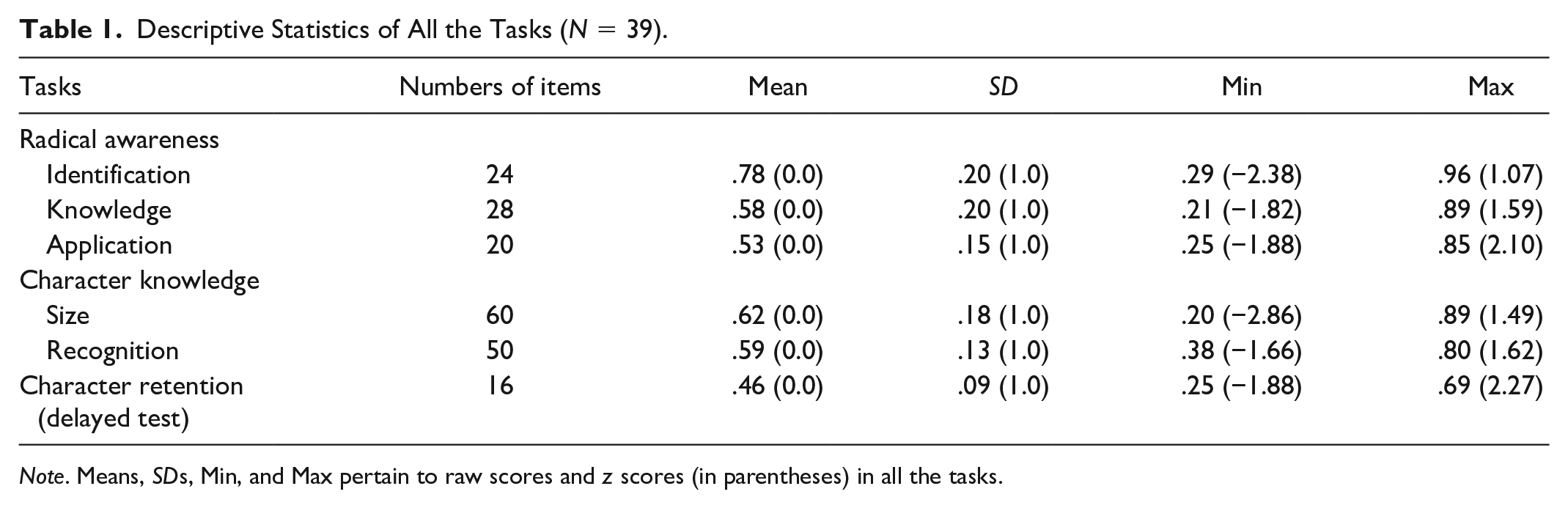
Note. Means, SDs, Min, and Max pertain to raw scores and z scores (in parentheses) in all the tasks.
To answer RQ1 “Does L2 learners’ radical awareness affect the meaning retention for nontransparent compound characters?,” a Pearson product-moment correlation was run first to assess the intercorrelations among all variables, which are reported in Table 2. Results showed that radical awareness and character knowledge at all sublevels were significantly correlated with each other, as well as correlated with nontransparent character retention.
Correlations Among the z Scores of Radical Awareness, Character Knowledge, and Nontransparent Character Retention (N = 39).

p < .05. **p < .01. ***p < .001.
Second, a hierarchical multiple regression was performed to determine the relative contribution of radical awareness and character knowledge to character retention. To clearly understand the relationship among radical awareness, character knowledge, and character retention, this study followed S. Ke and Koda’s (2017) method to use the composite z scores of each facet of a construct to represent the whole construct. Specifically, the composite z scores of radical identification, radical knowledge, and radical application were used to represent learners’ radical awareness. The composite z scores of character size and character recognition were used to represent learners’ character knowledge.
For nontransparent characters, a two-stage hierarchical multiple regression was conducted with character knowledge as the control variable, radical awareness as a predictor, and character retention as the dependent variable. Specifically, character knowledge and radical awareness were entered at the first and second stages of the analysis, respectively. The results are provided in Table 3. Character knowledge was a significant contributor of character retention, F(1, 36) = 31.75, p < .001, which explained 46.2% of the variance. But after character knowledge was controlled, radical awareness was not an independent, significant contributor (p = .276).
Hierarchical Regression Analysis With the Meaning Retention for Nontransparent Characters as the Dependent Variable (N = 39).

p < .001.
To answer RQ2 “Does the role of radical awareness in the meaning retention for nontransparent compound characters change between L2 learners with higher and lower character knowledge?,” this study first categorized the learners’ character knowledge into two groups based on the composite z scores of character size and recognition tasks. Group 1 was categorized as the “higher character knowledge” group with 20 participants (51.3%), in which the participants’ scores were above the mean score and Group 2 as the “lower character knowledge” group with 19 participants (48.7%), in which the participants’ scores were below the mean score. The follow-up t tests showed significant differences between the two groups on radical awareness, t(37) = 5.14, p < .001, d = 1.65, character knowledge, t(37) = 10.42, p < .001, d = 2.94, and character retention, t(37) = 4.97, p < .001, d = 1.59.
In terms of relatively small sample sizes in the both groups, two Pearson product-moment correlations were run to exploratively investigate the intercorrelations among radical awareness, character knowledge, and character retention in higher and lower character knowledge groups. The results are reported in Tables 4 and 5. Results showed that for learners with higher character knowledge, radical awareness was significantly correlated with character knowledge and character retention. Character knowledge was also significantly correlated with character retention. In contrast, for learners with lower character knowledge, L2 learners’ radical awareness, character knowledge, and character retention were not significantly correlated with each other.
Correlations Among the Composite Scores of Radical Awareness, Character Knowledge, and Character Retention in the Higher Character Knowledge Group (N = 20).

p < .05. **p < .01.
Correlations Among the Composite Scores of Radical Awareness, Character Knowledge, and Character Retention in the Lower Character Knowledge Group (N = 19).

Discussion
This study investigated the relationship among L2 learners’ radical awareness, character knowledge, and the meaning retention for nontransparent characters.
First, radical awareness did not independently contribute to the meaning retention for nontransparent characters. This finding seemed to be inconsistent with the previous studies wherein radical awareness was viewed as an independent contributor to character learning (e.g., Chen, 2019a; Lü et al., 2015; Shen & Ke, 2007), but was consistent with our hypothesis that radical awareness does not positively affect nontransparent character retention. As suggested above, most of the previous studies focused on the relationship between radical awareness and transparent character learning. Thus, it is not surprising that radical awareness can facilitate compound character learning because this ability to identify, analyze, and apply radicals within compound characters helps L2 learners better understand unfamiliar characters’ orthographic and semantic features, such as internal structures and the relationship between meanings of radicals and characters. Heightened sensitivity to the structures and meanings of characters can reduce learners’ memory burden (e.g., Reder et al., 2016), which facilitates unfamiliar character recognition, inference, and retention (e.g., Chen, 2019a). In contrast, L2 learners cannot take advantage of nontransparent characters by analyzing the relationship between the meanings of radicals and characters. After all, those characters are categorized as the compound characters whose meanings of radicals and characters are not directly related. Therefore, it follows that L2 learners’ knowledge and familiarity to radicals does not directly affect the meaning retention for nontransparent characters.
Interestingly, this study did not find a negative relationship between radical awareness at all sublevels and nontransparent character retention. These findings suggest that, compared with potential, negative effects brought by learners’ proactive interference, their better orthographic knowledge, radical awareness, and character knowledge play a more important role in character learning (e.g., Jin, 2003; Su & Kim, 2014). One possible explanation is that radical awareness is a multifaceted construct, which includes different sublevel abilities from the orthographic level (e.g., radical identification) to the semantic level (e.g., radical knowledge and application). Although the sensitivity to the meanings of radicals within nontransparent characters cannot help learners memorize the meanings of characters, and may even hinder their memorization as a consequence of the semantic inconsistency between the meanings of radicals and characters, the familiarity to rules of compound character composition (e.g., legal positions and combinations) does facilitate learners’ memorization. This assumption could also explain the results in Table 3, which suggest that that radical awareness did not independently contribute to character retention when character knowledge was controlled.
According to the multilevel interactive-activation framework (cf. Taft et al., 1999), activation units in morphemic processing are organized hierarchically in levels corresponding to radicals, characters, and multi-character words at orthographic and semantic units. Character knowledge at the relatively upper level of Chinese writing system allows learners to make use of existing orthographic knowledge about radicals at the relatively lower level in character recognition and memorization. However, learners cannot directly use radical awareness, particularly those abilities related to semantic levels, to memorize unfamiliar nontransparent characters because the meanings of characters and radicals are not related. Learners’ orthographic sensitivity to radicals may function in nontransparent character learning via character knowledge at the relatively higher level. Thus, radical awareness and character retention were significantly correlated with each other, but radical awareness cannot independently contribute to nontransparent character retention. That is because radical awareness may necessarily function via learners’ character knowledge.
The answer to RQ2 also supported the idea that character knowledge moderates the relationship between radical awareness and character retention. Theoretically, the concept of “moderator” is a further understanding of the idea of a threshold level of L2 linguistic knowledge in previous studies (e.g., Bernhardt & Kamil, 1995; Clarke, 1980) that L2 linguistic knowledge is required for using L1 reading subskills (Clarke, 1980). The present concept of “moderator” emphasizes that without the requisite linguistic knowledge (e.g., character knowledge) that supports a learner’s deployment of a particular reading subskill (e.g., radical awareness), L2 learners are unable to benefit from that subskill during literacy development (e.g., Chen, 2018; Koda & Miller, 2018).
Specifically, there were no significant correlations among radical awareness, character knowledge, and the meaning retention for nontransparent characters among learners with lower character knowledge. On the other hand, significant correlations were found among learners with higher character knowledge. Although no previous study, to our knowledge, investigated the role of character knowledge in nontransparent character learning, the present findings were consistent with studies regarding L2 word learning (e.g., Chen, 2018; Koda & Miller, 2018). Specifically, Koda and Miller (2018) found that linguistic knowledge moderates the relationship between morphological awareness (another key metalinguistic awareness, which refers to the sensitivity to word-internal structures) and word-meaning inference among 157 L2 English learners who were Japanese native speakers. In other words, without requisite linguistic knowledge, L2 learners’ morphological awareness may not play a role in word learning. Similarly, Chen (2018)investigated 73 L2 Chinese learners in China and found that the relationship between morphological awareness and word-meaning inference varied according to language-learners’ levels of language proficiency. Therefore, the present findings suggest that character knowledge, like linguistic knowledge in word learning, is a moderator that shapes the relationship between radical awareness and character retention.
It should also be noted that for learners with lower character knowledge, the correlation coefficient between radical awareness and character retention was negative, though it was not significant. As a result, in the lower character knowledge group, the learners with relatively higher radical awareness performed worse in the meaning retention for nontransparent characters. Learners’ prior radical awareness may even interfere with their retention of unfamiliar characters, though statistically radical awareness and character retention were not correlated. This finding indicates that some L2 learners’ understanding is limited regarding radicals’ roles, perhaps due to the lack of nontransparent character exposure. Without sufficient understanding of the Chinese character system, L2 learners might overuse their radical awareness in learning new characters, particularly encountering nontransparent compound characters with familiar radicals. More empirical evidence in the future studies with larger samples would further our understanding regarding whether, and the extent to which, radical awareness negatively affects nontransparent character learning, particularly for those learners with lower character knowledge.
Pedagogical Implications
This study helps us realize the complex relationship between radical awareness and character learning. The findings hold potential for Chinese language instruction, textbook design, and specific classroom activities. First, language instructors and textbook editors should note that different levels of semantic transparency of compound character affect the way learners memorize and retain the meanings of characters, as well as the extent to which they could positively use their radical awareness. L2 Chinese learners are encouraged to reach the correct meanings of unknown transparent characters containing familiar radicals once they have a sense of how character components (i.e., phonetic and semantic radicals) combine with each other and are willing to guess. In contrast, it is more effective to memorize a nontransparent character as one unit, particularly for semiopaque characters (e.g., 软, /ruǎn/, “soft”) and opaque characters (e.g., 丛, /cóng/, “crowd”). Meanwhile, learners should be explicitly guided toward the orthographic features of the radical to the whole character. For nontransparent characters, learners necessarily extend more effort in character memorization and retention.
Second, direct instruction and exercises in radical–character recombination and segmentation for compound characters should be provided for guided in-class as well as out-of-class learning activities. For example, after learning the characters 妈 (/mā/, “mother”), 姐 (/jiě/, “elder sister”), and 妹 (/mèi/, “younger sister”), L2 learners should practice segmenting and analyzing new characters containing the same radical and the similar character-internal structure, such as 姨 (/yí/, “aunt”) and 婿 (/xù/, “son-in-law”). These exercises could help learners better understand the semantic relation between the radicals and transparent characters, as well as the orthographic relation between the radicals and nontransparent characters. Similar activities are not only limited in Chinese compound character learning but can also be applied to compound word learning in other languages. For example, after learning “fossilization” and “Europeanization” with the same component “-ization,” learners who speak English as a second/foreign language should be encouraged to analyze, infer, and memorize the meanings of complex unfamiliar words, such as “hybridization” and “Africanization.”
Limitations and Conclusion
Admittedly, there are some limitations in this study. First, a larger sample size with learners at different levels of character knowledge would be helpful to generalize our findings and provide more evidence regarding our hypothesis that character knowledge is a moderator shaping the relationship between radical awareness and the meaning retention for compound characters. Second, future study with a post-delayed test would do well to consider the effects of semantic radicals and phonetic radicals together. In addition, more information about learners’ strategies to remember unfamiliar characters should be investigated. This information could help us understand whether different learning strategies would affect the function of radical awareness in L2 learners’ character retention.
In summary, the present study investigated the relationship among L2 learners’ radical awareness, character knowledge, and the meaning retention for nontransparent compound characters. The main findings showed that radical awareness did not positively affect character retention when character knowledge was controlled. Moreover, character knowledge was a moderator, which shaped the relationship between radical awareness and character retention. To be specific, for learners with higher character knowledge, there was a significant correlation between radical awareness and character retention. In contrast, for learners with lower character knowledge, no significant correlation existed between radical awareness and character retention.
Supplemental Material
sj-pdf-1-sgo-10.1177_2158244020969669 – Supplemental material for Nontransparent Compound Character Learning in L2 Chinese: Does Radical Awareness Always Work?
Supplemental material, sj-pdf-1-sgo-10.1177_2158244020969669 for Nontransparent Compound Character Learning in L2 Chinese: Does Radical Awareness Always Work? by Tianxu Chen and Yali Feng in SAGE Open
Footnotes
Declaration of Conflicting Interests
The author(s) declared the following potential conflicts of interest with respect to the research, authorship, and/or publication of this article: The authors declare that the research was conducted in the absence of any commercial or financial relationships that could be construed as a potential conflict of interest.
Funding
The author(s) disclosed receipt of the following financial support for the research, authorship, and/or publication of this article: Funding was provided by Key Research Project of “Double First-Class” Initiative by Minzu University of China (Grant No. 20SYL011).

Supplemental Material
Supplemental material for this article is available online.
References
Supplementary Material
Please find the following supplemental material available below.
For Open Access articles published under a Creative Commons License, all supplemental material carries the same license as the article it is associated with.
For non-Open Access articles published, all supplemental material carries a non-exclusive license, and permission requests for re-use of supplemental material or any part of supplemental material shall be sent directly to the copyright owner as specified in the copyright notice associated with the article.
