



Abstract
The purpose of this article aims to analyze the effect of word-word space in written Chinese to advanced non-native speakers when they read and process Mandarin texts. The participants have performed one online reaction time experiment and another one offline pencil-paper test. The results indicate that the structure of word segmentation in written Chinese texts have play an effective role in sentences’ semantic processing, and the length and difficulty of sentences stimuli have also displayed significant function for their Chinese sentences processing. However, the results of offline test show that the combinational amount of segmental words have not affected the texts materials processed by advanced L2 participants. These results suggest that word boundary can facilitate L2 learners of Mandarin Chinese in processing text during their reading. Apart from theoretical implications, this article also proposes a new pedagogical approach to teaching text segmentation in Chinese, which can be useful in instructing Chinese as a second or foreign language.
Introduction
Reading is one of the most crucial skills in foreign language learning. The written texts in many languages use word-word space to indicate of the boundary of continuous words (e.g., English, German etc.). The between-word space offers some convenience for learners to recognize and process words accurately and fast. In fact, the word-word space in texts serves as a visual tool to help learners understand the reading materials. However, there is no word-word space to mark word boundary in Chinese texts, but only a narrow space between two continuous characters to mark the morpheme boundary. Native Chinese speakers with normal mentality usually do not experience difficulty reading Chinese texts (e.g., Bai et al., 2008; Chen, 2021; Liang & Bai, 2010; Shen et al., 2001, 2010). However, this does not mean that word boundary or segmentation is not important in native Chinese reading. In fact, the literature indicates that Chinese words play a vital role in reading. Furthermore, words have a psychological reality in Chinese. The first step to successful Chinese reading is to recognize a word and to segment the boundary between words (e.g., Bai et al., 2013; Hoosain, 1992; Ma et al., 2019; Shen et al., 2012; Zang et al., 2013). Many studies have shown that word-word space is necessary for Chinese reading, notwithstanding no word-word space between two words. In other words, if native and L2 speakers of Chinese know the location of the word boundary, they will then recognize and process word fast and accurately. The text segmentation in Chinese is crucial for recognizing words in a Chinese text, as it clearly shows the boundary between two consecutive words. Besides, word boundary helps deconstruct the direct constituents of a sentence, which permits the correct and clear understanding of each word.
In Chinese grammar, segmental ambiguity has a close link with the word boundary. In general, ambiguity is a complicated linguistic phenomenon resulting from conflicting external syntactic structures and internal semantics (Zhu, 1980). It is typical of all languages to have conflicting points, and we can discover that many interfaces of a language, including pronunciation, vocabulary, sentence, meaning, and context, have some ambiguity. For resolving ambiguity, an enormous amount of cognitive resources will be consumed. Necessarily and importantly, language ambiguity is an indispensable factor to probe the issue of second language acquisition and processing.
In general, there are two types of grammatical ambiguities in Chinese, structural ambiguity, and semantic ambiguity (e.g., Clifton & Staub, 2008; Shao, 2007; Xing & Wang, 2013; Zhu, 1980). Structural ambiguity is not apparent in a phrase or a sentence, but readers or listeners can easily understand the meaning of text and speech well (Huang & Liao, 2011). On the other hand, semantic ambiguity needs more linguistic clues to resolve, such as contexts and pragmatics. Structural and semantic ambiguity in Chinese text cannot be resolved by marking the boundary between ambiguous words, as ambiguity resolution requires more linguistic clues. However, segmental ambiguity in Chinese text can be resolved by directly marking the boundaries between ambiguous words.
Segmental ambiguity refers to a common phenomenon in Chinese reading. Readers can use clues such as stress and pause to resolve ambiguity in speech, but how readers resolve it in Chinese text without an apparent word boundary? Native Chinese speakers do not have difficulties resolving segmental ambiguity and can accurately grasp the meaning of the text. In theory, advanced L2 speakers can approximate native speakers in terms of language proficiency. However, there are still some remaining questions. For example, what reading performance will L2 learners demonstrate when trying to resolve segmental ambiguity in reading Chinese text? Will L2 learners successfully resolve segmental ambiguity in the same way as their native counterparts? One of the purposes of this article is to analyze and discuss how advanced L2 learners of Chinese resolve segmental ambiguity in reading. To explore the effect of word segmentation on reading and the resolution of ambiguities in reading Mandarin Chinese text, we designed two experiments to collect data and analyzed nonnative reading performances. The first experiment was a time-locked processing experiment to test the reading reaction time of word-word space sentences and only-characters space sentences. If word boundary in Chinese text helped nonnative participants recognize and process words, the reading reaction time would be faster than the reaction time of reading sentences of characters space. The second experiment was an offline pencil-paper test that required participants to mark the word boundaries in ambiguous Chinese strings. If participants correctly marked the boundary between words in ambiguous strings, it suggested that the nonnative participants possessed the knowledge of resolving ambiguities in reading Chinese text.
Literature Review
Segmental ambiguity is common in Chinese text, and the core of the resolution is to segment the word boundary correctly. The effect of word-word space reading and resolutions on Chinese ambiguous segmentation strings are the two sides to discuss in this article.
Chinese Word-Word Space Reading Experiments for L2 Learners
Many studies focus on recognition and acquisition of Chinese words as a second language (e.g., Everson, 1998; Feng, 2003; Gan, 2009; Yang, 2000). However, empirical studies probing the effects of word-word space in sentence reading fail to yield consistent results.
Measuring reaction time research is a practical experimental approach to observing participants’ processing results in second language acquisition. The reaction time of reading Chinese text with word-word space is faster than that without space (e.g., Bai et al., 2009; Bassetti & Lu, 2016; Gao & Jiang, 2015; Ma, 2017; Perea & Wang, 2017; Rayner & Pollatsek, 1996; Rayner et al., 1998; Shen et al., 2012), this indicates that word-word space can help L2 speakers of Chinese process text and spend less time in reading. On the contrary, word-word space does not significantly increase the reading speed in native reading, and the incorrect space between words decreases their reading speed (e.g., Bassetti, 2005; Everson, 1986; Gao, 2004; Inhoff & Liu, 1997; Li et al., 2009). Meanwhile, previous results also show that word-word space facilitates nonnative participants’ reading speed, and the nonnative speakers can acquire the meaning of Chinese texts faster than those texts without word-word space (e.g., Feng, 2020; Chang, 2002; Gao, 2006; Li, 2019; Song, 2014b; Wang, 2011).
There are two different opinions regarding Chinese word-word space reading by L2 learners. Some researchers claim that word-word space facilitates L2 learners’ reading, and others find contradictory results. These experiments aim at finding whether the word-word space in Chinese text can promote L2 learners’ reading and decrease the reading time. However, with different participants, materials, and procedures, the literature has inconsistent results. In this case, more efforts are needed to test the effect of word boundary reading in L2 Chinese.
Resolutions on Chinese Segmentation Ambiguity by L2 Learners
In Chinese text, there is no word-word space, but a boundary between two characters. For example, the string太平淡 (tai ping dan), has only three characters, but can be divided into two different words, 太平 (peaceful)and 平淡 (ordinary). This very string has a common character 平in the middle and allows two segmental results, for example, 太平/淡 and 太/平淡. This sort of segmental ambiguity refers to as “overlapping ambiguity.” Besides, another sort of segmental ambiguity is combinatorial ambiguity. For example, a frequent word in our life, 电影院 (dian ying yuan, cinema) is a three-character string. If there are some characters come before or after this string, this string will become longer and have at least two possible ways to segment this three-character string. One possibility is 电影 (film), and another one is 电影院 (cinema). Meanwhile, there are also two possibilities of the combinatorial ambiguity, such as . . .. . ./电影/院. . .. . . and . . .. . ./电影院/. . .. . .. The correct segmentation of overlapping and combinatorial ambiguity is extremely important to acquire the exact meaning of segmental ambiguity in Chinese text reading. However, the knowledge of syntax, semantics, and pragmatics is necessary for readers to resolve these two sorts of segmental ambiguities.
Different lengths of overlapping and combinatorial segmental ambiguity can be divided into two or more words, because of the various amount of characters in these ambiguous strings. Three-character overlapping ambiguity can be divided into two words, such as the above-mentioned string 太平淡. Four-character overlapping ambiguity can be divided into three words, such as 如今天气 (ru jin tian qi) string into 如今 (now), 今天 (today) and 天气 (whether). The four-character overlapping string shares two common characters. Five-character overlapping ambiguous segmentation can be divided into four words. For example, 排演戏剧院 (pai yan xi ju yuan) can be segmented into 排演 (drill, as a verb), 演戏 (act, as a verb), 戏剧 (drama) and 剧院 (theater). The five-character overlapping string shares three common characters. The segmentation of combinatorial ambiguity is a slightly different from the segmentation of overlapping ambiguity. Two-character combinatorial ambiguity, such as 将来 (jiang lai) into 将 (in the future), or 将来 (in the future). Three-character combinatorial ambiguity 会议室 (hui yi shi) into 会 (can), 会议 (meeting), or 会议室 (meeting room). Four-character combinatorial ambiguity 出版物品 (chu ban wu pin) into 出 (out), 出版 (publish), 出版物 (publication), or 出版物品 (“publication” or “publish subjects”).
Researchers often adopt a quantitative manner, such as the Possible Number of Word Combinations (PNWC), to distinguish the inner difference of segmental ambiguity. In daily Chinese text and daily communication, PNWC from 1 to 3 approximately arrives at 99% (Liang, 1987; Liu, 2000). Previous studies have taken PNWC as an independent variable, and this independent variable has three different levels (Yang & Jiang, 2012; Yang & Yang, 2016). In detail, for overlapping ambiguity, PNCW can be one (e.g., 太平淡), two (e.g., 如今天气), or three (e.g., 排练戏剧院). For combinatorial ambiguity, PNCW can be one (e.g., 将来), two (e.g., 会议室), or three (e.g., 出版物品). Using PNWC to distinguish segmental ambiguity is a clear and objective way to the present research question. Some studies have analyzed the structure of segmental ambiguity in Chinese and discussed the resolution of the two sorts of segmental ambiguities by native speakers of Chinese (Gan et al., 1996; Ma et al., 2014; Yen et al., 2012), but few studies have tested how L2 learners of Chinese resolve these segmental ambiguities. Proficiency levels of L2 learners of Chinese and PNWC are both significant in resolving the overlapping ambiguity by pencil-paper test among beginning and intermediate learners, and the error rates are different in the two groups (Yang & Jiang, 2012). Beginners of L2 Chinese use the bottom-up approach to segment the overlapping and combinatorial ambiguities, and intermediate learners take the top-down strategy to deal with these two kinds of ambiguities (Yang & Yang, 2016).
Limitations of Previous Studies
Recognition of word and resolution of segmental ambiguity is essential for L2 learners of Chinese to clearly understand the text meaning. Previous researches have confirmed that resolution of segmental ambiguity plays an important role in reading comprehension among beginners and intermediate L2 learners of Chinese. Advanced non-native speakers of Chinese read more texts and the possibility of resolving segmental ambiguity is higher than beginners and intermediate learners of Chinese. However, the way of advanced L2 learners of Chinese divide the boundary between words and resolve the segmental ambiguity is still unclear. Previous studies have focused on beginning and intermediate L2 learners instead of the advanced learners. Advanced learners who have mastered a great number of Chinese linguistic knowledge should know how to appropriately segment word boundary. If advanced learners of Chinese are asked to read word-word space text, will they behave like beginning or intermediate learners? How will advanced L2 learners segment the word-word space on Chinese segmental ambiguous strings?
Word frequency is another key factor for word reading, and some researches have taken it as an independent variable that is of two levels (high vs. low frequency) (Crossley et al., 2019; Durrant & Doherty, 2010; Ellis, 2002; Gablasova et al., 2017; Gass & Mackey, 2002; Hulstijn, 2002). If the word frequency is high, L2 learners can quickly recognize and segment word boundary. If the word frequency is low, nonnative speakers should spend longer time in recognizing words and segmenting word boundary. However, some previous studies have not given enough attention to the word frequency of testing materials. Besides, in psycholinguistic experiments, the familiarity with words and the number of Chinese characters in each sentence are also important factors for influencing the results. In this case, word frequency and familiarity with words should be critical for researching segmental ambiguity for L2 learners of Chinese.
Considering the limitations of previous studies, we have designed two experiments on Chinese segmentation and resolution of segmental ambiguity by advanced L2 learners of Mandarin Chinese. Below are the two research questions for this study:
Will the word-word space facilitate the reading speed of advanced L2 learners of Mandarin Chinese?
How will the advanced L2 learners resolve the ambiguities of Chinese segmentation by using word-word space?
Method
Experiment 1: Reaction Time of Word-Word Space Reading
The first experiment aimed at acquiring whether there was a significant effect on reaction time when advanced L2 learners read Chinese word-word space text.
Participants
Participants were 20 (M = 9, F = 11) advanced L2 learners of Mandarin Chinese were all graduate students enrolled in master’s projects in China. Advanced L2 learners spend much more time studying Chinese, which attenuates their L1 influence and allows them to process L2 as natives. Compared to elementary and intermediate learners, the advanced learners are familiar with the orthography of Chinese and have a good knowledge of Chinese writing. The participants aged between 21 and 32 (Mean = 25.35, SD = 3.03), and their average time of learning Chinese was 4.73 years. These nonnative participants came from a variety of countries. All of the L2 participants used alphabetic orthography in their native languages, and they were accustomed to reading word-word space text. They all achieved a minimum of Hanyu Shuiping Kaoshi (HSK) level 5, and some of them achieved level 6. HSK is a standardized Chinese language proficiency testing system for L2 learners administered by the Center for Language Education and Cooperation affiliated to the Ministry of Education of the P.R.China.
Materials
Experiment 1 had three independent variables, that is, text presentation, length, and sentence difficulty. Every variable in Experiment 1 had two levels. Text presentation was divided into word boundary or not having a word boundary. Length of sentences was divided into short sentences or long sentences. There were two levels of difficulty for sentences, that is, easy versus difficult. The dependent variable of Experiment 1 was reaction time in sentence reading, measured in milliseconds (ms).
All of the materials were chosen from an advanced L2 Chinese language textbook. Ten advanced L2 Chinese learners (HSK Level 6), who were not participants in Experiment 1, judged the difficulty of all experimental sentences with a six-point scale (1 = very easy, 6 = very difficult). After judgment, we checked the difficulty of words and grammar in the sentences according to HSK. If the difficulty score was higher than the average point, then the sentence was a difficult sentence. If lower than the average point, the sentence was an easy sentence. We counted the total characters and average of all material sentences. Long sentences had more characters than the average number of characters, and the short sentences had fewer characters than the average number of characters.
Procedures
We used E-Prime 2.0 in the first reading task, a platform of experimental psychology to conduct response tasks and collect data to analyze psychological performance. Before the experiment, participants were given instructions for the experiment as well as a brief description of how to make responses. This procedure lasted 60 minutes for each participant, and there was a 3-minute break after reading every 10 sentences. Every participant read 80 Chinese sentences, including the eight different types of sentences. There were 300 ms lag between each sentence presentation. The participants read silently and acquired the meaning of the sentence, and then pressed the space bar and waiting 300 ms, continually read the next sentence. Before the formal experiment, each participant operated a group of related test to know the procedures clearly (Figure 1).
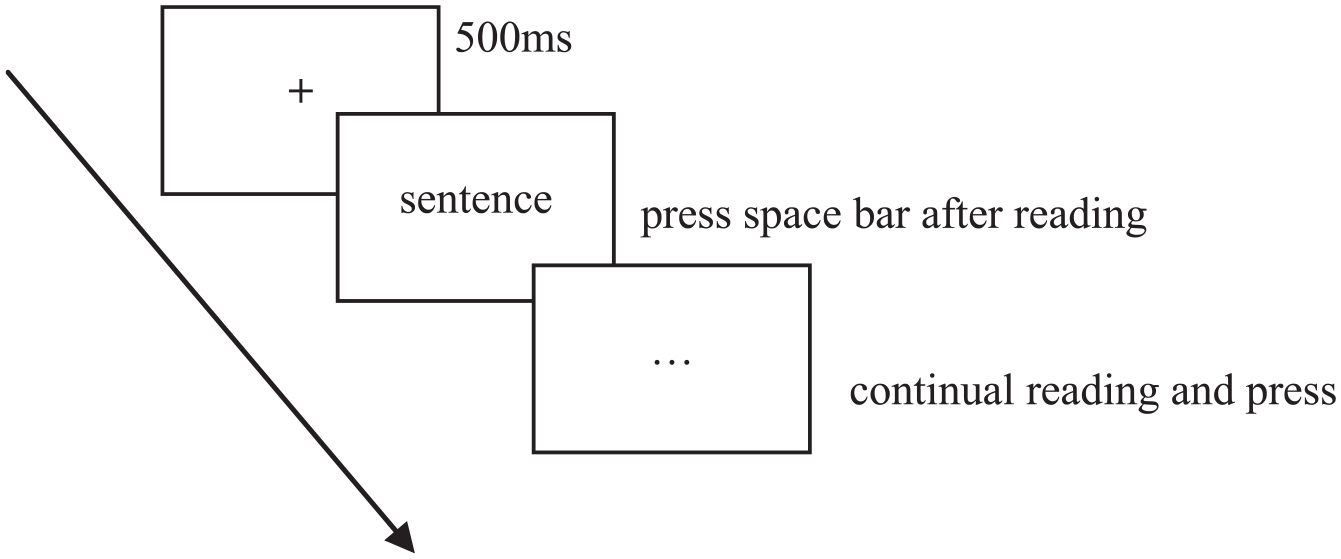
The illustration of a trial in Experiment 1.
Results
A 2 × 2 × 2 within-subjects ANOVA was conducted with sentence reading reaction time as the dependent variable and word boundary (word-word space/no space), sentence length (short/long) and sentence difficulty (easy/difficult) as the independent variables (see Table 1). The results indicated that there was a significant main effect for a word boundary (F (1,152) = 7.035, p < .05), with text without word-word space incurring significantly more reaction time than text with word-word space text. There was also a significant main effect for length (F (1,152) = 208.386, p < .05) and difficulty (F (1,152) = 21.423, p < .05). The long sentence incurred significantly more reaction time than that of a short sentence, and the difficult sentence incurred significantly more reaction time than that of an easy sentence. However, there were no two/three-way interaction effects among the three independent variables.
Descriptive Statistics of the Three Independent Variables in Experiment 1 (n = 20).

Note. nws-s-e = non-word space, short and easy sentences; ws-s-e = word-word space, short and easy sentences; nws-s-d = non-word space, short and difficult sentences; ws-s-d = word-word space, short and difficult sentences; nws-l-e = non-word space, long and easy sentences; ws-l-e = word-word space, long and easy sentences; nws-l-d = non-word space, long and difficult sentences; ws-l-d = word-word space, long, and difficult sentences.
Experiment 2: Resolutions on Ambiguities of Chinese Segmentation
The resolution on segmental ambiguity is an efficient way to study how L2 learners process Chinese text. The purpose of Experiment 2 was to observe whether the PNWC exerted a profound effect on the resolution of the two types of segmental ambiguity among advanced L2 learners of Mandarin Chinese.
Participants
The participants in Experiment 2 were the same as those in the Experiment 1.
Materials
Experiment 2 was a single factor within-subjects design, and the PNWC was the independent variable of three levels. The dependent variable was the error counts of segmental ambiguity. We used ANOVA to analyze the data. The most important point in this experiment was the selection of segmental ambiguity. We chose testing words that had the potential to constitute overlapping and combinatorial ambiguity from New Edition of HSK Vocabulary Syllabus. The syllabus totally contained 5,000 words from HSK level 1 to level 6. Most of the experimental words were distributed from HSK level 3 to 5 and were frequent to L2 learner of Chinese. To make sure that each of the participants understood the words of Experiment 2, they had been required to conduct a vocabulary test. There was no significant difference (t (35) = 1.99, p > .05) between the frequency of the 12 overlapping ambiguities (M = 0.0242, SD = 0.0728). Likewise, there was also no significant difference (t (35) = 2.15, p > .05) between the frequency of the 12 combinatorial ambiguities (M = 0.0147, SD = 0.0213).
Procedures
The overlapping and combinatorial ambiguous strings always exists in a complete sentence, and these strings are the components to construct sentences. Single overlapping or combinatorial ambiguous strings cannot be segmented correctly and properly except in a complete sentence. Therefore, we offered 24 ambiguous Chinese segmentation sentences as the experimental materials. A test paper with 30 sentences was distributed to all participants, including 12 overlapping ambiguities sentences, 12 combinatorial ambiguities sentences, and six sentences that completely did not contain any ambiguities from a Chinese textbook for advanced L2 learners. After getting the test paper, each participant read the guidelines in Chinese to know how to proceed with the pencil-paper test. Then participants used divide line to mark the boundary between two words. We gave an example on the test paper, if someone of the participants did not know the procedure, he or she could ask us for help. We prepared 20 test papers which were printed in different sequences of the 30 sentences for 20 participants. All participants sat in a quiet classroom to finish the pencil-paper test, and they were not allowed to ask any questions or look up in the dictionaries during the whole test.
Results
The statistics were only calculated on the segmentation errors of ambiguous segmental strings in Experiment 2. For overlapping ambiguity (Table 2), errors were significantly different for the PNWC (F (2, 28) = 15.601, p < .05). Repeated contrasts tests were conducted to assess which of the PNWC differed from one another. The results indicated that errors were significantly different when the PNWC is 3. Generally speaking, the errors increased with the number of PNWC. For combinatorial ambiguity (Table 3), errors were also significantly different for the PNWC (F (2, 28) = 8.263, p < .05). Similarly, the results indicated that errors were significantly different when the PNWC was 3. However, when the PNWC was 2, the combinatorial ambiguity had elicited fewer errors.
Comparison of Segmental Errors in Overlapping Ambiguous Strings (n = 20).

Comparison of Segmental Errors in Combinatorial Ambiguous Strings (n = 20).

Discussion
In the present study, word boundary facilitated participants’ reading speed and decreased their reaction time. The space between words helped L2 learners in understanding Chinese text quickly (e.g., Bai et al., 2009; Gao & Jiang, 2015; Perea & Wang, 2017; Shen et al., 2012). Moreover, the effect of word boundary in reading helped primary, intermediate, and advanced L2 learners of Chinese reading texts. Space between words in a text made every single word clear to learners. Reading word-word space text, L2 learners had more time to integrate word information and acquired the complete meaning in a short time. As for the length and difficulty of a sentence, word-word space also played an important role in the two aspects. Word-word space had a close link to the syntactic structure in cognitive processing. The syntactic structure was an explicit form to semantic structure (Shao, 2007). The meaning of a word was a fundamental element to understand the text. Word-word space offered an indispensable clue that helps L2 learners to recognize word quickly. Word processing was a crucial step in language comprehension. For L2 learners of Chinese, dividing the right boundary between words in the text was the first and very important step before word processing. In this regard, Chinese language teachers can adopt a word-word space approach in teaching reading, especially when the reading content was very difficult for learners.
The pencil-paper test indicated that the PNWC had a significant effect in the resolution of segmental ambiguity, while other linguistic factors jointly affected the decision of L2 speakers in the resolution of segmental ambiguity (Yang & Yang, 2016). The errors between the two types of segmental ambiguity were different. There were two obvious trends in the resolution of overlapping and combinatorial ambiguity. One of the reasons was the form structure of the two types of segmental ambiguity. For overlapping ambiguity, the explicit form was a collocation of words. It was very important in resolving overlapping ambiguity to recognize words and understand how to collocate each neighboring Chinese character. In a nutshell, vocabulary played an important role in resolving overlapping ambiguity, and the form structure was a string that took the character (morpheme) as a core to expand at either right or left end. If the PNWC was longer, more knowledge of vocabulary was needed. For combinatorial ambiguity, the external structure was a string which took an unambiguous word as a core to expand in the line to the right. Using a lexical way to resolve this type of ambiguity was not enough. The knowledge of syntax, semantics and pragmatics were also needed. To resolve the two types of segmental ambiguity, participants not only used linguistic knowledge but also fully took their cognitive resources to recognize the exact word in ambiguous strings.
The arrangement between words could be different if the syntactic structure of the two types of segmental ambiguity is assessed. In overlapping ambiguity, one character (morpheme) combines with another character (morpheme) that comes before or after it. The two characters thus form into a word which is clear and unambiguous. Relying on lexical information to divide the word boundary in overlapping ambiguity was an easy and appropriate approach. In combinatorial ambiguity, an unambiguous string is enclosed in an ambiguous string, and the lexical information cannot be discovered from words in the string. To divide the word boundary in combinatorial ambiguity, the participants must consider the information between two or more words in strings, and analyze the neighboring characters and words. The two types of segmental ambiguity need different approaches to resolve because of their differences in the syntax-semantics interface.
A semantic clue is a necessary linguistic point to understand the text (Huang & Liao, 1991; Shao, 2007). Learners construct the links between words to acquire the meaning of the text. Before getting the meaning of a sentence, learners firstly need to recognize and segment each word in Chinese text, and then use collocation rules of vocabulary in the language to understand the whole meaning of a sentence. For any segmental ambiguities, the ambiguous string matches with unambiguous string. The possibility of collocation and arrangement are to be considered when segment the ambiguous string. The meaning of each word in an ambiguous string is a clear clue to segment ambiguity.
There are more possibilities for the collocation of words in segmental ambiguity if the PNWC is longer. Words form a certain context for learners to discover helpful information and acquire the best collocation in an ambiguous string. The context in an ambiguous string can be divided into the information of vocabulary and of the sentence. Context information of vocabulary means that every character in the ambiguous string can be combined to a single word. Learners have more difficulties recognizing a word if a character has more possibilities with other characters coming to be a word. Context information of sentence aims to tell learners the types of segmentation of ambiguous Chinese strings, and helping them to find the exact word in a sentence in recognizing and segmenting word in Chinese text. Knowledge of syntax, semantics, vocabulary, and pragmatics is indispensable for L2 learners to resolve segmental ambiguity.
Conclusion
The two experiments of the present study have shown that word-word space can help advanced non-native learners of Mandarin Chinese fast process Chinese texts and correctly segment ambiguous Chinese strings. The present study has used both reaction time experiments and pencil-paper tests to assess how advanced L2 learners of Mandarin Chinese process Chinese texts in both online and offline situations. The results have shown that word boundary is an essential part for L2 learners to process Chinese texts. Without a doubt, the first step to understand the meaning of a text in reading is to recognize a word in a non-word space text. Understanding every word constitutes a fundamental task in reading, while dividing the word boundary paves the way for L2 sentence parsing. For the resolution of segmental ambiguity, Chinese segmentation in the ambiguous string may be the most crucial way for resolution. The word-word space approach that indicates the boundary between words in Chinese text can simplify the sentence parsing for L2 readers. The word-word-space approach should be appropriate for teaching Chinese reading, along with the knowledge of syntax, semantics, pragmatics, and context. Moreover, the word-word space approach can be a scaffold to help L2 learners of Chinese identify and process words in texts quickly and accurately. For teachers, they can take advantage of this language feature when delivering reading lectures to learners. On the whole, teaching Chinese characters and words is basic but essential for L2 learners, and the highly frequent collocations from multi-words are necessary to recognize and judge the word-word boundaries.
Supplemental Material
sj-docx-1-sgo-10.1177_21582440211059150 – Supplemental material for Can Word-Word Space Facilitate L2 Chinese Reading: Evidence From the Two Empirical Studies by Advanced L2 Learners of Mandarin Chinese
Supplemental material, sj-docx-1-sgo-10.1177_21582440211059150 for Can Word-Word Space Facilitate L2 Chinese Reading: Evidence From the Two Empirical Studies by Advanced L2 Learners of Mandarin Chinese by Ken Chen, Lei Gu, Hongshan Zuo and Qiaoyan Bai in SAGE Open
Footnotes
Declaration of Conflicting Interests
The author(s) declared no potential conflicts of interest with respect to the research, authorship, and/or publication of this article.
Funding
The author(s) received no financial support for the research, authorship, and/or publication of this article.

Supplemental Material
Supplemental material for this article is available online.
References
Supplementary Material
Please find the following supplemental material available below.
For Open Access articles published under a Creative Commons License, all supplemental material carries the same license as the article it is associated with.
For non-Open Access articles published, all supplemental material carries a non-exclusive license, and permission requests for re-use of supplemental material or any part of supplemental material shall be sent directly to the copyright owner as specified in the copyright notice associated with the article.
