




Abstract
Because of their importance to people, nature, and societies, domestic gardens have attracted increasing research interest. However, significant areas of interest remain unexplored, such as the variables that determine individuals’ satisfaction with their gardens. Our main goal was to address this gap. We surveyed 1,005 individuals with home gardens in Quito, Ecuador, to collect information on three groups of variables: (a) psychological and individual factors, (b) social and family aspects, and (c) garden characteristics. We used these groups of variables as predictors of satisfaction in a regression model (R2 = 0.242), with the first and third contributing the most to our understanding of satisfaction. In particular, people tended to be more satisfied with gardens composed of mostly native plants. In addition, individuals tended to be more satisfied if their motives for garden use were related to nature. In contrast, a high level of consumed resources negatively affected satisfaction.
Domestic gardens are of great importance in modern societies. As other urban green spaces do, private gardens allow urban dwellers to interact with nature, thereby providing considerable physical and psychological benefits (Benfield, Rainbolt, Bell, & Donovan, 2015; Bhatti, Church, & Claremont, 2014; Honold, Lakes, Beyer, & van der Meer, 2016; C. H. Lin, 2013). Private urban gardens contribute to the maintenance of biodiversity and wildlife (Gaston, Warren, Thompson, & Smith, 2005; Irvine et al., 2010; Loram, Warren, Thompson, & Gaston, 2011). They also benefit business interests, particularly in the form of plants, fertilizers, garden equipment, and design and maintenance services.
The importance of domestic gardens varies between cities and countries. In areas where data are available, domestic gardens account for more than 25% of the total urban area (Loram, Tratalos, Warren, & Gaston, 2007; Mathieu, Freeman, & Aryal, 2007). The extension of domestic gardens reflects their importance as one of the main urban domains where individuals can interact with nature (Goddard, Dougill, & Benton, 2013). Despite the importance of domestic gardens, recent research indicates a reduction in green areas and domestic gardens in places where such spaces have been studied for decades (Verbeeck, Van Orshoven, & Hermy, 2011; Warhurst, Parks, McCulloch, & Hudson, 2014). This worrisome trend underscores the need for further research into the relationship between people and their gardens to prevent the decline of these private green spaces (Warhurst et al., 2014).
Satisfaction, a concept rooted in psychology, is useful in understanding the relationship between domestic gardens and their owners. Satisfaction is a subjective evaluation that individuals make regarding the state of their life in general or a specific domain in it, such as family life, free time, work, or gardens; if this evaluation is negative, individuals will strive for change (van Praag & Ferrer-i-Carbonell, 2004). According to our review, no previous study has addressed the factors determining individuals’ satisfaction with their gardens. The present study addresses this gap in Quito, the capital of Ecuador, a developing South American country.
We expect that this investigation into the determinants of individuals’ satisfaction with gardens will provide valuable information for different types of organizations, including both the nonprofit and for-profit sectors. For public and nonprofit organizations, understanding individual sources of satisfaction and dissatisfaction will empower the development of better campaigns aimed at the conservation and preservation of gardens (Clayton, 2007). Such efforts are especially important in developing countries, where the most urbanization is occurring (United Nations Population Fund, 2007). Meanwhile, for-profit organizations with commercial offerings sold to garden owners may better understand the determinants of satisfaction, enabling them to develop better and more appropriate products and services.
To explain individual satisfaction, it is necessary to study the influence of both internal and external factors (Diener, Suh, Lucas, & Smith, 1999). In this sense, the present study draws upon both psychology and ecology, disciplines that have dominated previous studies on home gardens. However, despite their dominance, there has been little communication between these two fields (Irvine et al., 2010). After reviewing the literature, we formulated nine hypotheses regarding the association of several variables with satisfaction. Additional variables were chosen as covariates. This set of variables (hypotheses and covariables) came from three areas: psychological and personal variables, social and family variables, and variables related to the physical characteristics of the garden. Before going into more detail regarding these hypotheses, we present our review of two specific areas of the literature: domestic urban gardens and satisfaction.
Literature Review
Domestic Urban Gardens
Domestic gardens are located in the exterior areas of houses and may include small structures, green areas, and vegetated spaces (e.g., plants, lawns, and trees) as well as driveways, paths, and fences (van Heezik, Freeman, Porter, & Dickinson, 2013). Domestic gardens contribute substantially to the urban green space (Goddard et al., 2013), which also includes public parks, sports spaces, and natural areas (Warhurst et al., 2014).
One method of classifying studies regarding home gardens is by their objectives and findings. In this sense, two large groups of studies can be identified: those oriented toward studying the motivations and benefits of using domestic gardens and those oriented toward informing management decisions regarding gardens and their structure and design. Studies in the first group have identified six motivations for planting or using domestic gardens: (a) to connect with nature (Bhatti & Church, 2004; Clayton, 2007; Goddard et al., 2013; Kiesling & Manning, 2010; Loram et al., 2011; Tang, Sullivan, & Chang, 2015); (b) to engage in leisure activities with family, friends, and pets (Clayton, 2007; Goddard et al., 2013; Loram et al., 2011); (c) to perform physical, hands-on work (Clayton, 2007; Goddard et al., 2013; Kiesling & Manning, 2010; Loram et al., 2011); (d) to grow food and medicinal plants (Clayton, 2007; Goddard et al., 2013); (e) to embellish the house for others (e.g., friends or neighbors) or to meet neighborhood standards (Bhatti & Church, 2004; Goddard et al., 2013); and (f) to increase the economic value of a house (Clayton, 2007).
In this same group of studies on motivations and benefits, previous research has also established the benefits of garden use and activity, particularly in terms of the mental and physical health advantages that gardens generate for people (e.g., Freeman, Dickinson, Porter, & van Heezik, 2012; C. H. Lin, 2013; Scott, Masser, & Pachana, 2014; Soga, Gastón, & Yamaura, 2017). Studies also confirm that gardens have several social and economic benefits (e.g., Calvet-Mir, Gómez-Baggethun, & Reyes-García, 2012; Freeman et al., 2012; Gray, Guzman, Glowa, & Drevno, 2014). However, domestic gardens and the gardening activities that occur in them can also have negative consequences. For example, many invasive alien plants began their expansion in domestic gardens (Reichard & White, 2001). In addition, certain garden owners may form negative attitudes about the physical work that gardens require, the resources they consume (e.g., time and money), and the presence of dirt and bugs that may affect the home (Kaplan & Kaplan, 1989).
Within the second major area of research on domestic gardens, which concerns management decisions regarding structure and design, studies have focused on garden management activities (e.g., sowing, watering, pruning, cultivating, weeding, and using fertilizers and pesticides), their predictors, and their impacts (e.g., Clayton, 2007; Goddard et al., 2013; Kiesling & Manning, 2010; Loram et al., 2011). Research has identified owners’ environmental values (Larson, Cook, Strawhacker, & Hall, 2010), their income (Larsen & Harlan, 2006), and the prevailing cultural norms (Nassauer, Wang, & Dayrell, 2009) as variables that influence the design of domestic gardens. Interestingly, research demonstrates that the front garden structure differs substantially from backyard garden structure (Larsen & Harlan, 2006).
Home garden studies can also be classified based on the dominant approach or discipline that they follow. Traditionally, studies on home gardens have been dominated by either psychology or ecology approaches (Irvine et al., 2010). However, a small stream of research aims to bridge these two areas (e.g., van Heezik, Freeman, Porter, & Dickinson, 2014). This multidisciplinary approach bears great potential for understanding the complex interaction between human and nature in green spaces in general and in domestic gardens in particular (Irvine et al., 2010). The present study adopts this perspective with the aim of understanding people’s satisfaction with their home gardens.
Satisfaction
Satisfaction is defined as an individual’s subjective assessment of the current state of his or her life or a specific domain thereof (van Praag & Ferrer-i-Carbonell, 2004). There are several specific domains in which people are immersed. Therefore, the relevant domains must be established according to the way people conceive of their lives (Rojas, 2006). Examples of domains of interest for satisfaction studies include family life, work, leisure time, and shopping, among others. Domestic gardens are also a relevant domain, as the past research mentioned in the previous sections demonstrates their great impact on people’s physical and mental health.
Previous research on individual satisfaction has focused on identifying the predictors of domains of satisfaction and predictors of overall life satisfaction. In addition, studies have sought to identify the contributions of domain satisfaction to overall life satisfaction. For example, research has found that women are more satisfied than men with family life, and men are more satisfied than women with leisure activities (Daig, Herschbach, Lehmann, Koll, & Decker, 2009). In addition, people with more income are more satisfied with family life and leisure activities (Daig et al., 2009). However, studies have also established that overall satisfaction with life is a weighted aggregation of satisfaction with different domains (e.g., Chang-Ming, 2003; Diener et al., 1999; Myers & Diener, 1995; van Praag & Ferrer-i-Carbonell, 2004). As far as we know, our study into owners’ satisfaction with their gardens is novel; no previous study has analyzed this topic as a main theme. However, there is a large body of relevant information that allows the selection of possible predictors for this type of satisfaction, a task developed in the following section.
Variable Selection and Hypotheses
This section is divided into two subsections: hypotheses and other variables to be examined. The “Hypotheses” section analyzes variables with sufficient evidence from previous studies to allow us to propose a specific association between these variables and individuals’ satisfaction with their gardens. In the section referring to “Other Variables to Be Considered,” we identify covariates that merit consideration in the prediction of satisfaction, but we do not propose any specific hypotheses regarding these variables.
Hypotheses
Because both internal and external factors can determine satisfaction (Diener et al., 1999), the hypotheses are divided into three subsections based on the variables: psychological/personal, social/familial, and garden characteristics.
Psychological and personal variables
Within this group of variables, we consider individuals’ environmental awareness to be promising in predicting satisfaction with gardens. Environmental awareness is the propensity to incorporate environmental care values into behavior (Haws, Winterich, & Naylor, 2014). People with greater environmental awareness value being in contact with nature more (Kiesling & Manning, 2010), so they interact with their gardens more often and for longer periods (B. B. Lin et al., 2017). Therefore, people with greater environmental awareness are likely to benefit more from their gardens. We, thus, hypothesize the following:
Social and family variables
Specific characteristics of an individual’s family and interactions with other people are also important in determining satisfaction. Therefore, in this group of variables, we propose three hypotheses regarding how homeownership, home density, and neighborhood likability are associated with individuals’ satisfaction with their gardens. Because of their property rights, homeowners have a greater range of possibilities for modifying their home’s characteristics, including the garden. Research has found that homeowners (as opposed to renters) exert more effort to change the garden structure (e.g., planting plants and fruit trees; Dennis & Behe, 2007). Homeowners’ ability to modify their garden more than renters reflects their greater capacity to adapt the garden to obtain the desired results, which leads to the following hypothesis:
A family’s property includes both the physical unit of the house and its exterior gardens. The number of inhabitants per household is a determining factor of family life and welfare (Bratt, 2002). Therefore, household density should factor into garden satisfaction. In high-density houses, gardens may be one of the few quiet places available for its inhabitants. Thus, we expect the following hypothesis to hold true:
Although a neighborhood’s likability is a subjective assessment, we included it in this section because it is a valuation of the physical aspects of a neighborhood and the interrelationships between an individual and his or her neighbors. Friends and neighbors have proven to be an important influence in management decisions (Goddard et al., 2013). However, beyond this factor, satisfaction in various domains demonstrates significant correlations (van Praag & Ferrer-i-Carbonell, 2004). Thus, we posit the following hypothesis:
Garden characteristics variables
The physical environment surrounding individuals influences their satisfaction. In the present context, these external elements revolve around garden characteristics. We propose five hypotheses in this group of variables concerning possible influences of the relative area of the garden, the structure of the garden, the majority origin of the existing plants, the disadvantages of the garden, and the diversity of the garden.
While larger gardens may be expected to have a greater capacity to provide benefits to their owners, it also should be considered that the different areas of a house (e.g., living room, bedrooms, and gardens) compete with one another for individuals’ attention during leisure time at home (Arnold & Lang, 2007). With this important aspect in mind, we make the following proposal:
Urban garden design varies depending on the owner’s and/or builder’s particular taste or style. However, a garden’s basic structure can be described by its main base cover (Goddard et al., 2013), that is, either plants or hardscaping. Factoring in the human benefits of interacting with nature, which were discussed in the literature review, we propose the following hypothesis:
Previous studies have demonstrated that intense physical work is not the main reason why people maintain a garden (Clayton, 2007; Kiesling & Manning, 2010). According to Loram et al. (2011), the proportion of native plants in a garden is an important determinant of the work necessary in that garden; that is, labor demands decrease as the percentage of native plants increases. Based on this relationship between native plants and the amount of work needed, we propose the following:
Negative events and experiences in a specific domain of people’s lives have a negative impact on people’s assessment of their satisfaction and well-being with that domain (Diener et al., 1999). Inconveniences in a garden context have been poorly studied. However, Kaplan and Kaplan (1989) identified several negative aspects of gardening, including physical effort, monetary resources needed, and uncertain results. Accordingly, we generate this hypothesis:
Individuals are motivated to search for novelty and variety in their lives (Hirschman, 1980). Applying the psychological concept of variety-seeking to the present study, we predict that the plant diversity and structural variety in a garden influence satisfaction:
Other Variables to Be Considered
Personal and family variables
Age, gender, employment status, and income are used often in psychology and social sciences because of their ease of measurement and their ability to explain varied behaviors. In the literature, several studies on public green space, consumer behavior and gardening, and satisfaction with specific life domains have also considered these variables (e.g., Daig et al., 2009; Dennis & Behe, 2007; Larsen & Harlan, 2006). Therefore, we find it important to include this group of personal and family variables as covariables in the present study.
Motivation
Motivation is one of the most-studied psychological variables in regard to domestic gardens. Motivation is also a crucial variable in studies of human behavior because it refers to the needs or desires that initiate and direct behavior (Myers, 2010). The importance of motivation inspired our interest in exploring the influence of different motivations for using gardens on individuals’ satisfaction.
Method
Study Environment
The present study was conducted in the urban area of the Metropolitan District of Quito (DMQ in Spanish), the capital of Ecuador (see Figure 1). Ecuador is a developing South American country with more than 16 million Spanish-speaking inhabitants. It uses the U.S. dollar as its national currency. Quito has approximately 2.2 million inhabitants, 72% of whom live in urban areas (National Institute of Statistics and Censuses, Ecuador [INEC], 2010). Ecuador is one of 17 ecologically megadiverse countries worldwide (Mittermeier, Mittermeier, & Gil, 1997), and the areas surrounding Quito and the Pichincha volcano are plant and bird hotspots (BirdLife International & Conservation International, 2005; Pitman, Valencia, & León-Yanéz, 2000).

Map of the location of the study area.
Quito’s urban expansion began in the 1960s, partially because of a boom in the oil industry (Carrión & Erazo Espinosa, 2012). Between the 1960s and 1980s, the urban area grew by almost 500% (Carrión & Erazo Espinosa, 2012). In response, conservation efforts in the DMQ expanded, focusing primarily on nature reserves and human footprint reduction (Secretary for Environment, Quito, 2011). However, these efforts have largely neglected private green spaces inside the city, spaces that may serve as biodiversity repositories.
Private gardens in Quito can be classified as those that are covered mostly by green (lawn, plants, and trees; Figure 2) and those dominated by impermeable or inert features (Figure 3). Gardens in Quito are almost always surrounded by fences that separate houses and gardens from the streets, a practice followed for safety reasons.

Examples of gardens whose main component is the green area.

Examples of gardens whose main components are inert elements.
Fieldwork and Sampling
For questionnaire implementation, 107 out of Quito’s 448 urban census areas were randomly selected, and approximately 11 questionnaires were administered per area. The survey targeted adults (18 years or older). A market research firm hired for the task administered the questionnaires through personal interviews in participants’ homes during the first few months of 2014. The final sample included 1,005 adult individuals.
Several filters were used in the survey. The questionnaire was administered only in homes with private green spaces. The houses could be rented or owned, as long as the family had lived in the house for at least two years. After the interviewer ensured that these two conditions were met and an adult agreed to participate in the survey, the interviewer gathered demographic information about household members, including age and gender. The interviewer also asked which household members participated in activities related to the use or maintenance of the garden. Having obtained this data, the interviewer selected the person to fill out the questionnaire among the eligible adults available at home. During the survey period (approximately 3 months), every attempt was made to balance the sample in terms of age and gender.
Variables and Form of Measurement
In this study, we predicted individuals’ satisfaction with their private household gardens. Satisfaction was measured based on a 7-point scale, where 1 = very unsatisfied and 7 = very satisfied (van Praag & Ferrer-i-Carbonell, 2004).
Table 1 presents a summary of how the predictive variables were measured. Because different motivations to use gardens are not mutually exclusive (Clayton, 2007; Goddard et al., 2013; Larson et al., 2010; Loram et al., 2011), we asked the respondents to indicate the personal importance of each motivation item using a 7-point scale. The neighborhood’s likability was also measured on a scale from 1 to 7. Age was measured in its usual format, years. Gender was measured in a dichotomous format (male/female), as was status of having a remunerated job (yes/no) and homeownership (owner/renter).
Variables and Forms of Measurement Used in the Questionnaire.

Environmental awareness was measured using six items based on Haws et al.’s (2014) “green scale.” This scale includes attitudes and values related to consumerism and life in general. In our preliminary test of the questionnaire, we found that respondents who were less educated had difficulty answering in an agreement/disagreement format. Accordingly, we decided to present the items as questions while maintaining the 7-point scale response format (Schuman & Presser, 1996). With respect to assessing differences in family size, which are more pronounced in developing countries, family income was measured on a per capita basis. Meanwhile, home density was measured as a ratio of the number of persons to the number of bedrooms.
Regarding garden characteristics, we defined garden structure as the main garden cover (Goddard et al., 2013) and included four options related to the main coverage: grass, plants and trees, soil, or inert elements. With respect to plant origin, we posed three possibilities: mostly native, mostly exotic, or an equal proportion of these two types. Based on Lubbe, Siebert, and Cilliers (2010), regarding garden composition and diversity, we included six nonmutually exclusive categories: ornamentals, food and medicinal plants, fruit trees, living fences, grass, and trees.
Regarding major garden inconveniences, a significant number of respondents did not identify any substantial inconveniences in the preliminary test of the questionnaire. Therefore, the inconvenience-related questions were modified from interval scales to a categorical response format that considered the options proposed by Kaplan and Kaplan (1989) along with Shaw, Miller, and Wescott (2013): bugs, time and money spent, humidity and dirt, and space occupied. We also included the option of “no inconvenience.”
Results
Descriptive and Factor Analysis
The sample included more women (65.5%) than men. The average respondent age of 46.4 years (SD = 14.1) was higher than the average adult age in Quito, which is 40 (INEC, 2010). The average monthly household income of US$1,220.6 (SD = 598.7) was also higher than the average income of US$1,046 in Ecuador’s urban population (INEC, 2010, 2013). However, the respondents’ educational backgrounds reflected the population parameters, with the majority of the sample having completed secondary education (INEC, 2010). The survey’s filters—targeting individuals who spent time gardening or at least undertook some activities in a garden—produced the higher average age and household income observed in the sample. Other studies have shown that the individuals most interested in gardens typically do not have the average population characteristics (e.g., Bhatti & Church, 2001; Clayton, 2007; Kiesling & Manning, 2010; Shaw et al., 2013).
The majority of our survey subjects were homeowners (79.2%), and 75.0% of them had a remunerated job. On average, neighborhood likability was 5.6 (SD = 1.0), garden satisfaction was 5.7 (SD = 1.0), and environmental awareness was 5.0 (SD = 0.8), with a Cronbach’s alpha of 0.74. On average, motivations included “to connect with nature” (5.6, SD = 0.9), “leisure activities with family, friends, and pets in the garden” (5.4, SD = 1.0), “food and medicinal plant cultivation” (5.1, SD = 1.1), “house embellishment for others” (5.4, SD = 1.0), “gardening activities using one’s hands” (5.3, SD = 1.0), and “house value increase” (4.7, SD = 1.4).
Table 2 presents some of the characteristics of the sampled gardens. The main cover type was “plants and trees” (71.9%), and the majority of the plants were native or traditional (89.0%). Ornamental plants were the most common in the gardens (95.1%), followed by food and medicinal plants (79.2%) and fruit trees (53.0%). The most commonly cited inconvenience was bugs (49.3%); however, 27.1% of the respondents did not identify any major inconveniences associated with their gardens.
Garden Characteristics (N = 1,005).

On average, gardens occupied 12.3% of the residential lots (SD = 11.2) and had an area of 33.3 m2 (SD = 71.7). The average number of individuals who participated in garden activities was 1.8 (SD = 0.8) per household. In 70% of the households, women were the individuals who spent the most time in the garden.
The motivations for having and using a garden were subjected to a common factor analysis with varimax rotation, and a solution of two underlying dimensions or factors was obtained. As observed in Table 3, the four motivations that loaded highly on Factor 1 were motivations related to nature (Motivation 1). The two motivations that loaded highly on Factor 2 were motivations unrelated to nature (Motivation 2). In this regard, Clayton (2007) identified—also based on factor analysis—two very similar underlying factors related to the benefits/motivations for gardening: “benefits from nature” and “benefits from others.”
Results of Common Factor Analysis With Varimax Rotation.

Hierarchical Regression
We calculated a four-step hierarchical regression model to determine the association of the different variables with satisfaction and to estimate the contribution of the different groups of variables in explaining satisfaction. We first entered the psychological and personal variables; second, the social and family variables; third, the garden characteristics variables; and finally, some interaction terms. Four possible interactions were entered into the model: Motivation 1 × Age, Motivation 2 × Age, Motivation 1 × Neighborhood likability and Motivation 2 × Neighborhood likability. We chose to include motivation in all interactions because of its great importance as a variable related to people’s behavior in domestic gardens. We entered age in some interactions because it is one of the most-used personal variables in studies of human behavior. Finally, we selected neighborhood likability as a measure of satisfaction in other domains.
Format of the variables in the model
Motivations for garden use were entered into the model in the form of two constructs resulting from the solution obtained in the factor analysis. The first motivational construct, referred to as Motivation 1, was calculated as the average of the scores on the four motivations related to nature. The second construct, called Motivation 2, was calculated as a function of the average of the two motivation scores unrelated to nature.
For gender entry, we created a design variable with men being the comparison category. Homeownership was entered through a design variable with renter as the comparison category. Similarly, the status of having a remunerated job was entered as a design variable where not having a job was the comparison category.
To estimate gardens’ plant composition and diversity, we assigned a score of 1 to 6 to each garden. This score indicated the number of different items (ornamentals, food/medicinal plants, fruit trees, living fences, grass, or trees) present in the garden. For example, gardens with six different items received a score of 6.
For the garden structure variable, we created a design variable that merged “majority plants and trees” with “majority grass cover” because both are related to green spaces. We also merged “majority soil cover” with “majority hard cover” because both categories refer to elements without plants; as such, this category served as the comparison category.
The plant origin variable was also transformed: “majority natives” became the design variable, merging “same proportion of exotics and natives” and “majority exotics” into one category—“same or greater proportion of exotics”—which served as the comparison category. The variable of the most significant inconveniences related to having a garden was transformed into two design variables. The first design variable combined “humidity and dirt” and “bugs”; the second design variable, which focused on resources consumed, combined “time and money expended” and “space occupied by the garden.” The comparison category was “no inconvenience.”
To explore the possible interactions between variables, we centered all continuous predictor variables around their means (in each case subtracting from the score the mean value of all scores) before entering them into the hierarchical regression model. We performed this transformation to reduce unnecessary collinearity (Cohen, Cohen, West, & Aiken, 2003).
Results of the hierarchical regression model
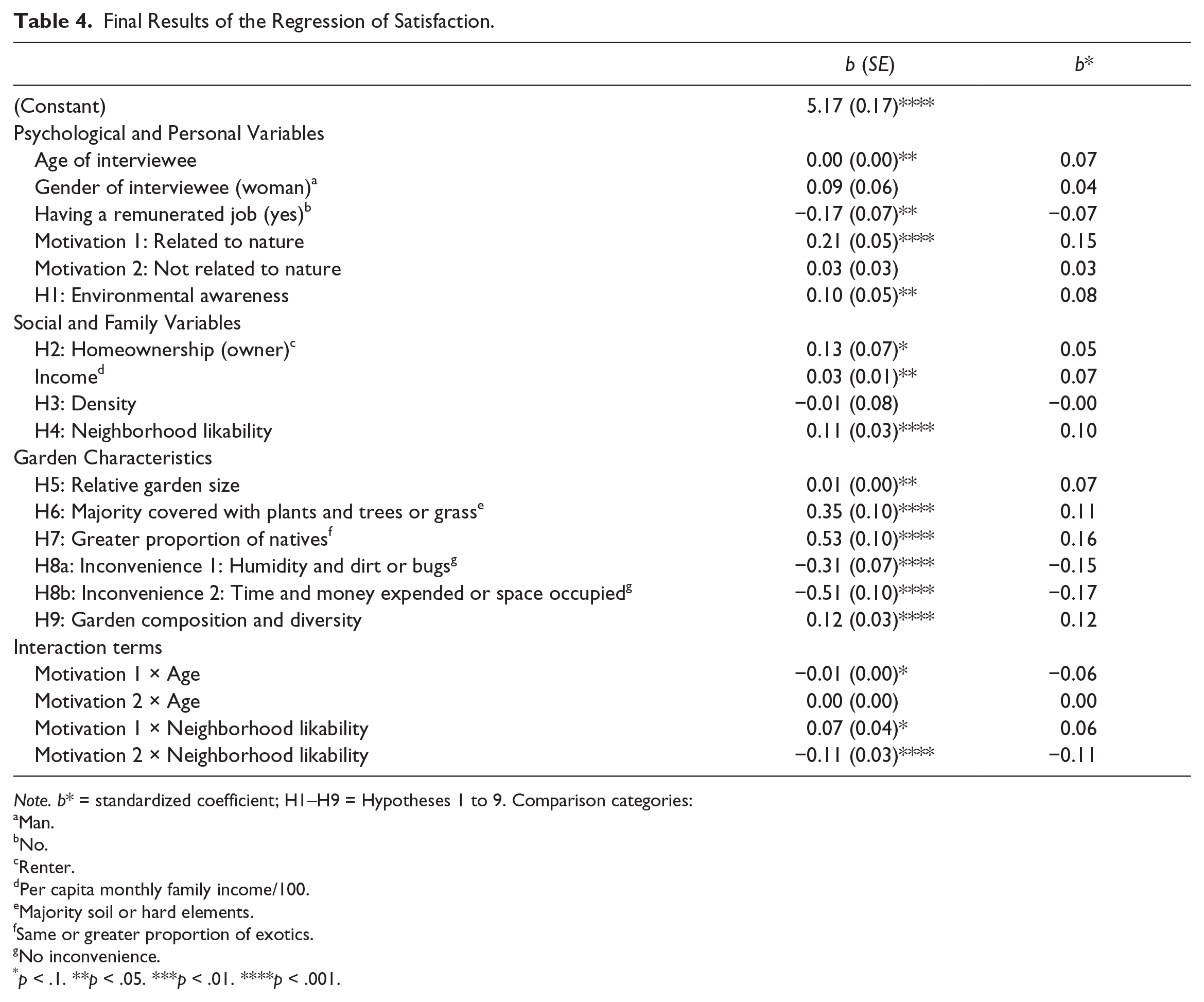
In Stage 1, the psychological and personal variables generated an R2 of 0.108. In Stage 2, the addition of the social and family variables induced a significant change in R2 of 0.025. In Stage 3, we added the garden characteristics into the model, and there was a significant change in R2 of 0.097. Finally, the interaction terms were added to the model, which also brought about a significant change in R2 of 0.012. This final model was significantly better than the intercept-only model: F(20,984) = 15.68, p < .001. The final value of R2 was 0.242; that is, the variables and interaction terms in the final model were able to explain 24.2% of the variance in satisfaction.
The variance inflation factor numbers for all variables were lower than 2, which is less than the reference value of 10 (Cohen et al., 2003). Accordingly, collinearity was not an issue in our model. Furthermore, the Durbin–Watson test value was 2, confirming the independence of the residuals (Durbin & Watson, 1951).
Table 4 presents the results of the hierarchical regression model. Overall, the results supported Hypotheses 1, 4, 5, 6, 7, 8, and 9. However, Hypothesis 3 was not supported, and the results for Hypothesis 2 were marginally significant. Interestingly, the strongest positive predictors of garden satisfaction (based on standardized βs) were garden composition with a majority of native or traditional plants and nature-related motivations. On the other hand, an emphasis on inconveniences related either to consumed resources or the presence of humidity, dirt, and bugs demonstrated the most important negative correlations with satisfaction.
Final Results of the Regression of Satisfaction.
Note. b* = standardized coefficient; H1–H9 = Hypotheses 1 to 9. Comparison categories:
Man.
No.
Renter.
Per capita monthly family income/100.
Majority soil or hard elements.
Same or greater proportion of exotics.
No inconvenience.
p < .1. **p < .05. ***p < .01. ****p < .001.
Regarding the interactions entered into the model, the interaction of Motivation 2 with age was not significant. The interactions of Motivation 1 with age and with neighborhood likability were marginally significant, the first being negative and the second positive. Interestingly, the interaction of Motivation 2 with neighborhood likability was significant and negative. One way to interpret this significant interaction is that Motivation 2 has a moderating effect on the relationship between neighborhood likability and people’s satisfaction with their gardens, a relationship that decreases as Motivation 2 increases.
Discussion
The psychological and personal variables and garden characteristics explored in this study contributed the most toward explaining the variations in garden satisfaction in our sample. Our results support Diener et al.’s (1999) general conception that individual satisfaction is determined by both internal and external factors. At a multivariate level, the most important positive predictors of garden satisfaction include nature-related motivation for garden use and a majority presence of native plants. The most important negative predictors include disadvantages related to the resources consumed by gardens and the presence of humidity, dirt, and bugs.
We also found a positive correlation between environmental awareness and garden satisfaction. However, this causative relationship is not unidirectional; rather, it is more accurately understood as bidirectional. People with high environmental awareness may feel that garden activities suit their philosophy or ideology; consequently, they garner satisfaction from their gardens. However, behavior can also change attitudes (Myers, 2012). Accordingly, if an individual spends time in his or her garden and obtains satisfaction from it, that positive feeling of obtaining benefits may eventually modify his or her individual perspective into one that is more environmentally friendly (Collado & Corraliza, 2015).
Age and income were positively related to satisfaction. However, there was no significant gender-based difference in garden satisfaction, although women were the most involved in garden activities in the majority of households (70%). This gender difference can be attributed to gender roles in Ecuador and in Latin American countries more broadly. Gardens are traditionally considered an extension of the house (Bhatti & Church, 2004; Clayton, 2007); in highly masculine societies such as Ecuador, most household chores are completed by women (Hofstede, 2001). Meanwhile, neighborhood likability was positively associated with garden satisfaction, reflecting the positive association that usually exists between satisfaction in different domains (van Praag & Ferrer-i-Carbonell, 2004). Interestingly, household density held surprisingly little importance in this study.
All predictor variables related to garden characteristics showed a significant association with individuals’ satisfaction with their gardens. These results demonstrate the weight that external factors bear for individual satisfaction (Diener et al., 1999). Thus, an individual’s satisfaction with his or her garden is positively associated with various characteristics, such as the relative size of the garden, the majority presence of native plants, and the diversity of plants in the garden’s composition. In contrast, satisfaction is negatively associated with the perception of important drawbacks related to the garden. By identifying this association between garden inconveniences and satisfaction, the present study demonstrates a relationship that has been discussed little in the literature (e.g., Kaplan & Kaplan, 1989).
Despite the value of these findings, this study has its limitations. One important issue is the generalizability of the Quito-based results to other regions and countries. The psychological and personal variables have high generalization potential. Nonetheless, differences in the influence of garden characteristics on satisfaction could occur in other contexts. In particular, the importance of vegetation cover could vary; for example, studies in desert regions have revealed different preferences (Kennedy & Zube, 1991; Larsen & Harlan, 2006). Another limitation of the present study is the number of variables incorporated into the model, which increases the probability of a type I error (rejecting a true null hypothesis; Cohen et al., 2003).
Furthermore, the focus of this study was limited to individuals in houses with gardens who undertook activities in their gardens. On average, 1.8 people per household participated in these activities. We believe that the future of private urban green spaces depends on an understanding of what factors determine this group’s satisfaction (or dissatisfaction). However, as the average urban family household size in Quito is 3.8 members (INEC, 2013), a significant portion of each family does not participate in garden maintenance or other activities. Accordingly, future studies should focus on other household members to explain this lack of interest and its influence on garden-related decisions.
How public and private green spaces replace or complement one another remains unclear (Irvine et al., 2010). Future studies should examine this subject based on our study’s results. For example, garden owners who are highly motivated by nature-related reasons to use their gardens and are consequently more satisfied might visit fewer public parks and green communal spaces than less satisfied garden owners. Further analysis of this relationship could produce beneficial findings for urban green space initiatives. For instance, such studies could help determine the target audience for public parks.
In the for-profit sector, producers and sellers of garden-related products and services should consider applying our findings in consumer behavior studies. Such studies could measure the effect of owners’ satisfaction with their gardens on their total expenses and purchases related to gardening. They could also explore the effect of satisfaction on the consumption of specific categories of goods and services, such as plants, fertilizers, and gardening services. This consumer information would be highly valuable to the market.
Landscape designers should both apply and exploit the knowledge that a garden’s relative size and plant variability influence owners’ satisfaction. Although the inclusion of exotic plants with unusual beauty may produce stronger curb appeal (Ignatieva, 2010), native and traditional plants promote greater satisfaction over time. This long-term advantage for homeowners could lead to more satisfied customers and more referrals.
Likewise, public and nonprofit organizations should carefully consider the inconveniences associated with gardening. In this study, the perception of inconveniences negatively affected garden satisfaction. In particular, money, time, and space investments, and the presence of humidity, dirt, and bugs, had the greatest negative impact on garden satisfaction (based on standardized βs). As noted, unsatisfied people will strive to change unsatisfactory situations (van Praag & Ferrer-i-Carbonell, 2004). In this case, change could mean a reduction in or complete elimination of the green area of one’s garden. Accordingly, green space initiatives should address the variables that cause dissatisfaction among garden owners. For instance, policymakers should seek to minimize the negative effects of these inconveniences. To do so, the public and private nonprofit sectors could conduct educational campaigns on mitigating insect- and humidity-related issues, cultivation techniques, irrigation methods, and plant selection to help owners reduce the time, effort, and resource input necessary for garden care.
Footnotes
Declaration of Conflicting Interests
The author(s) declared no potential conflicts of interest with respect to the research, authorship, and/or publication of this article.
Funding
The author(s) disclosed receipt of the following financial support for the research, authorship, and/or publication of this article: This study was financially supported by the Universidad Tecnológica Indoamérica.
