




Abstract
Quality of Life (QoL) is a multidimensional concept and covers urban life in all its parts. Nowadays the quality of urban life focuses mainly on the urban environment. There is increasing evidence that green areas significantly contribute to quality of life. Social, economic, cultural, ecological, physical, and psychological health benefits are many positive impacts of green areas on quality of life. Especially green areas in the residence immediate environment have an important role in improving the quality of life. For this reason, urban green areas are accepted as one of the basic indicators of urban quality of life. In this paper, residents’ perceptions of quality of life in green areas are examined via data from a survey in Selçuklu District (Konya, Turkey). Using face-to-face interviews, 415 residents were interviewed in Selçuklu District from January to March 2020. Also, this study evaluates the contributions of the urban green areas to the quality of life in Selçuklu District. Analysis of how green spaces enhance the quality of life has been examined from the residence immediate environment perspective. Results show that residents with green areas in the residence immediate environment that are accessible and usable are more satisfied with their residence. From the findings, strategies have been established to potentiate the role of urban green areas in the promotion of the urban quality of life and sustainability for Selçuklu District.
Plain Language Summary
Individuals settle in specific regions of town according to their social, economic, and cultural characteristics. Characteristics of housing and its close environment are the most basic factors which determine the choice of residence. Education, health, culture, social, sport, religious, and commercial facilities, and green areas are social equips located around housing. The level of meeting residents’ needs has an impact on their satisfaction, and the level of satisfaction has an impact on their life quality. In this sense, green areas have an important place in determining and increasing urban life quality. The quantity and quality of green areas and the way they satisfy the needs of users show urban life quality. Few studies have investigated green areas and quality of life within the green area satisfaction framework with different indicators. Research on urban green areas and quality of life has steadily expanded beyond green spaces’ benefits, and researchers have been studying how various aspects of quality of life are affected by exposure to green areas. To meet life satisfaction and to improve the quality of life, the existence of urban green areas is important for most of the population living in cities. In this study, it is aimed to measure which aspects of green areas in residence immediate environment affect the overall quality of life and the extent of this affect. The application of the sample space was performed in Selçuklu District of the province of Konya. This study presents a statistical assessment of green area uses and satisfaction levels in Selçuklu District.
Keywords
Introduction
Individuals settle in specific regions of town according to their social, economic, and cultural characteristics. Characteristics of housing and its close environment are the most basic factors which determine the choice of residence. Education, health, culture, social, sport, religious, and commercial facilities, and green areas are social equips located around housing. The level of meeting residents’ needs has an impact on their satisfaction, and the level of satisfaction has an impact on their life quality. In this sense, green areas have an important place in determining and increasing urban life quality. The quantity and quality of green areas and the way they satisfy the needs of users show urban life quality.
In the 21st century, housing has become an instrument for the need for shelter, but it has also gained a function that defines the lifestyle and social status residents belong to or want to belong to. Therefore, the criteria differ for people when determining the residences, they would like to live in (Karakurt Tosun & Fırat, 2012). Settlements’ characteristics, status, prestige, social homogeneity, proximity and accessibility to green areas, topography, landscape, security, and proximity to children’s school are important in choosing a residence (Cernicova-Buca et al., 2023; He et al., 2022; Oğuz, 1994; Taqi et al., 2021; Türkoğlu et al., 2017). There is a growth in the interaction between socioeconomic and ecological factors, which has created an increasing demand for specific housing preferences such as good accessibility and proximity to green areas, water, and other physical attractions (Chrysanthou, 2016). Based on this review of various studies regarding housing preferences, place attachment, and satisfaction with the home and its surroundings, the following list of important characteristics of housing can be made (Skifter Andersen, 2011). Characteristics of home surroundings and location included in various studies are as follows:
The physical environment: The physical character and appearance of buildings, streets and squares, green areas, physical nuisances such as traffic, noise, and pollution, maintenance standards in the area, and access to green spaces and water.
The social environment: Status and social environment, crime and security, social networks and place attachment, lifestyle (Skifter Andersen, 2011).
Local public and private service facilities: Shops, restaurants, social activities, culture and entertainment, institutions, green areas, sports facilities, playgrounds and conditions for children, local social networks, and associations, and so on.
Location and transport: Distances to jobs, education and urban centers, transportation opportunities, and distances to family and friends (Skifter Andersen, 2011).
Environment quality has always been one of the most important components of the quality of life. Numerous factors contribute to the improvement or deterioration of the quality of life from an environmental point of view (Keleş, 2011). During the last few decades, measuring the perceived quality of urban life and residential environments has been one of the areas of inquiry for researches in the field of urbanism (Oktay & Rüstemli, 2010). Characteristics of a residence immediate environment are one of the most important indicators of life quality and the results of life quality studies are directly reflected in the design of the residence immediate environment. Well-designed and organized residence environments increase life quality and direct people to live there. As a result, if the residence immediate environment is well-designed, satisfaction from that environment increases accordingly. Both the physical and social aspects of residence immediate environment should be analyzed in the sense of life quality (Türkoğlu et al., 2007).
Urban green areas generate several perceived benefits toward human health and well-being, including an overall improvement of the quality of life (Giannico et al., 2021). Ambrey and Fleeming (2014) investigated a positive relationship between the percentage of public green space in a resident’s local area and their self-reported life satisfaction. Especially, green areas in the residence immediate environment have an important role on improving the quality of life. Therefore, urban green areas are accepted as one of the basic indicators of the urban quality of life.
Societal benefits supplied by urban green spaces to city dwellers are vital to maintain and increase urban citizens’ quality of life. The quality of life benefits derived from urban green spaces are increasingly central to urban society, thus, understanding visitors’ attitudes and perceptions of urban green spaces is essential for informed urban planning and landscape design (Kothencz et al., 2017). Few studies have investigated green areas and quality of life within the green area satisfaction framework with different indicators. Research on urban green areas and quality of life has steadily expanded beyond green spaces’ benefits, and researchers have been studying how various aspects of quality of life are affected by exposure to green areas. To meet life satisfaction and to improve the quality of life, the existence of urban green areas is important for most of the population living in cities.
Most previous studies on residents’ satisfaction have been conducted on the physical properties of green areas. However, reports on various types and levels of the subjective human senses as impact factors in the evaluation of residents’ satisfaction of green areas are scarce. For an expression of the residents’ satisfaction of green areas, investigating their physical properties only could be insufficient; therefore, it is necessary to take into account of the residents’ satisfaction of green area from different aspects of the human perception of the landscape environment (He et al., 2022). In this study, it is aimed to measure which aspects of green areas in residence immediate environment affect the overall quality of life and the extent of this affect. The application of the sample space was performed in Selçuklu District of the province of Konya. This study presents a statistical assessment of green area uses and satisfaction levels in Selçuklu District.
Review of Literature
Quality of Life (QoL)
Quality of life is a multifaceted concept used by a variety of disciplines and at different spatial levels. The theoretical aspect of quality of life to happiness, life satisfaction, and needs satisfaction approaches (Mohit, 2013). The concept of life quality is a broad notion that is intended to approach and assess life in all its parts. Hence, it is involved in the domain of almost every discipline. Therefore, there is not a single definition of life quality that is agreed upon. Every discipline reveals different definitions concerning their study areas; accordingly, studies are performed to determine and develop life quality (Aklanoğlu & Erdoğan, 2012).
Quality of life is defined as the product of the interplay among social, health, economic, and environmental conditions which affect human and social development. Quality of life provides a conceptual framework, consistent with sustainable human development and determinants of health, for the interdependence of social, health, economic, and environmental conditions in communities (Barreira et al., 2021; Shookner, 1998). Quality of life research aims to answer questions such as whether social development has been achieved or not, whether the current policies are capable of satisfying people’s needs or not, and whether the investments that have been made are worthy or not (Diener & Suh, 1997).
World Health Organization (WHO) defines the quality of life as an individual’s perception of their position in life in the context of the culture and value systems in which they live and are about to live with respect to their goals, expectations, standards, and concerns. It is a broad-ranging concept affected in a complex way by the person’s physical health, psychological state, personal beliefs, social relationships, and their relationship to salient features of their environment (WHO, 1997). Generally, this term reflects the environmental conditions in which people live, or some other features that depend on the people themselves (Azami & Razavian, 2013).
Mohit (2013) listed seven main disciplines (economics-political science, sociology-psychology, health studies, marketing, housing, cities level analysis, and urban analysis, three of which focus on physical environmental, and spatial issues) which were related to the concept of quality of life (Table 1). Quality of life can be seen from two indicators. The area (1) objective indicators, by measuring actual conditions of the built environment, natural environment, and social and economic aspects and (2) subjective indicators, by measuring evaluative statements of what people feel about any living factors (Nasution & Zahrah, 2014). Quality of life researchers use either objective or subjective measurement or a combination of the two, through modeling exercises (Table 1) (Mohit, 2013). Recent research in the quality of life generally focuses on two basic types of methodologies of measurement: (i) subjective: looking to self-reported levels of happiness, pleasure, or fulfilment, generally described under the term subjected well-being and (ii) objective: utilizing quantifiable social or economic indicators to reflect the extent to which human needs are met (Papachristou & Rosas-Casals, 2015).
Disciplines Related to the Quality of Life Studies (Mohit, 2013).

Central to the developing interest in quality of life is research into the relationship between people and their everyday urban environments (Azami & Razavian, 2013). Quality of life studies aim to investigate the causes and effects of the factors that make up the sense of well-being of individuals, to provide information on the social and spatial distribution of satisfaction and dissatisfaction, to establish effective policies, and to follow the spatial effects of these policies. It has been observed that different indicators are used for quality of life measures, especially in different countries and in many academic studies (Hatipoğlu Şahin & Tereci, 2021). The quality of life has many dimensions including family, job, financial situation, age, and health. Those interested in the environment are well aware that different places, each of which has numerous environmental attributes, are also important to the quality of life. As such, a fundamental assumption underlying many approaches in terms of planning and design is that places may be designed to enhance the quality of people’s lives. Most people live in cities and metropolitan areas and therefore, it seems important to examine the relationships between the characteristics of these places and the perceived quality of life of the residents (Marans, 2012).
Quality of Urban Life (QoUL)
Quality of urban life is the part that describes the influential relationship between the built environment and personal life (Taqi et al., 2021). It is possible to define the quality of urban life as the balance of supply and demand of the services needed by the individual living in the city and all conditions. Although this process is complex, it also refers to a series of indicators. In addition to the well-being of the citizens and the variety and quality of services, the standards of the urban spaces must also be considered. In this sense, it is possible to define quality of urban life as a concept that deals with the measurable spatial, social, and physical elements that form the framework of the concept of urban life quality and how city residents perceive these elements (Akpolat et al., 2021).
With the majority of people living in cities it has become increasingly important to examine the relationship between the qualities and characteristics of an urban setting and the perceived satisfaction of its users (MacLean & Salama, 2019). Based on the literature review, it can be deduced that seven main dimensions contribute to realizing the urban quality of life (Figure 1). These dimensions are interrelated and dependent on each other (Serag El Din et al., 2013). The physical quality of housing and the resident immediate environment are among the basic indicators of the quality of life of any given community.

Quality of urban life dimensions (Serag El Din et al., 2013).
It has been revealed in the quality of life studies that the quality of life of the person depends on social environment and physical environment factors. The relationship of the individual with the place and its environment constituted the main point of these researches (Hatipoğlu Şahin & Tereci, 2021). There is a broad consensus on the fact that a high-quality and meets the needs built environment impacts positively on people’s everyday lives (ACE, 2019). There are studies on the type of indicators, measurement scales, and approaches to the quality of urban life. Studies on the quality of urban life at the residential level are more common in the literature because the place perception, evaluation, and satisfaction of people are primarily experienced in their microenvironment. Case studies on the relationship between residential environment and quality of life have gained momentum since the 2000s around the globe. The common trait in these studies is that residential quality of life research should be periodically revisited (Salihoğlu & Türkoğlu, 2019).
Green Areas: As a Quality of Urban Life Indicator
Standard indicators of the quality of life include not only wealth and employment, but also the built environment, physical and mental health, education, recreation and leisure time, and social belonging (Gregory et al., 2009). Regarding only the spatial data of the parameters can be categorized into eight headings: residential, transport, security-safety, environment, socio-cultural, recreational, educational, and health. Among these dimensions, transportation, residential, and environment involved the highest number of parameters. Public transport, accessibility to educational and health facilities, aesthetics of the built environment, safety and security, clean water, air quality, educational facilities, solid waste disposal system, noise pollution, parks, and green areas are the most repeated and concerned parameters in all studies (Çubukçu & Erin, 2016).
Quality of life, as a multidimensional concept, covers different domains of urban life (Kısar Koramaz & Türkoğlu, 2018). The quality of life of people in urban areas is the outcome of people’s interaction between man and their urban environment (Das, 2008). The availability of urban green areas is acknowledged as one of the most important elements of well-being and quality of life in cities (Gerçek & Güven, 2017). Urban green areas, as one of the determinants of urban quality of life, are considered part of the urban spatial system and a crucial public service (Kısar Koramaz & Türkoğlu, 2014). In recent decades, considerable evidence has accumulated suggesting that green areas in the living environment may positively contribute to the overall quality of life of urban residents (Zhang et al., 2017). Marans (2015) has stated that green areas is a subjective phenomenon, everyone has different perception. In recent years, on the other hand, security, peace, health, space quality, ecological features, and open-green areas have come into prominence among the values that increase the life quality in cities. They are constituted as a result of the steady spatial distribution and the relationship between a good-quality living environment, structures on the urban fabric, transportation facilities, and open-green areas (Aklanoğlu & Erdoğan, 2012).
Results of studies have witnessed the emergence of the relationships between the residence immediate environment and quality of urban life as an important topic in the academicians and among local governments. But the relationships between the residence immediate environment and quality of urban life need to scrutinize broad perspective. It is a requirement for more quality of urban life to predict the needs in a place resulting from users’ physical, physiological, psychological, cultural, social, and economic characteristics, and to shape green areas in residence immediate environment according to such needs. The more the functions of the green areas and the user needs overlap, the more users’ perceived quality of urban life will increase.
The role of green areas is also very important in increasing the quality of life of the people especially in urban areas. Open-green areas improved the quality of life of cities and neighborhoods through the city’s amenities and facilities. Apart from that, meeting basic human needs toward urban green areas in the urban landscape environment is significant in order to achieve quality of life and develop the quality of a neighborhood park (Abdul Malek et al., 2010). The urban green areas, due to the functions and the role they have in cities, are fundamental elements, and inductors of quality of life. When they get organized in systems, this value is potentiated and incremented, contributing more efficiently to the quality of life (Aklanoğlu & Erdoğan, 2012). The design of successful green areas depends on understanding the particular needs it will meet (Cowan & Hill, 2005).
Green areas are great importance in urban areas for human life and needs (Demircan & Sezen, 2018). Green areas may improve air quality, absorb pollution, cool temperatures, reduce noise (Dubson et al., 2019), support wildlife and habitats (Rakhshandehroo et al., 2017), infiltrate stormwater, and replenish groundwater (Çelik, 2016), improve physical and psychological health (Lee & Maheswaran, 2010; van den Berg et al., 2015), create, and promote social interactions (Dubson et al., 2019), increase productivity, generate employment opportunities (Kim & Peiser, 2018), moreover, it can provide food (Çelik, 2017).
Urbanization affects the environment negatively leading to air pollution, noise, waste products, the destruction of natural areas for urban development, the degeneration in the quality of urban life, the decrease in urban landscape, and reduced green areas for recreation. However, for urban quality of life, urban green areas are significant as they are important in cities because they enable people to interact with nature and one another. Urban green areas neutralize unfavorable impacts and enable to sustain the urban quality of life since interaction with nature is a basic human need and the availability of urban green areas becomes significant in this context as for the concept of the urban quality of life (Yılmaz et al., 2017). Creating green areas in a city is an effort to embrace the ecological environment and taking it into cities that have been isolated from surrounding flora and fauna due to excess urbanization, therefore, supports the ecological functioning and integrity of cities (Gerçek & Güven, 2017).
Green areas have been proposed to be a determinant for quality of the urban life and well-being through different mechanisms. Studies conducted all around the world have demonstrated the health benefits of green areas in the living environment. According to the World Health Organization, green areas are solutions for urban health. WHO’s report summarizes evidence of health benefits, discusses pathways to health, and evaluates health-relevant indicators of urban green areas. This report summarizes the available evidence of the beneficial effects of urban green areas, such as improved mental health, reduced cardiovascular morbidity and mortality, obesity and risk of type 2 diabetes, and improved pregnancy outcomes (WHO, 2016).
Research on investigating the relationship between urban environments and quality of life has found that people who live near green areas have improved health and increased levels of satisfaction at home, education, work, and with life in general. The purpose of McFarland’s study was to investigate the relationship between the use of green spaces and public gardens in the workplace on mental well-being, overall quality of life, and job satisfaction with consideration of both employees and volunteers. The results of this study indicated the benefits of spending time in green areas, even if this time is small (McFarland, 2017). Kısar Koramaz (2014) examined the relationship between quality of life and green areas, aiming to determine the crucial features of green areas in the context of their contribution to quality of life, and defined these features for different residential areas of Istanbul. This study has demonstrated green area use and subjective evaluations for them, social integration levels and social environment attributes, personal health levels, and health attitudes, and finally quality of life level depending on these issues, in Istanbul’s residential areas.
Cernicova-Buca et al. (2023) have focused on a vignette study of satisfaction with green areas in a Romanian small urban setting that meets the standards of green area availability and accessibility proposed by the World Health Organization. Their study establishes statistically significant correlations between the general satisfaction with life and the distance in meters to the nearest park, between the general satisfaction with life and the distance in time to the nearest park, and between the distance in meters and the time spent in parks and green areas.
The urban green areas are essential for the quality of life of citizens and vital to a high quality of life for all citizens. The green areas of the city, which contributed to the sustainable development of urban areas, have the characteristics of increasing the quality of urban life. In this respect, the relationship between quality of life and urban green is regarded as a positive one and often described as significant. To improve the quality of life through urban green, public and private decision-makers need better information regarding the quantity and quality of urban green available in their city (Van Leeuwen et al., 2005).
The urban green areas (of public, semi-public, or private character) constitute one urban element that, due to their structure and multi-functionality, have an exemplary contribution to the quality of life in several ways. These spaces have different functions in cities, at several levels such as the environmental, ecological, social, economic, cultural, and aesthetic, promoting the image and character of an urban area. They are also elements that, due to their multi-functionality, act as factors of interaction between human activities and the environment, being excellent promoters of quality of life. Urban green areas are local promoters of quality of life (Quintas & Curado, 2009). In addition to the sense of place and community satisfaction, cultural services from urban green spaces can demonstrate more tangible impacts on the neighborhood and built environment (Jennings et al., 2016).
As communities and local governments have become increasingly concerned with the quality of life issues, community indicators have become a widely used tool to measure the quality of life and the progress that is being made toward improving it (Mostafa, 2012). Improving citizens’ quality of life is a stated priority of many local governments. However, efforts to achieve this often focus on socio-economic measures, with limited attention to the contributions of environmental variables such as green areas (Mensah et al., 2016). To improve the quality of life through urban green areas, decision-makers need better information regarding the quantity and quality of urban green areas available in their city (Van Leeuwen et al., 2005).
Material and Method
Study Area
The study area, called Selçuklu District, is located north of Konya (Turkey) with a total area of approximately 2.056 km2 (Figure 2). With more than 8,000 years of history, Selçuklu has many cultural heritage sites and new developing sites. Selçuklu District is the fastest growing and developing district in Konya. The area of urban built-up land in Selçuklu District has expanded over the last 10 years. Rapid urbanization and industrialization are profoundly impacting the district’s environmental quality and quality of life. The district’s population has increased from about 472.436 in 2008 to 690.667 in 2022. Population density is about 332 persons per square km. Selçuklu, the largest district in Konya, has more population than 49 cities in Turkey.

Location of Selçuklu District (Anonymous, 2023).
Within the framework of this study, urban green areas particularly include urban parks and gardens, neighborhood parks, pocket parks, sports areas, street trees, picnic areas, allotments, cemeteries, and playgrounds which are used for recreational and other needs of the residents (Figures 3–5). In Selçuklu District, urbanized and industrialized areas are widespread and green areas exist among the built areas. But there are no forest areas or other natural green areas. Selçuklu residents use the green areas for a very wide range of activities including sports exercises, walking, promenading, sitting, relaxing, riding a bicycle, playing with children, meeting with friends, picnicking, and interacting with green. Green areas in Selçuklu District that are conducive to active and passive recreation are highly valued.

Examples of small parks around residence immediate environment (Çelik, 2023).
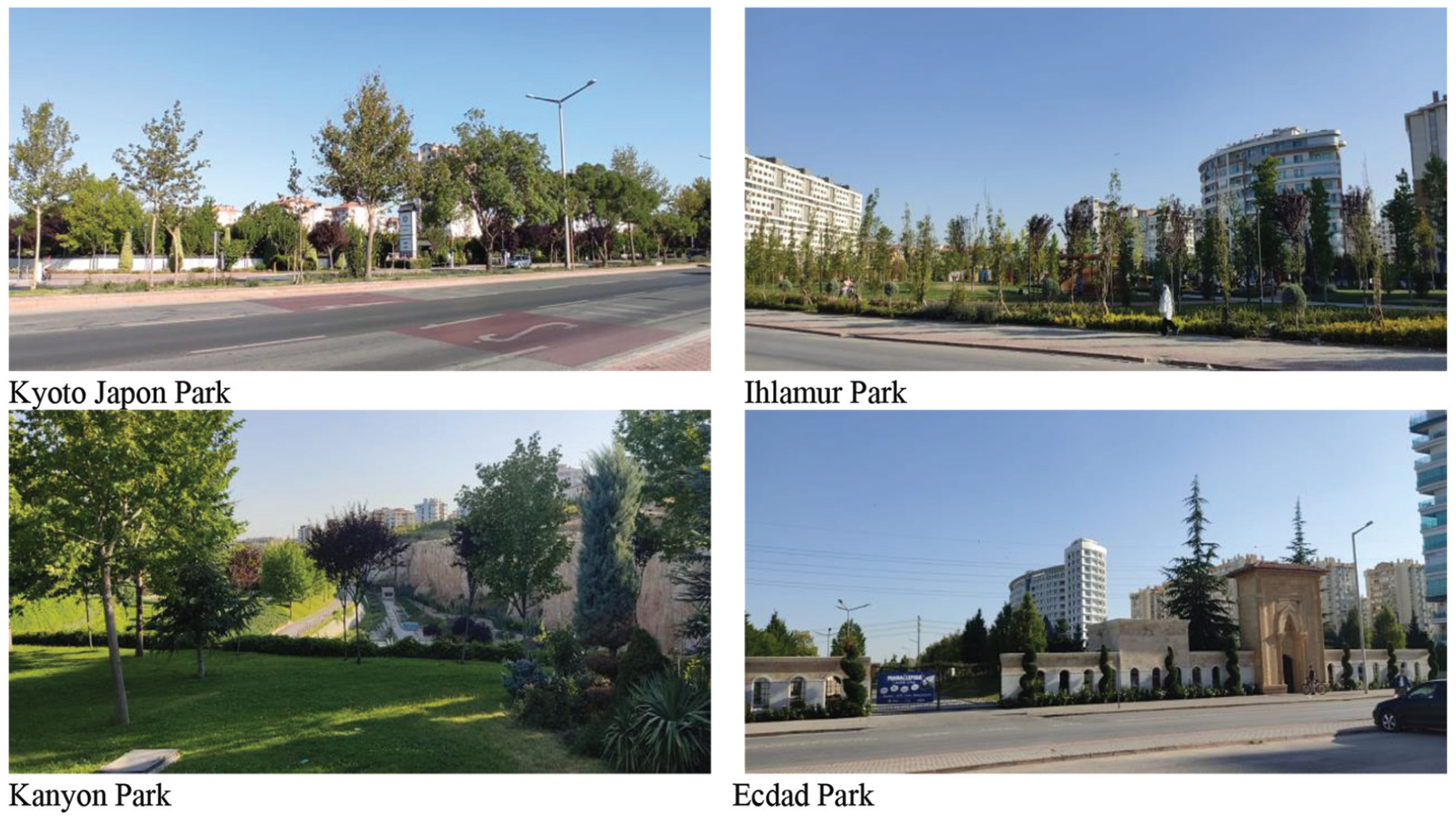
Examples of neighborhood parks around residence immediate environment (Çelik, 2023).

Examples of playgrounds around residence immediate environment (Çelik, 2023).
Research Model
This research, which aims to determine the views of people living in Selçuklu District about their perceptions of quality of life-related to green space use, is a survey model based on quantitative data. Marans’ model hypothesized that the perceptions of environmental and urban amenities will influence peoples’ use of urban amenities and their satisfaction (Marans, 2012). The methodology of this study is guided by Marans’ model which formulates the relationship between green areas in residence immediate environment satisfaction and quality of life. Marans’ model for the residence immediate environment is adjusted for green areas. A “satisfaction-based measurement” has been adopted in this research. Quality of urban life covers places where people live and has both objective and subjective dimensions. Subjective dimensions reflect people’s feelings about objective socio-environmental conditions and people’s behaviors. Measuring subjective dimensions is primarily through survey research with corresponding measures of objective conditions (Marans, 2015). Stakeholders in a city (developer, designer, user, etc.) may assess the quality of a place in different ways as they do not have the same requirements of or attitudes toward the built environment and do not all attach the same value to the various features that characterize a quality place (ACE, 2019).
The measurement approach used in this study is based on the satisfaction model with the help of objective and subjective indicators. The research model explains the formation of quality of life in the framework of the interplay between green areas and residence immediate environment (Figure 6). While everyone may give a greater or lesser value to the needs, all of them should be considered when assessing the quality of urban life. Quality of life is a result of the interaction between three components: needs, requests, and satisfaction. Satisfaction from life is affected by satisfaction levels from meeting the needs and requests in the residence immediate environment. The role of green areas is also very important in increasing the quality of life of the people especially in urban areas. The quality indicators of life used in this work were focused mainly on the role that the green areas in residence immediate environment have in the quality of life, being selected only the indicators that are directly associated with the presence of these areas.

Research model (adapted from Marans’ model) (Marans, 2015).
Sample and Sampling
In this study, the specific hypothesis underpinning this research is how Selçuklu residents perceive the contributions of urban green spaces to quality of life. The data used in this study are based on a questionnaire study held in Selçuklu District. The sample size of the survey used in data gathering was calculated according to the formula below (Creswell & Creswell, 2022; Montello & Sutton, 2012).

Z = Confidence coefficient (z-score = 1.96 for 95% confidence level)
N = Population size
p = Proportion of the sample in the population (values p and q were taken equal and 0.5)
q = 1 − p = 0.5
D = Sampling error (10%)
n = Sample size
The formula applied to the population of Selçuklu District (the population in 2020 is 663.280) resulted in a sample size of 384. The questionnaire was implemented from January to March of 2020; with the method of face-to-face meeting that was conducted with 415 people. Within the survey study, questionnaires were given to residents living in residential areas within different neighborhoods in Selçuklu District. The survey was applied to adults over 18 years of age who were selected according to the basis of random sampling. The COVID-19 pandemic was not expected when the survey started. However, the constraints did not negatively affect this study at the beginning of the COVID-19 pandemic.
Measurement Tools and Data Collection
The questionnaire covers issues of Quality of Life in Selçuklu District, with a specific focus on green areas and residence immediate environment. The questionnaire consisted of 24 questions, which were divided into three different sections. The first section was about respondents’ demographic characteristics while the second section collected information on their overall quality of life. The respondents were asked about their satisfaction with housing and green areas in residence immediate environment (subjective perception and objective indicators) in the third section. In this study, defining the quality of life is based on the satisfaction of preferences. Data obtained were subjected to analysis using SPSS. Green areas users’ responses to survey questions helped create a series of variables to be used in the subsequent regression analysis as described below. Frequency, percentage, correlation analysis, and t-test were applied according to independent variables; thus, differences and significance levels were determined. Cronbach alpha value was found for reliability analysis. Since Cronbach alpha was found reliable, gender, income level, and number of children are among the independent variables included in the evaluation.
Analysis and Results
The analysis and the results are presented in different sections below starting from the sociodemographic characteristics and overall quality of life to satisfaction from residence immediate environment.
Sociodemographic characteristics included gender, age, education level, marital status, number of children, income level, and occupation. Considering population distribution, females and males were well represented; the distribution of female-male is 50.4% to 49.6%. Of all 415 people who make up the sample size, 209 of them are females, and 206 males. In the sample group, 104 people are in the 18 to 25 age group, 81 people are in the 26 to 35 age group, 93 people are in the 36 to 45 age group, 49 people are in the 46 to 55 age group, 52 people are in 56 and 65, and 36 people are in the 66 years-and-above age group, which is the least represented. As for the education level of the sample, 43.4% of the participants are university graduates, 14.9% are undergraduates, 19.3% are high-school graduates, and 8.2% are postgraduates. In the sense of marital status, 46.7% are single, 44.8% are married, and 8.4% are widows or divorced. There is a parallelism between the number of single people (194 people) and the number of people who have no children (225 people). Income level of participants; 112 people earn between 1,500 and 2,500 TL, 130 people earn between 2,501 and 3,500 TL, 89 people earn between 3,501 and 4,500 TL, 54 people earn between 4,501 and 5,500 TL, and 30 people earn between 5,501 TL and above. 62.2% have a job, and of those who are working, 28.3% are working at public institutes, 58.5% are working at a private sector, and 13.2% run their own business (Table 2).
Demographic Characteristics of the Respondents.

The overall quality of life components included housing, living location (Selçuklu District), education, job, economic situation, living standards, health, personal evolution, social and cultural life, family life, relations of family, friends, and neighbor, and overall life as a whole. Participants were asked to evaluate general life quality within the scope of the study and their answers were evaluated over a 5-point Likert type scale ranging from “1—I am not satisfied at all” to “5—I am satisfied.” Cronbach’s alpha is 0.857 and general life quality is 3.91 for the whole of the sample (Table 3). This result puts forward the satisfaction of participants from life quality in the perception of the overall quality of life components.
Overall Quality of Life Satisfaction Level.

The satisfaction level of participants with social services such as access to education, health services, transportation, cleaning, security, green areas, and so on is 3.70. Participants were asked to mark more than one choice to determine factors effective in living and choosing residence in Selçuklu. In this sense, 1076 answers were taken from 415 people. When we analyze reasons that have an impact on living and choosing residence in Selçuklu, the most common reason is “security, serenity, clean environment” with a rate of 24.3% which is followed by “having a place to spend time around residence immediate environment” with the rate of 19.3%, “having a private garden” with 15.6%, “having more green areas compared to other districts” with 13.5%, “having green area around residence immediate environment” (Figure 4) with 12%, “having children playground around residence immediate environment” with 8.2%, and “having landscape around residence immediate environment” with 7.1% (Table 4).
Factors for Living and Having Residence in Selçuklu District.

The participants were asked to evaluate the existence of green area around residence immediate environment and the effect of scenery within the scope of the study. The answers were evaluated over a 3-point Likert type scale ranging from “1—makes me dissatisfied, 2—makes me partly satisfied, 3—makes me satisfied,” and “1—has negative effect, 2—has no effect at all, 3—has positive effect.” Cronbach’s alpha is 0.745 for the existence of green area around residence immediate environment, and 0.712 for the scenery of the green area. Having green areas around residence immediate environment makes 84.1% satisfied, 11.6% partly satisfied, and 4.3% give it no importance. Watching green area scenery from the window of residence has a positive impact on 90.8% of participants, has no impact on 6.7%, and has a negative impact on 2.4% of them (Table 5). Satisfaction level and positive impact level of having a green area around the residence immediate environment and seeing green area scenery from the window of residence are parallel to each other.
Existence of Green Area Around Residence Immediate Environment and the Effect of Scenery.

Due to p = .007 < 0.05, there is a positive relation between “income level” and “watching green area scenery through the window of residence.” While income level increases, the positive effect of seeing the green area around residence environment increases as well, the negative effect decreases on the contrary. Participants were asked to evaluate watching green area scenery through the window of residence within the scope of the study and their answers were evaluated over a 3-point Likert type scale ranging from “1—negative, 2—no effect, 3—positive.” Participants who have over 5,501 TL income stated no negative effect. Despite the low economic income level (1,500–2,500 TL and 2,501–3,500 TL), the positive effect of seeing green spaces around the residence is very high (83.9% and 92.3%) (Table 6).
The Relationship Between the Green Areas in Residence Immediate Environment and the Income Level.

Due to p = .008 < 0.05, there is a significant relation between gender and the need to go to green areas. 61.4% consider going to the park as a need while 23.4% regard it as not a need and 15.2% had no statement about this. The level of regarding green areas as a necessity is higher among females (67.9%) compared to males (54.9%). But the level of regarding green areas as a necessity for men is 54.9%, and this result is over 50% (Table 7). It can be said that the need to go to green areas is essential for both females and males.
The Relationship Between the Need to go to Green Areas by Gender.

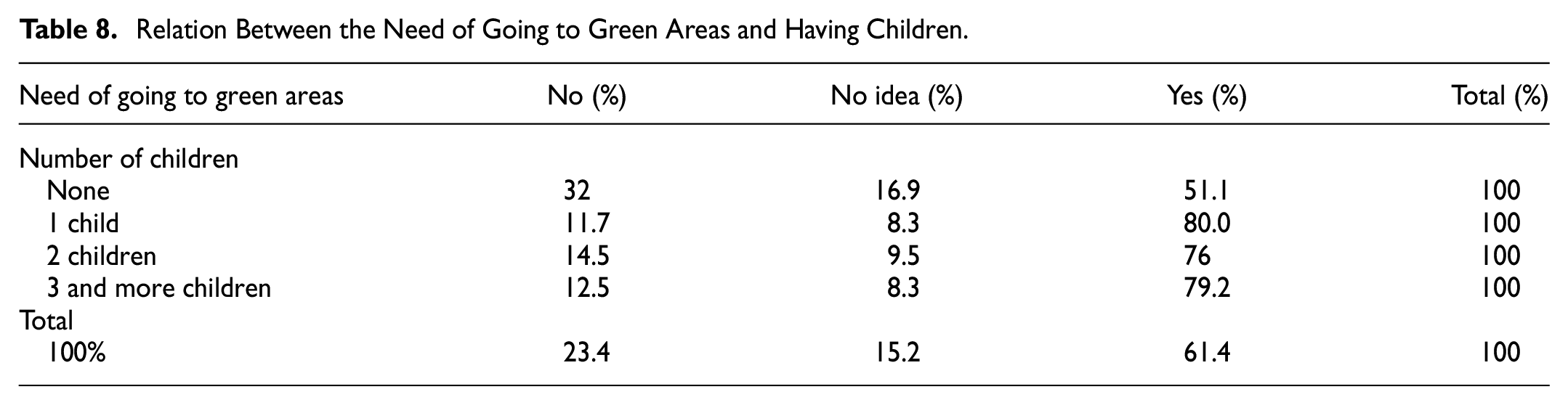
Due to p = .001 < .05, there is a significant relation between having children-number of children, and the need to go to the park. While the need to go to the park is 51.1% for those who do not have children, this rate is even higher for those who have children. 80% of those who have one child, 76% of those who have two children, and 79.2% of those who have three or more children stated that there is a need to go to green areas (Table 8). In this study, it can be concluded that having children increases the use of green areas. The necessity of urban green area for children does not only directly benefit a child’s quality of life, but it has also been shown to the development of the parent–children relationship.
Relation Between the Need of Going to Green Areas and Having Children.
59.1% of the participants stated that they visit green areas 1 to 2 times around residence immediate environment while 41.5% stated they visit green areas outside Selçuklu District. 5.8% of participants said that they visit green areas 4 to 5 times a week or more frequently around residence immediate environment while none of the participants stated that they visit green areas outside Selçuklu District (Table 9).
Frequency of Going to Green Areas.

When the reasons for not going to green areas are analyzed, the most common problem is the unavailability of time with a rate of 30.3%. When it is considered that 62.2% of the participants are working, the problem of time is justified. The second reason is that green areas do not satisfy their expectations (15.9%) and the third reason is that green areas resemble each other and do not provide any difference and motivation (15.2%) (Table 10).
Reasons for not Going to Green Areas,

While the level of satisfaction from green areas around residence is 3.41, the effect of green areas on life quality is 3.78. This result shows that people are satisfied with the green areas around residence immediate environment, and they have important contributions to their life quality. Several studies have examined the links between exposure to green areas and quality of life, with most studies putting forward beneficial effects. Also, for policymakers, knowing the public’s needs and requests about green areas is necessary to improve quality of life.
Cronbach’s alpha value is 0.900 and the average of satisfaction in a 5-point Likert scale is 3.98. Although the participants stated that green areas do not meet their expectations (15.9%) and they resemble one another and provide no difference to them (15.2%), they believe that green areas have positive contributions (Table 11).
Evaluation of Green Areas in Residence Immediate Environment.

Recent studies indicate that green areas are one of the important urban environment elements which give a positive contribution to the quality of life. Green areas have been linked to quality of life in many ways. Green areas remain a testament to how thoughtfully designed parks can enhance the quality of life for generations. Green areas are also the essential constituent element of urban development for quality of life. Green areas provide a healthy life, social relations, personal fulfillment, and happiness. The role and the function of green areas, and meeting the needs are also very important in increasing the quality of life of the people especially in urban areas. Green areas are part of cities where human beings meet belongingness, esteem, and self-actualization needs. Meeting these needs results in satisfaction and satisfaction also improves the quality of life.
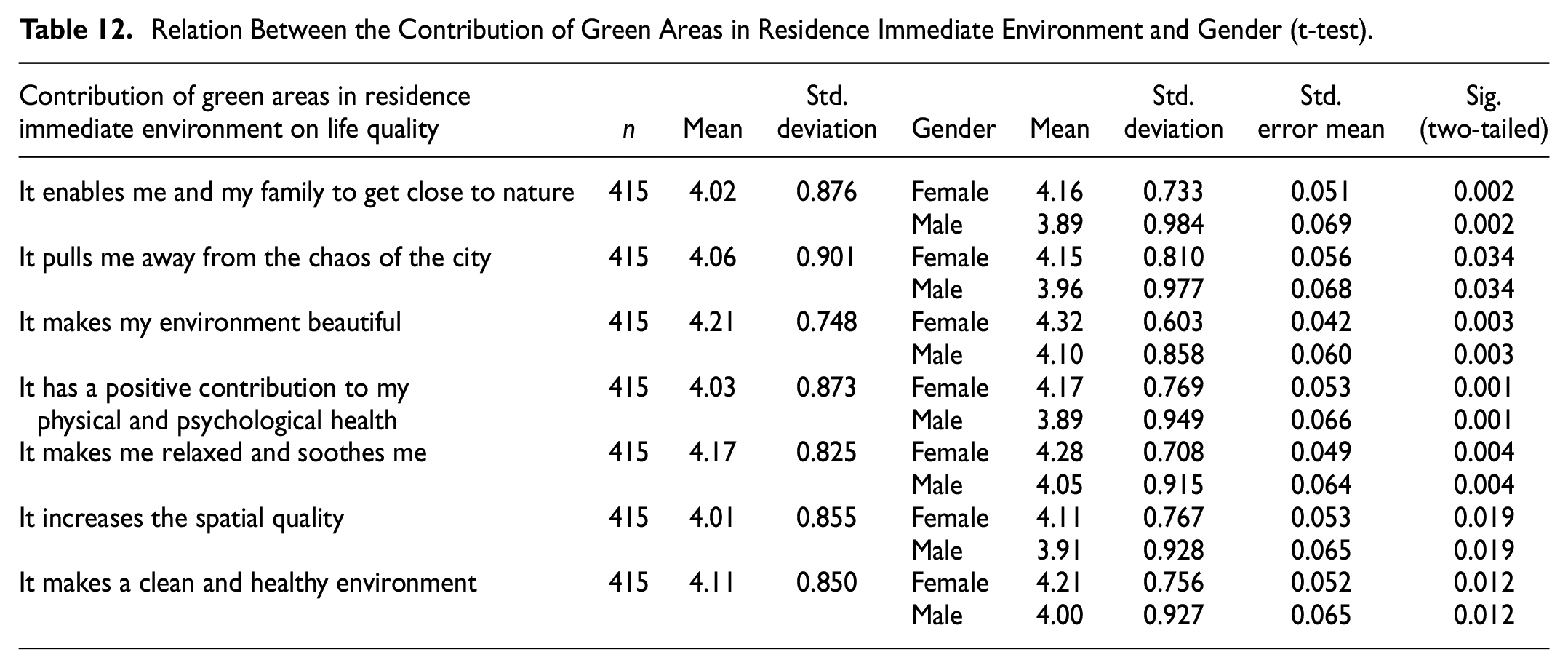
Cronbach’s alpha value is 0.923 and the average of satisfaction in a 5-point Likert scale is 4.08. When the relation between “the impact of green areas around residence immediate environment on life quality” and “gender” is analyzed, due to p < .05 in all statements of the scale, it has been concluded that there is a significant relation with gender. Participation changes according to gender. Participating females in all scales are higher compared to males (Table 12).
Relation Between the Contribution of Green Areas in Residence Immediate Environment and Gender (t-test).
Discussion and Conclusion
In this research, the relationship between using green areas in the residence immediate environment and quality of life has been evaluated. In this study which has been designed by considering different types of indicators in the relationship between green areas in the residence immediate environment and quality of life, overlapping results have been obtained in terms of user perceptions, satisfaction, and subjective and objective indicators. The findings of the survey are supported by the model proposed by Marans in which the interaction between subjective and objective indicators is proposed.
Characteristics such as gender, age, education level, marital status, income status, employment status, and having children are important factors affecting the quality of life of city residents and their choices about where they live. Among the reasons which affect choosing a residence in Selçuklu District, the effect of green areas in the immediate vicinity of the residence is quite high (Table 4). The presence of green space in the immediate vicinity of the residence satisfies 84.1% of the participants, while the presence of a green area affects 90.8% of the participants positively (Table 5). As the income level increases, the positive effect of the presence of green space in the immediate vicinity of the residence is very high (96.7% and 96.7%) (Tablo 6). From a gender perspective, the need to go to green areas is higher for women (67.9%) than for men (54.9%). According to the results of this research, going to green areas is indispensable for both women and men (Table 7). There is a parallelism between having a child and the need to go to green areas, and this rate varies according to the number of children (Table 8). While the rate of not using the green areas in the immediate vicinity of the residence is 17.8%, the highest level of use 1 to 2 times a week is 59.1% (Table 9). “Lack of time” (30.3%) ranks first among the reasons for not using green areas, while “green areas do not meet expectations,”“green areas are similar to each other,”“difficult to access green areas,”“uncomfortable with other users,”“insecure,”“feeling good,”“being crowded,”“insufficient,” and “being neglected” constitute the other reasons (Table 10). According to the subjective evaluations made by the participants, the green areas in the immediate vicinity of the residence beautify the living environment and make it a more aesthetic place and it is seen that it makes it a more qualified, attractive, and valuable, prestigious place and defines the living environment and gives it an identity (Table 11). The green areas in the immediate vicinity of the residence contribute to the quality of life with functions such as “ensuring that the participants and their family members get closer to nature, away from the chaos of the city, beautifying the environment I live in, making a positive contribution to physical and psychological health, relaxing and resting, increasing the spatial quality, and creating a clean and healthy environment” (Table 12). These results support existing evidence that green areas are quality of urban life enhancing for urban residents and users’ needs should be considered when planning and designing green areas.
The results of this research reveal the level of green area usage and satisfaction with green areas in the residence immediate environment throughout Selçuklu District. According to the survey results, the satisfaction of those living in the planned developing district of Konya, Selçuklu with the green areas in residence immediate environment is quite high. This situation also contributes to the satisfaction with the residence and its surroundings. In the example of Selçuklu District, the level of utilization and satisfaction in terms of green areas reveals the importance of creating green areas integrated into the residential neighborhood. The fact that this study is supported by quantitative data will provide important data for Selçuklu Municipality in the planning and design of new urban green areas at the city scale and the residential neighborhood scale.
Quality of urban life has always been the prime concern of local governments, strategic plans, and landscape designs. The results point to the benefits of the existing green environments in Selçuklu District on quality of life. Quality of life is an extremely complex concept that involves the residence immediate environment providing opportunities for humans to meet their needs and desires. The results of this study have important implications for quality of life and green areas policies for the Selçuklu Municipality. Therefore, in the context of Selçuklu District, case studies could be repeated at regular intervals and their results could guide strategic plans. In addition, from this point of view, this study and subsequent revisits are useful resources to guide concerted interventions by planners and designers to improve themselves and their quality of services.
During the time this study was carried out, the first known COVID-19 case in Turkey was announced on March 11, 2020. Shortly after, more than 80 million people in Turkey started to live under some form of restriction, and isolation. During restrictions, the urban open-green areas were one of the most important requirements for people. One type of open-green space that is most easily accessible and usable has been green areas in the residence immediate environment during the COVID-19 period. Thus, the COVID-19 period has shown that green areas in the residence immediate environment need to be improved to provide a better quality of life and healthier living space.
Footnotes
Author contributions
Filiz Çelik contributed to the study research and design. Material preparation, data collection, survey, and analysis were performed by Filiz Çelik. The first draft of the manuscript was written by Filiz Çelik and Emmanuel Babatunde Jaiyeoba commented on previous versions of the manuscript. All authors read and approved the final manuscript.
Declaration of Conflicting Interests
The author(s) declared no potential conflicts of interest with respect to the research, authorship, and/or publication of this article.
Funding
The author(s) received no financial support for the research, authorship, and/or publication of this article.
Ethics Statement
This research was carried out ethical standards.

Data Availability Statement
Data sharing not applicable to this article as no datasets were generated or analyzed during the current study.