




Abstract
The widespread adoption of digital technology have catalyzed a surge in digital governance (DG). This paper aims to conduct a systematic analysis of 4,782 documents retrieved from the WOS database. Employing bibliometric methods, we unveil the landscape of hotspots, evolutionary trajectories, and emerging trends in DG research. Our findings indicate that the focal points of DG encompass corporate governance, digital finance governance, digital government governance, smart city governance, and Internet and digital platform governance. These topics exhibit a structural synergy, and interconnectedness, with data serving as the key. While there exist disparities in research emphasis across the evolution of distinct DG topics, the overarching trend suggests a shift in the field from localized to globalized governance. Moreover, the research perspective is transitioning from application-specific inquiries to the establishment of comprehensive governance systems. This transformation extends from singular, fragmented governance modes to innovative, synergistic models. International Internet governance, global digital governance, digital governance analysis framework, smart transformation of urban governance, and multi-dimensional collaborative governance represent pivotal directions for future research. By examining research status and intrinsic connection of each topic in DG, this endeavor aids researchers to grasp its development situation, rectify research gaps, and furnish invaluable references to advance theoretical inquiry and practical applications within the sphere of DG.
Introduction
The swift, iterative advancement of digital technologies— such as artificial intelligence, big data, and 5G technology—has catalyzed transformative shifts in global society, economy, and politics, spurring the emergence of digital governance (DG). This phenomenon has garnered significant attention from the academic community. The conceptual roots of “digital governance” can be traced back to 1978 when Giovanni, an Italian scholar, introduced the forward-thinking notion of digital administrative law during a meeting convened by the Supreme Court of Italy. At its core was the assertion that electronic documents bear legal weight. Simultaneously, in the United States, the inaugural study on “digital signatures” was published (Rivest, 1978). Early literature often conflated DG with “electronic governance” (e-governance), positing it as an outgrowth of governmental governance in the digital era, with governments, citizens, businesses, and related interest groups constituting its primary stakeholders (Garson, 2006). Subsequently, for the study of DG, the most referenced by scholars is British scholar Dunleavy’s Theory of Governance in the Digital Age. He contends that DG emerges at the confluence of the waning influence of new public management and the rise of the information society. He probed the intricacies of DG through three prisms: the attributes of the information society, the tools of information technology, and the objectives of DG. Over time, with the persistent evolution of digital technology, the concept and scope of DG have assumed deeper and broader dimensions. This study contends that DG entails the strategic deployment of emerging intelligent technologies. Its objective is to empower the governance system and bolster its capacities through digital means. This initiative aims to forge a pioneering governance framework, guided by a collaborative leadership comprising government entities, platforms, enterprises, social organizations, network communities, individual citizens, and a diverse array of stakeholders. Together, they actively engage in shaping the pertinent affairs of institutional arrangements and ongoing processes. Blockchain technology, for instance, furnishes a decentralized approach to data storage and transmission, ensuring both transparency and security in the realm of DG. Big data technology excels in amassing vast quantities of network data (Kushwaha, 2021), affording governments enhanced understanding and analysis capabilities for more effective decision-making. Meanwhile, AI technology finds application in diverse sectors like education, energy, transportation, agriculture, and healthcare, facilitating the realization of smart city governance (Herath & Mittal, 2022). Furthermore, scholarly investigation posits a strategic shift towards forging a digital nation as an important orientation of smart city development (Kar et al., 2019). This paradigm entails a holistic approach, cultivating new technologies from a more macroscopic perspective, thereby galvanizing active engagement from citizens, governments, and a spectrum of organizations. The overarching objective is to propel the establishment of a digital nation through technological innovation, thereby promoting social innovation and sustainable development. However, the journey towards DG is not without its challenges. Issues pertaining to data privacy security, the digital divide, and technological ethics often accompany this transformation, exerting unprecedented influence on technological, societal, and even global dynamics. These challenges underscore the imperative for researchers to delineate focal points and evolutionary trend in the realm of DG, catalog deficiencies in both theoretical frameworks and practical applications, and engage in more extensive inquiry to inform the practice of DG.
Scholars have undertaken a comprehensive discourse and analysis on important topics of DG research. These primarily encompass the content, logic, and pathways of governance. Examining governance content, scholars have investigated DG within governmental contexts (Yao & Fan, 2022), education (Han, 2023; X. Yang, 2022), smart cities (Mora, 2023), corporate settings (Riaz, 2022), platform environments (Janowski et al., 2018), and digital finance (Razzaq & Yang, 2023). In terms of governance logic, researchers have dissected DG based on different theoretical logics. For example, Liu et al. (2019) analyzed the evolution of DG through the lens of systems theory, employing the “environment-network-subject-factor” perspective. Zhang and Ma (2023) developed a DG framework for managing food safety risks based on information ecosystem theory. Luo et al. (2022) utilized digital transformation thinking to enhance national spatial DG based on the “data-digital governance logic-scenario” architecture. In terms of path exploration, scholars have analyzed and proposed measures to enhance DG in various fields, following different paths. These pathways primarily include enhancing the DG capacity of smart city communities (Chen, 2022), implementing DG within industrial clusters (Qi & Liu, 2022), and promoting the digital transformation of library governance (Zhao, 2023). However, the existing summarization and compilation of the subject structure of knowledge in the field of DG remain relatively limited. Most studies currently focus on a superficial description of DG, with few scholars delving into the significance of key research areas, its evolutionary lineage, and the research frontiers through the lens of dynamic historical development. Acknowledging this gap, this study employs bibliometric analysis utilizing the citespace literature visualization tool to comb through 4,782 documents sourced from the Web of Science (WOS) database. By conducting a review of the DG literature while focusing on the three following questions, this paper attempts to enrich this field of study and elucidate new directions for future research.
(1) What are the main hotspots and subject structure of DG?
(2) What is the evolution trend of research hotspots of DG?
(3) What are the research frontiers and emerging trends in DG research?
The paper is structured as follows: In Section “Literature Review,” a comprehensive literature review on DG is undertaken as a prelude to the ensuing bibliometric analysis. Section “Materials and Methods” centers on elucidating the data sources and research methods employed in this study. Following that, Section “Results” embarks on an in-depth analysis of the research hotspots, evolutionary trends, and frontiers within the domain of DG, culminating in the construction of a subject structure. Proceeding to Section “Discussion,” the paper’s contributions are evaluated through a comparative lens with existing studies. Lastly, Section “Research Conclusions and Prospects” encapsulates the paper’s findings and proffers insights into future research perspectives, while discussing the limitations of this study.
Literature Review
Understanding and applying the results of existing research is the cornerstone of conducting academic research (Snyder, 2019), and the literature review, as an important method of collecting and reviewing literature, allows scholars to gain a holistic view of a specific field of study and helps them to find important directions for their research (Baumeister & Leary, 1997; Tranfield et al., 2003). Given this, this paper conducts a literature review on DG to further understand the lineage of knowledge on it, as well as to summarize the shortcomings in existing research. We found that in previous studies, the most frequently discussed is the development of theories related to DG and the practical application of DG, scholars have continuously researched and improved the theoretical system and framework of DG, and have extensively explored a variety of practical scenarios of DG.
DG involves multiple governance subjects, such as governments, enterprises, and the public, and is an organic collection of digital technology and related governance theories, its development and evolution involve multiple theories, mainly involving holistic governance theory, collaborative governance theory, meta-governance theory, and digital governance theory. The holistic governance theory emerged in the 1990s, originating from the concept of “whole government” proposed by Hicks. The key to holistic governance is to fill the governance gaps through coordination and integration to realize holistic benefits. Integral governance needs to connect the four dimensions of the governance system: internal, external, upper, and lower, internal collaboration needs to be strengthened within the organization, external collaboration needs to be explored across organizations and departments, higher levels need to clarify the responsibility assessment and incentive mechanism, and lower levels need to form a clear workflow, and ultimately to break the state of “fragmentation” of governance, so that the government can become a “united, coordinated, horizontal and vertical” governance system. The ultimate goal is to break the fragmentation of governance and make the government a “seamless organization” with unity, collaboration, and horizontal and vertical coordination (Pollitt, 2003). Holistic governance is the formation of effective integration and coordination between government agencies and organizations through adequate communication and cooperation. After the rise of governance theory, collaborative governance theory was introduced into the field of management and gradually developed collaborative management, cooperative governance, network governance, polycentric governance, and other theoretical modes, and collaborative governance theory was gradually innovated from the cross of synergy theory and governance theory. A study found that collaborative governance consists of all stakeholders, such as government, social organizations, and individuals, participating in actions in a collaborative manner, thus achieving a balance of rights responsibilities, and interests among multiple subjects (Yan, 2013). Furthermore, Another study has distilled the essence of collaborative governance into four key components: a diversity of governance subjects, synergies among subsystems, harmonization among self-organized entities, and the establishment of shared rule-making mechanisms (Li, 2014). With the rapid development of the economy and society, social interests have become more diversified and complex, and the governance environment has also become more complicated. Under such circumstances, it is inevitable that “governance failure” will occur. As a result, the meta-governance theory was born, which was proposed by Bob Jessop. He believes that governance itself needs to be governed, namely, the governance of governance, which mainly refers to the coordination of sectoral governance, market governance, and network governance, so that they can be effectively combined to achieve better governance (Jessop, 1998). The meta-governance theory, on the other hand, emphasizes the selection of a subject to act as a “meta-governor” based on the equal roles of all subjects. Because of the government’s power and financial and legal resources, this role should be taken by the government, because it is more capable of playing the role of “meta-governance,” which has also reached a consensus in the academic community. The above three theories have laid a good foundation for the development of digital governance theory. With the arrival of the digital era, the theory of DG came into being, so it is also known as the “theory of governance in the digital era,” which was put forward by the British scholar Dunleavy. He believes that governance in the digital age refers to a series of new concepts and modernization transformations that have changed the way public services used to be organized and supplied on a commercial basis (Dunleavy, 2006). Margetts and Dunleavy (2013) analyze the emerging trends in DG, suggesting that “Intelligent Centre” and “Devolved Delivery” have become new trends.
DG has a wide range of applications and many application practices in many fields, and the hotspots of its discussion are constantly changing and deepening. As shown in the following literature review (see Table 1), many scholars have explored DG a great deal, from which we can learn some contributions and shortcomings in the previous research on DG. We found that many scholars have reviewed the research on DG applications using different research methods, mainly including DG concepts and hot trends (Kang & Wang, 2018) and specific practices of DG applications, such as digital platform governance (Chen et al., 2022), urban governance (Kloppenburg et al., 2022; Zhou et al., 2020), corporate governance applications (Coskun-Setirek et al., 2023), digital government governance (Cheng & Ding, 2012; Erkut, 2020; Idzi & Gomes, 2022).
A List of Review Studies in the Field of DG.

Upon thorough examination of extant DG review articles, it became evident that while some papers have undertaken bibliometric analyses on specific facets of DG, a comprehensive assessment of the entire field’s knowledge base is conspicuously absent. Hence, this study harnesses the power of CiteSpace scientometric software to furnish an objective and visually intuitive depiction, offering a systematic and comprehensive insight into the research hotspots and emerging trends within the domain of DG.
Materials and Methods
Data Sources
Many databases can be used as data sources for bibliometric analysis, and the more famous ones are WOS (Web of Science), Scopus, Google Scholar, and CNKI (China National Knowledge Infrastructure). In this paper, we select the literature related to DG included in the WOS core database for econometric analysis, and we choose WoS for the following reasons: (1) In general, the WOS stands out as the most frequently employed and highly regarded data source for bibliometric analysis (van Leeuwen, 2006). Its academic standing is notably robust, encompassing approximately 12,000 premier journals worldwide (Corley et al., 2013; Gerbic & Stacey, 2005). (2) Our study involves the analysis of DG research hotspots and their evolution, and WoS provides a set of metadata that is crucial for bibliometric reviews, including titles, author lists, institutions, countries, keywords, abstracts, references, and citation counts (Carvalho et al., 2013). (3) It has been demonstrated that Web of Science and Scopus provide quite similar results (Harzing & Alakangas, 2013), and that considering the existence of duplicates. It may not be necessary to use different databases at the same time (Aparicio et al., 2021). In addition, compared with Scopus, the data format handled by CiteSpace software is based on the WOS data download format (Chen, 2015). Therefore, the WOS database was selected for the literature search.
Next, it is the selection of search terms. In order to make the results of this study more comprehensive and representative, we take the representative terms related to DG into consideration and set the search method as: Topic terms = “digital governance” or “big data governance” or “internet governance” or “artificial intelligence governance” or “intelligent governance”; document category = “Article”; the time period = “2007–2023.” In order to improve the quality of the sample data, we manually excluded non-research literature such as “news reports,” “conference announcements,” “conference reviews,” and literature unrelated to DG (Wang et al., 2018), and finally obtained 4,782 valid documents, which are used as the data source for the bibliometric statistics and visualization analysis in this paper.
Research Methods
Bibliometric analysis refers to a quantitative inquiry into a particular subject (Mayr & Scharnhorst, 2015). This method enables a more profound comprehension of the intellectual and conceptual framework central to any given topic of research (Shafique, 2013). It has the capacity to unveil inherent logical linkages within the literature, elucidating the knowledge foundation and trends within this field of study. Consequently, it aids researchers in comprehending the comprehensive landscape of DG development. At present, there are various software that can support bibliometric analysis, among which CiteSpace is a practical software package for literature knowledge mapping and visualization analysis, which was developed by Professor Chen based on Java language and has been widely used in different fields of research and analysis by virtue of its deep theoretical foundation and intuitive mapping output. The software is capable of systematically analyzing the hot trends at the frontier of a certain field of study, exploring its evolution path and knowledge inflection points, and identifying new trends for future development (Chen, 2004; Chen et al., 2012). Therefore, this study utilized CiteSpace as a research tool to perform keyword co-occurrence analysis, clustering analysis, hotspots timeline analysis, and burst detection analysis on its output knowledge graph, in order to sort out the knowledge structure of DG and to grasp the development trend, research frontiers, and hotspots in the field of DG.
Results
Analysis of Research Hotspots
The keywords in the paper provide a highly condensed and concise summary of the main ideas and central themes of the essay. Through the utilization of CiteSpace software and employing the “keyword” option, a network map of research hotspots on DG was generated (see Figure 1). The data presented in the Figure 1 indicates that the map consists of 289 nodes connected by 1,011 links, yielding a network density of 0.0243.

A network map of research hotspots on DG.
According to the results of quantitative statistics, the top 10 hot keywords of word frequency are “big data, governance, internet, artificial intelligence, management, impact, information, technology, innovation, performance.” These keywords characterize the research hotspots in the field of DG. Among them, the keyword with the highest frequency is “big data” and the second is “governance,” which reflects that big data, as an important product and resource in the digital era, plays an irreplaceable role in DG. From the perspective of centrality, “governance” exhibits the highest centrality value, with a centrality of 0.15, and other keywords with centrality greater than 0.1 are “big data, technology, impact, and corporate governance.” This suggests that these nodes play a crucial role in the realm of DG research. Shown in Figure 1, it illustrates that DG research primarily focuses on big data governance and intelligent technology innovation. This research develops collaboratively and systematically across different fields and directions, exploring various aspects such as city governance, corporate governance, digital finance governance, and Internet governance.
Subject Structure Analysis
Cluster analysis amalgamates correlated topics and concepts into broader conceptual clusters, facilitating researchers in comprehending the underlying intellectual frameworks and knowledge architecture within a specific field. To conduct a more thorough and lucid analysis of the subject structure in DG, the CiteSpace software was employed. This entailed employing literature co-citation clustering analysis and keyword co-occurrence clustering analysis to generate a clustering map of document co-citation in DG research (see Figure 2) and a clustering map of keyword co-occurrences in digital DG research (see Figure 3) respectively.
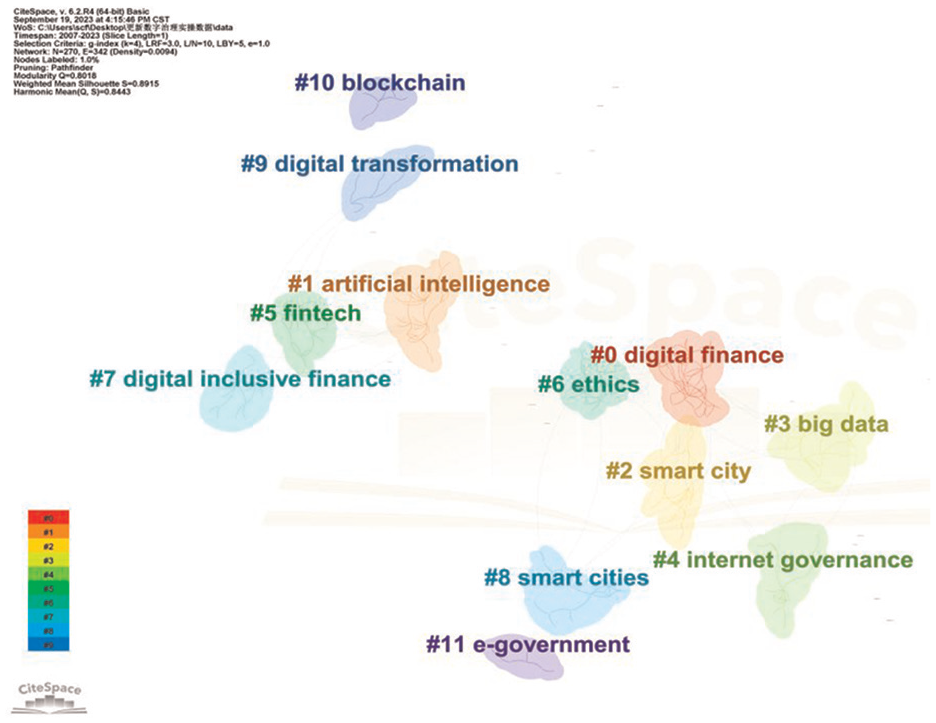
A clustering map of document co-citation in DG research.

A clustering map of keyword co-occurrences in DG research.
A total of 12 clusters are formed in Figures 2 and 5 clusters in Figure 3. Synthesizing the key information in the clusters of the two figures, it is found that DG involves a plurality of fields, and according to the collaborative governance theory and the digital governance theory, the research hotspots on DG can be classified into five subject structures, namely, corporate governance, digital financial governance, digital government governance, smart city governance, and Internet and digital platform governance.
Corporate Governance
This subject clustering mainly focuses on corporate governance and digital transformation. The keywords include corporate governance, management, directors, financial performance, ownership, digital transformation, sustainable development, green innovation, and economic development. In corporate governance, managers use digital technology for data analysis and application practice to optimize the company’s equity structure and improve corporate governance efficiency and managers’ decision-making level. The research on this topic mainly covers three aspects: corporate equity structure governance, enterprise operations and decision-making, and digital transformation and sustainability.
Corporate Equity Structure Governance
Related studies mainly focus on the interaction among corporate ownership, equity structure, and corporate governance. Feng et al. (2020) explores the relationship among corporate governance, equity structure, and capital structure. The study finds that board size, equity concentration, and firm size have positive effects on capital structure, while state ownership and corporate profitability have negative effects on capital structure. This has far-reaching significance for improving corporate governance mechanisms as a way to improve capital structure management. Haque et al. (2011) suggests that corporate governance affects capital structure and plays an important role in corporate financing decisions. Companies can achieve corporate objectives, protect shareholders’ rights, and meet legal compliance requirements through a strong corporate governance structure (Alshbili & Elamer, 2019; Elamer et al, 2020; Granado-Peiro & Lopez-Gracia, 2017).
Enterprise Operations and Decision-Making
Relevant research hotspots focuses on enterprise performance, enterprise digital decision-making, and so on. In the digital era, big data analytics has changed the way companies compete (Müller et al., 2018), which helps to promote organizational knowledge co-creation and thus make efficient and correct corporate decisions, bringing more business benefits to companies (Acharya et al., 2018). In addition, the annual corporate performance of companies with good corporate governance provisions is significantly better than that of companies with poor governance (Bauer et al., 2008), which provides an important direction for the management of corporate operations and the realization of goals in the digital era.
Digital Transformation and Sustainability
Sound corporate governance practices play a pivotal role in fostering sustainable social development (Achim et al., 2023). In recent years, with the pervasive adoption of sustainable development principles within the international community, modern enterprises have increasingly aligned their objectives towards attaining sustainable development. Consequently, the enhancement of corporate sustainable development performance and the pursuit of green innovation have garnered considerable scholarly attention. Enterprises are leveraging Internet platforms and social media to disseminate the principles of sustainable development, thereby bolstering employee awareness and consequently elevating levels of green innovation and sustainable development performance within the organization. Furthermore, an expanding body of scholarship has delved into the myriad factors and methodologies underpinning corporate sustainability performance. Naciti (2019) emphasized that an important influencing factor of corporate sustainability performance lies in the composition of the corporate board of directors. In a complementary effort, Ahi et al. (2018) developed a probabilistic model for appraising corporate sustainability performance, furnishing academia with a direct assessment.
Digital Finance Governance
This subject clustering mainly contains four aspects of digital finance, fintech, digital inclusive finance, and blockchain. The iconic keywords include digital economy, public benefits, financial supervision, financial inclusion, market regulation, supply chains, and technology innovation. Digital financial governance has caused far-reaching impact on the development of modern society, and its research hotspots mainly focus on digital financial services and digital financial risk regulation and innovation.
Digital Financial Services
In the process of DG, digital finance promotes the process of financial productivity with digital knowledge and information as production factors, providing a new source of power for economic prosperity (Ahmad et al., 2021), and the related hot research topics are mainly focused on the research and application of blockchain, financial inclusion, and digital inclusive gold tolerance. Blockchain originated from Satoshi Nakamoto’s Bitcoin, which was first proposed in 2008, and it allows transactions to be conducted in a decentralized manner, so it has been applied more in the field of financial services, and digital cryptocurrency and smart contracts have triggered extensive discussions among scholars. In addition, digital financial inclusion and digital financial inclusion have also become key topics discussed by scholars. Mushtaq and Bruneau (2019) found that financial inclusion has a poverty reduction effect and that better cooperation between ICTs and the financial sector will likely promote digital financial inclusion, thus helping to bridge the gap in financial infrastructure. One study found that digital financial inclusion has a positive impact on reducing the gap between urban and rural disposable income per capita (Yu & Wang, 2021).
Digital Financial Risk Regulation and Innovation
Robust financial regulation is a pivotal prerequisite for the efficacy of DG. Scholars have put forward their own countermeasure suggestions based on the risks that may exist in the process of digital financial digitalization. Prior research found that there is a certain correlation between fintech and digital financial risk management, and should focus on the application of fintech in digital financial risk management (Jing, 2023). In addition, the continuous progress of financial technology also promotes the development and innovation of regulatory methods, and the use of big data, artificial intelligence, and other technologies helps to promote the standardization of financial regulation and improve the efficiency of financial regulation (Treleaven, 2015).
Digital Government Governance
The subject clustering mainly includes e-government and moderating effect. The key topics encompass local community groups, smart government, legal governance, heterogeneity analysis, communication technologies, civic engagement, and developed countries. The pervasive use of Information and Communication Technologies (ICTs) has not only transformed individuals’ daily lives but also revolutionized the way governments interact with people. Digital government, as a deeper form of organizational synergy in DG, seamlessly incorporates Internet communication technologies into governmental structures. This integration is designed to enhance and redefine existing as well as novel information, communication, and transaction-based interactions with various stakeholders such as citizens and businesses. The ultimate goal is to optimize governmental operations and provide high-quality services to the public (Dunleavy et al., 2006). Related research hotspots focuses on smart government and digital democracy.
Smart Government
DG is an important initiative to crack the problem of government governance. In the era of big data, digital government governance and innovation around digital technology is an important topic for the government to enhance the efficiency of DG and build a smart government. Shen and Zhu (2019) introduced the concept and framework of smart government governance, attributing it to the management 2.0 revolution. They argue that smart government governance represents a further evolution of DG in government, underlining its pivotal role in augmenting the city’s governance capacity. This breakthrough transcends the digital foundation, infusing digital government governance with a more comprehensive meaning. Additionally, another study underscores the significance of factors such as clear governance, legal agility, and digital awareness in ensuring the successful implementation of smart government (Guenduez et al., 2018).
Digital Democracy
Digital democracy, also known as citizen participatory governance, embodies a governance paradigm leveraging digital technology and network platforms to facilitate citizen involvement in political decision-making and societal affairs. Within the realm of DG, government digital governance is undergoing a transformative shift from conventional public administration towards a contemporary model of public governance, so government-citizen interaction and the participation of multiple subjects in digital governmental governance have become important topics for scholars to study. Consequently, governments are embarking on innovations in organizational structure, operational protocols, and capabilities. They are mobilizing, deploying, and harnessing human capital, information technology, and financial resources to deliver services to citizens. This drive seeks to foster broad-based participation in governance through informatization, thereby catalyzing a fresh expansion of democratic principles within digital government governance. In recent years, scholars have also extensively discussed the overall impact of e-government on different countries’ political systems and economic conditions (Lindgren et al., 2021; Upadhyay et al., 2022). In developed countries, e-government can promote citizen participation and improve government transparency, but in developing countries, its advantages are questionable and it may even be counterproductive (Adam, 2020; Basyal et al., 2018; Lindgren et al., 2019). For example, the construction of e-government in China and the United States is very different, with the United States mainly emphasizing public participation and e-democracy, while China focuses on the development of security and surveillance systems, digital information tools are often used to track online activities and limit the dissemination of public opinion (Lin, 2018; Qin et al., 2017; Seifert & Chung, 2009), which is closely related to China’s centralized political system.
Smart City Governance
The key clusters covered by this subject mainly include smart city and smart cities. The main keywords include smart cities, governing body, technological innovation, mode innovation, citizen participation, big data analytics, public policy, digital transformation, autonomous systems and environmentality. With the iterative upgrading of Internet technology, accelerating the use of digital technology to promote the digital transformation of urban governance, from a single government-led urban governance to social collaborative governance, and realizing the integrated development of online and offline urban governance has become an objective requirement and historical choice for the development of modern society. Consequently, numerous countries wordwide have embedded intelligent technology into urban governance to form smart governance. Its main research focuses on three aspects: urban governance system, digital application practice, and digital city governance issues and governance innovation.
Urban Governance System
Relevant studies mainly focus on the two aspects of urban governance subjects and the interactive participation of governance subjects. In terms of the role of governance subjects, the urban government is the dominant force in urban governance, and is an irreplaceable organizer and guide, while profit-making organizations, as organizations that provide public products and services in conjunction with the government, are important participants in urban governance. In reality, however, the role of the government should be “planner of urban space, provider of basic public services, balancer of local finances” and “coordinator of the relationship between multiple governance subjects in the city” (Wang, 2006; Zhang, 2013), but on the other hand, it is manifested as “government incompetence.” As another important force participating in urban governance, profit-making organizations usually act as supplements to the public products and services provided by the government in the process of urban governance, and this has resulted in narrow channels for profit-making organizations to participate in urban governance. In addition, in terms of the participation of governance subjects, increasing the degree of public participation and promoting effective interaction between the various behavioral networks in the city are also effective means to achieve urban smart governance. For example, a study found that the use of open innovation processes and communicative information and communication technologies to encourage the participation of residents in local or community governance and decision-making, so as to bring into play the collective wisdom of different stakeholders to realize the co-design and co-innovation of urban public services, and to strive to achieve a healthy and sustainable urban development (Meijer & Bolívar, 2016).
Digital Application Practice
The application of digital technology in urban governance is mainly embodied in two dimensions. Firstly, from the perspective of the comprehensive development dimension of the city, through the intelligent digital system, DG can effectively promote the construction and governance of the digital twin city (Deng et al., 2021), the collaborative governance of the trans-regional urban environment (Qi & Ge, 2022), the construction of resilient cities and climate-smart cities (Pee & Pan, 2022). Secondly, in specific application practices, researchers have elaborated on the operation logic and its advantages in different specific scenarios through data sharing to realize DG, such as urban smart transportation (Ouallane, 2022), digital environmental governance (Hsu et al., 2020), digital management of urban communities (XingShu and ZiXiang, 2022) and e-government (Lindgren et al, 2021; Upadhyay et al, 2022).
Digital Urban Governance Issues and Governance Innovation
With the booming development of digital technology, urban digital governance has undergone a large transformation, and for some fragmentation problems in the governance process, the academic community has actively explored innovation and taken some targeted countermeasures. Zhang et al. (2017) proposed innovative governance models such as multisectoral collaboration, extensive application of big data, and citizen participation for government governance in the context of smart cities. A study proposed that for the emerging mismatch between the scale and execution capabilities of city governments and technology companies, researchers need to conduct multi-scale governance of urban digital infrastructure, and further explore the relationship between urban governance and emerging digital infrastructure (Barns et al., 2017). In addition, from the perspective of multi-stakeholder participation in the construction of smart cities, another study found that the PPP model should be vigorously promoted in the future development of smart cities and the power of private capital should be actively mobilized (Zhang et al., 2018).
Internet and Digital Platform Governance
The clusters involved in this subject mainly include internet governance, artificial intelligence, big data, and ethics. The iconic keywords are social media, platform governance, authoritarianism, data ethics, technology, democracy, general data protection regulation and code-based regulation. As the basic elements of DG, Internet and digital platform governance is an important part of the evolution and development of digital society. Its research focuses mainly on social media governance, Internet platform recommendation algorithm governance, and data ethics.
Social Media Governance
As the easiest way for people to access the digital public sphere, social media platforms have become the focus of Internet control in every country (DeNardis & Hackl, 2015). The extensive development and widespread use of social media have fundamentally transformed the mode of mass communication. However, this new communication paradigm poses challenges to data security, privacy expression, and the authenticity of information dissemination. Concerning data security and privacy expression, ethical issues frequently arise, such as debates surrounding social platform privacy policies, individual privacy rights, and informed consent. For instance, Facebook’s requirement for real names and Google’s YouTube service allowing individuals to use either their real names or pseudonyms have sparked discussions. The implementation of real-name policies conflicts with the values of freedom of expression and identity upheld by these platforms, limiting individuals’ right to self-expression and potentially jeopardizing online safety for certain individuals. Under pressure, Google eventually abolished its real-name policy (York & Kayyali, 2014). Regarding the governance of disinformation on social media platforms, Chen and Ren (2022) conducted an exploration and analysis of the factors contributing to the spread of disinformation on online social platforms. They identified three governance models: technical governance, rule of law, and autonomy. By comparing the advantages and disadvantages of these approaches, the study provided valuable insights and recommendations for governments, social platforms, and other stakeholders.
Internet Platform Recommendation Algorithm Governance
In the operation practice of Internet platform governance, platform enterprises bear the primary responsibility for ensuring the safety of platform content. In response to national policies that emphasize strengthening network content governance, platform enterprises continuously enhance their content auditing and intelligent gatekeeping capabilities. They also adjust and optimize algorithm recommendation mechanisms to promote the dissemination of mainstream values. Regarding algorithmic content auditing, there has been a shift from manual auditing to tool-assisted low-intelligence auditing and progressively to algorithm-led intelligent auditing (Gorwa et al., 2020). Currently, two main content review strategies are employed: pre-moderation and post-moderation. The former allows users to post content that can be displayed to others after machine filtering and then undergoes manual review. This approach is suitable for content with high timeliness requirements. The latter involves machine filtering based on content thresholds for preliminary risk assessment, followed by human review, which is more applicable to current affairs news. This demonstrates that DG requires not only the participation of multiple stakeholders such as government, enterprises, and public social organizations but also the collaboration between the digital technology-led algorithmic content review and human subjectivity. In terms of algorithmic recommendation mechanisms, major platforms primarily adjust content recommendation algorithms and provide preferential treatment to authoritative institutions (Seering et al., 2019). For example, the short-video platform DouYin assigns higher weight to accounts from professional media and governmental institutions. Consequently, their content enters a higher-level traffic pool for recommendation compared to that of ordinary users. As internet platforms continue to advance, the influence of algorithmic recommendation mechanisms on political communication becomes more prominent. Issues such as algorithmic discrimination, algorithmic abuse, and political ethics require ongoing attention from the academic community.
Data Ethics
Data ethics, as the cornerstone supporting the development of the digital economy, provides normative guidance for the operation of the digital economy, and following and standardizing data ethics principles and reasonably applying them in practice have a far-reaching impact on the high-quality development of the digital economy. However, as the data generated by digital platforms and their applications continue to increase, data ethics misconduct and data monopolization have become important topics of concern in the academic and practical worlds. Consequently, many scholars have explored and proposed solutions to these problems. The most common manifestation of data ethics violations is the infringement of personal privacy, including the unauthorized collection of sensitive personal information and the unauthorized sharing of personal data with third parties or for unauthorized purposes. In addition, data ethical misconduct may also manifest itself in the misuse of data, which is highly detrimental to the interests of individuals. For this reason, a prior research proposed to advocate the principle of ethical norms for big data and to adopt measures such as moral indoctrination and public opinion guidance for the governance of ethical deficiencies in network information (Tian, 2018). For the problem of data monopolization in Internet platforms, it is not possible to regulate big data by antitrust laws alone. Therefore, it is necessary to regulate data monopolization (Ohlhausen & Okuliar, 2015).
The outcomes of the aforementioned clustering analysis form the basis for constructing the subject structure of pivotal topics within DGresearch, as illustrated in Figure 4. Notably, Internet and digital platform governance emerge as key drivers, furnishing efficient technical and secure data support for the advancement of various digital domains. This is achieved through the regulation of social media, recommendation algorithmic processes, and addressing issues of data ethics, which forms the cornerstone for the remaining four prominent topics. Additionally, the themes of digital financial governance, corporate governance, smart city governance, and digital government governance exhibit a harmonious interconnection. Concretely, through DG, some digital fintech companies have established a service ecosystem that meets the standards of financial data governance. Standardized digital financial technology provides intelligent financial services for enterprises, governments, and smart city residents, which greatly promotes capital flows within and between enterprises, between government departments and governments, and between smart cities and cities. It improves financial convenience and efficiency and is conducive to the realization of corporate goals and the development of smart cities and digital governments. Standardized corporate governance mechanisms play a pivotal role in bolstering the stability of digital financial governance, thereby fostering the robust growth of the digital financial market. Simultaneously, adopting best practices in corporate governance, including data sharing, stakeholder engagement, and sustainable development, holds equal importance for both smart city governance and digital government. Smart city governance leverages the power of big data technology to capture extensive datasets stemming from both public life and business operations. These data sets are then seamlessly integrated, rigorously analyzed, and widely shared through active public participation. This dynamic process establishes a fertile external environment conducive to enterprise development and the establishment of robust digital government infrastructure. Concurrently, the advancement of smart city infrastructure also propels the growth of urban digital inclusive finance (Xu et al., 2023). Digital government governance is a two-way application of digital information technology to the internal organization of the government and the external environment of the results of integrated governance, which not only involves the main body of the government, but also the citizens’ organizations, business organizations, to achieve the citizens and other social subjects with the help of information technology means to interact with the government, participate in public affairs, better for enterprise development, smart city construction services, but also for digital finance provides a It also provides a convenient regulatory platform for digital finance, which is conducive to strengthening the prevention and control of financial risks. In summary, within the era of big data, data has emerged as a pivotal production factor and a crucial governance resource, constituting the linchpin of the five interconnected domains. Consequently, multi-subject cooperation and multi-domain collaborative governance stand as vital focal points in the exploration of DG.

The subject structure of DG.
Analysis of Timeline
Based on the analysis of research hotspots and subject structure, we employ the timeline analysis method within the CiteSpace software. Figure 5 illustrates the timeline view of research hotspots of DG, generated from the sample data. By referring to Figure 5, various cluster features such as historical length, citation classics, and citation outbursts can be visually observed and identified, allowing for an analysis of the evolution of hotspots in this field (Chen et al, 2010).

The timeline view of research hotspots of DG.
The first path mainly reflects the evolution of corporate governance research hotspots in the context of DG. Initially, research interests centered on enterprise performance management and decision-making, gradually shifting towards the systematic establishment of DG frameworks within enterprises. Since 2007, pivotal research areas have revolved around “agency cost, performance, determinants, decision making.” This underscores the academic community’s emphasis on leveraging DG to mitigate agency costs and enhance business performance. The integration of big data technology for comprehensive analysis, improving digital decision-making processes, furnishing data-driven support for enterprise decision-making, and augmenting the efficacy of corporate governance has been a focal point. Post-2015, with nations accelerating the modernization of their systems in tandem with the broader modernization drive, the micro-level optimization of corporate governance systems and the bolstering of governance capacities have emerged as imperative prerequisites for digital transformation within the purview of the digital economy. Consequently, the structured construction of enterprise digital governance frameworks and governance mechanism systematization stands as a crucial subject for future scholars to study.
The second and fourth paths primarily focus on the evolutionary progression of research concerning smart city governance and digital government governance. These critical subjects exhibit a degree of similarity in their research themes. Studies in these domains have respectively delved into the implementation of information technology-driven practices, public participatory governance, data governance, as well as innovation in smart city and government governance. From 2007 to 2010, research topics prominently featured “information, internet use, technology,” among others. This period witnessed a surge of interest in leveraging information technology to empower urban and governmental development. It marked an era where numerous countries worldwide embarked on ambitious smart city governance initiatives, including endeavors like New York’s PlaNYC, Tokyo’s Smart City Program, and Sydney’s Smart City Program. These initiatives harnessed information technology to enhance urban operational efficiency. Simultaneously, the widespread adoption of information technology in governance facilitated the enhancement of online government services, leading to more effective citizen engagement. This provided avenues for citizens to voice their opinions and participate in meetings and decision-making processes. Consequently, public participatory governance emerged as a significant subject of scholarly investigation. In 2013, the keyword “big data” experienced a notable surge in intensity, reflective of the fervent discussions ignited by the technology’s applications in both academic and practical spheres. Subsequently, data governance within the realms of smart city and digital government construction garnered substantial attention from scholars during this period.
The third path delves into the evolutionary history of Internet and digital platform governance. The pivotal themes in chronological order include Internet governance, digital global governance, social media governance, and challenges and responses in IT governance. From 2007 to 2012, the largest node of the timeline path was “governance,” followed by the node of “internet governance,” underscoring the predominant focus on internet governance in the realm of DG during this period. As globalization continued its relentless march forward and internet technology gained widespread popularity worldwide, research hotspots shifted towards “policy, state, global governance.” Consequently, scholars honed in on governance policy and global governance issues. Additionally, on a macroscopic scale, researchers also delved into the influence of digital communication technology on political communication and regime stability (Zhang & Liang, 2019). After 2013, the explosion of social media platforms such as Twitter and Weibo changed people’s way of information dissemination, and thus social media governance became a important topic of research in this period. DeNardis and Hackl (2015) explored social media governance from an Internet perspective, systematically examining the extent to which Internet platforms promote or restrict rights in the three themes of anonymous speech and individual privacy, the ability to express ideas, and technical affordances of interoperability and permissionless innovation. 2019 onwards, the dilemmas and challenges of Internet governance have attracted a lot of attention, and the related solutions, governance programs, and frameworks have become the key topics (DeNardis et al., 2020), which will be the important direction of the scholars’ continued exploration in the future.
The fourth path centers on the evolution of the digital finance governance hotspots. Subsequent studies have delved into Internet finance, digital financial regulation and governance, as well as the external impacts of digital finance. Between 2007 and 2010, digital finance experienced a surge, with various forms of Internet finance—such as P2P platforms, third-party payments, and crowdfunding—garnering substantial attention from scholars. During this period, Internet finance emerged as a focal point of research. Belleflamme et al. (2014) conducted a comprehensive analysis of crowdfunding platforms, encompassing market development, functional features, and pricing structures. They further formulated a theoretical model for selecting crowdfunding types. However, the rapid expansion of Internet finance also introduced heightened risks, underscoring the significance of digital finance regulation and governance. Within this context, legal regulation emerges as an effective tool for digital finance governance. It serves to enhance government information transparency, bolster the governance framework of digital government, and subsequently elevate the standardization of financial institution management in the digital transformation process. By 2019, scholars had shifted their attention towards the external impacts of digital finance, particularly at the municipal level. This dimension plays a pivotal role in advancing urban innovation and enhancing the degree of urban-rural integration (Hao et al., 2023; Li et al., 2023).
Analysis of Emerging Trends
In a specific field, the research frontier refers to the collection of articles that are actively cited by scientists (Chen, 2006). CiteSpace’s “emergent word detection technology” provides a scientific method for analyzing the research frontier and development trends in a particular field, based on the changes in word frequency trends within articles. Sudden words are terms or keywords that experience a sudden increase in frequency over a short period of time. By examining the frequency changes of these sudden words, one can gain insights into the changes and trends at the forefront of digital research. In this study, we organized keywords with significant frequency changes in chronological order and duration using the emergent word detection technology, resulting in Table 2.
Top18 Keywords with the Strongest Bursts in DG Research.


Examining the findings presented in Table 2, it becomes evident that “framework” exhibits the highest emergence intensity. This underscores the pivotal role of DG architecture in guiding research endeavors within the domain of DG. In addition, there are four other keywords with a burst intensity of more than 20, which are “corporate governance, internet governance, social media, city.” These prominently emergent keywords drive the research frontiers in DG, which are mainly reflected in five aspects: corporate governance, internet and platform governance, e-government, city governance, and digital governance framework. Specifically, since 2007, the words such as “corporate governance, strategy, ownership, and determinants” have emerged with greater intensity and have demonstrated heightened emergence intensity. This observation underscores that early DG research predominantly centered around the governance of corporate structures and the exploration of influential factors. At this stage, enterprises use digital technology to carry out enterprise informatization construction and management information system improvement to realize the governance of corporate ownership structure, information disclosure, and other aspects. Moreover, Khanchel (2007) explored the determinants of corporate governance in the United States. The emergent words such as “internet governance, state, social media” reflect that internet and platform governance is the research frontier at this stage. With the continuous advancement of globalization, Internet governance is no longer a domestic affair of a country but has become an important issue of global governance. Internet governance has become one of the issues at the origin of conflicts in today’s international relations (Mueller, 2010). Therefore, international Internet governance is an important trend in scholars’ research. In addition, social media in the digital era has profoundly changed the international pattern and order of information dissemination, and a new way out of governance can be explored by improving the international governance mechanism, strengthening international cooperation, enhancing users’ media literacy (Dai, 2022). From 2010 to 2016, keywords such as “e-government, politics and communication” have been used, “services” and other keywords reflect that e-government was the research frontier in this stage. DG provides a new paradigm for government service innovation and functional transformation, which is conducive to promoting the planning and legalization of the government’s digital construction, and effectively improves the government’s intelligent decision-making level, public service capacity, corruption prevention level and risk management capacity. With the continuous embedding of digital elements in the practice of urban governance, how to use intelligent technology to realize the refinement, standardization, and long-term effectiveness of urban governance, and to promote the intelligent transformation of urban governance requires further attention. At present, digital technology is being comprehensively integrated into all fields of human economic, political, cultural, social, and ecological civilization construction with new concepts, new forms, and new modes, and along with the dual process of digitization and globalization, multi-dimensional collaborative governance has become an important form of organization (Davidson, 2023). In this context, the global digital governance, and the construction of digital governance analysis frameworks in line with the conditions of each country have become an important direction for scholars’ future research (Jia & Chen, 2022).
Discussion
In conclusion, this paper is structured around the three research questions presented and contributes significantly in two key dimensions. Firstly, employing CiteSpace software, we have methodically standardized and systematized the prominent subjects, evolutionary timeline, and emerging trends within the realm of DG research. This undertaking holds substantial value in advancing the theoretical comprehension of this field. The analysis reveals that hotspots in DG research predominantly revolve around “big data, governance, internet, artificial intelligence, management, impact, information, technology, innovation, performance.” Notably, big data governance emerges as a crucial focal point, aligning with prior research (Shang et al., 2023). The scrutiny of the DG timeline indicates a historical progression characterized by the shift in governance emphasis from local to global, research perspective from specific application practices to the establishment of comprehensive governance systems, and governance mode from fragmented, piecemeal approaches to synergistic and innovative development. In contrast to a previous study (Li et al., 2022), this paper not only delves into the vertical evolution phases of DG but also conducts a comparative examination of the evolutionary trajectories of the five prominent subject horizontally. This provides researchers with a clearer and more comprehensive understanding of the research landscape in DG. Our analysis of emergent terms in DG reveals that international Internet governance, global digital governance, digital governance analysis framework, smart transformation of urban governance, and multi-dimensional collaborative governance represent pivotal directions for future research in DG. The global dimension of DG has garnered considerable attention among scholars and stands as a key area for future exploration, affirming the trends identified in a prior study (Li & Sun, 2022). This discussion provides a more comprehensive response to research questions (2) and (3).
Secondly, through an in-depth analysis of DG research hotspots, this study constructs a comprehensive subject structure encompassing corporate governance, digital government governance, Internet and digital platform governance, digital finance governance, and smart city governance. It illuminates that data forms the nucleus of the interconnected dynamics across these domains, underscoring the critical importance of multi-subject cooperation and multi-domain collaborative governance. This research direction significantly contributes to a more profound, comprehensive, and systematic comprehension of DG in both theory and application. Regarding the exploration of the subject structure of DG, previous studies have delineated subject areas across four dimensions: technological governance, digital governance, grassroots government, and rural revitalization (Li & Wang, 2022). Some have further examined the subject structure of DG through the lens of domestic and international comparisons (Yang et al., 2023; Zhou, 2023). In contrast, this paper consolidates the subject structure of DG from the pertinent theories of DG, thus enhancing the objectivity of research findings and the reliability of conclusions. Consequently, this analysis aids scholars in discerning research focal points and emerging trends within the specific domain of DG applications. This, in turn, offers substantial reference value for academics and practitioners in related fields, facilitating more robust research and implementation of DG. Additionally, this elucidates the research question (1) clearly.
Research Conclusions and Prospects
Major Conclusions
In this study, we utilized the visual analysis tool CiteSpace to analyze 4,782 articles obtained from the Web of Science database. We conducted literature keyword co-occurrence analysis, literature co-citation analysis, hot word clustering analysis, and emergent word detection analysis. Through comprehensive bibliometric assessments encompassing literature characteristics, knowledge mapping, and research history, we conducted a comprehensive examination of DG research. Finally, we present the main research conclusions:
(1) DG research has experienced an outward expansion, placing big data governance and intelligent technology innovation at its core. This expansion has led to the emergence of five pivotal areas of focus: corporate governance, digital finance governance, digital government governance, smart city governance, and Internet and digital platform governance. Rooted in digital governance theory and collaborative governance theory, we have established the subject structure for DG research hotspots. It underscores the importance of multi-subject cooperation and multi-domain collaborative governance, with data serving as the pivotal element facilitating coordination and interaction among these subjects.
(2) The evolutionary process of DG can be examined through two dimensions: specific evolution and comprehensive evolution. In terms of specific evolution, distinct thematic paths exhibit variances in research emphasis; nevertheless, core governing principles such as public participation and data governance remain consistent. However, when viewed through the lens of comprehensive evolution, the trajectory of DG indicates a shift in the field from localized to globalized governance. Moreover, the research perspective is transitioning from application-specific inquiries to the establishment of comprehensive governance systems. This transformation extends from singular, fragmented governance modes to innovative, synergistic models.
(3) The research frontiers in DG primarily centers around five focal points: corporate governance, Internet and platform governance, e-government, city governance, and digital governance framework. Upon closer examination of keyword burst characteristics, it becomes evident that international Internet governance, global digital governance, digital governance analysis framework, smart transformation of urban governance, and multi-dimensional collaborative governance stand as pivotal research directions in the future of DG. These areas warrant further comprehensive exploration and in-depth study.
Future Work and Limitations
Based on the above insights, to acquire a comprehensive understanding of DG, we could enrich the literature by examining the following directives in future research. Firstly, multi-subject cooperation and multi-domain collaborative governance have emerged as the cornerstone for shaping the future DG paradigm. Anchored by the framework and driving principles of a multi-governance community, we assert the imperative of integrating multidisciplinary theories into the realm of DG research. This necessitates a comprehensive and detailed examination, as well as systematic analysis, of the mechanisms governing multidisciplinary co-governance within specific contextual scenarios. Furthermore, empirical investigations rooted in multidisciplinary perspectives promise to yield substantial theoretical insights, thereby enhancing the body of knowledge in DG research.
Secondly, this study reveals that DG covers multiple important topics, reflecting the fragmented nature of research in the field of DG and its close connection with unclear conceptual studies. Therefore, future research should focus on clarifying related concepts and addressing key issues such as DG theoretical paradigms, theoretical boundaries, and theoretical constructs. A cyclical approach that involves theory-to-practice and practice-to-theory interactions should be adopted to continuously enrich and improve the subject structure presented in this paper.
Thirdly, by dissecting emerging trends, we can see the development trends in the field of DG, including corporate governance, Internet and platform governance, e-government, city governance, and digital governance framework. These hotspots spotlight the challenges and pressing issues confronting us in the digital age. Hence, future endeavors should delve into comprehensive examinations of international internet governance, global digital governance, digital governance analysis framework, smart transformation of urban governance, and multi-dimensional collaborative governance. These avenues of inquiry offer novel perspectives and serve as valuable references for DG research.
Although study findings offer multiple theoretical contributions to the domain of DG, any pattern of results should be interpreted according to the possible limitations of the work. To begin, the application of a bibliometric approach in this study affords a broad overview of hotspots and emerging trends in the domain of DG. However, there exists room for a more in-depth analysis of specific topics, especially when compared to other review methodologies such as systematic reviews and meta-analyses. Furthermore, the reliance on a singular database for literature retrieval has constrained the scope of the study. Therefore, forthcoming research endeavors could augment data synthesis by encompassing diverse literature repositories, such as Scopus and CNKI. Moreover, related investigations could undertake comparative analyses across different databases to further enrich the depth of research findings.
Footnotes
Author Contributions
Conceptualization, C.S. and G.J.; methodology, J.Z.; software, C.S.; formal analysis, C.S. and G.J.; data resources and curation, C.S.; writing—original draft preparation, C.S.; writing—review and editing, C.S. and G.J.; visualization, C.S.; supervision, J.Z.; project administration, C.S.; funding acquisition, G.J. All the above authors have read and agreed to the published version of the manuscript.
Declaration of Conflicting Interests
The author(s) declared no potential conflicts of interest with respect to the research, authorship, and/or publication of this article.
Funding
The author(s) disclosed receipt of the following financial support for the research, authorship, and/or publication of this article: This work was supported by the National Social Science Foundation of China (grant No. 23BGL055), the Beijing Municipal Natural Science Foundation of China (grant No. 9222010) and the Humanities and Social Sciences Foundation of Ministry of Education (grant No. 20YJCZH066).

Data Availability Statement
The data will be made available on a reasonable request.