




Abstract
This study aims to promote camping as a healthy leisure culture rather than a passing trend. A literature review, expert interviews, and consultations were conducted to identify key factors influencing campers’ choice of campgrounds. The analytic hierarchy process (AHP) analysis was employed to determine the level of priority of these factors. The results showed that campers value facilities, operating hours, fees, and facility stability when selecting campgrounds. Facilities include camping grounds, shared facilities, and convenience amenities. Operating services encompass human services, reservation systems, and usage hours. Fees comprise price utility, charged services, and payment methods. Facility stability encompasses emergency response, firefighting facilities, and campground hygiene. The AHP analysis revealed that campers prioritize camping grounds and common facilities among facilities and campsite hygiene and firefighting facilities among facility stability. Human services, reservation systems, and reasonable fees were also found to be important. The findings highlight the need for effective facility management, safety measures, appropriate human services, and reasonable fees to encourage camping.
Introduction
Korea is no exception; trekking is a popular sport in the country due to its mountainous terrain and coastal surroundings (Cha et al., 2016). Additionally, there is a growing interest in camping as a nature-friendly activity that allows people to enjoy leisure time and travel safely, away from infectious diseases (Korea Culture & Tourism Institute, 2021; Ministry of Culture, Sports and Tourism, 2021). With camping becoming more established, implementing measures for the sustainable use of campgrounds is crucial, ensuring that camping becomes an integral part of the healthy leisure culture.
In 2017, the camping industry in Korea was valued at KRW 2 trillion, which increased by 19.2%, to KRW 3.1 trillion, in 2019. According to a survey conducted by the Korea Tourism Organization (2020), campers on average spent 1.6 days camping, with the majority (74.4%) using tents. Camping provides an opportunity for individuals to take a break from work and immerse themselves in nature, enjoying the sounds of birds, wind, and waves while bonding with family and friends around the campfire. As an outdoor activity, camping is subject to regulations outlined in various laws in Korea to prevent environmental degradation, such as the Natural Parks Act, Forest Protection Act, Natural Environment Conservation Act, Framework Act on Firefighting Services, and the Waste Control Act. However, camping-related accidents have been on the rise. Safety accidents, including gas leakage, overheating, ignition, sparks, falls, food poisoning, and electrocution during the rainy season and illegal dumping of garbage accounted for 61.9% of reported incidents. These issues also have an adverse impact on local communities (Jeon & Yoo, 2017; Korea Fair Trade Commission, 2020, 2021). In light of this, campers must prioritize understanding and adhering to safety rules, as well as ensuring they have appropriate safety equipment for camping. Above all, enjoying camping legally and in a safe environment is crucial.
Recently, the South Korean government has been exploring various national policies and advocating for legal improvements to enhance the competitiveness of the camping industry. Since 2019, the Office for Government Policy Coordination has been implementing the Living Social Overhead Capital policy, aiming to establish approximately 2,150 campgrounds by 2020 and improve the facilities and environment of existing ones (Office for Government Policy Coordination, 2019). Concurrently, local governments have been working toward developing unique nature trails to attract tourists and stimulate local economies (Jeong & Son, 2020; H. S. Lee et al., 2018). They are also operating campgrounds to cater to more tourists and promote the camping culture (W. J. Kim et al., 2014). Furthermore, the government made improvements to the “campground business” legislation outlined in the Tourism Promotion Act of Korea in August 2015. These changes were aimed at ensuring the safe use of facilities and attracting a larger customer base. Academia has also engaged in diverse discussions on policy improvement measures to enhance camping infrastructure and increase the industry’s competitiveness (Jeon & Yoo, 2017; Y. Y. Kim & Kim, 2015; Nam et al., 2017). However, research examining user expectations and requirements when using campgrounds is lacking. The government and academic efforts should focus on improving camper satisfaction and incorporating the factors that campers consider important. Understanding these crucial factors serves as the foundation for selecting, operating, and managing campgrounds effectively.
The identification and prediction of important factors among customers play a crucial role in informing decision-making, which in turn helps meet customer expectations (J. Lee, 2019). A comprehensive understanding of customer needs is vital for establishing camping as a popular leisure activity in Korea. From an economic perspective, the tourism industry, including camping, has the potential to generate employment opportunities and stimulate local economies (J. Choi & Jeon, 2021; Wong et al., 2021). Additionally, enhancing campgrounds to foster a safe camping culture is important.
Camping is a highly favored leisure activity that offers a unique natural experience, distinct from urban environments. Consequently, the quality of facilities plays a significant role in campers’ choice of campgrounds. This is because campers seek tranquility, relaxation, and the opportunity to immerse themselves in a clean, natural environment surrounded by trees and woodlands (Daniel & Marion, 2006; C.-F. Lee, 2020). Moreover, certain amenities contribute to a more comfortable and enjoyable camping experience in nature, such as electricity, privacy between campsites, shaded areas for protection against strong sunlight, appropriate campsite sizes, and access to portable toilets or showers (Y. H. Choi et al., 2015; Jo, 2017; Sildoja & Eagles, 2003). Furthermore, factors related to safety incidents and safety management are of paramount importance for campers, as incidents such as landslides, flooding, fires, and carbon monoxide poisoning due to improper handling of heating equipment in winter pose risks (Park & Oh, 2013). In addition to safety, the quality of human services, convenience of reservations, and reasonable usage fees are also crucial considerations for campers when selecting campgrounds (Y. H. Choi et al., 2015; Ham et al., 2018; W. S. Lee et al., 2019; K. Lee & Kwon, 2013). To attract and retain customers, understanding their intentions and identifying the factors they deem important when choosing campgrounds are essential aspects. Challenging the prevailing stereotype that camping facilities lack convenience while maximizing the utility value of campgrounds is important.
Previous studies on camping have predominantly employed either qualitative or quantitative methods to understand consumer behavior and provide insights. However, to develop an effective business strategy for the camping industry, employing a research method that integrates both qualitative and quantitative elements is essential. Therefore, this study aims to examine various factors that may influence the camp utilization process, such as usage fees, facility stability, service quality, natural environment, facilities, and accessibility. The study accomplishes this through a comprehensive review of previous studies, in-depth interviews, consultations with experts, and the application of the analytic hierarchy process (AHP) analysis method. The goal is to determine the relative importance and level of priority of these factors and provide strategies and recommendations for improving the operational systems and environments of existing campgrounds, as well as future camps, while facilitating easier access to campgrounds.
Research Aims and Questions
Camping received significant attention during the COVID-19 pandemic, as an alternative that minimizes face-to-face contact while fulfilling the desire for travel. This led to a rapid increase in the demand for camping. Camping offers psychological stability and leisure satisfaction by enabling individuals to enjoy lodging and dining along with performing recreational activities in nature. It became a prominent form of travel, especially during the pandemic (Liu et al., 2024; Lu et al., 2024). However, whether the demand for camping will persist in the post-pandemic era remains uncertain (Gössling et al., 2021; J. H. Kim & Lee, 2021). To establish camping as a stable and sustainable leisure activity rather than a temporary trend, systematically analyzing the factors that enhance and inhibit the intention to continue camping is important. In particular, camping is an outdoor activity set against natural backdrops and has unique characteristics and needs distinct from general accommodations or leisure services. For instance, while tent sites are used as independent spaces privately by users, shared facilities such as showers, cooking areas, and sinks require a separate management approach since they are shared by multiple users. Thus, campgrounds must clearly distinguish private spaces and common facilities, and they must establish a facility management system that considers user convenience and safety. Moreover, as camping inherently involves certain inconveniences compared to general accommodations, identifying the factors that users consider important when selecting campgrounds is necessary.
Accordingly, this study aims to identify the key factors considered important by users in the process of camping. It also seeks to explore strategies for enhancing the competitiveness of campgrounds and developing approaches for their sustainable development. This will help improve the sustainability of the camping industry and provide practical management measures for operating campgrounds. By identifying the factors considered important by users when choosing campgrounds and evaluating their relative importance, the study aims to set strategic directions that may be helpful for operating campgrounds. To this end, the following research questions are established:
Research question 1: What are the key factors that users consider important when selecting campgrounds?
Research question 2: How do users prioritize these key factors in terms of their importance?
Research Background
Korea is a mountainous country where trekking is a popular leisure activity. However, camping was previously considered a pastime exclusively for backpacking enthusiasts. This perception has been changing due to the COVID-19 pandemic and the necessity of social distancing brought about by it. As lifestyles continue to evolve, interest in camping as a nature-friendly leisure activity is growing (Craig & Karabas, 2021; K. S. Kim, 2021). The concept of enjoying a relaxed and romantic time in a secluded place is reflected in newly coined words that represent the camping culture. Examples include Seommeong (leisurely tree-watching in the forest), Bulmeong (gazing blankly at burning firewood), Byeolmeong (appreciating the stars in a peaceful place without lights), Sorimeong (listening to the sound of waves at the beach or the rustling of leaves in the forest), and Moekping (eating and drinking while camping) (Shin, 2021; Sung & Yi, 2021; Yoon, 2023). Consequently, many people find enjoyment in camping to rejuvenate their weary bodies and minds amid the natural landscapes of mountains, fields, rivers, and beaches. However, acknowledging that the current law restricts camping and cooking activities in certain areas is crucial.
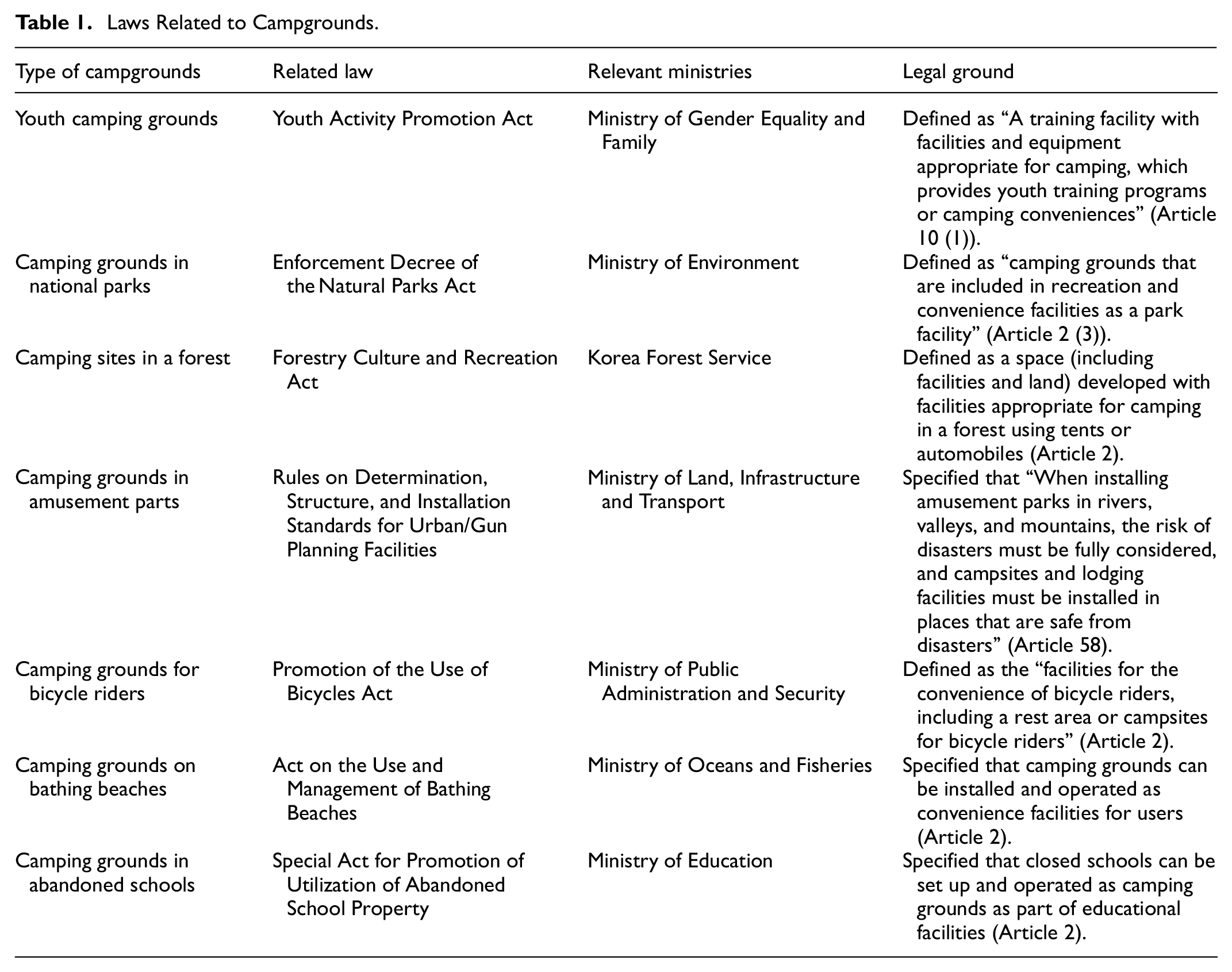
To legally and safely enjoy camping, campers must adhere to various laws, as presented in Table 1. According to the Tourism Promotion Act, “campground business” is defined as “the business of enabling tourists to use campgrounds that offer camping facilities with facilities and amenities suitable for camping.” Camping is prohibited in national parks according to the Natural Parks Act (Articles 27 and 36), and non-compliance may result in an administrative fine of up to 2 million won by the Natural Parks Act. Additionally, ecological landscape conservation areas, including wetlands, protected areas for forest genetic resources, and natural conservation areas such as Baekdudaegan protection areas, are subject to a legal system that manages all areas except for designated shelters or campsites.
Laws Related to Campgrounds.
Campgrounds, operated in accordance with these laws, are categorized as either public or private facilities depending on the operator. Both types are situated in areas of natural beauty near mountains, rivers, valleys, or the sea and offer amenities such as camping decks, restrooms, washrooms, sinks, electric facilities, and garbage collection services. National and public campgrounds are comprehensively managed by the Korea National Park Service through the National Park Reservation system (Korea National Park Reservation Service, 2025) National facilities provide advantages such as breathtaking natural scenery and operate on a larger scale compared to private campgrounds. Go Camping Korea, which is one of the major websites among tourism organizations in Korea, provides information on the 2,974 campgrounds across the country, including “Recommended Campgrounds of the Month,”“Campground Events,”“Camping-related Media Information,”“Campground Safety Rules Videos,” and “Campground Support Projects and Safety Education” (The Korean Tourism Organization, 2025). Recently, various camping trends have emerged in Korea. These include emotional camping, which involves purchasing props and products to enhance the romantic atmosphere; minimal camping, which aims to break away from the equipment-dependent camping culture; camping with sports utility vehicles or trailers, allowing for an enjoyable experience regardless of tent suitability; and camping with pets, promoted by The Korean Tourism Organization (2025).
Methods
Data Collection and Research Procedure
In this study, we aimed to clarify the priorities for selecting and managing campgrounds by consolidating the factors considered important by an expert group when using campgrounds. To achieve this, we ensured logical, objective, valid, and reliable procedures through the following research steps.
Firstly, we analyzed the relevant literature to develop a comprehensive understanding of the service qualities that specifically pertain to Korean campgrounds. The literature analysis in this study encompassed news articles, academic papers, and research reports. Additionally, we formed an expert group to conduct in-depth interviews and consultations to supplement the theoretical foundation on the components of the campgrounds: the environment, operating services, usage fees, and safety. In this study, we reviewed the literature related to the quality of campground services as discussed in previous studies to identify the attributes for selecting campgrounds.
To determine the unique service qualities of camping facilities, we examined studies that focused on the attributes considered by campers when choosing campgrounds (Y. H. Choi et al., 2015; Ham et al., 2018; Jo, 2017; H.-R. Kim & Baek, 2015; W. S. Lee et al., 2019; K. Lee & Kwon, 2013). As depicted in Table 2, the common selection attributes include the natural environment, physical environment, available services, accessibility, and usage fees. Some studies focused on physical elements such as parking and convenience facilities, while others examined human and reservation services as available amenities. Additionally, attributes such as accessibility, comfort, scalability (neighboring attractions and scenery), safety, complaint-handling speed, and proximity to nearby tourist spots were considered (H. Y. Kim et al., 2016).
Analysis of Prior Research Related to Camping Service Quality Improvement to Explore Preliminary Components.

The unique service qualities of camping facilities can be indirectly confirmed through previous studies that analyzed the barriers to leisure and the consumption behavior of campers. In a study by J. H. Kim et al. (2017), which developed a scale for leisure obstacles in camping activities in Korea, factors closely related to the service quality of campgrounds were identified. These factors included regulatory issues related to improper usage rules and fees, safety concerns such as theft and loss, and administrative factors such as facility management, sanitation, and water quality. Furthermore, the service quality of campgrounds can be ascertained through previous studies examining policy elements associated with campground operations. Park and Oh (2013) emphasized the importance of safety management in campgrounds, while H. Kim and Yoon (2019) suggested accessibility and environmental management, staff service, facility environment and services, additional amenities, recreation programs, and the accommodation environment as important criteria for evaluating Korean campgrounds. D. G. Yoo et al. (2021) categorized service qualities into accessibility, facility, responsiveness, interpretability, and safety. Drawing from these previous studies, we classified the components of campgrounds that contribute to fostering a healthy leisure culture into the following categories: facility environment, operational services, usage fees, and safety.
Secondly, we conducted a series of in-depth interviews and consultations with experts from May to September 2021, building upon the findings obtained from the analysis of the previous studies. The panel of experts consisted of nine individuals, comprising three university professors responsible for camping classes, four seasoned campers with over 5 years of experience each, and two campground practitioners. Appointments were scheduled with the selected experts, and the interviews were meticulously recorded.
The in-depth expert interviews were conducted individually, with each session lasting between 30 and 90 min. Two sessions were held to cover the necessary discussions. To address any issues encountered during the analysis and interpretation, as well as to enhance the reliability of the analysis, we also conducted additional interviews via phone or mobile messenger. During the first individual in-depth interview, we posed open-ended questions such as, “What are the most important factors considered when selecting campgrounds?” and “What are the most important factors considered when operating campgrounds?” These questions provided the experts with the freedom to express their opinions. Following the in-depth interviews, we summarized the similarities and differences observed among the experts. In the second individual in-depth interview, we initially inquired about the validity of the four components (facility: environment, operating service, usage fees, and safety) derived from the previous studies. Subsequently, we focused on identifying any additional components that should be considered. After the completion of the interviews, we administered a survey to obtain the experts’ final opinions. The questionnaire was designed to assess the validity of the operational definitions, components, and contents of the campground selection attributes, derived from theoretical considerations and in-depth interview surveys. The questionnaire utilized a five-point Likert scale, accompanied by open-ended questions to allow the experts to provide additional insights.
Thirdly, based on the results obtained from reviewing the previous studies and consulting the experts, we administered a questionnaire to conduct the AHP analysis. The questionnaire survey was conducted between October 10 and November 30, 2021. It included participants who had a minimum of 2 years of camping experience, camping leaders, and individuals involved in the camping industry. The researcher(s) provided a comprehensive explanation of the study’s purpose and procedures to all participants, and only those who expressed a willingness to participate were requested to complete the survey. Specifically, participants were provided with a written or online consent form to sign and sign in person to participate in the study. The consent form outlined the study’s purpose, procedures, and rights, and also mentioned personal information protection. This included the assurance that their personal information and responses would be anonymized and used exclusively for research purposes. These measures were implemented to mitigate any potential risks associated with the study’s design. While there is no financial incentive for participants, the results of this study are anticipated to be of practical use in enhancing the camping industry and related policies. Of the 50 responses received, 36 were considered for the final analysis, while 14 respondents were excluded due to insincere or inconsistent answers. In the AHP analysis, the consistency of sincere responses holds greater significance than the size of the respondent sample. The success of the study is significantly influenced by the selection of experts who possess relevant knowledge and experience aligned with the survey’s purpose (Cho et al., 2003). For instance, in a study conducted by Duleba et al. (2012), they gathered opinions from 41 individuals and a group of experts consisting of three governmental officers and three company managers. The participant demographics are presented in Table 3, and a summary of the study can be found in Figure 1.
Demographic Characteristics of the Survey Participants.


Research procedure.
Data Processing Method
We primarily utilized two methods for our analysis: the intraclass correlation coefficient (ICC) and the AHP. The ICC was employed to assess the reliability and validity of the experts’ consensus on the various components of campground service quality. In general, an ICC of 0.8 or higher is considered highly reliable, while a value of 0.6 or higher indicates relatively high reliability (Landis & Koch, 1977). Our ICC analysis yielded results ranging from 0.979 to 0.846, indicating a high level of consistency and reliability.
The AHP is an evaluation method that involves the hierarchical decomposition of complex problems and the assignment of weights to each item, enabling rational decision-making (Saaty, 1987). The fundamental principle of the AHP involves dividing the elements required for decision-making into upper and lower strata and then conducting pairwise comparisons between them. To ensure consistent responses to the questionnaire, the participants were asked to utilize the self-evaluation method after the pairwise comparison response method, following a thorough explanation of the study’s objectives. Subsequently, we assessed the consistency ratio (CR) to determine the participants’ level of consistency in their answers. The acceptable threshold for the CR was defined as CR ≤ 0.1 (Saaty, 1987, 1995).
In our study, the service quality of campgrounds was categorized into four high-level factors, 12 low-level factors, and 33 components (see Figure 2 and Table 5). Considering the time required for the questionnaire completion and the evaluators’ understanding of the AHP technique, we only administered the questionnaire for the upper and lower factors. We gaged the importance of the 33 components using a 7-point Likert scale. The AHP analysis was conducted using Excel for Windows, while the ICC was verified using SPSS 22.0.

Hierarchy.
AHP Analysis
The AHP analysis is a method developed by Saaty (1987), in which items being evaluated are structured hierarchically and their relative importance is measured to determine priority. The AHP analysis consists of three stages.
The first stage involves developing measurement criteria to assess relative importance. Since the main objective of the AHP analysis is to identify the political implications of the derived areas perceived as relatively important by respondents, establishing details such as the top factors (measurement indicators) and sub-factors (measurement criteria) is crucial. To accomplish this, the current study reviewed the literature, conducted in-depth interviews, and consulted with an expert group to establish the measurement indicators and criteria.
The second stage involves conducting pairwise comparisons to determine the relative importance of the measurement indicators and criteria. A pairwise comparison is a method used to evaluate the importance between items, as presented in Table 4. If the pairwise comparison is performed on a set of n elements, a total of n(n − 1)/2 pairwise comparisons are conducted. In this study, pairwise comparisons were conducted for four top factors, resulting in six pairwise comparisons (4(4 − 1)/2). Each of the four top factors consisted of three sub-factors, resulting in 12 pairwise comparisons ({3(3 − 1)/2} × 4). Therefore, 18 pairwise comparisons were conducted in all.
Example of the Pairwise Comparison.

The third stage involves verifying the consistency of the pairwise comparison matrix and calculating the priority weights for alternatives. Once the pairwise comparisons are completed through surveys, the relative importance between the evaluation criteria needs to be analyzed in the analysis stage. The relative importance (weight, Wi) between A1, A2,…An is determined through the pairwise comparison. For instance, if A1 is three times more important than A2, it is compared using the ratio w1/w2 = 3. The pairwise comparison matrix A, which consists of weight ratios, is a square matrix of size n × n, where n represents the number of evaluation criteria. This matrix A is symmetrical, as shown below.

To ensure significant results from the AHP analysis, respondents must provide consistent responses. Inconsistent responses cannot be utilized as data for analysis. With the Matrix A and column vector w, consisting of w1, w2,…, wn, we can determine the λ value in the equation A·w = λ·w. If A is perfectly consistent, then λ = n. The higher the consistency, the more accurate the value of λmax = n. The degree of inconsistency in the measured data from respondents is assessed through consistency verification. This assessment is represented by the consistency index, which is calculated as (λmax − n)/(n − 1).
Results
The consistency of the higher and lower categories was verified, and the weight of each category was calculated to determine the service qualities prioritized regarding campgrounds. Subsequently, the total weight was derived for both the higher and lower categories.
Consistency Verification
We validated the consistency of the participants’ responses by conducting the AHP analysis. A response is deemed to be completely consistent if the consistency ratio is 0.00, and it is considered to maintain logical consistency if the ratio is 0.1 or lower (Saaty, 1987, 1995).
The consistency ratio for the high-level factors, which were the primary evaluation factors of the analysis results, was 0.006. Regarding the consistency verification of the low-level factors, which were the secondary evaluation factors, the facility environment had a ratio of 0.004, operational services had a ratio of 0.001, facility usage fees had a ratio of 0.004, and facility safety had a ratio of 0.002. When we combined these results, we confirmed that all 36 participants had performed the pairwise comparisons with consistency. Based on these findings, the logical consistency of the responses was secured not only for the main categories but also for the subcategories, confirming a reliable level of analytical results for the data used in this study.
Results of the Primary Selection Factor Importance Analysis
After conducting a pairwise comparison of the high-level factors, ranked in order of importance among the four selection factors, the results were as follows: facility environment (0.373), safety (0.273), usage fees (0.196), and operational services (0.158).
In other words, the facility environment had the highest weight, making it the most important factor, followed by facility safety, facility usage fees, and available services. These findings indicate that the participants considered the facility environment the most important criterion when selecting campgrounds. They also significantly valued the physical conditions and safety of the campground environment, followed by economic factors and service quality as key evaluation factors.
Results of the Secondary Selection Factor Importance Analysis
In the pairwise comparison of the low-level factors for the facility environment, the camping site (0.460) was deemed the most significant. It was followed by common facilities (0.422) and convenience facilities (0.117). Regarding operational services, human services (0.456) ranked the highest, followed by reservation services (0.285) and hours of use (0.259). As for facility usage fees, the order of importance was as follows: price efficacy (0.691), payment services (0.182), and paid services (0.126). Regarding facility safety, sanitation (0.590) ranked the highest, followed by firefighting facilities (0.253) and emergency services (0.157).
These findings indicate that the participants considered camping sites the key factor of the facility environment. Furthermore, they valued the quality of human services provided in available resources while also considering the convenience of reservations and the efficiency of usage hours. They also considered price efficacy the most significant factor under facility usage fees and sanitary conditions as the most critical factor of safety.
Comprehensive Priority Analysis Results
The comprehensive priorities were analyzed, taking into account the results of the importance analysis of the high-level and low-level factors. The results are presented in Table 5 and are as follows: camping site (0.172), sanitation (0.161), common facilities (0.157), price efficacy (0.135), human services (0.072), firefighting facilities (0.069), reservation services (0.045), convenience facilities (0.044), emergency (0.043), hours of use (0.041), payment services (0.036), and paid services (0.025).
Components of the Campground Service Qualities and the ICC Results.

Note: ICC: intraclass coefficient.
These findings demonstrate that the participants considered the facility environment and safety the most important factors when choosing campgrounds while also valuing price efficacy and the quality of services provided. In particular, camping sites and sanitary conditions ranked the highest, which highlights that the physical and hygienic conditions of camping environments held significant priority for the participants. Moreover, the high rankings of common facilities and price efficacy reflect consumer preferences for shared spaces and the economic value provided by campgrounds. In conclusion, the results of this study suggest that improving the facility environment, safety, pricing policies, and service quality are key strategies for campground operators to meet consumer demands. Based on these results, specific measures to improve campground facilities and services can be developed (see Table 6).
AHP Analysis Results.

Note. C.I. = confidence interval.
Discussion
We conducted the AHP analysis to determine key factors among campers when selecting campgrounds and the level of priority of these factors. The findings can be summarized as follows:
Firstly, tangible service quality factors, such as the facility environment and safety, were confirmed to be more important than intangible service quality factors, including operational services and facility usage fees, when selecting campgrounds. We discovered that campground users regarded camping sites (first) and common facilities (third) as significant in terms of the facility environment. Additionally, they considered sanitation (second) and firefighting facilities (sixth) important for facility safety.
The most frequently mentioned models when explaining service quality are those of Parasuraman et al. (1988) and Grönroos (1984, 1988). Parasuraman et al. (1988), based on Oliver’s (1980) expectation performance disconfirmation model, developed the SERVQUAL model, defining service quality through five dimensions: tangibles, reliability, responsiveness, assurance, and empathy. Contrarily, Grönroos (1984, 1988) defined service quality by dividing it into technical quality and functional quality. Technical quality refers to outcome quality, which is the quality assessed by customers after the delivery of a service. Functional quality, in contrast, refers to process quality, which reflects the quality experienced by customers during the service delivery process. Camping sites and common facilities, which were identified as relatively important factors in this study, represent the physical spaces and facilities used by customers and correspond to the concept of tangibles outlined in the SERVQUAL scale. In particular, since customers consider the condition of such physical facilities and the service environment important criteria when selecting campgrounds, these factors can be interpreted as tangibles. Contrarily, sanitary conditions and firefighting facilities are key factors that determine the safety and comfort of campgrounds, and they are also related to potential risks or safety concerns that may arise during campground use. Given that camping involves outdoor cooking and lodging, poor sanitary conditions of campgrounds can increase the risk of health issues, including the risk of food poisoning and infectious diseases (S. Kim & Lee, 2021). Furthermore, as tents and tarps are often made of flammable materials, insufficient firefighting facilities are highly likely to result in severe casualties in the event of a fire (W. Choi & Jung, 2024; Z. Lee, 2024). Therefore, the sanitary conditions and firefighting facilities of campgrounds can be aligned with the concept of technical quality proposed by Grönroos (1984, 1988), which indicates customers’ evaluation of the outcomes experienced after service use. From this perspective, campground operators must regularly inspect camping sites and common facilities and keep them clean and convenient so that customers feel relieved upon using the campgrounds. Moreover, factors associated with safety, such as sanitary conditions and firefighting facilities, are critical since they directly affect the health and safety of users. Thus, thoroughly managing these factors and proactively preventing potential risks are essential aspects. In particular, since campgrounds are common spaces shared by multiple users, one should not overlook the fact that managing the physical environment and ensuring safety serve as key criteria for evaluating campground quality.
When planning a trip, it is common to select an area first, followed by choosing accommodation for a day or two before planning the rest of the itinerary. The choice of where to sleep when traveling is crucial. In the case of camping, sleeping and cooking outdoors are essential. In other words, setting up a tent marks the beginning of a camping trip, while taking it down signifies the end. Therefore, the facility environment and factors related to safety are important when using campgrounds. Previous findings, which reported enjoying nature, seeking emotional stability and rest, escaping from daily stress, engaging in self-reflection, and sharing delicious food after setting up a tent as the primary purpose of finding a campground, also support this (Genson, 2010; H. I. Kim & Ko, 2012). Hence, the camping site becomes a crucial factor in terms of the facility environment, as tents serve as the main form of accommodation. Moreover, campground users are particularly sensitive to sanitation due to the need to share facilities such as toilets, drinking fountains, and shower rooms with multiple users (H. W. Choi & Seo, 2016; Ham et al., 2018).
Furthermore, special attention must be paid to the cleanliness of kitchen facilities and fire safety, as campers often barbecue and build bonfires (Ham et al., 2018). Notably, the frequency of carbon dioxide poisoning and fire accidents is high in Korean camping culture, where campers prefer individual cooking areas over communal ones (Ahn et al., 2019). Therefore, staying prepared for fire accidents is crucial. However, previous research has shown that users tend to be dissatisfied with existing firefighting facilities and safety instructions at campgrounds (K. Lee & Kwon, 2013; D. G. Yoo et al., 2021), highlighting the importance of measures to promote a safe camping culture. Additionally, the results of this study support previous findings that campers consider convenience, congestion, cleanliness, and safety of facilities important environmental factors when selecting campgrounds (S. G. Kim, 2013; J. H. Kim et al., 2017; Maguiña et al., 2004). Camping is an activity that emphasizes a connection with nature, so the focus should be on creating an environment where participants can enjoy a leisurely sense of freedom in nature. To achieve this, improvements to the cleanliness and convenience of common facilities are necessary. Since most campground fire accidents are caused by negligence (Nam et al., 2017), campgrounds should provide safety information and precautions during check-in, as well as fire-fighting equipment and staff education, which will enable them to respond quickly in emergencies. Facility and safety management should be improved to develop campgrounds into complex leisure spaces to which visitors wish to return. Therefore, campground operators need to prioritize investing in and managing facilities and safety to ensure the campgrounds are in harmony with nature and offer a pleasant atmosphere.
Second, among operational services and facility usage fees—classified as intangible service quality—the most important criteria for selecting campgrounds were human services (fifth), reservation services (seventh), and facility usage fees (fourth). These findings are consistent with a study conducted by H. Y. Kim et al. (2016), which emphasized the need for continuous management and maintenance of staff friendliness, appropriate admission prices, and prompt handling of complaints to enhance camper satisfaction.
Human services are crucial in campgrounds due to two main reasons: Firstly, activities within campgrounds always entail risks and can result in accidents (H. Kim & Yoon, 2019; K. Lee & Kwon, 2013). Secondly, campground users are unfamiliar with the surrounding environment and facilities, requiring assistance and services provided by the staff (D. G. Yoo et al., 2021). Therefore, friendly and helpful responses from campground staff, along with their ability to address inconveniences, are essential elements for a positive camping experience.
Reservation services were also identified as an important factor in the quality of services when using campgrounds. K. Lee and Kwon (2013) pointed out that reservation services are a critical selection attribute for government-run campgrounds, as they offer excellent scenery at affordable costs. However, the supply is insufficient to meet the demand during peak season. Kwon et al. (2017) highlighted the same issue, along with the problem of information imbalance, which complicates the reservation process for those without prior information due to fixed reservation periods. Media reports have also covered campground-related complaints, including customer demands for a 50% refund of cancelation fees, complaints about organizations unilaterally canceling reservations ahead of schedule, and instances of duplicate reservations (Maeil Newspaper, 2021).
Facility usage fees also play a significant role in selecting campgrounds. State-run campgrounds are relatively inexpensive, while private campgrounds face criticism for their expensive prices, presenting a significant disadvantage. In some cases, additional costs are imposed based on the size of the tent or the number of users, which places a heavy burden on visitors (Kwon et al., 2017; B.-H. Yoo & Hong, 2014). Big data research has confirmed the importance of facility usage fees (Jang & Yoon, 2016; J. H. Kim & Lee, 2021).
Based on the results of previous research and those of this study, human services, reservation services, and facility usage fees are crucial selection factors in terms of the service quality of campgrounds. This implies that a reliable reservation system and reasonable usage fees are not optional but rather integral aspects of campground services, particularly when considering the facility usage fees during reservations. Previous research has emphasized the need for an integrated portal system that allows users to check the reservation status of all campgrounds. Such a system would address the high demand for reservations during peak periods, such as the summer season or weekends. Similar to hotels, campgrounds should offer reasonable pricing and human services and also implement a credible rating system. The majority of previous studies have focused on microscopic research by conducting regression analysis or structural equation modeling (S. G. Kim, 2013) or have discussed the revitalization of campgrounds (H. Y. Kim et al., 2016; J. H. Kim & Lee, 2021; H. Kim & Yoon, 2019). In contrast, this study conducted the AHP analysis to provide insights and prioritize the development of a comprehensive and integrated operating system for campground operators. The aim is to support the evolution of camping into a sustainable, healthy leisure culture rather than a fleeting trend. The authors hope that the results of this study will serve as fundamental data for the operation and management of campgrounds.
Conclusion
Based on the realization that more active research is required to develop the culture of camping, this study explored the criteria that customers use to select campgrounds and derived the level of priority among them. Firstly, the study established the selection attributes of the campgrounds, namely the facility, environment, operation hours, usage fees, and safety. The facility environment encompassed camping sites, common facilities, and convenience facilities. The operational services included human services, reservation services, and hours of use, all of which were low-level factors. Facility usage fees consist of price efficacy, paid services, and payment services. Facility safety included emergency services, firefighting facilities, and sanitation, which were also low-level factors.
Secondly, regarding the facility environment, the AHP analysis indicated that camping sites and common facilities were prioritized. Regarding facility safety, sanitation and firefighting facilities were highlighted. In addition, human services, reservation services, and facility usage fees—classified as intangible service quality under operational services—were identified as important selection criteria. Based on these findings, considering the four high-level factors presented in this study is necessary to continuously attract campground users. In other words, attending to facility and safety management is important to ensure campers have a positive experience and take home fond memories of relaxing and healing in nature. This can be facilitated by reasonable fees and appropriate human services.
In this study, the components of campground selection factors were examined from the users’ point of view, and high- and low-level factors were determined. Understanding these factors can help encourage continuous use of campgrounds, retain existing customers, and attract new ones. Additionally, the objective prioritization of the factors provided by the AHP analysis can be used to evaluate the service quality of campgrounds in future studies and establish practical standards for operating campgrounds, giving it academic significance.
Based on the limitations of this study, the suggestions for future research are as follows: Firstly, future researchers would benefit from analyzing differences according to place, rather than sex, because the camping experience varies depending on the location—whether it is in the city center, at the beach, in the mountains, or at an auto campground. In this study, a pairwise comparison was not conducted on the composition of the lower categories to avoid increasing the questionnaire response time. Conducting a pairwise comparison of the lower-category components in future research could provide more specific implications.
Lastly, future research should evaluate the contribution of camping to local economic activation by suggesting ways to revitalize the economy of a region through the integration of local leisure sports activities or historical tourist sites with accommodation facilities. Although this study focused on the social context of Korea, the results can be used to establish advanced operation plans at overseas campgrounds and provide opportunities to experience the unique culture of each country, developing camping as a new national tourist product. Moreover, this study is significant as it prioritized the issues that should be included or considered by excellent campgrounds. While this study only examined Korean camping sites, it highlights the need for differentiated indicators to manage the quality of campgrounds. As campground operations and camper awareness levels differ in each country and can change over time, the results of this study may also vary. As this study serves as the initial evaluation criteria for the healthy operation of campgrounds, future research should consider factors such as standards, levels of awareness, and camper preferences.
Footnotes

Ethical Considerations
This study was approved by the Institutional Review Board of (Sehan University). A consent form including full explanation of the interviews was signed by each participant. The participants were allowed to ask any question and to withdraw at any time during the interview process. Prior to participation, all participants were provided with information regarding the study’s purpose and were required to sign an informed consent form.
Funding
The author(s) received no financial support for the research, authorship, and/or publication of this article.
Declaration of Conflicting Interests
The author(s) declared no potential conflicts of interest with respect to the research, authorship, and/or publication of this article.
Data Availability Statement
Data sharing not applicable to this article as no datasets were generated or analyzed during the current study.