




Abstract
Decarbonisation of shipping is very crucial to achieve the International Maritime Organization (IMO)’s zero-carbon target by 2035 especially in middle-income economies with relatively limited budget constraints. This paper purposes to demonstrate the importance of mitigation measures in decarbonisation of international shipping using a fuzzy- Analytic Hierarchy Process (AHP) approach. For this purpose, both main and sub-measures proposed by International Transport Forum in decarbonisation of international shipping are ranked in terms of their importance based on eight expert opinions working at an international port in Türkiye using survey data. The empirical evidence of the present paper reveals that alternative fuel and energy sources are the most important main mitigation measure of decarbonisation of international shipping. The results also put forward that more efficient use of ammonia is the most important sub-measure of decarbonisation of international shipping followed by light materials, slender design and solar energy use, respectively. More attention on the deployment of alternative fuel and energy sources including ammonia and solar energy is recommended for future decarbonisation policies of international shipping. The importance of combination of mitigation measures for decarbonisation of international shipping is also highlighted to achieve zero-carbon target by 2035.
Keywords
Introduction
Seaports are widely considered as crucial contributors to global economic growth (Alzahrani et al., 2021; Efimova & Gapochka, 2020), while they also play an essential role to facilitate imports and exports between countries (Alzahrani et al., 2021), since maritime transport is the most cost-effective way of moving goods around the world as the backbone of international trade (Serra & Fancello, 2020). Despite sustainability of international shipping emerges as an increasingly important strategic consideration across sectors and geographies (Ashrafi et al., 2022), carbon emissions of international shipping are still projected to reach almost 1.1 million tons (Mt) by 2035 without additional policy measures that accounts for a 23% increase on carbon emissions compared to 2015 (International Transport Forum, 2018). Whilst the role of ports is crucial to promote global and economic growth along with global energy consumption (Yang et al., 2022), they cause serious environmental issues as they are highly dependent on landside and seaside operations of fossil fuels with overwhelmingly anthropogenic emissions. In fact, ports are major sources of diesel particulate matter and black carbon as well (Azzara et al., 2015). Therefore, decarbonisation of international shipping becomes relatively difficult (Alamoush et al., 2022) since high emission rates of the maritime transport sector significantly jeopardise commitment to key global emissions including Paris Agreement and Kyoto Protocol (Ampah et al., 2021). On the other hand, policy deficiencies are reported (Masodzadeh et al., 2022; Vakili, Schönborn, Ölçer, 2022) as one of the most important barriers on international shipping decarbonisation.
According to OECD (2022) estimates, the amount of carbon dioxide (CO2) emissions from global maritime transport in 2022 is 866 million tons. IMO Fourth Greenhouse Gas (GHG) Study (2020) reported that GHG emissions from maritime transport constitute 2.89% of the total human-induced emissions and that the 2008 emissions will reach 90% to 130% by 2050. Increasing debates about the trade-off between economic development and environmental pollution and pressures regarding environmental sustainability on all stakeholders of environmental degradation have resulted in short- and long-term policy changes in the shipping industry. In its strategy to reduce GHG emissions in shipping, IMO (2023) aims to reduce the amount of CO2 emissions in international shipping by 40% compared to 2008 and the amount of GHG emissions by at least 20% by 2030. The target of reducing GHG emissions by 50% compared to 2008 in the IMO (2018) strategy is included in an updated form of the IMO (2023) strategy and aims to achieve zero GHG emissions by 2050. For these purposes, maritime transport stakeholders are working on measures based on technological, operational, and alternative fuel and energy sources.
The main mode of transport in global trade is maritime transport. Approximately 90% of traded goods are transported by seas (OECD, 2024). This makes discussions about the process of decarbonising shipping more important. Because demand-side emission reduction strategies in maritime transport are quite limited. In addition, the necessity that the measures to be taken for maritime transport should not conflict with the quality of life and economic interests are important constraints in this field (Bhattacharyya et al., 2023). Thus, the search for decarbonising the current maritime transport system with minimum costs is a matter of discussion for stakeholders. There are various measures for decarbonisation under the headings of technological, operational, and alternative fuel and energy sources. In the study, the findings obtained with the fuzzy AHP method are compared and prioritised in terms of their contribution to the decarbonisation process.
Türkiye is a large peninsula surrounded by seas on three sides and thus the maritime transport traffic in Türkiye has been gradually increased during the last two decades. As the late of December 2023, total number of calling vessels in all Turkish ports has reached to 60,195 (19,277 domestic and 40,918 foreign vessels) with more than 766 million gross tons (Turkish General Directorate of Maritime Affairs, 2023). Among the top 20 economies, Türkiye has taken the sixth place with 213,717 port calls in 2022 (UNCTAD, 2023b) and ranked 10th in terms of number of ships owned with 1,766 ships as of 1st January 2023 (UNCTAD, 2023c). This high volume of maritime transport in Türkiye has led to the amount of greenhouse gas (GHG) emissions to significantly rise. In 2021, the total amount of GHG emissions in Türkiye was reported as almost 564.5 million tons of carbon dioxide equivalent (MtCO2eq) with a 157.1% increase compared to 1990. The total GHG emissions per capita was also calculated as 6.3 tCO2eq in 2020 with a more than 60% increase since 1990 (Turkish Statistical Institute, 2022b). The energy industry including transport operations is the largest contributor of GHG emissions that accounts for three-quarters of total amount of emissions (The World Bank, 2022). Specifically, the total amount of GHG emissions of transport and storage was 30.8 MtCO2eq in 2019 and CO2 emissions account for more than 94% of all those GHG emissions with 29 MtCO2eq in transport and storage sector (Turkish Statistical Institute, 2022a). Whilst Türkiye’s transport sector is less carbon-intensive than the European Union average (The World Bank, 2022), Türkiye ranked sixth among OECD member countries with respect to the amount of total GHG emissions in 2020 (OECD, 2022). Since Türkiye’s transport sector is considered as more vulnerable than many OECD member countries (The World Bank, 2022), transport sector including maritime transport plays a crucial role in increasing the amount of GHG emissions in Türkiye as well owing to its dependence on fossil fuels (Alamoush et al., 2022). At that point, a resilient and net zero carbon pathway can significantly contribute to achieve climate objectives of Türkiye (The World Bank, 2022). Türkiye declared its strict commitment to the zero-carbon target by 2035 after ratifying the Paris Agreement in October 2021. The first target of Türkiye is to halve the amount of carbon emissions by 2030. As a member of the International Transport Forum, Türkiye also commits to decarbonise international shipping by 2053 within the scope of the Initial GHG Strategy agreed in 2018 and Türkiye has successfully carried out 6.33% of all ship recycling worldwide in 2022 (UNCTAD, 2023a). In June 2023, The European Bank for Reconstruction and Development has launched ‘The Maritime Decarbonisation and Green Shipping Programme’ that emphasises on green investments by seeking to update the maritime industry while promoting environmentally friendly technologies in ports and vessels. The programme will support both private- and public-sector investments capable of having a positive impact on reducing emissions or assisting sectoral players to better mitigate disruptions caused by the climate change (Sarı, 2023).
The 2018 International Transport Forum (2018) unveiled a variety of measures required to achieve decarbonisation of maritime transport such as technological, operational measures and measures related to alternative fuels and energy. Technological measures have four main measures: light materials, slender design, less friction and waste heat recovery; while main measures of operational measures lower speeds, ship size, ship-port interface. The International Transport Forum (2018) introduces sustainable biofuels, liquefied natural gas (LNG), hydrogen, ammonia, electric ships and wind assistance as main measures of alternative fuels and energy measures as well. Technological measures are selected from those that provide the largest carbon emission reductions. Technological measures involve relevant technologies that can be applied to international ships to facilitate potential increases on their energy efficiency levels. International Transport Forum (2018) reports that propulsion improvement devices and slender design can contribute 1% to 25% and 10% to 15% reductions on energy efficiency of international ships, respectively (International Transport Forum, 2018). Operational measures are associated with the way in which international ships are being operated by the International Transport Forum (2018). The underlying report also suggests speed and ship size have the potential to reduce CO2 emissions by 0% to 60% and 0% to 30%, respectively. If alternative fuels and energy are used for ship propulsion, they generally have lower or even zero ship emissions. Similarly, the International Transport Forum (2018) puts forward that advanced biofuels, hydrogen, ammonia, electricity, and nuclear energy have the potential to completely reduce CO2 emissions of international ships.
In the extant literature, several recent studies carefully address the efficiency of technological, operational, alternative fuels and energy measures towards the decarbonisation of maritime transport. Prior research (Czermański et al., 2020; Halim et al., 2018; Mallouppas & Yfantis, 2021; Zis et al., 2020) finds empirical evidence for the crucial role of technological measures including light materials in ship design, air lubrication technology, waste heat recovery and flettner rotors on decreasing carbon emissions. Halim et al. (2018) indicate that carbon emissions can be reduced between 82% and 95% by 2035 with those combined measures. However, technological transformation in maritime transport transformations requires a certain amount of time. Therefore, along with technological measures, operational measures and alternative energy sources are crucial for decarbonisation of shipping in maritime transport. Some earlier findings (Bows-Larkin, 2015; Czermański et al., 2020; Halim et al., 2018) have demonstrated that operational measures such as reducing speed (i.e., slow steaming), capacity and trip optimisation, ship-port interface, weather guidance and ship size adjustment significantly influence on reduction of carbon emissions. Zis et al. (2020) stressed that reducing speed as an operational measure can enhance decreasing carbon emissions. However, they emphasised that this step can also lead to a significant service quality decrease. Since maritime transport operates and evolves with economic development simultaneously, significant changes are more difficult without compromising service quality and economic benefits (Bhattacharyya et al., 2023). Despite the efforts of policy makers and stakeholders, uncertainties remain on the path to sustainability (Stavroulakis et al., 2023).
Other measures that can be relatively more effective and whose results can be observed in the short term in the process of decarbonising maritime transport are the use of alternative fuel and energy sources. An important part of the debate about measures aimed at decarbonisation is on alternative fuel and energy sources and hence the importance of alternative fuel and energy sources for the purpose of decarbonisation is noteworthy. One can argue that technological and operational measures spontaneously contribute to decarbonisation of maritime transport by certain reductions on fuel and energy consumption. Fragkos (2022) revealed that improving energy efficiency and low-carbon clean fuels are the most promising measures for decarbonisation of maritime transport. Liquefied natural gas (LNG), hydrogen, ammonia, biofuels, fuel cells, electricity, nuclear and renewable energy sources provide alternatives to fossil fuels to e international shipping. While Zhang et al. (2023) reported that alternative fuel choices instead of traditional fuels can reduce GHG emissions by more than 60% and they revealed that the most environmentally friendly choice in this process is hydrogen. Herdzik (2021) has emphasised on fuel cells and hydrogen composition with efficiency close to 100%, instead of diesel engines for decarbonisation. However, since there are difficulties in substituting hydrogen for traditional fuels due to cost and infrastructure deficiencies, several earlier research (Curran et al., 2023; Mallouppas & Yfantis, 2021) has found hydrogen disadvantageous among the alternatives in achieving carbon emission reduction targets. In that sense, Inal et al. (2022) and Curran et al. (2023) reported that ammonia performed better than hydrogen in the decarbonisation process. Similarly, ammonia was also highlighted by Hansson et al. (2020) among alternative fuel and energy sources. On the other hand, Atmayudha et al. (2021) demonstrate the use of LNG as a fuel in ships can reduce carbon emissions by 27.8%. Curran et al. (2023) stated that LNG, with its low renewal cost, can reduce GHG gas emissions by 25% and will represent the solution in the fight against carbon for the next 20 years. Similarly, Ejder et al. (2024) have also found that LNG reduces carbon emissions by around 30% in the maritime industry as an important transitional fuel until the mid-2030s. Xuan et al. (2022) suggest LNG power technology as suitable for large coastal ro-ro passenger vessels. These empirical findings show similarity with Balcombe et al. (2019) and Czermański et al. (2020). Since LNG is relatively more suitable for commercial use, it has been proposed as a promising alternative for decarbonisation targets in the short term (Mallouppas & Yfantis, 2021). Xuan et al. (2022) also highlight LNG power technology as the most suitable alternative for large coastal ro-ro passenger vessels. Similarly, Hansson et al. (2019) indicate that the use of LNG and renewable hydrogen are ranked as the highest by ship-owners and Swedish government authorities, respectively among alternative fuel use to reduce CO2 emissions in international shipping sector.
There exist other earlier studies that shows biofuels, another alternative, are one of the powerful options in the fight against carbon. Grzelakowski et al. (2022) revealed that biodiesel has the potential to reduce carbon emissions by up to 100% and Stathatou et al. (2022) stated that biofuels are the leading alternative in decarbonisation in maritime transport. Zis et al. (2020) indicated the effectiveness of biomethanol in achieving GHG reduction targets and they discussed the feasibility of this alternative, citing reasons such as the engine costs that make this type of fuel possible and the fact that the fuel is quite expensive compared to fossil fuels. In another study that confirms the effectiveness of biofuels in combating carbon, Tan et al. (2022) proposed a biofuel alternative with temporary financial support policies and economic incentives. On the other hand, Xing et al. (2021) have found methanol as the most promising alternative fuel option for low-carbon maritime transport. Bhattacharyya et al. (2023) revealed that although the transition from fossil fuels has huge technological and financial requirements, nuclear energy is important for the decarbonisation goal. Although most studies mentioned nuclear energy as an alternative against carbon in the extant literature, nuclear energy has remained in the background due to technological requirements and financial constraints. In terms of fuel cells use, Inal and Deniz (2020) have found that diesel using molten carbonate fuel cell is the most appropriate fuel cell type for ships. While Herdzik (2021) discussed the fuel cells option, Ammar and Seddiek (2023) suggested that the lowest emission level would be achieved with the hybrid system. There has been a consensus on the implementation of various combinations of measures aimed at decarbonising maritime transport. In addition, the importance of choosing appropriate policies along with combinations of measures was emphasised. Government financing that supports technological transition (Ezinna et al., 2021), fuel tax avoidance (Lagouvardou et al., 2022), subsidies and port taxes (Balcombe et al., 2019) are some of the proposed policies in addition to other measures.
As one of main actors of international shipping, port administrations have certain important responsibilities to achieve decarbonisation of international shipping target by 2035 and their rigorous commitment of unveiled measures of International Transport Forum (2018) is crucial. In that sense, future attempts to explore port administrators’ evaluation on decarbonisation policy in maritime transport can provide valuable information for decision- and policy makers. The main objective of the present paper is to reflect Turkish port managers’ implementation on importance levels of unveiled measures by International Transport Forum using a fuzzy-AHP approach. Despite a variety of multi-criteria decision-making (Celik et al., 2020; Demirel et al., 2020; Hansson et al., 2019, 2020; Inal et al., 2022; Inal & Deniz, 2020; Mishra et al., 2021; Nguyen, 2018, 2019; Vakili, Schönborn, & Ölçer, 2022; Vakili, Ballini et al., 2022; Wang and Nguyen, 2017; Xuan et al., 2022) and multi-objective optimisation approaches (Atmayudha et al., 2021; Hu et al., 2019) are successfully utilised in the existing literature on decarbonisation of international shipping, only limited research (Demirel et al., 2020; Kanberoğlu et al., 2023; Zincir et al., 2022) addressed Turkish ports’ decarbonisation issues. In their literature review, Serra and Fancello (2020) also assessed earlier studies on decarbonisation in maritime transport according to their origin. Türkiye with intense maritime transport, was not including in the rankings in terms of hosting studies. Greece, which has similar characteristics to Türkiye, ranked 10th in this ranking. This situation leads to inferences of insufficient interest in the goal of decarbonisation in Türkiye and this deficiency strengthens the motivation of the present study. At that point, the main objective of this paper is to rank mitigation measures in decarbonisation of international shipping of Turkish ports using a fuzzy-analytic hierarchy process approach. The empirical evidence gained from this paper contributes to decarbonisation process of international shipping in Türkiye. The remainder of this paper is organised as follows. Second section gives information about methodological background utilised in the present paper and introduces the dataset in detail. Third section presents empirical findings of the present study and compares them with the existing literature. Fourth section is comprised of a detailed discussion of empirical results. The paper concludes with limitations of the present study, policy implications and recommendations for future research.
Methodology
Fuzzy-AHP Approach
The AHP is a frequently used multi-criterion decision making technique with useful, simple and systematic approach (Chan et al., 2008) to provide the objective mathematical solution for subjective and personal preferences of an individual or a group in decision making (Saaty, 2001). Using human judgements in decision-making processes AHP is a frequently used methodology to organise complex processes and to eliminate confusion in the problem for people and organisations in decision-making situations. Hence, a more efficient decision-making is endeavoured (Saaty, 2000). Through AHP, decision makers make decisions with analytical approaches. In this way, it allows structuring a multi-criteria decision problem as a simple hierarchy and evaluating quantitative and qualitative variables together. In this method, people who are directly related to the subject of research are informed about their judgements about the options given through a survey or interview. To keep consistency, those people must be experts or moderately knowledgeable in their fields since AHP results are evaluated depending on the pairwise comparison judgements made by these people. Depending on these judgements, a superiority, judgement or pairwise comparison matrix is created in AHP. This matrix is created by converting judgements into numerical values and calculations are made based on these values (Saaty, 1990, 2000). Fuzzy-AHP is regarded as the combination of fuzzy set theory and the AHP (Chan et al., 2008). As U denotes the universe of discourse,

where
Step 1: Setting up a pairwise comparison matrix.
The following


Step 2: Normalise the fuzzy decision matrix.

Step 3: Perform a consistency test.
The consistency test ratio (CR) is tested as the following:
Compute the largest Eigen value of the matrix by,

where
2. The consistency of pairwise comparisons is assessed using the CR. The CR, consistency index (CI), and random index (RI) are calculated as the following:


The RI values with respect to matrix size (n) are shown in Table 1. As an instruction, the consistency of the matrix
Step 4: Analyse fuzzy weights and rank the criteria.
The Random Consistency Indexes.

A process of defuzzification is needed to transform the weights of each criterion into non-fuzzy values since they are still in the fuzzy triangular values. The best fuzzy performance (BNP) value with respect to the centre of the area of centroid is regularly adopted for defuzzification. The BNP value of a fuzzy number is realised as the following:

The criteria with a larger BNP value are considered to have a larger influence than the other criteria (Kim & Seo, 2019).
Data Collection
According to the International Transport Forum (2018) report within the OECD, if all currently known technologies are applied, the amount of carbon emissions resulting from maritime transport can be almost eliminated by 2035. In this regard, the aim of the research is to determine the importance of the measures discussed in the report to achieve decarbonisation by 2035 and, in this way, to determine the most effective variables in reaching zero carbon target. In the present study, alternative mitigation measures proposed by International Transport Forum (2018) to achieve the goal of decarbonising maritime transport were evaluated for a Turkish port using the fuzzy AHP method. Potential strategies to eliminate carbon emissions from maritime transport have been determined and a hierarchy has been created to solve the problem. Technological measures, operational measures and the use of alternative fuel and energy sources to reduce carbon emissions have been determined as the main criteria. Sub-criteria have been created for these main criteria. Sub-criteria for reducing carbon emissions in maritime were created in line with the relevant literature and expert opinions. Table 2 summarises all main and sub-criteria used in the present study. Based on a fuzzy AHP approach, measures, that is, criteria and sub-criteria, aimed at decarbonising maritime transport were compared.
Main and Sub-Criteria for Decarbonising of International Shipping.

This study is carried out based on eight expert opinions working at one of Türkiye’s largest container port operations using survey data. Experts were informed about the data collection method and purpose. Data were collected from experts on a voluntary basis. No name, surname or any personal information was requested from the experts during any process. In addition, the name of the company from which the data was collected was not reflected in the study. The survey was formed based on main and sub-criteria in Table 2 and all those expert judgements are made based on Saaty (1990)’s AHP scale summarised in Table 3 to keep consistency. As the end of 2023, the total number of calling vessels to this port were 2,918 (804 domestic and 2,114 foreign) with almost 63.5 million gross tons (Turkish General Directorate of Maritime Affairs, 2023) and this facility is an international port with this handling capacity. Additionally, this port was ranked in the top five ports of Türkiye in 2022 based on port liner shipping connectivity index (UNCTAD, 2023a). This port has the technology to use the largest cranes produced on a world scale with sufficient depth to unload the cargo of large container ships and to dock these ships. This port allocates a significant budget to social responsibility activities for sustainable development and implements quality, occupational health and safety, environment, energy, social responsibility, green port achievements, ECOPORTS and information security management systems. This port is also very successful in zero waste management and has collected and recycled approximately 13 thousand tons of waste in 2020.
Saaty (1990)’s AHP Scale.
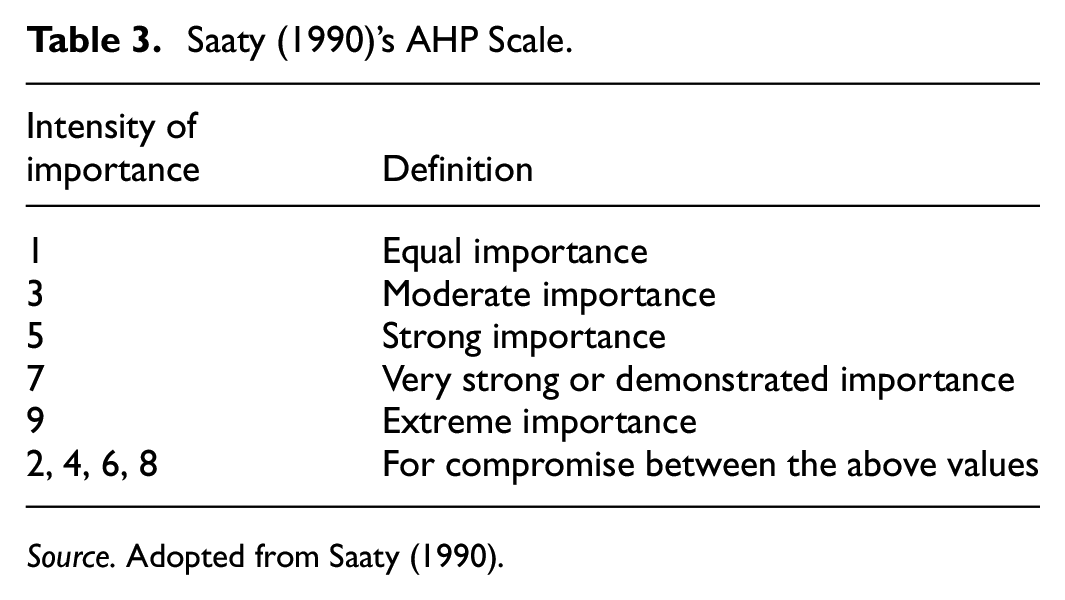
Source. Adopted from Saaty (1990).
The main reasons why this port was chosen as a target sample in the present study are as the following: Firstly, the port is environmentally friendly, and it is designed to be a successful candidate for the green port certificate. Secondly, it minimises carbon emissions and carries out the necessary activities for the use of natural resources. In the present study, the important measure headings in the International Transport Forum (2018) report are used to determine the degree of importance of the measures that need to be taken to zero the amount of carbon emissions resulting from maritime transport by 2035. Thirdly, the fact that many measures under those headings are used by this port is another reason why this port was chosen. Consequently, one can argue that the experience regarding the benefits of the measures would contribute to the comparison with others. In this port operation, different technologies such as electric cranes, LNG motor carriers, solar panels, and LED lighting are used to minimise carbon emissions and protect the environment. Ships and shore cranes in the port powered by electricity, and transport vehicles in the port powered by LNG is decisively preferred.
Empirical Findings
Table 4 shows all four steps of fuzzy-AHP determine ranking of three main measures used in the present study. The final model consistency is validated (CI = 0.03 < 0.58;
Final Ranking Steps of Main Measures.

To obtain more detailed information about sub-measures under three main measures, further fuzzy-AHP steps are followed. Table 5 represents final rankings of technological sub-measures in detail and consistency is successfully confirmed (CI = 0.32 < 1.12;
Final Ranking Steps of Technological Sub-Measures.

Table 6 summarises fuzzy-AHP steps being followed to obtain final ranking of operational sub-measures. The final fuzzy- AHP model for operational sub-measures is consistent (CI = 0.06 < 0.90;
Final Ranking Steps of Operational Sub-Measures.

Table 7 provides detailed evaluation of alternative fuel/energy sub-measure rankings based on fuzzy-AHP steps. The final fuzzy-AHP model for alternative fuel/energy sources measures is consistent (CI = 1.20 < 1.45;
Final Ranking Steps of Alternative Fuel/Energy Sub-Measures.

Table 8 gives fruitful information about general fuzzy-AHP rankings when all main and sub-measures are simultaneously considered. Table 8 presents that ammonia is found as the most important measure of decarbonisation of international shipping. Furthermore, light materials, slender design, and solar energy are found to be the second and the third most important measures that can potentially contribute to future decarbonisation process of international shipping, respectively. Curran et al. (2023) described ammonia as a promising zero-carbon fuel in their study and Grzelakowski et al. (2022) stated that hydrogen and ammonia have the potential to reduce carbon emissions by 100%. However, although hydrogen and ammonia are promising, Mallouppas and Yfantis (2021) revealed that there are still some barriers (storage, transport, cost) before their application for environmental solutions. Ashrafi et al. (2022) have also found fuel cost as one of the top five most important criteria to evaluate marine fuels. In their study evaluating alternative fuels for decarbonisation, Bhattacharyya et al. (2023) reported that ammonia was more suitable than hydrogen in terms of safety, cost, storage, sustainability and environmental impact criteria. Thus, it is noteworthy that the priority ranking presented by this study in terms of these two alternative fuels is compatible with previous studies.
General Fuzzy-AHP Rankings.

Discussion
In 2023, global renewable energy addictions increased by approximately 50% to nearly 510 GW (GW) which was the fastest growth rate in the past two decades. At the COP28 climate change conference, all parties agreed to triple the global installed renewable energy capacity to at least 11,000 GW by 2030. International Energy Agency (IEA) forecasts global renewable energy capacity to reach 7,300 GW by 2028 under existing market conditions and policies. Among several renewable energy milestones between 2024 and 2029, renewables are expected to surpass coal to become the largest source of energy generation in 2025. During this period, wind and solar photovoltaic (PV) are expected to generate more electricity than hydropower in 2024 and wind and solar PV are also expected to each surpass nuclear electric generation in 2025 and 2026, respectively. Solar PV and wind are expected to account for 95% of global renewable expansion by the courtesy of lower generation costs compared to fossil and non-fossil alternatives. As the end of 2023, an estimated 96% of newly installed solar PV and onshore wind capacity had lower generation costs than new coal and natural gas plants counterparts. At the same time, spot prices for solar PV modules experienced a significant nearly 50% decline and manufacturing capacity has tripled 2021 levels in 2023 (IEA, 2024).
In the present study, the measures in the upper group of the measure hierarchy were compared and ranked among themselves. Accordingly, the priority order is alternative fuel and energy sources, technological measures, and operational measures, respectively. This empirical finding emphasises the importance of alternative fuel and energy sources in the maritime decarbonisation process already in line with earlier research (Dos Santos et al., 2022; Fragkos, 2022; Grzelakowski et al., 2022; Zhang et al., 2023). Ammonia has zero carbon content when produced from renewable sources and it does not require capturing CO2 emissions with expected lower cost of operation advantages. Thus, ammonia is considered as one of the most suited alternative energy fuels for international shipping with advanced biofuels and methanol. However, the use of ammonia as a fuel can increase nitrogen oxide emissions and other safety and availability issues of ammonia deserve further investigation as crucial barriers in terms of decarbonisation of international shipping (International Renewable Energy Agency, 2021; UNCTAD, 2023d). Nevertheless, around 80 Mt of existing ammonia production capacity is considered as an important early opportunity for decarbonisation (International Renewable Energy Agency, 2022). Along with its high mass energy density and low environmental impact, hydrogen is an important alternative as an energy carrier for the use of fossil fuel-based energy sources. Hydrogen is used in many different areas, from transport, renewable energy integration to green chemical production (The Turkish Ministry of Energy and Natural Sources, 2023b). Renewable power capacity of hydrogen-based fuel production is forecasted to grow by 45 GW between 2023 and 2028 (IEA, 2024). The Turkish Ministry of Energy and Natural Sources (2023b) has recently declared the use of hydrogen as one of the priority areas by courtesy of its significant contribution to future sustainable energy commitment. In 2023, the Ministry unveiled ‘Türkiye’s Hydrogen Technologies Strategy and Road Map’ to create a carbon-zero economy model using hydrogen more efficiently in parallel with net zero-carbon emission targets by 2053. Additionally, more efficient hydrogen use is expected to offer a new export potential to Türkiye through its remarkable contribution to the share of production and use of renewable energy, potential improvements on production, storage and usage technologies, and the reduction of GHGs in the heat sector. It is estimated to reduce the cost of green hydrogen production in Türkiye below 2.4 USD/kgH2 and 1.2 USD/kgH2 by 2035 and 2053, respectively. Türkiye has included the encouragement of the widespread use of green hydrogen in all relevant industries where carbon emissions are difficult to reduce (chemistry, iron and steel, transport, glass, ceramics, etc.) among 12 hydrogen-oriented future policy implications. Therefore, deployment of ammonia or hydrogen as a marine fuel is suggested to decarbonise international shipping for Türkiye. However, due to relatively high prices on production costs, future development of an international hydrogen market remains to be a key uncertainty especially for markets with limited domestic demand for hydrogen (IEA, 2024). As International Transport Forum (2023) stresses, the use of hydrogen or ammonia in international shipping is still in its infancy stage and further research is required to better understand the feasibility of using these fuels in the real world.
It is widely supported that renewable energy sources such as solar and wind and electricity are alternatives that can be used against environmental degradation. However, the number of ships using fully renewable propulsion systems is limited (Stavroulakis et al., 2023). As of the end of June 2022, Türkiye’s solar energy-based electricity installed power is approximately 8.5 thousand megawatts (MW), that accounts for 8.35% in total installed power (Turkish Ministry of Energy and Natural Resources, 2022b). Türkiye has a total capacity to establish approximately 47.9 thousand MW wind power plants. As of the end of June 2022, the total installed power of wind energy is nearly 11 thousand MW in Türkiye that accounts for 10.81% of total installed power (Turkish Ministry of Energy and Natural Resources, 2022c). However, the shares of solar and wind energy in total electricity production in Türkiye are only 5.7% and 10.4% in 2023, while the major share still belongs to a fossil fuel, namely, coal with 36.3% (Turkish Ministry of Energy and Natural Resources, 2024). As of the end of December 2023, the total installed power of electricity of Türkiye is 107 thousand MW. In 2023, the number of electrical energy production plants in Türkiye has increased to 13,077, while 756 of those power plants are hydroelectric, 68 are coal, 365 are wind, 63 are geothermal, 344 are natural gas, 10,990 are solar, and 491 are other power plants (Turkish Ministry of Energy and Natural Resources, 2024). Although LNG, which ranks sixth among alternative fuel and energy sources in the study, is not considered sufficient to achieve decarbonisation targets alone, it is effective for decarbonisation when used with some other alternative fuel and energy sources (Balcombe et al., 2019; Czermański et al., 2020; Grzelakowski et al., 2022; Halim et al., 2018) and short-term (Curran et al., 2023; Mallouppas & Yfantis, 2021) tools representing measures. The inadequacy of LNG alone in achieving the decarbonisation goal is supported by the fact that it is relatively low on the priority list in this study.
As IEA (2024) emphasises, if supported by robust biofuel policies, emerging economies have the potential to drive 70% of global biofuel demand growth between 2023 and 2028 along with increasing transport fuel demand. As of the end of June 2022, the installed power based on biomass and waste heat energy of Türkiye is 2,172 MW that accounts for only 2.14% of total installed power (Turkish Ministry of Energy and Natural Resources, 2022a). In terms of nuclear energy in Türkiye, four units have reached the construction phase with the granting of a licence for the fourth unit by the Nuclear Regulatory Authority in October 2021 (Turkish Ministry of Energy and Natural Sources, 2023a). Thus, Akkuyu Nuclear Power Plant site has become the largest nuclear power plant construction in the world. Akkuyu Nuclear Power Plant is expected to be operational in October 2024 and Türkiye purposes to produce 35 and 34 billion kilowatt-hours of electricity annually from Akkuyu and Sinop Nuclear Power Plants, respectively that account for 25% electric production from nuclear energy (Turkish Ministry of Energy and Natural Resources, 2016).
Another main measure related to the aim of decarbonising shipping is operational measures. However, operational measures are last in the priority list for decarbonisation targets. In the general ranking, it has been determined that each alternative fuel and energy source has priority over all operational measures, that is, it is more effective for decarbonisation targets. This can be explained by the fact that the impact of operational measures on the decarbonisation process indirectly occurs. Namely, operational measures contribute to the decarbonisation process by reducing fuel and energy consumption. However, alternative fuel and energy sources are measures that directly eliminate CO2 emissions. Technological measures can also be evaluated partly in the same context as operational measures. However, it has been demonstrated that the energy efficiency provided by technological measures will contribute much more to decarbonisation targets. In the study, technological measures ranked second in the priority list. Measures regarding lightweight materials and ship design are technological measures that stand out in the general priority list. The findings regarding the complementary role of operational and technological measures in the decarbonisation process also support the findings of some previous studies (Balcombe et al., 2019; Czermański et al., 2020; Halim et al., 2018). The empirical findings of the present study and relevant literature emphasise that measures regarding alternative fuel and energy sources are more prioritised in decarbonising shipping and the complementary role of technological and operational measures. The consensus that the measures taken under the title of alternative fuel and energy sources are more prioritised in achieving decarbonisation targets is confirmed by the IMO (2020) Fourth Greenhouse Gas Study, which reveals that 64% of the total CO2 reduction amount from transport in 2050 will be achieved by alternative fuel and energy sources.
Conclusions and Limitations
Maritime transport is often a part of recent debates about economic development and environmental degradation as the industry strictly relies on economic development in terms of its existence and evolvement. As in many other fields, ongoing discussions about ensuring environmental sustainability without sacrificing economic development, quality of life, lower costs and higher benefit levels arise in maritime transport as well. In this context, IMO and other stakeholders work on a variety of measures by setting specific targets for the decarbonisation of shipping. In this study, the priorities of technological, operational, and alternative fuel and energy resources measures in the decarbonisation process were analysed using fuzzy AHP method. The empirical findings revealed that measures regarding the use of alternative fuel and energy sources in maritime transport are more prioritised than technological and operational measures for decarbonisation targets. Though the process of technological change and development can provide a cleaner environment and make a significant contribution to achieving the goals of decarbonising maritime transport, time constraints and emphasis on only commercial profits can be considered as main disadvantages of technological measures to achieve those goals. Technological change necessitates a certain amount of time and industry-wide transformation to achieve environmental goals requires comprehensive and gradual transition processes. In addition, the target of reducing carbon emissions by increasing the energy efficiency of technological and operational measures emerges in the form of indirect effects. In this respect, it is expected that the direct effect of alternative fuel and energy sources will take priority over the indirect effect of other measures.
Not surprisingly, insufficient financing in developing economies including Türkiye is considered as one of four current challenges highlighted by IEA (2024) that needs to be overcame to increase global renewable capacity and the rate of new installations needs to accelerate in middle-income economies to reach forthcoming 2030 goals. Since 2021, renewable energy producers have been hit hard by higher inflation rates in middle-income economies. In addition, there exists a significant decline of market value for the wind industry in Europe and North America due to volatile demand, limited raw material access, higher costs, and higher interest rates (IEA, 2024). As an upper middle-income economy, the same situation holds for Türkiye. Turkish economy has been under the influence of relatively high inflation for several years due the negative impacts of post-COVID-19 and political uncertainty in its geographical region. At that point, ongoing financial supports by international organisations such as United Nations Development Programme is important for future infrastructure investments of alternative fuel and energy sources (i.e., ammonia, hydrogen) to achieve zero-carbon target by 2035.
Whilst using alternative fuel and energy sources are the top priority measures to achieve the decarbonisation target, they alone are not sufficient to achieve those goals. It is a remarkable fact that the measures are complementary to each other in the process of decarbonising maritime transport. Some measures are recommended for policy makers to ensure the necessary transformation in decarbonising maritime transport. For such reasons, combined measures of all technological, operational, and alternative fuel and energy sources measures can be recommended based on empirical findings of this study in line with earlier fuel combination suggestions (Ejder et al., 2022; Halim et al., 2018; Hansson et al., 2019; Herdzik, 2021). For instance, a combination of using ammonia and/or solar energy as an alternative fuel and energy sources, utilising from light materials and slender design as technological measures and reducing speed as an operational measure would be the optimum solution in decarbonisation of international shipping. Additional taxation of fossil fuels with high carbon emission levels will contribute to environmental sustainability by both providing a focus on alternative fuel and energy sources and increasing technological searches for energy efficiency. Along similar lines, Balci et al. (2024) also suggest stakeholder support and carbon taxation as a roadmap to alternative fuels for decarbonisation of shipping. Xue and Lai (2023) emphasise the effectiveness of carbon-emission-linked financial leasing on decarbonisation of shipping, while other studies (Baştuğ et al., 2024; Liu & Chen, 2024) discuss the importance of the use of incentive mechanisms as the most prioritised funding alternative for decarbonisation of shipping. On the other hand, Herdzik (2021) indicates that the development of technologies for adapting potential fuels to combustion requirements in marine diesel engines and gas turbines as the main barriers of their limited use, whereas Nisiforou et al. (2022) also discuss important roles of technological development and operation optimisation on decarbonisation of shipping. The technological transformation required in the decarbonisation process should be supported with the help of subsidies and incentives. Policies should be developed to provide alternative financing tools for measures that require higher costs. This study is limited to expert opinions gathered from an international port in Türkiye within a limited period. The generalisation of empirical findings of the present study should be made with caution. Future studies can be carried out in other ports of Türkiye and other middle-income economies to justify and compare empirical findings. Future investigation is also deserved to better understand the exact roles of LNG, hydrogen, nuclear energy and operational measures in decarbonisation of shipping. Future attempts can use other multi-criteria and multi-objective decision-making methods within the availability of datasets. Future longitudinal studies are recommended to periodically observe past, present and future indicators of decarbonisation of international shipping.
Footnotes

Ethical Considerations
Experts were informed about the data collection method and purpose. Data were collected from experts on a voluntary basis. No name, surname or any personal information was requested from the experts during any process. In addition, since the name of the company from which the data was collected was not reflected in the study, no ethical declaration permission was required for this study.
Consent to Participate
Informed consent was obtained from the relevant company officials for the collection of data used in this study.
Funding
The author(s) received no financial support for the research, authorship, and/or publication of this article.
Declaration of Conflicting Interests
The author(s) declared no potential conflicts of interest with respect to the research, authorship, and/or publication of this article.
Data Availability Statement
The datasets used and/or analysed during the current study available from the corresponding author on reasonable request.