




Abstract
The purpose of this study is to observe the effect of perceived organizational culture on affective commitment. The study also examines the mediating role of perceived psychological contract fulfillment (PPCF) and the moderating role of leader-member exchange (LMX). Using a stratified sampling technique, data were obtained from 297 workers employed in a telecommunications sector located in the capital city of Riyadh, Saudi Arabia. To test the developed hypotheses, structural equation modeling was performed using AMOS 21.0. The results indicated that perceived organizational culture has a significant impact on PPCF and affective commitment. They also showed that PPCF partially mediates the relationship between perceived organizational culture and affective commitment. Furthermore, LMX moderates these relationships. The results of this study are valuable for the telecommunications sector and strategic decision-makers who seek to enhance affective commitment among their employees. Moreover, this study provides opportunities for researchers and scholars to conduct further research in this area. This study helps address inconsistent findings in previous research on perceived organizational culture, PPCF, and affective commitment. Furthermore, it makes a novel contribution by identifying LMX as a fundamental mechanism linking perceived organizational culture and PPCF, particularly in the context of Saudi Arabia.
Keywords
Introduction
During 1980s, organizational culture has been emerged as popular management topic. Many top selling books of 1980s containing the anecdotal evidences of organizational culture played pivotal role in the rapid expansion of the concept (Deal & Kennedy, 1982; Pascale & Athos, 1982; Peters & Waterman, 1982). In their work on searching key feature of the top American organizations, Peters and Waterman (1982) observed organizational culture as tightly linked with the success of such leading organizations. Likewise, corporate culture is the main attribute of the success of Japanese companies and businesses (Pascale & Athos, 1982). The researchers have been showing great interest in the strategic significance and importance of organizational culture and its role in the efficiency and effectiveness (e.g., performance, change, innovation, autonomy, and communication) of the organization (Denison et al., 2003; Denison & Mishra, 1995; Fey & Denison, 2003).
In organizational science, organizational culture is increasingly accepted as a predictive and explanatory concept. Liu et al. (2006) note that much of the early research on organizational culture was conducted in the fields of sociology, anthropology, and organizational psychology. The term “organizational culture” originates from anthropology, and current literature on organizational and management studies acknowledges the contributions of psychology, sociology, and anthropology to this field (Brown, 1998). Kim (2014) argues that affective commitment to an organization is significantly influenced by its culture, which develop an emotional sense of involvement and dedication to organizational values and moral norms. A diverse array of concepts, theories, and frameworks, primarily from anthropology and sociology, are encompassed within the study of organizational culture (Yahyagil, 2015).
In psychological contract, expectations from the employee and the employer are developed whereas organizational culture performs a significant role in shaping and forming these expectations. In the view of Denison (1990), Denison et al. (2003, . 2004), psychological contract is fulfilled at a workplace where employees perceive and evaluate organizational culture positively (through involvement and high consistency). When such values are displayed in organizational practices, it encourages employees to support company vision by working on shared mission and therefore, flexibility is promoted in an environment which is essential to encounter changes and external uncertainty (mission and adaptability). Research has proved that when an organization fulfills its required obligations, this perception of contract fulfillment resulted in positive job attitudes, such as affective commitment (Alshuhumi et al., 2024; Daouk et al., 2021; Ng, 2023).
The significance of leadership has been progressively proposed in this era when moral and ethical standards appear less contented and appreciated in the current economic and business stage. The role of leaders in the workplace demonstrates a high level of honesty, motivation, creativity, and ethical behavior (Awan & Jehanzeb, 2022; Caulfield et al., 2021; Insan & Masmarulan, 2021) and inspire such behaviors among their subordinates through different incentives and disciplinary actions (Wu et al., 2023). The LMX relationship focuses on affiliations between leaders and subordinates, and describes how leaders develop diverse interactions and act contrarily with their subordinates. Therefore, leaders strive to create atmosphere of fair treatment among their subordinates and inspire them to reciprocate his behavior.
Some studies have examined the relationship between organizational culture and organizational commitment but have found mixed results. A few confirmed the positive relationship between them (Huey Yiing & Zaman Bin Ahmad, 2009), while others did not reveal any relationship (Lok & Crawford, 2001). As there is no established agreement on the fundamental theory of organizational culture, this may contribute to the partially inconclusive results (Fey & Denison, 2003; M. A. Khan et al., 2020). Previous research studies (e.g., Lee et al., 2018; Lok & Crawford, 2001; Salvador et al., 2022) primarily focused on examining the effects of organizational culture. As a result, they contributed little to understanding when and why organizational culture is linked to commitment (Huey Yiing & Zaman Bin Ahmad, 2009; Ng, 2023). Furthermore, not considering possible mediating and moderating variables may also have contributed to these mixed results.
The Denison framework has been tested and validated in various cultural settings, including the United States (Denison & Mishra, 1995), China (Lee et al., 2018), Asia (Denison et al., 2004), and Russia (Fey & Denison, 2003). Therefore, it provides an opportunity to examine it in the Middle East, particularly in the Kingdom of Saudi Arabia. Secondly, choosing the telecommunications sector for this study supports broadening the generalizability of previous studies that focused on the manufacturing sector (Dunger, 2023; Salvador et al., 2022), high-tech organizations (Lee et al., 2018), and the health sector (Lok & Crawford, 2001). Moreover, due to fierce competition for highly talented employees, the telecommunications industry is naturally linked to high employee turnover. Therefore, more consideration should be given to developing organizational culture and values that strengthen the relationship between employees and organizations. Finally, to advance both academic and practical knowledge, this study builds on previous research by examining how PPCF mediates the relationship between perceived organizational culture and affective commitment in the telecommunications sector located in Kingdom of Saudi Arabia (Alshuhumi et al., 2024; Dunger, 2023; Lee et al., 2018; Ng, 2023).
Literature Review and Hypotheses
Theoretical Foundation—Social Exchange Theory
The social exchange concept posited that when one party perform something for other, the other reciprocate the same (Blau, 1964). This interdependence infers that the reaction of one party depends on the reaction of the other, therefore, it creates a sense of collaboration as well as mutual respect (Ahmad et al., 2019). The theory represents a socio-emotional aspect, which is admiring, taking care and self-esteem, and developing a positive relation among employees and the employers (Ahmad et al., 2019; Ahmad & Zafar, 2018; Insan & Masmarulan, 2021). Social exchange theory accurately explains the relationship among perceived organizational culture and PPCF. Therefore, Blau’s (1964) social exchange theory was adopted to represent the theoretical position to recognize the momentous role of leadership in organizational effectiveness. Considering the social exchange theory, the relation among two parties is reflected as mutual and interdependent.
As per the social exchange perspective, employees who believe their organization has acted fairly, equitably, and balanced (Rousseau, 1995) will feel an obligation to reciprocate by strengthening their emotional and social ties to the organization (Lee et al., 2018). Saudi Arabia ranks highly in power distance, particularly in private organizations, similar to Western nations that emphasize individual interests, and instrumental exchange (Chen & Li, 2005; Morris et al., 2008). Alqurashi (2013) conducted a survey among Saudi Arabia’s public and private organizations, revealing that the private sector exhibits greater power distance than public organizations. These findings have significant implications for managers and decision-makers in both the public and private sectors, not only in Saudi Arabia but throughout the GCC countries. To further explore this, we use social exchange theory (Blau, 1964) to examine how LMX influence the relationship between organizational culture, psychological contract fulfillment, and affective commitment. This approach aims to provide a more comprehensive understanding of these dynamics.
Organizational Culture
Organizational culture defined as a number of underlying beliefs, expectations and collective values (Schein, 1996, 2004) that significantly impacts the organization’s specific social and psychological environment (Dunger, 2023). The current study adopted Denison’s model of organization culture (Fey & Denison, 2003; Denison et al., 2004) that approaches culture as a complete set of internal integration and external adaptation. Internal integration can be described by developing and focusing on a set of internal relationships between members of the organization (Schein, 1992). Internal integration, divided into two dimensions, such as involvement and consistency. Involvement primarily emphases on the participation of members of the organization at all levels where they feel authoritative, involved and team members. Whereas, consistency indicates a set of vibrant, explicit guidelines, and consistent values that members of the organization must follow.
Building and preserving positive relationships with the organization’s external stakeholders is referred to as “external adaptation” (Schein, 1992). It is comprised of externally emphases two cultural dimensions: adaptability and mission. Adaptability refers to the organizational ability to improve and change their business process as required by the environment and the needs of the stakeholders. Lee et al. (2018) reported it as the organization’s ability to embrace the requirements of the business environment and agree to take risks and support constant learning. The mission means the strategic organizational goals and objectives that explains the overall vision and mission of the organization in the long-term. Fey and Denison (2003) concluded that these four dimensions of the culture focuses diverse utilities of the culture whereas mission enhances stability, and adaptability and involvement stimulate change.
Organizational Culture and Affective Commitment
Organizational commitment refers to as employee’s psychological and emotional bond with their employer (Meyer & Allen, 1991). Meyer and Allen’s (1991) three-component model of organizational commitment are consisting of affective, normative, and continuance commitment. On the other hand, organizational culture is based on values, mission, vision and goals of the organization that significantly impacts behavior of employees (Denison & Mishra, 1995; Schein, 1996). The internal combination of organizational culture enhances employees’ morals and encourage them to participate in organizational processes (Salvador et al., 2022), however, external adaptation always helps employee to perceive their tasks more meaningful (Lee et al., 2018). Organizational culture is perceived to develop the attitude and employees’ behaviors that significantly impact their affective commitment, since recognition of organizational values is their prerequisite (Alshuhumi et al., 2024; Dunger, 2023; Lee et al., 2018; Ng, 2023).
In terms of internal integration of cultural, consistency refers to the organization that encourage and promotes consistent and shared norms as well as values that generate a higher level of appreciation and improve internal coordination between organizational members (Ng, 2023). According to Fey and Denison (2003) adaptability captures the willingness of organization and ability to react environmental changes and seek continuous learning. However, it is also expected that adaptability of the organizations is linked of employees’ commitment. Lastly, the mission that provides shared sense of directions, strategy and clear purpose that contributes in the formation of a shared identity that can increase affective commitment (Dunger, 2023; Lee et al., 2018). Campbell and Yeung (1991) proposed that such shared sense of mission also provides a coordinative mechanism that leads the efforts of employees toward the accomplishment of strategic objectives of the organization. Therefore, taking into account the previous argument, it is proposing:
Hypothesis 1: There will be a positive relationship between perceived organizational culture and affective commitment.
Organizational Culture and Perceived Psychological Contract Fulfillment
Organizational culture clearly describes the roles of members of the organization, informs them about the valuable (or not valuable), decides how the matter are resolved, creates the nature of the relation among senior level employees and their subordinates, and develops mutual expectation between employee and the employer (M. A. Khan et al., 2020; Lee et al., 2018). Thus, organizational culture is anticipated to affect perceptions of employees and their expectations about the promises by the organization and responsibilities forming the labor relations (Rousseau & Greller, 1994). When employees observe that their organizations are delivering on their promises fairly, employees will reciprocate by developing strong as well as affective and socio-emotional ties with the organization. As a result, social exchange relationships are perceived as mutually necessary. The psychological contract provides a helpful paradigm for exploring the relationship between organizational culture and affective commitment among workers.
Similarly, when an employee perceives that their organization support basic needs, offers them with sense of security and opportunities to grow at workplace, he or she will ultimately develop a strong socio-emotional ties with organization. In the similar vein, Jiwen Song et al. (2009) showed that an inclusive, customer-oriented, innovative, socially responsive, and supportive culture indicates a relationship of social exchange while resulting in greater commitment among employees. The aforementioned both forms of cultures are similar to the four dimensions of cultures as presented by Denison’s framework, such as consistency, involvement, adaptableness, and mission (. Denison et al., 2004; Denison & Mishra, 1995; Fey & Denison, 2003). It is probable that the organizational culture impacts in perceiving the psychological contract fulfillment of the employees and, in return, their affective commitment (Alshuhumi et al., 2024; Dunger, 2023). According to social exchange theory (Blau, 1964), psychological contract fulfillment posits that the relationship between employees and their organization is reinforced through the exchange of positive outcomes, leading to high-quality relationships (Cropanzano & Mitchell, 2005). Hence, it leads to the following hypothesis development;
Hypothesis 2: There will be a positive relationship between perceived organizational culture and perceived psychological contract fulfillment.
Perceived Psychological Contract Fulfillment and Affective Commitment
An employment contract can be described as a set of implicit promises or legally enforceable responsibilities between employee and the organization. These contracts can be considered to have two major components, such as operational and psychological (Behery et al., 2012). The psychological component of this contract is defined as perceived shared responsibilities that are developed in an organizational setup between employees and the employer (Tekleab et al., 2020). This is the key component of the psychological contract that emphasizes on employee and employer relationship from emotional and caring perspectives. Furthermore, the psychological contract is perceived as naturally vibrant as it’s actually based on human association which is always striving to improve.
The current available literature has also defined two more components of psychological contract, such as; (a) transactional and (b) relational (Lee et al., 2018; Rousseau, 1995, 2001). The transactional contracts aimed the short-term tangible monetary benefits and rewards that are relatively accurate, and limited in scope (Behery et al., 2016). Whereas the relational contract is established at socio-emotional and non-monetary rewards that are well defined and established by spending a specific period of time in the organization (Rousseau, 1990; Tekleab et al., 2020). These non-monetary rewards can be described as trust, commitment, developmental opportunity, respect, fair treatment, and loyalty (Behery et al., 2016). Hence, this discussion leads to the development of the following hypothesis;
Hypothesis 3: There will be a positive relationship between perceived psychological contract fulfillment and affective commitment.
Perceived Psychological Contract Fulfillment as Mediator Between Perceived Organizational Culture and Affective Commitment
The organizational culture of the Middle Eastern region is notably shaped by the predominant cultures within each country. For example, in the United Arab Emirates (UAE), the social exchange process is guided by the relationship between employees and employers, as well as favor exchange. This stands in contrast to the instrumental rationales that typically underlie such relationships in Western cultures (Behery et al., 2016). Given that social relationships are viewed as obligatorily reciprocal in nature, the psychological contract serves as an effective framework for exploring the relationship between organizational culture and employees’ commitment. In defining psychological contract, Rousseau (1989) view it as an individual person’s beliefs about unwritten and formal terms of a contract which is reciprocal in nature and takes place between a focal individual and other party (Rousseau, 1989, p. 123). These perceptions include expectations that are developed by temptation of benefits which organization promises to offer in exchange of efforts, hard work and contribution of an employee in organizational success (Ng, 2023; Rousseau, 1995; Tekleab et al., 2020).
The perception of psychological contract fulfillment leads to affective commitment. The higher the PPCF, the stronger the perceived affective commitment (Ng, 2023; Tekleab et al., 2020). According to social exchange theory (Blau, 1964), for the psychological contract to be fulfilled, the employee-organization relationship must be maintained through the mutual exchange of favorable outcomes, resulting in a strong and enduring relationship. This is especially true in dynamic contexts such as high-technology companies, where knowledge professionals must maintain a strategic focus while also developing new skills and exploring innovative methods (Lee et al., 2018). Furthermore, knowledge workers are typically self-sufficient individuals who may reject a traditional command-and-control culture (Horwitz et al., 2003). Furthermore, the success of high-tech companies largely depends on the tacit knowledge possessed by their employees. This tacit knowledge can be fully realized and exploited only when employees have an implicit, unwritten employment relationship with their organizations, rather than through formal, written contracts (Flood et al., 2001; Lee et al., 2018). As a result, PPCF is expected to mediate the relationship between perceived organizational culture and affective commitment. Therefore, it is proposed:
Hypothesis 4: Perceived psychological contract fulfillment will mediate the relationship between perceived organizational culture and affective commitment.
Leader-Member Exchange (LMX) as Moderator Between Perceived Organizational Culture and Perceived Psychological Contract Fulfillment
The LMX is thought to be fair, humane and honest which helps it to motivate subordinates and co-workers and inspire them to promote same behaviors in them to exhibit at workplace (Insan & Masmarulan, 2021; Khan and Iqbal, 2022), Hence, it is predictable that leaders may also affect subordinate employees’ PPCF positively, as illustrated in Figure 1. Employees working under the supervision of such leaders are supposed to develop positive perception regarding leaders’ ethical role at workplace (Knotts & Houghton, 2021; Wu et al., 2023). Thus, they feel the better fulfillment of implicit, unspoken, and unwritten contract by the leaders and experience the conduct of these leaders as ethical, just, and fair toward employees. Keeping psychological contract, a side, when employees build perception about their leaders as honest, true, and ethical (Caulfield et al., 2021), they experience the fulfillment of the psychological contract.

The proposed conceptual framework.
We assert that leaders, as organizational spokespeople, significantly influence and shape various essential techniques such as recruitment and selection, reward management, fair treatment, ethical standards, health and safety, and career development (Ahmad & Zafar, 2018). Social exchange theory (Blau, 1964) offers an appropriate theoretical framework for comprehending the outcomes of LMX relationship. According to social exchange theory, two-party interactions are interdependent and mutual. As one party’s behavior depends on the actions of the other, dependency encourages collaboration, mutual respect, and risk reduction (Cropanzano & Mitchell, 2005). Similarly, reciprocity, a key aspect of social exchange theory, is considered a norm, and non-conformists are penalized (Mauss, 1967). Norms set the standards for acceptable conduct, and adherence to these norms entails reciprocal behavior (Cropanzano & Mitchell, 2005).
As a result, employees working under the supervision of ethical leaders, who exhibit greater psychological contract fulfillment due to their ethical behavior, are expected to be motivated to demonstrate improved work performance in the workplace (Wu et al., 2023). The results of recent research further support these arguments by suggesting that PPCF as indicator to enhance OCB in employees (Ahmad & Zafar, 2018). The contention of the present study aligns with past research, which indicated strong evidence that psychological contract fulfillment leads to certain positive organizational outcomes (Vantilborgh et al., 2014). Hence, it is argued here that employees working in the command of ethical leaders are anticipated to put extra efforts and energy happily even if it is not officially required (T. Khan & Iqbal, 2022; Knotts & Houghton, 2021). Therefore, it is believed that:
Hypothesis 5: Leader-member exchange (LMX) will moderate the relationship between perceived organizational culture and perceived psychological contract fulfillment.
Research Methodology
The Data Collection and Sampling
The research work was solely conducted in the telecommunication industry located in capital city of Riyadh, Kingdom of Saudi Arabia. The selection of capital city was based on the assumption of hosting greatest number of important business units with their headquarters that contained a multi-ethnic and diverse population which indicates the general culture of Saudi Arabia. The primary data was collected by one of the researchers while preserving the confidentiality and privacy of the respondent and firm (Neuman, 2009). Initially, an invitation letter was dispatched to HR managers and group managers of featured telecom companies, such as Mobily, Saudi Telecom Company (STC), Virgin, and Zain to request them to permit their employees to take part in the survey.
A stratified sampling technique was adopted for selecting the respondents employed in the telecom sector. A total of 400 questionnaires were distributed while following the guidelines of Krejcie and Morgan (1970). Out of these 400 survey questionnaires, 315 responses were obtained, with a response rate of 79%. In these responses, 15 had been omitted owing to the high ratio of missing values (Tabachnick & Fidell, 2013), this practice resulted in a total of 300 questionnaires. Moreover, 300 responses were selected for the purpose of data analysis. To examine the hypotheses of the study, the Structural Equation Modeling (SEM) method was adopted using AMOS 21.0.
In the second step, for testing multivariate outliers, the Mahalanobis distance test (D2) was performed. The D2 test is the most frequently used test to detect multivariate outliers (Tabachnick & Fidell, 2013). Mullen et al. (1995) advocated that D2 values that are considered significant at the 5% level are specified as outliers, while the values at the 1% level are extreme outliers. Therefore, considering these guidelines D2 with p < .001, the data reported three responses as multivariate outliers. Therefore, out of 300 responses, those three responses were dropped, resulting in a final sample size of 297.
The demographic samples showed that the majority of them (92%) were male, whereas only 8% were female. Most of the respondents belonged to the age bracket of 21 to 30 years (62%), and only 3% were above 40 years. In terms of the nature of the job, 63% were working on a permanent contract, whereas 37% were found to be contractual employees. In terms of designation, 54% were sales/customer service executives, 10% were human resources executives, and only 5% were technical/operational executives. The majority of the respondents (96%) were Saudi nationals; however, only 4% were expatriates. The highest number of local respondents are due to the fact that the Ministry of Labor in Saudi Arabia has nationalized the entire telecom job. Finally, in terms of telecom organizations, STC, Zain, Mobily, and Virgin were contacted with a response rate of 64%, 15%, 14%, and 7%, respectively.
Instrument of the Study
According to Sarantakos (2007), many academics are advised to use an instrument that has already been tested because it has been shown to be reliable and valid. In this study, the data were obtained through structured questionnaires. Each questionnaire contained some statements which were required to be rated by the respondent according to the significance level at five points Likert scale from “strongly disagree” to “strongly agree” where 1 represented strongly disagree and 5 as strongly agree.
Perceived Organizational Culture
The 20-item scale, a shorter version of Fey and Denison’s (2003) instrument, was adopted to measure the four dimensions of organizational culture: consistency, involvement, adaptability, and mission. Sample questions from the “involvement” dimension included, “Decisions are usually made at the level where the best information is available,”“Working in this organization is like being part of a team,” and “This organization relies on horizontal control and coordination to get work done, rather than hierarchy.” The sample items from the “consistency” dimension included, “There is a clear and consistent set of values in this organization that governs the way we do business,” and “The leaders and managers follow the guidelines that they set for the rest of the organization.” Some sample questions from the “adaptability” dimension included, “This organization is very responsive and changes easily,” and “This organization responds well to competitors and other changes in the business environment.” Here are some example questions from the “mission” dimension: “This organization has a clear mission that gives meaning and direction to our work,” and “This organization has a clear strategy for the future.” The Cronbach’s alpha for this scale was .91.
Perceived Psychological Contract Fulfillment
PPCF is measured through three-items scale that was developed by Robinson et al. (1994). The sample questions included, “My company has kept its promises to me,” and “My company has often broken promises made to me.” This scale had a Cronbach’s alpha of .97.
Affective Organizational Commitment
The six-item scale, a shorter version of Meyer and Allen’s (2004) instrument was borrowed to measure employees’ affective commitment. The sample items included for this scale were: “I would be very happy to spend the rest of my career with this organization,”“I really feel as if this organization’s problems are my own,” and “This organization has a great deal of personal meaning for me.” For this scale, the Cronbach’s alpha was .96.
Leader-Member Exchange
The study utilized a 12-item scale developed by Liden and Maslyn (1998) to gauge the four dimensions of LMX: loyalty, affect, contributions, and professional respect. Sample questions from the “loyalty” dimension included, “My supervisor defends my work actions to a superior, even without complete knowledge of the issue in question,” and “My supervisor would defend me to others in the organization if I made an honest mistake.” Following are a few sample questions concerning the “affect” dimension: “My supervisor is the kind of person one would like to have as a friend,” and “I like my supervisor very much as a person.” The following questions offer insights into the “contribution” dimension: “I do work for my supervisor that goes beyond what is specified in my job description,” and “I am willing to apply extra efforts, beyond those normally required, to meet my supervisor’s work goals.” Here, we provide some of the sample questions pertaining to the “consistency” dimension: “I am impressed with my supervisor’s knowledge of his or her job,” and “I admire my supervisor’s professional skills.” The Cronbach alpha of this scale was .96.
Control Variable
We also have observed that whether age of the employees, tenure, and Job nature can impact their affective commitment to the organization. For examining this relationship, guidelines of Hedges and Olkin (2014) were followed. Therefore, age, tenure, and nature of job were tested as control variables.
Data Analysis
Descriptive Statistics and Correlations
Table 1 presents mean, standard deviation, and bivariate correlations of the demographics, and all the variables.
Mean, Standard Deviations, and Bivariate Correlations.

Note. POC = perceived organizational culture; PPCF = perceived psychological contract fulfilment; AC = affective commitment; LMX = leader-member exchange.
p < 0.05; **p < 0.01.
Model Evaluations Measurement
The measurement model was tested by selecting two-stages analytical procedure. At initial stage, CFA (confirmatory factor analysis) was executed by adopting AMOS 21.0 assuming maximum likelihood estimation to classify the pattern in which each measure loaded on a particular factor (Byrne, 2010; Hair et al., 2010). At subsequent stage, structural regression model was performed to test the proposed conceptual model. In both testing stages, different fit measures were examined to have a best model fit. These measures include: Chi-square (χ2), normed chi-square (χ2/df), goodness-of-fit index (GFI), comparative fit index (CFI), and root mean square error of approximation (RMSEA).
The measurements model fits statistics results are explained in the Table 2. The Chi-square’s (χ2/df) value is found 2.16 that is less than 3, a generally suggested value that indicates a good fit for suggested model (Byrne, 2010). The GFI and CFI values are 0.76 and 0.94, respectively, indicating a common excepted goodness of fit (Hair et al., 2010). Finally, the value of RMSEA is representing as 0.06, which represent an adequate model fit (Kline, 2010). Therefore, outcomes of measurement model provided in Table 2 shows that values are adequately acceptable and authors can move forward to test the structural model.
CFA of Measurement Model.

The standard factors loading and Cronbach alpha of each variable (POC, PPCF, affective commitment, and LMX) were also examined to define their validity following the guidelines of Kline (2010). The outcome values reported that every factor loading for reflective indicator ranging from .92 to .97 that is exceeding the suggested level range of .50 (Hair et al., 2010). As factor loading of every construct were found greater than the suggested cut-off value (.50), later on convergent validity of every established construct was also examined that provided the confirmation for validity of all the established constructs (Hair et al., 2010). Moreover, coefficient α’s was also found exceeding the bare minimum set standard of .70, hence, indicating a good fit estimation for internal consistency.
Table 3 describes relationships between latent variables and AVE (average variance extracted) of each variable. Diagonal elements of the table are square root of AVE, while off-diagonal elements are showing the relations between established constructs. AVE of the construct is estimated in examining the discriminant and convergent validity following the guidelines of Hair et al. (2010). As presented in Table 3, the value of AVE is from 0.699 to 0.926, that exceeds 0.50, the minimum acceptable value of convergent validity (Kline, 2010). However, square root of AVE of every variable is found greater than correlations between variables, which indicated adequate discriminant validity (Byrne, 2010).
Convergent and Discriminant Validity of the Construct.

Note. POC = perceived organizational culture; PPCF = perceived psychological contract fulfilment; AC = affective commitment; LMX = leader-member exchange.
Structural Model Evaluations
In second stage, Structural Equation Modeling method was applied again by adopting AMOS 21.0 for testing structural model of the study (Kline, 2010). Table 4 reports the fit indices of structural model as: χ2 = (N = 297) 997.32; df = 461, χ2/df = 2.16; GFI = 0.81; AGFI = 0.79; CFI = 0.95; and RMSEA = 0.06. The results of all the indices reported that values are fairly acceptable and established hypotheses can be tested using this data. Figure 2 portray the relationships between one exogenous (perceived organizational culture) and two endogenous variables (PPCF and affective commitment).
CFA of Structural Model.


Structural model of the study.
Results of Direct Relationship
A two-steps method of CFA was adopted by using SEM to examine the hypothesized relationships in accordance with guidelines of Hair et al. (2010). The study anticipated that perceived organizational culture and PPCF positively interact to influence affective commitment. The impact of control variables (age, tenure, and nature of job) was also tested by using affective commitment as dependent variable. Structural model results are being presented in Table 5. Hypothesis one (H1) anticipated that there is a significant relationship between perceived organizational culture and affective commitment. This hypothesis was tested through an average score of four perceived organizational culture constructs (involvement, consistency, adaptability, mission) and affective commitment. The results reported a significant and positive relation between perceived organizational culture and affective commitment (β = .650, p = .000>.001, refer Table 5). Therefore, results are aligned and supported to the proposed hypothesis.
The Results of Direct Relationship.

Note. POC = perceived organizational culture; PPCF = perceived psychological contract fulfilment; AC = affective commitment.
p < .001.
Hypothesis two (H2) was proposed to test the relationship between perceived organizational culture and PPCF. The results described that perceived organizational culture is significantly impacting PPCF (β = .201, t =0.10, p = .048 < .05). The results stated that though this relationship is positive but it is very weak, as value of p is very close to .05, a minimum cut for the acceptance of established relationship. Consistent with the results of earlier studies (Behery et al., 2016), the results of current study explained a positive relationship between perceived organizational culture and PPCF among telecom employees of Saudi Arabia. Hypothesis three (H3) proposed that there is a positive relationship between PPCF and affective commitment. The results inferred a positive and significant relationship between PPCF and affective commitment (β = .064, t = 0.03, p = .044 < .05). Similar, findings have been reported by earlier study (Behery et al., 2016).
The results of the study also explained a positive relationship between employee tenure and affective commitment (β = .094, t = 0.03, p = .010 < .005); however, an insignificant relationship was found between employees’ age, job nature and affective commitment (β = −.125, t = 0.06, p = .062 > .05; β = −.054, t = 0.08, p = .541 > .05, respectively). These results are consistent with the findings of numerous earlier studies, which report that affective commitment depends on the number of years an employee spends in the organization (Yucel & Bektas, 2012). To conclude, hypothesized relationships H1, H2, and H3 were found to have support from a majority of the respondents.
Analyzing the Mediating Relationship
The mediating relationship was tested using SEM with AMOS 21.0, employing the maximum likelihood estimation method. In doing so, it provides a ground to test the importance of indirect impacts (James et al., 2006). SEM approaches have long been preferred over regression techniques for assessing mediating relationships because they allow for the modeling of both measurement and structural interactions and provide comprehensive fit indices (Baron & Kenny, 1986; James et al., 2006). In SEM, the standard paradigm for mediation is used in the complete mediation model (James et al., 2006). As shown in Figure 3, this is a basic mediation model where perceived organizational culture is the predictor, PPCF is the mediator, and affective commitment is the criterion.

Mediation model of the study.
Figure 3 depicts a hypothesized mediating model of POC←PPCF→AC. It was hypothesized that PPCF mediates the relationship between perceived organizational culture and affective commitment (H4). Perceived organizational culture served as the independent variable, PPCF acted as the mediator, and affective commitment was the criterion variable. As presented in Figure 3, there are three paths: POC→PPCF, PPCF→AC, and POC→AC.
The summary of the findings for the mediating model is explained in Table 6. The findings demonstrate a significant relationship between perceived organizational culture and affective commitment (β = .686, t = 0.06, p = .000 > .001) before adding the mediating variable. But it’s seen that following the addition of the mediating variable (PPCF), the three paths POC→PPCF, PPCF→AC and POC→AC remain significant (see Table 6). Baron and Kenny (1986) recommended as partial mediation if after adding the mediating variable three paths remain significant. The results indicate that PPCF partially mediates the relationship between perceived organizational culture and affective commitment. Therefore, the fourth hypothesis (H4) is accepted.
The Results of Mediation Analysis.

Note. POC = perceived organizational culture; PPCF = perceived psychological contract fulfilment; AC = affective commitment.
p < .001.
Analyzing the Moderating Relationship
SEM is selected once more, employing AMOS 21.0 with maximum likelihood estimation, to explore the moderating relationship. Generally, SEM is expected to accommodate measurement errors within a statistical model. Hence, measurement errors are considered critical because they have the potential to weaken the relationship between two variables (Baron & Kenny, 1986). SEM techniques are perceived as a better approach than regression because they allow modeling of structural and measurement relationships (Baron & Kenny, 1986; James et al., 2006). Figure 4 shows the moderating role of LMX in the relationship between perceived organizational culture and PPCF (Hypothesis 5). It also presents three paths (a) POC→PPCF, (b) LMX→PPCF, and (c) POC × LMX→PPCF.

Moderation analysis.
Table 7 provided the results of moderation analysis. The results show that the interaction term (POC × LMX) has a significant impact on PPCF (β = −.442, t = 0.06, p = .000 < .001). So, if this interaction term significantly influences the outcome variable, it can be reported as moderation effect (Baron & Kenny, 1986; Hair et al., 2010). Thus, the results suggest that LMX moderates the relationship between perceived organizational culture and PPCF. The findings indicate that the LMX relationship moderates the relationship between perceived organizational culture and PPCF. Employees who work under such leaders are likely to have positive perceptions of their leaders’ ethical roles in the workplace (Wu et al., 2023). Consequently, they believe that their leaders are better at fulfilling implicit, unspoken, and unwritten contracts, and that their behavior toward employees is ethical, just, and fair. Beyond the psychological contract, when employees perceive their leaders as honest, sincere, and ethical (Caulfield et al., 2021), they experience greater psychological contract fulfillment.
The Results of Moderation Analysis.
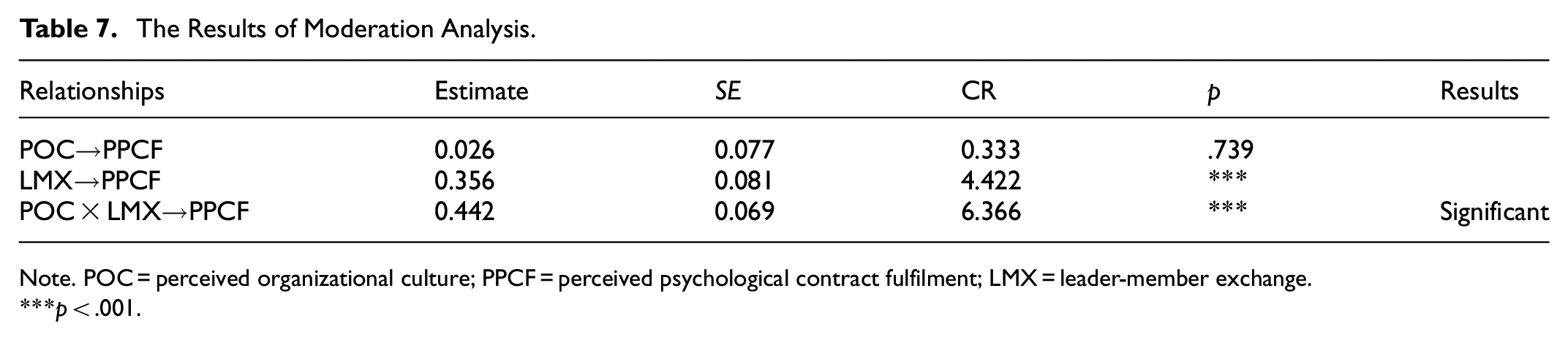
Note. POC = perceived organizational culture; PPCF = perceived psychological contract fulfilment; LMX = leader-member exchange.
p < .001.
To analyze the moderating effect of LMX on the relationship between perceived organizational culture and PPCF, LMX was categorized into high and low groups using statistical tools in Excel, as per Gaskin’s (2012) methodology. Figure 5 illustrates this relationship, showing a stronger positive correlation between perceived organizational culture and PPCF in the high LMX group compared to the low LMX group. This finding confirms the moderating role of LMX, as high-quality exchanges amplify the positive influence of organizational culture on fulfilling psychological contracts. For example, in practice, employees in high-LMX relationships may perceive greater alignment between cultural values and the promises made by the organization, leading to more substantial psychological contract fulfilment. Conversely, those in low-LMX relationships might lack the trust or communication needed to experience this alignment. From a managerial perspective, these results suggest that cultivating high-quality LMX can enhance the effectiveness of organizational culture initiatives, thereby improving psychological contract fulfilment. Managers should invest in leadership development programs to enhance trust, mutual respect, and open communication with team members, ensuring that the organizational culture is perceived as supportive and consistent with employees’ expectations.

Moderation effect of leader-member exchange (LMX).
Discussion
Using the organizational culture framework of Denison and Mishra (1995), this study contributes to the theoretical understanding of how organizational culture influences the affective commitment of skilled workers in highly technological companies in the unique context of Saudi Arabia. The findings extend this framework by demonstrating that organizational culture dimensions, such as internal integration (involvement, consistency) and external adaptation (adaptability, mission), are significantly related to affective commitment. Some past studies have also indicated that PPCF enhances employees’ emotional attachment to the organization (Daouk et al., 2021; Yu, 2022). These insights provide a clearer understanding of the ways in which organizational culture can drive emotional attachment to the organization, particularly in high-tech environments where adaptability and mission-driven goals are crucial, and specifically in the Saudi Arabian business landscape.
Moreover, the study makes an important theoretical contribution by demonstrating that PPCF partially mediates the relationship between perceived organizational culture and affective commitment. This finding deepens our understanding of psychological contract theory, supporting the notion that when employees’ expectations are met, it enhances greater emotional attachment to the organization (Lee et al., 2018). Previous studies have primarily explored breaches in psychological contracts and their negative consequences (Tekleab et al., 2020), but this study shifts the focus to how fulfilling these contracts can enhance employees’ affective commitment, contributing to the literature on the positive outcomes of PPCF. These arguments are also consistent with the findings of some past studies, which suggested that the ethical and fair policies of organizations affect psychological contracts (Ahmad & Zafar, 2018; Vantilborgh et al., 2014).
From a practical perspective, the findings have important implications for managers in highly technological sectors. Leaders should focus on cultivating a culture that promotes both internal integration (e.g., involvement, consistency) and external adaptation (e.g., adaptability, mission) to develop higher levels of employee commitment. Moreover, managers must recognize the importance of LMX in shaping employees’ perceptions of organizational culture. High LMX levels enhance the relationship between perceived organizational culture and PPCF, which in turn strengthens affective commitment. Managers should invest in creating fair, ethical, and transparent relationships with their subordinates to increase trust and communication, ultimately improving emotional attachment to the organization.
For employees, the study suggests that fulfilling their psychological contracts leads to higher levels of emotional attachment, resulting in reduced anxiety and stress, increased job satisfaction, and the ability to propose innovative solutions. Policymakers in Saudi Arabia and similar cultural contexts can use these findings to promote organizational environments that align with local values, creating workplace settings that are conducive to high commitment and performance. Given Saudi Arabia’s collectivist culture, where trust and relationship-building are integral to workplace dynamics, these findings highlight the importance of culturally sensitive leadership and organizational practices that align with local expectations.
Thus, the results underscore the critical role of the cultural context in shaping organizational behavior, particularly within the dynamic and rapidly evolving technological sector. By cultivating a culture that aligns organizational goals with employee expectations and values, companies can not only enhance affective commitment but also develop a more engaged and resilient workforce. This strategic alignment not only strengthens individual employee outcomes but also contributes to broader organizational success, ensuring organizations remain competitive and adaptive in a constantly changing environment.
Theoretical Contributions
The results of present study contribute in the available literature on perceived organizational culture, PPCF, and affective commitment in numerous ways. We extended the prior research of Lee et al. (2018) and demonstrated that organizational culture has a substantial impact on employees’ affective commitment working in telecom sector of Saudi Arabia. Our results are consistent in line with Blau’s social exchange theory (Blau, 1964) by demonstrating that role of organization in creation of employees’ PPCF is significant. As a result, it forces employees to reciprocate and return in the form of affective commitment. In this way, it helps us to answer the call for the purpose of further research to add value to the existing literature in order to identify the antecedents of affective commitment in Asian context (Lee et al., 2018).
We also tested relationships between individual perceived organizational culture, PPCF, and affective commitment, particularly in the context of Saudi Arabia where cultural values, institutions, and lifestyles differ substantially from the Western world (Behery et al., 2016). This study finds that since Saudi Arabia’s organizational culture could be directly related to its socio-cultural norms, the impact of management philosophies of the West and practice can be seen too. The results of this study also support the Denison and Mishra’s framework of organizational culture that can also be generalized to the Gulf, especially Saudi Arabia. The study also argued in this assertion that one of the mechanisms through which an ethical leadership effects the relationship between perceived organizational culture and PPCF. Therefore, a reciprocal trust is developed (Blau, 1964), which further leads to build a psychological relationship between employee and employer.
Practical Implications
The results of this study not only support local organizations in Saudi Arabia, but also multinational companies operating locally and wanting to work in this direction to achieve high employee commitment. Our findings suggested that greater attention to organizational culture is required for managing a healthy employment relationship and meeting employee expectations to enhance affective commitment. The results also suggests that leadership behavior plays a vital role in fulfilling the implicit contract to increase the subsequent level of organizational commitment. Our findings demonstrated that when quality of LMX variability at group level is higher, the relationship between LMX and contract fulfillment is stronger than low level of LMX variability in the group.
To effectively manage the differentiation process, its implications for developing the perception of PPCF and related behaviors of employees, organizations, and the manager should follow the following general guidelines. First, it must be ensured that LMX differentiation is supported in such a way that it is matching and consistent with organizational objectives, cultural values and norms of the organization. Second, the potential of a high LMX relationship that makes your characteristics and contributions valuable, particularly to managers, teams, and organizations, should also be communicated at the group level to spread awareness of why some members are being treated in different ways. If such communication takes place in an environment where it will be construed positively, the fear of the deleterious implications of LMX differentiation can be minimized.
Limitations and Future Research
There are several limitations of this study that deserve careful attention. First, we focused on workers in the telecommunications sector, but recent studies suggested that occupation, hierarchy level, and profession can significantly impact employees’ commitment and other positive outcomes (Dunger, 2023; Lee et al., 2018). Therefore, future studies should consider whether PPCF and affective commitment are influenced by different work roles. Second, the fact that we considered only one cultural context—Saudi Arabia—and ignored potential cultural effects is a significant limitation of this study. Although our sample broadens our understanding of perceived organizational culture and affective commitment relationships beyond the scope of studies typically conducted in Western countries, taking cultural differences into account is crucial for ensuring the generalizability of our findings. Therefore, cultural factors such as power distance (Hofstede, 1983) should be a key area for research in this relationship.
Third, in addition to LMX relationship, other significant variables such as different leadership styles, personality traits, or cultural variables (i.e., traditionality, collectivism, indulgence) could be explored and potentially included in subsequent studies. Considering that organizational culture mirrors the perspectives of leaders within the company, observing how leadership and organizational culture interact to influence employees’ commitment would be intriguing. Therefore, it is important to examine the mechanisms that drive relationships between perceived organizational culture and PPCF empirically at the individual level. In last, another significant limitation of this study is that all the constructs are self-reported. Although self-report variables are often helpful in better understanding employees’ perceptions of their environment and determining their responses to work experiences, complete reliance on self-reports can pose the problem of method variance (Henderson et al., 2008).
Conclusion
The study aimed to observe the relationship between perceived organizational culture, PPCF and affective commitment. The study examines the moderating role of LMX in the relationship between perceived organizational culture and PPCF. The results reported that perceived organizational culture has a positive and significant impact on PPCF and affective commitment. In addition, the results of the study explain a significant relationship between PPCF and affective commitment. The result of the study also reported that the PPCF mediates between the perceived organizational culture and the affective commitment relationship. However, the results reveal that LMX moderates the relationship between perceived organizational culture and PPCF.
Footnotes

Ethical Approval
An ethics statement is not applicable to this study.
Funding
The author(s) received no financial support for the research, authorship, and/or publication of this article.
Declaration of Conflicting Interests
The author(s) declared no potential conflicts of interest with respect to the research, authorship, and/or publication of this article.
Data Availability Statement
The data supporting the findings of this study are available from the corresponding author upon request.