




Abstract
In today’s competitive and complex environment, school leaders require social influencing skills to mobilize schools to enable them to adapt to change. The schools’ openness to change (SOC) is affected by the direction and strength of relationships between teachers and principals in the school. In particular, the political skills of school principals can play a prominent role in mobilizing employees for change. This research investigates the impact of school principals’ political skills on schools’ openness to change, with a focus on the mediating role of leader member exchange (LMX) quality. The sample group was obtained by simple random sampling from 613 state teachers working in the Kocaeli province in Turkey in the 2019 to 2020 academic year. This study is based on quantitative data collected through the “Leader-Member Exchange Scale,”“Schools’ Openness to Change Scale,” and “Political Skill Inventory.” The measurement models of the latent variables (political skill, LMX, and SOC) were confirmed via running Confirmatory Factor Analysis (CFA). Afterward, Structural Equation Modeling (SEM) was used to test the structural model. The results reveal that the political skills of school principals significantly predict the SOC and the LMX. Political skills of school principals affect schools’ openness to change positively, and leader-member exchange positively effects the relationship between political skills and openness to change. It’s recommended that activities supporting the quality of leader member interactions in schools be carried out.
Plain language summary
This research examines the impact of school principals’ political skills on schools’ openness to change (SOC), focusing on the mediating role of leader member exchange (LMX) quality. The study was conducted on 613 state teachers in Turkey during the 2019 to 2020 academic year. Data was collected through the “Leader-Member Exchange Scale,”“Schools’ Openness to Change Scale,” and “Political Skill Inventory.” The results showed that political skills significantly predict the SOC and LMX, positively affecting schools’ openness to change. The relationship between political skills and openness to change is positively influenced by leader-member exchange. The study recommends activities supporting the quality of leader member interactions in schools.
Keywords
Introduction
School principals play a remarkable role in enabling teachers to understand and be open to change. Principal success in accomplishing change depends on acting like a change agent and being capable of motivating teachers (Furnham, 2002; Oreg & Berson, 2019). School principals’ leadership behaviors feature human relationships and involve other staff members in the process, which contributes to the schools’ openness to change (A. Harris, 2006). However, one reason for the failure of change practices is the inconsideration of the possible staff member reactions (James & Connolly, 2000). Political skill is a notion studied to reveal the factors which enables employees’ openness and interest in organizational change. Pfeffer and Pfeffer (1981) define political skills as the capability to mobilize others to achieve organizational and personal goals. Political skills structured by the dimensions of social astuteness, interpersonal influence, networking ability, and sincerity can play a critical role in launching and maintaining the efforts for change and its successful conclusion. First, the effective use of these skills can ensure staff members openness to change. For instance, leaders with high political skills can aspire employees to achieve the organizational objectives by using their social astuteness and sincerity, and establishment of these interactions with the employees increases their performance (Ahearn et al., 2004; Ferris et al., 2007). In addition, leaders with political skills are talented observers who can easily adapt to different social situations and discern their own and others’ behaviors. School principals with political skills act sensitively, are capable of identifying themselves with others and have tactical and persuasive manners that leave a strong impression on those around them. Therefore, the interpersonal influence dimension of political skill is a major factor for leaders to motivate employees in line with the goals of the organization (Blickle et al., 2010). Organizational goals and social capital are emphasized through the networking dimension of their political skill to lead employees (Pfeffer, 2010). Leaders with high political skills expand their communication networks (Zivnuska et al., 2019). School leaders’ social networking skills impacts employees’ performance and aspires them for change, sustains their efforts, and facilitates solving of organizational challenges (Munyon et al., 2015; Wang & McChamp, 2019). Thus, leaders with political skills have significant social capital that increases their reputation and influence on others. Establishing good relationships with people and organizations, stakeholders and others, increases support for the organization in unforeseen challenging situations. Individuals with political skills exhibit high integrity, honesty, reliability, and sincerity. Sincere leaders easily gain the trust of employees (Blickle et al., 2010). Besides the effect of political skills, another factor that may affect employees’ openness to change is Leader-Member Exchange (LMX) (Rizvi et al., 2021). The effect of LMX on openness to change remains unanswered, considering its relationship with political skills. While there is existing research on the importance of both political skills and openness to change in educational settings (Ouedraogo et al., 2024; Stringer & Hourani, 2016), there is a gap in understanding how principals’ political skills influence schools’ openness to change. Addressing this gap is crucial for understanding principals’ effectiveness in leading change initiatives, identifying areas for interventions and training programs to enhance political skills, and developing more effective strategies for organizational change in educational settings. Therefore, this study examines the mediating role of LMX on the effect of political efficacy on openness to change. The major goal is to capture key points in the development of school administrators’ skills in educational organizations to support the perception of employees’ openness to change in educational organizations.
Literature Review
Schools’ adaptability to change is crucial in the rapidly changing educational landscape. The principals’ leadership shapes the schools’ culture and climate, setting vision and direction while serving as change agents (Hargreaves & Fink, 2012; Leithwood & Jantzi, 2006; Robinson, 2017). Understanding factors influencing schools’ openness to change, such as the role of the principal and the quality of relationships within the school, is essential for driving meaningful educational reform and improvement (A. Harris, 2011; Bryk, 2010). School principals’ political skills influence schools’ openness to change, navigating the complex landscape of educational leadership and reform (Ouedraogo et al., 2024; Stringer & Hourani, 2016). They manage relationships and expectations, foster a conducive atmosphere for change, and effectively balance internal and external stakeholders (Bryk, 2010; Robinson, 2017).
Openness to Change and Political Skill
The main purpose of organizational change is to bring changes that allow an organization to maintain, strengthen, or renew its position (Oreg & Berson, 2019; Pfeffer, 2010). An organization that has stayed on course for long and not changed with the environment, or if the environment itself has changed drastically, the previously effective structure may not be the most efficient forward model (Krishnan, 2018). However, schools’ adaptation to change and their role in realizing change require them to be open to change as an organization. It is expected that the stakeholders be open and willing to change when it comes to complex organizations such as schools. For example, for teachers’ professional development activities to be effective, a prerequisite for the success of the change process is for teachers to demand training for their professional needs and respond positively to the change (Baylor & Ritchie, 2002; Boyle et al., 2005; Patterson, 2013). The role of school principals comes to the fore in schools’ openness to change. The success of school principals in interpersonal relations, sincere attitudes toward employees, access to resources related to the realization of change, and ability to establish this social network can encourage and develop a positive perspective toward change among the school employees. Therefore, a school principals’ political skills, different from their typical managerial abilities, can be seen as an indicator of their social astuteness. In organizations, individuals with high political skills have easier access to resources and influence other employees by targeting a larger share (Ferris et al., 2005). However, political skills are not inherent in leaders. Political skills of principals are revealed by different variables such as leadership (Ferris et al., 2005), emotional intelligence (Salisu & Awang, 2016), and interpersonal skills (Treadway et al., 2013). To exemplify, LMX correlates with both political skill and organizations’ openness to change. High-quality LMX relationships lead to enhanced access to knowledge, participation, and trust in management. Individuals involved in these connections are more inclined to acquire further information regarding alterations, have increased prospects for engagement, and cultivate enhanced confidence in the management (Bezuijen, 2005; Sparrowe & Liden, 2005). As a result, employees in high-quality LMX interactions are more receptive to change compared to those in low-quality relationships (Sparrowe & Liden, 2005; Van Dam et al., 2008, 2021). Therefore, leadership discussions based on LMX theory focus on the quality of the relationship between leaders and followers. The quality of the relationship can support motivation for change. In this case, school leaders, as change agents, can be expected to consider high-quality LMX when influencing teachers.
Openness to Change and LMX
In the LMX model, it is assumed that the leader does not treat all his subordinates equally but instead establishes different types of relationships with them. This theory, is based on exchange relationship (Yu et al., 2018), and LMX ensures trust, enjoyment, and mutual respect between the leader and the employees. The quality of relationship between leader and employees affects employee efficiency and performance (Graen & Uhl-Bien, 1995). The perception of a leader is the same for everyone in traditional leadership. However, LMX theory focuses on a two-way relationship between leaders and followers. According to this, the employees who develop high-quality interactions with their superiors are more determined to reach mission objectives, volunteer for extra work beyond the tasks assigned to them, and demonstrate increasing commitment to their superiors (Graen & Uhl-Bien, 1995).
The structure of LMX is composed of four dimensions, affect, contribution, loyalty, and professional respect. The affect dimension in leader-member exchange (LMX) refers to the mutual affection and emotional bond between the leader and member of a dyad, stemming from interpersonal attraction rather than shared work or professional values. This dimension reflects the quality of the relationship in terms of emotional connection, trust, and liking between the leader and member (Dienesch & Liden, 1986; Liden et al., 1997). Affect dimension, refers to a two-way relationship in which the leader and the member influence each other. Dienesch and Liden (1986) describe contribution, a subdimension of LMX, as the perceived amount and quality of work and work-related activities both parties in an LMX carry out for shared goals. Few employees affect decision-making processes by contributing more than what is expected of them to the organization (Scandura et al., 1986). The superior is easily drawn to the contributing employee. The leader of an organization may not expect an equal contribution from each employee but they do expect a certain level of contribution because the employees have to fulfil their duties for the continuity of the organization. Loyalty, another subdimension of LMX, is the behavior of a good team player. Loyalty reflects the degree of commitment and dedication that followers have toward the leader and the organization. It indicates the extent to which followers are willing to support the leader and the organization, even in difficult or challenging situations (Liden et al., 1997). Professional respect subdimension of LMX is described as the perceived degree of respectability each member of the dyad has for one another in or out of the organization (Ionescu & Iliescu, 2021). The perceived respect is not one-way, which implies each dyad member (leader and follower) acknowledges the others dignity in the organization. However, not all employees within the organization are expected to perceive the dignity of the leader equally (Liden & Maslyn, 1998). Considering these sub-dimensions, it can be argued that leaders who can create a positive impact, recognize and value the contributions of their followers, instill loyalty, and show professional respect are likely to establish stronger and more productive relationships with their followers.
The employees are willing to achieve the goals and change in organizations where LMX quality exists. Additionally, they make efforts to exceed the performance expected demonstrating the positive impact of LMX on organizations’ openness to change (Arif et al., 2017). Employees’ openness to change is an essential factor for successful changes in organizations (Chawla & Kelloway, 2004). Considering the roles of school principals in the success of organizations, political skills draw attention (Friedman & Berkovich, 2020). Because they build positive relationships with stakeholders, manage conflicts, and create coalitions that drive change forward. In addition, a high-quality leader-member interaction can support both the organization’s openness to change and the political skills of the school principal. The relationship between employees’ openness to change and their superiors and LMX has been revealed in previous studies (Van Dam et al., 2008, 2021).
Studies which examine the correlation between political skill and LMX reveal the positive effect of political skill on LMX (Epitropaki et al., 2016), the mediator effect of the LMX between political skill, and work and life satisfaction (Magnusen & Kim, 2016), the mediator effect of political skill, and LMX in the relationship between organizational policies and affective attachment (Kimura, 2013), the mediator effect of LMX between job satisfaction and intention to leave the job (Öztürk & Emirza, 2022), and the mediator effect of LMX between political skills of the leaders and the job satisfaction of employees (Kim et al., 2017). The variables affecting the openness to change remain unanswered. Thus, LMX can play a role in the effect of political skill of school principles on teachers’ attitudes toward openness to change. Although, previous studies have addressed possible correlations between these variables (Epitropaki et al., 2016; Kim et al., 2017; Ouedraogo et al., 2024; Rizvi et al., 2021; Stringer & Hourani, 2016), no study has examined the role of LMX on the political skill of school principals on teachers’ openness to change. Examining the role of LMX on the political skill of school principals on teacher’s openness to change is critical for reforms in the education sector (Figure 1). The implications for educational reforms and the empowerment of principals as leaders of change are expected to be useful. Therefore, the findings are important in terms of global implications. This study examines the mediating role of the LMX on political skills of school principals on the teachers’ openness to change. Thus, the following research questions are framed:
Q1: Do the political skills of school principals significantly predict LMX?
Q2: Is the openness to change significantly predicted by the political skills of school principals?
Q3: Does the LMX perceived by the teachers significantly predict openness to change?
Q4: Does the LMX play the mediating role between political skill and openness to change?

Conceptual framework.
Methods
The focus of the current study was to examine the mediating role of the LMX in the relationship between political skills of school principals and the schools’ openness to change. The research is a study based on the relational model in quantitative research methods. Relational research design focuses on understanding the connections and relationships between different variables or concepts. In the relational model, it is accepted as a non-experimental method that allows determining possible relationships between two or more variables and expressing them with symbols (Edmonds & Kennedy, 2016).
Population and Sampling
The population in this research study consisted of all teachers who work at primary, secondary, and high schools in the 12 districts (Başiskele, Çayırova, Darıca, Derince, Dilovası, Gebze, İzmit, Körfez, Gölcük, Kandıra, Karamürsel, and Kartepe) of Kocaeli in the 2019 to 2020 academic year in Turkey. A total of 23,462 teachers in these schools comprised 100% of the population. The population was stratified by districts and the number of teachers in each district was based on the population percentage for the formation of the sample group. The population and sample group are shown in Table 1.
Population and Sampling.
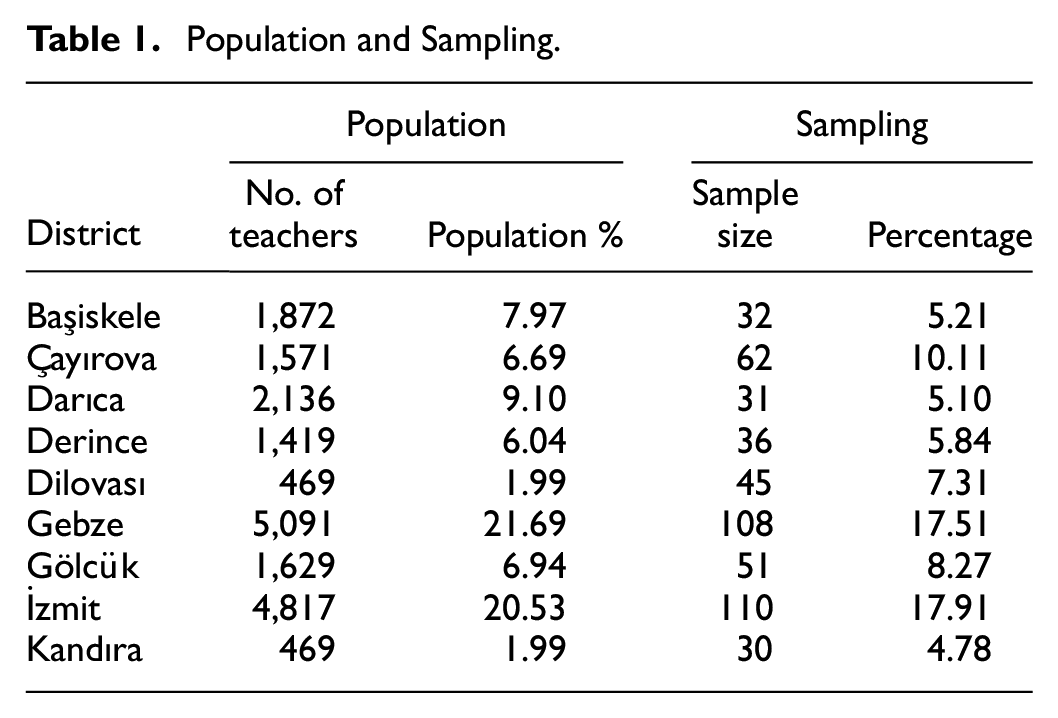
Finally, the number of teachers in each district was determined through simple random sampling. Simple random sampling is a technique in which every element in the population has an equal chance and probability of being selected (Meadows, 2003). A population ranging from 5,000 to 50,000 can be represented by a sample of 381 people with a 5% error margin and 95% confidence level. It was deemed appropriate to take 40% more of this sample size in case of low response rate to the scales (Saunders et al., 2015). Thus, we considered a sample size of 645. Responses to some of the items were missing which made it difficult to include them in analysis. It is well-known fact that missing values can severely distort the results of analysis even replaced by mean (Pallant, 2020). Therefore 32 cases were excluded and the sample group was formed with the data of 613 participants. The demographic features of the sample group are presented in Table 2.
Demographic Features of the Sample Group.

Of the participants in the sample group 373 were female, and 240 were male teachers. There were 183 preschool and class teachers, 49 mathema, 60 Turkish-literature, 46 natural sciences, 49 history and geography, 45 art, music, and physical education, 25 special education and psychological counselling and guidance, 34 information technologies, technology and design, and vocational, 54 religious culture and moral knowledge, and 68 foreign language teachers.
Data Collection Tools
After an extensive review of the literature, the research data were collected through the “Leader-Member Exchange Scale,”“Schools’ Openness to Change Scale,” and “Political Skill Inventory” in this study. The following are the quantitative data collection tools used in the study:
Perceived-School Principals’ Political Skills Scale (P-SPPSS) developed by the researchers of this study based on the literature review.
LMX Scale developed by Liden and Maslyn (1998) and adapted in the Turkish context by Göksel and Aydıntan (2012).
Schools’ Openness to Change Scale developed by Smith and Hoy (2007) and adapted in Turkish context by Demirtaş (2012).
Perceived-School Principals’ Political Skills Scale
In recent years, researchers and practitioners have shown great interest in the concept of political skill. This is because it has been found to have a strong connection with work success in different industries, contributing to a better understanding of how organizations function (Jacobson & Viswesvaran, 2017; Kwon, 2020; Salisu & Awang, 2016). The most frequently used tools in the literature to measure the political skills of administrators is “Political Skill Inventory” developed by Ferris et al. (2005). It has a four-factor and 18-item structure adapted in Turkish by Atay (2010). This tool measures the political skills of its responders. The factors of the inventory comprise social astuteness, interpersonal influence, networking ability, and sincerity (Ferris et al., 2005). All items are scored on a 5-point Likert scale. This tool allows principals to assess their political skills. However, the purpose of this study was to examine the political skills of school principals based on teacher perceptions. Thus, it was necessary to reorganize PSI based on teacher perceptions, develop a new scale and further assess the reliability and validity of the scale. The items in PSI were rewritten in terms of teachers’ perceptions and new items were added to the scale based on the literature review. The question pool, consisting of 22 items was submitted for review to three subject matter experts in educational administration departments and based on their feedback, two items were removed due to their lacking ability to measure correlations in the questions. Next, the 20-item draft scale was submitted for review to Turkish language experts for correction of grammar and language errors. The 20-item scale was applied to a different sample (determined through convenience sampling method) consisting of 225 teachers working in the Düzce province to conduct exploratory and confirmatory factor analysis. Convenience sampling is a type of sampling in which members of the target population who fulfil certain practical criteria, such as easy accessibility, are included in the study for reasons such as geographical proximity or willingness to participate at a given time.
The elements in the sample may be selected because they are spatially close to the place where the researcher carries out the data collection. For this reason, convenience samples are sometimes also considered as random samples (Etikan et al., 2016). Statistical Package for Social Science (SPSS Ver. 22) was utilized for statistical data analysis. The scale factors were determined through the Exploratory Factor Analysis (EFA). The value for Kaiser-Meyer Olkin (KMO) test was 0.835 which is greater than .70 (considered the minimum acceptable level). The result of the Bartlett spherical test was significant at 5% confidence level since p = .000 < .05. Thus, the data collected using the draft scale was found to be suitable for EFA according to the values obtained through the KMO and Bartlett test (Çokluk et al., 2012).
Cronbach’s Alpha test and Spearman-Brown split-half test values were obtained as .973 and .962 respectively. These were examined to assess the internal consistency of the “Perceived-School Principals’ Political Skills Scale” (SPPSS). The EFA was performed on the data obtained by first applying the scale whose reliability and validity were proved. The EFA revealed the four dimensions with Eigen values above 1. Varimax orthogonal rotation was performed on the loaded items. The factor loading values of all items were above .32 which is the minimum acceptable level. Later, the overlapping item were examined with the dimensions. Accordingly, items 1, 2, 8, 13, 14, and 18 were removed from the scale as their factor overlapping values were lower than .10. Finally, the developed scale consisted of four factors and 14 items. The P-SPPSS was developed based on teacher perceptions which comprised four subdimensions of “social astuteness,”“sincerity,”“interpersonal influence,” and “networking ability” in line with the literature. The results of Cronbach’s Alpha, for the subdimensions of the scale are given in Table 3.
Cronbach’s Alpha Test Result for P-SPPSS Subdimensions.

Cronbach’s Alpha test results for the subdimensions of P-SPPSS were over .70, the minimum acceptable value. The results show the reliability of the scale with its subdimensions. Following the EFA, the developed scale was applied to 613 teachers working in the Kocaeli province. The fit indices were calculated (by using the data obtained from the actual survey application) through the Confirmatory Factor Analysis (CFA) run with the LISREL 8.7 programme were as Normed Fit Index (NFI) = 0.96, Non-Normed Fit Index (NNFI) = 0.97, Root Mean Square Error of Approximation (RMSEA) = 0.006 Comparative Fit Index (CFI) = 0.98, Incremental Fit Index (IFI) = 0.98, Goodness of Fit Index (GFI) = 0.93, Adjusted Goodness of Fit Index (AGFI) = 0.89, and (χ2/SD) 1.86. The results of the CFA confirmed the structure of the P-SPPSS, the fit indices, (χ2/SD, SRMR, NFI, NNFI, and CFI) demonstrate perfect compliance, while another part (RMSEA, GFI, and AGFI) are at an acceptable level (Hu & Bentler, 1999). The table of fit indices confirmed the four-dimensional structure of the P-SPPSS with the results of the EFA after being applied to 225 teachers.
Leader-Member Exchange Scale
The Leader-Member Exchange Scale (LMXS) is a 4-dimension scale developed by Liden and Maslyn (1998) and adapted in the Turkish context by Göksel and Aydıntan (2012). Cronbach’s Alpha test results of the scale and its subdimensions are shown in Table 4.
Cronbach’s Alpha Test Result for LMXS.

The reliability of the scale was measured using coefficient of internal consistency while construct validity was tested using CFA. The CFA results confirmed the structure of the LMXS, the fit indices obtained were NFI = 0.99, NNFI = 0.99, RMSEA = 0.008 CFI = 0.99, GFI = 0.94, AGFI = 0.89 and (χ2/SD) 3.84. Thus, a part of the fit indices demonstrate perfect compliance (Standardized) Root Mean Square Residual (SRMR) ≤ 0.08, 0.90 ≤ NFI, 0.90 ≤ NNFI, 0.90 ≤ CFI) while the other (0.06 ≥ RMSEA, 0.90 ≤ GFI, 0.90 ≤ AGFI) is at an acceptable level (Çokluk et al., 2012; Hu & Bentler, 1999). However, the χ2/SD value was slightly above the minimum acceptable level (0 < χ2/SD < 3). However, the model is feasible since the indices with perfect and good compliance were significantly high in the CFA (Schermelleh-Engel et al., 2003).
Schools’ Openness to Change Scale
This study used the Schools’ Openness to Change Scale (SOCS) developed by Smith and Hoy (2007) and adapted in the Turkish context by Demirtaş (2012). The scale consists of three dimensions and 19 items. The dimensions of the scale are “Teachers’ Openness to Change,”“School Principals’ Openness to Change,” and “School Environment’s Pressure for Change.” The items related to the dimensions “teachers’ openness to change” and “school principals’ openness to change” were used in the research to comply with the purpose of the study. Cronbach’s Alpha test results for the scale and its subdimensions are given in Table 5.
Cronbach’s Alpha Test Results for the Schools’ Openness to Change Scale.

The CFA results confirmed the structure of the LMXS, the fit indices calculated were, NFI = 0.99, NNFI = 0.99, RMSEA = 0.005 CFI = 0.99, GFI = 0.97, AGFI = 0.94, and (χ2/SD) = 2.62. Thus, a part of the fit indices demonstrates perfect compliance (SRMR ≤ 0.08, 0.90 ≤ NFI, 0.90 ≤ NNFI, 0.90 ≤ CFI, 0.90 ≤ GFI, 0.90 ≤ AGFI) while the other part (0 < χ2/SD < 3, 0.06 ≥ RMSEA) is at an acceptable fit (Çokluk et al., 2012; Hu & Bentler, 1999).
Data Analysis
Many study designs use mediating variables analysis with social sciences in the lead (Hayes, et al., 2016). Baron and Kenny (1986) state three criteria for analyzing the mediating variable.
The independent variable has a significant effect on the mediating variable.
The mediating variable has a significant effect on the dependent variable.
The independent variable has a significant effect on the dependent variable.
The adequacy of the measurement model’s fit was confirmed by the utilization of SPSS Amos for Structural Equation Modeling (SEM). Ideally, the values for each variable in the dataset should be normally distributed to examine the suitability of the data for analysis (Tabachnick & Fidell, 2012). The skewness and kurtosis values were calculated using SPSS to examine the distribution. According to George and Mallery (2019) the Z scores obtained by dividing the skewness and kurtosis values into their standard errors for normally distributed data should lie between −2 and 2, Tabachnick and Fidel (2012) determine these to be between −1.5 and 1.5. The results of kurtosis and skewness of the data for normality are displayed in Table 6. These show the skewness and kurtosis coefficients to be within the acceptable range for each of the three variables.
Skewness and Kurtosis Values.

Consequently, parametric tests were performed on the data due to its normal distribution. Linearity addresses the linear relationship between independent and dependent variables (Field & Wilcox 2017). The homogeneity of the variances assumes the variance of the predicted variables to be constant at all levels of the predictor variables. In other words, the variances of the dependent variable are equal for each level of independent variables (Aldrich & Cunningham, 2016; Field & Wilcox, 2017). It is possible to control the variance linearity and homogeneity with a single graphic (Pallant, 2020), shown in this study through the scatter diagram (Supplemental Annexure). A high level of linear association should not exist between two or more predictor (independent) variables in research models that include more than one predictor (independent) variable (Field & Wilcox, 2017) to obtain accurate results from the analysis. The statistics for the multicollinearity of the predictor variables are displayed in Table 7.
The Statistics of the Multicollinearity of the Predictor (Independent) Variables.
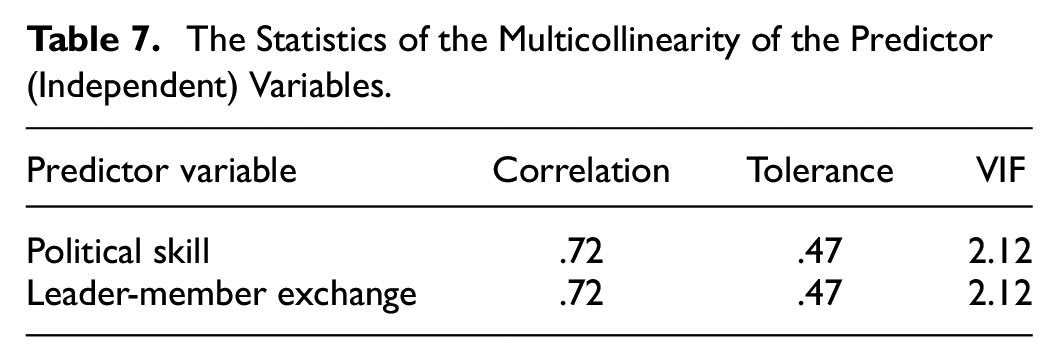
The Variance Inflation Factor (VIF) and Tolerance values of the predictor variables given in Table 7 reveal that the VIF values were lesser than 3 and tolerance values were greater than 0.2. The correlation (r = .72, p < .01) between the predictor variables, was less than .75. Hence, high level of correlation between the predictor variables was not observed. Thus, the predictor variables were independent of each other (Field & Wilcox, 2017). The study utilized SEM to analyze the underlying relationships between the latent constructs.
Results
According to the findings, the social astuteness factor and the interpersonal influence factor had the lowest (
Arithmetic Mean and Standard Deviation Values of SPPSS.

The arithmetic means and standard deviation values for the factors (Affect, Contribution, Loyalty, and Professional Respect) derived through the measurement of LMX teachers maintained with their principals are given in Table 9. The findings indicate that the average LMX between teachers and principals are at the lowest and highest level in the “affect” dimension (M = 3.79, SD = 1.03) and the “contribution” dimension. (M = 4.19, SD = 0.91) respectively. The averages for both dimensions are at the level of “agree.”
The Arithmetic Means and Standard Deviation Values for the LMX Factors.

The arithmetic means and standard deviation values of the data obtained by measuring schools’ openness to change are depicted in Table 10 which demonstrates that both the teachers’ (M = 3.75, SD = 0.81)and the school principals’ (M = 3.99, SD = 0.95) openness to change is at the level of “agree”. Consequently, the participant teachers consider themselves and their principals as open to change.
The Arithmetic Means and Standard Deviation Values of SOC Scale.

Pearson’s correlation coefficients were calculated and analyzed in a matrix to correlate the quantitative data. The values of correlation coefficients can range from −1 to +1 with −1 and +1 indicating a negative and positive correlation respectively .10 ≤ r < .30 indicates a weak correlation. .30 ≤ r < 50 points to a moderate correlation, and r ≥ .50 shows a strong correlation between the variables. The analysis of Pearson’s Correlation Coefficient ascertained the correlation between the dimensions of teachers’ openness to change, social astuteness, networking ability, interpersonal influence, and sincerity. (Aldrich & Cunningham, 2016; Field & Wilcox 2017). The results for Pearson’s Correlation Analysis displaying the subdimensions of the variables are given in Table 11, which indicate a significant positive correlation between independent, mediating, and dependent variables.
Pearson’s Correlation Analysis.

Significant at p < 0.01.
In order to address the study’s research questions, the proposed model, which assumes the relationships between the variables, was analyzed using the AMOS software. The maximum likelihood method and variance-covariance matrices were used as input for the analysis. The results indicated that all of the path coefficients were statistically significant (p < .05) and the fit indices were also deemed satisfactory. To clarify, the findings from the SEM analysis provided evidence for all the relationships in the structural model. The fit indices of the model obtained as a result of the analysis are presented in Table 12.
Goodness-of-Fit Indices (GFI) of the Model.

It is concluded that some of the fit indices presented in Table 12 show excellent fit (0 < χ2χ2/SD < 2, SRMR ≤ 0.08, 0.90 ≤ NFI, 0.90 ≤ NNFI−TLI, 0.90 ≤ CFI) and some of them show good acceptable fit (0.06 ≥ RMSEA, 0.90 ≤ GFI, 0.90 ≤ AGFI) (Kline, 2023). The SEM results (Figure 2) show that school principals’ political skills has a strong statistically significant direct effect on LMX (β = .926, R2 = .61, t = 25.446, p < .001). This suggests that school principals who use their political competences could create quality leader-member interactions. In terms of the second research question, the results of the analyses showed that political skills of school principals had a significant and positive effect on schools’ openness to change (β = .379, R2 = .25, t = 4.561, p < .001). When the SEM results were analyzed in terms of the third sub-question of the study, it was seen that leader member exchange was a significant and positive predictor of schools’ openness to change (β = .395, R2 = .29, t = 7.493, p < .001).

Mediating role of LMX on the relationship between schools’ openness to change and political skills school principals.
Finally, the results of the analysis showed that when leader-member exchange was included in the model, it supported political skill and had a positive and significant effect on schools’ openness to change. The leader-member interaction between school principals and teachers confirms that it acts as a mediating variable between the political skills of school principals and schools’ openness to change.
Discussion
This study highlights the significance of LMX quality between school principals and teachers in mediating the relationship between school principals’ political skills and schools’ openness to change. The results emphasize the significance of cultivating favorable relationships between leaders and followers in educational environments. Enhancing the quality of LMX enables administrators to cultivate a school atmosphere that is more receptive and flexible, hence facilitating the implementation of change efforts. To gain 21st century skills, educational reforms are an urgent requirement. The implementation of these educational reforms brings about changes in educational organizations, involving school principals, teachers and other stakeholders. Educational change is a complex process consisting of many aspects (Fullan, 2002). School leaders may encounter difficulties in applying and maintaining change in response to internal and external influences (Salinas, 2010). Nevertheless, it is known that school principals’ relationships and skills with teachers can provide an advantage for teachers to be open to change. Some studies have revealed remarkable findings at this point. For example, the effect of LMX and transformational leadership on teachers’ innovative behaviors was emphasized (Vermeulen et al., 2022) and within the framework of LMX theory, it is stated that managers who establish high quality relationships with their employees can facilitate the change process in their organizations (Van Dam et al., 2021). In particular, the political skills of school principals and the role of leader-member exchange are seen as variables that are suggested to be effective. For example, it has been emphasized that perceptions of organizational politics mediate the relationship between leader-member exchange and schools’ openness to change, and that the quality of the relationship between leaders and members can significantly affect organizational processes in schools (Drory et al., 2022; Maharvi et al., 2023).
The findings of this study based on teacher perceptions, reveal that the school principals’ political skill significantly predicts LMX. Previous studies have verified the relationship between political skill and LMX (Brouer et al., 2011; K. J. Harris et al., 2009; Kimura, 2013). These results suggest that school principals need to use their political skills effectively in realizing quality leader-member interactions with teachers and the important effect of developing these skills in the relationships. In conclusion, the school principals increasingly affect the LMX between them and teachers by using their political skills.
The findings indicate that the political skill of school principals significantly predicts schools’ openness to change which is similar to results of other studies (Chawla & Kelloway, 2004; Wanberg & Banas, 2000). Organizations can achieve the desired change by investing in their leaders’ political skills. Employing leaders with high-level political skills can play a critical role in the change process since change is an emotional process, and leaders’ behaviors can influence employees (Cheema, 2008). Therefore, school principals use their political skills (such as being sincere, gaining trust by establishing networks to solve problems encountered during the change process, and using skills for interpersonal influence) to make an impact on teachers’ and therefore schools’ openness to change. According to Gallagher et al. (2019), school principals use of political skills, persuasion, and reputation function as change agents in achieving change while building trust. Some research findings on resistance to change also support the findings of our study. For example Patterson (2013) ascertains that political skill reduces resistance to change. Pieterse et al. (2012) state that the differences in discourse could increase the resistance to change. When we consider the innovativeness of employees, it can be argued that the innovative behaviors of employees who are open to change are supported by political skill. As a matter of fact Grosser et al. (2018) demonstrate a positive relationship between political skill and employee innovation. Employee innovation mediates the relationship between political skill and job performance.
The findings reveal that there is a significant positive and moderate relationship between teachers’ perceptions of openness to change and the subdimensions of LMX (affect, contribution, loyalty, and professional respect). Previous LMX research similarly suggests that managers influence employees’ perceptions of change by developing high-quality relationships with their subordinates (Graen & Uhl-Bien, 1995; Van Dam et al., 2008). To conclude, LMX between school principals and teachers predicts schools’ openness to change significantly. Therefore, both school principals’ political skills and LMX affect schools’ openness to change at a positive and moderate level. Puspitasari and Mangundjaya (2020) identify a positive and significant relationship between LMX and emotional commitment to change. Thompson (2018) ascertains a positive and significant relationship between readiness for change and LMX, consistent with this study’s results. Similarly, Van Dam et al. (2021) indicate a positive and significant relationship between LMX and participation to change.
The findings demonstrate that school principals’ political skill is a significant and fundamental predictor variable of schools’ openness to change, and LMX is the mediating variable for schools’ openness to change. Therefore, school principals’ political skills affect their LMX with teachers and therefore contribute to teachers’ openness to change, which is similar to Crary’s (2019) study, which states that teachers’ interactions with their school principals are crucial to schools’ openness to change. In addition, García-Chas et al. (2019) assert that leaders and employees with high political skills get a higher level of organizational support. Political skills can play a critical role in supporting employees who worry and fear about the changes supporting the results of this study (Block, 2016). According to Van Dam et al. (2008), employees engaged in high-level LMX are less resistant and easily adjust to change. Roczniewska and Higgins (2019) ascertain that employees perceive fair treatment when their leaders communication of the change enables them to think positively and become more open to change.
Conclusion and Recommendations
The positive effect of LMX between school principals and teachers on the political skills of school principals and the openness to change of education employees is the key finding of this study. In this case, it can be suggested that activities to support the quality of leader-member interactions in schools should be carried out. Political skill and LMX focus on the strong relationships between the leader, employees, and stakeholders, thus, communication skills are important and channels of communication in schools should be kept open. This necessitates effective use of mass media, elimination of existing barriers in personal dialogue, accessibility of school principals, and encouraging people to establish communication. This study has significant practical implications. School principals should prioritize building trust, mutual respect, and open communication with teachers. All of these factors have the potential to improve the schools’ openness to change. In addition, leadership development programs should include instruction on political skills and the cultivation of relationships to assist principals in effectively leading innovative activities inside their educational institutions. Schools should prioritize the assessment of the quality of LMX relationships as a crucial element in fostering a culture characterized by transparency and preparedness for embracing change. Principals and other leaders should give top priority to creating strong and positive relationships with teachers in order to foster a supportive atmosphere for initiatives aimed at organizational change.
This study has several limitations. Firstly, the sample of the study was conducted with a limited group of teachers in only a certain province of Turkey. Although Kocaeli is a developed province in Turkey with a large population with many people from different provinces, the effect of LMX reinforced by principals’ political skills on openness to change should be examined in different samples. In addition, the period when the data of the study were collected coincided with the beginning of the Covid-19 pandemic. Therefore, some data were lost and the authors experienced difficulties during the data collection process. Another limitation of this study is that it measured schools’ openness to change based on the teachers’ views only.
Despite these limitations, we believe that our findings have meaningful implications. It is seen that more research is needed on how school principals can reveal and exhibit LMX and political skills that contribute to schools’ openness to change. While this study contributes to the findings of other studies that school principals are the leaders of change, future research can focus on how LMX and political skills can be developed. Future research should focus on exploring the complex relationships between LMX, political skill, and organizational behavior in educational settings and may aim to clarify the processes through which high-quality leader-member interactions influence organizational outcomes. Ultimately, these studies may provide valuable insights for leadership development programs and practices and enable educational leaders to skillfully drive change in schools. Furthermore, longitudinal studies can provide insights into the long-term effects of LMX quality on openness to change.
Supplemental Material
sj-doc-1-sgo-10.1177_21582440241273936 – Supplemental material for Leader Member Exchange as a Mediator of the Relationship Between Schools’ Openness to Change and Political Skills of School Principals
Supplemental material, sj-doc-1-sgo-10.1177_21582440241273936 for Leader Member Exchange as a Mediator of the Relationship Between Schools’ Openness to Change and Political Skills of School Principals by Bekir Bilge and Tuğba Konaklı in SAGE Open
Footnotes
Author Note
This paper is derived from the doctoral thesis authored by the first author under the supervision of the second author.
Declaration of Conflicting Interests
The author(s) declared no potential conflicts of interest with respect to the research, authorship, and/or publication of this article.
Funding
The author(s) received no financial support for the research, authorship, and/or publication of this article.

Data Availability Statement
Data sharing not applicable to this article as no datasets were generated or analyzed during the current study.
Supplemental Material
Supplemental material for this article is available online.
References
Supplementary Material
Please find the following supplemental material available below.
For Open Access articles published under a Creative Commons License, all supplemental material carries the same license as the article it is associated with.
For non-Open Access articles published, all supplemental material carries a non-exclusive license, and permission requests for re-use of supplemental material or any part of supplemental material shall be sent directly to the copyright owner as specified in the copyright notice associated with the article.
