




Abstract
Based on Perry’s Public Service Motivation Theory, this paper aims at (1) measuring public service motivation of village cadres and the effectiveness of rural living environment governance; (2) examining the public service motivation of village cadres as a factor potentially influencing the effectiveness of rural living environment governance. Through the survey of village heads, the village party secretaries and villagers in 118 villages in south-central China, an empirical study on the impact of village cadres’ public service motivation and effectiveness of rural living environment governance is conducted. Empirical results indicate that village cadres’ public service motivation (four dimensions) positively influences the effectiveness of rural living environment governance (three aspects). Therefore, we could consider more about perspective of village cadres’ public service motivation for improving the effectiveness of rural living environment governance.
Introduction
With the continuous development of society and the economic progress of rural regions, problems in the rural living environment (RLE) have also gradually come to light; in particular, the management of domestic garbage and sewage and architectural planning have become the focus of RLE renovation. Rural living environment governance refers to the full use of available resources to help a rural community overcome its problems and achieve environmental governance goals, and the implementation of specific governance measures to optimize the RLE and improve the sense of gain, happiness, and security of villagers. RLE governance is a collective effort involving various stakeholders, including villagers, private sectors, social organizations, various groups, and local governments (Yun, 2020). From 2015 to 2019, the No. 1 Document of the Chinese central government has listed requirements and measures for RLE renovation. The year 2020 was specified as the decisive year for China to build a moderately prosperous society in all respects. Therefore, it is increasingly crucial to accelerate RLE renovation. Village cadres are the specific executors of national policy and local government administrative tasks. They constitute the main body of village public affairs governance, playing the dual role of state agents and village leaders (Wu, 2002; Zhu & Wei, 2019). In accordance with the Chinese saying, “one thousand lines above, one needle below” (Wang & Shu, 2018), the central government needs to rely on the “needle,” that is, the village cadres, for the grassroot implementation of reasonable scientific RLE governance strategies formulated at the central level. To a certain extent, the competency and caliber of village cadres determine the effectiveness of RLE governance in China. China has nearly 600,000 administrative villages, 2.6 million natural villages, and a rural population exceeding 600 million (He, 2016). However, the impact of RLE governance across different rural communities is uneven. This difference in the effectiveness of RLE governance is largely a result of the differences in the motivation and attitude of village cadres.
Some highly driven village cadres with a sense of mission and responsibility are determined to improve the living environment of the village area under their jurisdiction, while others who are dragging along, lazy, and indolent neglect this task. Therefore, different village cadres achieve different results in RLE governance. To resolve this problem, it is crucial to deeply explore the motivation behind the governance behavior of village cadres. The study of public service motivation (PSM) provides an excellent perspective for explaining the professional actions and behavior of Chinese village cadres (Wang & Shu, 2019).
Research has mainly focused on factors determining the success or effectiveness of RLE governance. These studies are mostly qualitative analyses that consider village characteristics, villagers, and central policies as the major influencing factors. For example, Peng and Zhang (2019) constructed a rural residential environment quality index system with three dimensions: the living environment, public security, and ecological environment. He relied on the baseline survey data of the National Fixed observation points of the Ministry of Agriculture and Rural Affairs for an empirical analysis of factors affecting RLE quality. The factors included village economic characteristics, village collective economic development level, and village environmental governance. Rural solid waste emissions are also influenced by farmers’ income levels and certain external socio-economic conditions (Huang et al., 2013; Pan et al., 2017), which further affects the effect of RLE governance. Zhang et al. (2018) show that farmers’ satisfaction with village environmental governance is generally high, and the factors negatively affecting satisfaction mainly concern the ecological environment and infrastructure. Min et al. (2019) and other researchers have analyzed in detail the specific factors influencing the participation by farmers of the southwest minority mountainous areas in the improvement of the environment they live in. These studies focused on participation in three endeavors—the introduction of flushing toilets, the discharge of domestic sewage, and the treatment of domestic solid waste. The empirical results show that the household head’s gender and nationality, the family size (number of family members), family wealth, the altitude of farmers’ residences, and the traffic conditions of the village all affect farmers’ participation in RLE governance (Min et al., 2019). Ju and Sun (2010) states that in recent years, China has formulated a series of supporting policies to guarantee comprehensive RLE improvement. To a certain extent, these policies have been helpful in achieving positive results. Due to the dispersed population and underdeveloped economic status of rural China, it is difficult to establish the charges mechanism. Although relevant policies such as “promoting governance with awards” have been established, insufficient funds have greatly hampered the promotion and implementation of RLE governance (Ju & Sun, 2010).
However, literature on the effect of village cadres’ professional attitude and behavior on the success of RLE governance is lacking. Hence, this study attempts to examine the PSM of village cadres as a factor potentially influencing the success of RLE governance. Thus, this study contributes to the knowledge on factors impacting the effectiveness of RLE governance, and seeks to provide a decision-making reference for optimizing the effectiveness of RLE governance.
Literature Review and Hypothesis Development
Index Selection of Village Cadres’ Public Service Motivation and Effectiveness of Rural Living Environment Governance
Perry and Wise (1990) define PSM as “the tendency of individuals to be driven mainly or solely by the motivation of public institutions and organizations.” Perry (1996) operationalized PSM into four dimensions: attraction to public policymaking, compassion, commitment to public interest, and self-sacrifice. “Attraction to public policymaking” emphasizes the desire for political participation based on rationality. “Compassion” refers to love for the people and the desire to protect them, for example, philanthropic patriotism. “Commitment to public interest” refers to the commitment to public interest, civic responsibility, social equity, and other normative motives. “Self-sacrifice” can be simplified as serving others without a reward. Based on Western definitions, Wang and Shu (2018) stated that the village cadres’ PSM refers to the tendency of village cadres to be driven mainly or entirely by the desire to provide public service through village governance within the framework of the public system and governmental organization they work for. Taking into consideration China’s national conditions, they created a scale to measure the PSM of the localized rural village cadres. Village cadres’ PSM measurement scale developed in this study is derived from the scale created by Wang and Shu (2018), with adjustments to reflect the actual situation of the village cadres that were surveyed.
The RLE is the sum of rural human environment, geographical space environment, and natural ecological environment (Li, & Liu, 2010). Rural living environment governance is a management process in which the government, villagers, social organizations, business enterprises, and other stakeholders work together in a coordinated manner to create a clean and beautiful RLE, achieve sustainable development, and ultimately cultivate harmony in the rural community (Li & Liu, 2010). In 2018, the General Office of Central Committee of the Communist Party of China and State Council issued the Three-Year Action Plan for the Improvement of Rural Living Environment, with a focus on rural garbage and sewage treatment and rural beautification. Therefore, this study measures the effectiveness of RLE governance with a narrow focus; it mainly looks at the three areas mentioned before—garbage treatment, sewage treatment, and rural beautification—which are closely related to rural life. The measurement does not directly involve problems related to agricultural production. Garbage treatment includes the placement of garbage cans in the village, the management of cleaning personnel, and the scope of their work, as well as the daily cleaning and transportation of garbage. Sewage treatment includes unified and centralized treatment and discharge of sewage generated in daily life, and the construction of infrastructure such as drainage ditches, river sewage treatment, and eco-friendly toilet renovation. Rural beautification includes the construction of public infrastructure, such as roads, bridges, cultural squares, and village-level libraries, as well as the planning and construction of residential spaces, which involves such activities as the demolition of tin sheds, hollow houses, dilapidated houses, and the livestock enclosures.
The Exposition of Public Service Motivation Theory
With the rise of the western public service movement, the PSM theory appeared. In the West, there have been endless studies on PSM theory, leading to the gradual formation of the school of PSM theory. Together with the traditional theory of Weberian bureaucracy, the theory of representative bureaucracy, and the theory of public choice, PSM theory constitutes the fourth of the theoretical schools describing the behavior of bureaucracy in the West (Lu & Lin, 2019). Drawing on Western PSM theory, Chinese scholars posit PSM as an incentive factor. Some scholars associate it with occupational preference, while others regard it as altruistic motivation, and still others as prosocial behavior (Wise, 2004). Advocates of motivational research on public service have argued that most government workers cite public service and influence on social affairs as important reasons to work for the government, with little regard for monetary rewards or job security. These government employees, who work hard and believe in public service, attach great importance to helping others and benefiting the society, working with self-dedication, and having a strong sense of responsibility and integrity (Chen & Su, 2017). Some empirical studies have found that PSM can significantly improve job satisfaction and career happiness, while also improving individual job performance (Zheng & Zhou, 2017).
Based on the existing research findings related to PSM theory, we can preliminarily infer that village cadres with higher PSM are more likely to work with a sense of responsibility and mission. It is likely that they are more committed to protecting the villagers’ interests, providing more convenient public services, and creating a more pleasant living environment. After the central government issued the decree on RLE improvement, the village cadres’ PSM has formed an internal driving force, pushing them to work harder and accept RLE governance as a responsibility and mission. This sincere attitude has greatly contributed to the success of governance efforts. In view of the above information, this study constructs a model of the relationship between the village cadres’ PSM and the effectiveness of RLE governance (see Figure 1).
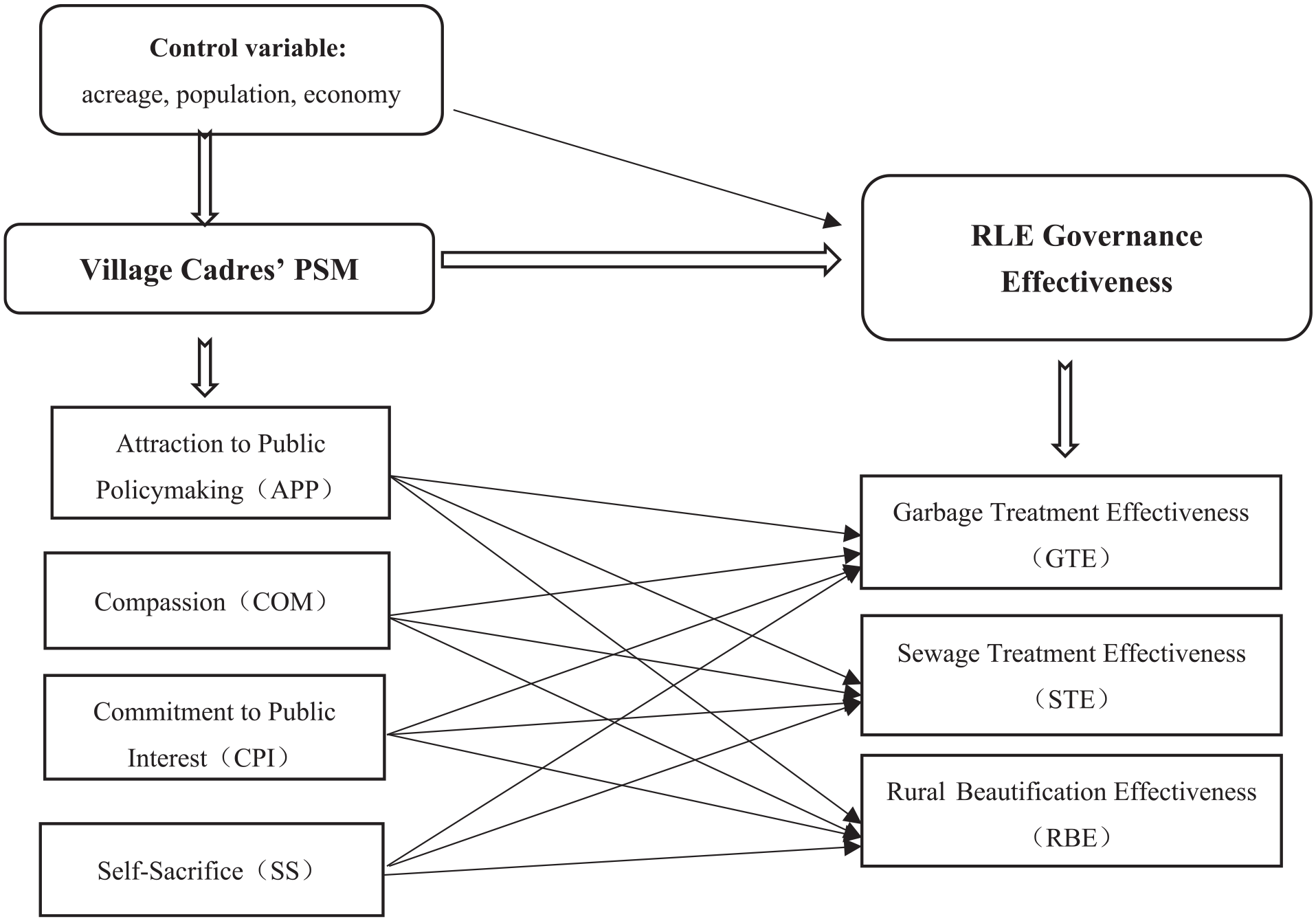
The model of relationship between village cadres’ PSM and the effectiveness of RLE governance.
Research Hypotheses
The governance of rural living environment in China is based on policy issued at the national level and requiring close cooperation between local governments. As a bridge connecting the government and the grassroot villagers, village cadres must undertake extensive routine work. Due to the peculiarities of RLE governance, garbage treatment, sewage treatment, and rural beautification are all being promoted simultaneously in a systematic project involving a wide range of sectors and groups. In this process, village cadres often face several challenges and difficulties. The governance of the rural living environment is not only regarded as a great and arduous task, but also a noble and great cause that encompasses rural revitalization and new rural construction to improve farmers’ health, living standards, and quality of life; narrow the gap between urban and rural areas; and promote urbanization of rural regions.
The PSM theory emphasizes that some individuals desire to participate in public service, help others, and benefit society (Li & Dong, 2012; Sun & Zhou, 2020). Houston (2000) found that public sector employees attach more importance to the sense of achievement from work. Khojasteh (1993) conducted a survey among top managers of government departments, finding that although the salaries of most top managers decreased, they did not care about whether they were compensated or not; rather, serving the public and successfully overcoming challenges were their greatest professional motivations. Wang and Shu (2018) measured the PSM of different groups of rural cadres in China along with the factors influencing it. They found no obvious difference between groups in the level of PSM, and wage income level had no effect on PSM. As reflected in RLE governance, village cadres’ PSM includes enthusiasm about their daily work, a sense of responsibility and mission regardless of their salary and income level, and a willingness to serve and contribute to the governance of their village’s living environment.
The higher the PSM, the higher the individual’s performance (Khojasteh, 1993). Perry and Wise (1990) discussed the assumption of “motivation-performance,” suggesting that PSM is positively correlated with performance in public organizations. Some empirical studies of employees of government departments found that PSM indeed has a positive impact on individual performance (Alonso & Lewis, 2001; Brewer & Selden, 2000; Naff & Crum, 1999). Chinese scholars, including Li and Dong (2012) and Meng and Ma (2010), have also empirically confirmed the relationship between motivation and performance using graduate students and teachers as samples. After investigating villages, the author learned that the evaluation results of RLE governance were also included in the year-end performance evaluation of individual village cadres. Therefore, this paper tries to show that in RLE governance, a high PSM leads village cadres to take initiative, work with the attitude of selfless service, and work with focus and attention. This sincerity strengthens their job performance, enhances the quality and effectiveness of governance work, and thus ultimately helps improve the RLE.
In the light of the above-mentioned findings, this paper proposes the following hypotheses.
Hypothesis 1: The public service motivation of village cadres has a positive impact on the effectiveness of RLE governance.
Hypothesis 1a: The public service motivation of village cadres boosts the effectiveness of village garbage treatment.
Hypothesis 1b: The public service motivation of village cadres boosts the effectiveness of village sewage treatment.
Hypothesis 1c: The public service motivation of village cadres boosts the effectiveness of rural beautification projects.
Research Design
Data Collection
The village cadres and villagers of 118 villages in south-central China were the research participants. The research design involved matching the village head and the village party secretary with two villagers from the same village. In other words, the questionnaire evaluating the village head’s PSM was matched with a questionnaire evaluating RLE governance in the village completed by one villager; similarly, the questionnaire evaluating the village party secretary was matched with a questionnaire evaluating RLE governance completed by the other villager. To clarify, all four of these respondents belonged to the same village. The PSM questionnaire surveying village heads and village party secretaries collected personal background information and assessed attraction to public policymaking, compassion, commitment to public interest, and self-sacrifice. The matching questionnaire surveying villagers measured the effectiveness of RLE governance. It collected the villagers’ personal background information and asked about the outcomes of garbage treatment, sewage treatment, and rural beautification.
Many villages in Jiangxi Province have made remarkable achievements in RLE renovation. Hence, we conducted a preliminary investigation in which we interviewed a number of villagers and village cadres about RLE governance. In this way, we learned that some villages had effectively implemented the garbage treatment projects and significantly improved the living environment. Some villages established sewage pipes and renovated toilets to solve sewage discharge problems. Moreover, with the strong support of the Chinese central government, the renovation of dilapidated old houses and the construction of new infrastructure had significantly improved living conditions in the villages. After understanding this background, we conducted a survey in 118 villages located in Jiangxi Province in central China similar to villages in other regions of China (see Figure 2), and collected data for empirical analysis. A total of 236 questionnaires on village cadres’ PSM were distributed to the village heads and village party secretaries of all participant villages, of which 204 copies were returned. Similarly, 236 questionnaires for evaluating RLE governance were distributed to villagers, of which 219 were returned. In the end, the village cadres’ PSM questionnaires matched 204 questionnaires on RLE governance effectiveness answered by villagers, yielding 204 valid samples for a response rate of 86.4%.

A map of China and plot Jiangxi province where investigation was conducted in blue line.
Measurement of Variables
By referring to Wang and Shu’s (2018) research on village cadres’ PSM, this study measures the village cadres’ PSM based on four dimensions: attraction to public policymaking (APP), compassion (COM), commitment to public interest (CPI), and self-sacrifice (SS). The measurement of APP is including three items such as “I'm interested in making plans for rural development”. The measurement of COM is including eight items such as “It makes me sad to see villagers unfortunate.” The measurement of CPI is including five items such as “I regard it as my duty to serve the villagers.” The measurement of SS is including eight items such as “What is useful to village is far more meaningful than individual achievement.” All items in the scale are scored on a five-point Likert scale: very inconsistent, relatively inconsistent, general, relatively consistent, and very consistent. To afford greater differentiation for each evaluation, this study assigns the following scores for each degree: 1 = very inconsistent, 3 = relatively inconsistent, 5 = neutral, 7 = relatively consistent, and 9 = very consistent.
The measurement of the effectiveness of RLE governance in this study is based on the supervision and examination table of village-level RLE governance as determined by the author in previous research with reference to the governance contents and standards. At the same time, considering the actual situation of this study, the evaluation indices for health environment and landscape style from the measurement and evaluation indices of the RLE of Liu and Chen (2018) were selected. Finally, a questionnaire evaluating the effectiveness of RLE governance was created. Within it, the evaluation of rural garbage treatment effectiveness (GTE) consists of four items on the placement of garbage cans, cleaning and transportation of garbage, the provision of cleaning personnel, and garbage disposal habits of villagers. The evaluation of rural sewage treatment effectiveness (STE) includes four items on the construction of drainage facilities, renovation of toilets, discharge of domestic sewage, and cleanliness of rivers and canals. Finally, the evaluation of rural beautification effectiveness (RBE) includes five items on infrastructure construction, culture-related construction, housing planning and construction, and domestic hygiene. All the questions in this questionnaire were also designed using a five-point Likert scale. The answers and scores were the same as the PSM scale.
In this study, the control variables are: population size, village acreage, and annual village collective economic income. When designing the questionnaire, based on interviews and surveys, the author divided the village population into five categories: less than 1,000 people; 1,000–2,000 people; 2,000–3,000 people; 3,000–4,000 people; and more than 4,000 people. The village area is divided into: less than 5 square kilometers, 5–10 square kilometers, 10–15 square kilometers, and over 15 square kilometers. The annual village collective economic income includes five categories: less than 100,000 yuan; 100,000–200,000 yuan; 200,000–300,000 yuan; 300,000–400,000 yuan; and more than 400,000 yuan.
Empirical Results and Analysis
Common Method Deviation Test
Common method deviation is a systematic error. In order to address it, this study first took relevant measures at the stage of data collection, that is, in the measurement of village cadres’ PSM, by issuing questionnaires to village heads and village party secretaries in different periods, and in the measurement of the effectiveness of rural human settlement environment governance by considering different genders, age groups, and other demographic factors. This resulted in a questionnaire on the PSM of village cadres and a questionnaire on the effectiveness of RLE governance completed by the corresponding villagers. Second, Harman’s single factor test was adopted in this study to measure common method deviation. SPSS 22.0 was used to conduct exploratory factor analysis of all questions in the questionnaire. The results showed that there was more than one factor with a characteristic root greater than 1, whose variance interpretation degree was 35.9%, which was less than the standard criterion of 40%. Therefore, the data in this study were less affected by common method deviation.
Reliability and Validity Tests
In this study, exploratory factor analysis was conducted on the PSM scale of village cadres and the effectiveness scale of RLE governance. A KMO value (see Table1) was obtained above 0.8, indicating that scale validity was relatively high. After the questionnaire data were collected, SPSS 22.0 was used for analysis. The results showed that the Cronbach’s α coefficient of the four categories of village cadres’ PSM is above 0.6 (see Table 2), and the Cronbach’s α coefficient of the total table of village cadres’ PSM is 0.759, indicating that the overall internal consistency is good. The same analysis was carried out on the data on the effectiveness of RLE governance. It was concluded that the Cronbach’s α of the three dimensions were all above .8, and the Cronbach’s α coefficient of the total scale of the effectiveness of RLE governance was .889, indicating that the overall internal consistency is close to ideal. Thus, the scale adopted in this study has qualified reliability.
The KMO Value of Variables in the Questionnaire.

Cronbach’s α Coefficient of Variables in the Questionnaire.

Describe Statistics and Correlation Analysis
The results of descriptive statistics (see Table 3) show that the mean value of the four factors of village cadres’ PSM was above 8.30, which is a high level. The mean value of the three factors representing the effectiveness of RLE governance was above 7.20, which also reflects a significant effectiveness of governance.
Descriptive Statistics and Correlation Analysis Results (N = 204).

Note. **Indicates that the correlation is significant at the 0.01 level (double tail); M = Mean; SD = Standard Deviation.
According to the Pearson correlation coefficient of four variables of village cadres’ PSM and three variables of RLE governance effectiveness, there were significant correlations among attraction to public policymaking, compassion, commitment to public interest, self-sacrifice, garbage treatment effectiveness, sewage treatment effectiveness, and rural beautification effectiveness. Overall, the correlation coefficients between all variables were mostly lower than 0.75, indicating that the design of each measurement index ensures good distinctiveness from the others, justifying the application of regression analysis.
Regression Analysis
Hierarchical regression analysis was used in this study. The village acreage, population, and collective economic level were the control variables, and the effectiveness of garbage treatment, sewage treatment, and rural beautification were the dependent variables. The independent variable village cadre PSM was analyzed by regression for these three dependent variables, and the results are shown in Table 4.
Statistics Analysis of Regression Model (N = 204).

Note. Independent variables: a-garbage treatment effectiveness; bsewage treatment effectiveness; crural beautification effectiveness; *p < .1. **p < .05. ***p < .01.
According to model 1a, village acreage (β = −.011, p > .1), population size (β = −.082, p > .1), and collective economic level (β = −.009, p > .1) were negatively correlated with garbage treatment effectiveness, without any significant correlation. According to model 1′a, the four dimensions of attraction to public policymaking (APP; β = .147, p < .01), compassion (COM; β = .381, p < .01), commitment to public interest (CPI; β = .370, p < .01), and self-sacrifice (SS; β = .208, p < .01) under the PSM of village cadres have significant positive correlation with garbage treatment effectiveness. Therefore, Hypothesis H1a is supported.
According to model 2b, village acreage (β = −.018, p > .1), population size (β = −.023, p > .1), and collective economic level (β = −.060, p > .1) were negatively correlated with the sewage treatment effectiveness, without any significant correlation. As can be seen in model 2′b, APP (β = .127, p < .01), COM (β = .374, p < .01), CPI (β = .096, .05 < p < .1), and SS (β = .511, p < .01) were significantly positively correlated with the sewage treatment effectiveness. Therefore, Hypothesis H1b is supported.
According to model 3c, village acreage (β = −.037, p > .1), population size (β = −.041, p > .1), and collective economic level (β = −.082, p > .1) were negatively but non-significantly correlated with the rural beautification effectiveness. According to model 3c, APP (β = .090, .05 < p < .1), COM (β = .443, p < .01), CPI (β = .208, p < .01), and SS (β = .411, p < .01) were significantly positively correlated with rural beautification effectiveness. Therefore, Hypothesis H1c is supported.
Discussion
Generally, RLE governance follows two pattern: spontaneous governance and cooperative governance (Yun, 2020). Spontaneous governance refers to a voluntary and mutual assistant governance mode reached by villagers, families or collectivities through consultation based on the living environment problems they faced. The goal is to improve the environment of the village on which villagers live together. Spontaneous governance has a strong nature of mutual assistance, so it is also considered as a kind of “mutual assistance governance.” Cooperative governance refers to a governance mode oriented to solve rural living environment problems, which is led by the government and jointly participated and cooperated by other multiple subjects. The government is the leader whose function is to control the overall situation, provide resources and information for multiple subjects, and make governance decisions and policies. In contrast, other subjects such as villagers, social organizations and enterprise organizations only supplement and assist governance, playing the role of cooperators.
Regardless of whether governance is spontaneous or cooperative, it is inseparable from the key group, village cadres. On the one hand, village cadres are originally elected from among the villagers; they live in their villages, and naturally connect with villagers, village traditions, and customs. Thus, village cadres have special advantages in RLE governance that afford them the opportunity to practice spontaneous governance. On the other hand, they are the nerve endings of state administrative power. As front-line implementers of government policies, they also cooperate with enterprises, villagers, county government officials, and other parties to jointly implement RLE governance. This cooperation and mutual assistance promotes the effectiveness of RLE governance. According to research and the current practices of rural living governance in China, we also found that the factors affecting RLE governance are diverse, including policy formulation and institutional supply at the government level, profit-seeking attributes of enterprises at the market level, and villagers’ weak awareness of environmental protection and poor family circumstances at the village level (Yun, 2020). This study revealed that village cadres’ PSM has a positive impact on RLE governance. Good leaders are adept at providing resources and information for collective action through their positional power, alertness to opportunities, social skills, and social connections, which improves the efficiency of policymaking and optimizes the effectiveness of policy implementation (Einwohner, 2007; Glowacki & von Rueden, 2015; Theesfeld, 2004). As village leaders, village cadres generally manifest strong PSM. In policymaking, they closely follow the policy instructions of the central government and take scientific and feasible steps in RLE governance. At the same time, village cadres sympathize with their villagers, regarding the optimization of the RLE and improvement of the quality of life of villagers as their aims. The self-sacrificial spirit of village cadres is also reflected in their striving for more manpower, material, and financial resources to improve rural living environment governance through their own social skills and connections, so as to speedily meet the standards of county government in RLE governance. Village cadres make a commitment to the county government and villagers, which improves the village’s living environment, whether regarding garbage management, sewage treatment, or rural beautification, all for the realization of a good RLE. This not only verifies the hypothesis mentioned above but also enriches the practical exploration of the influencing factors of RLE governance.
Research Conclusion and Prospects
Research Conclusion
This study uses empirical research to demonstrate the relationship between the PSM of village cadres and the effectiveness of RLE governance. The above analysis verified all three sub-hypotheses, H1a, H1b, and H1c; that is, the PSM of village cadres is positively correlated with the effectiveness of garbage treatment, sewage treatment, and rural beautification. In terms of garbage treatment, the compassion (β = .381, p < .01) and commitment to public interest (β = .370, p < .01) of village cadres were more important than attraction to public policymaking and self-sacrifice. In terms of sewage treatment, the four dimensions of village cadres’ PSM were positively correlated with sewage treatment effectiveness; the self-sacrifice of village cadres (β = .511, p < .01) had a strong influence on sewage treatment. In terms of rural beautification, the compassion (β = .443, p < .01) and self-sacrifice (β = .411, p < .01) of village cadres had a stronger positive influence on the effectiveness of rural beautification than the other factors. In summary, village cadres’ PSM has a significant impact on RLE governance.
Policy Implications
Cultivating a contingent of high-caliber village cadres at the grassroot level is necessary for implementing the rural revitalization strategy and building a new socialist countryside with Chinese characteristics. Village cadres are the backbone of rural construction, providing public services for the rural frontline, and undertaking arduous tasks in rural governance. The governance of the rural living environment is also an important part of rural revitalization and new rural construction. However, different villages have significant differences in governance outcomes, which can be explained to a certain extent by the level of village cadres’ PSM. Therefore, from the perspective of village cadres’ PSM, it is particularly important to understand the role of village cadres’ attraction to public policymaking, compassion, commitment to the public interest, and self-sacrifice, respectively, in RLE governance. In combination with the above research conclusions, this paper proposes a driving model diagram (Figure 3) to promote the effectiveness of RLE governance from various dimensions of village cadres’ PSM, so as to provide more targeted suggestions for improving the effectiveness of governance.
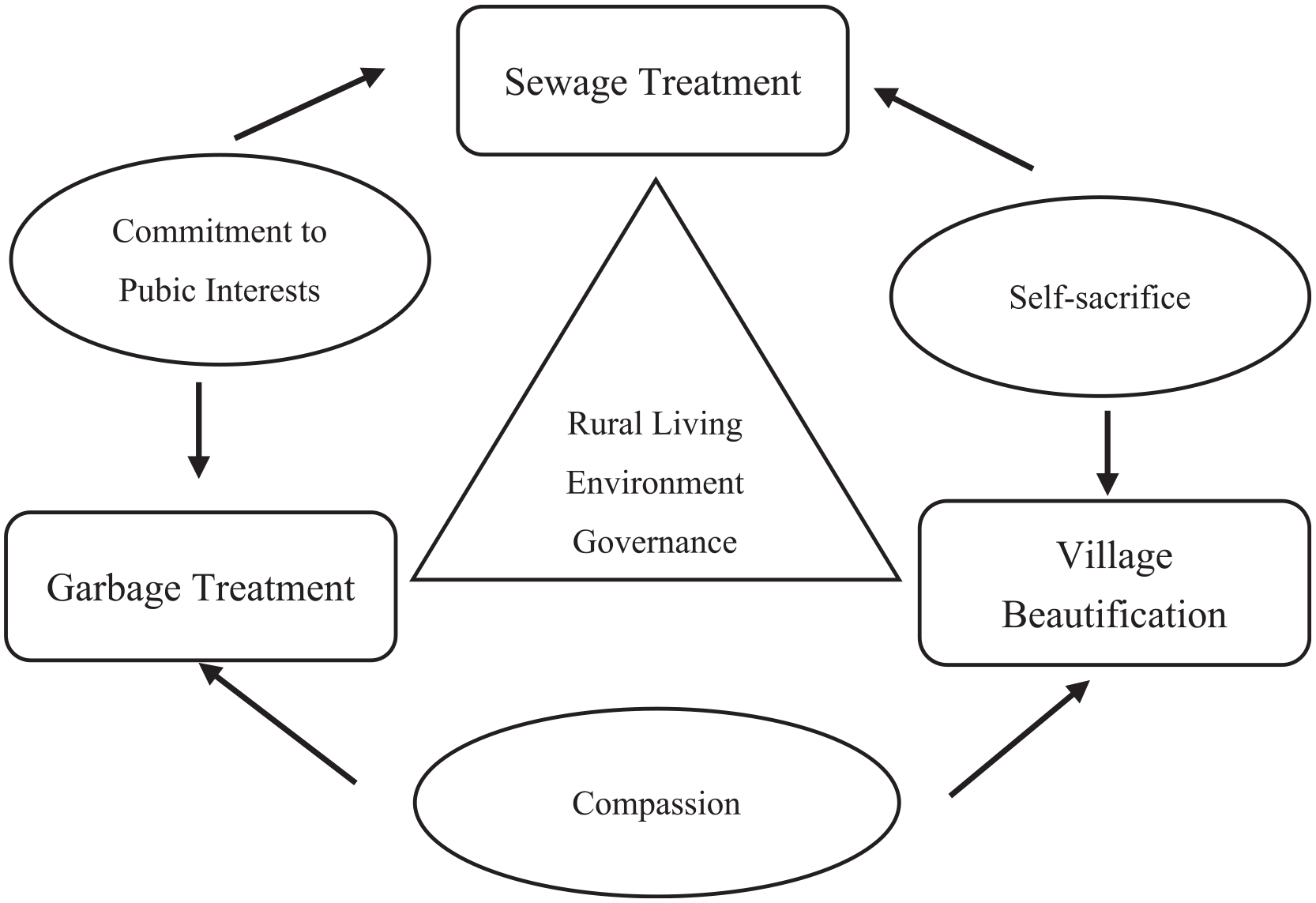
Graph of village cadres’ PSM driving RLE governance.
Pay attention to the compassion motivation of village cadres and improve the effectiveness of garbage treatment and rural beautification. Village cadres’ compassion belongs to the endogenous emotional level. As villagers live in a harsh and messy environment administered by village cadres, village cadres tend to be more sympathetic to the suffering of villagers and urgently work to improve the status quo of disorderly garbage piling, crumbling infrastructure, and insufficient entertainment services supply through RLE governance. Therefore, we should pay more attention to the compassion motivation of village cadres and improve their PSM using the pathway of endogenous emotional factors, allowing village cadres to actively support the construction of public projects in the village, encourage villagers to work together to help vulnerable groups in the local community, improve the welfare of villagers as a whole, and strengthen close contact with villagers. All these actions build a sturdy foundation for village garbage treatment and beautification and further improves the effectiveness of RLE governance.
Cultivate the motivation for self-sacrifice in village cadres and improve the effectiveness of sewage treatment and rural beautification. Village cadres make self-sacrifices for the villagers’ public interest. This behavior choice and psychological tendency to a large extent affect the success of sewage treatment and rural beautification endeavors. First, in the process of governance work, land requisition and fundraising would be involved in the construction of projects (e.g., the construction of drainage, toilet renovation, road reconstruction), which certainly affects villagers’ personal interests. Village cadres, who were selected by villagers on their behalf, take the lead in sacrificing their own interests, take public interests into consideration, and set an example for the villagers, which encourages villagers to cooperate with RLE governance projects. Second, village cadres have a strong sense of responsibility and service based on their position. They shoulder the heavy responsibility of improving the RLE and take on the mission of serving the villagers. Even though they are not paid, they are eager to contribute to the village’s development. Therefore, the cultivation of village cadres’ self-sacrifice should be paid attention to, as it enhances PSM from the emotional and inner level, promoting the effectiveness of sewage treatment and beautification of the village and further improving the effectiveness of RLE governance.
Strengthen village cadres’ motivation for protecting public interests and optimize the effectiveness of garbage treatment and sewage treatment. Village cadres are the core group of RLE governance. Thus, their job performance is not only responsible for township and county government, but it also inspires the commitment of villagers. Village cadres with a stronger commitment to the public interest are usually more interested in the village’s public affairs. They do their utmost to serve villagers without any reward. They translate this cognition into work behavior and show a more pragmatic attitude in RLE governance and promote the effectiveness of governance. Therefore, it is necessary to enhance village cadres’ motivation for committing to the public interest. When serving the villagers, village cadres should not forget to spread awareness among farmers of the importance of environmental protection and the specific operation methods of garbage and sewage treatment. Only if the villagers understand the harm to the living environment and soil caused by the indiscriminate use of chemical pesticides, chemical fertilizers, garbage disposal, sewage discharge, and other harmful behaviors will they develop the habit of treating domestic garbage and sewage correctly. For environmentally conscious villagers, environmental protection would become second nature. With their new found awareness of environmental impact, villagers can work together with village cadres to improve the effectiveness of RLE governance.
Research Limitations and Future Research Directions
In this study, the author explores the impact of the PSM of village cadres on the success and effectiveness of RLE governance. However, the specific mechanism whereby PSM improves governance quality needs to be further explored. Second, this study only collected data from rural areas of south-central China. Thus, the study has a limited geographical scope. In the future, it will be necessary to collect more sample data from other Chinese regions to verify the findings. Third, the control variables selected in this research study do not positively relate to the effectiveness of RLE governance. Therefore, other more appropriate control variables need to be identified for more accurate results.
Footnotes
Acknowledgements
The authors are grateful to the village cadres and villagers participant the survey. And we also feel grateful for the funding supporting of Shanghai Philosophy and Social Science Program and National Natural Science Foundation of China.
Declaration of Conflicting Interests
The author(s) declared no potential conflicts of interest with respect to the research, authorship, and/or publication of this article.
Funding
The author(s) disclosed receipt of the following financial support for the research, authorship, and/or publication of this article: This work was supported by Shanghai Philosophy and Social Science Program and National Natural Science Foundation of China, grant number 2020BGL004 and 71471041.
