




Abstract
With the rise of the platform economy, a new form of labor known as crowdwork is expanding rapidly. Despite criticisms of low pay and social insecurity, the autonomy associated with crowdwork makes it appealing. Using job characteristics theory and self-determination theory, this study examines the positive impact of job autonomy on job satisfaction among crowdworkers and the mediating roles of self-efficacy and meaningfulness of work. A survey of 941 South Korean crowdworkers was conducted to test our hypotheses. Our results show that job autonomy is significant for job satisfaction among crowdworkers. Furthermore, we find that job autonomy positively influences crowdworkers’ job satisfaction through self-efficacy and meaningfulness of work. This study confirms the importance of human relations management within the limitations of crowdsourcing, which is characterized by impersonality and information asymmetry. Crowdsourcing platforms can leverage our findings to design tasks that offer crowdworkers a higher degree of autonomy. Platform operators can also use empowerment practices and positive feedback to improve the self-efficacy of crowdworkers.
Introduction
With the rise of the platform economy, a new form of labor known as crowdwork receiving a lot of attention. Crowdwork introduces a more decentralized and fluid approach to work arrangements (Kittur et al., 2013). It involves employment based on the digital form of profitable crowdsourcing, where an unspecified number of individuals create digital goods through open recruitment on an information technology (IT)-based platform (Durward & Blohm, 2018).
Job satisfaction has been extensively researched as a variable directly related to organizational performance. However, it has received relatively less attention in the context of crowdwork compared with the number of studies on traditional employment (Brawley & Pury, 2016; Durward & Blohm, 2018; Liu & Liu, 2019). This can be attributed to crowdsourcing being characterized as digital Taylorism, with a focus on algorithmic control (e.g., Tate et al., 2017), overlooking the autonomous agency of individual crowdsourcers. Nonetheless, despite crowdworkers lacking a direct employment relationship, job satisfaction remains crucial for them because it influences their continuance intention (Durward & Blohm, 2018). Hence, in the dynamic landscape of work, job satisfaction is important not only in the context of a traditional employment relationship but also for platform-based work.
Insights into other factors influencing crowdworkers’ attitudes are also lacking. Previous research on crowdwork has focused on the technological aspects of crowdsourcing, primarily how work is organized and controlled using digital technologies such as algorithms, and the resulting changes in performance (Gerber & Krzywdzinski, 2019; Straub et al., 2015; Tarable et al., 2016). Studies have argued that crowdworkers experience frustration owing to algorithmic control on online platforms (Strunk et al., 2022), face potential labor exploitation (Kwek, 2020), contend with one-sided reputation systems (Whiting et al., 2017), and are treated as characters in a game that must be won in an endless competition (Morschheuser & Hamari, 2019). Recent research has shifted away from a negative view of crowdworkers and identified job characteristics in crowdwork, with job autonomy emerging as a typical feature (Bureau et al., 2018; Kwek, 2020; Nierling et al., 2023). Crowdworkers have a relatively high degree of job autonomy because of their status as independent self-employed workers (Weiss, 2020). Indeed, job autonomy is a key reason why individuals engage in crowdwork despite its high job insecurity, lack of social insurance, and absence of minimum wage coverage (Berg, 2019; Gerber, 2022; Hiessl, 2018; Hornuf & Vrankar, 2022).
To address the aforementioned gaps in the literature, this study examines the impact of job autonomy on job satisfaction among crowdworkers. The mechanisms through which job autonomy affects job satisfaction in crowdwork remain unclear (Deng & Joshi, 2016; Ma et al., 2018). Identifying how job autonomy, a key job characteristic of crowdwork, affects job satisfaction through different processes and pathways would help support workers’ growth and enhance organizational performance (Gerber, 2021). This study also examines the mediating roles of self-efficacy and meaningfulness of work.
The contributions of this study are twofold. First, we extend the job characteristics model (JCM; Hackman & Oldham, 1976) by examining the relationship between job autonomy and job satisfaction in crowdwork. Since its emergence in the 1970s, the JCM, which demonstrates that job autonomy affects individuals’ psychological state and improves their job performance, has been applied across various fields from traditional manufacturing to IT, depending on the stage of industry development (Pierce et al., 2009; Wegman et al., 2018). However, research on whether the JCM can be applied to crowdwork, which is a new field, is limited (Deng & Joshi, 2016). This study contributes to the development of the JCM by expanding its applicability to crowdwork despite the limited interaction between workers and lack of direct contractual relationships. Second, our study analyzes the mechanisms between job autonomy and job satisfaction in crowdwork. This analysis demonstrates the efficacy of a human relations approach to crowdwork, moving beyond existing research on the change in crowdworkers’ attitudes, which focuses on the technical control of the work process (Bush & Balven, 2021; Klinger & Lease, 2011).
In the next section, we review job characteristics theory and self-determination theory (SDT) as the theoretical frameworks employed to address our research questions about job autonomy and job satisfaction among crowdworkers.
Theoretical Framework
Job Autonomy of Crowdworkers
Job autonomy in traditional employment has been studied using the JCM, which explains the mechanisms through which core job characteristics affect workers’ psychological state and determine their job performance (Fried & Ferris, 1987). The JCM identifies five key job characteristics that influence workers’ motivation, satisfaction, and performance: skill diversity, job identity, job significance, autonomy, and feedback. Autonomy refers to the degree of independence and discretion afforded to employees to determine their work-related tasks, methodologies, and temporal arrangements (Hackman & Oldham, 1976). Job autonomy is crucial, as it empowers workers to make decisions about their work methods, schedules, and environment, leading to increased productivity and job satisfaction (Khoshnaw & Alavi, 2020). Since Autonomy clarifies the meaningfulness of work performed and influences the sense of achievement regarding the outcomes, these factors ultimately contribute to job satisfaction, which is manifested in improved performance (Ali et al., 2014).
Crowdworkers engage in tasks on a project-by-project basis, often without direct supervision or a long-term commitment. Hence, the characteristics of crowdwork include flexibility, autonomy, and diversity. Among these, crowdworkers’ job autonomy sets them apart from traditional workers (Toyoda et al., 2020). Crowdworkers do not have a direct employment relationship with platform providers or task requesters and are not in a direct command-and-control relationship with them; therefore, they have high autonomy in carrying out tasks (Leimeister et al., 2015). They are assigned tasks through online platforms and have the freedom to choose whether to perform them. Hence, crowdworkers are free to decide which projects to choose or reject (Nierling et al., 2023) and are responsible for managing their tasks and schedules independently. Thus, crowdwork offers a high degree of job autonomy because of its tripartite contractual relationship compared with a traditional employment relationship (Kuhn & Maleki, 2017; Spreitzer et al., 2017).
The rationale for including autonomy as a core job characteristic in the JCM can be derived from SDT, which posits that humans have three innate psychological needs: autonomy, competence, and relatedness (Deci & Ryan, 2000; Gagné & Deci, 2005). When these psychological needs, including autonomy, are fulfilled, motivation, job satisfaction, and well-being improve (Bureau et al., 2018; Lange, 2012; Slemp et al., 2015). In crowdwork, job autonomy is closely related to the autonomy needed in SDT, allowing workers to make decisions about their tasks, methods, and schedules.
Numerous empirical studies have been conducted since the emergence of the JCM. Over time, the model has been extended beyond manufacturing plant workers to IT professionals owing to technological advancement since the 1970s (Wegman et al., 2018). Although crowdwork differs from traditional employment, the interaction of crowdworkers with organizations remains similar and job design remains an important strategy for organizations to leverage crowdworkers (Gerber, 2021; Idowu & Elbanna, 2021). Recent research has attempted to apply the JCM to crowdwork, assuming that despite the repetitive nature of microtasks, crowdwork performance varies depending on workers’ attitudes and task structure (Bush & Balven, 2021; Durward et al., 2020; Kaufmann et al., 2011; van Zoonen et al., 2023). Therefore, job characteristics such as job autonomy are important predictors of crowdworkers’ job behavior and performance.
The importance of job autonomy in crowdwork can be inferred from the main reasons crowdworkers engage in it. Some studies have shown that crowdworkers’ job autonomy increases the speed and efficiency of their work (Deng & Joshi, 2016; Kost et al., 2018). Moreover, job autonomy is an important factor in crowdworkers’ evaluation of the value of their work (Deng et al., 2016). A study on young crowdworkers in South Korea reported that being able to choose their working hours was the most common reason for engaging in online platform work (Kim et al., 2023). Thus, job autonomy is a key feature of crowdwork and a critical motivator for crowdworkers, particularly among younger generations.
Job Autonomy and Job Satisfaction
Studies have explored the positive impact of job autonomy on job satisfaction, identification, and engagement in crowdwork (Deng & Joshi, 2016; Durward et al., 2020). First, ensuring a high degree of autonomy is important to keep crowdworkers engaged and prevent them from leaving platforms (Wu et al., 2023). Second, job autonomy increases crowdworkers’ motivation by empowering them to make their own decisions on how to complete tasks (Toyoda et al., 2020). Individuals who control their task selection and working hours have been found to experience higher job satisfaction (Li & Zhang, 2021; Zheng et al., 2023). Third, job autonomy enables individuals to manage their workload and work/life balance (Barrio Fernández & Zekic, 2017). The flexibility in setting their work schedules and priorities enables workers to avoid burnout. Fourth, job autonomy allows crowdworkers to use their skills and perform tasks more efficiently based on their capabilities and strengths, leading to higher job satisfaction (Krzywdzinski & Gerber, 2021). Autonomy in managing time and workload according to personal preferences also contributes to overall job satisfaction (James, 2024; Ravenelle, 2019). Based on this discussion, we propose the following hypothesis:
Hypothesis 1: Job autonomy is positively related to job satisfaction among crowdworkers.
Self-Efficacy as a Mediator
Self-efficacy refers to individuals’ belief in their capability to effectively orchestrate and perform essential procedures to attain a predetermined goal (Bandura, 1977). It assumes increased importance among crowdworkers given their above-noted substantial job autonomy over their work schedules and procedures (Rockmann & Ballinger, 2017). The positive relationship between job autonomy and self-efficacy among crowdworkers can be inferred from SDT (Durward et al., 2020). When crowdworkers perceive high job autonomy, they feel empowered to make decisions, take ownership of their work, and have a sense of control over their outcomes. Wang and Netemeyer (2002) found that higher job autonomy increases confidence in job performance and thus enhances self-efficacy by improving the perception that job performance results from one’s own efforts. Social learning theory can also be used to explain the relationship between job autonomy and self-efficacy. According to this theory, individuals observe different outcomes of different behaviors during the learning process (Bandura, 1971). Individuals with high autonomy are more likely to observe different outcomes of their actions, which enhances their understanding of their work and strengthens their belief in their ability to perform the tasks assigned to them (Sousa et al., 2012).
Self-efficacy can also have a positive impact on job satisfaction (Borgogni et al., 2013; Demir, 2020; Lai & Chen, 2012). Workers with high self-efficacy experience relatively high job satisfaction because they can cope with challenging tasks (Alifuddin & Widodo, 2021; Salanova et al., 2006). Confidence and competence, components of self-efficacy, also contribute to job satisfaction because they make work more enjoyable (Purwanto, 2002). The path from job autonomy through self-efficacy to job satisfaction is particularly relevant in the context of crowdwork. First, crowdworkers choose the type and amount of work they perform, which allows them to experience a sense of autonomy from the outset (Nierling et al., 2023). Second, they increase their self-efficacy by finding tasks they can perform most efficiently among those available on the platform, which raises their satisfaction (J. Chen et al., 2023; Noh & Ryu, 2022). Specifically, crowdworkers can experience self-efficacy by selecting and performing tasks that align with their values based on the information they acquire during the process of selecting tasks on online platforms, where information asymmetry is inevitable (Han et al., 2020). Therefore, crowdworkers can enhance their self-efficacy by choosing tasks that align with their values, which can positively impact their job satisfaction (Alifuddin & Widodo, 2022). Accordingly, we propose the following hypothesis:
Hypothesis 2: Self-efficacy mediates the positive relationship between job autonomy and job satisfaction among crowdworkers.
Meaningfulness of Work as a Mediator
Meaningfulness of work refers to the significance and level of contribution that work provides to one’s life and growth (Steger et al., 2012). Specifically, it is the value and purpose that individuals attach to their work, including the intrinsic value they derive from it, such as a sense of accomplishment, satisfaction, and contribution to personal and societal goals (Pignault & Houssemand, 2021; Rosso et al., 2010). Meaningfulness of work is not determined solely by the job itself but by how workers perceive, interpret, and recreate it, which is also valid in the crowdwork context of microtasking (Allan et al., 2018; Kost et al., 2018). Additionally, the experience of meaningfulness of work is intrinsic to individuals and can exist independently of an employment relationship (Brawley & Pury, 2016; Kost et al., 2018). For instance, Chandler and Kapelner (2013) found that Amazon Mechanical Turks workers who were informed that their task of labeling tumor cells contributed to medical advancements perceived higher work meaning, engaged more in crowdwork, and were more productive than those not informed of the significance of their work.
When workers have autonomy, they feel empowered to make choices, set goals, and perform tasks aligned with their preferences and values (Martela et al., 2021). This sense of autonomy fosters a deeper sense of ownership and investment in their work, enhancing its meaningfulness (Lysova et al., 2019). Job autonomy catalyzes the cultivation of meaningful work experiences by allowing individuals to exercise control and autonomy in their professional endeavors (Michaelson et al., 2014). In crowdwork, job autonomy allows workers to be creative in solving problems and performing tasks independently (Strunk & Strich, 2023). This sense of ownership allows workers to create meaning in their tasks because they recognize themselves as active contributors (Nie et al., 2023; van Zoonen et al., 2023).
Perceived meaningfulness of work among crowdworkers can positively impact their job satisfaction (Kost et al., 2018; Mousa & Chaouali, 2023; Toyoda et al., 2020). When crowdworkers find their work meaningful, they are intrinsically motivated to perform their tasks effectively (Ihl et al., 2020). This intrinsic motivation stems from a sense of purpose and fulfillment derived from contributing to projects that align with their values and beliefs, leading to a deeper connection with their work and increased job satisfaction. Based on the above discussion, we hypothesize the following:
Hypothesis 3: Meaningfulness of work mediates the positive relationship between job autonomy and job satisfaction among crowdworkers.
Self-Efficacy and Meaningfulness of Work as Parallel Mediators
Based on the foregoing, self-efficacy and meaningfulness of work may also serve as parallel mediators of the relationship between job autonomy and job satisfaction. Parallel parametric models allow us to explore how different parameters act simultaneously to explain the relationship between the independent and outcome variables. Thus, we propose the following hypothesis.
Hypothesis 4: Self-efficacy and meaningfulness of work simultaneously act as parallel mediators of the relationship between job autonomy and job satisfaction among crowdworkers.
Based on these four hypotheses, we derive the theoretical framework presented in Figure 1. In the next section, to validate the above-mentioned hypotheses, we present the results of a statistical analysis based on survey data to explore the relationships among the variables.
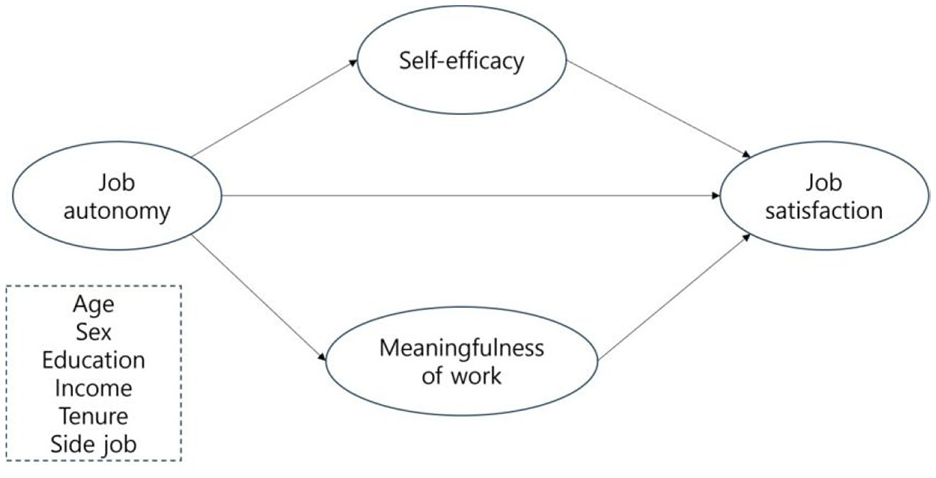
Theoretical model.
Methods
Research Setting, Sample, and Procedure
To collect the data for this study, we adopted a survey design. An online survey of platform workers performing data entry, content moderation, data cleaning, transcription, and image labeling for a platform company in South Korea was conducted from May to July 2020. While many competitors have now emerged, the platform company was the dominant player in the market when the survey was conducted, employing about 80% of South Korea’s crowdworkers. (Approximately 160,000 of the estimated 200,000 crowdworkers in South Korea were registered as workers at the target company.) Of these, approximately 100,000 crowdworkers were estimated to have reached at least the silver level (i.e., they had earned 50,000 points and were working stably). We targeted this group of mature crowdworkers to better capture the characteristics of all crowdworkers in South Korea, especially given the ease of joining and leaving the platform and fact that they often have second jobs (De Stefano, 2016). Prior to the survey, a pilot test was conducted with 50 participants to ensure the content validity of the survey and to facilitate accurate communication, and the survey questions were improved based on the feedback received.
The survey was then randomly distributed to silver-level crowdworkers or higher, and consent for the research process and presentation of results was obtained from respondents. A total of 950 people responded to the survey, and 941 complete responses were included in the analysis. A sample size of 941 was an appropriate size for our statistical analysis with a margin of error within 5% at the 99% confidence level (Cohen, 1992; Cook & Campbell, 1979; Well et al., 1990).
The online questionnaire was accompanied by a cover letter that explained the details of the study, its voluntary participation, and an assurance of confidentiality. The main survey questions focused on the respondents’ job autonomy, job satisfaction, meaningfulness of work, and self-efficacy. Of the respondents, 296 (31.5%) were men and 645 (68.5%) were women. The majority (635, 67.5%) had been working on online platforms for more than 1 year but less than two years. Most respondents were in their 20s (360, 38.3%) and 30s (355, 37.7%), followed by those in their 40s (142, 15.1%). The average monthly income from platform jobs was less than 1 million won (about $750) for 720 people (76.5%). This was followed by 194 respondents (20.6%) who earned more than 3 million won (approximately $2,250). The remaining 27 (2.9%) earned between 1 million to 3 million won ($750–$2,250). In terms of education, 684 respondents (72.7%) had graduated from university. Additionally, 381 respondents (40.5%) engaged in crowdwork as their primary job, while 560 respondents (59.5%) engaged in it as a secondary job.
Measures
Job Autonomy
The job autonomy scale used in this study included four items from the job control scale of the Instrument for Stress-Oriented Job Analysis (Semmer et al., 1996). Specific items included “I can decide my own work projects” and “I have considerable authority over how my work proceeds.” Responses were measured on a five-point Likert-type scale ranging from 1 (strongly disagree) to 5 (strongly agree). The Cronbach’s α for the scale was .88.
Job Satisfaction
Job satisfaction was measured using four items from Cranny et al.’s (1992) survey considering both intrinsic factors, which are the meaning of the job itself, and extrinsic factors such as relationships, safety, and salary. The four items were “I am satisfied with the intensity of my work,”“I am satisfied with the compensation I am receiving,”“I am satisfied with the work itself,” and “I am satisfied with the company’s work methods.” Responses were measured on a five-point Likert-type scale ranging from 1 (strongly disagree) to 5 (strongly agree). The Cronbach’s α for the scale was .82.
Self-efficacy
To measure self-efficacy, we used three items on goal achievement, self-esteem, and confidence following Spreitzer (1995) and G. Chen et al. (2001). The three items were “My abilities can match the demands of the task,”“I have the skills and abilities to perform the task,” and “The demands of the task and my personal and temperamental characteristics match well.” Responses were measured on a five-point Likert-type scale ranging from 1 (strongly disagree) to 5 (strongly agree). The Cronbach’s α for the scale was .91.
Meaningfulness of Work
We measured meaningfulness of work using three items developed by Bunderson and Thompson (2009) and Wrzesniewski et al. (1997): “Crowdwork is very important to me,”“Crowdwork is meaningful to me,” and “Crowdwork is personally meaningful to me.” Responses were measured on a five-point Likert-type scale ranging from 1 (strongly disagree) to 5 (strongly agree). The Cronbach’s α for the scale was .88.
Control Variables
We controlled for several demographic variables known to influence crowdworkers’ job satisfaction. These variables included respondents’ age, sex (male = 1, female = 0), marital status (married = 1, single = 0), education level (less than middle school education = 1, graduated from high school = 2, graduated from college = 3, more than college = 4), length of time working on a crowdwork platform (in months), and income (in won). The length of time engaged in platform work can affect respondents’ perceptions of crowdworkers (De Groen et al., 2017). We also controlled for average monthly income based on research that has shown that extrinsic motivation is more important for crowdworkers than for traditional workers (Campbell, 2022). Finally, we controlled for whether or not the crowd worker was a secondary job, following previous research that found that whether or not crowd work is a primary or secondary source of income affects the worker's experience in the platform economy (Myhill et al., 2021).
Data Analysis
We analyzed the demographic variables descriptively. We also created a correlation matrix of the variables using SPSS version 26.0. Additionally, to test the validity of our study measures, we conducted a confirmatory factor analysis (CFA) on all the questionnaire items using AMOS version 26.0. We tested for potential mediating effects using Hayes (2017) PROCESS macro (Model 4) in SPSS because of its ability to determine all paths (i.e., the total, direct, and indirect effects) simultaneously through a bootstrapping procedure, without problems, thus addressing some of the weaknesses associated with the Sobel test (Gonzalez & MacKinnon, 2021; Rasoolimanesh et al., 2021). The model was tested with 10,000 bootstrapped samples to confirm its validity, and 95% bias-corrected confidence intervals (CIs) were used to adjust for the bias in the bootstrap estimates (Tibbe & Montoya, 2022).
Results
Descriptive Statistics
Table 1 shows the means, standard deviations, and correlations of the variables. The associations between job autonomy and job satisfaction (r = .26, p < .001), job autonomy and self-efficacy (r = .20, p < .001), job autonomy and meaningfulness of work (r = .07, p < .05), self-efficacy and job satisfaction (r = .25, p < .001), and meaningfulness of work and job satisfaction (r = .32, p < .001) were significant and positive. This established the initial statistical foundation for testing our hypotheses using the PROCESS macro (Hayes, 2017).
Means, SDs, and Correlations.

Note. N = 941.
p < .05. **p < .01 (two-tailed).
Confirmatory Factor Analysis
A CFA was conducted to test the factorial validity of the measures. To determine whether a four-factor model was appropriate for this study, three alternative models were constructed and their fit indices were compared. A three-factor model combining self-efficacy and meaningfulness of work was tested, which demonstrated a poorer fit than the four-factor model. A two-factor model combining job autonomy with self-efficacy as well as job satisfaction with meaningfulness of work was tested, which again showed a poorer fit than the four-factor model. Finally, a one-factor model loading all the variables onto one latent factor was tested, again showing a poor goodness-of-fit. By contrast, the four-factor model fit the data well, as indicated by the fit indices in Table 2, supporting the discriminant validity of the measures.
Results of the Confirmatory Factor Analysis.
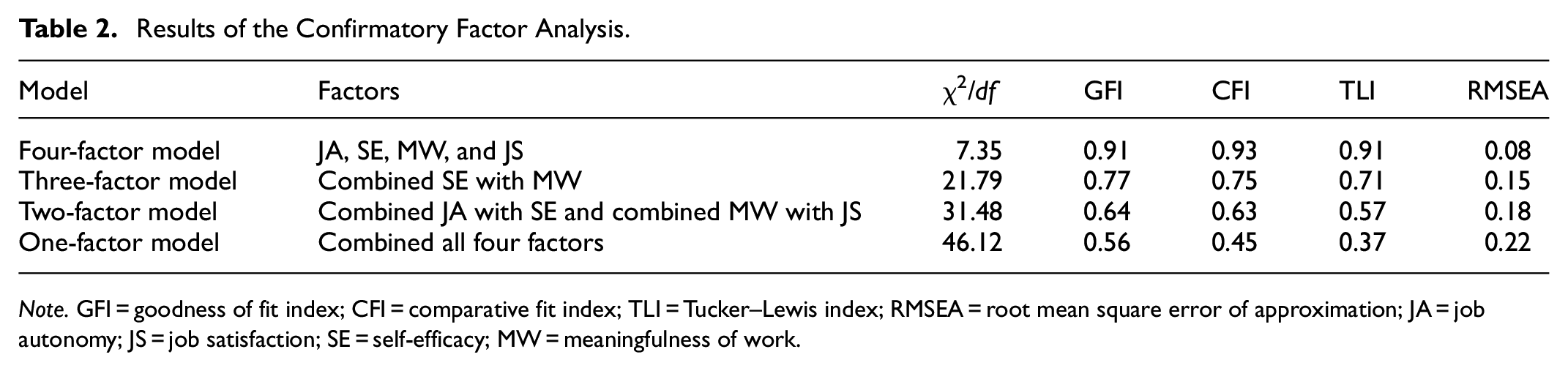
Note. GFI = goodness of fit index; CFI = comparative fit index; TLI = Tucker–Lewis index; RMSEA = root mean square error of approximation; JA = job autonomy; JS = job satisfaction; SE = self-efficacy; MW = meaningfulness of work.
The standardized factor loadings of the items exceeded 0.6, suggesting an acceptable model fit (Credé & Harms, 2015; Hair et al., 2012). Furthermore, both convergent and discriminant validity were assessed to examine construct validity. The constructs used in this study met the criteria for discriminant and convergent validity defined by Fornell and Larcker (1981): composite reliability (CR) >0.6 and average variance extracted (AVE) >0.5 (Table 3). The discriminant validity obtained was acceptable, as the AVEs exceeded mean square variation and the inter-construct correlations were less than the square roots of the AVEs. Furthermore, convergent validity was acceptable as the factor loadings and AVEs exceeded 0.50 and the CRs exceeded the AVEs. All the scales had Cronbach’s α values above .70.
Results of the Convergent and Discriminant Validity.

Note. The bold values on the diagonal are the square roots of the AVE, which show the ratio of the variance captured by the construct and variance due to measurement error. Cr = composite reliability; AVE = average variance extracted; MSV = maximum shared variance; ASV = average shared variance; JA = job autonomy; JS = job satisfaction; SE = self-efficacy; MW = meaningfulness of work.
Common Method Bias
In this study, Harman’s single-factor test and the common latent factor (CLF) analysis were used to test the occurrence of common method bias (Podsakoff et al., 2003). The results of Harman’s single-factor test showed no significant concern about common method bias, as the first component explained 32.16% of the variance, below the 50% threshold. Similarly, the results of the CLF analysis indicated that common method bias was not a major issue, as the difference between the CFA with the CLF and the CFA without the CLF was less than 0.2.
Hypotheses Testing
We used the three-step procedure developed by Baron and Kenny (1986) to test our hypotheses. The first step was to assess the effect of job autonomy on job satisfaction. The results of Model 3 in Table 4 show that job autonomy was positively related to job satisfaction (β = .27, p < .001) after controlling for the effects of age, sex, education, income, tenure, and the presence of a second job. This result supported Hypothesis 1. Next, we examined the impact of job autonomy on self-efficacy and meaningfulness of work. The results of Models 1 and 2 in Table 4 show positive relationships between job autonomy and self-efficacy (β = .20, p < .001) and meaningfulness of work (β = .09, p < .01). Third, we tested the mediating effects of self-efficacy and meaningfulness of work. The results of Model 4 in Table 4 show that self-efficacy (β = .12, p < .001) and meaningfulness of work (β = .28, p < .001) were significantly and positively correlated with job satisfaction, controlling for job autonomy. These results suggested that the effect of job autonomy on job satisfaction was partially mediated by self-efficacy and meaningfulness of work, supporting Hypotheses 2 and 3.
Regression Results for the Direct and Indirect Effects.
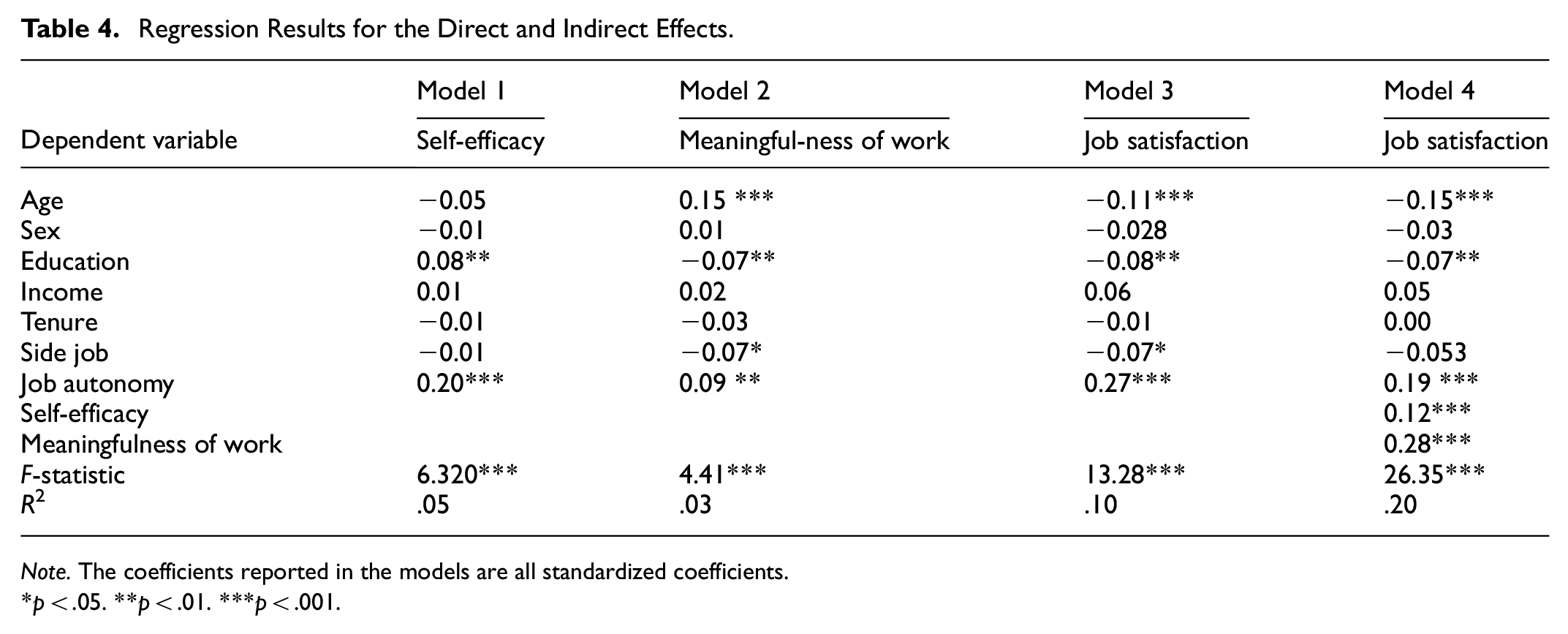
Note. The coefficients reported in the models are all standardized coefficients.
p < .05. **p < .01. ***p < .001.
The Baron and Kenny test is limited in that it does not directly test the significance of the indirect effect. Thus, we conducted an additional mediating effect test by bootstrapping. Table 5 presents the results of the total, direct, and mediating effects. To test the multiple mediation model and evaluate the significance of the conditional indirect effects, 95% bias-corrected bootstrapped CIs (10,000 bootstrap samples) were generated (DiCiccio & Efron, 1996). To test the hypotheses, Hayes (2017) PROCESS macro (Model 4) was again employed.
Results of the Indirect, Direct, and Total Effects.

Note. JA = job autonomy; JS = job satisfaction; SE = self-efficacy; MW = meaningfulness of work.
Confidence intervals computed using the standard Delta method.
For the indirect effects, the results of the bias-corrected bootstrapped CIs were above zero for all the validations (Table 5). The results demonstrated the partial mediating effect of self-efficacy (β = .17, 95% CI [0.11, 0.22]) in the relationship between job autonomy and job satisfaction. Hence, Hypothesis 2 was supported. Similarly, meaningfulness of work (β = .18, 95% CI [0.13, 0.23]) partially mediated the relationship between job autonomy and job satisfaction. Therefore, Hypothesis 3 was supported.
Parallel Mediation Analysis
To test the parallel mediating effects of self-efficacy and meaningfulness of work, we referred to the differences in the point estimates of the indirect effects of these two mediators (Table 6). The 95% CI indicated that the indirect effects of the two parallel mediators were not statistically different, suggesting that job autonomy indirectly affected job satisfaction through both self-efficacy and meaningfulness of work. Thus, self-efficacy and meaningfulness of work were parallel mediators in the relationship between job autonomy and job satisfaction, supporting Hypothesis 4. Furthermore, the small differences in the point estimates between the two mediators showed that both self-efficacy and meaningfulness of work played similar parallel mediating roles in enhancing job satisfaction.
Indirect Effects of Job Autonomy on Job Satisfaction.

In summary, after analyzing the survey data on our sample of 941 crowdworkers, we found that all our hypotheses were supported. We discuss the implications of our findings in the next section.
Discussion and Conclusions
In this study, we focus on job autonomy as a factor affecting crowdworkers’ job satisfaction in this rapidly expanding segment of the workforce that is not as well understood as traditional employees. Crowdworkers’ job satisfaction is an important variable for understanding their organizational behavior, as it is positively related to their intention to continue working (Durward & Blohm, 2018), perceived identity (Durward et al., 2020), and higher motivation and better work outcomes (Barashev & Li, 2019). One of the main reasons for the surge in the number of crowdworkers is that they enjoy the autonomy to choose when, where, and how to work (Kwek, 2020; Nierling et al., 2023).
Based on the theoretical foundations of SDT and the JCM and using data from 941 crowdworkers in South Korea, we find that crowdworkers who perceive high job autonomy tend to experience high job satisfaction. Furthermore, we demonstrate the positive mediating effects of self-efficacy and meaningfulness of work on the relationship between job autonomy and job satisfaction among crowdworkers. Crowdworkers with higher self-efficacy may have higher job satisfaction because they feel that their chosen job is a better fit for their abilities and that their role is more effective (J. Chen et al., 2023). Moreover, when crowdworkers have high job autonomy, they have a sense of ownership over their work and perceive higher meaningfulness of work, which leads to higher job satisfaction. Our empirical results support all four of our hypotheses and offer valuable implications.
Theoretical and Practical Implications
This study’s findings have the following theoretical implications. First, this study distinguishes itself from previous research in that it focuses on job autonomy in crowdwork, a recently emerged form of labor, and extends the JCM, which is based on workplace interactions and direct employment relationships, to apply the concept of job autonomy to microtasks. Further, while previous research on crowdwork has primarily focused on negative job characteristics such as algorithmic control, job insecurity, detachment from the labor process, and lack of social interaction, this study focuses on job autonomy as a positive job characteristic of crowdwork (Elbanna & Idowu, 2022; Glover, 2021; Kittur et al., 2013; Webster, 2016). Prior research also points to the relative lack of crowdworker recognition and job satisfaction (Tate et al., 2017). We concur with the findings of Deng and Joshi (2016), who revealed that job autonomy can be an intrinsic motivator that enhances job satisfaction (Truong & McColl, 2011).
Second, by using a mediation effect analysis not previously tested in the literature, we find that job autonomy positively affects job satisfaction through the mediators of self-efficacy and meaningfulness of work. According to the JCM, when workers experience high job autonomy, they perceive their work as meaningful, leading to job satisfaction (Martela et al., 2021). Studies on meaningfulness of work have focused primarily on employees in creative and professional occupations, with relatively little research on employees who perform blue-collar and/or repetitive tasks (Saari et al., 2022). Our study shows that meaningfulness of work is not an objective dimension of the work itself, but can be enhanced through the interpretation and sense-making of the worker, making it an important variable in the crowdwork context. Moreover, according to SDT, job autonomy is positively related to self-efficacy, which is the sense of ownership over one’s work and belief that job performance is improved by one’s efforts (Alifuddin & Widodo, 2022). Hence, this study advances theory by integrating these two frameworks and extending them to the crowdwork setting.
This study also offers several practical implications. First, crowdsourcing platforms can leverage our findings to design tasks that offer crowdworkers a higher degree of autonomy. Consistent with our findings, companies such as Upwork and Uber are working to build features into their platforms that offer workers the ability to choose their tasks and control their workflow. Platform operators should use digital technologies such as algorithms to provide more autonomy to crowdworkers on online platforms rather than controlling and constraining them. In South Korea, Crowdworks has recently introduced job training courses and skill enhancement programs to increase the autonomy of crowdworkers. As our research shows, organizations can enhance workers’ job satisfaction and productivity by providing autonomy in task selection and execution.
Second, platform operators can use empowerment practices and positive feedback to improve the self-efficacy of crowdworkers (Kost et al., 2018). Specifically, they can help improve crowdworkers’ self-efficacy by providing regular and constructive feedback on their performance, thereby contributing to their job satisfaction. Offering targeted feedback allows workers to gauge their efficacy and adjust their behavior, further boosting their self-efficacy. This can be done through rating systems, peer reviews, and AI-driven feedback that reflects workers’ progress. These programs can empower crowdworkers to tackle challenging tasks confidently and derive greater job satisfaction.
Third, the findings show that the job autonomy provided to crowdworkers can increase job satisfaction through their perception of the meaningfulness of their work. While it may be difficult for crowdworkers to fully perceive the meaningfulness of their work because microtasks are divided into small unchallenging tasks (Kwek, 2020; Morschheuser & Hamari, 2019), this study finds that crowdworkers’ job satisfaction can increase when they consider their work to be meaningful, even if they lack the structure to interact with task requesters. This result supports the job design approach proposed by Kost et al. (2018) in that crowdworkers can derive meaning from their work through the exploration of positive roles. Many employees in high-tech companies are committed because of the positive impact their programs have on society. Accordingly, platform operators could provide information such as how data are used to help crowdworkers perceive the meaning of their work (Bailey et al., 2017).
Limitations
Our study has several limitations. The first is the issue of sample representativeness. Since this study was conducted primarily on crowdsourced workers affiliated with major platforms in South Korea, it may not accurately reflect the broader population of crowdworkers globally. Second, our study used a cross-sectional design relying on data collected at a single point in time. This approach makes it challenging to establish causal relationships over time, as job satisfaction and job autonomy may evolve. Longitudinal studies would provide better insights into these dynamics. Furthermore, since our study focused on internal factors such as job autonomy and self-efficacy, future research could consider external factors and circumstances (e.g., economic conditions, technological development, and government policies) that affect crowdwork to provide a more comprehensive understanding of crowdworkers.
Footnotes

Consent to participate
Informed consent was obtained from all individual participants included in the study.
Funding
The author(s) disclosed receipt of the following financial support for the research, authorship, and/or publication of this article: This research was funded by Seoul National University of Science and Technology
Declaration of Conflicting Interests
The author(s) declared no potential conflicts of interest with respect to the research, authorship, and/or publication of this article.
Data Availability Statement
Raw data supporting the findings of this study are available from the corresponding author on request.