




Abstract
The number of teaching assistants (TAs) working in mainstream schools has soared in recent years as students with special educational needs (SEN) are integrated into regular classrooms. However, research on TAs is rare. This study investigated whether and how work engagement mediates the relationship between self-efficacy and job satisfaction among 292 Chinese TAs working in Hong Kong mainstream schools. Survey data were analyzed using partial least squares structural equation modeling (PLS-SEM). Supported by the social cognitive theory of self-efficacy and self-determination theory of work engagement, our results showed that TAs’ self-efficacy is positively related to their job satisfaction through the mediation of work engagement. Implications for an appropriate focus on enhancing TAs’ self-efficacy through classroom experiences and training courses are discussed.
Introduction
Teaching assistants (TAs) had been employed in Hong Kong primary, secondary, and special schools since 1997. The Board of Education, Sub-Committee on Review of School Education (1997) recommended the recruitment of “Teaching Assistant” to alleviate the heavy workload of in-service teachers, including for the purpose of recording pupils’ test scores, compiling and performing data search for class preparation, preparing teaching aids, organizing class activities, as well as handling pupils’ disruptive behaviors (Chapter 10). With such support from TAs, teachers would be able to be relieved of their nonteaching duties and thus have more time to concentrate on teaching responsibilities. Besides, in response to the implementation of the 2-year pilot project on inclusive education since 1997, coupled with the Hong Kong education reform in 2000 (Education Bureau [EDB], 2014), schools have been subsidized by the EDB to recruit more TAs to support students with special educational needs (SENs) in ordinary schools where SEN students are provided with opportunities to access the mainstream curriculum and to learn alongside their able peers for gaining essential lifelong learning experiences (EDB, 2012; Wong-Ratcliff & Ho, 2011). Integrated education was extended to all public sector ordinary schools from 1999/2000 onward after the 2-year pilot project (Audit Commission, 2018).
The first large-scale survey, which entailed the job status of 392 Hong Kong TAs, was conducted by the Hong Kong Professional Teachers’ Union (HKPTU, 2016) in March 2016. A total of 392 TAs participated in this survey in which 150, 224, and 18 respondents worked in primary, secondary, and special schools, respectively, where children with more severe or multiple disabilities are placed. Regarding the job nature, 214 of them were responsible for teaching and 178 performed nonteaching duties. The results revealed that many participating TAs were young and educationally trained. More than 60% of them were aged below 30 years. About 55% of them had completed or were currently attending teacher training programs (e.g., postgraduate diploma in education [PGDE]). Their job creation was based on the availability of funds and they were employed on a yearly contract basis. Hence, the contract extension was not guaranteed and the retention rate was generally low. Moreover, more than 60% of them believed that they were underpaid. Besides, about 31.4% and 24.4% of those surveyed stated that they were discouraged by the heavy workload and long working hours, respectively. A similar survey in a sample of 251 TAs was conducted by the HKPTU again in 2018 (HKPTU, 2018). It was found that the work situation of TAs had not improved. Kwok (2013) had indicated that TAs in Hong Kong were unable to change from contract-based jobs to permanent jobs. They were treated by schools as external help and thus their working relationships with schools have not been stable. Trent (2014) had also investigated the clarity of “positionings” of TAs and discovered that TAs experienced identity confusion, that is, the discrepancy between the way they make sense of themselves and the image of themselves that they present to others. On one hand, the TAs working at different Hong Kong secondary schools had positioned themselves as a “teacher-to-be,” as applying the knowledge and skills acquired from their PGDE course. On the other hand, they were incompatible with fellow colleagues’ positioning the TAs as controllers of students or preparers and distributors of teaching materials. Trent’s result implied that to attract and retain TAs, the issue of identity conflict needs to be solved and the identity positions of “TA” and “teacher” need to be reconceptualized.
The experiences of TAs is under-researched compared with teachers, so this is an area that is worth exploring. Little research has been conducted to examine the relationships among self-efficacy, work engagement, and job satisfaction of TAs (e.g., Higgins & Gulliford, 2014). The following empirical evidence and theories are therefore reviewed on sources related to teachers.
Literature Review
Self-Efficacy
According to Bandura (1977, 1997), individuals’ behavior is affected by both outcome and efficacy expectations. Outcome expectations referred to the judgment individuals make about the likelihood of behaviors that would lead to certain outcomes in a particular situation or context. However, individuals would not produce such behavior unless they held the beliefs that they were capable of doing so, that is, efficacy expectations. Grounded in Bandura’s social cognitive theory, self-efficacy can be defined as people’s beliefs about the extent to which their capabilities can bring about changes for desired results. Teacher self-efficacy has been conceptualized as a multidimensional construct in various domains (Tschannen-Moran & Woolfolk Hoy, 2001). Meta-analysis and review of studies have shown that teacher self-efficacy contributes to teaching effectiveness, student achievement and motivation, quality of classroom processes, and teacher well-being in a wide array of settings (Klassen & Tze, 2014; Zee & Koomen, 2016).
Self-Efficacy and Job Satisfaction
Teachers’ job satisfaction has been conceptualized as the affective reactions and cognitive appraisal of their day-to-day work (Ho & Au, 2006; Skaalvik & Skaalvik, 2010). Having a high level of self-efficacy can contribute to job satisfaction. Specifically, teachers who consider themselves competent to promote changes in teaching and learning processes are more likely to make positive evaluative judgments about their jobs (Klassen & Chiu, 2010). The associations between teacher self-efficacy and job satisfaction have also been examined in studies worldwide. For example, teachers’ self-efficacy was found to be positively related to job satisfaction in both Western (e.g., Canada and United States) and Eastern countries (e.g., Singapore and South Korea; Klassen et al., 2009; Lee & Shin, 2017). In a longitudinal study, Caprara et al. (2006) showed that teachers’ self-efficacy predicted their job satisfaction and students’ academic achievement. Its replication performed in two subsequent scholastic years has also revealed similar results. In a study of 523 Canadian teachers, Wang et al. (2015) found that those with high self-efficacy levels in student engagement and classroom management are more satisfied with their job.
Work Engagement
With the recent trend of positive psychology, organizational researchers start focusing on one’s engagement with their work. Work engagement is defined as “a persistent, positive affective-motivational state of fulfillment, which is characterized by the three components of vigor, dedication, and absorption” (Maslach et al., 2008, p. 103). Vigor concerns high levels of energy and mental resilience of a worker, that is, a willingness to invest effort in one’s job, and persistence in facing difficulties (Maslach et al., 2008). Dedication refers to an individual’s strong enthusiasm in their work, accompanied by feelings of personal significance, pride, and inspiration (Maslach et al., 2008). Finally, absorption is characterized by being fully committed to one’s work to such an extent that an individual is unable to detach oneself from work (Maslach et al., 2008).
Self-Efficacy and Work Engagement
Self-efficacy, as a personal resource, is considered as one of the important antecedents of work engagement (Tims et al., 2011). Self-efficacy fits well with a person’s feeling of competence—an inherent psychological need within the self-determination theory (SDT; Deci & Ryan, 1985). According to the SDT, individuals’ work has provided them with the opportunities to demonstrate their competence, which is essential to the development of work engagement (Timms & Brough, 2013). It was found that workplace buoyancy (i.e., “ability to effectively deal with setback, challenge, adversity, and pressure in the workplace setting”; Parker & Martin, 2009, p. 70) predicted work-related engagement among a sample of 515 teachers in Australia. Teachers who rated themselves higher on self-efficacy are more engaged in their work, experience more positive emotions, and less negative emotions toward their students (Burić & Macuka, 2018). Longitudinal studies have also shown that teacher self-efficacy and work engagement reciprocally influence each other (Salanova et al., 2011; Simbula et al., 2011).
Work Engagement and Job Satisfaction
Work engagement contributes to job satisfaction. Engaged teachers are more likely to perform better in their jobs (Bakker & Bal, 2010), be more committed to their schools (Hakanen et al., 2006; Jackson et al., 2006), and be more likely to report higher levels of job satisfaction primarily characterized by positive experiences. A number of studies have also shown that teachers’ overall engagement was moderately to strongly related to their job satisfaction (Klassen et al., 2012; Shoshani & Eldor, 2016; Simbula, 2010; Skaalvik & Skaalvik, 2013). Targeting the three dimensions of engagement individually (i.e., vigor, dedication, and absorption), a longitudinal study had shown that both Time 1 and Time 2 vigor, dedication, and absorption were positively associated with job satisfaction among the 312 Australian teachers (Timms & Brough, 2013), showing that job satisfaction is the outcome of these dimensions.
Self-Efficacy, Work Engagement, and Job Satisfaction
There were a few studies that simultaneously examined teacher self-efficacy, work engagement, and job satisfaction. For example, Høigaard et al. (2012) indicated that teacher efficacy, work engagement, and job satisfaction were positively correlated with one another in a sample of newly qualified teachers. In another study of 2,569 Norwegian teachers in elementary and middle schools, Skaalvik and Skaalvik (2014) also reported that self-efficacy significantly predicted both work engagement and job satisfaction. Latent profile analysis revealed that the dimensions of teacher self-efficacy, work engagement, and job satisfaction differed meaningfully across four different personality profiles (i.e., rigid, ordinary, well-adjusted, and excitable), with well-adjusted teachers reporting the highest levels on all the outcomes (Perera et al., 2018).
Rationale and Hypotheses of Study
There has been an increase in the number of TAs in mainstream schools for inclusive practices in recent years. However, relatively little is known about TAs in Hong Kong. Specifically, previous research has mainly examined the relationships among self-efficacy, work engagement, and job satisfaction in teachers. There is a need to fill this gap in the literature. Based on the aforementioned literature review on self-efficacy as an antecedent of work engagement and work engagement as an antecedent of job satisfaction, together with the assumptions of social cognitive and self-determination theories, we proposed a theoretical model (Figure 1) that specified the direct effects of self-efficacy on job satisfaction and its indirect effects through work engagement. We hypothesized that
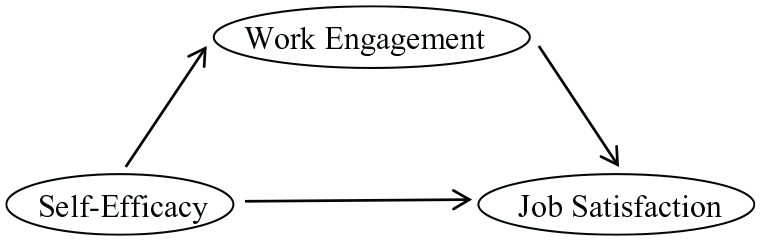
The proposed mediation model.
Method
Participants and Procedures
According to the EDB, it was estimated that 580 TAs were serving in Hong Kong public schools (HKPTU, 2018). As a result, a purposeful sample of 326 TAs working in various schools was recruited for this study because they were assumed to share common characteristics with the population of TAs in Hong Kong. The participants had attended a government-funded workshop for inclusive education in the 2015–2016 school year. An anonymous questionnaire was administered to the participants of the workshop during the last session. In particular, an oral informed consent was obtained and participants were free to decide whether to fill out the questionnaire or not. Survey completion was voluntary. From the 326 questionnaires, 310 questionnaires were returned, with a return rate of 95.1%. As the target participants to be studied are TAs working in primary or secondary schools, two participants working in other schools were discarded. There were 292 valid questionnaires involved in the final statistical analysis after deleting 16 more cases with a total of 82 missing values.
Among the 292 respondents, 201 of them were from secondary schools and 91 were from primary schools, with 88 males and 204 females. More than half of them were aged 24 years and below. In addition, 209 of them were involved in classroom and/or assisted teaching and 83 of them were only responsible for performing nonteaching duties. About three quarters of the participants had not received any teacher training (e.g., PGDE) and more than 95% of them had never attended a special education training course. About 60% of the participants have been working as TA for 1 to 2 years, with about one fourth having worked for 2 to 7 years and less than 1% having worked for 10 years or more.
Instruments
Self-efficacy
The TAs’ self-efficacy was measured by the 30-item Teaching Assistant Efficacy Scale (TAES), assessing five domains of efficacy: learning support (six items; for example, “I can motivate students who show low interest in school work”), teaching support (five items; for example, “I can provide an alternate explanation or example when students are confused”), behavior management (eight items; for example, “I can control disruptive behavior in the classroom”), cooperation (seven items; for example, “I can cooperate with non-teaching staff in my school”), and administrative support (four items; for example, “I can assist to improve the learning environment”; Yan et al., 2015). The items are presented on a 6-point Likert-type scale ranging from 1 (strongly disagree) to 6 (strongly agree). The results of the Rasch analyzes supported the five-domain structure, with Rasch reliabilities for all domains above .90. The reliability coefficients (.96 for total, .91 for learning support, .88 for teaching support, .92 for behavior management, .86 for cooperation, and .75 for administrative support) were higher than .75, indicating satisfactory internal consistency in the present study.
Job satisfaction
In the present study, the Chinese version of the short-form Minnesota Satisfaction Questionnaire (MSQ) was adopted (Wu, 1998). Six items (e.g., The feeling of accomplishment I get from my job) relevant to the job nature of TAs in Hong Kong were properly selected based on a 5-point Likert-type scale ranging from 1 (very dissatisfied) to 5 (very satisfied). The wordings of selected items had been slightly modified to fit into the Hong Kong context. The reliability for these six items was satisfactory (α = .83) in the present study.
Work engagement
Work engagement was measured by the Chinese Version of the Utrecht Work Engagement Scale (UWES-9; Fong & Ng, 2012). It consists of nine items grouped evenly into three components: vigor (e.g., “At my work, I feel bursting with energy”), dedication (e.g., “I am enthusiastic about my job”), and absorption (e.g., “I feel happy when I am working intensely”). Responses to items are given on a 7-point Likert-type frequency scale, ranging from 0 (never) to 6 (everyday). The factorial validity of the three-factor model was intact, as shown by decent goodness-of-fit indices (i.e., comparative fit index [CFI] =.93, Tucker–Lewis index [TLI] = .90, root mean square error of approximation [RMSEA] = .08, and standardized root mean square residual [SRMR] = .05). In this study, all of the Cronbach coefficients (.92 for the overall scale, .79 for vigor, .83 for dedication, and .80 for absorption) were higher than .70, suggesting satisfactory internal consistency.
Data Analysis
Using the partial least squares structural equation modeling (PLS-SEM) approach (Hair et al., 2017), the data analysis was performed by Smart PLS 3.0 (Ringle et al., 2015). PLS-SEM can be applied to the analysis of non-normally distributed data, does not demand a large sample size, and serves the purposes of exploratory study rather than theory testing (Urbach & Ahlemann, 2010). For the present study, the data set contains non-normally distributed data (e.g., items JOBSAT 32, TAEFF 41, and TAEFF 60), which violate the assumptions of the covariance-based structural equation modeling (CB-SEM) approach. Besides, the present study only involves 292 valid cases, which are fewer than 300—the minimum required sample size for confirmatory factor analysis (Worthington & Whittaker, 2006). What is more, the TAES is a newly developed scale that has neither been validated nor been used for independent study. Therefore, the present study is the first study to use this scale to explore TAs’ efficacy and its potentially related constructs such as work engagement and job satisfaction. PLS-SEM is more suitable for theory development in this case.
Following the instructions of conducting and reporting PLS-SEM analyses (Hair et al., 2019), the data analysis of the present study includes evaluation of the measurement models (i.e., examining the reliability and validity of the latent constructs) and the structural model (i.e., examining the hypothesized relationships among the latent constructs).
Results
Measurement Models
The psychometric properties of TAs’ self-efficacy, work engagement, and job satisfaction scales were assessed by using Smart PLS 3.0 (Ringle et al., 2015). To satisfy convergent validity, indicator loadings should exceed .70 and both indicator reliability and average variance extracted (AVE) should be higher than .50. Discriminant validity was assessed by the Fornell–Larcker criterion and cross-loadings. The square root of AVE of each latent construct should be higher than the correlations with other latent constructs based on the Fornell–Larcker criterion. In addition, an indicator’s outer loading on the associated construct should be higher than its cross loadings with all other constructs (Hair et al., 2017). Composite reliability and Cronbach’s alphas between .60 and .70 indicate acceptable internal consistency in exploratory research, with values between .70 and .90 indicating satisfactory to good reliability (Hair et al., 2019).
It was found that TAES would be reliable and valid after deleting four items with outer loadings equal to or less than .70. The 26-item TAES has satisfactory levels of convergent validity and reliability with significant loadings (>.70), good indicator reliability (>.50), acceptable AVE (>.50), and high level of internal consistency on each of the five factors (i.e., learning support, teaching support, behavior management, cooperation, and administrative support), with composite reliability and alphas ranging from .788 to .934. As the TAES met the evaluation criteria of discriminant validity based on the Fornell–Larcker criterion and higher outer loadings, these five factors discriminated each other clearly. TAs’ self-efficacy, as a second order construct, also demonstrated good composite reliability (α = .909), AVE (=.666) and internal consistency (Cronbach’s α = .951).
Regarding work engagement, it was shown that the work engagement scale (UWES-9) was reliable with high internal consistency (composite reliability and Cronbach’s alphas ranged from .797 to .898). It was valid in terms of both acceptable convergent validity, that is, good and significant loadings (>.70) and indicator reliability and high AVE, and discriminant validity on each of the three factors (i.e., vigor, dedication, and absorption). It was noteworthy that work engagement was also a second order construct, with good composite reliability (α = .938), AVE (=.834), and internal consistency (Cronbach’s α = .918). Regarding job satisfaction, two out of six items in MSQ were deleted as the outer loadings of these two items were lower than .70 in the first round of analysis. The remaining four items were independence, ability utilization, creativity, and achievement, reflecting the intrinsic motivational aspect of job satisfaction. Subsequent analysis indicated that job satisfaction represented by these four items was of high internal consistency (composite reliability α = .897 and Cronbach’s α = .850), satisfactory convergent validity with significant loadings (>.70) and both indicator reliability and AVE values were greater than .50, and acceptable discriminant validity. The results were summarized and presented in Table 1.
Results Summary for the Measurement Models.
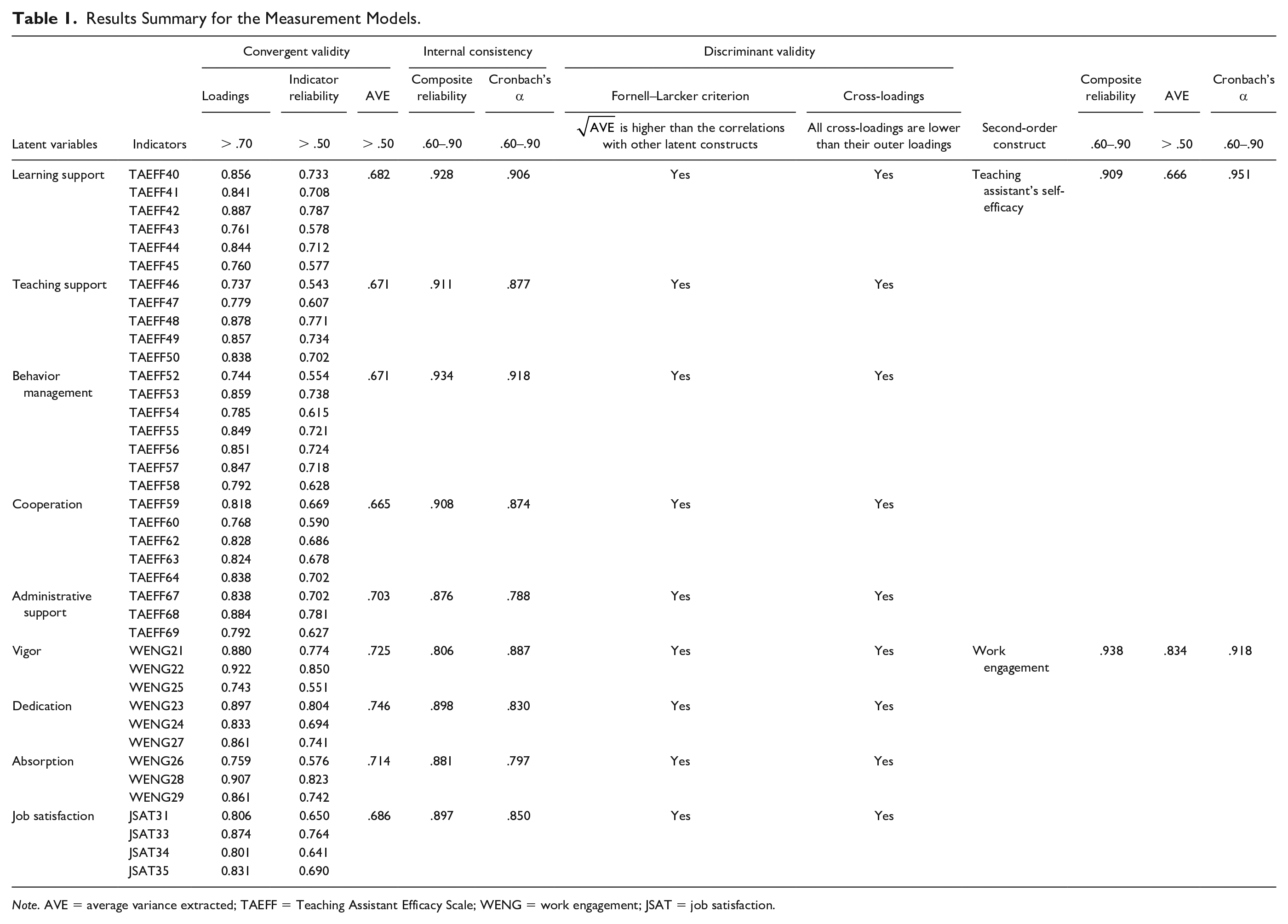
Note. AVE = average variance extracted; TAEFF = Teaching Assistant Efficacy Scale; WENG = work engagement; JSAT = job satisfaction.
Descriptive Data and Correlational Analysis
Scale means, standard deviations, and the intercorrelations among the latent and observed variables are shown in Table 2. The intercorrelations among self-efficacy, work engagement, and job satisfaction were statistically significant. Specifically, self-efficacy was positively related to work engagement (r = .46, p < .01) and job satisfaction (r = .43, p < .01), with medium to large effect sizes. A strong positive relationship was found between work engagement and job satisfaction (r = .54, p < .01). Thus, Hypotheses 1, 2, and 3 were supported.
Descriptive Statistics and Correlations for the Observed and Latent Variables.

Note. LEASUPP = learning support; TEASUPP = teaching support; BEHMGT = behavior management; COOPER = cooperation; ADMSUPP = administrative support; VIGOR = vigor; DEDICATE = dedication; ASORPT = absorption; WE = work engagement; JSAT = job satisfaction; SE = self-efficacy.
Correlation is significant at the .01 level, two-tailed.
Structural Model
After the assessment of measurement models, the validity of the structural model was evaluated. The coefficient of determination (R2) reflected the combined effect of exogenous latent variables on a target endogenous latent variable, ranging from 0 to 1, with higher values indicating a better explanatory power of the model. As shown in Table 3, the R2 values of work engagement (.208) and job satisfaction (.360) were considered weak and moderate. The f2 effect size was measured to assess the change of the R2 value of a specified endogenous latent variable when a certain exogenous latent variable was removed. The effect size of self-efficacy on work engagement R2 value was moderate (f2 = .262) and on job satisfaction the R2 value was low (f2 = .058). The effect size of work engagement on job satisfaction R2 value was moderate (f2 = .273). The Q2 value (the threshold of zero) indicates the predictive relevance of exogenous latent variables for a certain endogenous latent variable. In the present study, Q2 values of work engagement (.117) and job satisfaction (.220) depicted small to medium predictive relevance of the model. The effect sizes of self-efficacy and work engagement on job satisfaction Q2 values were small (q2 = .031) and small to medium (q2 = .133), respectively (Hair et al., 2017).
Result Summary for the Structural Model.
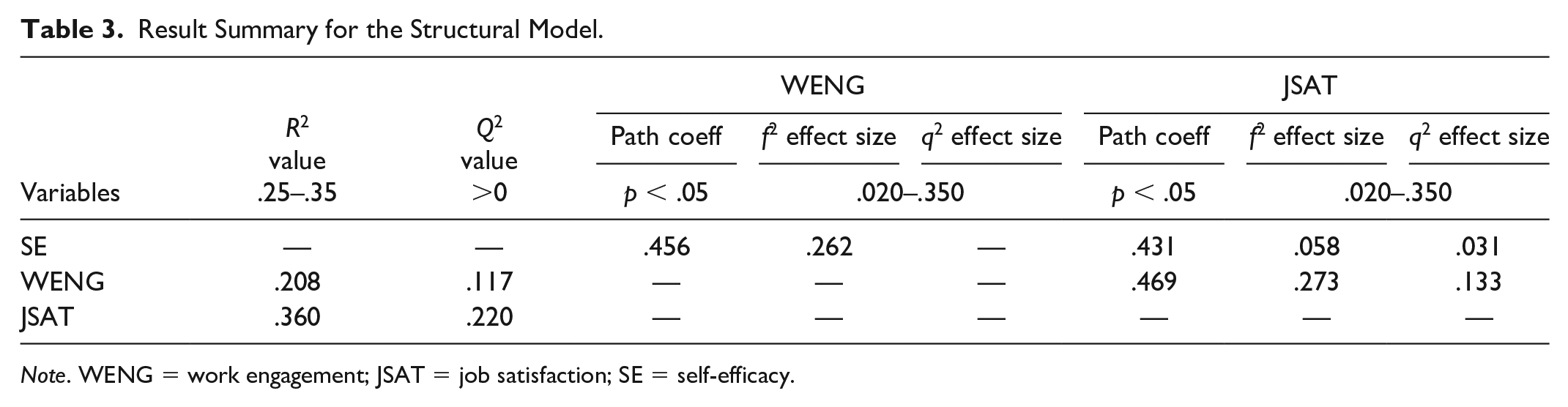
Note. WENG = work engagement; JSAT = job satisfaction; SE = self-efficacy.
To assess the significance of path coefficients, bootstrap procedure was performed to establish confidence intervals (CIs) for the coefficients. No assumption of normality is required for the sample distribution by using bootstrapping procedure. A path coefficient is significant when zero does not fall within the lower and upper 95% CIs. Critical t-value for a two-tailed test larger than 1.96 indicates that a path coefficient is significant at p < .05. As shown in Table 4 and Figure 2, the direct and indirect effects of self-efficacy on job satisfaction were estimated with the mediator (i.e., work engagement). The result indicated that the indirect effect of self-efficacy, through work engagement, on job satisfaction was significant (β = .214, p < .05), with significant direct effect of .217, indicating that Hypothesis 4 was supported. The strength of mediation was estimated using variance accounted for (VAF). It was equal to the indirect effect divided by the sum of direct and indirect effects (i.e., the total effect) and had a value of .497, showing that 49.7% of self-efficacy’s effect on job satisfaction was explained through work engagement. As the value of VAF was between 20% and 80%, this mediation was classified as partial mediation, with work engagement serving as a complementary mediator (Hair et al., 2017).
Significance Analysis of the Total, Direct, and Indirect Effects.
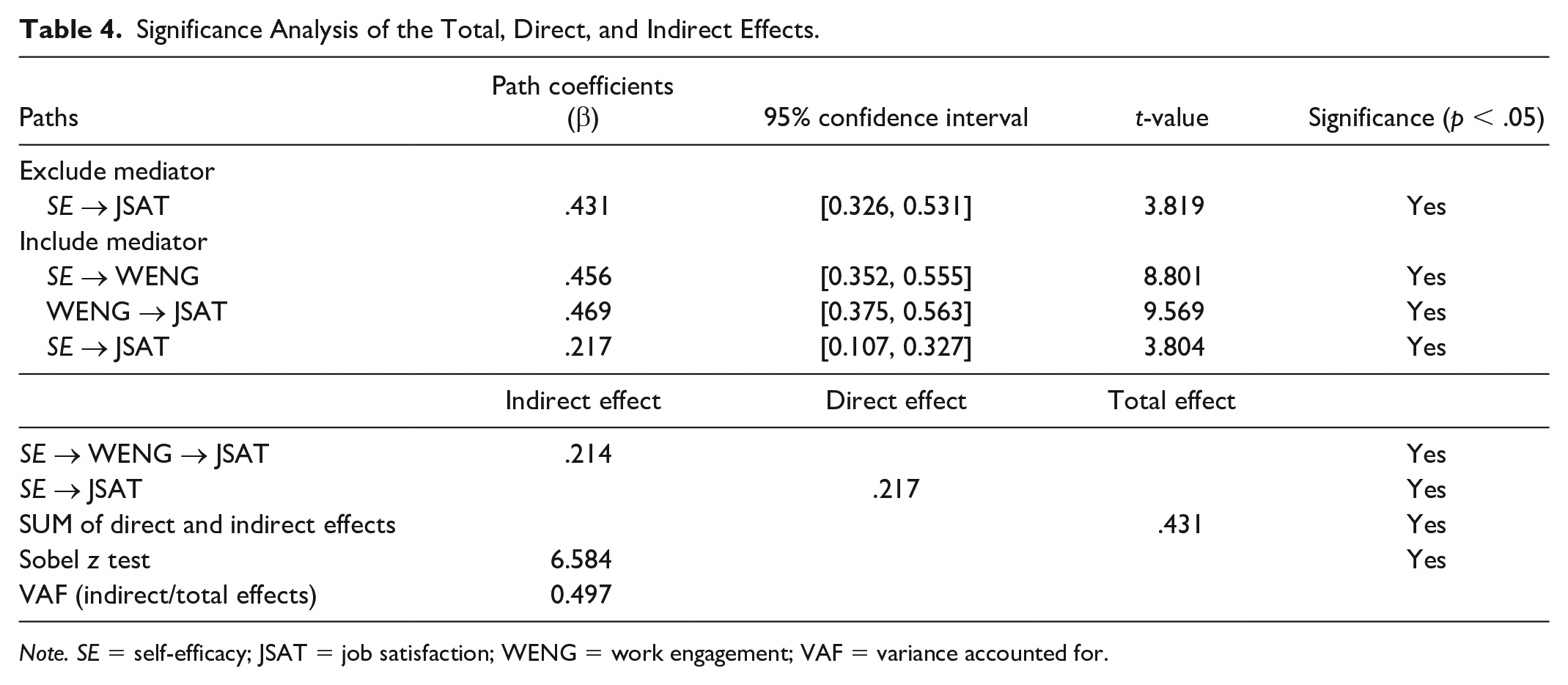
Note. SE = self-efficacy; JSAT = job satisfaction; WENG = work engagement; VAF = variance accounted for.
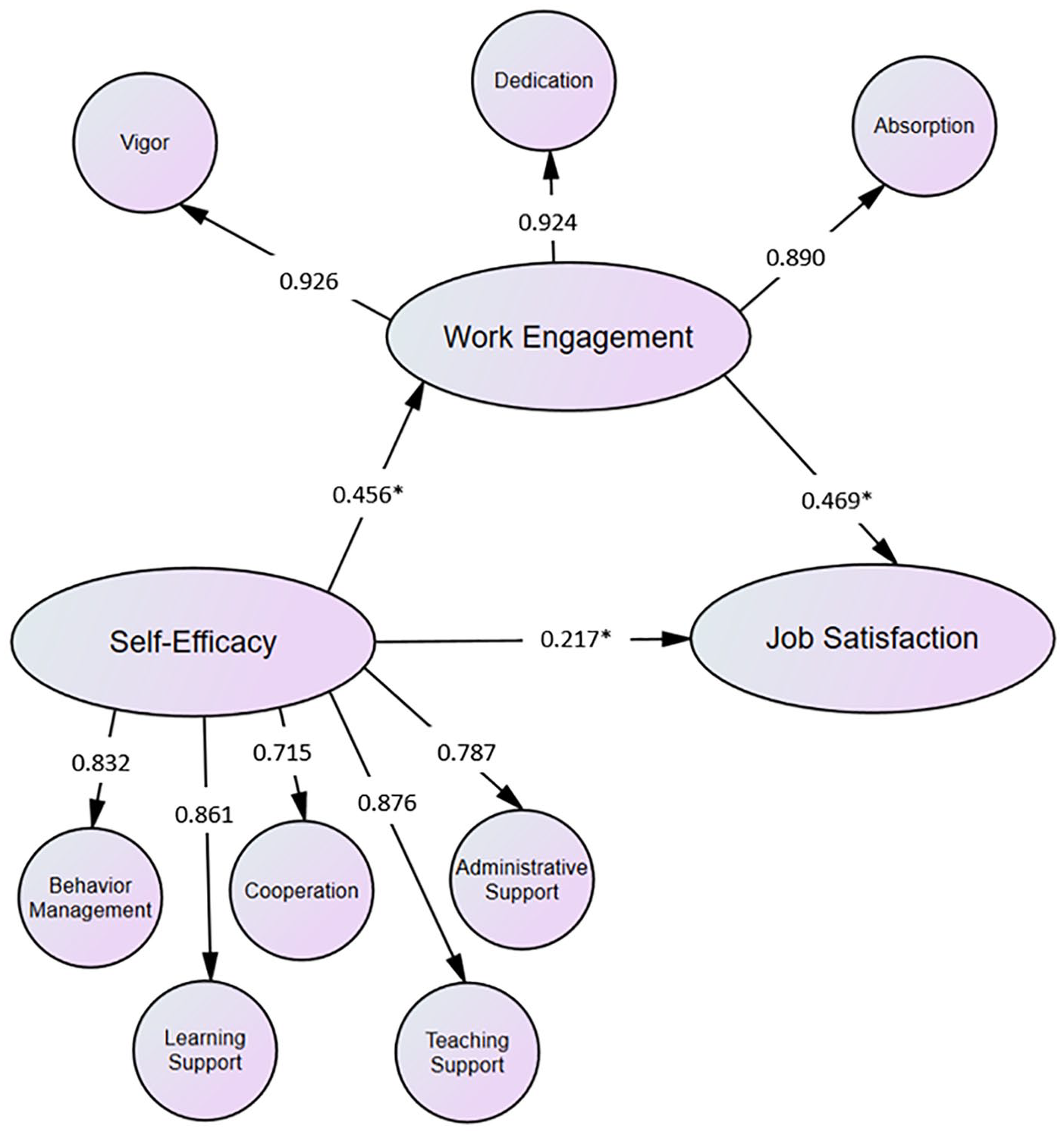
The structural model of the relationships among self-efficacy, work engagement, and job satisfaction.
Discussion
The present study examined the relationships among self-efficacy, work engagement, and job satisfaction in a sample of TAs in Hong Kong. We also investigated whether their self-efficacy contributes to job satisfaction through work engagement. Our results supported the predictions that there were positive correlations among TAs’ self-efficacy, work engagement, and job satisfaction. TAs who reported high levels of self-efficacy in this study were more engaged and more satisfied with their jobs. The strengths of these relationships are in line with previous studies conducted with school teachers (e.g., Høigaard et al., 2012; Perera et al., 2018; Skaalvik & Skaalvik, 2014), showing that self-efficacy contributes to work engagement and job satisfaction. In particular, work engagement partially mediated the relationship between self-efficacy and job satisfaction, indicating that work engagement played a role in explaining this relationship. Our results also gave support to the social cognitive theory of self-efficacy and SDT of work engagement, highlighting the importance of beliefs in competence and intrinsic motivation in job satisfaction among the TAs in this sample. According to the social cognitive theory, efficacy belief regulates engagement, serving as a self-motivation mechanism (Simbula et al., 2011). TAs with high levels of self-efficacy may tend to interpret demands and problems as challenges instead of hindrances, which in turn will relate to more engagement at work (Ventura et al., 2015). A strong sense of self-efficacy may also enhance the performance of TAs, contributing to the promotion of school commitment and job satisfaction (Caprara et al., 2006). Based on the perspective of SDT, for TAs who are more engaged at work, aspects such as enjoying the student–teacher interaction and observing student progress (Scott et al., 2001) may serve as an important intrinsic motivation for job satisfaction.
Limitations and Future Research Directions
A limitation of the present study is that we have examined only one mediator—work engagement. Work engagement in this study has been found to partially mediate the relationship between TAs’ self-efficacy and job satisfaction, without indicating whether other potential variables would account for this relationship. For example, work conditions and goal progress were found to mediate the relation of self-efficacy with job satisfaction in teachers (Badri et al., 2013; Lent et al., 2011). Future research could extend the number of mediators. Another limitation of this study was that it has been designed as a cross-sectional study. Although we have tested the proposed model in which self-efficacy predicts job satisfaction through work engagement, no causal interpretations among the study variables could be inferred. Longitudinal studies would be needed in future research to explore the hypothesized causal relations among self-efficacy, work engagement, and job satisfaction for extended periods of time. Finally, all the instruments in the current study were self-report measures, which would be subject to inflated bias of social desirability. Multiple sources of data would be recommended in further studies. As self-efficacy is crucial to teaching and learning effectiveness, and well-being, further investigation of TAs’ self-efficacy and its relation to various educational and psychological outcomes is critically necessary.
Suggestions and Conclusion
It was suggested that schools should assign appropriate in-class and assisted teaching duties to TAs to raise their level of self-efficacy as TAs were least confident in teaching support and managing students’ misbehavior (Sin et al., 2017). This experience also provides opportunities for TAs to explore new issues in the teaching process, collaborate with other teaching staff (Gavish & Friedman, 2010; Guo et al., 2011; Pas et al., 2010), and engage students with SENs more readily. Increased self-efficacy can be attributed to increased confidence gained through various classroom experiences (Klassen & Durksen, 2014). More importantly, in-class teaching is a relatively and highly complexed task; the more complex the task, the more self-efficacious the TAs become (Mills, 2011).
With the implementation of inclusive education, TAs have grown in numbers and they have also been changed from nonteaching staff (i.e., technician, office clerk, and administrative staff who do not need to support students under teachers’ supervision) to para-educators (i.e., school employees who provide instructional support to students under the supervision of teachers or special educators; Butt & Lance, 2005; Cajkler & Tennant, 2009; Nguyen, 2015). Along with the change of roles of TAs, provision of more advanced professional training in teaching and learning for TAs would be inevitable. The findings of the current study thus call for strengthening TAs’ self-efficacy with these courses. The effectiveness of such courses on improving teacher self-efficacy has been evidenced in Hong Kong (Chao et al., 2017; Forlin et al., 2014; Wan, 2016). Efficacy would be one of the intervention foci on school management in developing TAs’ training courses as well. Future research could examine whether TAs report enhanced self-efficacy (e.g., pretest vs. posttest) after participating in these courses (Giangreco, 2013; Gkolia et al., 2014; Sin et al., 2017).
When Hong Kong continues to embrace inclusive education to cater to the needs of students with SEN (EDB, 2012, 2014), it would be important to promote the self-efficacy of TAs. To better equip TAs with more skills for future needs, to provide support for SEN students, and to enhance TAs’ engagement in more complex classroom duties, professional development programs for TAs may have to be included to enable them to have more hands-on experience in workplace. The inclusive classroom is a dynamic environment that demands flexible and prompt responses from TAs and teachers, and professional training with focus on developing TAs’ knowledge-in-action would prepare them to handle problems and challenges in the inclusive classroom contexts.
Although schools in Hong Kong have been hiring TAs for more than two decades, the position of the TAs has been relatively unstable, which has resulted in high turnover rate (HKPTU, 2016, 2018; Kwok, 2013) and low propensity for professional development among them. TAs’ contributions should be recognized in teaching and learning, as well as student support. It is recommended that government should review the current employment situation of TAs to promote TAs’ professional development. In the long run, concrete plans and policies should be formulated to provide more regular teachers posts, so as to enhance the career prospects and construct the professional identity of TAs.
Footnotes
Declaration of Conflicting Interests
The author(s) declared no potential conflicts of interest with respect to the research, authorship, and/or publication of this article.
Funding
The author(s) received no financial support for the research, authorship, and/or publication of this article.
