




Abstract
In this study, it was aimed to determine the relationship between self-efficacy and job satisfaction of teachers Turkish teaching as a foreign language. The mixed methods study was used by collecting quantitative and qualitative data from teachers. The study was conducted with 150 Turkish teachers working in different countries. Interviews were conducted with 12 participants selected from the sample. Participants voluntarily participated in the study. Job satisfaction scale, general self-efficacy scale, and interview guide were used to collect data. In the study, they have used scales with high validity and reliability and an interview guide prepared by the researcher. Data has been collected online. In the analysis of the data, t-test, ANOVA, correlation, and regression analysis were performed using the SPSS 22.0 package program. Content analysis was used for qualitative data. According to the results, it was determined that there were significant differences according to the variables of gender, age, place of work, and professional seniority. Positive and significant relationships were found between teachers’ self-efficacy perceptions and job satisfaction, and it was determined that self-efficacy predicted job satisfaction. It was determined that general self-efficacy and job satisfaction have an important effect on solving problems in professional life. The results of the research are expected to guide the professional life of language teachers.
Introduction
Teaching Turkish as foreign language is carried out in many countries. Today, the increasing number of people who want to learn Turkish has led to an increase in the number of institutions and organizations that teach Turkish in many countries (Balcı & Melanlıoğlu, 2016, p. 987). Every year, students from many countries come to Turkey to study. According to the data of the Council of Higher Education (2022), 260,151 foreign students have studied at Turkish universities in the 2021 to 2022 academic year. These students learn Turkish for 1 year before their university education. A large group of people learning Turkish in Turkey are also immigrants. Turkey hosts millions of refugees, especially from Syria and Afghanistan. According to the data of the Ministry of National Education (2020), the efforts to gradually enroll the Syrian population of education age (a total of 1,197,124 children) under temporary protection in public schools affiliated to the MNE are continuing. School-age students and adults constitute a large group of Turkish learners. Every year, thousands of students learn Turkish in more than 50 Turkish teaching centers affiliated with Yunus Emre Institute abroad. In addition, Turcology department students at universities abroad are among those who learn Turkish. Apart from these, the Turkish Maarif Foundation has activities in 67 countries and provides education at primary, secondary, and high school levels to 48,078 students (Turkish Maarif Foundation [TMF], 2022). In some countries, Turkish is taught as an elective subject at the secondary and high school levels. Turkish teaching activities carried out by various institutions in many countries of the world are concentrated in the Middle East, the Balkans, Africa, and Central Asia. In this context, there has been an increase in the number of teachers working in these institutions. Teachers who teach Turkish to varied educational levels and target groups work within various institutions. These teachers differ from other teachers with some unique characteristics while doing their profession. According to Hammadou and Bernhardt (1987, p. 302) foreign language teachers have different experiences than other teachers. The process of learning content and content in foreign language teaching is the same. Foreign language teachers also have some differences in terms of working conditions. These teachers need to be satisfied and enjoyed while working their job. Because this profession also includes some emotional features. Teachers can teach better if they are confident and satisfied with their job.
“There is a relationship between teachers’ self-efficacy and job stress and job satisfaction” (Troesch & Bauer, 2017, p. 394). According to Caprara et al. (2003) we will enjoy more if we are confident in carrying out job activities. As Ryan and Deci (2000) points out, teachers “self-efficacy affects teachers” inner needs are met and affect job satisfaction by increasing the sense of pride and achievement among teachers. Teachers with low self-efficacy are not satisfied with their jobs and therefore leave the teaching profession (Evans, 2001). Job satisfaction is likely to accompany teachers’ sense of competence and contribute to children maintaining optimal educational attainment (Caprara et al., 2006). It has been revealed that self-efficacy beliefs positively affect teachers’ job satisfaction, motivation, and job engagement (Demir, 2020, p. 216). Teachers with higher self-efficacy are expected to be more satisfied with their job (Safari et al., 2020, p.36).
It has been considered as important to examine the professional life of Turkish teachers, which is intensively taught in many countries of the world and Turkey. It is thought that the level of teachers’ job satisfaction and self-efficacy is effective in teaching efficiency. The satisfaction of the language teachers with professional life increases the academic success of the students. Therefore, the job satisfaction of those who teach Turkish as a foreign language is expected to be high. Considering the conditions of those working abroad, it can be said that they need more satisfaction. Examining the job satisfaction of foreign language teachers is important for understanding the situation of teachers.
Background
Job Satisfaction
“Job satisfaction is the positive emotional state arising from the evaluation of one’s job or work experiences.” (Lambrou et al., 2010, p. 1). Teacher job satisfaction, “the sense of satisfaction that teachers experience through their work as a teacher” (Ainley & Carstens, 2018). According to Shann (1998), The teacher’s job satisfaction contributes to the effectiveness of the school by determining the permanence of learning. Job satisfaction is an important predictor in working life. People who are satisfied with their job can take a more positive attitude toward life. Job satisfaction in teachers as well as in all employees; improves well-being and prevents occupational fatigue (Skaalvik & Skaalvik, 2017). It can also contribute to job satisfaction, positive interactions, and collaboration between colleagues and supervisors in the organizational context (Amorim Neto et al., 2017).
According to Weiss and Cropanzano (1996 (cited in Burić & Moé, 2020), work events about to the work environment and emotional tendencies of the individual cause certain emotions that accumulate over time and shape work attitudes and behaviors. Emotional regulation and psychological well-being affect work engagement (Greenier et al., 2021). These emotional situations experienced by the individual also affect their professional commitment and their job satisfaction. Job satisfaction also flows from variables such as wage, nature of the job, individual’s working conditions, management policies, and colleagues, which are dimensions of job satisfaction (Luthans, 1992 cited in Ertürk & Keçecioğlu, 2012). When a person is fully and joyfully immersed in his/her professional role, productivity increases (Greenier et al., 2021). A teacher must have job satisfaction to be successful in the profession and therefore to provide quality education (Demirel, 2014). Therefore, Travers and Coopers (1996 cited in Amoli & Youran, 2014) stated that teachers intend to leave the job when they are not satisfied with their working conditions.
Individuals who are not satisfied with their jobs are absent and show different reactions to fill the time in the workplace. These can include the following behaviors: using the time spent in the workplace for private work, taking long breaks, seeming busy without doing work, chatting with colleagues on trivial matters, delaying work, deliberately ignoring the rules and opposing authority, aggressive behavior toward colleagues and superiors, revenge, retaliation (Sun, 2002 cited in Ertürk & Keçecioğlu, 2012).
Self-efficacy
According to Bandura (1997, p. 3) Self-efficacy is “beliefs in a person’s ability to organize and carry out the necessary action paths to achieve the given gains.” Self-efficacy shows the degree of perception of individuals toward the belief that they have the skills and abilities necessary to achieve a specific task rather than the degree of their abilities. Self-efficacy perception affects persons’ motivation, behavior, and choices (Hsu et al., 2007, p. 155). When the concept of self-efficacy is evaluated from the perspective of teachers, it emphasizes the knowledge, skills, and attitudes that must be possessed to fulfill the duties and responsibilities of teaching (Demirtaş et al., 2011).
Self-efficacy is influenced by various factors, such as the availability of resources, perceived difficulty of the task, and contextual difficulties (Fathi et al., 2020) Self-efficacy beliefs affect people’s goals, expectations, how they motivate themselves, and how they will handle when faced with challenges. Self-efficacy and burnout affect emotional regulation (Fathi et al., 2021) People with high self-efficacy beliefs can easily solve the problems encountered, as they can improve themselves (Pajares & Urdan, 2006). Teachers’ self-efficacy can affect how teachers perceive and deal with job stress (Fathi & Derakhshan, 2019).
Self-efficacious teachers appreciate the contribution of other school components to the functioning of the school (Caprara et al., 2006). Teachers with high self-efficacy are more open to new ideas and have higher planning and organization skills. These teachers use new strategies with their students (Allinder, 1994). Self-efficacy helps individuals to be better teachers and improves a sense of job satisfaction in teaching practice (Skaalvik & Skaalvik, 2017). Teachers’ self-efficacy affects their performance in their professional careers (Fathi et al., 2020). Teachers “self-efficacy also affects the learning process and is related to students” academic success. Teachers’ self-efficacy can affect a student’s success in some ways.
Literature Review
There have been some studies examining the effect of various variables on self-efficacy. According to Bandura, the most important reason for differences in self-efficacy in individuals may be intercultural differentiation (Bandura, 1997) Some studies have addressed the relationships between self-efficacy and different variables (Grissom et al., 2014; Jiayi & Ling, 2012; Skaalvik & Skaalvik, 2014). Some research has been done on the self-efficacy effect of gender (Gençtürk & Memiş, 2010; Villafañe et al., 2014; Wahyudiati et al., 2020). There are studies on the effect of seniority on self-efficacy (Cox & Simpson, 2016; Daugherty, 2005; Jasiński, 2021; Kaçar & Beycioğlu, 2017).
There have been studies examining the relationship between different variables and job satisfaction (Akomolafe & Olatomide, 2013; Musenze et al., 2014; Schubert-Irastorza & Fabry, 2014; Stearns et al., 2014). Studies have been conducted on the effect of gender on job satisfaction (Bhat, 2018; Safari et al., 2020; Yilmaz et al., 2010) related to the age variable (Celep, 2002; Yilmaz et al., 2010) related to the seniority variable (De Nobile & McCormick, 2008; Fencl & Scheel, 2005; Jasiński, 2021).
Teachers’ self-efficacy beliefs affect their school commitment and job satisfaction (Caprara et al., 2003, 2006; Skaalvik & Skaalvik, 2017). Also, studies are stating that there is a relationship between self-efficacy and job satisfaction (Burić & Moè, 2020; Chaaban & Du, 2017; Demirdag, 2015; Fathi & Rostami, 2018; Hassan & Ibourk, 2021; Kasalak & Dağyar, 2020; Katsantonis, 2019; Rastegar & Moradi, 2016; Safari et al., 2020; Zakariya, 2020). According to Caprara et al. (2003) teachers’ self-efficacy beliefs determine their job satisfaction and academic success of students. Gençtürk and Memiş (2010) examined “primary school teachers’ self-efficacy toward the teaching profession and job satisfaction.”
There are deficiencies in studies dealing with the self-efficacy levels and job satisfaction of teachers teaching Turkish as a foreign language. Engül (2018) examined the self-efficacy of Turkish teachers. Gürsoy and Kana (2019) examined the job satisfaction levels and burnout levels of Turkish teachers. This study discussed the relationship between Turkish language teachers’ self-efficacy and job satisfaction. This study will present data on the professional lives of teachers and lay the groundwork for further studies. Considering that foreign language teachers working domestically and abroad have similar conditions, it will contribute to understanding the conditions of foreign language teachers in an international context.
This study aims to determine the relationship between self-efficacy perceptions and job satisfaction of teachers teaching Turkish as a foreign language. For this purpose, answers were sought for the following sub-problems:
Do teachers’ self-efficacy perceptions differ significantly according to gender, place of work, age, education level, and professional seniority?
Do teachers’ job satisfactions differ significantly according to gender, place of work, age, education level, and professional seniority?
What is the relationship between teachers’ self-efficacy perceptions and job satisfaction?
Are teachers’ self-efficacy perceptions a meaningful predictor of job satisfaction?
Method
Research Model
In the study, qualitative data were used to support quantitative data. With this aspect, the research was designed as an explanatory sequential mixed design. According to this method, “the data of qualitative and quantitative research are combined and presented holistically” (Creswell, 2014). The correlation model was used in the quantitative part of the study. In the qualitative part, the phenomenology design was used. With a holistic approach, detailed information about teachers’ job satisfaction was obtained.
Participants
The study was conducted with 150 Turkish teachers working in different countries. E-mails were sent to the teachers to participate in the study, and work was carried out with the teachers who provided feedback. The participant consists of people with different sociodemographic characteristics. Teachers in Turkey are people working in Turkish teaching centers affiliated with state and foundation universities in 14 different provinces. The participants abroad are Turkish teachers working in the countries of Egypt, Malaysia, Poland, Morocco, Bosnia and Herzegovina, North Macedonia, Senegal, the Turkish Republic of Northern Cyprus, Albania, Jordan, Romania, and Italy within the body of Yunus Emre Institute. The personal rights and working conditions of individuals in Turkey and abroad differ from each other. The fact that the country’s change of employees abroad is determined centrally is an important difference in working conditions compared to those in the country. The difference between the student groups taught by teachers working in Turkey and those working abroad is a significant issue. With the high number of refugees in Turkey, more than half of the teachers also teach language to refugee students. Barriers in the language learning process, cultural differences, and language proficiency levels can impact teachers’ self-efficacy levels. Teachers experienced in teaching languages to refugee students can be aware of these differences and utilize appropriate methods for these students. While students abroad generally commence learning Turkish based on their personal preferences, refugee students learn Turkish for reasons such as continuing their education, finding a job, and integrating. These differences may impact teachers’ self-efficacy and job satisfaction. The information about the participants is shown in the tables in the results section.
In the qualitative part of the study, 12 participants were interviewed. The criterion sampling method was used in the selection of these participants. Among these participants, there are seven men and six women.
Data Collection
In the study, General Self-Efficacy Scale with 17 items adapted to Turkish by Yildirim and Ilhan (2010) was used to determine the general self-efficacy perceptions of the teachers. The scale has a Cronbach Alpha reliability coefficient of .80. (Yildirim & Ilhan, 2010). In this study, the Cronbach Alpha reliability coefficient was determined as .89.
In the study, short form of Minnesota Job Satisfaction Scale with 20 items adapted to Turkish by Akkamış (2010) was used to determine the job satisfaction of the teachers. Minnesota Job Satisfaction Scale consists of two factors: intrinsic and extrinsic. Akkamış (2010) determined that the accrued scale has a reliability level of 0.82. The Cronbach Alpha reliability coefficient of this study was determined as .89.
It has been stated that the reliability coefficient accepted in the literature is 0.70 and above (Mc Millan & Schumacher, 2010). Since both scales used in the study were above this specified limit, it was concluded that these scales were appropriate to be used in the study. Scale data were collected through Google Forms.
Interviews were conducted to support quantitative data in the study. According to the literature, a semi-structured interview guide was prepared by the researcher. Content validity was ensured by taking the opinions of two experts. A pre-practice was made with three participants. Changes were made in the guide accordingly. People participated in these interviews voluntarily. Interviews were made with the participants via online connection. The interviews transcribed by the researcher were checked by the participants. Member checking is important for qualitative research. Ethics committee approval was obtained for the research.
Data Analysis
The data collected in the research were analyzed with the SPSS 22.0 package program. Positive items were scored between 1 and 5 in the study. While analyzing, firstly, skewness and Kurtosis values were found to determine the normality of the data. These values were found to be between 0.00 and +0.50.
According to these values, normality was achieved in the data. The arithmetic mean and standard deviation were calculated and the independent samples t-test and one-way analysis of variance (ANOVA) were applied. Correlation analysis was conducted to determine the relationship between participants’ self-efficacy and job satisfaction. In addition, simple linear regression analysis was used.
Content analysis was used in the qualitative part of the study. The data are interpreted by transforming into code and category. In order to ensure the reliability of the data, the study was detailed by giving examples from student views. Two different people coded the data. As a result of the coding process, the Miles and Huberman (1994, p. 64) formula was used to determine the compatibility of the coders. Based on the 0.85 agreement rate calculated with the formula, it was seen that the encoder reliability was sufficient. Participant checking was provided for the transcribed texts. In the validity (credibility) dimension of the research, attention was paid to expert opinions and the compatibility of the findings with the conceptual framework.
Results
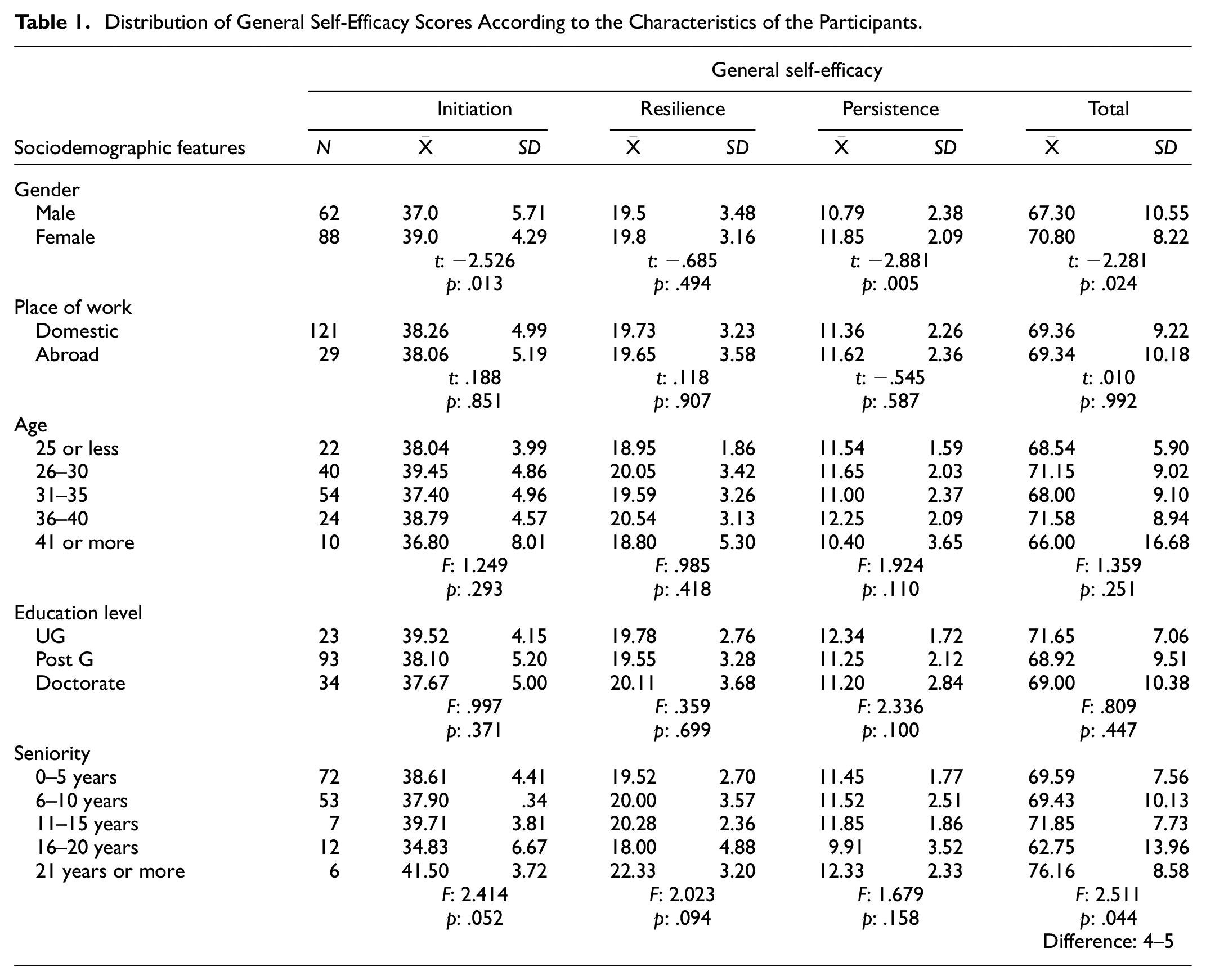
As Table 1 shows, there is a significant difference between the initiation (t = −2.526, p < .05), persistence (t = −2.881, p < .05) sub-factors and overall scores of self-efficacy (t = −2.881, p < .05) for the gender status of the participants. When the arithmetic averages are examined, it is seen that women (X = 70.80) have higher scores than men (X = 67.30) in the initiation, persistence, and total. On the contrary, there is no significant difference in the resilience factor. There is no significant difference between the place of work variable and general self-efficacy scores. No significant difference was found between the age variable and general self-efficacy scores. Considering the educational status, there is no significant difference between them and their general self-efficacy scores. There is no significant difference between the professional seniority and the factors. However, there is a significant difference in general scores (F = 2.511, p < .05). As a result of the Post-Hoc test, it was determined that the difference is between 16 and 20 years (X = 62.75) and those who are seniors of 21 years or more (X = 76.16).
Distribution of General Self-Efficacy Scores According to the Characteristics of the Participants.
As Table 2 shows, it was determined that there is no significant difference between the gender variable the sub-factors and total scores of the Job Satisfaction Scale. Accordingly, it is seen that job satisfaction scores between men and women are close to each other. It was determined that there was a significant difference between the place of work and job satisfaction total scores (t = 3.40, p < .05), intrinsic (t = 2.282, p < .05) and extrinsic (t = 3.940, p < .05) factors. Accordingly, it can be said that those who work domestically (X = 79.49) have higher scores in job satisfaction than those who work abroad (X = 72.24). It was determined that there was a significant difference between the age variable and job satisfaction total scores (F = 3.984, p < .05), intrinsic (F = 2.663, p < .05) and extrinsic (F = 3.993, p < .05) factors. According to the Post-Hoc test, it is understood that aged 25 or less (X = 52.68) have higher scores than those aged 26 to 30 (X = 49.50) in job satisfaction. There is no significant difference between the job satisfaction scores of the participants according to their education level. It was determined that there was a significant difference between the professional seniority of the participants and their job satisfaction total scores (F = 3.817, p < .05), internal (F = 2.448, p < .05) and extrinsic (F = 5.064, p < .05) factors. According to the Post-Hoc test, it is seen that those who are 0 to 5 years senior (X = 50.63) in the intrinsic factor have higher scores than those who are 11 to 15 years old (X = 45.14). When looking at the difference in the extrinsic factor and total scores, it was determined that those who were seniors of 0 to 5 years had higher scores than those who were seniors of 6 to 10 years.
Distribution of Job Satisfaction Scores According to the Characteristics of the Participants.

As Table 3 shows, a simple linear correlation analysis was made between the job satisfaction scale and the general self-efficacy scale scores. According to this analysis, a positive relationship was found between intrinsic satisfaction and initiation (r =, 367, p < .05), not giving up ( r = .242, p < .05), persistence (r = .263, p < .05) and total scores (r = .343, p < .05). There was no significant relationship between extrinsic satisfaction and self-efficacy total score and sub-factors (p > .05). While it was determined that there was a positive relationship between job satisfaction total score and initiation (r = .254, p < .05), persistence (r = .217, p < .05), and total self-efficacy scores (r = .234, p < .05), no significant relationship was found with the scores of resilience (p > .05).
Correlation Between Participants’ General Self-Efficacy and Job Satisfaction.
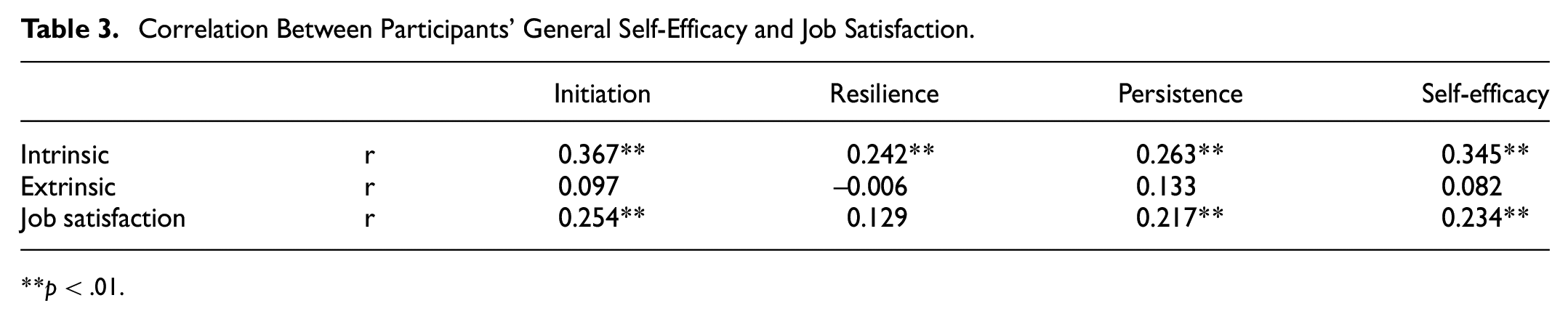
p < .01.
As Table 4 shows, in the simple linear regression analysis, it was determined that general self-efficacy scores (R = .234, R2 = .055, F(1–148) = 8.569, p < .05) significantly predicted job satisfaction. According to this finding, the general self-efficacy level explains 5% of the variance regarding job satisfaction.
Simple Linear Regression Analysis Results Regarding the Status of General Self-Efficacy Predicting Job Satisfaction.

As mentioned in the analysis section; the member checking, inter-coder agreement, credibility, and reliability processes required for qualitative analysis were completed. As Figure 1 shows, the codes of seeking alternative solutions, consultation, and talking with officials come to the fore in the interviews with the participants regarding methods of solving problems in professional life. Also, solutions such as getting help, planning, confronting problems, taking responsibility, ignoring, professional development, and research are stated. The codes of consultation and talking with officials indicate that the solution is realized with external factors. The code of seeking alternative solutions means that the person is trying to overcome the problems. The general self-efficacy of the people plays an important role in solving the problems. The opinions of the participants who show the will to solve the problems are as follows:
P8: I am confronting problems in professional life and I’m looking for a solution. I can usually find the solution to the problem. I consider myself successful in this regard.
P11: I really struggle until I find a suitable solution. I always try to find a solution by trying many ways, not just one way. I am trying to direct the people around me to one of these solutions.
The views of a participant who applied to external factors for the solution of the problem are as follows:
P2: I used the support of my friends and advisors. It has been successful in my development.

The solutions to problems in professional life.
Discussion
In this study, the differences between the gender, place of work, age, education level, and seniority of the participants were examined, correlation and regression analyzes were made between scales. Qualitative data were used for in-depth analysis of the data.
According to the gender variable, the general self-efficacy perceptions have a significant difference. No significant difference was found in the resilience factor. According to this difference, female scores are higher than male’s. Women have higher self-efficacy levels than their male colleagues due to more positive attention and self-confidence (Villafañe et al., 2014; Zeldin et al., 2008). In some studies, no significant difference was found between teachers’ self-efficacy and their gender (Engül, 2018; Gençtürk & Memiş, 2010; Kaçar & Beycioğlu, 2017; Saracaloğlu et al., 2017). There is no significant difference between gender and job satisfaction. The role of gender in teachers’ job satisfaction has been examined in many studies. Some studies do not report a relationship (Gençtürk & Memiş, 2010; Saracaloğlu et al., 2017; Sargent & Hannum, 2005). Some studies indicate those female teachers have higher job satisfaction than males (De Nobile & McCormick, 2008; Ma & MacMillan, 1999).
There is no significant difference in perceptions of general self-efficacy according to the place of work. It is seen that there is a significant difference between job satisfaction perceptions and the place of work. Accordingly, it is understood that those who work domestically have higher scores than those who work abroad. Having some difficulties in working abroad may affect the level of job satisfaction.
It is understood that there is no significant difference between the age variable of the participants and their general self-efficacy perceptions. Engül (2018) and Yilmaz et al. (2010) states that there is no significant difference between self-efficacy and age. According to Celep (2002) Turkish teachers’ efficacy beliefs vary according to their age, and their teaching efficacy increases as the age of teachers increases. When the job satisfaction scores were examined, it was determined that there was a significant difference in the age status. Accordingly, it is understood that those in the age group of 25 or less have a higher level of job satisfaction than those in the 36 to 40 age group. The excitement of being younger plays an important role in making this difference. As the age progresses, people’s expectations from the profession may increase more. Some studies suggest a nonsignificant relationship (Crossman & Harris, 2006; Mertler, 2002).
It is understood that there was no significant difference in general self-efficacy perceptions and job satisfaction perceptions according to education level. Increasing and decreasing education levels did not affect general self-efficacy and job satisfaction much. Engül (2018) states that the level of education is affecting self-efficacy. According to Akkamış (2010) job satisfaction scores are not significant according to the education level variable.
A higher level of self-efficacy is positively related to seniority, higher professional skills, and feelings of competence. A significant difference was found between the professional seniority of the participants and their general self-efficacy perceptions. According to this difference, it is seen that those who are 21 years or more seniority have a higher general self-efficacy perception than those who are 16 to 20 years. It is seen that those who worked for 16 to 20 years among the groups have the lowest average. There is a significant difference between the professional seniority and job satisfaction of the participants. It is seen that those who worked for 0 to 5 years have higher scores than those who worked for 6 to 10 years. The high job satisfaction of teachers who have recently started their profession shows that their expectations are met. According to Silah (2001) job satisfaction is high at the first entry of employees, then it starts to decrease, as the career level at the job rises, the level of satisfaction begins to increase again. There are some studies on the relationship between professional seniority and job satisfaction. Some studies (Bishay, 1996; Gençtürk & Memiş, 2010) indicate a positive relationship. Some studies (Crossman & Harris, 2006; De Nobile & McCormick, 2008; Saracaloğlu et al., 2017) also indicate that there is no difference in job satisfaction based on experience.
It has been stated that high self-efficacy belief protects teachers from stress and burnout and increases job satisfaction (Organisation for Economic Cooperation and Development [OECD,], 2020). A positive significant relationship was determined between general self-efficacy and job satisfaction according to simple linear correlation analysis. Accordingly, as the general self-efficacy level increases, the job satisfaction levels also increase. Studies show that there are positive and significant relationships between teachers’ self-efficacy perceptions and job satisfaction (Blackburn et al., 2017; Caprara et al., 2006; Fathi & Rostami, 2018; Klassen & Chiu, 2010; Safari et al., 2020; Vieluf et al., 2013). Theoretical models and empirical studies assume that the positive relationship between teacher self-efficacy and job satisfaction is invariant regardless of teacher factors, and teacher self-efficacy predicts job satisfaction (Burić & Kim, 2021). In some studies, it was determined that there is no significant relationship between self-efficacy and job satisfaction (Demirdag, 2015; Rastegar & Moradi, 2016).
Teachers with high self-efficacy are those who put more effort in the learning-teaching process and have high job satisfaction (Saracaloğlu et al., 2017). It was determined by simple linear regression analysis that general self-efficacy scores significantly predicted job satisfaction scores. These results confirm the results of many studies reported in the literature (Adebomi et al., 2012; Caprara et al., 2003, 2006; Chaaban & Du, 2017; Klassen & Chiu, 2010; Skaalvik & Skaalvik, 2017). Teachers with higher self-efficacy are expected to be more satisfied with their job (Safari et al., 2020).
In the qualitative part of the study, it was determined that they used different solutions to problems in professional life. Among these, seeking alternative solutions, consulting, and talks with officials are more preferred. High general self-efficacy and job satisfaction play an important role in solving problems in professional life. According to Protheroe et al. (2002) teachers’ ability to cooperate and solve problems encountered with other teachers and school administrators plays an important role in increasing motivation and job satisfaction among teachers. According to Afshar and Doosti (2016)“lack of professional commitment,”“interpersonal relationship problems” cause poor job performance of teachers.
Conclusion
This study is limited to 150 teachers teaching Turkish as a foreign language. The results determined for this sample group may not include teachers in primary and secondary education institutions or teachers of other branches. Also, this study was limited by the teachers’ perceptions of self-efficacy and job satisfaction.
As a result of the research, it was determined that general self-efficacy has a significant difference with the variables of gender and professional seniority, while job satisfaction has a significant difference with the variables age, place of work, and professional seniority. It was determined that there is a positive relationship between general self-efficacy scores and job satisfaction scores. It was determined that general self-efficacy scores are predictors of job satisfaction. In the qualitative part, it was determined that general self-efficacy and job satisfaction have an important effect on solving problems in professional life. Considering that self-efficacy play an important role in increasing teachers’ job satisfaction, at first, teachers’ self-efficacy should be increased. According to these results, some steps should be taken to increase teachers’ job satisfaction. Considering the effect of their general self-efficacy on their professional success, people must develop in this respect. Conducting different studies examining other factors affecting job satisfaction will contribute to the literature. Taking institutional measures to improve teachers’ job satisfaction can increase the efficiency of the education process. Studies can be conducted to demonstrate the pedagogical contributions of having self-efficacy and job satisfaction to teachers. Experimental studies or long-term applied studies examining teachers’ self-efficacy and job satisfaction can be done.
Implications
Self-efficacy and job satisfaction are strongly related to each other for Turkish teachers. Similar results were obtained in studies conducted with other teachers (Burić & Kim, 2021; Burić & Moè, 2020; Kasalak & Dağyar, 2020; Zakariya, 2020). We can understand that the relationship between self-efficacy and job satisfaction is valid for all teachers. These factors also strongly affect the performance and teaching status of teachers. Learning about teachers’ self-efficacy and job satisfaction will contribute significantly to their professional development. Conducting different studies examining other factors affecting job satisfaction will contribute to the literature.
For the effectiveness of teachers, there is a need to increase their self-efficacy and job satisfaction. In this sense, it is important to solve administrative and institutional problems. More teachers’ empowerment in the teaching processes increases their self-efficacy and ensures that they are satisfied with their work. The results of this study can increase the awareness of the necessary elements to increase the effectiveness and efficiency of teachers and contribute to the provision of quality education services.
Footnotes
Declaration of Conflicting Interests
The author(s) declared no potential conflicts of interest with respect to the research, authorship, and/or publication of this article.
Funding
The author(s) received no financial support for the research, authorship, and/or publication of this article.
