



Abstract
As energy-intensive industries significantly impact the ecological environment, they serve as both foundational sectors for national economic development and cornerstones for ensuring the security and stability of industrial and supply chains. These industries are critical for promoting regional sustainable development. Considering the multiple challenges posed by the development of energy-intensive industries in China, such as environmental governance and energy supply issues, this study aims to explore how local governments can use environmental regulation to address these challenges. Using evolutionary game theory, this paper constructs an evolutionary game model between local governments and energy-intensive enterprises in China. The model examines the equilibrium points and their stability in their strategic interactions. MATLAB simulations are employed to illustrate how non-ideal equilibrium states can evolve into ideal equilibrium states. The findings reveal four equilibrium states in the game between local governments and energy-intensive enterprises: undesirable, worst, suboptimal, and ideal. The initial intentions of participants do not affect the equilibrium state of the system. However, selectively adjusting other cost-benefit variables in the model can guide the system from undesirable, worst, or suboptimal equilibrium states toward the ideal equilibrium state. This study not only deepens the understanding of industrial transfer research but also provides novel insights for local governments to leverage environmental regulation in designing policies that promote regional sustainable development.
Keywords
Introduction
Since the reform and opening-up policy, China has achieved remarkable economic growth, but environmental pollution has increasingly become a serious issue, even eroding the economic gains made during this period (Huang & Cheng, 2023). High energy-consuming industries, which include sectors such as steel, non-ferrous metals, building materials, chemicals, and power generation, are the largest consumers of energy and the highest emitters of pollutants within China’s industrial sector (L. Li et al., 2020; J. Wang et al., 2019). Carbon emissions from these industries alone account for nearly 80% of total industrial emissions (Åhman et al., 2017). However, these industries also serve as fundamental pillars of China’s economy, ensuring the security and stability of industrial and supply chains (Nurdiawati & Urban, 2021), making them indispensable for a developing country of China’s scale. Consequently, addressing the intertwined challenges of environmental governance, energy supply, and industrial development has become a pressing issue for achieving regional sustainable development in China.
High energy-consuming industries, also known as energy-intensive industries, are characterized by their high proportion of energy costs in their product value. Energy and these industries are mutually constraining yet interdependent (Roh & Yoon, 2023). At present, these industries in China are primarily concentrated in eastern coastal provinces such as Shandong, Jiangsu, and Guangdong. In contrast, the country’s energy resources are distributed unevenly, with more in the west than in the east and more in the north than in the south. Notably, seven of the nine large clean energy bases proposed in China’s 14th Five-Year Plan are located in the western regions (Ji et al., 2022). Research indicates that China’s energy consumption is expected to continue growing over the long term (M. Wang, 2024). Amid increasing uncertainties and complexities in global energy supply, China’s domestic energy supply and demand will remain in a tight balance, intensifying energy constraints for eastern energy-intensive industries. Therefore, studying the relocation and upgrading of energy-intensive industries to western regions with clean energy advantages is not only crucial for achieving China’s carbon peak and neutrality goals and fostering a new development pattern but also offers valuable insights for sustainable development in other developing countries.
Existing academic studies suggest that using environmental regulations to effectively guide energy-intensive industries to relocate and upgrade in clean energy-advantaged regions could be key to addressing these challenges. The theoretical rationale behind this approach is that environmental regulations increase the pollution costs for energy-intensive industries, incentivizing their relocation to other regions (Dam & Scholtens, 2012; Millimet & Roy, 2016; Shen et al., 2017). Accordingly, in January 2022, China’s Ministry of Industry and Information Technology, the National Development and Reform Commission, and eight other government departments jointly issued the Guiding Opinions on Promoting the Orderly Transfer of Manufacturing Industries. This policy supports the transfer of energy-intensive industries that meet ecological zoning controls and standards for environmental protection, energy efficiency, and safety to western regions with clean energy advantages. However, achieving regulatory outcomes is not a straightforward causal process. During the implementation of environmental regulations, a typical conflict of interests and strategic interaction emerges between local governments and energy-intensive enterprises (Sun et al., 2023; Xia et al., 2024). The dynamic game relationship and strategy choices between these two actors play a critical role in determining the effectiveness of regulations.
Considering the interactive game relationship between local governments and energy-intensive enterprises, this study employs evolutionary game theory to explore the following three key questions:
(1) Is the transfer of high-energy industries under environmental regulation as an ideal strategy to solve multiple challenges in the environment, energy, and economy a game equilibrium between local governments and high-energy-consuming enterprises?
(2) What factors influence the strategic choices of governments and high-energy-consuming enterprises?
(1) How can these influencing factors be adjusted to evolve the strategic choices of governments and high-energy-consuming enterprises toward the ideal strategy?
The methods for analyzing industrial transfer issues are highly diverse and can be broadly categorized into three types: marginal analysis, econometric methods, and game theory. Specifically, marginal analysis focuses on using economic principles to construct mathematical models that explore the intrinsic mechanisms of industrial transfer. Econometric methods not only emphasize validating the internal mechanisms of industrial transfer but also conduct empirical analyses of its external effects. Game theory, on the other hand, concentrates on industrial transfer behavior from the perspective of strategic choices made by stakeholders.
This study adopts evolutionary game theory as its research method based on two key considerations. First, compared to marginal analysis and econometric methods, game theory is better suited for micro-level theoretical and empirical analyses of industrial transfer behavior from the perspective of strategic choices. Second, compared to traditional game theory, evolutionary game theory relaxes the assumptions of complete rationality and perfect information, making it more aligned with real-world scenarios. It also facilitates a more comprehensive analysis of participants’ strategic behaviors from a global perspective (Hu et al., 2024; Mu et al., 2023).
To systematically address the three key questions mentioned earlier, this study employs evolutionary game theory to construct a model of the dynamic interactions between local governments and energy-intensive enterprises in China. The study identifies the equilibrium points of their strategic interactions and analyses their stability. MATLAB simulations are also utilized to explore how non-ideal equilibrium points evolve into ideal equilibrium points.
Firstly, while guiding energy-intensive industries to transfer is regarded as a promising tool for addressing multiple regional development challenges, previous studies lack empirical validation of this viewpoint from the perspective of government-business interactions. Furthermore, they do not sufficiently explore the evolutionary pathways of promoting industrial transfer through environmental regulation. This study conceptualizes the environmental regulation behaviors of local governments and the transfer behaviors of energy-intensive industries as a dynamic evolutionary system. It reveals the ideal strategies for collaboration between local governments and energy-intensive enterprises to promote regional sustainable development, thereby broadening the research perspectives of industrial transfer theory and regional sustainable development theory.
Secondly, from a methodological perspective, unlike previous studies that rely on marginal analysis or econometric methods, this study incorporates local governments and energy-intensive enterprises as an interacting group into the evolutionary game analysis framework. By adopting the assumptions of bounded rationality and imperfect information, which better reflect real-world conditions, the study explores the factors influencing the strategic choices of local governments and energy-intensive enterprises. It clarifies how non-ideal strategies can evolve into ideal strategies, providing practical guidance for local governments in formulating environmental policies and for energy-intensive enterprises in making transfer decisions.
Literature Review
Industrial Transfer
Industrial transfer refers to firms initiating new location choices, a core issue in the theoretical study of regional economics (Krugman, 2010). From the historical evolution of firm location choice theories, several major schools of thought have emerged, including classical location theory, modern location theory, contemporary location theory, and new economic geography location theory. These theoretical frameworks, combined with successive waves of global industrial transfer practices, have given rise to classic international industrial transfer theories such as the Flying Geese Model (Akamatsu, 1962), the Product Life Cycle Theory (Vernon, 1966), the Marginal Industry Expansion Theory (Kojima, 1973), the Eclectic Paradigm of International Production (Dunning, 1988), and the New Economic Geography Theory (Krugman, 1998).
Industrial transfer, particularly the transfer of energy-intensive industries, has both positive and negative implications for the receiving regions. On the positive side, it can lead to technological spillovers and capital inflows. However, it may also exacerbate ecological and environmental pollution in the host regions, resulting in the so-called pollution haven effect (Birdsall & Wheeler, 1993). To mitigate the pollution haven effect, scholars have increasingly turned their attention to the role of environmental regulation. Regarding the transfer behavior of energy-intensive enterprises, existing research mainly explores the relationship between environmental regulation and industrial transfer based on the pollution haven hypothesis and the Porter hypothesis. According to the pollution haven hypothesis, the government of the origin of industry transfer can induce companies to increase compliance costs by implementing command-and-control regulatory tools such as laws, regulations, environmental protection standards, and ecological entry lists, thereby raising expenses for purchasing pollution treatment equipment and restoring polluted sites (List & Co, 2000; Tan & Lin, 2020; Zhang et al., 2022). Alternatively, market-oriented regulatory tools like emission fees, tradable pollution permits, and deposit-refund systems can directly increase production costs, reducing corporate profit margins. In an effort to cut costs and enhance competitive advantages, companies may choose offsite transfer to areas with weaker environmental regulations. Similarly, the receiving government, aiming to attract capital and labor mobility, may adopt strategies to lower environmental regulation levels (Shen et al., 2017; Z. Wang et al., 2019). Conversely, according to the Porter Hypothesis (Porter & Van der Linde, 1995), an appropriate level of environmental regulation can stimulate companies to optimize resource allocation efficiency and engage in energy-saving and emission reduction technological innovations, resulting in an innovation compensation effect to offset increased pollution control costs. This effect may lead high-energy-consuming enterprises to choose local innovation instead of relocating to cope with heightened local environmental regulation intensity (Awan et al., 2018; Awan & Sroufe, 2022; Birdsall & Wheeler, 1993; Ge et al., 2020). Therefore, the spatial restructuring of high-energy industries is highly complex, influenced by various internal and external factors.
Environmental Regulation
Environmental regulation refers to measures aimed at protecting the environment by regulating behaviors that pollute public environments (Aslam et al., 2024). Since the 1970s, as global economic development has accelerated, human activities have increasingly caused severe damage to ecological systems (Zhu et al., 2021). Under the guiding principle of sustainable development, global environmental awareness has risen sharply, and the study of environmental regulation has gradually attracted scholarly attention. As early as the late 20th century, American scholars Grossman and Krueger (1995) introduced the famous Environmental Kuznets Curve. Subsequently, most researchers have agreed that environmental regulation, by altering the internal and external costs faced by enterprises, profoundly impacts their behaviors, including technological innovation, efficiency improvement, and relocation (Zhang et al., 2022).
Energy-intensive industries, as key targets of environmental regulation, have become the focus of significant scholarly discussion. For regulatory authorities, particularly governments, existing studies primarily center around the public interest theory and the local government competition theory (Nurdiawati & Urban, 2021). According to Public Interest Theory, environmental resources possess attributes of public goods. Companies, by freely discharging pollutants into the environment, gain private benefits, harming public interests, and preventing optimal environmental quality. In this scenario, government intervention through environmental regulation can push environmental quality toward optimal levels, enhance resource allocation efficiency, increase social welfare, and achieve a win-win situation for the economy and the environment (Levinson, 2003). According to Local Government Competition Theory, using China as an example, the degree of environmental regulation in China is primarily determined by local governments. Motivated by the development of the local economy and political promotion, Chinese local governments engage in long-term competition for economic growth and promotion (H. Li & Zhou, 2005; Pu & Fu, 2018). Non-cooperative behavior and local protectionism among local governments make the environment a sacrificial victim (Wu et al., 2020). The significant competition for fiscal revenue among local governments markedly reduces the inhibitory effect of environmental regulation on the transfer of high-energy industries. For instance, when high-energy industries contribute significantly to local economic growth and tax revenue, local governments may lower environmental policy standards or enforcement to attract the inflow of capital and labor, protecting local high-energy-consuming enterprises from relocation (Esty & Dua, 1997; Oates & Schwab, 1988; Wu et al., 2020). Ultimately, this leads to a race to the bottom competition among local governments. However, when environmental protection is a key indicator for officials’ promotion, or when the environmental damage caused by high-energy industries exceeds the economic benefits they bring, and pollution levels are high, local governments may competitively adopt stringent regulatory strategies, forcing high-energy industries to offsite transfer. This results in the “not in my backyard” outcome and the emergence of a benchmark competition phenomenon (Markusen et al., 1995).
Evolutionary Game Theory
By the late 20th century, with the maturation of classical game theory and growing skepticism toward the foundational assumption of complete rationality, scholars began integrating evolutionary concepts from biology with game theory. It became increasingly evident that not only could most economic and management issues be analyzed as evolutionary game processes, but nearly all interactive social phenomena could also be explained using evolutionary game theory (Matsui & Matsuyama, 1995; Smith & Price, 1973; Yee, 2003). Friedman (1991) argued that evolutionary game theory, as a vital component and analytical paradigm of modern economic theory, combines the theoretical advantages of classical game theory with evolutionary insights. This makes it a powerful analytical tool with vast potential applications.
Since the 21st century, the rapid development of evolutionary game theory has expanded its application across numerous fields. Harms (2001) constructed a spatially explicit non-standard cooperative evolutionary game model, suggesting that spatial gradients increasing individual mortality risk could sustain cooperative subpopulations in one-shot prisoner’s dilemma scenarios with random matching. Santos et al. (2016), through an evolutionary game model of indirect reciprocity, discovered that norms fostering cooperation depend on factors such as community size, social norms that enhance or damage reputations, and the attitudes of game participants.
In the context of China, Yuan et al. (2020, 2022) employed evolutionary game theory to analyze issues surrounding transboundary water pollution and resource sharing. Antoci et al. (2023) used an evolutionary game model to study how social norms spread within populations undergoing demographic changes, emphasizing that the reasons behind norm adherence are more crucial for successful diffusion than adherence itself. Similarly, Hu et al. (2024) developed an evolutionary game model focusing on the bounded rationality of local governments. Their study examined the behavioral evolution and trends in land supply competition among Chinese local governments in the context of industrial transfer.
Evolutionary Game Model Construction and Analysis
Research Assumptions
To construct the model and simplify calculations, the following assumptions are made based on the reviewed literature:
Assumption 1: Since the fiscal decentralization reform in 1994, the central government of China gradually delegated economic decision-making authority to local governments to stimulate their enthusiasm for economic development. Currently, national environmental protection policies are formulated by the central government, and local governments at all levels adjust and implement them according to their regional conditions (Pan et al., 2014). As a result, Game Participant 1 represents a randomly selected individual from the group of local governments across various levels in China. According to the current ecological and environmental protection framework, local governments primarily undertake supervisory and enforcement responsibilities. Game Participant 2 represents a randomly selected enterprise from the energy-intensive industries under the jurisdiction of these local governments.
Assumption 2: The strategy set for local governments is “strict enforcement, lax enforcement.” Strict enforcement means local governments strictly supervise and enforce environmental regulations in accordance with national and regional requirements, imposing severe penalties on high-energy-consuming enterprises with deviations. Lax enforcement refers to local governments exerting less supervision, not penalizing high-energy-consuming enterprises that fail to meet emission standards (Sheng et al., 2020). The strategy set for high-energy-consuming enterprises is “stay in place, offsite transfer.” Stay in place means high-energy-consuming enterprises continue operations at their current location. Under this strategy, these enterprises have two sub-strategies based on local government choices: upgrading production processes and technology to reduce emissions and comply with local ecological environmental regulations, or continuing operations without any changes. Offsite transfer implies high-energy-consuming enterprises move to regions with advantages in clean energy and comply with the environmental regulations of the receiving area.
Assumption 3: Chinese local governments, as relatively independent entities, have independent revenue under the current fiscal decentralization system. High-energy-consuming enterprises, as profit-maximizing organizations, also have their basic revenue. To facilitate calculation and analysis, during the game between the two sides, regardless of the strategy adopted by the other party, it is assumed that both local governments and high-energy-consuming enterprises have basic revenue
Assumption 4: In the current era, where China’s central government is vigorously promoting ecological civilization, local governments that fail to strictly perform their duties as required by environmental regulations face potential penalties
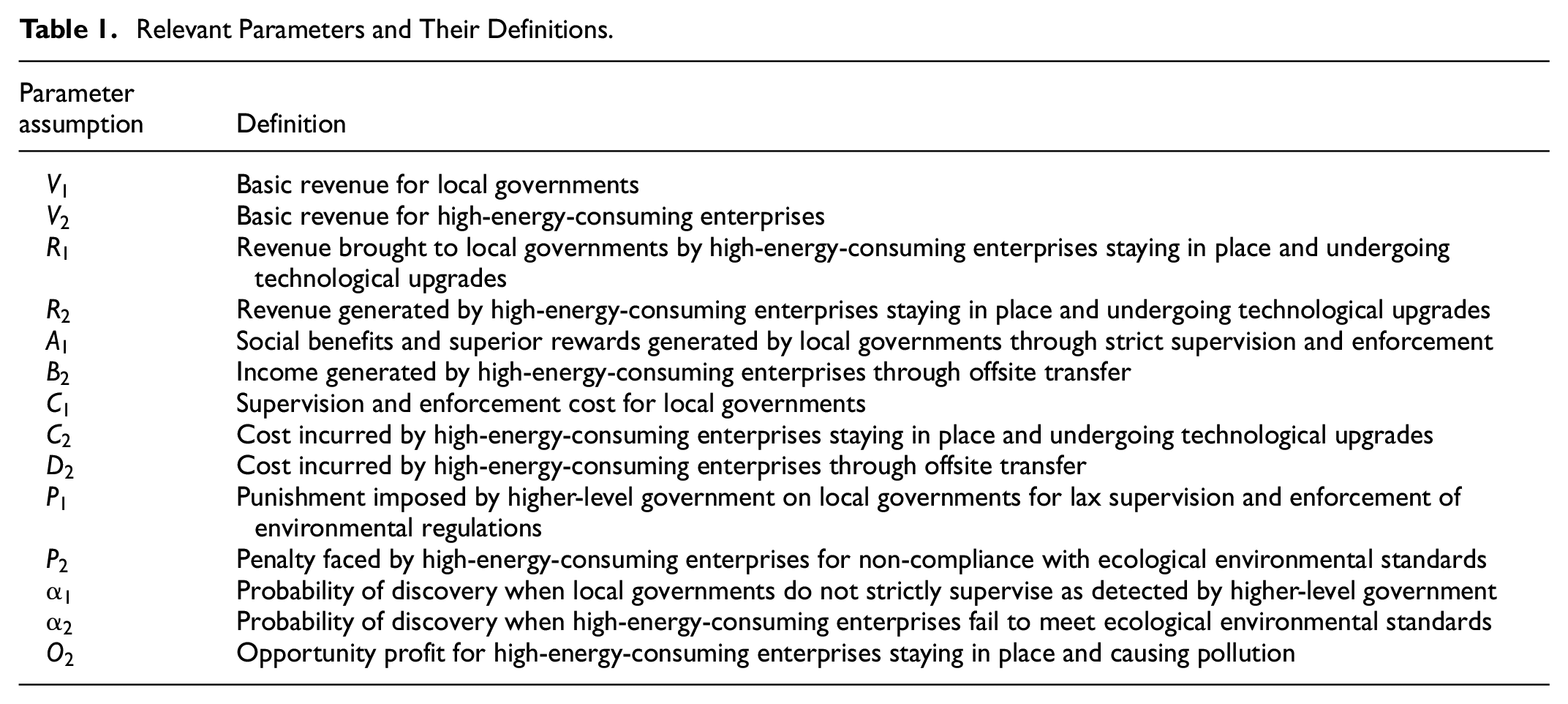
The relevant parameter assumptions and their definitions are presented in Table 1.
Relevant Parameters and Their Definitions.
On the basis of the above assumptions, further assume that
Evolutionary Game Payoff Matrix for Local Governments and High-Energy-Consuming Enterprises.

Replicator Dynamics Equations
Based on the evolutionary game payoff matrix for local governments and high-energy-consuming enterprises in Table 2, the expected payoffs can be derived as follows:
For the local government choosing the strict enforcement strategy, the expected payoff

For the local government choosing the lax enforcement strategy, the expected payoff

Using these expressions, the average expected payoff

Consequently, the replicator dynamics equation for the probability of the local government choosing the strict enforcement strategy is given by:

Similarly, the replicator dynamics equations for the probability of high-energy-consuming enterprises choosing the stay in place strategy are given by:

Here,
Stability Analysis of the Evolutionary Game Model
Based on the analysis above, the equilibrium solutions for the evolutionary game model between local governments and high-energy-consuming enterprises can be analyzed through a two-dimensional dynamical system composed of their replicator dynamics equations. Setting
However, these five equilibrium points are not necessarily evolutionarily stable strategies for the system. According to the method proposed by Friedman, the evolutionary stability of a two-dimensional dynamical system can be deduced through the local stability analysis of the system’s Jacobian matrix.
For this purpose, by taking partial derivatives of

Where:

Simultaneously, the trace


For the equilibrium solutions to be evolutionarily stable, it is required that
Specific Values of
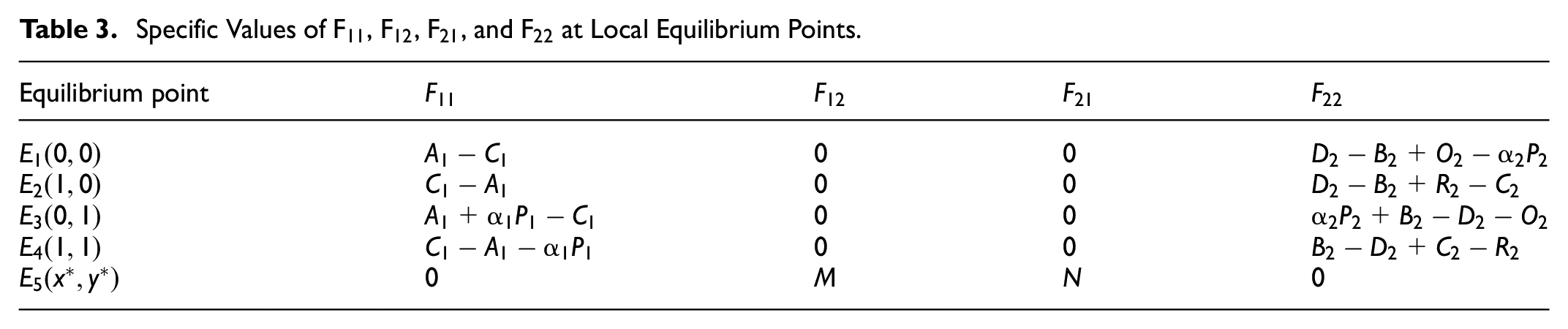
From Table 3, it can be observed that at
(1) Scenario One: When
(2) Scenario Two: When
(3) Scenario Three: When
(4) Scenario Four: When
Analysis of Evolutionarily Stable Strategy Equilibrium Points Scenario One.
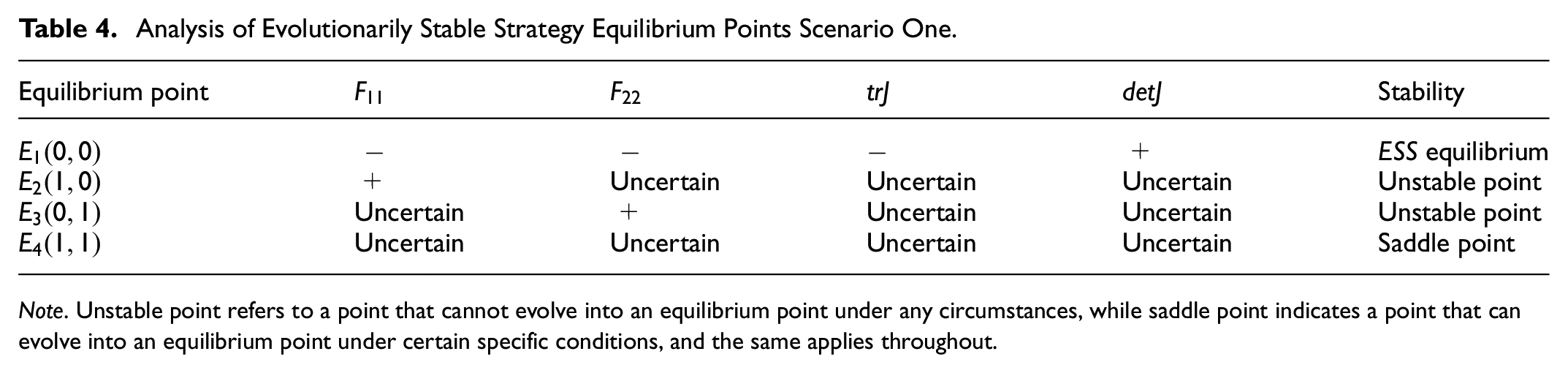
Note. Unstable point refers to a point that cannot evolve into an equilibrium point under any circumstances, while saddle point indicates a point that can evolve into an equilibrium point under certain specific conditions, and the same applies throughout.
Analysis of Evolutionarily Stable Strategy Equilibrium Points Scenario Two.

Analysis of Evolutionarily Stable Strategy Equilibrium Points Scenario Three.

Analysis of Evolutionarily Stable Strategy Equilibrium Points Scenario Four.

Numerical Simulation Analysis
In order to provide a clearer and more intuitive reflection of the dynamic behavior of high-energy-consuming enterprises in the context of strict government supervision of the ecological environment, this study utilizes MATLAB 2018a software to perform simulation analysis on the evolutionary game model. To meet the requirements of simulation, the replication dynamic equations for local governments and high-energy-consuming enterprises are discretized to analyze the asymptotically stable trajectories of the evolutionary game between the two parties. Let

Based on the above formulas, the evolutionary game between the government and high-energy-consuming enterprises is simulated using MATLAB 2018a to analyze and validate the robustness of the model. Additionally, we will further adjust variables such as the local government’s social benefits, superior rewards and penalties, transfer benefits, and costs. The system will be analyzed to understand how equilibrium points transition from non-ideal states like
Evolutionary Stable Paths and Initial Strategy Simulation Analysis
Scenario One:
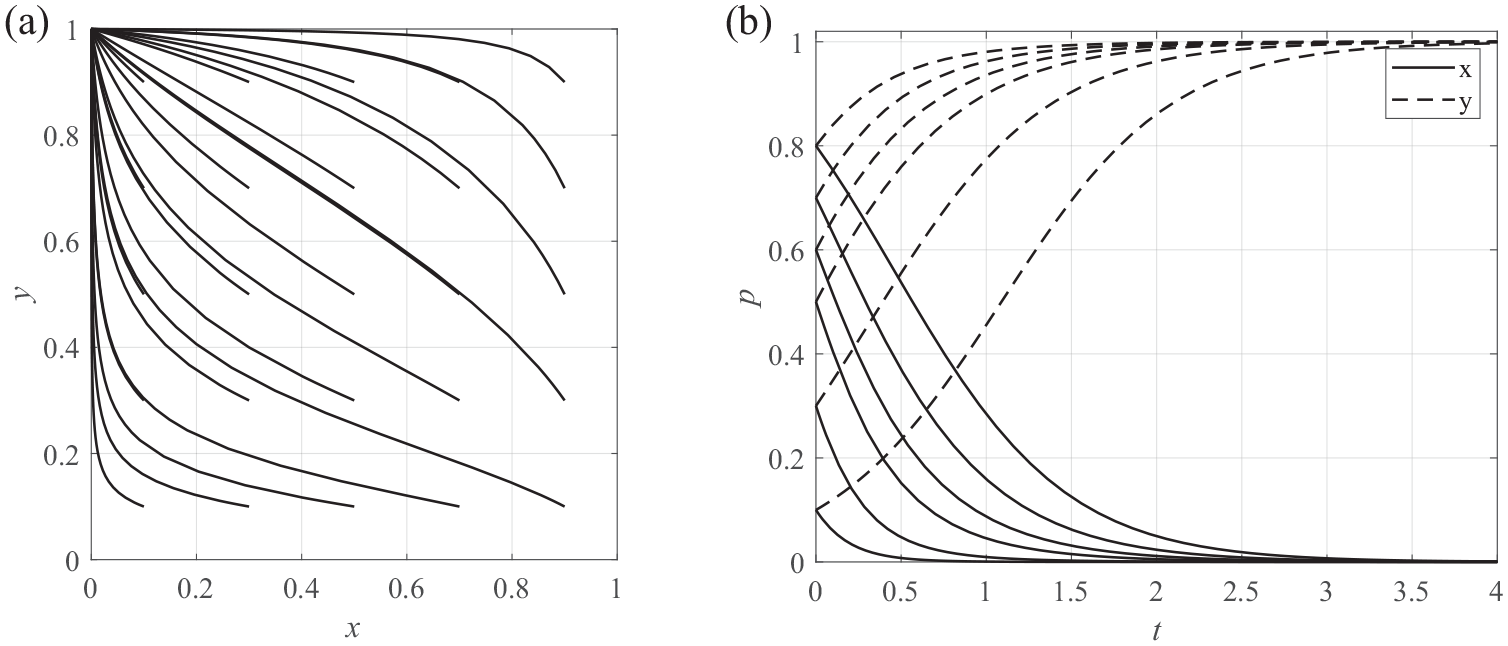
Based on the above configurations, to analyze the initial strategy choices of local governments and high-energy-consuming enterprises and their impact on evolutionary outcomes, set the initial values for the local government’s choice of strict enforcement and the high-capacity enterprise’s choice of stay in place to 0.1, 0.3, 0.5, 0.6, 0.7, and 0.8, respectively. The same values apply subsequently.
Utilizing MATLAB 2018a for path analysis of the replicator dynamic system, we obtain the evolutionary game paths for both entities, as illustrated in Figure 1. From Figure 1a, it is evident that when the parameters in the replicator dynamic system satisfy the conditions required for equilibrium points, the system’s evolutionary path converges to

Evolutionary stable paths and initial strategy simulation for scenario one (a) represents any initial state, while (b) represents a given initial state.
Specifically, even if the local government has a strong initial inclination toward the strict enforcement strategy, the high cost of supervision and enforcement, exceeding the sum of its social benefits and superior rewards, leads the local government to evolve gradually from strict enforcement to lax enforcement through comprehensive rational considerations. Similarly, despite the initial preference of high-energy-consuming enterprises for the stay in place strategy, the diminishing gap between the opportunity benefits of staying in place for pollution and the expected punishment faced, compared to the difference between transfer benefits and costs, reduces the enthusiasm of high-energy-consuming enterprises to stay in place. Eventually, under the interactive behaviors of both parties, the system evolves toward an undesirable equilibrium point,
(2) Scenario Two:

Evolutionary stable paths and initial strategy simulation for scenario two (a) represents any initial state, while (b) represents a given initial state.
Specifically, even if the local government has a strong initial inclination toward the lax enforcement strategy, the social benefits and superior rewards obtained from choosing this strategy outweigh the enforcement costs. Through comprehensive rational considerations, the local government’s behavior evolves gradually from lax enforcement to strict enforcement. Similarly, despite the initial preference of high-energy-consuming enterprises for the stay in place strategy, repeated interactions with the local government, which consistently chooses the strict enforcement strategy, lead to a clearer understanding for high-energy-consuming enterprises. This results in an increased expectation of punishment for staying in place and emitting pollution. Meanwhile, the difference between the benefits and costs of implementing energy-saving and emission reduction technology upgrades is smaller than the difference between transfer benefits and costs. Driven by interests, the enthusiasm of high-energy-consuming enterprises to stay in place gradually diminishes. Eventually, under the interactive behaviors of both parties, the system evolves toward an ideal equilibrium point,
(3) Scenario Three:
Evolutionary stable paths and initial strategy simulation for scenario three (a) represents any initial state, while (b) represents a given initial state.
Specifically, even if the local government has a strong initial inclination toward the strict enforcement strategy, the sum of social benefits, superior rewards, and expected punishment outweighs the enforcement costs. Through comprehensive rational considerations, the local government’s behavior gradually evolves from strict enforcement to lax enforcement. Similarly, despite the initial preference of high-energy-consuming enterprises for the offsite transfer strategy, repeated interactions with the local government lead to a clearer understanding for high-energy-consuming enterprises. This diminishes the motivation for staying in place and implementing energy-saving and emission reduction technology upgrades. The gap between the opportunity benefits and expected punishment for risky pollution emissions is larger than the difference between transfer benefits and costs. Driven by interests, the enthusiasm of high-energy-consuming enterprises for offsite transfer gradually diminishes. Eventually, under the interactive behaviors of both parties, the system evolves toward the least favorable equilibrium point,
(4) Scenario Four:

Evolutionary stable paths and initial strategy simulation for scenario four (a) represents any initial state, while (b) represents a given initial state.
Specifically, even if the local government has a strong initial inclination toward the lax enforcement strategy, the sum of social benefits, superior rewards, and expected punishment outweighs the enforcement costs. Through comprehensive rational considerations, the local government’s behavior gradually evolves from lax enforcement to strict enforcement. Similarly, despite the initial preference of high-energy-consuming enterprises for the offsite transfer strategy, as the difference between transfer benefits and costs is smaller than the difference between staying in place and implementing energy-saving and emission reduction technology upgrades, staying in place for technical upgrades becomes more favorable. Therefore, the enthusiasm of high-energy-consuming enterprises for offsite transfer gradually diminishes. Eventually, under the interactive behaviors of both parties, the system evolves toward the suboptimal equilibrium point,
Simulation Analysis of Model Variable Adjustments
This paper aims to promote the evolution of the strategic behavior between local governments and high-energy-consuming enterprises from the non-ideal states of
(1) Variable Adjustment for Scenario One: Building upon the parameter values of scenario one, assuming other variables remain constant, and setting the initial willingness of both local governments and high-energy-consuming enterprises to 0.5,

Evolutionary trajectory of the system with
The reason behind this lies in the continuous increase in social benefits and rewards given by the superior government for strict implementation of environmental regulations. When the total exceeds the local government’s enforcement cost, the local government’s behavior gradually shifts from the initial lax enforcement strategy toward the strict enforcement strategy. Meanwhile, high-energy-consuming enterprises, initially choosing the offsite transfer strategy, become more steadfast in their initial strategy choice when the local government’s behavior shifts from lax enforcement to strict enforcement. Consequently, the system ultimately evolves toward the ideal state.
(2) Variable adjustments in Scenario Three. Based on the parameter values in Scenario Three, assuming other variables remain constant, let the initial intentions of local governments and high-energy-consuming enterprises be both 0.5. Taking
(3) Variable adjustments in Scenario Four. Based on the parameter values in Scenario Four, assuming other variables remain constant, let the initial intentions of local governments and high-energy-consuming enterprises be both 0.5. Taking

Evolutionary trajectory of the system with
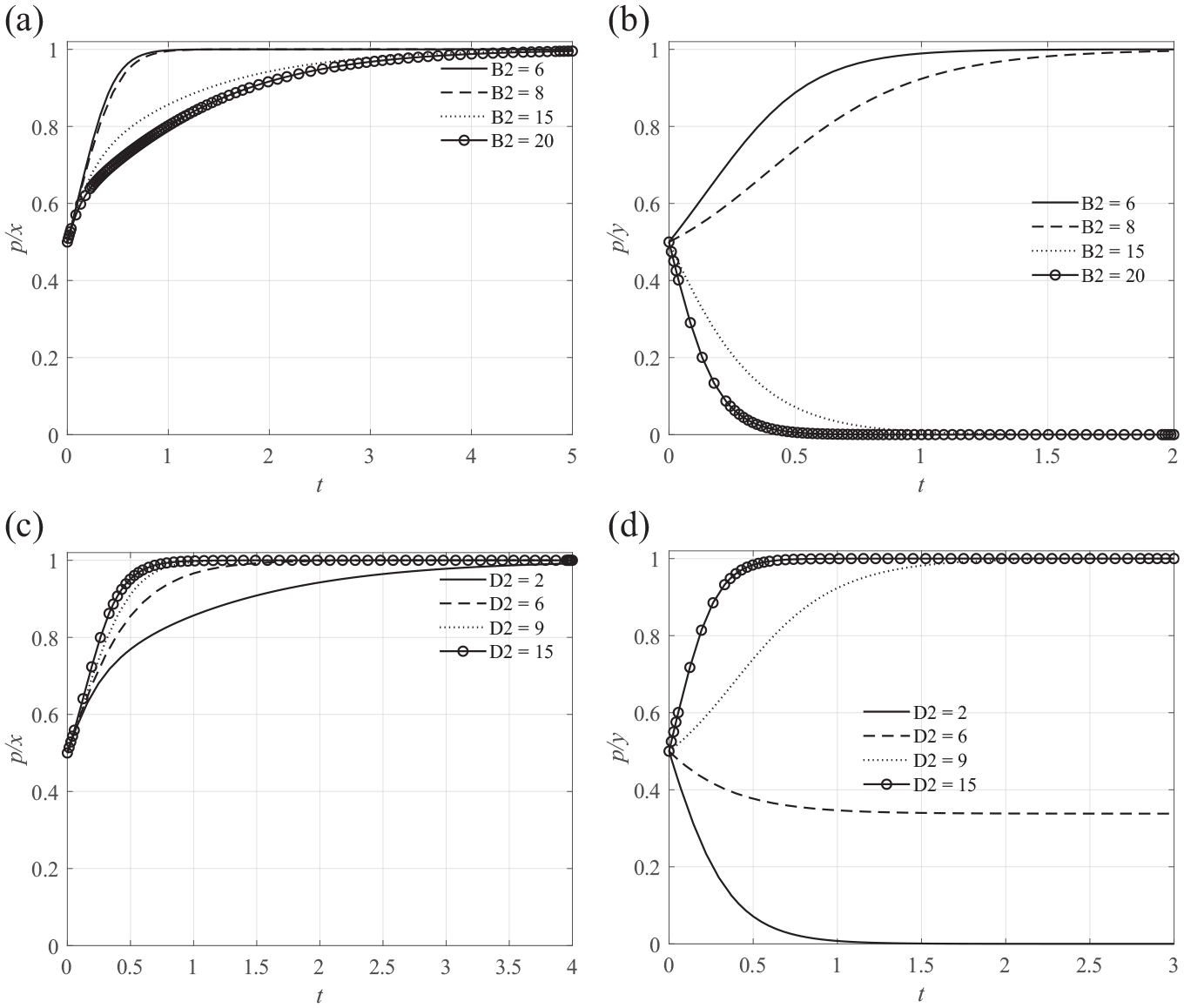
Evolutionary trajectory of the system with
It can be observed that by continuously increasing
Discussion
Theoretical Contributions
Existing literature that explicitly focuses on high-energy-consuming industries, whether using the concept of Nash equilibrium or evolutionary equilibrium, does not incorporate local governments as participants in the model from the perspective of environmental regulation or measure the social benefits of these industries using market share (Antoci et al., 2023; Xia et al., 2024). While these highly abstract models are effective in revealing the environmental pollution behaviors of high-energy-consuming industries, they are insufficient for analyzing the cross-regional transfer behaviors of these industries.
This study, based on the characteristic involvement of local governments in economic development in China, incorporates local governments as primary participants directly into the model. The analysis concludes that the game between local governments and high-energy-consuming enterprises results in four stable states: undesirable, worst, suboptimal, and ideal. This conclusion not only aligns with existing research findings (Sun et al., 2023) but also effectively explains the current state and trends of high-energy-consuming industries under increasingly stringent environmental regulations in China. Moreover, it enriches the theoretical understanding of environmental governance and industrial transfer.
Most existing studies employ econometric methods at the macro level to explore the linear causal relationship between environmental regulation and the economic development of high-energy-consuming industries (Aslam et al., 2024; List & Co, 2000; Qiu et al., 2022; Z. Wang et al., 2019). They primarily focus on whether the pollution haven effect exists (Birdsall & Wheeler, 1993; Millimet & Roy, 2016). However, such linear causal inferences and the singular focus on the existence of the pollution haven effect fail to elucidate the micro-level impacts of environmental regulation on the behavior of high-energy-consuming enterprises. Consequently, they are less effective in guiding practitioners to take targeted actions based on specific situations.
By employing the evolutionary game analysis method, this study addresses this issue to some extent. It conceptualizes local governments and high-energy-consuming industries as groups and constructs an evolutionary game model to examine how both parties adjust from suboptimal strategies to optimal strategies. Within the framework of evolutionary equilibrium, this study not only distinguishes the pollution haven effect but also effectively differentiates the transfer and upgrade effect, the pollution deterioration effect, and the innovation compensation effect. This provides more systematic theoretical support for the design of relevant policies.
Practical Recommendations
The findings and theoretical contributions of this study are highly relevant for policymakers. Currently, China has the highest carbon emissions globally. With the ongoing industrial restructuring in developed regions along the eastern coast and the continuous upgrading of China’s central government’s energy-saving and emission reduction policies, the multiple challenges posed by high-energy industries in terms of environmental governance, energy supply, and industrial development are crucial issues for regional sustainable development. According to our research, the ideal strategy of facilitating the transfer of high-energy industries to clean energy advantage regions can be achieved by adjusting the evolutionary path. Firstly, the central government should enhance the promotion of ecological civilization construction and consider environmental protection as a significant criterion for assessing local governments and appointing officials. This will increase local governments’ expectations of the anticipated benefits of implementing ecological environmental protection and prompt them to take the initiative in assuming environmental protection responsibilities. Secondly, penalties for local governments that do not strictly enforce environmental policies should be increased. The central government should establish an ecological environmental inspection system to impose severe penalties on local governments that do not strictly enforce ecological environmental regulations. Environmental protection regulatory authorities should also impose strict penalties on high-energy-consuming enterprises with substandard environmental emissions. Finally, eastern and western regions of China should strengthen regional cooperation. Both parties should work together to facilitate the transfer of high-energy industries, thereby maximizing the benefits of offsite transfer and minimizing the costs.
Limitations
It is undeniable that this study has certain limitations. Apart from the two parties considered in the model—local governments and high-energy-consuming enterprises—it does not account for other potential participants, such as the central government or the public, nor does it consider a broader range of strategy options for the participants. In future research, the model could be expanded to include three or four parties while broadening the strategy choices available to participants. This would aim to overcome the current limitations of a two-party game and a binary strategy set, thereby providing a more comprehensive analysis.
Conclusion
This paper systematically deduced the strategic choices of Chinese local governments and high-energy-consuming enterprises in a game through constructing an evolutionary game model. Using MATLAB software, the paper simulated the evolutionary paths of the system under different scenarios and the influence of initial strategy choices on the evolutionary paths. Based on this, by adjusting the values of relevant variables in the model, the paper systematically deduced how stable equilibrium points evolve from detrimental, worst, and suboptimal states to the ideal state. The following research conclusions were drawn:
Firstly, in the game between local governments and high-energy-consuming enterprises, four stable states exist: detrimental, where local governments do not strictly enforce environmental regulations, and high-energy-consuming enterprises form a pollution refuge effect through offsite transfer; worst, where local governments do not strictly enforce environmental regulations, and high-energy-consuming enterprises pollute locally, leading to sustained environmental deterioration; suboptimal, where local governments strictly enforce environmental regulations, compelling high-energy-consuming enterprises to upgrade energy-saving and emission-reducing technologies, forming an innovation compensation effect; and ideal, where local governments strictly enforce environmental regulations, guiding high-energy-consuming enterprises to offsite transfer and upgrade. Secondly, when the system is in a detrimental state, increasing the social benefits of local governments and the rewards from higher-level governments can drive the system’s evolution from a detrimental state to an ideal state. Thirdly, when the system is in the worst state, simultaneously increasing the penalties for local governments and high-energy-consuming enterprises can drive the system’s evolution from the worst state to the ideal state. Fourthly, when the system is in the suboptimal state, increasing the offsite transfer benefits for high-energy-consuming enterprises or decreasing their offsite transfer costs can drive the system’s evolution from the suboptimal state to the ideal state.
Footnotes
Acknowledgements
The authors gratefully acknowledge the reviewers.
Author Contributions
All authors contributed to the study conception and design. Methodology, L.H. and X.C.; writing—original draft preparation, L.H., H.W. and X.C.; writing—review and editing, L.H., H.W. and X.C.; project administration, H.W. All authors have read and agreed to the published version of the manuscript.
Declaration of Conflicting Interests
The author(s) declared no potential conflicts of interest with respect to the research, authorship, and/or publication of this article.
Funding
The author(s) disclosed receipt of the following financial support for the research, authorship, and/or publication of this article: This research was supported by the National Social Science Fund of China (Grant number: 24BGL294).
Ethics Statement
Not applicable. This study did not involve surveys, thus there are no ethical issues concerned.

Data Accessibility Statement
Data sharing not applicable to this article as no datasets were generated or analyzed during the current study.