




Abstract
We examined the evolutionary stability of preferences (altruism and envy) in an evolutionary game that infinitely repeats a stage game. In the stage game, players who survived the previous game compete for survival in pairs. By solving the evolutionary game, we show that the survival advantage between altruism and envy depends on whether players’ efforts in the stage game are strategic complements or substitutes. With strategic complements, altruistic players have an advantage in survival. With strategic substitutes, envious players have advantages.
Plain language summary
Individuals often take care of others’ well-being. This can often have significant economic consequences. Numerous studies have explored individual preferences, such as altruism, envy, and selfishness as economic phenomena. To the best of our knowledge, there have been no studies examining how the evolutionary advantage of altruism and of envy exist. This paper aims to study an evolutionary game that can explain the conditions under which altruism and envy coexist and the conditions under which one of the two becomes extinct. This study adopts the indirect evolutionary approach developed by Güth and Yaari to induce the evolutionary stability of preferences-one type becomes extinct with a lower expected material payoff than the other. By solving the evolutionary game, we show that the survival advantage between altruism and envy depends on whether players’ efforts in the stage game are strategic complements or substitutes. With strategic complements, altruistic players have an advantage in survival. With strategic substitutes, envious players have advantages. Our results indicate that altruism’s advantage differs from envy, depending on whether the stage game exhibits strategic complements or substitutes.
Introduction
Individuals often take care of others’ well-being. This can often have significant economic consequences. Numerous studies have explored individual preferences, such as altruism, envy, selfishness, and fairness, as economic phenomena. The literature on preferences for evolutionary games focuses on two aspects. The first is whether evolutionary stability of preferences exists. Second, if an evolutionary environment exists, what individual preferences are chosen?
An evolutionarily stable strategy (ESS), proposed by Smith and Price (1973), is a key concept in evolutionary game theory. Furthermore, ESS is a term used to describe a strategy without an alternative strategy in which most population members have higher payoffs if they adopt it. This study also focuses on the evolutionary stability of preferences to examine whether preferences such as altruism and envy can be ESS and whether the two preferences coexist. The reason for dealing with altruism and envy among various preferences is that the two preferences are at opposite points in the central assumption of selfishness that most economists take for granted.
Some studies analyzed the evolutionary stability of altruism or envy by adapting an indirect evolutionary approach to be introduced later (Bester & Güth, 1998; Bolle, 2000; Kim et al., 2022; S.-H. Park & Kim, 2022). These previous studies showed that there can be no envious players (altruistic players) in evolutionary games with positive externalities (negative externalities) generated by the players’ efforts. When players’ efforts generate positive externalities (negative externalities), the result that envious players (altruistic players) do not survive seems plausible. This study, which solves an evolutionary game by applying an indirect evolutionary approach, finds that (i) altruism favors survival over envy if players’ efforts generate positive externalities, and (ii) envy favors survival over altruism if their efforts generate negative externalities. Paradoxically, the findings of this study can explain the more real world by showing conditions in which envious players (altruistic players) can survive in evolutionary games with positive externalities (negative externalities). Furthermore, this study shows the conditions under which altruists become extinct in the game where positive externalities occur. In the next section, we will introduce previous studies that analyzed this altruism or envy, and the differences between this study and previous studies will be discussed.
Related Literature
Literature on Individual Preferences: Altruism and Envy
Nowak and May (1992, 1993) represent the literature on altruism in evolutionary games. They showed that altruism could survive in an evolutionary environment where altruistic individuals gather. Like Nowak and May (1992, 1993) and Alger and Weibull (2010) examined the evolution of altruism toward siblings.
Bester and Güth (1998) studied a market game to examine the evolutionary stability of altruism and egoism through strategic interactions. They showed that the evolutionary stability of altruism is based on games with strategic complements and that the stability of egoism is based on games with strategic substitutes. (In Bester and Güth [1998], when an increase in individual B’s effort level generates an increase [decrease] in individual A’s effort level, we say that individual A’s effort is a strategic complement [substitute] of individual B’s effort.) Alger and Weibull (2013) showed that the coexistence of morality and egoism in evolutionary games could be stable if players are randomly matched into pairs, and the matching process is assortative.
Bergstrom (1999), building upon Bergstrom and Stark (1993), regarded the specific effects of the two preferences as evolutionarily stable symbiosis in the sibling group. Bolle (2000) extended the altruistic version of Bester and Güth’s (1998) game by examining whether envy is evolutionarily stable. Bolle (2000) showed that the stability of envy is based on the fact that evolutionary games exhibit strategic substitutes. Bolle (2000) was extended by Possajennikov (2000), who considered incomplete information regarding preferences. Possajennikov (2000) showed that selfishness is evolutionarily stable regardless of strategic interactions. Schmidt (2009) extended the framework of Konrad (2004) by modeling Tullock-type contests in which players are altruistic or envious. Based on Konrad’s (2004) assumption that selfishness is fundamentally a necessary condition for survival, not an object selected by nature, Schmidt (2009) showed the advantage of envy over altruism as follows: Players with very high altruism become extinct, whereas players who are extremely envious do so under specific conditions. H. Park (2019) examined how the persistence of preference habits affects short- and long-run economic growth in a dynamic competitive economy and deals with the possibility of an equilibrium cycle in the presence of the persistence of preference habits.
There are several studies on the coevolution of multi-types of individual preferences, including Shaffer (2006), Dekel et al. (2007), Heifetz et al. (2007), Herold and Kuzmics (2009), Heller and Mohlin (2019), S.-H. Park and Kim (2022), and Kim et al. (2022). Shaffer (2006) modeled a Tullock-type contest by considering three types of preferences (altruism, selfishness, and envy) and showed that selfishness is evolutionarily stable. Dekel et al. (2007) and Herold and Kuzmics (2009) considered all possible preferences and showed that the evolutionarily stable equilibrium varies depending on whether individuals can observe others’ preferences. S.-H. Park and Shogren (2020) considered a Tullock-type contest to develop a condition in which each egoistic player chooses to release their preferences information to the rival.
To the best of our knowledge, there have been no studies examining how the evolutionary advantage of altruism and of envy exist. This paper aims to study an evolutionary game that can explain the conditions under which altruism and envy coexist and the conditions under which one of the two becomes extinct.
As with most of the studies mentioned above, this study adopts the indirect evolutionary approach developed by Güth and Yaari (1992) and Güth (1995) to induce the evolutionary stability of preferences-one type becomes extinct with a lower expected material payoff than the other. The indirect evolutionary approach assumes that as a result of maximizing subjective utility, the material payoff obtained by an individual determines the evolution of preferences. In the indirect evolutionary approach, individuals seek to maximize their subjective utilities by exerting efforts in stage games. However, there is no guarantee that the material payoff of an individual with a large subjective utility is also large. From nature’s point of view, the subjective utility of an individual is not important because nature chooses the individual with the highest material payoff by repeating infinitely the stage game.
In most previous studies that analyze the evolutionary stability of preferences, an altruistic individual’s subjective utility is the addition of the other individuals’ material payoffs to one’s material payoff. In other words, altruistic individuals feel greater subjective utilities when their material payoffs and those of others increase. Naturally, an envious individual’s subjective utility is regarded as subtracting the other individuals’ material payoffs from its material payoff. In other words, envious individuals feel that their subjective utilities increase as their material payoffs do, but they feel that their subjective utilities decrease as their counterparts’ material payoffs increase.
There may be slight differences between studies on the definition of individual preferences. For example, Foley (1967) and Mui (1995) used the concepts of individual preferences to address the economic problem of resource allocation. This study follows the concepts of altruism and envy such as Bester and Güth (1998), Bolle (2000), Possajennikov (2000), Konrad (2004), Schmidt (2009), Alger and Weibull (2010, 2013), S.-H. Park and Kim (2022), and Kim et al. (2022) to name a few.
The Similarities and Differences Between Previous Studies and This Study
The present study is closely related to Heifetz et al. (2007), who developed a general methodology to characterize the dynamic evolution of preferences in a wide range of strategic interactions. This study also analyzes an evolutionary game that exhibits strategic interactions (strategic complements and strategic substitutes) by specifying the methodology developed by Heifetz et al. (2007).
Unlike Schmidt (2009), who induced evolutionary conditions favorable to envious players by considering a winner-takes-all contest, this study draws on the conditions favorable to altruistic players and those favorable to envious players by considering a market game. When adopting winner-takes-all contest models in evolutionary games, the following disadvantages should be noted. In winner-takes-all contests, the winning player monopolizes the prize money. Since the contest has nothing to gain from the losing player, the altruistic player is likely the underdog. Naturally, the possibility of altruistic players’ material payoffs becoming low is high, and it becomes difficult for altruists to survive in evolutionary contests (Guse & Hehenkamp, 2006). In contrast to winner-takes-all contests, market games have no winners or losers. Therefore, the mechanism by which the material payoffs of altruistic players in the market game are smaller than those of envious players is excluded.
This study is similar to Bester and Güth (1998), Bolle (2000), and S.-H. Park and Kim (2022) in terms of considering market games with two types of externalities: positive and negative externalities. Similarly, this study assumes that positive externalities cause strategic complements in material payoffs and that negative externalities cause strategic substitutes. The aforementioned studies assume that selfishness is also an object of natural selection, just as altruism and envy are selected by nature. Furthermore, S.-H. Park and Kim (2022) showed that selfishness hinders the coevolution of envy and altruism. However, altruistic individuals and envious individuals may live in one area. In contrast to S.-H. Park and Kim (2022), this study adopts the assumptions of Konrad (2004) and Schmidt (2009): selfishness is not an object selected by nature but fundamentally exists. This assumption is essential in deriving the results of this study and comparing them with those of Bester and Güth (1998), Bolle (2000), Schmidt (2009), and S.-H. Park and Kim (2022).
Before we solve the evolutionary game, we need to add an important assumption about whether individuals observe others’ preferences. There is no exact answer as to whether it is evolutionarily stable for individuals to reveal their preferences. Studies that assume the observability of individuals’ preferences are vast (see Kim et al., 2022). Furthermore, S.-H. Park and Shogren (2020) and Kim et al. (2022) showed that individuals can increase their material payoffs by revealing their preferences. Possajennikov (2000), who used the same model as this study, assumed that individuals do not reveal their preferences. He showed that selfishness is evolutionarily stable regardless of the degree of externalities. To analyze the coexistence of altruism and envy and the extinction of one among them, this study assumes that individuals observe rivals’ preferences.
The remainder of this study is as follows. This study summarizes the altruism and envy version of S.-H. Park and Kim’s (2022) stage game. In the stage game, a pair of randomly met players (altruistic or envious) competes with each other in the population. Next, this study extends this stage game to an infinitely repeated game in which player types are determined through evolution. The concluding remarks are presented at the end.
The Stage Game with Strategic Interactions
We considered a population of finite-measure players. There are two types of players, altruists and envious players. They are pair-met, and each match plays a stage game. We assume that each player can gauge the type of opponent. Thus, each player uses two strategies in a stage game, implying that the four pairing combinations are feasible. An altruist can meet another altruistic player and an envious player. Let qAA be the altruist’s effort level when their opponent is another altruistic player, and qAE be their effort level when their opponent is an envious player qAE. Similarly, an envious player can meet with an altruistic player or another envious player. Let qEA be the envious player’s effort level when their opponent is an altruist and qEE be their effort level if their opponent is another envious player.
Let Πmn represent the material payoff for a type-m player in a stage game against a type-n player. Then, according to Bester and Güth (1998), Bolle (2000), S.-H. Park and Kim (2022), and Kim et al. (2022), a type-m player’s material payoff is defined as:

where w represents the strategic interaction type. If w > 0, the type-n player’s effort level generates a positive externality for the type-m player. If w < 0, the effort level of player n generates a negative externality for player m. Their material payoffs determine the survival of players. In other words, the higher the material payoff of a player, the higher the likelihood of survival or reproduction.
Let GAn represent the subjective utility of an altruistic player who plays against a type n player. Then, the subjective utility of the altruistic player is
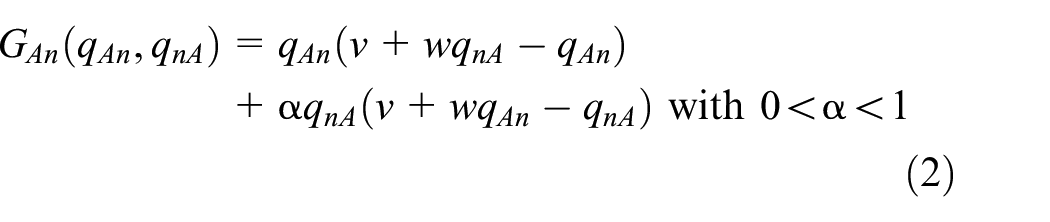
where α represents the degree of altruism. We assume that α is exogenously given. Similarly, GEn represents the subjective utility of an envious player playing against a type n player. Then, the envious player’s utility is

where β represents the degree of envy, and it is exogenously given.
Next, we determine four optimal effort levels in a stage game. If an altruistic player competes with another altruist, the altruistic player seeks to maximize their utility GAA over their effort level qAA, taking the opponent’s effort level

The altruist’s best-response function to the first-order condition for maximizing (4), qAA(

Equation (5) shows two things about the relationship between externalities and strategic interactions. First, if a player’s efforts generate positive externality, w > 0, then the game exhibits strategic complements. Second, if their efforts generate negative externality, w < 0, then the game exhibits strategic substitutes (see Bester & Güth, 1998; Bolle, 2000; Kim et al., 2022; S.-H. Park & Kim, 2022; Possajennikov, 2000). These concepts also apply to equations (9), (13), and (15) to be analyzed later. As the players are symmetric because their types are the same, we can solve for the equilibrium effort level qAA** by deriving the altruists’ effort levels qAA =

If we insert qAA** (6) into the material payoff (1), we can calculate the altruist’s material payoff πAA**, resulting in the equilibrium of the stage game:

Consider a case in which two envious players enter a stage game. An envious player computes their effort level qEE to maximize their utility GEE given the effort level

The envious player’s best-response function to the first-order condition for maximizing (8), qEE(

We can solve for the equilibrium effort level qEE** by deriving the envious players’ effort level qEE =

Inserting qEE** (10) into payoff (1), we can calculate the envious player’s material payoff πEE**, resulting in the equilibrium of the stage game:

The last residual case is a stage game between an envious player and an altruist. The altruistic player chooses qAE to maximize (12), given the previous player’s effort level

The altruist’s best-response function to the first-order condition for maximizing (12), qAE(

Given the altruist’s efforts,

The envious player’s best-response function to the first-order condition for maximizing (14), qEA(

The unique equilibrium for this stage game is given by the pair (qAE**, qEA**), which satisfies the two best response functions (13) and (15) simultaneously. Taking an algebraic approach to the simultaneous solution, we obtain


Inserting qAE** (16) and qEA** (17) into material payoff (1), we obtain the equilibrium material payoffs of the players:


Lemma 1 reports the outcomes in the equilibrium of each stage game.
(a.1) Players expand qAA** = v/{2 − (1 + α)w}, and
(a.2) The material payoffs are πAA** = (1 − αw)v2/{2 − (1 + α)w}2.
(b) At the equilibrium of the stage game, in which an envious player competes with another envious player
(b.1) Players expand qEE** = v/{2 − (1 − β)w}, and
(b.2) The material payoffs are πEE** = (1 + βw)v2/{2 − (1 − β)w}2.
(c) At the equilibrium of the stage game, in which an altruist meets an envious player
(c.1) Players expend.


(c.2), their material payoffs are


Before we examine the evolutionary stability of preferences in an infinitely repeated game, we characterize the type of strategic interaction and then compare the material payoffs of altruists with those of envious players. From the best response functions (5), (9), (13), and (15), we characterize the type of strategic interaction: If w > 0, the players’ efforts in the stage game are strategic complements of the opponents’ efforts because the best response functions (5), (9), (13), and (15) are upward sloping. In addition, if w < 0, the best response functions are downward sloping; the players’ efforts are strategic substitutes for the opponents’ efforts. Next, it is easy to see that πAA** > πEE** and πAE** < πEA** hold using (7), (11), (18), and (19) or Lemma 1. The results are summarized as follows.
Indeed, Proposition 1 is the same as the results reported in S.-H. Park and Kim’s (2022, p. 360) Appendix. However, this study differs from S.-H. Park and Kim’s (2022) study. Unlike S.-H. Park and Kim’s (2022) study, this study examines players’ preferences that are advantageous for survival in situations where altruistic and envious players coexist. In the finitely repeated game of S.-H. Park and Kim (2022), the coevolution of altruism and envy is excluded with the emergence of selfishness (see S.-H. Park & Kim’s [2022] Proposition 1, pp. 354–355).
Proposition 1 is similar to Schmidt’s (2009, p. 252) result 2. The difference is as follows: Unlike Schmidt (2009), who adopted a Tullock-type contest, this study adopts the model presented by Bester and Güth (1998) to consider players’ strategic interactions. This study shows that the results of Schmidt (2009) are maintained in the model of Bester and Güth (1998), regardless of whether players’ efforts are strategic complements or strategic substitutes.
The Infinitely Repeated Game
We combine the rational behavior that results in the equilibrium of a stage game with natural selection, resulting in an evolutionarily stable preference that plays this stage game (Schmidt, 2009). In the indirect evolutionary approach, the stage game is repeated infinitely on a continuum of finite-measure players. Based on the indirect evolutionary approach, we assume that the proportion of one type increases if it has a higher expected material payoff than the other in the population (Schmidt, 2009).
In the following, we find the evolutionary stability of preferences under the long-run conditions for each value of α, β, and w [we use the computer program Maple to solve for the equations in Section “The Stage Game with Strategic Interactions.”] Following Schmidt (2009), we denote the proportion of altruistic players in the population as h, so that h increases at the point ĥ if and only if

holds. Let E [πA**] be an altruist’s expected material payoff. Using Lemma 1, we compute E [πA**].

Let E [πE**] be the previous player’s expected material payoff. Then, we can compute E [πE**]:

Now, we attempt to show whether our model can explain the advantages of preferences. First, we considered two extreme cases: h = 0 and h = 1. Next, we examined the case of 0 < h < 1 and analyzed the evolutionary stability of altruism and envy, which encompasses all cases. To make it easier to understand the evolutionary decision process, we used four figures (Figures 1–4). Following Schmidt’s (2009) methodology, this study began with a population of purely envious players, h = 0. If E[πA**]|h = 0 ≥ E[πE**]|h = 0 holds, then the share of altruists in the population increases. Otherwise, altruists can never break into a population of purely envious players. Let α0(β) denote α for E[πA**]|h = 0 = E[πE**]|h = 0. Then, this applies to

α 0(β) is an increasing function of β (Figures 1–4): ∂α0(β)/∂β = 4(1 − β)[4 + {2(1 − β2) − (1 − β)2w}w2]/{4 − (1 − β)2(2 − w)w2}2 > 0 with 0 < β < 1 and − 1 < w < 1. If α0(β) is less than or equal to the right side in (23), that is, if the altruism weight of altruistic players α is sufficiently low or the envy weight of the envious players β is sufficiently high, an altruist can break into a purely envious population. Figures 1 to 4 show that when the sign of w is different, the left intercept of α0(β) changes. When β is zero, equation (23) can be rewritten as α0(0) = w(4 − w2)/(w3 − 2w + 4) > 0 for w > 0 (Figures 1 and 2) and α0(0) < 0 for w < 0 (Figures 3 and 4). Unlike the changes in the left intercept of α0(β), the right intercept of α0(β) is always one: α0(1) = 1.
In a population of purely altruistic players, that is, h = 1, if E[πA**]|h = 1 ≤ E[πE**]|h = 1 holds, the share of envious players in the population rises. Otherwise, envious players can enter a population of purely altruistic players. Let α1(β) denote α for E[πA**]|h = 1 =E[πE**]|h = 1. Then, this applies to

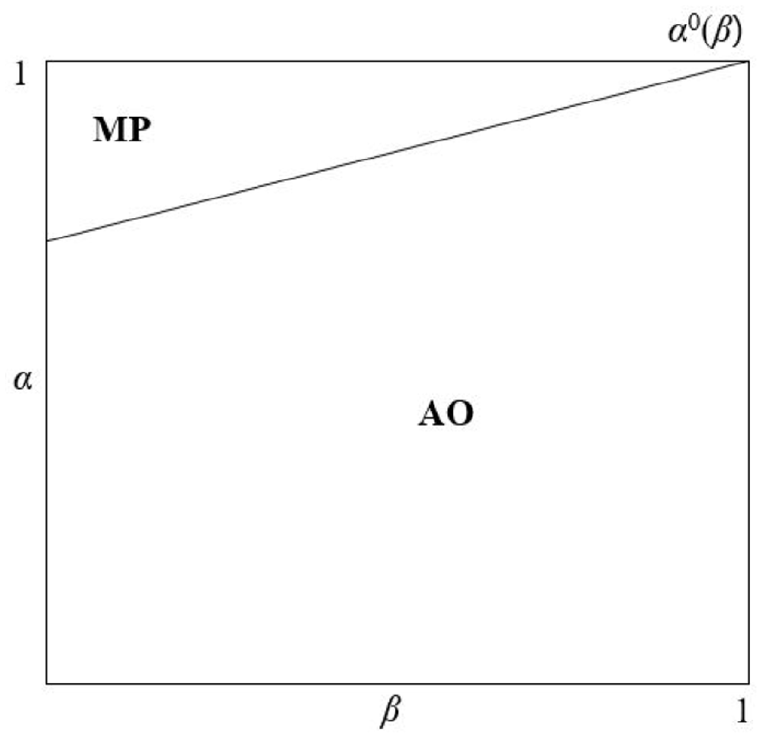
Stability regions “altruists only” and “mixed population” with respect to preference parameters of altruists α and envious players β for (51/2 − 1)/2 ≤ w < 1.

Stability regions “altruists only,”“mixed population,” and “envious players only” with respect to preference parameters of altruists α and envious players β for 0 < w < (51/2 − 1)/2.

Stability regions “altruists only,”“mixed population,” and “envious players only” with respect to preference parameters of altruists α and envious players β for 1 − 31/2 < w < 0.

Stability regions “mixed population” and “envious players only” with respect to preference parameters of altruists α and envious players β for − 1 < w ≤ 1 − 31/2.
α 1(β) is also an increasing function of β (Figures 2 and 3): ∂α1(β)/∂β = 2(1 − β)[(2 − w){(1 − β2)w3 + (2β3 − 2β + 1)w2 − 2w + 1}1/2 − (1 − β)w3 − (1 + 2β)w2 + 3w − 2]/{(1 − β)w + 2β)2w2}{(1 − β2)w3 + (2β3 − 2β + 1)w2 − 2w + 1}1/2 > 0 with 0 < β < 1 and − 1 < w < 1. If α1(β) is greater than or equal to the right side in (24), that is, if the altruism weight of altruistic players α is sufficiently high or the envy weight of the envious players β is sufficiently low, an envious player can enter a population of pure altruists. Otherwise, an envious player can never break into a population of pure altruists. Figures 2 and 3 show that when the sign of w is different, the left intercept of α1(β) changes. When β is zero, equation (24) can be expressed as α1(0) = {−w3 + 2w − 2 + 2(w3 + w2 − 2w + 1)1/2}/w3 > 0 for w > 0 and α1(0) < 0 for w < 0 (Figures 2 and 3, respectively). It is interesting that if (51/2 − 1)/2 ≤ w < 1, α1(0) ≥ 1 holds true. This result shows that if w is sufficiently high, the population of envious players does not survive regardless of the levels of α and β. The right intercept of α1(β) also depends on w’s sign. When β = 1, (24) can be rewritten as α1(1) = {−w2 + w − 1 + (5w2 − 2w + 1)1/2}/w2 > 1 for w > 0 and α1(1) < 1 for w < 0 (Figures 2 and 3, respectively). Furthermore, we show that if − 1 < w ≤ 1 − 31/2, then α1(1) ≤ 0 holds. This result shows that if w is sufficiently low, the altruist population does not survive, regardless of the levels of α and β.
Next, we examine the case where two types of preferences (altruism and envy) coexist using (20). E[πA**]|h = ĥ = E[πE**]|h = ĥ is the necessary condition for both altruists and envious players to coexist. From this equation, we can calculate the equilibrium share of altruists ĥ.


If α is replaced by α0(β) and α1(β) in (25), ĥ becomes zero and one, respectively. Note that h represents the share of altruism in the population. α0(β) and α1(β) are derived from two extreme cases: E[πA**]|h = 0 = E[πE**]|h = 0 and E[πA**]|h = 1 = E[πE**]|h = 1, respectively.
To analyze the evolutionary stability of altruism and envy under long-run conditions for each value of α, β, and w, we use (23) through (25) and Figures 1 through 4. In the infinitely repeated game, the evolutionary stabilization strategy changes according to w’s sign. We categorize four figures as Figures 1 to 4, depending on the sign of w. Figures 1 and 2 correspond to cases where w > 0, and Figures 3 and 4 correspond to cases where w < 0. First, we analyzed Figures 1 and 2. Figure 1 corresponds to the case where (51/2 − 1)/2 ≤ w < 1. In this case, there are only altruists in the region AO “altruists only,” and altruists and envious players coexist in the region MP “mixed population.” In addition, as mentioned earlier, a population of purely envious players cannot survive. Figure 2 corresponds to the case in which 0 < w < (51/2 − 1)/2. In this case, only altruists survive in the AO region, and altruists and envious players coexist in the MP region. There are only envious players in the region EO “envious players only”: If w > 0, the region AO corresponds to ĥ < 0 (Figures 1 and 2), and the region EO corresponds to ĥ > 0 (Figure 2), and 0 < ĥ < 1 holds in (25), which is in the MP region regardless of the sign of w.
Next, we analyzed Figures 3 and 4. Figure 3 corresponds to the case where 1 − 31/2 < w < 0. In this case, only altruists survive in the AO region, and altruistic and envious players coexist in the MP region. There are only envious players in the EO field. Figure 4 corresponds to the case where −1 < w < 1 − 31/2. In this case, only envious players survive in the local EO, while altruistic and envious players coexist in the local MP. There was no population of pure altruism: if w < 0, region AO corresponds to ĥ > 0 (Figure 3), and the region EO corresponds to ĥ < 0 (Figures 3 and 4).
The results are summarized in Lemma 2.
(a) If (51/2 − 1)/2 ≤ w < 1, in region α > α0(β), the share of altruists is 0 < h < 1 “MP”; and in the region α ≤ α0(β), the share is h = 1 “AO” (Figure 1).
(b) If 0 < w < (51/2 − 1)/2, in the region α ≥ α1(β), the share of altruists is h = 0 “EO”; and in the region α0(β) < α < α1(β), the share is 0 < h < 1 “MP”; and in the region α ≤ α0(β), the share is h = 1 “AO” (Figure 2).
(c) If 1 − 31/2 < w < 1, in the region α ≥ α0(β), the share of altruists is h = 0 “EO”; in the region α1(β) < α < α0(β), the share is 0 < h < 1 “MP”; and in the region α ≤ α1(β), the share is h = 1 “AO” (Figure 3).
(d) If − 1 ≤ w < 1 − 31/2, in the region α ≥ α0(β), the share of altruists is h = 0 “EO”; and in the region α < α0(β), the share is 0 < h < 1 “MP” (Figure 4).
Now, we give an intuitive explanation of Lemma 2 (see Appendix for theoretical analysis of Lemma 2). First, assume that individuals’ efforts generate positive externalities. This situation corresponds to (a) and (b) of Lemma 2. Consider (a) in Lemma 2, where the external positive effects are large. Here, individuals who are too altruistic can meet envious individuals. Furthermore, if the altruism of individuals is not too high, altruistic and envious individuals may coexist together. (b) of Lemma 2 applies to the case with low external positive effects. In this case, a situation is added where altruistic individuals may not survive: Extremely altruistic individuals may become extinct and are replaced with low envy individuals. Taken together, (a) and (b) of Lemma 2 shows that altruistic players are more advantageous in survival than envious players in situations where positive externalities occur.
Second, assume that individuals’ efforts generate negative externalities. This situation corresponds to (c) and (d) of Lemma 2. A case with low external negative effects applies to (c) of Lemma 2. This case is similar to the case of (b) of Lemma 2. The difference between the two cases is that the domain in which only envious individuals survive is widened, and the domain in which only altruistic individuals survive is reduced. Consider (d) of Lemma 2 that applies to the case with high external negative. In this case, a situation is excluded where only an altruistic group can survive. The finding of (c) and (d) of Lemma 2 is close to that of Schmidt (2009), who presented that envious players are more advantageous in survival than altruists. Proposition 2 presents the above main findings.
Some studies have demonstrated the advantages of envy in the context of evolutionary games. For example, Guse and Hehenkamp (2006) have shown the advantage of envy by demonstrating that the envious players’ material payoffs are greater than the altruists’ material payoffs. Schmidt (2009) explains the advantage of envy by inducing a region where altruistic players cannot survive.
The key proposition of this study is contrasted with S.-H. Park and Kim’s (2022) Proposition 1. S.-H. Park and Kim (2022) state that envious players become extinct if players’ efforts generate positive externalities; that is, their interactions are strategic complements. They also say altruistic players are gone if their efforts generate negative externalities; their interactions are strategic substitutes. The finding of S.-H. Park and Kim (2022) is very related to the findings of Bester and Güth (1998) and Bolle (2000), in which altruists only survive with positive externalities, and they become extinct with negative externalities. In contrast to their results, Proposition 2 presents two things. If players’ efforts generate positive externalities, the population of altruistic players is advantageous for survival. That does not mean that envious players always disappear, even if their efforts generate positive externalities. If players’ efforts generate negative externalities, envy has an advantage. That does not mean altruists always become extinct, even if negative externalities are generated.
The external effects must be large for envious players (altruists) to disappear in an evolutionary game where positive externalities (negative externalities) occur. Otherwise, in a game where positive externalities (negative externalities) occur, envious players (altruists) may exist. For example, even if a bee farm and an orchard are adjacent and the two owners recognize that they gain positive externalities from each other, there is no guarantee that they will act altruistically toward the other. This result is more realistic than the results of Bester and Güth (1998), Bolle (2000), and S.-H. Park and Kim (2022), and it is the novelty of this study.
Concluding Remarks
In reality, altruists and envious individuals may coexist. Although previous studies have shown this reality, no study has shown evolutionary advantages in altruism or envy depending on a given evolutionary environment. Among the previous studies, Schmidt (2009) demonstrated the advantage of envy over altruism. In addition, this study shows the advantages of altruism over envy. The contrast comes from the difference between Schmidt’s (2009) models and this study’s considerations. Schmidt (2009) modeled a Tullock-type contest in which a prize was awarded to the winner, but nothing was awarded to the loser. This study models a market game developed by Bester and Güth (1998), Bolle (2000), and S.-H. Park and Kim (2022). In a market game, strategic intersections are classified into two categories: strategic complements and strategic substitutes. Altruists can prosper when the game exhibits strategic complements, whereas envious players can prosper from strategic substitutes. Our results indicate that altruism’s advantage differs from envy, depending on whether the stage game exhibits strategic complements or substitutes.
Furthermore, this study complements the results of Bester and Güth (1998), Bolle (2000), and S.-H. Park and Kim (2022), who showed the result of no coexisting altruistic and envious (or selfish) players by presenting two new findings. Firstly, regardless of whether the externality is positive or negative, situations can arise in which altruistic players and envious players coexist. Secondly, if the degree of positive externalities is low, extremely altruistic individuals may become extinct, and it is replaced with low-envy individuals.
The limitations of this study are as follows. Firstly, the observability of individual preferences was assumed in the study. Research on whether it is desirable for altruists and envious players to show their preferences will be interesting. Secondly, this study has assumed that players’ efforts generate the same externality as in previous studies. In the real world, one player may face a positive externality, and the other may face a negative externality. It is interesting to analyze whether individual preferences are due to the externality generated by their action or by a rival’s action by using a two-stage game. Finally, this study has focused on theoretical analysis. Behavioral economics can play a role in supplementing the theoretical approach to altruism and envy in many different issues, such as the nature of economic behavior, fairness, and social preferences. This study’s extension in line with the limitations is saved for future research.
Footnotes
Appendix
We now investigate whether there is a preference advantage for an evolutionary game. As previously mentioned, a population of purely envious players cannot survive (Figure 1). Figure 2 also shows that the number of altruists is greater than that of envious players. In particular, there appears to be a region in which a population of purely envious players cannot survive: an area where the altruistic weight of altruistic players is sufficiently low or the envy weight of envious players is sufficiently high. The regions are as follows: α < { − w3 + 2w − 2 + 2(w3 + w2 − 2w + 1)1/2}/w3 or β > (w2 + w − 1)/(w2 − w − 1) for 0 < w < (51/2 − 1)/2 (Figure 2). The right side of the former equals α1(0), and that of the latter equals β derived from α1(β) = 1.
Regarding the advantages of envy, Figure 3 shows that the population of envious players was greater than that of altruists. In particular, there appears to be a region in which a population of pure altruists cannot survive: an area where the altruistic weight of altruistic players is sufficiently high or the envy weight of envious players is sufficiently low. The regions are as follows: α > { − w2 + w − 1 + (5w2 − 2w + 1)1/2}/w2 or β < w(4 − w2)/(w3 − 2w2 + 4) for 1 − 31/2 < w < 0 (Figure 3). The right side of the former equals α1(1), and that of the latter equals β derived from α1(β) = 0.
Acknowledgements
Not applicable.
Declaration of Conflicting Interests
The author(s) declared no potential conflicts of interest with respect to the research, authorship, and/or publication of this article.
Funding
The author(s) received no financial support for the research, authorship, and/or publication of this article.
Ethical Approval
Not applicable.

Data Availability Statement
Data sharing not applicable to this article as no data sets were generated or analyzed during the current study.