




Abstract
The integration of agricultural and tourism industries is an important way for underdeveloped regions to build economic development momentum with a distinctive industrial system, and digital technology or artificial intelligence provides opportunities for industrial integration and innovative development. Using panel data from 17 prefecture-level cities in the former Central Soviet Area of Jiangxi, Fujian, and Guangdong Provinces spanning from 2012 to 2021, this study empirically examines the impact of digital intelligence on the integration of agricultural and tourism industries, along with its underlying mechanisms. The empirical results show that digital intelligence can significantly promote the integration of agricultural and tourism industries, but intelligence contributes less to the integration of agricultural and tourism than digitization. In addition, digital intelligence promotes the integration of agricultural and tourism industries through the industrial structure, threshold-lowing, and consumer demand effects. Moreover, the empowering effect of digital intelligence in the cities of the Jiangxi Region is greater than that of the Fujian and Guangdong Regions.
Keywords
Introduction
Since the 1980s, China’s economy has been characterized by the non-equilibrium of regional development. The economic gap between different regions is widening, and the coordinated development of regions has become an urgent issue in China’s development. With the central government’s support in recent years, the appearance of less-developed areas has undergone profound changes. However, universal problems such as relatively poor natural conditions, slow economic development, and low living standards persist (S. Wang et al., 2021). At the industrial level, underdeveloped regions have supported a considerable agricultural population and agricultural output in China for a long time (Chen & Gong, 2021). Although agriculture has provided a solid foundation and resource advantages for these areas, the issues of insufficient innovation, homogenization, and slow updating and iteration speed of regional agricultural products have not been adequately addressed (He et al., 2024).
In order to give full play to the multiple functions of agriculture and improve its output efficiency, the Chinese government has introduced a series of policies to support the integration and development of agriculture with other industries. Among them, the integration of agriculture and tourism has developed rapidly in recent years (Wang, Xia et al., 2023). From 2011 to 2019, the number of registered private enterprises related to leisure agriculture increased from more than 26,000 to 216,000 (Zhou et al., 2021). Moreover, the operating income from leisure agriculture and rural tourism rose from 216 billion yuan in 2011 to 850 billion yuan in 2019, which is released by the Ministry of Agriculture and Rural Affairs of China, accounting for 4.82% and 12.06% of the country’s gross domestic product in rural areas, respectively (China’s rural Gross Domestic Product (GDP) is approximated by the value added of the primary industry, which was 4.48 and 7.05 trillion yuan in 2011 and 2019, respectively, according to the National Bureau of Statistics of China). However, due to various factors such as economic development, geographical location, and ideology, most agro-tourism programs in these areas have a single form of technological integration and are not sufficiently innovative. Low-level activities exist, such as tea plantation visits, orchard visits, and agricultural product sales (He et al., 2024). As a result, these areas have not been able to fundamentally move away from the traditional industrial development mode (Wen & Jiang, 2024).
To promote the high-quality development of agricultural and rural areas, it is necessary to take the initiative to comply with the digital and real integration trend and take agricultural and rural productivity to a new stage. In this process, the enabling role of digital intelligence is becoming increasingly prominent. As a product of the development of digital technology to a higher stage of artificial intelligence, the cognitive, perceptual, and problem-solving capabilities generated by digital intelligence through the use of intelligent algorithms and digital technologies can be applied to a wide range of production and service scenarios (Rammer et al., 2022). It is an essential lever for traditional industries to transform old and new kinetic energy (Zang et al., 2024). The emerging digital intelligence technology represented by 5G promotes the integration of agriculture and other types of resources, including tourism, reconstructing the industry chain, innovation chain, and value chain, and becoming the core technological support and an essential means of empowerment for the integration of agriculture and tourism (Charatsari et al., 2022). Firstly, digital intelligence enables the system to have the ability to independently analyze data, intelligent decision-making, and self-learning to improve, which is conducive to the optimal allocation of resources between industries, thus promoting the upgrading of industrial structure (Zeng et al., 2021). It promotes extending the intrinsic functions of agriculture and tourism and ultimately realizing the integration of the agriculture and tourism industries. Secondly, digital intelligence enables interconnected data to have practical tools and means to be analyzed and processed, thus lowering the threshold of public services (Zhong et al., 2022). It promotes the extension of the intrinsic resources of agri-tourism. Finally, digital intelligence utilizes representative technologies to achieve ubiquitous connections among all fields, stimulating consumers’ dynamic demands (Heo & Lee, 2019). It promotes the extension of the intrinsic market of agri-tourism.
Less-developed areas may benefit from late-comer advantages, in which they can use advanced technology to accelerate industrial integration. Therefore, digital intelligence can be a breakthrough in local industrial modernization and a driving force for rural residents in these areas to cross the digital divide and achieve shared prosperity. Integrating the agriculture and tourism industries can awaken the vitality of the rural economy, promote the adjustment of the rural industrial structure, and realize rural revitalization.
However, digital intelligence must be adapted to local conditions to empower the integration of agriculture and tourism industries. Taking China’s old revolutionary base areas as an example, it can be seen that most of them are border areas and mountainous regions, facing the dual pressures of economic development and ecological protection (Wen & Jiang, 2024). Among them, the former Central Soviet Area of Jiangxi, Fujian, and Guangdong Provinces is China’s largest and most populous of the 13 old revolutionary base areas. These have made significant contributions and great sacrifices for China’s revolution. Due to the geographical proximity of Jiangxi, Fujian, and Guangdong Provinces, the whole region is deeply influenced by the Hakka Culture and has a high level of traditional social interaction, making it more like a relatively independent economic system. The cities in this region have always been far away from the political and economic centers of Jiangxi, Fujian, and Guangdong Provinces, making it a politically marginalized and impoverished area in these three provinces (Zhang & Kong, 2022).
Additionally, the region has assumed nationally or regionally critical ecological functions and the level of national policies is mainly based on restricted development (Y. M. Huang et al., 2024). As a result, the development of agri-tourism needs to catch up to the national average among similarly underdeveloped regions. Therefore, this study selects the former Central Soviet Area of Jiangxi, Fujian, and Guangdong Provinces as a sample and uses them as an entry point to study how less developed areas can realize the integration of agriculture and tourism empowered by digital intelligence and put forward effective policy recommendations for exploration.
Using the panel data of the old revolutionary base area of Jiangxi, Fujian, and Guangdong Provinces from 2012 to 2021, this study examines the impact of digital and intelligence on the integration of agriculture and tourism industries. The results show that digital intelligence can significantly promote the integration of agriculture and tourism industries, and the industrial structure effect, threshold-lowering effect, and consumer demand effect play a positive moderating role.
The possible marginal contributions of this study are as follows: First, In terms of research topic, this study contributes to the enrichment of research related to the integration of data and reality. Existing studies mainly focus on the empowering effect of digital intelligence regarding enterprise management (Ferreira et al., 2019), and few studies have been conducted in tourism. Some studies on digital-real integration in less-developed regions also focus on digitization and rural construction (J. Huang, 2018). Therefore, this study investigates its impact on integrating agriculture and tourism industries. It elucidates the empowering effects through the “Three-Chain” model, aiming to provide a comprehensive interpretation of the enabling mechanism. Second, this study presents a relatively novel research perspective. It is based on detailed data from prefecture-level cities in the old revolutionary base area of Jiangxi, Fujian, and Guangdong Provinces for the first time. It confirms digital intelligence’s significant positive empowering effect on integrating agricultural and tourism industries. Under China’s strategy of prioritizing supporting the revitalization and development of old revolutionary base areas, such as a famous old revolutionary area in China, the above conclusions provide decision-making support for forming locally adapted industrial development strategies in those underdeveloped areas. At the same time, it also provides a possible reference for other less developed areas to realize their late-coming advantages in industrial development.
The rest of this study is arranged as follows: Chapter 2 introduces the mechanism of digital intelligence enabling the integration of agricultural and tourism industries. Chapter 3 describes the data and models. Chapter 4 gives the results and further discussion of the impacts of digital intelligence, digitization, and intelligence on the integration of agricultural and tourism industries in different regions. Chapter 5 draws the research conclusions and puts forward the corresponding policy implications.
Literature and Theoretical Analysis
Existing research is still relatively weak in the relevant fields, focusing more on the two dimensions of digital intelligence to empower the agricultural and tourism industries. First, digitization enables the agricultural and tourism industries. Digitization encompasses various phenomena and technologies, including big data, IoT, cloud computing, digital twins, and blockchain. These can be categorized as physical technology and non-physical technologies. From a physical technology perspective, new devices like drones and robots enhance precision agriculture and improve agricultural production. From a non-physical technology perspective, digital technology is demonstrated through remote operations, such as remote agricultural extension, consulting services, and digital equipment management (Wolfert et al., 2017). It also enables the distribution and marketing of travel products through task automation, such as e-tickets and online hotel reservations (Law et al., 2014). Second, intelligence enables the agricultural and tourism industries. Initially, smart farming (Wolfert et al., 2017) and precision farming (Wolf & Buttel, 1996) in the agricultural sector represented different forms of agricultural digitization, while the concepts of smart tourism and cloud tourism were reflected in the tourism industry. However, artificial intelligence is growing from weak AI to strong AI. Intelligent devices and cloud computing are increasingly supporting agricultural production and tourism services. Lioutas et al. (2019) note that these technologies can provide smart insights for farmers, while Baggio and Cooper (2010) suggest that they impact service processes, costs, and management methods for tourism enterprises. According to Ivanov and Webster (2017), intelligent customer service, precise information push, and robotic sensing services significantly impact tourists’ needs, preferences, decisions, and experiences. However, despite its transformative power, concerns are associated with the digital farming brigade. These include the digital divide between urban and rural areas, large and small farms, male and female farmers, and farmers in industrialized and developing countries (Aker et al., 2016). Data governance issues have also been raised (Bronson & Knezevic, 2016; Rotz et al., 2019). Therefore, the emergence of digital intelligence technology, represented by 5G technology, is expected to connect the relationship between the agricultural and tourism industries, blur the boundary between them, and catalyze their integration.
In 1958, American economist Hirschman proposed the concept of the industrial chain for the first time from the perspective of forward and backward linkages of industries in Economic Development Strategy. Subsequently, some scholars successively proposed the concepts of the value chain related to the industrial chain (Porter, 1985) and innovation chain (Rothwell, 1992). Therefore, with reference to the studies of Y. Y. Wang (2022) and Dai (2022), based on the perspectives of the industrial chain, innovation chain and value chain, this study analyzes the enabling mechanism of digital intelligence on the integration of agricultural and tourism modernization.
First, the industry chain perspective: technology empowerment. The Industrial Integration Theory specifies the dynamic development process in which different industries or different industries within the same industry penetrate and cross each other, eventually merging into one and gradually forming new industries (Li & Wang, 2002). Industrial integration helps promote the innovation and upgrading of traditional industries and enhance the competitiveness of business entities. From this perspective, the essence of the digital and intelligent empowerment of agri-tourism integration is the joint promotion of digital and intelligent technology and agri-tourism industry, digital economy and intelligent economic subjects, and agri-tourism business subjects. Digital intelligence provides new technical support for the agri-tourism industry. It accelerates the transformation of traditional agri-tourism projects to digital intelligence by extending, supplementing, and strengthening the agri-tourism industry chain. In contrast, the agri-tourism industry provides carrier support for developing digital intelligence. Big data technology helps consumers gain a better insight into the current hotspots and trends in tourism development; blockchain technology provides end-to-end applications for tourists and improves the transparency of the tourism process. 5G technology empowers other related ecosystems and realizes the human-computer interaction scenarios of tourism through video. The introduction of AR and VR wearable devices brings an immersive experience to tourists. Mobile technology and cloud computing help small farmers and large scenic spots achieve more convenient business management, ultimately promoting the integration of agricultural and tourism industries. Coordinating and sharing the whole process and application scenarios can help build a solid industrial chain.
Second, the innovation chain perspective: data empowerment. Schumpeter’s Innovation Theory emphasizes combining traditional production factors and conditions in a new way and applying them to the production system, thus triggering the emergence of new production functions and productivity, including the five dimensions of new products, new technologies, new markets, new energy sources, and new combinations (Schumpeter, 1990). From this perspective, digital intelligence is the use of digital intelligent technology and data, the two new factors of production, to empower the various fields of the industrial chain to realize the digital and intelligent development of the nodes of the industrial chain, that is, technological innovation plays a vital role in its development. Moreover, from the perspective of technological revolution, throughout the history of the development of human civilization, each round of general technological revolution will trigger a profound change in the paradigm of industrial development. The rapid development of the digital and intelligent economy has triggered a new round of the Digital Intelligence Revolution. Compared with previous technological revolutions, the industrial development paradigm driven by the Digital Intelligence Revolution breaks the existing industrial boundaries and triggers a vast wave of industrial integration, which leads to the disruptive reshaping of product functions, production technologies, business models, and other aspects (Kohli & Melville, 2019). At the agricultural and tourism industry integration level, digital intelligence has changed traditional industries’ development mode and technical means, providing technical support for constructing digital villages and the integrated development of three industries. Therefore, technological innovation is a prerequisite for the deep integration and development of digital intelligence and agricultural tourism, and relying on this theory can provide a clearer understanding of its specific attributes as a factor of production and provide a theoretical basis for analyzing its integration effect with the industrial economy. Data, as a new production factor, can break through the boundary of the original inter-regional production factor flow, quickly promote the reconfiguration of the factor resources in the old district, optimize the combination with the traditional production factors, and improve the output of the traditional industry. The data flow drives the flow of technology, capital, talents and materials to realize the agglomeration and integration, and ultimately form a double cycle of factor flow within and outside the old area, helping it find a new development balance point. Specifically, from the point of view of the agricultural industry, digital intelligence has promoted the transformation of agricultural operation mode and improved the efficiency of farmers’ work through the application of intelligent agricultural machinery and equipment and the use of information platforms. From the point of view of the tourism industry, the data elements have further converged the boundaries between the virtual and the real through the moderate incorporation of emerging technologies including VR and AR, which have increased the sense of science and technology of the tourism projects, and provided a diversified experience. Especially with the accelerated advent of the meta-universe era, by creating virtual cloud tourism routes, we can enhance the immersive experience of tourists, realize the symbiosis between reality and virtual reality, and ultimately build up a new mode of service and ecology for the agricultural and tourism industries, thus broadening the innovation chain.
Third, the value chain perspective: demand empowerment. Based on the Collective Action Theory, common interests are promoted by negotiating commonly faced action problems and realizing public goods provision through corresponding institutional arrangements such as channel maintenance (Mancur, 2017; Ostrom, 1990). It has been shown that rural governance and development cannot be separated from the collective action of the behaviors of local governments, enterprises, rural collective economic organizations, and farm households (Y. H. Wang et al., 2022). Precisely at the level of agricultural and tourism industry integration, the application of digital intelligence technology has built an excellent collective decision-making and coordination platform for enterprises, consumers, locals, and other subjects. By integrating the resources, a platform is built between consumers and suppliers to match needs dynamically. For example, digital intelligence improves the matching of supply and demand between tourism enterprises and tourists. On the one hand, by adapting to local conditions, the regional brand characteristics and advantages are enhanced to achieve differentiated competition. On the other hand, through online platform tools to provide tourists with the highest level of customization, it also improves the exposure of tourist attractions and the surrounding areas, and ultimately realizes the value co-creation of all stakeholders, thus building up the value chain. Therefore, based on the above analysis, this study puts forward the following hypothesis:
Schumpeter (1990) systematically put forward the theory of Integrated Innovation for the first time in the Theory of Economic Development. He pointed out that innovation is the recombination of production factors introduced into the production system to obtain potential profits. The essence of fusion innovation is a multi-agent collaborative innovation model featuring resource integration, knowledge sharing and value co-creation (Najafi-Tavani et al., 2018). The driving factors triggering the integration of the agricultural and tourism industries include technological innovation, service innovation, product innovation, and other innovative behaviors, but essentially belong to the behaviors triggered by element innovation. In addition, the integration of the agricultural and tourism industries mainly comes from the two dimensions of agricultural transformation and development and tourism consumption upgrading supply and demand, and cannot be separated from the interaction between industrial factors. Therefore, based on the theory of fusion innovation and supply and demand, this study explores the transmission mechanism affecting the integration of agricultural and tourism industries enabled by digital intelligence from the perspectives of function, resources and market.
First, the industrial structure effect. Digital intelligence, enabled by artificial intelligence technology, allows systems to independently analyze data, make intelligent decisions, and self-learn to improve. This promotes optimal resource allocation between industries and facilitates the upgrading of industrial structures. This industrial structure effect promotes the extension of the intrinsic functions of the agricultural and tourism industries, ultimately integrating them. Similar to the classification of digital industrialization and industrial digitization in the digital economy, digital intelligence is categorized into digital intelligence industrialization and industrial digital intelligence. The former reflects the transformation of the primary industry to the tertiary industry, while the latter promotes the transformation and upgrading of the agricultural and tourism industries. Marx believed that new productive forces were the driving force behind economic development. These forces optimize the industrial structure by stimulating new demand and generating new supply, thus acting as the engine of economic development (Heo & Lee, 2019). Digital intelligence can reduce technical barriers in agriculture, tourism, and related service industries, reshaping enterprise boundaries, reducing transaction costs, and broadening business scope. This promotes advanced industrial structure and implies fully activating the post-productivism function of agricultural space (Wilson, 2001). Currently, cloud tourism, which uses digital media as a carrier, has become an emerging leisure mode. Tourists can experience a tourist destination without leaving their homes (Scott et al., 2019). Digital landscapes, such as intelligent greenhouses, have become a popular attraction for tourists. Therefore, farmers can transform the production function of agricultural space into the exhibition function of tourism space through digital landscape projects, such as picking experiences and sightseeing tours. The development of digital intelligence from the demand side reduces the risk of technological innovation for agricultural and tourism businesses. It also improves the efficiency of technological innovation carried out by agricultural tourism enterprises, reduces their costs, and promotes the rationalization of the industrial structure. The rationalization of industrial structure involves maximizing the effectiveness of tourism services, particularly through rural live broadcasting that showcases fields and other natural scenes. Anchors enter the local agricultural and tourism space to create popular products through the platform network. This enhances the scale and adds value to agricultural products, ultimately achieving integration of the functional levels of the agricultural and tourism industries. Therefore, this study puts forward the following hypothesis:
Second, threshold-lowering effect. Digital intelligence, enabled by technologies such as big data, cloud computing and blockchain, provides practical tools and means for analyzing and processing interconnected data (Mithas & McFarlan, 2017), thus reducing the threshold of public services. This effect promotes the extension of internal resources in the agricultural and tourism industries and ultimately leads to the integration of these industries. Digital intelligence improves the quality of tourism services and the efficiency of agricultural production by adjusting internal resource allocation in these industries. This lowers the threshold of internal allocation and improves the overall efficiency of industry resource allocation. The characteristics of digital intelligence technology, such as driving force, permeability, and multiplicity, promote the integration of the development of the agricultural and tourism industries and the inter-regional flow of development elements. This reduced the threshold of the industry’s interaction. The following is an example of digital financial inclusion. Digital inclusive finance combines digital technology and financial services to provide diversified services and improve the function of Internet plus finance. On the supply side, digital inclusive finance can reduce the security risk of rural residents. In addition, it can reduce transaction costs and optimize the business environment for farmers’ entrepreneurship. On the demand side, digital inclusive finance can meet farmers’ financing needs by providing diverse and extensive financial services, leading to better benefits for farmers and integrating the resource levels of agricultural and tourism industries. Therefore, this study proposes the following hypothesis:
Third, consumer demand effect. Digital intelligence utilizes representative technologies such as the mobile Internet, the loT and 5G technology to achieve ubiquitous interconnection between people, things, objects, and fields, thus stimulating the vitality of social consumption demand. This consumer demand effect then promotes the extension of the inner market of agricultural and tourism industries and ultimately realizes the integration of the two. The main contradiction in China has become the contradiction between the people’s aspirations for a better life and the unbalanced and inadequate development. The digital age represents a significant shift in people’s consumption demands from material-based to spiritual-based consumption. Farmers can learn digital technology and operational skills through the network to transform into the New Farmers. This allows them to use digital intelligence tools for planting, production, processing, and other aspects that match consumer demand, ultimately creating a dynamic market. Consumer demand plays a crucial role in the market. It facilitates the integration of agricultural reproduction and digital intelligence technology, optimizing the utilization of land and resources. On the one hand, it makes the process of agricultural reproduction and digital intelligence technology a better combination and optimizes the utilization of land and other resources. On the other hand, it increases the income of farmers from land dividends and other properties, contributing to the development of the factor market and the prosperity of the agricultural and tourism industries. This leads to a dynamic matching of supply and demand between the factor and product markets, resulting in a win-win situation. Therefore, the following hypothesis is proposed:
Based on the analysis above, this study attempts to incorporate digital intelligence, the integration of agricultural and tourism industries, the industrial structure effect, the threshold-lowering effect, and the consumer demand effect into a unified analytical framework (Figure 1), so as to provide a new perspective for the main body of agricultural and tourism industries to realize modernization and high-quality development through the use of digital intelligence tools.

Theoretical analysis framework.
Research Design
Sample and Data
This study selects 17 prefecture-level cities in the former Central Soviet Area of Jiangxi, Fujian and Guangdong Provinces from 2012 to 2021 as research samples, with 170 observations. As the largest and most populous revolutionary base established by the Communist Party of China (CPC) during the Agrarian Revolutionary War, this region belongs to typical underdeveloped areas (Wen et al., 2023) and has a strong sample representation. The data were mainly taken from the China Urban Statistical Yearbook, China Torch Statistical Yearbook, and provincial and municipal statistical yearbooks in previous years. This study shrinks the data at the [1%, 99%] level to eliminate the effect of extreme values. In addition, individual missing data are filled in using the domain mean method to mean-populate the missing data in the intermediate years. The linear interpolation method in the three-bar function interpolation, based on the assumption of a linear relationship, populates the missing values according to each individual’s yearly trend. In order to reduce the indicator magnitude gap and the estimation bias caused by the model heteroskedasticity problem, the variables of the integration of agricultural and tourism industries and digital intelligence are standardized in the empirical regression. The collected digital intelligence-related indicators and the variables of the threshold-lowering effect, the consumption demand effect, education development, and economic growth are logarithmically processed.
Empirical Model
In order to verify the positive empowering effect of digital intelligence on the integration of agricultural and tourism industries, this study constructs the following benchmark regression model:

Where Agr_Tou denotes the level of integration of agricultural and tourism industries in city i in year t, Dig_Inti,t denotes the level of digital intelligence in city i in year t, Controlsi,t is the set of control variables, μi denotes the individual fixed effects of city i, vt denotes the time fixed effects of year t, εi,t is the random disturbance term, and α1 denotes the coefficients to be estimated. If α1 is significantly positive, then Hypothesis1 and Hypothesis 2 are tested.
Further, to verify whether Hypothesis 2 to 4 is established and in order to reveal the intrinsic action mechanism of the integration of agricultural and tourism industries empowered by digital intelligence, this study designs the following mechanism testing model:


Where Inmediai,t is the set of mechanism variables and the other variables have the same meaning as (1).
Variable Definition and Description
The dependent variable is the integration of agricultural and tourism industries (Agr_Tou). As a dynamic development process, the integration of agricultural and tourism industries is characterized by the selection of measurement indicators that reflect the respective development levels of agricultural and tourism industries and the interconnection between the two systems. Moreover, the above methods are prone to sample selection bias caused by the individual heterogeneity of survey respondents, and the endogeneity problem caused by unobservable variables is also inevitable to avoid. Therefore, this study refers to the method of Jiang et al. (2022) and adopts the coupling coordination degree model to evaluate the integration level of agricultural and tourism industries.
In terms of index selection, the agriculture indicators are constructed based on Lai et al.’s (2020) ideas and measured by agricultural factor input, agricultural output capacity and agricultural production sustainability. The tourism indicators are measured by the state of demand, resource base, and support condition. The details are shown in Table 1.
Index System of the Integration of Agricultural and Tourism Industries.

In terms of the processing method, to begin with, the entropy value method is used to measure the respective development levels of the agricultural and tourism industries (specific steps are omitted). Then, the coupled coordination degree model was selected to measure the level of integration between the two systems and their respective development levels in various regions. The calculation formula is as follows:

Where: U1 and U2 represent the comprehensive evaluation index of agricultural and tourism respectively, and D is the degree of coupling coordination; αU1+βU2 is the comprehensive coordination index of the two sub-systems, where α and β are the coefficients to be determined to reflect the contribution of the two systems. Agricultural and tourism industries intersect and integrate in a dynamic process of integration and development, and the study believes that for these areas, both are equally important in the coupled coordination system, so α = β = 0.5 is taken here (L. F. Wang, 2018; Wang, Zhou et al., 2023).
The core explanatory variable is digital intelligence (Dig_Int). There are few empirical studies on the development of digital intelligence in domestic and international academic circles and even fewer measurements for the new concept of digital intelligence. Instead, there are more studies on the development of the digital economy and digitization. Therefore, this study draws on the research constructed by Luo and Chen (2022) to create two first-level indicators of digitization and intelligence, which are then used to measure the indicators of digital intelligence. The index system has the advantages of spatial and temporal comparability and data stability for an accurate portrayal of digital intelligence in the Soviet areas of Jiangxi, Fujian, and Guangdong Provinces.
The first is the digital index (Dig). This study refers to the Report on China’s Regional Digitization Development Index. It mainly draws on the research of Yu and Xiao (2023), who measure digitization using six indicators across three categories: digital infrastructure, digital application degree, and digital technology support.
The second is the intelligence index (Int). At present, research results on measuring the level of intelligence are limited and have not yet formed a unified system. This study adopts the approach proposed by Hou and Liu (2022) to construct indicators for measuring intelligence levels. These indicators are based on three aspects of intelligence: intelligent foundation, intelligent benefit, and intelligent innovation with six indicators. Specific indicators are shown in Table 2.
Index System of the Level of Digital and Intelligence.

The weights of the fundamental indicators in the index system of digitization and intelligence are determined using Global Principal Component Analysis (GPCA). This method overcomes the limitation of classical principal component analysis that is only suitable for cross-sectional data and embeds the analysis of temporal dynamics in operation. The results reflect the trajectory of the overall level of the research sample over time (Vidal et al., 2005). In terms of the processing method, firstly, Principal Component Analysis (PCA) is applied to both the digital level and intelligence level. Then, GPCA is applied to both indicators to obtain the comprehensive digital intelligence level.
Mechanism variables are the following three variables. First, industrial structure effect (Ind). The industrial structure effect makes agricultural and tourism industries bound, forming the trend of bringing agriculture with tourism, thus expanding the corresponding share of the agricultural and tourism industries. The advanced industrial structure can not only reflect the coordination and reconstruction degree of the agricultural and tourism chain but also reflect the benefits of traditional agriculture from relying on nature to relying on people after the integration with the tourism industry. Therefore, this study uses the advanced industrial structure to measure the effect of industrial structure. Second, the threshold-lowering effect (Thr). The rapid development of digital intelligence technology can expand the service scope of inclusive finance and reduce the entry barriers of financial institutions. This can accelerate the diffusion of capital flow, information flow, and talent flow, providing the possibility of generating innovative technologies in the agricultural and tourism industries. The economic inclusive effect facilitates the sharing of innovation risks and benefits among agricultural and tourism business entities, thus promoting in-depth cooperation and win-win situations among agricultural and tourism industries. Therefore, this study uses the digital finance index to measure the threshold-lowering effect. Third, the consumer demand effect (Con). Under the background of the “Digital Intelligence Revolution,” products, technologies and even business models are all involved in the trend of innovation, and agricultural and tourism enterprises need pursue profit maximization by satisfying consumers’ refined demand with personalized and technological supply. The total retail sales of consumer goods in the product market reflect not only the quality of agricultural manufactured products but also the scale of production and services in the factor market. The scale of factors behind it will flow into the agricultural and tourism enterprise sector again to promote the allocation and optimization of resources between the agricultural and tourism. Therefore, this study uses total retail sales of consumer goods per capita to measure the consumer demand effect.
In summary, industrial structure advanced (Ind), digital financial inclusion index (Thr), and total retail sales of consumer goods (Con) are selected as proxy variables to examine the industrial structure effect, the threshold-lowering effect, and the consumer demand effect, and the specific calculation methods are shown in Table 3.
Variable Definitions.
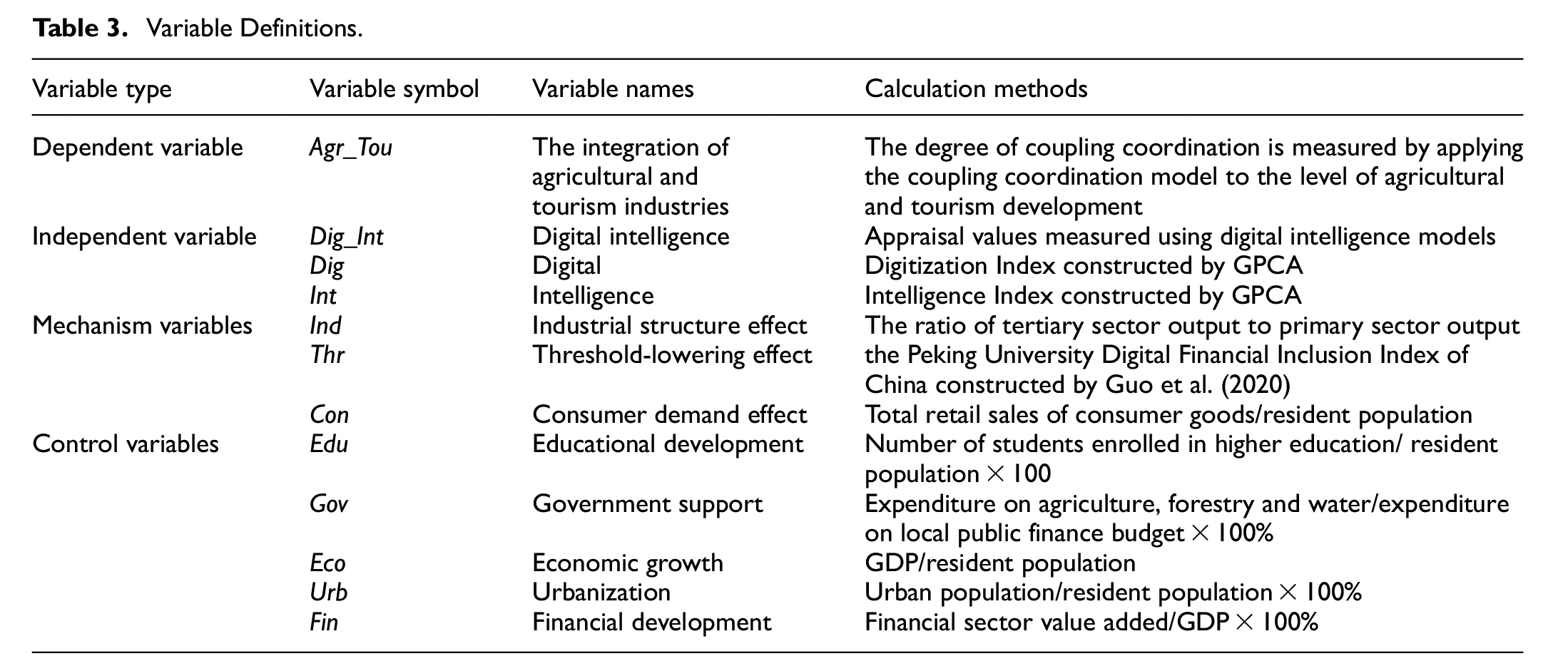
In order to control the influence of other factors on the integration of agricultural and tourism industries, this study refers to the selection of Ma et al. (2023) and chooses the following indicators as control variables (as shown in Table 3): educational development (Edu), governmental support (Gov), economic growth (Eco), urbanization (Urb) and financial development (Fin). The details are shown in Table 4.
Descriptive Statistics.

Table 4 shows the descriptive statistics of the variables analyzed in this study. It can be seen that there is little difference between the mean and the median, indicating that the sample follows an approximately normal distribution. Regarding the level of digital intelligence, the maximum value is 2.53 and the minimum value is −2.171, which is less than 0, indicating that the level in this region has realized a quantum change to a qualitative change in the past 10 years. In terms of the level of education development, there is a difference of 0.2 between the average and the median, and the influence of extreme values cannot be excluded. There may be a gap between talent reserves and education development in different regions. The maximum value of government support is close to 0.2, and the minimum value is almost 0, indicating that the government’s support for the agricultural and tourism industries has significant regional heterogeneity. This also highlights the importance of the government’s top-level design and funding policy tilt. The other indicators are consistent with the reality.
Empirical Results and Discussion
Measurement Analysis of Digital Intelligence and the Integration of Agricultural and Tourism Industries
This study examines the coupling and coordination degree of the integration of agricultural and tourism industries, referring to Ma et al. (2023) and Liao (1999). The coupling and coordination degree of the two industries is classified into three types (Table 5). Additionally, the study synthesizes the coupling coordination degree of each city and region from 2012 to 2021, along with its corresponding coordination type (Table 6). Due to space limitations, this study shows data for the four time sections of 2012, 2015, 2018, and 2021.
Classification System of Coordinated Development of the Agricultural and Tourism Industries and Its Discriminating Criteria.

Coordination Degree and Type of Agricultural and Tourism Industries Coupling From 17 Cities in 2012, 2015, 2018, and 2021.

Note. The coupling coordination degree of each region is calculated by the mean of its cities.
From 2012 to 2021, the coupling and coordination degree between the agricultural and tourism industries in the cities is generally reasonable. In addition, the region has made significant progress in terms of coordination levels, moving from moderate dysfunction to high-quality coordination. By 2018, all cities had reached at least the primary coupling coordination level, which is considered an acceptable range for agritourism integration. This achievement marks a significant milestone in the development of agritourism. The reason for this is that China proposed the Rural Revitalization Strategy in 2017, which emphasized the need to deepen the structural reform of the agricultural supply side and solve the issues concerning agriculture, countryside, and farmers. Therefore, while agriculture is revitalized, tourism has a catalytic effect and an excellent driving effect.
Among the coupling types of agricultural and tourism integration in each region of its cities, Guangdong Province, as a coastal province, developed their tourism industry earlier. It is evident from the coordinated types of municipalities in the regions and cities in 2012. In 2011, Guangdong Province began piloting the Construction of Beautiful Village. The government has provided strong support for rural farmers, and the integration of agritourism has led to development. As a result, the coupling coordination degree between the depth of the agricultural and tourism industries in the Guangdong Region in 2012 was relatively high, with all of them having mild disorder or above. By 2021, the Jiangxi Region has realized the later on, the coupling degree of coordination of municipalities to reach a good or even high-quality coordination level, far more than the other two regions of prefecture-level cities, but also realized the transformation from a large agricultural region to a strong region of tourism (in 2021, Jiangxi Region prefecture-level cities are all tourism-led). It may be that during the “13th Five-Year Plan” period, Jiangxi Province vigorously promoted the development of “Regional Tourism.” The construction of modern agriculture is actively integrated into the elements of tourism, the depth of the integration of agricultural and tourism, and the interactive development has achieved remarkable results. Among them, the coupling coordination degree of Ganzhou City in 2021 is 0.981, the highest level of all prefecture-level cities. Ganzhou’s continuous efforts in constructing a modern industrial system have also been verified as a demonstration zone for the high-quality development of underdeveloped regions.
In order to visualize the development speed of the level of digital intelligence in each region, this study will use 2012, 2015, 2018, and 2021 to show the scores (as shown in Figures 2–4). Additionally, this study selects the data from four cross-sections (2012, 2015, 2018, and 2021) to show the changes in the ranking of each city’s digital intelligence level score (Table 7).
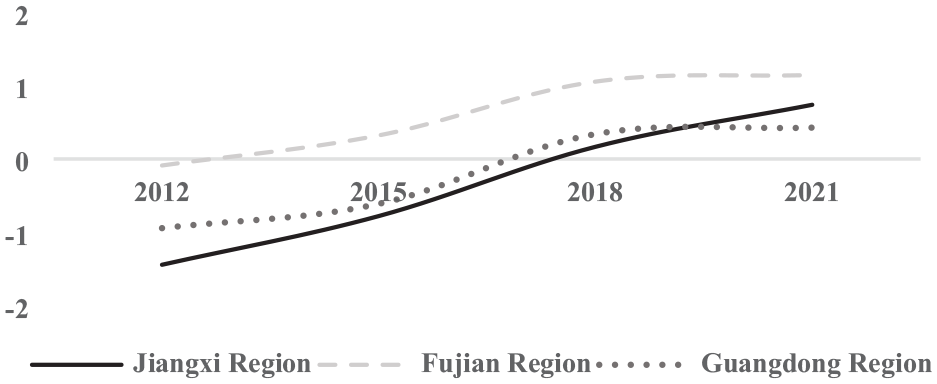
The development speed of digital intelligence of 3 regions in 2012 and 2021.
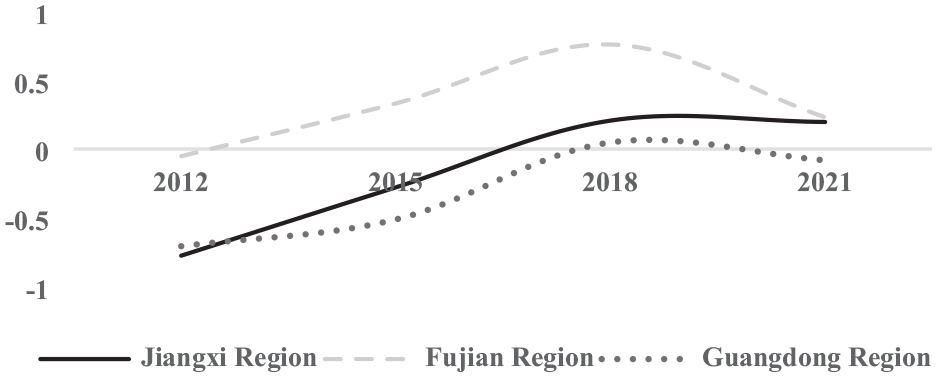
The development speed of digital of 3 regions in 2012 and 2021.
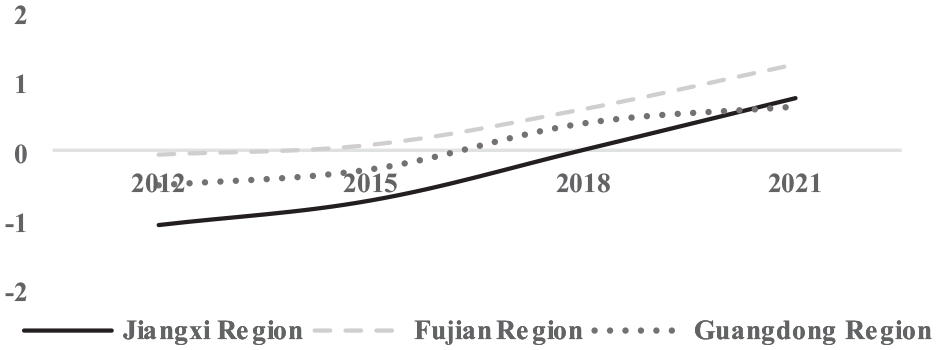
The development speed of intelligence of 3 regions in 2012 and 2021.
Ranking of Digital Intelligence Level Scores of 17 Cities in 2012, 2015, 2018, and 2021.

From a horizontal perspective, the chart illustrates that the prefecture-level cities in 3 Regions have better advanced digital and intelligence technology. However, between 2018 and 2021, the cities have not yet made significant breakthroughs. The reason may be that due to the external impact of the COVID-19 epidemic, enterprises lack the corresponding funds to install and maintain the digital system, which effectively affects the digital subsystem. From a vertical perspective, the Fujian Region has maintained steady growth in the development of digital and intelligence. At the turn of the century, Fujian Province grasped the trend of information technology development and planned and deployed the construction of “Digital Fujian”. It can be seen that the Jiangxi Region is narrowing the digital intelligence gap with the other two regions. The reason may be that the other two coastal provinces are at the forefront of economic development and modernization and have already gone through a period of technological dividends.
In details, in 2012, 2015, 2018, and 2021, Ganzhou City and Quanzhou City will be ranked 11, 1, 2, 2 and 1, 2, 1, 1, respectively. These cities are at the forefront of the digital and intelligence revolution.
Baseline Regression Analysis
According to the Hausman test results, the fixed effect model is better than the random effect model, and the fixed effect model should be chosen to analyze the impact of digital intelligence on the integration of agricultural and tourism industries. The results are shown in Table 8. From column (1), it can be seen that The correlation between digital intelligence and the integration of agricultural and tourism industries is significant at the 1% level, and Hypothesis 1 is verified. Among the control variables in Model 3, economic growth and financial development are positively related to the integration of agricultural and tourism industries at the 1% significant level, along with urbanization at the 5% significant level, education development and government support at the 10% significant level. The reason may be that the data element of digital intelligence accelerates the circulation of traditional factors such as land, capital and labor in the region of Jiangxi, Fujian, and Guangdong Provinces. This can help to overcome resource barriers and promote the flow of capital, talent and information elements between internal and external regions. As a result, it can facilitate the integration of agricultural and tourism.
Results of Benchmark Estimation and Robustness Tests.

Note. Robust standard errors in parentheses.
p < 0.01. **p < 0.05. *p < 0.1.
Robustness Tests and Endogeneity Discussion
First, consider changing the sample capacity. Influenced by the national policy, key cities tend to have access to more resources needed for development than general cities. Therefore, this study examines the impact of digital intelligence on the integration of agricultural and tourism industries in general cities, excluding the key cities in old revolutionary base areas (Ganzhou City, Ji’an City, Longyan City, Sanming City, and Meizhou City). The results are shown in Table 8.
Second, consider replacing measurement method. The “National Leisure Agriculture and Rural Tourism Demonstration Counties and Demonstration Sites” selection activities carried out by the Ministry of Agriculture and the Tourism Bureau of China can measure the integration of agricultural and tourism industries in different regions, the ratio of the number of selected demonstration counties/demonstration sites in prefecture-level cities to the number of county-level administrative units (including county-level cities) under the jurisdiction of the city is used to measure the level of integration of agricultural and tourism industries. The results are shown in Table 8. As can be seen from columns (2) and (3), the estimated coefficients of the model’s explanatory variables for the level of digital intelligence are significantly positive, indicating that digital intelligence significantly and positively empowers the integration of agricultural and tourism industries.
Therefore, the conclusions of this study are reasonably robust and
In the benchmark regression model above, although controlling for fixed effects and correlated variables as much as possible, there may still be a correlation between digital intelligence and disturbance. Therefore, this study included lagged dependent variables( L.Dig_Int and L2.Dig_Int) as instrumental variables. The Two-Stage Least Squares (2SLS) results are shown in Table 9. Columns (1) and (2) present the results of the first-stage regression estimates. Both sets of instrumental variables are significantly and positively associated with the digital intelligence variables. In the first-stage regression for both sets of instrumental variables, the F statistic is greater than the rule of thumb 10, indicating no weak instrumental variable problem. Column (3) presents the results of the second-stage regression. The tests on the instrumental variables show that the instrumental variables pass both the weak identification test (Cragg-Donald Wald) and the over-identification test (Sargan-Hansen), indicating that the instrumental variables have been reasonably selected. Based on the above conclusions, it can be seen that after considering the endogeneity problem, digital intelligence empowering the integration of agricultural and tourism industries still exhibits a significant positive impact.
Results of 2SLS.

Note. Due to space constraints, regression results for relevant control variables are not reported. Same below. [ ] values are p-values, { } values are the threshold at the 10% level of Stock-Yogo Weak Identification Test.
p < 0.01.
Mechanism Analysis
In order to verify from
Results of Mechanism Tests.

p < 0.01. **p < 0.05.
Heterogeneity Analysis
Considering that the integration of agricultural and tourism industries empowered by digital intelligence may have different impacts in different regions, this study divides the samples into three sub-samples of Jiangxi, Fujian, and Guangdong Regions based on the geographic location of the region. The results are shown in Table 11. It can be found that the estimated coefficients in the three regions are 0.087, 0.049, 0.040, of which Jiangxi Region is significantly positively correlated at the 1% level. At the same time, Fujian and Guangdong Regions are significantly positively correlated at the 10% and 5% levels, respectively. It can be seen that digital intelligence in Jiangxi, Fujian, and Guangdong Provinces all has noticeable empowering effects on the integration of agricultural and tourism industries. However, there exist differences in the degree of its impact. Jiangxi Province has a greater positive impact than Fujian and Guangdong Provinces. This may be because Jiangxi Province, as a large agricultural Province, has generated exponential technological dividends with the aid of digital intelligence. These advancements have greatly improved the efficiency of recreational agriculture and opened up income-generating opportunities through rural tourism. In Fujian and Guangdong Regions, traditional agriculture has been transformed and upgraded. Therefore, the empowering effect of digital intelligence on these two regions is experiencing diminishing marginal benefits, and the spillover dividends generated by digital intelligence technology are relatively weak. Overall, the impact of digital intelligence empowerment provides new opportunities for exceeding.
Results of Heterogeneity.

p < 0.01. **p < 0.05. *p < 0.1.
Analysis of the Impact of Digital and Intelligence Subsystems on the Integration of Agricultural and Tourism Industries
The following section further examines how digital intelligence subsystems affect the integration of agriculture and tourism. On the one hand, in order to examine whether there is a significant difference in the results of the impact of the subsystems of digital and intelligence on the high-quality development of tourism in each region, a Chow test is conducted. The conclusion shows that the Chow test values of the impact effects of digitization and intelligence on the integration of agricultural and tourism are 2.90 and 3.35, respectively, and the corresponding p-values are 0.058 and 0.038, respectively, which indicate that there is a significant difference between the subsystems. On the other hand, in terms of the impact effect (as shown in Table 12), digital intelligence has a significant positive facilitating effect on the integration of agricultural and tourism industries. However, intelligence contributes less to agri-tourism integration than digitization. The reason may be that intelligence, compared to digitization, started later; there is a specific time effect. And Guangdong Region has not indicated a positive impact due to the lack of samples possibly.
Results of Digital Intelligence Subsystems Affecting the Integration of Agricultural and Tourism Industries.
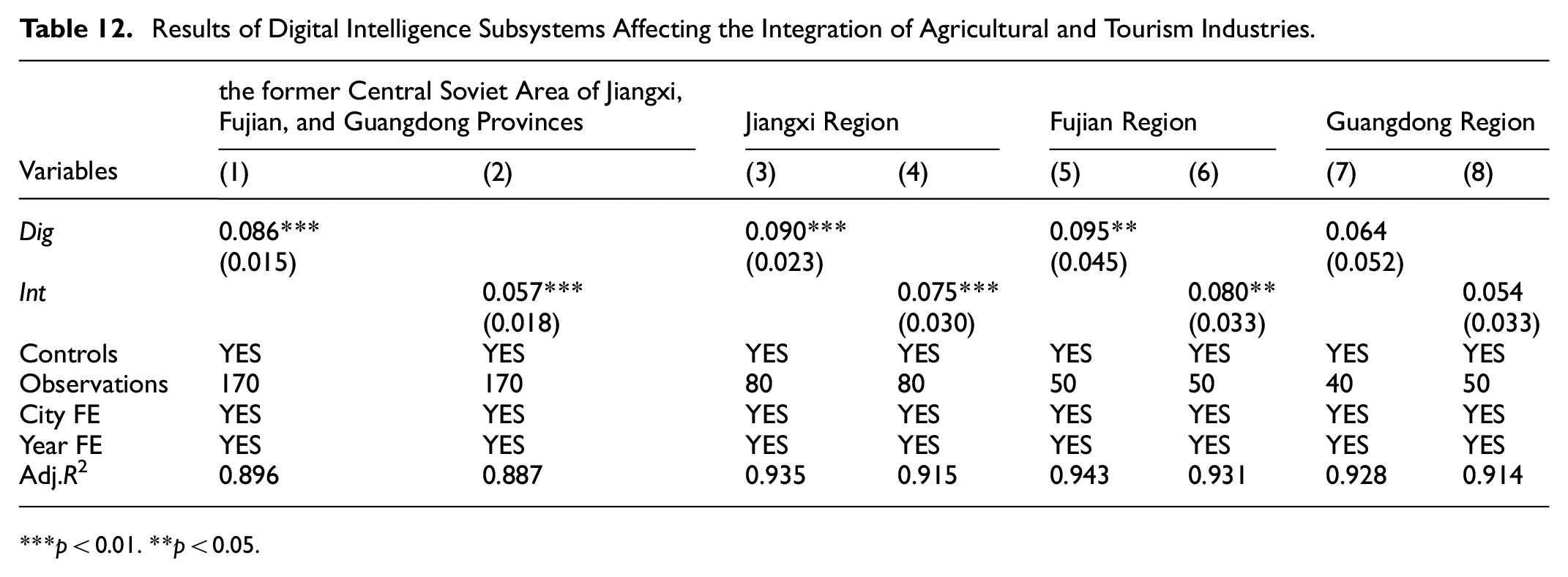
p < 0.01. **p < 0.05.
Conclusions and Policy Implications
Digital intelligence empowerment has been a hot research topic in recent years. Based on the panel data of 17 prefecture-level cities in the former Central Soviet Area of Jiangxi, Fujian and Guangdong Provinces from 2012 to 2021, this study examined the impact of the integration of agricultural and tourism industries empowered by digital intelligence.
After a series of empirical tests, the following conclusions are drawn:
The level of digital intelligence in the prefectures of the region of Jiangxi, Fujian and Guangdong Provinces has generally shifted from negative to positive, of which Ganzhou and Quanzhou Cities have the highest comprehensive score of digital intelligence.
The integration between the agricultural and tourism industries has realized a six-level leap from moderate disorder—barely coordinated—primary coordination—intermediate coordination—good coordination—quality coordination, of which all cities reached the primary and above coupling coordination level in 2018.
There is a significant positive empowering effect of digital intelligence on the integration of agricultural and tourism industries. The findings of this study remain robust even after regressing with instrumental variables, changing the sample capacity, and replacing the core explanatory variable measurement method.
The analysis of regional heterogeneity shows that digital intelligence can promote the integration of agricultural and tourism industries. However, the technological dividends empowered by digital intelligence in Jiangxi Region are greater than those in the two regions of Fujian and Guangdong Regions. Specifically, from the perspective of the digital intelligence subsystem, digitization has a significant positive impact on the integration of agricultural and tourism industries in the prefecture-level cities where the old revolutionary base areas in the three regions are located, among which the impact effect on Jiangxi Region is more apparent. However, intelligence contributes less to their integration than digitization.
The following policy recommendations are made based on the findings of this study.
On the one hand, the following suggestions are given from the government’s perspective.
Initially, digital intelligence will be an engine that promotes the integration of the agricultural and tourism industries to deepen development and improve the modern industrial system. First, building a human-machine collaborative agricultural tourism application system is recommended using digital intelligence technology to promote collaboration and sharing throughout the entire process and application scenarios. Second, data should be the starting point, and its mobility and dissemination should be combined and optimized with traditional factors of production to increase the output of agritourism resources and build a new ecology for the agritourism industry. Third, a platform for information sharing and technology transformation must be established to meet the needs of primary production and processing enterprises, farmers, and other direct interest subjects. It will enable the co-creation of value among all stakeholders.
Then, the transmission mechanism of the industrial structure effect, the threshold-lowing effect, and the consumption demand effect are considered to deepen the integration of digital and reality effectively. First, to give full play to the universal effect of data differentiation to create featured products and star products through industrial clustering and the scale effect of integrating agricultural and tourism industries to strengthen the functional chain. Second, enhance the innovation support for the digital intelligence transformation of agricultural and tourism businesses, lower the threshold of agricultural and tourism public services, establish market-oriented ecological organizations, improve management service capabilities and benefits, and enhance the resource chain of agricultural and tourism integration. Third, digital intelligence technology can help standardize and improve production, processing, sales, and management in the agricultural industry. It can drive the market for agricultural products and integrate the tertiary industry to meet customized and personalized demands. It can also enhance the added value and comprehensive benefits of products and broaden the agricultural and tourism market chain integration.
Finally, from the above findings, it is clear that less-developed regions have unique latecomer advantages, which can be summarized and extended to other less-developed regions. First, the full acceptance of policy dividends. The government of the less-developed regions by undertaking the relevant favorable policies of the country, joint counterparts to help the region in order to increase the digitization, intelligent technology, and the comprehensive construction of infrastructure across the digital and intellectual divide for the digital and intellectual dividend. At the same time, local governments should pay attention to the heterogeneity of the development of digital intelligence in different regions. Combined with the status quo of digital and real integration in less-developed regions, optimizing and improving the design of policy institutions and the Matthew Effect between regions and developed coastal areas should be utilized to formulate a correct development strategy for digital intelligence in agriculture and tourism. It will create a superior business environment and allow for financial support and agricultural policies to be scientifically formulated. It will also guide less-developed areas in achieving curve overtaking. Adhere to the principle of coordination between current and long-term planning to enhance industrial digitization and intelligent integration and strive to build a modern industrial system. Second, reasonably based on the resource base. Promote the in-depth coordinated development of tourism and other related industries such as agriculture and culture, deeply excavate the connotation of other resources such as culture, give other elements to agricultural tourism, innovate the expression of agricultural tourism, and expand the depth and breadth of promoting the digital and intelligent transformation of traditional industries. Constructing a centralized test field for scientific research, providing training to lay the foundation, and establishing science and technology parks for industrial agglomeration are essential. It is also crucial to protect the local ecological environment and resources to maintain the value of nature. Third, the advantages of location must be fully explored. Although most of the underdeveloped regions are in China’s inland areas, they can break the geographical restrictions and neighboring regions for resource integration and complementary advantages and jointly create regional agricultural tourism brands and boutique routes through the digital intelligence platform to achieve information sharing, mutual delivery of sources of customers, the market co-construction, to enhance the overall competitiveness and influence of the regional agricultural tourism industry. The three northeastern provinces, Guangxi Province, Yunnan Province, and other regions in China’s border areas, can be through its bordering neighboring countries for cross-border e-commerce transactions, rise, and friendly interaction with neighboring countries. This can promote the realization of e-commerce import and export trade better and attract the total amount of cross-border tourism business through the Internet.
On the other hand, for agritourism business subjects, including farmers, agricultural business subjects, rural cooperatives, and other institutional organizations, this paper puts forward the following management insight based on this perspective.
First, increase the innovation investment in the agri-tourism industry and innovate the ecology of the agri-tourism industry chain. Agri-tourism integration cannot be separated from the support of carriers, and agri-tourism business subjects should start from important carriers such as agri-tourism product projects, festivals and activities, and agri-tourism space to enrich the forms. First, the production side should vigorously plan and develop new products for agricultural tourism, promote the digitization, greening, and branding of products, create rural local fist products and star products, and create a new brand for integrating agriculture and tourism. Second, the consumption side should promote the innovation of agricultural industrial parks, garden complexes, creative agriculture, rural leisure tourism, and other new forms and modes, supplemented by warehousing and logistics and the innovation of the new mode of agricultural tourism. Finally, the consumer should promote the innovation of agricultural industrial parks, idyllic park complexes, creative agriculture, rural leisure tourism, and other new business forms and modes, supplemented by warehousing logistics and e-commerce platforms.
Although this study attempts to add to the existing research by examining the empowering effect of digital intelligence on the integration of agricultural and tourism industries, certain limitations may require additional research. First, this study selects the primary data of prefecture-level cities in the former Central Soviet Area of Jiangxi, Fujian, and Guangdong Provinces for indicator construction and analysis. However, in the actual situation, specifically in the development of agri-tourism integration between countries, there may also be differences, which may make the empirical results have some bias. In future studies, we hope to conduct a field study by collecting qualitative data to understand the digitization of agritourism business entities and even the specific empowerment status of digital intelligence to capture local perceptions further. Furthermore, it would be interesting for future research to look at other less-developed regions. Second, there is currently no perfect and uniform evaluation index for agro-tourism integration. Although this paper enriches its dimensions as much as possible, it may need further optimization.
Footnotes

Ethic Statement
Not applicable.
Funding
The author(s) disclosed receipt of the following financial support for the research, authorship, and/or publication of this article: Supported by the National Social Science Fund Project (22GBL268); Key Program of University Research Base of Jiangxi Province, China (24ZXSKJD03); The Social Science Foundation of Jiangxi Province, China (24YJ04); Key Program of University Humanities of Jiangxi Province, China (JD23070).
Declaration of Conflicting Interests
The author(s) declared no potential conflicts of interest with respect to the research, authorship, and/or publication of this article.
Data Availability Statement
The data that support the findings of this study are available from the corresponding author upon reasonable request.