




Abstract
Digital-intelligence plays an important role in transforming the energy consumption structure and promoting the emission reduction process. To explore the relationship between digital-intelligence and regional carbon emissions, we assume that there is a differential impact in carbon emission reduction effects, given the obvious differences in regional green technology innovation during the development of digital-intelligence in China. Thus, we systematically construct a new digital-intelligence system definition and include the heterogeneous threshold of green technology innovation in the relationship of the impact of digital-intelligence on carbon emissions by using a nonlinear dynamic threshold model. The results show that the development of regional digital-intelligence in China exhibits a relatively stable upward trend, and there is heterogeneity among regions. Interestingly, there is a significant heterogeneous threshold effect from green technology innovation between digital-intelligence and carbon emissions. A lower level of green technology innovation will increase the carbon emission effect of digital-intelligence to a certain extent, but when green technology innovation increases and exceeds a threshold, digital-intelligence is able to dramatically inhibit regional carbon emissions. Our research answers the question of how to achieve digital-intelligence transformation through green technology innovation and reduce total regional carbon emissions and provides new insights for developing countries to curb carbon emissions.
Plain Language Summary
Our research answers the question of how to achieve digital-intelligence transformation through green technology innovation and reduce total regional carbon emissions and provides new insights for developing countries to curb carbon emissions. The results show that the development of regional digital-intelligence in China exhibits a relatively stable upward trend, and there is heterogeneity among regions. Interestingly, there is a significant heterogeneous threshold effect from green technology innovation between digital-intelligence and carbon emissions. A lower level of green technology innovation will increase the carbon emission effect of digital-intelligence to a certain extent, but when green technology innovation increases and exceeds a threshold, digital-intelligence is able to dramatically inhibit regional carbon emissions.
Keywords
Introduction
Climate issues have long been the focus of worldwide attention. Global warming has become an indisputable fact, and has a great impact on the development of countries around the world (M. Liu et al., 2023). Excessive emissions of greenhouse gases are one of the primary drivers of global climate change, with carbon dioxide being the main contributor, accounting for approximately 60% of the greenhouse effect (P. Li et al., 2022; Yu and Yin, 2023). Given the Paris Agreement’s objective of limiting the global average temperature rise to within 2°C and making efforts to control the temperature within 1.5°C, reducing carbon emissions has become a hot topic to curb the warming trend (F. Wu et al., 2020). The dramatic increase in carbon emissions is one of the major contributing factors to global warming and ecological damage. According to the “Global Energy Review: Carbon Dioxide Emissions 2021,” global carbon emissions from energy combustion and industrial processes rebounded in 2021, reaching the highest level ever. Compared to 2020, emissions increased by 6%, pushing them up to 363 tons. The International Energy Agency’s data shows that China is the largest carbon dioxide emitter in the world. China has been emitting more carbon than any other country since 2007 (Xiao et al., 2021). Therefore, there is an urgent need to find a reasonable and effective way to alleviate the pressure on global carbon emissions. China’s rapid urbanization and economic growth have caused a large amount of energy consumption and increased China’s total carbon emissions, and with the development of its economy and the expansion of demand, its carbon dioxide emissions will only continue to rise in the future. To control total carbon emissions, the Chinese government has included the synergistic management of environmental pollution and greenhouse effects as a fundamental principle in its 14th Five-Year Plan and emphasized in the 75th General Assembly General Debate in 2020 that China will continue to enhance its national contribution and strive to peak carbon emissions by 2030 and achieve carbon neutrality by 2060 through more effective environmental regulation policies (Hong et al., 2022). This shows that improving energy efficiency and accelerating the process of energy conservation and emission reduction have become important tasks facing China at present.
To reduce carbon emissions in all regions of China, it is necessary to shift the energy consumption structure to improve resource utilization. With the continuous intensification of global competition, the rapid development of the digital economy, and the rapid advancement of information technologies such as mobile 5G, the Internet of Things, and artificial intelligence, the digital transformation of industries has become an inevitable development trend (Pham & Vu, 2023). The development of mobile internet, big data, artificial intelligence, blockchain, and other digital-intelligence information technology under the latest round of digital revolutions has deeply empowered traditional industries, shaped a new economic form, and accelerated the process of energy saving and emission reduction. Digital transformation is a prerequisite for digital-intelligence, and digital-intelligence is an upgrade of digital transformation. If digital transformation is the use of digital technology to digitize the production and management processes of industries, then digital-intelligence is the combination of digital technology and intelligent technology, in-depth analysis of massive data, and empowerment of industrial production, operation, and management activities (Selock, 2023). The high penetration and socialization of digital technology in the context of the digital-intelligence era has also provided technical support for a new round of economic and social changes and deep transformation. People have changed from the traditional industrial economy to a platform economy and digital-intelligence society driven by digital information technology (Luo & Chen, 2022). The definition of digital-intelligence is defined mainly from the perspective of the Industrial Revolution, which divides the overall technological paradigm changes in human society into four times, namely, the emergence of the “steam engine” in the first industrial revolution, which transformed human society from a traditional agricultural society to an industrial society. The emergence of generators and internal combustion engines in the second industrial revolution pushed mankind from the “steam age” to the “electrical age.” The third industrial revolution entered the 1940s and 1950s, with the widespread use of electronic computers and the international internet being a milestone in the development of human history. As a result, humanity entered an information-based society. The fourth industrial revolution was a huge revolution in the history of technological development. It’s a new round of technological change based on digital information and intelligent technologies such as computers, mobile internet, big data, blockchain, and artificial intelligence since the beginning of the 21st century (David et al., 2022). Human society is gradually entering into a “digital-intelligence society.” Thus, as an important support for economic operation, the role of digital-intelligence in reducing total carbon emissions cannot be ignored, and an in-depth study of the relationship between digital-intelligence and carbon emissions has important theoretical significance and research value for improving energy use efficiency and thus reducing greenhouse gas emissions.
Digital-intelligence technology achieves deep empowerment for traditional industries, promotes the transformation and upgrading of the energy structure, and can effectively drive green technology innovation. Green technology innovation is an important engine to alleviate climate pressure and provide energy efficiency and is the key path for China to reduce carbon emissions. Therefore, the role of green technology innovation is essential in reconciling digital-intelligence and carbon emissions. Habiba et al. (2022) concluded that green technology innovation is one of the influential factors in reducing total carbon emissions, which can effectively reduce the level of carbon emissions of enterprises and promote their sustainable development. Chen et al. (2023) concluded that the impact of green technological innovation on carbon intensity shows a significant “inverted-U” relationship, when the level of green technological innovation is relatively low, green technological innovation will promote carbon emissions, while when the level of green technological innovation reaches a certain level, this promotion relationship will change into inhibition relationship. In addition, Du et al. (2019) concluded that there is a significant single threshold effect of income level between green technology innovation and carbon emissions and that green technology innovation is effective in reducing carbon emissions when income level is increasing and crosses the threshold. Thus, in the face of a series of environmental problems brought about by climate warming, can digital-intelligence become an important engine to reduce carbon emissions? What will be the role of green technology innovation between digital-intelligence and carbon emissions? At different levels of green technology innovation, how will digital-intelligence impact carbon emissions? Taking into account the above questions, we study the relationship between digital-intelligence and carbon emissions from the perspective of green technology innovation. First, the emerging concept of digital-intelligence is proposed, and the current level of digital-intelligence in China is analyzed by constructing indicators from the two aspects of “digitalization” and “intelligence.” Second, we deeply examine the heterogeneous relationship between digital-intelligence and carbon emissions in different regions of China and discuss the heterogeneity “threshold” characteristics caused by differences in green technology innovation, providing new insights for reducing carbon emissions.
The remaining parts are as follows: “Literature Reviews” section summarizes the literature review of the research, “Methodology of Measuring Digital-Intelligence” section builds a digital-intelligence indicator system to reveal the current status of China’s digital-intelligence, “Results of Digital-Intelligence” section elaborates the data sources of the article and builds a threshold model, and “Empirical Model and Variables” section shows the empirical results and analyzes the impact mechanism of digital-intelligence on carbon emissions under different levels of green technology innovation. “Empirical Results and Discussions” section puts forward corresponding policy recommendations based on the empirical results.
Literature Reviews
The development of global digital-intelligence has accelerated the process of the carbon reduction effect, and digitalization and intelligence have become important ways to change China’s traditional economic growth model and relieve the pressure on the environment. However, there is relatively little literature that explicitly includes digital-intelligence and carbon emissions in a unified examination, but the mechanism of the impact of digitization and intelligence on carbon emissions can provide an important reference for exploring the relationship between the impact of digitization and carbon emissions.
First, digital and intelligent development can relieve environmental pressure and reduce the level of carbon emissions. Bloomfield et al. (2021) argue that the development of artificial intelligence can help mitigate climate change and reduce CO2 emissions by optimizing processes and changing conservation practices. Meanwhile, J. Liu, Liu, et al. (2022) argue that artificial intelligence, an important engine of the new round of technological revolution and industrial change, can significantly reduce the intensity of carbon emissions. From an industrial perspective, Wang et al. (2022)chose the input–output method and structural decomposition analysis to verify the impact of production structure factors on carbon emissions in China’s digital industry and indicated that the digital industry can effectively reduce carbon emission levels. At the regional level, J. Liu, Yu, et al. (2022) explore the impact of digital technology development on carbon emissions in a spatial analysis framework and find that digital technology development not only reduces local carbon emissions but also promotes carbon reduction in neighboring cities, and the “siphon effect” that negatively affects carbon reduction in neighboring cities is offset by the “spillover effect.”R. Ma et al. (2023) established a fixed effect model to study the panel data, and used principal component analysis and non-radial distance function (NDDF) to measure the digitalization and total factor carbon emission performance of 245 prefecture-level cities in China from 2003 to 2019, and concluded that digitalization can significantly promote CO2 emission reduction in China. Q. Ma et al. (2022) argue that the digitization of the Chinese economy has great potential to ensure environmentally sustainable growth and that the pressure on China’s CO2 emissions can be alleviated by developing state-of-the-art technologies.
Second, there are also studies that show that digital and intelligent development can increase energy consumption levels and carbon emissions. X. Zhou et al. (2019) used the power industry as a starting point to demonstrate that as the demand for general-purpose information technologies continues to expand, it will raise the level of carbon emissions to some extent. Similarly, Jin and Yu (2022) used a static panel model with variable selection and double fixed effects from the manufacturing industry using the LASSO method to demonstrate that while the diffusion of information general-purpose technologies has improved energy use efficiency to some extent, it has also expanded energy demand and increased carbon emissions in the nonmetal manufacturing industry, producing some backlash effects. Wang et al. (2022) demonstrated that the indirect production structure of digital industries increases the level of carbon emissions by comparing the impact of digital industries on the carbon emissions of various industries in China from 2002 to 2018.
Finally, regarding the relationship between digital-intelligence and carbon emissions, some scholars have found a certain nonlinear influence between the two in the process of research. Z. Li and Wang (2022) combined the spatial DURBIN model (SDM) and the panel threshold model (PTM) to conduct a nonlinear analysis of the relationship between the digital economy and carbon emissions, demonstrating that the digital economy has an inverted u-shaped relationship with carbon emissions. Green technology innovation, as a key factor in reducing carbon emissions, has to some extent accelerated the process of energy saving and emission reduction and improved environmental quality (J. Liu, Liu, et al., 2022). Green technology innovation is an effective strategy to solve environmental pollution, reduce carbon emissions and help achieve the goal of sustainable development (Chang et al., 2023). Cao et al. (2021) argue that green technology innovation is the transmission pathway through which digital finance affects environmental energy performance and that the Chinese government’s regulation of financial and environmental aspects has to some extent enhanced the role of digital finance in enhancing energy and environmental performance. Green technology innovation is an effective way to balance economic growth and environmental governance. Green technology innovation contributes to CO2 emission reduction, and its marginal mitigation effect on CO2 emission is significant (Lin & Ma, 2022). Meanwhile, Zhang and Liu (2022) analyze the relationship between digital finance, green technology innovation, and carbon emission efficiency using panel data from 285 cities in China from 2011 to 2017, demonstrating that the synergistic effect of digital finance and green technology innovation can have a significant contribution to local carbon emission efficiency. These findings provide important guidance for analyzing the nonlinear relationship between digital-intelligence and carbon emissions from the perspective of green technology innovation.
Therefore, scholars have conducted research on the logical relationship between digital-intelligence, green technology innovation and carbon emissions. Compared with existing studies, the contributions of this paper are mainly as follows. First, the impact of digital-intelligence on carbon emissions has been less studied in the Chinese context, especially on the premise that the relationship between digital-intelligence, green technology innovation, and carbon emissions cannot be viewed in isolation, given the obvious differences in regional green technology innovation during the development of digital-intelligence in China. Based on this, we incorporate digital-intelligence and green technology innovation into the research framework on regional carbon emissions, focusing on how to promote the carbon reduction effect of digital-intelligence through green technology innovation in the era of digital-intelligence, and innovatively demonstrate the nonlinear heterogeneous threshold effect between digital-intelligence and carbon emissions at different levels of regional green technology innovation. This approach provides a theoretical basis and practical experience for China to designate supporting policy measures to improve regional carbon emission efficiency and achieve the “double carbon” goal according to local conditions.
Second, due to the relatively new perspective of digital-intelligence leading to less literature on the subject, there is no clear explanation of the concept of digital-intelligence. Therefore, on the basis of the definition of the concept of digital-intelligence, we initially constructed the relevant indicators of digital-intelligence and constructed a digital-intelligence evaluation index system from the two aspects of digitization and intelligence, which specifically presents the current digital-intelligence state in China. The development status quo avoids the problems of imperfect analysis and imperfect systems caused by measurement deviation under the measurement of a single indicator.
Third, the existing research on the relationship between digital-intelligence and carbon emissions mainly uses traditional econometric models but ignores a large number of nonlinear relationships contained in economic variables. Therefore, we use an improved dynamic threshold regression method to construct a dynamic threshold model of carbon emissions in areas affected by digital-intelligence under different green technology innovation threshold changes and consider the endogeneity and dynamics of the model to ensure the robustness of the results. This provides an important path choice for using digital-intelligence technology to achieve carbon reduction goals.
In summary, in the context of the digital-intelligence era, we scientifically assess the current situation of regional digital-intelligence development in China, analyze the internal logical relationship between digital-intelligence, green technology innovation and carbon emissions, and provide new insights for reducing carbon emissions to achieve the “double carbon” goal.
Methodology of Measuring Digital-Intelligence
Construction of Index
At present, there are relatively few studies on digital-intelligence and few empirical measurements. The only studies on digital-intelligence mainly focus on the impact of information technology and digital development on macroeconomics or microenterprises. At the same time, the typical characteristics of digital-intelligence are information and data, which are distinguished from the factors of production such as labor, land and capital in the first and second industrial revolutions and become independent factors of production functioning in the digital-intelligence society. Digitalization, informatization, intelligence, networking, and personalization are the processes that guide the production, consumption, exchange, and distribution of all types of organizations in the economic and social sphere. Therefore, as an important way to reduce carbon emissions, digital-intelligence, through a reasonable index system to reflect the current development status of digital-intelligence in China, will provide important theoretical support for subsequent research on the impact of carbon emissions. Luo and Chen (2022) innovatively construct a comprehensive index of digital-intelligence from both digital and intelligent levels. Some scholars have constructed a digital-intelligence indicator system from the two dimensions of digital finance and intelligent reform efficiency (Liang & Li, 2023); Zhang et al. (2022) constructed a digital-intelligent indicator system based on the development foundation of the digital industry, digital innovation capabilities, and the application level of intelligent products; Makarov(2020) constructed a digital-intelligence evaluation index system from five dimensions: digital infrastructure, product digitization, intelligent technology, intelligent efficiency, and intelligent technology. Based on the definition of digital-intelligence and the summary of the digital-intelligence measurement index system in the literature, taking into account the data availability of the measurement indices, our specific treatment of digital-intelligence indices is as follows:
Digital aspects: (1) Digital infrastructure level. Digital infrastructure development is a prerequisite for digital development. Without good infrastructure as a guarantee, other series of digital reforms cannot be discussed. In digital infrastructure, there is an inherent connection between the emergence of digitalization and the popularization of the Internet, and the use of the Internet is an indispensable prerequisite for digital development. From the perspective of the demand for terminal networks, fixed broadband, especially mobile networks, has also become the foundation for digital development. Therefore, we measure the level of digital infrastructure, which includes both hardware facilities and software facilities. Specifically, the level of hardware facility construction is measured by three indicators: fiber optic cable length/province area, cell phone exchange capacity/total population, and number of cell phone base stations/province area (Chen et al., 2022). The level of software facility construction is measured by the number of broadband internet access users/total population (Yang et al., 2021). (2) Digital industry development level. Digital industry has become the main theme of technological revolution and industrial transformation. The innovative application of new generation information technology is leading a new round of industrial transformation, driving the continuous breeding of new models such as digital manufacturing, which is an important manifestation of digitization. Digital industrialization refers to the development of the software and hardware information industry by effectively integrating artificial intelligence, blockchain, cloud computing, and data science technologies, gradually crowding out traditional products and services with digital products and services, empowering the upgrading of traditional industries, promoting the integration of digital technology and the real economy, and thereby expanding the scale of the digital economy. The digital industrialization reflects the depth and breadth of penetration between the digital economy and other industries, mainly including digital product manufacturing, digital product service, digital technology application, and digital factor driven industries. These industries are the “pioneers” of integrating digital infrastructure, so specific measures need to be taken. The level of digital industry development covers five main dimensions: employment, telecommunications, software, e-commerce, and communications. Specifically, the number of employees in the computer services and software industry, total telecommunications business/total population, software business revenue/total population, (e-commerce sales + e-commerce purchases)/2 and information transmission computer services and software industry social fixed asset investment/total social fixed asset investment reflect the corresponding dimensions (Chen et al., 2022; D. Ma & Zhu, 2022). (3) Industry digital development level. Digitalization brings new management models to the industry, and data is an important basis for further improving efficiency or improving the market. Industry digitization is a solid foundation for obtaining and applying these data. The level of industry digitalization development is one of the important indicators for evaluating the level of digitalization, which can guide the direction of industry digitalization development. According to the “Statistical Classification of Digital Economy and Its Core Industries (2021)” released by the National Bureau of Statistics in China, the main indicators of industrial digitization are efficiency improvement industries, including digital commerce, intelligent manufacturing, and digital finance industries. Therefore, the level of industrial digital development is examined mainly from two aspects: financial digitalization and enterprise digitalization. Specifically, digital financial inclusion defines the level of financial digitization (Yang et al., 2021; Zou & Deng, 2022). Digital inclusive finance covers three dimensions of digital technology: coverage breadth, depth of use, and digital support services. This index has a strong authoritative position in China and is widely used in studies to measure the development of digital technology. The digitalization level of enterprises is represented by the number of enterprises with e-commerce transaction activities, the number of domain names, the number of IPV4 addresses and the number of web pages (Pan et al., 2022).
Intelligent aspects: (1) Infrastructure. Intelligent infrastructure is an organic combination of traditional urban public infrastructure and new generation information technologies such as the Internet of Things, 5G, big data, cloud computing, artificial intelligence, etc. It can collect its own operational data and urban operational data in real-time, upload the data to the smart city platform, and use it to build a digital city for the “urban brain” to make intelligent decisions, and manage the digital intelligence of infrastructure. It is one of the important indicators reflecting the level of intelligence. However, the key technologies of intelligence are still subject to human constraints, and technological talents are one of the important factors affecting the level of intelligence. From this, the construction of intelligent infrastructure mainly starts from two aspects: software popularization and application situation, and intelligent talents. The popularity of software applications as expressed in terms of the share of revenues from products such as basic software, support software, and embedded application software in the final product; intelligent talent is measured by software developers (J. Liu, Liu, et al., 2022). (2) Production Applications. Production application is an inevitable process of intelligent development, and promoting the optimization, upgrading, application, and production of intelligent industries is a prerequisite for promoting intelligent development. Intelligent technological innovation is the primary driving force for development, and the production of new products is a concrete manifestation of the level of intelligence. Mainly from the two aspects of intelligent technology development and new product production, the number of software enterprises is used to measure intelligent technology development, and the share of new product sales revenue in GDP is used to measure new product production (Luo & Chen, 2022). 3) Competitiveness and efficiency. The efficiency and competitiveness of intelligent development are based on improving industrial efficiency. Through technological transformation, efficiency constraints are overcome, industrial competitiveness is enhanced, and the maximum output is achieved with predetermined inputs, thereby enhancing the level of intelligent development. Therefore, intelligent efficiency and competitiveness are key indicators for measuring the level of intelligent development. This mainly summarizes three aspects: innovation ability, economic benefit, and social benefit. Innovation capacity is expressed as the ratio of the number of patent applications granted to the full-time equivalent of R&D personnel. Economic efficiency is measured by the profits of the electronics and communications equipment manufacturing industry. Social benefits are expressed in terms of energy consumption per unit of GDP. It is important to note that energy consumption refers mainly to the consumption of two types of energy, electricity and coal (J. Liu, Liu, et al., 2022). The details are shown in Table 1.
Construction of Digital-Intelligence Indicators.

Measuring Method
First, Principal Component Analysis (PCA) was performed on digital and intelligent indices to obtain DIG (digital) and INT (intelligent) related values; then, principal component analysis was applied again to obtain the digital-intelligence (DI) integrated index.
Principal Component Analysis (PCA) is a commonly used method for dimensionality reduction of data, which can simplify the problem-solving process by extracting the main characteristics of things. The main idea is to convert high-dimensional data into low dimensional data through linear transformation, reduce the dimensionality of the original data, and form a set of unrelated new indicators to replace the original indicators for data processing and analysis. After conducting linear transformation, the larger the variance contribution rate of the new indicator, the more information the indicator contains, which is called the first principal component. If the first principal component cannot fully reflect the situation of the original data, the second principal component will be selected, and so on. By using principal component analysis to simplify the original variables, it can effectively reduce the interference of subjective factors and obtain more reliable results in subsequent data analysis, making the obtained results more objective and scientific.
Results of Digital-Intelligence
As shown in Table 2, overall, all 30 regions in China show a steady upward trend in the level of digital-intelligence, which reflects the degree of importance attached to digital-intelligence in each region. Since the implementation of China’s 13th Five-Year Plan, more attention has been given to the development of digital-intelligence technology. In 2015, the Chinese government released “Made in China 2025,” which also proposed taking intelligent manufacturing as the main direction to promote the transformation and upgrading of the manufacturing industry. The report of the 19th Party Congress emphasized the need to promote the deep integration of the internet, big data, artificial intelligence and the real economy. To a certain extent, these measures will help eliminate the “digital divide” and promote radical changes in economic and social life, giving rise to a digital and smart economy and driving digital-intelligence transformation and innovative development. Although the development level of digital-intelligence in each region of China has shown significant improvement, there is a certain degree of heterogeneity in the development level of digital-intelligence due to the differences in the economic base, geographical location, and resource factors of each region. The main reason for this phenomenon is that the development of digital-intelligence in the eastern region of China started earlier and deeper, with more sufficient funds, more complete hardware and software infrastructure, and more efficient resource allocation. Coupled with the large employment and development space in the eastern region, the high level of technological development, and the greater attraction to high-end talent, the eastern region has also promoted the level of regional digital-intelligence development with the advantages of perfect infrastructure and high-quality talent. The central and western regions, due to the late start of the digital-intelligence development, the lack of resource endowment and talent elements, and the relative lack of policy interpretation and implementation, to a certain extent, restrict the regional level of development of digital-intelligence.
Digital-Intelligence in China (2013–2020).

As shown in Figure 1, of the 30 regions in China examined, the nine regions with above-average levels of digital-intelligence are Guangdong, Beijing, Shanghai, Jiangsu, Zhejiang, Shandong, Fujian, Tianjin, and Liaoning. This also shows that the level of China’s digital-intelligence development still has great potential, the level of digital-intelligence in most regions of China is still low, and there is much room for improvement. Provinces that exceed the average of digital-intelligence are mainly concentrated in the developed eastern regions, partly because the public infrastructure environment in these regions itself has a deeper degree of influence on the development of digital-intelligence and is more likely to enhance the regional level of digitization. The other part is mainly due to the good foundation of industrial development and more emphasis on the degree of attention and application of digital-intelligence technology. The regions have built good communication and interaction relationships with each other, laying the foundation for improving regional digital-intelligence.

Digital-intelligence in China (2013–2020).
Empirical Model and Variables
Specifications of the Dynamic Threshold Model
The “threshold” in economics refers to the phenomenon where when an economic parameter reaches a certain value, it will cause another economic parameter to suddenly shift to other forms of development. The interval changes before and after the critical points of these threshold elements have a significant heterogeneity effect on the explained indicators. Based on the consideration of the characteristics of threshold factors, it is possible to further characterize the effects of economic parameter indicators in the context of heterogeneous factors.
Specifically, improving carbon emission reduction also depends on the characteristics of technological innovation levels in a country. Backward countries or regions do not have good basic conditions in supporting the basic environment of digital innovation technology, the corresponding carbon reduction effect may be limited, which is not conducive to the improvement of carbon reduction efficiency. Due to the uneven distribution of innovation resources in different regions of China, in order to effectively achieve digital-intelligence, it is necessary to have certain innovative technological foundation conditions. For example, the knowledge capital, and technological information of industries in the eastern and coastal provinces of China are close to the level of developed countries, and the guarantee role of innovation foundation promotes significant results in digital transformation. Therefore, the differential characteristics of technology elements in different regions result in heterogeneous “threshold effects.”
The panel threshold model is an economic statistical method used to estimate mixed discrete selection models, solving the problem of uncertainty and heterogeneity when individuals make discrete choices. Based on the previous theoretical analysis, if the role of green technology innovation is ignored, there may be deviation in the analysis of the relationship between digital-intelligence and carbon emission to a certain extent. Therefore, in response to the shortcomings of traditional unstructured methods in dealing with covariance problems, grouping standard constraints, significance bias, and the lack of comprehensive consideration of the endogeneity of econometric models and the dynamic changes of research objects in existing research, one approach is to use grouping tests and cross term models for estimation. In grouping tests, it is difficult to effectively define standards and there are serious collinearity problems. The correctness of the threshold estimation cannot be verified. Another approach is to use Hansen’s (2000) static panel threshold model, which addresses the biases of grouping tests and cross term models, but cannot reflect the dynamic changes of the research object and ignores the treatment of endogenous variables. In order to address this defect and better test the nonlinear threshold heterogeneity effect of digital-intelligence on carbon emissions, we refer to the research methods of Hou et al. (2018, 2023), and adopts a modified dynamic panel threshold model based on Hansen’s (2000) static panel model. The modified model adds lag variables to control the lag effect and dynamic factor effect. By using the GMM method to estimate the impact coefficient step by step, not only does it effectively solve the endogeneity problem, but also reflects the dynamic characteristics of suppressing carbon emissions. For example, a single threshold model is as follows:

where the subscripts i and t denote province and year, respectively. CO2 is carbon emissions, DIG is digital-intelligence, and GTI is green technology innovation. L1 and L2 are lag terms, I(·) is the indicator function, and γ is the threshold value. The observations are divided into two regimes depending on whether the threshold variable GTIit is less than or greater than the threshold value γ. The regimes are distinguished by differing regression slopes,
The multi-threshold model (double threshold as an example) is:

Variables and Data Sources
Explained variable: carbon emissions (CO2). The Intergovernmental Panel on Climate Change (IPCC) provides a calculation formula for carbon dioxide emissions. The standard coal method provides a reference for most scholars to measure carbon emissions. On this basis, this study draws on the method of Y. J. Zhou and Ji (2019) and adopts the eight categories of energy consumption data of coal, coke, crude oil, gasoline, kerosene, diesel, fuel oil, and natural gas published by the National Energy Administration of China. Then, we multiply the total consumption of these eight energy sources by their corresponding carbon emission coefficients to estimate China’s carbon emissions from 2013 to 2020, using the formula as follows:

where t denotes year, i denotes province, j denotes energy; CO2ti denotes the carbon emissions of region i in year t; Etij represents the consumption of the jth energy in region i in the tth year; Cj represents the carbon emission factor per unit energy of fuel j; Cj is calculated from the carbon content of fuel j*44/12; Nj is the low calorific value of fuel j; and Oj represents the oxidation rate of fuel j.
Core explanatory variable: digital-intelligence (DIG). The results of the measurement of the digital-intelligence evaluation index system constructed above.
Threshold variable: green technology innovation (GTI). Patents can reflect the extent of regional technological innovation and inventive progress, and patents, as direct physical evidence to support innovation-driven sustainable development, can be used to measure the output of green technology innovation. Based on the CNRDS database (China research data service platform), this paper selects the number of green patent applications in each region to reflect the regional green technology innovation level (Chen et al., 2022).
This involves the following control variables.
(1) Environmental regulation (REG). Enhanced environmental regulation can lead to improved economic and environmental benefits for the entire region. The impact of environmental regulation on carbon emissions has been widely studied, and most scholars believe that environmental regulation has a positive impact on reducing carbon emissions. We use the amount of completed investment in industrial pollution control by region to express the intensity of environmental regulation (Wang et al., 2022).
(2) Level of openness to the outside world (OPE). The digital-intelligence influence on carbon emissions is a dynamic process in which there is a need for better communication and information exchange with the outside world. Generally, if a region has a high level of openness to the outside world, then the speed of information acquisition in the region is also more rapid, and it can absorb and digest the advanced technology and management methods in time to accomplish the improvement of resource utilization efficiency from quantitative change to qualitative change, thus playing a suppressive role in carbon emissions. Therefore, the ratio of total imports and exports to regional GDP is chosen to measure the level of openness to the outside world (Chen et al., 2022).
(3) Urbanization (URB). With the acceleration of urbanization, the concentration of population and economic activities, and the acceleration of industrialization, people’s demand for energy is increasing, leading to the acceleration of resource and energy consumption and the intensification of environmental pollution, which to a certain extent increases the total carbon emissions. Therefore, in the process of urbanization, it is necessary to control the number of people, consider the development of talent and regulate the level of talent occupying the total population in an orderly manner. We choose the share of the urban population to the total population to express urbanization (Wang et al., 2022).
(4) Population agglomeration (AGG). The cost optimization effect brought by population clustering can guide economic activities and production factors to cluster in space, share infrastructure, improve the efficiency of energy resource utilization, maximize energy saving and emission reduction costs, facilitate centralized government supervision, and provide more possibilities for centralized management of carbon emission problems. Therefore, we use the number of permanent residents per unit area to measure the degree of population agglomeration (Xu et al., 2020).
The data we use are China’s regional panel data from 2013 to 2020. The original data mainly come from the National Bureau of Statistics of China and the Energy Administration, the Digital Finance Research Center of Peking University, and the “IPCC (Intergovernmental Panel on Climate Change) Guidelines for National Greenhouse Gas Inventories.” All of the variables’ descriptions are summarized in Table 3.
Descriptive Statistics of Variables.

Empirical Results and Discussions
Estimation Results of the Dynamic Threshold Model
First, we take the regional heterogeneity threshold of green technology innovation as the entry point and use the dynamic panel threshold model to focus on the impact relationship between digital-intelligence and carbon emissions. The results of the test for the threshold effect are given in Table 4. The single and double thresholds are significant at the 1% level, while the triple threshold is not significant and does not pass the test. Therefore, according to Hansen’s threshold model, the results show there is a double threshold effect of green technology innovation between digital-intelligence and regional carbon emissions.
Threshold Significance Test.
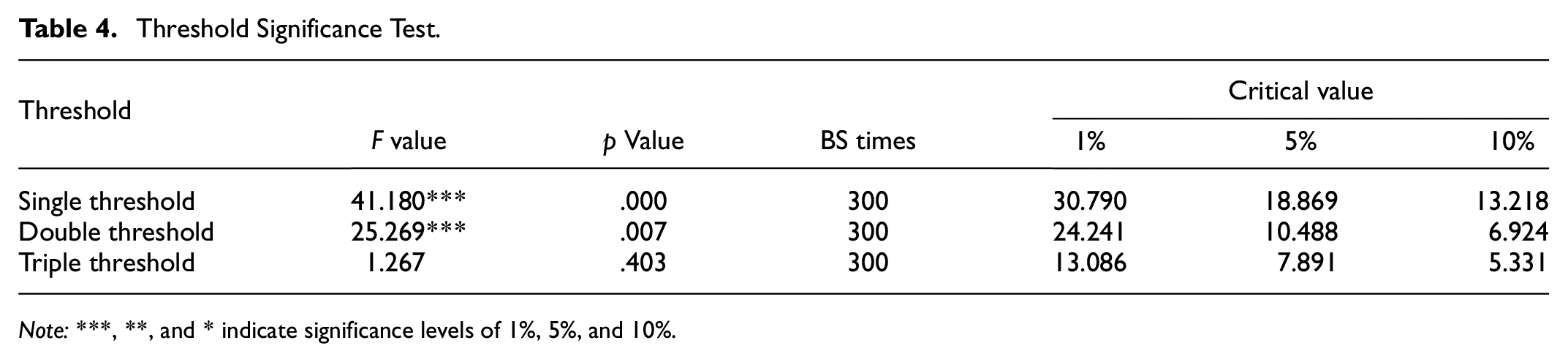
Note: ***, **, and * indicate significance levels of 1%, 5%, and 10%.
Second, for the results estimated from the double threshold model, the threshold estimate value is in the 95% confidence interval: 0.031 [0.027, 0.033], 0.225 [0.209, 0.234]. Therefore, according to the threshold value, green technology innovation is classified into three types: low green technology innovation level (LCI ≤ 0.031), medium green technology innovation level (0.031 < LCI ≤ 0.225), and high green technology innovation level (LCI > 0.225). In addition, Figures 2 and 3 reflect the estimated values and confidence intervals of the single and double thresholds corresponding to green technology innovation, respectively, from which it can also be obtained that there is a more obvious double threshold effect of green technology innovation between digital-intelligence and regional carbon emissions (Table 5).

Likelihood ratio function plot for the single threshold model.
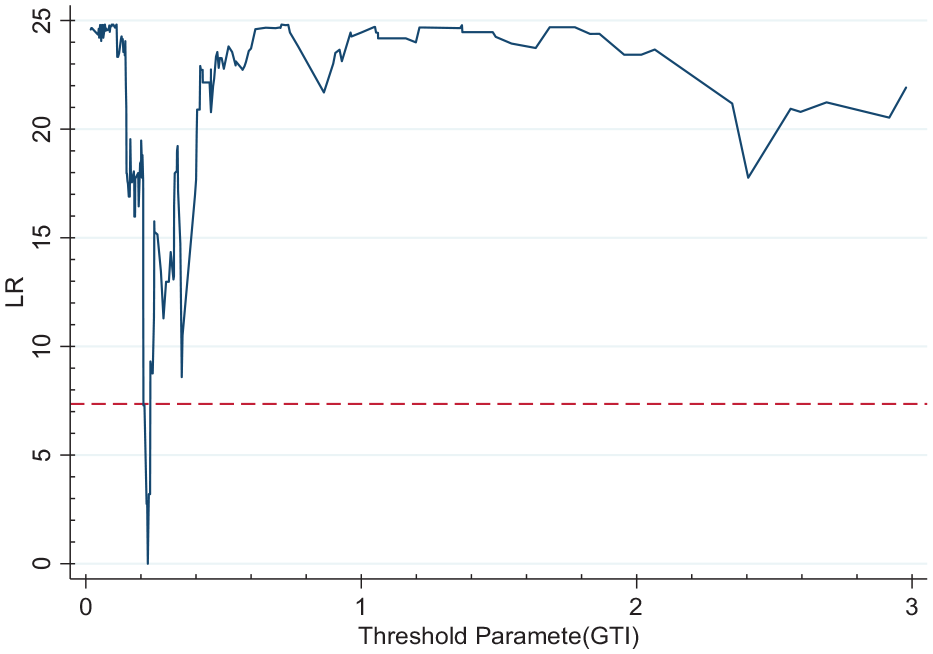
Likelihood ratio function plot for the double threshold model.
Results of Threshold Estimators and Confidence Intervals.
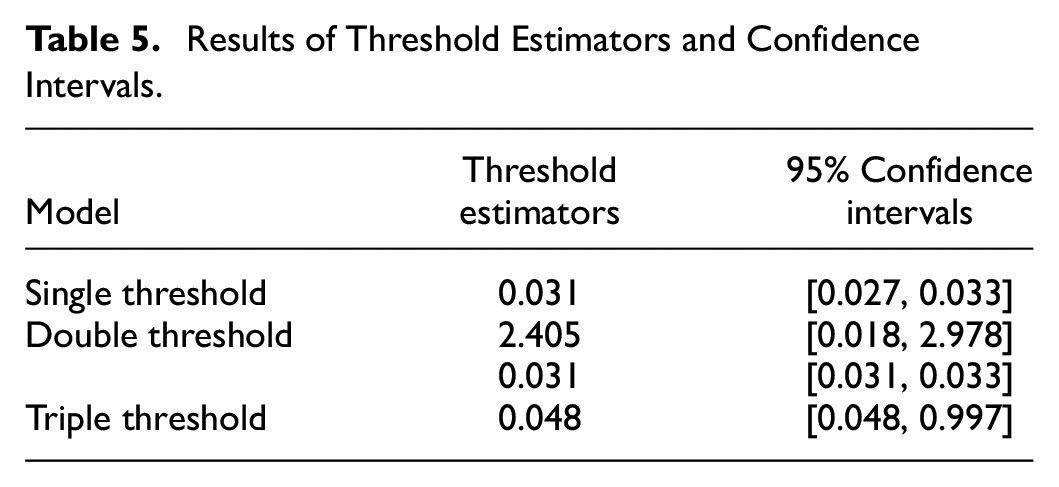
Meanwhile, we divide green technology innovation into different intervals according to the threshold value and explore the influence relationship and heterogeneity between digital-intelligence and regional carbon emissions at different levels of green technology innovation. Table 6 shows the estimation results for each parameter.
Results of Dynamic Threshold Regression.

Note: ***, **, and * indicate significance levels of 1%, 5%, and 10%.
Table 6 demonstrates that when green technology innovation is low (GTI ≤ 0.031), digital-intelligence has a certain positive impact on carbon emissions. When green technology innovation is at a moderate level (0.031 < GTI ≤ 0.225), the contribution of digital-intelligence to regional carbon emissions increases, showing a significant positive effect. As the level of green technology innovation further increases and exceeds the critical value (GTI > 0.225), the impact of digital-intelligence on carbon emissions changes from a driving effect at the beginning to a significant inhibiting effect. This also reflects a significant green technology innovation threshold effect on the impact relationship between digital-intelligence and regional carbon emissions. That is, a lower level of green technology innovation will increase the carbon emission effect of digital-intelligence to a certain extent, and as the level of green technology innovation increases and exceeds the critical value, it can give full play to the carbon emission reduction effect of digital-intelligence. This is also consistent with the research of scholar (Chen et al., 2023; Hou et al., 2023)
In addition, among other factors affecting carbon emissions, environmental regulation (REG) and population agglomeration (AGG) have a significant negative impact on carbon emissions, indicating that environmental regulation and population agglomeration can improve the level of digital and intelligent development in China, achieving the effect of reducing carbon emissions. The level of openness to the outside world (OPE) has a certain positive impact on carbon emissions, which also shows that the increase in the level of openness to the outside world will inhibit the carbon emission reduction effect of the region. The improvement of opening up will turn many developing countries into production bases, attract more investment in carbon intensive industries, increase resource and energy consumption, and have a positive impact on carbon emissions. This situation is currently more prominent in China (Wang et al., 2021). While urbanization (URB) also has some positive contribution to carbon emissions, this effect is not significant, and in the process of urbanization development, we should be alert to the negative effects of the rapid expansion of city size and the rapid rise of population based on regional carbon emissions.
Finally, based on the above calculation results and the division of threshold values (low green technology innovation level (LCI ≤ 0.031), medium green technology innovation level (0.031 < LCI ≤ 0.225), and high green technology innovation level (LCI > 0.225)), we present the distribution of green technology innovation at high, medium, and low levels in 30 provinces and regions of China each year in Table 7. On the whole, the level of green technology innovation in most regions of China is high and on a steady upward trend, mainly because the Chinese government is aware that the traditional crude economic development model, while promoting rapid economic growth in the short term, also brings negative effects such as excessive consumption of resources and damage to the environment. Therefore, after China put forward the goal of carbon peak and carbon neutrality, it advocated building a green low-carbon cycle economic system, and green technology innovation is not only an important support for China to achieve the goal of “double carbon” but also a key driving force for China’s sustainable economic development. At the same time, green technology innovation plays an important role in enterprise production and residents’ lives, which can promote cleaner production, improve energy conservation and emission reduction, reduce resource consumption from the production side and consumption side, and use new energy consumption methods to help transform the industrial structure to low-carbon green industries.
Regional Heterogeneity Distribution of the Green Technology Innovation Threshold in China.

Discussion
First, when green technology innovation is at a low or medium level, green technology infrastructure is not perfect, and in a competitive market situation, most enterprises may neglect the protection of the environment to gain benefits. Overconsumption of energy resources is not conducive to the low-carbon transformation and upgrading of the industrial structure, and it is difficult to effectively control the decarbonization cost of the region and provide more effective technical support for the research and development and large-scale application of carbon dioxide utilization, capture and storage technologies, which cannot reduce the regional carbon emission level in a short time (Habiba et al., 2022). At the same time, the lower level of green technology innovation makes it difficult to coordinate the development of green technology integration among enterprises, universities, and research institutes in the development of digital-intelligence, and it is difficult to attract more high-quality human capital. Coupled with the immaturity of technological innovation development and imperfect government supervision, it is difficult to achieve data sharing, data opening and data circulation among innovation subjects, resulting in deficiencies in digital infrastructure construction (Du et al., 2019), leaving a long way to go to reduce total regional carbon emissions.
However, as the level of green technology innovation continues to increase and exceeds the critical value, digital-intelligence can have a significant dampening effect on regional carbon emissions. This is also consistent with the research of scholar (Chen et al., 2023; Hou et al., 2023). The main reason is that the high level of green technology innovation will give rise to a large number of new industries that rely on digital technologies such as big data and blockchain. With the wide penetration and application of digital technologies, the demand for highly skilled and educated talent will continue to increase, thus optimizing the human capital structure, providing a good accumulation of talent for the development of regional digital-intelligence and boosting the level of development of regional digital-intelligence in China (J. Liu, Yu, et al., 2022). The enhancement of the green technology innovation level in neighboring cities also helps to bring into play the upstream and downstream industrial linkage effect between cities, the technology demonstration effect and the positive spatial spillover effect, which helps to enhance the digital-intelligence of cities by spreading related knowledge and technology spillover, further promoting the improvement of urban production structure and optimal resource allocation, and finally promoting the overall regional energy conservation and emission reduction (Chen et al., 2022).
Second, for other factors affecting carbon emissions, the mechanism of environmental regulation on carbon emissions is on the one hand due to government taxes on users and producers of fossil energy, which increase the production and environmental costs of firms and thus will reduce some of the energy demand and lower carbon emissions. On the other hand, the government exerts pressure on the environmental governance costs of enterprises, forcing enterprises to use green and clean technology and energy, reducing the demand for high-carbon energy, optimizing the energy consumption structure, and promoting the development of the industrial structure in the advanced direction, thus indirectly reducing carbon emissions. Population agglomeration can change the methods of energy use and transportation, reduce the marginal emission reduction cost through a certain scale effect, improve the efficiency and intensive use of energy resources, and reduce the level of carbon emissions in the region. The level of opening up to the outside world is to a certain extent not conducive to the reduction of regional carbon emissions, probably because some regions have disadvantages such as insufficient experience in technology management and a shortage of capital, resulting in their relatively low position in the international trade chain, and more goods with higher carbon emissions will be implied in the processing trade exports. The accelerated urbanization process has led to the concentration of the population from rural to urban areas, increasing population density in urbanized regions, increasing consumption levels, and changing lifestyles and consumption patterns, increasing energy consumption and affecting regional carbon emission levels.
Robustness Test
To increase the credibility of this study, we further perform a robustness test on the impact relationship between digital-intelligence and carbon emissions, which is significant at the 1% level for the lagged term of the dependent variable, indicating that the dynamic panel threshold model we construct is reasonable. As shown by Hansen’s test, Prob > chi2 = .544, there is no rejection of the original hypothesis that the instrumental variable is valid. The AR(1) and AR(2) tests also illustrate the reasonableness of the model (Table 8).
AR(1) and AR(2) Test.
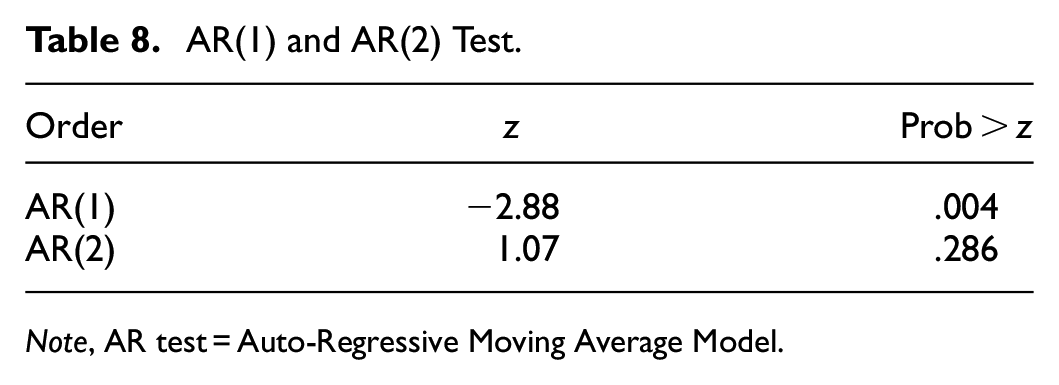
Note, AR test = Auto-Regressive Moving Average Model.
Moreover, with regard to the variable of digital-intelligence system (DIG), we use its digital aspects indicator (Digital infrastructure-Digital industry development-Industry digital development) to recalculate it separately, forming a digital variable (DIG1), and re-estimated the regression relationship using the first-order difference GMM. The results show (Table 9) that there is still a significant threshold effect of digitization on carbon emissions, and the coefficient directions remain consistent, indicating the robustness and rationality of the results in this paper.
Robustness Test.

Conclusions, Implications, and Future Research Directions
Conclusions
Based on China’s regional data from 2013 to 2020, we calculated the development level of digital-intelligence, and from the perspective of green technology innovation, we focused on the nonlinear relationship between digital-intelligence and carbon emissions through dynamic panel thresholds.
(1) At present, the development of digital-intelligence in China is showing a relatively stable upward trend, and there is heterogeneity among regions. The regions with a higher level of development of digital-intelligence are mainly concentrated in the eastern region of China, followed by the central region, while the western region is relatively slow to develop and still has great development potential.
(2) Our new insight is that there is a significant green technology innovation threshold effect on the impact relationship between digital-intelligence and carbon emissions. That is, a lower level of green technology innovation will increase the carbon emission effect of digital-intelligence to a certain extent, and as the level of green technology innovation increases and exceeds the critical value, it can give full play to the carbon emission reduction effect of digital-intelligence.
(3) In terms of the heterogeneous trend of thresholds, the level of green technology innovation in most regions of China is relatively high and is in a stable upward trend. The role of green technology innovation in the blending of digital-intelligence and regional carbon emissions cannot be ignored, and it is necessary to empower the development level of China’s digital-intelligence and achieve the goal of reducing carbon emissions by continuously improving the level of green technology innovation.
(4) For other factors affecting carbon emissions, environmental regulation (REG) and population agglomeration (AGG) have a significant negative effect on carbon emissions. In contrast, the level of openness to the outside world (OPEN) has a positive effect on carbon emissions, which also indicates that an increase in the level of openness to the outside world suppresses the carbon reduction effect of the region. Similarly, urbanization (URB) exerts some positive contribution to carbon emissions, but this effect is not significant.
Policy Implications
We focus on the role of digital-intelligence on regional carbon emissions and provided new experience for reducing carbon emissions by combining the heterogeneous threshold characteristics of green technology innovation. Based on the above findings, we recommend the policy paths listed below.
First, enhance the development of digital-intelligence in each region. On the one hand, each region should continuously accelerate the construction of digital-intelligence infrastructure, empower government management through digital-intelligence technology, promote the transformation and upgrading of government digital-intelligence, expand the integration, opening and sharing mechanism of government data, provide technical support to improve the efficiency of energy resource utilization and reduce the level of regional carbon emissions. On the other hand, the government should also increase its support for the transformation and upgrading of digital-intelligence, including innovation capacity and financial guarantees, to reduce the carbon emission level of the region by using digital-intelligence technology and to promote the sustainable development of our economy with higher quality and fairness. Market players should also continue to increase their investment in independent innovation and use green innovation technologies to improve the ecological environment and reduce the intensity of regional carbon emissions by virtue of the “flood” of digital-intelligence development.
Second, focus attention on the important role of digital-intelligence in the process of reducing carbon emissions. The construction of new infrastructure bearing digital-intelligence technologies, such as 5G base stations, cloud computing platforms, and big data centers, should be accelerated to provide the foundation for digital and intelligent development and promote the development of deep integration between digital-intelligence technologies and cities, industries and enterprises. Emphasis on the development of artificial intelligence, blockchain and other digital-intelligence technologies, promote the development of digital technology and intelligent products to the traditional industry penetration, strengthen the application of digital technology and intelligent products in a number of areas such as people’s production and life practices, make digitalization and intelligence an important future development direction, improve the level of digital-intelligence development, and reduce regional energy consumption. Relying on digital technology and intelligent products to guide the transformation and upgrading of the region into digital-intelligence, strengthening the communication and collaboration between regions, continuously reducing the level of regional carbon emissions will help China achieve the goal of “double carbon.” Relying on digital technology and intelligent products to guide the transformation and upgrading of the region into digital-intelligence, strengthening the communication and collaboration between regions, continuously reducing the level of regional carbon emissions would help China achieve the goal of “double carbon.”
Third, Focus attention on the threshold differences in the level of green technology innovation in different regions and develop reasonable carbon reduction measures. For regions with low levels of green technology innovation in developing countries, we should continuously strengthen technological breakthroughs in green and low-carbon core technologies, support the development of green technology innovation through digital technology and intelligent products, increase financial support for green technology R&D projects, increase support for carbon sequestration and capture technologies, and continuously improve the financial support system for promoting green technology innovation and development; At the same time, it is necessary to create a good policy environment, create a fair market competition environment at multiple levels and in all aspects, cultivate a team of green and low-carbon talents, cultivate green technology innovation platforms, strengthen the application of green technology innovation achievements in multiple fields, thereby improving the overall level of green technology innovation in the region and providing technical support for promoting regional energy conservation and emission reduction. For regions with relatively high levels of green technology innovation in developing countries, make good use of existing green and low-carbon technologies for green production, promote regional digital transformation and upgrading, and reduce regional carbon emissions. In addition, we should also focus on grasping the inhibitory effect of digital intelligence on carbon emissions, and implement differentiated digital intelligence development strategies based on regional differences. For example, in terms of policy formulation, China should appropriately tilt toward the central and western regions, gradually eliminate the “digital divide” between the central and eastern regions, achieve coordinated development of green technology innovation in the eastern, central, and western regions, take the opportunity of digital and intelligent development, optimize the regional human capital structure, increase investment in science and technology finance, and continuously promote the development of regional green technology innovation. For developed countries, they should take the lead in significantly reducing emissions, making good use of existing green and low-carbon technologies for green production, promoting regional digital-intelligent upgrading, consolidating and strengthening the construction of carbon trading markets, and limiting the development of high pollution and high emission industries. Meanwhile, regional governments should increase tax incentives, emission reduction assistance funds, and a series of incentive measures to accelerate industrial digital-intelligent transformation and reduce regional carbon emissions.
Fourth, in terms of other motivating factors for reducing carbon emissions, moderately strengthening the intensity of environmental regulations is conducive to both reducing carbon emissions and enhancing the application of green technologies, but at the same time, we should also be wary of unrealisticly and blindly increasing the intensity of environmental regulations to follow the trend so as not to trigger the green paradox effect. It is also necessary to choose reasonable environmental regulation tools and adopt differentiated environmental regulation tools according to the heterogeneity of economic bases and carbon emission levels between regions. At the same time, the formulation of population policies also needs to take into account the differences between regions, guide the population of regions with high carbon emission levels to appropriately concentrate in urbanization, improve the compactness of urban construction, and achieve the intensive use of public resources. In addition, we should establish a more perfect mechanism for energy conservation and emission reduction, continuously improve the level of China’s opening to the outside world, actively introduce advanced foreign technology and equipment and management experience, continuously improve energy utilization efficiency, and reduce the level of regional carbon emissions. Finally, it is necessary to bring into play the economies of scale brought about by urbanization, improve the efficiency of factor agglomeration, promote the transformation and upgrading of industrial structure and energy consumption structure, and reduce the negative impact of urbanization on carbon emissions.
Research Limitations and Prospects
The article still has some limitations that can be further studied in the future. First, due to the availability of the existing statistical data, the sample selected in this paper mainly focus on the regional macro level. With the continuous updating of the database, future research can consider expanding the data dimension, such as the role of market players and public (their acceptance and contribution to policy implementation). Second, the impact of regional heterogeneity factors, in addition to green technology innovation, may also include environmental regulations, industrial integration, etc, which can be further verified.
Footnotes
Acknowledgements
The author would like to thank the editor and the anonymous referees for their helpful comments and suggestions. We also gratefully acknowledge the help of Dr. Wanting Bai from Beijing Forestry University and Prof. Ye Li from Henan Agricultural University.
Declaration of Conflicting Interests
The author(s) declared no potential conflicts of interest with respect to the research, authorship, and/or publication of this article.
Funding
The author(s) disclosed receipt of the following financial support for the research, authorship, and/or publication of this article: This work was financially supported by the Graduate Education Reform Project of Henan Province (Grant number 2023SJGLX205Y), Henan Province Higher Education Philosophy and Social Science Innovation Talent Support Program (2025-CXRC-08) and Major Project of Philosophy and Social Sciences Basic Research in Henan Province(2025-JCZD-03) and Philosophy and Social Sciences Research Innovation Fund of Henan Agricultural University (SKJJ2024A04).
Ethical Approval
This article does not address the ethics of animal and human research.
If necessary, data will be provided.

Data Availability Statement
Data sharing not applicable to this article as no datasets were generated or analyzed during the current study.