




Abstract
Uzbekistan has not adopted robotics education as the school curriculum yet. However, several robotics learning centers have introduced robotics education in an informal setting. This research paper aims to highlight the essence of robotics education in Uzbekistan investigating the perception of parents and children to their full potential and identifying impediments to the process of implementing robotics in Uzbekistan. This research study involves primary and secondary research methods. A systematic literature review was conducted to examine the reflection of robotics education among primary and secondary school children. Official statistical data was gathered to prove the scope of demographics. Primary data was collected through the survey among parents whose children attended robotics classes. Ultimately, the authors have used empirical evidence to provide recommendations and solutions on how to implement robotics education effectively in Uzbekistan. Much emphasis has not been put on robotics education in Uzbekistan, despite reforms in the field of STEM education. Moreover, the condition (including teachers, lesson materials, classrooms, computers, and robotics kits) to implement robotics classes as more developed countries are doing has not been created properly, which hampers the introduction of robotics at schools. In addition, the majority of parents are not fully aware of the authentic value of robotics education in children’s lives. Hence, Uzbek schools are lagging in the field of robotics.
Plain Language Summary
The importance of robotic education to higher education systems in emerging economies. This article looks into ways to implement new methodologies of teaching and learning in the school education system. It will increase the productivity of the sector holistically.
Introduction
Popular interest is arising among preschool, primary school, and secondary school students with the view to gain new computer literacies, including technology fluency, technological terminology, programming, cognitive skills, and non-technical skills such as problem-solving, critical thinking, collaboration, creativity, and team building. In this case, educational robotics is a core curriculum in terms of developing cognitive skills and digital literacy at schools, as in robotics foundation STEM education lies (Science, Technology, Engineering, and Mathematics) (Gomoll et al., 2016).
The term ER (educational robotics) possesses a holistic approach, playing the role of mediator in connection with different fields. ER aims at boosting interest in science and simultaneously puts forward several skills constituting autonomy, taking initiative, and creativity. Active inclusion of ER in schools has gained popularity despite being implemented with force (Maloney et al., 2010).
Robotics Education was aimed at equipping students with knowledge through robotics constructions. It dates back to the 1960s, when Logo programming language commenced being implemented widely through recruiting programmable devices based on project-based learning (Papert, 1980). Based on this research, it is obvious that children who were actively involved in robotics classes gained more chances to develop problem-solving capabilities, and were engaged in geometry, mathematics, and metacognition (Clements & Meredith, 1993; Yelland, 1994).
In addition, some studies indicate that students were able to boost their computational and algorithmic thinking, programming skills, and modeling (Wing, 2006). Various researchers in the past (Adams et al., 2010; Alimisis, 2013; Cavas et al., 2012; Danahy et al., 2014; Hendrik et al., 2020; Huei, 2014; Jagust et al., 2017; Lubart et al., 2010) have concentrated on highlighting benefits derived from education robotics. However, there are some areas of research that need to be meticulously analyzed, such as a shortage of data regarding precise outcomes of robotics classes, and what students have achieved (Bredenfeld et al., 2010). As a systematic approach to robotics projects and their implementation have not been conducted based on specific evaluation, the question is left open. Ortiz, Bustos, and Rios state in their research that the next worthwhile aspect that requires in-depth research is a lack of systematic and standardized evaluation of student achievements. These issues can be tackled through long-term efforts and detailed research.
Developing students’ technical and non-technical abilities, robotics education will be a great asset in preparing the young generation for the most required 21-century skills. Robotics classes integrate the active involvement of STEM education that prepares students via real-life applications. Lessons are project-based learning in which STEM, engineering, technical knowledge, and coding are well-integrated.
Educational robotics helps students gain experience through the combination of hands-on and mind-on approaches. The more interesting part of it is that a student involved in a fun ambiance creates robots using technology that can fulfill the task the student writes through a coding program. This engaging environment is quite essential to motivating young people to attain their goals, owing to their great interest and willingness. Furthermore, robotics classes have a tremendous impact on students by fostering problem-solving, critical thinking, teamwork, and logical thinking abilities (Benitti, 2012).
In the last two decades, the LEGO group, in collaboration with the Massachusetts Institute of Technology (MIT), developed LEGO MINDSTORMS constructors, popularizing it in the entire world, ranging from toy robots to more educational robotics. They are organizing international competitions dedicated to LEGO, stimulating diverse age categories to be more innovative and converting them to active users rather than passive ones. Due to the great accessibility of LEGO robotics, a large number of educational centers are engaging more students. LEGO Mindstorms have educational kits which are user-friendly to assemble and contain blocks and programmable controllers. EV3 is more appropriate for educational purposes and it includes various sets ranging from a core set to the space challenge set (Education Lego, 2021). It allows students to design robots, assemble them, and create a program, followed by the testing process, making them ready to participate in a robotics competition. Thus, a student’s elementary programming skills are quite essential to assembling and making the robot function (Chetty, 2015).
Another educational kit is named VEX, a leading robotics kits provider in the entire world, provided by Innovation First International. VEX has an assembly-friendly platform to boost creativity in problem-solving. Students are capable of assembling modules of a wide range of robots in various configurations. VEX robotics includes several types such as VEX 1,2,3 ideal for ages 4+, VEX Go kits are for age frame of 8+, VEX IQ is for those, whose age bracket is over 11+, and VEX V5 kits are available for the 14+ age category (Vex Robotics, 2021). Annually VEX Robotics Competitions (VRC) are held encouraging students to be ready for new challenges such as building, programming, and solving tasks to fulfill a specific task.
This study aims to focus on the empirical evidence of the implementation of robotics classes in Uzbekistan, and the challenges which are being faced. In addition, the paper highlights facts regarding the significant impact of robotics education on the young generation by bringing up-to-date educational materials and robotics construction kits. Along with these points, research questions arise:
RQ1. What is the current situation of robotics education in Uzbekistan?
RQ2. How effectively can robotics education be implemented in the Uzbek education sector?
Literature Review
Connections Between STEM and Robotics Education
Robotics creates a motivational and rich learning ambiance for STEM education. Üçgül and Altiok have highlighted that robotics provide opportunities to gain skills such as creativity, communication, and critical thinking collaborating in STEM education. Educational robotics, which includes designing robots, constructing, and writing code, followed by testing the robot utilizing robotic platforms, is essential as well. Leonard et al. (2016) state that robotics helps to improve the self-efficacy of children, STEM, and computational thinking abilities.
According to academic literature (Barak & Zadok, 2009; Barker et al., 2008, 2014; Zhong & Xia, 2020), integrating STEM with robotics students enhances mathematical skills, a robust understanding of science, and computer programming. In addition, engineering and robotics education experienced significant growth, which has been observed in the improvement of the creativity of the youth, the technical and innovative approach, entrepreneurship of students (Ospennikova et al., 2015; Pokholkov, 2012; Tsoy et al., 2017). Robotics classes stimulate students to create robots to take part in contests and competitions and a wide range of events (Filippov, 2013; Kashirin & Fedorova, 2013; Vyazovov et al., 2014).
Moreover, significant literature (Muminov, 2019; Hakimov et al., 2020, etc.) stated the essence of STEAM (which stands for science, technology, engineering, art, and mathematics) education and reforms in this field in Uzbekistan. The learning experience of robotics education in more developed nations, analyzing and using convergence education in the field of robotics in Uzbekistan, would give the expected results. One more noticeable achievement that has been made in the field of STEM education is the implementation of science, technology, engineering, arts, and mathematics education at Presidential Schools all over Uzbekistan, where students can boost their knowledge in these spheres. To facilitate the process of acquiring STEM knowledge, students should be involved actively and find solutions to emerging questions via science (Kennedy & Odell, 2014). Cognitive and affective learning can be considered beneficial, which has been proven based on student engagement in STEAM (Kang, 2019). Thus, the initial steps to popularize and apply robotics in primary, middle, and higher education schools have been taken despite being minor.
The Significance of Robotics in Socio-Economic Progress
Most countries use robotics to enhance economic conditions and make efforts to adapt their economic systems to use technology in fields such as service, education, agriculture, and industry (Kareem & Hassan, 2020). Robots are implied as a major phenomenon in the service sector, agriculture, manufacturing process, farming, hospitality, and even in the education sphere (Ford, 2015; Hicks, 2018; Jaimovich & Siu, 2012; Mani, 2017; Moses, 2017; Schaub, 2016; Semuels, 2011; Shubber, 2013; Singh, 2015; Tabuchi, 2010). Mfanafuthi et al. (2019) state that artificial intelligence and robotics will replace human labor in the future, more precisely, in such areas as the production, office tasks, and administration sectors. Webster and Ivanov (2019) advocate the statement that alterations that are taking place in the sphere of technology change the economy, as a consequence of which humanity shall be competitive making adaptations to the new economy, enhancing their technology-related skills, and changing their perceptions towards the job market dramatically. Increased robot use leads to an increase in the productivity of labor and total employment in developed countries, whereas it is negligible in developing countries (Fu et al., 2021).
Technology-related knowledge will be crucial to compete in the labor market, which will be assessed based on an employee’s technological competencies. It is predicted that training will equip the new generation with scientific and technological capabilities, thus allowing them to innovate new technologies. Recognizing the authentic value of STEM education, the United States, Korea, and the European Community have commenced implementing it in their education systems (Hong, 2016; Yakman & Lee, 2012). Hence, preparing the right candidates with technical knowledge has to be the main focus of robotics education. This trend stimulates the young generation to be engaged in the IT and robotics spheres, understanding the true benefits it can bring in the future.
Bhargava et al. (2021) report that artificial intelligence and automation will not replace “human touch” and “soft skills.” In addition, employees will need to recognize artificial intelligence and robotics as a great chance and perceive technological innovations concerning their well-being in the future workplace. In rapidly changing economic conditions, companies must make preparations for pre- and post-industrial alterations. Employers and industry demand for fresh graduates of robotics education are going up negligibly, which requires further research. If there was a great demand for skilled robotics specialists in the job market, more and more students would opt for robotics education.
Government’s Role in Implementing Robotics in the Education System
Various studies (Egamberdievich et al., 2019; Kulmatov, 2015; Tolipov et al., 2014) have highlighted the necessity of educational reforms and the application of ICT (information and communication technologies). In Uzbekistan students have limited options in terms of choosing educational centers to learn robotics, which fall into two categories: private learning centers offering robotics classes for a particular fee and republican children’s centers, where the classes are conducted free of charge, so-called “Barkamol avlod.” Moreover, there was a letter decree from the President of the Republic of Uzbekistan “On measures to introduce new management principles into the public education system” issued on September 5, 2018 year ? PP-3931, which stated that starting from 2020/21 at republican children’s centers, STEAM education and robotics classes would be implemented .
The Ministry of Education, in partnership with UNESCO and the Global Partnership in Education (GPE), initiated reforms in the field of education and published the Education Sector Plan in 2019 (Lee, 2021). The Education Sector Plan that will have been accomplished by 2030 has identified aims and strategies in the field of education (Uzbekistan Government, 2019). This collaboration advocated the education system of Uzbekistan, investigated problems, and developed methods to tackle them (World Bank, 2018). However, all of these attempts were made to improve the overall school curriculum and education system.
The current Uzbek education system still approves and utilizes the curriculum based on traditional ways of teaching, which have not been changed for decades. Robotics education in Uzbekistan falls behind other more developed countries, more precisely, historical aspects of Uzbekistan regarding science before the collapse of the USSR and in 1991 onwards need to be considered. Mainly, Russia is taking a leading role in robotics education, catching up with developing nations (Pokholkov, 2012). Even major Lego shops which are distributing robotics kits and educational materials are being created in Russia, so that other Central Asian countries can implement them in their own countries without any challenges. The second leading role is held by Kazakhstan, in particular, Presidential Schools have managed to involve foreign specialists to implement robotics education (Nis.edu, 2021). However, several noticeable actions have been taken in Uzbekistan to build up its model of robotics, which is equivalent to Russia’s educational robotics.
The root of the problem is the lack of specialists, who can create a national robotics curriculum, that can be integrated into the school syllabus. The government would have achieved it by deploying current resources to create robotics content and step-by-step disseminate implications at primary and secondary schools.
“Barkamol avlod”—a governmental educational establishment that offers extracurricular activities for nursery, primary, and secondary school students.
Lex. uz—an electronic set of administrative regulations for the provision of public services.
The focus has to be given to training teachers, organizing teacher training sessions, and exchanging experience, with foreign robotics specialists. The most vulnerable point to highlight is that even the trial version of robotics has not been tested in any government school. Considering the results achieved by these reforms and decrees, it is evident that a lack of proper, well-designed robotics curriculum and trained specialists to conduct classes makes the situation reversed. Without creating a basic layout for robotics education, direct implementation of robotics classes relying on only available robotics kits, and children’s perception and interest in robotics, their multilateral development has been put under threat.
Methodology
As previous researchers have highlighted (Borrego et al., 2013; Camfield et al., 2009; Michelle, 2011), secondary and primary research methods have been applied in this study, adding that they have complementary targets and that these two paradigms are used to provide underlying outcomes and provide coherent, more reliable conclusions.
For the qualitative survey, the sample size of the questionnaire was 50 parents, whose children were attending robotics classes within the age range of 7 and 14 at IT KIDS International Robotics Center. These participants were chosen based on purposive sampling as they are most likely to yield appropriate and useful information. These participants are familiar with robotics education and were aware of their children’s progress.
While conducting the survey, precautions were taken meticulously to ensure the security of personal information. Hence, there was no requirement to give detailed information regarding gender, age category, ethnicity, socioeconomic background, or race of parents to maintain anonymity because the survey covered participants who were living within the territory of Uzbekistan and had no direct impact on the outcomes of the survey. To facilitate the process of gathering data for the study from participants, explanations regarding the essence of the research in the field of robotics education were conveyed to participants so that they could provide a holistic approach to this study.
Questions were presented in Google Forms and were sent directly to parents. The sample selection is parents, as they are the decision makers for their kids to study robotics. In addition, on the social media of the IT KIDS Center, Google Forms were attached encouraging parents to volunteer for the following study. The Likert scale was used to evaluate the presented questions, which were averaged to get a mean score. The questions covered the most essential areas of robotics education, such as the basic understanding of robotics, children’s interest, and progress while attending robotics classes, the importance of robotics education, and the major challenges participants faced. Respondents were able to opt for the pre-set options based on a 5–6-point Likert response scale without providing extra narrative answers. The qualitative Likert scale method (Ponsiglione et al., 2022) was adopted to estimate the degree of consensus on specific topics. The variables were based on each parent’s approach, involvement period, gained information about robotics education, and study plans of their children, which varied greatly from each other’s. In addition to investigating their interests and perceptions of robotics, the questionnaire was intended to find the correlation between students’ attendance at robotics and their future choice of major in the field of robotics and engineering. The data analysis gained through the questionnaire was based on a descriptive study in which the percentage of responses was calculated.
Results
The survey helped to identify the perspectives and notions of respondents on robotics education in Uzbekistan, evaluating its potential and robotics-associated stumbling blocks. The survey was performed to mark the distinctive features of robotics education based on respondents’ own experience, as robotics education is in its early stages in the meantime. The longer the respondents’ children were attending robotics classes, the more precise information was provided by parents, as they were well-informed about robotics education. The constant and long duration of attendance helped parents consolidate their viewpoints on robotics. The following are the outcomes derived from the survey:
How would you rate Your Awareness of the Advantages of Robotics Education?
The initial question was whether parents were aware of the positive aspects of robotics education and understood the true notion of robotics. As shown in Figure 1; 55.1% of respondents confirmed that they knew the advantages of robotics very well, while 28.6 % held the view that their awareness of robotics merits was good, and 16.3% of votes went for the answer of being averagely informed (Figure 2).

Awareness of robotics education.

Attendance to robotics classes.
A lack of awareness was the major reason why parents chose an appropriate answer. After meticulous explanations in terms of the values of robotics classes, the level of curiosity about robotics will increase, and parents have a greater tendency to send their children to be engaged in robotics. Smyrnova et al. (2016) advocate the concept of conducting workshops, utilizing robotics as the main factor of interdisciplinary education so that more youth shall raise their interest and awareness. Ospennikova et al. (2015) report that it is because robotics is a new direction in terms of theory and methodology, whose peculiarities have not been fully integrated into the scale of the subject at school.
How Frequently Does Your Child Participate in Robotics Classes?
Most of the parents felt that their children always participated in the robotics classes. Some students attended classes sometimes as well, which constituted 22.9% of students. However, only a mere 6.3% of respondents opted for the answer of never attending robotics classes.
Birk et al. (2020) argue that owing to Covid-19 unexpected changes in the robotics lessons’ structure occurred. Hence, students opted for being involved in robotics classes online rather than offline. A further reason for concern is the unsatisfactory previous experience of parents and children. Several parents who have already been familiarized due to other robotics centers which offer LEGO Mindstorms classes are quite reluctant to send their children again to robotics classes. It is because previous classes and an unhealthy competitive market have devastated their notions of robotics and treated them as toys and perceived them as an ordinary past-time.
What Part of Robotics is Your Child More Interested In?
Responses to this question varied greatly. The aim of giving this question was to encourage parents to be more attentive to their children’s interests and find out whether they knew what aspect of robotics was more appealing to their offspring. A roughly equal proportion of parents believed that programming (36%) and assembling a robot (40%) were the most interesting points for their children, which surpassed other aspects of robotics education. Another part of the respondents (17%) thought that their children were keener on testing the robot and identifying the problems. In any case, each child’s desires and interests differed greatly from the others as seen in Figure 3.

Area of interest in robotics.
Give Your Opinion on the Following Statement. “Robotics Classes have to be Included in the school Curriculum”
There existed five answers to this question to know what parents thought of including robotics classes in the school syllabus. That was the driving force for all respondents to come to the robotics centers which did not exist at schools.
Interestingly, the strongly agreed and agreed parents’ proportion was the same, which comprised 38.8%. In contrast, just over a fifth of respondents neither agreed nor disagreed and preferred to be neutral. In the answers, there were no negative points of view such as disagreement and strong disagreement answers (see Figure 4).

Opinion on including robotics in the school curriculum.
Tzagkaraki et al. (2021) argue that challenges happen due to the dearth of knowledge and experience of teachers in the field of robotics to implement robotics at primary and secondary schools. There is a lack of robotics specialists, despite having some, who only know the technical aspects of robotics without a pedagogical approach to integrating robotics into the school curriculum effectively. However, any information technology teacher with core knowledge related to computers and technology can be trained online without facing any challenges, as robotics education facilitates the process of gaining knowledge for all ages, no matter what background a person possesses .
A further barrier is the availability of teaching materials. In Uzbekistan, all robotics centers use ready-made LEGO teaching materials available on the Internet, most of which are in the Russian language. Due to easy accessibility, books, and teaching materials are distributed among students and play the role of a robotics curriculum. IT KIDS has also utilized some of these teaching materials initially. However, after implementing VEX robotics in Uzbekistan, the major challenge was the lack of educational books for children. The strategy the center applied successfully was creating its materials during the COVID-19 lockdown. VEX educational tools are created in such a way that each center and school can create its materials based on knowledge, necessities, and skills.
The availability of robotics constructors/kits is a further reason why robotics classes are not conducted at schools. Possessing only computers and overhead projectors is not sufficient to conduct robotics classes. Hence, robotics kits are a vital part of the class to design, assemble, and test robots without which the expected target cannot be fulfilled. Considering this fact, in the Uzbek market, robotics constructors like LEGO Mindstorms are not available for sale, they can be obtained only through Russia which takes control over the Central Asian robotics market (Mir-kubikov, 2021). When it comes to VEX kits, the situation is even unattainable in Uzbekistan.
Logistics and infrastructure: Along with the challenges connected with acquiring robotic kits, logistics issues could emerge that require much time for customs, and taxes for import and export goods. Even the customs office demands several documents and registration of the goods that are delivered by foreign countries, and legally binds the company.
How Important is it to you that Your Child has Participated in Robotics Competitions?
Figure 5 shows that just over half of respondents considered participation in robotics competitions very important. While just under a quarter of parents claim that it was somewhat important as opposed to the ones who believed it to be important (Figure 6).

Participating in robotics competitions.

Level of Vex Robotic Kits.
Kitano et al. (2000) highlighted the importance of robotics championships, which aim at promoting engineering education and popularizing robotics. They are held to meet various needs in the field of robotics, expand social networks among students, and create infrastructure to assist those who are involved in robotics.
On a Scale of 1 to 5, How Distinctive are the Features of VEX Robotics Kits, Compared to Other Similar Kits in Uzbekistan?
Takacs et al. (2016) found in their research that numerous educational robotics kits are available in different categories, depending on their usability interface, aptitudes, modularity, and educational materials, teachers select the appropriate educational tools.
Very similar responses were given to this question by parents. Twenty percent of respondents claimed that VEX robotics kits were very distinctive. Whereas 26.7% of parents believed it to be very distinctive, a slightly higher proportion of respondents took into consideration VEX kits as it were very distinctive. However, some respondents did not see any distinction among robotics kits, and this indicator comprised 6.7%.
Please Indicate How Useful Robotics Education Would be in Helping Your Child Build his/her Future Academic Career
Figure 7 illustrates the responses from parents to the question of whether robotics education would be helpful in their children’s future academic careers (Figures 8–10).

Use of robotics education in the future career.
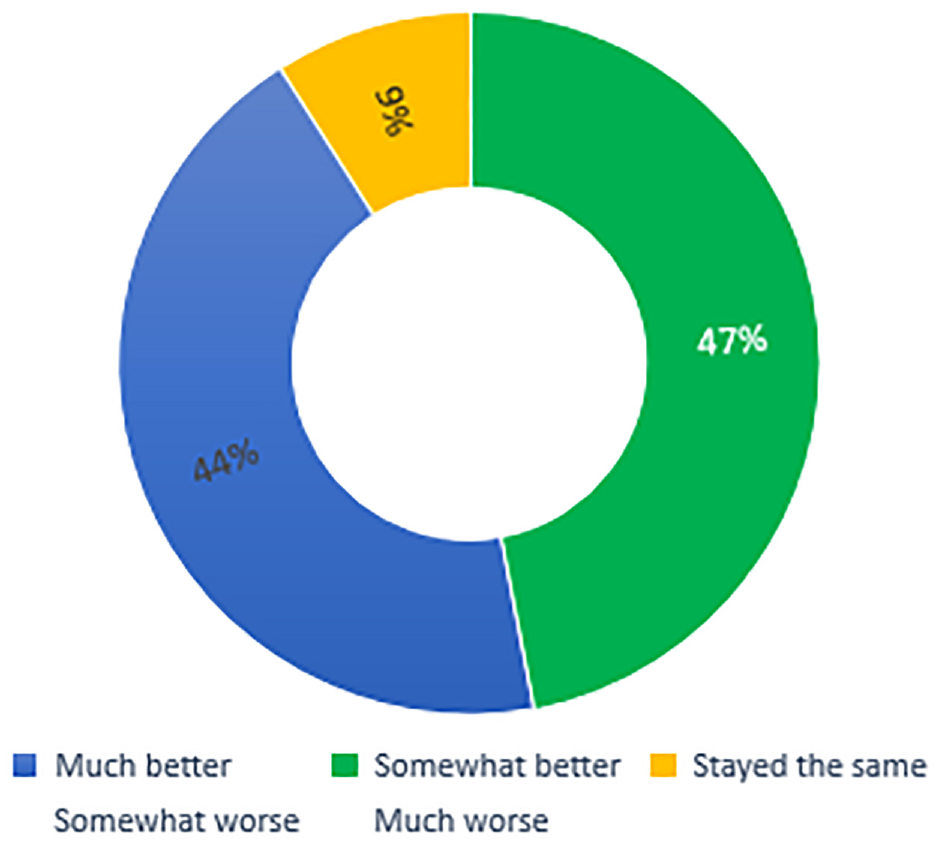
Students progress in robotics classes.

Importance of robotics education.

Major issues in robotics education.
As can be seen, parents valued that robotics education was very useful in the future academic career of a child, which comprised most of the respondents. In second place came parents, who felt that robotics education was extremely useful, followed by those who emphasized robotics education as moderately useful. Negligibly 2% of respondents were concerned about the usefulness of robotics education in the academic studies of a child and found it slightly useful.
How Would you Rate a Child’s Progress in Robotics Classes?
There were five options to determine the awareness of respondents about their children’s progress in robotics classes. The most selected answer was “somewhat better.” Chart 8 shows responses to this question.
Those who felt the progress of their children much better occupied the second highest place on the table. In contrast, very few parents thought their children’s progress in robotics classes stayed the same without any changes. Negative opinions, including somewhat better and much worse, were not provided by respondents.
Please, Choose 1 Point Out of 5 Points for Each Question. How Important is Robotics Education for Your Child?
Responses to the question of identifying the importance of robotics education varied greatly. The majority of parents evaluated robotics education that improved the critical thinking and problem-solving abilities of a child as extremely important. The next more common responses were for attaining academic success and usefulness for the future career of a child, which was somewhat important for parents. Respondents who were not sure and considered the essence of robotics education somewhat unimportant emerged as well, which made up between 1 and 7 proportions. Importantly, avoiding computer games and addiction were fewer concerning aspects for parents so that was not thought of as one of the important aspects of robotics education.
Please, Select the Option, Which Most Accurately Reflects Your Opinion About the Main Issue of Robotics Education
Respondents said that the amount of effort was required from a child to learn robotics was a major disadvantage. The second widespread answer was the lack of budget that prevented people from attending robotics classes. Answers “lack of time” and “lack of interest of a child” gained similar proportions, which were not considered as big disadvantages. About whether integration with other subjects such as science, mathematics, and physics were drawbacks for certain respondents, 18% of respondents selected the “Yes” answer, whereas a slightly higher proportion of respondents (21%) felt the opposite, choosing the answer “No”.
Castro et al. (2018) state that the robotics kits cost is a major drawback. High-cost classes that are conducted at learning centers are unaffordable for most students.
Discussions
Necessity to Organize Robot Teacher Training Courses
Many applied pedagogical approaches are based on a traditional way of teaching through interaction between a teacher and a student. The most crucial point to take into consideration is project-based learning classes, in which collaboration overshadows cooperation between teachers and students and should be prioritized, removing conventional methods of teaching. Effective implementation of robotics education lays a solid foundation to alter current trends to a more advanced level, which helps to clarify the potential and abilities of each student to work and make experiments with the help of supervisors and teachers (Tochácek et al., 2016). Thus, teacher training courses with a focus on pedagogical abilities (Kim et al., 2012) shall be conducted regularly to equip robotics teachers with up-to-date robotics knowledge. In addition, Hynes and Dos Santos (2007) recommended that robotics teachers need to learn how to control and manage the classroom effectively to boost the productivity of students, which is one of the major challenges during the class. Hence, not only improving the technical and pedagogical capabilities of robotics teachers but also class management with innovative methodologies is required to be gained. Finally, a further pivotal aspect of a robotics teacher training program is to obtain support and guidance from mentors, and teacher trainers to delve into teaching robotics fully. Negrini (2019) highlighted that instructors or mentors attending classes to provide feedback and observe the classes will be able to get the overview picture of activities organized by new teachers and assess their overall performance. Hamner et al. (2016) also added that trainers should evaluate the lesson plans and give holistic feedback for further improvement purposes.
Essence of Teaching Materials and Robotics Constructors as Main Tools
In addition, effective implementation of robotics education is impossible without teaching materials and robotics constructors which are core components of robotics. A Robotics curriculum with an emphasis on STEM (science, technology, engineering, mathematics) education with several components such as critical thinking, design thinking, problem-solving, and computational thinking is vital (Kopcha et al., 2017). As regards robotics constructors, students can create various programs which need the right execution with the help of specially designed robot constructors such as LEGO, VEX, and many other types of educational robotics constructors. It stimulates students to learn academic disciplines more entertainingly and boosts their level of involvement (Kadeeva et al., 2020). Another issue is giving a constructor to a child to “play” which might cause disintegration and even can lead to losing interest. Considering this fact, student engagement should be based on problem-solving tasks which are great assets to develop computational thinking, design thinking, and critical thinking abilities. Constructors are aimed at enabling learners to be constructors rather than knowledge consumers. As the most critical issues: robotics constructors’ availability and cost cause impediments to popularizing and implementation at schools effectively (Khanlari, 2016). Hence, finding a better alternative and making robotics constructors available for the mass market will eliminate the obstacles in the field of robotics.
Boosting the Effectiveness of School Education With the Help of Robotics
The wide application of robotics being included in the school curriculum has the potential to remove traditional methods of learning mathematics and science. Anwar et al suggested that the gained knowledge in the field of robotics is a great asset having an immense influence on a child’s academic performance at school. For that reason robotics education encompasses the following aspects:
Technical skills of children: Designing robots and programming, computational thinking, technical parts of robots, assembling robotics, and mechatronics.
Non-technical abilities: Logical thinking, critical thinking, problem-solving, teamwork, and collaboration, boosting creativity.
Personal development through the learning process: Patience, responsibility, overcoming stress, peer evaluation, increasing curiosity and being open to changes, self-confidence, being determined, time management, and self-reliance.
An innovative approach to teaching robotics should be prioritized as it can enhance the capabilities of children (Scaradozzi et al., 2015). Hence, children gaining technical, and non-technical skills not only in the field of robotics and STEM education but also in other subjects of the school curriculum can confidently perform better which leads to their multilateral personal growth. The congregation of these skills and abilities assists the young generation to transfer values in social and organizational scope.
Robotics as a Great Contributor to Increasing the Efficiency of Human Labor
The enhancement of technology in automation and digitalization is transforming human resources and intensifying their necessity to gain more capacities to be ready for the job market. Therefore, educational establishments have aimed at generating more capable human resources boosting their efficiency in working with novel equipment fostering computational thinking, problem-solving, and design thinking skills. Focusing on building more human capital extensively, institutions should involve diverse aspects such as technology, human resources, and robotics to enhance e capabilities of the workforce (Medina & Caicedo, 2021). Therefore, robotics education is implemented to give guidance assisting learners to enter the automated workforce in the future (Sergeyev, 2017).
Through Social-Economic Progress Toward Digitalized Future
Furthermore, robotics’ contribution to social-economic progress is immense as a platform to involve the youth with job prospects. We are on the verge of facing the Fourth Industrial Revolution which has already been noticed in the way of learning, working, and communicating. Hence, humans need to get prepared for the new economy gaining crucial skills to be more competitive (Webster & Ivanov, 2020). Educational establishments with a focus on robotics should generate specialists equipping them with the right capabilities in the field of artificial intelligence for a novel and transformed job market. Robotics centers need to expand their vision and take into account today’s trends to envisage the future workforce and ensure that skills in the field of artificial intelligence including robotics will aid humans to step into the job market confidently. Therefore, by maintaining the balance between teaching educational robotics based on educational curriculum and robotics with the specific needs of the future workforce, robotics education would attain goals.
Conclusion
Robotics developing technical and non-technical knowledge of students has stepped up into the education system as an extracurricular subject, which has laid a solid foundation to enrich it further. Recognizing all the benefits of robotics education, it is worthy to implement activities in the Uzbek education system.
Through the presented solutions in this research paper, applying gained knowledge based on the experience of more developed countries where robotics education has been prioritized at the same level as STEM, creating suitable conditions to master it requires specific well-planned action.
Educational kits, proven teaching materials (learning and practice materials), and trained robot teachers are crucial to implementing robotics education effectively.
A further aspect that has to be recognized is the necessity of students taking into consideration their interests, needs, and achievements which would be gained due to robotics classes. Here, a vital point is focusing on the targeted skills of children. In this process, local and international robotics competitions are great assets that allow students to sharpen their skills in the field of robotics.
Furthermore, workshops, seminars for parents, master classes, and mini-championships regarding robotics help to popularize robotics education. Consequently, all attendees and the younger generation would be aware of the essence of fostering engineering and robotics skills. As public schools are deprived of robotics education, only private schools are the main providers of robotics education in the meantime in Uzbekistan; however, productive, result-based actions have to be taken further to attain the expected goals.
Footnotes
Acknowledgements
Not applicable.
Declaration of Conflicting Interests
The author(s) declared no potential conflicts of interest with respect to the research, authorship, and/or publication of this article.
Funding
The author(s) received no financial support for the research, authorship, and/or publication of this article.

Data Availability Statement
The datasets used and/or analyzed during the current study are available from the corresponding author upon reasonable request.