



Abstract
Student performance, disciplinary innovation and teaching methodology occupy the main concerns of educational research. Therefore, there is a greater interest in gamification strategies, where digital tools facilitate the development of competitive activities and strengthening of learning. One example of this idea is the use of video games created for non-educational purposes, where disciplinary strategies and/or social skills can be developed. In this paper, the game Among Us is used to develop an educational experience at higher education. Its use helps to develop a methodology for the identification and analysis of fallacies, according to their recurrency and effectiveness. The result of this learning experience led to a greater comprehension about the use of fallacies, favorable perceptions about the use of games for educational experience, and a deeper reflection about social intelligence in the students.
Plain language summary
This work develops a methodological proposal for the development of the argument through the analysis of the fallacies used in the game Among Us. The chosen environment represents high interest for students, as well as better learning results.
Introduction
Educational research is in a constant search for better student learning, the development of new teaching-learning methodologies, and the innovation in disciplinary topics (Odden et al., 2021). These contributions indicate the inclination towards a greater development of the student’s experience inside and outside the classroom. That includes adapting education to a reality in which the interest of the new generations has turned to a digital and gamified environment (Carrillo-López & García-Perujo, 2022). Furthermore, the prolonged confinement of recent years, due to the COVID-19 pandemic, has conditioned the educational praxis to distance mode. That is to work in environments with different levels of preparation of distance education methodology, variations in the effectiveness of learning, challenges for digital inclusion, new ways to motivate physical activity, and search for social activities (Bruijns et al., 2022; Kim & Rhee, 2022; Marino-Jiménez & Ramírez-Rodríguez, 2022; Marino-Jiménez et al., 2024; Shen et al., 2022).
Although the return to the face-to-face modality is currently predominant in educational centers, it has been highlighted the need to develop social skills in digital environments (Bonotti & Willoughby, 2022; Örtegren, 2022). Training in interpersonal interaction is linked to the ability to recognize transparent communications, which is essential for activities of citizen life, such as the defense of one’s own rights and correct performance in the workplace (Denault et al., 2022; Ortega-Martín et al., 2021; Shcherbakova et al., 2020; Yang & Kinchin, 2022).
For all these reasons, digital environments must offer better alternatives for learning. They have become more important for the student population, complement face-to-face activities, and must be constituted as a potential for the simulation of real situations. An important factor of video games is that they are related with friendly communication, playful activities and sharing common tastes in digital environments. Therefore, the impact of distance interaction increases the uncertainty in communication styles, the arbitrary choice of interlocutors (they can start or end communications more easily), and in the lack of situations with greater commitment and/or communicative deepening (Muhr, 2020). Besides, the atomization of opinions, arranged by social networks and mass media, promotes an emotional vision of reality. This happens especially when people should make decisions objectively and well informed (Cox et al., 2022; Leigh et al., 2022; Marino-Jiménez et al., 2023; Shi et al., 2022).
This coincidence between the massive use of digital communication and the lack of commitment in these environments makes it difficult to develop attentive, transparent and assertive communication. Additionally, it restricts the ability to understand how public messages influence people. Such is the case of the use of fallacies in a population that lacks information, experience, and/or social participation (Casey, 2022; Jepma et al., 2022; Pugh et al., 2022; Schumann, 2022). For these reasons, this paper analyzes these tools of persuasion, through an educational experience supported by the video game Among Us. A software suitable for people over 10 years old, which has more than 500 million downloads in the Google Play Store, more than 600,000 favorable opinions on Steam, and it is in fifth place for action games in the Apple Store. In that video game, the participants must be persuaded to expel an impostor by votation in a space crew meeting. In addition to this, the development of this proposal at the university level is particularly interesting, due the closeness between this age group and citizen participation. An activity that requires the ability to interpret the intention of message senders, beyond the message itself (Jääskä & Aaltonen, 2022).
The educational use of Among Us in this scenario represents a valuable opportunity to foster this kind of learning, as communication in digital spaces—whose prominence has grown significantly in recent years—is often mediated by digital identities. These identities can introduce biases, prejudices, and the spread of false information. However, simulations in environments that mimic real-life scenarios not only expose these challenges but also provide a platform to develop and refine strategies to effectively address and overcome them.
The increasing reliance on digital interactions has heightened the relevance of studying these dynamics, as suggested by Sundar (2020), who emphasizes the importance of understanding human behavior in mediated environments to develop more effective communication strategies. Moreover, the use of gamified platforms for educational purposes aligns with Gee’s (2007) argument that video games can serve as “semiotic domains” where players acquire critical skills by navigating complex, real-world-like systems.
Recent studies indicate that game-based learning (GBL) significantly enhances students’ critical thinking skills. A meta-analysis by Hwang et al. (2021) found that GBL had a substantial positive effect on critical thinking, with role-playing games yielding the largest impact. Additionally, a study by Alojepan-Mas (2023) reported a significant relationship between online gaming and the development of critical thinking skills among high school students. These findings suggest that integrating GBL into educational settings can effectively foster critical thinking abilities.
To evaluate the learning experience, it is necessary to develop a series of steps. First, it is important to analyze the latest works that relate educational practices with the use of games. Second, in the methodology, the students are invited to participate in a reinforcement project with the use of the game Among Us for a period. The students collect and analyze information on the identification of the fallacies used in the game (the most used and the most effective) and go through an entrance test and exit test to determine their learning regarding the use of fallacies. Finally, the results obtained in the tests and the students’ work are analyzed with regard to the learning experience.
Theoretical Framework
The development of educational activities based on games is a practice that has been strengthened with the advent of the Internet. It allows a more customizable level of interaction, the possibility of assuming roles, and obtaining information on the learning results based on the interaction of the user. Its literature is predominantly oriented towards the identification of the basic education student with the educational practice based on games. In the reviewed literature, there is a consistent presence of three factors. The first is the student’s identification with the game-based educational experience. The second is the predominance of studies at the school level. This is significant, since there is little presence of this kind of experience at the university level. Finally, the third is linked to the use of simulations of real situations. Because the majority of papers are oriented at the school level, the representation of citizen and professional life is infrequent.
The first factor to observe is the level of identification and participation of the student with the educational practice based on games. Such is the case of the paper by Oliveira et al. (2022). It highlights the combination of personalization, experience, motivation and enjoyment of an educational tool for learning, and its subsequent optimization based on the collected information. Similarly, studies such as the one by Santos et al. (2022) focus on the kind of users, according on their actions. These variations are more significant in certain groups, which respond to activities more or less assertively, according to the kind of activity or characteristics of the game. A similar case is the evaluation of conditions in a game, as occurs with the work of Leonardou et al. (2022). It evaluates motivation through the aesthetic dimension (presentation), informative dimension and degree of participation. The activation and emphasis on these options were favorable for the educational practice to improve according to the group and its needs. Finally, the study by Cesário and Nisi (2022) applies the student participation of adolescents to the development of mobile applications that offer significant experiences in reviewing museum exhibits. This implies a commitment in the form of appreciation, in addition to generating a source of valuable information for museologists, curators, and art historians. The comparison of points of view of the experts and common users can be used to improve a game and its objectives (Simonofski et al., 2022). Finally, the work of Tarantino et al. (2022) highlights the personalization of the educational practice according to the health conditions faced by the students, the option to continue learning at a distance, and the way in which the game becomes a tool to inform and raise awareness about health care.
This first factor is consistent with most of the educational literature (Odden et al., 2021). The characteristics, participation and conditions of the students provide support to adapt the educational processes. In addition, the software customization process is highlighted for cases corresponding to gamification practices in digital environments. However, it is different when it comes to adapting games for other purposes in the educational field. The conception, development and evaluation of programs adapted to the needs have been sought. For this reason, the methodological adaptation of a game with entertainment purposes results novel in the educational field. These kinds of actions can facilitate access to real contexts, such as civic life or participation in public opinion (Li & Qian, 2022).
A second factor to consider is the fact that in the educational praxis and literature associated with gamification there is a pre-eminence of studies associated with the school level. Jääskä and Aaltonen (2022) point out that higher education has specialized more in disciplinary knowledge than in educational methodology. This is especially stated in the use of educational technology. However, their study highlights the benefits shown to increase interest through alternatives such as the use of badges, linked to the fulfillment of certain tasks (Tahir et al., 2022). That is, student activity is technically optimized without representing an additional burden to the educator. Another case to mention is the paper of Musyaffi et al. (2022). This research pays attention to the potential use of distance educational games in the context of higher education. But it also highlights the conditions of adaptation (theoretical, procedural and cultural) that are required for it to work both on the side of the professor and in the students (Johnston et al., 2022; Kanwar & Sanjeeva, 2022).
The consequence of this factor is closely related to gamification, the customs and actions developed within the educational environment, and the need for actions linked to the reality of students. The characteristics of higher education are closer to citizen participation actions or productive activities. Therefore, the affinity with real situations is particularly interesting in a university environment, and potentially in adult education. Both have a position closer to the application of their knowledge and are psychologically more willing to learn if it is useful for their own work (Barros, 2022; Mila et al., 2022). The low coincidence between the university and games is a missed opportunity to improve education quality.
A third factor to consider is the simulation of real situations in a game, as a reflection and an experience similar to the real world. The study of Ulmer et al. (2022) highlights the use of virtual reality to improve a reasonable increase of difficulty and optimize correction in a digital environment. The paper of Jogo et al. (2022) develops something different. It doesn’t use digital technology, because it was about the use of thinking-aloud techniques at the preschool level. Other cases analyze the use of technology to improve habits or anticipate new circumstances. An example of this idea is the research presented by Wallius et al. (2022). It was about a gamification program that was implemented for the development of safe habits in local transport. The second case is exemplified by the work of Frías-Jamilena et al. (2022). It simulates experiences such as traveling to a remote country, communicating in other languages or adapting to new cultural practices. This is particularly interesting to reduce anxiety, fear or anguish when facing new situations. In addition, it allows anticipating better performance, according to protocol experiences in a different cultural environment.
As evidenced in this third factor, the simulation of real situations can be useful to anticipate future circumstances and decision making. Such is the case of job performance and citizenship (Jaccard et al., 2022). Therefore, participating in challenges that are close to the real ones represents a real opportunity for students in higher education. This practice results novel and attractive to increase the student participation. The main reasons for this are the discovery of an open environment (such as a popular game, suitable for the general public), the social interest, and the use of soft skills (such as negotiation, convincing groups and defense against manipulation by third parties). The confrontation of messages and fake news is based on a practice that includes the rational and the emotional sides. For this reason, carrying out an analysis at the university level will represent a significant advantage for future citizen actions. This is especially important in digital environments, where the exercise of opinion has generated more complex problems (Beauvais, 2022; Straub et al., 2022).
These factors are in consonance with Kolb’s model of experiential learning (Kolb & Kolb, 2009), which emphasizes the importance of concrete experience, the active processing of that experience, the engagement of students in novel situations, the development of solutions to real-world problems, and critical reflection on those experiences. Kolb’s approach, being inherently holistic, significantly enhances the overall quality of the learning experience, fostering deeper understanding and practical application (Kleinheksel et al., 2023; Morris, 2019). The critical analysis of a gaming experience becomes a catalyst for reflection and the exploration of concepts that were previously overshadowed or implicit within the framework of the experience. This process allows for the uncovering and deeper understanding of underlying ideas, fostering a more nuanced engagement with both the gaming environment and the broader contexts it represents.
Once the previous cases have been reviewed, a potential and novel benefit is evident in the use of games for university education. The methodology will offer analysis methods that determine whether this learning experience supported by the game Among Us for the analysis of fallacies is consistent with what was suggested.
Methodology
This article presents the increase of knowledge about fallacies through a higher education educational practice, linked to the game Among Us. This involves the use of entry and exit tests, in addition to an academic report in which students must report on the most used fallacies and those that were most effective during a period of 3 weeks. As previously mentioned, this kind of activity is novel at the educational level indicated, and with the use of a game whose original purpose is entertainment.
The chosen course is Lenguaje II. It is about the optimization of communication competences, emphasizing argumentative skills. These kinds of courses are important in Peru, due to the notable differences between school and university education. Evaluations such as the PISA test have shown low reading comprehension and logical mathematical ability at school. That makes it necessary for the university to include courses to strengthen these skills (OECD, 2023; Saenz-Moron & Sanchez-Trujillo, 2023) (Figure 1).

PISA results in 2022.
A sample of 97 students (from a population of 500) participated from the beginning to the end of the process. That is to take the entrance test, develop the learning process from playing, analyzing and evaluating fallacies in the game, develop an academic report, and participate in the exit test. The original sample was 200 students, but those who did not comply with any of the parts of the process were removed from the analysis (most of these chose not to take the exit test due to lack of time).
The work carried out by the students consisted in playing Among Us from an analytical point of view, to analyze the most used fallacies in the videogame. They played 10 games on a public server (with anyone in the world) and 10 games on a private server (with the work group itself). During these games, they had to identify the kind of fallacies most used (for example, ad hominem, post hoc, ad baculum, ad misericordiam, etc.) and the most successful ones (that is, those that achieve an effective result in the game). Then, they prepared an academic report based on what was analyzed. The video game allows one to perform tasks in a certain environment, observe behaviors, deduce intentions and communicate all this during meetings in which everything stated can be questioned. The anonymous appearance of the characters and the lack of knowledge about who is impersonating the imposter increases social tension. Therefore, arguments and fallacies are used to accuse or defend (Figure 2).
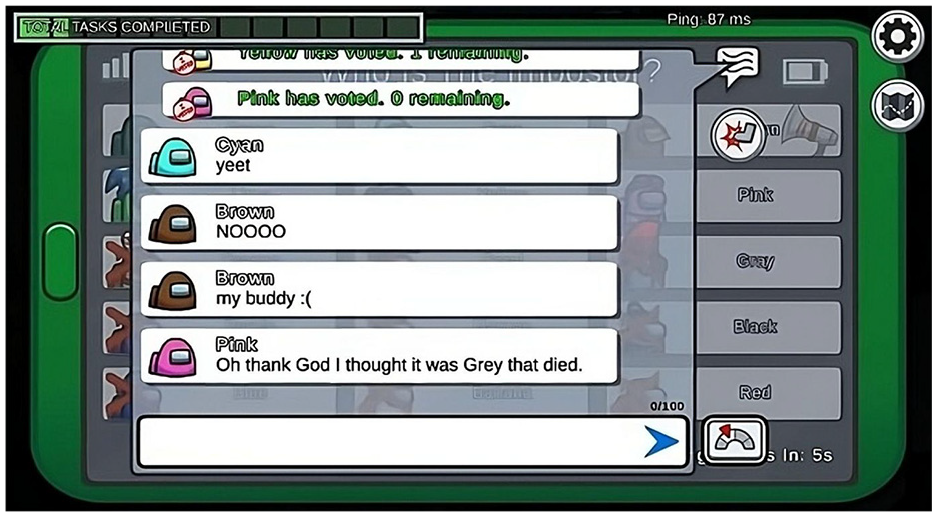
Example of meeting in Among Us.
To ensure the well-being of participants, the study was designed to minimize any potential risk of harm. The activity took place in a controlled educational setting, where students engaged in a structured learning experience focused on the identification and analysis of fallacies. Rather than fostering competitive gameplay, the intervention emphasized analytical skills and reflective learning. The study posed no physical, psychological, or reputational risks, as all interactions occurred within the framework of regular coursework, and no sensitive personal data were collected. Participation was entirely voluntary, and students retained the right to withdraw at any time without academic consequences. Additionally, all collected data were anonymized prior to analysis to further protect participants’ privacy.
The potential benefits of this research significantly outweighed any minimal risks. By engaging in a structured learning experience, students developed critical thinking, argumentation skills, and a deeper understanding of persuasive discourse, all of which are essential for academic and professional development. The study also provided valuable insights into the use of gamification in higher education, contributing to research on innovative pedagogical strategies. As the activity aligned with standard classroom practices and adhered to ethical research standards, the risks were considered negligible.
Prior to participation, all students received a clear and detailed explanation of the study’s objectives, procedures, and voluntary nature. They were informed of their right to withdraw at any point without any form of penalty. To ensure transparency and compliance with ethical standards, written informed consent was obtained from all participants before engaging in the activity.
It is worth mentioning that during the last years Among Us has become one of the most popular games in the world. Such is the case that its developers are creating an animated series. This demonstrates the interest of people in general about the game, and the possibility to develop projects that can be carried out from the brand (Figure 3).

Teaser trailer of the animated series of Among Us.
The above is linked to real situations. People with different characteristics or ideas face a situation of digital anonymity, the pressure of a social environment, the presumed confirmation bias, the limitations of criteria to distinguish truthful sources of information and emotion in the face of a presumed finding, which goes viral because collective interest (Abbas, 2022; Beauvais, 2022; Iwendi et al., 2022). All this leads to the need to understand the main fallacies that are used in different contexts. Such is the case of the game Among Us, in which a group of players interacts in a fictional spaceship, and they can only communicate in meetings where they accuse each other of being an impostor. On the other hand, the player who has that role must act with stealth and use rhetorical resources to unload the accusation on another player.
During the development of the educational activity, they had the option of working in groups of up to six people. They presented academic reports that consisted of the following: a cover, an introduction to the work (which would indicate the context of the game, the educational practice and the relationship with the fallacies), a brief summary of the experience (with one page of writing and two pages of screenshots), the analysis of the information about the fallacies used in the game, a brief comment on the results achieved, conclusions, and references. With these parts, the academic report helped to evidence the observation of the learning experience.
Due to the affinity between what is described and what is played, the students focused on the analysis of the situation rather than winning the game. Therefore, this practice leads to a more objective vision about a situation that is frequently emotional, or where social pressure tends to reaffirm biases. Therefore, it is a metacognitive practice that is close to their reality, in which they can experience both the role of participant and evaluator (Bababei et al., 2022; Cabañes, 2022; Loos & Ivan, 2022). The election of groups in a public server and in a private server helps to compare situations and look for the way they can act similar to unknown people (Table 1).
Games to Prepare the Academic Report.
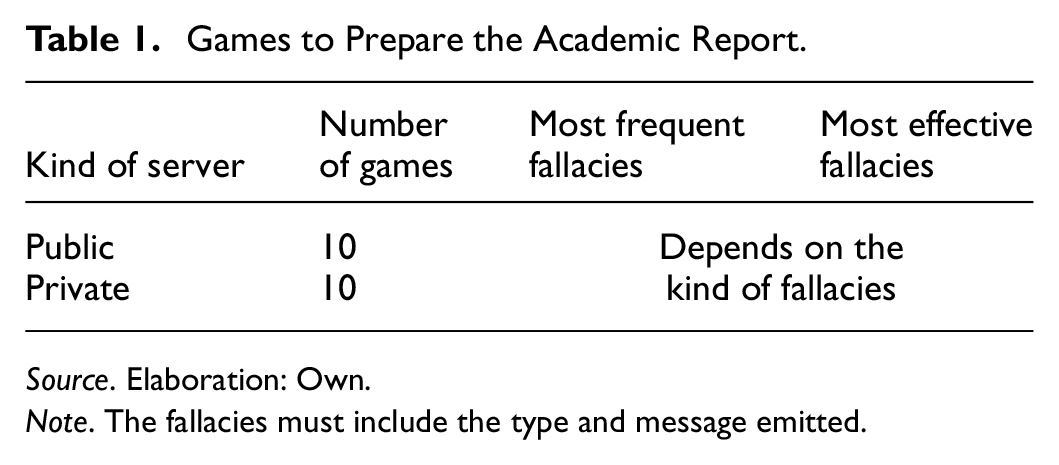
Source. Elaboration: Own.
Note. The fallacies must include the type and message emitted.
This research uses a non-probabilistic convenience sampling model. The proposal assumes the most natural closeness to the universe of students, taking into consideration that this kind of educational practice is novel (Castro-Martín et al., 2022; Pobee, 2022). The entire student population was invited, but it lasted with a total of 97 participating in all the actions. These are: the performance of an entrance test, the development of the activity and the participation in an exit test. The research design is pre-experimental, because the exposure to playful and learning experiences is made to a single group of students.
The entrance and exit tests were taken individually, with multiple choice questions, through Google Forms, for 40 min. Six items were about conceptual knowledge. That is the relationship between a name of fallacy and its concept. The following 10 were about identification of fallacies in text messages and advertisements. Finally, the last four require an exercise of deduction about the kind of fallacies based on an incomplete or different statement or explanation (Table 2).
Items in the Entrance and Exit Tests.
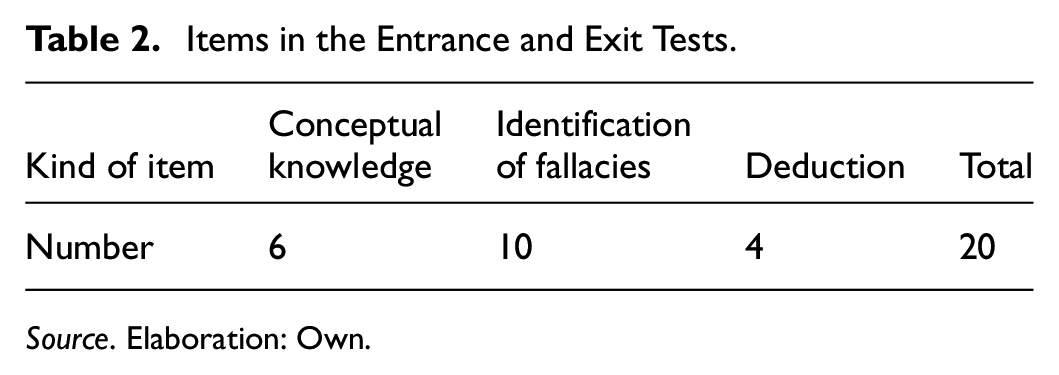
Source. Elaboration: Own.
The validity of the instruments by expert criteria was carried out by six judges both in the entrance test (Table 3) and the exit test (Table 4). This corresponds to the degree to which the set of items of the instrument represent a relevant and representative sample of the construct that is sought to be measured (Martínez, 2005). In this sense, Aiken’s V coefficient of the questionnaire was 0.9. In the same way, the coefficients were obtained according to the dimension and category evaluated by the experts. Both tests, linked to argumentation and fallacies, will allow establishing the influence corresponding to the use of the methodology in said knowledge.
Content Validity Statistics of the Entrance Test.
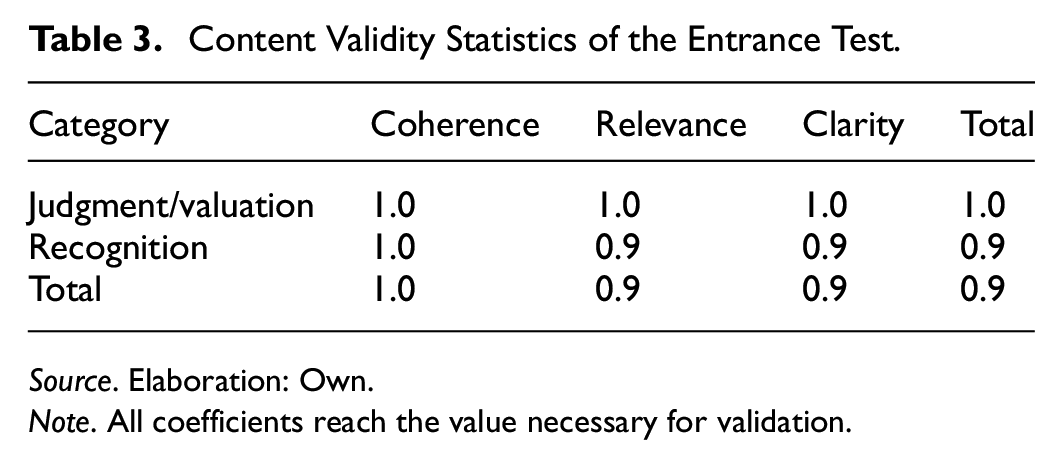
Source. Elaboration: Own.
Note. All coefficients reach the value necessary for validation.
Content Validity Statistics of the Exit Test.

Source. Elaboration: Own.
Note. All coefficients reach the value necessary for validation.
Results
After analyzing the corresponding processes of both tests, and the development of the actions corresponding to the activity, three types of results were generated: descriptive, inferential, and qualitative. The first two analyze the differences established between the entry and exit tests, considering the variations in results and their consistency, respectively. The third parties explain and interpret the characteristics and features corresponding to the products developed by the students.
Descriptive Results
To adequately represent the differences of the entry and exit test, the results were limited to those students who participated in both assessments. In this sense, over a maximum of 20 points, the results increased from an average of 13.27 to an average of 15.70, this difference corresponding to a 12.17% increase in the level of learning achievement achieved by the students (Table 5).
Results of the Entrance Test and the Exit Test.

Source. Elaboration: Own.
Besides, the configuration of the level of achievement reached by the students divided into quartiles (called In Start, In Process, Accomplished and Outstanding), showed a significant change between the entrance test and the exit test (Figure 4). The most notable transformation was the increase in the Outstanding level, which went from 21% to 60% of the sample. This corresponds mainly to a migration of an important part of the 65% of students who were at the Accomplished level towards the Outstanding level.

Comparison of results of the entrance test and the exit test by levels.
Inferential Results
To verify the research hypothesis through parametric or non-parametric tests, the type of data distribution (results of the input and output tests) was analyzed. It was verified that the data do not present a normal distribution, according to the results of the Kolmogorov-Smirnov tests (Table 6). This suggests the use of Wilconxon ranges, as will be seen later.
Data Normality Tests.

Source. Elaboration: Own.
Note. aLilliefors significance correction.
Research Hypothesis
The hypothesis was focused on verifying the influence of an educational guided experience with the game Among Us on the level of achievement of learning related to fallacies.
Ho: The educational guided experience with the game Among Us does not significantly influence the level of achievement of learning related to the use of fallacies, such as inductive argumentative elements of the first cycle university students.
Ha: The educational guided experience with the game Among Us significantly influences the level of achievement of learning related to the use of fallacies, as inductive argumentative elements of the first cycle university students.
In correspondence with the results of the data normality tests, the non-parametric Wilcoxon rank test was applied to verify the research hypothesis. According to the results shown in Table 7, the bilateral asymptotic significance value is <.05; therefore, the research hypothesis (Ha) is accepted, and the null hypothesis (Ho) is rejected.
Test for Contrasting the Research Hypothesis.

Source. Elaboration: Own.
Note. aWilcoxon signed rank test.
It is based on negative ranges.
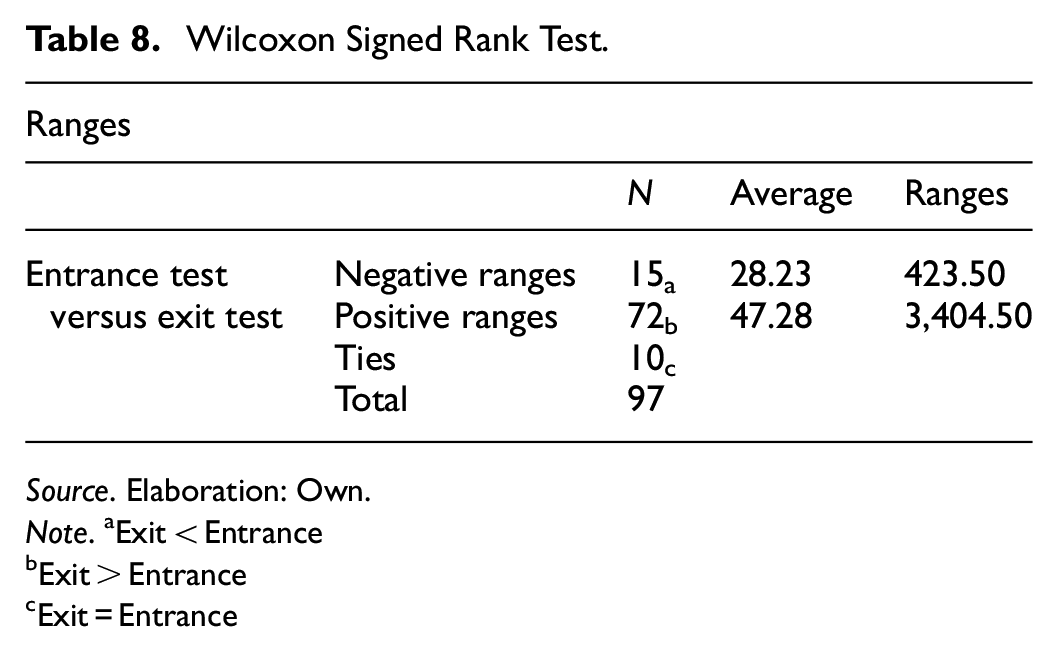
In addition, Table 8 shows that of the 97 students who participated in the study, 75% of them improved their level of learning in relation to the use of fallacies as argumentative elements. In 10% of students no variation was observed in the level of learning achievement, and in 15% it was observed that the level of learning achievement had decreased.
Wilcoxon Signed Rank Test.
Source. Elaboration: Own.
Note. aExit < Entrance
Exit > Entrance
Exit = Entrance
Based on the above, it is evident that 75% of the students who participated in the study verified that the guided educational experience in the game Among Us significantly influences the level of achievement of learning related to the use of fallacies as argumentative elements.
On the other hand, this knowledge transcends the identification or analysis within the argumentative competence, since the very elaboration of a practical activity in a real scenario aroused various reflections through the praxis itself, which is corroborated in the qualitative aspect of this study.
In the analysis of the works on this activity, various types of responses were found. For example, in the introductory part, the inclusion of information about the game was requested. In this section, works were found whose introduction was completely original, others that were partially supported by third-party comments, but also some copied from Internet reviews. This constitutes an indicator of the disposition with which the students entered to develop their proposal: works with a marked enthusiasm for developing broad, detailed, illustrative and original on the subject (Figure 5); works with a relatively conventional introduction and works with a degree of inattention, in which he ended up resorting to copying the multiple reviews about Among Us.

Work introduction example.
Regarding the use of strategies, the participation was much more natural for the students. The fact of systematizing examples of fallacies with a positive or adverse result was also a way of finding strategies to win a game and (consequently) to simulate a social circumstance. The impostors and the crew members who find themselves involved in a compromising situation chose various types of fallacies: false cause (presenting a reason unrelated to the consequence), false dilemma (reducing a problem to only two alternatives), ad ignorantiam (based on ignorance about a fact to make some statement, ad hominem (direct an attack against the person), ad misericordiam (appeal to compassion), ad baculum (appeal to force or threat), etc. This also results in greater learning about the preferences of action by a certain community, whether they are strangers or members of the team itself (Table 9).
Examples of Fallacies with the Highest Vote Gain in Internal and External Communities.

Source. Elaboration: Own.
Note. It is significant the use of a greater diversity of fallacies in public items, which are consistent with a space of less social commitment.
In the proposal presented, a greater proliferation of successful fallacies (with positive results for those who used them) is observed in public spaces than in private ones. That is, a greater tendency to include these strategies when the competitors are unknown, and, therefore, with less social commitment in their relationships (Etzrodt, 2022).
Finally, the observations presented by the students themselves also suggest reflection on the use of fallacies and their effects in spaces of social interaction. This played out in a number of ways: praising the game as an interesting space, where social interaction, with associations and betrayals, leads to very specific and exciting consequences for students; determining the use of multiple fallacies (four or more) to achieve successful results; establishing situations of rapid communication, to motivate or counter public judgment; and extrapolating the strategies used in everyday life. In this sense, although the playful space is attractive for students, the activity generated an extrapolation towards situations of daily life. Although the sample size in this case is modest, it represents a particularly interesting scenario. This approach could be further explored in larger studies to develop educational experiences aligned with the theory and supported by similar methodologies.
Conclusions
Although the use of games for educational purposes is more prevalent in schools than in universities, the methodology developed in this paper has proven to be effective within the context of higher education. This learning experience is enriched with popular games of high impact. Simulations to anticipate situations in a real context are also added to the intrinsic motivation of playful activity. That is, confront aspects of professional and civic life, but in a safer environment. In addition to this, a guided learning experience allows students to reflect on these situations, providing more consistent, mature and prepared responses and actions. Although not all students were able to participate consistently, the incorporation of tests, methodology, and institutional support opens a path for the development of proposals that, far from representing a workload for the teacher, enhances and facilitates educational methods and the usefulness of the knowledge it offers.
Various kinds of improvement were evidenced in this paper: greater learning in 75% of the students, the effort in the acquisition of knowledge (motivated by the affinity with the ludic activity), the recognition of fallacies in situations of public discussion (considering both its potential for obtaining results and its danger in the irresponsible use of this practice), and the influence of social commitment against most common fallacies. That is, the identification of fewer truthful messages in public spaces. This praxis can be extrapolated to citizenship against the proliferation of information that contaminates public opinion, such as fake news (Byrd & John, 2022). It also constitutes a possible remedy for education to defend future professionals from false information. This is a clear response to another problem: traditional education has not provided many alternatives to develop soft skills in digital environments. Whether it is for personal life, participation in the public space or the labor requirements, this action becomes urgent and necessary.
Footnotes
Declaration of Conflicting Interests
The author(s) declared no potential conflicts of interest with respect to the research, authorship, and/or publication of this article.
Funding
The author(s) received no financial support for the research, authorship, and/or publication of this article.
Ethical Approval
This study was conducted in accordance with the Declaration of Helsinki and recognized ethical guidelines for educational research. As it involved a pedagogical intervention using a widely accessible commercial video game (Among Us) within a standard university course, and did not include any collection of sensitive personal data, deception, or interventions posing potential risk to participants, formal ethics approval was not required. Participation was entirely voluntary, and all students were fully informed about the study’s purpose, procedures, and their right to withdraw at any time. Prior to participation, written informed consent was obtained from all students, ensuring transparency and ethical integrity in the research process.
