




Abstract
Based on the experiences of preservice Turkish teachers (PTTs) along with the transition to distance education, the objective of this study was to evaluate their views on this process in terms of various variables and determine the problems they experienced during the distance education process. One hundred eighty PTTs constituted the sample of the present mixed-method study. Afterward, 40 PTTs were selected from the sample by the criterion sampling method, and their responses to open-ended questions constituted the qualitative data. The data were collected online using the “Interview Form for Distance Education” developed through Google Forms. Descriptive statistical (percentage and frequency distributions) techniques, the chi-square technique for a single sample and two variables were used to analyze quantitative data, and the qualitative data were analyzed by content analysis. The study showed that most PTTs regarded the attainments obtained through distance education as not equivalent to face-to-face education, and there was no significant relationship between these views and gender, grade level, and grade point average. However, there was a significant relationship between PTTs’ problems in distance education, their places of residence, and connection speed. Furthermore, while quite few PTTs thought that distance education was beneficial to developing higher-order thinking and language skills and enriching interaction, most preservice teachers found distance education useful in terms of providing an opportunity to repeat the course content and ensuring space and time flexibility.
Introduction
Rapid technological developments have caused changes in the quality of people’s important life-related actions such as learning, working, communicating, and using time. Fluctuations in technological development have shown their effects on education, especially with computers and the internet, and time and space limits in education have disappeared with the internet. Distance education, which has removed borders over time, has emerged as one of the developments with the potential to change educational processes (Pardue, 2001). Distance education has experienced dramatic growth nationally and internationally since the early 1980s (Gunawardena & McIsaac, 2004, p. 356). With distance education, it has become possible to experience a different teaching process, and an unusual learner-teacher relationship has emerged. The quality of distance education, which provides learners with independence in the teaching process, is important under all circumstances. When distance education is provided in an unstable and temporary environment, beliefs and concepts related to learning affect the learning strategies used (Nelson & Hawk, 2020). In this respect, distance education is a complex process where teaching occurs with technical tools, and the use of technology affects the quality of education in this process. Teachers’ and students’ adoption and use of technology are important determinants (Lukina et al., 2022). In this process, teachers should rely on and be able to use educational tools such as laptop computers, online platforms, and social media, which provide an important online environment, while facing the rapid transition toward distance education (Svrcek et al., 2022). Furthermore, online learning is entirely dependent on technological devices and the internet, and teachers and students with poor internet connection face being blocked from online education (Adedoyin & Soykan, 2023).
Greenberg (1998, p. 36) defined contemporary distance education as an education, learning and teaching experience that uses a wide range of technologies to reach distant students and is designed to encourage learners. In other words, a distance education system is a learning and teaching system where the interaction between students and teachers who are distant from each other is realized through technological tools (Yalın, 2008, p. 3). Distance education, an ever-changing and evolving field, makes use of online and offline technologies that try to provide the most effective working solutions for learners who are separated from learning resources and facilitators in terms of time and space. Therefore, distance education is a pragmatic approach to learning (Bozkurt, 2019). Distance education represents an effort to make education sustainable via systematic activities with its theoretical and practical characteristics. Open, flexible and online distance education environments have become common with rapid technological developments in today’s world, increased access to information and communication technologies, and digital transformation. Nowadays, schools and open universities where all education is provided online are located in many countries of the world (Doghonadze et al., 2020). The literature mentions the advantages of distance education, such as ensuring sustainability in education (Akinbadewa & Sofowora, 2020; Seage & Türegün, 2019), reducing educational costs (Al-Husban, 2020; Harrison & Lee, 2018; Traxler, 2018), and ensuring lifelong learning (Alharthi, 2019; Serhan, 2019). Moreover, its qualities, such as appealing to a wider audience, shaping individuals according to the learning speed and method, and allowing the use of multimedia tools, are also the positive aspects of the distance education environment (Arat & Bakan, 2011). In addition to the above-mentioned advantages, the inadequacy of teacher-student interaction and knowledge transfer (Aygüneş et al., 2022; Y. Can & Bardakci, 2022; Duran, 2020; Elcil & Şahiner, 2014; Syauqi et al., 2020), the negative effect on students’ active participation in courses (Perets et al., 2020), technical problems and limited collaborative learning opportunities (Bączek et al., 2021; Canpolat & Yıldırım, 2021; Jin, 2023; Kolyada et al., 2021; Koray & Pekbay, 2022), lack of emotions and feedback in the process of communication, psychological barriers and weak digital competencies (Lukina et al., 2022), the stress caused by the lack of social interaction in the academic context on students (Babicka-Wirkus et al., 2021; Chaturvedi, 2021; Schiff et al., 2020), and the relationship between lack of academic social interaction and learning and self-organization difficulties (Ivanec, 2022) are among the disadvantages of distance education specified in the literature.
Taylor (2001, p. 2) described the historical development of distance education as follows:
Distance education operations have evolved through the following four generations: first, the Correspondence Model based on print technology; second, the Multimedia Model based on print, audio, and video technologies; third, the Telelearning Model, based on applications of telecommunications technologies to provide opportunities for synchronous communication; and fourth, the Flexible Learning Model based on online delivery via the internet. Although many universities are just beginning to implement fourth-generation distance education initiatives, the fifth generation is already emerging based on the further exploitation of new technologies. The fifth generation of distance education is essentially a derivation of the fourth generation, which aims to capitalize on the features of the internet and the Web.
The first distance education application in Turkey was started at Ankara University in 1956 and then in 1960 as a trial under the name of “Education by Letter” affiliated with the Ministry of National Education (MoNE). The Letter Education Center was established within the MoNE in 1974 and continued its activities (Kaya, 2002, p. 30). In the following years, the Open Education Faculty was established at Anadolu University with Higher Education Law numbered 2547. Student admission was started with the Open Education Faculty in the 1982-1983 academic year. Thus, distance education has started to be implemented at the higher education level. Distance education in Turkey is carried out at the level of associate degree, bachelor’s completion, internet-supported formal graduate education program, and undergraduate and graduate programs in higher education (Akdemiär, 2011). Since distance education brings learners and teachers in different regions together, its area of impact expands, and the opportunity to interact with different cultures increases (Uşun, 2006).
Distance education, which plays an essential role in the active involvement of students in the education process and the realization of lifelong learning by taking responsibility for learning, also provides freedom in terms of age. In this regard, giving a chance to individuals who have not received education or have left their education halfway, solving the transportation problem in remote areas, using time economically without disrupting the life course, and helping students to realize their education alone contribute to developing distance education (Kaya & Önder, 2002). Considering the distance education process in terms of instructor roles, these roles are not limited to a specific place and time but continue before, during, and after the teaching process. In the distance education process, teachers are persons who plan the lesson before the lesson, organize the contents determined according to weeks and prepare the relevant activities and teaching materials. They guide the understanding of the content using appropriate methods, techniques, and materials in the teaching process and can make this process effective and efficient. At the end of teaching, teachers are responsible for evaluating the effectiveness of teaching.
In distance education, a person who is responsible for his/her own learning and achievement by collaborating with the teacher and providing feedback can become a researcher who can solve a problem when it occurs. It is students’ responsibility to attend lessons, attend concurrent or separate activities on time, have some equipment, complete homework and projects, and try to solve technical problems (Gülbahar, 2009; Işık et al., 2013). According to some researchers, students learn the course content in the distance education process at least as much as their traditional classmates (Neuhauser, 2002; Rovai, 2002; Young et al., 2001). In fact, some studies have found that students have very positive attitudes toward video conferencing for online learning (Pedroso et al., 2023; Rio-Chillcce et al., 2021; Suadi, 2021). However, some researchers have stated that distance in the online learning environment leads to isolation, frustration, boredom, overload, and low course completion rates (Hara & Kling, 2000; Northrup, 2002). For many students in a traditional school setting, their social life is an important part of education. Since most of the social interaction in traditional learning settings disappears in distance education, students cannot see each other or instructors. They have to stay online all day without any social interaction with their peers (García & Weiss, 2020). The absence of these physical cues can cause disappointment among students. As one of the factors affecting learning, disappointment prevents students from achieving their goals and continuing learning (Hara & Kling, 1999, as cited in Falowo, 2007). Many students face problems logging into online courses, uploading assignments, attending classes, sharing their screens, or expressing their opinions (Goldstein et al., 2020). According to Northrup (1997), there is a need to focus on the perception of faculties in higher education concerning distance education because one of the most important factors in the success of the distance education environment in higher education is students’ views or perceptions of these environments. In the study by İbicioğlu and Antalyalı (2005) on university students, motivation and the possibility of using a computer together with the perception of distance education are of primary importance in the success of distance education, and if these factors are not provided, distance education does not achieve successful results. In the study by Z. Tuncer and Çeliköz (2021), students who took applied courses with distance education were found to have negative attitudes regardless of their department. The teachers who participated in the study by Avcı and Akdeniz (2021) thought that distance education could not replace face-to-face education. In similar studies, teachers stressed the obstacles to e-learning implementation as the lack of access to the internet and devices (Almanthari et al., 2020; Asanov et al., 2021; Lai & Widmar, 2021) and expressed the difficulties caused by teachers’ lack of sufficient experience in online learning environments (Lase et al., 2022). Indeed, during the COVID-19 pandemic, anti-distance education explanations were made in various parts of the world for various reasons (Yamamoto & Altun, 2020).
Transition to Distance Education in Universities in Turkey During the COVID-19 Pandemic
With the development of science and technology, some universities in the world and Turkey have started to use distance education systems to meet people’s needs for learning and self-improvement. However, COVID-19 disease, which emerged in China in December 2019, turned into a pandemic that impacted the whole world as of March 2020, and the flow of life for people worldwide changed after the World Health Organization declared it a pandemic on March 11, 2020 (World Health Organization [WHO], 2020). Numerous precautions were taken to protect public health, and measures such as lockdowns, quarantine, self-isolation, and social distancing were taken all over the world to reduce its contagiousness and spread due to the rapid transmission of the disease. The closure of schools and universities was also one of the social distancing measures to slow down the spread of the infectious disease. According to the data from the United Nations Educational, Scientific and Cultural Organization, schools in 188 countries were closed due to the COVID-19 pandemic as of April 07, 2020 (UNESCO, 2020). The closure of schools and universities due to COVID-19 increased uncertainties and disagreements about what to teach and how to teach (Wang et al., 2020).
The Ministry of National Education in Turkey decided to switch to distance education on March 12, 2020 (MoNE, 2020). The Council of Higher Education announced the decisions on distance education with an information note published on March 13, 2020. In this respect, it was decided that programs, which were opened in accordance with the procedures and principles related to distance education and being carried out with distance education, would continue their education, except for practical and face-to-face education (CoHE, 2020, p. 1). Studies have shown that the closure of schools during pandemics effectively reduces transmission (Cowling et al., 2020; Nafisah et al., 2018). While more than half a billion individuals around the world became virtual students by staying at home and receiving distance education, other family members assumed a supportive role to ensure that children’s educational lives were not adversely affected (Cohen & Kupferschmidt, 2020).
Then, in line with the decisions taken during the course of the pandemic, distance education was started in universities in the spring semester of the 2019 to 2020 academic year. Furthermore, providing theoretical courses in universities in a completely remote way was discussed. In faculties of education, basic applied courses and even the evaluation of these courses were performed through distance education. Considering the data from the United Nations, 770 million learners in the world were influenced by the closure of schools and universities (Zhong, 2020). University students and young adults were most affected by the pandemic since they experienced social isolation (Clair et al., 2021; Rodriguez-Besteiro et al., 2021). In this respect, whether courses provided through distance education in the faculties of education made contributions as in face-to-face classroom environments and whether preservice teachers experienced problems in the distance education process were considered subjects to research. Likewise, the study by Mohalik and Sahoo (2020) revealed that most preservice teachers did not consider online education a good alternative to face-to-face education and felt stressed and isolated on the online platform because the increase in time spent in front of the computer and online causes loneliness and weakens mental and physical health (Al-Kumaim et al., 2021). In another study, university students stated that they would prefer face-to-face learning if given a chance to choose, and they made negative statements about distance education environments (Abbasi et al., 2020).
Some studies have emphasized that the demographic characteristics of the target audience, their perceptions, views and attitudes toward distance education must be well determined to obtain sufficient and effective results in distance education systems designed by higher education institutions (Çelen et al., 2011; Erdoğan et al., 2006) because perceptions of distance education affect learning outcomes and achievement (Başar et al., 2019; Çelik & Uzunboylu, 2022; Hung, 2016; Offir et al., 2003; Woodcock et al., 2015; G. K. Yılmaz & Güven, 2015; S. Zhang & Fulford, 1994) and it is important that students have a realistic perception of distance education experiences. Studies have also demonstrated that variables such as audio and video problems during the distance education process, the lack of interaction, and the duration of lessons affect participants’ perceptions of distance education (Koppelman & Vranken, 2008; Marsh et al., 2010; Syauqi et al., 2020) and especially simultaneous distance education practices do not fully meet participants’ expectations (Delaney et al., 2004). The problems caused by insufficient feedback, face-to-face communication, and interaction in studies conducted to identify problems in distance education (Adnan & Anwar, 2020; Aygüneş et al., 2022; Bower, 2001; Y. Can & Bardakci, 2022; Duran, 2020; Falowo, 2007; Ferri et al., 2020; Haber & Mills, 2008; Koray & Pekbay, 2022; Li, 2009; Maden & Önal, 2022; Peper et al., 2021; Schifter, 2002; Vasiliki et al., 2021; Xiao, 2017), the lack of support services for the teaching staff and students (Falowo, 2007; Galusha, 1997), the disappointment experienced by students due to their unmet expectations (Falowo, 2007; Hara & Kling, 2000; Shanahan et al., 2022), and the inability to use technology correctly and effectively (Falowo, 2007; Jin, 2023; Lger, 2021) were found to be important.
Some studies examined university students’ perceptions, attitudes, or opinions on distance education (Asio & Bayucca, 2021; Karataş Aydın, 2023; Bariş, 2015; Başar et al., 2019; Belcheir & Cucek, 2002; Brinkerhoff & Koroghlanian, 2005; Drucker & Fleischhauer, 2021; Eygü & Karaman, 2013; Hamutoğlu et al., 2019; Hebebci et al., 2020; Ivanec, 2022; Jin, 2023; Karataş & Tuncer, 2020; Paydar & Doğan, 2019; Sumner & Hostetler, 2002; Tanner et al., 2009; Tarchi et al., 2022; Yenilmez et al., 2017). Researchers agreed that the distance education process experienced during the COVID-19 pandemic necessitated improving personal qualities such as motivation, advanced planning skills, self-organization and self-control in each student (Lukina et al., 2022). For example, the study by Ivanec (2022) examined the relationship between university students’ lack of academic social interaction and their learning status and found that students who perceived a greater lack of social interaction experienced more learning and self-organization difficulties. Since students’ experiences in the educational process are essential, it is assumed that the lack of academic social interaction affects the student level (Hong et al., 2021).
Distance education and digital transformation initiated in all universities in Turkey due to the COVID-19 pandemic have resulted in a process never experienced before. Due to the COVID-19 pandemic, an emergency distance education experience has emerged, and the importance of digital learning and teaching skills has been revealed more clearly. The concept of emergency distance education refers to the temporary transition of education, which is normally carried out face-to-face, online or in a mixed way, to alternative options in emergencies (Ferri et al., 2020; Hodges et al., 2020). Unfortunately, many students have lost learning opportunities and have been left behind in mass distance education during the pandemic, as all students have been forced into a massive distance learning environment (Yeh & Tsai, 2022). The digital transformation that has started with the emergency distance education process experienced in all universities suggests that online learning may soon become the main learning structure (Yamamoto & Altun, 2020). Moreover, in order to increase the efficiency of distance education, the need to conduct research on the qualifications of preservice teachers who will provide this education service in the future and their perceptions, knowledge, skills, and experiences regarding online learning and teaching environments comes to the forefront (Cabı, 2018; Sae-Khow, 2014; Yılmazsoy et al., 2018). Studies have shown that instructors face obstacles and challenges in online learning and teaching environments (Engzell et al., 2021; Reimers & Schleicher, 2020). Numerous students face difficulties getting used to the functions of attending online courses, logging in, uploading assignments, sharing their screens, or expressing their opinions (Goldstein et al., 2020). Hence it has become important to determine in detail how preservice teachers perceive this process, reveal their expectations, and create a perspective on what can be done to improve distance education. Although quick studies have been conducted in the health sector to understand the effect of COVID-19 and find a solution to the pandemic, such academic studies in the field of education have been inadequate (Dehghanbanadaki et al., 2020; Hossain, 2020). Wang (2004) emphasized that distance language teaching is still not as efficient as desired despite technological developments and advancements in computer technologies. However, the use of technology also affects changes in the methods and processes of language teaching nowadays (Ahmadi, 2018). The perspective on providing qualified social interaction and collaboration opportunities is one of the most important approaches to integrating technology into the language teaching process (Warschauer, 2000). Kolyada et al. (2021) suggested that distance between people was the most obvious disadvantage of distance education in language teaching and stressed that distance education was tiring and monotonous and learning a language in front of a screen could be quite demanding and challenging. It can be said that studies on distance language teaching, especially those carried out during the pandemic, are insufficient (Atmojo & Nugroho, 2020). Revealing the perceptions and opinions about this process will play a critical role in determining the positive and negative aspects of distance education, which is experienced for the first time on such a large scale.
Individuals who will work in a language teaching and practice-based field, such as Turkish education, are expected to have acquired language skills and the knowledge required for teaching and to carry out the necessary practices. The fact that Turkish lessons are based on skills rather than knowledge and involve practice requires Turkish teachers to use language skills effectively and ensure student-teacher interaction. It is also essential that they know the approaches and methods to develop these language skills. Therefore, this research is important in terms of determining how PTTs perceive the distance education process, what kind of problems they experience in distance education courses based on their experiences, and what their opinions are about the contribution of these courses to basic language skills. Furthermore, it is assumed that, whether PTTs’ expectations about the distance education process are met and what the positive and negative situations are in this regard can be determined, and their perspectives on instructor and student roles and the measures to be taken in the distance language teaching process can be specified based on their opinions and experiences within the scope of the study. It is important to determine the distance education process in Turkish education from preservice teachers’ perspective and investigate it from a scientific perspective in order to understand the situation of preservice teachers and shed light on academic studies in this matter. Moreover, it is predicted that comparing the study results with the findings in different fields will increase the quality of distance education practices in faculties of education and contribute to the literature.
The objective of the present study conducted due to the aforesaid importance and justification is to determine the views of PTTs on the distance education process in terms of various variables and determine the problems they experience in this process based on the experiences of PTTs with the transition to distance education during the COVID-19 pandemic. The research questions determined within the scope of the study are as follows:
Is there a significant relationship between PTTs’ views on whether attainments obtained with distance education are equivalent to those in face-to-face education and their gender, grade level, and grade point average (GPA)?
Is there a significant relationship between the place of residence and connection speed and problems in distance education?
Is there a significant difference between PTTs’ views on whether they should agree with the stated benefits of distance education or not?
Is there a significant relationship between the effect of distance education on PTTs’ perspective and the competence and attitude statements regarding distance education?
What are the problems experienced by PTTs in the distance education process?
What are PTTs’ views on instructor roles in the distance education process?
What are PTTs’ views on student roles in the distance education process?
Method
Research Design
The current study was conducted in a mixed design. Johnson and Turner (2003) indicated the basic principle of mixed design as collecting multiple data with different methods and approaches. The objective of a study conducted in a simultaneous mixed design is to collect both qualitative and quantitative data and integrate the obtained results in order to understand a research problem. The basic assumption of this design is a holistic understanding of the research problem (Creswell, 2012). According to Onwuegbuzie and Leech (2004), the purpose of the mixed method is not to confirm or support an idea in many cases but to expand the understanding of the event addressed. Within the scope of the study, quantitative data were collected from 180 PTTs, and qualitative data were obtained through the answers given to open-ended questions by 40 PTTs selected by the criterion sampling method. Web pages, reports available through file transfer protocols, electronic texts, and visual programs are considered easily accessible electronic data sources, data collection tools, documents, and data (Merriam, 2018, p. 149). It was thought that by asking open-ended and closed-ended questions in the Interview Form for Distance Education, the reasons for the participants’ answers to the closed-ended questions could be interpreted, and comments could be integrated by obtaining more in-depth data. In this regard, in line with the study’s objective, qualitative data were also collected to have a more detailed and in-depth understanding of PTTs’ views on distance education. Thus, multiple data were collected through mixed design and data diversity, and the findings were discussed in a holistic manner.
Population and Sample
The study population consists of PTTs studying in the faculties of education at state universities in Turkey in the spring semester of the 2019 to 2020 academic year. The sample comprises PTTs studying at Çukurova University, Faculty of Education, Department of Turkish Education. In this process, data were collected from 180 PTTs selected on a voluntary basis from the first, second, third, and fourth grades at Çukurova University, Faculty of Education, Department of Turkish Education. Then, 40 PTTs were selected as the study group from this sample using the criterion sampling method, and their answers to open-ended questions were analyzed. Including 10 students from each grade level was accepted as a criterion. When determining the study group, the criterion sampling method was used, in which “situations that meet certain criteria are determined and selected” (Patton, 2014, p. 243). The criteria set as the basis for determining 40 PTTs are the voluntary participation of preservice teachers in the study and their regular attendance of distance education courses. Therefore, it was deemed appropriate to interview 10 PTTs from each grade level who attended online courses regularly and had no absences. The attendance and absenteeism of the PTTs regarding the courses were determined by examining course records. Table 1 contains findings on the personal characteristics of PTTs.
Findings on the Personal Characteristics of Preservice Turkish Teachers.

At Çukurova University, semester and general student achievement grades are calculated on a 4-point system. The Higher Education Council’s table showing the equivalents of grades in the 4-point system to the grades in the 100-point system can be accessed from the following link: https://oyp.yok.gov.tr/Documents/Anasayfa/4lukSistem.pdf (Access Date: November 8, 2023).
Table 1 contains the personal information of 180 PTTs participating in the study. In addition to their personal information, PTTs were asked about the means of access to distance education, and it was stated that they could select more than one option in this question. In this respect, mobile phones were the most preferred means of access, and 132 PTTs stated that they accessed distance education via mobile phones. PTTs mostly used laptop computers after mobile phones. On the other hand, some PTTs accessed distance education with desktop computers, tablets, and internet-connected televisions at home.
Data Collection and Analysis
The “Interview Form for Distance Education” developed online though Google Forms was used as a data collection tool in the study. The form comprises two sections and 14 questions. Seven questions in the first section aim to learn personal information, whereas seven questions in the second section aim to learn views on distance education. The section asking views on distance education includes open-ended questions that can be evaluated as qualitative data, multiple-choice items where more than one option can be marked, and Likert-type items where the degree of agreement with various statements can be marked. As stated by Creswell (2012), open-ended and closed-ended questions can be asked together in measurement tools. Asking questions in this way allows participants to make comments that go beyond their answers to closed-ended questions. The interview form prepared by the researcher was structured based on the feedback from three domain experts, and a pilot study was carried out by applying it to five preservice Turkish teachers from first, Second, Third, and fourth grades before applying it to preservice teachers. The form was finalized in this way.
The Faculty of Education at Çukurova University carried out undergraduate distance education with the PERCULUS-Distance Live Training Virtual Classroom Platform. In this system, all participants, instructors and preservice teachers, can simultaneously open a camera and microphone. At the same time, students can communicate in writing interactively with each other or with instructors. Video and audio sharing is possible using the camera and microphone, documents can be worked on, and presentations can be made. This system offers the opportunity to start live sessions, invite participants, and manage users. Sessions are recorded and can be watched again to draw meaningful inferences. 1
PTTs were provided with access to the form by sharing the link of the “Interview Form for Distance Education” prepared through Google Forms in WhatsApp groups created with PTTs. Attention was paid to the fact that volunteering was taken as a basis for filling out the form. The researcher could monitor student responses via Google Forms. Taking into account the criteria of volunteering and regular attendance in online courses, interviews were conducted with 40 PTTs selected from among 180 PTTs. Since interviews could not be held face-to-face due to the pandemic, meetings were defined and held in the PERCULUS system. The researcher asked the questions to the PTTs, and it was assured that the data would be used for scientific purposes and the participants’ identities would remain confidential. The interviews lasted approximately 30 to 35 min, and no internet outage occurred during this time. All data were collected after the education process in the spring semester was completed.
Data analysis was carried out in two stages. The SPSS package program was used to analyze quantitative data, and the data were analyzed using descriptive statistics (percentage and frequency distributions) techniques, the chi-square technique for a single sample and the chi-square technique for two variables. The chi-square test was preferred because non-parametric statistical techniques were used in categorical data. Since the data obtained within the scope of the study consist of categorical data such as grade level, grade point average, place of residence, positive/negative opinions, and agreement/disagreement, the chi-square test, one of the most commonly used non-parametric statistical techniques, was employed.
Qualitative data were analyzed by content analysis. The data analysis consists of the following steps: Transcription, coding, and creating categories.
Transcription: It is the process of converting the data obtained through interviews into text. Prior to the analysis, all data were first transferred to the Excel environment, and then the qualitative data were transferred to the file created with the Microsoft Word text editor. The researcher read the raw qualitative data obtained in this way several times. After becoming familiar with the data, she passed to the coding step.
Coding: Coding is the process of identifying various aspects of data and marking or labeling them in small pieces (Merriam, 2009; Miles & Huberman, 2016). Within the scope of the study, codes were created based on the concepts in the relevant literature and using the expressions that best describe the phenomenon that can answer the research questions. During this process, raw data were read many times. Once codes are created, they need to be reviewed. After the codes are reviewed, it is also essential for the researcher to decide when to finish coding. As stated by Strauss (1987), the coding process is completed when the researcher is able to classify the data, codes reach saturation or no new codes emerge. The frequency of code repetition was also determined.
Creating categories: Categories should respond to the study’s objective and answer the research questions (Merriam, 2009). During the analysis process, categories were created based on the qualitative findings that emerged in response to the research questions. In this regard, after coding the data to identify the problems that PTTs experienced in the distance education process, two separate categories were reached, including instructional and technical problems. When analyzing PTTs’ views on roles in the distance education process, it was decided that the basic categories to be collected under codes based on the research questions would be instructor roles and student roles. The results obtained from the analysis of qualitative data were described, and direct quotations from PTTs’ views were included to increase reliability. While presenting the quotations, the participants were coded as PTT (PTT9, PTT118…).
Results
This section presents the results from data analysis in accordance with the research questions. Table 2 summarizes the results of the chi-square test performed to find an answer to the question, “Is there a significant relationship between PTTs’ views on whether attainments obtained with distance education are equivalent to those in face-to-face education and their gender, grade level, and GPA?.”
The Results of the Chi-Square Test Conducted to Reveal a Relationship Between PTTs’ Views on Whether Distance Education is Equivalent to Face-to-Face Education and the Variables of Gender, Grade Level, and GPA.

As seen in Table 2, most PTTs of different genders and with different grade levels and GPAs think that the attainments obtained through distance education are not equivalent to those in face-to-face education. As a result of the chi-square test conducted to understand whether this view expressed by PTTs on distance education was associated with gender, grade level, and GPA, no significant relationship (p > .05) was determined. In other words, there was no significant relationship between PTTs’ views on whether attainments obtained with distance education are equivalent to those in face-to-face education and their gender, grade level, and GPA.
Table 3 presents the results of the chi-square test performed to determine whether there is a significant relationship between the place of residence and connection speed and problems in distance education.
The Results of the Chi-Square Test Conducted to Reveal a Relationship Between the Place of Residence and Connection Speed and Problems in Distance Education.

While 60.6% of the PTTs stated that they experienced problems in distance education, 39.4% stated that they did not. The chi-square test was conducted to determine whether there was a significant relationship between experiencing problems in distance education and the place of residence and connection speed, and it was found that the views of PTTs on experiencing problems in distance education differed significantly (p < .5). In other words, there was a significant relationship between experiencing problems by PTTs in distance education and their place of residence and connection speed. As seen in Table 3, 72.2% of PTTs living in the village experienced problems in distance education, while 75.7% of those living in the district had problems. Whereas 84.6% of PTTs with poor connection speed experienced problems in distance education, 64.6% of those with medium connection speed experienced problems.
Within the scope of the study, 11 items, indicating various benefits of distance education, were given to PTTs to find an answer to another research question, and PTTs were asked to indicate whether they agreed with them or not. Table 4 summarizes the results obtained.
The Results of the Single-Sample Chi-Square Test Conducted to Determine Whether Preservice Turkish Teachers Agree With the Stated Benefits of Distance Education.

According to the results of the single-sample chi-square test in Table 4, a significant difference was found between PTTs’ views on whether they agreed with the above-mentioned benefits of distance education. PTTs agreed the most with the benefits of distance education, such as providing time and space flexibility and providing the opportunity to repeat the course content. While very few PTTs thought that distance education was beneficial for improving language skills, the vast majority did not think that some of the stated items were benefits of distance education. For example, 176 preservice teachers did not find distance education as beneficial for enriching interaction. Furthermore, 173 preservice teachers did not agree with the item that distance education improves higher-order thinking skills, and 171 preservice teachers did not agree with the items that it provides education sensitive to individual differences and increases the motivation for learning. Moreover, 169 PTTs did not think that distance education increases participation in classes.
Table 5 contains the results obtained by the chi-square test conducted to determine whether there was a significant relationship between the effect of PTTs’ experiences with distance education on their perspective and competence and attitude statements regarding distance education.
The Results of the Chi-Square Test Conducted to Determine the Views on the Effect of Distance Education on PTTs’ Perspective and Competence and Attitude Statements Regarding Distance Education.

As seen in Table 5, PTTs were asked about the effect of their experiences with distance education on their perspectives on distance education, and positive and negative opinions were obtained. The chi-square test detected a significant relationship between the effect of distance education on PTTs’ perspectives and various competence and attitude statements regarding distance education. The results demonstrated that 85.7% of PTTs stating “Strongly disagree” among those who did not consider themselves competent, for example, in terms of the item “I am confident in using basic Office programs such as Word, Excel, and PowerPoint,” had negative perspectives on distance education. It was found that 67.6% of the PTTs indicating the degree of regarding themselves as competent in terms of the item “I use my time effectively and plan my learning process” by stating “Strongly agree” had positive perspectives. Accordingly, it can be said that most of the PTTs who had positive perspectives on distance education with the experience gained during the distance education process agreed with competence statements at a high level.
PTTs were asked what problems they experienced during the distance education process, and Table 6 summarizes the results obtained.
Problems Experienced by PTTs During the Distance Education Process.

As seen in Table 6, the problems experienced by PTTs during the distance education process were coded under two themes, technical and teaching-related problems. The failure to connect to the internet was the most common technical problem experienced by PTTs. Only three PTTs reported no problems. The failure to connect to the internet was followed by problems such as access to the PERCULUS system used, the system’s delayed opening, not being able to watch lessons again, and problems with image and sound. Some PTTs experienced problems because they did not have some technical knowledge about using technology. PTTs who experienced teaching-related problems mostly stated that learning in distance education was not fully realized. They said that they experienced distraction and a loss of motivation. Five PTTs stated that some courses could not be practiced and courses were taught theoretically. Furthermore, four PTTs reported that not being able to communicate with teachers or their friends created a problem in the teaching process, one PTT stated that students were not active in the lesson in distance education, and one PTT indicated that he experienced unwillingness for lessons. Some PTTs expressed their views on the problems they experienced in the distance education process as follows:
“Of course, there are problems with the internet and network. Both teachers and we experience difficulties in this regard, and in this sense, there is not complete learning in lessons as in the school.” PTT 9
“I have technical difficulties in the distance education process. I use the computer, but the internet connection is not good. Thus, when I want to listen to the lecture from the phone, the system does not open in a different location.” PTT 41
“Sometimes there is a problem with the internet connection, and I cannot attend the class. Moreover, the inability to take courses face-to-face decreased my learning speed and capacity. Therefore, my grades and my interest in lessons decreased.” PTT 81
“Sometimes, there is a problem when logging into the system. I am not fully motivated for lessons.” PTT 109
“We can experience video and sound failures due to the internet connection. Moreover, while being socially active in face-to-face education motivates for lessons, we cannot benefit from this in distance education.” PTT 147
“Internet disconnection, students’ inability to be active, not being able to communicate one-on-one with my teachers and friends.” PTT 151
An open-ended question about the instructor’s roles in the distance education process was asked, and Table 7 presents the results.
PTTs’ Views on the Instructor’s Roles in the Distance Education Process.
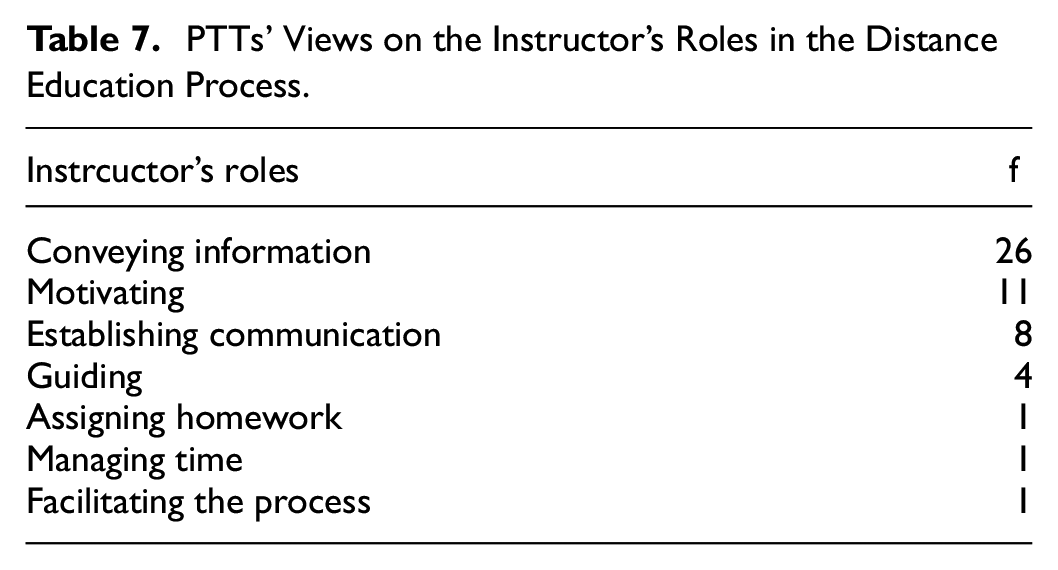
As seen in Table 7, PTTs think that instructors mostly have an informative and information-conveying role in distance education. Furthermore, 11 PTTs stated that instructors should motivate students, Four PTTs stated that instructors should communicate with students, and four PTTs stated that they should guide students. One of the PTTs with a different view stated that the role of the instructor in distance education was to assign homework, one stated that instructors should manage time, and one said that they should facilitate the distance education process. Some opinions of the PTTs whose views on this subject were obtained are presented below: “It is to establish active communication with students. If time is not enough, it is to keep communication alive by communicating in social networks, such as WhatsApp, etc.” PTT 9 “I think the role of instructors is to communicate with students as if they were lecturing in the classroom.” PTT 41
“To motivate students for the lesson as best as they can, to keep students ready for the next lesson.” PTT 116
“To present information about the course to students.” PTT 118 “Teaching the lesson and assigning homework.” PTT 131 “Trying to provide benefits to students by explaining the lesson.” PTT147 “It should be to increase students’ motivation even a little.” PTT 152 “It should be guiding students.” PTT 175
An open-ended question about the student’s roles in the distance education process was asked to PTTs, and Table 8 summarizes the results obtained.
PTTs’ Views on the Student’s Roles in the Distance Education Process.

Table 8 includes PTTs’ views on students’ roles in the distance education process. Most PTTs stated that students played the role of a passive listener in the distance education process, while 12 PTTs stated that they should take the role of an active participant. Furthermore, 11 PTTs stated that the most important role of students was to attend classes on time, Five said that students must do the assigned homework, and four stated that students must listen and repeat the lessons recorded in the system. Additionally, although there were quite a few opinions that students should be researchers and independent learners in the distance education process, one PTT stated that students had no role in this process. Some PTTs expressed their views on student roles in the distance education process as follows: “To participate actively in lessons and be able to respond quickly to the questions asked by teachers. To examine the relevant documents before the lesson. Sometimes to realize learning on their own, at least to strive for it.” PTT 9 “Listening to the lesson and repeating at the end of the lesson.” PTT92 “The student’s role is to listen to the lesson and do homework or studies regularly.” PTT 97 “Attending the lesson on time and being active in lessons. To gather information on the subject beforehand and participate in the lesson.” PTT104 “It is to attend classes during the course hours as much as possible and be active in lessons.” PTT 116 “To attend classes on time as much as possible.” PTT 148 “To learn and internalize the information presented.” PTT 180
Discussion
The present study conducted to evaluate the views of PTTs on the distance education process in terms of various variables based on their experiences with the transition to distance education during the COVID-19 pandemic and determine the problems experienced primarily revealed that there was no significant relationship between PTTs’ views on whether attainments obtained through distance education were equivalent to those in face-to-face education and gender, grade level, and GPA. This finding obtained in terms of the gender variable overlaps with some research findings associating distance education and the gender variable (Ağır et al., 2007; Ateş & Altun, 2008; Kırali & Alcı, 2016; Kışla, 2005; Moçoşoğlu & Kaya, 2020; Yu, 2021). Moreover, contrary to the findings from the study, there are also studies in which gender created a significant difference in the perception of distance education (Başar et al., 2019; Fidan, 2016; Graham & Jones, 2011; Schifter, 2002; Turan et al., 2022; Yenilmez et al., 2017). Alghamdi et al. (2020) determined that although females have stronger self-organization skills than males in online learning, males can use learning strategies more than females. H. Zhang et al. (2021) found that male graduates performed better than female graduates in the distance education process. Similar to the absence of a significant relationship in terms of grade level and grade point average in the study, the study by Ateş and Altun (2008) revealed that preservice computer teachers’ attitudes toward distance education did not differ significantly according to their grade levels. Another study determined that academic achievement did not have a significant effect on preservice science, elementary mathematics, and primary school teachers’ attitudes toward distance education (Yenilmez et al., 2017).
The study revealed that most PTTs of different genders and with different grade levels and GPAs thought that the attainments obtained through distance education were not equivalent to those in face-to-face education. Some studies in the relevant literature have emphasized the problem that the level of expectation of students taking distance education courses is lower compared to students receiving face-to-face education (Wheeler, 2002) and that students who take distance education courses are less happy than students who take similar courses with traditional education (Carr, 2000). A study found that undergraduate and graduate students in the USA and Australia similarly regarded distance education as a second option (Dick et al., 2001). Furthermore, some studies determined that most students did not regard distance education as effective and wanted to receive face-to-face education in the classroom environment (Abbasi et al., 2020; Ersoy, 2015; Koray & Pekbay, 2022; Mohalik & Sahoo, 2020; Sutiah et al., 2020; Z. Tuncer & Çeliköz, 2021), most instructors did not think that the course they taught in the virtual environment was as useful and efficient as in formal education (Ömeroğlu, 2019), and they thought that web-based distance education could not replace formal education (Düzakın & Yalçınkaya, 2008). According to Uşun (2006), one of the limitations of distance education is the possibility of low efficiency in the education process. Even when it is supported with multimedia facilities (high-quality audiovisual training materials such as graphics, pictures, animation, simulation, and video), productivity can only be increased up to 35% to 40% in group training. When the group is made smaller or training is provided one-to-one, the efficiency can only reach 43%. Some educators also stated that an online course did not offer the same value as a course on campus (Mangan, 1999). According to Vonderwell (2003), the virtuality of the community in distance education prevents the formation of sufficient ties with the educator and the faculty. One of the most important consequences of this is the lower perceived expertise level of the person receiving distance education (Petrides, 2002). Furthermore, students must be disciplined, equipped, and knowledgeable in using technology to succeed in the e-learning environment (Darnell & Rosenthall, 2000). It was determined that disadvantages similar to the views previously expressed in the literature concerning the emergency distance education process experienced with the pandemic came to the forefront. Negative effects on teacher-student interaction (Duran, 2020; Maden & Önal, 2022; Syauqi et al., 2020) and students’ active participation in the course (Perets et al., 2020), technical problems and limited collaborative learning opportunities (Almanthari et al., 2020; Bączek et al., 2021), some students’ encounter with an unfavorable learning environment due to the pandemic (Kapasia et al., 2020), the inadequacy of emotions and feedback in the communication process (Lukina et al., 2022), the stress caused by the lack of social interaction on students in the academic context (Babicka-Wirkus et al., 2021; Chaturvedi, 2021; Schiff et al., 2020; Shanahan et al., 2022), and the relationship between the lack of academic social interaction and learning and self-organization difficulties (Ivanec, 2022) are among the disadvantages of distance education during the pandemic identified in the study. Some studies have determined that students taking courses through distance education and teachers who teach courses have negative attitudes toward distance education (Avcı & Akdeniz, 2021; Z. Tuncer & Çeliköz, 2021). In this regard, in addition to the reasons specified in the literature, PTTs do not regard attainments obtained through distance education as equivalent to those in face-to-face education because they think that the development of Turkish education and language skills cannot be fully realized through distance education. Moreover, the fact that they were caught psychologically and mentally unprepared for the sudden COVID-19 pandemic may have adversely affected their perceptions and thoughts about distance education. Supporting this result, Kolyada et al. (2021) stated that distance between people in language teaching was the most important disadvantage of distance education and stressed that learning a language in front of a screen could be quite demanding and challenging.
One of the findings obtained from the study is a significant relationship between PTTs’ place of residence and connection speed and problems in distance education. In this respect, while most PTTs living in villages and districts stated that they experienced problems in distance education, the vast majority of those with poor connection speed reported that they experienced problems in distance education. For students to perceive distance learning environments as beneficial, they should be able to use them easily. In support of the above-mentioned finding, Muthuprasad et al. (2021) found that students’ participation in online learning activities was interrupted due to the inadequate internet connection in rural areas and poor internet connection frustrated students when they were trying to access learning platforms and materials. For students to perceive distance learning environments as useful, they should be able to access them easily. The low level of interaction in distance education can cause students to be distracted, in other words, disconnected from the lesson (Volery & Lord, 2000) due to the connection problems experienced by students (Akkuş & Acar, 2017). Studies revealed that some students had difficulties in distance education courses due to slowdowns in internet speed and disconnections (Arıcı, 2020; Durak et al., 2020; Kolyada et al., 2021; Kırmacı & Acar, 2018; Lger, 2021; Sakarya & Zuhal, 2020; Süğümlü, 2021; Sutiah et al., 2020; Xhelili et al., 2021). It was determined that most students experienced connection problems in distance education, resulting in a loss of motivation (Karatepe et al., 2020). The study by Öztaş and Kılıç (2017) revealed that students mostly used laptop computers and mobile phones while attending distance education courses, but when synchronous courses were held, they could not communicate as in face-to-face education and experienced problems due to equipment deficiencies. The study by Avcı and Akdeniz (2021) reported that teachers from different branches mostly had problems with internet connection among access and infrastructure-related issues in the distance education process. In the study by Maden and Önal (2022), Turkish teachers stated that problems related to audio, display, and internet connection disrupted the course flow. Likewise, E. Can (2020) drew attention to access problems and emphasized that such problems experienced during the distance education process might pose an obstacle to equality of opportunity in education for students. Successful implementation of distance education brings about the need for infrastructure and equipment (Lau et al., 2020). In this regard, in order to provide distance education effectively, the internet infrastructure, especially in small settlements, should be strengthened. Only in this way it will be possible for all students to benefit from the provided education services fairly and to experience equality of opportunity in education, even if they live in a village or a district.
According to another result of the study, a significant difference was detected between PTTs’ views on whether they agreed with the various benefits of distance education or not. Providing flexibility in the use of time and space and the opportunity to repeat the course content were the benefits of distance education with which PTTs agreed the most. In support of the aforementioned finding, the study by Lall and Singh (2020) determined that university students had positive attitudes toward distance education due to flexible learning opportunities. Slack and Priestley (2023) also revealed that undergraduate students valued the flexibility provided by online learning and assessment. Independence of time and space is one of the distance education features emphasized the most in the related literature (Gökçe, 2008; Gökdağ, 1986; Joia & Lorenzo, 2021; Kaya, 2002; Moore & Kearsley, 2012; Simonson et al., 2008; Williams et al., 1999). Ally (2008) indicated the main benefit of online learning for students as time and distance flexibility. In the study where Belcheir and Cucek (2002) examined university students’ perspectives on distance education, the participants stated that the most positive aspect of distance education was the independence of time and place. However, contrary to this positive perspective, Kurnaz and Serçemeli (2020) revealed that students expressed their opinion that the opportunity to access lessons whenever and wherever they wanted during the distance education process did not increase their interest in the course. Most preservice Turkish teachers agreed with the idea that the opportunity to repeat the course content was the main benefit of distance education. To support this finding, it was stated that well-prepared software in distance education had benefits such as providing education in a shorter time compared to traditional methods, presenting teaching in the appropriate place and time, providing flexibility in planning, facilitating learning, and repeating the lesson (Kaya & Önder, 2002). In some studies, students stated that the opportunity to repeat was a prominent feature and advantage of distance education upon comparing traditional education with distance education (Paydar & Doğan, 2019; M. Tuncer & Bahadır, 2017). Moreover, the distance education environment can be effective when conditions such as cooperation and interaction between faculty members and students, quick feedback, performing tasks on time, using active learning techniques, and respecting the learning paths and differences of each student are met (Sutiah et al., 2020). Some studies have found that students have very positive attitudes toward video conferencing for online learning (Pedroso et al., 2023; Rio-Chillcce et al., 2021; Suadi, 2021). Most of the university students who took part in the study by Lukina et al. (2022) expressed that using distance education technologies gave students the opportunity to choose an appropriate learning program, and their stress was reduced since they could adjust it to the rhythm of their lives. According to the views of the teachers who participated in the study by Kocayiäğiät and Uşun (2020), the most important advantages of distance education were that it provided students outside the existing education with educational opportunities, its cost was lower than formal education, and there was no space limitation. Despite the above-mentioned prominent benefits of distance education in the literature and the present study, there are also points at which PTTs think that distance education does not provide sufficient benefits in language education.
The study determined that very few preservice Turkish teachers thought that distance education was beneficial in enhancing language skills and higher-order thinking skills and enriching interaction. The most important objective of language education is to develop four basic language skills. Language skills based on understanding and explaining are integrated, and the development of each language skill contributes to the other. The development of language skills is practice-based and fed by interaction. The more preservice teachers use their language skills and experience the language with practice-based activities, the more their usage competence will develop. While listening and reading skills that are understanding-based language skills can be used in distance education to a some extent, speaking and especially writing skills that are explaining-based language skills are used less by PTTs. The lack of the effective use of language skills and the thought that this may adversely affect the fact that language skills will develop together may be the reason for thinking that distance education will not be beneficial for developing language skills. The research by Süğümlü (2021) found that teachers had difficulties developing language skills in distant Turkish courses. Teachers stated that they mostly had difficulty developing writing skills among language skills, which were followed by speaking, reading, and listening/watching skills. Likewise, the study by Bulut and Susar Kirmizi (2021) elucidated that primary school teachers mostly had difficulty developing speaking and writing skills in distance education. In the study conducted by Sarıçam, I et al. (2020), Turkish teachers agreed that language skills, involving psychomotor processes such as reading and writing, and especially speaking skills, could not be structured sufficiently in the distance education process. Other studies have found that technology adversely affects writing skills (Yurekturk & Coskun, 2020) and that students’ writing skills do not improve sufficiently in distance education during the pandemic (Günaydın, 2021). The study by Karakuş et al. (2020) concluded that the distance education process of preservice Turkish teachers contributed most to their listening skills and least to their writing skills. In the study where they evaluated the views on Turkish language courses taught through distance education, Özer and Çekici (2020) stated that both Turkish and foreign students experienced a lack of motivation and preferred face-to-face courses considering the quality of teaching. Likewise, Ömeroğlu (2019) stated that it was inappropriate to teach the Turkish language course, which is the common compulsory course in universities, through distance education, and the targeted attainments of the course would not be achieved due to teaching this course using the distance education system. Considering that students who benefit from the distance education system have to continue their education on their own and may experience numerous problems such as loneliness, loss of motivation, inadequate communication and interaction, it can be said that practice- and interaction-based language teaching cannot be carried out through distance education due to its nature.
In the study by Zer (2011), similar to the views of PTTs, who thought that distance education was not beneficial for enriching interaction in lessons, students stated that the biggest deficiency of distance education was the problem of interaction and it could not provide sufficient communication with their teachers and friends. This finding shows that while listening and speaking skills, which play an important role in communication, can be used more effectively in the face-to-face education process, they cannot be used sufficiently due to various obstacles in distance education. In the study by Maden and Önal (2022), Turkish teachers stated that the biggest limitation of distance education was experienced in communication, and neither students nor teachers could use body language during the teaching process. In a study conducted by interviewing university students, Duran (2020) found that the anxiety caused by limited communication and interaction in distance education adversely affected students’ perceptions of education. Considering the need for language teaching to be carried out in a practical manner based on student-teacher interaction, studies have revealed this deficiency in distance education (Meirovitz et al., 2022; Sarıçam, I et al., 2020). In their study, Aydin and Erol (2021) examined the opinions of Turkish teachers about distance education during the COVID-19 period and concluded that participants regarded distance education as negative compared to face-to-face education. In this respect, as stated by Elcil and Şahiner (2014), the fact that students and teachers are in separate places due to the nature of distance education, distracting factors, motivation problems, and the lack of synergy in face-to-face communication cause different problems than those in traditional education. Aktürk (2017) found that the achievement of PTTs decreased in distance education and was adversely affected. In their study, Metin et al. (2017) revealed that providing language education through distance education affected the efficiency, attractiveness, and achievement of students in a way supporting this. Hence it was predicted that the success of language education could be increased by face-to-face education and providing it in an interactive way between teachers and students because when interactive activities are carefully planned, they improve motivation in addition to ensuring more learning (Berge, 1999; Northrup, 2002).
Some studies have demonstrated that distance education requires higher levels of cognitive skills than learning in classroom environments, and there are higher drop-out rates among distance learners than face-to-face students. Moreover, students in distance higher education frequently express disappointment due to the lack of time management, higher levels of cognitive skills and self-regulation skills (Hara & Kling, 2000; Levy, 2007; Moore, 2009; Peters, 2001; Saiz, 2009, as cited in Lee, 2017; Northrup, 2002). Another study reported that virtual classroom systems did not provide high-level cognitive attainments, similar to this finding (E. O. Yılmaz & Aktuğ, 2011). The results of the research by Yates et al. (2021) support this finding, and some students in the above-mentioned research stated that they had difficulty in self-management by feeling extremely free during the distance education process, and they noticed that their lack of time management affected their motivations and thinking, learning levels negatively. In this regard, most PTTs think that distance education does not benefit the development of higher-order thinking skills because they experience similar situations revealed in the literature. Furthermore, considering the connection between language skills and the development of thought, they may think that the negativity in language skills has a negative impact on higher-order cognitive domain attainments.
It is a remarkable research finding that most PTTs disagree with the benefit of distance education in improving individual and independent learning. In the study conducted to determine graduate students’ attitudes toward distance education and independent learning, Ural (2007) found that students thought that distance education systems would not support independent learning. On the other hand, distance education provides receivers with individuality, flexibility, and independence from the aspects of age, purpose, time, place, and method of instruction (Uşun, 2006) and with the opportunity to do it again whenever and as many times as desired by reaching the desired subjects and relevant resources (Balaban, 2012). Nevertheless, it requires students to act more autonomously and take more responsibility for organizing their learning processes to achieve learning goals (Shearer & Park, 2018). Benson (2001) stated that autonomy in language teaching was basically a student-centered concept and that student participation and helping students to think critically in the planning and evaluation stages of their own learning were the basic principles in developing autonomy in language teaching. In this respect, PTTs, thinking specifically about teacher training and language education, may have expressed an idea that distance education does not benefit the development of individual and independent learning, considering that these fields are based on teacher-student and student-student interaction, teacher guidance and applied studies. As a matter of fact, teachers’ effective guidance and assistance also affect students’ learning approaches and give them the power to act independently (Leenknecht et al., 2021). During the distance education process, the fact that preservice teachers were concretely away from such guidance when they needed it may have caused them to think that their independent learning skills would not improve sufficiently.
One of the study findings is a significant relationship between the effect of distance education on PTTs’ perspectives and various competence and attitude statements regarding distance education. The findings showed that the majority of the PTTs who did not regard themselves as competent, e.g., in terms of the item “I am confident in using basic Office programs such as Word, Excel, PowerPoint,” by saying “Strongly disagree” had negative perspectives on distance education. The majority of the preservice teachers who indicated the degree of regarding themselves as competent in terms of the item “I use my time effectively and plan my learning process” by saying “Strongly agree” had positive perspectives on distance education. In this respect, most of the PTTs with positive perspectives on distance education and the experience obtained in distance education agreed with competence and attitude statements at a high level. Some studies have revealed that perspectives, perceptions, academic achievement, competence or attitudes toward distance education are interrelated variables. It is understood that the experiences and knowledge regarding distance education affect the perceptions of distance education, whereas the perceptions of distance education affect the success of distance education (G. K. Yılmaz & Güven, 2015). The most important factors for success in distance education environments are learners’ attitudes and approaches toward these environments (Yıldırım et al., 2014). Furthermore, some studies have determined that the perception of distance education is directly proportional to the efficiency, achievement, and learning quality of individuals in distance education (Mills et al., 2009; Offir et al., 2003; Tao & Yeh, 2008; S. Zhang & Fulford, 1994 as cited in Başar et al., 2019). While students’ positive attitudes toward distance education facilitate adaptation to the system and the acceptance process, negative attitudes cause low achievement (Çelik & Uzunboylu, 2022). Students’ computer skills are also among the factors that determine their attitudes (Öztürk et al., 2017). Studies on the relationship between computer skills and attitudes toward distance education (Ateş & Altun, 2008; Brinkerhoff & Koroghlanian, 2005) have revealed that students with better computer skills have more positive attitudes toward distance education. As a result of the study, it can be said that detecting a significant relationship between PTTs’ competence and attitude statements toward distance education also supports the mentioned findings.
The content of students’ digital competence consists of obtaining information from various sources and interpreting it in an understandable way, being able to think creatively and critically, evaluating information, applying digital tools in professional activities, and acting competently and ethically in online spaces (Sagre et al., 2021). Saienko et al. (2022) found that most students in higher education had an average level of digital competence and that most were not completely informed about the manipulative possibilities of information sources. In this regard, in their study on the digital competencies of preservice teachers, Reisoğlu and Çebi (2020) revealed that preservice teachers should receive training on knowledge and data literacy, communication and collaboration, digital content creation, and digital security. Based on the findings of their study, Meirovitz et al. (2022) also stressed an urgent need to increase teachers’ confidence in technology, expand their cognitive skills regarding technology pedagogy, and encourage the culture of using technology meaningfully in teachers’ lives. The integration of technology with language learning and its effective use are closely related to the opportunities and capabilities of teachers in this field. Teachers should be guides who prepare the environment for language teaching, and their competence in this field must be at a high level (Gilakjani & Sabouri, 2017).
The study determined the problems experienced by PTTs during the distance education process by obtaining detailed data through open-ended questions and revealed that these problems were in technical and instructional dimensions. It was found that PTTs mostly experienced technical problems due to the internet connection, and they also experienced problems such as access to the PERCULUS system, the system’s delayed opening, not being able to watch lessons again, and video and sound-related problems. In line with the results of this study, Karakuş et al. (2020) determined that preservice teachers most frequently experienced general network connection and unsupported device or hardware problems in distance education. The review of the relevant literature showed that other studies similar to the mentioned findings also detected problems such as sound and internet connection cut-off, connection problems, visual problems, the system’s delayed opening, not being able to enter the system, and not recording lessons in the system among these technical problems (Agung et al., 2020; Akkuş & Acar, 2017; Arıcı, 2020; Bączek et al., 2021; Bilgiç & Tüzün, 2015; E. Can, 2020; Erol Şahin, 2019; Keskin & Özer Kaya, 2020; Kolyada et al., 2021; Kırmacı & Acar, 2018; Maden & Önal, 2022; Niemi & Kousa, 2020; Sakarya & Zuhal, 2020; Xhelili et al., 2021). Furthermore, these problems were found to affect preservice teachers’ perceptions of distance education, and due to these problems, preservice teachers could not feel like real students (Gillies, 2008), had a negative perception of distance education and were distracted (Kalelioğlu et al., 2016; Karal et al., 2011). Rasheed (2007) confirmed this by stating that courses taught in simultaneous learning environments created more technical problems than normal face-to-face courses. This causes learners to be absent from lessons and fail (Park & Choi, 2009, as cited in Akkuş & Acar, 2017, p. 375). During the pandemic, some university students in Turkey had limited access to the internet because of inadequacies in their socio-economic levels in their geographical regions and circumstances, and it was impossible to carry out the distance education process appropriately for them. In support of this fact, Durak et al. (2020) reported that some students could not attend distance education courses due to a lack of computers and problems with internet connection. Therefore, they stated that there was no obligation to attend courses in some universities. The inability to create adequate educational processes for students in technical subjects is one of the obstacles that students experience in distance education (Falowo, 2007). PTTs in education faculties that have started to provide distance education suddenly with the COVID-19 pandemic in the world and Turkey may have thought that sufficient training support cannot be provided to them in technical subjects, which is one of the reasons for their problems.
The study revealed that PTTs experienced incomplete learning, distraction, and the loss of motivation the most among instructional problems during the distance education process. Moreover, some PTTs stated that not being able to communicate with their teachers or friends and be active in the lesson created problems in the teaching process. Kruse et al. (2022) stated that, despite its popularity and widespread use by most students in the distance foreign language teaching process, distance education could not replace face-to-face interaction between teachers and students. Bozavlı (2021) examined the learning experiences of students who tried to learn a foreign language through distance education during the pandemic and their beliefs about whether it was possible to learn a foreign language without going to school and revealed that students believed that they could not learn a foreign language without going to school. Furthermore, the results showed that their skills in distance education were inadequate and students had low motivation to learn. In their study evaluating Turkish language courses conducted through distance education, Özer and Çekici (2020) found that students experienced a lack of motivation to participate in the course and they preferred face-to-face teaching considering the quality of teaching. In the study by Akkuş and Acar (2017), participants thought that the education provided in the simultaneous learning environment was inefficient and permanent learning could not be achieved in this way. In the study by Adnan and Anwar (2020), most university students stated that distance education contributed to the effective use of time, but face-to-face presence was required for active participation, and learning in a traditional classroom was more motivating than distance education. However, some studies indicated that not being able to attend classes effectively and not being motivated were important problems in distance education, and student-teacher and student-student interaction was low because face-to-face communication was not fully provided (Birişçi, 2013; Canpolat & Yıldırım, 2021; Galusha, 1997; Ilgaz, 2014; Li, 2009; Meirovitz et al., 2022; Paydar & Doğan, 2019; Sümer, 2016; M. Tuncer & Taşpınar, 2008; Yates et al., 2021). Furthermore, most of the metaphors that preservice teachers created for distance education emphasized that distance education was an inefficient, boring, non-interacting, and emotionless form of education (G. K. Yılmaz & Güven, 2015). The studies by Moore (1993) and Ali et al. (2011) determined that the interaction emerging as a result of the communication between teachers and students played an important role in the effectiveness and success of distance education (as cited in Birişçi, 2013).
Some PTTs stated that courses could not be practiced in distance education and some courses were taught theoretically. With the transition to the distance education system in universities and education faculties in line with the decisions taken along with the COVID-19 pandemic, courses such as teaching practice, community service practices, theater and drama applications, among the basic applied courses, started to be taught through distance education. In this regard, PTTs may have thought that with the conduct of applied courses in a digital environment, they could not find the opportunity to practice in lessons, which prevented achieving attainments in application environments. Since these courses are activity-based and student-centered, they are parallel to the disadvantages of distance education. In particular, the teaching practice course is defined as “a course in which preservice teachers gain teaching skills in the classroom, in the field and at the teaching level where they will teach, and in which practice activities are discussed and evaluated, enabling them to teach a particular course or courses in a planned manner” (MoNE, 1998). Therefore, this course must be taught face-to-face since it is largely an applied course and requires preservice teachers to interact with students. The study by Güven and Uçar (2021) determined that preservice teachers found the distance teaching practice course inadequate due to the way courses were taught and internet problems and they thought that continuing the teaching practice through distance education would create a deficiency in terms of experience. There are other studies in the literature in which participants reported negative opinions about the teaching practice course taught through distance education (Aslan Altan, 2021; Aygüneş et al., 2022; Koray & Pekbay, 2022). The study by Jin (2023) found that preservice teachers encountered difficulties while working remotely with children. As stated by Horzum (2003), if some applied courses are taught through distance education, there are application problems, and healthy learning cannot be achieved. In their study where they aimed to determine the problems experienced by students during the pandemic, Kürtüncü and Kurt (2020) found that most students thought that both theoretical and applied courses would be inadequate when taught through distance education. According to Gelişli (2015, p. 320), despite some drawbacks of distance education, the chance of success may increase with separate practices to be created for theoretical and applied courses. School-based practices are among the important ways to achieve this. Teaching can be supported by theoretical lessons taught with the techniques and methods of distance education and applied lessons taught in faculties and schools. However, with the COVID-19 outbreak in Turkey, it was impossible to create such different opportunities for theoretical and practical courses in faculties of education. In this respect, PTTs in the present study stressed that they did not have the opportunity to practice in courses because applied courses were conducted in a digital environment, and they might have thought that this situation prevented them from achieving the attainments in the practice environments.
One of the study findings is PTTs’ thoughts about the roles of instructors and students in the distance education process. In this regard, PTTs stated that instructors in distance education mostly assumed the roles of information conveying and motivating, whereas students mostly played the role of passive listeners. Additionally, some preservice teachers think that instructors should guide, manage time, and facilitate the distance education process, but they are very few in number. The study by Yıldız (2015) also determined that teachers played an active role in distance education and that teaching activities should be carried out as teacher-centered, while students mostly played passive roles. Ryba and Anderson (1990) divided teachers’ roles into five in the process of using computer technologies. These are the roles of planner, administrator, facilitator, guide, and participant. As a planner, the teacher should know how computers are appropriately incorporated into education. As an administrator, the teacher should ensure that students use programs in line with their needs and abilities. As a facilitator, the teacher should help students structure and create their own knowledge. As a guide, the teacher should motivate students to participate in tasks developing thinking skills. As a participant, the teacher should cooperate with students to accomplish cognitive learning tasks. These determinations concerning the roles of teachers enable the use of computers to be brought into the classroom and replace the teacher’s traditional role of an information provider with the role of an information facilitator (as cited in Gilakjani & Sabouri, 2017). The study revealed that PTTs thought that the roles of administrator, facilitator, and guide, among the roles specified by Ryba and Anderson (1990), were not the basic roles that instructors assumed in distance education. The teacher’s helpfulness and accessibility in the communication process in online courses is a predictor of students’ perceptions of the quality of education (Ives, 2021; Slaydon et al., 2020). In this regard, in the distance education process, teachers should also discover ways to integrate digital tools into language classes, paying attention to language learners and what goals of language learning they consider for them (Drucker & Fleischhauer, 2021).
It is remarkable that while some PTTs, whose opinions were taken in the study, thought that students played active participant roles in distance education, very few PTTs thought that students played the roles of researchers and independent learners. However, distance education can offer individuals the opportunity to develop in the field they want, with the opportunity for lifelong individual and independent learning (Odabaş, 2003). In this regard, when distance education is used effectively, it can provide students with the roles of researchers and independent learners directly, as a process where students can develop their individual and independent study, learning, and research characteristics and turn them into a habit. The restrictions and lockdowns caused by the pandemic may have made students suddenly feel isolated from any support. They may also have felt that it was difficult to balance their roles as students or family members. Although different roles were assigned to students in online learning environments during the pandemic, these remained unclear. Online learners are less motivated and less encouraged to focus on learning activities than traditional students. The reason for the student roles expressed within the scope of the study may be the negative experiences due to the pandemic. Based on this finding, online course designers should find strategies that will strengthen students’ learning roles and enable them to concentrate on learning activities (Yu, 2022). It is essential for preservice Turkish teachers, who are the teachers of the future, to gain awareness about the roles of instructors in distance language teaching as planners, facilitators, guides, participants and, when necessary, administrators, and to position students as researchers and independent learners. Hence it seems necessary to equip preservice teachers with knowledge and skills regarding both traditional and face-to-face practices and online teaching methods and to include these skills and knowledge in future teacher training programs (Jin, 2023).
Conclusion
The COVID-19 pandemic has caused online education to be conducted worldwide, making it clear that online learning and teaching processes will become permanent in our lives. During the pandemic, students at Turkish education departments or preservice Turkish teachers were faced with experiencing language teaching remotely for the first time. Therefore, their views on this process were found worth investigating, both in terms of the quality of their own education and the quality of their performance in Turkish courses when they become teachers. In this respect, based on PTTs’ experiences with the transition to distance education during the COVID-19 pandemic, it was aimed to determine their views on this process in terms of various variables and identify the problems they experienced during the distance education process.
Accordingly, the study revealed that the views of PTTs on whether the attainments obtained through distance education were equivalent to those in face-to-face education did not create a significant relationship in terms of gender, grade level, and GPA. It was found that most PTTs thought that the attainments obtained through distance education were not equivalent to face-to-face education. While a significant relationship was determined between the place of residence and connection speed and problems in distance education, PTTs’ views on whether they agreed with the various benefits of distance education or not differed significantly. Moreover, the study revealed that there were very few preservice Turkish teachers who thought that distance education provided benefits in improving language and higher-order thinking skills and enriching interaction. Additionally, most PTTs did not agree with the benefit of distance education in improving individual and independent learning. Furthermore, there was a significant relationship between the effect of distance education on PTTs’ perspectives and various competence and attitude statements regarding distance education, and PTTs experienced technical and instructional problems during the distance education process.
It was found that the most common technical problem experienced by PTTs was related to internet connection, and problems such as logging into the PERCULUS system, the system’s late opening, not being able to watch courses again, and video- and sound-related problems were also experienced. The most common instructional problems experienced by PTTs during the distance education process were incomplete learning, distraction, and loss of motivation. Some PTTs stated that no practice was carried out in the courses during the distance education process and courses were taught only theoretically. Moreover, PTTs stated that instructors mostly assumed the roles of information conveying and motivating in distance education, while students played the role of passive listeners.
Nowadays, applied courses in universities have become widespread in different departments and faculties. In this respect, it is important how quality can be increased when fields involving practice, such as Turkish education, need to provide lessons with distance education. Therefore, it is essential to conduct research in the field of Turkish education, which requires teacher-student interaction and the development of language skills, reflecting the perspectives of PTTs, who are the main actors in this field, and revealing the problems experienced in the distance education process from their perspectives more concretely. Moreover, the research has an original value since it enables determining what PTTs expect from distance education, how they evaluate teacher and student roles, and in what aspects they think this process is effective and in what aspects it has deficiencies. Therefore, it can academically contribute to producing realistic solutions and increasing the quality of distance Turkish education.
Implications and Limitations
In this respect, the following suggestions were made based on the results from the study:
Since there is a significant relationship between problems experienced by PTTs in distance education and their place of residence and connection speed and the majority of PTTs living in villages and districts and those with poor connection speed have problems in distance education, the necessary technical infrastructure problems should be resolved immediately. Considering that university students may not have a personal computer and the internet access, access points where they can connect to the internet for free should be increased in number.
The study found a significant difference between PTTs’ views on whether they agreed with the various benefits of distance education, and very few PTTs regarded improving language skills by distance education as a benefit. Furthermore, most PTTs thought that distance education did not enrich interaction, did not improve higher-order thinking skills and did not provide teaching sensitive to individual differences. In this regard, Web 2 tools and materials aimed at increasing interaction can be used in distance education courses to create an interactive environment that is rich in interaction and close to the real classroom environment. For example, by including tools such as Google Classroom and Teams in distance education, language and higher-order thinking skills can be improved more effectively by ensuring more sharing with PTTs. The fact that Web 2.0 tools have a lot of content at the word and sentence levels allows them to be used effectively in language teaching to develop the four basic language skills of reading, writing, speaking, and listening. For example, Storybird, one of the digital story tools, Mentimeter, Quizizz and Kahoot!, assessment and evaluation tools, YouTube, WhatsApp and Instagram, social media tools, and Google Classroom, Microsoft Teams and Edmodo, virtual classroom tools, are some Web 2.0 tools that can be used in the implementation process.
Moreover, to increase the participation of PTTs in lessons and allow them to practice more in the distance education process, groups where they can interact one-on-one can be formed by reducing the number of classes. Instructors can encourage them to interact by designing teaching sensitive to individual differences and occasionally involving preservice teachers in online discussions. They can also stay in contact with students through various online platforms and e-mail. Google Classroom and Microsoft Teams can help students communicate directly by sharing their work with classmates. Teachers can make announcements and ask questions in real time. Students can make mutual comments. Thus, communication will be improved inside and outside the classroom. One Drive/Google Drive folders are automatically created for each task and student. Teachers can see who has completed their assignments and who has not and can provide direct feedback to each student.
Distance education, an option in the educational process, is expected to maintain its existence effectively as an important part of teaching in the coming days since it has begun to be used at every level as a necessity along with the COVID-19 pandemic. Therefore, instructors and preservice teachers should be informed about solutions to possible problems in the distance education process through online meetings, and introductory videos and guides should be prepared, especially for preservice teachers who will start their university education, on how to use the system. In this respect, preservice teachers can be oriented through introductory videos and guides on how to use the Learning Management System (LMS). Informative content can be prepared and presented on how to enter the learning management systems used in distance education, how to set a username and password, how to use the system effectively, how to participate in courses, how to present assignments, and how to conduct assessment and evaluation.
PTTs stated that teachers mostly assumed the roles of conveying information and motivating students in distance education, while students played the role of passive listeners. With distance education, which has become a medium in which all studies in the field of education are carried out with the COVID-19 pandemic, teachers may not have been able to fully provide active roles to students in this sudden process and may have involuntarily positioned students as passive listeners. Therefore, based on PTTs’ views, it should be considered that distance education environments should be organized in a way that students take a more active role in distance education, make lesson presentations, and use their language skills effectively. In this regard, based on PTTs’ views, it should be taken into consideration that digital materials should be prepared and distance education environments should be organized, where students take a more active role in distance education, they can make course presentations and use their language skills effectively. Existing programs in faculties of education that train teachers can be revised according to novel technologies, preservice teachers can be provided with technological pedagogical content knowledge as teachers of the future, and their digital competencies can be increased. Moreover, awareness can be raised for preservice Turkish teachers to assume the roles of planners, facilitators, guides, participants and administrators, when necessary, in the language teaching process. Furthermore, a qualified teaching practice guide can be prepared for preservice teachers, and preservice teachers can be provided with information about the methods and materials they will need during the emergency distance education process.
On the other hand, the present study also has some limitations. Future studies may take the present study further by taking these limitations into account. First, all findings are limited to the views and personal characteristics of PTTs who study at the Department of Turkish Education at Çukurova University. Second, self-efficacy and attitude scales toward distance education can be used in future research because studies have revealed that one of the most important factors affecting preservice teachers’ online learning and teaching competencies is their self-efficacy perceptions regarding online environments (Hung, 2016; Woodcock et al., 2015). The findings of the study by Ertmer et al. (2012) also show that attitudes and beliefs are among the most significant obstacles to technology use. Therefore, the scales in question can be applied to a wider sample of students studying in Turkish Education departments of different universities or different departments. Thus, the obtained results can be generalized to larger populations, and comparative studies on the positive aspects and problems in distance education practices may provide interesting clues.
Footnotes
Declaration of Conflicting Interests
The author declared no potential conflicts of interest with respect to the research, authorship, and/or publication of this article.
Funding
The author disclosed receipt of the following financial support for the research, authorship, and/or publication of this article: This study is supported by Çukurova University Scientific Research Projects Department (SBA-2023-15963).

Notes
Data Availability Statement
Data sharing not applicable to this article as no datasets were generated or analyzed during the current study.