




Abstract
Although for many students’ stress is a natural part of university life, new stress sources have come into the picture with the pandemic. A “phenomenological” method, one of the qualitative analysis methods, was used in this study, which seeks to reveal the effects of various aspects of the pandemic on the life of university students. The findings show that students want to return to face-to-face education in terms of educational life and, in parallel, find distance education inefficient, have difficulty in adjusting to the new order, have psychological problems, their work habits are negatively affected and they experience performance loss. In addition, they need social interaction since they are deprived of the university environment. On the other hand, limitation of social life, change in social behavior, personal development and devoting more time to themselves are the leading behavioral changes that students observe in themselves.
Introduction
Although stress is a natural part of university life for many students, new sources of stress have come into the picture with the pandemic. With COVID-19 pandemic, the worries experienced by the university students while they are trying to balance their education and social lives have become overwhelming. In a study carried out in the United States of America with the participation of 745 university students, it has been found out that 44% of the students worry about getting registered in a university or maintaining their registration, that 78% of the students experience serious disruptions in education due to COVID-19, and that 8 out of 10 students deal with an increasing anxiety because of such disruptions (Johnson, 2020). It is possible to interpret this situation as the evidence demonstrating how COVID-19 pandemic interferes with the family lives, education, income and jobs of the university students.
The arrangements made in both social life and education with the revelation of the fact that the most effective way of minimizing the spreading speed of the disease is social distancing have affected teachers, families, societies and the economy on a global scale as well as students (Aslam, 2020; Owusu-Fordjour et al., 2020). University students have experienced a sudden transition to online education from formal education, libraries have been closed down, communication methods with instructors have evolved, new evaluation technics and education methods have been put in place, dormitories have been closed down, students have been back to living in their family homes, meeting with friends have been suspended for an indefinite duration of time, job and economic losses have been experienced, education and career options have been revised and such emotions as anxiety, fear and stress have been experienced (Brooks et al., 2020; Cao et al., 2020). Despite all these challenges, some desired behavioral changes have taken place with the pandemic (quitting smoking, regular and healthy diet, doing sports and spending more time with the loved ones), as well (Pan, 2020). In other words, the pandemic has affected the academic lives and studies (Cao et al., 2020), social lives (Cao et al., 2020), income (Brooks et al., 2020), psychological health (Cao et al., 2020) of the university students in various aspects profoundly.
Throughout history, there have been many events that deeply affected humanity leading to significant changes in our current way of life. The COVID-19 pandemic has been one of these events and laid the groundwork for the appearance of a new order in the history of the modern human. Education which is the topic of this article, was subject to a sudden and dramatic change, was separated from traditional education and was forced to fight uncertainty and great stress due to the pandemic. As a result of this situation, disadvantaged groups were affected more negatively by this process. Being separated from traditional formal education and not having the necessary equipment for online education has made it difficult to continue education for families that were affected by the economic repercussions of the pandemic. Graduations were postponed due to students who had to drop out of school or pause their education. When examined on a larger scale, it can be stated that these disruptions on education have also had a considerable impact on labor market, human capital and social welfare. (The World Bank Report Education [WBR], 2020) It can be assessed that this difference in human capital will make social inequalities more visible. (Burgess & Sievertsen, 2020)
This unprecedented period ongoing due to COVID-19 pandemic has suddenly placed educational technology at the center of education in a way that has never seen before, and virtual classrooms, once considered luxury, have become a global norm. To what extent higher education needs to support virtual learning is a controversial matter. As a matter of fact, even the most successful distance education programs have more school / program dropout rates, compared to formal education, ranging from 10% to 20% (Rovai, 2002). This is because virtual programs, in general, fail to ensure participation of students and to create a sense of community as well as their creating a sense of isolation (Croft et al., 2010). Additionally, the COVID-19 pandemic has caused a high rate of school dropout—regardless of the quality and nature of distance education—and an increase in child marriages as well as child workers. (WBR, 2020)
In Turkey, on March 12, 2020 education was suspended for 2 weeks and right after, it was decided to continue with online education (Cited by Salturk & Güngör in, 2020 from YÖK 2020). All higher education institutions in the country switched to online education within their capabilities and while some institutions were able to provide synchronous online education, others managed the process with asynchronous online education. Even though there were differences in practice, this process was considered as an urgent solution rather than a substitute for formal education. However, when compared to the data around the world, the potential digital gap seems highly concerning (Cited by Sezgin and Fırat (2020) from UNESCO 2020). While it may seem as if education has failed during the pandemic, it can be seen that there were already significant disparities (ERI, 2019) in access to education in the case of Turkey, even before the pandemic, as seen in the 2019 data of the Education Reform Initiative. However, it is certain that the distance learning process made this gap larger and more visible than before.
University students not only fight against the increased stress stemming from the transition to distance learning, but also against a limited university experience. Loss of social life has ended conventional rites of passage such as orientation weeks, graduation ceremonies etc., and carried all these experiences, which stand as a milestone for students, to the virtual world. However, all students—the new students in particular—would like to feel valuable and supported both socially and academically in their learning. Developing strong bonds with peers and instructors creates positive relationships that motivate students to do their best. Nonetheless, the safety policies implemented for the public health have led to the weakening of such support systems. The level of satisfaction to be yielded by the actions taken to replace real opening ceremonies and graduation ceremonies with virtual ones is a matter of debate. This unprecedented period has required reformulation of norms both on the basis of institutional and individual experiences (Honorato et al., 2020), which has changed the understanding of education of the future workforce (Rose, 2020). Within this context, it can be considered that even if social distancing policy is replaced by a controlled social life, it will be difficult to return to the period before COVID-19.
At this point, it is certain that approaching toward educational technologies with suspicion will not help. However, how technology is integrated into the teaching-learning process is a pedagogical issue that can create unexpected problems if it is prescribed only by education bureaucrats. The social and educational distancing that a large student population has had to transition is not just a matter of access to technology, as many would misunderstand. It reflects basic defects and development inequalities in the existing socioeconomic systems. In addition, in such a period where it is likely to go from social distance to social rupture, it is thought that students’ staying away from their instructors, peers and campus ecosystem may cause a number of unpredictable problems. Therefore, it is aimed with this study to examine the experience of university students regarding social distancing and transition to distance education from a student’s perspective.
In line with this aim, answers to following questions have been sought in relation to university students’ experience during the period following the pandemic:
a. What are the changes they have observed in their education lives?
b. What are the changes they have observed in themselves?
c. What are the changes they have observed in their family lives?
Importance of Research
Global-scale transformations in the higher education in line with the pandemic have resulted in the creation of digital campuses and virtual education platforms’ being primary education method. However, it is too early to make any systematic attempt toward making an evaluation on the long-term impact of COVID-19 pandemic on education system in general and on higher education specifically. A database relating to supporting students in the higher education institutions can be established through setting forth the impacts of various aspects of the pandemic on the lives of the university students with this study, which aims at offering an insight into how COVID-19 affects the lives of university students. Moreover, it is thought that the study can contribute to the literature in terms of understanding what student life is like during the pandemic, what is experienced in learning and teaching processes, their social relations, studying habits, routines and how they cope with the pandemic as well as what kind of support they expect emotionally and financially.
Method
Research Design
The use of qualitative research methods is recommended for studies that aim to examine learning processes in distance education with an explanatory approach (Morgan, 1984). Therefore, the “phenomenological” method, one of the qualitative analysis methods, has been used in this study with a view to exploring the experiences of the university students related to social distancing and transition to distance education during the pandemic. Phenomenological method is used to set forth the common meaning of the experiences of the individuals relating to a concept or phenomenon (Creswell, 2015).
In addition to adapting to university, first year students also had to cope with stress on an unpredictable global level. Stress specific to the period and problems caused by this burden may have affected existing adaptation processes. It was aimed in this study to examine the experiences of first year university students because determining the experience of students that is changing with the COVID-19 pandemic that are also struggling with a limited university experience may provide a basis for studies related to the process of adapting to university.
Research Group
Multi-stage sampling method was employed for the selection of sampling. In the first stage of the sampling, convenient sampling was used as one of the purposive sampling methods. The aim of this method is to determine the students who are suitable and willing to participate in the research. In this regard, online messaging applications, which students took part in, were benefited from. At this stage, 42 students provided positive feedback for participation in the research study.
At the second stage of the sampling, criterion sampling was used as one of the purposive sampling methods. Accordingly, such criteria as not having had formal education at undergraduate or associate levels before and continuing the first year at undergraduate level in the current academic term were paid attention to. Online messaging applications, in which students took part, were benefited from at this stage, as well. Within this context, since 8 of 42 students were found out to have received formal education at undergraduate/ associate levels before, they were excluded from the research. Four of the students later refused to participate in interviews due to several reasons. Final sample included 30 people. Since it is recommended to collect information through in-depth interviews related to a specific concept or a phenomenon with the participation of 30 people (Nastasi, 2015) in the phenomenological research, it was evaluated that this number was sufficient to conduct the research. It is aimed, through the selection of the first-year students for the study, to examine the views of the students who have just started higher education and have, on normal terms, to develop skills in adapting to university life, but ended up struggling with new difficulties as they have fallen apart from formal education. Characteristics of the participants are provided in Table 1.
Demographic Characteristics of Participants.

Note. Examining Table 1, it is seen that 70% of the participants are 18 to 19 years old, 60% are Female, all are first-year students at university and 60% live in either in a City or a Metropolitan City.
Afyon Kocatepe University continuing education with 13 faculties, 5 institutes, 4 colleges, 1 State Conservatory and 14 vocational high schools since 1992 has significant diversity when it comes to student profile, in addition to having students who had high success in the Higher Education Institutions Examination (YKS). In this context, evaluating the views of the aforementioned sample is considered important in order to ensure maximum diversity and locate students who may be relatively disadvantaged from an economic point of view on the digital gap when compared to universities in larger provinces.
Data Collection
Data were collected through a semi-structured interview form, prepared by the researchers. Semi-structured interview is applied in cases where the questions are flexible and there are not pre-defined words or orders (Merriam, 2009). While preparing the interview form, opinions of Ph.D. experts in the field of educational sciences were taken and revisions were made in line with the suggestions. With a view to testing the clarity of the form finalized in line with the comments taken, a pilot test was conducted on a small group (n = 3) similar to the target group. Data obtained through pilot practices were not included in the analyses. The data obtained from the pilot application is in parallel with the findings obtained from the student data included in the analysis. In the results of the pilot application, it was seen that the students talked about their biases on the inefficiency of distance education and the difficulties they experienced in adapting to the new system. At the same time, it was found that there were also students who considered this process as an opportunity and that they had other chances to improve themselves.
Interviews subject to data analyses were conducted in the last week of April and the first week of May. When the fact that education continued online until the end of June after education was suspended for 2 weeks on March 12, 2020, during the spring term of higher education institutions in Turkey is considered, it can be stated that this research was conducted in the relatively early stages of the pandemic.
Interviews lasted around 30 min and were conducted via online teleconference programs. The students were informed of the purpose of and participation criteria in the research study as well as of audio recording and use of their data, and their verbal consents were obtained. Only audio recordings were made of the interviews after the consents were obtained, and these recordings were transcribed word for word before the data analysis. Analyses were conducted through written texts. Sample research questions are provided in Annex 1.
Data Analyses
Various strategies were followed to ensure the validity (conclusiveness and transferability) and reliability (consistency) of the research study (Yıldırım & Şimşek, 2018). Participant confirmation was used for conclusiveness (internal validity). At the end of the interview, data were summarized by the researcher and feedback was received from the interviewer regarding the integrity. Detailed descriptions were included to ensure transferability. A meeting was held with two researchers, who had applied interview and content analysis methods for consistency, before, in order to discuss raw data, codes and themes. Codes and themes were examined until a consensus was reached. Data collected through the interview form was analyzed based on the method recommended by Braun and Clarke (2006). Obtained data were subjected to “content analyses” by both of the researchers individually and compliance rates of the themes were studied. It was observed that two researchers did not agree on only one (Educational Development) of the 10 themes they achieved. Accordingly, the compliance rate of these studies was estimated as 90%.
As Baltacı (2019) pointed out, trying to generalize humankind which is a sociological being is a problematic approach. For this reason, this study was interested in the details of phenomenon and fact examined in accordance with the nature of qualitative research as well as the internal constructs behind it rather than the generalization or the universal scale of information. Since the goal in this study was to examine the experiences and views of the students on the current situation in detail through semi-structured interviews, findings obtained through data analysis can only be generalized to student groups with similar characteristics.
Findings
Changes in Educational Life
The themes and codes obtained from student views on their observations related to the changes in their educational lives in the post-pandemic period have been provided in Table 2.
Changes Observed by the Students in Their Education Lives in the Post-Pandemic Period.
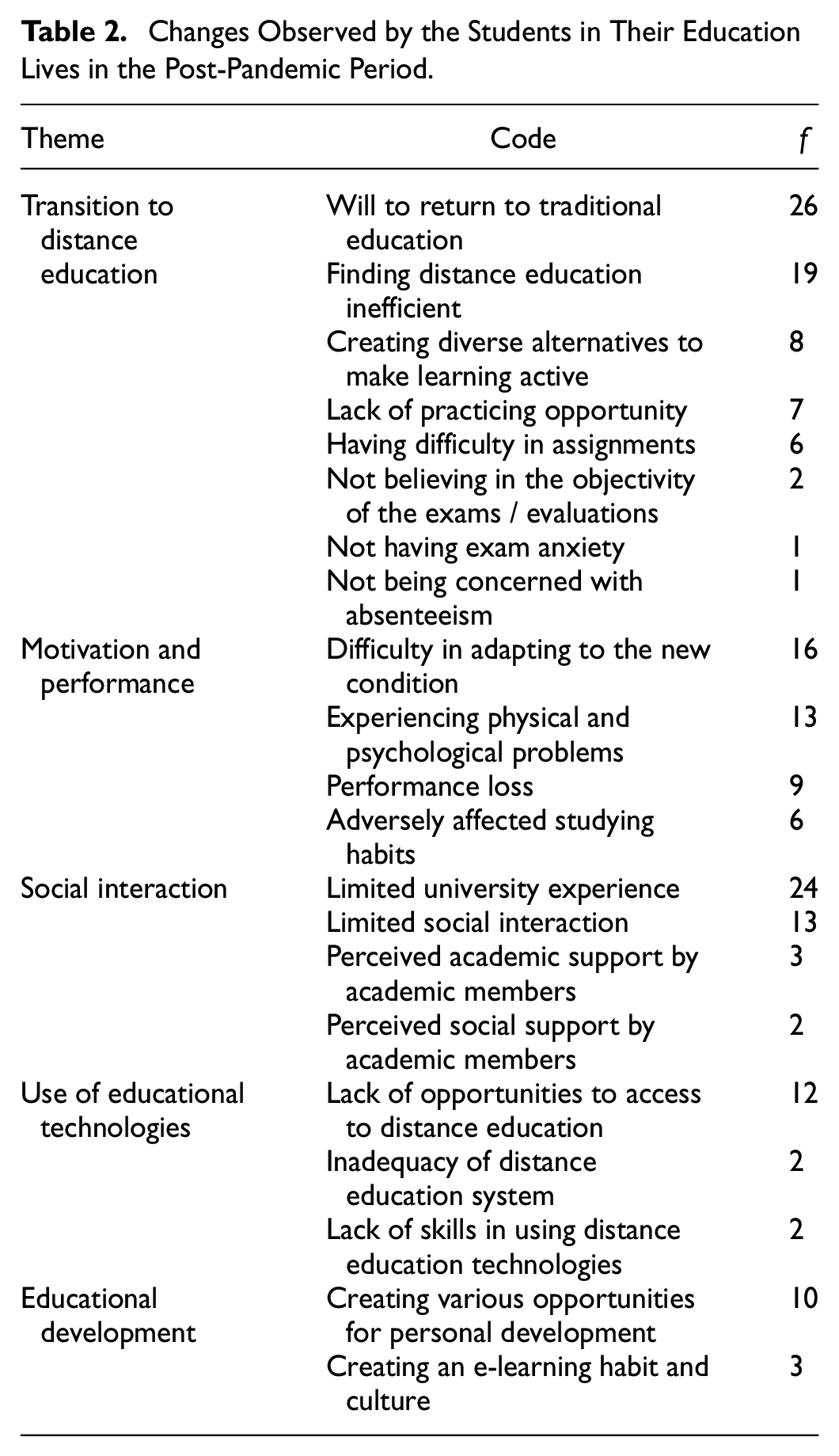
The opinions of the participants on the changes they observed in their education lives in the post pandemic period were categorized under five themes in Table 2 as “Transition to Distance Education,”“Motivation and Performance,”“Social Interaction,”“Use of Educational Technologies” and “Educational Development.”
Examining the obtained findings in terms of students’ observations related to changes in their educational lives in the post-pandemic period, the most frequently uttered view is understood to be students’ wills to return to conventional education. Students’ finding distance education inefficient is also among the frequently uttered views. For example, S4, one of the participants underlined his/her will to return to conventional education as follows: “Currently, we cannot do the things that we were doing before this period as easily. I want to return to the education life back in the pre-pandemic period as soon as possible.” Moreover, S28 expressed this need as saying the following: “I want to return to face-to-face education as soon as possible. I would study for my exams along with my friends, we would help each other in exam subjects, and sit side by side using the same pencils. When we were done with studying, we would give a hug to each other and leave. We would go to libraries; we would share our books with each other and we wouldn’t have any slightest doubt or fear in mind.” One of the students who found distance education inefficient expressed his/her opinion as follows: “In my opinion, distance education was, of course, not so good as going to school and listening to the relative lesson live because even though distance education has been a good solution for now, I think that it has not really helped in our learning well enough.” In this regard, S15 stated the following: “Face-to-face education was very efficient. Many methods such as lecture, question-answer technique, drama and brainstorming were applied during the class. We had more fruitful education life considering the fact that we had the opportunity to talk about the subjects we did not understand or know face-to-face with our instructors and friends.”
In contrast, it was seen that some students mentioned that they had various opportunities to make learning effective. Nevertheless, students also expressed their discomfort on being unable to have the opportunity to practice. On the other hand, considering that students receive theoretical education in their first year regardless of their department, their complaints about the lack of practice during lectures are considered to be unfounded. S13, who expressed opinions under this theme in relation to development of various alternatives to make learning effective, stated the following: “Another situation required by the pandemic is seminars’ being broadcast live on social media applications such as Instagram and YouTube, which, I think, is the biggest feature earned by the pandemic because seminars were held in different provinces each and due to limited quota and expenses incurred, our access thereto was not easy. However, as the live broadcast is on the platforms which everyone can access easily, this situation has affected us positively. We can have the opportunity to listen to life experiences from people we may otherwise not know in our lives at all.” On the other hand, S22 expressed that the education in questions did not provide the opportunity to make practice as saying the following: “Apart from these, I had courses progressing with practical applications, in which we would make acquaintances with the individuals working in the institutions that we paid visits to. However, these visits were suspended due to the outbreak of the pandemic.”
On the other hand, it was observed that students did not believe in the objectivity of the evaluations made and pointed out to the difficulty of the assignments. It was also seen that some students addressed the lack of test anxiety and concern about absenteeism as important and positive change. For example, S5 stated the following in this regard: “Results of some assignments surprised me pretty much because I had a very unexpected result for an assignment on which I spent all most all of my time. I went to the pieces necessarily. Plus, some instructors gave the same grade to all the students, which was also surprising. The class average was the same as the grade given by the instructor. I think that this is unfair. If everybody was supposed to get the same grade, why did some of us bother to spend days on an assignment while others copied and pasted the contents? Such cases affected me very negatively and changed my points of view on certain matters.” In addition, S9 expressed his/her views related to the lack of test anxiety as follows: “As we have done assignments instead of taking exams during this period, I think I managed to express myself better since I get nervous unavoidably during exams and no matter how much I study, I forget most of the stuff during exams. However, as we are graded based on assignments during this period, I feel more comfortable and I believe I can prepare my assignments more properly.” Under this theme, it was also observed that students expressed their views in relation to their lack of any concern about absenteeism. To illustrate, S1 expressed his / her views in this regard as follows: “To be honest, we were happy not to go to school. We thought that there was no need to wake up early, do presentations, no more absenteeism, no classes… it sounded good at first when you put the situation this way.”
Another matter frequently raised by the students is associated with their motivations and performances. Students emphasized that they experienced performance loss and their studying habits were adversely affected while they were having difficulty in adapting to the new conditions and dealing with physical / psychological problems. For example, S5 explained his/her challenge to adapt as follows: “I hardly adapted to the quarantine period. I always wanted to sleep at home, and I did not want to study for the lessons, at all. I thought that doing assignment would be easy, but I was quite wrong. This transition was very difficult for me. I had already difficulty psychologically for some time and when this situation was combined with the assignments, the period became very hard. I tried to do everything I could to avoid falling into the void.” Moreover, S3 pointed out the problems s/he had been physical and psychological problems by stating the following: “I could not perceive the distance education psychology and I was confused. While I was doing my assignments, I was nervous, worried, I wondered about whether I could answer the questions asked by the instructors. In terms of education, I was affected by the pandemic as a student. The worst part of this period was going through worrisome, stressful times.” S29 underlined the changes her studying habits and expressed/her studying habits and expressed his/her views as follows: “As the subjects were uploaded on the system in the format of presentation slides, there were some points that I did not get thereon. I did not attend the classes as I found them boring. During that period, I missed the classes most of the time. My studying habit was thoroughly disturbed. At times, I started my assignments at night in order to do them in a longer period of time and easily.” Performance loss is also among the matters specified by the students. For example, S25 explained his/her views in this regard as follows: “During the first weeks, I was not able to wake up for the classes because of the fact that there was not face-to-face education and with the permissiveness of home environment and most of the time I forgot about the class hours. I even did not want to study Obviously, distance education was not even any close to the education at school in terms of efficiency, the classes were not so efficient as was required. For me, studying the lessons by looking at the slides by myself was also very difficult in distance education.”
Another issue raised by the students under this theme is students’ struggles with limited university experience. To illustrate, S12 mentioned his/her views in relation to the limited university life as below: “We had a studying habit and course schedule before the pandemic. Education was fun and beneficial. Most importantly, face-to-face exams were better because there was at least the support of the instructors and friends, and I knew then on which areas and subjects I should focus and studied accordingly.” The findings have revealed that even if limited social and academic interaction strained students, limited number of students received social and academic support from instructors. S21 explained his/her views in relation to the perceived academic supports as below: “In the classroom groups where our instructors did also attend, we discussed the assignments and talked about the jobs for our future. The instructor recommended us live conference broadcasts so that we could learn more about our profession.” On the other hand, S2 expressed his/her views in relation to perceived social support as follows: “We watched the broadcasts recommended by our instructors and started to discuss with our friends our profession and details about what we were going to do. We tried to continue our education and develop ourselves through video conferences or teleconferences with our instructors and friends.”
Another subject that students frequently mentioned is related to the use of educational technologies. Lack of opportunities to access to distance education and lack of skill when using technology were among views that were often expressed. It was understood that students familiarizing and improving themselves with educational technologies and creating a culture of education became even more important in the age of information. Some of the examples from the participants’ views have been provided below: In relation to the code “Distance education was very challenging for me, I had to both work and keep up with the system at the same time. I had much difficulty in logging in the system because I worked, I experienced problems related to internet connection and to uploading assignments and following the forms.” (S19). In relation to the code “While it is easy to understand subjects if we learn them in face-to-face education, understanding them through the files uploaded is difficult. We can ask the questions to the instructors by means of forms if we do not understand them, but as we receive their answers in writing, it is still difficult to understand.” (S24). In relation to the code “As I don’t necessarily do any of my assignments online normally, I haven’t had the necessary knowledge, so it has been challenging.” (S29).
Students also explained that distance education allowed for self-development. For example, S21 expressed his/her views as follows: The instructor recommended us live conference broadcasts so that we could learn more about our profession.“ We started watching such broadcasts to be more informed of our profession and discussing with our friends our profession and details about what we were going to do. We were distant from each other but still we tried to do something. Even though the pandemic rendered face-to-face education almost impossible, we tried to continue our education and develop ourselves through video conferences or teleconferences with our instructors and friends.” The findings have demonstrated that students expressed that distance education helped them gain knowledge on e-learning and provided alternative learning opportunities for both field and non-field knowledge acquisition. To illustrate, S13 expressed his/her views in this regard by stating the following: “Another situation required by the pandemic is seminars’ being broadcast live on social media applications such as Instagram and YouTube, which, I think, is the biggest feature earned by the pandemic because seminars were held in different provinces each and due to limited quota and expenses incurred, our access thereto was not easy.”
Student Observations on Changes in Themselves
The themes and codes obtained from student views on their observations related to the changes in themselves in the post-pandemic period have been provided in Table 3.
Changes Observed by the Students in Themselves During the Period Following the Pandemic.

The views of the participants on the changes they have observed in their social lives have been provided in Table 3 under two themes, namely “Behavioral Changes”’ and “Emotional changes”.
The most astonishing finding regarding the changes students observed in their educational life after the pandemic has been the behavioral and emotional changes students experienced. In relation to behavioral changes, students frequently mentioned struggling with having a limited social life. Frequency of views mentioning changes in their social behavior and the increasing use of social media/electronic communication devices is also noteworthy. S13 expressed his/her views in relation to limited social life by stating the following: “I made cookies, pastries, pies at home. I had video / audio conferences with my friends. We did not make ‘home visits’, which is, in fact, a tradition during the eids, because a lockdown was declared. Instead of home visits, we had video/audio conferences. We said ‘happy eid’ to our relatives on the phone for the very first time. We had conversations with the neighbors from balconies to balconies, whose places we went to in order to drink a cup of tea together before the pandemic.” S30, on the other hand, pointed out to the changes in social behaviors by stating the following: “We have started to wear masks if we are to leave home and we have started to be more cautious about hygiene rules than the time before the pandemic. When we were out, we tried to maintain social distance between us and others. We eliminated our culture of hand shaking. We did not make home visits unless we had to.” S11 expressed his/her view below in relation to the increase in use of social media and internet: “In order to be aware of the developments, the interest in social media has increased greatly. “We have started to wear masks if we are to leave home and we have started to be more cautious about hygiene rules than the time before the pandemic. It was also observed that students pointed out to their increased responsibilities, as well. To illustrate, S9” My mother is a housewife; she deals with the stuff at home and I try to help her.”(S7) “My major activity at home is cleaning and helping my twin in studying. My mom cooks and I lay the table and we eat altogether. Then, I tidy up the kitchen and go to sit in the living room.” S14, who pointed out his/her longing for pre-pandemic period, stated the following: S7, who underlined that they were able to spare more time to themselves, stated the following: “At odd times, I tend toward developing myself and reading books, I have noticed that the more I read and the more I do research, I learn many more things about my department. In particular, I pay attention to watching movies and documentaries and to reading books suggested by our teachers.”“I look forward to the day when the COVID-19 virus has been eliminated and we have returned to our old activities, and we can do what we want.” expressed the following
Students also expressed that they postponed their plans, had problems related to self-regulation, had increased responsibilities and used internet more frequently. S7 explained his/her views about postponing the plans as follows: “I had a plan with my friends to go on a holiday in Summer, but I don’t know if it is a reasonable idea to go on a holiday in such a period.” (S17) “Although I made many plans with my friends, we were not able to implement any of them. I wanted to go abroad, but I couldn’t due to the closure of border gates.” S2 expressed his/her views about the difficulty in self-regulation as follows: “I was well-nourished and fit before the pandemic. I used to be able to eat more and have a regular sleep pattern. As I felt good, I accorded more importance to myself. The pandemic affected my sleep pattern quite negatively. I have started to eat unhealthy food, and in the meantime, it has also caused headache and body aches.” (aaa-sil)
Students also addressed emotional changes as well as the behavioral ones. The most frequently expressed view in this regard is related to their struggle with health concerns. For example, S1 explained as below: “Just like everyone else, we started to wonder ‘what if’. Let alone the distant people, we started to doubt about even the closest people to us such as our family members and friends. We had a fearful approach all the time, well even we did not even approach them. We looked at the people passing by outside fearfully because our lives were at stake, which was not something petty.” In addition, students underlined the change in mood, as well. S1 explained his/her views about it as follows: “We had a fearful approach all the time, well even we did not event approach them. We looked at the people passing by outside fearfully.” It was also found out that there were students expressing that they had the opportunity to know themselves better since they were alone with themselves. To illustrate, S2 expressed his/her view as follows: “Above all, I got back to and tried to get to know myself. I’ve learned my expectations and contemplated my future goals. I have tried to learn my expectations from the life and I have constantly questioned myself about where I see myself in the future.” Addressed as a whole, student views related to behavioral and emotional changes can be interpreted that students made efforts to adapt to changing order.
Student Observations on Changes in Their Family Lives
The themes and codes obtained from student views on their observations related to the changes in their family lives in the post-pandemic period have been provided in Table 4.
Changes Observed by the Students in Their Family Lives During the Period Following the Pandemic.
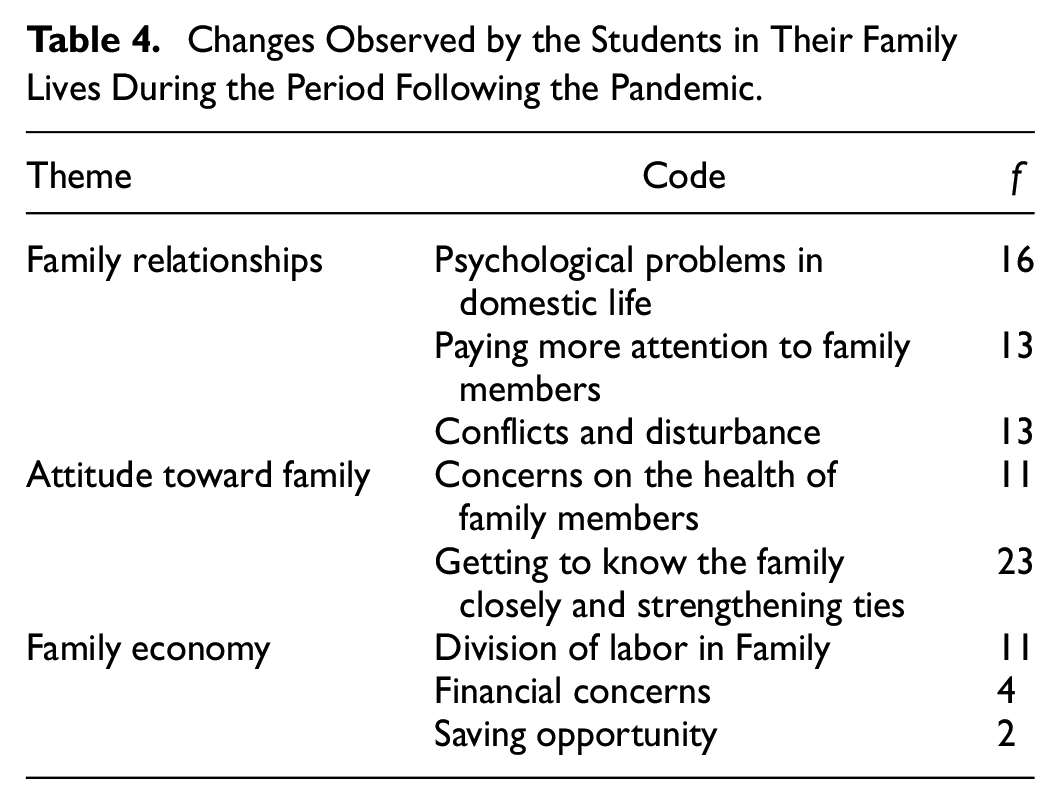
The most striking finding in relation to the changes in family life is students’ views on psychological problems they went through in domestic life. For example, S1 expressed the following: “It is like we have been caged within four walls; yes, it is necessary for our health, but not necessarily for our mental health.” In addition, S2 stated in this regard the following: “Before the pandemic, I was in a better condition both in terms of psychological and spiritual health than I am in now.”
Although some students stated that they paid more attention to family members, others expressed that there were conflicts and uneasiness at home. For example, S11 underlined that s/he took care of family members: “The major change in my life after the pandemic is that we need to pay attention to our loved ones and hug them tightly and cherish the moments we are together.” On the other hand, S18 stated the following: “When I stayed at home with my parents, we had many quarrels. As we were at home and the system was very different, we were all nervous and had frayed nerves. So, anything was annoying for everyone.”
It has also been observed that students pointed out to their concerns about the health of the family members, the opportunity to get to know the family closely and the strengthened bonds. Underlining the health concerns about family members, S1 stated the following: “During the spread of this disease, the fear of getting sick and of death was one of our primary fears. The fear of losing our loved ones hit us like a slap in the face once again to appreciate their values.” In this regard, S7 explained that their family bonds were strengthened, as saying the following: “We have become closer to each other in the family, my parents give a lot of advice to me and my sibling. As we are all constantly at home, we spend more time together. In fact, during this period of time, the home is what we all have, we have started to spend more time together.”
Findings also revealed students views on family economy. It was seen among the students, who underlined the division of labor in the family, that they addressed their concerns about livelihood, as well. S1 pointed out to the division of labor in the family by explaining the following: “We plant and mow in the greenhouse in front of the house, my sister and I knit, I also make some drawings. So, time passes very well.” S1 also underlined his/her financial concerns by expressing the following: “If my father does not engage in agriculture, which is our livelihood, he cannot make money. So, my parents have become so stressed. They have worried about what if the crop in the field dries up, how they are supposed to generate income, what they should do etc.” Some students explained that they saw this process as a saving opportunity. For example, S13 stated the following to underline his/her views in this regard: “Another positive effect of the pandemic was its role in saving. Thanks to the scholarship I received, I saved money and managed to buy a laptop. My expenditures, which incurred due to the fact that I spent money lavishly before the pandemic, was ipso facto restricted with the pandemic. Lack of social life contributed to the decrease in the expenses on clothing and junk food to a minimum.”
Discussion and Conclusions
With the COVID-19 pandemic, a rapid transition has taken place from traditional education to computer-assisted distance education. Even if online distance education is not a novelty for some of the universities, for the majority, it is a method taken up without adequate preparations (Khan, 2020). As a matter of fact, it is possible to state that the main purpose of this rapid integration of technology into education is to sustain education with minimum loss without any interruption, considering the fact that the Higher Education Quality Council of Turkey defined the first actions taken in parallel with the pandemic as “emergency distance education” (Higher Education Quality Council, 2020). As the transition took place without necessary time allocated therefor, it was not possible to get prepared for the quality education and educational technologies (Carey, 2020). However, one of the main factors determining the quality of education in distance / online education is the quality of educational technologies employed (Gilani, 2020). Indeed, with this research study, it has identified that the students provided their views related to the inadequacy of distance education system. Moreover, it has been determined that students from undeveloped, remote and rural areas had problems with access to distance education such as poor Internet connection, lack of equipment and even power blackout. It is not possible to ignore the determining effect of the returns of socioeconomic status on distance education. As a matter of fact, this situation may lead to consequences such as students’ taking a dislike to online / distance education and program dropouts (Owusu-Fordjour et al., 2020). In addition, it has been observed in this study that students also emphasized their lack of knowledge and skills in using distance education technologies. Studies have shown that this situation negatively affects the evaluation made by students on distance education (Antalyalı, 2004).
The efficiency of online distance education depends on the course content, educational methods and the extent of the engagement of the instructors and students in online climate and interaction (Bao, 2020). In this study, the students criticized that they had doubts about the objectivity of the evaluations made on online distance education, that they did not have the opportunity to practice, and they found distance education inefficient because they had difficulties in assignments. Since universities do not have the infrastructure to handle this rapid transition, it has been observed that they frequently share written course materials on distance education management systems (Saltürk & Güngör 2020). It can be considered with this study that the factors that cause students to act with suspicion when it comes to distance education stem from the nature of the application method of the distance education. In a study examining student views on distance education at the international level, it was determined that students pointed out to the live (synchronous) and webinars as the most efficient online application of distance education methods provided that they did not have difficulty in accessing educational technologies. (Aristovnik et al., 2020). Furthermore, it has been also determined that students stated their views on the positive aspects of the distance education such as not having exam anxiety, not being concerned with absenteeism and its creating alternatives to make learning active.
Student views have been examined under education, family and individual lives in the period following the pandemic in this study that aims to explore the experiences of the university students related to social distancing and transition to distance education during the pandemic. In terms of educational life, it is observed that students want to return to face-to-face education, and in parallel thereto, they find distance education inefficient, have difficulty in adjusting to the new order, have psychological problems, their studying habits have been adversely affected and they experience performance loss, which are similar to the reasons that Bozkurt et al. (2020) found out in their studies on the psychological effects of the pandemic. In addition, it is understood that they are deprived of social interaction because they have been separated from the university environment. It stands out that there are students who provided their views on the lack of opportunities to access to distance education. On the other hand, students stated that distance education period created opportunities for their personal development. Considering the fact that it is foreseen that in the near future distance education will become the main form of education (Telliä & Altun, 2020), although it has gained momentum following the pandemic, instead of being an (idle) alternative to or a complementary method for face-to-face education, it seems that the situation of the students in such a case may be more worthy of attention.
Limited social life, changes in social behaviors (social distance, not shaking hands, distant communication, etc.), devoting more time to personal development and themselves have been the leading behavioral changes observed by students. It can be stated that health concerns and longing for the period before the pandemic may cause the changes in mood. As for the domestic life and family life, it can be stated that the students suffer from conflicts, tension, and psychological problems in their domestic lives. It is seen that the ties among family members have become stronger and students have contributed to the division of labor in the family during the pandemic. During this period, as informed by the students, they have experienced psychological problems as well as conflicts and disturbance in their family relationships, led mainly by staying home. Many studies (Ünal & Gülseren, 2020) and numerous news (BBC News, 2020; HaberTürk, 2020) exist setting forth that cases of domestic conflicts and violence have increased during the period following the pandemic. On the other hand, it has been observed that family members started to care more, contributed to the division of labor, did various activities and chores together at home and that their family bonds strengthened. Karakaş (2020) states that longer period of time spent at home increases closeness among the family members through ensuring the participation of the family members in the division of labor.
Recommendations
The most important constraints of this study are as follows: The data were (i) collected only from the first year students (ii) in the early stages of the pandemic, and (iii) the sample examined was small-scaled. In future studies, data can be collected at different times depending on the course of the pandemic, larger-scaled samples can be studied on, and the metaphors produced by the students regarding the effects of the pandemic can be examined in order to examine their experiences in more depth. A study conducted in the United States shows that students who have just started higher education have put their enrollment on hold until they return to face-to-face education in order not to miss student life experiences (Johnson, 2020). Within this context, the views of senior students can be examined in future studies and a comparative study can be carried out regarding the school / program drop-out rates.
Recommendations made to the implementers can provide a basis for future studies just as researchers do. As a matter of fact, even though the COVID-19 pandemic caught many educational institutions unprepared, this situation proved the need for having emergency recommended solutions and preventive work at the ready in the future. In this context, taking the conjuncture the country is in into account following recommendations can be made:
Selective closure of schools based on case numbers instead of closing them all entirely
Accelerating hygiene, control, social distancing, etc. work to keep schools open
Conducting infrastructural work in schools in accordance with the needs of distance education
Constructing access centers for online education that respect public health rules in order to close the digital gap and help disadvantaged groups
Restructuring existing digital resources and human capital in order to minimize loss of learning
Footnotes
Annex 1: Examples of Interview Questions
What are the changes you have observed in your education life during the period following the pandemic?
What are the changes you have observed in yourselves during the period following the pandemic?
What are the changes you have observed in your family life during the period following the pandemic?
Annex 2
Declaration of Conflicting Interests
The author declared no potential conflicts of interest with respect to the research, authorship, and/or publication of this article.
Funding
The author received no financial support for the research, authorship, and/or publication of this article.
Research Ethics and Participant Consent
The research was approved by Scientific Research and Publication Ethics Committees of Afyon Kocatepe University (Date: 12.10.2020 and Decision Number: 2020/165). Additionally, participants provided verbal informed consent.
