




Abstract
This article aims to evaluate the impact of cluster characteristics, including cooperation and information sources, on the innovative performance of companies in the health sector in Colombia. It analyzes how collaboration and knowledge exchange within clusters affect innovation outcomes and provides information on their role as mechanisms to foster competitiveness and enhance innovation in the health sector. An ordered multinomial logit model was used, where the dependent variable was the innovative performance of companies in the health sector, classified into four categories: intention to innovate, initiation and abandonment of the innovation process, and innovation for the national and international market. Explanatory variables included aspects of cooperation and sources of information. The Survey of Development and Technological Innovation EDIT VI, conducted by the National Administrative Department of Statistics of Colombia, was used to collect data from 408 companies in the health sector in Colombia during the period 2016 to 2017. The research findings suggest a positive relationship between cluster formation and companies’ innovative performance in Colombia’s health sector, observed in business cooperation and sources of information. In addition, these characteristics of the cluster promote innovation at different levels, from the initial intention to the achievement of innovations for national and international markets. This article contributes to the literature by generating knowledge about the role of dual causality variables as mediators between effort and innovative success in health service companies. It will also have managerial and social implications, serving as an input for strategic decision-making and the design of public policies promoting sustainable innovation.
Introduction
Innovation is widely recognized as a critical driver of economic growth, particularly in developed economies, due to its significant contributions to creating new products and services within regional and global markets (Díaz & Guambi, 2018). This transformative process is essential for enhancing organizational efficiency and productivity (Álvarez & Morales, 2021) but is also correlated with heightened dynamism within the economy, ultimately leading to elevated growth and development metrics.
In Colombia, a nation striving to improve several development indicators, empirically assessing the country’s innovative performance is imperative. This can be achieved through a cross-sectional model that categorizes firms based on their innovative capabilities, ranging from low to high performance. Such an analysis will facilitate the identification of elements that enhance or inhibit the generation of innovations, thereby addressing potential undervaluation or overestimations.
Despite its profound importance, Colombia’s current landscape reveals that innovation is not yet fully realized. Much of the innovation within the country tends to prioritize the local market over international markets, with many enterprises refraining from any innovation whatsoever. Consequently, fostering a national dialog encompassing diverse sectors and economic actors is essential to address these challenges (Castro & Méndez, 2019). Additionally, the contribution of innovations to value creation must be emphasized (Navarro & Rojas, 2011, p. 9).
Several factors contribute to innovation across various industries, including investments in research and development (Benavente, 2005; Buesa et al., 2002) and the size of organizations (Bos et al., 2011), both of which exert a significant influence on innovative outputs. A more granular examination of individual organizations reveals that these determinants can impact innovation differently based on the nature of the products or services offered or the specific needs of each subsector. Certain organizations may deprioritize innovation, particularly for the international market, reflecting the unique characteristics and operational requisites of individual industries alongside the target demographics of the organizations.
The presence of clusters justifies further investigation, as these entities facilitate the concentration of companies, research institutions, and specialized service providers within specific locations. Exploring how these interactions foster collaborative innovation can yield valuable insights into developing new products, services, and medical solutions. Furthermore, it can elucidate strategies for reducing research and development costs, enabling organizations to allocate more significant resources to innovative endeavors. Understanding the influence of infrastructure and shared resources within clusters on innovative performance can uncover effective approaches to bolster competitiveness and sustainability among sector companies. Additionally, studying the impact of clusters on attracting innovative talent, entrepreneurs, and venture capitalists can provide critical insights to strengthen the healthcare innovation ecosystem.
Innovation in the human health sector directly impacts improving people’s quality of life and well-being. It has significant implications for global public health. At the industrial level and under the formulation of public policies, governments and institutions provide information on the innovative performance of companies in the human health sector. This information helps create more effective policies and design support programs that maximize clusters’ economic and social impact. In conclusion, investigating the effect of cluster creation on the innovative performance of companies in the human health sector is academically relevant. Still, it can also have important practical implications for improving companies operating in this vital sector’s competitiveness, sustainability, and social impact.
On the other hand, government policy decisions aimed at enhancing or leveraging innovation processes in organizations are typically based on factors that apply to all types of organizations. Some distinguishing elements may include the level of investment, the percentage of gross domestic product utilized, and the human capital employed, among others.
The health sector plays a crucial role in the Colombian economy. It affects job creation, the type of services provided, and the overall population. Therefore, it is necessary to study the innovation within the sector, with explanatory variables of the innovative performance of organizations offering health services. Considering the characteristics of a cluster and how it impacts industrial policy and economic development. Two main groups are categorized: cooperation and sources of information. Cooperation includes dealing with obstacles, accessing resources and donations, collaborating with companies in the same group, and collaborating with suppliers. Meanwhile, the sources of information involve interaction with companies in the same group, suppliers, and chambers of commerce.
This study uses quantitative research with a correlational component to evaluate the impact of clusters on innovation in Colombia’s health sector. The goal is to assess the level of innovation by estimating an ordered multinomial logit and then calculating the marginal effects of each performance. The statistical description indicates that innovation in the health sector is still in its early stages in Colombia, with most companies making innovations in a broad sense rather than in a strict sense. Therefore, it is essential to conduct research that explains how to make innovation a driving force for the country’s growth and socioeconomic development.
The study’s originality lies in its being the first to use ordered multinomial models for Colombia that measure the impact of cluster formation on innovative performance in the health sector.
The document is organized as follows: In the literature review and hypotheses section, the existing literature on innovation, clusters in the health sector, and their hypothesis is analyzed; in the Methodology section, which includes the variables, the choice of the model, and the specification of the model instilling confidence in the robustness of our research process.; in the Results section, the findings are analyzed, and sections 4 and 5 present the discussion and conclusions.
Theoretical Framework
Clusters
Clusters are interconnected and geographically concentrated business groupings comprising suppliers, companies, and institutions involved in a specific activity (Baena et al., 2006; Porter, 2003); they are designed to enhance competitive advantage by reducing costs through proximity to suppliers and customers, fostering knowledge creation and exchange (Shakib, 2020), and promoting increased innovation, collaboration, and ties within businesses and regions (Cappiello et al., 2020). They involve government agencies, universities, regulatory bodies, study centers, suppliers, trade associations, training, education, research, and technical support, resulting in high-quality economic growth, development, and productivity (Baena et al., 2006; Mittal et al., 2020).
The formation of clusters enables collective actions to enhance overall efficiency; productivity within clusters tends to be higher than in other sectors due to the complementary nature of activities rather than a competitive environment. As a result, there is interdependence among cluster participants where the success or failure of one business can significantly impact others. This underscores the importance of synchrony and commitment among the companies involved (Mahendran et al., 2020; Rodríguez, 2012).
Relevant aspects such as geographical proximity (territorial dimension), business cooperation networks (cooperative dimension), and institutional networks (sectoral dimension) must be considered when forming a cluster (Iordache et al., 2010). However, Piotr (2010) stated that the importance of certain factors varies depending on the cluster’s development phase.
In a cluster, key relationships, relevant complementarities in technology, production, marketing, knowledge and information, marketing, and customer needs can be better observed and captured (Chen et al., 2021; Porter, 1999); in short, belonging to a cluster generates competitive advantages for companies over those that do not belong to it (Cappiello et al., 2020).
Innovation
Innovation is considered an element of high importance in the generation of growth and economic development. It helps create new products and services for national and international markets, leading to positive impacts. It also improves organizational efficiency and productivity, fostering greater innovative achievements. This creates dynamism in the economy, resulting in higher growth rates and overall economic development, ultimately benefiting all members of society.
Since Colombia is a developing economy, there is a strong interest in examining and understanding the country’s progress in organizational innovation and overall development. This includes empirically investigating the factors that foster environments conducive to innovation and identifying elements that may be overestimated or do not have the same level of impact.
Joseph Schumpeter (1942) discussed the concept of innovation, explaining that “creative destruction” propels economic development; this process involves technological change, accelerating economic growth through competition between firms. Ultimately, this dynamic leads to increased economic development and higher growth rates, all driven by innovation (Jaimovich, 2020; Mohamed et al., 2022). Also, innovation implies new knowledge to offer to the market (Geizzelez & Linares, 2016; Liu et al., 2020).
In short, innovation is a tool that entrepreneurs use to create wealth, leading to greater competitiveness and profitability (Eggers et al., 2020; Nemlioglu & Mallick, 2021; Drucker, 1985, cited by Formichella, 2005; Jaramillo et al., 2000). Innovation activities represent a series of scientific, technological, organizational, financial, and commercial steps driven by investment in R&D (OECD, 2002; Raffo et al., 2008).
Innovation performance indicators encompass the introduction or non-introduction of new products and processes, the percentage of sales of new products (Hu et al., 2020; Purchase & Volery, 2020), and intellectual property protection (Mairesse & Mohnen, 2010; Reznakova & Stefankova, 2022). In other words, innovative performance depends to a large extent on the innovation capital of the industry and the characteristics of the environment (Benito et al., 2012; Fernández & Valle, 2018; García, 2021). The level of knowledge of human resources facilitates the learning and creation of new technologies, establishing a relationship between technology, training, and competitiveness (Águila & Padilla, 2010; Bernal-Jiménez & Rodriguez Ibarra, 2019; Langeback & Vásquez, 2007; Leal Morantes, 2012).
In summary, this research embraces the definition of innovation proposed by the National Administrative Department of Statistics of Colombia, which defines it as “any new or significantly improved service introduced into the market; any new or significantly improved processes introduced into the company; or any new organizational method or new marketing technique introduced in the undertaking” (DANE, 2016, p. 1).
Innovation in the Health Sector
In Colombia, activity related to human health includes short- or long-term hospital activities, general and specialized hospitals aimed at patients (Dirección de Impuestos y Aduanas Nacionales, 2020), and innovation in the subsector is important because “this characteristic has a significant impact on the market behavior and institutional behavior of the agents providing goods and services necessary to improve or preserve the health of the population” (Katz, 1995, p. 311). As a result, organizations that create new or improved goods and services generate income through innovation, which allows them to initially offer the product or service to a small group of people who can afford it. Over time, the price decreases, making it accessible to more people, and this price reduction indicates an improvement in the quality of life. For this reason, organizations in the sector need to consider innovation as a growth engine for their industry and a mechanism for economic development, reflecting that they can balance people’s needs and have more equitable systems.
This investment, together with competitiveness, implies and ensures the functioning of organizations over time, creating a link between sustainability and business (Arana & Ballesteros, 2016; Barrera et al., 2022), even more so when it comes to services associated with human health, for which an innovative effort must be constantly represented in R + D spending and the opening of national and international markets that give visibility and recognition to the work carried out.
Innovation also reduces the gaps between developed and developing economies, as it not only increases productivity per worker but also increases knowledge in the population, which is transferred through the goods, services, and processes generated (Dueñas-Ocampo et al., 2021; Gallego et al., 2015). The lack of innovation will always keep developing economies relegated and dependent on developed economies.
Considering that the engine of growth and economic development of a country is highly associated with the production of new knowledge and that this, in turn, is highly correlated with the efforts made by organizations to create new and improved elements, such as spending on R + D, implies for companies the creation of relationships with actors external to the company. The opening of markets, access to information, internal capabilities, education and training, and understanding of the environment surrounding the company, among other benefits, can be materialized through the conjunction of clusters.
Particularly in organizations in the health sector, innovation itself, innovation adapters, the organization’s communication mechanisms, the organization’s internal and external context, the implementation and sustainability process, and the links between the aforementioned components influence the success or failure of innovation implementation (Ortega & Quiroz, 2020).
Thus, the relationship between these components explains that a health organization obtains innovations and can remain over time; from the above, it is possible to consider these elements as determining innovation factors. Along the same lines, the factors that determine innovation, both internal and external, are highlighted: the importance of human talent, financial resources for research and development, and public policies (Terán Rosero et al., 2017).
Some estimates of innovation through logistical regressions measured the innovative effort of the organizations, defining as determining factors the schooling, cooperation with other companies, the age in years of the company, the sources of knowledge, the type of financing, the existence of an R + D department and the link with the external sector measured through exports, among others. It was found that the degree of linkage with other companies and the ability to relate and network with external agents ultimately determines the ability to generate innovation (Morales & Díaz, 2019; Sánchez Báez & Avancini Schenatto, 2017).
Similarly, it is observed that information reduces internal asymmetries in the company and reduces production costs by providing economic advantages, and companies must take the global information provided by different institutions as an advantage in the market (Igartua et al., 2018; Kamasak, 2015), thus, by having fewer obstacles to access information, on the other hand, reinforcing them together with those of management and external relations facilitates the transfer of individual knowledge at the organizational level, promoting the creation of knowledge and organizational innovation, (Debela Daksa et al., 2018).
Research Hypothesis
This research will analyze the expected positive impact of establishing clusters on innovative performance in the health sector for companies in Colombia. The study aims to understand and explain this phenomenon by constructing an empirical econometric model.
Studies suggest that clusters play a crucial role in fostering cooperation between companies (Alberti et al., 2021), creating environments conducive to innovation by fostering trust, reducing barriers, and promoting collaborative projects (Kowalski et al., 2023), collaboration and cooperation through clusters have an impact on innovative performance. Delgado et al. (2021) indicate that these collaborations are one of the primary mechanisms for accessing the experience of the innovation activities of other entities, which can occur through alliances and cooperation agreements; likewise, cluster collaboration has a positive impact on the expansion of open innovation, which translates into an improvement in business results (Kim et al., 2021).
Therefore, this study proposes the first hypothesis:
H1: Cooperation in cluster formation is positively related to innovative performance in the Colombian health sector.
H1a: The importance for the innovative firm of overcoming the associated obstacle of limited possibility of cooperation (Espoin) is positively related to innovative performance.
H1b: The receipt of cooperation resources or other national donations (Recodon) is positively related to innovative performance.
H1c: Cooperation with other companies of the same group or conglomerate (Coemgr) is positively related to innovative performance.
H1d: Cooperation with suppliers (Coprov) is positively related to innovative performance.
On the other hand, access to information sources is essential for knowledge transfer, and facilitating innovation; clusters promote knowledge exchange through dynamic networks (Alberti et al., 2021), and relationships within clusters expand access to information and knowledge (Grashof & Brenner, 2021), which generates higher levels of innovation, improving the competitiveness and performance of cluster members (Fioravanti et al., 2021), and promoting the growth and development of the health sector (Laimer et al., 2023), leading to the formulation of the second hypotheses.
H2a: The importance of information by the other companies in the group or conglomerate (Iminfo) is positively related to innovative performance.
H2b: The importance of information provided by suppliers (Improv) is positively related to innovative performance.
H2c: The importance of the information provided by the chambers of commerce (Imcaco) is positively related to innovative performance.
Methodology
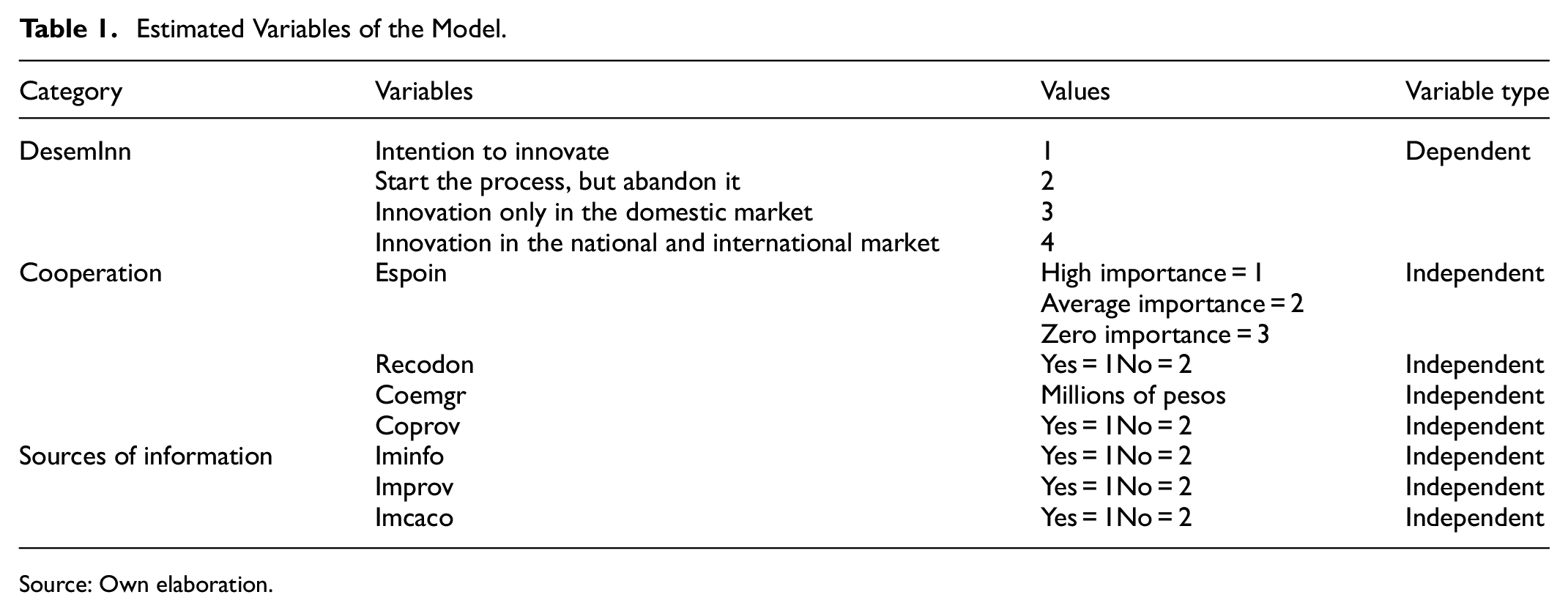
This research created an organized log to classify innovative performance on a scale of 1 to 4. A value of 1 indicates that the company intended to carry out innovation but did not, a 2 indicates that the company initiated an innovation process but abandoned it before completion, a 3 indicates that the company made at least one innovation for the national market, and a 4 indicates that the company made at least one innovation for both the national and international markets.
The independent variables were classified into two categories related to cluster formation. Competition is a strong emphasis in the study of companies and business development. However, competition also impacts communities, providing advantages and benefits for those associated with them. Ultimately, it serves as a tool for competitiveness in business environments.
Through a literature review, the factors influencing innovation within a cluster were identified. The review focused on business cooperation between stakeholders with shared goals of growth and sustainability, the sources of information they provide to firms, and their impact on business innovation. Therefore, control variables were not used.
For the first category, which focuses on cooperation, the following variables were included:
The significance of overcoming the obstacle of limited cooperation opportunities is critical for innovative companies (Espoin). Specifically, if a company does not view cooperation with others as an impediment, its innovative performance tends to improve. This supports the notion that collaboration between companies leads to greater innovative outcomes. In this context, the variable is assigned values of 1 if the importance of this obstacle is perceived as high, 2 if it is medium, and 3 if it is nonexistent.
Receipt of cooperation resources or other national donations (Recodón) is measured in millions of pesos. The operationalization of this variable suggests that the greater the monetary resources from cooperation, the better the firm’s innovative performance. These resources can be allocated to research and development, sustainability, communication mechanisms, and more.
Cooperation with other companies within the same group or conglomerate (Coemgr) is indicated by a value of 1 if there was cooperation and 2 if not. This operationalization implies that increased cooperation leads to enhanced innovative performance, resulting in greater achievements in efficiency and effectiveness in innovation production.
Cooperation with suppliers (Coprov) operates on the premise that this relationship positively contributes to the development of innovations within companies. It improves performance and generates new ideas related to enhancements in the production and quality of goods or services offered. This variable takes a value of 1 if cooperation exists and 0 if it does not.
In the second category, related to information sources, the following variables were included:
The Importance of Information from Other Companies in the Group or Conglomerate (Iminfo) highlights that organizations that place higher importance on information from affiliated companies tend to exhibit greater innovative performance. This variable is measured by assigning a value of 1 to information considered important and a value of 2 to information regarded as unimportant.
Importance of Information Provided by Suppliers (Improv) suggests that as the importance of information received from suppliers increases, so does the innovative performance. It is also scored with values of 1 for important information and 2 for unimportant information.
Importance of Information Provided by Chambers of Commerce (Imcaco) follows the same trend as the previous variables. It is expected that the greater the importance of information received from chambers of commerce, the better the innovative performance achieved.
Table 1 presents the variables included in the model proposed by this research. These variables were identified through a literature review focused on the significance of clusters in business innovation and the access to these insights through the EDIT survey utilized for this study.
Estimated Variables of the Model.
Source: Own elaboration.
Choice of Model
The observations gathered are cross-sectional, as they pertain to data from a specific year. This data reflects the total number of companies in the health sector that simultaneously responded to the questions posed in EDIT VI. The sample comprises 408 randomly selected firms in Colombia, with each firm being treated as an individual observation. These firms are assumed to be independently and identically distributed.
The dependent variable is discrete in nature and corresponds to a vector of random variables that take a limited and known value of values. In this case there are four ordered alternatives: first, those that had the intention of innovating (1); second, those that are potentially innovative (2); third, those that innovated in the broad sense (3), and fourth, those that obtained innovations in the strict sense (4). The set of explanatory variables are non-stochastic and are represented by a matrix where the i-th row expresses the information of the K exogenous variables corresponding to the i-th company.

The type of innovation conducted by firms, understood as the dependent variable of the model, is discrete and expresses several mutually exclusive ordinal alternatives. In this case, the dependent variable presents three problems. First, boundary occurs because probability predictions may not be within the range of (0,1). Second, discretitude, the dependent variable is a discrete non-continuous variable that takes absolute values. Third, it does not comply with the assumption of normality in errors, so the variance of errors is not constant; heteroskedasticity is present, so linear regression is not adequate to explain the particularities of this endogenous variable. The least squares method is not used in discrete dependent variable models for these three reasons.
Additionally, the maximum likelihood method, which consists of maximizing the likelihood function, allows solving the problems of bounding, indiscriminateness, and non-normality. This is why discrete dependent variable models are used. They also have the advantage that they do not require the assumption of normality in errors. However, the maximum likelihood estimators coincide with those obtained by the least squares method (Davidson & Mackinnon, 2004).
On the other hand, for Davidson and Mackinnon (2004) these choice models are useful when the decision of an individual, in this case a company, has different alternatives or possible non-quantifiable results. Still, if it is observable by assigning a result value of the veracity or not of a particular event, these models are classified into two. First, the discrete-choice binomial models used when the response variable is categorical and binary are modeled according to the cumulative distribution function: if it is Logistics, it will be a Logit model, and if it is Standard Normal, then it will be a Probit.
According to Cameron and Trivedi (2005), the second set of models is used when the dependent variable expresses three or more alternatives. In these situations, multiple choice models are applicable, and the specification can take on one of four types: multinomial (the alternatives do not express an order, and the regressors do not vary between the individual’s alternatives), conditional (alternatives do not express an order and regressors vary across the individual’s alternatives), nested (the response variable expresses at least two sequential decisions), and ordered (the alternatives of the variable of interest possess a natural order). The latter is the one that is being followed in this research.
According to Cameron and Trivedi (2005), when the dependent variable is discrete and ordered, the inclusion of information that provides the order of the possibilities that the dependent variable may have in the model specification allows better results to be obtained. Thus, this research specifies a cross-sectional regression model with a discrete dependent variable of ordered multiple-choice, so an ordered multinomial model will be used to establish the types of innovation of companies that offer services in Colombia.
Model Specifications
The innovative performance to be estimated has four possibilities with an intrinsic order, under the existence of a latent variable (DesemInn) that, although not observable, can be inferred by assigning values to each type of performance (Cameron & Trivedi, 2005).


The thresholds are equivalent to the different possibilities, that is, the limits



Where







The ordered logit is estimated as a logistic function where it is the cumulative distribution function of the errors

Maximum likelihood allows thresholds and estimators to be estimated together, maximizing the probability of obtaining an innovative performance, while the impact of the determinants is obtained through marginal effects (Greene, 2007).


Results
The sample followed by this research was composed of 35 companies that intended to innovate at some point but have not yet done so, 49 that started the innovation process but abandoned it without achieving positive results, 323 obtained at least one innovation in the regional or national market and one innovated in the global or international market. This provides a universe of 408 companies for the realization of the model. Figure 1 shows the percentages of firms that belong to each innovative performance as a dependent variable.

Innovative performance.
Figure 2 presents the results with respect to the independent variable, determinants of innovative performance, as follows, to the answer of the importance for the innovative firm of overcoming the associated obstacle of the low possibility of cooperation (Espoin), which takes values of 1 if the importance of this impediment is high. 2 if it is medium and 3 if it is zero; cooperation with other companies of the same group or conglomerate (Coemgr), which takes values of 1 if it had cooperation and 2 if it did not; cooperation with suppliers (Coprov), which takes values of 1 if it has had cooperation and 2 if it has not; the importance of the information by the other companies of the group or conglomerate (Iminfo), which takes values of 1 if it was important or 2 if it was not; the importance of information by suppliers (Improv), which takes values of 1 if it was important or 2 if it was not; and, the importance of information by chambers of commerce (Imcaco), which takes values of 1 if it was important or 2 if it was not.

Determinants of innovative performance.
As shown in Figure 2, the Coemgr, Iminfo, and Imcaco variables presented a negative response of more than 92%, and the Improv and Coprov variables had a negative response of between 70% and 90%.
Model Estimation
The equation to be estimated in the proposed model for the determinants of innovation in the health subsector based on the formation of clusters corresponds to:

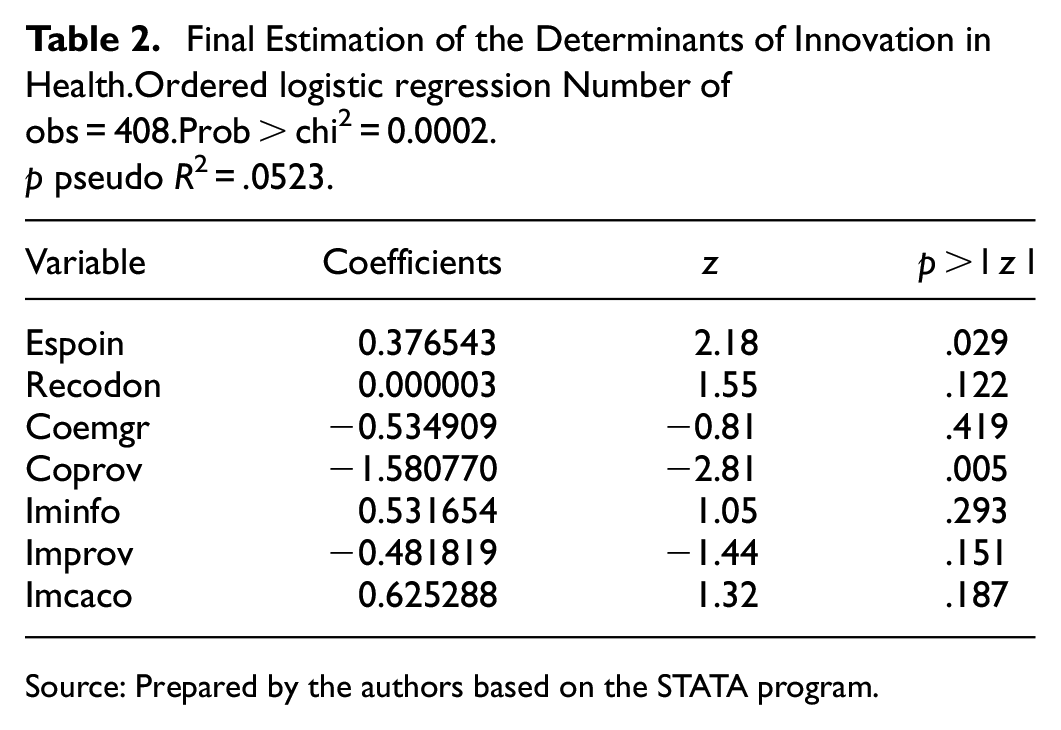
Table 2 presents the result of the ordered multinomial logit proposed to determine the impact of clusters on the innovative performance of companies in the health sector in Colombia for the period 2016 to 2017.
Final Estimation of the Determinants of Innovation in Health. Ordered logistic regression Number of obs = 408. Prob > chi2 = 0.0002. p pseudo R2 = .0523.
Source: Prepared by the authors based on the STATA program.
As can be seen in Table 2, using the Z statistic to check the statistical significance of the independent variables individually, the non-significant estimators with at least 80% confidence are cooperation with companies in the same sector and information sources from companies in the same industry. In contrast, the chi-square statistic (chi2) is observed using Wald’s test at the joint level of the entire proposed equation. obtaining (0.0002), which is less than a significance (α = .01); that is, the model as a whole is significant with 99% confidence, and it is possible to leave all the variables since together they help to explain the innovative performance.
The marginal effects of each innovative performance are calculated to assess the impacts on the dependent variable. This analysis determines the probabilities of an increase or decrease for each performance in response to changes in the independent variables. Essentially, it measures how a 1 unit increase in the value of each independent variable affects the innovative performance of the companies involved in this research.
As shown in Table 3, the probability of a company in the health sector intending to innovate is 7.03%. This means that out of every 100 companies in this sector, 7 have plans to innovate. Furthermore, regarding the independent variables, it is found that in the cooperation category, if an organization reduces the importance it places on the potential for cooperation with other companies in the same sector—from high to medium or from medium to low—the probability of that organization performing with the intention to innovate decreases by 2.46%, compared to the second variable, for each million additional pesos from resources from other companies in the sector or from donations, this probability decreases .02%. Compared to cooperation with other companies in the industry, when you go from having to not having it, this probability increases by 3.5%. In contrast, when you go from cooperating with suppliers to not doing so, the probability of this return increases by 10.3%.
Marginal Effects of Firms’ Intention to Innovate.Marginal Effects After Logit. Y = Probability (DesemInn = 1) (predict, p result(1)) = .07031.

Source: Prepared by the authors based on the STATA program.
Regarding the category of information sources, when a company with the intention of innovating goes from having information from other companies in the sector to not having it, its probability of being in this performance decreases by 3.47%, when the information comes from suppliers and goes from having it to not having it, the probability of this performance increases 3.15% and compared to the information of the chambers of commerce when it goes from having to not having it. This probability decreases by 4.09%.
The impacts of the independent variables of potentially innovative companies are shown in Table 4. The probability that a company in the health sector is potentially innovative is 10.9%. When an organization of this kind decreases the importance it gives to the limited possibility of cooperation with other companies in the same sector, from high to medium or from medium to none, the probability of having a potentially innovative performance decreases by 3.09%. As for the second variable, for each additional million pesos from resources from other companies in the sector or from donations, this probability decreases by .03%. Compared to cooperation with other companies in the sector, when it goes from having to not having it, this probability increases by 4.38%, while when it goes from cooperating with suppliers to not doing so, the probability that this return increases by 12.96%.
Marginal Effects of Potentially Innovative Firms.Marginal Effects After Logit. Y = Probability (DesemInn = 2) (predict, p result(2)) = .10934.

Source: Prepared by the authors based on the STATA program.
Regarding the category of information sources, when a potentially innovative company goes from having information from other companies in the sector to not having it, its probability of being in this performance decreases 4.36%, when the information comes from suppliers and goes from having it to not having it, the probability of this performance increases 3.95% and compared to the information of the chambers of commerce when it goes from having it to not having it When having it, this probability increases by 5.13%.
For broadly innovative companies, the corresponding impacts by independent variables are presented in Table 5, which shows that the probability that a company in the health sector is innovative in the broad sense is 81.9%, and when an organization of this kind decreases the importance it gives to the scarce possibility of cooperation with other companies in the same sector, from high to medium or from medium to none, The probability of having an innovative performance in the broad sense increases by 5.49%. As for the second variable, for each additional million pesos from resources from other companies in the sector or from donations, this probability increases by .08%. Compared to cooperation with other companies in the industry, when it goes from having to not having it, this probability decreases by 7.81%, while when it goes from cooperating with suppliers to not doing so, the probability of this performance decreases by 23.1%.
Marginal Effects of Innovative Firms in the Broad Sense.Marginal Effects After Logit. Y = Probability (DesemInn = 3) (predict, p result(3)) = .81897.

Source: Prepared by the authors based on the STATA program.
Regarding the category of information sources, when an innovative company in the broad sense goes from having information from other companies in the sector to not having it, its probability of being in this performance increases 7.76%, when the information comes from suppliers and goes from having it to not having it, the probability of this performance decreases 7.03% and compared to the information of the chambers of commerce when it goes from having to not having it. This probability increases by 9.12%.
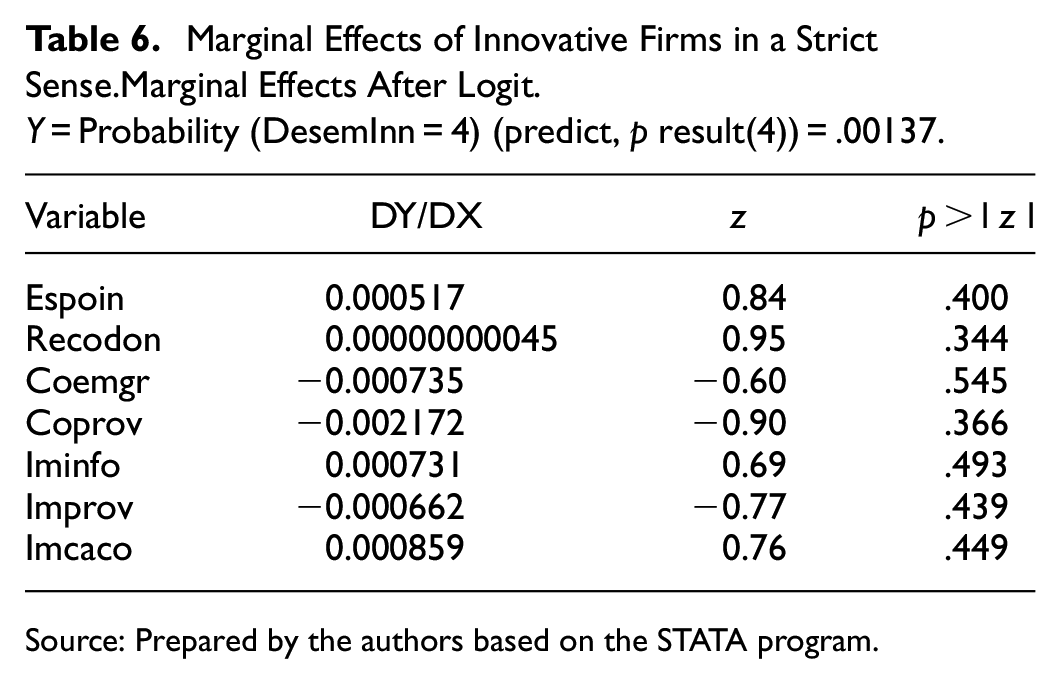
The impacts on the innovative performance of innovative companies in a strict sense are presented in Table 6, which shows that the probability that a company in the health sector will be innovative in the strict sense is .14%, and when an organization of this kind decreases the importance it gives to the limited possibility of cooperation with other companies in the same sector, from high to medium or medium to none, the probability of having an innovative performance in the broad sense increases by .052%.
Marginal Effects of Innovative Firms in a Strict Sense.Marginal Effects After Logit. Y = Probability (DesemInn = 4) (predict, p result(4)) = .00137.
Source: Prepared by the authors based on the STATA program.
As for the second variable, for every additional million pesos from resources from other companies in the sector or from donations, this probability increases by .0004%. Compared to cooperation with other companies in the sector, when it goes from having to not having it, this probability decreases by .073%, while when it goes from cooperating with suppliers to not doing so, the probability of this return decreases by .22%.
Regarding the category of information sources, when an innovative company in the strict sense goes from having information from other companies in the sector to not having it, its probability of being in this performance increases .074%, when the information comes from suppliers and goes from having it to not having it, the probability of this performance decreases .087% and compared to the information of the chambers of commerce when it goes from having to not having it. This probability increases by .086%.
Discussion and Conclusions
This research allows the model used to establish four profiles of innovative performance, so the model proposed for this research was successful. The proposed variables are shown to be antecedents of innovative performance, confirming that cooperation between companies and the social appropriation of knowledge as characteristics of a cluster have a positive impact on innovation.
This research confirms the low levels of innovation of companies in the service sector. This profile is explained by the fact that companies do not invest part of their income in innovation activities and processes but focus more on survival and day-to-day operations. In other words, they seem to be focused on making a series of improvements in their organizational, commercial, or productive management that are so slight and progressive that they are not distinguished either in their own business history or in highly competitive performance.
Companies that carry out activities related to human health, for the most part, innovate in a broad sense, but not in a strict sense; which should be taken as an opportunity for improvement in the future; in which the public sector reorients its policies to promote the development of processes that encourage innovation not only for the local market but also for the international market, without ignoring that there is a majority of companies in this sector that do not innovate or are not interested in doing so in the future, but by their nature they were excluded from this model.
In companies in the health sector, the characteristics of a cluster have different impacts on possible innovative performance, on the one hand, giving less importance to the obstacle of little cooperation increases the probability of innovating in some sense (H1a), as mentioned by Delgado et al. (2021)“collaboration agreements increase the effectiveness of innovation activities and processes” (p. 90), and on the other hand, the greater the resources obtained from other companies in the sector or donations (H1b), the lower the probability of obtaining innovations, so when own resources are scarce the innovation process is insufficient, then companies should explore collaborations with other organizations in search of disruptive innovations (Ayneto, 2019, p. 105).
When it comes to cooperating with other companies in the sector and with suppliers, this relationship increases the probability of innovation in companies in this sector (H1c, H1d), results that are consistent with the literature, that is, the cooperation category yielded the expected results in each of its selected variables, thus a cluster or associative model conducive to the development of innovations must be based on cooperation and competition in a common geographical context (Sánchez Báez & Avancini Schenatto, 2017, p. 67), In summary, belonging to a cluster or cluster generates competitive advantages for companies over those that do not belong to it, for López et al. (2016), these benefits are:
Shared advantages, which may include: (a) economic advantages arising from externalities; b) sociological analysis of industrial districts, which creates an advantage because they are located in an environment with specific patterns of social organization; and finally, c) from a strategic perspective, the advantages of the shared resources and capabilities to which one has access by being in a cluster (p. 31).
In the words of Bouncken et al. (2020)“under high levels of perceived competitive intensity, the expert power of partners turns out to be negative for innovation-related value creation” (p. 241), Van den Berg et al. (2001), who observe how cluster definitions relate to the formation of localized networks of specialized organizations that, in one way or another, their production process is related by enabling the generation of exchanges, whether of “goods, services and/or knowledge” (p. 187).
In the category of sources of information from other companies in the sector, the probability of obtaining innovations in some sense decreases (H2a, H2c), which could be explained by competition between them and give rise to incomplete or erroneous information provided by them, as is the case with information from chambers of commerce (H2c). That is, when these are used as a source of information, the probability of innovation decreases, for his part, Ayneto (2019), mentions “they must then open the innovation process so that knowledge and technologies flow bidirectionally across their borders to external agents” (p. 105), to achieve better results, not only to one side or from one side, in this regard, Cifuentes et al. (2021) found that the less critical the obstacles that a company faces when it reaches information, the better the effects of innovation (p. 128).
While in the case of supplier information, the probability of innovation in companies in this sector increases, it is therefore essential that companies take advantage in the market of the global information provided by different institutions (Igartua et al., 2018). Another obstacle faced by organizations is the scarcity of information they have, both about markets and about the available technology, since the “accumulation of capital for the twenty-first century is being directed to technology that, due to its rapid innovation, allows multiplying production, raising productivity and reducing costs, thus increasing the rate of profit and accumulation.” (Rayran Cortés, 2020, p. 94)
Relationships with other companies in the sector bear fruit as far as it is a direct work and not only through the exchange of information, on the contrary, both information and direct work with suppliers provide greater opportunities for innovation to these companies.
Thus, enhancing management systems, such as information systems, and improving external relations are crucial for converting individual knowledge into organizational knowledge, fostering knowledge creation and driving innovation within the organization. (Kianto et al., 2017) say that “The ability to jointly develop and absorb knowledge from abroad is a valuable and difficult capacity to imitate by competitors in agile environments” (p. 62).
In addition, there is room for discussion regarding public sector participation through grants, where it is demonstrated in this research that this practice helps as long as real results are obtained, that is, “national collaborations are more important for innovation performance due to shared culture and regulations” (Cumbers et al., 2003 cited by Zahoor & Al-Tabbaa, 2020, p. 104), provided that the companies that are really committed take advantage of this income in a satisfactory way, an important aspect when distinguishing between an investment and a welfare action.
Likewise, the discussion is open about cooperation between companies in the same sector so that they can take advantage of each other through the exchange of information and cooperation that reduces risks and avoids abandoning new processes capable of improving productivity and business efficiency.
After conducting a cross-sectional study and analyzing the data of the 408 companies in the health sector in Colombia, the results found in this study showed that both cooperation between companies and the social appropriation of knowledge as characteristics of a cluster have a positive impact on the innovative performance of companies in the health sector.
The findings found in this research are evidence that recognizes what is referred to in the literature of relevant aspects that impact the innovative performance of companies and the categories used as determinants in this research, such as cooperation between agents in the formation of clusters and the importance of the joint use of information, elements that can undoubtedly be used in the formulation of public policies in the human health sector. in such a way, they seek improvements in firms’ innovative performance and can be more competitive and sustainable over time.
Thus, Policymakers should support knowledge transfer and promote networks for innovation, recognizing that enhancing innovative performance involves unique elements in the services provided, thus preventing the abandonment of innovation (Méndez-Ortiz et al., 2024, p. 18).
Contribution and Implications of Research, Limitations, and Future Research
Contribution and Implications of Research
The innovative effort in the literature is practically represented by spending on research and development. This research goes beyond this proposal because this activity is specific to certain activities in the service sector and is even less formalized and structured in developing countries, so it was decided to use clusters based on cooperation and exchange of information with other companies related to health services. They can be similar companies, suppliers of these and chambers of commerce.
From a theoretical perspective, it contributes to a different position from the literature of considering variables with a double causality as determinants, on the one hand, they express the result of an effort to dedicate resources to innovative activities, but on the other hand, they show the success that has been had in differentiation by innovation, in such a way that they express the decision to innovate, the development of the idea of innovation, the efforts to undertake innovation projects and the potential to be applied in the company and exploited in the national and even international market. In other words, they are mediating variables between effort and innovative success.
From a practical perspective, In the case of health services, it is advisable to have a dynamic agent that leverages ideas in such a way that companies do not give up on the innovative dawn, since the service markets do not react to the demand of the sector. This can be done through a project that monitors and accompanies companies to sustain an innovation-oriented culture, ensuring innovative awakening.
It is important to focus attention on innovation, leveraged by other companies with which companies have a relationship, since this has positive impacts on the awakening of innovation and negative effects on the abandonment of this activity, consolidating companies to advance in the national and foreign market using cooperation and information between them and their suppliers.
Limitations and Future Research
This research has some limitations and recommendations for future research, First, In this study, the independent variables were determined considering the common aspects found in the literature and the information available in the survey used; therefore, additional specific elements such as the support and related industries that are part of the cluster can be studied. Second, the study focused on a cross-sectional research on the performance of innovation in the health sector in Colombia, so it is suggested that future studies expand the relationship between cluster formation and innovation performance in other countries with similar characteristics and a comparative study to find common practices and trends that may suggest greater possibilities for innovation. Finally, future research may involve qualitative aspects that consider the particular characteristics of the context of the geographical space in which it is developed.
Footnotes
Author Note
Edwin Leonardo Mendez Ortiz
Education background: Economist, Master in Economic Sciences, PhD in Administration.
Work experience: Junior researcher categorized in Colombia by the Ministry of Science, Technology and Innovation. Full time profesor, Universidad de la Salle, Colombia on topics related to Econometrics, Innovation, Microeconomics and Macroeconomics.
Current and previous research interests: Econometrics, Innovation, Entrepreneurship
Alejandra Pulido-López
Education background: Undergraduate in Finances and Foreign trade, Universidad Sergio Arboleda, Colombia. International Trade master’s degree, Universidad Sergio Arboleda Colombia, Phd, Universidad de Celaya, Gto, México
Work experience: Full time professor at Colegio de Estudios Superiores de Administración CESA, Colombia, International business professor (international business management, international trade, international context, Latinamerican current affairs, export and import processes), regional internationalization advisor for Regional administration (Cundinamarca, Colombia), business opportunity consultant for agribusiness, Colombia, administrative -academic experience in national and international quality assurance
Current and previous research interests: business internationalization, intellectual capital, strategic and dynamic capabilities for internationalization, sustainability and internationalization
Awards received: 1. Distinguished professor School of Management, Universidad del Rosario 2021, 2. Best of the region award ACSP (Accreditation Council for Business Schools and Programs), Region 9, 2021.
Jose Armando Hernandez Bernal
Education background: Business Administrator, Economist, Specialist in Financial Management, Specialist in University Teaching, Master in Economic Sciences, PhD in Administration.
Work experience: Associate researcher categorized in Colombia by the Ministry of Science, Technology, and Innovation. Extensive experience in formulating and directing research projects in economic, administrative, and financial areas. Teacher for more than 19 years at the Specialization, Master’s, Ph.D. and Undergraduate level, on topics related to Corporate Finance, Asset Valuation, and Financial Simulation, Currency and Banking, Strategic Planning, administrative theory, among others.
Current and previous research interests: Strategy planning, financial valoratión, Entrepreneurship, SMEs, financials systems.
Jorge Hernan Cifuentes Valenzuela
Education background: Economist, Specialist in Financial Private, Master in organizational management, PhD in Business Administration.
Work experience: Associate researcher categorized in Colombia by the Ministry of Science, Technology and Innovation. Dean of Business Sciences at Uniminuto. Extensive experience in formulating and directing research projects, and administrative areas.
Current and previous research interests: Administrative áreas, Innovation, Strategy planning.
