




Abstract
The present study aims to examine the effect of authentic leadership (AL) on service innovative behavior (SIB) of employees as well as to identify whether proactive personality (PP) mediates this connection at an individual level. The quantitative cross-sectional study design was utilized to gather information from a study sample which consisted of 428 front-line employees (FLE) working at banks located in North Cyprus. Specifically, the study uses confirmatory factor analysis (CFA), correlation, structural equation modeling (SEM), and bootstrapping techniques to test the hypothesized relationships. The results reveal that both AL and PP have a significant positive effect on SIB; AL has a positive impact on PP of FLE, and PP plays a partial mediating role between AL and SIB of FLE. By relating the study findings, authenticity and proactivity in the banking sector in North Cyprus play a critical role in fostering the innovative behaviors of FLE. The study also discusses the practical and managerial implications, as well as the future scope.
Keywords
Introduction
Over six decades ago, Katz (1964) stated that organizations need leaders who are accomplished at motivating employees so that the employees can demonstrate positive behaviors to maintain stability and benefit the organization, especially when those behaviors are not officially stated as part of the job description. Innovative behavior, which has been receiving increasing attention in the field of leadership studies, occurs when employees in the workplace generate, encourage, and implement novel and beneficial ideas (De Jong & Den Hartog, 2007). Scholars and professionals now support individual innovation to achieve organizational efficiency (Damanpour, 1991) and success (Yuan & Woodman, 2010).
An increasing amount of empirical research such as organizational culture (Scott & Bruce, 1994), psychological construct (Kim, Karatepe, & Lee, 2017), knowledge sharing (Kim & Lee, 2013), autonomy (Sönmez & Yıldırım, 2019), personality (Yeşil & Sözbilir, 2013), and leadership styles (Schuckert et al., 2018) has been carried out to define the background of innovative behaviors in the workplace. Accordingly, the leadership style is considered one of the most influential and significant determinants regarding innovative behavior (Dhar, 2016; Schuckert et al., 2018). Current literature suggests that the most frequently researched approaches to management associated with innovative behavior are transformational leadership (TL) and participative leadership (De Jong & Den Hartog, 2007).
As a comparatively evolving leadership style that stems from the values of positive psychology (Seligman & Csikszentmihalyi, 2000), an increasing amount of academicians have been contextualizing the notion of AL, particularly in the last decade (Walumbwa et al., 2008), due to the beneficial impacts of AL on the attitude and behaviors of employees in the workplace (Walumbwa et al., 2008). Authentic leaders are ethical, transparent, open to change, involve their subordinates in decision-making, and encourage positive attitudes and behaviors, which in turn advance organizational performance (Walumbwa et al., 2008). Instead of highlighting errors (Peterson & Luthans, 2003), they concentrate on beneficial achievements and promote employee trust which result in the development of more positive emotions and novel idea proposals (Avolio et al., 2004). As authentic leaders are tolerant to ambiguity and open to change, the employees end to display more innovative behaviors.
Unfortunately, empirical studies that directly link AL to the innovative behavior of employees are underdeveloped. Most of the antecedent researchers have examined AL’s impact on creativity (Malik et al., 2016; Rego et al., 2012, 2014), which is the first phase of innovative behavior; however, there has been less exploration of the implementation of ideas. Mumford (2003) suggested that future studies should explore late-cycle abilities such as the implementation of creative ideas. In addition to that, Neider and Schriesheim (2011) proposed further research aimed at reinforcing the structural validity of the AL measures. The present study aims to fill this gap in the literature concerning the AL theory by connecting it with the service innovative behavior (SIB) of front-line employees (FLEs) at the individual level in the banking sector in North Cyprus. With that in mind, this study contributes to the literature in the five key ways.
To date, extensive research has predominantly focused on one side of the proposed relationship, that is, on how proactive personality (PP) impacts leadership and not on how leadership impacts PP. Organizational research on the possibility that personality can change due to leadership and on how such changes can occur has been neglected. Based on the bottom-up model of personality stability and change (Roberts et al., 2006), the repetition of certain behaviors in specific situations suggests changes in the emotions and traits of the subordinates which in turn gradually affects and alters their fundamental characteristics (Wrzus & Roberts, 2017). AL promotes proactive behavior as leaders reflect their positive psychological capacities on their subordinates which in turn increase employees’ psychological capital and positive emotions (Zhang et al., 2018). Thus, AL, as a positive form of leader behavior, fosters positive emotions which can lead to change in habits and traits, resulting in a change in personality. This study is novel in that it focuses on the influence of AL on PP of FLEs. This study is novel in that it focuses on the influence of AL on PP of FLEs.
This study also attempts to respond to Shalley and Gilson’s (2004) request for more researches concentrating on the interaction between personal features such as PP and work context such as AL. AL, which has its roots in the literature of positive psychology (Luthans & Avolio, 2003), nurtures subordinates’ learning and growth via emotional contagion (Avolio & Gardner, 2005) within the workplace. Indeed, some scholars support those leaders who have positive states of mind and other positive traits positively influence their subordinates’ states of mind and traits (Walumbwa et al., 2008). These scholars maintain that AL influences the PP of FLEs. As a result, a person with PP who is comparatively unrestrained by situational demands, impacting environmental change (Bateman & Crant, 1993), is the best match in the constantly changing organizational setting of today. Literature review shows that PP has been recognized as the significant individual-level factor in terms of influencing workers’ innovative behavior (Li et al., 2017; Seibert et al., 2001). Therefore, this study examines the mediating effect of PP between AL and SIB of FLEs; it contributes information that will fill the gap in the literature.
AL is employed as a fundamental structure in the present study. Albeit the likenesses between the four AL dimensions, psychological research literature typically examined them as separate constructs in the works by Gatling et al. (2013) and Petan (2016). Consequently, in line with Kernis (2003), conceptualization of authenticity and latest empirical evidence given by Walumbwa et al. (2008), AL was regarded as a higher order construct represented with four dimensions in the present study.
It has been documented that the contribution of the service sector in the world’s emerging and advanced economies has become more significant compared with the production sector generating more than 70% of the gross domestic product from services (Attiah, 2019) and that there is a propensity toward the service sector (Thakur & Hale, 2013). The literature on this matter provides us with a lot of empirical studies on services innovation (e.g., Dhar, 2016; T. T. Kim et al., 2017; Schuckert et al., 2018) but there are the limited number of studies focused on services sector in North Cyprus (Baradarani & Kilic, 2018). It has been pointed out by scholars that the innovation in the service industry does not support the same models of development as in the manufacturing sector (Barras, 1986; Miles, 1993). Furthermore, researchers have overlooked service innovation in emerging economies (such as North Cyprus), although it has an essential part in their economic growth. All of the statements above have therefore paved the way for the present study to be carried out.
Finally, the present research sample includes FLEs in the banking sector. FLEs have a crucial role in offering innovative services to customers in service organizations, as in any labor-intensive sector. They operate at the core of the service organization in a customer-centric approach and are acknowledged as the company’s face (Rothfelder et al., 2013). According to Karlsson and Skalen (2015), FLEs often understand customers’ demands and can recognize areas that need to be improved and can provide alternative solutions to customer problems in the long run. However, in the services industry, especially in the banking sector, there are few empirical studies on the SIB of FLEs (Garg & Dhar, 2017). Mishkin (2001) states that banking and financial services are demand-driven industries, and apart from representing a major portion of the services industry, they are also highly involved sectors (Araslı et al., 2005). Besides, many regulatory, structural, and technological modifications have taken place within the worldwide banking sector in line with the trends toward a more integral worldwide banking setting (Angur et al., 1999). So, this underlines the significant role SIB plays on attaining a competitive edge in the banking industry with the help of the perspectives of FLEs. Against the backdrop, the present research aims to empirically examine the direct influence of AL and PP on SIB, the direct influence of PP on SIB, and whether PP plays a mediation role between AL and SIB in banking sector in North Cyprus from the front-line bank employees’ perspective.
The second section of the present research paper outlines the theoretical structure and hypothesis formulation. The methodology is discussed in the third section. The fourth section provides the data analysis and findings, and the final section consists of the discussion and implications of the study.
Theoretical Framework and Hypothesis Formulation
In this study, AL is considered as the independent variable (IV), SIB as the dependent variable (DV), and PP (as the mediator variable) which is regarded as both IV and DV. Based on the literature review, in this section, the relationships between variables and hypotheses are presented. Figure 1 demonstrates the hypothesized model.

The hypothesized model.
AL Theory
Inspired by the study on positive psychology conducted by Seligman and Csikszentmihalyi (2000) and based on the principles of positive organizational behavior (POB), Luthans and Avolio (2003) developed the notion of AL as a reaction to management mistakes. Since its introduction, the most widely quoted definition of AL has been that it is a pattern of leader behaviour that draws upon and promotes both positive psychological capacities and a positive ethical climate, behaviour which fosters greater self-awareness, an internalised moral perspective, balanced processing of information, relational transparency on the part of leaders working with subordinates, and finally, one that fosters positive self-development. (Walumbwa et al., 2008, p. 94)
Based on the above definition, AL has four underlying subdimensional behaviors: self-awareness, an internalized moral perspective, balanced-processing, and relational transparency (Gardner et al., 2005). The first dimension is “self-awareness” (know thyself), referring to a process of gaining a deeper understanding of one’s strengths and weaknesses and how a leader affects others (Walumbwa et al., 2008). This definition suggests that modeling these behaviors and promoting open and genuine interactions serve leaders in nurturing authentic development of their subordinates. Through this mechanism, authenticity is expected to influence followers in the workplace through behavior modeling, personal identification, emotion spread, support for self-determination, and social exchanges (Ilies et al., 2005). Moreover, “self-awareness” is required to develop other AL elements.
The second dimension of AL is “internalized moral perspective” (doing the correct thing), which relates to an internalized and integrated type of self-regulatory process guided by inner moral norms and values (Northouse, 2013; Walumbwa et al., 2008) to which genuine leaders behave accordingly, even in the face of challenges arising from group, organizational, or cultural situations. A person following these inner moral norms and values in every condition is regarded as ethical which means that the individual makes ethical decisions and engages in ethical behavior that corresponds with personal values (Northouse, 2013).
The third dimension is “balanced-processing” (being fair-minded). It suggests that while maintaining a comparatively objective view, one should take the views of others and all the verified data into consideration in the decision-making process (Walumbwa et al., 2008). According to Northouse (2013), as with the other AL dimensions, “balanced-processing” can be generated and implemented in management and is useful to the organization as it includes positive management behaviors such as listening, avoiding favoritism, the consideration of other people’s thoughts, and absence of bias during the choice-making phase.
The final dimension is “relational transparency” (being genuine), referring to displaying one’s true personality to others honestly and openly (Kernis, 2003). The extent to which a person regulates his or her transparency with others occurs through self-regulation. As Kernis (2003) asserted, it occurs when people deliberately share with others what they feel, including their emotions and inclinations. In that regard, “relational transparency” contributes to enhanced trust among subordinates, and genuine leaders take the first step toward reciprocal confidence. Moreover, it culminates in several organizational outcomes, such as positive emotions, feelings of stability, and predictability as well as subordinates’ trust in their leaders (Chan et al., 2005). Theoretical and empirical evidence (Gardner et al., 2005; Kernis, 2003; Walumbwa et al., 2008) supports that it is appropriate to consider the four components as indicators of a higher order latent construct.
Due to the four distinctive elements presented above, AL has been differentiated from other positive leadership styles such as charismatic, transformational, ethical, and spiritual leadership. For example, Walumbwa et al. (2008) found differences between AL theory and ethical and transformational theories which revealed the enhanced validity of AL beyond transformational and ethical leadership. Besides, Avolio and Gardner (2005) provide detailed differences between AL theory and charismatic, servant spiritual, and TL. According to Malik et al. (2016), the major positive focus areas of AL that clearly emerge are building up the positive psychological capacity of subordinates, authentic behavior, and the development of the subordinate through leadership while maintaining a positive organizational context in view.
Positive organizational psychology enables executives to focus not on their weaknesses but the strengths of their subordinates (Gardner & Schermerhorn, 2004). If a genuine leader has psychological characteristics such as confidence, hope, optimism, and reliance, they can certainly provide a precious contribution to the organization (George, 2015). Authentic leaders concentrate on developing their subordinates as well as the organization by creating a culture of learning, which implies recognizing errors and building trusting relationships. In this way, genuine leaders improve the efficiency of their organizational subordinates (Luthans & Avolio, 2003) while creating a beneficial impact on the conducts of employees. Authentic leaders bear all beneficial characteristics of psychological and social well-being, such as self-confidence, positive feelings, delete hope, and the drive to accomplish goals. It could be a result of an attempt to apply the beneficial characteristics in management fields, according to Ilies et al. (2005). Same academics claim that authentic leaders focus on constructing the strengths of subordinates based on their true values and beliefs. They also maintain that they concentrate on expanding their thinking and establishing a positive and also engaging organizational context.
As described in the literature, the many results of AL’s beneficial influence on followers include creativity (Rego et al., 2012), work satisfaction (Černe, Dimovski et al., 2013), knowledge sharing (Edu-Valsania et al., 2016), process and product innovation (Elrehail et al., 2018), proactive behavior (Zhang et al., 2018), employee organizational citizenship behavior (Walumbwa et al., 2010), organizational commitment (Neider & Schriesheim, 2011; Petan, 2016), and innovative behavior (Garg & Dhar, 2017).
Innovative Behavior
Individual creativity is an essential antecedent for innovative behavior (Li & Hsu, 2016). Each of these is associated with several separate but closely related procedures, resulting in different but often related consequences. At the “creativity stage,” an individual produces ideas just like at the “innovation level,” and an employee implements those thoughts for better workplace practices, processes, or products. Scott and Bruce (1994) define innovative behavior as “production or adaptation of useful ideas and idea implementation, and begins with problem recognition and the generation of new ideas or solutions for problems” (p. 581).
Accordingly, scholars claim that the workplace-based SIB of employees’ aims to solve work-related issues and improve service procedures (De Jong & Den Hartog, 2010). For employees working in banks, their work requires to create ideas to facilitate innovation processes while retaining the competitive advantage (Komaladewi et al., 2012). Nowadays, a significant challenge for banks is to satisfy customer expectations by providing useful services to their customers to maintain their loyalty and satisfaction. Overall, an individual employee’s SIB during service delivery produces valuable outcomes for the organization. Thus, banks can comprehend the significance of enhancing their employee SIB as a service innovation, which helps to boost organizational, which, in turn, results in customer satisfaction. Besides, executives need to build a positive atmosphere that helps employees develop good relationships with supervisors so that employees can determine customers’ priorities and sensitive requirements by creatively adjusting their services.
The recent innovative behavioral models have sought to explore and comprehend employee SIB by applying various constructs in different sectors (Dhar, 2016; Garg & Dhar, 2017; Kao et al., 2015; Kim et al., 2017; Saeed et al., 2019; Schuckert et al., 2018; Slatten et al., 2011). Schuckert et al. (2018) observed that both TL and AL generate follower SIB directly, but simultaneously enhance follower psychological capital, which amplifies the follower’s SIB in the hotel industry. Garg and Dhar (2017) maintained that interaction between employees’ SIB and work engagement had a positive effect on leader–member exchange and further stated that job autonomy as a moderator encourages and reinforces the connection between leader–member exchange and SIB mediated through work engagement in the banking sector. Furthermore, Saeed et al. (2019) discovered that the leader–member exchange has a beneficial impact on the SIB of employees operating in the automotive industry. The result of this study also yielded that leader–member exchange, core self-evaluation (CSE), and domain knowledge (DK) interact to influence the employee’s innovative business behavior; thus, when CSE and DK are high, the leader–member interaction has a strong positive relationship. Thus, innovative business behavior and creative process engagement mediated this relationship. The results of a study carried out by Dhar (2016) showed that ethical leadership encouraged the SIB of hotel employees, while this process was mediated through leader–member exchange and also moderated with work autonomy. According to Slatten et al. (2011), both empowering management and a humorous work environment allow initiating FLEs’ SIB, while creativity mediates this relationship in the hotel industry. Kao et al. (2015) also observed that TL positively influences the employees’ perceived organizational climate for innovation, which in turn enhances employee SIB through both social-political and motivational-mediated mechanisms in hair salons. Interestingly, Elrehail et al. (2018) observed that while TL and knowledge sharing have a favorable effect on innovation, AL has proved to be of no assistance for innovativeness in the sector of higher education.
AL and Innovative Behavior
POB, which is the application of positive psychology within the workplace, focuses on the application of positively oriented human resources strengths that can be measureable, developable, and improvable in today’s workplace (Luthans & Church, 2002). According to Luthans (2002), in order for the behavior to qualify as POB, it should be able to be measured, developed, and effectively managed. Thus, POB is emphasized at measuring, developing, and managing research at an individual-level analysis (Youssef & Luthans, 2007). In this context, based on the POB and past study findings, it was hypothesized that AL promotes the SIB of employees in the workplace, where employees consider both AL and SIB to be beneficial behaviors. AL is a positive form of leadership that can have a potentially positive effect on the SIB of employees.
In light of the rationalization presented earlier, it was deduced that AL’s four dimensions can have a positive impact on the SIB of employees. The justification for this is as follows: genuine leaders provide psychological assistance and psychological safety through being open, sharing, and supportive of their employees which are deemed to be critical variables in employee voice behavior. In specific, AL objectively clears data, organizes high standards of moral behavior, and fosters transparency in engaging with subordinates. By having these characteristics, genuine leaders can reinforce their subordinates’ trust, leading to the promotion of psychological assistance and safety, and hence followers will feel free to take risks (Rego et al., 2012). This commitment promotes employees to convey unconventional thoughts freely and to express any view without fear. As Van Dyne and LePine (1998) underlined that employee voice behavior, which was previously assumed to be a significantly arbitrary behavior, is proof of positive challenge that contributes to the voluntary expression of problems and propositions for innovative behaviors (Walumbwa et al., 2008).
Schuckert et al. (2018) observed that AL directly affects follower SIB. Černe, Jaklic, and Skerlavaj (2013) indicated that AL has a positive effect on the creativity of members and innovation in general. Muceldili et al. (2013) observed that AL, directly and indirectly, assesses innovativeness through the mediation role of the creativity of employees. Scholars have since gradually concentrated on the connection between AL and innovative behavior. The research proposes the following hypothesis based on the past research outcomes.
PP
Organizational researchers have paid enhanced attention to PP over the past two decades. The concept of PP fits in with the social-psychological tradition of personality–environment interaction. The PP concept has its origins in interactionism, which claims that circumstances are as much a feature of the individual as the behavior of the individual is a function of a situation (Bower, 1973), and social cognitive theory (SCT) (Bandura, 1986) maintains that the individual, environment, and behavior constantly affect each other. SCT is reciprocal triadic causation in which individuals are both actors and environmental products (Bandura, 1986). In other words, individuals both affect the environment in which they work and are influenced by it.
The present research focuses on PP rather than other constructs of personality, such as Big Five personality variables examined by other scholars (e.g., Kim et al., 2009), as PP is outperforming the Big Five in explaining variability in organizational events (Crant & Bateman, 2000). Organizations also operate in a setting that is dynamic and unpredictable. Both employees and executives need to adopt proactive behaviors to deal with these evolving settings. According to Bateman and Crant (1993), proactivity is pursuing possibility, displaying initiative, and persevering in bringing about significant change. Moreover, passively proactive people are described as individuals who challenge the status quo rather than accept their roles. Therefore, they help to enhance present conditions and create fresh ones. In contrast, if a person has low PP scores, they are more passive and often unable to accommodate current conditions. Literature supports that PP has been correlated to a variety of positive outcomes such as career success and satisfaction, job satisfaction, organizational commitment, psychological empowerment, perceived autonomy, proactive behavior, innovative behavior, creativity, and self-efficiency (Fuller & Marler, 2009; Thomas et al., 2010).
AL and PP
Although leadership is playing an essential part in the motivation of employees’ proactive behavior (Parker et al., 2010), to the best of our knowledge, no empirical study to date has investigated the influence of AL on employees’ traits, particularly PP. Existing studies have shown that AL has a positive influence on employees’ proactive behavior (Hu et al., 2018; Liu et al., 2018; Smithikrai & Suwannadet, 2018; Zhang et al., 2018). Furthermore, a person’s personality/character also affects the degree to which they can be influenced by external factors (Hofmann & Jones, 2005) and leadership (AL in this study) is potentially one such external factor. It is worthy to examine whether a leadership style like AL which provides positive work environment can influence PP.
Positive psychology suggests people can affect permanent personality change via a set of behaviors such as positive reframing of situations and the practice of hope (Lyubomirsky et al., 2005). The theoretical framing of this positive psychology approach to personality change (development of personality) happens by means of bottom-up processes, in which moment-to-moment fluctuations in personality can be targeted, and in turn, underlying traits themselves are gradually changed (Roberts et al., 2006). AL, as a positive form of leader behavior, engenders positive feelings which can lead to change in habits and traits resulting from change in personality. AL draws positive psychological aptitude from leaders which reflect as positive emotions and positive cognition on their subordinates (Zhang et al., 2018). As authentic leaders are inclined toward change and PP is often a change-related trait, the change-related attribute modeled by authentic leaders may spur the same change-related character in leaders’ respective followers.
Furthermore, authentic leaders influence followers by positive modeling of the various dimensions of authenticity such as self-awareness, self-regulation process, positive psychological states, and positive moral perspective (Avolio & Gardner, 2005; Ilies et al., 2005). Zhang et al. (2018) indicated that subordinates working under an authentic leader with elevated SA and internalized MP are encouraged to share information and communicate their real ideas and emotions (Gardner et al., 2005). Later, the authenticity of leaders will set a positive role model that will influence subordinates in the work environment. And as Gardner et al. (2005) stated, genuine leaders prefer to promote the independent thinking and voicing behavior of employees before decision-making. For another, AL tends to build a climate of trust and fosters interpersonal support among employees that can enhance the self-efficacy of employees and satisfy their needs for competence (Zhang et al., 2018). Briefly, AL can fulfill subordinate requirements and their intrinsic motivation through their own words and actions to proactively improve their work and circumstances as well. In other words, AL helps to create an environment where positive emotions influence the bank employees’ personality. In this sense, this study assumes that AL can change the PP of front-line bank employees. The following hypothesis is proposed in line with the above reasoning:
PP and Innovation Behavior
According to scholars (Yılmaz et al., 2018), services are generated through employees’ interactions with customers, and this highlights the significance of the character traits of employees in the service industry. Li et al. (2010) claim that proactive employees tend to create high-quality exchange relationships with their supervisors as such relationships provide valuable data for their self-advancement.
Fuller and Marler (2009) performed a meta-analysis on relevant PP research and observed that PP has a positive correlation with creativity, career achievement, and leader–member exchange. Proactive behaviors promote employees to initiate change, according to Grant and Ashford (2008), and originations often depend on proactive employees to encourage innovation. In vibrant job environments where work becomes more decentralized and where the pressure for innovation is increasing, it is needed to work without close supervision. Thus, the employees’ PP plays a more critical role in organizational achievement. Kim et al. (2009) proposed that proactive employees are more probable to update their expertise and abilities and recognize fresh job procedures than passive employees. Seibert et al. (2001) considered PP to be positively associated with an individual’s innovative behavior. Thus, this study’s third hypothesis is as follows:
PP as a Mediator
While the studies, as mentioned earlier, have confirmed the positive direct relationship between PP and SIB, previous studies have not yet investigated the role of PP in mediating the relationship between AL and employees’ SIB. Previous researches have used various mediating factors such as employees’ creativity (Černe, Jaklic, & Skerlavaj, 2013; Muceldili et al., 2013) and psychological capital (Schuckert et al., 2018) to test the connection between AL and SIB. Therefore, the present study aims to examine the effect of AL on SIB through front-line bank employees’ PP. PP is an appropriate mediator in the hypothesized model because it is the most important personality trait that fosters employees’ in-role and extra-role behavior (e.g., Fuller & Marler, 2009; Thomas et al., 2010). Furthermore, banks need to adopt proactive and change-oriented behavior to cope with today’s unpredictable and rapidly changing environments to remain competitive. Yılmaz et al. (2018) claim that services are produced through employee’s personal interactions with customers in the services sector, which highlights the importance of FLEs’ personality. As noted earlier, PP and AL share several traits, authentic leaders have an inclination to be open to change, and PP is often a change-related trait; the change-related attribute modeled by authentic leaders may spur the same change-related character in leaders’ respective followers. According to Bateman and Crant (1993), proactive employees have an active orientation in the work environment. AL emphasizes the building of employee confidence, creating hope, raising optimism, and strengthening resilience, which promotes innovation behavior among the employees and leaders in an organization (Muceldili et al., 2013). Furthermore, some scholars have argued that PP is a prerequisite for innovation behavior (Seibert et al., 2001). In the banking sector, FLEs have direct contact with customers; hence, they need to regularly find solutions for various kinds of problems in different ways and this is directly related to SIB. Therefore, proactive employees help to tackle existing problems and prepare for upcoming challenges. FLEs who have a high PP could be innovative in the working place. From the empirical evidence above, it is assumed that PP positively mediates the relationship between AL and FLEs SIB in banking sector. Hence, the following hypothesis is proposed:
Method
Sample and Procedure
The study’s population consisted of bank employees working at branches of private and public banks located in North Cyprus. Judgment sampling was utilized to determine the samples. Data were collected from full-time FLEs (such as cashiers/tellers, customer service representatives, sales, or credit employees) as they are the ones who are in direct contact and communication with the customers throughout their work hours. Direct customer contact is critical to successful service innovation.
According to the North Cyprus Central Bank, at the time that the study was conducted (October–December 2018), there were 21 banks operating in the region (this figure was drawn from the North Cyprus Central Bank, 2018 Report). The field study started upon the confirmation of the research by the Near East University Ethical Committee. Before beginning the field study, each bank’s headquarters in North Cyprus were identified, and the human resource manager of each bank was either contacted via phone or an official introductory letter was sent to request approval and to explain the objective of the research as well as to provide details of the study. The request was subjected to the scrutiny of each bank’s ethical codes before management gave approval for the implementation of the study. The survey questionnaire cover page specified the participants’ right to confidentiality, voluntary involvement, and informed consent.
The management of 14 banks decided to take part in the research. Branch executives informed the participating FLEs that they were required to fill out the questionnaire and return it within 10 working days. The manager reminded respondents who had not returned their completed questionnaires. Completed surveys were transferred to the authors in sealed envelopes with the assistance of branch executives at each respective bank.
A total of 550 questionnaires were deployed among all full-time FLEs working at the 14 participating banks (more than 150 branches). A total of 471 completed questionnaires were distributed to the participants by the end of December 2018. Of this number, 34 questionnaires were discarded because they were incomplete, leaving 437 valid questionnaires. Then, nine questionnaires were discarded after an outlier check was implemented with the utilization of Mahalanobis distance (Byrne, 2010). On account of this, the final sample of this study comprised 428 questionnaires. The response rate was 77.81%.
Table 1 shows the respondents’ profile. As can be seen from the table, the majority of the respondents (73.5%, n = 313) were female, 33.8% (n = 144) were between the ages of 36% and 50, 67.6% (n = 288) were married, 60.1% (n = 256) had a university degree, 41.1% (n = 175) had been working at the same bank, and 29.3% (n = 125) had been working with the same manager in the banking sector.
Sample Demographics (n = 428).

Measurements
The present research employed a quantitative research approach with a cross-sectional survey design. The self-administered questionnaire was divided into four parts: Part 1, demographic question; Part 2, AL scale; Part 3, PP scale; and Part 4, SIB scale. Turkish is the formal language in Northern Cyprus; therefore, this research used the Turkish versions of questionnaires. A pilot study was conducted on 20 front-line bank employees working in two different banks. Responses were based on a 5-point Likert-type scale, which ranged from 1 (strongly disagree) to 5 (strongly agree).
Authentic Leadership Scale
The authentic leadership scale (ALS) was used to determine the perception of employees about the AL behavior of their direct supervisors. The ALS used in this study was developed by Walumbwa et al. (2008). The Turkish version of ALS has been validated by Tabak et al. (2012). This scale comprises 16 items separated into four subdimensions: Relational Transparency (RT), Moral Perspective (MP), Balance Processing (BP), and Self-Awareness (SA). Some representative items were as follows: “My leader openly shares information with others” (RT), “My leaders show consistency between their beliefs and actions” (MP), “My leader objectively analyses relevant data before making a decision” (BP), and “My leader is aware of the impact they have on others” (SA). Because the ALS measures are relatively novel, a confirmatory factor analysis (CFA) was administered (using AMOS 24 with the maximum likelihood estimation model) to examine the anticipated higher order AL structure. The observed variables were designated to load on latent variables. The original four-factor higher order model of AL consisted balanced-processing, internalized moral perspective, relational transparency, and self-awareness. All four of the factors loaded onto the same higher order latent variable (second-order factor model). The study utilized standardized loadings and modification indices to locate sources of misspecifications and found that the fit indices were unsatisfactory. After deliberation based on modification indices and low standardized loadings, three items were eliminated from ALS (two regarding ALRT1, ALRT2, and one regarding ALMP9). The second-order model produced the following fit indices: χ²/df = 3.16, ρ = .000, Tucker–Lewis Index (TLI) = 0.0944, comparative fit index (CFI) = 0.0960, root mean square residual (RMR) = 0.050, root mean square error of approximation (RMSEA) = 0.071. Therefore, based on these results, CFA analysis for ALS confirmed for the study.
Service Innovative Behaviour Scale
This research utilized the service innovative behaviour scale (SIBS) which was developed by Scott and Bruce (1994). The Turkish version of SIBS was validated by Calıskan and Akkoc (2012). This scale is composed of six items. Sample questions included “I am innovative” and “I promote and champion ideas to others.” The CFA results produced the following satisfactory results: χ²/df = 3.36, ρ = .000, TLI = 0.970, CFI = 0.985, RMR = 0.018, RMSEA = 0.074. Therefore, the CFA of SIB items showed that the model fits very well with the data.
Proactive Personality Scale
This research utilized the proactive personality scale (PPS) developed by Seibert et al. (1999). The Turkish version of PPS was validated by Akın and Arıcı (2015). Some sample questions from the scale were as follows: “If I believe in an idea, no obstacle will prevent me from making it happen,” and “I am constantly on the lookout for new ways to improve myself.” The CFA results were satisfactory after clearing five items from PP (PP5, PP6, PP7, PP9, and PP10) due to their low standardized loadings (Hair et al., 2010), and final results demonstrated a satisfactory indices (χ²/df = 3.30, ρ = .000, TLI = 0.964, CFI = 0.982, RMR = 0.017, RMSEA = 0.073). Therefore, the CFA of PP items showed that the model fits very well with the data.
Results
The study tested the hypothesized model via a two-step approach advised by Andersen and Gerbing (1988) with the implementation of AMOS 24. First, the construct validity (convergent and discriminant) and reliability (composite reliability [CR] and Cronbach’s alpha) of all the study items were tested. Structural equation modeling (SEM) was conducted to evaluate the fit and path coefficients (Jöreskog & Sörbom, 1982), and bootstrapping was utilized to test the mediation effect. Based on the recommendations of Kline (2011), the following goodness-of-fit indexes were used: the chi-square statistic divided by the degree of freedom (χ2/df ratio < 3), CFI > 0.90, TLI > 0.90, RMSEA < 0.06, standardized root mean square residual (SRMR < 0.08).
Assessment of Common Method Bias
This study tested common method bias (CMB) because data for AL, PP and employees’ SIB were provided from an individual source, namely front-line banking employees. Podsakoff and Organ (1986) claim common method variance (CMV) is the most frequently discussed issue in any individual report study because it threatens the validity of the results. Thus, the CMB is likely to affect the SIB of employees. Harman’s single factor was evaluated so as to comprehend the magnitude of CMB, as recommended by Podsakoff and Organ (1986). If one parameter clarifies the variability in the research factors by more than 50%, CMV occurs.
To achieve this, all constructs were entered into an exploratory factor analysis (EFA) by implementing SPSS Version 22. The results indicated that a single factor did not surface from the factor analysis. As the variance of a single factor was 27.03% (total variance: 56.19), it was concluded that there was no CMB. Therefore, for the present research, CMV was not a significant issue. Moreover, the Kaiser–Meyer–Olkin (KMO) measure of sampling adequacy test showed an adequate figure of 0.917 (Tabachnick & Fidell, 2007). Bartlett’s sphericity test was significant (χ² = 479.188, df = 253) atρ = .000 and was therefore acceptable. Moreover, the sample size of the present research was also acceptable (more than 200 components) based on the suggestions of Xerri and Brunetto (2013) to conduct SEM. That meant, therefore, that the sample size was suitable for hypothesis assessment.
Assessment of Convergent and Discriminant Validity
Before conducting CFA with maximum likelihood estimation to specify the measurement model, univariate normality was checked (Kline, 2011). The absolute values of skewness and kurtosis associated with the responses to observed variable were implemented to check the univariate distribution. The values for the skewness ranged from 0.293 to 1.347, whereas the values of kurtosis ranged from 0.042 to 2.779. These finding revealed that there was no evidence of univariate normality, because they were within Kline’s (2011) criteria of skewness <3 and kurtosis <8.
As can be seen in Table 2, the assessment of the CFA results indicated the significance of all the factor loadings of each item in the proposed model (ρ < .001; Hair et al., 2010), and results demonstrated a superior model fit for the three-factor measurement model (χ²/df = 2.397, ρ = .000, TLI = 0.920, CFI = 0.929, RMR = 0.036, RMSEA = 0.057).
Confirmatory Factor Analysis.
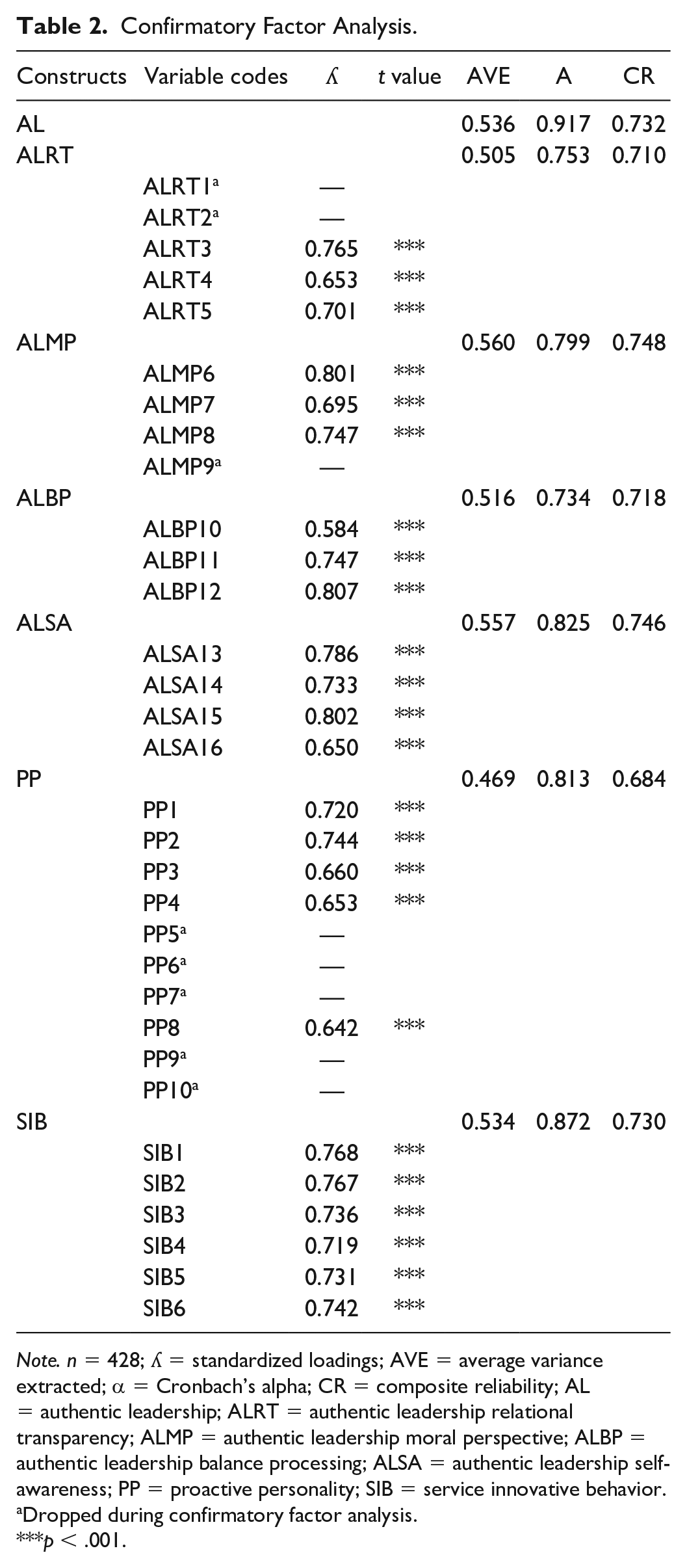
Note. n = 428; ʎ = standardized loadings; AVE = average variance extracted; α = Cronbach’s alpha; CR = composite reliability; AL = authentic leadership; ALRT = authentic leadership relational transparency; ALMP = authentic leadership moral perspective; ALBP = authentic leadership balance processing; ALSA = authentic leadership self-awareness; PP = proactive personality; SIB = service innovative behavior.
Dropped during confirmatory factor analysis.
p < .001.
As demonstrated in Table 2, the results of the average variance extracted (AVE) by AL, authentic leadership relational transparency (ALRT), authentic leadership moral perspective (ALMP), authentic leadership balance processing (ALBP), authentic leadership self-awareness (ALSA), PP, and SIB were 0.536, 0.505, 0.560, 0.516, 0.557, 0.469, and 0.534, respectively. Although the AVE by PP was below the threshold value of 0.50 (Fornell & Larcker, 1981), the standard factor loadings of these constructs were above 0.50 (from 0.642 to 0.744) and significant at ρ < .001 (Cheung & Wang, 2017). Also, the AVE by PP did not worsen the fit statistics presented earlier. Furthermore, an examination of the extent service research presented the findings for AVEs of several constructs, which were lower than 0.50 (e.g., Karatepe et al., 2018). As a result, the overall findings provided support for convergent validity.
According to Fornell and Larcker (1981), criterion of the expected inter-correlations among all factors in each variable was lower than the square root of the AVE and thus endorsed discriminating validity. In addition, as stated earlier, the study’s base model suited the data well. Thus, these results have provided the hypothesized model with discriminating validity.
To test the internal consistency, we used Cronbach’s alpha and CR. As demonstrated in Table 2, Cronbach’s alphas exceeded the threshold value of 0.70 (Hair et al., 2010) for AL, ALRT, ALMP, ALBP, ALSA, PP, and SIB, 0.917, 0.753, 0.799, 0.734, 0.825, 0.813, and 0.872, respectively. Also, all CRs exceeded the threshold value of 0.60 (Bagozzi & Yi, 2012) for AL, ALRT, ALMP, ALBP, ALSA, PP, and employees’ SIB 0.738, 0.751, 0.792, 0.759, 0.832, 0.814, and 0.869, respectively (Table 2). Therefore, these findings revealed that the scales were quite reliable (Bagozzi & Yi, 2012).
Descriptive and Correlation Results
The means, standard deviations, and inter-correlations between constructs are presented in Table 3. Results stated that all constructs were correlated substantially and positively, showing a normal distribution for both mean and standard deviations. In other words, AL, PP, and bank employees’ SIB proved to have a positive relationship.
Means, Standard Deviations, and Inter-Correlations.
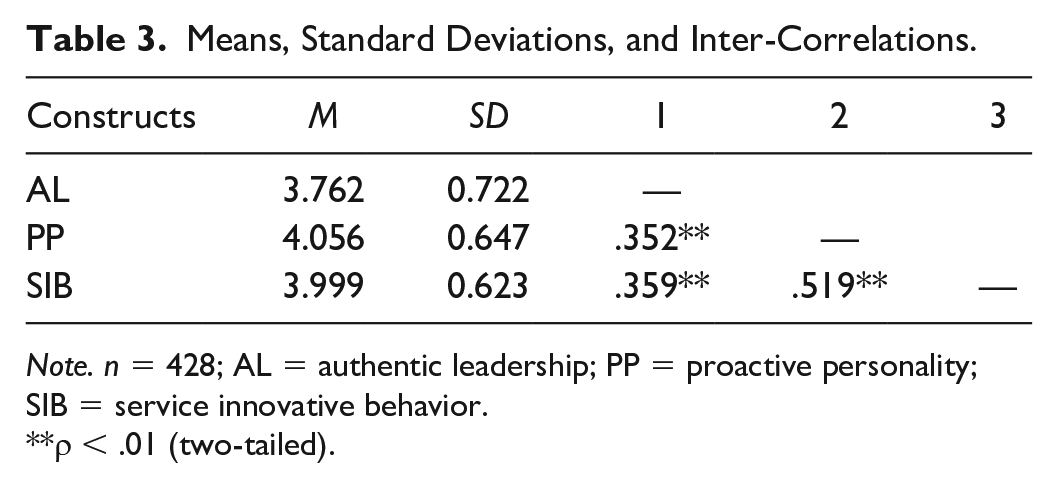
Note. n = 428; AL = authentic leadership; PP = proactive personality; SIB = service innovative behavior.
ρ < .01 (two-tailed).
As shown in Table 3, the mean value of AL is 3.76 (SD = 0.722), which demonstrates the favorable attitude of bank employees toward their leader. The mean value for SIB is 3.99 (SD = 0.623), which indicates that bank employees feel more innovative. And the mean value is 4.05 (SD = 0.647) for bank employees’ PP, which is the highest among all the variables. This value provides an opinion on how much bank employees consider themselves to be a proactive individual and who is more opposed to a positive reaction. These values show that the perceptions of bank employees are satisfactory for all variables.
PP appears to indicate the strongest magnitude of Pearson’s coefficient of correlation on the SIB of employees with r = .519, which was deemed to be powerful. Employees’ SIB strongly correlates with employees’ AL at r = .359, and employees’ PP strongly correlates with employees’ AL at r = .352, which also shows moderate strength (Cohen, 1988).
Hypothesis Testing
Direct effects
A path analysis modeled in AMOS 24 using the maximum likelihood procedure to assess the hypothesized connection between the constructs individually was conducted. SEM was selected because it can simultaneously test connections between many factors in a hypothesized model (Hair et al., 2010).
The outcomes of direct influence are shown in Table 4. The route ratio of employees from AL to SIB is positive in line with our estimates (β = 0.396, t = 6.690). This results in a rise of one-unit AL leading to a rise of 39.6% in the SIB of the employees. Besides, the route model discovered to be fit (R² = .157, ρ = .000) with AL describing 15.7% of the SIB employee variation. H1 has therefore been supported.
Standardized Direct Path Coefficients of the Hypothesized Model.

Note. n = 428; AL = authentic leadership; SIB = service innovative behavior; PP = proactive personality.
ρ < .05.
H2 predicted that AL would be associated positively with bank employees’ PP. The coefficients for PP, as shown in Table 4, are positive (β = 0.412, t = 6.583). This results in a rise of one-unit AL leading to a rise of 41.2% in the PP of the employees. The path model also discovered good fit (R2 = .169, ρ = .000) with AL describing 16.9% of employees’ PP variability. Consequently, the findings support H2.
Similarly, H3 predicted a positive association between PP and SIB among bank employees. As can be seen in Table 4, the SIB coefficients are positively significant (β = 0.612, t = 9.211). This result suggests an increase in one-unit PP leading to an increase in the SIB of the employees of 61.2%. The path model also observed to be fit (R² = .374, ρ = .000) with PP describing 37.4% of the variation in the SIB of the employees. H3 has therefore been supported.
Mediation effect
Baron and Kenny’s (1986) four-condition approach is the traditional method in which mediation hypothesis was tested. A recent approach formulated by Preacher and Hayes (2008) has shown greater statistical power in determining the significance of a mediation effect than the traditional causal steps (Baron & Kenny, 1986). Therefore, this study employed bootstrapping by using AMOS 24 while testing the mediation effect. As seen in Table 4, PP plays a partial mediating role in the relationship between AL and SIB (β = 0.173, with 1,000 samples, 95% bias-corrected confidence interval did not include zero [BC CI] = [0.141–0.324]). This indicates that AL not only has a direct positive impact on SIB but also indirectly improves SIB through PP. In addition, the results regarding H4 which hypothesized that front-line bank employees’ PP mediates the relationship between AL and SIB fit the data well (χ²/df = 2.39, ρ = .000, TLI = 0.920, CFI = 0.929, RMSEA = 0.057). Furthermore, the Sobel (1982) test was also implemented to check the significance of the indirect effect. The importance of Sobel stats was significant (Sobel statistics = 5.6, ρ = .002), thus providing support for PP mediating the AL-SIB connection. As a result, the empirical data support H4, as shown in Table 5.
Bootstrapping Results of Hypothesis Mediation Model.
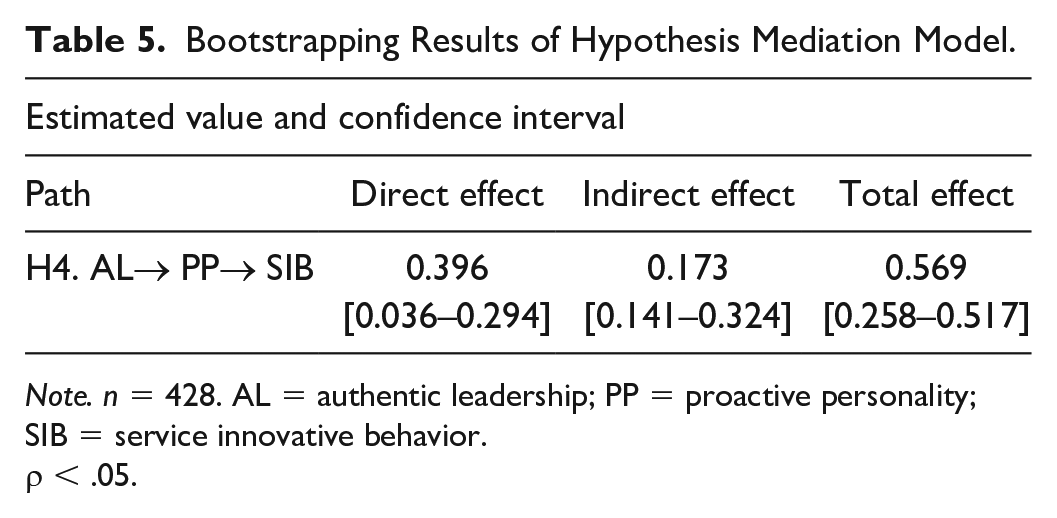
Note. n = 428. AL = authentic leadership; PP = proactive personality; SIB = service innovative behavior.
ρ < .05.
Discussion
This research was performed to test both AL and PP’s direct influence on SIB, AL’s direct influence on PP, and to test whether PP mediates the connection between AL and SIB at the individual level, especially from the view of FLEs working in the banking sector in North Cyprus.
First, results indicate that AL (as a contextual factor) perceptions of employees have a positive and significant impact on the SIB of employees, which supports the findings of Schuckert et al. (2018) and Muceldili et al. (2013). As such, the present results provide a starting point for a debate on AL’s impacts and benefits in the banking sector, especially regarding front-line workers. For instance, AL may encourage employees to perform better and positively because actions are taken in the employees’ best interest, not just for the organization/bank. As AL embodies RT and an internalized MP, this will lead to the positive performance of employees, which will benefit the organization/bank; thus, executives should be concerned about their employees and behave more ethically toward them. Besides, genuine leaders’ transparent engagement, trust, and respect for their employees will motivate them to generate innovative ideas (Avolio et al., 2004). In other words, genuine leaders promote employees’ sense of freedom by offering psychological safety to create fresh ideas and suggestions (Rego et al., 2012).
Second, the results point out that AL has a beneficial impact on bank employees’ PP. This finding promotes AL’s beneficial effect on followers, such as demonstrating transparency in relationships, encouraging a positive state of confidence and sharing information, and expressing their real emotions and ideas. Authentic leaders, in turn, contribute to the satisfaction of followers with their leadership and willingness to perform at higher levels of engagement (Avolio et al., 2004). Employees show greater levels of PP due to their commitment to the organizations. Besides, AL is a situation-based structure endorsed as a significant factor influencing PP in the workplace. As AL is a type of beneficial transformative management, AL has been recognized as an antecedent that can affect employees’ PP.
Third, in line with previous researches (Kim, Hon, & Crant, 2009; Seibert et al., 2001), the results of the present study found that the PP of employees has a positive and significant influence on their SIB. This outcome suggests that PP is a precious trait of personality that facilitates bank employees’ SIB. Thus, in the banking sector, as an extremely labor-intensive industry where services are generated in the workplace through FLE’s personal and direct interactions with customers, the importance of employee personality in this industry is highlighted.
And fourth, the present research revealed that PP mediates the connection between AL and FLEs’ SIB. This is because an employee who has PP tends to improve them, and they are open to constructive working environments. Proactive employees prove to be demonstrating initiative, taking action, and they persist until the change occurs. These dispositions, therefore, substantially increase the SIB of bank employees.
Theoretical and Practical Implications
First, by treating AL as a core construct, the results of the present study contribute to AL theory. From CFA results, it can be declared that the single-factor structure of the Turkish version (in North Cyprus) of the ALS scale is supported at an acceptable level (Kline, 2011). This research, therefore, makes a significant contribution, especially to the North Cyprus banking sector.
Furthermore, the results of the present research provide valuable insights to develop better leadership training programs that are required in the banking sector because it is an extremely labor-intensive sector. If organizations select leaders with authentic characteristics, they can enhance the SIB of employees needed in the tentative banking setting of today. Establishing scientific systems to motivate employees’ SIB could be beneficial for banks.
The present research promotes evidence that PP is a valid and significant predictor of SIB in the banking sector context. Besides, banks wishing to enhance innovative behavior may be more successful by recruiting PP employees with the implementation of suitable selection methods. Moreover, bank executives could participate in such motivation operations as authentic leaders do in the workplace to activate employees’ PP.
This research also contributes to the literature for being the first to propose and verify the positive influence of employees’ AL on PP. Although previous researches demonstrated the significant connection between AL and proactive behavior, studies on PP are rare. Hence, the present research provides insight into better comprehension of the relationship between AL and PP and thus fills a gap that was present in the related literature. Furthermore, the study confirms the influence process of AL on employees’ PP, where PP serves as a mediator. This outcome is valuable because it explains how the authenticity of leaders facilitates bank employees’ PP, which in turn impacts employees’ SIB.
Moreover, the results show that FLEs in the banking sector is the main source for SIB. Because of their direct interaction with customers, banks should pay adequate attention while selecting and training FLEs. They are the ones that solve the problems of customers and find instant alternatives for the expectations of customers. Consequently, it would provide banks with a competitive advantage if they turned their attention to FLEs.
Research Limitations and Direction for Future Researchers
Although the present study, as with all other studies, makes several significant contributions to existing literature, it has some constraints, creating opportunities for further research. First, this study concentrated only on the perceptions of FLEs operating in North Cyprus banking industry. Future studies could extend the topic by gathering information from other services industries, such as hospitality services, and studies could be conducted in different countries to support or contradict the findings of this study. Other participants, such as managers or customers, could also provide alternative outcomes. Second, this study focused on PP’s mediating role. Future studies on the connection between AL and SIB could explore the Big Five personality trait or other kinds of factors as mediators. Besides, the moderating role of PP in SIB can be evaluated in further research. Furthermore, future studies may also examine the impact of other kinds of leadership styles (such as leader–member exchange) and also explore distinct dimensions of AL to better understand the influence of individual aspects on innovative behavior, the results of which could be used for recruitment in the service sector. Third, the research was cross-sectional. Data were gathered only once and during the same period. Further research could, therefore, consider a longitudinal design to enable researchers to draw a pattern of change over time and in causal directions.
Conclusion
Based on AL theory, this study observes support for a hypothesized model that connects AL to SIB through PP of banking-sector employees. Results support that PP partially mediates the influence of AL on bank employees’ SIB. Indeed, this study helps to validate the AL theory and also provides a clear understanding of the mechanisms behind the theory in the context of North Cyprus. Most of the research related to AL has been conducted on populations and samples in Western countries a fact which initiated the implementation of the present study to develop the AL construct within different cultural context to enhance the generalizability of the resultant ALS measure.
Footnotes
Acknowledgements
Ozlem Uzunsaf Yamak wrote this article as a result of her PhD study and Serife Zihni Eyupoglu contributed as the supervisor for the dissertation.
Declaration of Conflicting Interests
The author(s) declared no potential conflicts of interest with respect to the research, authorship, and/or publication of this article.
Funding
The author(s) received no financial support for the research, authorship, and/or publication of this article.
