




Abstract
This article focuses on the innovation and knowledge evolution of industry clusters. We examine the effects of the hub firm and the interaction of network member firms on the upgrading of the cluster. Our study is based on two patterns of knowledge learning and innovation, namely, STI (science, technology, and innovation) and DUI (doing, using, and interacting). This article adopts a knowledge diffusion simulation model to study the exchange of knowledge between cluster network actors in the context of small-world networks. The results indicate that we must pay close attention to the influence of hub enterprises on cluster evolution. Although hub companies may have certain innovation capabilities, if knowledge absorption problems among members are not properly resolved in the cluster network, the innovation performance of the local clusters is likely to be weakened, despite the success of the hub firm.
Introduction
Global economic turmoil brings opportunities and challenges to industry clusters and small and medium-sized enterprises (SMEs) in a local cluster. Local policymakers and researchers have long focused on how to increase competitiveness and enhance the position of a local industrial cluster in the international division of labor. Keeping pace with the trends in industry cluster transformation and upgrading requires deep investigation (Rodriguez et al., 2017; Vrontis et al., 2020). Innovation is considered a key driver of economic growth, enhancing a firm’s competitiveness and performance (Cooke et al., 2004; Miozzo et al., 2016) in countries across the world (Zuniga & Crespi, 2013). Critical knowledge and innovation resources may cross enterprise boundaries and become shared among interconnected firms in a cluster network (Madhok et al., 2015).
However, some studies argue that, under certain circumstances, clusters and embedded networks have a negative impact on firms’ innovativeness (Boschma, 2005; Lhuillery & Pfister, 2011; Ozer & Zhang, 2015), leading to decrease in the industry cluster’s performance. The main driving factors supporting the continuous success of an innovative industry cluster remain unexplored (Gebreeyesus & Mohnen, 2013; Kernen et al., 2021; Levén et al., 2014; Schepis et al., 2021). We try to start our research from the angle of solving cluster upgrading and knowledge evolution issues.
Many scholars have proposed that enterprises in a cluster must undergo transformation and upgrading in a timely manner if they are to maintain competitiveness. Researchers have proposed that interorganizational networks are essential for SMEs’ innovation processes (Arvidsson & Mannervik, 2009; Bell, 2005; Casanueva et al., 2013; Schepis et al., 2021). In fact, SMEs often suffer from limited resources and low capabilities to generate development in internal activities (Narula, 2004). Therefore, interfirm networks are crucial to SMEs’ innovation processes. Extant studies on industry cluster development and innovation have focused on hub firms. Hub firms play a valuable role in facilitating social exchange within a cluster network. They are the companies that have the largest number of contacts with other member firms in the cluster (Batterink et al., 2010; Levén et al., 2014).
When current studies discuss the different innovation modes of firms, namely, the science, technology, and innovation (STI) and doing, using, and interacting (DUI) learning modes, they pay little attention to analyzing the relationship among network actors within industry clusters (Felzensztein et al., 2014; Thomä, 2017). The related inconsistencies lead us to study the issue of knowledge evolution and the important actors representing the driving force of cluster innovation upgrading. We need to systematically analyze the endogenous mechanisms in clusters.
Targeting this gap in the research, our study focuses on cluster networks established by SMEs. We believe that cluster upgrading is based on hub enterprise and interenterprise factors. In addition to considering the role of the hub firm, we consider cluster members as other drivers that impact the evolution of a cluster (Ye et al., 2020). Industrial clusters are thought to promote innovation through frequent interactions and exchange of information. We aim to determine the “optimal” collaborative network structure that can foster the fast and efficient diffusion of knowledge. Thus, we conduct simulation analysis in this article to show how the hub firm interacts with cluster member firms. With this model, we analyze how the knowledge creation and innovation capability of the central firm and the collective knowledge absorption capacity of the member firms influence the upgrading of the cluster by enhancing the innovation performance in the cluster network. We systematically examine whether the central enterprise in the industry cluster can achieve positive interaction with the network members through the STI and DUI patterns of knowledge learning and innovation within the cluster.
Literature Review
Industry Clusters and Innovation Networks
Industry clusters are characterized as collaborative networks comprising different firms and institutions that interact, evolve, offer significant opportunities (Rodriguez et al., 2017; Steinle & Schiele, 2002; Ter Wal & Boschma, 2009), and the network structure determines how efficient the information transmission can be. Cluster advantages, such as interactive learning and knowledge creation, relate to colocation (Maskell, 2001; Wolfe & Gertler, 2004). Industrial clusters are thought to promote innovation through frequent interactions and information flows. Barney (2001) argued that it is crucial to investigate how resources and innovation are embedded and used in each firm. Researchers have investigated the effects of clusters at the firm level and the regional level (Enright, 2003), as well as at other multiple levels.
We focus on innovation networks that are established by SMEs within an industry cluster. We explore how innovation is influenced by clusters (i.e., groups of firms in a related industry gathered together) and corresponding networks (i.e., sets of central firms and their formal partners). By analyzing the mechanisms of cluster endogeneity, we focus on the actors in the cluster and their dynamics.
Prior research has emphasized how network characteristics enhance interfirm innovation and knowledge learning by increasing the likelihood of knowledge creation and knowledge transfer within a cluster (Dyer & Nobeoka, 2000; Li et al., 2013). The network structure is measured qualitatively and quantitatively in dimensions such as structure position, network centrality, network size, and network density (Li et al., 2013).
The evolution of industrial innovation network comprises the interaction of enterprises, strategic decisions and knowledge activities of enterprises, and network structure, as well as the change of the relationship among the three due to the influence of external environmental changes (Ahuja et al., 2012; Tan & Tan, 2005), which forms a complex system. According to the innovation networks perspective, innovation networks can be regarded as cooperative relationships between companies that seek innovation performance. Therefore, it is necessary to quantify the relationships within an innovation network. Such a network is characterized as a collaborative network comprising different firms and institutions that interact, evolve, offer significant opportunities, and contribute to the performance of a specific geographical area (Ter Wal & Boschma, 2009). The technology and market knowledge gained through the innovation network increases the awareness of entrepreneurial opportunities (Song et al., 2017). Interaction between the central enterprise and other member enterprises in the industry cluster facilitates the sharing and reintegration of knowledge (Ye et al., 2020). By identifying opportunities, central firms continually reconfigure the resources and values of the network. Therefore, the network provides companies with knowledge conversion (David et al., 2020; Johnson & Sohi, 2003; Kernen et al., 2021; Li et al., 2013; Schepis et al., 2021; M. C. Wang et al., 2018).
To remain competitive, companies must constantly find new ways to guide and motivate increasing numbers of participants in the competitive innovation process (Levén et al., 2014; Van de Ven & Johnson, 2006; Xie & Wang, 2021). Bessant and Tidd (2009) suggested the value of enterprises promoting networks in their innovation process to improve collective learning and efficiency and discover the intersection between different knowledge sets.
Patterns of Knowledge Learning and Innovation: STI and DUI Innovation Modes
To become innovative, firms in developing countries need resources, capabilities, and skills that can be built through research and development (R&D) (Goedhuys & Srholec, 2015). Critical knowledge and innovation resources may be learned by companies that have mutually dependent business in the same clusters (Barney, 2001; Madhok et al., 2015). Dhanaraj and Parkhe (2006) suggested that networked R&D can be consciously orchestrated rather than managed by a single actor in the traditional sense. The network can be regarded as the knowledge coding coordination within and among professional companies in a specific cooperation and competition structure, in which “missing” value sources can be found (Kogut, 2000).
There are two ideal patterns of innovation and knowledge learning (Jensen et al., 2007). One is the STI pattern, which focuses on the formal process of R&D that aims to produce explicit scientific and technical knowledge. The STI pattern often refers to firms’ development of innovative activities by the reexamination of their current knowledge implementation. It refers to the formation and use of explicit and codified knowledge in the formalization of R&D; technological innovation often relies heavily on the STI pattern. The formal learning in this environment is crucial for knowledge creation; the focus is on making knowledge explicit and translating innovations into a codified form for documentation and communication.
The other pattern is the DUI innovation pattern, which focuses on learning from informal interactions between organizations to build capacity using tacit knowledge. It is described as focusing on informal learning and experiential processes and represents companies’ efforts to develop a “know how” and “know who” culture. This innovation pattern emphasizes the development of the skills needed to solve customer problems through effective coordination among innovators and suppliers. Thus, the learning from the DUI pattern is closely related to marketing and organizational innovation (market and organizational innovation).
The use of tacit knowledge is centrally located in the innovation process. The DUI innovation pattern aims to mobilize the development of corporate tacit knowledge and employee skills and is considered to be effective in stimulating nontechnological innovation (Parrilli & Heras, 2016).
Innovation in the DUI model can be achieved by interacting and building relationships with others. As the DUI mode of learning aims to obtain tacit knowledge from tacit knowledge, it is a process of learning by doing. Companies can further develop cognitive skills and stimulate nontechnical innovation (Parrilli & Heras, 2016). Apanasovich et al. (2016) demonstrate the importance of the STI and DUI joint model, which has a greater impact on innovation outputs (technical and nontechnical) than the two independent models. Jörg Thomä (2017) suggests that innovative firms can exploit their competitive advantage by focusing on experience-based DUI mode capabilities. They examine the correlation between learning patterns and barriers to different innovation portfolios. Project teams, task teams, and problem-solving teams that work on knowledge conversion can contribute positively to innovation performance. Giusti et al. (2020) confirmed that open innovation usually comes from a combination of different types of knowledge obtained through collaboration with heterogeneous participants. For firms to realize their full potential and benefit from knowledge complementarity and knowledge diffusion, the resources of all partners must be adjusted to fit all members within the cluster network (Li et al., 2013). Networks are the outcome of general coordination rules, which constitute the ability to increase the value of member companies.
The Role of the Hub Firm in the Industry Cluster
Firms try to strengthen their capabilities by controlling the flow of resources in their networks. Knowledge transfer and information acquisition vary greatly among enterprises in clusters (Giuliani & Bell, 2005; Li et al., 2013). Innovation actors are likely to obtain the knowledge and information they need in the cluster, which increases the frequency of the discovery of opportunities to turn knowledge into business value. Core enterprises often have substantial relationships with stakeholders in their regional clusters. Trade relationships can also be found between hub firms and local suppliers. By building new and promising relationships, hub firms can enhance network performance through existing relationships. In addition, by working with new enterprises that already have relationships with existing partners, the hub firm can create a new business model to adapt to the future or even enhance the structure and promote the overall dynamic development of the cluster network.
We define a hub company as a firm having a prominent position (Dhanaraj & Parkhe, 2006; Wasserman & Galaskiewicz, 1994) and power through individual attributes. Such a hub company often acts in the center of the network structure, integrating the dispersed but mutually interrelated resources and capabilities of network members. When hub firms and other partner enterprises within the cluster consciously interact, coordinate and learn together, the sharing and learning of knowledge are facilitated.
As absorptive capacity varies among enterprises (Cohen & Levinthal, 1990; Giuliani & Bell, 2005), not all enterprises can adopt and use publicly available knowledge and resources with equal proficiency. Hub firms have a stronger absorptive capacity than other firms, so they can better identify, absorb, and utilize knowledge from other member firms within the network. Hub firms act as brokers to acquire external knowledge (Cantner et al., 2010). They can more easily access the knowledge they need. The interaction with other network actors facilitates the recognition of the commercialization of ideas. Hub firms with transformational capabilities continue to expand in external markets and develop the partner networks, which further increases the frequency of the recognition of opportunities to transform knowledge into commercial value. The technical and market knowledge gained through networking increases the awareness of entrepreneurial opportunities (Song et al., 2017). Hub firms must integrate, reconstruct, and acquire a variety of locally gathered internal and external knowledge. A hub firm can more easily turn a random contact with another enterprise into a continuous partnership and attract other enterprises to join the cooperative network. Hub firms also have the ability to design and construct a variety of self-centered, complex connection relationships to effectively promote the integration and coordination of resources within the network. Hub firms can strengthen the public identity of the cluster by promoting knowledge sharing (Dyer & Nobeoka, 2000) and providing the required “cohesive force.” Hub firms can pool and utilize the dispersed knowledge of cluster partners via resource complementarities at different nodes in the cluster enterprise network (Dhanaraj & Parkhe, 2006; Paruchuri et al., 2006). Hub firms can also combine their own resources with those of partner enterprises to enhance their own resource base and increase their ability to selectively allocate these resources.
The Role of Network Members in the Industry Cluster
The performance of the network depends on not only the network structure but also the interaction between the independent members. Dyer and Singh (1998) contended that interfirm-specific resources can, themselves, be “sticky” to a particular interfirm relationship. Geographical proximity reduces costs and facilitates the transfer of local knowledge in the cluster (Rosenkopf & Almeida, 2003). As members’ interactions become increasingly wide and deep, allowing them to deepen their understanding of each other’s capabilities and characteristics, their connections are strengthened, and the collapse of the network becomes more difficult. New network relationships and links to new network partner nodes are formed, allowing members to continuously acquire new and complementary resources. This allows them to adapt to changing market and technological conditions, enhancing their own competitive ability to develop and survive.
Relationship theory emphasizes that firms build long-term relationships of trust by maintaining communication and knowledge and establishing consistency in needs and actions. Abbas et al. (2019) emphasize the roles and responsibilities of each participant in different stages of knowledge generation. Li et al. (2013) noted that firms can participate in various types of collaboration to access critical resources that they do not possess themselves yet consider necessary for maintaining or enhancing competitiveness (Madhok et al., 2015).
Method
Knowledge activities exist among organizations; therefore, the performance of interorganizational knowledge network is emergent and nonlinear to a certain extent. The main feature of a complex social system is the interaction between individuals within the network. Through the simulation method, we can understand more intuitively the overall complexity of the behavior of enterprises in the whole network. The simulation method is suitable for the complex adaptive system, such as interorganizational knowledge network, which can describe and analyze the dynamic development of knowledge system and enterprise network to a certain extent. Hakansson (1992) studied the evolution process of industrial network and pointed out that the evolution of industrial network was influenced by the macroeconomic cycle and micro-enterprise behavior. The simulation method can reflect the individuals in the system, individual behaviors and interactions between individuals, which is convenient for studying the system evolution based on individual interaction and reproducing the overall dynamic evolution process of the industrial innovation network. Cowan and Jonard (2007) established a bilateral cooperation model to study innovation network cooperation behavior. Lazer and Friedman (2007) verified the positive influence of network structure on enterprise performance through simulation experiments. Reagans and McEvily (2003) carried out simulation on a series of assumptions about whether there is interaction between knowledge, network, and enterprise behaviors. Miller et al. (2006) and Fang et al. (2010) also have adopted simulation models to carry out organizational learning research, providing strong scientific support for some flexible and dynamic descriptions of the organizational learning process and solving such problems.
Therefore, this article employs the barter trade diffusion model suggested by Cowan and Jonard (2004). We use the simulation method to model the knowledge exchanges between cluster network actors in the context of small-world networks (Watts & Strogatz, 1998), which are characterized by short average path lengths and high clustering degrees. This article adopts the simulation method to build an interorganizational knowledge network model and further conducts simulation and comparative experimental analysis on the influence relationship between enterprise knowledge network and innovation performance. We anticipate that these “primitive ” patterns are not mutually exclusive (Aslesen et al., 2011). While we provide support for the importance of the complementarity of these two knowledge earning patterns (Figueiredo et al., 2020), we contribute to related researchers using a dynamic and quantitative approach to examine how STI-mode and DUI-mode learning mechanisms affect the cluster innovation and knowledge evolution process in an emerging economy.
Small-world characteristics are often assumed to facilitate knowledge diffusion within networks (Uzzi et al., 2007). If a transaction is mutually beneficial, the participants in the network will continue to repeat the knowledge exchange. We adopt the barter trade diffusion model (Cowan & Jonard, 2004) in this study, as this diffusion process represents an informal exchange of knowledge among participants in the network. Through this process of mutual giving and receiving, knowledge spreads throughout the network until a stable state is reached, where the knowledge level of all participants remains constant.
In a cluster environment, the impact of the two patterns on innovation performance may be different. We set the parameters of innovation modes according to the special situation of China. It is related to the previous views of combining the two knowledge learning patterns as a verification in the cluster context (Apanasovich et al., 2016). In this article, we assume the industry cluster network is a small-world network G (S, L); S = {1, 2, . . ., N} is the collection of the finite number of nodes in the network. Each single firm actor can be seen as an individual node in the cluster. Thus,
We also assume that every actor in the cluster has a stock knowledge base. Actor firms frequently cooperate to exchange important information and knowledge, learn from each other, and then innovate (Morone & Taylor, 2013).
The process of knowledge exchange and knowledge learning is closely related to innovation achievements at the enterprise level. According to the knowledge interaction model proposed by Cowan and Jonard (2004), the STI knowledge process and innovation upgrade in the cluster can be abstracted as

where
In the second stage, actor i passes the new knowledge to its neighbor, actor j. The new DUI knowledge diffusion process of actor i can be abstracted as

where
This article also employs the method of multiplication curve matching based on ordinary least squares. According to data points

where
This article uses the average growth rate of knowledge as an indicator to reflect the innovation performance and upgrading of the cluster. For a certain period of time, the faster the growth of the average knowledge level of the industry cluster, the greater the effect of knowledge innovation and knowledge diffusion in the cluster. At this stage, the average level of knowledge in the network is

The average knowledge growth rate in the cluster is

where
Results and Discussion
We used MATLAB 7.0 software to process the simulation experiment. First, creating the small-world network, we set the parameters as follows. The size of the cluster network (i.e., the number of actors) N is set to 100. We assume that the cluster has two hub firms. The number m of the edges of node i in the cluster network is set to 8. To simplify the settings during the simulation process, we assume that the initial knowledge level of firms in the industrial cluster is 1. We set the number of simulations t to 1,000 to ensure the reliability of the results. We use the average index of multiple simulations to reflect the evaluation process of knowledge in the cluster. The innovation capability of hub firm
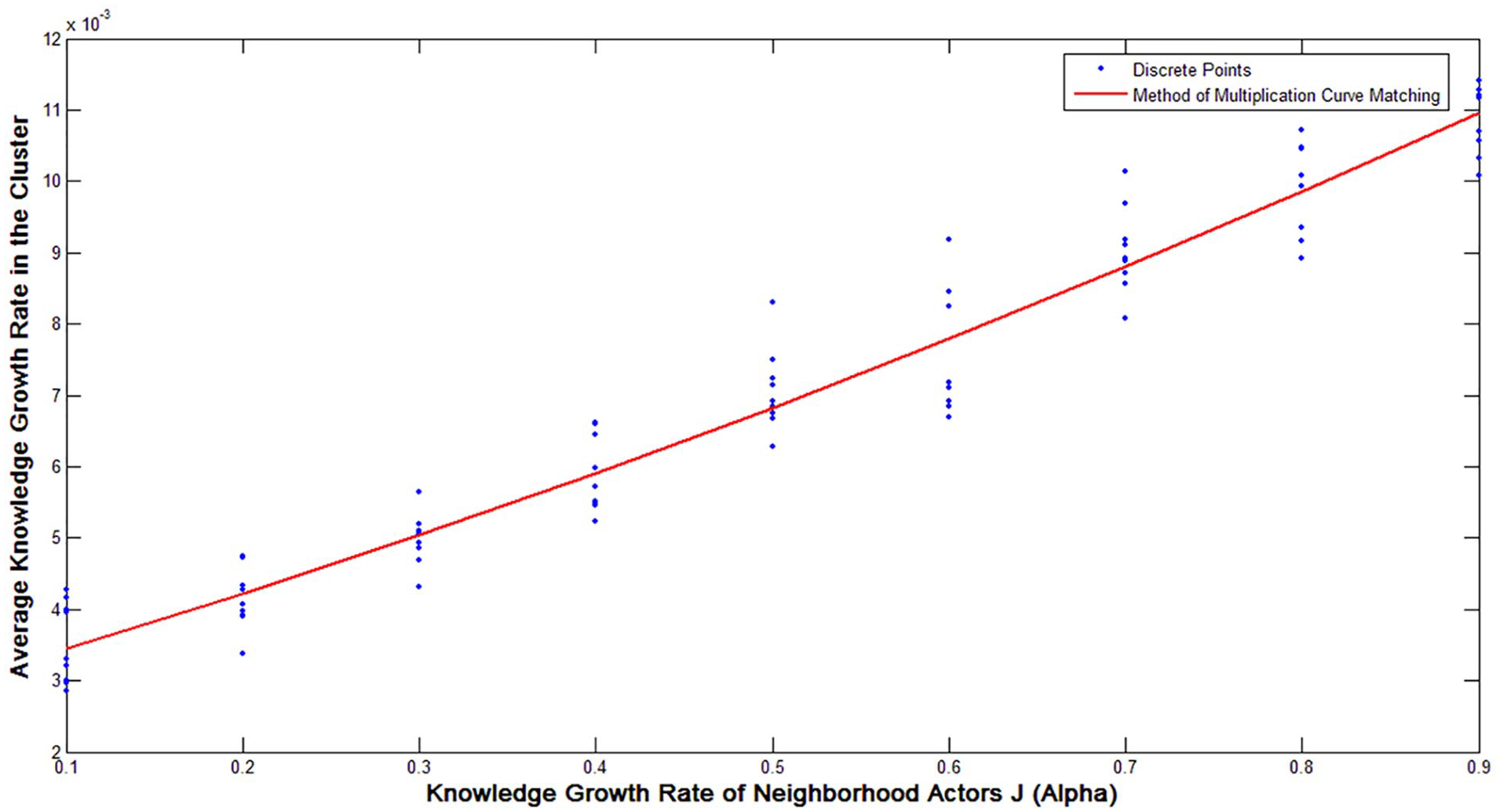
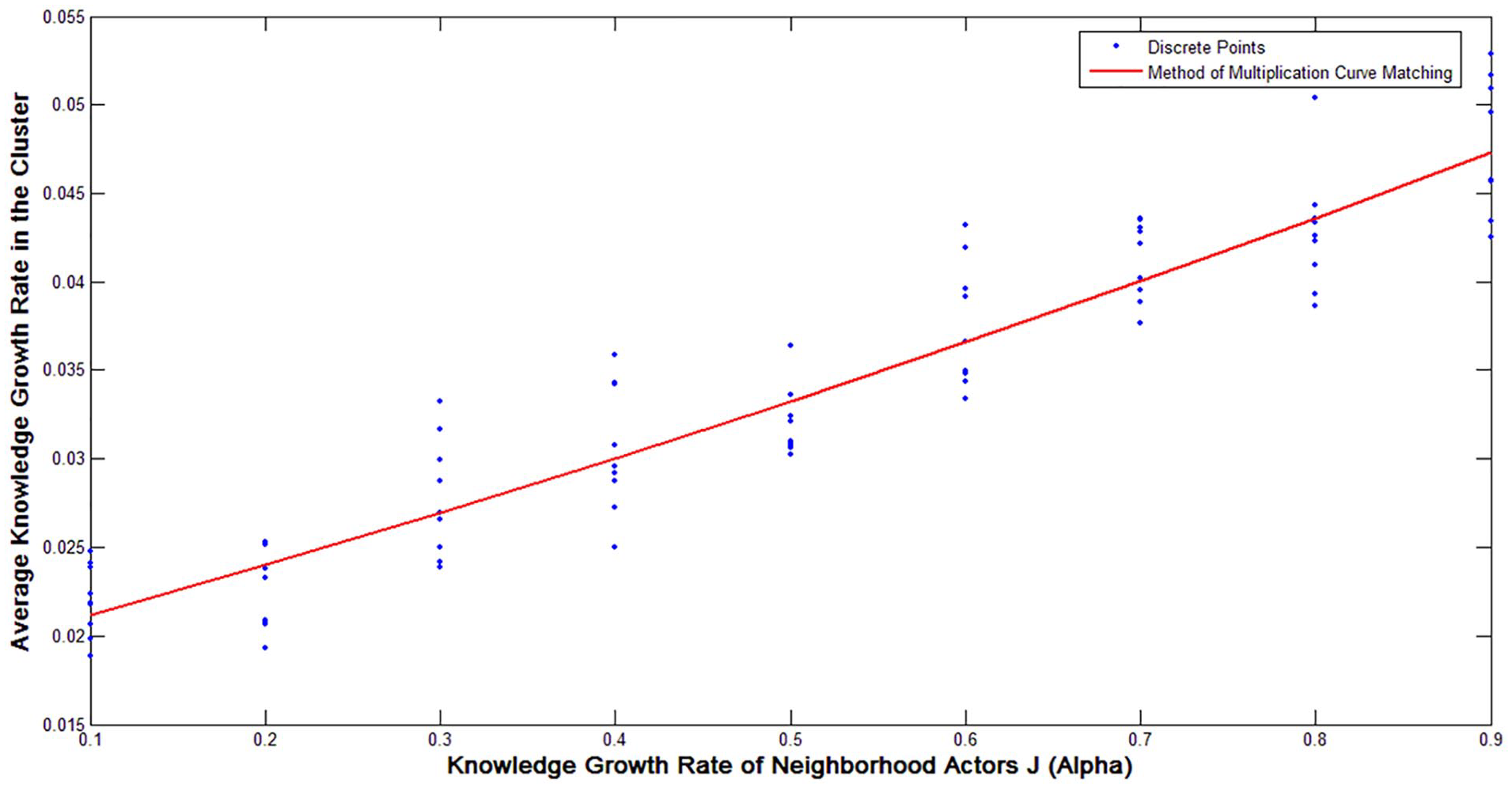
The simulation experiment results are shown in the figures below. A comparison of the differences between Figures 1–3, Figures 4–6, and Figures 7–9 reveals that when the parameter of innovation capability of actor firms





When the innovation capability of the actor firms is constant, there is a positive correlation between the knowledge growth rate and
A comparison of the differences between Figures 1, 4, and 7; Figures 2, 5, and 8; and Figures 3, 6, and 9 reveals that when
The results of multiplication curve matching show that when
These figures illustrate the results of the cluster network without hub firms. As shown in Figures 10–12, when



Conclusion and Implications
Global economic turmoil brings opportunities and challenges to China’s traditional manufacturing industrial cluster and the SMEs in the local cluster. How to enhance competitiveness and change the inferior position of local industrial clusters in the international division of labor has been a key focus of policymakers and researchers. In the development of an industry cluster, two important levers are of particular concern. Clusters that have one or more hub firms in the network have a higher knowledge growth rate that clusters whose networks lack hub firms. Thus, innovation performance is better when the cluster has a hub firm. However, we also suggest that the innovation management of the hub firm in the industry cluster should be treated dialectically. Central firms can influence network autonomy by recruiting cluster partners and redesigning network structures that facilitate collaboration (Levén et al., 2014). This can screen out and eliminate incompetent companies. Challenges associated with establishing and leveraging new innovation networks within clusters include finding the right partners to interact with, forming competitive partnerships with potential partners, establishing effective cross-linking of resources with these partners, and having effective and efficient processes in the partnerships (Bessant & Tidd, 2009).
Cluster learning is due to the interactions between firms and the coordination of these firms in solving the technical and market-related issues they face. Enterprises in clusters should have more flexible, and nimble capability to adapt to change and competition. Industry cluster partners should continually innovate to respond to the market.
To properly manage innovation, hub firms must have conscious, benign interactions with partner firms in the cluster. Through proper coordination, firms within the industry cluster can link their knowledge, technology, relationships, and various heterogeneous resources to achieve complementarity via the sharing process. Both the STI-mode innovation of hub firms and the DUI-mode innovation of cluster member firms can help improve a cluster’s innovation performance. There is a positive correlation between the innovation capability of actor firms and the knowledge growth rate of the cluster. Thus, a hub firm’s high level of STI-mode innovation leads to a higher level of innovation performance in the entire cluster network. There is also a positive correlation between the absorptive capacity of member actor firms and the knowledge growth rate in the cluster. This means that the DUI-mode innovation of cluster member firms leads to a higher level of innovation performance in the cluster network. The results further illustrate the knowledge interactions and learning effects as well as the general collaboration of partners within the cluster network. Flexible, cooperative relationships benefit cluster members by helping them adapt to market competition. Specifically, cluster members can find the partner whose knowledge best matches their particular task requirements at various times. Coexistence in a cluster network also enhances each member’s innovation performance.
Through proper coordination, firms within the industry cluster can link their knowledge, technology, relationships, and various heterogeneous resources, achieving complementarity via the sharing process. As cluster members collaborate and resource integration is optimized, new innovation capabilities are integrated and formed. This kind of hub enterprise leadership improves the innovation performance of the entire industry cluster. Hub enterprises have certain innovation capabilities, but if their partner firms are incapable of absorbing knowledge, the local cluster’s innovation performance will suffer, despite the successful innovative transformation of the hub firm. Thus, both STI-pattern and DUI-pattern innovations are critical to the innovation development of the cluster.
There is still ample room for the government to formulate policies on aggregation, especially the definition and strategic operation of policy clusters that determine long-term stability and better effective support means (Franco & Esteves, 2020). This also shows that we must monitor how the knowledge synergy between the hub firm and member firms impacts the dynamic evolution of the cluster. Measures should be taken to increase the efficiency with which knowledge synergy is achieved between the hub enterprise and the member enterprise with regard to operations and the innovative combination of resources. To obtain synergies from complementary knowledge, enterprises need to establish an effective coordination mechanism.
These specialized contributions identify and examine the impact of different patterns of innovation, in particular, patterns focused on STI versus patterns based on DUI. Echoing Jensen et al.’s (2007) seminal contribution and a series of other research (Thomä, 2017), we confirm the importance of the combination of the STI-based and DUI-based interaction patterns, which has a stronger impact on innovation output (technical and nontechnical) than either pattern individually. We systematically examine whether the central enterprise in a cluster can achieve positive interaction with the network partners through the STI and DUI patterns of knowledge learning and innovation within the cluster. Previous studies are mainly based on the enterprise level. Previous research on STI and DUI patterns did not discuss the roles of hub firms and member firms.
In this article, we propose a new approach and hypothesis for analyzing the effectiveness of the firm interaction model and the knowledge learning model. This study examines the interaction between members of the cluster with different innovation patterns. Understanding that the different interactions of members within the cluster networks are associated with different innovation patterns can help explain the paradox of innovation (Asheim & Gertler, 2005; Asheim & Parrilli, 2012).
The debate on STI and DUI innovation patterns has attracted the interest of researchers worldwide. However, most national-level analyses of innovation patterns have focused on developed countries with well-functioning market economies (Apanasovich et al., 2016). Several research have shown that the STI model is more relevant than the DUI model, and the combination of the two models does not have a particular impact on the adoption of the STI model alone(Parrilli & Heras, 2016). However, we consider that the two innovation modes are not completely separate in the context of China. We believe that both of them exist in industrial clusters, and both play an important role in cluster innovation networks. We proposed that these knowledge learning patterns can complement each other when they coexist in a cluster. We set the parameters of innovation modes according to the special situation of China. Our study supports previous studies that combine the two knowledge learning patterns in the cluster context (Apanasovich et al., 2016). This finding is due in part to the fact that certain characteristics are required to effectively combine the two patterns. The research results confirm that achieving a balance between STI-mode innovation and DUI-mode innovation has a positive impact on cluster upgrading. Only when the synergistic effect of knowledge integration within the cluster has been realized can the hub firm’s interactions play a positive role in the innovation upgrading of the entire cluster.
Limitations
The study has the following limitations: We only select manufacturing clusters as our experimental subjects. Our theoretical analytical framework is also in the exploratory stage. The simulation models cannot well reflect all the real practices of the enterprise behavior. We paid attention to the advantages of this method for measuring the performance of dynamism and complexity. Our research is limited to a specific geographic region and a set of industries. Based on our exploration, future research could classify the industry cluster networks. A comparative study could focus on specific industries. Other research could compare Chinese industry clusters with overseas networks of clusters with similar industry and technology features.
Further studies can characterize the evolution of cluster networks in a country or region at different stages of development. These studies can help guide policymakers and cluster planners to better understand the dynamics of upgrading and knowledge evolution in mature industry clusters.
Footnotes
Declaration of Conflicting Interests
The author(s) declared no potential conflicts of interest with respect to the research, authorship, and/or publication of this article.
Funding
The author(s) disclosed receipt of the following financial support for the research, authorship, and/or publication of this article: Funding was provided by Huaqiao University’s Academic Project supported by the Fundamental Research Funds for the Central Universities (18SKGC-QT01).
Ethical Approval
This article does not contain any studies with human participants or animals performed by any of the authors.
