




Abstract
With the rapid expansion of social media, sports YouTube programs have become increasingly ubiquitous. The aim of this study is to investigate the association among college students’ participation in sports YouTube engagement, psychosocial functions of sport, and well-being. In the spring semester of 2023, we recruited 243 Korean college students enrolled in university. The research participants completed scales measuring psychosocial functions of sport, well-being, and sports YouTube engagement scales. We employed the SPSS PROCESS Macro program (Model no. 5) to test our research hypotheses. Our findings demonstrated that engagement in sports YouTube engagement had a significant positive effect on both well-being and psychosocial functions of sport. Furthermore, psychosocial functions of sport had a significant positive effect on well-being. Additionally, the interaction between sports YouTube engagement and kinesiology/non-kinesiology students had a significant positive effect on well-being, but solely among kinesiology major students. To enhance sports values and well-being among non-kinesiology major students, universities should actively integrate sports YouTube engagement into their general kinesiology courses. For future research, it is recommended to conduct comparative analyses of psychosocial functions of sport among university students, both within Korea and in comparison with students from other countries. This will provide a deeper insight into sports society and culture.
Plain language summary
The aim of this study is to investigate the association among college students’ participation in sports YouTube engagement, psychosocial functions of sport, and well-being. In the spring semester of 2023, we recruited 243 Korean college students enrolled in university. The interaction between sports YouTube engagement and kinesiology/non-kinesiology students had a significant positive effect on well-being, but solely among kinesiology major students. This will provide a deeper insight into sports society and culture.
Keywords
In contemporary society, with the ongoing development of social media, can sports YouTube activities enhance well-being? Many individuals believe that engaging in physical activity can lead to a life of well-being (Penedo & Dahn, 2005) and emphasize the importance of sports. In essence, participation in physical activity is regarded as a positive endeavor that improves health (Miles, 2007), interpersonal relationships (C. Kim e, 2021), and quality of life (Rejeski & Mihalko, 2001). Therefore, the value of sports is considered significant. On the other hand, in modern society, social media is often regarded negatively due to various issues such as social media addiction (Balakrishnan & Griffiths, 2017), YouTube addiction (De Bérail, Gui et al., 2019), and sedentary lifestyles (McDonough et al., 2022) that arise with the continuous evolution of social media. Nonetheless, there is a paucity of research examining the relationship between well-being and real-life social media activities.
The development of social media has led people to use digital devices such as smartphones and tablet PC to participate in exercise and broaden their selection of training methods. For instance, YouTube channels that focus on home training provide consumers with busy lifestyles the advantage of easy access without the constraints of time and place (Dey et al., 2020; Stragier et al., 2016). The convenience of YouTube and its ability to facilitate communication among users has contributed to an increase in user consumption (Jeon & Pan, 2020). Furthermore, users can easily search for and find their interests, such as body image (Beytin, 2017; Holmes, 2017), sports norms (Halim et al., 2020), and fan vlogging (Pather, 2022) on YouTube, which can serve as a precondition for improving users’ convenience and well-being. Although studies examining the relationship between exercise methods via YouTube (Spencer, 2014) and exercise re-participation (Y. Oh, 2023) are currently underway, there is a dearth of research on the psychosocial functions of sport and well-being. This study emphasizes the need for further research on this topic.
Psychosocial functions of sport encompasses the benefits that arise from engaging in physical activity, including improvements to physical health (e.g., obesity, heart disease), mental health (e.g., stress, anxiety), personality traits (e.g., teamwork, leadership), job creation, tourism, and economic contributions through the sale of sports-related goods and services, as well as national pride fostered through hosting international sporting events like the Olympics and World Cup (Y. T. Oh et al., 2021; Silva et al., 2020). Well-being, from a psychological perspective, involves the development of one’s potential, a sense of control over one’s life, the pursuit of purposeful goals, and positive emotions (e.g., joy, contentment; Huppert, 2009).
This study aims to investigate the psychosocial functions of sport of Korean university students and to explore the effect of sports YouTube engagement on the well-being of both kinesiology and non-kinesiology students. The development of sports media is expected to enhance sports value and improve the quality of life for the public. Meanwhile, In a recent study conducted by Y. Oh (2023), the association between psychosocial functions of sport and sports YouTube engagement was examined among Korean university students. The author proposed a prospective investigation involving a comparison and analysis of two student groups: those majoring in kinesiology and those in non-kinesiology disciplines in Korea. Therefore, the purpose of comparing and analyzing two groups of kinesiology and non-kinesiology university students is to provide motivation for recognizing the importance of sports media in higher education. Specifically, enhancing general sports courses at universities can contribute to establishing a proper understanding of sports, fostering sportsmanship, promoting positive changes in students’ sports behavior, and supporting the development of sports sociology researchers.
Literature Review
Relationship Between Sports YouTube Engagement, Well-Being, and Psychosocial Functions of Sport
YouTube is a social media platform, similar to Facebook, Instagram, and Pinterest. It allows users to upload videos and for consumers to watch them. Created in 2005, YouTube has become a significant global platform with 2.1 billion monthly active users as of 2022 (Lee et al., 2022). Most users access YouTube through their mobile devices, making it easily accessible. YouTube is a popular social media activity because it offers a variety of platforms such as health (Green et al., 2018; O’Leary et al., 2022), music (Airoldi et al., 2016), and sports fans (Clavio & Walsh, 2014). In fact, in 2021, 81% of American adults reported using YouTube (Pew Research Center, 2017). As a subsidiary of Google, YouTube mainly generates revenue through advertising. It is currently used in over 100 countries and supports more than 80 languages. With the development of social media, people can easily access various information and enjoy a well-being life in their daily lives.
Research on human well-being began in 1960 (Gurin et al., 1960), and recent studies have been spurred by the positive psychology movement, which has seen a growing interest in human prosperity and well-being (Diener et al., 2009). People with high levels of well-being are generally mentally healthy, and those who experience fewer negative emotions tend to have higher levels of well-being (Lai et al., 2013). Furthermore, it was discovered that various forms of physical sports activities promote positive psychological well-being, irrespective of the environment in which they were conducted (Lawton et al., 2017; Penedo & Dahn, 2005; Rodríguez-Bravo et al., 2020). Engaging in regular physical activity contributes to the enhancement of high levels of life satisfaction and quality of life happiness (Stubbe et al., 2007). It also aids in the establishment of structures and resources that facilitate a balanced life (Campillo et al., 2008; Thompson Coon et al., 2011). This process not only fosters improvements in psychological well-being but also promotes better mental health, autonomy, body image, optimism, and emotional flexibility(Rodríguez-Bravo et al., 2020). This study aims to investigate whether engagement in sports YouTube engagement contributes to well-being in daily life.
Meanwhile, social media activities have been evolving to provide consumers with programs that convey information about sports and physical activities. Previous studies have examined various aspects, such as exercise motivation (Shen et al., 2019), exercise techniques (Tímár et al., 2011), exercise re-participation intention (Y. Oh, 2023), and sport mega-events (Lee Ludvigsen & Petersen-Wagner, 2022). In this study, we aim to investigate how sports YouTube engagement contribute to the perception of the value of sports. The value of sports refers to the positive perception that sports can have on individuals and society. Specifically, engaging in physical activity can help maintain health and wellbeing (Damberg, 2022), improve teamwork skills that recognize the importance of working with others (communication, trust), develop leadership skills, and enhance fair play abilities that respect others (Y. T. Oh et al., 2021).
Sports provide individuals with opportunities to interact with people from di-verse backgrounds and develop social skills such as communication, empathy, and tolerance (Li, 2013). Additionally, sports mega-events such as the Olympics or World Cup showcase the positive values of sports and their effect on society (Lee Ludvigsen & Petersen-Wagner, 2022). Therefore, in this study, drawing upon previous research (Lee Ludvigsen & Petersen-Wagner, 2022), we will examine whether sports YouTube engagement with enhance well-being and psychosocial functions of sport. The hypotheses 1 and 2 of this study are as follows:
H 1: Sports YouTube engagement will have a positive effect on well-being
H 2: Sports YouTube engagement will have a positive effect on psychosocial functions of sport
Relationship Between Psychosocial Functions of Sport and Well-Being
The value of sports can have a positive influence on various aspects. Participation in physical activity can bring happiness by relieving stress and anxiety, and can improve interpersonal relationships for the general public (Y. T. Oh et al., 2021). Meanwhile, the perceived value of elite sports recognizes the subjective perspective of individuals who constitute international sports success in their country and evaluates the value of national elite sports in an international context (Hallmann et al., 2013). However, the impact of sports success on national pride and well-being has not been widely researched (Silva et al., 2021). Despite this, it has been found that sports success in the Olympics and major international football competitions such as the FIFA World Cup and UEFA Europa League has a positive short-term effect on happiness (Silva et al., 2021).
However, a study conducted by De Bosscher et al. (2021) delves into the realm of elite sports, uncovering two distinct dimensions: positive and negative. To elaborate, the study focuses on the affirmative facets, elucidating how elite sports yield social benefits such as symbiosis, national pride and identity, well-being, and the advancement of grassroots sport participation, particularly within the context of elite athletes’ Olympic medal achievements (De Bosscher et al., 2021). Conversely, there is a deficiency in scholarly understanding concerning the social advantages derived from sports. To clarify, while research has explored negative repercussions, including corruption or criminal behavior linked to elite sports (Grix & Carmichael, 2012; Houlihan et al., 2009). Furthermore, De Bosscher et al. (2021) have demonstrated the utility of mapping perceived positive and negative impacts associated with elite sports. This mapping can offer guidance to public managers, assisting them in determining the elite sports policies and actions that hold value for the general public.
In this study, although elite athletes were not targeted, Korean university students with an interest in sports were selected as the research subjects due to the importance of physical activity and international sports mega-events. Therefore, the aim is to verify whether the perceived value of sports by Korean university students can enhance well-being. Hypothesis 3 of this study is as follows:
H 3: Psychosocial functions of sport will have a positive effect on well-being
Undergraduate Students Majoring in Kinesiology and Non-kinesiology Majors
Undergraduate students majoring in kinesiology are required to take both major and general courses at their respective universities. The core subjects for kinesiology majors typically include sports sociology, sports psychology, sports medicine, exercise physiology, and kinematics. However, the specific major courses required can vary depending on the characteristics of each department. By fulfilling the required credit hours, students can meet the graduation requirements. On the other hand, non-kinesiology majors primarily take courses related to their major, and kinesiology classes (e.g., such as badminton, tennis, and table tennis) are optional. In other words, while kinesiology majors learn specialized knowledge in the field of physical education, non-kinesiology majors only take physical education classes as part of their general education. This study predicts that the well-being perception levels of kinesiology and non-kinesiology undergraduate students will differ through with sports YouTube engagement. Hypothesis 4 of this study is as follows:
H 4: Interactions between sports YouTube engagement and major will have a positive effect on well-being
Method
Participants
This study selected college students who were enrolled in the spring semester of 2023 as the participants. The participating universities included colleges located in Seoul special city, Gyeonggi-do province, and Jeju special self-governing province of south Korea. The students from these universities participated in the study. The sample consisted of 192 (79%) students majoring in kinesiology and 51 (21%) students who were not majoring in kinesiology. In terms of gender, there were 151 (62.1%) male students and 92 (37.9%) female students, for a total of 243 (100%) participants.
Measures
The questionnaire used in this study was composed of scales that have previously demonstrated sufficient reliability and validity. The questionnaire consisted of 17 questions regarding sports YouTube engagement, supplemented by the Rubin (1981) scale. Participants responded to each question on a 7-point Likert-type scale. To measure psychosocial functions of sport, the Spreitzer and Snyder (1975) scale, which consists of 15 items, was utilized and measured on a 5-point Likert-type scale. Additionally, the well-being scale developed by Diener et al. (2010) was used, which consists of 8 items and was also measured on a 5-point Likert-type scale.
Statistical Analysis
The data collected in this study were analyzed using several statistical programs, including SPSS 24.0 (SPSS Inc., Chicago, Illinois, USA), SPSS PROCESS Macro, and Amos 24.0 (IBM, New York, United States). The analysis proceeded as follows. First, a frequency analysis was conducted. Second, Cronbach’s alpha values were calculated to assess the reliability of each measurement tool, and confirmatory factor analysis was performed to establish the constructs’ validity. Third, Pearson’s product-moment correlation was calculated for the major variables. Fourth, the SPSS PROCESS Macro (Hayes, 2018) was used to investigate the moderating effect of university students’ majors (kinesiology and non-kinesiology) on the relationship between sports YouTube engagement, psychosocial functions of sport, and well-being. To evaluate the significance of the results, we used a 95% confidence interval (C.I.) and an alpha level of .05.
Results
Results of Statistical and Correlation Analyses
Table 1 lists the descriptive statistics of study variables, including mean, standard deviation, skewness, and kurtosis, as well as composite reliability and average variance extracted. The data exhibited a normal distribution, as indicated by skewness and kurtosis values falling within the recommended ranges of −2 to +2 and −7 to +7, respectively (Hair et al., 2010). Correlations were calculated to investigate the overall relationships between variables, and all variables were found to be correlated below .67, indicating an absence of multicollinearity (Bollen & Lennox, 1991).
Pearson Correlations of Scores. Descriptive Statistics, and Cronbach’s α.

p < .05. **p < .01.
Path Analysis of Sports YouTube Engagement, Psychosocial Functions of Sport, and Well-Being
The results of verifying the path analysis of sports YouTube engagement, psychosocial functions of sport, and well-being are shown in Figure 1 and Table 2. First, sports YouTube engagement had a significant positive effect on well-being (Hypothesis 1 was accepted). Second, sports YouTube engagement had a significant positive effect on psychosocial functions of sport (Hypothesis 2 was accepted). Third, psychosocial functions of sport had a significant positive effect on well-being (Hypothesis 3 was accepted). Each path appeared meaningfully. In the next step, the moderating effect of major was tested on the relationship between sports YouTube engagement and team well-being.
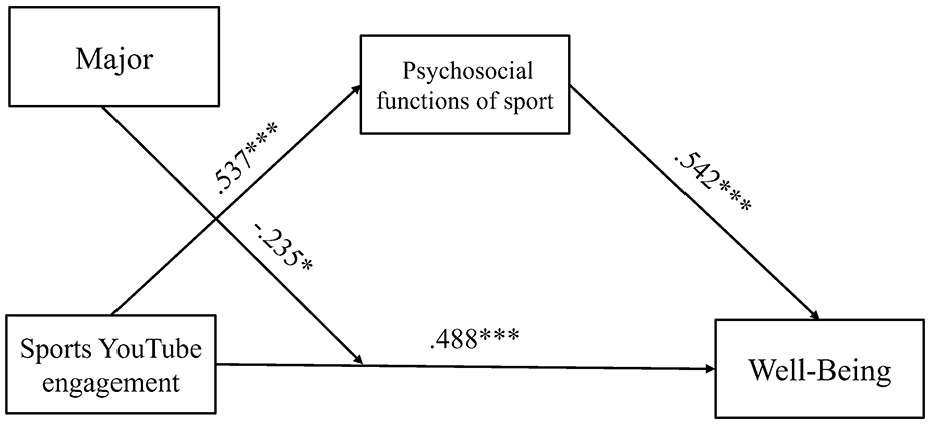
Finalized hypothesized model.
Direct and Interaction Effect Index.

Note. LL, UL: Bias-corrected 95% confidence interval (lower limit, upper limit); bias-corrected bootstrapping method is conducted for indirect effect estimates; *p < .05, **p < .01, ***p < .001.
Moderating Effects of University Students' on the Relationship Between Sports YouTube Engagement and Well-Being
The moderating effect of kinesiology/non-kinesiology on the relationship between sports YouTube engagement and well-being is shown in Figure 2 and Table 2. The moderating effect of sports YouTube engagement and kinesiology was significant. Kinesiology major university students’ 0.253 (CI [0.145, 0.361]) showed a significant moderating effect. Specifically, the analysis indicates a strong interaction between sports YouTube engagement and a heightened sense of well-being among students major in Kinesiology.

Interaction effects graph.
Discussion
This study revealed that sports YouTube engagement among Korean university students can enhance psychosocial functions of sport and well-being. Specifically, kinesiology major students showed improvement in well-being through participation in sports YouTube engagement, while non-kinesiology major students did not perceive any changes in well-being. Our study suggests the need to raise awareness among non-kinesiology major students about the value and importance of sports, and high-lights the potential contributions of sports media development and sports sociology to society. Based on these findings, the following discussions are presented.
The sports YouTube engagement has had a significant impact on well-being. A study of 396 adults who watched online games using the Twitch app, a social media platform similar to YouTube, revealed that it improved their psychological well-being in daily life (Kim & Kim, 2022). Consequently, social media activities have become increasingly popular in everyday life, and are recognized as contributing to the well-being of many people. Through live streaming technology, social media activities enable individuals to broadcast in real-time and engage with consumers in discussions, which is receiving much attention from the general public. Meanwhile, in Korea, sports games were held without spectators during the 2021 to 2022 season due to the spread of COVID-19. To enable real-time viewing of the actual game, YouTube was introduced in most sports games. As a result, many fans were unable to attend the stadium, but this study indirectly supports the notion that watching sports games of interest through smart media provides convenience and happiness in daily life.
Sports YouTube engagement had a significant effect on psychosocial functions of sport. As of April 2021, the Korea-based YouTube channel Physical Gallery had 3.06 million subscribers, while the YouTube channel Hipeuddeum, a female fitness SNS influencer, focused on weight loss and joint-specific exercises. Giji TV aimed to motivate viewers to participate in exercise by sharing their journey and progress on exercise and diet (M. Kim & Kim, 2022). Additionally, “home training” was the top keyword searched on Naver and Daum in 2020 (Y. J. Kim & Kwak, 2021). Kim & Kim (2022) confirmed various keywords such as “exercise,”“hip-up,”“shoulder,”“method,”“routine,”“diet,”“chest,”“home-training,”“health,”“back,” and “lower-body” as major search terms on fitness-related YouTube channels. Such interests indirectly support the fact that the participation rate in sports YouTube is high due to the recognition of the value of sports. In other words, although research directly confirming the relationship between sports YouTube engagement and sports values is insufficient, analysis of YouTube search terms allows us to confirm that many people recognize the importance of sports.
The sports values consciousness had a significant effect on wellbeing. According to a study by Silva et al. (2020), sports values had a positive effect on subjective wellbeing based on their research of 567 university students. Elling et al. (2014) also confirmed that perceived sports success among Dutch athletes had a short-term positive impact on subjective wellbeing. Moreover, Hallmann et al. (2013) supported these findings by ex-plaining that the happiness of the German people increased when German athletes won major international competitions. The present study found that higher levels of sports values consciousness among university students are associated with better well-being, indicating that university students perceive the importance of sports. Based on these results, it is recommended to enhance and promote general physical education in universities and government sports policies to increase awareness of the value of sports, which can lead to improvements in university students’ quality of life, happiness, and well-being.
The interaction between sports YouTube engagement and university students’ major fields had a significant effect on well-being among students majoring in kinesiology. However, comparing and contrasting this study with previous research that analyzed kinesiology and non-kinesiology majors separately has limitations. Nevertheless, Ko Wai (2020) phenomenological study of three Finnish university students indirectly supports our findings by showing that watching YouTube videos can enhance well-being and happiness. Kinesiology majors learn professional theories and practical skills as part of their university curriculum and are likely to actively utilize sports YouTube engagement to find topics of interest easily. However, non-kinesiology majors may have difficulty finding appropriate terminology and topics of interest due to their lack of basic knowledge about sports. Therefore, our study’s findings highlight the significant role of sports YouTube utilization in the field of kinesiology.
In summary, in modern society, sports information can be easily accessed through various online media such as YouTube and Instagram, as social media continues to evolve. Korean university students have confirmed the sequential relationship be-tween sports values and well-being through sports YouTube engagement. In particular, sports YouTube engagement has been shown to improve well-being among kinesiology majors. Therefore, the positive impact of sports YouTube engagement on well-being should not be overlooked among both kinesiology and non-kinesiology majors. Based on these findings, universities should strengthen their general sports courses to raise awareness of the importance of sports. Furthermore, this study is expected to contribute to the development of sports social sciences by expanding research on the sports values and well-being of university students through engagement with social media.
Limitations and Future Research Opportunities
This study examined the positive relationship between sports YouTube engagement, psychosocial functions of sport, and well-being among Korean university students, and found that the level of well-being perception varied depending on whether the students majored in kinesiology or not. The limitations and contributions of this study are as follows. Firstly, the proportion of kinesiology (79%) and non-kinesiology major (21%) among the subjects was not appropriate. Therefore, future research is needed to analyze and compare the relationship between psychosocial functions of sport and well-being by adjusting the proportion of subjects. Secondly, this study was limited in directly comparing and analyzing the relationship between sports YouTube engagement and psychosocial functions of sport, as there is a lack of research on this topic. Therefore, in future research, it is necessary to focus on analyzing the interpretation of sports values through YouTube, such as exercise motivation (Y. Oh, 2023), body image (Holmes, 2017), and home training (Sui et al., 2022), and to analyze the relationship between psychosocial functions of sport. Finally, this study is an important contribution to the field of sports social sciences through the use of social media. Therefore, for future research, it is suggested that comparative analyses of psychosocial functions of sport among university students, or between Korean and students from other countries, are needed to better understand sports society and culture.
Footnotes
Author’s Note
The authors has read and concurs with the contact in the final manuscript.
This research was conducted while [Youngtaek Oh] was at the [Department of Kinesiology & Sport Management, Texas A&M University, U.S.]. He is now at the [Department of Sport Science, Jeju National University, South Korea] and may be contacted at [
Declaration of Conflicting Interests
The author declared no potential conflicts of interest with respect to the research, authorship, and/or publication of this article.
Funding
The author received no financial support for the research, authorship, and/or publication of this article.
Ethics Approval and Informed Consent to Participate
The study was conducted in accordance with the Declaration of Helsinki, and approved by the Institutional Review Board. The data were used after obtaining consent from the study subjects.

Data Availability Statement
Data sharing not applicable to this article as no datasets were generated or analyzed during the current study.