



Abstract
We study the influence of the “surname relationship” of the senior management team on corporate green innovation by taking the A-share listed companies in Shanghai and Shenzhen from 2012 to 2022 as A sample. The results show that the “surname relationship” of senior management team has inhibitory effect on corporate green innovation. The mechanism effect test shows that the “surname relationship” affects the green innovation of enterprises by hindering the formation of multiple cognitive models of teams and weakening the internal supervision mechanism. This paper has enriched the relevant literature on the economic consequences of surname-related culture and the influencing factors of corporate green innovation, and has inspiration and reference significance for improving corporate governance structure and enhancing corporate green innovation ability.
Plain language summary
The results show that the “surname relationship” of senior management team has inhibitory effect on corporate green innovation. The mechanism effect test shows that the “surname relationship” affects the green innovation of enterprises by hindering the formation of multiple cognitive models of teams and weakening the internal supervision mechanism.
Keywords
Introduction
President Xi stressed that “We need to coordinate industrial restructuring, pollution control, ecological protection, and climate change, and work together to reduce carbon, pollution, promote green growth, and give priority to ecological, economical, intensive, green, and low-carbon development” in the 20 reports. At the same time, the proposal of the “double carbon” goal in 2020 points out the direction for the future coordinated development of China’s economy, society and ecology, and green innovation is the core force and important support for promoting green development and establishing a low-carbon circular economy system.
As the micro carrier of green innovation, enterprise management, as the maker and participant of innovation decision, plays an important role in enterprise innovation behavior (He et al., 2019). Considering the important role of management in corporate green innovation, existing literature mainly focuses on the impact of management characteristics and experiences on corporate green innovation, such as educational experience, psychological characteristics, special experience, and career experience (Amore et al., 2019; Arena et al., 2017; Z. Liu & Wang, 2021; J. Pan, 2023). In emerging market countries where the formal system needs to be further improved, the impact of informal system on the economic behavior of enterprises cannot be ignored (Chen et al., 2013; Guan et al., 2016). Ignoring the influence of informal system may not be able to fully understand the green innovation behavior of enterprises. The most typical manifestation of informal system in our country is the relationship culture.
In China, a country with a strong collectivist culture, surnames may be associated with families and social groups, thereby influencing the way in which internal team collaboration integrates green innovation resources. China is a typical relational society (Fei, 1998). Under the influence of China’s traditional “family culture,” surnames are an important link between individuals in a relational society and the core of establishing kinship groups. Individuals with the same surname are often assumed to have a common ancestor, called “five hundred years ago was one family.” As an important symbol of family culture, surnames were initially closely related to blood relationship and family. In ancient times, surnames had various origins. Some were derived from fiefdoms, some from official positions, and others from the names of ancestors, etc. However, regardless of the origin, groups with the same surname were considered to have some kind of inherent connection during the long-term development process. The importance of surname relationships in traditional concepts is also reflected in the reverence for ancestors. People believe that those with the same surname have a common ancestor, and this ancestor worship further strengthens the emotional bond among those with the same surname. For example, in some ancestor-worship ceremonies, members of the same-surname family will gather together to worship their ancestors jointly, and such activities enhance the sense of identity and cohesion among the same-surname group. Strictly speaking, there is a “surname relationship” between individuals with the same surname who are related by blood (Y. Yang, 1999). However, with the development of economy and society, this small range of “surname relationship” has been extended to a more extensive group relationship with the same surname, and has been recognized by people in reality (Y. Pan et al., 2019; L. Zhang et al., 2020). In modern society, with the increasingly frequent population mobility and social interactions, both the connotation and denotation of surname relationships have changed. The same-surname relationships that were originally based on blood and region have gradually broken through these limitations. For example, in business cooperation, people may have a special sense of closeness because of the same surname, and this sense of closeness may make them more willing to establish a cooperative relationship. The development of modern technology and media also provides conditions for the expansion of surname relationships. Through platforms such as the Internet, people with the same surname can be organized more easily and carry out various activities, such as surname-culture research, clan-relative association meetings, etc. These activities further strengthen the connections among those with the same surname from different regions and different backgrounds, extending surname relationships from the traditional family category to a broader social level. At the same time, in some public affairs or social activities, the same-surname group may also form a certain influence because of the surname relationship and jointly contribute to social development. Therefore, the profound heritage of “family culture” provides a good entry point for us to study how the informal system of “surname relationship” affects the green innovation of enterprises. Based on the upper echelon theory, the cognition and value preferences of members in the top-management team are shaped by their cultural environment and are reflected in corporate management decisions. In this context, in-depth exploration of the impact of “clan relationships” within the top-management team on corporate green innovation undoubtedly has significant theoretical and practical significance.
The “surname relationship” of senior management team may have two distinct influences on corporate green innovation. On the one hand, the “surname relationship” of the senior management team is easy to integrate members into a “circle,” and the cognitive mode of the members in the circle tends to be homogenized, which is not conducive to the cultivation of innovation-related multiple cognitive modes and critical thinking, and is not conducive to the generation of innovation-related new ideas and ideas. Moreover, considering the characteristics of high risk, long-term and large investment of research and development activities, the internal supervision and control mechanism is weakened by the “surname relationship,” and the management team is prone to “collusion,” which will have an “inhibiting effect” on green innovation. On the other hand, the “surname relationship” of the senior management team is conducive to the sharing and sharing of knowledge about innovation among the team members, which has an “information flow effect” on innovation. Moreover, the “surname relationship” may also enhance the trust between members, strengthen cooperation, and enhance the willingness of management to take risks, which will have a “promoting effect” on green innovation.
In order to verify the role of the “surname relationship” of senior management team in corporate green innovation, this paper empirically tests the impact of the “surname relationship” of senior management team on corporate green innovation activities by using the data of China’s A-share listed companies from 2012 to 2022. This paper finds that “surname relationship” can significantly inhibit enterprises’ green innovation activities. After a series of robustness tests and endogenous control methods, the above research conclusions are still valid. The mechanism test shows that hindering the formation of multiple cognitive models and weakening the internal supervision mechanism are the underlying mechanisms.
The research contribution of this paper is mainly reflected in the following three aspects. First, this paper enriches the research on the economic consequences of surname culture. Existing researches in related fields mainly focus on the fields of economics and sociology. Some research have explored the impact of “surname relationship” on financial misstatement, on-the-job consumption (C. Liu et al., 2019), and agency cost (Y. Pan et al., 2020; Yan & Xiao, 2019; L. Zhang et al., 2020) and corporate value (Y. Tan et al., 2021), while this paper adds the impact of “surname relationship” on corporate green innovation, providing a new perspective from the enterprise level for insight into the economic function under the culture of family name relationship.
Second, the researches on the influencing factors of corporate green innovation in existing literatures mainly focus on the micro and macro policies of enterprises, and only a few literatures have studied the influence of informal institutions such as the characteristics and experience of senior executives on corporate green innovation (Z. Liu & Wang, 2021, et al.). In this paper, the “surname relationship” of management team is introduced into the field of enterprise green innovation, so as to further expand and supplement the influencing factors of informal system of enterprise green innovation.
Finally, the empirical conclusions of this paper have certain practical value and policy enlightenment. In such a “relational society” in China, the research conclusions of this paper suggest that we should pay attention to the influence of “relational soft factors” in the structure of senior management team on the green innovation behavior of enterprises, strengthen the construction and governance of senior management personnel, and the research conclusions also have certain implications for the “double carbon” and “green development” strategies currently implemented in China.
The rest of this paper is arranged as follows: The second part is literature review; The third part is the research hypothesis; The fourth part is the research design; The fifth part is the empirical results; The last part is the conclusion of this paper.
Literature Review
Influencing Factors of Enterprise Green Innovation
The research on influencing factors of enterprise green innovation mainly includes external and internal aspects. External factors of enterprises mainly include environmental regulation, legal pressure from stakeholders, carbon finance, government subsidies, green credit policies, fintech, Pro-Qing relationship between government and business, etc. For example, Fan and Sun (2020) found that the promotion of green technology innovation depends not only on the intensity of environmental regulations, but also on the type of environmental regulations. J. Tan and Xu (2022) revealed that regional environmental regulation promoted corporate green innovation, among which command-control tools had more prominent incentive effect, and compared with substantive green innovation, environmental regulation tools had more significant impact on corporate strategic green innovation. The study of Lv et al. (2020) confirms that in order to meet the high expectations of stakeholders such as the government, consumers and media for green production, enterprises in leading positions in the industry are more willing to adopt green strategies. F. Wang et al. (2022) found that carbon emission trading can improve the level of corporate environmental responsibility, ease financing constraints and thus enhance high-quality green innovation of enterprises, but has no impact on general green innovation. P. Liu et al. (2022) showed that government subsidies have a significant double threshold effect on corporate green innovation, and only when government subsidies are located within a specific threshold value can the promotion effect on green innovation reach its maximum. F. Zhang and Yu (2023) found that green credit policies inhibit the green innovation of heavily polluting enterprises in the growth and decline stages by influencing financing constraints and R&D input. Xiao et al. (2023) showed that the development of fintech can significantly promote the green innovation of enterprises. Luo et al. (2023) found that the higher the level of the pro-Qing government-business relationship in the city where the enterprise is located, the higher the quantity and quality of the enterprise’s green innovation, that is, the pro-qing government-business relationship plays an “incremental quality” effect on the enterprise’s green innovation.
Internal factors mainly include internal resources, innovation ability, characteristics and experience of management, management team heterogeneity, corporate governance etc. For example, F. Yu et al. (2021) prove through research that enterprises with diversified knowledge base are more conducive to green innovation when they are embedded into low-knowledge distance alliances. Xing and Yu (2020) found that the ability to acquire and integrate green resources has a significant positive promoting effect on enterprises’ environmental innovation. Since the advanced theory was proposed, whether the unique experience and characteristics of corporate managers affect corporate green innovation has aroused great interest of scholars. By constructing a quasi-natural experiment, Amore et al. (2019) found that highly educated corporate executives have a stronger awareness of environmental protection and are more willing to invest in environmental protection, thus improving the level of corporate green innovation. Arena et al. (2017) showed that executives with arrogant traits would make decisions more dependent on their own opinions and overestimate the possibility of success of green innovation projects, thus increasing the investment in green innovation of enterprises. Z. Liu and Wang (2019) found in their research that compared with executives without military experience, the companies of executives with military experience have a higher level of green innovation. J. Pan (2023) showed that, compared with the enterprises with executives without green background, the enterprises with executives with green experience have better green innovation performance, more innovation quantity and higher innovation quality. In terms of management layer heterogeneity, for example, J. Li (2019) found that the heterogeneity of the functional backgrounds of the top-management team was significantly and positively correlated with the intensity of enterprise green R&D investment when exploring the relationship between the characteristics of the top-management team and enterprise green R&D investment. Xie et al. (2008) and others found that the heterogeneity of the educational level and tenure of members of the top-management team both had significant and positive impacts on green R&D performance. Corporate governance is also an important factor that cannot be ignored in influencing corporate green innovation. D. Zhao and Zhong (2024) took A-share listed companies in China’s heavily polluting industries from 2011 to 2021 as samples to explore the impact of common institutional ownership on corporate green innovation. The research found that common institutional ownership promotes corporate green innovation and supports the synergetic governance effect. K. Xue and Wang (2024) discussed the impact of shareholder heterogeneity on corporate green ambidextrous innovation under the background of mixed-ownership reform of state-owned enterprises. The research found that shareholder heterogeneity can promote corporate green ambidextrous innovation; Compared with green exploratory innovation, the impact of shareholder heterogeneity of state-owned enterprises on green exploitative innovation is greater. Y. Cheng (2024) found that the quality of internal control has increased corporate green innovation investment, thereby affecting corporate value. Yu and Nan (2024) revealed that an increase in the degree of equity balance will enhance the intensity of corporate green innovation investment; C. Li (2024) explored the impact of the characteristic governance of “integrating the Party’s leadership into all aspects of corporate governance” of state-owned enterprises on green performance. The research found that during the process of state-owned enterprises’ pursuit of green development, this characteristic governance of state-owned enterprises can effectively improve corporate green performance. Ma and He (2024) specifically analyzed the influence mechanism and effect of family governance on corporate green innovation investment. The research found that family governance significantly increased the level of corporate green innovation investment. G. Liu and Jiang (2021) discussed the impact of family involvement on corporate green innovation investment. The research conclusion shows that family ownership involvement, governance rights involvement, and management rights involvement all have a negative impact on corporate green innovation investment.
The literature that is relatively close to this text mainly focuses on the impact of senior executives’ social relationships on corporate green innovation. Firstly, in the dimension of alumni relationships, Shen et al. (2017), W. Wang and Xu (2020) have studied the impact of the alumni networks of senior executives in Chinese listed companies on corporate green innovation. The research findings show that both the breadth and depth of senior executives’ alumni relationships have a positive impact on the performance of corporate green innovation. Moreover, the connection of alumni networks provides rich resources for innovation and enhances the innovation ability of enterprises. On this basis, some related studies have focused on the alumni relationships of specific senior executive members. For example, W. Zhao et al. (2019) pointed out that there is a positive correlation between the alumni relationship between directors and CEOs and corporate green innovation. Secondly, in the dimension of fellow-townsman relationships, Du and Xiong (2017) have studied and shown that if there is a fellow-townsman relationship between the chairman and the general manager, the personal relationship between them will damage the independence of the corporate directors and have a negative impact on the R & D investment of the enterprise. Finally, in the dimension of colleague relationships, Xu et al. (2019) has studied and found that the diversified communication of information and knowledge generated based on colleague relationships is conducive to generating innovative ideas and relevant behavioral manifestations, thereby creating conditions for corporate green innovation.
In conclusion, certain achievements have been accumulated in the field of corporate green innovation research. Particularly, in aspects such as formal institutional social capital and formal corporate governance. However, the impacts of informal institutional social capital, informal corporate governance, and the social relationships of senior executives still need to be further explored in depth. Especially, the influencing factors from the cultural perspective are relatively limited. Considering the deeply rooted influence of China’s traditional “family culture,” the “clan relationship” is a very good entry point. Therefore, this paper attempts to conduct exploratory research in this regard.
Economic Consequences of Surname Culture
The influence of the “surname relationship” at the executive level on the economic behavior of enterprises has gradually attracted the attention of scholars. They focus on the impact of executive surnames on corporate economic behavior, including agency costs, on-the-job consumption, quality of information disclosure, financial restatements, and many other aspects. For example, Du used the surname relationship of CEO and auditor to investigate the impact of “surname relationship” on corporate financial restatement, and the research showed that the “surname relationship” of both sides enhanced the possibility of corporate financial restatement to some extent. Yan (2018) pointed out that the “surname relationship” between the succeeding and outgoing executives will significantly reduce the quality of corporate information disclosure after the change of senior executives. C. Liu et al. (2019) and Y. Pan et al. (2019), based on the “surname relationship” between the chairman and the general manager, found that this special relationship will not only reduce the agency cost of enterprises, but also help reduce the on-the-job consumption of senior executives. In addition, some scholars start from the “surname relationship” between CEO and director to explore its impact on agency costs, and the research shows that this special relationship will weaken the supervision function of directors, and then lead to the increase of agency costs of enterprises (Yan & Xiao, 2019; L. Zhang et al., 2020). Y. Tan et al. (2021) used the “surname relationship” among directors to provide empirical evidence that it reduces corporate value.
To sum up, the “surname relationship” based on the surname level has a crucial impact on the economic behavior of enterprises. Considering the increasingly prominent importance of corporate green innovation, existing studies have not yet provided micro-evidence that “surname relationship” affects corporate green innovation. This paper tries to explore this aspect.
Theoretical Analysis and Research Hypothesis
This paper argues that the influence of the “surname relationship” of senior management team on corporate green innovation is mainly reflected in the following two aspects:
Inhibition Effect
Firstly, the “surname relationship” within the top-management team hinders the formation of the team’s multiple cognitive patterns. According to the information-decision theory, the stronger the multiple cognitive patterns within the team are, the more diverse views and opinions individuals can provide for the whole group, more alternative options can be formed, and the alternative options can be evaluated and choices can be made more comprehensively. Innovation usually requires the top-management team to have diversified cognitive patterns to obtain and process diversified information and views, thereby increasing the types and number of alternative innovation strategy options and improving the quality of innovation strategy decision - making (Dahlin et al., 2005). However, the reasons why the “surname relationship” within the top-management team may hinder the formation of the team’s multiple cognitive patterns are as follows:
First, the bond formed by the surnames among team members easily makes the team form group thinking. Group thinking has a great impact on the consistent cognitive patterns and behaviors of team members (Ishii & Xuan, 2014), which is not conducive to the formation of multiple cognitive patterns. Because surnames represent the values at the biological, social, and cultural levels in history, and the connection of surnames will prompt the flow and spread of kinship emotions among members. Consequently, team members with the same surname are more likely to take collective actions (consistency in cognition and behavior) to conform to the common values and norms of the group. Second, the “circle” formed based on the “surname relationship” is not conducive to the collision of diverse viewpoints. Because members “inside the circle” have a relatively low acceptance of views outside the group or other views that conflict with the group (Y. Tan et al., 2021), this will often lead to the compromise of individual views, which is not conducive to the formation of multiple cognitive patterns. Therefore, considering the complexity of innovation decision-making, the “surname relationship” in the top-management team has a negative impact on the team’s multiple cognitive patterns. This makes team members lack critical thinking in order to reach a consensus and less likely to challenge the opinions of members within the team (Ke et al., 2019). It is not conducive to the top-management team’s examination of the innovation problems faced by the enterprise from different angles and viewpoints, and may ultimately inhibit the enterprise’s innovation ability and level.
Second, the “surname relationship” within the top-management team weakens the internal supervision mechanism. First, as innovation is a high-risk investment project, the CEO (Chief Executive Officer) is usually the decision-maker of this investment project, and the entire top-management team has the responsibility and obligation for the selection, implementation, and final success of the enterprise’s investment projects. Therefore, members of the top-management team have the motivation to supervise and restrain each member’s behavior in innovation. In an environment like China, which attaches great importance to personal relationships and where the institutional construction remains to be improved, members within the “surname relationship” group, out of considerations for maintaining relationships and saving face, will less likely challenge and question the scientific nature of the decision-maker’s innovation judgment (Lu & Hu, 2014; F. Zhang, 2003). Innovation-related decisions become easier to be passed and implemented. The independence of senior executives is weakened, and the supervision ability and effect among senior executives will also be affected. There may even be collusion on innovation-related issues. Based on the same logic, existing research has provided empirical evidence of the negative impact of the network connection within the top - management team on corporate performance, financial reports, investment efficiency, etc. Second, from the perspective of the characteristics of innovation, innovation is characterized by high income uncertainty and high failure risk. Considering that a large amount of R & D investment will have a negative impact on operating income, senior executives’ willingness to invest in innovation is not very strong, and it is easy to produce the “short-sighted profit-chasing effect” and ignore investment R & D projects with good profit prospects (Faleye et al., 2014). Moreover, considering that R & D activities are opaque and difficult to supervise, the possibility of the “surname relationship” weakening the internal supervision mechanism will increase, which will then have an “inhibitory effect” on corporate green innovation.
Promoting Effect
First, the “surname relationship” within the top-management team is conducive to promoting communication and exchanges among team members. First of all, according to the similarity-attraction theory and social capital theory, during the process of interpersonal communication, individuals with similar characteristics will attract each other, form in-group relationships, and increase the frequency of communication. Existing research has provided evidence to support the “information-flow effect” of the internal network connection within the top-management team from the aspects of investment efficiency, management performance prediction, and corporate mergers and acquisitions (Duchin & Sosyura, 2013; Ke et al., 2019). Similarly, within the top-management team, the special bond formed by the “surname relationship” network connection also helps to promote the frequency of communication and exchanges among top-management team members. Considering that the essence of innovation lies in knowledge innovation (Cai & Du, 2015), the process of enhanced communication among senior executives helps in the transfer and sharing of knowledge, reduces information search costs and trial-and-error costs, and thus helps enterprises complete highly complex and high-risk technological innovation activities. Secondly, social-psychological research shows that an increase in the frequency of interaction between individuals and group members can reduce the individual’s subjective perception level when facing uncertainty (T. Li & Guo, 2009). Since innovation itself is an investment activity with relatively high uncertainty, an increase in the frequency of communication among the top-management team also helps to enhance the innovation willingness of team members.
Second, the “surname relationship” within the top-management team helps to enhance the trust among members. According to the social identity theory, people often unconsciously classify themselves and others into their respective social categories in order to position or define themselves in the social environment, and the basis of classification is usually some visible or easily observable characteristics (such as surnames), and the result is the formation of in-group preference. Moreover, people will give relatively positive evaluations, trust, and support to members within the in-group (Ke et al., 2019; L. Zhang et al., 2020). Top-management teams with a “surname relationship” can easily establish in-group relationships through surnames, and it is more likely for group members to generate friendly and close emotions, expressions, and reactions among them. This may lead to certain types of emotional contagion, especially the transmission of positive emotions within the group (such as trust) is beneficial to the shaping of the innovation environment. Moreover, in an atmosphere of trust, it is easier for members to have in-depth and extensive cooperation, enhance the risk-taking willingness among team members, inspire innovation inspiration, and increase innovation opportunities (B. Cheng et al., 2020; Chua et al., 2008).
The influence mechanism of the “surname relationship” within the top management team on corporate green innovation is shown in Figure 1.

Logical framework for the research hypothesis.
Based on the above analysis, we propose competitive hypothesis 1:
Hypothesis 1a: Under certain other conditions, the “surname relationship” of the senior management team will inhibit corporate green innovation.
Hypothesis 1b: under certain other conditions, the “surname relationship” of the senior management team will promote corporate green innovation.
Research Design
Variables and Models
To test hypothesis 1, we build the following OLS regression model:

In Model (1), the explained variable is “Patent,” representing corporate green innovation. Referring to the research of Qi et al. (2018), the natural logarithm of the total number of green patents applied by the enterprise in the current year plus 1 is used as the proxy variable for corporate green innovation (denoted as “ln patent”). The larger this value is, the higher the level of corporate green innovation. Compared with the subjectivity of scale design and the instability of patent authorization status (Zhou et al., 2012), the number of green patent applications can better reflect the real green innovation level of the enterprise. Therefore, the number of green patent applications is mainly used to measure corporate green innovation. In addition, considering that innovation activities are essentially a long-term investment of the enterprise, and it usually takes a long cycle from innovation input to future innovation output. Therefore, in the regression model, the explained variable adopts the t + 1 period, while the explanatory variables and control variables on the right side adopt the t period for empirical testing. Green patents include green invention patents and green utility model patents. In the robustness test section, the number of green invention patent applications (p1) and the number of green utility model patent applications (p2) are further used as proxy variables for corporate green innovation to conduct robustness tests. The main explanatory variable is “Relation.” According to the research purpose of this paper and drawing on the research methods of existing literature (Khanna & Palepu, 2000; Y. Tan et al., 2021), the explanatory variable in this paper is defined as the sum of the squares of the proportions of executives with the same surname in the top management team. This variable can well measure the strength of the “surname relationship.” The larger this indicator is, the more concentrated the surnames of the top management team are, and the stronger the “surname relationship.”
Drawing on existing literature (Balsmeier et al., 2017; Custódio et al., 2019; He et al., 2019; S. Liu et al., 2020; Zhu et al., 2018), we have added the following control variables into the model: “Size” represents the enterprise scale, which is equal to the natural logarithm of the total assets at the end of the period. The larger the enterprise scale is, the more sufficient the funds for green innovation will be, and it is expected to have a positive impact on green innovation.“ROA” stands for Return on Assets, which is used to measure the profitability of the enterprise. It is equal to the net profit divided by the total assets at the end of the period. The stronger the profitability is, the more capital inflow there will be, and it is expected to have a positive impact on green innovation. “Lev” is the Asset-Liability Ratio, representing the financial leverage of the enterprise. It is equal to the total liabilities at the end of the period divided by the total assets. The higher the debt ratio is, the greater the debt pressure and the greater the pressure of capital outflow, which is unfavorable for carrying out green innovation activities. “SOE” represents the nature of enterprise ownership. State-owned enterprises are assigned a value of 1, and 0 otherwise. The risk-resistance ability of state-owned enterprises is relatively strong, and it is expected that state-owned enterprises will have a higher level of green innovation compared with private enterprises. In addition, we have also controlled for the annual and industry fixed effects. The detailed definitions are shown in Table 1.
Definitions of Main Variables.

Sample Selection and Descriptive Statistics
Since 2012, the attention to green innovation in China has risen sharply. Enterprises have actively invested in the research and development of green innovation, making the data related to green innovation extremely abundant during this period. This provides a solid data foundation for us to conduct in-depth research on green innovation in the context of surname relationships. Based on this, in the selection of sample data, we choose the A-share listed companies in Mainland China from 2012 to 2022 as the research samples. The required variable data are sourced from the CSMAR (China Stock Market & Accounting Research) Database and the Wind Database. Referring to the existing literature, we have carried out the following treatments on the initial data: (1) Excluding financial enterprises; (2) Excluding ST-class enterprises; (3) Excluding samples with missing major variables; (4) To reduce the impact of outliers, all continuous variables have been Winsorized at the 1% level. After screening, 11,935 company-year observations are finally obtained.
Table 2 reports descriptive statistics for the main variables. According to the descriptive statistical results of the whole sample, the variation coefficient of the green innovation level of enterprises is greater than 1, indicating that the green innovation level of different enterprises is relatively different. The average value of the “family Relation” of the senior management team is 0.191, and the comparison between the minimum value and the maximum value shows that there are big differences in the degree of “family relation” of the senior management team.
Descriptive Statistics.

Empirical Results
Basic Empirical Results
Table 3 reports regression results for hypothesis 1. The dependent variable is the enterprise green innovation Patent, which measures the degree of enterprise green innovation. The main explanatory variable is Relation. The regression results show that the regression coefficient of Relation is significantly negative at the 1% level (−0.499, t = −4.62). From the perspective of economic significance, for every one standard deviation increase in the “surname relationship” of the senior management team, the enterprise innovation level will decrease by 3.78%. This result is not only statistically significant but also economically significant. It indicates that the “surname relationship” of the senior management team has a suppressing effect on enterprise green innovation, and this result supports Hypothesis 1a.
Regression Results of “Surname Relationship” of Senior Management Team and Corporate Green Innovation.

**and ***Indicate significance at the levels of 5% and 1% respectively, the same below.
The regression results of control variables are as follows: the estimated coefficient of enterprise Size is significantly positive, indicating that large-scale enterprises have a higher level of green innovation; The estimated coefficient of asset-liability ratio (Lev) is significantly negative, indicating that the higher the financial leverage of enterprises, the greater the pressure of capital outflow, which is not conducive to enterprises to carry out green innovation activities. In addition, the ownership nature (SOE) is significantly positive, which indicates that SOEs have a relatively high level of green innovation.
Robustness Test
Replace the Explained Variable
In this paper, the explained variable of green innovation of enterprises is measured by the number of green patent applications of enterprises plus the natural logarithm of 1. Green patents include green invention patents and green utility model patents. Therefore, in the robustness test, the natural logarithm of the number of green invention patent applications plus 1 and the natural logarithm of the number of green utility model patent applications plus 1 are further used to re-measure green innovation. After replacing the explained variables, the regression results for hypothesis 1 are shown in Table 4. The coefficient of the “family relation” is still significantly negative, and hypothesis 1a is again tested.
Robustness Test I.
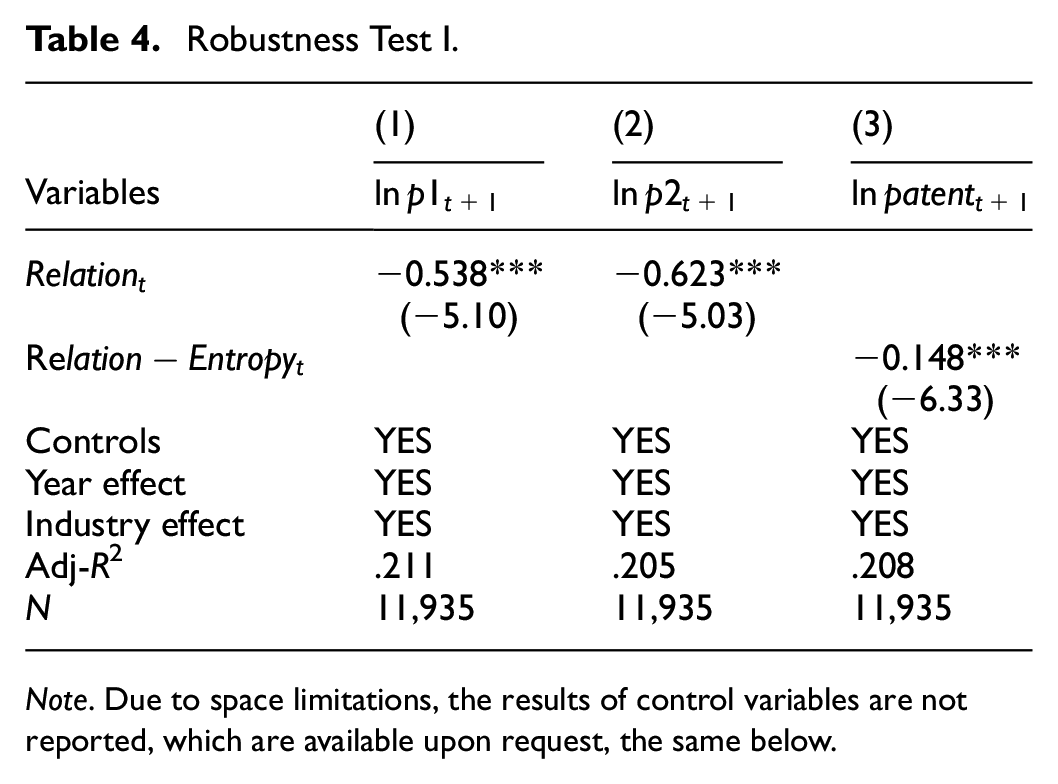
Note. Due to space limitations, the results of control variables are not reported, which are available upon request, the same below.
Replace Explanatory Variables
The measurement method referred to previous studies (Khanna & Palepu, 2000; Y. Tan et al., 2021), in this paper, the “Relation_Entropy” of the executive team is re-measured, and the calculation method is
Transformation of Regression Model
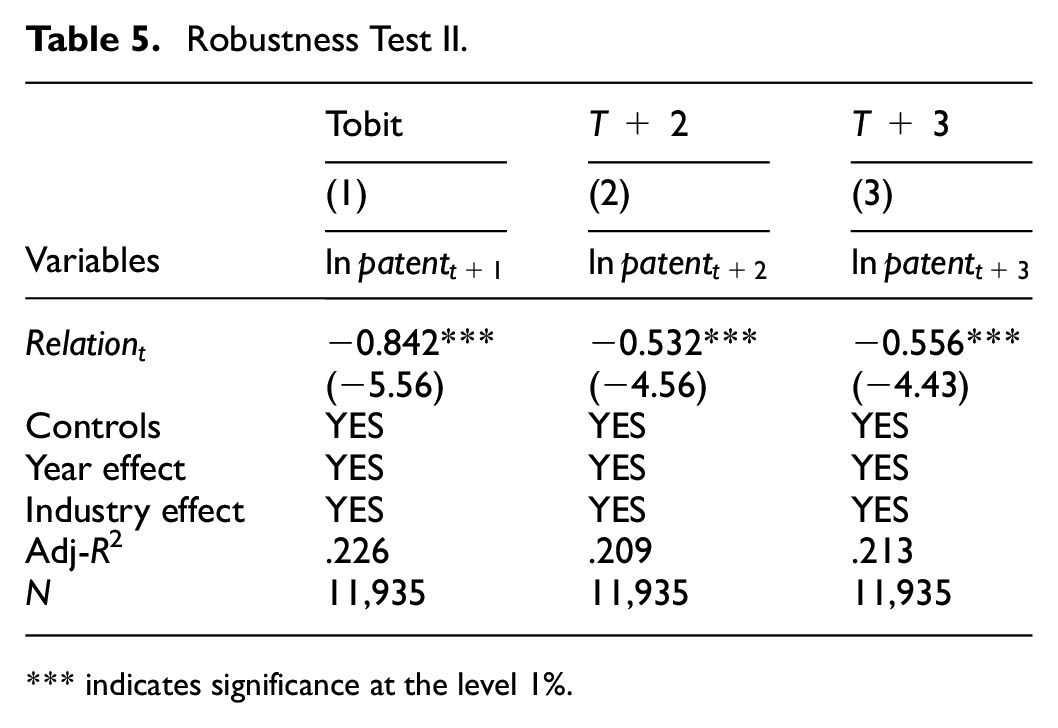
According to the distribution characteristics of green patent data (merged data), this paper also uses Tobit model to estimate, in order to investigate whether the research conclusion is sensitive to the model setting. According to column (1) in Table 5, the research conclusion remains robust for the model setting.
Robustness Test II.
*** indicates significance at the level 1%.
Measurement of Innovation Time
Green innovation activity is essentially a long-term investment of enterprises, and it usually takes a long period from green innovation input to future green innovation output. In order to investigate whether the research conclusions are sensitive to the measuring time points of green innovation, we reset the measuring time points of future green innovation output to t + 2 and t + 3 years, as shown in columns (2)–(3) of Table 5. The research conclusions remain stable for different measuring time points of enterprise green innovation.
Endogeneity Issues
In the research of this paper, although the “surname relationship” within the senior management team is an exogenous variable, the innovation activities of enterprises might influence the composition of the senior management team and subsequently impact the “surname relationship,” which is the endogeneity problem caused by reverse causality. Meanwhile, despite the fact that we have controlled for time and industry fixed effects as well as other variables in the previous regression, there could be omitted variables that simultaneously affect the “surname relationship” and enterprise green innovation, thereby leading to endogeneity issues. Therefore, in this section, we adopt two methods: the instrumental variable method and the propensity score matching method (PSM).
Instrumental Variable Method
Drawing on the research methods of Yan and Xiao (2019), the ratio of the number of executives who left their positions in the senior management team due to external reasons to the total number of executives in the senior management team (Left) is taken as an instrumental variable. According to the reasons for executive departures in the CSMAR database, the departures of executives due to “death, health reasons, or retirement” are regarded as sudden external reasons. The rationality of this instrumental variable is reflected in the fact that executives who leave due to external reasons will have a direct impact on the degree of “surname relationship” in the senior management team. Moreover, executives who leave due to external reasons usually do not have a direct impact on the enterprise’s green innovation activities.
In the first stage, Relation is regressed against the instrumental variable Left and the control variables respectively to estimate the predicted value Relation_hat. In the second stage, the enterprise innovation Patent in period t + 1 is regressed against the predicted value Relation_hat and the control variables. It can be seen from the first two columns of Table 5 that there is a negative correlation between the “surname relationship” of the senior management team and the enterprise green innovation at the 1% significance level, and the empirical conclusion still holds and is robust.
Propensity Score Matching Method (PSM)
According to the “family Relation” median of the executive team, all samples are divided into two categories: the processing group and the control group. When the “family relation” is larger than the median, the samples are classified as the processing group; otherwise, the samples are classified as the control group. Then, according to the estimated propensity score of the control variables, we used the nearest neighbor matching method to match samples in a 1:1 ratio. The deviation after the final matching is less than 5%, indicating that the matching effect is good. The results are shown in column (3) of Table 6. The regression coefficient of the Relation of the explanatory variable is significantly negative at the 1% level, indicating that the hypothesis that the “surname relationship” of the senior management team inhibits enterprise green innovation is still valid.
Results of Endogeneity-Controlled Regression.

*** indicates significance at the level 1%.
Further Analysis
Existing studies have shown that the alumni relationships among senior executives (W. Zhao et al., 2019), fellow - townsman relationships (Du & Xiong, 2017; Z. Zhang et al., 2018), and colleague relationships (Xu et al., 2019) all have a certain significant impact on corporate green innovation. So, among these common social relationships, which one has a greater impact on corporate innovation?
In order to compare the degrees of impact of these several common social relationships on corporate green innovation, first of all, the relevant concepts are defined as follows: (1) Fellow-townsman relationship. Referring to the practices of scholars such as Fracassi and Tate and Lu and Hu (2016), if the birthplaces (native places) of two senior executives are in the same province, they are defined as having a fellow-townsman relationship. (2) Alumni relationship. Referring to the practices of scholars such asButler and Gurun, if two senior executives have the same alma mater during their schooling experiences, they are defined as having an alumni relationship. (3) Colleague relationship. Judged according to the career experiences of senior executives, if two senior executives were in the same company before, they are defined as having a colleague relationship. Secondly, in order to maintain the comparability among different social relationships, that is, to avoid the influences of differences in dimensions, orders of magnitude, etc. in the same regression equation, this paper adopts the measurement method of the previously mentioned “clan relationship” for fellow-townsman relationships, alumni relationships, and colleague relationships, which are represented by Home_tie, Alumni_tie, and Colleague_tie respectively. The empirical results are shown in Table 7.
Comparison of Social Relationships in the Senior Management Team.

*, ** and *** indicate significance at the levels of 10%, 5% and 1% respectively.
First of all, generally speaking, the clan relationships and fellow-townsman relationships among senior executives have a negative impact on corporate green innovation, while the alumni relationships and colleague relationships among senior executives play a promoting role in corporate innovation. These empirical results are quite consistent with the conclusions of the existing studies mentioned above. Secondly, by comparing the magnitudes of the absolute values of the coefficients of these four types of social relationships in column (1) of the full sample, it can be seen that the degrees of influence of fellow-townsman relationships and clan relationships are comparable. The negative impacts of clan relationships and fellow-townsman relationships on innovation exceed the positive impact of colleague relationships on innovation. However, the positive impact exerted by alumni relationships is the greatest.
In addition, based on the situation of the latest population census, this paper removed the senior executives with the “top five” and “top fifteen” most populous surnames from the sample and conducted the regression again. In column (2), the degree of influence of the clan relationship among senior executives exceeded that of the fellow-townsman relationship, but was still lower than that of the alumni relationship. In column (3), the empirical results after removing the common “top fifteen” surnames showed that the clan relationship had exerted the greatest influence on innovation. The empirical conclusions of this part indicate that, compared with other “social relationships,” the “clan relationship” among senior executives with uncommon surnames has a more important impact on corporate innovation. Moreover, since these several social relationships in this part were simultaneously added into the empirical model, the empirical results also achieved the goals of the robustness tests of “excluding alternative hypotheses” and “controlling for omitted variables” simultaneously.
Mechanism Test
According to the analysis in the hypothesis part of this paper, “hindering the formation of multiple cognitive models of the team” and “weakening the internal supervision mechanism” may be two potential paths of action, and this paper then analyzes and validates them from an empirical perspective.
Mechanism 1: Hinder the Formation of Multiple Cognitive Models in Teams
From the perspective of the characteristics of enterprise innovation, innovation is an investment with uncertain returns and high risk of failure. Moreover, enterprises usually face macro-level (such as economy, policy and market) and micro-level (such as: Technology, capital) and many other aspects of uncertainty, these uncertainties greatly increase the possibility of enterprise innovation failure (B. Liu et al., 2017; Qu et al., 2011; Y. Wang & Song, 2014).
As mentioned above, the stronger the multiple cognitive mode in the senior management team, the more innovative alternatives the team members can form, the more comprehensively evaluate alternative innovation solutions and improve the quality of innovation decisions (Dahlin et al., 2005), to a certain extent, this will weaken the negative impact of uncertainty on innovation. Therefore, when enterprises are faced with high uncertainty, the multiple cognitive models of the senior management team are of great importance. Although, from the perspective of variable measurement, it is difficult to measure the comprehensive performance caused by the reduction of multiple cognitive modes of the senior management team, it can be demonstrated through the impact of the “surname relationship” of the senior management team on innovation under the uncertain state of the enterprise.
For example: In an environment of high uncertainty, innovation decision-making is more likely to be affected by bias and a single cognitive model, and the consequences of “surname relationship” hinders the formation of a team’s multiple cognitive models are reflected in the tendency of cognitive model homogeneity and the lack of critical thinking. They lack the ability to deal with complex problems and are less likely to challenge and question the scientific nature of decision makers’ innovative judgments. According to the above logic, when the enterprise is in a situation of high uncertainty, the restraining effect of the “surname relationship” of the senior management team on innovation will be more obvious. Therefore, this paper measures the uncertainty from two dimensions: external and internal.
First, the external uncertainty of the enterprise. Firms under intense market competition are faced with more complexity, and the predictability and certainty are significantly reduced, because their economic behavior and the resulting consequences are largely influenced by the behavior of competitors. The external market competition environment greatly intensifies the external uncertainty of enterprises. Based on this, the Herfindahl index is used to measure the degree of market competition by referring to the measurement methods of previous studies, and it is used as a proxy variable for the external uncertainty of the firm. The “high external uncertainty group” and “low external uncertainty group” were divided according to the median of the study sample for regression respectively, and the regression results were shown in the first two columns of Table 8.
Empirical Results of Mechanism 1.

** and *** indicate significance at the levels of 5% and 1% respectively.
Second, the uncertainty within the enterprise. Among the factors of internal uncertainty mentioned above, the capital uncertainty at the enterprise level is the most critical. Moreover, all aspects of enterprise innovation depend on capital support, and the cash flow status of enterprises directly affects the sustainability of enterprise innovation activities (B. Liu et al., 2017). Further, considering the correlation of capital sources and the fact that the expensed expenditure of R&D investment is included in the cash outflow from operating activities, this paper adopts the volatility of the net cash flow of operating activities excluding the expensed expenditure of R&D investment for reference to the ideas of previous studies (C. Zhang et al., 2019). Using “standard deviation of net cash flow from operating activities of an enterprise in recent three years (less expensed expenditure on R&D investment)” as a measure of the internal uncertainty of an enterprise, the “high internal uncertainty group” and “low internal uncertainty group” were divided according to the median of the research sample, and the regression results were shown in the last two columns of Table 8.
As can be seen from the regression results in Table 8, the estimated results of Relation coefficients are all significantly negative, which further verifies the inhibitory effect of the “surname relationship” of the executive team on enterprise innovation activities. Furthermore, the coefficients between different groups are significantly different at the level of 5% (p = .031 and p = .040), and the “inhibition effect” has a greater marginal effect in the groups of “high external firm uncertainty” and “high internal firm uncertainty.” The above results show that when the internal and external uncertainty of the enterprise is high, the “surname relationship” of the top management team has a more obvious inhibitory effect on the innovation of the enterprise, and the mechanism behind it may be generated by obstructing the multiple cognitive models of the team.
Action Mechanism II: Weakening the Internal Supervision Mechanism
The most direct manifestation of the impact on the internal supervision mechanism of an enterprise is the state of the enterprise’s internal control. As previous studies have shown (S. Xue & Jiang, 2008; J. Yang & Xu, 2020), the senior management team is responsible for the formulation and implementation of the enterprise’s internal control system and has the discretionary right over the content of internal control information disclosure, the degree of internal control deficiencies, and the conclusions of internal control self-evaluation. Therefore, in innovation activities, if the senior management team with a “clan relationship” has a “short-sighted profit-chasing effect,” it may suppress enterprise innovation by weakening the internal supervision mechanism, and during this process, the quality of the enterprise’s internal control will also be directly affected correspondingly.
Path analysis and structural equation modeling are powerful tools for analyzing the mechanism effect. Therefore, in order to test this path, we adopted path analysis for reference to the methods of previous studies (Bauer et al., 2020). The structural equation model used is as follows:


In the above structural equation model, the internal control quality (IC) of an enterprise is measured by “Dibo-Internal Control Index of Listed Companies in China,” and standardized by dividing the original variable value by 100. The empirical results are shown in Table 9. The direction of the coefficients of the empirical results in Table 9 is consistent with the expectations of the previous hypothesis, and the enterprise internal control (IC) does play a part of the intermediary role. Further, by comparing the effects of direct path and indirect path, it can be found that the impact of direct path on enterprise green innovation (Patent) accounts for 88.36% of the total effect, which has the largest impact. The indirect route accounted for only 11.64% of the impact. In summary, the empirical results confirm that “weakening the internal supervision mechanism” is an influential way for the “surname relationship” of senior management team to inhibit innovation.
Empirical Results of Mechanism 2.

*** indicates significance at the levels of 1%.
Conclusion and Discussion
Research Conclusions
Taking the listed companies of Shanghai and Shenzhen A-shares in China from 2012 to 2022 as samples, this paper empirically examines the impact of the “clan relationship” in the senior management team on corporate green innovation. The research findings are as follows: (1) The “clan relationship” in the senior management team has an inhibitory effect on corporate green innovation. (2) The test of the mechanism of action shows that hindering the formation of the team’s multiple cognitive patterns and weakening the internal supervision mechanism are the two channels through which the “clan relationship” in the senior management team exerts an inhibitory effect on corporate green innovation. From the perspective of the “surname relationship” of the senior management team and from the angle of the informal institution, this paper explores the green innovation behavior of enterprises, thereby further expanding the influencing factors in aspects such as the informal institutional social capital of corporate green innovation, informal corporate governance, and the social relationships of senior executives. Meanwhile, it also supplements the literature in the field of the economic consequences of surname culture.
Implications
(1) Acknowledge the “double-edged sword” effect of “surname relationship” on enterprise green innovation. Theoretically, this paper discusses its possible “two-way effect,” but empirical analysis of large-sample data reveals that the “inhibition effect” hypothesis is more prominent in China’s context. In China’s “relational” society, we should consider the impact of senior management team structure (like the “surname relationship” factor) on enterprise innovation and strengthen team construction and governance. For instance, from human resource management perspective, to create a “compatible” innovation environment, the government and enterprise boards should focus on recruiting senior management talents from diverse backgrounds, be wary of short-sightedness due to senior management team “circle” constraints, and maximize innovation continuity and long-term vision. Also, based on this paper’s empirical conclusions in the mechanism test, enterprises should seek effective ways to enhance innovation ability by “optimizing senior management team’s multiple cognitive mode” and “strengthening the internal supervision mechanism.” In terms of optimizing the multi-cognitive patterns of the senior management team, enterprises can take the following measures: (a) Promote the integration of Cross-Domain knowledge. For example, regularly organize senior executives to participate in cross-industry seminars and academic lectures covering various fields such as technology, culture, and finance, so as to broaden their horizons. Encourage senior executives to read interdisciplinary books and research reports, and establish an internal knowledge sharing platform. (b) Encourage multicultural experiences. Provide international exchange programs and overseas training opportunities for the senior management team, allowing them to experience the business cultures and management models of different countries and regions in person. Introduce international talents into the senior management team or cooperate closely with them. Through daily exchanges and cooperation, let local senior executives understand the ways of thinking and business logics under different cultural backgrounds. (c) Establish a diversified Decision-Making Team. When forming the senior management team, pay attention to the diversity of members’ backgrounds, including different professional backgrounds, work experiences, and age levels. Set up temporary cross-departmental innovative decision-making groups. For specific innovative projects, draw personnel from various departments to participate in the decision-making process. At the same time, enterprises can strengthen the internal supervision mechanism from the following aspects. (a) Perfect the supervision process. Establish a clear supervision system for the enterprise innovation process. Set clear supervision standards and inspection points for each link, from the establishment of innovation projects, the R & D process to the outcome evaluation. Utilize information systems to conduct real-time monitoring of the innovation workflow. Through setting key indicators and early-warning mechanisms, problems can be found in a timely manner. (b) Strengthen the function of internal audit. Regularly audit the financial status of enterprise innovation projects to ensure the rational and compliant use of funds. Audit the intellectual property management of innovation projects, including patent applications, protection of technical secrets, and other aspects. (c) Establish a feedback and improvement mechanism. Establish a smooth internal feedback channel and encourage employees to feedback problems and potential risks during the innovation process. According to the supervision results and feedback information, timely adjust and improve the internal supervision mechanism and innovation workflow.
(2) For stakeholders focusing on enterprise innovation, when assessing the sustainability and certainty of enterprise innovation, besides historical innovation-related data, this paper suggests increasing the understanding of senior management’s background and talent structure to judge if the enterprise has an innovation-matching structure. This helps evaluate enterprises’ innovation ability and level more objectively and comprehensively.
Research Limitations and Prospects
This study’s limitation is that the sample data is only from China, and the research conclusions’ applicability to other countries requires further verification. Different countries have unique cultural values, which will significantly affect the behaviors of senior management teams and the green innovation practices of enterprises. For example, in some countries with high power distance cultures, surnames may carry stronger hierarchical implications in team relationships. We will draw on Hofstede’s Cultural Dimensions Theory to analyze how culture shapes the association between the surname relationships of senior management teams and green innovation. In countries with a strong collectivist culture, surnames may be associated with families and social groups, which in turn affects the way of integrating green innovation resources through internal team collaboration. While under an individualist culture, this influencing mechanism may focus more on the role of the reputation represented by an individual’s surname in green innovation decisions. The institutional environments of various countries, including political systems, laws and regulations, and economic policies, etc., are of great significance to the research. In countries with strict protection of property rights and sound environmental regulations, senior management teams may be more actively promoting green innovation due to the social capital brought by surname relationships, in order to gain a competitive advantage and meet regulatory requirements. However, in some emerging market countries, the instability and imperfection of policies may cause surname relationships to play different roles when dealing with the risks and opportunities of green innovation. We will conduct in-depth research on how these institutional factors interact with the surname relationships of senior management teams and affect the inputs, processes, and outcomes of green innovation. Meanwhile, the sample period is selected as the period from 2012 to 2020. Whether the conclusions are applicable to other periods still needs further verification. In future research, we will consider expanding the research time period and conducting comparative analyses to better understand the impact of surname relationships on green innovation. The influencing factors of corporate green innovation at the informal institutional level need further exploration, and future research can be done from the perspective of executive-level culture.
