




Abstract
Breaking through the company’s own green knowledge barriers through school-enterprise cooperation has become an important means for companies to expand market competitive advantages and environmental governance. This article uses China’s non-financial listed company data from 2010 to 2021 to study the causal effect of school-enterprise cooperation on corporate green innovation. The results passed a series of robustness tests and confirmed that school enterprise cooperation can improve the level of green innovation of enterprises. This paper also uses the instrumental variable method to mitigate the causal relationship between the two. The results show that school-enterprise cooperation can still significantly improve corporate green innovation. The results of the mechanism test confirm that school-enterprise cooperation will promote corporate green innovation by reducing corporate green innovation risks and easing corporate financing constraints. At the same time, the heterogeneity analysis results show that school-enterprise cooperation has a better effect on improving green innovation for enterprises in heavily polluting industries, enterprises in years with low economic policy uncertainty, and enterprises with a high degree of government-enterprise connection. The findings of this article help to understand the intrinsic mechanism between school-enterprise cooperation and corporate green innovation, and confirm that school-enterprise cooperation can improve the climate and environmental innovation system, which has important practical significance for the construction of the industry-university-research system.
Keywords
Introduction
The contradiction between environmental pollution and economic growth has become increasingly prominent, and the necessity of green growth has become increasingly urgent (Dogan et al., 2022; Hussain et al., 2022; Zhang et al., 2019; Zhao et al., 2022; Zhu & Lee, 2022). Green innovation can save resources and reduce pollution emissions, thereby coordinating environmental protection and economic growth (Lee et al., 2022; Xu et al., 2021; Yang et al., 2020), which has received close attention from academic and political circles (Arfi et al., 2018). However, green innovation is a complex and challenging task, which requires a high reserve of green knowledge, continuous research and development (R&D) funds, and a clear understanding of the future application prospects (De Marchi, 2012; Pinkse & Kolk, 2010; Tian & Wang, 2014). To overcome these challenges, governments and enterprises need to work together to create a favorable environment for green innovation. This includes providing financial support, technical assistance, and market incentives. By working together, we can accelerate the pace of green innovation and build a more sustainable future.
In the above context, strategic cooperation between enterprises and suppliers, customers, universities, and other entities can promote knowledge exchange, increase the possibility of obtaining complementary resources and capabilities, and reduce R&D risks and costs (Chistov et al., 2021; Corbo et al., 2023; De Marchi et al., 2022; Faucheux & Nicolaï, 2011; Shi et al., 2020; Wiesmeth, 2020). At the same time, compared to other external collaborators, cooperation between enterprises and university institutions is more likely to promote innovation by enterprises (Arranz & de Arroyabe, 2008; Liu et al., 2023; Ma & Li, 2022). Most scholars have confirmed the important role of school-enterprise cooperation in corporate innovation, but have not explored the impact of school-enterprise cooperation on green innovation from the perspective of green governance. However, as environmental problems become more prominent, microlevel green collaborative governance has become increasingly important. Therefore, examining whether and how school-enterprise cooperation affects corporate green innovation plays a key guiding role in mitigating environmental degradation and achieving sustainable development of the economic structure.
This article uses China’s A-share listed companies from 2010 to 2021 as a data set to identify the causal effects of school-enterprise cooperation and corporate green innovation. We measured the green innovation capabilities of enterprises by the number of corporate green patent applications. Our findings suggest that school-enterprise cooperation can significantly improve the level of corporate green innovation. For every standard deviation increase in the number of corporate executives holding concurrent university positions, the number of corporate green innovation patent applications increases by 0.017 standard deviations. These results hold after being subjected to robustness tests such as replacing the explained variable, explanatory variables, and changing the sample interval. The results of heterogeneity analysis show that school-enterprise cooperation has a better effect on improving green innovation for enterprises in heavily polluting industries, enterprises in years with low economic policy uncertainty, and enterprises with a high degree of government-enterprise connection.
There is a potential concern that our estimation strategy may be subject to endogeneity issues. Although this study has added possible enterprise-level control variables and controlled for high-order fixed effects such as province-time, province-industry, and industry-time, there may still be other unobservable factors that affect the consistency of the estimation results. Additionally, to maintain their competitive advantage in the market, enterprises with a high level of green innovation may be more likely to seek external cooperation and utilize the scientific research advantages and technical expertise of universities to promote the development of school-enterprise cooperation projects. This could lead to a problem of reverse causality. Therefore, this study uses the number of middle school students in 1990 as an instrumental variable to identify the net effect of school-enterprise cooperation on corporate green innovation. On the one hand, middle school students are an important pool of future scientists and researchers, and they can better reflect the educational level and scientific research environment of a region. This can influence the development of school-enterprise cooperation in subsequent years, and satisfy the condition of endogeneity. On the other hand, the number of middle school students in the past is unlikely to have a direct effect on the level of green innovation in the present, and therefore has a certain degree of exogeneity. Additionally, this study controls for path variables such as regional economic development to block the potential pathways through which the number of middle school students could affect regional innovation in the past, further enhancing the exogeneity of the instrumental variable. The results show that after considering endogeneity issues, school-enterprise cooperation can still have a positive impact on corporate green innovation.
To further explore the impact mechanism of school-enterprise cooperation on corporate green innovation, this article proposes positive and negative hypotheses based on the different characteristics of green innovation and general innovation. Hypothesis 1 (Knowledge effect): School-enterprise cooperation can enable enterprises to obtain tacit knowledge about green innovation through formal and informal exchanges, enrich the enterprise’s own green knowledge base, broaden the scope of enterprise green knowledge, and improve the enterprise’s green innovation capabilities. Hypothesis 2 (Risk effect): School-enterprise cooperation can enable companies to utilize the university’s inherent experimental equipment and high-tech green talents to reduce the R&D investment and sunk costs caused by green innovation failures, mitigate corporate green innovation risks, and increase corporate green innovation willingness. Cooperation with universities can increase knowledge talents’ sense of identity and belonging to the enterprise, improve their employment possibilities, and increase the enterprise’s talent pool, which can further reduce the risks of green innovation. Hypothesis 3 (Funding effect): School-enterprise cooperation can enable companies to leverage the school’s strong social network to reduce the search cost of external investors and increase the likelihood of companies obtaining external financing. Additionally, school-enterprise cooperation may also receive government subsidies, which can provide implicit guarantees.
Convey green technology advantage signals to the outside world, reduce the concerns of different financing entities about corporate green innovation risks, allow external capital to continue to accumulate, and further ease corporate financing constraints; the negative hypothesis is “system logic difference,” and in school-enterprise cooperation, the two are fundamental Due to differences in institutional logic, both parties may be unable to agree on the disclosure and commercialization of cooperation results, resulting in an increase in coordination and communication costs, inhibiting the emergence and maintenance of trust in the school-enterprise cooperation process, and reducing the level of green innovation.
After providing direct and indirect evidence for or against each hypothesis, this paper finds that the “risk effect” and “funding effect” are consistent with this article’s expectations. Specifically, hypothesis 2 “risk effect” was confirmed. This paper uses the average value of corporate risk-taking ability to divide high and low groups into group regressions. The results show that the green innovation improvement effect of school-enterprise cooperation is more obvious in the group with low risk-taking ability, which confirms that school-enterprise cooperation can help reduce and smooth enterprises’ green innovation risks and increase green innovation willingness. Hypothesis 3 “Funding Effect” was confirmed. This paper performs regression by exchanging the mean value of corporate financing constraints for high and low groups. The results show that the green innovation improvement effect of school-enterprise cooperation is more obvious in the group with high financing constraints, which confirms that school-enterprise cooperation can provide enterprises with sufficient funds. This article failed to verify the existence of the “knowledge effect.” This may be due to the complex green innovation knowledge increases the knowledge distance between schools and enterprises, making it difficult for enterprises to effectively absorb, utilize and transform green innovation knowledge.
The marginal contribution of this article is mainly reflected in the following two aspects. First, based on the perspective of green environment, we expand the green governance effect of school-enterprise cooperation and systematically analyze its potential mechanism. The vast majority of scholars believe that school-enterprise cooperation can promote enterprise innovation by improving enterprise knowledge reserves, reducing R&D costs and risks (Corbo et al., 2023; De Faria et al., 2010; Faucheux & Nicolaï, 2011; He et al., 2021; Maietta, 2015; Segarra-Blasco & Arauzo-Carod, 2008; Shi et al., 2020; Szucs, 2018). However, there is a lack of literature that explores the impact of university-industry collaboration on corporate green innovation from an environmental governance perspective. Relevant to our discussion is the research conducted by Murillo-Luna and Hernandez-Trasobares (2023), De Marchi et al. (2022), and Song et al. (2020). They paid attention to the impact of cooperation between enterprises and universities on corporate green innovation, but they did not delve into the intrinsic mechanism between the two. Therefore, this article further expands the mechanism of school-enterprise cooperation affecting corporate green innovation from the perspective of knowledge improvement, risk reduction, financing and institutional logic conflicts, and deepens the understanding of the inherent laws of the two.
Secondly, this article better identifies the causal relationship between school-enterprise cooperation and green innovation. Existing literature has found that school-enterprise cooperation can promote corporate green innovation (De Marchi et al., 2022; Murillo-Luna & Hernandez-Trasobares, 2023; Song et al., 2020). However, green innovation performance may also affect a company’s cooperation behavior. In order to maintain its market competitive advantage, companies may seek cooperation more actively, forming a virtuous cycle, which in turn creates a reverse causality problem (Shi et al., 2020). This will exaggerate the green innovation effect of school-enterprise cooperation. This paper uses historical data as instrumental variables to overcome the endogeneity problem of school-enterprise cooperation and corporate green innovation and identify the net effect. This confirms that school-enterprise cooperation can improve the climate and environmental innovation system and is of great practical significance to the construction of the industry-university-research system.
Literature Review
Considering the increased technological complexity and technological convergence of corporate innovation activities, it is difficult for enterprises to have perfect resources as well as knowledge to conduct innovations, so it has gradually become a trend to seek external cooperation to utilize the resources of collaborators (Chesbrough, 2006). Strategic collaboration between enterprises and subjects such as suppliers, customers, and universities may facilitate the exchange of knowledge and increase the likelihood of accessing complementary resources and capabilities, while reducing R&D risks and costs (Chistov et al., 2021; Corbo et al., 2023; De Marchi et al., 2022; Faucheux & Nicolaï, 2011; Shi et al., 2020; Wiesmeth, 2020). It is worth noting that collaboration with university institutions is more likely to promote corporate innovation (Arranz & de Arroyabe, 2008; Liu et al., 2023; Ma & Li, 2022). This is mainly due to the fact that universities are more concerned with non-competitive basic research, focus on the accumulation of foreword knowledge, and have a rich stock of knowledge and talent pool that can generate knowledge spillovers to promote corporate innovation (Arranz & de Arroyabe, 2008; Belderbos et al., 2004; Ma & Li, 2022).
The vast majority of scholars believe that school-enterprise cooperation can promote corporate innovation by improving the knowledge base of enterprises and reducing the costs and risks of R&D (Corbo et al., 2023; De Faria et al., 2010; Faucheux & Nicolaï, 2011; He et al., 2021; Maietta, 2015; Segarra-Blasco & Arauzo-Carod, 2008; Shi et al., 2020; Szucs, 2018). Some studies have also found that school-enterprise cooperation does not have a significant effect on corporate innovation, or even has a negative impact (Bruneel et al., 2010; Estrada et al., 2016; Perkmann et al., 2013). This may be due to fundamental differences in goals and expectations between businesses and universities (Estrada et al., 2016; He et al., 2021). Yet there is little literature exploring the impact of school-enterprise cooperation on corporate green innovation from an environmental governance perspective, closely related to this paper are the studies by Murillo-Luna and Hernandez-Trasobares (2023), De Marchi et al. (2022), and Song et al. (2020). They found that school-enterprise cooperation can promote corporate green innovation, but they did not explore the intrinsic mechanism in depth. And green innovation performance may also affect a company’s cooperative behavior, that is, to maintain its competitive advantage, companies may seek cooperation more actively, forming a virtuous circle, which in turn creates a reverse causality problem (Shi et al., 2020). Existing studies lacks research on the inter-mechanisms, as well as endogenous issues treatment, which makes it difficult to provide refined theoretical guidance and sound evidence support for the government to formulate green competence enhancement policies.
Research Hypothesis
As an effective measure to coordinate environmental protection and economic growth, green innovation is an important means to achieve sustainable economic development (Carrion-Flores & Innes, 2010; Kunapatarawong & Martínez-Ros, 2016). Green innovation has multi-dimensional goals, and it requires enterprises to have high technology research and development capabilities (De Marchi et al., 2022; Song et al., 2020). Therefore, enterprises should adopt an open innovation approach and cooperate with external organizations to obtain rich external green knowledge and resources. Existing literature has found that school-enterprise cooperation can promote green innovation (De Marchi et al., 2022; Murillo-Luna & Hernandez-Trasobares, 2023; Song et al., 2020), but they have not explored the specific mechanism in depth. Oppositely, there are literature showing that due to the differences in the institutional logic of universities and enterprises, school-enterprise cooperation does not always have a positive impact (Bruneel et al., 2010; Estrada et al., 2016; Gilsing et al., 2011; He et al., 2021; Hemmert et al., 2014; Østergaard & Drejer, 2022). Therefore, Pros and cons hypotheses were proposed to explore school-enterprise cooperation effects on corporate green innovation.
Positive Influence
Knowledge Effects
Compared with general innovation, green innovation is an interdisciplinary innovation activity that integrates economics, management, ecology, environmental science and other disciplines, and involves areas such as air pollution prevention and solid waste reduction. However, companies that have been cultivating their own related fields tend to form a single professional knowledge and lack diversified knowledge, making it difficult to make breakthroughs in green innovation activities (Mubarak et al., 2021). As a comprehensive scientific research institution, the university’s research scope covers many green-related fields such as environmental science, pollution control, energy utilization, etc. It has relatively cutting-edge green knowledge and can generate knowledge spillover effects and provide green knowledge support to enterprises, promote the improvement of green innovation capabilities (Arza & Lopez, 2011; De Marchi et al., 2022; Liu et al., 2023; Murillo-Luna & Hernandez-Trasobares, 2023; Schwartz et al., 2012; Song et al., 2020). Different from the explicit knowledge that enterprises obtain by browsing patents and papers published by universities, school-enterprise cooperation can communicate through formal (such as postdoctoral mobile stations) or informal (such as telephone conferences, etc.) method, allowing university research teams to teach by words and deeds and accelerate the spillover of green tacit knowledge (such as some key skills, techniques, experience and know-how, etc.; Bakouros et al., 2002; Cohen et al., 2002; Maietta, 2015; Roy & Sivakumar, 2011). The green environmental tacit knowledge brought by universities can effectively alleviate the knowledge shortage dilemma, reduce their knowledge search costs, and promote the improvement of green innovation capabilities (Sherwood & Covin, 2008).
In addition, school-enterprise cooperation can improve the depth of utilization of internal resources by enterprises through heterogeneous knowledge complementation, allowing them to build, expand and update their own green knowledge base, increase the breadth of corporate green knowledge, and provide rich resources for enterprises to achieve transformative green innovation and knowledge reserve (Liu et al., 2023; Schwartz et al., 2012; Wirsich et al., 2016). Universities and enterprises are very complementary in the division of labor in innovation. Universities focus on breakthroughs in front-end basic theories and accumulation of knowledge, while enterprises pay more attention to innovation in back-end knowledge transformation. The combination of enterprises will give full play to the complementary advantages of resources and promote the improvement of green innovation (Belderbos et al., 2004; Cassiman & Veugelers, 2002; Laursen & Salter, 2006). Therefore, we propose hypothesis 1 (H1) as follows: H1: School-enterprise cooperation will promote corporate green innovation by improving corporate green knowledge.
Risk Effect
Compared with general innovation, green innovation emphasizes the coordination and unity of economic, social and ecological benefits. R&D costs are often higher, and future application prospects are unclear and have greater uncertainty (De Marchi, 2012; Pinkse & Kolk, 2010; Tian & Wang, 2014). This will lead to a higher risk of green innovation, which may damage managers’ reputation in the future labor market and result in insufficient willingness of managers to innovate green. In the process of school-enterprise cooperation, enterprises can use the university’s inherent experimental equipment and scientific and technological personnel to reduce the expenditure on purchasing production equipment and introducing green knowledge talents, reduce R&D investment and sunk costs caused by failure of green innovation, smooth the risks of enterprise green innovation and increase corporate willingness for green innovation (Al-Tabbaa & Ankrah, 2016; Faems et al., 2005; Hagedoorn, 2002; Niesten & Jolink, 2020; Veugelers & Cassiman, 2005). For example, a subsidiary of Baosteel and Guangdong University of Technology (GDUT) jointly funded the construction of a joint R&D center for low-carbon metallurgy technology and metal materials, using GDUT’s talent advantage to break through the core problems of green innovation. Continental Horse Tire Co., Ltd. and Tsinghua University jointly funded the construction of a joint research center for green manufacturing and low-carbon recycling, and the introduction of high-precision technical personnel to promote the research of green and low-carbon technologies.
As a comprehensive scientific research institution, the school can set up targeted disciplines and professional education around corporate green innovation and market demand for green products to cultivate green innovative talents, thereby effectively reducing the risk of corporate green innovation failure. In addition, school-enterprise cooperation will increase the recognition and sense of belonging of university talents to the cooperative enterprises, improve the employment possibilities of scientific researchers in the cooperative enterprises, further alleviate the risks of corporate green innovation, and improve the corporate green innovation capabilities (Scandura, 2016). Therefore, we propose hypothesis 2 (H2) as follows: H2: School-enterprise cooperation will improve corporate green innovation capabilities by reducing corporate green innovation risks.
Funding Effect
Compared with general innovation, green innovation has dual externalities caused by greenness and innovation, and there is great uncertainty about whether green innovation can realize product commercialization in a timely manner, meet market consumer demand and expand product competitive advantages. This will further increase investment risks, reduce their investment willingness, and make enterprises face more serious financing constraints in green innovation (Amore & Bennedsen, 2016). School-enterprise cooperation helps companies take advantage of the strong social network of universities, reduce search costs for external partners, and increase the possibility of companies obtaining external financing. More importantly, the cooperation network built on the university platform will help external investors obtain more specific details of corporate green innovation projects, such as project novelty, technical feasibility, expected benefits, etc., allowing investors to better evaluate the potential benefits and risks of the project can increase investment willingness and ease financing constraints.
In addition, green innovation cooperation between schools and enterprises can also receive government subsidies, further easing financing constraints. For example, Shenzhen’s several measures to promote the high-quality development of green and low-carbon industries (“Draft for Comments”) point out that in order to encourage enterprises and universities to build task-based innovation consortiums and carry out research and development targeting the development needs of green and low-carbon industry chains, the government can Funding will be based on 30% of the actual amount of capital contributed by the investor. In addition, government subsidies can also play an implicit guarantee role, signaling the advantages of green technology to the outside world, reducing the concerns of different financing entities about corporate green innovation risks, allowing external capital to continue to accumulate, and further easing corporate financing constraints. Therefore, we propose hypothesis 3 (H3) and forward hypothesis (Ha) as follows: H3: School-enterprise cooperation will improve corporate green innovation capabilities by easing financing constraints for corporate green innovation. Ha: School-enterprise cooperation will promote corporate green innovation.
Negative Influence
Existing literature has confirmed that there are fundamental differences in institutional logic between enterprises and universities. The former is a business logic that seeks to obtain excess profits from products, while the latter is an academic logic (De Fuentes & Dutrenit, 2012; He et al., 2021; Sauermann & Stephan, 2013) that seeks to create scientific knowledge through new concepts, models, empirical research, etc. The academic logic of universities makes school researchers more inclined to disclose green innovation research results in a timely manner and convert them into paper publications in order to gain academic incentives such as peer recognition (Bruneel et al., 2010; He et al., 2021). Scientific institutions have unique competition and incentive mechanisms. This allows scholars who publish papers first to dominate, reducing other scholars’ resource grabs on corresponding topics, and gaining incentives such as academic reputation and peer recognition (Bruneel et al., 2010; Hewitt-Dundas et al., 2019). The business logic of enterprises makes them more inclined to hide green innovation knowledge internally, or disclose it to a limited extent through patent applications, in order to ensure the temporary monopoly of green knowledge, and then obtain incentives such as excess profits in the market (Bruneel et al., 2010; Chesbrough, 2006).
The different institutional logics between schools and enterprises may differentiate their disclosure and commercialization priorities of cooperation results (Bruneel et al., 2010; Perkmann et al., 2013). He confirmed through a survey of a large pharmaceutical company that scholars prefer the timely publication of research results, while companies prefer to obtain higher income returns. Differences in institutional logic may lead to an increase in coordination and communication costs, inhibit the emergence and maintenance of trust in school-enterprise cooperation, and reduce the level of green innovation (He et al., 2021; Hemmert et al., 2014; Østergaard & Drejer, 2022). Therefore, we propose the negative hypothesis (Hb) as follows: Hb: School-enterprise cooperation will inhibit corporate green innovation.
Based on the above mechanism analysis, this paper constructs a mechanism analysis framework as shown in Figure 1:

Theoretical framework.
Research Design
Variable Selection
Explained Variable
The dependent variable in this study is corporate green innovation, and following the approach of Hall and Harhoff (2012) and Amore and Bennedsen (2016), this study measures corporate green innovation using the number of green patent applications by companies. There are two main reasons for this choice. Firstly, the number of green patent applications by a company is a straightforward indicator that reflects the output of corporate green innovation. It accurately measures a company’s green innovation capability and is easy to quantify. Secondly, compared to the number of patents granted to a company, the number of patent applications by a company is less likely to be influenced by bureaucratic factors and other confounding variables, making it less uncertain (Cheng et al., 2023; Tian & Wang, 2014).
The specific construction method is based on the research of Cheng et al. (2023). It involves obtaining patent classification information for all listed companies’ patents and identifying green innovation based on IPC codes from the “Green Patent List” published by the World Intellectual Property Organization (WIPO). The number of green patent applications (Greenpatent) is defined as the sum of corporate green invention patents and corporate green utility model patents. To address the issue of right-skewed distribution in the number of green patent applications, this study takes the natural logarithm of the count of green patent applications plus 1. The data on corporate green patents are sourced from the China National Research Data Service Platform (CNRDS).
Explanatory Variables
The explanatory variable in this study is the level of university-industry cooperation. The study uses the number of top executives in a company who concurrently hold positions in universities as a proxy variable for the level of university-industry cooperation. This is mainly because when a company hires university personnel to serve as top executives, it establishes a connection between the university and the company, creating a bridge for the transfer of knowledge. It also enables these executives to understand the company’s strategic planning and innovation direction, reducing information asymmetry between the university and the company, and ultimately facilitating a strong university-industry cooperation relationship. This data is sourced from Guotai (CSMR).
Control Variables
Considering that the financial performance and governance characteristics of the enterprise will not only affect the level of school-enterprise cooperation, but also affect the green innovation of the enterprise. The enterprise-level control variables selected in this article are as follows.
Asset Size (Size)
Existing literature shows that enterprise size is an important factor affecting corporate green innovation. For the sake of sustainable development, larger enterprises will provide their R&D departments with a steady stream of capital and talent to maintain competition. Moreover, larger enterprises will use resource advantages and information advantages to differentiate the level of school-enterprise cooperation. This paper uses the logarithm of the company’s total capital at the end of the year to measure company size.
Corporate Debt (Lev)
Corporate debt not only reflects the market’s evaluation of the company’s credit ability, but also moderate debt management allows companies to have more sufficient funds to improve technical equipment, reform processes, and carry out green innovation activities. In addition, the debt of an enterprise may reduce its risk-taking capacity, crowd out school-enterprise cooperation funds, and affect its progress. This article uses the ratio of total liabilities to total assets to measure the degree of corporate debt.
Cash Flow (Cashflow)
More abundant cash flow provides a strong guarantee for corporate innovation and school-enterprise cooperation. This article uses the ratio of net cash from operating activities to total assets to measure cash flow.
Income Growth Rate (Incomegrowth)
Generally, companies with higher income growth rates have more funds available for technology research and development and innovation investments to ensure sustained revenue growth. They are also more motivated to seek university-industry cooperation, utilizing the rich research resources and technical expertise of universities to accelerate the transformation of their research achievements. This variable is calculated as the difference in annual operating income compared to the previous year’s operating income, divided by the previous year’s operating income.
Total Executive Compensation (Salary)
Existing literature has shown that higher levels of executive compensation can incentivize senior executives to put more effort into green innovation, thereby promoting both corporate green innovation and university-industry cooperation.
Variables Related to Corporate Performance and Governance Structure
Considering that corporate performance and governance structure can influence corporate innovation behavior and university-industry cooperation, this paper controls for the following variables: Capital Intensity (CI), Return on Total Assets (Roea), and Independent Director
Proportion (Indboard)
Top 10 Shareholders’ Ownership Proportion (Top10), and Dual Roles. Capital Intensity is measured as the ratio of total assets to operating income; Return on Total Assets is represented as the ratio of net profit to total assets; Independent Director Proportion is the percentage of independent directors in the total number of board members; Top 10 Shareholders’ Ownership Proportion is the percentage of ownership held by the top 10 shareholders in the total share capital; Dual Roles is set to 1 if the chairman of the board and the CEO are the same person, otherwise, it is 0. Data for these corporate-level control variables are sourced from CSMAR.
Data Sources
This paper uses non-financial listed companies in China from 2010 to 2021 as data set. First, the financial crisis broke out in 2008, and the Chinese government implemented a series of proactive fiscal policies and moderately loose monetary policies to reduce the turmoil, which may lead to systematic differences in corporate green innovation behavior before and after the financial crisis. Failure to consider financial crisis may lead to biased estimates. Therefore, we set the starting year of the sample to 2010. Secondly, to play the key supporting role of green technology for low-carbon development, the Chinese government issued the “Implementation Plan for Further Improving the Market-Oriented Green Technology Innovation System (2023–2025)” in 2022, which encourages enterprises to carry out green innovation and provides government support, causing systematic differences for corporate green innovation before and after 2022. Therefore, to exclude the impact of the above policy, we set the end year of the sample to 2021. At the same time, financial companies have significant differences in capital structure and profit model from other entity enterprise, and their willingness for green innovation is insufficient. This paper excludes listed companies in the financial industry from the sample.
The paper also applies the following sample treatments: (1) Exclusion of ST, ST*, and PT companies since these companies are in financially abnormal states, and including them in the sample would affect the reliability of the estimates. (2) Trimming the tails of continuous variables at the 1st and 99th percentiles to eliminate the influence of extreme values on the estimates. (3) Removal of data with severe missing values. The used data come from China Research Data Service Platform (CNRDS) and China Stock Market and Accounting Research Database (CSMAR). The former is a high-quality, open, and platform-based comprehensive data platform for Chinese economic, financial, and business research, while the latter is the main research and monitoring database for the Chinese securities market. Both have professional and comprehensive data collection and auditing mechanisms, which can ensure the quality, reliability, and representativeness of the data.
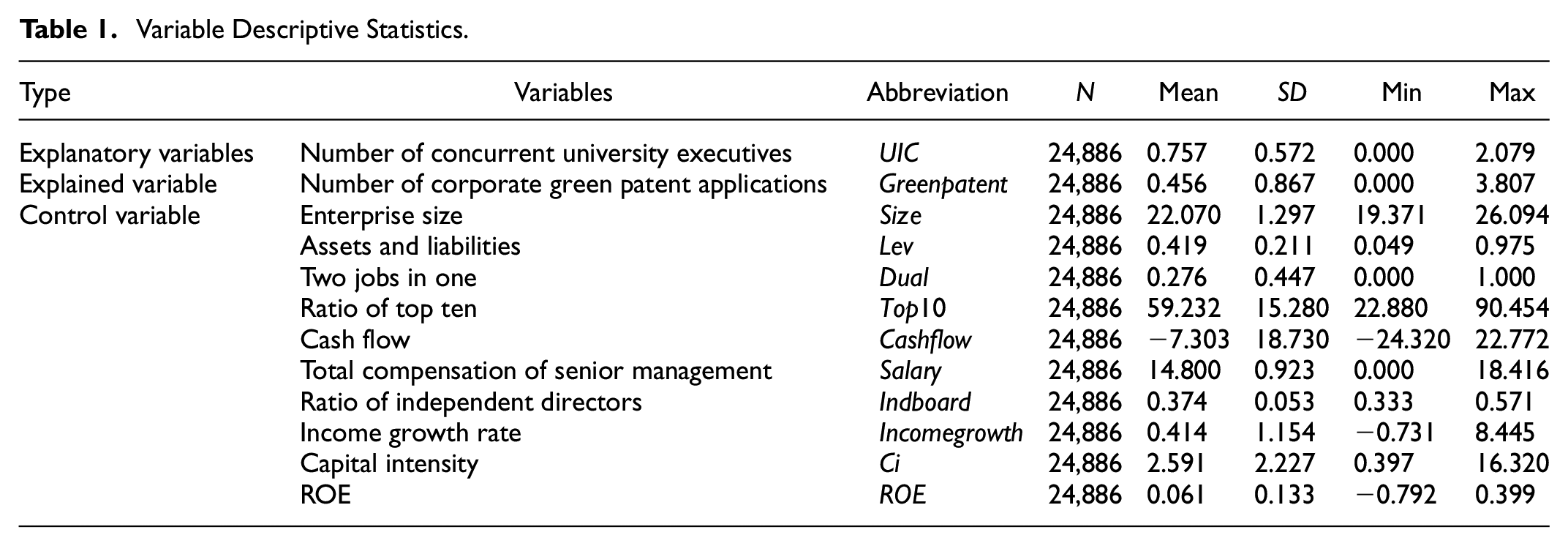
The main variables used in this paper and their descriptive statistics are presented in Table 1. From the results in the table, it can be observed that the average value of green patent applications is 0.424, but the maximum value reaches 3.807, indicating a significant disparity in green innovation capabilities in the A-share market. Currently, many companies have limited green innovation capabilities and produce relatively few green innovations. Overall, listed companies lack vitality in green innovation, which is consistent with existing literature.
Variable Descriptive Statistics.
Analysis of Empirical Results
Baseline Regression Results
Table 2 reports the baseline regression results for the relationship between university-industry cooperation and corporate green innovation. In column (1), controlling for firm fixed effects and year fixed effects, the results show that university-industry cooperation (UIC) has a positive impact on corporate green innovation at the 5% significance level. To address potential omitted variables at the firm level, column (2) adds a series of firm-level control variables to column (1). The estimated coefficient for university-industry cooperation (UIC) experiences a slight decrease in absolute value, but its significance remains unchanged. In column (3), further controls for industry-time fixed effects, province-time fixed effects, and industry-province fixed effects are added to column (2). The results continue to demonstrate that university-industry cooperation (UIC) has a positive and statistically significant impact on corporate green patent applications at the 1% significance level. For each standard deviation increase in the level of university-industry cooperation, the number of corporate green innovation patent applications increases by 0.017 standard deviations. The above results suggest that university-industry cooperation significantly enhances corporate green innovation capabilities, supporting the positive hypothesis (Ha).
Baseline Regression Results.

Note. The clustered robust standard errors at the province-year level are in parentheses.
***, **, and * indicate the significance levels of 1%, 5%, and 10%.
Robustness
To further ensure the robustness of the results, this article conducts the following robustness tests. Firstly, existing literature has found that companies may constantly pursue low-quality innovation in terms of quantity and speed of corporate green innovation to obtain external subsidies and cater to industry-university-research policy needs. Therefore, this paper uses the number of green invention patent applications to replace green patent applications for regression. The regression results are shown in column 1 of Table 3, the coefficient of school-enterprise cooperation (UIC) is slightly smaller than the baseline regression result, and it has a positive and significant impact on the number of corporate green innovation patent applications at the 5% level. Secondly, to eliminate the impact of corporate R&D capabilities on the estimated results, the ratio of corporate green patent applications to total patent applications were used to measure corporate green technology innovation (Popp, 2002, 2006). The regression results are shown in column 2 of Table 3. University-enterprise cooperation (UIC) can still positively affect corporate green innovation patent application data at the 1% level. Thirdly, considering that the risks of green innovation for enterprises are high, and major and substantive innovations that can lead to technological progress and product upgrades usually take a long time, this article selects the number of corporate green innovation applications in period t+1 to measure the status of corporate green innovation. The results are shown in Table 3, column 3. The positive impact of UIC has a significance of 10%. Fourth, to further reduce the error caused by variable measurement, this paper replaces the explanatory variables from the original number of concurrent university executives with whether the university is a shareholder of the company (Shareholder) and the proportion of corporate executives with university experience (Ratio) for regression, the regression results are shown in columns 4 and 5 of Table 3. When changing the explanatory variable measurement method, school-enterprise cooperation can positively affect the number of corporate green innovation patent applications at least at a 10% level. Fifth, to obtain unbiased and consistent estimation results, this paper updates the sample to 2023. Results show that school-enterprise cooperation still promotes corporate green innovation at the 1% level, indicating that the baseline regression results are still robust after replacing the sample interval. Sixth, considering that the COVID_19 will cause most enterprises to stop work and production, this paper excludes the samples after 2019. Results show that UIC can positively and significantly promote enterprise green innovation at the 1% level. Finally, since the number of green innovation patents is rounded non-negative integer technical data, this paper refers to the study of Aghion et al. (2009), and uses the Poisson regression model to explore the impact of university-enterprise cooperation on corporate green innovation, and the results are shown in Table 3. UIC is able to positively influence the corporate green innovation patent application data at the 5% level (Greenpatent).
Robustness Check.

Note. The clustered robust standard errors at the province-year level are in parentheses.
***, **, and * indicate the significance levels of 1%, 5%, and 10%.
Endogeneity Test
Although this study has addressed potential estimation issues arising from omitted variables by including control variables, industry-time fixed effects, province-time fixed effects, and industry-province fixed effects, there may still be significant endogeneity concerns if corporate green innovation is related to regions and industries and varies over time. Additionally, there could be reverse causality in the model. Companies with high levels of green innovation may seek external collaboration to maintain their competitive advantage. Due to the potential presence of omitted variables and reverse causality, this study attempts to mitigate endogeneity issues and identify the net effects between university-industry cooperation and corporate green innovation through instrumental variable methods.
The main idea of the instrumental variable method is to construct an instrumental variable to filter out the endogenous part of the endogenous explanatory variable correlated with the disturbance term, and use the remaining exogenous part to regress with the explained variable to obtain an unbiased and consistent estimate. Constructing an instrumental variable is a prerequisite for the method, and the instrumental variable needs to satisfy relevance (i.e., highly correlated with the endogenous variable) and exogeneity (i.e., there are no other channels to influence the explained variables except through endogenous variables). This study uses the number of secondary school students in 1990 as an instrumental variable. This indicator can reflect the emphasis a region places on education, prompting local governments to enact policies favorable to educational development. Selecting historical data on the number of secondary school student can meet the endogeneity requirement effectively. As times have rapidly changed, the historical number of secondary school students in a region is unlikely to significantly influence the region’s green innovation levels, and it possesses a certain level of exogeneity. This study also controls for variables such as regional economic development, industrial structure, fixed asset investment, foreign investment, internet development, and labor force development. This helps block potential pathways through which historical data on the number of secondary school students might affect regional innovation, further enhancing the exogeneity of this instrumental variable.
After constructing an instrumental variable, the two-stage least squares (2SLS) method is used for regression, where in the first stage, school-enterprise cooperation is regressed on the number of middle school students in 1990 to obtain a variable that is not correlated with the disturbance term. In the second stage, corporate green innovation is regressed on this variable to obtain a consistent estimator. The estimation results are reported in Table 4. The positive impact of UIC on Greenpatent is significant at the 10% level. This shows that after dealing with potential endogeneity issues in the model setting, the estimation results still confirm that school-enterprise cooperation can help improve the level of corporate green innovation. This study used the Kleibergen-Paap rk Lm statistical tool to conduct the instrumental variable non-identifiable test, and the result was that the null hypothesis of “instrumental variable non-identifiable” was rejected at the 1% significance level. The results of the Cragg-Donald Wald F test show that when there is only one endogenous variable, the statistic of the instrumental variable is significantly greater than the critical value at the 20% level, and the null hypothesis that “the instrumental variable selected is a weak instrumental variable” can be rejected. However, the results of the robust weak identification test using the Anderson-Rubin Wald test statistic and the Stock-Wright LM S statistic are both significant at the 1% level, further confirming the effectiveness of the instrumental variables in this study. In summary, the use of the number of secondary school students in 1990 as an instrumental variable is reliable. The results reaffirm that school-industry cooperation can effectively enhance corporate green innovation levels.
Instrumental Variable Estimation Results.
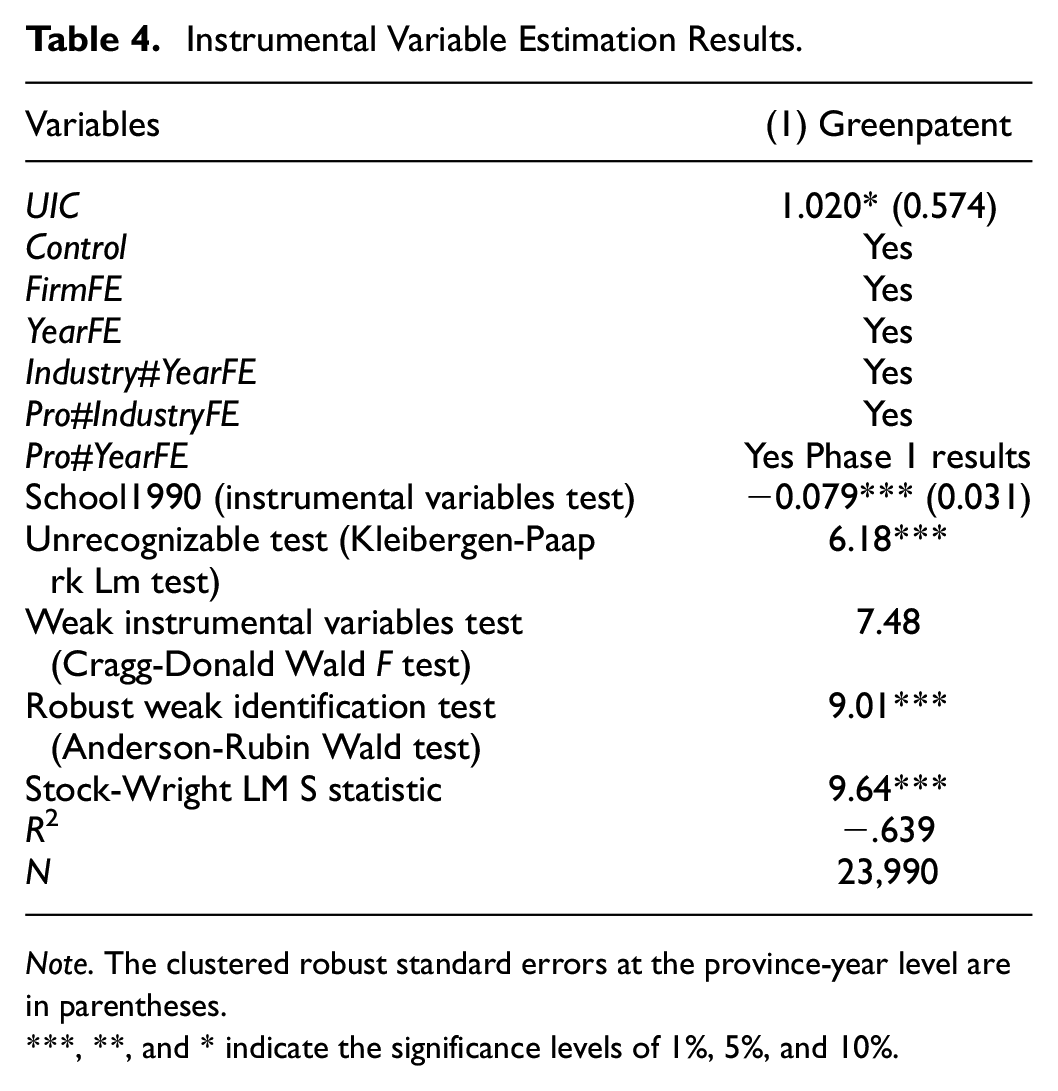
Note. The clustered robust standard errors at the province-year level are in parentheses.
***, **, and * indicate the significance levels of 1%, 5%, and 10%.
Mechanism Analysis
The above benchmark regression indicated that school-enterprise cooperation will actively promote green innovation in enterprises. In this chapter, we will focus on how school-enterprise cooperation will promote corporate green innovation.
Knowledge Effect
In terms of the knowledge effect, school-enterprise cooperation can enable enterprises to obtain tacit knowledge about green innovation through formal and informal communication, reducing their knowledge search costs and promoting their green innovation capabilities (Sherwood & Covin, 2008). At the same time, school-enterprise cooperation can enhance the utilization depth of corporate internal resources by complementing heterogeneous knowledge, enabling them to build, expand, and update their own green knowledge base, increasing the breadth of corporate green knowledge, and further improving their green innovation capabilities. To verify the knowledge effect, this paper refers to the research of Hsu et al. (2014) and uses the number of citations of green innovation patent applications (Citeapply) to measure the level of corporate green knowledge. This paper also refers to the research of Aghion et al. (2019) and Akcigit et al. (2016) and uses the patent width method to measure the level of corporate green knowledge. This method can reflect the quality of patents from the perspective of the complexity and breadth of knowledge contained in green innovation, reflecting the level of green innovation knowledge. Specifically, this paper calculates the breadth of corporate green innovation knowledge (Knowledge_B) based on the construction idea of the Herfindahl-Hirschman Index (HH) through the formula
Knowledge Effect Test.

Note. Robust standard errors for clustering at the province-year level in parentheses.
***, **, and * denote 1%, 5%, and 10% significance levels.
Risk Effect
In terms of the risk effect, in the process of school-enterprise cooperation, enterprises can jointly invest with universities to purchase specialized experimental equipment and human capital with scientific and technological personnel, reducing expenditures on purchasing production equipment and introducing green knowledge talents, lowering R&D investment and sunk costs caused by green innovation failure, smoothing corporate green innovation risks, and increasing risk-bearing capacity, thereby promoting corporate green innovation (Faems et al., 2005; Niesten & Jolink, 2020; Veugelers & Cassiman, 2005). Therefore, to verify the risk effect, this paper refers to the research of John et al. (2008) and uses the ratio of earnings before interest and taxes to total assets as the profitability indicator, adjusts it for industry and annual mean values, and then calculates the standard deviation of this indicator over five observation periods to obtain the volatility of enterprise profitability, thereby reflecting the enterprise’s risk-taking level (
Risk Effect.

Note. Robust standard errors for clustering at the province-year level in parentheses.
***, **, and * denote 1%, 5%, and 10% significance levels.
This result suggests that Hypothesis 2 (H2) is supported, indicating that effective university-industry cooperation can indeed reduce the risk of corporate green innovation and enhance a company’s willingness to engage in green innovation.
Funding Effect
University-industry cooperation allows companies to leverage the strong social network of universities, reducing the search costs associated with finding external investors and increasing the likelihood of securing external financing. Additionally, university-industry cooperation may lead to government subsidies, serve as implicit collateral, transmit signals of green technology advantages to the outside world, reduce concerns about corporate green innovation risks among different financing entities, and attract external capital accumulation, further alleviating corporate financing constraints.
To validate the role of financing constraints in corporate green innovation, this study uses the FC index and SA index, as practiced in existing literature, to measure the degree of corporate financing constraints. Then, it divides companies into high and low financing constraint groups based on the mean of these indicators and conducts group regression analysis. If alleviating corporate financing constraints plays a key role in corporate green innovation, enterprises with lower risk-taking capabilities will obtain greater marginal benefits from the stimulation of school-enterprise cooperation. The regression results in Table 7, columns 5 to 8, demonstrate that university-industry cooperation has a positive and significant impact on green innovation for companies in the low SA index group at the 1% significance level and for companies in the high FC index group at the 10% significance level. However, it has no significant impact on green innovation for companies in the high SA index group or the low FC index group. This result supports Hypothesis 3 (H3), indicating that university-industry cooperation can significantly reduce financing constraints in corporate green innovation, thereby enhancing corporate green innovation capabilities.
Capital Effect Test.

Note. Robust standard errors for clustering at the province-year level in parentheses.
***, **, and * denote 1%, 5%, and 10% significance levels.
Heterogeneity Analysis
Industry Attributes
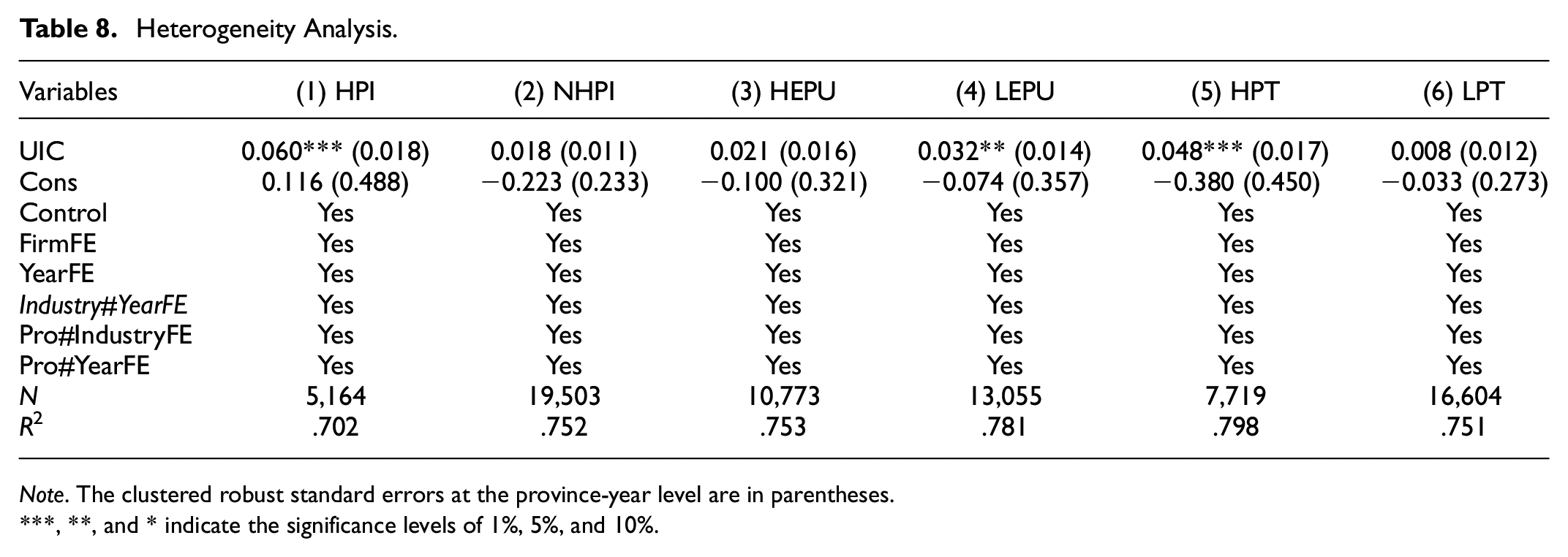
As environmental issues become increasingly severe, China has introduced multiple environmental regulation policies, strictly limiting pollution emissions in heavily polluting industries such as mining and power and increasing penalties for enterprises that violate emission regulations. For example, as reported by China People’s Daily, Shaanxi Huangling Coal Chemical Co., Ltd. was fined 4.1 million yuan and ordered to suspend production due to environmental pollution issues in 2018. Under this backdrop, the profit margins of heavily polluting industries are being squeezed, and they may also face the risk of environmental penalties. Thus, undergoing green upgrades and transformations has become a crucial task for the survival and development of heavily polluting enterprises. However, during the development of green capabilities, due to restrictions in heavily polluting industries, these enterprises may lack green innovation knowledge. Under the current emphasis on green development, heavily polluting enterprises may face severe financing constraints, making it difficult to effectively implement a green revolution. Therefore, compared to other industries, heavily polluting industries have more incentive to seek school-enterprise cooperation, utilizing the technological and social capital of educational institutions in the field of green technology to change the status quo of inadequate technology and insufficient funds, and achieve transformative green innovation to gain greater profits. Overall, we expect that compared to non-heavily polluting industries, heavily polluting industries may exhibit a stronger enhancement effect of school-enterprise cooperation on green innovation. This article classifies the data set into Heavy Pollution Industries (HPI) and Non-Heavy Pollution Industries (NHPI) based on the “Guidelines for the Classification of Industries of Listed Companies” revised by the China Securities Regulatory Commission in 2012, the “Management Catalog of Environmental Protection Inspection Industry Classification for Listed Companies” issued by the Ministry of Environmental Protection in 2008 (Environmental Letter [2008] No. 373), and the “Guidelines for Environmental Information Disclosure of Listed Companies” (Environmental Letter [2010] No. 78). The regression results are shown in columns 1 and 2 of Table 8, which indicate that university-industry cooperation has a positive impact on green innovation for heavy-pollution industry companies (HPI) at the 1% significance level but has no significant impact on non-heavy-pollution industry companies (NHPI). This suggests that the effect of university-industry cooperation on corporate green innovation varies due to differences in industry attributes, and it enhances the positive effect of university-industry cooperation on green innovation in the heavy-pollution industry.
Heterogeneity Analysis.
Note. The clustered robust standard errors at the province-year level are in parentheses.
***, **, and * indicate the significance levels of 1%, 5%, and 10%.
Economic Policy Uncertainty
Considering that green innovation emphasizes the harmonious unity of economic, social, and ecological benefits, R&D costs are often higher, with greater uncertainty and risk (De Marchi, 2012; Pinkse & Kolk, 2010; Tian & Wang, 2014). Especially in an environment of high economic policy uncertainty, this can increase the difficulty for managers to predict future economic conditions, further amplifying the risks of corporate green innovation. Motivated by their own performance incentives, managers have a motive to drive companies to avoid expected market and legal risks, reducing the input costs of cooperating with external institutions on green innovation. Cui et al. (2023) confirmed that economic uncertainty can change corporate investment decisions and reduce corporate green innovation using a sample of Chinese listed companies from 2005 to 2019. When economic policy uncertainty leads to increased volatility in corporate stock prices (Pastor & Veronesi, 2013), external investors find it difficult to judge the prospects of enterprises, and banks and other financial intermediaries become more risk averse. Bordo et al. (2016) found that economic policy uncertainty increases the systemic risk of the financial system, causing banks to be affected by the noise signals of economic policy and the herd effect of borrowing entities, reducing their willingness to lend. Gilchrist et al. (2014) and Waisman et al. (2015) also found that economic policy uncertainty strengthens the scrutiny of banks on projects and reduces the mortgage rate of collateral, leading to a reluctance to lend. This greatly reduces the “easing financing constraints effect” of school-enterprise cooperation, causing enterprises to face more severe financing constraints. Overall, we expect that high economic policy uncertainty will weaken the positive effect of school-enterprise cooperation on green innovation compared to low economic policy uncertainty.
Based on this, we utilized the policy uncertainty index constructed by Baker et al. (2016) and calculated the annual economic policy uncertainty (EPU) by taking the arithmetic average of monthly values. Subsequently, we divided data set into high economic policy uncertainty (HEPU) and low economic policy uncertainty (LEPU) groups based on the mean value of economic policy uncertainty and conducted group regression analysis, as shown in Table 8 columns 3 and 4. The results indicate that under the low economic policy uncertainty group, university-industry cooperation has a significant positive impact on corporate green innovation at the 1% significance level, whereas it has no significant impact on green innovation in the high economic policy uncertainty group. This suggests that the effect of university-industry cooperation on corporate green innovation varies due to differences in economic policy uncertainty, and higher economic policy uncertainty inhibits the positive impact of university-industry cooperation on corporate green innovation.
Degree of Policy Relevance
Strong political connections can optimize the institutional environment in which businesses operate, ensuring they have greater opportunities for economic returns (Li & Zhang, 2007; Xie et al., 2023), while can also impact the role of university-industry cooperation in corporate green innovation. Firstly, local governments often control the resources necessary for companies to engage in green innovation, such as market access thresholds and funding. This grants companies more leverage in their cooperation with universities, reduces their dependence on academic institutions, allows them to establish cooperation rules that are more favorable to their own interests, and enhances their green innovation capabilities (Xie et al., 2023). Secondly, government officials can assist companies in establishing effective monitoring and benefit sharing mechanisms, as well as create appropriate policy protections to ensure the proper functioning of these mechanisms, which reduces the risk of knowledge leakage and promotes effective knowledge spillover from universities to companies, thereby facilitating the improvement of corporate green innovation levels (Hernandez et al., 2015; Li & Zhang, 2007; Shahzad et al., 2022). In summary, a stronger degree of political connections may increase a company’s marginal benefits and reduce its marginal costs in university-industry cooperation, making them better able to leverage the green innovation effects of such cooperation compared to companies with weaker political connections.
Based on this, and referring to the research by Fan et al. (2007) the level of political connections of corporate executives (PT) can be used to represent the degree of their political affiliations. Corporate chairpersons or general managers who have held or currently hold positions in government, party committees (disciplinary committees), the National People’s Congress or Chinese People’s Political Consultative Conference permanent institutions, procuratorates, and courts are categorized into four levels of political connections. Specifically, political connections for cadres at the department level are assigned a value of 1, at the bureau level a value of 2, at the provincial level a value of 3, and at the ministerial or national level a value of 4, while a lack of political connections is assigned a value of 0. Subsequently, based on the sample mean, the sample is divided into groups with high political connections (HPT) and low political connections (LPT), and group regression analysis is conducted, as shown in Table 8 columns 5 and 6. The results indicate that, at the 1% significance level, university-industry cooperation has a positive effect on green innovation for companies in the high political connections group (HPT), whereas it has no significant effect on green innovation for companies in the low political connections group (LPT). This suggests that the impact of university-industry cooperation on corporate green innovation varies due to differences in the degree of political connections, with a higher degree of political connections promoting the positive effects of university-industry cooperation on corporate green innovation.
Conclusion
Using data from China’s A-share non-financial listed companies from 2010 to 2021, the present study found that school-enterprise cooperation is positively associated with corporate green innovation. These results have been robust to a series of robustness tests. Two possible mechanisms were found, school-enterprise cooperation reduces R&D investment and sunk costs caused by green innovation failures, smoothes corporate green innovation risks, and provides sufficient funds for corporate green innovation, thereby promoting corporate green innovation. In addition, the failure of the “knowledge effect” may be because the complexity of green innovation has increased the knowledge distance between universities and enterprises, making it difficult for enterprises to effectively use external knowledge to update their own green knowledge base, and unable to improve corporate green innovation ability. We further found that the green innovation-enhancing effect of school-enterprise cooperation is more significant among enterprises in heavily polluting industries, enterprises in years with low economic policy uncertainty, and enterprises with a high degree of government-enterprise connection.
The research in this article not only provides a series of empirical evidence for school-enterprise cooperation to improve corporate green innovation capabilities, but also has certain policy implications. First, we should vigorously promote the strength of school-enterprise cooperation to provide new kinetic energy for corporate green innovation. The government should fully integrate the advantages of universities in providing knowledge reserves and human capital, establish a platform for school-enterprise cooperation, build a bridge for cooperation between enterprises and universities, and actively fulfill the roles of participant, servicer, and guide played by the governmental departments in building a platform for promoting green innovation. Enterprises should also actively seek cooperation with universities, strengthen knowledge sharing between the two sides, and hold regular meetings to discuss and provide guidance on problems encountered in cooperation between the two sides, so as to realize the efficient combination of theory and practice, and improve the output of green innovation results.
Secondly, the risk-resistant and financial effects of school-enterprise cooperation should be brought into play to provide continuous support for corporate green innovation. The government should work with enterprises and universities to build a green innovation risk evaluation mechanism to control the risk of green innovation from the source, and provide the necessary tax exemptions and financial subsidies for green innovation projects with large application value, so as to improve the risk-bearing capacity of enterprises. At the same time, banks and venture capital institutions will be guided to increase credit support for green innovation cooperation projects, provide low-interest loans, guarantees and other financial services to reduce the financing cost of enterprise innovation, and set up a special green fund to provide financial services for schools and enterprises. Enterprises should start from their own reality, joint universities to build post-doctoral mobile stations and other cooperation platforms. With green innovation needs-oriented, the two sides work together to buy production equipment and training of green innovative manpower, to improve the risk-bearing capacity of enterprises. Enterprises should also actively utilize the university as a partner, based on the cooperation platform between the two sides, to enrich and extend their own social network, or outside investors and government support, to alleviate the enterprise financing constraints, and improve the green innovation capability.
Finally, the formulation and implementation of policies to promote school-enterprise cooperation should take into full consideration the characteristics of different enterprises, industries and economic environments, so as to improve the green output efficiency of school-enterprise cooperation. From the perspective of enterprises, the government should strengthen close contact with enterprises, enhance the degree of government-enterprise connection, increase support for outstanding enterprises, improve knowledge leakage of enterprises, and enhance the marginal benefits of enterprises in school-enterprise cooperation. Enterprises should also actively seek the cooperation and support of the government, regularly participate in meetings and activities organized by the government, and improve the communication mechanism between government and enterprises, so as to obtain government support and reduce the marginal cost of school-enterprise cooperation. From the industry point of view, the government should strengthen the supervision and management of the heavy pollution industry, improve the green innovation encouragement mechanism, and induce it to carry out school-enterprise cooperation, so as to produce breakthrough innovations. Enterprises in heavily polluted industries should make it clear that carrying out green upgrading and transformation is the only way for them in the context of the current green development requirements, and they should unite with universities and other research institutes to carry out a green revolution by utilizing the university’s technology and social capital in the field of green technology. From the economic environment, the government is frequently introducing or adjusting economic policies to smooth out economic volatility, weighing the negative impact of economic policy uncertainty on green innovation activities. If the government has to make policy adjustments, it should maintain long-term policy consistency as much as possible, and improve its own government credibility, so as to minimize the bad expectations of innovation subjects in school-enterprise cooperation on the uncertainty of economic policies, and then increase their willingness to green innovation. At the same time, enterprises also need to cooperate with universities to enhance their ability to resist risks, reduce their excessive dependence on government economic policies, and actively play the role of school-enterprise cooperation in promoting green innovation.
Although this paper provides certain research conclusions and policy insights, it still has some limitations. It fails to make a more fine-grained division of school-enterprise cooperation to explore the impact of the breadth and depth of school-enterprise cooperation on corporate green innovation. Specifically, an increase in the breadth of school-enterprise cooperation is conducive to corporate enrichment of knowledge acquisition channels, increase in knowledge breadth, and reduction of single-partner dependence, increase in risk-bearing capacity and expansion of financing channels, which in turn promotes corporate green innovation (Laursen & Salter, 2006). However, due to the huge differences between enterprises and universities in terms of goal orientation, organizational culture, work flow etc., enterprises need to pay a large search and communication cost in the process of searching for cooperative partners and collaborative research and development (Belderbos et al, 2004), which may require enterprises to spend additional energy and funds to coordinate the differences between the various innovation bodies, crowding out the innovation resources of the enterprise, and reducing the level of green innovation. Therefore, the direction of the impact of increase in the breadth of school-enterprise cooperation on the corporate green innovation is not clear. The depth of school-enterprise cooperation helps to establish a relationship of trust and common interests between the two sides, realizes the deep excavation and learning of external knowledge by enterprises, and achieves internal and external knowledge synergy (Wynarczyk et al., 2013). At the same time, the increase in the depth of cooperation is conducive to the establishment of mutual trust and common interests, prompting the two sides to jointly bear the risks of green innovation, and facilitating enterprises to better utilize the social capital and cooperation platforms of universities to obtain external funding, and to promote enterprise green innovation. In summary, different breadth and depth of school-enterprise cooperation may differentiate the mechanism of school-enterprise cooperation on corporate green innovation, and then produce different directions of influence. Therefore, exploring the depth and breadth of school-enterprise cooperation can help to comprehensively understand the relationship between school-enterprise cooperation and corporate green innovation, and provide detailed empirical evidence and theoretical basis for the government to formulate a program of school-enterprise cooperation to empower green innovation.
Footnotes
Acknowledgements
The authors gratefully acknowledge the supports of Southeast University.
Declaration of Conflicting Interests
The author declared no potential conflicts of interest with respect to the research, authorship, and/or publication of this article.
Funding
The author received no financial support for the research, authorship, and/or publication of this article.
Ethical Approval
This study was conducted in accordance with the Academic Integrity Code of Southeast University.

Data Availability Statement
The datasets generated during and/or analyzed during the current study are available from the corresponding author on reasonable request.