




Abstract
This systematic review examines the concept of awe in tourism and hospitality research through a comprehensive analysis of 41 empirical studies published between 2012 and 2023. Using the PRISMA methodology, the review reveals three key findings: (1) a strong consensus in awe conceptualization within tourism research, primarily following Keltner and Haidt’s and Shiota et al.’s frameworks; (2) a predominance of quantitative methods (68% of studies), with limited mixed-methods approaches; and (3) two primary awe antecedents - natural environments and cultural sites - leading to significant outcomes in tourist satisfaction, environmental behavior, and well-being. The analysis identifies critical research gaps, particularly in theoretical frameworks and methodological diversity, while highlighting opportunities for advancing awe research in tourism contexts. This review contributes to tourism literature by providing a comprehensive framework for understanding awe’s role in tourist experiences and offering practical implications for destination management and sustainable tourism development.
Introduction
The tourism industry is increasingly focused on providing meaningful and emotional experiences (Wei et al., 2021). These experiences are influenced by psychological factors and the inherent characteristics of the destination (H. Kim et al., 2015). Recent literature suggests a shift in management strategies toward offering “authentic” services that integrate emotional elements to enhance the memorability and influence on tourist behavior and intentions (Lajante & Lux, 2020; Tuerlan et al., 2021). Among these emotional experiences, awe—a profound emotional response elicited by encounters with vast and extraordinary phenomena—has emerged as a significant element in tourism research (Keltner & Haidt, 2003; Shiota et al., 2007).
Tourists seek awe-inspiring experiences across natural landscapes, cultural environments, and even man-made settings (He et al., 2022; L. Wang & Lyu, 2019; Y. Q. Yan et al., 2021). Recognizing individual differences in susceptibility to awe (H. Zhao et al., 2019), research is delving into the mechanisms that induce this emotion, which can transform perceptions, foster creativity, and shift paradigms (Bai et al., 2017; Valdesolo & Graham, 2013). Awe’s significance in tourism extends to enhancing well-being, promoting ecological behaviors, and encouraging prosocial actions (Diener et al., 2009; Y. Li et al., 2022; Prade & Saroglou, 2016; Van Cappellen & Saroglou, 2011; Yaden et al., 2017). Such experiences align with transformative tourism, where travelers seek personal growth (Chen et al., 2021).
Despite its potential to transform perceptions, foster creativity, and enhance visitor experiences, scholarly discussions on awe in tourism remain limited and lack systematic investigation (Chirico et al., 2017; L. Wang & Lyu, 2019). The concept of awe in tourism contexts presents unique characteristics that distinguish it from everyday emotional experiences, yet current literature reveals significant gaps in understanding its role, particularly regarding definition, measurement, and practical applications in destination management (Pearce et al., 2016; L. Wang & Lyu, 2019). Meanwhile, the lack of a unified theoretical framework hampers both academic progress and industry implementation of awe-based strategies. Additionally, the methodological approaches used to study awe in tourism contexts require systematic review to ensure robust and reliable findings (Caruana et al., 2014). This gap is particularly notable given the increasing recognition of individual differences in awe susceptibility and its implications for tourism experience design (H. Zhao et al., 2019).
The primary goal of this research is a comprehensive evaluation of the concept of awe and its impact within the tourism sector. To achieve this, the manuscript is driven by five key research questions:
How is awe conceptualized and defined within tourism and hospitality literature?
What are the prevalent trends and settings in awe-related tourism research?
Which methodological approaches have been employed to investigate awe in tourism?
What theoretical frameworks guide the examination of awe in tourism contexts?
What are the key antecedents, outcomes, and mechanisms underlying awe’s effects in tourism?
This research makes several significant contributions to both academic knowledge and industry practice. First, it develops a comprehensive theoretical framework for understanding awe’s influence on tourist behavior and destination management. Second, it provides a systematic review of existing literature, identifying methodological strengths and weaknesses to guide future research. Third, it offers practical insights for tourism practitioners seeking to create meaningful, awe-inspiring experiences while maintaining sustainable practices.
Literature Review
Awe has a rich history and multifaceted nature that has intrigued scholars across various fields, from psychology to philosophy to environmental studies (McSHANE, 2018). Its etymology traces back to the Old Norse word “agi,” signifying fear or terror, and the Old English “ege,” meaning dread or awe (Keltner & Haidt, 2003). Over time, the concept of awe evolved to encompass not just fear but also a profound sense of wonder and reverence, particularly in response to that which is vast or beyond human understanding. This evolution reflects a broader shift in human consciousness and our relationship with experiences that transcend ordinary understanding.
In contemporary tourism and hospitality research, awe has emerged as a critical construct, fundamentally linked to creating memorable and profound travel experiences that enhance visitor satisfaction and loyalty (Lu et al., 2017; Su et al., 2020). Such experiences are not merely pleasurable but transformative, fostering deeper quality engagement and significantly increasing the perceived value of a destination (Y. Q. Yan et al., 2021). The concept of awe is intrinsically connected to what Powell et al. (2012) identified as “peak experiences” within the tourism sector - extraordinary moments that differentiate a service or destination by offering experiences that transcend the ordinary. These peak experiences often serve as anchor points in tourists’ memories, shaping their overall perception of the destination and influencing future travel decisions.
The impact of awe in nature-based tourism is particularly well-documented, with extensive studies demonstrating how natural wonders can evoke deep emotional responses and contribute significantly to tourists’ psychological well-being (Jiang, Xia et al., 2022; Severin et al., 2021). Powell et al. (2012) expands on this understanding, suggesting that awe experiences in natural settings can enhance visitors’ sense of connectedness to the environment and promote environmental stewardship behaviors. This connection between awe and environmental consciousness has important implications for sustainable tourism practices and conservation efforts, as it suggests that awe-inspiring experiences in nature can foster long-term environmental awareness and responsible tourism behavior.
In the realm of cultural and heritage tourism, awe manifests through meaningful interactions with historical artifacts, artistic achievements, and architectural wonders, potentially transforming tourists’ perspectives and worldviews (Su et al., 2020; A. Yan & Jia, 2021). Bai et al. (2017) argue that awe can significantly motivate collective engagement and social connection, while Ramkissoon et al. (2012) demonstrate its crucial role in fostering cultural empathy and global understanding. These findings suggest that awe-inspiring cultural experiences can serve as bridges between different societies, promoting cross-cultural appreciation and mutual respect. The hospitality industry has recognized this transformative potential, with Pine and Gilmore (1999) contending that businesses can strategically create awe-inspiring experiences that transcend standard service offerings, leading to enhanced customer satisfaction and loyalty (Su et al., 2020).
Methodology
Systematic Literature Review
Systematic literature reviews have become increasingly popular in tourism research due to their methodical approach to mapping knowledge boundaries (Balaid et al., 2016). This type of review involves a structured search, extraction, and quantitative synthesis of literature. It allows researchers to discern what is known and unknown about a topic (Pickering & Byrne, 2013). Unlike narrative reviews, which may be biased by selecting studies that support the reviewers’ opinions, systematic reviews minimize bias through replicable search methods, and transparent procedures (Briner & Walshe, 2014; Paul et al., 2021). This review method is comprehensive, encompassing a range of variables such as geography and methodology to identify key areas for future research.
PRISMA Guidelines for Systematic Literature Review
The PRISMA (Preferred Reporting Items for Systematic Reviews and Meta-Analyses) model was chosen for this study due to its rigorous and systematic approach to literature review. This framework was selected because it provides a standardized, internationally recognized methodology that ensures comprehensive coverage of available literature while enabling transparent reporting of the review process. Additionally, PRISMA includes specific tools for assessing the quality of included studies and helps identify potential biases in the review process. The model outlines four essential phases: identification, screening, eligibility, and inclusion—each crucial for maintaining the integrity of the review (McCrae et al., 2015; Paul et al., 2021).
The review period from 2012 to 2023 was selected based on Powell et al.’s (2012) seminal article that marked a significant turning point in awe-related tourism research. Data collection concluded in November 2023. The search strategy employed specific keywords: “awe,”“small-self,”“need-for-accommodation,” in combination with “hospitality,”“hotel,”“tour*,”“travel,”“restaurant,”“catering,” or “recreation.” These terms were searched within article titles, keywords, and abstracts for comprehensive coverage.
The review process followed strict inclusion and exclusion criteria to ensure the quality and relevance of selected articles.
Inclusion Criteria:
- Peer-reviewed English-language articles
- Tourism/hospitality context
- 2012 to 2023 timeframe
- Empirical studies
Exclusion Criteria:
- Non-English publications
- Conference proceedings and book chapters
- Peripheral awe mentions
- Non-tourism contexts
The initial search yielded 231 articles. After eliminating duplicates, 191 unique articles were identified. Application of the inclusion/exclusion criteria reduced this to 159 articles. Further evaluation based on relevance and quality assessment resulted in a final sample of 41 articles from 41 journals spanning 2012 to 2023 (refer to Figure 1).

Research process.
Procedures of Analysis
In great detail, the following descriptive information was gathered for each article: (1) The definition of awe; (2) the year in which it was published; (3) the type of journal it belongs to, whether it falls under the category of tourism, management, or other social sciences; (4) the geographical focus of the publication; (5) the research methods that were employed in the publication, specifically empirical quantitative analysis, empirical qualitative analysis, or a combination of both; (6) the theoretical approaches that were utilized in the publication. (7) antecedents, outcomes, mediation, and moderation of awe.
Results
Awe Definition in Tourism and Hospitality
This systematic literature review (SLR) reveals strong consensus in the conceptualization of awe within tourism and hospitality research. Among the analyzed studies (n = 39), two predominant definitions emerge: those proposed by Keltner and Haidt (2003) and Shiota et al. (2007). Both frameworks characterize awe as an emotion arising from perceptions of vastness, novelty, or power, accompanied by feelings of being overwhelmed, a sense of mystery, and a desire to connect with something greater than oneself.
While Xiong et al. (2023) and Miyakawa et al. (2022) referenced Hicks & Stewart (2017) definition—emphasizing awe’s positive life impact—this conceptualization aligns with and is encompassed by the broader frameworks of Keltner and Haidt (2003) and Shiota et al. (2007). Consequently, this SLR recommends adopting these latter definitions as standard conceptualizations of awe in tourism and hospitality literature (See in Appendix 1 for more information).
Trend and Research Setting on Awe Research
Recently, there has been a surge of interest in emotion recognition through the use of awe, as evidenced by the escalating number of research publications. This SLR examined 41 studies on emotion recognition using awe. As shown in Figure 2, the number of publications has risen steadily from 2012 to 2022. Notably, between 2020 and 2021, the number of publications grew 480%, with nine total studies. In 2022, the number increased to 12 studies, indicating growing interest and significance of this field with immense potential for various applications.

Year of publication.
Figure 3 provides overviews of awe-related publications across fields such as economics, management, philosophy, sustainability, psychology, and marketing. Only 21.2% of journals have published two or more articles on awe since 2012 when researchers began investigating this area. The number of studies in the tourism sector has expanded over the last 12 years, beginning in 2012. “Current Issues in Tourism,”“Sustainability,”“Journal of Sustainable Tourism,” and “A Journal of Hospitality and Tourism Management” published three articles each, while “Annals of Tourism Research,”“Frontiers in Psychology,” and “Tourism Review” published two articles each. There are 23 other journals that contributed one article each. This provides academics with journals to consider when publishing awe research in the tourism sector literature.
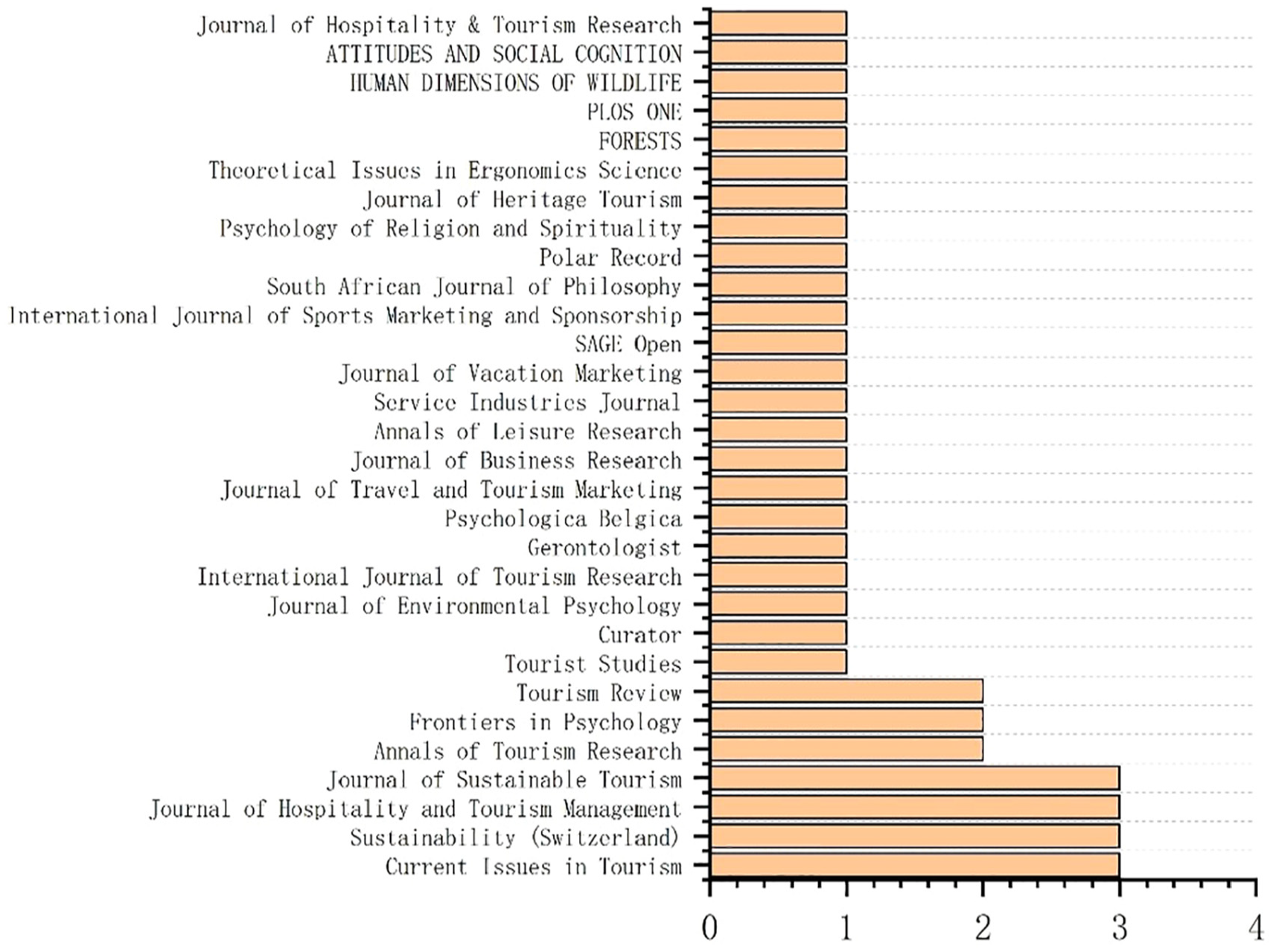
Journal of publication.
In research setting, Figures 4 and 5 showcase the existing literature on regulation studies in the tourism sector. It provides valuable insights into the specific locations where data collection for these studies has taken place. The Asian region, particularly China, has received significant attention in geographical research. Approximately 53.7% of all publications have been dedicated to this region. According to the research findings, a significant 17.1% of the articles published were focused on Europe. The study locations were evenly distributed across the West European region, including countries such as the United Kingdom, France, Spain, Belgium, and Portugal. The North Americas receive significant attention from researchers, accounting for 14.6% of the overall study focus. In stark contrast, there remains a paucity of research conducted in the Antarctic (n = 2), Space (n = 2), and Oceania regions (n = 1). It is also worth noting that there is a scarcity of research investigating multiple regions, with only one publication identified.

Geographic focus of publication by countries.

Geographic focus of publication by continents.
Methodological Approach on Awe Research
Figure 6 outlines the methodological diversity in awe research over different periods. Quantitative methods predominate, with over half of the articles (28 out of 41) employing them. Mixed methods have seen a modest rise recently, although they remain underutilized. Initially, discussions on related concepts and phenomena paved the way for experimental designs and measurement tools (e.g., Powell et al., 2012; Van Cappellen & Saroglou, 2011). Factor analysis is a common tool among quantitative studies for item and scale development (e.g., Hicks & Stewart, 2017; M. Zhao et al., 2022), while qualitative studies often employ interviews and observations to delve into awe’s intricacies. Mixed methods, though less common, combine interviews with statistical analysis for robust conceptual and empirical examination (e.g., Quesnel & Riecke, 2018). This methodological variety signifies a progressive deepening of awe’s understanding within tourism research (See in Appendix 1 for more information).

Methodological approach.
Theoretical Approaches on Awe Research
The third question addressed in this review concerns the theoretical frameworks applied to awe research in tourism. Table 2 reveals that while many studies focus on applied research and prototype development, theoretical underpinnings are less common. Of the 41 articles reviewed, only 15 integrate theories, encompassing 17 different theoretical frameworks. Two studies utilized the awe prototype theory (e.g., Y. Li et al., 2022; Lu et al., 2017), value-belief-norm (VBN) theory (e.g., Xiong et al., 2023), and two implemented interactional theory (e.g., Powell et al., 2015). Self-determination theory was employed by Y. Li et al. (2022), while Price et al. (2021) used the Delone and McLean model of information systems success and the generic learning outcomes model, respectively. Wu and Lai (2023) grounded their study in Associative Network Theory (Table 1).
Theories Applied or Cited in Reviewed Articles.
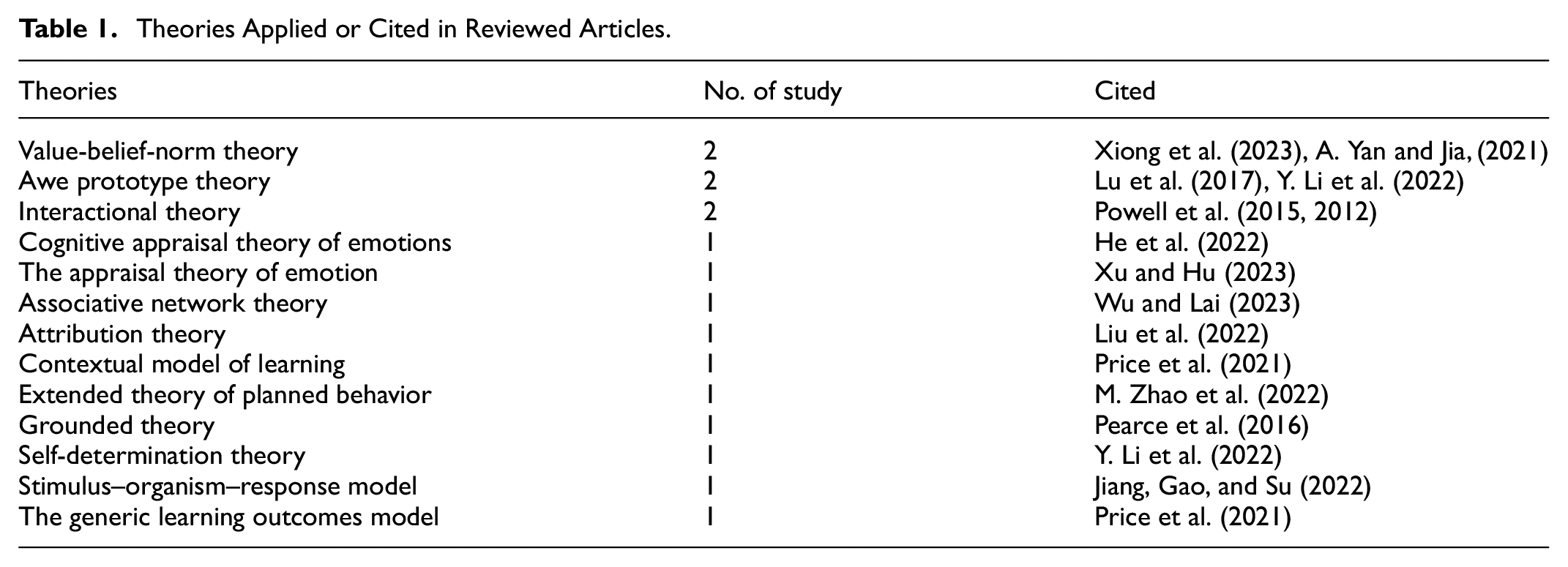
These theories provide valuable perspectives on awe’s formation, particularly within cultural and social psychology domains. The natural environment’s role in eliciting awe is also emphasized in recent literature (e.g., Lu et al., 2017). Established behavioral models like the Stimulus-Organism-Response framework are also applied to this field of study. However, the theoretical landscape of awe research is still evolving, with a dispersed adoption of various theories.
Antecedents
In Table 2, the existing research indicates various factors that contribute to the elicitation of awe. Real life natural environments (e.g., He et al., 2022; Lu et al., 2017; Severin et al., 2021; Y. Q. Yan et al., 2021; M. Zhao et al., 2022), cultural/Archeological sites (e.g., Lu et al., 2017; Su et al., 2020; Van Cappellen & Saroglou, 2011; A. Yan & Jia, 2021), and reflection/imagination (e.g., Y. Li et al., 2022; Liu et al., 2022; Van Cappellen & Saroglou, 2011; Xu & Hu, 2023), were the most studied.
Antecedents of Awe.

Numerous studies have shown that the natural environment has a consistent ability to evoke feelings of awe. In fact, research articles have highlighted that awe can be elicited through various natural settings such as sacred mountains, the Antarctic, and natural heritage sites. For instance, Lu et al. (2017) found that sacred mountains were particularly effective in evoking awe, while Powell et al. (2012) reported that the Antarctic was also a powerful setting for this emotion. Similarly, Jiang, Gao, and Su (2022) highlighted the ability of natural heritage sites to elicit awe. Research articles have found that cultural and archeological sites can elicit a sense of awe through various means such as spirituality, cultural artifacts, merchandise, and music (Bai et al., 2017). In the realm of tourism, individuals are not solely motivated by material and perceptible entities, including historic edifices, religious landmarks, and works of art (Robinson & Picard, 2012). They are equally inspired by socio-cultural aspects, such as religious practices and intangible cultural legacy (Su et al., 2020; Van Cappellen & Saroglou, 2011). Regarding eliciting feelings of awe via reflection/imagination (e.g., consider a recent awe-inspiring experience) with content of either natural or artificial environments (e.g., huge structures), there have a range of emerging and diverse findings (L. Wang & Lyu, 2019).
This research has identified various antecedents that can elicit awe, including man-made sites, diaries, trust, virtual reality (VR), images, and videos. While these antecedents have been expressed to a lesser extent in existing studies, they are still noteworthy.
Outcomes
Table 3 synthesizes the primary effects of awe in tourism contexts, highlighting five prominent outcomes: tourists’ environmentally responsible behavior (Pearce et al., 2016; L. Wang & Lyu, 2019; M. Zhao et al., 2022), well-being (Jiang, Xia et al., 2022; Severin et al., 2021; Van Cappellen & Saroglou, 2011), satisfaction (Lu et al., 2017; Liu et al., 2022; Rodrigues et al., 2022), behavioral intentions (Liu et al., 2022; Rodrigues et al., 2022; Smalley & White, 2023; Van Cappellen & Saroglou, 2011), and social connectedness (Y. Li et al., 2022; Price et al., 2021; Yang et al., 2021).
Outcomes of Awe.

Tourist behavior significantly influences environmental protection and sustainable tourism development. L. Wang and Lyu (2019) demonstrated that awe enhances environmental awareness, subsequently promoting more responsible tourist behavior. Furthermore, Jiang, Gao, and Su (2022) found that awe experiences increase perceived experiential value, leading to higher satisfaction levels. In the marketing domain, the relationship between awe and behavioral intentions has garnered substantial research interest (Rodrigues et al., 2022), particularly regarding revisit intentions and word-of-mouth behaviors, as these emotional responses shape future consumer actions (W. Kim, 2021; Phillips et al., 2011).
As a self-transcendent emotion, awe generates and nurtures social connectedness (Y. Li et al., 2022; Shiota et al., 2007; Yang et al., 2021). Studies by Bai et al. (2017) and Van Cappellen and Saroglou (2011) provide empirical evidence that this phenomenon extends beyond immediate social circles, fostering a broader sense of unity with others.
Several factors have been studied to a lesser extent in the context of tourism. These factors encompass small-self, memorable experiences, place attachment, purchase likelihood, tourist attitudes, pro-environmental behavior, and subjective norms, among others.
Mediation
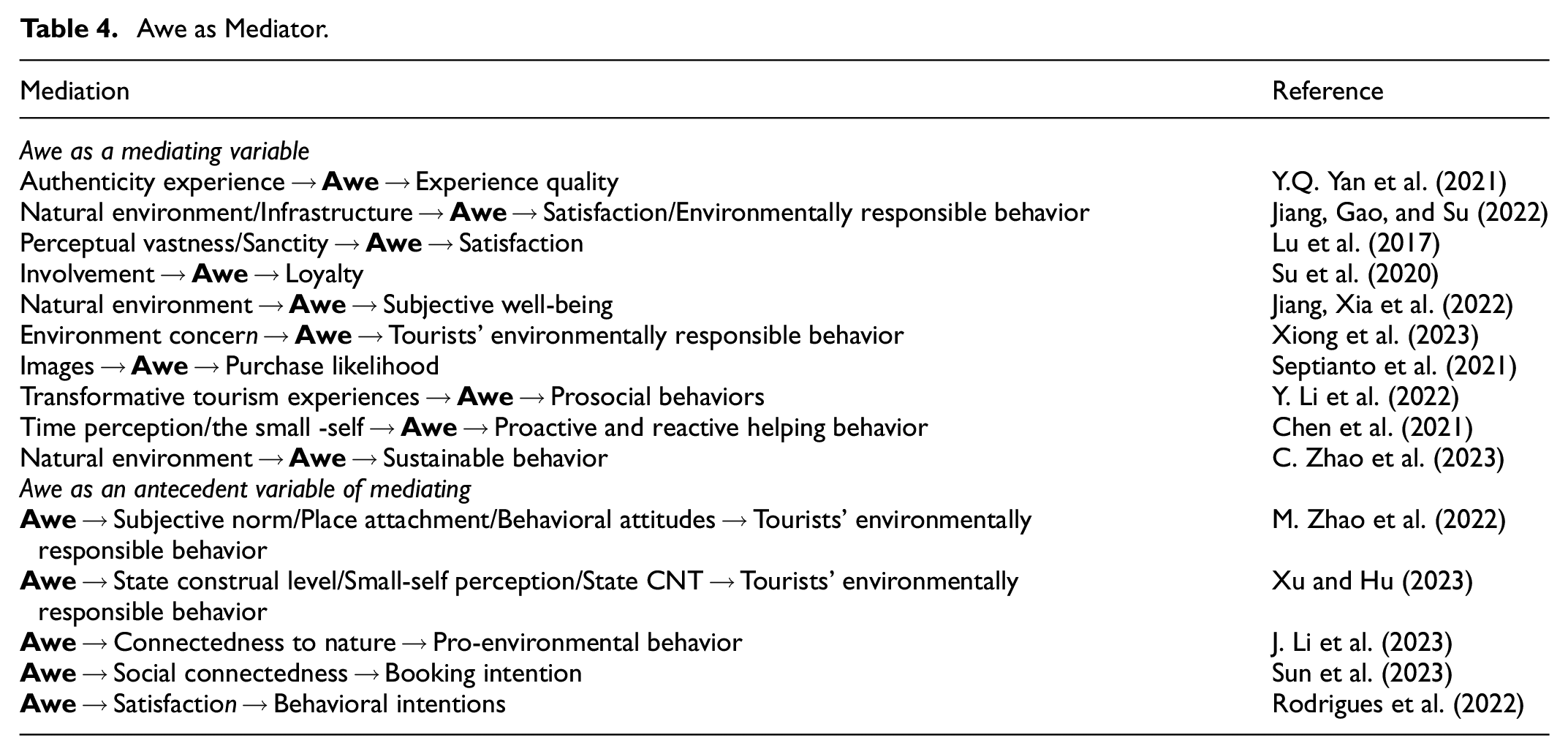
The present study revealed only nine articles in which awe served as a mediator (e.g., Lu et al., 2017; Xiong et al., 2023; Y. Q. Yan et al., 2021). Xiong et al. (2023) discovered that tourists who experience awe are more likely to adopt environmentally responsible behaviors in their future travels. Similarly, Lu et al. (2017) found that when tourists experience awe at Mt. Emei, a famous sacred mountain in China, their perceptions of vastness and sacredness can lead to increased satisfaction. Although the literature on this topic is sparse, awe can serve as a mechanism to explain why certain independent variables elicit cognitive responses, such as satisfaction, or behavioral responses, such as environmentally responsible behavior, from managers in the tourism industry.
Analysis of the literature revealed several significant mediating relationships involving awe in tourism contexts. Rodrigues et al. (2022) demonstrated that tourist satisfaction serves as a crucial mediator between awe and behavioral intentions, corroborating earlier findings by Pestana et al. (2019) regarding the indirect influence of positive emotional states on behavioral outcomes through satisfaction. Furthermore, independent studies by M. Zhao et al. (2022) and Xu and Hu (2023) established behavioral attitudes as mediators in the relationship between awe and environmentally responsible behavior among tourists (Table 4). These findings collectively suggest that awe’s influence on pro-environmental behaviors operates through a cascade of behavioral attitudinal changes.
Awe as Mediator.
Moderator
In a recent study conducted by He et al. (2022), it was discovered that awe can play a positive role as a moderator in the relationship between pride and pro-environmental behavior, particularly in the context of experiential consumption. The study also examined cases where awe acted as an antecedent or outcome variable for moderation. Moderation is a crucial factor that can affect the way independent and dependent variables interact in specific situations. For example, when awe interacts with parasocial moderators, it can influence the audience’s attitudes toward a video, as demonstrated in the study by Wu and Lai (2023). Furthermore, Lu et al. (2017) discovered that the experience of awe is influenced by the type of visitor, whether they are pilgrims or secular tourists. A comprehensive list of moderation relationships is available in Table 5.
Awe as a Moderating Variable.

Discussion
Summary of Findings
This systematic literature review (SLR) revealed significant geographical diversity in awe-related research within the tourism and hospitality sector. Data collection predominantly occurred in China, the US, Belgium, and Canada, with one notable study by Averbach and Monin (2022) examining awe’s effects across 12 countries, highlighting variations in tourist memory and well-being outcomes.
The theoretical foundation of awe research in tourism primarily rests on three perspectives: appraisal theory of emotion, interactional theory, and value-belief-norm (VBN) theory. Several other theoretical frameworks have been employed less frequently, including associative network theory, attribution theory, contextual model of learning, extended theory of planned behavior, grounded theory, self-determination theory, stimulus–organism–response theory, the generic learning outcomes model, and therapeutic landscapes theory.
The SLR identified key variables associated with awe in tourism and hospitality contexts, establishing a comprehensive conceptual framework that maps relationships between awe and its various components. Two primary antecedents emerged: real-life natural environments (as documented by He et al., 2022; Jiang, Gao, & Su, 2022; Lu et al., 2017; Yan et al., 2022; M. Zhao et al., 2022) and cultural/archeological sites (studied by Lu et al., 2017; Luke, 2021; Price et al., 2021; Robina-Ramirez & Pulido-Fernandez, 2021; Su et al., 2020; A. Yan & Jia, 2021).
The research predominantly focused on individual-level outcomes, categorized into four distinct domains: cognitive (including satisfaction, small self, tourist attitudes, subjective norm, and perceived value), affective (encompassing well-being, memorable experiences, and experience quality), behavioral (covering environmentally responsible behavior, behavioral intentions, pro-environmental behavior, prosocial behaviors, and proactive behavior), and performance outcomes (specifically experience quality). The mediating mechanisms were primarily tourist-centered, classified into cognitive (e.g., subjective norm), affective (e.g., place attachment), and behavioral mediators (e.g., behavioral attitudes), (refer to Figure 7) .

Conceptual framework.
Avenues for Future Research
This research mapped the current state of awe research in tourism. There are a series of recommendations for future research on awe in the tourism and hospitality sector, across the dimensions of context, methods, theories, and variables.
Contexts
Studies on the impact of awe in the tourism industry have mainly focused on data from Western and Eastern countries, as indicated in Table 2. However, there is a gap in research when it comes to countries in Africa and Latin America. To gain a better understanding of the effects of awe in different contexts, it is recommended that future studies test awe models based on datasets from these regions. Furthermore, we have identified two insightful cross-national studies conducted by Averbach and Monin (2022) in the USA and Canada, and Buckley (2022) in various countries across different continents. However, to obtain a more comprehensive understanding of awe in the tourism sector, it is crucial that future cross-national studies include countries from Latin America and Africa, as well as more nations from Eastern Europe and Mid-west Asia. This will allow us to acquire a comprehensive understanding of awe and its influence on the global tourism industry.
Moreover, it is also important for future research to examine how cultural individualism, and collectivism could influence the effects of awe in different nations, as three cross-national studies failed to provide an explanation on this matter. Tourist sites such as Catholic parishes, goddess Mazu and Buddhist temples can promote normatively appropriate awe among tourists, as suggested by Su et al. (2020). In cultures characterized by high power distance, tourists exhibit more pronounced environmental mindsets compared to individualists, as individualists prioritize personal gain and generally express lower levels of environmental concerns and attitudes. On the other hand, collectivists, guided by collectivistic values, consider the expectations of others before voicing their apprehensions about the environment (Morren & Grinstein, 2016). Therefore, it is imperative for upcoming research in tourism to investigate the influence of awe on the cultural background of tourists. Moreover, it is equally significant to explore its impact on their behavioral and attitudinal outcomes in cultures that promote collectivism as opposed to individualism.
To truly grasp the impact of awe on tourist behaviors, cross-national studies must delve deeper than just cultural values. It is essential to consider the unique national characteristics, including political, economic, and social aspects, as they influence individual behaviors. Golob et al. (2018) have shown that these factors play a significant role in shaping behavior. Therefore, it is imperative for future research to explore the effects of awe across nations with diverse demographics, including differences in gender, age, education, and occupation. By doing so, we can gain a deeper understanding of how awe influences tourist behavior and ultimately enhance the travel experience for all.
Methods
Of the 41 studies in our sample, 28 employed quantitative methods and adopted survey techniques for data collection (e.g., Lu et al., 2017; L. Wang & Lyu, 2019; M. Zhao et al., 2022). While these methods have provided valuable insights, future research should consider more diverse and innovative methodological approaches. Experimental designs, though present in some studies (Severin et al., 2021; Van Cappellen et al., 2012), remain underutilized and could be expanded to establish causal relationships in awe experiences. Mixed methods approach, currently employed by only a few researchers (Averbach & Monin, 2022; Miyakawa et al., 2022; Quesnel & Riecke, 2018), should be more widely adopted to provide both breadth and depth in understanding awe experiences. Additionally, while some studies have employed innovative methods such as mobile eye-tracking (Krogh-Jespersen et al., 2020) and virtual reality (Gallagher et al., 2014; Reinerman-Jones et al., 2013), there remains significant potential for incorporating new technologies and methodological approaches to capture the complex, multifaceted nature of awe experiences in tourism contexts. Longitudinal studies are notably absent from current literature, suggesting a need for research designs that can track the development and lasting impacts of awe experiences over time.
Theories
Future research needs significant development in several key areas. While current studies employ various theories such as value-belief-norm theory (Xiong et al., 2023; A. Yan & Jia, 2021), interactional theory (Powell et al., 2012, 2015), and cognitive appraisal theory (He et al., 2022), there is a notable lack of tourism-specific theoretical frameworks. The data reveals that approximately 60% of studies lack explicit theoretical foundations, suggesting a critical need for theory development and validation in tourism contexts. Future research should focus on: developing tourism-specific theories that better account for the unique characteristics of awe in travel experiences; expanding theoretical diversity beyond single-use applications like attribution Theory (Liu et al., 2022) and self-determination Theory (Y. Li et al., 2022); integrating multiple theoretical perspectives for more comprehensive understanding; and examining cross-cultural applications of theoretical frameworks, as current studies are predominantly conducted in limited geographical contexts. Additionally, there’s a need for context-specific theoretical models that can address the diverse settings (natural environments, cultural sites, virtual experiences) where awe occurs in tourism, and longitudinal theoretical applications to understand how awe experiences develop and impact tourism over time.
Variables
Research has predominantly focused on environmental perceptions as antecedents to awe. To broaden this scope, we suggest incorporating individual-level variables from psychological studies—such as bodily experiences, professional expertise, and personality traits like extraversion—as potential antecedents of awe in tourism contexts. Furthermore, moral dimensions like altruism and cultural authenticity warrant exploration. For instance, examining how tourists’ moral identities influence their behaviors could illuminate how awe fosters civility and environmental stewardship. Furthermore, the research has not fully examined the experience of awe triggered by senses other than sight, such as sound. It is essential to consider the implications of eliciting awe through multiple senses, particularly for individuals with sensory impairments, such as the visually impaired. Some studies have also proposed categorizing awe into threat-based and positive variants based on stimulus appraisal; thus, exploring the distinctiveness and phenomenology of these variants is of interest. Our categorization aims to provide a comprehensive overview of literature trends.
Moreover, while current research has addressed individual outcomes of awe, there are significant gaps that require attention. Future studies should focus on investigating the interrelationships between multiple outcomes rather than single-dimension effects; conducting longitudinal studies to understand long-term impacts beyond immediate outcomes like purchase likelihood (Septianto et al., 2021; Yang et al., 2021); exploring deeper psychological and social outcomes beyond basic social connectedness (Y. Li et al., 2022; Price et al., 2021); examining context-specific variations in outcomes across different tourism settings; investigating mediating and moderating effects beyond current limited studies on place attachment (Jiang, Xia et al., 2022; M. Zhao et al., 2022); expanding research on business-related outcomes, which are currently limited to booking intention (Sun et al., 2023) and purchase likelihood; and examining cross-cultural variations in outcomes, particularly regarding national identity (E. Wang et al., 2021) and pro-social values (A. Yan & Jia, 2021).
The analysis reveals that only a limited number of studies have explicitly examined mediating mechanisms, with most focusing on awe itself as a mediator (e.g., Chen et al., 2021; Septianto et al., 2021; Su et al., 2020). While some studies have incorporated social connectedness (Sun et al., 2023) and satisfaction (Rodrigues et al., 2022) as mediators, there is a clear need to explore additional mediating variables and more complex mediation models. Future research should expand beyond single mediator studies to examine parallel and serial mediation effects, particularly across different tourism contexts such as virtual environments, adventure tourism, and religious sites.
Besides those, future research should expand this range of awe contingencies beyond the moderating mechanisms identified in this systematic literature review (SLR). General management research on awe has highlighted the role of individual moderators like parasocial interaction (Wu & Lai, 2023) and positive emotion (Jiang, Gao, & Su, 2022). This suggests that future research in tourism and hospitality should incorporate a broader range of individual moderators (such as psychological ownership, psychological empowerment) and attitudinal factors (like trust, customer orientation), as well as contextual moderators such as collectivistic culture.
Conclusion and Limitations
This research analyzes previous research in the tourism sector, specifically focusing on the impact of awe on individuals’ thoughts and actions. It examines 41 published studies in prestigious journals that explore the concept of awe, including its definition, measurement, and investigation. Previous studies have primarily focused on the antecedents and outcomes of awe, drawing from conceptualizations by scholars from diverse disciplines. The study assesses different dimensions of awe and their influence on individuals’ cognitions and behaviors.
Theoretical Implications
The systematic review makes several significant theoretical contributions. First, it establishes a comprehensive theoretical framework that integrates various perspectives on awe, from its antecedents to outcomes in tourism contexts. The findings reveal a high level of consensus in defining awe, with most studies (n = 39) adopting either Keltner and Haidt’s (2003) or Shiota et al.’s (2007) conceptualization of awe as an emotion stemming from perceptions of vastness and accommodation. Second, the review identifies three primary theoretical perspectives commonly adopted in tourism awe research: appraisal theory of emotion, interactional theory, and value-belief-norm theory (He et al., 2022; Powell et al., 2015; Xiong et al., 2023). However, approximately 60% of studies lack explicit theoretical foundations, suggesting a critical need for stronger theoretical underpinnings in this field. Third, the review reveals significant gaps in theoretical understanding, particularly regarding cross-cultural applications and the integration of multiple theoretical perspectives. While some studies have employed innovative theoretical frameworks such as the stimulus-organism-response model (Jiang, Gao, & Su, 2022) and self-determination theory (Y. Li et al., 2022), there remains a need for tourism-specific theoretical frameworks that can better explain the unique characteristics of awe in travel experiences.
Practical Implications
Implications for tourism stakeholders: Tourism providers and destination managers can benefit from understanding that awe can be elicited through various settings, particularly natural environments and cultural sites (Lu et al., 2017; Y. Q. Yan et al., 2021). The strong connection between awe and pro-environmental behavior suggests opportunities for promoting sustainable tourism practices (Pearce et al., 2016; L. Wang & Lyu, 2019). Additionally, the research indicates that awe experiences can enhance visitor satisfaction and loyalty (Su et al., 2020), suggesting the value of incorporating awe-inspiring elements in tourism design.
Implications for consumers: The research demonstrates that awe experiences contribute significantly to tourists’ well-being (Jiang, Xia et al. , 2022; Severin et al., 2021) and can lead to more meaningful and transformative travel experiences. Consumers can benefit from understanding how different types of tourism experiences - from natural landscapes to cultural sites - can evoke awe and enhance their overall travel experience. The findings also suggest that awe experiences can foster social connectedness (Y. Li et al., 2022; Yang et al., 2021) and promote pro-environmental attitudes.
Implications for policymakers: Policymakers should consider the role of awe in developing sustainable tourism policies and preserving natural and cultural heritage sites. The research suggests that awe experiences can promote environmentally responsible behavior (Xiong et al., 2023; M. Zhao et al., 2022), indicating the potential for awe-based interventions in environmental conservation policies. Furthermore, the findings on cultural and heritage tourism (Su et al., 2020; A. Yan & Jia, 2021) suggest the importance of preserving and promoting cultural sites that can evoke awe.
Limitation
This research has several limitations due to the selective, observational, and retrospective nature of a systematic review. First, certain studies that were not relevant to the focus of this research were excluded. However, it is possible that previous studies utilizing awe to support their theoretical frameworks may have been overlooked, which could result in incomplete findings. Therefore, expanding the search keywords beyond the construct of awe in future research is imperative to ensure all relevant studies are included in the review. This allows us to provide a more comprehensive and robust analysis of the tourism literature. Future reviews should include awe-based dimensions such as wonder, esthetic pleasantness, and self-transcendent dimension of change to encompass additional studies that explore the role of awe in various research contexts and compare the results with those of this research. This will provide a more comprehensive understanding of the impact of awe on the tourism sector.
Footnotes
Appendix
Summary of Awe.

| Author | Awe definition by | Year | Research Setting | Methods | Theory |
|---|---|---|---|---|---|
| Luke (2021) | Keltner and Haidt (2003) | 2021 | Museums in UK | Qualitative studies | No theory |
| Jiang, Gao, and Su (2022) | Keltner and Haidt (2003) | 2022 | Mount Heng in China | Quantitative studies | Stimulus–organism–response model |
| Quesnel and Riecke (2018) | Keltner and Haidt (2003) | 2018 | VR in Canada | Mixed methods studies | No theory |
| Price et al. (2021) | Keltner and Haidt (2003) | 2021 | Museums, Science Centers and Cultural institutions in United States | Qualitative studies | Contextual model of learning |
| Van Cappellen et al. (2012) | Keltner and Haidt (2003) | 2012 | Nature and Child Born Video in Belgium | Quantitative studies | No theory |
| Su et al. (2020) | Shiota et al. (2007) | 2020 | Goddess Mazu On Meizhou Island in China | Quantitative studies | No theory |
| Bai et al. (2017) | Keltner and Haidt (2003) | 2017 | Fisherman’S Wharf in United States | Quantitative studies | No theory |
| Lu et al. (2017) | Keltner and Haidt (2003) | 2017 | Mount Emei in China | Quantitative Studies | Awe prototype theory |
| C. Zhao et al. (2023) | Keltner and Haidt (2003) | 2023 | Rural Area in China | Quantitative Studies | Self-transcendent emotions |
| Smalley and White (2023) | Keltner and Haidt (2003) | 2023 | Blue Sky-Nature in UK | Quantitative Studies | No theory |
| Powell et al. (2015) | Keltner and Haidt (2003) | 2016 | Voyages in Antarctic | Qualitative studies | Interactional theory |
| Yang et al. (2021) | Keltner and Haidt (2003) | 2021 | Mountains, Waterfalls, And Oceans in China |
Quantitative studies | No theory |
| M. Zhao et al. (2022) | Keltner and Haidt (2003) | 2022 | Potatso National Park in China | Quantitative studies | Extended theory of planned behavior |
| Hicks and Stewart (2017) | Shiota et al. (2007) | 2018 | Wildlife in United States | Quantitative studies | No theory |
| Krogh-Jespersen et al. (2020) | Keltner and Haidt (2003) | 2020 | Museum in United States | Qualitative studies | No theory |
| Liu et al. (2022) | Keltner and Haidt (2003) | 2022 | Outdoor Sports in China | Quantitative studies | Attribution theory |
| Powell et al. (2012) | Keltner and Haidt (2003) | 2012 | Tourism Environment in Antarctic | Qualitative studies | Interactional theory |
| Y. Q. Yan et al. (2021) | Keltner and Haidt (2003) | 2022 | Mt. Tangshan Quarry Park in China | Quantitative studies | No theory |
| Jiang, Xia et al. (2022) | Keltner and Haidt (2003) | 2022 | Nature Wulingyuan in China | Quantitative studies | No theory |
| Xiong et al. (2023) | Hicks and Stewart (2017) | 2023 | Prior Travel Experience in China | Quantitative studies | Value-belief-norm theory |
| Wu and Lai (2023) | Keltner and Haidt (2003) | 2023 | Video Clips in China | Quantitative studies | Associative network theory |
| Severin et al. (2021) | Keltner and Haidt (2003) | 2021 | Coast in Belgium | Quantitative studies | No theory |
| L. Wang and Lyu (2019) | Keltner and Haidt (2003) | 2019 | Yellow Mountain in China | Quantitative studies | No theory |
| Xu and Hu (2023) | Keltner and Haidt (2003) | 2023 | Mountain Scenic Area in China | Quantitative studies | Cognitive appraisal theory of emotions. |
| Reinerman-Jones et al. (2013) | Keltner and Haidt (2003) | 2013 | Mixed-Reality Environment in international Space Station | Qualitative studies | No theory |
| Miyakawa et al. (2022) | Hicks and Stewart (2017) | 2022 | Past Savoring and Tourism Experiences in Japan | Mixed methods studies | No theory |
| Buckley (2022) | Keltner and Haidt (2003) | 2022 | Wildlife in Multiple Regions | Qualitative studies | No theory |
| E. Wang et al. (2021) | Keltner and Haidt (2003) | 2021 | The Memorial Hall of The Victims of The Nanjing Massacre in China | Quantitative studies | No theory |
| Septianto et al. (2021) | Keltner and Haidt (2003) | 2021 | Imagine seeing an Advertisement of a hotel in Indonesia | Quantitative studies | No theory |
| Atsız (2021) | Keltner and Haidt (2003) | 2022 | Family Experience in France | Qualitative studies | No theory |
| Averbach and Monin (2022) | Keltner and Haidt (2003) | 2022 | Metropolitan Museum in United States and Canada | Mixed methods studies | No theory |
| Y. Li et al. (2022) | Shiota et al. (2007) | 2022 | Transformative Tourism Experiences in China | Quantitative studies | Self-determination theory |
| A. Yan and Jia (2021) | Keltner and Haidt (2003) | 2021 | Haizhou Guandi Temple in China | Quantitative studies | Value-belief-norm theory |
| Sun et al. (2023) | Keltner and Haidt (2003) | 2023 | Rental Experience in China | Quantitative studies | No theory |
| Rodrigues et al. (2022) | Keltner and Haidt (2003) | 2022 | The Dark Sky Party Alqueva in Portugal | Quantitative studies | No theory |
| Chen et al. (2021) | Keltner and Haidt (2003) | 2021 | Xuankou Middle School, The Memorial Site of The Epicentre Of the Wenchuan Earthquake in China | Quantitative studies | No theory |
| J. Li et al. (2023) | Shiota et al. (2007) | 2023 | China | Quantitative studies | No theory |
| Gallagher et al. (2014) | Keltner and Haidt (2003) | 2014 | Mixed-Reality Environment in Space | Qualitative studies | No theory |
| He et al. (2022) | Keltner and Haidt (2003) | 2022 | Danxia Mountain in China | Quantitative studies | Cognitive appraisal theory of emotions. |
| Pearce et al. (2016) | Keltner and Haidt (2003) | 2017 | Kimberley Coastal Wilderness in Australia | Qualitative studies | Grounded theory |
| Robina-Ramírez and Pulido-Fernández (2021) | Keltner and Haidt (2003) | 2021 | Monastery in Spain | Quantitative studies | No theory |
Acknowledgements
I confirm that anyone listed under the Acknowledgments section of the manuscript has been informed of their inclusion and approve this.
Author Contributions
1. Conceptualization
2. Methodology
3. Software
4. Formal analysis
5. Specifically performing the experiments, or data/evidence collection
6. Data Curation
7. Writing - Original Draft
8. Writing - Review & Editing
Declaration of Conflicting Interests
The author(s) declared no potential conflicts of interest with respect to the research, authorship, and/or publication of this article.
Funding
The author(s) received no financial support for the research, authorship, and/or publication of this article.
Ethical Considerations (Institution Name and Study Reference Number)
I confirm that all the research meets ethical guidelines and adheres to the legal requirements of the study country.
Consent Details
I confirm that any participants (or their guardians if unable to give informed consent, or next of kin, if deceased) who may be identifiable through the manuscript (such as a case report), have been given an opportunity to review the final manuscript and have provided written consent to publish.

Data Availability Statement and Fig Share Reference
The data that support the findings of this study are available on request from the corresponding author