




Abstract
Recognizing the complexity of the concept of authenticity, some researchers have proposed an authenticity model with a multidimensional structure comprising the true-to-ideal (TTI), true-to-fact (TTF), and true-to-self (TTS) dimensions. However, little is known about how different perceptions of authenticity affect consumer behavior. Thus, by applying cognitive appraisal theory, this study examines how the appraisal of different authenticity dimensions elicits emotional responses and consequently prompts diners’ revisit intentions. Data were collected from 531 Chinese consumers via a survey questionnaire and analyzed via structural modeling analysis. The results show that the TTI and TTF dimensions significantly affect revisit intentions both directly and indirectly through positive and negative emotions. Furthermore, TTS exerts a significant indirect effect on revisit intentions through positive emotions. This study provides critical insights into promoting patronage intentions and positive emotions and preventing negative emotions.
Introduction
In the literature, perceived authenticity is generally defined as individuals’ beliefs about whether an object is real, genuine, or true to the original (Le et al., 2019). Thus, what customers evaluate as authentic should satisfy their mental frames of how things should be (Day et al., 2015). Accordingly, acknowledging the significance of authentic experiences in a dining context, researchers have examined various authenticity cues that enhance customers’ authenticity evaluations of a product and service (Kim & Jang, 2016; Wen et al., 2020). However, previous efforts have been focused on increasing customers’ perceptions of uniqueness (Le et al., 2019). These studies argue that authenticity should not be considered a unidimensional construct due to its complexity (Moulard et al., 2021).
Therefore, researchers have called for future research to identify and empirically test multiple authenticity dimensions (Le et al., 2019). Recently, Moulard et al. (2021) proposed an entity-referent correspondence framework that includes the following three dimensions of authenticity: true-to-ideal (TTI), true-to-fact (TTF), and true-to-self (TTS). However, only a few studies have tested this multidimensional authenticity model and its impact on consumer behavior. For example, Xu et al. (2022) utilized these three dimensions of authenticity to measure brand authenticity in time-honored restaurants. They reported that TTI and TTS have significant effects on brand image. In another study, Kim and Song (2022) tested the effects of three types of authenticity on ethnic diners’ overall authenticity perceptions. However, none of these studies have examined how each of the three dimensions affects ethnic dining behavior. Thus, it is unclear whether these three authenticity dimensions influence ethnic diners’ revisit intentions.
Additionally, few researchers tested the authenticity effects on emotions, particularly negative emotions. Researchers have argued that emotions significantly influence consumption behavior (Kim et al., 2020). According to J. Song and Qu (2017), customers’ emotions determine their overall satisfaction in restaurants where hedonic purposes are pursued. In an ethnic dining context where businesses emphasize foreign flavors to attract customers, customers can develop both positive and negative emotional responses toward a restaurant’s authenticity features (Tasci & Knutson, 2004). Therefore, the paucity of research examining negative emotions represents a crucial knowledge gap.
According to cognitive appraisal theory, individuals’ appraisals of stimuli elicit emotional responses and resulting behaviors (Roseman, 1996). Accordingly, this study posited three authenticity evaluations as antecedents of different emotions (i.e., positive valence, positive arousing emotions, negative valence, and negative arousing emotions). The original theory focuses on the indirect effect of cognitive appraisals on behaviors through emotions. However, as the authenticity research report significant direct impact of authenticity perceptions on future behavioral intentions (Kim et al., 2020; Li et al., 2021), this study extends cognitive appraisal theory by examining the direct effects of different authenticity perceptions on revisit intentions.
In summary, the current research aims to answer the following research questions: (1) How do different authenticity dimensions (TTI, TTF, and TTS) affect ethnic diners’ revisit intentions? (2) How does the appraisal of different authenticity dimensions elicit positive and negative emotional responses, prompting diners’ revisit intentions? The findings of this study make significant theoretical contributions by empirically testing multiple authenticity dimensions in ethnic dining contexts, where authenticity has been emphasized as the main driving force of customers’ patronage behaviors (e.g., H. Song & Kim, 2022; H. Song et al., 2021). Furthermore, the current study contributes to the authenticity literature, as it examines the influence of negative emotions, which has not been explored. In ethnic dining contexts where cuisines are culturally different from the home country, customers can also develop negative emotions (Youn & Kim, 2018). As such, this study contributes to the authenticity literature by examining the underlying emotional mechanism by which different authenticity dimensions affect ethnic diners’ revisit intentions. Empirically, the findings of this study can assist ethnic restaurateurs in designing effective marketing strategies while highlighting the authenticity dimension critical for increasing customers’ positive responses.
Literature Review
Multiple Dimensions of Authenticity Perception
Customers’ perceptions of authenticity have been consistently emphasized in the ethnic dining literature (e.g., Wen et al., 2020). However, only a few studies have attempted to develop conceptual models and measurement scales for authentic dining experiences (Le et al., 2019). Researchers have widely utilized a unidimensional structure of authenticity to measure authentic dining and/or ethnic restaurant authenticity (H. Song & Kim, 2021). For example, Kim and Jang (2016) utilized four items to measure the authenticity of Korean food, and Youn and Kim (2017) used three items to assess Chinese food authenticity. H. Song et al. (2021) adopted a three-item scale, and Kim and Song (2020) utilized five items to measure restaurant authenticity. These all focus on the unique features of an ethnic restaurant (e.g., I could learn/experience the cultural theme of an ethnic restaurant). However, authenticity perceptions involve more than simple perceptions of uniqueness (Le et al., 2021).
To advance our knowledge of authenticity perception, Moulard et al. (2021) recently suggested a three-dimensional structure of an authenticity model comprising the TTI, TTF, and TTS dimensions. The TTI dimension refers to the extent to which customers perceive an organization’s attributes meeting socially determined authenticity standards. Consequently, customers tend to develop TTI judgments about products that match their beliefs and expectations (Peterson, 2005). Similarly, Grayson and Martinec (2004) noted that what customers perceive as authentic must conform to their mental frames of how things “should be,” as authenticity perception is a subjective rather than a reality. As there are no purely objective criteria for assessing the authenticity of market offerings, authenticity is regarded as an assessment that a person makes in a particular context that is personally constructed. Consistent with this notion, Stern (1994) considered TTI commercially created relative and socially negotiable authenticity. For example, a Korean restaurant decorated with traditional Korean cultural items conforms to diners’ image of Korea and makes diners feel they are visiting little Korea (Kim & Jang, 2016). As such, TTI does not arise from real objects but from the business’s ability to meet consumers’ expectations (Morhart et al., 2015).
The TTF is developed on the basis of consumers’ perceived conformity between product-related information provided by the business and actual product qualities (Moulard et al., 2021). To determine whether something is authentic, customers must trust the business to the extent that they trust the information it provides (Moulard et al., 2021). In this context, TTF is often considered the same as genuineness, truth (Grayson & Martinec, 2004) or inherent objective quality that distinguishes real things from fake ones (Bartsch et al., 2022; Wang, 2007). For example, if an ethnic restaurant publicized its authentic features, diners would rely on this information to determine whether this restaurant is credible. Alternatively, customers may judge the credibility of a business by experiencing its products or services (Kim, 2021). If the product conforms to what the business advertised it would be, then customers tend to develop TTF authenticity perceptions. For a Korean restaurant in China, if customers’ actual experiences match what was advertised by the restaurant, these diners are more inclined to trust the restaurant and develop TTF authenticity perceptions of the restaurant. As such, TTF authenticity is similar to credibility or honesty, and it is imperative that businesses deliver what they promise to their customers (Gilmore & Pine, 2007).
The TTS authenticity perception develops when a business is perceived as being aligned with its true self and intrinsically rather than extrinsically motivated (Moulard et al., 2021; Steiner & Reisinger, 2006). An intrinsically motivated business would follow its true self, values and principles and be true to its existential nature (Arnould & Price, 2003). On the other hand, extrinsic motivations imply external goals such as a reward, yielding to market demand or becoming too commercialized (Deci & Ryan, 2008; Moulard et al., 2021). Earlier work examined the effects of intrinsic and extrinsic motives on brand authenticity (Holt, 2002). Their findings suggest that businesses need to focus on intrinsic motives, as they show dedication to an activity and subsequent satisfaction (Simon & Bontour, 2023), as opposed to extrinsic motives that are counterproductive for developing brand authenticity. For example, in an ethnic Korean restaurant, high TTS authenticity arises from the restaurant’s commitment to delivering traditional Korean culinary culture (Kim, 2021). Thus, an entity with a high TTS is perceived as passionate and dedicated. In contrast, a restaurant with a low TTS is generally extrinsically motivated and focuses more on profits and customer counts (Kim, 2021).
This three-dimensional structure of the authenticity model has been validated in previous hospitality studies (Kim & Song, 2022). For example, Kim and Song (2022) confirmed the significant effects of these dimensions on overall authenticity, thereby supporting the use of multiple dimensions to measure authenticity. Furthermore, Xu et al. (2022) examined the influence of three authenticity dimensions on brand image and loyalty. They, however, did not test their direct effects on resulting behavior. Additionally, these studies have not examined the mediating role of emotions as a mechanism through which the authenticity dimension affects revisit intentions. This study attempts to fill these knowledge gaps.
Cognitive Appraisal Theory
Cognitive appraisal theory posits that individuals’ appraisals of stimuli elicit distinct emotions, which affect future behaviors (Roseman, 1996). Thus, researchers have utilized this theory to examine how individuals’ cognitive evaluations of events correspond to the elicited emotions (Hosany, 2012; Roseman, 1996). For example, earlier studies reported that happiness and joy are elicited by events appraised as pleasant, certain, and motive consistent, whereas distress and guilt are elicited by events appraised as unpleasant and motive inconsistent (Roseman, 1996; Ruth et al., 2002). Researchers have utilized cognitive appraisal theory in the literature and validated its appropriateness in various contexts (Hosany, 2012; Sung & Yih, 2019). For example, on the basis of cognitive appraisal theory, Hosany (2012) reported that appraisals of pleasantness and goal congruence determine positive emotions of love, joy, and positive surprise. Furthermore, Sung and Yih (2019) utilized cognitive appraisal theory to predict consumer responses to public relations incidents. They reported that anger is elicited when consumers appraise public relations incidents as unacceptable, motivationally incongruent, or personally relevant.
However, previous ethnic restaurant studies have focused mainly on positive emotions when discussing the effects of emotions on customer behavior (Kim et al., 2022). This is a significant research gap because some scholars have argued that negative emotions influence future behaviors more than positive emotions (Nawijn & Biran, 2019). In line with this, ethnic restaurants actively utilize unfamiliar stimuli to deliver unique cultural experiences, customers may also experience negative feelings, such as uncertainty and risk (Tasci & Knutson, 2004). Thus, it is important to also examine ethnic diners’ negative emotions, particularly the triggers of negative emotions.
The other problem in the literature is the use of the summary dimension of emotions when assessing the effects of types of customer emotions (Kim & Song, 2022). However, researchers have argued that such categorization cannot capture the similarities and differences among emotions (Lee & Kyle, 2013; Smith & Ellsworth, 1985). Accordingly, the valence-based approach cannot identify the antecedents that lead to emotions of the same valence (Ruth et al., 2002). For example, anger arises when individuals perceive that a negative event is caused by others’ faults, whereas fear is elicited when the situation is uncertain (H. Song & Kim, 2021). Consequently, the current study focuses on the types of emotions based on the two dimensions of valence and arousal.
The original theory focused only on the indirect effect of cognitive appraisals. However, researchers argue that individuals’ cognitive evaluations can also directly influence their future behaviors (Kim, 2019; Kim & Li, 2020). For example, Kim (2019) and Kim and Li (2020) reported that individuals’ appraisals of animosity beliefs both directly and indirectly significantly influence their switching intentions. In summary, this study utilized three authenticity perceptions (i.e., TTI, TTF, and TTS) as appraisal dimensions and four types of emotions (i.e., positive valence, positive arousal, negative valence, and negative arousal) elicited by these appraisal dimensions as emotional responses and revisit intentions as a behavioral response to both cognitive appraisals and emotions.
Hypothesis Development
The research model and hypotheses are presented in Figure 1. In this study, authenticity is a three-dimensional construct that influences revisit intentions directly and indirectly through emotions. Discussions leading to hypothesis development are presented in the following sections.

Research model.
The Influence of Authenticity Perceptions on Revisit Intentions
Earlier studies documented the significant effects of customers’ perceived authenticity on their behavioral intentions (e.g., Kim & Jang, 2016; Kim et al., 2017). For example, customers prefer to purchase a product or service from a business with high levels of authenticity (H. Song & Kim, 2021). In the current study, we posited the TTI, TTF, and TTS dimensions of customers’ perceived authenticity. As discussed above, TTI focuses mainly on the conformity between the attributes of a product and individuals’ image or beliefs concerning it. Congruity theory suggests that product cues that are congruent with a consumption context promote consumer behavior (Meyers-Levy & Tybout, 1989). Furthermore, TTF judgment is based on customers’ perceived trust in a business (Moulard et al., 2021). Earlier studies reported that the perceived credibility of a business significantly increases purchase intentions (Andronie et al., 2021). Additionally, Moulard et al. (2021) argued TTS perceptions are formed on the basis of customers’ perceptions of a business being intrinsically (i.e., passion and commitment to its own values) or extrinsically motivated (i.e., profits). Kim (2021) reported that talent, uniqueness, and scarcity are business characteristics of TTS. These three product elements provide premium value to customers and thus lead to higher levels of purchase intention (Moulard et al., 2016). Following this argument, we develop the following hypothesis:
H1. TTI authenticity perceptions have a positive influence on revisit intentions.
H2. TTF authenticity perceptions have a positive influence on revisit intentions.
H3. TTS authenticity perceptions have a positive influence on revisit intentions.
The Influence of Authenticity Perceptions on Emotions
According to cognitive appraisal theory, individuals’ appraisal of stimuli elicits emotional responses (Roseman, 1996). Accordingly, researchers have reported that customers’ authenticity evaluations affect positive emotions (Kim & Song, 2022). Kim et al. (2020) demonstrated that perceived authenticity, developed from time-honored restaurants’ attributes, increased positive emotions. Similarly, Kim and Song (2022) reported that ethnic diners who perceive a restaurant as authentic tend to experience positive emotions toward the restaurant. Accordingly, the following hypotheses are developed:
H4. TTI authenticity perceptions positively influence (a) positive valence and (b) positive arousal toward a restaurant.
H5. TTF authenticity perceptions positively influence (a) positive valence and (b) positive arousal toward a restaurant.
H6. TTS authenticity perceptions positively influence (a) positive valence and (b) positive arousal toward a restaurant.
Researchers have claimed that customers also develop uncomfortable feelings toward unfamiliar aspects of ethnic food (e.g., anxiety and perceived risk; Youn & Kim, 2018). In addition to the effect of authenticity on emotions, earlier studies reported that customers’ perceptions of authenticity directly influence their purchase behavior (Li et al., 2021; Youn & Kim, 2018). According to Wang and Mattila (2015), ethnic diners’ perceptions of authenticity derived from the service environment have a direct influence on their patronage intentions. Youn and Kim (2017) supported this finding by showing that perceived authenticity significantly affects purchase intentions. Additionally, Kim and Song (2020) discovered that perceived authenticity derived from the credibility of business claims increases purchase intentions. Therefore, we propose the following hypotheses:
H7. TTI authenticity perceptions negatively influence (a) negative valence and (b) negative arousal toward a restaurant.
H8. TTF authenticity perceptions negatively influence (a) negative valence and (b) negative arousal toward a restaurant.
H9. TTS authenticity perceptions negatively influence (a) negative valence and (b) negative arousal toward a restaurant.
The Influence of Emotions on Revisit Intentions
Cognitive appraisal theory explains that emotions elicited from individuals’ appraisals of stimuli determine their future behaviors (Lazarus & Folkman, 1984). Similarly, the literature consistently reports that emotions significantly affect customers’ behavioral intentions (Rahardja et al., 2023; Sung & Yih, 2019). For example, researchers have reported that customers’ negative emotions significantly decrease their loyalty behaviors (e.g., Kim et al., 2022) and increase their negative behavioral intentions (Sung & Yih, 2019; Kim & Li, 2020). Similarly, Kim (2019) and Kim and Li (2020) reported that ethnic diners’ negative emotions result in switching intentions to other ethnic restaurants.
In some studies that simultaneously tested the effects of positive and negative emotions on behavior, researchers confirmed that positive emotions (e.g., happy, joyful, and excited) and negative emotions (e.g., angry, bored, and regretful) significantly influence consumer behavior (e.g., Ou & Verhoef, 2017; Su et al., 2014). In particular, positive emotions increase positive behavioral intentions (e.g., purchase intentions and revisit intentions), whereas negative emotions decrease them. On the basis of the current theorization and earlier research findings, we propose four hypotheses:
H10. Positive valence has a positive influence on revisit intentions.
H11. Positive arousal has a positive influence on revisit intentions.
H12. Negative valence has a negative influence on revisit intentions.
H13. Negative arousal has a negative influence on revisit intentions.
On the basis of the above hypotheses, we developed a research model (see Figure 1). Additionally, cognitive appraisal theory suggests indirect effects of individuals’ cognitive evaluations on behavioral responses through emotions (Roseman, 1996). Thus, this study examines the mediating influence of emotions on the relationship between authenticity perceptions and revisit intentions. Hence, the following hypothesis is proposed:
H14. Emotions mediate the relationship between authenticity perceptions (TTI, TTF, and TTS) and revisit intentions.
Research Design and Method
We chose ethnic restaurants as the study context because authenticity is considered a key competency in attracting customers (Kim & Song, 2022). Korean food is the most popular food in China, followed by Japanese food (Cha et al., 2019). Gilmore and Pine (2007) also argued that authenticity has become an important purchase criterion for customers to evaluate general products and/or services. Thus, the findings of this study provide valuable information for assessing customers’ authenticity in diverse business contexts.
The research model was tested using a survey questionnaire targeting Chinese nationals in China who recently dined at a Korean restaurant. Thus, a screening question was utilized to identify those who visited a Korean restaurant during the past 6 months. The multi-item scales for the study constructs were taken from the literature and adapted to the study context. Specifically, TTI was assessed on four items from Xu et al. (2022) and Kim and Song (2022), for example: “This is a typical ethnic Korean restaurant.” TTF was measured with five items from Xu et al. (2022) and Kim and Song (2022) including: “This restaurant is trustworthy.” TTS was measured by six items from Moulard et al. (2016) and Kim and Song (2022), for example: “This restaurant is excited about the ethnic restaurant business.” The positive valence measures included four items from Kim et al. (2020): The dining experience at this restaurant made me feel (1) “happy,” (2) “joyful,” (3) “loving,” and (4) “pleasant.” Positive arousal was measured using five items from Jang and Namkung (2009) and King and Meiselman (2010): The dining experience at this restaurant made me feel (1) “active,” (2) “adventurous,” (3) “energetic,” (4) “affectionate,” and (5) “daring.” The measures related to negative valence included two items adapted from Kim et al. (2017): The dining experience at this restaurant made me feel (1) “calm” and (2) “bored.” Negative arousal was assessed with three items (Kim et al., 2017): The dining experience at this restaurant made me feel (1) “disgusted,” (2) “worried,” and (3) “guilty.” Revisit intentions were measured by three items from H. Song et al. (2021) and Youn et al. (2020): “This restaurant would be my first choice compared with other ethnic Korean restaurants,”“I would choose to go to this restaurant over other ethnic Korean restaurants in the future,” and “I will make an effort to revisit this restaurant soon.” All items were measured using a 7-point Likert scale. The original survey questionnaire was developed in English and then back-translated by two native Chinese scholars (Soriano & Foxall, 2002).
A Chinese panel data firm, Wenjuanxing, collected 550 samples in total. Wenjuanxing is a popular Chinese panel data company with over 2.6 million active users. Previous studies have used Wenjuanxing to conduct stratified random sampling, recruit target participants, and distribute surveys for quantitative research (e.g., H. Song et al., 2021; Xin et al., 2022). After 19 cases were excluded because of incomplete surveys, 531 valid cases were retained. The sample size satisfies the minimum requirement of 385 needed to achieve a 95% confidence level. Furthermore, it surpasses the rule of thumb for the participant-to-item ratio (i.e., 10:1, Hair et al., 2011).
We utilized two statistical programs to analyze the data. First, we used SPSS (version 28) to assess the demographic characteristics of the participants and check the normality of the distribution of the sample data. We then used Smart PLS (version 4.0.8.7) to test the measurement and structural models because PLS–SEM offers flexibility in analyzing prediction models and does not require a normal data distribution (Di-Clemente et al., 2020). Following the recommended two-step approach (Anderson & Gerbing, 1988), we assessed the measurement model prior to testing the structural model. To assess the measurement model, we examined the items’ factor loadings, t statistics, and reliability. We also assessed convergent and discriminant validity. Following this step, the structural model and research hypotheses were tested using a bias-corrected bootstrap technique with 5,000 sample iterations and a 95% confidence interval. The lower-level and upper-level confidence intervals were also used to examine the mediating effects of emotions.
Results
Participants
In total, 531 valid responses were collected. Table 1 shows that more females (51.2%) than males (48.8%) participated in this study. The participants’ ages varied between 18 and 62 years, with the majority in the 21 to 30 year age group (64.6%). The mean age was 27.4 years (SD = 7.8). The majority of them had a bachelor’s degree (62.3%). More than 30% of the participants were students (32.2%), with other frequently reported occupations being white-collar workers (15.8%), entrepreneurs (8.9%), and professionals (8.1%). Most participants (33.3%) earned between RMB 60,001 and 80,000 (US$ 8,951–11,935) per year. The sample’s characteristics correspond to Chinese ethnic diners who favor Korean food. For example, a market report demonstrated that Korean cuisine is popular among young female diners (Bai, 2021).
Sample Characteristics.

Note. As of May 2023, the exchange rate of 1 CHY (Chinese yuan) to USD was 0.14.
Normality Test
Sample data normality was assessed prior to performing formal data analyses. Specifically, a Shapiro–Wilk test was conducted via SPSS (version 28) to determine whether the study variables (both independent and dependent variables) were normally distributed. The results revealed that the data distribution was nonnormal (p < .001). Thus, this study employed the PLS–SEM method with 5,000 bootstrap resamples to analyze the data (Hair et al., 2011).
Measurement Model
To assess the measurement model, we examined the items’ factor loadings and t statistics. The results revealed that the factor loadings of all the items (0.78–0.96) were above the 0.50 threshold (Jurasek & Wawrosz, 2023). Additionally, the t values (ranging from 31.78 to 297.70) exceeded the cutoff value of 1.96 (Şengel et al., 2022). We then assessed the reliability and validity of the latent variables. The reliability of the scales was examined via Cronbach’s α. However, prior research suggests that the Spearman–Brown formula should be used instead of Cronbach’s α for two-item scales (Eisinga et al., 2013). Thus, this study reported the Spearman–Brown coefficient for the negative valence construct.
As shown in Table 2, the Cronbach’s α/Spearman–Brown coefficient values (ranging from .86 to .93) and the composite reliability values (ranging from .91 to .96) were satisfactory, surpassing the threshold of 0.70 (Bagozzi & Yi, 1988). Furthermore, all factor loadings were greater than 0.60, and the average variance extracted (AVE) for each construct was above 0.50, thereby supporting convergent validity (Fornell & Larcker, 1981).
CFA Results.

Discriminant validity was assessed via the Fornell–Larcker criterion and the heterotrait–monotrait (HTMT) ratio (see Table 3). Some researchers have noted that the HTMT ratio is superior to the traditional assessment method (i.e., the Fornell–Larcker criterion) for establishing discriminant validity (Henseler et al., 2015). Discriminant validity was successfully established, as the results satisfied the Fornell–Larker criterion, and all HTMT values were below the threshold of 0.85.
Discriminant Validity Results.
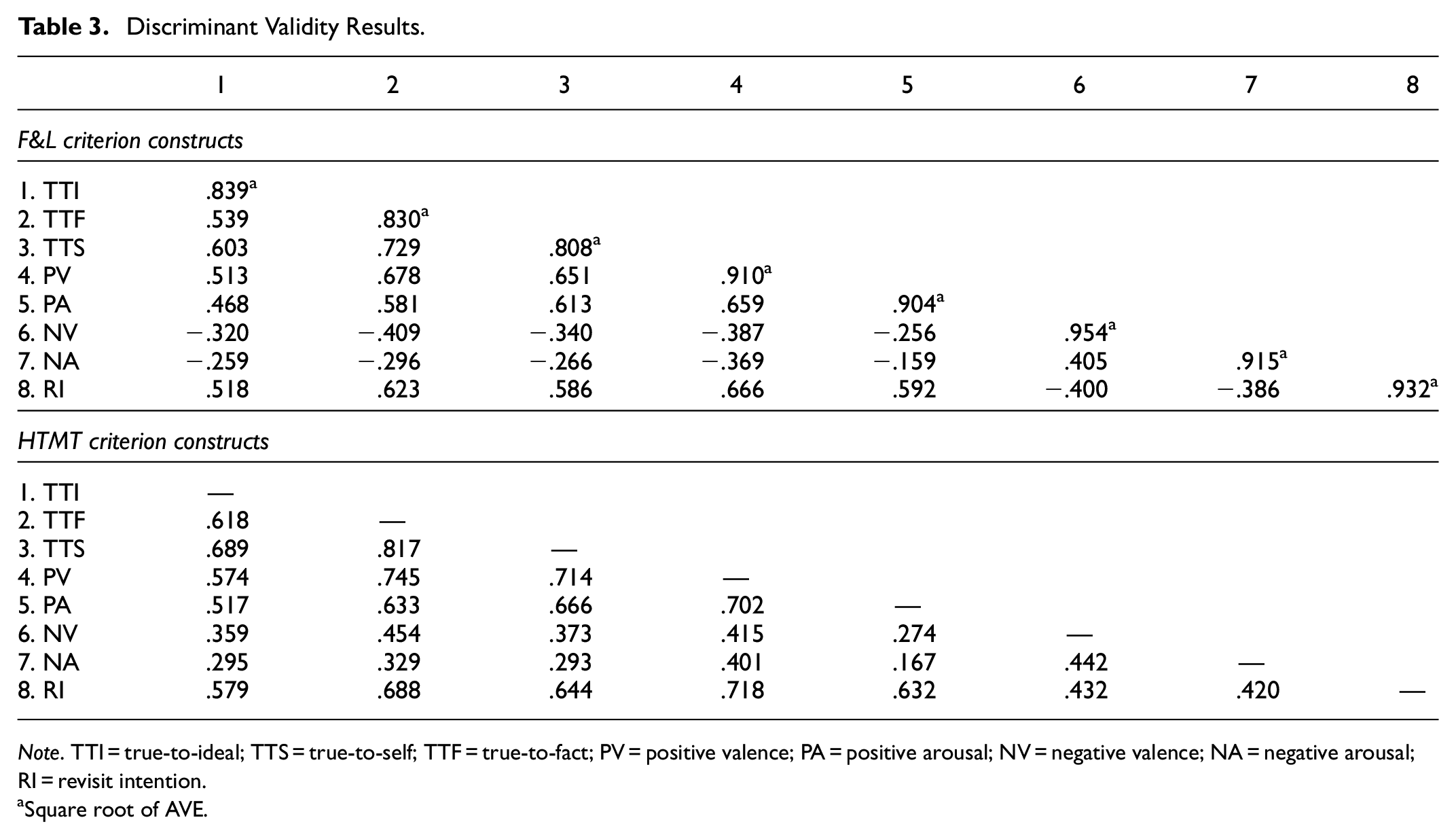
Note. TTI = true-to-ideal; TTS = true-to-self; TTF = true-to-fact; PV = positive valence; PA = positive arousal; NV = negative valence; NA = negative arousal; RI = revisit intention.
Square root of AVE.
Checking for Common Method Variance and Multicollinearity
Both common method variance (CMV) and multicollinearity were tested in this study. First, Harman’s single-factor test was conducted to test CMV, and the results indicated that the total variance for a single factor was 41.38%. As this was under the threshold of 50%, CMV was shown not to be an issue in the current study. We then examined the study constructs’ variance inflation factor (VIF) values. The values (ranging from 1.302 to 2.737) are within the acceptable range of 3.0 (Belsley et al., 1980). Thus, there is no multicollinearity issue in the data.
Structural Model
The research model and hypotheses were examined utilizing PLS–SEM via Smart PLS. This study first compared the research model to an alternative model that does not include the direct effects of the three authenticity perceptions on revisit intentions. According to Henseler et al. (2015), the standardized root mean square residual (SRMR) is the only model to fit the criterion. For example, they suggested an SRMR value less than 0.08 is appropriate for the PLS path model, and a zero value indicates a perfect fit. The research model’s SRMR value (0.062) was better than alternative model (0.067). Additionally, the research model had superior predictive power for revisit intentions (R2 = .563) than did the alternative model (R2 = .529).
We then tested the hypothesized relationships in the research model. As shown in Figure 2 and Table 4, the TTI and TTF dimensions significantly impact revisit intentions. However, TTS had a nonsignificant effect on revisit intentions. Hence, H1 and H2 but not H3 are supported. These results suggest that the greater the degree to which customers perceive TTI and TTF authenticity, the stronger their intentions to revisit the restaurant. Moreover, all three authenticity dimensions exerted significant and positive influences on positive valence and positive arousal. Thus, H4a, H4b, H5a, H5b, H6a, and H6b are supported. These findings suggest that, as respondents perceive TTI, TTF, and TTS more strongly, they experience more positive valence and positive arousing emotions toward ethnic restaurants. Additionally, TTI and TTF authenticity perceptions had significant negative impacts on negative valence and negative arousal. Therefore, H7a, H7b, H8a, and H8b are supported. However, TTS authenticity had a nonsignificant effect on negative and negative arousal. Therefore, H9a and H9b are not supported, suggesting that the more strongly respondents perceive TTI and TTF authenticity, the less negative valence and negative arousing emotions they feel toward ethnic restaurants.

Results of the structural model.
Hypothesis Testing.

Note. TTI = true-to-ideal; TTS = true-to-self; TTF = true-to-fact; PV = positive valence; PA = positive arousal; NV = negative valence; NA = negative arousal; RI = revisit intention.
The results also revealed significant and positive influences of positive valence and positive arousal on revisit intentions. Thus, H10 and H11 are supported. These findings suggest that the greater the degree to which participants felt positive valence and positive arousing emotions toward ethnic restaurants, the greater their intentions to revisit them. Additionally, this study showed that negative valence and negative arousing emotions significantly decrease revisit intentions. Therefore, H12 and H13 are supported. These results suggest that the stronger the negative valence and negative arousing emotions are, the lower the likelihood of revisiting ethnic restaurants.
We then examined the mediating role of customer emotions. Our findings showed that all three authenticity dimensions, TTI (βTTI→ PV/PA/NV/NA→RI = 0.082, p < .001), TTF (βTTF→PV/PA/NV/NA→RI = 0.206, p < .001), and TTS (βTTS→PV/PA/NV/NA→RI = 0.153, p < .001), significantly affected revisit intentions indirectly through the emotions of positive valence, positive arousal, negative valence, and negative arousal. Table 5 shows that the direct influence of TTI on revisit intentions decreased (Δ = 0.082) from 0.200 to 0.118. Furthermore, the direct impact of TTF on revisit intentions decreased (Δ = 0.206) from 0.376 to a reduced significance level of 0.169. However, the direct impact of the TTS on revisit intentions decreased significantly (Δ = 0.153) from 0.191 to a nonsignificant level of 0.038. This study further calculates the variance accounted for (VAF) to examine the strength of the mediation effect. Kim et al. (2023) suggested that VAF values less than 20%, 20%–80%, and higher than 80% suggest no mediation, partial mediation, and full mediation, respectively. According to the VAF values, emotions partially mediated the influence of the TTI and TTF dimensions and fully mediated the effect of the TTS on revisit intentions. Thus, H14 was supported.
Mediation Analysis Results.

Note. TTI = true-to-ideal; TTS = true-to-self; TTF = true-to-fact; RI = revisit intention.
p < .01. **p < .001.
We also measured the total influence of the research variables on revisit intentions. The findings indicated that TTF had the greatest influence on revisit intentions (β = 0.376, p < .001), followed by positive valence (β = 0.246, p < .001), positive arousal (β = 0.211, p < .001), TTI (β = 0.200, p < .001), TTS (β = 0.191, p < .01), negative arousal (β = −0.141, p < .001), and negative valence (β = 0.376, p < .05).
Discussion
The objectives of this study were (1) to examine the influence of different authenticity dimensions on revisit intentions and (2) to develop an integrated authenticity model that tests both direct and indirect effects of authenticity perceptions. By utilizing Moulard et al.’s (2021) authenticity model and an extended cognitive appraisal theory, this study examined the direct and indirect influences of three authenticity effects through the mechanisms of positive and negative emotions.
First, the results of CFA showed the appropriateness of the measurement model, with acceptable levels of reliability and validity supporting Moulard et al.’s (2021) three-dimensional structure of the authenticity model. Furthermore, the structural model analysis findings showed that the research model can predict Chinese ethnic diners’ revisit intentions.
This study also reported that TTI and TTF authenticity perceptions significantly influenced revisit intentions. However, TTS does not significantly influence revisit intentions directly. This finding can be explained by previous research showing that restaurant ownership type (chain vs. independently owned restaurants), as related to TTS authenticity, does not differ in terms of authentic dining experiences. Accordingly, both types of ownership can be successful in the marketplace (Zeng et al., 2012).
Another important finding is the comparative influence of three authenticity dimensions on revisit intentions. The results suggest that TTF authenticity is the most significant determinant of revisit intentions. These findings corroborate previous research findings that the credibility of business claims determines customer purchase intentions (Andronie et al., 2021; Gilmore & Pine, 2007; Kim & Song, 2022; Lăzăroiu et al., 2020).
Conclusions
Theoretical Implications
This study makes several important contributions to authenticity studies. First, this study confirms the multidimensionality of authenticity perceptions. While focusing on customers’ perceptions of uniqueness, previous authenticity research has widely utilized a single dimension of authenticity (Le et al., 2019). However, researchers have argued that authentic dining experiences can be explained by multiple authenticity dimensions rather than simply uniqueness (Le et al., 2021). Accordingly, Moulard et al. (2021) recently provided multiple components of perceived authenticity, and empirical studies are needed to test this authenticity model in diverse research contexts. The results of the measurement model support that the three-dimensional structure of authenticity is valid for ethnic restaurants.
Another important theoretical contribution of this study is the comparison of the variables comprising the different authenticity dimensions. This is one of the pioneering efforts to simultaneously examine and compare the effects of different authenticity dimensions. Thus, this study improves our understanding of the relative importance of the three authenticity dimensions on ethnic diners’ consumption behaviors.
The other significant contribution of the current research is that it is one of few studies to investigate the mechanism through which positive and negative emotions are elicited. The authenticity literature has focused mainly on positive emotions (e.g., Kim & Song, 2022; H. Song et al., 2021). However, some researchers have argued that authenticity cues highlighting unfamiliar elements (e.g., flavors and ingredients) can also lead to negative experiences (Tasci & Knutson, 2004; Youn & Kim, 2018). Furthermore, tourism and hospitality research has widely utilized a valence-based approach that loosely divides emotions into positive and negative emotions (Kim et al., 2022). On the basis of the two dimensions of valence and arousal, this study uses four types of emotions. Cognitive appraisal theory guided this research in examining the determinants of these four types of emotions. Cognitive appraisal theory posits that conditions that are appraised as pleasant, certain, or fair trigger happiness and love (Ruth et al., 2002). In support of this theorization, TTI (i.e., consistent with personal beliefs and images of ethnic Korean restaurants), TTF (i.e., trustworthiness of a business) and TTS (i.e., intrinsically rather than extrinsically motivated in operation) significantly affected customers’ revisit intentions through positive and negative emotions.
Practical Implications
This study has several important implications for ethnic restaurateurs. The findings confirm the multidimensionality of the authenticity construct and identify the effect of each authenticity dimension on customers’ emotions and revisit intentions. Therefore, ethnic restaurateurs should devise authenticity cues that convey each of these three types of authenticity to their customers. First, this study revealed that TTI authenticity significantly influences revisit intentions as well as positive and negative emotions. Thus, ethnic restaurateurs should deliver TTI authenticity by offering restaurant menus illustrating the theme of ethnic cuisine in a way that customers can easily relate to, such as bulgogi in Korean restaurants and taco in Mexican restaurants. Additionally, ethnic restaurateurs should carefully design and manage their service environments by conforming to customers’ knowledge of the foreign culture. For example, displaying cultural craft items that are viewed as representative of a typical ethnic culture can increase the perception of TTI authenticity.
Second, this study revealed that the TTF dimension is the key authenticity dimension that leads to revisit intentions and influences customers’ emotions. Thus, ethnic restaurateurs should actively find ways to convey the authenticity of TTFs. For example, ethnic restaurateurs should provide accurate information about their product offerings (e.g., ingredients, flavors, and cooking methods). If their dishes are acclimated to local tastes, then restaurateurs should openly inform their customers of this modification. Additionally, marketing communications should truthfully reflect the products and services customers will receive in the restaurant. Any incongruency between the advertised content and the actual product significantly lowers the perception of TTF authenticity. Additionally, ethnic restaurateurs should utilize cues that can improve the trust and credibility of restaurants. For example, ethnic restaurant operators should display certificates and/or recognition from official organizations (e.g., Thai select), awards obtained from competitions, and positive comments from customers. Because chain restaurants are generally perceived as more credible than independent units, ethnic restaurant operators can consider joining a restaurant chain.
Finally, TTS authenticity did not influence revisit intentions or negative emotions. However, TTS indirectly influenced revisit intentions through positive emotions. Thus, ethnic restaurateurs can improve the authenticity of TTS by impressing on customers that they are passionate and genuinely interested in restaurant operations rather than simply earning profits. Thus, ethnic restaurant operators should develop unique dishes and actively introduce a unique culinary culture to highlight a restaurant’s passion for business.
Limitations and Future Research
This study has several limitations. First, the study focused on ethnic Korean restaurants via a Chinese sample. In China, Korean food is one of the most popular ethnic cuisines. Furthermore, Chinese customers perceive chain restaurants to be more trustworthy than independent restaurants. Thus, the study findings may not be applicable to other study populations and contexts. Future research can replicate the current study in other countries or contexts to confirm the external validity of the results. Additionally, the current study is limited to examining the influence of different authenticity dimensions on revisit intentions. Thus, we do not examine the antecedents of the three authenticity dimensions. The literature suggests there are specific restaurant characteristics related to these authenticity dimensions. For example, historical, typical, and constant are characteristics related to TTI authenticity; sincere, transparent, accurate, and honest are characteristics associated with TTF authenticity; and passionate, uncompromising, scarcity, and talent are characteristics that correspond to TTS authenticity. Therefore, future research should further examine the influence of various restaurant attributes on the three authenticity dimensions to provide more practical suggestions for ethnic restaurateurs. Finally, future research should extend the research model developed in this study by investigating the possible moderating effects of individual factors. For example, future research should study the moderating effect of customers’ cultural motivation and level of knowledge of ethnic cuisine and culture.
Footnotes
Declaration of Conflicting Interests
The author(s) declared no potential conflicts of interest with respect to the research, authorship, and/or publication of this article.
Funding
The author(s) received no financial support for the research, authorship, and/or publication of this article.
Ethical Approval
Arizona State University IRB approved this study and data collection methods

Data Availability Statement
Data sharing not applicable to this article as no datasets were generated or analyzed during the current study.