




Abstract
Drawing on ethnic entrepreneurship theory and enclave economy theory, this study aims to investigate how restaurants’ internal and external factors—menu (high vs. moderate vs. low iconic ethnic dishes), ownership type (chain vs. independent), and location (ethnic vs. nonethnic enclave)—affect authenticity perception and purchase intention. This study further examines whether cultural motivation moderates the relationship between authenticity perception and purchase intention. Using a 3 × 2 × 2 experimental design, data were collected from 446 Chinese ethnic diners. The results show that moderate-iconic Korean dishes offered by restaurants in ethnic enclaves and by chain restaurants are more effective in enhancing authenticity perceptions than their counterparts. Moreover, ethnic diners’ cultural motivations significantly moderate the relationship between perceived authenticity and purchase intention. The findings provide valuable insights for ethnic restaurateurs to enhance the authentic dining experience and contribute to the application of ethnic entrepreneurship theory and enclave economy theory within the hospitality context.
Introduction
Ethnic restaurants have become an increasingly significant segment of the global food service industry. In 2024, the global ethnic food industry was evaluated at USD 48.6 billion, and an annual growth rate of 8.3% is expected between 2025 and 2030 (Grand View Research, n.d). Globalization and the increasing movement of people across borders have promoted the ethnic food market (Arviv et al., 2024). In China, the rapid development and globalization have also led to the increasing popularity of international and ethnic cuisines, highlighting the intricate relationship between food, culture, and global influences (Zhu et al., 2018). Among the most prominent ethnic cuisines in China is Korean food, with a notable surge in the number of Korean restaurants abroad, particularly in China (Cha et al., 2018; Mishan, 2022; Nam, 2018). This rise is a direct result of China’s dynamic economic growth and its increasingly globalized food culture (D. Li, 2024Zhu et al., 2018). Despite this growth, the success of ethnic restaurants largely depends on how consumers perceive the authenticity of the food and the overall dining experience (Arviv et al., 2024; Song et al., 2022). Thus, this study aims to explore the factors influencing the perception of authenticity in Korean restaurants within China.
Perceived authenticity has been identified as a key determinant of customer behavior in ethnic restaurants, influencing their purchase intentions (J.-H. Kim et al., 2020; Salem et al., 2024). Previous research has explored various aspects of authenticity in ethnic restaurants, examining both internal factors, such as ingredients and menu (Arviv et al., 2024), and external factors, including restaurant ownership and location (Song et al., 2022). However, while the importance of authenticity is well recognized, the complex interaction between these internal and external factors remains underexplored.
Internal factors, such as menu design, are critical in shaping the perception of authenticity in ethnic restaurants. Menus reflect not only a restaurant’s identity but also a powerful tool for cultural expression (Frank et al., 2022). When menus effectively convey cultural identity, they activate consumers’ cultural schemas, which enhances their perception of authenticity (Youn, 2024). Corroborating this, Moulard et al. (2021) note that product attributes corresponding to socially determined standards can increase authenticity perception (i.e., true-to-ideal). However, other researchers have argued that ethnic dishes provide unique and novel experiences and can also convey authentic dining experiences, increasing consumers’ perceptions of the other (Youn, 2024; Youn & Kim, 2017). Accordingly, researchers have found that unfamiliar food names and ingredients increase ethnic diners’ authenticity perceptions (Arviv et al., 2024; J.-H. Kim et al., 2017). Furthermore, experiencing new flavors is becoming a major reason for dining (Giacoman & Joustra, 2024); therefore, modified ethnic menus with fused dishes have become popular in ethnic restaurants (Y. Liu et al., 2023). The contradictory role of the influence of iconic dishes on perceived authenticity confuses ethnic restaurateurs; thus, whether ethnic cuisines with high (vs. low) cultural icons increase authenticity perception remains unclear and merits further investigation (Moulard et al., 2021). Therefore, this study focuses on three different types of Korean ethnic dishes that vary by their degree of cultural icons (high, moderate, and low) and examines their effects on consumers’ perceived authenticity.
External factors, such as restaurant location and ownership, also influence authenticity perceptions. Location plays a critical role in restaurants’ long-term business prosperity (K. Kim et al., 2024), particularly for ethnic restaurants (Koytak, 2024; Parsa et al., 2021). Ethnic business owners prefer to start businesses within their ethnic enclave, that is, the specific geographical location where certain ethnic people settle (Marinoni, 2023). Although several qualitative studies have discussed the influence of ethnic restaurant location on conveying authenticity, limited research has empirically investigated whether ethnic restaurant location in an ethnic or nonethnic enclave is an authenticity cue (Song & Kim, 2022). Furthermore, researchers have identified the interaction effect between ownership type and customer perceived authenticity (J.-H. Kim et al., 2020; Youn, 2024). However, scholars are similarly split on whether independent restaurants still have more perceived authenticity than chain restaurants after COVID-19 (J.-H. Kim et al., 2020; Song & Kim, 2022). Thus, the relationship between business ownership type and authenticity needs further investigation (Song & Kim, 2022; Youn, 2024). In addition, as ethnic food represents a culture (Mascarello et al., 2020), cultural motivation plays a vital role in diners’ ethnic food consumption (Liu et al., 2023). Despite the acknowledged importance of authenticity in shaping purchase intentions, few studies have explored how cultural motivation moderates this relationship, particularly in the context of rapidly globalizing markets like China.
This study contributes to the existing knowledge. First, we applied ethnic entrepreneurship theory and enclave economy theory to the hospitality context and extended our understanding of both theories from the ethnic entrepreneur and business perspective to the customer perspective. Ethnic entrepreneurship theory focuses on the factors determining ethnic immigrants’ entrepreneurship behaviors (Wang & Warn, 2018), and enclave economy theory considers the ‘location’ of ethnic enclaves as a key characteristic (Chan, 2015; Eng, 2020). The literature on both theories particularly pays attention to the ethnic entrepreneur and ethnic business development perspectives. However, neither theory has been examined from the customer perspective. For example, how customers view the factors on ethnic immigrants’ entrepreneurship behaviors and ethnic enclave-related factors. Our study fills this knowledge gap and links ethnic entrepreneur and business factors to consumer authenticity perception. More specifically, we examine how ethnic restaurants’ internal factors (menus) and external factors (ownership type and location) influence perceived authenticity and purchase intention.
Second, menus have been widely discussed in the ethnic restaurant context (F. F. Chen et al., 2022; S. Q. Liu & Mattila, 2015), but little attention has been given to how the iconic ethnic menus (high vs. moderate vs. low) influence perceived authenticity. To our knowledge, this study is the first empirical investigation of the different levels of cultural icons manifested in ethnic restaurants’ menus. Third, studies have rarely empirically examined whether location determines perceived authenticity (Song & Kim, 2022). Our study thus extends the literature by empirically assessing location within an ethnic or nonethnic enclave in the ethnic restaurant context. Finally, despite cultural motivation being vital in ethnic food consumption (Liu et al., 2024), its moderating effect has not been clearly articulated in the literature (H. Liu et al., 2018). This study, therefore, advances this knowledge by exploring the moderating effects on the relationship between perceived authenticity and purchase intention in this specific dining context.
In summary, the objectives of this study are (1) to investigate the effect of restaurants’ internal and external factors—namely, menu (high vs. moderate vs. low iconic ethnic dishes), ownership type (chain vs. independent), and location (ethnic vs. nonethnic enclave)—on consumers’ perceived restaurant authenticity and (2) to assess the moderating effect of cultural motivation on the relationship between perceived authenticity and purchase intention.
Literature Review
Cultural Icons and Authenticity
The constructivist theory of culture suggests that individuals develop a cultural schema (i.e., knowledge, beliefs, values, and objects associated with a certain culture) via their direct and indirect cultural experiences (Hong et al., 2000). Accordingly, the constructive viewpoint of authenticity emphasizes the use of cultural icons or symbols to evoke cultural schemas (Day et al., 2015; Moulard et al., 2021; Youn, 2024). For example, pizza and pastas are iconic Italian foods, and Tacos and burritos are iconic Mexican foods and are part of its cultural schema (Torelli & Ahluwalia, 2012). Thus, ethnic restaurant menus include iconic dishes to stimulate ethnic diners’ authenticity perceptions.
However, some researchers have argued that authenticity evaluation depends on consumers’ perceptions of uniqueness and novelty (Le et al., 2019). Accordingly, researchers have found that the unfamiliar attributes of ethnic dishes (e.g., food names and ingredients, Youn & Kim, 2017), as well as innovative and creative ethnic dishes (i.e., ethnic fusion dishes, Y. Liu et al., 2023) that go beyond the classic ethnic food category increase, perceived authenticity. These conflicting views on cultural icons reflected in ethnic cuisine confuse ethnic restaurateurs (Youn, 2024; Youn & Kim, 2018). Therefore, we divide Korean food according to the level of cultural icons (i.e., high, moderate, and low) and examine whether a restaurant menu including iconic ethnic dishes is effective at conveying authenticity.
Based on this discussion of cultural icons (Torelli & Ahluwalia, 2012), we define highly iconic Korean dishes as those that foreigners can easily identify with Korean national identity, such as Kimchi Jjigae (Kimchi stew), Bibimbap (mixed rice with egg and assorted vegetables), or Bulgogi (Korean BBQ). Moderate iconic Korean dishes are less popular Korean foods among foreigners but are sold in the home country, for example, Galbi Jjim (braised beef short ribs), Wolgwa-chae (stir-fried vegetable dish), or Dak Gomtang (chicken soup). Finally, low iconic Korean dishes are instances of ethnic fusion that mix different cuisine styles (Stano, 2014), for example, a combination of Korean and Chinese cuisine (fusion) on a single plate, including Korean-styled Malatang (spicy hot pot), Korean-styled sweet and sour pork, and Korean-styled braised chicken.
Ethnic Entrepreneurship Theory and Enclave Economy Theory
Ethnic entrepreneurship theory mainly concerns ethnic immigrants’ entrepreneurship behaviors (Smith & Mannon, 2020; Wang & Warn, 2018). Specifically, ethnic immigrants’ individual, group, and social factors, as well as factors in their destination countries, contribute to their entrepreneurship behavior. This theory has been applied in research on ethnic enclaves (Ma et al., 2013); as a result, enclave economy theory has become one of the key frameworks in the domain of ethnic entrepreneurship (Volery, 2007) to study the ethnic enclave economy. This study applies enclave economy theory and ethnic entrepreneurship theory to study the variable of ‘location’. For example, ethnic immigrants implement entrepreneurial activities in their ethnic enclave or neighborhood due to social and personal capital barriers (Lassalle & Scott, 2018; Ndofor & Priem, 2011). Once immigrants become acculturated and socially integrated into the host society in their host country, they may shift their business locations to broader geographical areas to target nonethnic markets (Evansluong et al., 2019). For example, to develop ethnic restaurant businesses, such as Thai restaurants in Hong Kong, business owners extend their business location from ethnic enclaves to other districts in wider society (Chan, 2015).
Recent ethnic entrepreneurship literature has focused on ethnic entrepreneurs’ business strategies (Banerjee, 2024; Lassalle & Scott, 2018; Orozco, 2022). For example, scholars Lassalle and Scott (2018) and Orozco (2022) developed a similar typology of ethnic minority entrepreneurs based on two dimensions: product/service provided and clientele served. The typology includes four types of ethnic minority entrepreneurs, namely, enclave-market entrepreneurs (e.g., offering coethnic products to coethnic clientele), niche-market entrepreneurs (e.g., providing coethnic products to mainstream clientele), middleman entrepreneurs (e.g., offering mainstream products to coethnic clientele) and mainstream market entrepreneurs (e.g., providing mainstream products to mainstream clientele). These four typologies are not static but dynamic. For example, ethnic entrepreneurs can shift from enclave-market entrepreneurs to niche-market entrepreneurs, middleman entrepreneurs, and mainstream market entrepreneurs (Lassalle & Scott, 2018). For instance, ethnic restaurant owners may adapt their restaurant menus to appeal to native-born mainstream customers and transform them from enclave-market entrepreneurs to niche-market entrepreneurs (Allen & Busse, 2016). Based on the above justification, ethnic entrepreneurs may develop various products to their target market (Lassalle & Scott, 2018; Orozco, 2022). The current study applies ethnic entrepreneurship theory to research the variable of ‘menu’. Additionally, ethnic business owners may expand their business capabilities to achieve scale economies and cost advantages in markets (Yeung, 1999). When quickly expanding a business, franchising is commonly considered an effective tool for driving business growth (Chirico et al., 2011). Therefore, ethnic entrepreneurs may develop chains to expand their business (Chirico et al., 2011; Song & Kim, 2022; Yeung, 1999). The present theory applies ethnic entrepreneurship theory to study the variable of ‘ownership type’. Based on ethnic entrepreneurship theory and enclave economy theory, this study focuses on three independent variables, restaurant menu, location, and ownership type, and examines their influence on Chinese ethnic diners’ perceived authenticity and purchase intentions.
Research Model and Hypothesis Development
The Effect of Cultural Iconic Menus on Authenticity
According to ethnic entrepreneurship theory, ethnic restaurant owners may adapt their restaurant menus to appeal to native-born mainstream customers and transform them from enclave-market entrepreneurs to niche-market entrepreneurs (Allen & Busse, 2016; Lassalle & Scott, 2018; Orozco, 2022). Restaurant menus, as agents of culinary culture, reveal symbolic expressions of ethnicity (Gvion & Trostler, 2008). Ethnic food contributes to customers’ perceived authenticity of ethnic restaurants (J.-H. Kim et al., 2017; Song et al., 2019). The levels of cultural icons include high, moderate, and low iconic ethnic dishes in our study. High levels of cultural iconic dishes represent markers of cultural identity, whereas lower levels of cultural iconic dishes cannot be easily associated with a specific culture of origin (Avieli, 2005). For example, ethnic dishes that are not popular among foreigners and fusion cuisines that mix different cuisines could confuse ethnic diners in terms of the cultural origin of the food. In particular, researchers have argued that fusion food has an artificial image of an ethnic dish (Hillel et al., 2013), which may decrease customers’ perceived authenticity (Gupta & Sajnani, 2020). Hence, based on the above discussion, we propose the following:
H1: Low cultural iconic food leads to a significantly lower authenticity perception than high and moderate cultural iconic food.
The Effect of Ownership Type on Authenticity
There are two organizational forms: chain (e.g., company-owned or franchise outlet) or independent ownership (Enz et al., 2013; Mazzeo, 2004). Franchising is commonly considered an effective tool for driving business growth (González-Márquez et al., 2023). Previous studies have explored the relationship between restaurant ownership type and restaurant authenticity (J.-H. Kim et al., 2020; Song & Kim, 2022). For instance, studies in a Western context, such as the USA or UK, have commonly shown that small independent organizations demonstrate a greater sense of product authenticity than multiunit organizations (Lehman et al., 2018; Song & Kim, 2022). Linking to the ethnic entrepreneurship theory, ethnic business owners may develop chains to expand their business (Chirico et al., 2011; Song & Kim, 2022; Yeung, 1999). Surprisingly, this finding has not been supported in China. For example, research in China has revealed that compared to small independent restaurants, chain restaurants are more strongly linked to a higher level of food authenticity (J.-H. Kim et al., 2020). A possible interpretation of this finding is that chain organizations are more likely to be associated with reliability and trust, which are often associated with business authenticity (J.-H. Kim & Song, 2020; Xu et al., 2022). Kim and Song (2024) surveyed Chinese customers based on their dining experiences in Korean restaurants in China and reaffirmed that while Korean chain restaurants are more likely to be linked to credibility, trust, and honesty than independent Korean restaurants, the latter demonstrates a higher level of true passion toward their businesses than chain restaurants. The existing studies have thus indicated that more empirical evidence is needed to obtain an in-depth understanding of the topic. Based on the above literature, we propose the following hypothesis:
H2. Being a chain ownership type of an ethnic restaurant positively affects authenticity perception.
The Effect of Business Location on Authenticity
Both enclave economy theory and ethnic entrepreneurship theory have confirmed that ethnic businesses sometimes extend their business locations from ethnic enclaves to other districts in wider societies (Chan, 2015; Evansluong et al., 2019). Selecting a restaurant’s location is not an easy decision. Many economists have evaluated multiple variables, such as population in an area (L.-F. Chen & Tsai, 2016), public transportation, competitors (Han et al., 2022), and crime rates (Sloan et al., 2016), to determine the factors affecting restaurant location selection. Most of these studies focus on international multi unit chains’ selection of an international or domestic business location (Goerzen et al., 2013). In addition to these common considerations, ethnic businesses, particularly those in the early stage of business development, may consider establishing their businesses in an ethnic neighborhood (Wang & Warn, 2018).
Studies have conceptually discussed the possible relationship between business location and business authenticity. Ethnic enclaves demonstrate a higher level of ‘otherness’ and uniqueness, distinguishing themselves from other places in mainstream culture (Aldrich & Waldinger, 1990; Ang, 2020). It is easy to find the same ethnic immigrants or ethnic groups in ethnic enclaves (Ojo, 2018). J. Kim (2018) noted that the landscape of Koreatown in New York offers a certain level of authentic Korean culture and flavors. Wu et al. (2020) also indicated that Chinatown in Thailand is an authentic Chinese space with linguistic landscapes, for example, Chinese characters and Chinese architectural features, which greatly contribute to its authenticity. Hence, based on the above discussion, we propose the following:
H3. Ethnic restaurants located in an ethnic enclave positively affect authenticity perception.
The Influence of Perceived Authenticity on Purchase Intention
The positive relationship between authenticity perception and consumers’ purchase intentions has been confirmed in many studies (X. Li et al., 2021). For example, H. Yang et al. (2022) researched Chinese restaurants in China and confirmed that the greater the level of food authenticity perception in a restaurant is, the greater the chance that a consumer will make a purchase decision at that restaurant. Additionally, in an ethnic restaurant context, such as Chinese restaurants in Australia, diners are more likely to purchase a dish if it is perceived to be authentic (Youn & Kim, 2018). Accordingly, based on the previous literature, we propose the following hypothesis:
H4. There is a positive relationship between authenticity perception and purchase intention.
Moderating Effect of Cultural Motivation
Food consumption provides opportunities for engaging with different cuisines, cultures, and traditions (Kruger et al., 2020). Playing an essential role in understanding ethnic culture and serving as a significant medium for cultural expression (Chang et al., 2010), food can be seen as a carrier of culinary and ethnic culture in overseas markets. As ethnic food is one of the strong symbols of culture, it can generate cultural interest and cultural motivation in the ethnic restaurant context (Y. Liu et al., 2023). Customers who have more cultural motivation toward ethnic restaurants are better at perceiving authenticity (H. Liu et al., 2018). Trying authentic and traditional dishes can be one of tourists’ most anticipated activities (McKercher et al., 2008). Moreover, motivation affects customers’ attitudes and subsequently stimulates their purchase intentions (Y. Liu et al., 2023). Cultural motivation thus moderates the relationship between perceived authenticity and value, while perceived value influences customers’ behavioral intentions in ethnic restaurants (H. Liu et al., 2018). Therefore, customers with a higher cultural motivation are more likely to perceive higher levels of authenticity, driving their positive behavioral intentions. Hence, we hypothesize the following:
H5. The higher one’s cultural motivation for ethnic food is, the greater the impact of authenticity perception on purchase intention.
Figure 1 presents the research model of this study.
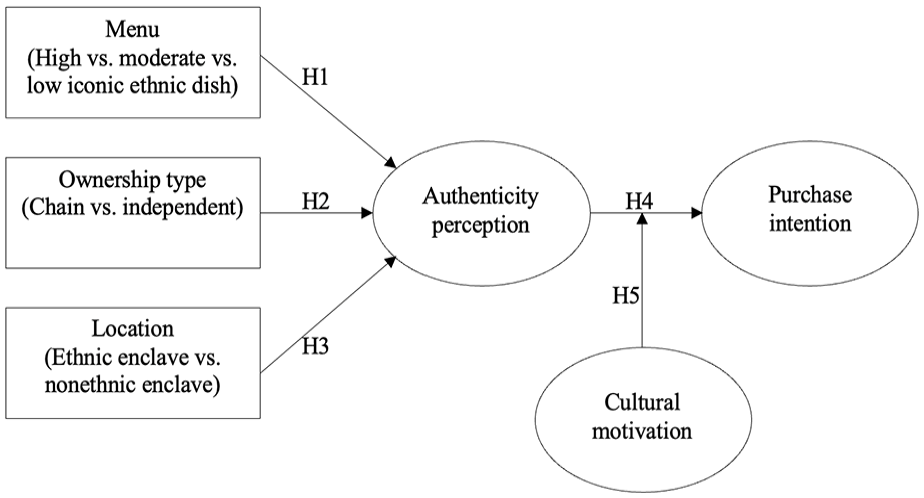
Research model.
Method
Design and Stimuli Development
A 3 (Menu: high-iconic Korean dish vs. moderate-iconic Korean dish vs. low-iconic Korean dish) × 2 (ownership type: chain vs. independent) × 2 (location: ethnic enclave vs. nonethnic enclave) between-subjects design was employed. To manipulate food type, we first made a list of Korean foods by referencing menus offered in Korean restaurants in China as well as those in the home country. For example, menus offered only in the home country (i.e., South Korea) were considered moderate-iconic dishes. Fusion dishes were carefully developed based on the comments that Korean expatriates living in China posted on an online forum named Jungjeonggong. In this online forum, users often exchange information about Chinese food that could substitute specific Korean dishes for those who crave authentic Korean taste. Then, from this list, we carefully selected different dishes while considering the main ingredients as well as the type of food (e.g., soup or noodles). Moreover, two different ownership types (chain and independent) were used to manipulate the ownership type of a Korean restaurant. Additionally, two different locations (Korean ethnic enclaves and non-Korean ethnic enclaves) were used to manipulate the location of a Korean restaurant. The stimuli used for this study are shown in Appendix A.
Measures
Validated scale items measuring study constructs were identified in the literature and modified to fit the current study. For example, three items measuring restaurant authenticity were adopted from Kim and Song (2022); four items assessing purchase intention were adapted from J.-H. Kim et al. (2020) and Youn and Kim (2018); two items measuring cultural motivation were adapted from H. Liu et al. (2018). All these items were measured on a 7-point Likert scale ranging from 1 (strongly disagree) to 7 (strongly agree). We also measured participants’ demographic information, such as gender, age, education, occupation, and annual income. All scale items exhibited high reliability and validity (see Table 1).
Measurement Items.

Additionally, the survey questionnaire included items for manipulation checks for three independent variables. For example, the participants were asked to choose a statement that best described their perception of the restaurant’s food, ownership type, and location. The participants were also asked to evaluate the reality of the scenario description by rating the following item on a 7-point Likert scale ranging from 1 (strongly disagree) to 7 (strongly agree): ‘The description of a Korean restaurant is realistic’. The initial version of the questionnaire was developed in English based on the extant English literature, and then two native Chinese colleagues translated the survey into Chinese following a back-translation procedure (Song, Xu, & Kim, 2021).
Preliminary Study
Prior to conducting the main study, we conducted a pilot study for the experimental stimuli to be used. The primary purposes of this pretest were (1) to ensure the effectiveness of the experimental stimuli in manipulating the study variables and (2) to ensure the realism of the scenario. This study recruited 144 participants from a Chinese panel data company, wenjuan.com. The participants were asked to read the description of a Korean restaurant and answer questions about its food, ownership type and location. These results showed that the manipulations of food, ownership type and location were successful. For example, a series of chi-square tests showed a significant association between the manipulation of food (χ2(4, N = 144) = 243.51, p < .001), ownership type (χ2(1, N = 144) = 144, p < .001), and location (χ2(1, N = 144) = 140.06, p < .001) and the respondents’ perceptions of each corresponding independent variable. Additionally, the respondents indicated the high realism of the scenarios (ranging from M = 5.08 to 5.75). The ANOVA results also showed that the realism of the 12 conditions was not significantly different (F(11, 132) = 0.60, n.s.).
Procedure and Participants
We utilized G*Power to determine the minimum required samples for the main study. For example, as we planned to conduct a three-way analysis of covariance (ANCOVA) to analyze the data, we set a medium effect size of 0.25, an α error probability of .05, a power of .95, 12 experimental groups, and 5 covariates to generate the minimum sample size of 413 (Song, Ma, & Cheng, 2021; Song, Xu, & Kim, 2021). Accordingly, we collected 480 samples in September 2022 using a Chinese panel firm, wenjuan.com. Wenjuan.com is one of the most popular Chinese panel data companies, with more than 8 million active users in all regions of China in its database supporting random sampling data collection. Participants were randomly assigned to 1 of 12 experimental conditions. Before answering the survey questions, the participants were instructed to imagine that they were looking at a menu of the restaurant described in the scenario. After deleting 34 cases due to survey incompletion, we obtained a total of 446 usable cases for data analysis (37–40 per experimental group). Female participants slightly outnumbered their male counterparts (female: 50.2%; male: 49.8%). Participants’ ages ranged between 18 and 66 years, with a median age of 30 years. The majority of respondents had earned a bachelor’s degree (56.7%). The top three occupations were white-collar workers (38.6%), private enterprise employees (14.8%), and self-employed workers (12.3%). In terms of their annual income, the majority earned between 84,001 RMB and 120,000 RMB (30.5%).
Analytical Methods
A three-way analysis of covariance (ANCOVA) was conducted, with perceived authenticity as the dependent variable and with the menu (high-iconic Korean dish vs. moderate-iconic Korean dish), ownership type (chain vs. independent) and location (ethnic enclave vs. nonethnic enclave) as independent variables. We also included a covariate to control for participants’ demographics. As this study focuses on examining mean differences between groups for the dependent variable, we used ANCOVA instead of regression analysis.
We then conducted a moderation analysis using a bootstrapping approach (Hayes, 2013) to test our theorized predictions that customers’ cultural motivations moderate the influence of perceived authenticity on purchase intention. Perceived authenticity served as an independent variable; cultural motivation was used as the moderator; purchase intention was used as the dependent variable; and participants’ demographics were control variables.
Results
Manipulation and Realism Check Results
Consistent with the pilot study results, all three manipulations were successful. For example, a series of chi-square tests showed a significant association between the manipulation of food (χ2(4, N = 446) = 783.57, p < .001), ownership type (χ2(1, N = 446) = 426.23, p < .001) and location (χ2(1, N = 446) = 422.36, p < .001) and the participants’ perceptions of each corresponding independent variable. Furthermore, across all experimental conditions, the participants viewed the scenarios as realistic (ranging from M = 5.34 to 5.92). Additionally, the ANOVA results showed that the realism of the 12 conditions was not significantly different (F(11, 434) = 1.24, n.s.).
Ancova
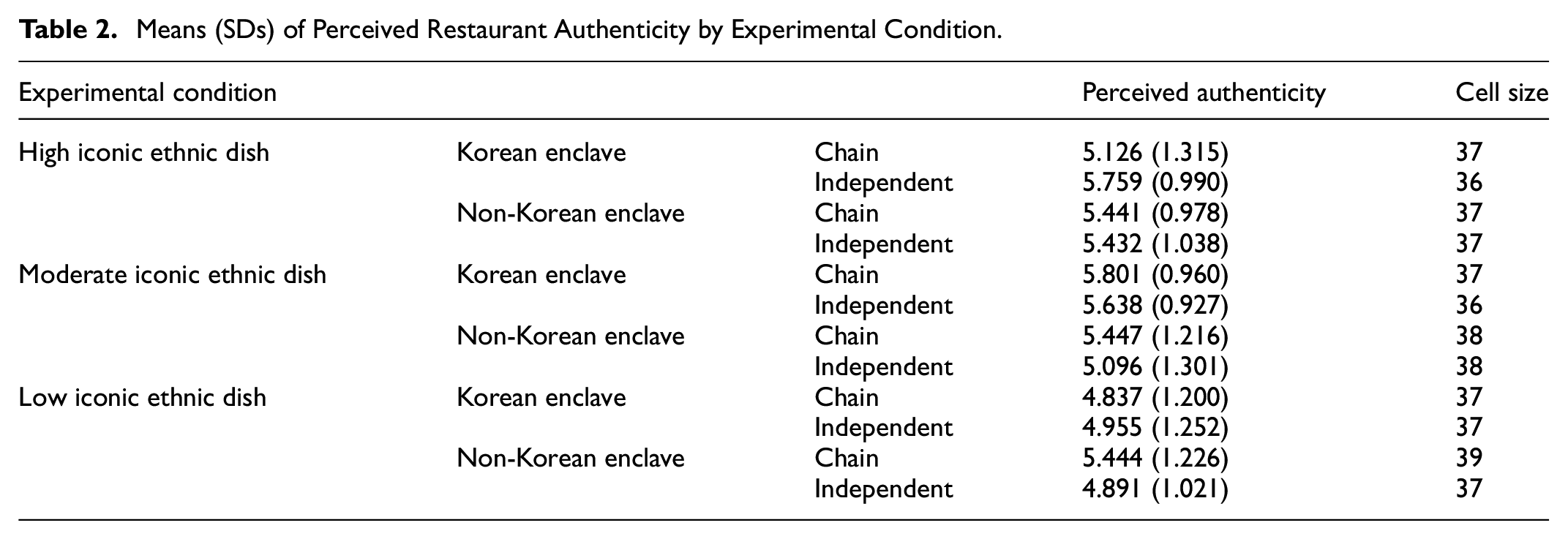
To test H1, H2, and H3, we performed ANCOVA on perceived authenticity. We included covariates to control for participants’ demographics (i.e., gender, age, education, occupation, and income). Table 2 reports the mean ratings of perceived authenticity by experimental condition. As shown in Table 3, the covariates of education (F[1, 429] = 5.611, p < .05) and income (F[1, 429] = 4.746, p < .05) were significant. These results demonstrate that participants in the moderate iconic ethnic dish condition perceived the highest level of authenticity (Mmoderte iconic ethnic dish = 5.49) and that those in the high iconic ethnic dish condition reported a slightly lower level of authenticity (Mhigh iconic ethnic dish = 5.43); furthermore, participants in the low iconic ethnic dish condition reported the lowest level of authenticity (Mlow iconic ethnic dish = 5.05, F[2, 429] = 6.796, p < .01). Thus, H1 is supported. The ownership type of an ethnic restaurant was expected to increase perceived authenticity. However, the results show that participants in the chain (Mchain = 5.34) and independent ownership conditions (Mindependent = 5.31) rated a similar level of authenticity perception (F[1, 429] = 0.083, n.s.). Therefore, H2 is not supported. Similarly, the results reveal that ethnic restaurant location does not significantly affect perceived authenticity (MKorean ethnic enclave = 5.35; Mnon-Korean ethnic enclave = 5.30, F[1, 429] = 0.259, n.s.). Thus, H3 is not supported.
Means (SDs) of Perceived Restaurant Authenticity by Experimental Condition.
The ACOVA Results on Restaurant Authenticity Perception.

p < .05. **p < .01.
In addition to the main effects of three independent variables, we identified three two-way interaction effects. First, we found a significant interaction effect between menu and restaurant location on perceived authenticity (F[2, 429] = 3.293, p < .05). As shown in Figure 2, this interaction effect is driven by a significant contrast effect of dish type in the Korean ethnic enclave condition (Mhigh iconic ethnic dish = 5.44; Mmoderate iconic ethnic dish = 5.72; Mlow iconic dish = 4.90, F(2, 217) = 10.155, p < .001). This effect was attenuated in the non-Korean ethnic enclave condition (Mhigh iconic ethnic dish = 5.43; Mmoderate iconic ethnic dish = 5.27; Mlow iconic ethnic dish = 5.18, F(2, 223) = 0.994, n.s.). Furthermore, there was a significant interaction effect between menu and ownership type on perceived authenticity (F[2, 429] = 3.069, p < .05). As depicted in Figure 3, both high (Mhigh iconic ethnic dish = 5.59) and moderate iconic ethnic dishes (Mmoderate iconic ethnic dish = 5.36) in an independent restaurant have significantly higher mean ratings of authenticity than their low iconic counterparts (Mlow iconic ethnic dish = 4.92, F(2, 218) = 6.944, p < .01). However, in the chain restaurant condition, a statistically significant difference was observed only between moderate iconic ethnic dish (Mmoderate iconic ethnic dish = 5.62) and low iconic ethnic dish (Mlow iconic ethnic dish = 5.14, F(2, 222) = 3.257, p < .05). Additionally, we found a significant interaction effect between ownership type and restaurant location (F[1, 429] = 4.281, p < .05). As depicted in Figure 4, in the Korean ethnic enclave condition, participants’ perceptions of the authenticity of independent restaurants were arithmetically higher than those of their chain counterparts (Mchain = 5.26; Mindependent = 5.45, t[218] = 1.208, n.s.). However, when the restaurant was located in a non-Korean ethnic enclave, individuals’ authenticity perceptions were significantly higher when the restaurant belonged to a chain group (Mchain = 5.44; Mindependent = 5.14, t[224] = 2.009, p < .05).

Interaction effect between menu and location on restaurant authenticity perception.

Interaction effect between menu and ownership type on restaurant authenticity perception.

Interaction effect of ownership type and restaurant location on restaurant authenticity perception.
Measurement Model
Before conducting a moderation effect test, a confirmatory factor analysis (CFA) was conducted utilizing SmartPLS (version 4.0.8.4) to assess the construct validity and internal consistency of each construct (Anderson & Gerbing, 1988). As shown in Table 4, all indicators’ outer loadings for each construct were above the 0.7 threshold, demonstrating indicator reliability (Hair et al., 2011). Furthermore, the average variance extracted (AVE) values for all constructs were greater than the critical value of 0.5. Thus, convergent validity was confirmed. As shown in Table 5, the square root of each AVE was greater than the corresponding construct intercorrelation (Fornell & Larcker, 1981). Furthermore, all values of the heterotrait-monotrait (HTMT) ratio were lower than the suggested threshold of 0.85 (Voorhees et al., 2016). Thus, discriminant validity was supported.
CFA Results.

Discriminant Validity Results.
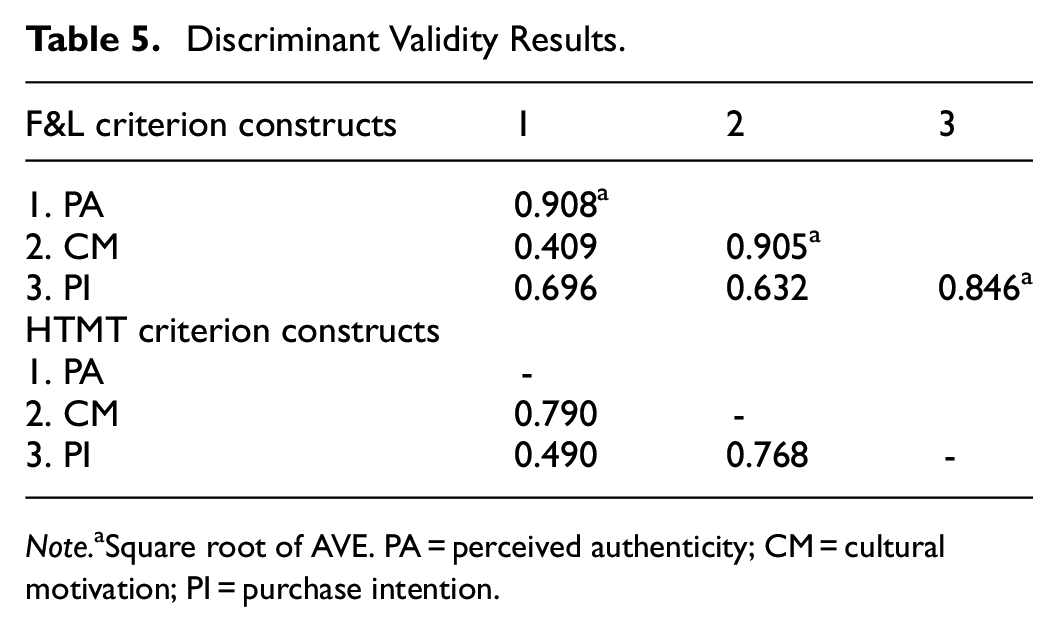
Note. aSquare root of AVE. PA = perceived authenticity; CM = cultural motivation; PI = purchase intention.
Structural Model
In the next step, the proposed structural model was analyzed using Hayes (2013) PROCESS Function Model 1 in SPSS. Specifically, we assigned perceived authenticity as the independent variable, cultural motivation as a moderator, and purchase intention as the response variable. Participants’ demographics (i.e., age, gender, education, occupation, and income) were entered as control variables. These results showed that the overall model was statistically significant, R2 = 0.653, F(8, 437) = 102.817, p < .001. Individuals’ perceived authenticity significantly affects their purchase intentions (β = .210, 95% CI [0.002, 0.417], p < .05), supporting H4. Furthermore, cultural motivation moderates the influence of perceived authenticity on purchase intention (β = .037, 95% CI [0.001, 0.074], p < .05). By utilizing the Johnson–Neyman technique, which is referred to as floodlight analysis by Spiller et al. (2013), in Figure 5, we depict the magnitude of the effect of perceived authenticity on purchase intention amid a continuous level of cultural motivation with a 95% CI. This result shows that the effect of perceived authenticity on purchase intention is contingent on individuals’ cultural motivations, that is, cultural motivation strengthens the magnitude of the effect of perceived authenticity on purchase intention. Therefore, H5 is supported.
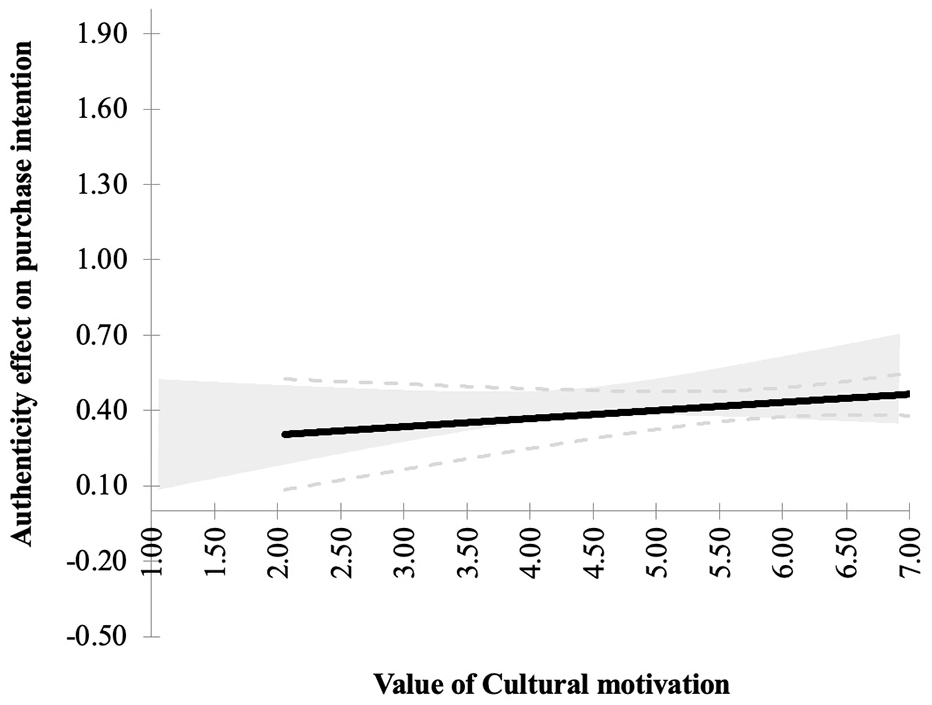
The effect of perceived authenticity on purchase intention versus cultural motivation.
Discussion
Based on ethnic entrepreneurship theory, enclave economy theory, and the authenticity literature, this study has examined ethnic diners’ authenticity perception via internal and external factors: menu (high vs. moderate vs. low iconic ethnic dishes), ownership type (chain vs. independent restaurant), and location (ethnic vs. nonethnic enclave). Furthermore, this study tested the moderating effect of ethnic diners’ cultural motivations on the relationship between perceived authenticity and purchase intention. Our results thus confirm that ethnic restaurants’ menus have a significant influence on consumers’ authenticity perception (H1). Specifically, we have found that while moderate (M = 5.49) and high iconic ethnic dishes (M = 5.43) are equally effective in promoting authenticity perception, low iconic ethnic dishes (i.e., Chinese Korean fusion food) increase consumers’ authenticity perception the least (M = 5.05). However, our other two external factors of ethnic restaurants were not found to be significant (H2 and H3). Additionally, our results confirm the significant influence of perceived authenticity on purchase intention (H4). Finally, we have demonstrated that the influence of perceived authenticity on purchase intention is greater among ethnic diners with a stronger motivation in Korean culture than among those with a weaker motivation (H5).
Theoretical Implications
This study extends the literature from several perspectives. First, we contribute to the knowledge on ethnic entrepreneurship theory and enclave economy theory from the entrepreneur and business development perspective to the consumer perspective. Although Song and Kim (2022) applied ethnic entrepreneurship theory to study consumer perceptions of Chinese restaurants in the UK, they used it only to research the relationship between business history (e.g., restaurants and ethnic enclaves) and consumers’ authentic cultural experiences. However, our study has applied ethnic entrepreneurship theory and enclave economy theory to study consumer perceptions of the relationships among three variables—food product, location and ownership, and authenticity perception. Therefore, an in-depth understanding of ethnic entrepreneurship theory in consumer behavior has been gained.
Second, our study used a new approach to research the menus of ethnic restaurants. Previous studies have offered a useful understanding of the topic, for example, using familiar or unfamiliar names to describe the same dish (Youn & Kim, 2018), using handwritten or computer-generated font on a menu (Yu et al., 2020), or offering two types of menus to customers (e.g., secret menus for ethnic groups and a normal menu for mainstream customers; S. Q. Liu & Mattila, 2015). The literature, however, has mainly considered a particular ethnic cuisine homogeneous. Nevertheless, ethnic restaurant entrepreneurs may develop various forms of ethnic dishes, such as well-known (iconic) dishes, less popular dishes, or even fusion dishes, in the same ethnic cuisine category. Our study therefore contributes to the literature by comparing different forms of ethnic menus (with high iconic, moderate iconic, and low iconic ethnic dishes) and exploring the effect of these ethnic dishes on restaurant authenticity perception. The results showed that traditional Korean dishes (e.g., moderate and high iconic ethnic dishes) are associated with greater perceived restaurant authenticity than fusion dishes. This finding supports previous findings suggesting that the use of cultural icons or symbols to evoke cultural schemas is effective in increasing ethnic diners’ authenticity perceptions (Day et al., 2015; Moulard et al., 2021).
Third, this study interestingly did not fully support Moulard et al.’s (2021) argument on the effect of true-to-ideal authenticity. Although the group differences were not statistically significant, participants in the moderate iconic ethnic dish group showed higher perceived authenticity than those in the high iconic ethnic dish group. This finding is congruent with previous research suggesting that unique or unfamiliar characteristics of ethnic dishes largely determine authenticity perception (e.g., J.-H. Kim et al., 2017; S. Q. Liu & Mattila, 2015). In a similar vein, S. Q. Liu and Mattila (2015) found that a more authentic menu that is not popular among mainstream customers in a foreign country increases the sense of uniqueness, which is an important characteristic of authenticity (Le et al., 2019).
Fourth, we offer new knowledge on the factors (e.g., ownership and location) affecting restaurant authenticity. Previous research examining the influence of restaurant ownership on perceived authenticity has yielded conflicting results, with some finding that customers view chain restaurants as inauthentic (Lehman et al., 2018; Song & Kim, 2022) and others finding that chain restaurants increase perceived authenticity (e.g., J.-H. Kim & Song, 2020; Xu et al., 2022). To resolve the contraction, this study examined the influence of restaurant ownership while considering other restaurant attributes. The results showed that restaurant ownership does not have a main effect on customers’ perceived authenticity. Additionally, this study did not find a main effect of restaurant location on authenticity perception. This result supports previous findings that restaurant location does not influence customers’ authentic gastronomic experiences (Song & Kim, 2024). However, we found that both factors interact with ethnic dishes to contribute to restaurant authenticity.
Finally, this study provides an important contribution by identifying the moderating effect of consumer cultural motivation on the relationship between authenticity perception and purchase intention. Y. Liu et al. (2023) found that customers’ cultural motivations determine their attitudes toward ethnic restaurants attitudes. Furthermore, researchers found that ethnic diners’ cultural motivations moderate the relationship between customers’ authenticity perceptions and their perceived value (H. Liu et al., 2018). In support of previous findings, this study found that the higher a consumer’s cultural motivation is, the greater the effect of restaurant authenticity perception on his or her purchase intention.
Practical Implications
The theoretical contributions of this paper entail that our results have several managerial implications for ethnic restaurant operators. First, a low iconic ethnic dish (fusion dish) leads to a lower level of authenticity than a moderate or high iconic dish. Thus, if ethnic restaurant operators wish to increase restaurant authenticity, they need to avoid fusion dishes on their menus. A safe way to enhance authenticity is to adopt either moderate or high iconic ethnic dishes. Second, although restaurant ownership and location do not directly contribute to restaurant authenticity, both factors moderate the effect of dishes on restaurant authenticity. For example, a ‘moderate iconic dish’ in an ethnic enclave leads to a higher level of restaurant authenticity than a ‘high iconic dish’ or ‘low iconic dish’. A ‘high iconic dish’ in a nonethnic enclave is more effective in driving restaurant authenticity than a ‘moderate iconic dish’ or ‘low iconic dish’. According to our results, if ethnic restaurant investors aim to enter into a new niche market while focusing on moderate iconic dishes, such as signature dishes from small areas, they may strategically choose a location in an ethnic enclave (e.g., Korean neighborhood or Korean business district). However, if ethnic restaurant investors wish to focus on typical or highly iconic ethnic dishes, it is ideal for them to select a location in a mainstream neighborhood.
Third, we found that ‘moderate iconic ethnic dishes’ in chain restaurants lead to a higher level of restaurant authenticity than ‘high iconic ethnic dishes’ or ‘low iconic ethnic dishes’. Additionally, a ‘high iconic ethnic dish’ in the independent restaurant context leads to a higher level of restaurant authenticity than a ‘moderate iconic ethnic dish’ or ‘low iconic ethnic dish’. For an ethnic restaurant, the combination of offering high iconic cultural food and being an independent restaurant conveys higher restaurant authenticity. Offering moderate iconic ethnic dishes in chain restaurants is also a safe approach to creating high levels of restaurant authenticity.
Finally, we found a moderating effect of cultural motivation on the relationship between authenticity and purchase intention. This effect is particularly stronger for consumers with a higher level of cultural motivation than for those with a lower level of cultural motivation. If a restaurant finds that most of its customers have a strong cultural motivation, it should demonstrate a higher level of restaurant authenticity, as their authenticity perception plays an important role in influencing customers’ purchase intentions.
Limitations and Future Research
This study has several limitations that offer directions for future studies. First, this study was conducted in China targeting Chinese consumers. Because of their geographical proximity, China and South Korea share a similar food culture; therefore, Korean food is one of the most popular ethnic cuisines in China (Cha et al., 2018). Thus, the findings of this study may not be generalizable to other populations in different countries. To ensure external validity, future studies should consider utilizing diverse ethnic cuisines that are less popular among Chinese ethnic diners and/or employing diverse samples from different countries.
Furthermore, this study utilized a unidimensional factor structure of perceived authenticity. However, some researchers discussed that multiple dimensions of authenticity constitute authentic ethnic dining (J. H. Kim & Song, 2024). Thus, it would be interesting to test multiple-dimensional authenticity model and examine the influence of different types of authenticity on consumer behavior. Also, this study only assessed authenticity perception while examining the determinants of ethnic diners’ purchase intention. However, other researchers have discussed customers’ risk perception as an important factor influencing consumer behavior (e.g., Youn & Kim, 2018). Thus, it would be interesting to examine how different ethnic menus affect consumers’ risk perceptions and their purchase intention.
Additionally, this study was limited to three attributes of an ethnic restaurant when examining the determinants of ethnic diners’ authenticity perceptions. However, other restaurant attributes, such as history of restaurants (Song & Kim, 2022) or typeface of menu (Yu et al., 2020), can also influence ethnic diners’ authenticity perceptions. Thus, future research could also explore the influence of these factors on consumers’ authenticity perceptions. Lastly, this study conducted a scenario-based experiment; however, some researchers have been concerned with the artificial conditions of the experiment to predict consumer behavior in real-life contexts (J. H. Kim & Jang, 2014). Therefore, researchers should use other data sources (e.g., actual purchase data) to validate this study’s findings.
Conclusions
Based on ethnic entrepreneurship theory, enclave economy theory, and the authenticity literature, this study examined ethnic diners’ perceptions of authenticity via internal and external factors: menu (high vs. moderate vs. low iconic ethnic dishes), ownership type (chain vs. independent restaurant), and location (ethnic vs. nonethnic enclave). Furthermore, this study tested the moderating effect of ethnic diners’ cultural motivations on the relationship between perceived authenticity and purchase intention. The findings confirmed that ethnic restaurant menus have a significant influence on consumers’ authenticity perceptions, which lead to positive consumer behavior. Specifically, the results suggest that restaurant menu should be developed and designed to reflect the iconic ethnic cues that customers are familiar with. Additionally, this study found that the influence of perceived authenticity on purchase intention is greater among ethnic diners with a stronger motivation in Korean culture than among those with weaker motivation. This finding suggests that customers’ motivation should be considered as an important factor in the marketing and delivery of ethnic-themed dining.
Supplemental Material
sj-docx-1-sgo-10.1177_21582440251341932 – Supplemental material for Influences of Menu, Restaurant Ownership, and Location on Chinese Ethnic Diners’ Authenticity Perceptions
Supplemental material, sj-docx-1-sgo-10.1177_21582440251341932 for Influences of Menu, Restaurant Ownership, and Location on Chinese Ethnic Diners’ Authenticity Perceptions by Huijun Yang, Jong-Hyeong Kim and Hanqun Song in SAGE Open
Footnotes

Funding
The author(s) received no financial support for the research, authorship, and/or publication of this article.
Declaration of Conflicting Interests
The author(s) declared no potential conflicts of interest with respect to the research, authorship, and/or publication of this article.
Data Availability Statement
The datasets generated during and/or analyzed during the current study are available from the corresponding author on reasonable request.
Supplemental Material
Supplemental material for this article is available online.
References
Supplementary Material
Please find the following supplemental material available below.
For Open Access articles published under a Creative Commons License, all supplemental material carries the same license as the article it is associated with.
For non-Open Access articles published, all supplemental material carries a non-exclusive license, and permission requests for re-use of supplemental material or any part of supplemental material shall be sent directly to the copyright owner as specified in the copyright notice associated with the article.
