



Abstract
Understanding consumers’ psychology and revisit intentions are important to destination management. Few studies explored how hedonism affected on tourists’ experience and revisit intention. This study analyzes the relationship among hedonism, tourism experience, and revisit intention in Macau from the customers’ perspective. The findings show that there are direct and positive relationships between hedonism and revisit intention. This study draws the attention of applying hedonism to entertainment tourism to increase tourist revisit intention. Implications and suggestions for entertainment providers and tourism planners are provided.
Introduction
Hedonism received considerable attention in marketing research in the 1980s. Hedonism was applied to explain consumer behavior from the perspective of behavioral and cognitive psychology (Jantzen et al., 2012). According to Zhang and Zhang (2013) and Moore and Lee (2012), hedonism was defined as the consumption pleasure and gratification derived from an enjoyable experience. Hedonistic consumption was the consumption based on the desire to fulfill pleasurable needs (Tamir et al., 2008). Sometimes hedonism was associated with emotional desire (Haylett et al., 2004) because people normally preferred pleasurable life (O’Shaughnessy & O’Shaughnessy, 2007). These underpinnings of hedonism stemmed from the Greek word hedone, which means pleasure, enjoyment, or delight (Sandoff & Widell, 2008). Beyond pleasure, the fun was part of hedonism understanding. Hedonism was a reflexive form of pleasure and fun (Oliver & Raney, 2011). In a consensual way, hedonism was associated with pleasure and fun attributes. In addition, hedonic offerings possessed subjective and intangible attributes that create correspondingly hedonic reactions in consumers (Hanzaee & Khonsari, 2011).
Until now, most of the hedonism studies focused on the relationship between hedonic value and other variables, such as satisfaction (Lim, 2014), perceived value, (Bernardo et al., 2012; Lim, 2014), attitude toward the brand (Voss et al., 2003), compulsive consumption (1994), cultural difference (Richard & Habibi, 2016), and travel experience (Kim et al., 2012). The results from the marketing or business literature were rather mixed. Theoretically speaking, some scholars (Bloch et al., 1989; Cox et al., 2005) argued that the main impact of hedonism was to encourage people to look around, seek information, and browse products. This increased the length of stays in the store or location, hence visitors increased consumption (Indirect effect). Oliver and Raney (2011) found out the hedonism has a positive impact on customer entertainment consumption and experience.
In today’s business environment, an excellent customer experience is crucial to the success of the business (Verhoef et al., 2009). Many gambling destinations incorporated entertainment as part of tourist experience. Entertainment tourism was a popular riche of tourism and it attracted tourists to travel around to seek pleasurable experience (Adeboye, 2012). Entertainment took a variety of forms, such as concerts, musical, talk shows, and other performing arts (Hughes, 2013). Loi and Pearce (2012) claimed that the incorporation with entertainment enhances the image and attractiveness of the gambling industry. This combination of gambling and entertainment was viewed as a regenerating or rejuvenating strategy (McCarthy, 2002) and became increasingly common in Singapore, United States, Australia, and Eastern Europe.
Macau as one of world-class entertainment tourism destination, diversifying the economy had been an important goal for Macau and Central Chinese government since the opening up of the gaming sector of Macau (Luo et al., 2019). Macau had surpassed Las Vegas in terms of gaming revenue and ranking of destination many years ago and had become the top gaming destination in the world (Luo & Lam, 2017). However, there were many challenges and competitions from surrounding destinations, such as such as Singapore, Philippines, South Korea, and Taiwan (Blanke & Chiesa, 2013). Therefore, understanding consumer’s psychology and revisit intentions were important to destination management. However, previous studies did not address the effect of hedonism on tourist experience and revisit intentions. Therefore, this study analyzed the relationship between hedonism, tourism experience, and revisit intention in Macau from the customers’ perspective. Our goal was to contribute to the literature by examining the effects of hedonism on tourist experience and tourists’ revisit intentions. The results further provided marketing guidelines for entertainment service providers.
Literature Review
Hedonism
“Hedonic” was originally from the literature of consumption in 1982. According to Hirschman and Holbrook (1982), hedonic consumption was consumer behavior related to sensory, fantasy, and emotion one obtained from product experience. Consumer obtained pleasure from both shopping-hedonic and utilitarian (Bridges & Florsheim, 2008). Hedonism was a strong motivation for consumption (Yim et al., 2014). Hedonic consumption was connected to adventure. This meant the experience can be more important than the product purchased (Davis et al., 2014; Richard & Habibi, 2016). Therefore, consumers purchased to stimulate qualities, escape routine life, forget problems in daily life, or to fulfill their hedonic needs (Roggeveen et al., 2015). Hedonic needs were needed to satisfy sensory pleasure, which was subjective feeling related to hedonism (Allam & Shoib, 2013). Pleasure was a simple feeling but was difficult to measure since it could be felt by the person who experiences it. However, the desire to be please was not sufficient to experience the pleasure (Jantzen et al., 2012). Hedonic feelings enhanced product and service value and the likelihood to purchase (Roggeveen et al., 2015). Given the same level of product quality, people were more likely to purchase when hedonic needs were high. Hedonistic consumption occurred when people purchased to satisfy their needs of pleasure (Tamir et al., 2008).
Many researchers attempted to measure hedonism in order to understand the concept and its application in marketing and tourism. Hirschman and Holbrook (1982) used a five-item scale to measure hedonism or hedonic consumption. The scale included escape, fondness for experience, adventure, fun, and excitement. Babin et al. (1994) used a seven-item scale to measure hedonism and examined the impact of hedonism on price in the United States. The scale included: (1) pleasant feeling, (2) fondness for the experience, (3) joy, (4) interest in buying, (5) adventure, (6) demand for products/services, and (7) quick/pleasant way to spend time during the purchase. The authors used this scale to study consumer experiences with an emphasis on the purchase price for the consumer in the United States. Voss et al. (2003) generalized hedonic and utilitarian dimensions of consumer attitudes into five items: fun, exciting, delightful, thrilling, and enjoyable, to measure brand product attitudes.
Grappi and Montanari (2011) applied hedonism to tourism in an event study in Italy. The scale they used was very similar to the one used by Babin et al. (1994). The scale included pleasant feeling, escape, fondness for the experience, and adventure. Bernardo et al. (2012) used a similar scale to study the service quality of travel agencies. However, they replaced pleasant feeling and adventure with satisfaction and comment sharing. Davis et al. (2014) extended Babin et al. (1994) by replacing fondness for the experience with satisfaction, escape, and new products or services to examine the purchase intent of customers in New Zealand. Guido et al. (2015) modified Davis et al. (2014) by replacing pleasant feelings and satisfaction with fondness for the product. Yim et al. (2014) used fondness for novelty, curiosity satisfaction, new experience, and adventure to examine the motivation for hedonic shopping in supermarkets. While the above literature focused on measuring hedonism or applying hedonism to a particular sector, Lim (2014) used the scale developed by Voss et al. (2003) to examine customer hedonism in hospitality.
Some scholars (Beatty & Ferrell, 1998; Bloch et al., 1986; Hirschman & Holbrook, 1982) argued that hedonism affected people’s impulsive purchase behavior, which leads to immediate consumption (Direct effect). Empirically, Yim et al. (2014) showed a negative direct relationship between hedonism and consumption (although the p-value is only 12%) but a positive indirect relationship, moderated by impulsiveness, between hedonism and consumption. However, as indicated within Yim et al. (2014), their sample was collected in an environment where utilitarian or functional purchases were the primary motives. Hence, the hedonic motives were minimized. This meant as the sampling environment was mostly consist of utilitarian goods, which means the purpose or function of the goods are mainly to serve functional needs, the effects of hedonic value were minimized, and hence negative. Since our sample was collected in general tourists arrival or departure ports, our sample collecting environment does not possess the same utilitarian properties as in the study of Yim et al. (2014). Hence, it was not surprise that our study did not show any negative relationship. Ryu et al. (2010) found hedonism positively and directly affect consumer behavior, such as positive word-of-mouth, and repatronage anticipations in the context of fast food restaurants. However, the indirect effect, moderated by satisfaction, of hedonism toward positive word-of-mouth was negative. Davis et al. (2014) found a direct effect of hedonism toward purchase intention was significant, while the indirect effect, moderated by gender, was not significant in the male respondents but significant in the female respondents. In a heritage site context, Calver and Page (2013) concluded a positive and direct relationship between hedonism and behavior intention, which included repurchase intentions. However, since the authors combined both perceived value and behavior intention into one construct, the effect of hedonism toward behavior intention was unclear.
Tourist Experience
Tourist experience was an ancient topic in tourism literature (Zatori et al., 2018). Tourist experience was a multi-dimensional construct (Neuhofer et al., 2014) which is associated with multiple interpretations from social, environmental, and activity components of the overall experience (Tussyadiah & Fesenmaier, 2009). Tourist experience was “a constant flow of thoughts and feelings during moments of consciousness which occur through highly complex psychological, sociological, and cognitive interaction processes” (Kang & Gretzel, 2012, p. 442). Social researchers defined tourist experience as experience derived from visiting attraction outside people’s daily life (Komppula et al., 2016; Quan & Wang, 2004). Cohen (1979) argued that different motivations induce people to pursue different experience. There were five main modes of tourist experience, which are recreational, diversionary, experiential, experimental, and existential. Schmitt (1999) identified five types of experience assuming rational and emotional consumers are aiming to achieve pleasurable experience. These experiences included sensory experience, affective experience, behavior and lifestyle, and social identity experience. Xie (2005) argued that tourist experience is a mental process resulted from tourist activities within tourist attractions. Tourist experience could be achieved via appreciation, communication, imitation, and game. Kao et al. (2008) argued that the tourist experience consists of four dimensions, Immersion, Surprise, Participation, and Fun. Kang and Gretzel (2012) used Learning, Enjoyment, and Escape to study tourist experience. Recently, Luo et al. (2020) proposed an entertainment tourism model using Learning, Enjoyment, Escape, Refreshment, Novelty, Involvement, Local culture to measure entertainment tourism. They used this scale to measure entertainment tourism experience in Macau from the consumers’ perspective. Their study found that the most crucial dimensions were Enjoyment, Local culture, and Learning, respectively. Escape and Novelty was the least important factor in tourists’ experience.
Revisit Intention
The main reason why people travel is because people are looking for pleasurable experience; hence tourism is experience-intensive (Sørensen & Jensen, 2015). In order to develop tourism products that could effectively promote to target customers, regardless new or repeated customers, destination managers should understand tourist satisfaction, and its relations to experience (Yu & Goulden, 2006). Revisit intention was defined as, according to Baker and Crompton (2000), the likelihood of tourists to undergo an activity or revisit a place again. Revisit intention was related to travel experience (Barnes et al., 2016; Kim et al., 2015). Using a sample of 208 elderly, Kim et al. (2015) found a positive and significant relationship between tourist experiences and revisit intention. However, the authors’ used only four items to measure travel experience and they focus primarily on the satisfaction level of the trip. Barnes et al. (2016) proposed that revisit intentions were affected by the “positive remembered affects,” which may include pleasure, arousal, dominance, anger, anticipation, disgust, fear, joy, sadness, surprise, trust, love, and positive surprise. To a certain extent, this “positive remembered affect” was very similar to the hedonistic measures. However, the authors’ focus was how the “positive remembered affects” affect revisit intentions. Other aspects or factors impacting revisit intentions were ignored.
Relationships Between Variables
Chang et al. (2014) argue that the understanding of tourist behavior and the use of its to predict future behaviors are important research topic of tourism. This is because there is a limited amount of theoretical and empirical evidence, hence researchers need to continue their research on the antecedents of tourists’ revisit intentions and how these antecedents change according to the characteristics of the destinations (Um et al., 2006). Hedonism was claimed to have significant impact on consumer behavior and decisions (Lim, 2014; Scarpi, 2012). Hedonism had a positive impact on the intention to repatronize (Scarpi, 2012). Within the tourism and hospitality literature, Grappi and Montanari (2011) and Lim (2014) were two closely related studies to the current study. Lim (2014) showed that hedonism has positive effects on satisfaction and perceived value, and hence consumer behavioral intentions. Similarly, Grappi and Montanari (2011) found that hedonism facilitates environmental cues and the participants’ re-patronizing intention festival tourism. However, both authors did not incorporate the possibility that hedonism could directly affect behavior, despite the theoretical possibilities.
According to Reimer and Kuehn (2005), tourism experience is not only the perception of service quality, but also the physical environment around the tourism activities. These service quality, physical environment, and tourism experience provide hedonistic arousal. On one hand, realistic hedonism tourists tend to enjoy the same experience repetitively. On the other hand, imaginative hedonism tourists tend to try new experience based on their imaginations and media reports (Campbell, 2005; Tussyadiah & Fesenmaier, 2009). Previous studies showed that tourist experience have a positive effect on revisit intentions (Huang & Hsu, 2009; Mazursky, 1989; Sonmez & Graefe, 1998). Mazursky (1989) found that the number of previous visits significantly influenced future intention. Huang and Hsu (2009) also found that past experience is positively influenced revisit intention in examining mainland Chinese visitor of revisiting Hong Kong.
A review of literature suggested positive interrelationships between the three constructs: Hedonism, tourism experience and revisit intention. Based on the previous literature review, the theoretical model and three hypotheses as following:
Hypothesis 1. Hedonism is positively related to tourist revisit intention.
Hypothesis 2. Hedonism is positively related to tourism experience.
Hypothesis 3. Tourism experience is positively related to revisit intention.
Hypothesis 4. Tourism experience mediates the relationship between hedonism and revisit intention.
Methods
This study developed a self-administered questionnaire based on the literature review. Three experts, a HR Director from Crown Plaza Macau, a Senior VP from Galaxy Macau, and a professor from the City University of Macau, examined the questionnaire. The experts should sufficiently represent the views of practitioners and researchers. Twenty students were selected to participate in the pilot test. A questionnaire was revised according to the comments of participants. The questionnaire was divided into four parts. There were four sections in the questionnaire. The first part was about the respondents’ demographic information. The second part assessed the hedonism with five items. The third part measured tourism experience using 26 items derived from a previous study. Finally, the fourth part measured revisit intention with four items. The questionnaire used a five-point Liker-type scale, ranging from 1, which indicated strongly disagree, to 5, which indicated strongly agree. This study used three scales. They were:
(1) Hedonism: This scale was based on the research from Lim (2014). The researchers used this scale to evaluate hedonism. There were five items in this scale. Examples of this scale included “It is important that I enjoy my visits to most entertainment activities” and “It is important that I have delightful experiences with most entertainment activities.”
(2) Tourism experience: This scale was created by Luo et al. (2020) which was developed based on Kang and Gretzel (2012), Kim et al. (2012), and Kim et al. (2015). This scale included Learning, Enjoyment, Escape, Refreshment, Novelty, Involvement, and Local culture dimensions. There were 26 items in this scale. Example of this scale included “I gained information and knowledge about the entertainment tourism.”
(3) Revisit intention: This scale was created based on Lim (2014) and Kim et al. (2015). This scale was designed to measure how likely tourist will visit in the future. There were six items in this scale. Examples of scale items included “I will revisit the destination” and “I would like to stay more days in the destination.”
The data were collected via self-administered survey conducted by student helpers who possessed good English, Mandarin, and interview skills. To acquire a representative sample, self-administered questionnaires were distributed at different points at Border Gate, Macau International Airport, and Harbour Ferry Terminal from June to July 2018. These locations were suitable because respondents could be approached at major departure terminals (Luo, 2018). The choice of sampling was based on convenient sample. Certain quotas related to gender and nationality were developed. A self-administered questionnaire was selected since it is accurate, anonymous, and relative cheap to conduct (Malhotra, 2004). One thousand questionnaires were distributed and 791 usable questionnaires were collected. The response rate was 79.1%. In the respondents’ profile, the frequency analysis indicated 59.5% were female. Approximately 49.6% were aged between 20 and 29. Over 80% of the respondents were Chinese and 52.3% were working at the time of the survey. More than half of the respondents have monthly income from US$1,001 to US$5,000 and 54.2% held a university degree.
Data Analysis and Results
Exploratory Factor Analysis (EFA) of the Measurement Model (First Half Set, N = 395)
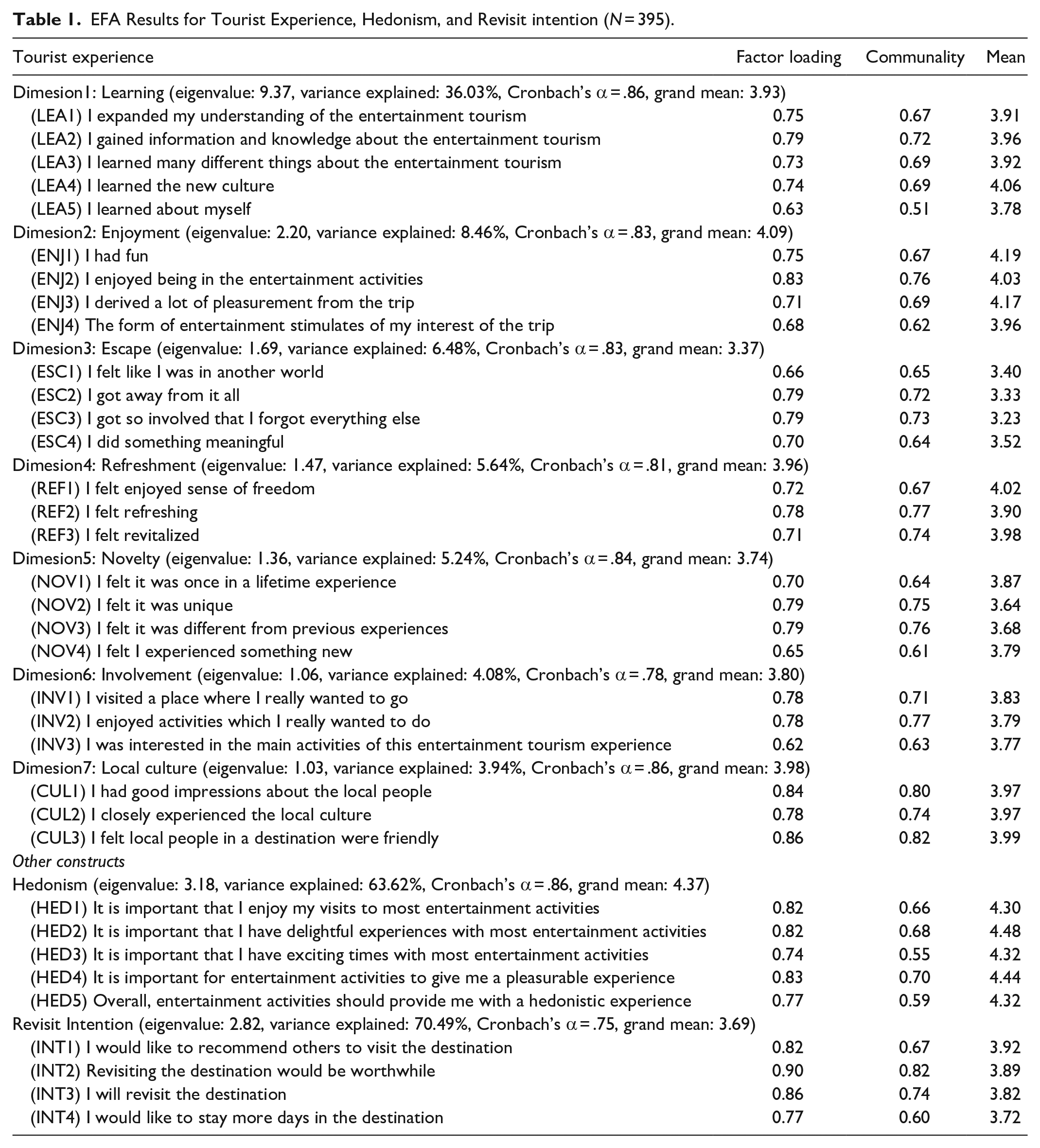
To examine the relationships between unobservable constructs with data appropriately (Hair et al., 2010), this study used Structural Equation Model (SEM). The software used to analyze the data was AMOS 22.0. The method of estimation was Maximum Likelihood estimation. To cross validate the data, this study divided the sample into two parts randomly (Kline, 2011). The EFA results for the first data set were determined by factoring principal axis and rotating Promax. Items with factor loadings below 0.45 and communalities less than 0.5 were removed (Comrey & Lee, 1992). Table 1 showed the result of EFA. Factors with eigenvalues of less than 1.0 were not selected. The reliability alphas for all of the domains were within the .75 to .86 range. The extracted seven domains of tourist experience were Learning, Enjoyment, Escape, Refreshment, Novelty, Involvement, and Local culture dimensions.
EFA Results for Tourist Experience, Hedonism, and Revisit intention (N = 395).
Confirmatory Factor Analysis (CFA) of the Measurement Model (Second Half Set, N = 396)
To confirm the underlying dimensions and items, this study used CFA to analyze the second half of the data set. The result showed a significant goodness of fit. Table 2 showed that all items exhibited a standardized factor loading higher than the 0.5 threshold. All AVE values were 0.5 or higher than 0.5, confirming their convergent validity. The AVE values were compared with the correlation coefficients to assess their discriminant validity. Since all AVE values were higher than the biggest squared correlation of the data set, this indicated discriminant validity. The goodness of fit was examined by the root mean square error of approximation (RMSEA), the normed fit index (NFI), and the comparative fit index (CFI) (Bentler, 1990). The corresponding results were 0.057, 0.854, and 0.913, respectively (See Table 2). To further examine the discriminant validity of the model, this study calculated the factor correlation between the nine dimensions. Since the factor correlation were smaller than .5, this indicates good fit among the factor structure of the model (see Table 3).
Measurement Model CFA Results (N = 396).

Discriminate Validity for First Order CFA (N = 396).

Structural Model Analysis
Figure 1 showed the direct path for the structural model. The SEM results revealed a supportive level of fit for the overall fit indices. Three relationships, H1, H2, and H3, were the focus of this study. Besides these three main relationships, tourist experience consisted of seven connotations learning; enjoyment; escape; refreshment; novelty; involvement; and local culture. Our result shows that the signs of these seven connotations were consistent with the literature. The positive and significant relationships of learning, enjoyment, and escape to tourist experience were consistent with Kang and Gretzel (2012) and Luo et al. (2020) Similarly, the positive and significant relationship between involvement and tourist experience was consistent with Kim et al. (2015) and Luo et al. (2020), while the relationships of refreshment, novelty, and local culture toward tourist experience were consistent with Kim et al. (2012) and Luo et al. (2020). The positive relationship between tourist experience and local culture was also documented in Morgan and Xu (2009). When tourists interacted with local culture more frequently, it was more likely that tourists will enhance their travel experience, especially to their memory. However, our results of these seven connotations were not fully in line with the literature. Our results showed that refreshment was the most influential connotation among all, while in a similar research conducted by Kim (2010), the author found involvement was the most important connotation.

Direct path of the structural model.
H2 measured the relationship between hedonism and tourist experience. This hypothesis examined the coefficient between hedonism and tourist experience. The result showed that tourist who had high hedonic value had a positive tourist experience. This was consistent with our expectation since when tourists have high hedonic value, this usually means they seek adventurous experience, which also imply the effect of fun and play can affect entertainment and emotional potential.
H3 measured the relationship between tourist experience and revisit intention. This hypothesis examined coefficient between tourist experience and revisit intention. The result showed that tourists who have good tourist experience would tend to revisit. This result was consistent with the previous literature (Barnes et al., 2016; Grappi & Montanari, 2011; Lim, 2014; Ryu et al., 2010).
H1 measured the relationship between hedonism and revisit intention. This hypothesis examined the coefficient between hedonism and revisit intention. Our results showed that hedonism could positively and directly affect revisit intention. This was consistent with previous researches (Davis et al., 2014; Ryu et al., 2010). The sample of Ryu et al. (2010) was collected from fast-causal restaurant and the sample of Davis et al. (2014) was collected from online stores. These researches showed hedonism could affect repurchase intention. This study showed that in a tourism setting, hedonism could also affect tourist revisit intention. Combing the results from H2 and H3, this study showed that hedonism could affect tourists’ revisit intention directly and indirectly (see Table 4).
Direct Path for the Structural Model (N = 396).

The results of the SEM show that hedonism indirectly affects revisit intention via tourism experience. The coefficient is 0.241 (Table 5). The present study employs bootstrapping to investigate the significance of the mediating effect between hedonism and revisit intention (Hayes, 2009). After 1,000 resamplings, the 95% bootstrap confidence interval is 0.131 and 0.356. In addition, since the interval does not contain zero, this means hedonism affects revisit intention through tourism experience, respectively. The p-value of the coefficient between hedonism and revisit intention is less than .01. Thus, the results support H4. The mediation effect is significant. Hence, the tourism experience partially mediated the relationship between hedonism and revisit intention in entertainment tourism context.
Results for Mediation Tests.

Note. N.A. = not applicable.
Implications and Conclusions
Our findings were important from the theoretical and practical perspectives. First, from the theoretical perspective, this study identified the relationship among hedonism, travel experience, and repurchase intention. This enhanced the tourism literature by developing a relationship model. Second, through SEM modeling, this study found the direct and positive relationship between hedonism and revisit intention. Most of the existing literature either measured indirect effect of hedonism toward repurchase intention via satisfaction (Grappi & Montanari, 2011; Lim, 2014; Ryu et al., 2010) or simply ignored the existence of direct effect (Grappi & Montanari, 2011; Lim, 2014). This study not only explicitly modeled a direct relationship between hedonism and repurchase intention, but also showed travel experience could be a mediating variable between hedonism and repurchase intention. While some researches (Calver & Page, 2013; Ryu et al., 2010) showed that there was a direct and positive effect of hedonism toward repurchase intentions, some researches (Yim et al., 2014) showed that there was a direct and negative effect. This study showed that within the tourism context, the direct effect of hedonism toward repurchase intentions was positive and significant.
This study also examined the mediating effect of tourism experience on the link between hedonism and revisit intention. No previous study has examined this mediating relationship. The identification of the indirect relationship, mediated by travel experience, shows that other than satisfaction, hedonism could affect revisit intention via other mediating variables (Lim, 2014). The findings of this study confirm tourism experience as a mediating variable between hedonism and revisit intention. This would enhance the literature by having a more thorough understanding of how hedonism affects repurchase intentions, regardless directly or indirectly.
From the practical perspective, these results also have important managerial implication. In particular, this study shows that when destination managers and planners want to improve recommendation intentions, they can enhance tourist travel experiences with entertainment tourism. Tourism providers were interested in examining and evaluating their service and products because improvement of service and products could increase the number of visitors and revenue (Baker & Crompton, 2000). The identification of the direct relationship between hedonism and revisit intention encouraged practitioners to investigate the hedonic nature of visitors. Entertainment destination can be developed and marketed as the hedonic entertainment attraction for tourists. Such as luxury hotel and shopping center. Furthermore, while promoting their products to repeat customers in oversea, tourism practitioners should improve the hedonic attractiveness of their products. For example, through advertisement, practitioners should create hedonistic effects on oversea tourists with the aim to increase the number of oversea tourists. Practitioners can brand Macau as a luxury entertainment destination to attract those tourists. Different products could be provided to satisfy the hedonic nature of visitors. Luo and Lam (2019) found out entertainment products had different performance on tourist experience in Macau. The identification of travel experience as a mediating variable between hedonism and repurchase intention provide justification for tourism providers to enhance existing products or develop new products to enhance the tourist experience.
Limitation and Future Research
This study has several limitations. First, most of the participants in this study were from mainland China. Our results could be affected by the culture and nationality of our sample. The cultural and nationality difference made the results difficult to generalize to other cultures or nationalities. Future research could reexamine the same issue in this topic with a more diversified sample. Furthermore, since this study focused mainly on Asian content, future research could examine other gaming destination, such as Las Vegas. Second, this study tried to incorporate as many connotations as possible to measure travel experience. However, there could be some missing connotations, such as memory. Future research could incorporate more connotations of travel experience while examining the effect of hedonism toward revisit intention.
Footnotes
Declaration of Conflicting Interests
The author(s) declared no potential conflicts of interest with respect to the research, authorship, and/or publication of this article.
Funding
The author disclosed receipt of the following financial support for the research, authorship, and/or publication of this article: This work was partly supported by the Macao Foundation.
