




Abstract
This study aims to examine the effect of low-income group (LIncG) women’s financial well-being (FWB) on their quality of life (QoL) and to assess the moderating effect of capability on the relationship between their FWB and QoL. A survey of 320 LIncG women was conducted in Malaysia. QoL constructs examined were overall QoL in general, QoL in terms of overall health, and four domains of QoL: physical health, psychological, social relationship, and environment. The results indicated that FWB had a significant positive effect on the LIncG women’s overall QoL in general and the three QoL domains of physical health, social relationship and environment. However, FWB had no significant effect on LIncG women’s QoL in terms of the overall health and psychological domain. Additionally, the results demonstrated that capability had a significant positive moderating effect only on the relationship between the FWB and QoL (in terms of psychological domain) of LIncG women. Nonetheless, capability was found to have no moderating effects on the relationship between FWB and the other QoL constructs (overall QoL in general, overall health, physical health, social relationship and environment). The findings of this study offer useful empirical evidence regarding the QoL of women in the LIncG in Malaysia. Strategies should be formulated to improve the FWB of LIncG women which will ultimately enhance their QoL.
Introduction
The World Health Organization (WHO) (2012, p. 11) defined QoL as “individuals” perceptions of their position in life in the context of the culture and value systems in which they live and in relation to their goals, expectations, standards and concerns’. The Malaysian Economic Planning Unit (EPU) (2000, p. 6) defined QoL as “encompassing personal advancements, a healthy lifestyle, access and freedom to pursue knowledge, and a standard of living which surpasses the fulfilment of basic needs of individuals and their psychological needs, to achieve a level of social well-being compatible with the nation’s aspirations.” In Malaysia, the EPU developed the Well-Being Index (MWI), previously known as the Malaysia Quality of Life Index (MQLI), used by the government to measure the level of society’s well-being and overall QoL (Mahdzan et al., 2019). QoL is used as a marker for government policy implementation (e.g., Meyer & Dunga, 2014). The MQLI was designed to be a comprehensive measure of welfare and human well-being that considers various facets of life, such as working life, family life, health, education, and financial gain.
QoL is a vital goal for any human being (Yuill et al., 2010). According to Rathakrishnan et al. (2018), every person is motivated to live a better life and obtain a high QoL. The lack of financial well-being (FWB), which is a socio-economic problem (Gutter & Copur, 2011), is thus essential for investigation. According to Agyei et al. (2019), FWB is the state of contentment with one’s financial circumstances, and it is attained when a person is satisfied with his or her ability to meet basic life needs. Losing FWB is a socio-economic problem as it relates to other aspects of life, such as the levels of general well-being, happiness, satisfaction, social relationships and overall self-perceived QoL (Gutter & Copur, 2011). Individuals with low levels of FWB impact the country’s economic status (Wahab & Yaacob, 2018) as financial difficulties may hurt a person’s productivity, physical health, and economic and psychological status (M. Kaur et al., 2013). A government must be attentive to its citizen’s FWB, particularly in the low-income group (LIncG), as members of this group have the greatest difficulty satisfying their basic needs (Rahman et al., 2021). As a result, strengthening the citizen’s FWB is a priority of the government.
Low-income households are seen as a vulnerable population facing numerous obstacles in crucial aspects of life such as financial, health, and job (Saigaran, 2021). Household income in Malaysia is divided into three categories: the bottom 40% (B40), the middle 40% (M40), and the top 20% (T20). According to the Department of Statistics Malaysia (DOSM) (2020), B40 is the lowest-income group with a monthly household income of less than RM 4,850. The B40 group is further divided into four sub-groups: (a) B1: income less than RM 2,500; (b) B2: income between RM 2,500 and RM 3,169; (c) B3: income between RM 3,170 and RM 3,969; and (d) B4: income between RM 3,970 and RM 4,850. According to the most recent DOSM data from 2019, 2.91 million households met the income threshold for the B40 group. Thangiah et al. (2020) revealed that the M40 and T20 income groups have higher perceived QoL than the B40 income group. Therefore, improving the QoL of the B40 income group is critical to the country’s economic growth and elevating its position to that of a developed nation (Thangiah et al., 2020). Santhalingam et al. (2022) found low QoL among women in the LIncG in Sri Lanka. Unfortunately, little is known about the QoL of women from the LIncG in Malaysia and how FWB impacts their QoL. Thus, it is imperative to investigate how FWB influences the QoL of women in this group. The concept of FWB has received much consideration, particularly following the COVID-19 pandemic, which had a detrimental effect on people’s well-being. Notably, the impact of this pandemic on the country led to the financial crisis confronting the overall well-being of the population, particularly the LIncG. The FWB of individuals in this particular segment, which includes women, may consequently impair their QoL.
Women, specifically low-income earners, were greatly affected by the COVID-19 pandemic, which caused job loss and mental illness (Women’s Aid Organisation [WAO], 2021). Low-income women’s QoL has impacted their well-being (Kadir & Wan Puteh, 2023). This worsens when the gender gap and stereotypes exist. The World Economic Forum Global Gender Gap Index (2024) revealed that Malaysia ranked 114 of 146 countries, indicating the disparity between men and women in economic, educational, health, and political outcomes. Nevertheless, the WAO (2021) criticised the Malaysian Budget 2021 for failing to consider how women’s access to employment, education, healthcare, and opportunities was affected. If this issue remains, poverty may continuously affect the QoL and well-being of this group.
Kadir and Wan Puteh (2023) found a positive relationship between QoL and well-being among women-headed-B40 families. They assessed the QoL of women-headed-B40 families as their life conditions are worsen compared to men-headed families. Poor QoL has significantly affected low-income women due to their inability to meet their needs. Thus, the QoL of B40 women is likely correlated with higher total household income, as women who earned more than RM 3,860 were found to have better QoL (Puteh & Kadir, 2022). Furthermore, low-income older women with a low educational level and co-morbidities have a lower overall health-related QoL (Rizal et al., 2022).
Sen (1985) emphasises people’s functioning and their capabilities in life. A person’s capability to function may relate to their FWB (Bowman et al., 2017) and ultimately impact their QoL. It is expected that women in the LIncG who possess high FWB and a high capability to function may enhance their QoL. Focusing on FWB and capability to gain a better understanding of QoL is worth investigating. According to the theory of human needs, there is a hierarchy of needs (physiological, safety, love and belonging, esteem, and self-actualisation) that people try to satisfy. In a similar vein, QoL spans a wide range of physical, social, environmental, and psychological domains and is viewed as an effective assessment of one’s life satisfaction, desires, needs, and aspirations within the framework of one’s culture and value systems (WHO, 1998). In the context of this study the capabilities to function, in general, relate to these human needs in life. In addition, FWB is viewed as a human aim and is expected to create good QoL.
Nonetheless, little is known about LIncG women’s FWB, capability and QoL, particularly in Malaysia. This study predicts that the FWB of LIncG women may impact their QoL. Moreover, their capability may influence the relationship between their FWB and QoL. Therefore, this study poses two research questions: (a) Does LIncG women’s FWB have an impact on their QoL?, and (b) Does capability moderate the relationship between LIncG women’s FWB and their QoL? Subsequently, two research objectives were framed to answer these questions: (a) to examine the effect of LIncG women’s FWB on their QoL, and (b) to examine the moderating effect of capability on the relationship between LIncG women’s FWB and their QoL.
The following section reviews the literature on QoL, FWB, capability, and the theory of human needs. This is followed by the hypotheses. Then, the research method, data analysis, discussion, and conclusion of the study are presented.
Literature Review and Hypotheses
Theory of Human Needs
Fulfilling one’s needs is the aim of QoL. An efficient social emotional functioning is a progression towards higher-order needs (Sirgy, 1986). Abraham Maslow (1943) developed the hierarchy of needs, emphasising the necessity to reach full human potential and motivation. This theory classifies fundamental human needs and links those needs to conduct. According to Maslow if people grow up in an environment where their needs are not met, they are unlikely to function as healthy or well-adjusted individuals (A. Kaur, 2013). Based on Maslow’s hierarchy of requirements, psychological needs progressed from basic desires to self-realisation and happiness through gradual satisfaction phases. According to the theory, a person is a well-organised, holistic entity continually driven to meet their own needs (Zlenski & Raspa, 2006).
Five levels of motivational demands in the hierarchy of needs represent the stages of human needs (Daniel, 2019). These include physiological, safety, love and belonging, esteem, and self-actualisation needs. The needs at the lower level of the hierarchy must be met for a person to advance to the upper level. Meeting these requirements becomes more critical the longer they are ignored at the lowest level. Maslow (1943) stated that there is a hierarchy of needs, and that satisfying one allows the person to satisfy another need at a higher level. In other words, the person is driven to meet lower-order demands before meeting higher-order requirements.
Numerous disciplines have investigated Maslow’s hierarchy of needs. Since financial instability may lower life satisfaction and may have a potential impact on women’s happiness, this study uses the theory of human needs to investigate FWB, capability, and QoL among LIncG women in Malaysia.
Quality of Life
QoL describes an individual’s subjective appraisal of their life (Bakar et al., 2016). It assesses an individual’s equality and well-being (Aripin & Puteh, 2017). Numerous terms used to measure QoL, such as happiness, life satisfaction, and well-being. Brod et al. (1999, p. 1) referred QoL as “people’s overall evaluation of their lives in general (e.g., how satisfied they are, all things considered, with their current lives) or of various components of life such as social life, financial situation, work, or living situation.” Similarly, Rusli et al. (2008, p. 2) defined QoL as “an individual’s perception of his/her position in life in the context of the culture and value systems in which he/she lives and in relation to his/her goals, expectations, standards and concerns.”
QoL is commonly refers to the general well-being of individuals and societies. Most people define QoL as the “goodness of life” and the ability to live contentedly and successfully in one’s surroundings (R. I. Brown & Brown, 2005). Several studies have examined QoL and the motivations for positive life assessments. Sirgy and Cornwell (2002) found that in a hierarchy of attitudes, total QoL is at the top and is influenced by happiness with family, work, social life, health and other factors. The World Health Organization Quality of Life (WHOQOL) Group (1995) indicated that QoL is a broad standard that is influenced in complex ways by an individual’s physical health, psychological state, social relationships, and environment. The WHOQOL Group (1995) developed a QoL measurement which covers overall QoL in general, QoL in terms of overall health, and four QoL domains, namely, physical health (e.g., pain and discomfort), psychological (e.g., positive feelings), social relationship (personal relationships), and environment (e.g., physical safety and security).
QoL was investigated in various contexts ranging from health-related (e.g., Sabri et al., 2022) to work-related issues (e.g., Kõrreveski, 2011). In Malaysia, Rusli et al. (2008) examined the relationships between working conditions, stress, anxiety and depression, and the QoL of male automotive assembly workers. The QoL factors tested were physical health, psychological well-being, social relationships, and environmental conditions. The results indicated that social support positively influences the QoL of the workers while higher job demands decrease their QoL related to environmental factors. Additionally, depression, anxiety, and stress mediated the relationship between the working conditions and QoL of the workers. Khan and Tahir (2004) revealed that living with spouses and family members and being socially active were significantly associated with a high QoL of the elderly in Malaysia. Conversely, the study found that being dependent on partners and children and having poor and moderate support were significantly associated with a low QoL among the elderly.
Iqbal et al. (2020) investigated the socioeconomic determinants of QoL among health-care providers (HCPs) in Malaysia. They revealed that the HCPs had better QoL overall. Meanwhile, Woon and Tiong (2020) demonstrated moderate-to-strong correlations between Copenhagen Burnout Inventory, Depression, Anxiety and Stress scale-21, and QoL among health employees in Malaysia. Additionally, mental ill-health had a significant mediating effect on the relationship between burnout and poor QoL. Nazali et al. (2021) revealed that university staff in Malaysia had low QoL in the physical health, psychological health, social relationships and environment domains. They found that predictors of the physical health QoL domain included depression, medical illness, and number of dependents, whereas predictors for the psychological QoL domain were work promotion, depression, medical illness, and number of dependents. Besides, the social relationship QoL domain predictors were campus location, depression, and work promotion, while those of the environment QoL domain were age, level of education, depression, work promotion, and medical illness. Furthermore, depression significantly impacted all QoL domains. Furthermore, respondents with a university degree and no medical conditions were more likely to have good QoL. Those with dependents and no work promotions and those working in suburban areas were less likely to have good QoL. Meanwhile, M. M. Tan et al. (2022) revealed that religiosity is positively associated with QoL of older adults in Malaysia.
Studies in different countries revealed that females experience lower QoL than males. For instance, Khan and Tahir (2004) conducted a study in Malaysia, Alipour et al. (2009) in Qatar, and Thangiah et al. (2020) in Sri Lanka. Kõrreveski (2011) discovered that the ability of working women to balance job and family responsibilities determines their QoL. In Malaysia, it was found that married young adults’ QoL is better compared to single young adults because being married or having a partner makes one feel secure, connected, and safe even though they may have lower household income (Norfazilah et al., 2015). The respondents in the study conducted by Norfazilah et al. (2015) were majority represented by female young adults. Ahmad and Khan (2018) found no difference in QoL between married working women and housewives related to physical health. Instead, the two groups’ QoL related to psychological, social, and environmental aspects were found to be different. Iqbal (2021) demonstrated statistically significant differences in marital status, education level, income, and years of practice in various QoL domains of health care workers (HCWs) in Malaysia. However, there was no significant effect of gender on all QoL domains. For the physical QoL domain, males were happier and more satisfied compared to female respondents. For the psychological QoL domain, females enjoyed better QoL than male respondents. For the social QoL domain, females had better QoL than male respondents, and for the environment QoL domain, males had better QoL than female respondents. Regarding income, they revealed that HCWs who earned more scored higher in all QoL domains.
The above discussion demonstrated numerous socioeconomic factors impacting QoL had been investigated such as age, education and income. The studies’ focuses ranging from worker, elderly and young adult. However, the literature review offered dearth of studies conducted specifically on women’s QoL, not to mention LIncG women, in Malaysia (e.g., Ahmad & Khan, 2018). A review of the literature revealed few studies investigated the LIncG women’s QoL in other countries, for instance, Cruz et al. (2011) conducted a study in Brazil and Santhalingam et al. (2022) in Sri Lanka. These two studies revealed low QoL among LIncG women. Since this group receives less attention, this study contributes significantly to the literature on the QoL status of LIncG women, providing a means to improve their QoL.
Financial Well-Being and Quality of Life of Low-Income Group Women
The LIncG is the Malaysian government’s primary focus in its efforts to help improve their income and well-being. In countries such as Brazil (Cruz et al., 2011), the United Kingdom (Skevington & McCrate, 2012), and Sri Lanka (Santhalingam et al., 2022), low-income households are reported to have low QoL. Similar finding for Malaysia was obtained by Wan Puteh et al. (2019). Additionally, motivation and entrepreneurial attitudes significantly correlate with the QoL among people living in absolute poverty in Sabah, Malaysia (Rathakrishnan et al., 2018). Su et al. (2019) reported that, aside from the physical functioning domain of QoL, the residents of low-income housing in Kuala Lumpur, Malaysia who met the recommended physical activity levels had greater levels of QoL in the other domains. A significant association was found between income and the physical, psychological, social, and environmental QoL domains of rural residents in Malaysia (Thangiah et al., 2020).
Min Fui et al. (2022) and Sing Joo et al. (2021) investigated the health-related factors of QoL for the LIncG in Malaysia. Min Fui et al. (2022) revealed that resiliency facilitates good psychological QoL domain among Malaysia’s multi-ethnic urban lower-income communities. Problematic QoL, however, was associated with depression, older age, unemployment, cash shortage, hypertension, diabetes, stressful life events and low health literacy. Sing Joo et al. (2021) discovered a significant negative correlation between the subscales of depression, anxiety, and stress scale-21 and the four domains of QoL among B40 residents in a low-cost urban housing area in Kuala Lumpur, Malaysia. Social relationships and psychological domains demonstrated a highly significant association.
Sabri et al. (2022) assessed the relationships between financial literacy (FL) and financial behaviour (FB) on health-related quality of life (HRQOL) during the COVID-19 pandemic among the low-income working population (20–60 years old) in Malaysia. The study found a lower age group, ethnicity, and a high FB score to be significant determinants of a higher EuroQol 5-Dimension 5-Level. A lower age group, ethnicity, and chronic medical condition were found to be significant determinants of higher HRQOL. Additionally, Sabri et al. (2022) revealed that chronic diseases confounded the impact of FB on QoL, implying that interventions focusing on improving the FB of persons with chronic medical conditions may help to improve QoL among the low-income working population.
Scherpenzeel and Saris (1996) examined life satisfaction using domain-specific variables like housing, household finances, and social connections. According to Diener and Suh (1997), individuals living in poverty have lower QoL because of issues relating to a healthy lifestyle, owing to their struggles in meeting their everyday needs. As a result, these individuals will obtain only the basic needs that coincide with their financial ability.
In terms of financial matters, Kar (2017) revealed that monthly income is associated with elderly’s QoL but Eliasi et al. (2017) found a contradictory result. Sabri et al. (2022) discovered that early investments in health, social participation, and financial stability may lead to better QoL. Having financial security, households would be better prepared to face unforeseen circumstances (Sabri et al., 2022). Low-income people are not able to have better QoL due to financial difficulties as their FWB are the most unstable (Rahman et al., 2021). Their income is only sufficient for basic necessities and unable to protect them from unexpected spendings such as unplanned medical expenses and other out-of-pocket expenditures (Rizal et al., 2022). People with low total household income have low QoL as their access to health facilities, laws and policies in reducing serious diseases are inadequate (Wan Puteh et al., 2019). They have risky health behaviors, unhealthy eating habit, a lack of health access to facilities and unable to have healthy live (Rizal et al., 2022). Furthermore, less wealthy people use public health services lesser than those who are richer people (Kadir & Wan Puteh, 2023) especially those who are living in the rural area. Thinagar et al. (2021) reported a significant impact of the movement control order enforcement on the LIncG in Malaysia. Thus, it is imperative to understand how FWB impacts the LIncG’s QOL as they have been significantly affected during the COVID-19 pandemic.
Men and women handled their finances differently (Anthony et al., 2022), and their satisfaction with their financial situation differs depending on their exposure to financial socialisation, which has a substantial impact on their financial stability (Abdullah et al., 2019). Prior studies offered inconclusive results on the impact of gender on FWB. Some studies revealed that females have a greater FWB level and financial knowledge than males (e.g., Anthony et al., 2022; Rashid et al., 2022; Sabri et al., 2012). Conversely, other researchers (e.g., Lusardi & Mitchell, 2017; Sabri & Zakaria, 2015) obtained the opposite findings.
Rashid et al. (2022) reported that working women are financially secure because they possess the financial knowledge and skills that contribute to a higher level of FWB. For women, specifically single mother, who become breadwinners and face financial hardships after the divorce may have stressful life contributing to poor households and low QoL (Azer et al., 2022). Malone et al. (2010) revealed that women’s household income positively affects their financial status and FWB. Women’s perceptions of their current financial situation and ability to save for retirement are significantly influenced by their income; hence, older women and women with higher education levels are more likely to be financially stable. Clark et al. (2021) determined the factors contributing to FWB for Black, Hispanic and White women. They found that different educational backgrounds, marital status, FL, and employment status are correlated with FWB. In addition, FWB is positively influenced by higher income levels but negatively influenced by single or divorced women.
Anthony et al. (2022) demonstrated that the relationship between FB and FWB among young adults is influenced by gender. Specifically, female respondents significantly impacted this association but not male respondents. Furthermore, female college students have greater levels of FWB than male students because of socialisation differences, individual expectations for money saved, present financial situation, and financial management abilities (Sabri et al., 2012). Besides, Foong et al. (2021) reported that older women strongly moderate the relationship between FWB and life satisfaction compared to older men. Due to their limited economic resources such as income and not being the breadwinner of the family, elderly women in particular have higher life satisfaction and FWB which contributes to their happiness (Foong et al., 2021).
Nevertheless, a few studies found that females possess lower FWB and financial knowledge than males (e.g., García-Mata et al., 2022; Sabri & Zakaria, 2015). García-Mata et al. (2022) applied the FWB index from the National Survey on Financial Inclusion to the Mexican population aged 18 to 70 years old, and their study confirmed that males have better FWB than females. Sabri and Zakaria (2015) discovered that male young employees have higher FWB than the female young employees in Malaysia. Additionally, Santos et al. (2019) identified that financial self-confidence and social comparison influence the credit card use habits and FWB among female college students. Female students were more inclined to misuse their credit cards because they frequently compared their social lives to those of others. In terms of FL, women have a relatively lower level of financial knowledge than men (Lusardi & Mitchell, 2017). Factors contributing to low FWB among women includes personal life disadvantages, lack of FL, lower income, irregular work schedules, and lower-quality employment (Gonçalves et al., 2021) and economic disadvantages (Madero-Cabib & Fasang, 2016).
In financial investment studies, Kushwaha et al. (2023) found that female investors have more unpleasant experiences than male investors during challenging financial market conditions. In a family structure, wives are less confident in deciding to invest money as they are more risk-averse compared to their husbands (Hira & Loibl, 2008).
Excellent lifestyle and high earnings can significantly improve the overall QoL of an individual (Iqbal, 2021). Income is significantly associated with the psychological and environment QoL domains and overall general health satisfaction states (Iqbal et al., 2020 and Iqbal, 2020). According to Sirgy et al. (2001), one’s current job, family, friends, leisure activities, financial condition, health, education, neighbourhood, community, spiritual life, environment, housing, cultural life, and social standing are all considered QoL domains. Santhalingam et al. (2022) found that income has a positive impact on the physical health and psychological domains of the elderly in Sri Lanka. Additionally, elderly females had lower QoL than males in the physical health, psychological and social participation domains, but not the environment domain.
The above discussion revealed that most studies found low QoL among low-income households. The aforementioned studies (e.g., Wan Puteh et al., 2019) identified a number of significant determinants that contributed to the low QoL of this group. In other studies (e.g., Rahman et al., 2021), researchers discovered a substantial difference between males and females in terms of their FWB and QoL. However, studies that evaluated the FWB and QoL of LIncG women in a single research are scarce. Therefore, this study focused on this relationship to further understand how FWB and QoL affect LIncG women.
This study adopted The World Health Organization Quality of Life-Brief (WHOQOL-BREF) measurement of QoL due to its comprehensiveness. This is consistent with the theory of human needs, where individuals (LIncG women), as a well-organised entity, will strive for their fundamental needs. FWB and QoL were viewed as the fundamental needs of LIncG women. Consequently, this study predicted that a high level of FWB possessed by LIncG women will enhance their overall QoL in general and QoL in terms of overall health, physical health, psychological, social relationship and environment. Based on the above discussion, this study proposed the following hypotheses:
H1a: FWB has a positive effect on the QoL (in terms of overall QoL in general) of LIncG women.
H1b: FWB has a positive effect on the QoL (in terms of overall health) of LIncG women.
H1c: FWB has a positive effect on the QoL (in terms of the physical health domain) of LIncG women.
H1d: FWB has a positive effect on the QoL (in terms of the psychological domain) of LIncG women.
H1e: FWB has a positive effect on the QoL (in terms of the social relationship domain) of LIncG women.
H1f: FWB has a positive effect on the QoL (in terms of the environment domain) of LIncG women.
Capability, Financial Well-Being and Quality of Life of Low-Income Group Women
The capability concept introduced by Sen (1980) emphasised individuals’ functioning and their capabilities. Specifically, functioning deals with the things an individual actually does and experiences. On the other hand, capabilities comprise the opportunities for individuals to achieve various lifestyles (Sen, 1985). Nussbaum (2006) extended the concept into ten general capability dimensions: (1) life; (2) bodily health; (3) bodily integrity; (4) senses, imagination and thought; (5) emotions; (6) practical reason; (7) affiliation; (8) other species; (9) play; and (10) control over one’s environment. Anand et al. (2005) investigated the extent to which people’s capabilities (based on Nussbaum) are covariates of a life satisfaction measure of utility. The study found that capability indicators had an impact on respondents’ subjective well-being; in particular, low capability people were correlated with poor health and low income. In the context of FWB, Bowman et al. (2017) explored the capability to understand the factors that form FWB and how individuals experience economic security. Nonetheless, their study focused on financial capability which differs from the capability concept by Sen (1980) and Nussbaum (2006). In J. T. Brown and Bowman (2020) established an FWB framework based on the concept of economic dignity. Although, the study recognised the influence of capability concept in their proposed framework, however, it did not empirically test the role of capability on FWB. In short, there is a lack of empirical studies examining the impact of capability on FWB and QoL particularly among LIncG women. Therefore, this study focused on the general capability concepts introduced by Nussbaum (2006), rather than on a more specific capability such as financial capability, which was used by finance-related studies such as Potocki’s (2019). Due to the wide scope of human functional capabilities in life and the dearth of literature on FWB that explores this important factor, this study investigates the potential moderating role of capability on the FWB and QoL of LIncG women.
This study explores whether the strength and form of the relationship between FWB and QoL depend on the value of capability. According to MacKinnon (2011), the moderator (i.e., capability) alters the form or strength of the relationship between the independent variable (i.e., FWB) and the dependent variable (QoL). In line with the theory of human needs, it was predicted that LIncG women, as individuals, aim to fulfil their fundamental needs (e.g., QoL). Having the capability to manage their needs is essential life attribute to attain and sustain good QoL, meaning that LIncG women who are capable to meet their basic needs throughout their life stages and possess high FWB to function are likely to have greater QoL. It is expected that high capability ensures that basic needs are met, and with high level of FWB will improve the QoL of LIncG women. Income adequacy, for instance, ensures a sense of financial security (Santhalingam et al., 2022) or a high level of FWB and is associated with higher QoL. Women in the LIncG who are capable of managing their basic life needs and possess a high level of FWB will contribute to a high level of QoL. For instance, if LIncG women’s capability to access financial resources is high, with a high FWB, this will improve their QoL. This leads to the next hypotheses:
H2a: Capability positively moderates the relationship between FWB and QoL (in terms of overall QoL in general) of LIncG women.
H2b: Capability positively moderates the relationship between FWB and QoL (in terms of overall health) of LIncG women.
H2c: Capability positively moderates the relationship between FWB and QoL (in terms of the physical health domain) of LIncG women.
H2d: Capability positively moderates the relationship between FWB and QoL (in terms of the psychological domain) of LIncG women.
H2e: Capability positively moderates the relationship between FWB and QoL (in terms of the social relationship domain) of LIncG women.
H2f: Capability positively moderates the relationship between FWB and QoL (in terms of the environment domain) of LIncG women.
Research Method
Research Design and Sample
A survey was conducted to gather information about the FWB, capability, and QoL of LIncG women. The respondents were women from the LIncG in Malaysia. As mentioned earlier, there were 2.91 million households categorised in the B40 group (DOSM, 2020). Unfortunately, the statistical report did not breakdown the data into gender classification. Therefore, sample was used because the exact population of women in the LIncG was unknown. A purposive sampling method was adopted to obtain information from a specific target group, the LIncG women. A self-administered survey was performed because it was not practical to use an online survey as the email addresses of LIncG women were not available. Furthermore, based on their economic background, there was a high likelihood that some did not have email addresses at all. Due to the COVID-19 pandemic, data collection was restricted to Peninsular Malaysia and was performed when the government temporarily lifted the movement control order in 2021. Eighty respondents were selected from the northern, central, southern, and east coast regions of Peninsular Malaysia. Targeted respondents from various locations in the respective regions such as community centres and markets were approached. Potential respondents were personally approached and informed about the purpose of the study. They were then invited to voluntarily participate in the survey should they fall under the required income category.
G*Power version 3.1.9.7 was used to estimate the minimum sample size for this study. With the presence of two predictors at a .05 significance level and a statistical power of .95, the recommended minimum sample size for this study was estimated at 107. After data screening, there were 320 validated research instruments. Hence, this was taken as the final sample size and used for analysis. The final sample size of 320 was appropriate as it exceeded G-power’s estimated minimum sample size.
Research Instrument
The questionnaire was developed based on FWB, capability, and QoL literature. There were four sections in the questionnaire: Section A solicited the respondents’ demographic background, Section B examined the respondents’ FWB, Section C measured the respondents’ capability, and Section D measured the respondents’ QoL. Section B was developed based on Prawitz et al. (2006); Section C was developed based on Anand et al. (2005); and Section D was developed based on WHOQOL-BREF (WHOQOL Group, 1998). Measurement of this study’s variables is explained further in the following section. Thirty respondents chosen at random from the sample were involved in the pilot test (Cooper & Schindler, 2006). In view of the feedback from the pilot test, no changes to the questionnaire were necessary. Following that, the questionnaires were distributed to the actual respondents.
Variables of the Study
Dependent Variable
The dependent variable of this study was QoL. The MQLI is a composite index based on the indices of 11 economic and social life components. Objective indicators are used in this index to represent measures such as the unemployment rate, real per capita income, and average household income. However, this study used subjective indicators to explain the LIncG women’s QoL. A subjective measure of QoL is based on data collected by individuals through a survey assessing their current life according to the QoL domain scale (Stimson & Maran, 2011). Subjective indicators can explain the QoL of people living in absolute poverty based on their evaluations of their life experiences (Diener & Suh, 1997). Moreover, research has proven that there is no better way to assess QoL than to ask the individuals themselves (Hasanah et al., 2003).
This study measured QoL following Hasanah et al. (2003), who based their work on WHOQOL-BREF, which is the abbreviated version of WHOQOL-100 (The WHOQOL Group, 1998). WHOQOL-BREF consists of 26 items: 2 items measuring overall general and health-related QoL and another 24 items measuring QoL in four domains: physical health (7 items), psychological (6 items), social relationship (3 items), and environment (8 items). All 26 items are universally regarded as imperative in assessing QoL. The items were scored using a 5-point Likert scale based on various ratings, for instance, two physical health item measurements range from 1—not at all, 2—a little, 3—a moderate amount, 4—very much, to 5—an extreme amount. A higher score denotes higher QoL and a lower score indicates lower QoL.
Independent Variable
The independent variable of this study, FWB, was measured by the InCharge Financial Distress/FWB (IFDFW) Scale (Prawitz et al., 2006) and validated by Kamaluddin et al. (2018) in the Malay language. These questions comprised the IFDFW Scale, which was copyrighted by Prawitz et al. (2006). This scale may be duplicated only with a written permission from the authors. The scale contained eight items organised on a continuum (from negative to positive feelings) on a 10-point Likert scale which measured the respondent’s perception of their FWB. For data analysis, the responses were converted into a 5-point Likert scale to ensure consistency with the measurement of other variables of this study. Higher scores indicated higher FWB and lower scores indicated lower FWB.
Moderating Variable
The moderating variable, capability, was measured according to Anand et al. (2005) based on the capability dimensions introduced by Nussbaum (2000). The dimensions employed for this study were bodily health (four items), bodily integrity (seven items), sense imagination and thought (four items), emotions (five items), practical reason (four items), affiliation (eight items), and control over the environment (seven items). The items were scored using a 7-point scale or a dichotomous scale, with 0 for “no” and 1 for “yes,” which agreed with Anand et al.’s (2005) study. The items were transformed into a 5-point Likert scale for data analysis for consistency with the assessment of other variables. For example, two bodily integrity items were measured on a range from 1—completely dissatisfied, 2—dissatisfied, 3—neither satisfied nor dissatisfied, 4—satisfied, to 5—completely satisfied.
Results and Discussion
Results
Study data were analysed using SmartPLS 3, as this software can analyse complex data (e.g., Wetzels et al., 2009). A moderator was tested for its influence on the relationship between FWB and the various measures of QoL (namely overall QoL in general, QoL in terms of overall health, physical health, psychological, social relationship, and environment). Similar studies, such as Al-Shaer et al. (2024), Dzogbenuku et al. (2022), Yao and Meng (2022), and Chatterjee (2021), also utilised structural equation modelling (SEM) for their analyses. Thus, the adoption of SEM in this study was appropriate to measure the complex relationships among the variables. FWB and capability were regressed separately with the individual dimension of QoL (Rusli et al., 2008) and the two overall QoL questions. Bodily health as a capability construct was eliminated from the analysis since three of its four items had identical values. As such, only six capability items were used in this study from which six models were developed. Each model was assigned one capability item as moderator and run independently. More specifically, bodily integrity was added as moderator in Model 1, sense imagination and thought as a moderator in Model 2, emotion as a moderator in Model 3, practical reason as a moderator in Model 4, affiliation as a moderator in Model 5, and finally control over one’s environment as a moderator in Model 6. Consistent with the SmartPLS protocol, the moderator was first added to the model to evaluate its main effect. According to the bootstrapping results before moderation, FWB had a significant positive effect on all of the QoL indicators for the women in the LIncG for all models. In all models, the capability factor significantly affected several QoL indicators in either a positive or negative way.
In comparison to the other five models, the R-squared (R2) value of Model 1 showed the largest variations, as per the bootstrapping results with moderators. Thus, the main and moderating effects of Model 1 are presented and discussed in this study.
Latent Variable Correlations
Table 1 presents the results of the latent variable correlations among the variables measured in this study. The correlation results indicated a significant and negative correlation between QoL (overall QoL in general) and capability; a significant and either a positive or negative relationship between QoL (physical health domain) and capability, QoL (environment domain), QoL (psychological domain), and QoL (social relationship domain); a significant and either a positive or negative relationship between QoL (psychological domain) and capability, QoL (environment domain), QoL (physical health domain), and QoL (social relationship domain); a significant and either a positive or negative relationship between QoL (social relationship domain) and capability, FWB, QoL (physical health domain), and QoL (psychological domain); and a significant and either a positive or negative relationship between QoL (environment domain) and capability, QoL (physical health domain), QoL (psychological domain), and QoL (social relationship domain). The relationships were significant at either the 1%, 5%, or 10% significance level.
Latent Variable Correlations.
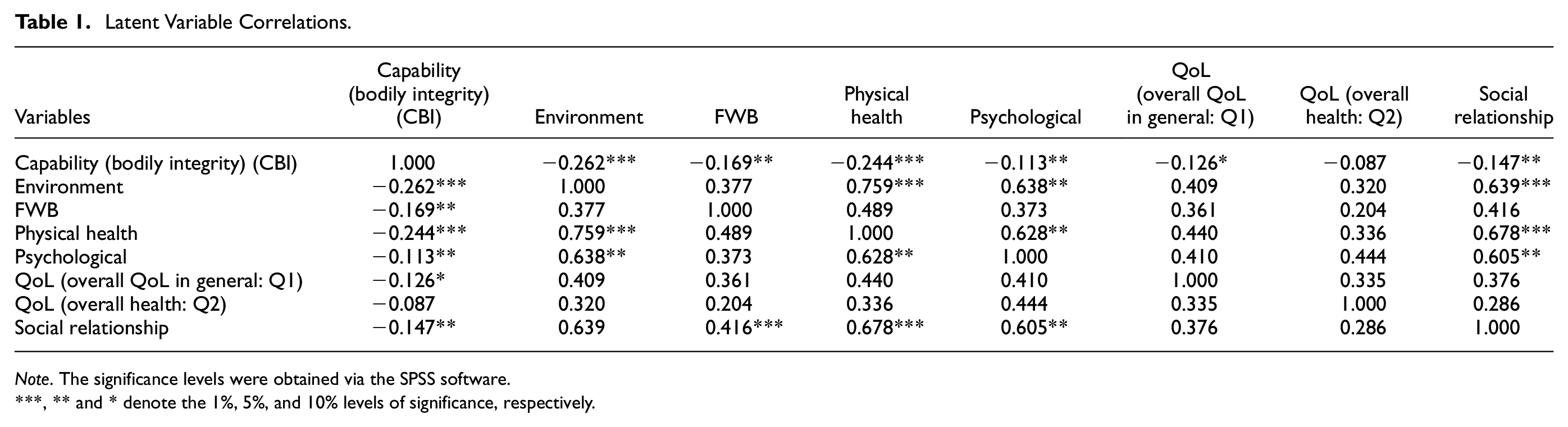
Note. The significance levels were obtained via the SPSS software.
***, ** and * denote the 1%, 5%, and 10% levels of significance, respectively.
Measurement Model
The measurement model was established to evaluate the reliability and validity of the indicators and constructs (Hair et al., 2017a) of this study. The model’s internal consistency was evaluated using Cronbach’s alpha and composite reliability (CR). For validity, convergent validity was assessed using average variance extracted (AVE), while discriminant validity was evaluated using the Fornell-Larcker criterion, cross-loading and heterotrait-monotrait (HTMT).
Reliability and Validity
Construct Reliability
The result of the construct reliability assessment is presented in Table 2. Following Hair et al. (2011), the cut-off value for the observed items’ factor loading is 0.7. As displayed in Table 2, two items (Item 1 and Item 2) for the construct QoL in terms of the physical health domain, one item (Item 6) for the construct QoL in terms of the psychology domain, two items (Item 1 and Item 3) for the construct QoL in terms of the environment domain, two items (Item 6 and 7) for the construct FWB, and five items (Items 1, 2, 3, 4 and 6) for the capability (bodily integrity) construct were removed due to low outer loading. Subsequently, five items were kept for the construct QoL in terms of the physical health domain, five items for the construct QoL in terms of the psychological domain, two items for the construct QoL in terms of the social relationship domain, six items for the construct QoL in terms of the environment domain, six items for the construct FWB, and two items for the construct capability. Four items with an outer loading value of at least 0.483 were retained as they contributed an AVE score greater than 0.5 (Byrne, 2016). The items were Item 5 of FWB with a loading value of 0.483, Item 4 of QoL in terms of the physical health domain with a loading value of 0.502, Item 4 of QoL in terms of the psychological domain with a loading value of 0.559, and Item 2 of QoL in terms of the environment domain with a loading value of 0.594.
Summary of Measurement Model Results.

Regarding internal consistency, the CR, as another measure of reliability, was at least .802 for the constructs. A CR value of more than .7 signified that the internal consistency level of the constructs as satisfactory and it denoted that each item in the measurement model measured the same concept (Hair et al., 2017b; Saunders et al., 2019). Cronbach’s alpha values for all constructs except capability ranged from moderate to excellent (Hair et al., 2016), which were considered acceptable (Pallant, 2001; Nunnally & Bernstein, 1994). The Cronbach’s alpha value of .562 for capability was acceptable as there were fewer than 20 items (Dall’Oglio et al., 2010) used to measure capability.
Convergent Validity and Discriminant Validity
As shown in Table 2, all constructs of this study achieved AVE scores above .5, indicating that the convergent validity was adequate (Hair et al., 2017b). Table 3 presents the model’s discriminant validity evaluated by cross-loading. The results indicate that all item loadings on the associated constructs were greater than all item loadings on other constructs, establishing that the indicators of the various constructs were not interchangeable, resulting in good discriminant validity (Henseler et al., 2015). Furthermore, the results of the Fornell-Larcker criterion presented in Table 4 illustrate that each construct in the model adequately explained the variance of its own items as opposed to the variance of other constructs. Finally, as depicted in Table 5, the absence of the value 1 in the HTMT results indicated that discriminant validity was proven.
Cross Loading Result.

Fornell-Larcker Criterion Results.

Heterotrait-Monotrait (HTMT) Results.

Structural Model
A structural model was evaluated to test the hypotheses. Figure 1 displays the structural model of this study using the bootstrapping protocol before the moderation effect of capability on the relationship between the LIncG women’s FWB and QoL (the overall QoL—general and health, physical health, psychological, social relationship, and environment domains). The structural model showed an R2 value of .134 for QoL (overall QoL in general), .045 for QoL (overall health), .266 for QoL in terms of the physical health domain, R2 value of .142 for QoL in terms of the psychological domain, .179 for QoL in terms of the social relationship domain, and .182 for QoL in terms of environment domain. All the R2 values were below .33, which is considered as weak level of predictive accuracy (Cohen, 1988). Based on these results each of the QoL constructs was weakly explained by FWB and capability (Cohen, 1988).

Structural model before moderation effect of capability.
The structural model using the bootstrapping protocol for the moderation effect of capability on the relationship between the LIncG women’s FWB and QoL (overall QoL—general and health, physical health, psychological, social relationship, and environment domains) is shown in Figure 2. The results exhibited improved R2 values for all QoL constructs. Specifically, for QoL (overall QoL in general) the improved R2 value was .137, an increase of 2.24%; for QoL (in terms of overall health) the improved R2 value was .075, an increase of 66.67%; for QoL in terms of the physical health domain the improved R2 value was .269, an increase of 1.13%; for QoL in terms of the psychological domain the improved R2 value was .153, an increase of 7.75%; for QoL in terms of the social relationship domain the improved R2 value was .180, an increase of .56%; and for QoL in terms of the environment domain the improved R2 value was .200, an increase of 9.89%. Accordingly, this study revealed that although each of the QoL constructs was weakly explained by FWB (Cohen, 1988), the changes in the R2 value suggested that the capability may have a moderating effect on the relationship between the FWB and QoL of the LIncG women.
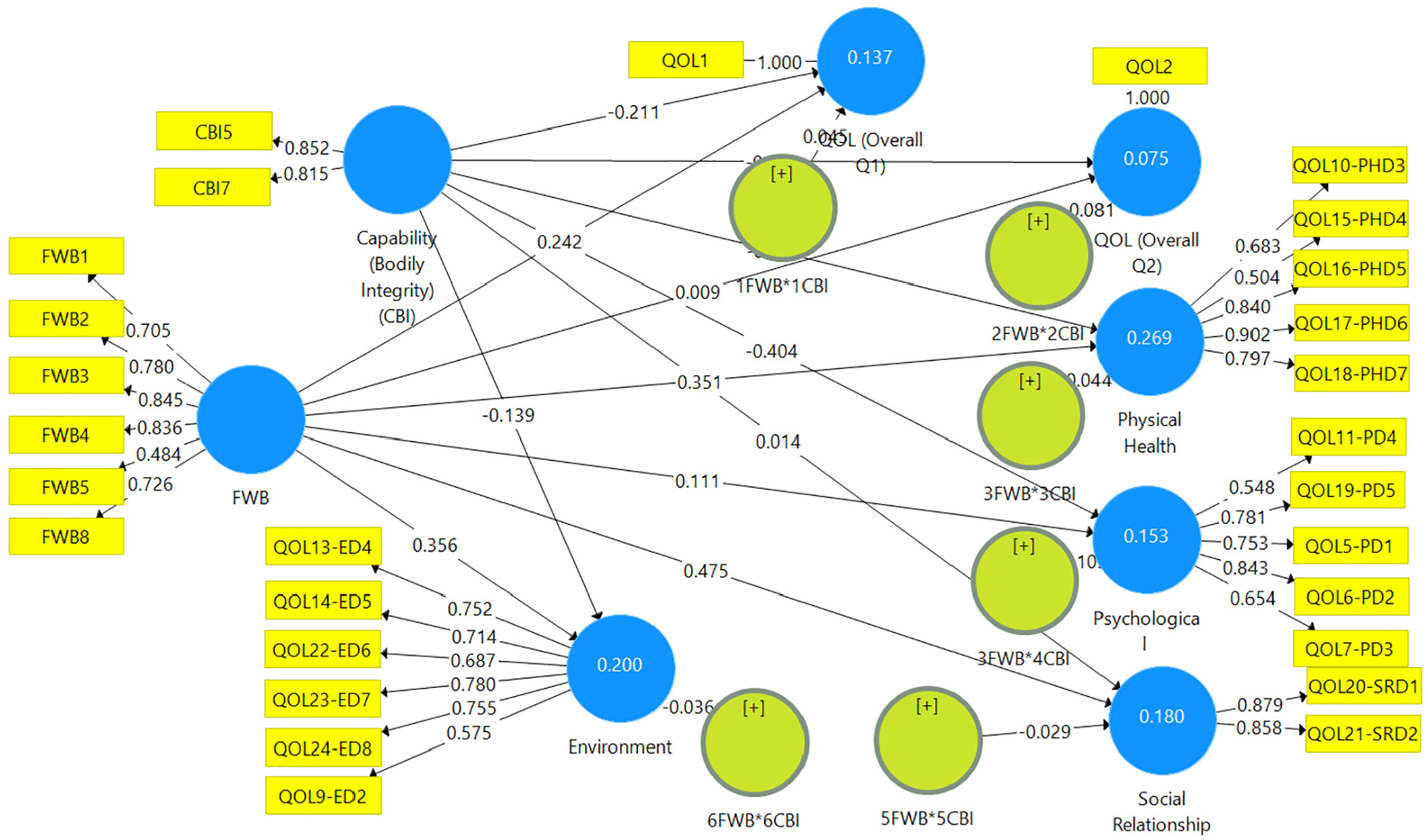
Structural model after moderation effect of capability.
Analyses of the effect size, demonstrated by the f-squared (f2) value, indicated that one relationship of FWB and capability had a large effect size in producing the R2 value for QoL. The relationship was between FWB and QoL in terms of the environment domain (f2 = 0.153), in which the f2 value was above 0.15 (Cohen, 1988). Meanwhile, the effect size analyses revealed that four other relationships of FWB and capability evidenced a moderate effect, above 0.02 but less than 0.15 (Cohen, 1988), in R2 values for QoL. The relationships affected were FWB on QoL in terms of the physical health domain (f2 = 0.033), FWB on QoL in terms of the social relationship domain (f2 = 0.044), the effect of capability on FWB and QoL in terms of overall health (f2 = 0.033), and the effect of capability on FWB and QoL in terms of the environment domain (f2 = 0.024). These signify that there were moderate relationships between FWB and capability and the respective QoL constructs. On the other hand, for the other relationships, the f2 value was between 0.000 and 0.020, indicating that FWB and capability had a small effect on the R2 values for FWB.
Hypotheses Testing
Table 6 presents a summary of the results. Five hypotheses were supported: H1a, H1c, H1e, H1f, and H2d. For H1a, the result denoted that FWB has a significant positive effect on the QoL (overall QoL in general) of LIncG women at p-value = .025. The result for H1c indicated that FWB has a significant positive effect on the QoL (in terms of the physical health domain) of the LIncG women at p-value = .000. The result of H1e signified that FWB has a significant positive effect on the QoL (in terms of the social relationship domain) of LIncG women at p value = .000. Additionally, the H1f results demonstrated that FWB has a significant positive effect on the QoL (in terms of the environment domain) of LIncG women at p-value = .000. Finally, for H2d, the results revealed a significant positive moderating effect of capability on the relationship between FWB and QoL (in terms of the psychological domain) of LIncG women at p-value = .013.
Summary of Results.

Despite the above, this study aimed to highlight the Model 5 results that revealing that H1a–H1f and H2b were accepted. This means that in Model 5, FWB had a positive significant effect on QoL (overall health; H1b) and QoL (in terms of the psychological domain; H1d). In addition, under this model capability was found to have a significant positive moderating effect on the relationship between FWB and QoL (in terms of the overall health).
Discussion
The findings revealed that five hypotheses were accepted: H1a, H1c, H1e, H1f, and H2d. For H1a, the finding showed that FWB has a positive effect on the QoL (in terms of overall QoL in general) of LIncG women. It signified that the higher the FWB level of the LIncG women, the greater their overall QoL in general. The findings corroborated Iqbal (2021), who discovered that high earnings can significantly improve one’s overall QoL. The results substantiated that FWB, as a basic need, that humans, in particular, LIncG women, intend to fulfil, would subsequently satisfy their needs for good QoL. For H1c, the finding demonstrated that FWB has a positive effect on the LIncG women’s QoL (in terms of the physical health domain). This finding implied that the higher the LIncG women’s FWB level, the higher their QoL in terms of physical health. This finding validated Santhalingam et al. (2022), who discovered that income is significantly associated with QoL (in terms of the physical health domain). Specifically, when needs for FWB is highly satisfied it will then enhance the needs to achieve good physical health for the LIncG women. QoL is also viewed as a measure of health which determines whether disease or impairment limits a person’s ability to accomplish a normal role (Testa & Simonson, 1996). H1e was accepted, denoting that FWB has a positive effect on the LIncG women’s QoL (in terms of the social relationship domain), meaning that the higher the LIncG women’s FWB level, the higher their QoL in terms of the social relationship domain. This finding is consistent with Santhalingam et al. (2022), who found that income is significantly associated with QoL (in terms of the social relationship domain). The findings of this study substantiate the theory of human needs, which holds that FWB is a basic need that everyone, including LIncG women, intends to satisfy to ultimately achieve their needs for a high QoL. Finally, H1f was accepted, signifying that FWB has a positive effect on the QoL (in terms of the environment domain) of LIncG women. Thus, it can be concluded that the higher the level of FWB possessed by LIncG women, the higher their QoL in terms of the environment domain. This finding validated Iqbal (2020), Iqbal et al. (2020), and Santhalingam et al. (2022) who determined that income is positively associated with QoL (in terms of the environment domain). In other words, when FWB needs are met at a high level, LIncG women’s achievement of a healthy environment will also be enhanced. The findings, however, did not support H1b and H1d. They indicated that, although the LIncG women exhibited high FWB levels, this nevertheless did not significantly enhance their QoL (in terms of the overall health and psychological domain). This finding did not substantiate previous studies, such as Wan Puteh et al. (2019), Iqbal (2020), Iqbal et al. (2020), and Santhalingam et al. (2022), who found that income influenced QoL (in terms of the overall health and psychological domain). Low-income people were reported to be the most affected group by Non-Communicable Diseases in Asian Pacific Region because they have poor access to health facilities (Tuckett et al., 2016). The presence of this illness had significantly affected LIncG health status and QoL due to disease complications, or acute problems (e.g., Petersson et al, 2016). In comparison, people with higher income and accompanied by good social support has better health status and QoL (Z. Tan et al., 2013). In Malaysia, although the LIncG women felt satisfied with their FWB, this however is not an essential factor to explain their QoL in terms of overall health. This could be because the health care services provided to all citizen are adequate and accessible and as such it was not viewed as an essential element of QoL by the LIncG women. However, the findings of this study were consistent with Bazrafshan et al. (2011), who found no association between income and QoL. In this study, majority (164, 51.2%) of the respondents felt at least satisfied with their overall health, therefore, it is presumed that although if they felt financially stressed, this does not have any impact on their QoL.
In terms of the moderating role of capability, the findings only supported H2d. This implied that capability moderates the relationship between FWB and QoL (in terms of the psychological domain) of LIncG women, meaning that capability strengthens the relationship between their FWB and QoL in terms of the psychological context. The greater the capability of the LIncG women to satisfy their basic needs, together with their FWB needs were highly satisfied, the greater their achievement of QoL. Moreover, although Nussbaum (2006) investigated a direct impact of capability indicators on subjective well-being (in terms of health and income), it offered some insights regarding the role of capability in fulling an individual’s basic needs. For instance, when LIncG women can access financial matters or needs, this will positively influence their FWB to enhance their QoL. Moreover, in a specific financial capability perspective, Elliott (2021) found that planning ahead, a dimension of financial capability, has a moderating effect on the relationship between income and QoL. While this study focused on general capability, the insights from Elliott’s (2021) study is worth to be acknowledged. The findings, nevertheless, did not support H2a, H2b, H2c, H2e, and H2f. For H2a, H2b, and H2c. The findings established that, although LIncG women exhibited a high capability in satisfying their basic needs, together with a high level of FWB, this nonetheless did not significantly increase their QoL (in terms of overall QoL in general, QoL in terms of overall health, and the physical health domain). In addition, the findings for H2e and H2f demonstrated that while LIncG women displayed a high capability in satisfying their basic needs, together with a high level of FWB, this resulted in low QoL (in terms of the social relationship and environment domains), although not significant.
This study revealed no relationship between FWB and QoL (in terms of overall health) and no moderating effect of capability on the relationship between FWB and QoL (in terms of overall health). Ashri et al. (2021) found that being younger was significantly positively associated with overall health-related QoL among government employees in Putrajaya, Malaysia. In this study, majority of the respondents (236; 73.7%) were considered young, that is, below the age of 35 years. Additionally, 164 (51.25%) respondents indicated that they were at least “satisfied” with their overall health. Therefore, it is presumed that being young the LIncG women experienced healthy life. Thus, although they were not satisfied with their present financial situation it did not affect their QoL. Moreover, the majority of the respondents (300; 93.7%) stated that they felt either “a moderate amount,”“a little” or “not at all” the need for any medical treatment to function in their daily life over the prior two weeks. This finding denoted that the respondents have no medical conditions and as such were more likely to have good QoL (Nazali et al., 2021). Regarding their FWB, among others, the majority of the respondents, 256 (80%), felt either “neither stress nor no stress,”“low stress,” or “no stress at all” about the current level of their financial stress. Hence, this study concluded that young, low-income women who potentially did not feel financial stress felt no impact on their QoL (in terms of overall health). In addition, the majority of the respondents indicated a high rating on every item measuring capability. This denoted that young, LIncG women, who possessed a high capability and did not feel financial stress, demonstrated no effect on their QoL (in terms of overall health). Furthermore, majority of the respondents (190, 59.4%) were married, signifying that they have good QoL as being married makes one feel secure, connected, and safe even though they may have lower household income (Norfazilah et al., 2015). Also, ability of FWB of the LIncG women to effectively lead to a good QoL (in terms of overall health) was not influenced by whether or not they were capable to meet their basic needs. Elliott (2021) who examined financial capability discovered three dimensions of financial capabilities (making ends meet, keeping track, and staying informed behaviours) did not moderate the relationship between income and QoL.
Conclusion
This study found overall QoL (in general), physical health, social relationships, and environment domains were positively influenced by FWB. However, there was no discernible impact on the QoL (overall health) and psychological domains. Importantly, capability emerged as a moderator in this context, notably enhancing the relationship between FWB and psychological domain. Some relationships demonstrated moderate effect sizes, highlighting the substantial impact of FWB and capability on certain aspects of QoL. To improve the well-being of low-income women as a whole, these findings highlight the need for individualised and all-encompassing strategies that address both financial empowerment and the development of individual capabilities. This emphasises not only the significance of financial resources, but also personal autonomy and self-efficacy. Women who possess both economic resources and a sense of control over their lives report greater psychological well-being, indicating that a combination of financial education, social support, and skill development programmes can significantly enhance mental health outcomes. This nuanced understanding challenges conventional perspectives and highlights the need for multifaceted, holistic interventions that go beyond mere economic aid to empower women on social, psychological, and economic levels. Improved incomes among them would increase their standard.
The implications of these findings for policymakers and future research endeavours are substantial. These insights can be utilised by policymakers to design targeted interventions aimed at enhancing FL, making microfinance opportunities accessible, and fostering social support networks for low-income women. By fostering an enabling environment, policymakers can empower these women economically and socially, thereby improving their QoL. Educators should adopt an integrated approach that combines financial education with programmes that develop psychological resilience, social skills, and vocational skills. Such extensive interventions have the potential for a significant and lasting effect on the lives of LIncG women. A further example of an intervention that the government or relevant entities can implement to improve the QoL of LIncG women is to develop social entrepreneurship efforts (Rokis et al., 2018). Social entrepreneurship broadens access to financial sources, fosters the application of social innovations to remedy social problems, and provides individuals with a sense of empowerment, all of which contribute to income creation for the poor (Kazmi et al., 2016). Women’s empowerment enhances their potential in the socioeconomic sector, especially in developing nations (Rokis et al., 2018). It encompasses the idea of contributing to household income, making household decisions, and owning assets, among others (Rokis et al., 2018). Furthermore, women’s empowerment is about having the right to education (Beteta, 2006), for instance, education on FL or financial management. Accordingly, social entrepreneurship is a mechanism that can help to alleviate poverty, particularly among poor women, in urban settings in Malaysia (Rokis et al., 2018). Additionally, the empowerment programme should aim at assisting LIncG women in managing their finances, gaining access to resources, and achieving economic security. Skill training initiatives can be enhanced to improve employment possibilities and career opportunities for low-income women. Improved income among low-income households would raise their standard of living and social well-being, resulting in an improvement in their overall QoL (Hassan et al., 2017). Existing programmes, organised by many institutions and government agencies such as Malaysian Financial Planning Council, Malaysia CARE and The Credit Counselling and Debt Management Agency, which aim at educating people in FL and financial management skills, can be further extended to encourage more participation of LIncG women.
It is important to recognise the study’s limitations, such as its cross-sectional design, which restricts the ability to establish causality, and its geographical focus on Malaysia, which may limit the applicability of the findings to other regions. Nonetheless, this study provides valuable insights into the complex relationship between FWB, capability, and QoL among LIncG women, with implications for policies and practices that can improve the lives of this vulnerable population. Furthermore, these findings may provide valuable insights for enhancing the QoL of low-income individuals in other regions of the world.
Future research should build upon these results. For instance, longitudinal studies can shed light on the long-term effects of FWB and capability interventions on LIncG women’s QoL. Understanding the dynamics over time can inform policy changes that are sustainable. Additionally, it will be insightful to investigate the complexities of the relationship between FWB and QoL in terms of the psychological domain. A more comprehensive psychological study can investigate the mediators and moderators of the association between FWB, capability, and psychological well-being. This can yield nuanced insights regarding the mental health of LIncG women. Furthermore, comparative studies across different regions and cultures will enrich our understanding of the various factors influencing the well-being of LIncG women, thereby providing policymakers with a broader perspective on how to improve their lives. Similarly, qualitative research methods, such as interviews and focus group discussions, can provide a deeper understanding of low-income women’s lived experiences. This qualitative insight can complement quantitative findings and provide a more comprehensive viewpoint. Finally, this study proposed that an in-depth study on FL and its antecedents, including financial socialization and culture, effect on the LIncG women’s QoL is worth investigated to offer a comprehensive view of the issue.
Footnotes
Acknowledgements
The researchers would like to thank the Ministry of Higher Education Malaysia and Multimedia University in accomplishing this research.
Correction (April 2025):
The article has been updated with correct affiliation of one of the authors.
Author Contribution Statement
Nahariah Jaffar involved in the conception, design, analysis, interpretation of the data and drafting of the paper. Sellywati Mohd Faizal involved in design and drafting of the paper. Zarehan Selamat involved in design and drafting of the paper. Izyan Syazana Awaludin involved in conception and drafting of the paper. Noor Adwa Sulaiman involved in conception and drafting of the paper. All authors were equally involved in critically revising the paper. All authors approved the final version of the paper to be published and agreed to be accountable for all aspects of the work.
Declaration of Conflicting Interests
The author(s) declared no potential conflicts of interest with respect to the research, authorship, and/or publication of this article.
Funding
The author(s) disclosed receipt of the following financial support for the research, authorship, and/or publication of this article: This research was financially supported by the Fundamental Research Grant Scheme (FRGS) (Project ID: FRGS/1/2020/SS01/MMU/02/2).
Ethics Approval
The questionnaire and methodology for this study was approved by the Secretariat of Research Ethics Committee of the Multimedia University, Malaysia (Ethics approval number: EA0152021).

Data Availability Statement
Data will be made available on request.