




Abstract
This paper has looked at the response of plastic manufacturers and retailers after introducing the Pakistan Environment Protection Act of 2019. This paper analyzes the behavior of government, manufacturers and retailers using the evolutionary game theory model. This model was used to test hypotheses about various characteristics of the three players. The main variables selected for this purpose include the probability of adoption of business process innovation, the probability of monitoring, the income manufacturers and retailers can expect from innovation and costs associated with non-compliance with regulations. Furthermore, simulation analysis was conducted to examine equilibrium strategies’ stability. Additionally, a small survey was conducted in Lahore and Islamabad on plastic bag manufacturers and retailers to find empirical support for our research. This study makes a significant contribution to the existing literature on environmental regulations because it highlights the conditions in which a ban on plastic bags can effectively reduce plastic bag usage. Simulation analysis reveals that environmental policies on plastic bags can be more successful if an incentive-based approach is used by governments as strict enforcement leads to high monitoring costs which is not feasible in the long run. Survey analysis provides support to the findings as it shows that retailers and manufacturers are discouraged by the high costs of manufacturing and distributing environment friendly bags. This study carries significant policy implications for key stakeholders; the government should give subsidies and tax incentives to manufacturers and retailers for adopting business process innovation and using environmentally friendly bags.
Plain language summary
This paper has looked at the response of plastic manufacturers and retailers after introducing the Pakistan Environment Protection Act of 2019. This paper analyzes the behavior of government, manufacturers and retailers using the evolutionary game theory model. This model was used to test hypotheses about various characteristics of the three players. The main variables selected for this purpose include the probability of adoption of business process innovation, the probability of monitoring, the income manufacturers and retailers can expect from innovation and costs associated with non-compliance with regulations. Furthermore, simulation analysis was conducted to examine equilibrium strategies’ stability.
Keywords
Introduction
Globally, single-use plastic bags have been popularly used since the past 80 years but the problems they have created for the environment might take centuries to correct. Developing countries commonly use plastic bags because of their durability, water resistance, weight, and easy accessibility (Bumbudsanpharoke & Ko, 2022). It is a common practice in developing countries to use plastic bags to transport water and milk in many areas and to hold fruits and vegetables (Kumar et al., 2022). Even though plastic bags have many significant uses in our daily routine, their usage has solid repercussions for marine life, human health, and the atmosphere. The extensive use of plastic bags threatens marine life because plastic debris usually ends up in the sea (Høiberg et al., 2022).
Moreover, when marine animals ingest plastic bags, then, it can reduce their stomach capacity, which can cause a reduction in nutritional intake and may even cause death (Watt et al., 2021). Furthermore, if humans consume marine animals which were exposed to plastic debris, then it can have a detrimental effect on human life as well (Davison et al., 2021). People sometimes try to burn plastic bags to get rid of mounds of waste; this causes the emission of greenhouse gases, which are harmful to the atmosphere (Badola & Chauhan, 2022). Moreover, improper waste disposal of plastic bags means that they usually end up clogging sewers, which can even cause floods (Genon et al., 2022). Scientists say that if the plastic problem is ignored, then global plastic production might increase from 450 to 900 million tonnes in 2045 (Gkoutselis et al., 2021).
To cope with the rising problem of plastic pollution globally, the United Nations (UN) launched its sustainable development goals in 2015; since then, many countries have tried to incorporate these goals in their policy-making process in order to deal with environmental issues (Lal et al., 2021; Salvo et al., 2021). Much work is being done specifically to follow Goal 14: “Conserve and sustainably use the oceans, seas and marine resources for sustainable development.” China has also introduced environmental policies which focus on the reduction of carbon emissions through green subsidies (G. Li et al., 2022; Qi et al.,2023; Yang et al., 2021; X. Yu & Wang, 2021).
In order to achieve sustainable development goals, single-use plastic bags have been subjected to many types of regulations by policymakers around the world (Borg et al., 2022). Some countries have enforced bans and taxes on plastic bag production, while other countries have encouraged people to voluntarily give up using plastic carrier bags by creating awareness among consumers and retailers (Muposhi et al., 2022). Developed countries have primarily imposed pricing strategies compared to outright bans because they do not face waste disposal issues compared to developing countries (Bharadwaj et al., 2021).
Looking from the South Asian perspective, Pakistan is said to have the highest rate of improper plastic bag waste management (Akmal & Jamil, 2021). United Nations Development Program (UNDP) reports regarding Pakistan show that around 3.3 million tonnes of plastic is wasted in Pakistan annually (S. Ali et al., 2022). Furthermore, the report says that if all plastic waste is dumped collectively, it might exceed the height of the tallest mountain in the world. In 2019, Pakistan became the 128th country in the world to impose a ban on the use, sale and distribution of single-use, non-biodegradable plastic bags (Y. Ali et al., 2021). This ban was initially imposed in Islamabad by the Pakistan Environmental Protection Agency (EPA), but it eventually extended to other parts of Pakistan. Under this ban, a fine was imposed from PKR 10,000 to PKR 500,000 for regulation violations. As discussed earlier, Pakistan is one of many countries that impose environmental regulations to control plastic bag production, usage, and distribution. However, it is interesting to see whether a developing nation whose plastic bag manufacturing industry is the fifth largest employer in Pakistan (S. Ali et al., 2022) can successfully work under global pressure to reduce its plastic bag production and consumption and adopt sustainable business production.
Studies that have been previously conducted show that incorporating environmental regulations in business processes can make production costlier for firms, which can cause them to lose their competitive advantage in the market (L. Liu et al., 2021). Many researchers disagree with these results; one prominent advocate of the link between environmental regulations and increased efficiency of businesses is Michael Porter, who came up with the Porter hypothesis (Porter, 1991; Zou & Wand, 2024). According to this hypothesis, successful implementation of environmental regulations can encourage firms to adopt business process innovation which can improve their market competitiveness (M. Wang et al., 2022). Moreover, firms must examine the conditions they are operating under before adopting sustainable business practices (Barros et al., 2021). Porter’s hypothesis does not state that only environmental regulations will cause businesses to innovate; the role of consumers and retailers is also essential (C. Li et al., 2022).
By looking at the global supply chain process, it can be seen that environmental regulations imposed by governments also influence consumers and retailers. There is a two-way relationship between customers and businesses; stakeholders can pressure each other to adopt sustainable practices (Sanchez-Planelles et al., 2022; Zameer et al., 2021). Figure 1 summarizes the choices that the government, manufacturers and retailers have after the introduction of an environmental regulation. In today’s modern world, customers are more aware of environmental degradation, and they demand ecologically sustainable production, and retailers are bound to provide them with eco-friendly products. If firms can cater to customers’ needs successfully, their market share can increase (Krafft et al., 2021). Figures 2 and 3 depict the differences in traditional manufacturing practices and innovative practices adopted by Pakistani businesses. If environmental regulations are well designed, firms are forced to recognize the externalities their actions can cause (Ruan & Liu, 2021). If businesses can successfully incorporate compliance costs to increase profitability, then it is a win-win situation for both firms and policymakers (P. Yu et al., 2022).

Structure of government-manufacturer-retailer replicator dynamic evolutionary game model.

Traditional manufacturing process of single-use plastic bags in Pakistan.

Business process innovation in manufacturing of plastic bags in Pakistan.
Given the above background, this study has a few research objectives which need to be addressed:
Study the process by which environmental regulations can drive the adoption of business process innovation and how retailers respond to these regulations.
Design a three-player evolutionary game model to be used to capture the effectiveness of the Pakistan Environment Protection Act of 2019.
Conduct a simulation analysis of the results of the three-player evolutionary game model.
Conduct a survey analysis from two metropolitan cities of Pakistan to obtain results from firms and retailers.
There are studies present in Pakistan which have looked at the relationship between environmental laws and firm responses by using traditional game theory models as well as qualitative research (S. Ali et al., 2022; Zaheer et al., 2021). However, these studies have not looked at the perspective of retailer’s response to government regulations; that is, the strategies of retailers are primarily ignored in existing studies due to which we feel the need to include them in our study (S. Ali et al., 2022; Mishra & Yadav, 2021; Q. Wang et al., 2021). The existing literature shows a gap; further investigation is needed to analyze their behavior.
This study contributes significantly to the existing literature on the relation between environmental laws and firm behavior. The critical innovation points of this study Firstly, this study is for a developing country like Pakistan, where there is a dearth of literature available on measures taken for sustainable development. This study provides an in-depth quantitative analysis of the effect of the Pakistan Environment Protection Act of 2019 on firms’ adoption of business process innovation. The studies which have been previously conducted have either looked at traditional game models or just conducted qualitative analysis using surveys and interviews (S. Ali et al., 2022; Zaheer et al., 2021). Secondly, this paper uses the replicator dynamic evolutionary game theory model, which is different from traditional game theory because it looks at all players without any stringent assumptions about rationality (Dou et al., 2021; C. Li et al., 2022; Yuan et al., 2022). It allows the usage of a framework relatable to real-world situations and applicable to all the involved players. We can holistically look at the relationship between environmental regulation, firm behavior, and retailer responses using evolutionary game theory. Thirdly, the focus of our study is the plastic bag industry of Pakistan because the Environment Protection Act of 2019 directly affects the supply chain of plastic bags, which includes plastic manufacturing firms and retailers who keep plastic bags for their consumers. We have not come across any research that has applied the evolutionary game model to look at the plastic manufacturing industry of Pakistan or the retailers who use plastic shopping bags (S. Ali et al., 2022; Y. Ali et al., 2021; Haq et al., 2021; Rizwan Ahmed & Siddiqui, 2021). Overall, this research will provide valuable insights into how manufacturers and retailers based in Pakistan react to environmental regulations because Pakistan is a developing country with low economic growth.
The structure of this paper is as follows. It is divided into six sections; Section 2 is a literature review, which consists of all relevant research regarding environmental regulations and firm behavior. The theoretical background and opposing theories have been extensively discussed in this section. Section 3 consists of methodological framework and model construction; Section 4 consists of replicator dynamic equation, stable strategy, and simulation analysis. Section 5 contains the analysis and discussion of the model, along with policy recommendations. Lastly, section 6 contains the research’s limitations and future research direction.
Theoretical Background and Literature Review
Due to an increase in population as well as growth-driven economic policies, plastic pollution has become a severe problem. This issue has attracted much attention from academics and researchers trying to find ways to reduce plastic usage. Plastic usage is widespread in the form of water bottles, agricultural produce, plastic straws, food packaging, and many other purposes (Varkey et al., 2021).
Theoretical Background
Multiple theories have discussed the relationship between environmental regulations and business process innovation. In 1994, Walley and Whitehead presented a neoclassical theory claiming that environment-related regulations pressure firms to adopt measures to reduce pollution, increasing their variable costs and putting a dent in their profits, which means that sustainable business process innovation harms business performance. In contrast to this theory (Porter, 1991) considers that technological innovation can be encouraged by environmental regulations, which can reduce costs and improve business performance (Song et al., 2022). Furthermore, Michael Porter introduced the win-win paradox in which he suggested that firms can seize opportunities presented by environmental laws to improve their business performance by switching to business process innovation (C. Li et al., 2022).
Multiple studies have shown results that are consistent with the Porter hypothesis (Akbar et al., 2021). In contrast, some studies found that environmental regulations did not significantly affect sustainable business performance (Bhatia, 2021; Rahuma & Fethi, 2022).
The most applicable theory is the resource-based view and stakeholder theory. These theories state that firms can use the organization's resources to deal with environment-related problems, which can help firms improve their business performance (Gerhart & Feng, 2021). This means that maintaining good relationships with environmentally conscious customers and suppliers positively affects sustainable business performance.
Influence of Environmental Regulation Imposed by the Government on Firm’s Adoption of Business Process Innovation
When plastic bags were first introduced, they were treated as semi-public goods because they had limited life and were readily available (O'Brien & Thondhlana, 2019). Due to these characteristics, the problems caused by plastics were ignored for a long time. Environmental regulations have been put in place to control environmental disruptions caused by plastic bag usage (Silva et al., 2020). The effects of these regulations have been under debate by many theorists.
The most common method of regulating plastic bag usage and distribution is to ban them entirely (Clapp & Swanston, 2009). The reason for its popularity is that there is a defined method of using this policy. The administrative body maps out the target of the ban and ways to enforce the ban (Sivadas et al., 2022). Theoretically, this is very easy for the government or environmental regulatory body. The difficulty comes in the execution of the ban because many people argue that bans provide only a short-term solution; in the long run, the black market for plastic bags might increase (I. E. Nielsen et al., 2019; T. D. Nielsen et al., 2019).
Policies to ban plastic bags started in the late 1990s in India and Bangladesh (Hossain et al., 2021). Later, other countries in Asia, as well as Africa, adopted similar policies. The strictness of these bans varied from country to country. Kenya and Rwanda, along with a few Asian countries, have adopted harsh measures to ban plastic bags because of health issues caused by plastic usage (Adam et al., 2020). These areas have poor waste management systems, so plastic bags add to existing land pollution (Mihai et al., 2021). In countries where waste management is not an issue, some types of plastic bags are excluded from bans; for example, in China, the ban is placed on only lightweight plastic bags (Arriagada et al., 2022).
In addition to placing bans on using single-use plastic bags, governments should focus on regulations that encourage sustainable business process innovation (Sharpe et al., 2021). Sustainable business process innovation means using technology which can reduce pollution caused by plastic bag manufacturers (Shakeel et al., 2020). Altering business processes can result in the creation of products which are healthy for the environment.
Firms are adopting sustainable business practices by altering existing technology and creating environmentally sustainable products (Albort-Morant et al., 2018; Awan et al., 2021) because fewer resources are wasted (Ibn-Mohammed et al., 2021; Oláh et al., 2020). This way, firms can reap profits from business process innovation and cover the cost of complying with environmental regulations (Asadi et al., 2020; Dong et al., 2022). Traditionally, technological innovation was viewed as beneficial for firms only through a reduction in production costs and economies of scale, but sustainable business production can benefit the environment, economy, and society (Gupta et al., 2021; Lahti et al., 2018). Whichever type of innovation a firm adopts depends on multiple factors because a firm’s business performance is not just affected by internal resources; external pressures also have an essential role (Lin et al., 2020). According to a project of the European Union called “Measuring Green Innovation,”; features of innovation, the market for innovation, environmental regulation, and features of “green innovation” are factors which can affect business performance (Skordoulis et al., 2022). Studies have shown that environmental regulations which provided subsidies to manufacturers who complied with regulation encouraged business process innovation (J. Liu et al., 2020; Seman et al., 2019).
Influence of Environmental Regulation of Government on Retailer’s Adoption of Business Process Innovation
Stakeholder theory says firms can meet the environment-related requirements of stakeholders as well as improve business efficiency by adapting to changes in the external environment (Nguyen et al., 2021). This means that maintaining good relationships with environmentally conscious customers and suppliers has a positive effect on sustainable business performance.
Environmental regulations are placed not only on firms but also on users and distributors of single-use plastic bags. Bharadwaj et al. (2021) discuss the case of Nepal, where a ban has been placed on single-use plastic bags. Their paper suggests that environmental regulations like a complete ban on plastic bag usage present challenges. If time and effort are not spent on monitoring plastic bag distribution, then the ban might be ignored by manufacturers and retailers alike. They conducted three rounds of retailer-level data for a municipality in Nepal to test their claims and found support. Plastic bag usage decreased at the beginning of the ban, but when the likelihood of fines decreased, more retailers were using plastic bags. They concluded that continuous monitoring is required to impose a ban on the use of plastic bags.
When a policy is implemented without involving all stakeholders, policymakers should be prepared to face resistance and high monitoring costs (Howlett & Leong, 2021). Muposhi et al. (2022) reviewed the literature present, which recorded the effects of plastic bans in various situations. Retailers started exploiting customers in many countries by charging high prices for plastic bag substitutes. After a plastic ban was introduced in China, many retailers in rural areas ignored it and kept on providing free plastic bags (B. Wang & Li, 2021). Even if a ban is not placed on plastic bags and a pricing mechanism is adopted instead, retailers might react differently depending on enforcement and monitoring. For some retailers, pricing plastic bags can be a source of income, so they will have little or no incentive to discourage the sale of plastic bags (Cabrera et al., 2021).
Additional Contribution to Literature
We have looked at different contexts within which governments have imposed environmental regulations and responses of manufacturers and retailers to such policies. Our contribution to literature is based on three elements. In contrast to most of the literature, which has focused on empirical or theoretical analysis, we have placed focus on the replicator dynamic evolutionary game model, which is a relatively new approach to analyzing the strategies of different stakeholders. Moreover, the analysis of past literature shows some limitations, which this paper attempts to address. The ban on single-use plastic might be ecologically beneficial, but whether it contributes to overall economic growth and sustainability still needs to be clarified by researchers.
The key reasons for selecting Pakistan as a model country include:
The Pakistan Environment Protection Act of 2019 was recently introduced. To our knowledge, no specific study in Pakistan has examined the relationship between single-use plastic manufacturers, the government, and retailers.
Many laws are introduced in Pakistan, but few are implemented; this study wants to see the effectiveness of environmental regulation in curbing the excessive use of single-use plastic bags and encouraging the adoption of business process innovation.
Out of all the literature, only a few studies have used the replicator evolutionary game model to incorporate multi-stakeholder perspective in their research. Most studies have applied empirical analysis for this purpose (Huang & Lei, 2021; H. Wang et al., 2021; Yao et al., 2021; Zhang & Vigne, 2021).
Theoretical Framework and Methodology
To curb the rising pollution of plastic, the Environment Protection Agency of Pakistan introduced the Environment Protection Act of 2019. Pakistan offers valuable insight into the relationship between environmental regulations and whether firms adopt business process innovation. Similarly, we can check if retailers comply with environmental regulations by reducing the distribution of single-use plastic bags.
Based on the theoretical background provided by Porter’s hypothesis, we can look at the behavior of all three stakeholders. Logically, firms should adopt business process innovation when the government introduces environmental regulations to avoid being penalized. Also, retailers should avoid using single-use plastic bags. Still, in some cases, firms and retailers can choose to be penalized for non-compliance because the cost of adopting new processes is higher compared to compliance with the regulations. Similarly, the government has a choice; it can either follow strict regulations by taxing firms and retailers for engaging in plastic bag manufacturing, or it can provide subsidies to firms and retailers who follow sustainable business practices. The government also has the choice of neglecting any harm done to the environment. Thus, a game model can be constructed to observe each player’s behavior under different scenarios.
Application of Conventional Game Models to Assess Manufacturer’s and Retailer’s Response to Environmental Regulation by Government
Many studies have used game theory to understand the effect of various environmental regulations. Hafezalkotob (2015) used a Stackelberg model to assess two types of firms and retailers: those that are environmentally friendly and those that are not. Results of this model showed that government attitude toward the environment and social responsibility greatly affected profits earned by retailers and manufacturers under both setups. I. E. Nielsen et al. (2019) and T. D. Nielsen et al. (2019) also adopted a Stackelberg model to explore the greening level of manufacturers under different government policies and found that it was maximum under the R&D incentive policy. Taleizadeh et al. (2021) used game theory to study the relationship between manufacturers and retailers in a dual supply chain model. They concluded that both should cooperate in order to avoid market failure.
In the case of Pakistan, S. Ali et al. (2022) applied a game theory model to observe the behavior of plastic bag manufacturers in response to environmental regulation imposed by the government. Their game theory analysis showed that a policy to impose fines on the production of plastic bags might be productive in the short run, but in the long run, it is essential to create awareness among the consumers of plastic bags about the environmental destruction caused by plastic usage.
Application of Evolutionary Game Theory Models to Assess Manufacturer’s and Retailer’s Response to Environmental Regulation by Government
In the proposed model, we need to understand how firms and retailers react to pressures from environmental laws; therefore, the evolutionary game theory model is more applicable than the traditional game theory model. Evolutionary game theory models were used to study natural sciences earlier, but now they are used in studies of other disciplines. It is challenging to make strict assumptions about the behavior of firms and governments because of differences in internal and external surroundings. To build a dynamic replicator model, it is important to draw lessons from biological techniques and mechanisms and expand traditional game theory models (Grüne-Yanoff, 2011). Biological implications also apply to business environments because just as living things constantly evolve to improve themselves and deal with dynamic environments, so do businesses. If firms refuse to change their processes and products with the change in environment, they cannot hope to survive.
Moreover, to maintain good relations with external stakeholders, firms must continuously update themselves. In their paper, Zhou et al. (2022) used a dynamic evolutionary game model in which the government was the leading player imposing environmental regulations while firms were altering plastic-related behaviors in response to these regulations. Results showed that rewards and penalties increased the likelihood of stakeholders changing their view on plastic usage and manufacture.
For firms to adopt process or product innovation, they must have a dynamic nature and flexibility (Bhatia, 2021; Chirumalla, 2021). In today’s uncertain world, businesses should be able to cater to all kinds of external issues, such as strict environmental laws and ecologically concerned customers; this can only happen if businesses are willing to use their resources for business process innovation.
The evolutionary game theory model has been mainly used to evaluate a firm’s responses to environmental regulations. We have looked at the available literature with much detail, and we have not found any study in Pakistan which has used the evolutionary game theory model to study business process innovation in response to environmental regulation.
Structure of the Government-Manufacturer-Retailer Replicator Dynamic Evolutionary Game Model
Manufacturer Business Process Innovation versus Traditional Business Processes in Pakistan
Traditional Manufacturing Process of Single-Use Plastic Bags
First, plastic granules are purchased and then transferred to the extrusion machine’s material box. In this machine all the plastic particles are melted and then this molten liquid passes through a pipe and into the die, this die puts pressure on the molten liquid until it takes the shape of a balloon, the more pressure is placed the bigger the balloon becomes. Later, the balloon is passed through rollers, which squeeze it until it flattens. The flattened plastic sheet is removed from the extrusion machine and placed in the cutting machine, this machine cuts the plastic sheet according to the required size and at the end loops are made for the plastic bag by wounding up remaining plastic.
Business Process Innovation in Manufacturing of Plastic Bags
The difference between traditional manufacturing processes and business process innovation is the addition of biodegradable chemicals in the plastic granules once placed in the material box, making the plastic bags biodegradable. Biodegradable chemicals cost PKR 10/kg, and it makes the production process easier. One percent biodegradable chemical is added to 1 kg of plastic granules, which raises the cost of production by PKR 8/kg.
Survey Analysis Manufacturer and Retailer Response to Pakistan Environment Protection Act of 2019
For additional research, a survey of plastic bag manufacturers and retailers based in Lahore and Islamabad was conducted in which three industrial estates in Lahore, namely Quaid-e-Azam Industrial Park, Sundar Industrial Estate and Farooq Industrial Estate, were visited; additionally, plastic bag manufacturers near Islamabad were also visited. About 150 firms in Lahore and 50 firms near Islamabad were surveyed. The sample size was selected based on purposive sampling because most plastic bag manufacturing firms in Lahore and Islamabad are located in industrial estates. A survey technique was adopted to collect data because more information can be collected quickly. Simple Yes/No questions were asked from the respondents because they were to the point and, therefore, easy to comprehend. Operations managers of 250 firms in Lahore and 70 firms in Islamabad were approached and asked to complete the survey. Initially, we contacted them via email by sharing the link to Google Forms. We obtained their email addresses from the Plastic Bag Manufacturers Association. In 1 month, only 30% of the surveys were filled, and therefore, we hired a team of researchers who physically went to the remaining firms and got a total of 200 responses. Our selection of cities made it easy to visit and physically obtain responses from plastic bag manufacturing firms. The first question of the survey was related to business process innovation; through this question, we differentiated between innovative firms and traditional firms. There were 60 innovative firms out of 150 in Lahore and 90 traditional firms. In Islamabad, there were 22 innovative firms out of 50 and 28 traditional firms. Table 1 shows the division of these firms. Different questions were asked to each category, and the answers are expressed in percentage form based on the total of each category. The table shows that only some firms have altered their manufacturing processes in response to the Environment Protection Act. Appendix A contains pictures of the manufacturing process.
Survey Analysis of Plastic Bag Manufacturers in Lahore and Islamabad Conducted in May 2022.

For collecting data on retailers, we used a team of researchers who physically visited big and small retailers and wholesalers. The survey was translated into Urdu for retailer data to make it easier for all retailers to fill it out accurately. Table 2 shows survey questions we asked of retailers based in the Lahore and Islamabad areas. Anarkali and Shah Alam market in Lahore, two big wholesale markets, were visited. In Islamabad, we visited weekly “bazar” and I8 market. The results show stricter standards are present in Islamabad compared to the Lahore area, and customers are more environmentally conscious in Islamabad than in Lahore. We have added some pictures of retail markets in Appendix B.
Survey Analysis of Retailers in Lahore and Islamabad Conducted in June 2022.

Basic Assumptions and Parameters
First, we will assume all three players are rational because of incomplete information regarding each player’s analytical and decision-making skills. In an evolutionary game model, players are not affected by each other’s strategies at the beginning.
Strategies available to the government are environmental regulations before the introduction of the Pakistan Environment Protection Act of 2019 and environmental regulations after the introduction of this act. Regulations without the Environment Protection Act mean that the government is not penalizing firms for ignoring the harmful effects of plastic production. Regulations with the Environment Protection Act mean that the government can impose restrictions on plastic manufacturing firms. In case of non-compliance, the government can fine these firms. If the government implements environmental regulation, then they will incur supervision and monitoring costs
The strategies available for firms are complying with the Pakistan Environment Protection Act of 2019 and adopting business process innovation. They can receive the subsidy
The Strategy for retailers is to accept the regulation,
The probability of firms adopting business process innovation is
The probability of the government imposing the Environment Protection Act is
The probability of retailers accepting eco-friendly bags is
The description of each notation is present in Table 3. Based on all assumptions, a payoff matrix is formulated and shown in Table 4. Given all the assumptions and parameters of the proposed model, a hybrid strategy is applied.
Analysis of Previous Literature.

Government-Manufacturer-Retailer Evolutionary Game Model Parameters.

Hypothesis Development
Based on the above assumptions and parameters for government, manufacturers, and retailers, we have proposed the following hypothesis:
Government-Manufacturer-Retailer Game Model
A replicator dynamic equation can be constructed using the above matrix by calculating the average expected revenue of each player.
The government’s expected revenue while opting for environmental regulation is
The government’s expected revenue while opting for environmental regulation is as follows:

The expected revenue the government opting for no environmental regulation is as follows:
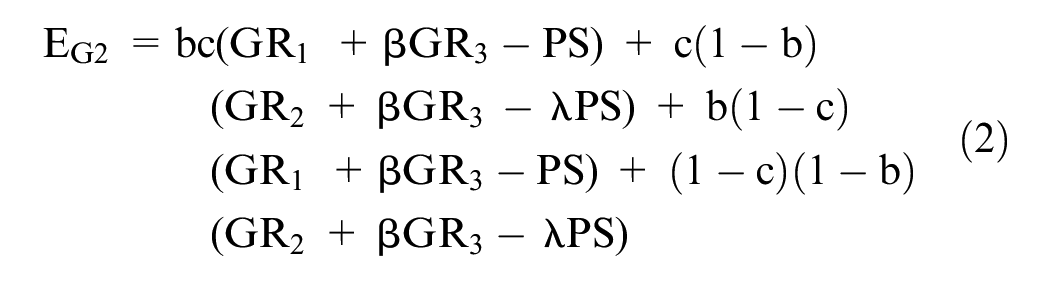
The average expected revenue is as follows:

The differential dynamic equation of the government is as follows:



A manufacturer’s expected revenue from choosing business process innovation is
Now, the manufacturer’s expected revenue from choosing business process innovation is as follows:

The manufacturer expected revenue of choosing traditional business processes is as follows:

The manufacturer’s average expected revenue is as follows:

Now assuming that



The retailer’s expected revenue from choosing environment-friendly bags is
The expected revenue of retailers using environment-friendly bags is as follows:

The expected revenue of retailers using single-use plastic bags is as follows:

The average expected revenue of the retailer is as follows:

The differential dynamic equation of retailers is as follows:


Analysis of Evolutionary Stability Strategies
Based on Equations 6, 12, and 18, the dynamic system equation for the presented game model is as below:

Now, let us assume that

Government-Manufacturer-Retailer Payoff Matrix.

Equilibrium Points and Eigenvalues of the Jacobian Matrix in Correspondence to Each Equilibrium Point.

Table 6 shows equilibrium points and eigenvalues of the Jacobian matrix Eigenvalues show the stability of each equilibrium point. There are three equilibrium points in the three-dimensional dynamic system. When
And
Equilibrium point (1,0,0) shows that
We have analyzed the evolutionary stability strategies of our three-player game model based on the following theorems:
Theorem 1: When
Theorem 2: In the dynamic replicator system of a three-player evolutionary game model, the evolutionary stability strategy will be asymptotically stable, and the asymptotically stable state will be the evolutionary stability strategy.
Proof: In an evolutionary game model, X will be the evolutionary stability strategy if and only if X is a Nash equilibrium and the strategy combination of X is asymptotically stable. This theorem is proved for our model.
These three stable strategies have been analyzed below:

Evolutionary results under Scenario 1.
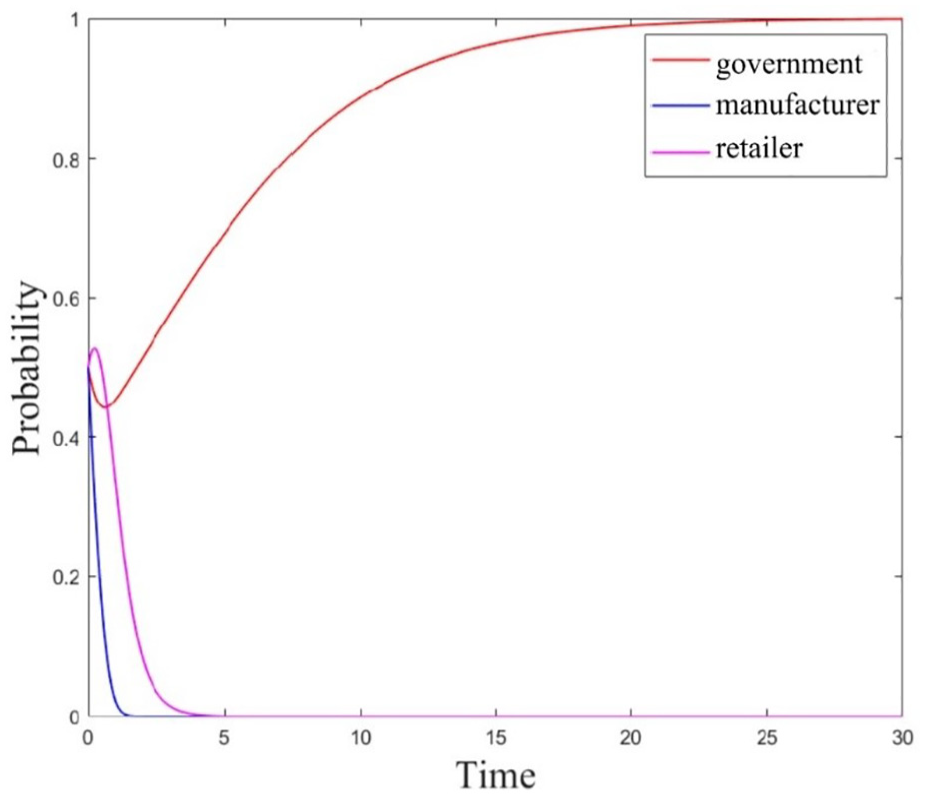
Evolutionary results under Scenario 2.

Evolutionary results under Scenario 3.
Scenario 3 offers the ideal system stability strategy while Scenario 1 and 2 try to identify how that ideal strategy is achieved. Hence, this section has discussed the effect of the important parameters on the system strategy and how each strategy achieves its ideal state. We have looked at the impact of retailer acceptance on evolutionary results under scenario 1, the impact of environmental regulation on evolutionary results under Scenario 2, and lastly, we have looked at the impact of initial strategy of each player on evolutionary results under Scenario 3.
Exploration of Player’s Strategy Evolution Under Different Scenarios
The evolutionary results of each scenario are depicted in Figures 4–6. The combinations under each scenario are (0,0,0) for Scenario 1, (1,0,0) for Scenario 2, and (1,1,1) for Scenario 3. At this point, the evolutionary trend of the retailer strategy is similar to the manufacturer strategy, although the retailer strategy reaches its stable path slower than the manufacturer strategy. Government and manufacturer stability strategy relies on costs and revenues, while retailer strategy depends on whether the manufacturer practices business process innovation. According to the defined parameters under all scenarios, the retailer earns more revenue from using environment-friendly bags as opposed to single-use plastic bags, but the simulation results show a different picture. Scenarios 1 and 2 show that the stability strategy for the retailer would be to use single-use plastic bags, and just under Scenario 3, the stability strategy is to shift to environment-friendly bags. This might be because single-use plastic bags are more in demand by consumers.
Parameter Analysis Through Simulation
This study used MATLAB and Wolfram Mathematica version 11.3 to conduct a simulation analysis of the game theory model to assess each player’s strategy under different conditions. Simulation analysis tests the assumptions set out when defining parameters and constructing the model (Barman et al., 2021; Sana, 2020). For this purpose, the effect of players’ initial strategy, environmental regulations, manufacturer willingness and retailer acceptance on the results of the dynamic evolutionary game are studied.
Impact of Initial Strategy on the Evolutionary Results
The evolutionary results of the three-player game are shown in Figure 7. This figure depicts the results after the probability values (a, b, c) were changed for Scenario 3. It shows how changes in probability can affect the rate at which each player reaches its steady state. The higher the probability (b) of manufacturers adopting business process innovation, the more time it takes for government environmental regulation to reach its steady state. This might happen because if manufacturers have a high probability of practising business process innovation, then the probability of fraudulent acts (λ) will be lower, and government regulation will not be needed.
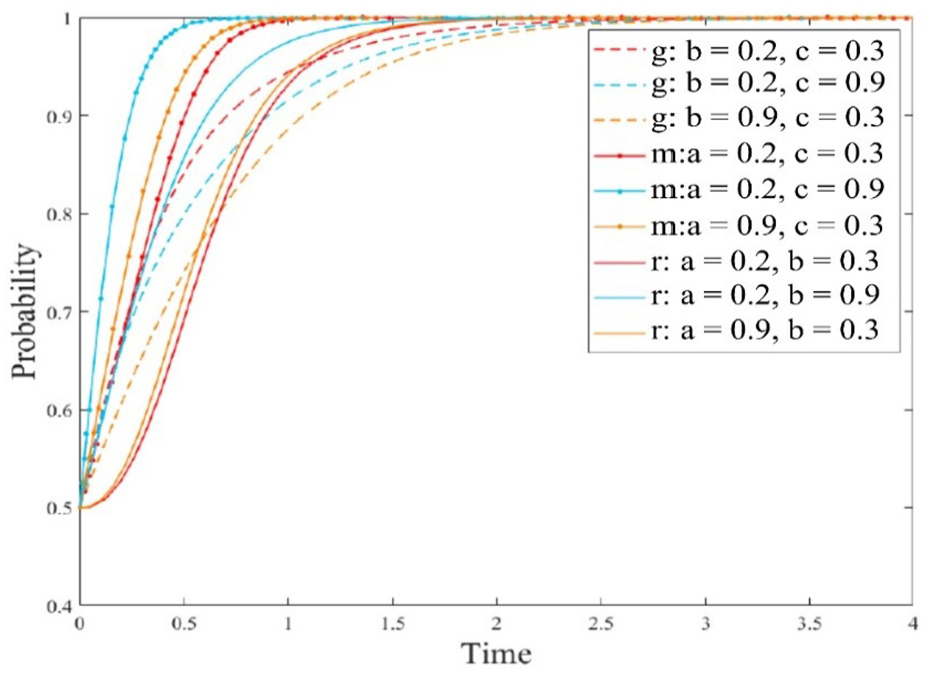
Evolutionary results of strategy with different player’s initial strategy (g: government, m: manufacturer, r: retailer).
Moreover, compared to environmental regulations, retailers have a higher effect on manufacturers’ willingness to adopt business process innovation. This means that the higher the probability of retailers’ acceptance of environment-friendly bags is, the faster the manufacturer will adopt business process innovation to reach a steady state. This happens because manufacturers want to satisfy the demand of the retailers’ direct customers. The strategy of the retailer is affected by the manufacturer’s strategy. The higher the probability of manufacturers adopting business process innovation, the quicker retailers opt for environmentally friendly bags to reach their steady state.
Influence of Government Environmental Regulations on Evolution
Simulation results of Scenario 2 are depicted in Figures 8 and 9. At this point, the strategy is (environmental regulation, manufacturers using traditional business processes, retailers using single-use plastic bags). Figure 8 shows that when the government offers tax incentives and subsidies to manufacture environment-friendly bags after implementing the Pakistan Environment Protection Act of 2019, manufacturers will shift from traditional business processes to sustainable business processes. Similarly, retailers will move away from using single-use plastic bags and toward environment-friendly bags. In contrast, government strategy has shifted to no regulation. This might be because manufacturers have altered their production processes. Furthermore, due to high cost of monitoring and supervising government can move away from imposition of environmental regulations.

Evolutionary results of strategy with different tax incentives and subsidies (PS) (g: government, m: manufacturer, r: retailer) (PS: Tax incentives or production subsidies received by the manufacturers for process innovation after the implementation of Pakistan Environmental protection act of 2019).

Evolutionary results of strategy with different penalties/fines (PE) (g: government, m: manufacturer, r: retailer) (PE: Penalty/fine imposed by the government regulatory authority on plastic bags manufacturers that have not conform to the regulation or either manufactured sub-standard products).
Figure 9 shows that if the government increases the number of penalties charged for violating the Pakistan Environment Protection Act of 2019, it will incentivize manufacturers to adopt business process innovation. Due to high penalties, firms might reduce engaging in fraudulent activities. However, it can increase the government’s monitoring cost, due to which environmental regulation will fall, and a steady-state strategy for the government will be no environmental regulation.
Influence of Retailer Utility on Evolution
This section discusses the effect of retailer utility. As the utility obtained from using environment-friendly bags is proportionate to the positive influence on the retailer, according to the parameter conditions of Scenario 1, we changed the retailer’s utility (RU1). We assessed the effect of the degree of positive influence P1 on manufacturers simultaneously under different scenarios.
Figure 10 depicts the retailer utility’s effect of using environmentally friendly bags on the government’s strategy. Retailer utility has a negligible impact on government strategy because external factors do not influence government decisions, but they are based on its cost-benefit analysis.

Evolutionary results of the strategy of the government.
Figure 11 shows that the threshold value

Evolutionary results of strategies of manufacturer and retailer (m: manufacturer, r: retailer) (RU1: retailer’s utility from using environment-friendly bags, degree of positive influence on retailer of business process innovation).
Influence of Retailer Acceptance on Evolution
Now, we have set our parameter setting so that retailer acceptance and RA are used to analyze system evolution results. These results are shown in Figures 12 and 13. Figure 12 shows that a high value of RA means that the government approaches its steady state quickly, but RA does not change government strategy from no environmental regulation to environmental regulation. This might be because retailer acceptance does not directly influence government strategy, and it mainly revolves around costs and revenue associated with imposing environmental regulations.

Evolutionary results of government strategy (RA: Retailer acceptance of environment-friendly bags).

Evolutionary results of manufacturer and retailer strategies (m: manufacturer, r: retailer).
Furthermore, Figure 13 shows that the threshold value of
Discussion of Results
This section discusses more comprehensive application of the results and policy implications.
After applying evolutionary game model analysis, three stable strategies were identified. According to H1 and H2, government had the option to either impose environmental regulation or ignore it, similarly the manufacturers have the option to use sustainable business processes or to stick with traditional processes. The results of the evolutionary game model and simulation analysis show that when supervision costs of the government are higher than the reputation revenue then there is no incentive for the government to impose environmental regulations. In their paper on pollution control measures in China, Zhou et al. (2022) have shown a similar outcome of evolutionary game model analysis.
In hypothesis H3, when cost of supervision for government is low and reputation revenue from enforcing Pakistan environment protection act of 2019 is higher than the government opts for imposition of the law, moreover, findings show that manufacturers are incentivized to adopt sustainable business process innovation if they earn more revenuer through it.
Analysis for hypothesis H4, H5, and H6 revealed that the retailer strategy is significantly affected by manufacturer strategy because single-use plastic bags are considered necessary. This indicates that manufacturers are essential players in the distribution and production of single-use plastic bags, due to which government should impose regulations.
Results from simulation analysis have shown that tax incentives and subsidies are a better option for the government compared to a complete ban which might lead to increased supervision costs. As depicted in Figure 8, increasing tax incentives or subsidies leads to usage of sustainable business processes by firms and environmentally friendly bags by retailers.
When P1 > µ (0.8 < µ < 0.9) and when
Outcomes from the survey analysis have shown that on the retailer front, those retailers with multiple branches and in the public’s, eye are using non-woven bags instead of single-use plastic bags to avoid criticism from the public. In contrast, small retailers residing in the wholesale markets of Rawalpindi and Lahore have continued using single-use plastic bags. Therefore, if subsidies are provided to retailers, then they might also shift to biodegradable bags.
In conclusion, manufacturers should take the first step to protect the environment by using sustainable business processes. This way there will be increased acceptance in retailers of plastic bags. Moreover, firms should navigate the general opinion on adoption of biodegradable bags by making them widely available, which will only be possible through business process innovation. Government should also create awareness among the public of the ecologically damaging effects of single-use plastic bags
Conclusion, Policy Implication, Limitation, and Future Research Direction
Conclusion
This paper constructs a three-player dynamic replicator evolutionary game model in which government, plastic bag manufacturers and retailers are the leading players. This model was constructed to evaluate the effects of the Pakistan Environment Protection Act of 2019. In this model, we looked at the changes in manufacturer strategy in response to changes in strategy of government and retailers. Moreover, through simulation analysis this paper looked at the evolution of different player’s strategies under different scenarios and its influence each player’s initial strategy. The few conclusions that were drawn from this exercise were, firstly, that government strategy is not influenced by outside factors but depends on own costs and revenues.
In contrast, the manufacturing strategy is dependent on the retailer strategy. If the government offers subsidies to manufacturers, then they can invest in business process innovation, which will be ecologically beneficial, but if manufacturers are penalized for fraudulent practices, then environmental regulation might not be effective because of high monitoring and supervision costs. Lastly, retailers’ views about environmentally friendly bags are important in influencing business decisions. For further support of the findings, we conducted a survey analysis of manufacturers and retailers based in Lahore and Islamabad which are two major metropolitan cities of Pakistan. We found out that the ban is more strictly implemented and followed in Islamabad which is also the capital of Pakistan. In contrast, manufacturers and retailers in Lahore are more relaxed and only few of them have adopted process innovation after the introduction of the plastic ban. The findings of this paper have shown the need for the development of a systematic regulation which not only involves placing a ban but also provides sufficient incentive to manufacturers and retailers to shift to sustainable production and consumption methods.
Policy Implications
Environmental regulations imposed by the government have a long-term impact on multiple fronts. At a macro level, it leads to the achievement of sustainable goals as is reflected in the manufacturer element where the manufacturer will adopt sustainable business processes, whereas at the retailer front, they will go for environmentally friendly bags. This will facilitate a national transition aiming toward a circular economy. Adopting this strategy has global implications because internationally, most developed economies have moved away from using traditional methods that produce carbon emissions by adhering to environment-friendly practices. The findings of this study carry significant implications for managers. The managers of manufacturing firms will adopt innovative process manufacturing if the government provides subsidies for it. Otherwise, there is an increased motive to ignore environmental regulations. In order to promote a circular economy, the government should take manufacturers and retailers into confidence so that everyone is on board with the new laws. The results of this paper indicate the importance of curbing plastic pollution. Government and regulatory bodies should provide import subsidies to manufacturers to encourage them to manufacture environment-friendly bags.
Limitations
This paper has a few limitations which future researchers can address.
The model which was used in this paper carries its own set of limitations similar to all mathematical models, that is the assumption that equations are defined by idealized situations of three-player games, in reality, can have two players or four players, or we can have interaction of all players involved in the supply chain mechanism (Sanders, 2020) of plastic bag manufactMSPuring.
In this paper, we have focused on Pakistan’s Lahore and Islamabad regions and looked at a few wholesale markets because of time limitations. Thus, solutions cannot be generalized to other regions. The sample size was relatively small for empirical analysis.
When looking at the effects of retailer strategy, we did not consider retailers’ corporate social responsibility objectives, which can alter their behaviour towards single-use plastic bags. Furthermore, the perspective of consumption patterns has yet to be incorporated.
This study did not conduct a cross-country comparison of alterations in consumption and production patterns after the ban on single-use plastic bags.
In addition to this, we did not calculate Skiba points (Fortin et al., 2020) to study the differences in government, manufacturing, and retailer strategy across a dynamic period.
Future Research Direction
Future research can incorporate more regions of Pakistan and draw a comparison of manufacturer strategies before and after implementing the Pakistan Environment Protection Act of 2019. Future researchers can construct a four-player dynamic evolutionary game model by incorporating a consumer perspective. In addition, future researchers can also study consumption patterns across different countries where a similar ban is imposed. While determining system evolutionary strategy, future researchers can calculate Skiba points to study strategies across a dynamic period.
Footnotes
Appendix
Authors’ Contribution
Saba Fazal Firdousi: Conceptualization and methodology, Beenish Amir: Writing-original draft preparation, software, formal Analysis, and Ayesha Afzal: Reviewing and editing the final draft.
Declaration of Conflicting Interests
The author(s) declared no potential conflicts of interest with respect to the research, authorship, and/or publication of this article.
Funding
The author(s) received no financial support for the research, authorship, and/or publication of this article.
Ethics Approval
The Lahore School of Economics review board exempted the research from ethical approval as it was a survey-based study.
Consent for Publication
Informed consent was obtained from all subjects involved in the study while collecting the data through survey.

Data Availability Statement
The data and materials will be made available upon request.