




Abstract
This paper aims to investigate the relationship between manufacturing industry transfer and land use efficiency in china. Our study found that industrial transfer does not have a significant impact on land use efficiency in the full sample. However, when differentiating between the direction of manufacturing transfer, we found that in areas where manufacturing moves out, it inhibits land use efficiency significantly. Whereas in areas where manufacturing moves in, it has no significant impact on land use efficiency. We further analyzed the impact of manufacturing adjustment range and adjustment quality on land use efficiency. The results show that manufacturing structure adjustment has a positive impact on land use efficiency in the full sample and manufacturing immigration areas. In manufacturing emigration areas, manufacturing adjustment quality inhibits land use efficiency significantly, while manufacturing adjustment range improves land use efficiency significantly. Based on these findings, we suggest some policy recommendations to improve land use efficiency through manufacturing transfer.
Introduction
As one of the fundamental pillars of resources, policies, accomplishments, and systems, land reflects the trajectory of urban construction and growth. The rational utilization of land is directly linked to the sustainable development of a region. The manufacturing industry plays a crucial role in the allocation and utilization of land, affecting a country’s industrial development and technological progress (Estoque et al., 2021; Huang et al., 2017). It is evident that the manufacturing industry determines the long-term development potential of a country or region. Therefore, while the allocation of land resources affects the manufacturing industry’s development, the manufacturing industry also impacts the land use structure and spatial layout, eventually leading to the scientific allocation and rational utilization of land resources (Kuang et al., 2020), that is, land use efficiency.
Land use is a complex and selective behavior, with different land use patterns providing varying social, economic, and environmental benefits (Ahmed et al., 2020). Assigning industries with low economic benefits to locations with high geographical advantages not only wastes limited land resources but also hinders healthy and rapid economic development. Therefore, land serves as the carrier of manufacturing development (T. Ding et al., 2021), and improving land use efficiency requires continuous optimization of land use structure, promotion of industrial structure adjustment and upgrading, and concentration of advantageous industries in the most suitable locations. Moreover, the development of the manufacturing industry significantly impacts land use structure, layout, and patterns (Lambin & Meyfroidt, 2011). Changes in the manufacturing industry’s development (Wu et al., 2023) also exhibit high sensitivity to land use, which affects the level of land use efficiency.
The transfer of the manufacturing industry is a significant aspect of industrial structure adjustment. The manufacturing industry has facilitated the transnational or transregional transfer of manufacturing industries worldwide. The transregional transfer of the manufacturing industry makes it easier for countries to shed the burden of relatively backward industries and focus on human, financial, and material resources (Han & Jiang, 2022), to develop innovative industries with high added value and advanced technology (J. Ding et al., 2022), and to expedite the regional manufacturing industry’s upgrading. Furthermore, the transregional transfer of the manufacturing industry has brought development opportunities for underdeveloped countries to undertake industrial transfer, to introduce relatively advanced industries, and to access technologies at a lower cost (Yang et al., 2009). The transfer of manufacturing industries in different countries has resulted in not only the improvement of the industrial structure’s level (Barbier & Hochard, 2016), but also a change in the quantity and structure of land use in spatial layout, reflecting the value of land use and the rationality of spatial layout.
While the previous research has contributed significantly to the understanding of land use efficiency, there are still some limitations that need to be addressed: (1) The research on the direct effect of industrial structure on land use efficiency is abundant, but there is a lack of attention given to the nonlinear relationships and spatial effects between them, leading to the absence of a unified theoretical analysis framework; (2) Most studies primarily focus on various countries or regions, with a lack of research on international organizations or globally significant countries; (3) The transfer of manufacturing is a dynamic process, yet there is a dearth of comprehensive analysis regarding the long-term and short-term, direct, and indirect effects of manufacturing transfer on land use efficiency.
This paper potentially proposes several innovative insights, including: (1) Discussing the impact of industrial transfer on land use efficiency while also examining the effects of other factors on land use efficiency; (2) Analyzing the impact of developed region and developing region on land use efficiency using dynamic spatial models, moving beyond the traditional static approach used by previous research; and (3) Investigating the impact of industrial transfer on land use efficiency from multiple perspectives, including the adjustment range and quality of manufacturing industry and the perspective of manufacturing industry moving in and out.
Theoretical Mechanism
“Coercion Mechanism” of Manufacturing Transfer
The theory of industrial structure evolution suggests that the three major industrial structures tend to evolve gradually from the order of the first, second, and third industries to the second, third, and first industries and ultimately to the third, second, and first industries (König et al., 2013). The manufacturing industry serves as the backbone of the real economy. To cater to its development needs, countries globally make adjustments to the land use structure during the manufacturing industry’s growth. This is evident in the gradual increase in land area of the secondary and tertiary industries. Under constant land resources, the primary industry’s land area continuously faces “tension” or “squeezing,” which presents as the “coercion mechanism” (Lu et al., 2018; Noda et al., 2019). The changing industrial structure leads to changes in regional land structure.
Based on the theory of industrial location, enterprises should strive for Pareto optimality in terms of efficiency and choose suitable locations to prevent the wastage of land resources. In the case of manufacturing industry transfer, the reallocation of land resources among various production sectors (Xie et al., 2018) or the reorganization of land use structure (Su & Jiang, 2021) occurs, leading to changes in land use structure, which inevitably results in changes in land use efficiency. If the industrialization process in a given region accelerates and the scale of the manufacturing industry changes, the manufacturing industry’s demand for urban construction land changes correspondingly. Given constant construction land availability in the region, only the conversion of agricultural land into industrial land can meet the industry’s demands. This results in a decrease in land use area in the primary industry and an increase in land use area in the manufacturing industry, leading to a change in the inherent structure or nature of the original land in the region and introducing a “stress effect” on the new land use and ecological environment.
Hypothesis 1: The “coercion effect” of manufacturing transfer leads to changes in the land use structure, which impacts the land use efficiency.
The “Promotion Mechanism” of Manufacturing Transfer
Modern economic development is characterized by industrial growth, a transition from quantitative to qualitative progress. The transfer of personnel from primary to secondary and tertiary industries accelerates due to the shift in manufacturing, resulting in increased labor available for further industries. As a consequence of this industrial or demographic cluster, the demand for related services and support facilities increases, necessitating changes in the surrounding land use structure (Searchinger et al., 2018; Noda et al., 2019; D. Zhu et al., 2022). Thus, in the process of industry transfer, the focus of development shifts from primary to secondary and tertiary industries, causing land supply pressure. However, the redistribution of land resources stimulates the transfer of industries from lower revenue to higher revenue, increasing the revenue per unit of land (Xie & Wang, 2015), ultimately improving overall land use efficiency.
The spatial change in the urban land use structure is attributed to industrial competition, as suggested by location theory and land rent theory. The adjustment and upgrading of manufacturing industry have led to the gradual replacement of traditional industrial projects with modern service industry, resulting in changes in the number of land use structures (Voget-Kleschin & Stephan, 2013; Liu & Zhao, 2022). This shift is characterized by a decrease in the proportion of industrial and residential, storage and other functional land areas in the urban center, and an increase in the proportion of commercial services, transportation, and other land areas, which ultimately increase the building density and floor area ratio. Consequently, economic benefits correspondingly increase, while the level of land use intensification improves (Pascual, 2015). Thus, the transfer of manufacturing industry reduces the absolute use of land resources required by industrial development and improves the unit efficiency of land use.
Hypothesis 2: The transfer of manufacturing industry can lead to changes in land use structure, ultimately improving land use efficiency.
Mutual “Restraining Effect” Between Land Use and Manufacturing Development
The process of industrialization and the development of new industries require sufficient land resources to expand their scale. When the demand for industrial land increases, land resources are limited by the protection of cultivated land and the ecological environment, making it difficult to provide adequate development space. This, in turn, can limit the development of manufacturing industry. Therefore, when adjusting the industrial structure, it’s crucial to ensure that there are sufficient land resources available. If not, the upgrading of the industrial structure may be inhibited (Valerio et al., 2015; Wolfersberger et al., 2015). Furthermore, during the process of manufacturing industry transfer, differential land benefits in urban areas can lead to concentration of various spatial economic elements in the city center. In accordance with the principle of balanced supply and demand in the market, land prices in the urban center will rise, resulting in exclusion of industries with low added value from the center, pushing them to the edge of the town and eventually to the periphery. As a result, the upgrading of the manufacturing industry can have an “inhibitory effect” on the original manufacturing industry.
In summary, the relationship between land use efficiency and industrial structure can have both positive and negative effects (Chivu et al., 2020; Haygarth & Ritz, 2009When the land use structure is coordinated with the development of the industrial structure, the adjustment of the industrial structure promotes the change of the land use structure or efficiency. However, when the land use structure is not coordinated with the development of the industrial structure, such as when industrial expansion exceeds the land carrying limit, the adjustment of the industrial structure can stress the land use structure and lead to a feedback effect on industrial development, causing an inhibitory effect. Consequently, industrial structure and land use efficiency are interdependent, and their relationship is interactive.
Hypothesis 3: The mutual “inhibitory effect” between the development of manufacturing industry and land use makes it uncertain how manufacturing industry transfer would impact land use efficiency.
Research Design
Variable Description
Land Use Efficiency
In this paper, land use efficiency is defined as achieving the highest economic output as the primary objective within the framework of maximum land utilization. The land use efficiency index is defined based on input-output measurements, as observed in studies by Tu et al. (2014), Z. Wang et al. (2018), Wu et al. (2022) and others. Since variable returns to scale have greater practical value in enterprise production and decision-making compared to constant returns to scale, an output-oriented model is defined. Scholars have not yet reached a consensus on the choice of scale remuneration. Thus, to overcome the limitations of traditional index evaluation methods, this paper utilizes the Data Envelopment Analysis (DEA) method, more suitable for the characteristics of land input-output. Consequently, this study utilizes the output-oriented non-radial super-efficiency model (Super-SBM-O-V) under the assumption of variable returns to scale to measure land use efficiency, with the indicators shown in Table 1.
Indicators of Land Use Efficiency.

Manufacturing Transfer
Manufacturing industry transfer refers to the spatial distribution of industries over different periods and areas. Currently, there exist variations in the identification methods of manufacturing transfer. Developed countries generally have detailed enterprise management information and directly determine the direction and scale of manufacturing transfer based on the geographical and scale changes of enterprises. However, developing countries often lack such data and rely on indirect indicators to measure the degree of transfer (Han & Jiang, 2022). These indicators include location entropy, absolute share index, Herfindahl-Hirschman index (HHI), industrial gradient coefficient, and so on. To more comprehensively describe the reality of industrial transfer between countries, this study refers to the research method by Han and Jiang (2022). This method measures the proportion of a country or region’s economic size relative to the overall economic size of the country, manufacturing output value and the number of manufacturing enterprises. This method not only reflects the expansion or contraction of a country’s industrial factors of production but also the spatial flow of the number of enterprises, thereby eliminating the error caused by changes in regional production conditions to the industry share, with the calculation method outlined as follows:

where,
Control Variables
Based on the preceding literature, we select control variables that adhere to the principles of representativeness and data availability. The influential economic and institutional measures are chosen as important endogenous variables that affect land use efficiency. The selected control variables are as follows:
(1) Level of economic development
The data are from the China Statistical Yearbook, China Energy Statistical Yearbook, China Science and Technology Statistical Yearbook, and China Industrial Economy Statistical Yearbook.
Benchmark Model
To examine the impact of manufacturing industry transfer on land use efficiency, we first constructed the following benchmark test models.
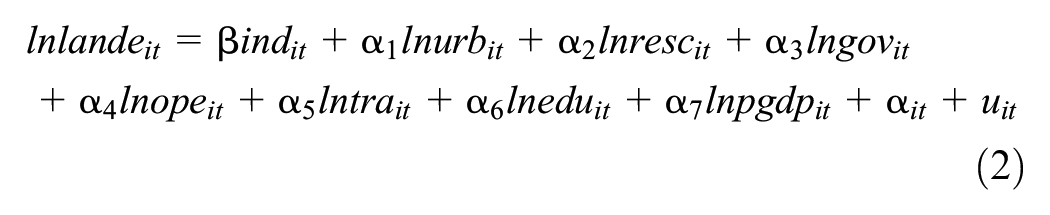
Where
Spatial Metrology Modeling
The transfer of manufacturing industries between different countries is impacted by economic development, changes in industrial structures, technology spillover, population flow, interregional trade transactions, market division and cooperation, and other factors (Xie & Wang, 2015). Thus, industrial transfers exhibit strong spatiotemporal characteristics. With the development of information and the efficient use and sharing of resources, the geographical distance between economic entities is reduced, leading to increased information exchange and knowledge socialization (Minten et al., 2007). Hence, the transfer of manufacturing industries not only reflects the influence of regional factors but is also subject to the dynamic spatial patterns of other regional factors (Ord et al., 2010; X. Zhu et al., 2019). Neglecting the correlation of spatial factors could result in analytical errors. Therefore, in addition to the benchmark regression model, this paper employs a spatial econometric model.


where
When
When
When
Moreover, if we choose the spatial Durbin model, its spatial lag term complicates the interpretation of parameters, making it challenging to provide a clear explanation of the explained variables. From the perspective of the partial differential of the SDM model, we need to decompose the impact of independent variables on dependent variables into direct and indirect effects, in order to portray the spatial impact better. The SDM model can be transformed into the following vector form:

The partial differential matrix of explained variable Y to variable k in the explanatory variables
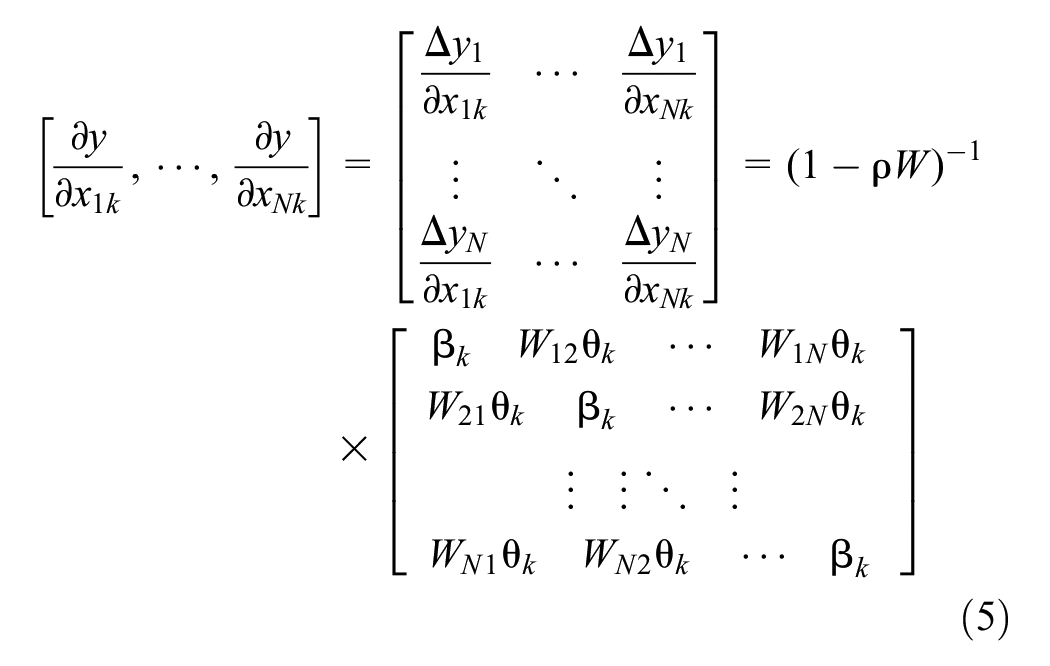
In model (5), the direct utility corresponds to the mean value of the diagonal elements of the matrix, while the mean sum of non-principal diagonal elements in each row or column represents the indirect effect. This indicates that the direct and indirect effects resulting from changes in the explanatory variable of a specific spatial individual on itself, or on different spatial individuals are different. Building on the aforementioned analysis, we have constructed a spatial measurement model that examines the impact of manufacturing transfer on land use efficiency.
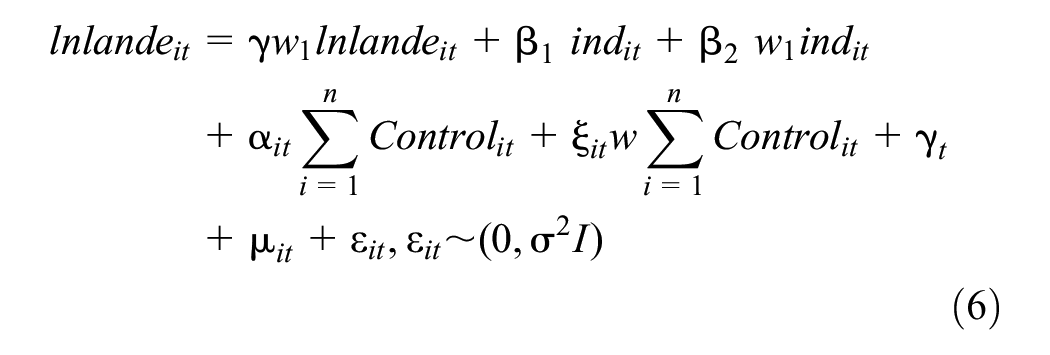
where, the explanation variable and the explained variable are the same as the above formula,
Because the weight of economic distance can reflect the difference level of economic development among different regions to a certain extent. The most important factor of manufacturing transfer is the difference of national economic development level, so
Results
This section begins by analyzing the spatial effect of the benchmark model and subsequently tests the same for the core variable. Based on these results, a spatial calculation model is chosen to further analyze the spatial effect. The transfer of the production industry is then divided into transfer to and out of the country, based on which the impact of the transfer direction on land use efficiency is analyzed under different circumstances. Finally, a robustness test is performed to assess the potential endogeneity and measurement error.
Benchmark Regression Results and Analysis
The benchmark panel regression is selected before analyzing the spatial effect of manufacturing transfer on land use efficiency. Control variables are gradually added to maintain the robustness of the explained variables, and the results are presented in Table 2.
Benchmark Panel Regression.

The regression results of the benchmark panel indicate that manufacturing transfer has no significant impact on land use efficiency without considering the control variables (Table 2. model (1)), validating hypothesis 3.
Even after adding control variables, manufacturing transfer still has no significant impact on land use efficiency. This can be attributed to urban construction in most countries, which focuses on extension and expansion without proper supervision and guidance, resulting in a “hollowing out” phenomenon and land waste. In less developed areas, land is often viewed as a preferential condition for attracting investment, leading to speculation and low land use efficiency. Gao et al. (2014) suggest that some land-use units consider completing the assessment target and do not restrict subsequent development, leading to speculation and low land use efficiency. Some enterprises occupy land without utilizing it or build “garden-style” factories, lowering land output efficiency. Additionally, enterprises often try to occupy more land during investment negotiations, leaving the land unoccupied. According to Gao et al. (2014), some land-use units believe completing the assessment target is sufficient and do not restrict subsequent development, resulting in speculation and low land use efficiency. Furthermore, some enterprises occupy land without utilizing it or build “garden-style” factories that integrate production, office work, food and lodging, leading to low actual investment and land output efficiency. Additionally, during enterprise development, the eagerness to attract foreign investment often leads to the occupation of more land, leaving it unoccupied.
Based on the regression results of the control variables, we observe that economic development, opening to the outside world, and infrastructure construction significantly enhance land use efficiency. Therefore, we conclude that economic development is a major driving force behind land use change. Social and economic progress is primarily indicated by economic output, investment development, and urban construction. The urban land use pattern is a byproduct of urban economic development. Infrastructure construction promotes the concentration of productive forces. As the economy continually develops and productivity levels increase, the output value of land per unit area increases, resulting in improved land use efficiency. From the perspective of opening to the outside world, it not only increases a country’s capital stock but also indirectly encourages enterprises to expand their investment scale. The expansion of capital scale, in turn, promotes enterprises to invest in new ventures, thereby creating new increases in capital. Additionally, opening to the outside world accelerates the optimization and upgrading of a country’s industrial structure, resulting in increased output value of land per unit area and enhanced land use efficiency. Based on Table 2, it is evident that urbanization and government intervention exert a significant negative impact on land use efficiency. This is due to the fact that urbanization propels the expansion of urban areas, resulting in an increase in the size of the urban built-up area. However, the growth of the urban built-up area does not always lead to a corresponding improvement in land use efficiency. With regard to government intervention, the allocation of land resources still operates under administrative intervention. Administrative intervention frequently results in wasteful urban land use and management practices, which in turn results in market failure. Consequently, government intervention at times leads to ineffective resource allocation, which generally diminishes land use efficiency.
Spatial Effect Analysis
Spatial Correlation Test
In section 4.1, we examined the impact of manufacturing transfer on land use efficiency using the general panel model. However, given the intricate interconnections within economic systems, traditional regression methods may result in estimation errors and analysis deviations. Therefore, it is essential to investigate the spatial effect of land use efficiency through spatial measurement. To select an appropriate spatial measurement method, it is necessary to first test for spatial correlation. If spatial correlation exists between variables, the spatial econometric model can effectively address the issue. In the absence of spatial correlation, traditional methods can be used for analysis. In Section 5.1, we further analyze the spatial effect of manufacturing adjustment range and quality on land use efficiency. To this end, we conducted a Moran’s I test, as shown in Figure 1.

Test result of Moran’s I.
Figure 1 presents the results of the Moran’s I test, which indicate that land use efficiency (lande) values from 2000 to 2021 have a Moran’s I value ranging between 0.2 and 0.3, except for 2019. In most years, the p values are less than .05. Moreover, the Moran’s I value of manufacturing transfer (ind) ranges from 0.1 to 0.4, and the significance (p-value) of manufacturing transfer is mostly below the .05 line. The Moran’s I value of manufacturing adjustment range (ran) shows slight fluctuations from 2000 to 2009, but fluctuates considerably from 2009 to 2019. On the other hand, the Moran’s I value of manufacturing industry’s adjusted quality (qua) exhibits significant fluctuations before 2008, but after 2008, the Moran’s I value is between 0.2 and 0.3. Although the significance (p-value) of each year failed to pass the significance, the p-values of other years were all less than .05. Accordingly, it can be inferred that manufacturing industry transfer, manufacturing structure adjustment, and land use efficiency do not exhibit complete random characteristics but instead display obvious spatial correlation features.
Having established the presence of spatial correlation among the variables, it is necessary to select an appropriate spatial econometric model for analysis. The selection of a spatial fixation, temporal fixation, or dual fixation effect is determined by various testing methods, based on the classification of spatial econometric models. Based on the results of the spatial measurement model test in Table 3, both LM-error and LM-lag failed at a significance level of 5%, which requires further testing using Robust-LM-lag and Robust-LM-err. Similarly, Robust-LM-lag and Robust-LM-err did not reach significance at the 5% significance level. Based on the SDM model degradation test, it was observed that the SDM model could not be degraded to SEM or SAR, and hence the SDM model was selected for analysis.
Spatial Econometric Model Selection Test.

Spatial Spillover Effect Analysis
According to the results of SDM regression selected in Table 4, the lag period of land use efficiency is significantly positive, indicating that there is a time lag effect of land use efficiency. Through the spatial spillover effect, the goodness-of-fit coefficient is 0.584, which is slightly higher than the goodness-of-fit of ordinary panel regression, indicating that the fitting effect of spatial dobbin model is better than that of ordinary panel model. Specifically, the significance of core explanatory variable (manufacturing transfer) on land use efficiency is still not significant, indicating that after considering the spatial effect, this also validates hypothesis 3, manufacturing transfer has no significant impact on land use efficiency. By comparing the spatial panel regression results of the control variables with the ordinary panel regression results, it is found that their significance and coefficient direction have not changed. As the control variables are not the focus of this paper, the interpretation of the above-mentioned benchmark model shall prevail and will not be repeated here. At the same time, it is also found that the significance of the spatial lag term between manufacturing transfer and other control variables is not high, but because the regression coefficient of the spatial model lag term often cannot fully reflect the influence of independent variables on dependent variables, the spatial spillover effect needs to be explained by decomposing it into direct effect, indirect effect and total effect.
Decomposition of Spatial Effect of Land Use Efficiency.

, **, and * are significant at the levels of 1%, 5%, and 10% respectively; Z statistics are in parentheses.
Table 4 presents the effect decomposition of the spatial Durbin model. The direct effect and total effect of manufacturing transfer are not significant, indicating that manufacturing transfer has no significant impact on land use efficiency in China under the condition of the full sample. The indirect effect of manufacturing transfer in “neighboring” areas is also not significant, implying that it has no significant effect on the land use efficiency of their respective areas. Furthermore, the effect of control variables was also decomposed. The direct effect of government regulation significantly inhibits the land use efficiency of China. However, its indirect spillover effect is not significant, suggesting that government policies have a significant influence on the land use efficiency of China and not that of neighboring areas. Additionally, the direct effects of opening up to the outside world and infrastructure construction have significantly promoted the land use efficiency of China. However, their indirect effects are not significant. Therefore, domestic factors remain the main reason for affecting land efficiency in China.
Through the above research, it is found that the land use efficiency of manufacturing transfer has no significant effect without distinguishing the direction of manufacturing transfer. Under the condition of not controlling the direction of other variables, the manufacturing industry is divided into net inflow areas and net outflow areas, and the impact of the transfer direction of manufacturing industry on land use efficiency is investigated respectively. As the unbalanced panel data cannot be measured spatially, the data is truncated to the balanced panel data and then estimated. The regression results are shown in Table 5.
Estimation of Impact on Land Use Efficiency by Distinguishing the Direction of Manufacturing Transfer.

Table 5 reveals the results after distinguishing the areas from which the manufacturing industry moves in and out. Firstly, from the perspective of areas from which the manufacturing industry moves out, the lag phase of land use efficiency remains significantly positive (0.523), whereas the transfer of the manufacturing industry has a significantly negative effect (−1.398). This suggests that the outward movement of the manufacturing industry significantly inhibits the improvement of land use efficiency. The outward movement of the manufacturing industry is known to bring adverse effects to land use in both developed and developing countries (Tinker, 1997). Developing countries, such as China, Brazil, and Russia, have relatively large manufacturing bases. However, their industrial bases are relatively weak, and their manufacturing industries are not as strong as those in developed areas. Furthermore, their enterprises’ ability to resist risks is relatively weak. Therefore, when the manufacturing industry moves out of these areas, the hollowing-out effect is more pronounced. It results in the withdrawal of capital, technology, and other essential elements from the real economy (Tahir et al., 2020). The core manufacturing department will also withdraw from the transfer-out place and invest in the industrial undertaking place. The withdrawal of capital, technology, and other elements can easily result in the hollowing-out of the industry. This further weakens the input, supply, and output of manufacturing enterprises in the exporting areas. It leads to a lack of investment in research and development in the manufacturing sector and a dearth of innovation among enterprises, thereby reducing the regional innovation output. The decline in regional innovation output causes a decrease in social wealth output and a reduction in output value per unit land area. All of these factors significantly inhibit the improvement of land efficiency for manufacturing industries moving out of the country.
Secondly, for the manufacturing industry moving into the country; In the process of moving in, the manufacturing industry has optimized its industrial structure. The trans-regional transfer of manufacturing industry coordinates different factor endowments in the region within each country through economic and trade exchanges, technology input, capital flows, and other ways, giving full play to the comparative advantages of manufacturing industry in technology research and development, brand image, and marketing. In addition, the manufacturing industry moves into the country and gradually evolves through the production process sequence of labor, capital, knowledge and technology, service industry, and industrial value chain (Barbosa et al., 2015).
The change in the proportion of input factors of various industries, as well as the development of the manufacturing industry and agglomeration, not only enhance the skill level of the labor force but also enable the regional workforce to adapt more effectively to changes in the industrial structure. Therefore, for countries where the manufacturing industry moves in, the move-in of the manufacturing industry not only enhances the skills of the labor force but also, more importantly, boosts the regional innovation output per unit land area and the level of economic development, and improves the land use efficiency. This validates Hypotheses 1 and 2.
Robustness Test
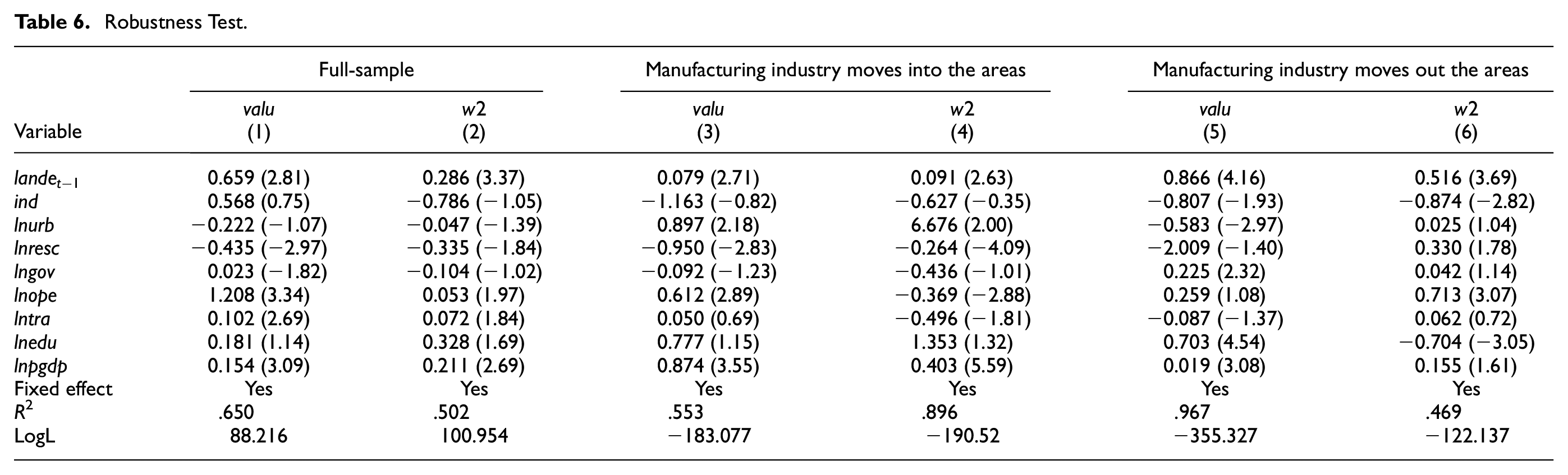
Given the potential for errors in model setting and variable selection, which could impact the reliability of regression results, this study aims to further test the robustness of manufacturing transfer to land use efficiency. To achieve this goal, we substitute land use efficiency with the value added per unit of GDP (valu) of the built-up area. Additionally, we replace the economic distance matrix with a traffic distance matrix (w2) between one capital and another capital, where the traffic distance matrix is calculated as
Table 6 presents the estimation results of the robustness test. We observe that the direction and significance of the regression results of the core explanatory variables remain unchanged after replacing land use efficiency with the unit GDP increment of the built-up area, under full sample conditions (from Model (1) to Model (2)). The significance of the manufacturing transfer variable is slightly altered after replacing the spatial economic weight with the spatial distance weight matrix. However, the change characteristics of the main variables remain consistent with the benchmark regression model, thereby verifying the robustness of our regression results. The robustness test results for distinguishing manufacturing industries moving in and out of the areas (from models (3) to (6)) reveal that the regression results for manufacturing industry move-in on land use efficiency are consistent across regions, while the regression results for manufacturing industry move-out under transportation distance are consistent with the results presented in Table 4. These findings indicate that the transfer of manufacturing industry is not solely related to national economic development levels, but is also influenced by migration distance. Furthermore, through controlling variables, we observe that the symbols and significance of variables remain robust. However, the details are limited by space and are not explained in full.
Robustness Test.
Further Analysis
Throughout the development of human society, a new scientific and technological revolution and an ascendant industrial transformation are often accompanied by one another. Scientific and technological progress and industrial transformation are interdependent, and through the effects of industrial connection and technological diffusion, emerging industries often surpass traditional industries, gradually becoming the leading industries in the industrial system. This accelerates the evolution of the industrial structure to a higher level, presenting new features and providing transformation and upgrading approaches. In this process, the change of industrial structure profoundly affects the land use structure and spatial layout, as illustrated in Figure 2. This in turn affects the use of land resources, as noted by Breuste et al. (2015) and Masini et al. (2019). For instance, the direction of adjustment of manufacturing structure determines the characteristics of land use, while the extent of adjustment of the manufacturing industry determines the scale of land use. Therefore, the adjustment of manufacturing structure is reflected in the corresponding change of land use, which is manifested as the reallocation of land resources among different industrial sectors. This reallocation constitutes an essential part of land use efficiency.

The impact mechanism of manufacturing structure adjustment on land use efficiency.
From the perspective of the influencing mechanism (Figure 2), on the one hand, the adjustment of industrial structure aims to promote the transformation of more agricultural labor force into the secondary and tertiary industries, which is facilitated by the accelerated development of cities. This promotes the continuous upgrading of the industrial structure and ultimately leads to the change of land use structure and nature. As observed in studies conducted by Bryan et al. (2015) and Pili et al. (2017), this phenomenon results in changes to the quantity, structure, and spatial layout of land use, as well as the continuous enhancement of the intensive degree of land use. As a result of the adjustment of industrial structure, a large number of agricultural productive lands, such as cultivated and forested lands, and scattered rural residential lands are transformed into non-agricultural lands, such as urban and industrial and mining lands. This transformation leads to a decline in the proportion of primary industries, while the proportion of secondary and tertiary industries and their land is greatly increased, ultimately resulting in a change in land use efficiency. Moreover, the adjustment of industrial structure also causes changes in the land market, technical means, and transportation conditions, among other factors. These changes have a significant impact on various types of industrial land use and increase the pressure on the adjustment of land use structure. As a result, the spatial layout of land resources is also affected.
Construction of Indicators
Adjustment Range of Manufacturing Structure
To gauge the magnitude index of manufacturing structure, we refer to the work of Findeisen et al. (2008). The research method utilized by Han and Jiang (2022) could be employed to assess the adjustment range of manufacturing structure. Specifically, such methods involve measuring the intensity of the reallocation of total employment within industrial enterprises relative to a country’s total employment.
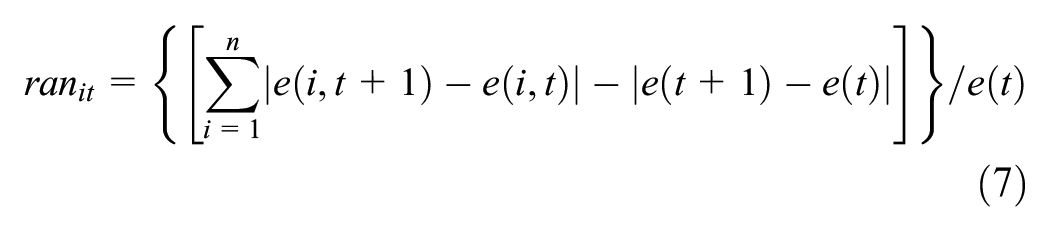
where, the variables e(i,t+1) and e(i,t) represent the number of manufacturing employees in industry i during periods t+1 and t, respectively. Similarly, e(t+1) and e(t) denote the total number of employees within industry i during those same periods. This index provides insight into the degree of cross-industry labor force allocation.
Quality of Structural Adjustment of Manufacturing Industry
The quality of structural adjustment within the manufacturing industry refers to the transition of the industry from lower productivity departments to those featuring higher levels of productivity and greater technical complexity (Han & Jiang, 2022). This quality can be understood as having two primary implications: firstly, a shift in the proportional relationship of input factors; and, secondly, an improvement in labor productivity. The method of calculating this quality is as follows.

where, the variables
Model
Building upon the indicator structure outlined in Section 5.1, this paper examines the impact of manufacturing structure adjustment quality (qua) and adjustment range (ran) on land use efficiency. Additionally, this study explores the interaction effect between qua, ran, and manufacturing transfer, aiming to determine whether interaction items exhibit a synergistic or antagonistic effect on land use efficiency. The model is constructed as follows:


Here, the variable ran represents the adjustment range of industrial structure, qua signifies the adjustment quality of industrial structure, while the remaining variables are consistent with the formula presented earlier.
Regression Results and Analysis
Upon incorporating the structural adjustment of the manufacturing industry (Table 7), it was observed that there was no significant change in the direction and significance of industrial transfer across the entire sample, including both areas where the industry moves in and out (models 1 and 2). From the perspective of manufacturing structure, the adjustment range and quality of the manufacturing industry significantly enhance land use efficiency across the entire sample and in areas where the industry moves in. This is because changes in manufacturing structure inevitably lead to changes in the scale, direction, and distribution of production factors, all of which have a decisive impact on land use structure during the development of the manufacturing industry. Such changes exert both stress and optimization effects on land use structure. These changes lead to a redistribution of land resources among different industrial sectors and strengthen the overall use of land resources. As a result, the regional industrial structure is influenced not only by its own social and economic development level but also by the land use structure of the country.
The Impact of Industrial Structure Adjustment on Land Use Efficiency.
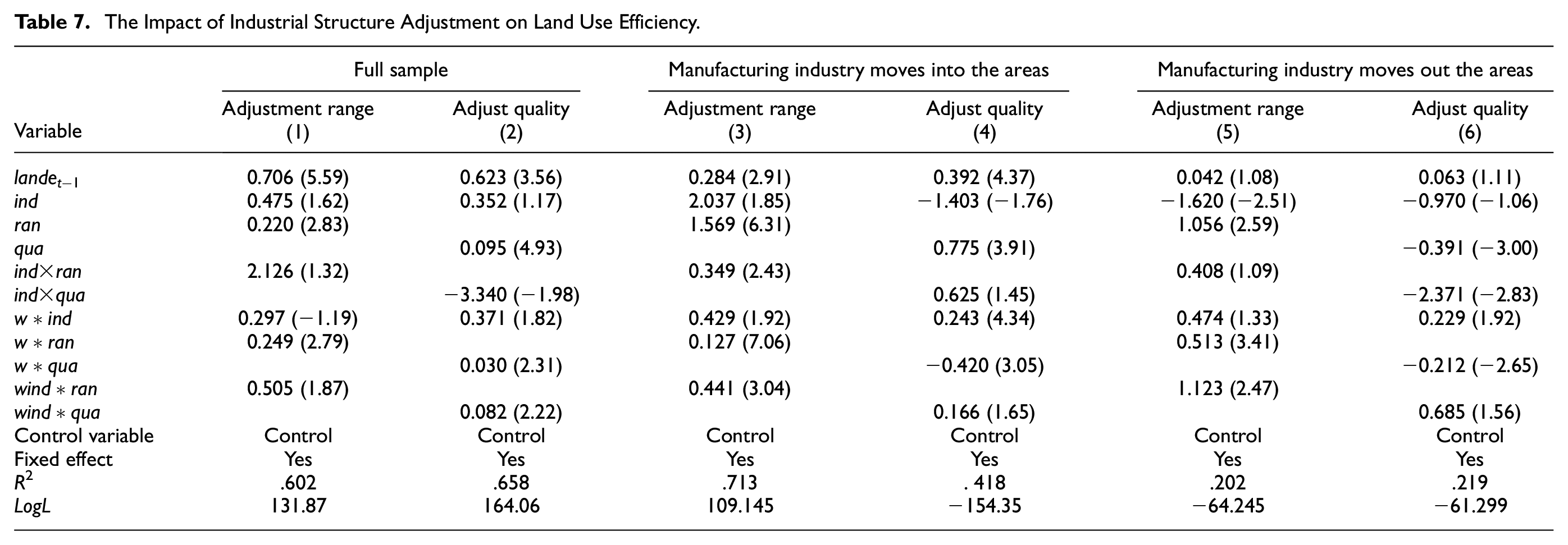
Regarding manufacturing migration (Table 7, models 3 and 4), after controlling for other variables, the adjustment range and quality of the manufacturing structure significantly improve land use efficiency. This is because newly migrated manufacturing enterprises typically occupy land previously used by other industries, primarily primary industries. This change not only impacts the original land use structure of these industries but also alters the demand for land resources and the benefits of land utilization during the transfer and relocation of the manufacturing industry. As primary industries occupy the largest area of land but generate relatively lower benefits from land utilization compared to manufacturing industries, the adjustment in the quality and extent of the manufacturing structure causes an increase in the transfer of agricultural labor resources to the secondary and tertiary industries. This leads to a change in the overall land use structure and an increase in unit land production value, ultimately resulting in the expansion of land use efficiency.
In light of the manufacturing areas, the adjustment range of the manufacturing structure has notably improved land use efficiency. This is because the adjustment mainly focuses on the scale perspective, transferring out enterprises with high energy consumption, high pollution, and low efficiency through industrial transfer. This change alters the pattern of industrial division of labor in the region, promoting the upgrading of the manufacturing industry, and optimizing the intensive use of land use structure.
Furthermore, considering the impact of the quality of industrial structure adjustment on land use efficiency in areas where manufacturing industries have moved out, we observe a significant inhibition of land use efficiency. Therefore, we conclude that in many developing areas, the industrial base remains relatively weak, particularly in areas with a weaker manufacturing industry that primarily features middle and low-end manufacturing enterprises with limited risk resistance. As such, the relocation of the manufacturing industry out of a country can lead to regional industry hollowing, which has detrimental effects. Industry hollowing not only increases the unemployment rate of regional personnel, but also significantly results in the withdrawal of capital, technology, and other factors from the real economy. This situation ultimately leads to a large number of idle industrial or commercial land, which is unfavorable to the efficiency of land utilization in the areas where the manufacturing industry moves out.
Conclusion and Policy Implications
This study utilizes china panel data spanning from 2000 to 2021 to develop a transfer index for 21 sub-sectors of the manufacturing industry. The index is based on factors such as output quantity, gross product, and scale. Using the Super-SBM method, we calculate land use efficiency and analyze the impact and direction of manufacturing transfer. Our findings suggest that manufacturing transfer does not significantly affect land use efficiency under full sample conditions, regardless of transfer direction. However, partial sample analysis indicates that manufacturing transfer can suppress land use efficiency in relevant areas. Moreover, we examine the impact of manufacturing industry adjustment extent and quality on land use efficiency. Our results reveal that structural adjustment, in terms of adjustment range and quality, has a significant positive impact on land use efficiency in both full sample and manufacturing transfer areas. However, in manufacturing transfer areas, quality adjustment of the manufacturing industry structure hinders land use efficiency, while adjustment range improves it. Based on these findings, the following policy recommendations are suggested:
Firstly, to enhance regional land use efficiency, it is imperative to align related and basic industries with the leading industries. Regional industrial adjustment should be performed in accordance with economic development conditions to coordinate industrial advantages, foster competitive industrial clusters, and establish a better open market system.
Secondly, combining manufacturing transfer with regional policies can generally enhance land use efficiency. To achieve coordinated development and optimize industrial structures in each region, it is necessary to integrate regional policies with industrialization strategies. This integration is of utmost importance for less developed areas, where leading industries, associated industries, key support, and restricted industries can leverage their regional advantages according to local conditions.
Thirdly, to improve land use efficiency in developing areas, it might be resultful to prevent regional industry hollowing-out by designing an exit mechanism for low-value-added manufacturing industries. In the transfer process, leading industries should be guided towards technology and knowledge-intensive sectors to address the gap left by traditional labor-intensive industries. Policies could be implemented to support this, such as developing high-tech industries, cultivating new manufacturing sectors with higher productivity and added value, and providing backing for small and medium-sized high-tech enterprises.
Fourthly, developed areas can clarify the industrial basis, carry out industrial positioning, and prioritize the development of strong industries to improve land use efficiency. Developed regions should take into consideration natural resources, regional characteristics, core industries, and enterprise division of labor. This would facilitate the expansion of investment and development of related basic industries and support investment around industrial chain cultivation. Integrating original industrial clusters, building industrial cluster areas, and implementing elimination systems for industries with weak foundations would promote the high-end development of manufacturing clusters.
Footnotes
Declaration of Conflicting Interests
The author(s) declared no potential conflicts of interest with respect to the research, authorship, and/or publication of this article.
Funding
The author(s) received no financial support for the research, authorship, and/or publication of this article.Nanjing University of Posts and Telecommunications Humanities and Social Sciences Research Fund Project (NYY222059; NYY222040).

Notes
Data Availability Statement
Data sharing not applicable to this article as no datasets were generated or analyzed during the current study.