




Abstract
Board informal hierarchy plays a crucial role in board governance and corporate strategic decision-making. The article empirically examines the impact of board informal hierarchy on corporate digital transformation based on relational contract theory, using a fixed-effects model with Shanghai and Shenzhen A-share listed manufacturing companies from 2012 to 2019 as research subjects. The findings of this study demonstrate a positive correlation between board informal hierarchy and digital transformation. Specifically, the presence of a chairman with the highest rank in the informal hierarchy strengthens this relationship, while the presence of a CEO with the highest rank weakens it. Mechanistic analysis shows that informal hierarchy accelerates digital transformation through three channels: improving board decision-making efficiency, mitigating management myopia, and facilitating information communication. This study extends existing research. On the one hand, this paper explores the drivers of digital transformation in manufacturing firms at the level of corporate governance and board characteristics. The findings provide empirical evidence to support the understanding of transformational change behaviors of manufacturing enterprises in the digital economy. On the other hand, it also opens up the “black box” of the internal operation of the board and provides valuable lessons for strengthening board governance.
Plain Language Summary
The article empirically examines the impact of board informal hierarchy on corporate digital transformation based on relational contract theory, using a fixed-effects model with Shanghai and Shenzhen A-share listed manufacturing companies from 2012 to 2019 as research subjects. The findings of this study demonstrate a positive correlation between board informal hierarchy and digital transformation. Specifically, the presence of a chairman with the highest rank in the informal hierarchy strengthens this relationship, while the presence of a CEO with the highest rank weakens it. Mechanistic analysis shows that informal hierarchy accelerates digital transformation through three channels: improving board decision-making efficiency, mitigating management myopia, and facilitating information communication. This study extends existing research. On the one hand, this paper explores the drivers of digital transformation in manufacturing firms at the level of corporate governance and board characteristics. The findings provide empirical evidence to support the understanding of transformational change behaviors of manufacturing enterprises in the digital economy. On the other hand, it also opens up the “black box” of the internal operation of the board and provides valuable lessons for strengthening board governance.
Keywords
Introduction
The manufacturing industry is the main body of the national economy and the key force in determining the country’s core competitiveness (Y. Li et al., 2022). Under the new situation of digital economy development, accelerating the digital transformation of manufacturing enterprises is not only an objective need to comply with the new round of scientific and technological innovation and the historical law of industrial change, but also a key choice to deepen the structural reform on the supply side and promote high-quality economic development (Tien, 2020). The governance practices of COVID-19 have further highlighted the importance and urgency of manufacturing enterprises’ digital transformation (L. Li et al., 2022). Manufacturing enterprises that started early in the transformation showed strong development resilience and competitiveness and played a prominent role in epidemic prevention and control and stable production and supply (Lee & Trimi, 2021). Moreover, those enterprises that started late were severely impacted by the epidemic, and some even fell into bankruptcy (Okorie et al., 2020). Accelerating the digital transformation of manufacturing enterprises has become a social consensus. However, digital transformation is difficult to achieve. McKinsey (2018) research points out that even in digitally savvy industries, such as high-tech and media, the success rate of digital transformation is at most 26%. In traditional manufacturing industries, the success rate of digital transformation is even less than 11%. Therefore, it becomes necessary to deeply study the factors affecting the digital transformation of manufacturing enterprises in the face of unprecedented changes (Coombs, 2020; Rapaccini et al., 2020).
“Board influence on strategic decision-making” is a hot research issue in corporate governance. Existing studies have explored the mechanisms of the role of the board in corporate strategic decision-making in terms of reducing resource dependence, reducing management agency costs, and playing a leadership role (Haynes & Hillman, 2010; Quigley & Hambrick, 2012), mainly focusing on formal structural factors such as board size, board independence and the proportion of independent directors. However, decades of board research have not led to a consensus on the critical question of “what kind of board is more effective.” As early as 1989, Zahra and Pearce (1989) pointed out that direct research on the relationship between board structure and company actions is misguided and even leads to contradictory conclusions. The board of directors is a typical meeting-type collective decision-making body, and directors have different interests, perceptions, and abilities. Thus, it is easy to cause conflicts in the board of directors and reduce the “rational” choice of directors’ decision-making (Dalton et al., 2007). This has led scholars to realize that to understand how boards influence strategic corporate decisions, and more attention needs to be devoted to informal interactions among board members, such as personal relationships, emotional conflicts, etc. (Finkelstein & Mooney, 2003; Westphal & Stern, 2006).
Board informal hierarchy is an invisible hierarchical structure spontaneously formed within the board of directors based on the differences in members’ abilities and influence, a social network of relationships with an order of respect and obedience (Anderson & Brown, 2010; Magee & Galinsky, 2008; Overbeck et al., 2005). Once established, this informal hierarchy acts as a coordinating mechanism to influence communication and exchange among board members, resulting in an implicitly affected organizational behavior is. He and Huang (2011) introduced the concept of board informal hierarchy, arguing that an informal hierarchy based on trust and respect can effectively reduce board conflicts and improve the efficiency of board decisions, thus significantly improving the financial performance of companies. Since then, some scholars have focused on the role of the board informal hierarchy in green governance decision-making (Dong et al., 2019), stock price crash risk (Jebran et al., 2019), and enterprise innovation efficiency (Xu et al., 2022). Yet little attention has been paid to the role of the informal hierarchy on enterprises’ digital transformation, defined as the technological and organizational changes that companies make to adapt to the rapidly changing digital era (Blanka et al., 2022; Hanelt et al., 2021; Verhoef et al., 2021). The board, serving as the central entity of corporate governance (Fama, 1980), assumes a dual role in digital transformation as both the principal driver and decision-maker, as well as the coordinator and overseer of managers compliance in discharging their obligations. Consequently, the board’s attributes are closely related to the digital transformation trajectory. Hence, we investigate the effects and mechanisms of the informal hierarchy on the digital transformation of companies to provide a logical interpretation and validation of how the board of directors influences corporate decisions.
To examine the association between the board informal hierarchy and the enterprise’s digital transformation, we apply relational contract theory to provide theoretical support and use the Gini coefficient to measure the clarity of the board informal hierarchy specifically. According to previous studies, enterprises’ digital transformation degree is difficult to measure effectively. For this reason, we construct proxy variables for the digital transformation of enterprises using textual analysis of their annual reports. Research has shown a positive association between board informal hierarchy and corporate digital transformation. The higher the clarity of the informal hierarchy, the more significant the degree of digital transformation. We further note that this positive relationship depends on the difference in the status of directors. Whoever is at the top of the informal hierarchy can influence board decisions significantly. This study addresses the specific informal hierarchical status of the chairman and CEO. In addition, we also validate three channels through which the informal hierarchy influences the enterprise’s digital transformation: improving the efficiency of decision-making, mitigating managerial myopia, and facilitating internal information communication.
Three core factors underpinned our selection of China as the research subject for this study. First, Chinese modern enterprise system has been established for a relatively short period, and enterprises (especially state-owned enterprises) still retain a strong hierarchical concept of “Priority to Bureaucrat,”“Obedience at Authority,” and “Respect and order,” which makes the informal hierarchy within the board of directors more prominent (Chen et al., 2023). Second, China accounts for about 25% of the world’s manufacturing activity, more than any other country, and enjoys the reputation of being the “world’s factory” (McKinsey, 2017). However, Chinese manufacturing is primarily concentrated in the lower and middle segments of the value chain, with gains from lower labor and capital costs increasingly being eroded as productivity lags substantially behind developed economies. Chinese manufacturing productivity is still only one-fifth that of developed economies. Therefore, achieving innovation-driven development through digital transformation for the Chinese manufacturing industry has become a real problem that needs to be solved (Wen et al., 2022). Third. Chinese companies have actively explored technological innovations and applications in big data, artificial intelligence, and cloud computing in recent years, becoming the main force of digital transformation. Thus, Chinese manufacturing companies provide a good environmental background for the research in this paper.
The possible marginal contributions of this paper are reflected in the following aspects. First, we reveal the positive effect of board informal hierarchy on digital transformation, which both enriches the study of the economic consequences of board informal hierarchy and expands the literature related to the impact factors of corporate digital transformation. Second, based on the micro-level of the board, it is found that having the chairman at the top level strengthens the facilitating effect of informal hierarchy on digital transformation, while having the CEO at the top level weakens this effect. The findings provide empirical evidence for optimizing the board hierarchy and curbing the principal-agent problem. Third, an innovative board dynamic interaction perspective points out that informal hierarchy influences corporate digital transformation through three channels: improving board decision-making efficiency, alleviating management myopia, and facilitating information communication, providing the theoretical basis and evidence support for understanding the relationship between board operating mechanisms and corporate digital transformation.
The study is organized as follows. “Theoretical Analysis and Hypothesis Development” presents the theoretical background of board informal hierarchy and digital transformation. We also developed three hypotheses based on this background. “Study Design” explains our data sources, variables and models. “Results” gives the results of the data analysis performed. “Discussion” is a comparison of existing literature. “Conclusion” section includes the findings and limitations of the study.
Theoretical Analysis and Hypothesis Development
Informal Hierarchy and Digital Transformation
Sociological theory suggests that any group decision is influenced by hierarchy. Hierarchy includes formal and informal hierarchies (Diefenbach & Sillince, 2011). Formal hierarchy is derived from statutory or chaptered authority and is a legalized contracted hierarchical arrangement. Informal hierarchy stems from emotional logic and is influenced by social norms and individual perceptions. The board, as a formal group for collective decision-making on major strategic issues of the company (Veltrop et al., 2017), is based on the principle of “one person, one vote” (Johnson, 2004), with equal power and status among directors, and there is no explicit formal hierarchy. Differences in social capital and prestige status within the board can lead to respectful and submissive behavior, resulting in informal hierarchies (Oehmichen et al., 2017; Zhu & Yoshikawa, 2016). Informal hierarchy is more prominent in boards that lack clear formal hierarchical relationships. The specific reasons for this are twofold. First, the issues faced by the board of directors are ambiguous, complex, and uncertain (Forbes & Milliken, 1999). The handling and resolution of such matters must rely on all directors’ experience, knowledge, and resources. However, it is difficult for them to have a marked effect within the constraints of formal board rules and procedures. The informal hierarchy provides a coordination mechanism for the board of directors to match their talents with the needs of their work. Directors with a greater number of concurrent positions and political affiliations are more likely to bring fresh ideologies and management experience to the company. This often leads to recognition and respect from other directors, allowing them to occupy a higher position in the informal hierarchy (Tarakci et al., 2016). The lower-level directors have higher psychological expectations of the higher-level directors, consciously follow the decision-making results of the higher-level directors in the board operation process (Simpson et al., 2012), and cooperatively contribute constructive ideas, which helps strengthen the intensity of directors’ performance and improve the science of decision-making. Second, the board represents a combination of different interest groups. Directors represent different groups and have different experiences, so they have different knowledge and understanding of the content of relevant decisions. The lack of a clear hierarchical order and status distinction can escalate directors’ competition for positions and interests into destructive conflicts (Bloom, 1999; Huse, 2007), undermining group solidarity and even threatening corporate survival (Groysberg et al., 2011; Ridgeway & Johnson, 1990). Relational contract theory suggests that, when status differences are clear, lower-level directors tend to be subservient to higher-level directors. Even in the face of conflicts of interest, lower-level directors tend to sacrifice their interests to satisfy the needs of higher-level directors, thereby reducing differences of opinion and achieving orderly cooperation within the board of directors.
There are two academic viewpoints on the board informal hierarchy: the power distance viewpoint and the relationship contract viewpoint. The key to the power distance viewpoint is to examine the allocation and operation of power in the boardroom with the help of the informal hierarchy, emphasizing the ability of top-level directors to carry out their will from the top down. It is argued that informal hierarchy establishes an effective organizational order of leadership within the board. It motivates senior executives to take their leadership and risk responsibilities more seriously by providing them self-confidence and a sense of psychological superiority (Garg et al., 2018). In contrast, the relational contract viewpoint emphasizes the initiative of cooperation of lower-level directors. When interacting with other elites, directors tend to develop a sense of friendliness and respect, emulate behaviors and preferences of their peers, and often avoid revealing their distinctive personalities (Westphal & Shani, 2016). Informal hierarchy enhances the willingness of lower-level directors to collaborate by reinforcing inter-individual relationships, thereby fostering constructive dialog and intra-organizational solidarity. Hogg (2001) also points out that maintaining organizational unity and stability is the best way to deal with challenges and uncertainty.
Building upon the above analysis, this paper posits that the facilitation effect of the informal hierarchy within the board on the corporate digital transformation manifests in the following ways.
The informal hierarchy facilitates the enterprise’s digital transformation by reducing board conflicts and improving the efficiency of board decisions. First of all, the duration of a board meeting is typically short (Carter & Lorsch, 2003; Leblanc & Gillies, 2005), and the digital transformation is extremely complex and specialized, requiring the board to make effective meeting decisions in a short period. The informal hierarchy clarifies the role played by each director, specifies the direction for directors to perform their duties, and provides a stable and efficient implicit order for board meeting discussions. The higher-level directors, leveraging the information resources and innovative advantages they possess, can unite the lower-level directors around their leadership (Hays & Bendersky, 2015), showing the behavior of cooperating and supporting relevant resolutions. With the positive demonstration and guidance effect, the board, in a short time, will be encouraged to engage in constructive dialog on many complex digital transformation challenges. This embedded informal hierarchy within the organization’s management ensures that the opinions of lower-level members are adequately while also valuing the viewpoints of senior-level directors, effectively reducing ineffective board issues and unwarranted internal conflicts (Smith et al., 1994). Second, the relationship governance practiced in the informal hierarchy can reinforce a sense of respect and obedience within the board, thereby improving board cohesion. The board will be very cautious when it comes to making relevant digital transformation decisions. Its decision-making process is often subject to a heated clash of opinions. A high level of board cohesion can coordinate the interests of different directors and improve the effectiveness of board operations, thus ensuring the smooth implementation of digital transformation strategies. Finally, digital transformation is a long-term and dynamic process in the complex and changing social environment. The efficient compliance behavior brought by the informal hierarchy aids companies in accurately identifying digital development opportunities and perceiving market threats (Hambrick & Mason, 1984). It also allows them to adjust the direction of transformation development in a timely manner according to their characteristics and changes in policies, to achieve the desired effect of the digital transformation.
The informal hierarchy facilitates digital transformation by improving management cognitive level and alleviating management myopia. Compared with innovation, the digital transformation of enterprises requires more investment, lasts longer, and takes higher risks (R. Li et al., 2022). Considering of their interests, the management tends to avoid risks and demonstrates short-sightedness in decision-making (X. Liu, 2022). It has been demonstrated that management myopia significantly reduces actual corporate investment and R&D spending (Edmans et al., 2017; Ladika & Sautner, 2019). Moreover, the informal hierarchy can effectively mitigate management short-sightedness. On the one hand, the informal hierarchy provides reliable information and decision reference for digital transformation. Senior-level directors bring enterprises more valuable information and resources through social networks (McNulty & Pettigrew, 1999). This helps deepen management’s understanding of digital transformation and mitigate management’s cognitive bias, thus helping managers eliminate the shackles of short-term goals and incorporate enterprise transformation and long-term development into the organization’s strategic decision-making arrangement (Ridge et al., 2014). On the other hand, the informal hierarchy clarifies key issues such as whom to communicate with, when to communicate, and how to communicate, thus facilitating internal information communication. Clear information communication channels can ensure the board stays informed about the implementation and progress of the corporate digital strategy. This allows management to make timely directional adjustments based on information feedback, but also strengthens management supervision and maintains board independence. The checks and balances, created by the informal hierarchy, help to prevent the board of directors from being “captured” and “controlled” by the management. It reduces the self-interest of the management, and makes the administration put more energy and money into the construction of the enterprise digitalization, thus maximizing the value of the enterprise. Based on the above analysis, the following hypotheses are proposed.
Hypothesis H1: Informal board hierarchy is positively correlated with corporate digital transformation.
Ranking of the Chairman and CEO in the Informal Hierarchy
Most previous studies have treated the board of directors as a unified entity and have not distinguished the roles of the board members. As an implicit structure, the effectiveness of the informal hierarchy in coordinating board interactions may depend on the extent to which directors can easily retrieve information and act in hierarchical order among themselves. Members with special status or position can use their resources or power to influence the issues and procedures of decision-making. In the role of informal hierarchy, directors who have the advantage of status are able to build around themselves leadership structure and demonstrate their perspectives, styles and preferences in their work. Tsui et al. (2002) showed that hierarchical differences in company executives significantly affect organizational behavior. The Chairman and CEO are the typical representatives of the board executives. Here, the Chairman is the highest decision-maker in the company and is the direct representative of the shareholders’ interests. And the CEO is the executor of board resolutions and the top management leader. When substantial conflict arises between shareholder and management interests, the informal hierarchical distinction between the Chairman and CEO can notably impact the selection and execution of corporate decisions. As this paper examines, driving digital transformation in the enterprise is risky and promising. Different understandings of digital transformation by executives at different hierarchy will have different impacts on the digital transformation process of enterprises.
In the formal mechanism, the chairman is at the highest level of hierarchy (Krause et al., 2016). Suppose he or she also has the highest rank in informal hierarchy. In that case, the chairman is at the top of the board’s formal and informal hierarchies, thus achieving high unity of power and responsibility. Thus, the chairman is even more responsible for the actions of the company. In particular, the chairman will bear the brunt as the most important responsible person when there is a decision-making mistake. To maintain his reputation, the chairman will be more proactive in exercising relevant duties and taking responsibility for digital transformation. At the same time, studies have shown that in a social culture of authoritative obedience in China, it is difficult to ensure the decision effectiveness of an elite board without a leader. On the one hand, the existing transformation practice shows that digitalization has injected new development vitality for manufacturing enterprises. Its role in the management model, organizational processes, dynamic capabilities and product structure has been generally confirmed by the industry. On the other hand, digital transformation also brings new challenges for companies regards teams, funding, technology and capabilities. Most enterprises are caught in the triple dilemma of being unable to transform, lacking funds for transformation and fearing the transformation process. (Yu & Yan, 2022). Risk perception differences and conflicts of interest can lead to disagreements within the board about digital transformation decisions. This can make board work confusing, inefficient and frustrating, which can easily reduce organizational effectiveness. When the chairman is at the top of the informal hierarchy, he or she can use his or her position and authority to unify opinions, promote efficiency and improve the quality of decision-making. However, others believe that the role played by the chairman varies from person to person. The role of the chairman of Chinese companies in a “shareholder-centric” institutional environment has a more authoritarian tone. If the chairman is team-oriented and can balance the relationships within the board well, decisions are more likely to be rationally driven (Bailey & Peck, 2013). But when the chairman is arbitrary and has unrestricted power, a “false consistency” is created within the board (Neck & Moorhead, 1995). This can result in the majority of decisions merely reflecting the chairman’s will, thereby ignoring differing opinions and diminishing the objectivity of decisions. A misguided digital transformation decision by the chairman can profoundly impact the company negatively. Based on the above analysis, the following hypotheses are proposed.
Hypothesis H2a: The positive correlation between informal hierarchy and digital transformation is enhanced when the chairman has the highest rank in informal hierarchy.
Hypothesis H2b: The positive correlation between informal hierarchy and digital transformation is weakened when the chairman has the highest rank in informal hierarchy.
Stewardship theory suggests that human behavior tends toward collectivism (Davis et al., 1997). the CEO possesses behavioral motivations that are motivated by maximizing the interests of the principal. The CEO acts as a close strategic collaborator with the Board, the primary role of which is to support the CEO’s decision-making and provide advice and counsel. In the view of stewardship theory, the CEO has the highest informal hierarchy and can facilitate mutual trust, reduce resistance and political behavior within the board, and improve governance efficiency. And the board that excessively restricts the power of the CEO signals distrust, and even worsens the principal-agent relationship, which is the source of the ongoing controversy (Sundaramurthy & Lewis, 2003). The digital transformation of the enterprise will inevitably affect the interests of certain board members, who are likely to obstruct and hinder the digital transformation process. The CEO is the actual executor of board decisions, and the CEO at the highest informal level can gain maximum understanding and support from board members, thus focusing valuable time on the digital transformation decision implementation rather than the order maintenance and meeting discussions. This assist in the smooth implementation of enterprises’ digital transformation. However, agency theory takes the exact opposite view. Agency theory suggests that shareholders and management have different interest objectives and need the board to act as an intermediary to reconcile their claims (Jensen & Meckling, 1976). When the CEO is at the top of the informal hierarchy, he or she is likely to intervene in the board’s decision-making out of self-interest, and the board is “captured” by the management represented by the CEO, leading to a serious agency problem. In this case, it is difficult for the board to play its governance role effectively, and the role of the informal hierarchy in promoting the digital transformation of the enterprise will be significantly limited. Moreover, when the CEO has the highest rank, the CEO relies on his or her influence to gain greater decision-making freedom in board meetings (Baldenius et al., 2014; Eisenhardt, 1989). This makes it difficult for the relational governance of the informal hierarchy to play its role, affecting the board of directors’ capacity to supervise the CEO, and thereby weakening the positive influence of the informal hierarchy on corporate digital transformation. Based on the above analysis, the following hypotheses are proposed.
Hypothesis H3a: The positive correlation between informal hierarchy and digital transformation is enhanced when the CEO has the highest rank in informal hierarchy.
Hypothesis H3b: The positive correlation between informal hierarchy and digital transformation is weakened when the CEO has the highest rank in informal hierarchy.
Ultimately, we construct a model of board informal hierarchy affecting enterprise digital transformation based on Hypotheses H1, H2a, H2b, H3a, and H3b, as illustrated in Figure 1.

The theoretical model of board informal hierarchy influencing digital transformation.
Research Design
Sample and Data Collection
This study uses a dataset of A-share manufacturing companies listed on the Shanghai and Shenzhen stock exchanges from 2012 to 2019. The original data was obtained from the CSMAR database, which is widely used for research on Chinese listed companies. The reasons for choosing Chinese manufacturing enterprises as our research sample are as follows. China has the most complete and largest industrial system in the world. Since 2010, China’s manufacturing industry has long been in first place in the world, enjoying the reputation of being the “world’s factory.” However, the phenomenon of a “large but not advanced” manufacturing industry is still quite prominent in China. Transitioning toward intelligent manufacturing through digital technology is important for advancing Chinese manufacturing industry. For this reason, more and more manufacturing enterprises have begun to implement digitalization, but the relevant theoretical research lags far behind the practice. Most of the existing research focuses on the enterprise changes brought by the application of relevant digital technologies and the construction of digital platforms, while neglecting the impact antecedents and the mechanism of the digital transformation of manufacturing enterprises. Therefore, we examine the impact of board characteristics on Chinese manufacturing enterprises. We also excluded ST, ST*, and samples with missing values and finally obtained 13,039 observations.
Measurement of the Variables
Dependent Variable
There is no direct academic measurement standard for digital transformation of enterprises. We construct an enterprise digital transformation index based on previous research by conducting a textual analysis of the listed company’s annual reports. The specific process is as follows. Firstly, we obtained the corporate annual reports needed to calculate digital transformation indicators from www.cninfo.com.cn, which is the information disclosure website for listed companies designated by the China Securities Regulatory Commission. Subsequently, we manually sorted out the annual reports of benchmark enterprises undergoing digital transformation. Using Python software, we automatically segmented words, identified keywords related to digital transformation, and built a digital transformation dictionary. The second step is calculating each keyword’s frequency in the annual report based on the constructed digital transformation lexicon. In the third and most important step, considering the differences in the content and number of words of each company’s annual report, we construct the enterprise digital transformation index according to Equation 1.

Independent Variable
An ideal way to measure the board informal hierarchy is to use a questionnaire to survey each board member’s level of respect and compliance with other members, but the survey requires responses from each board member, and it is difficult and costly to obtain data, so it is difficult to use in a large sample study. Another possible way to do this is to select the proper proxy variables. The part-time directorship allows members to have direct access to information about the strategic practices of other companies or to indirectly obtain valuable information about other companies by establishing contacts with other directors through the chain directorship. Bringing this knowledge and experiential information to the board of directors facilitates better corporate decision-making and improves the quality of the board’s advice and recommendations (Zhang, 2008). In addition, politically connected directors can bring more information and political resources to the company. This results in significantly better performance than non-politically related companies. China is a high-power distance country. The board members with political connections have a higher position in the board. Boards also prefer to recruit people with political affiliations such as having served as civil servants, deputies to the National People’s Congress, or having served in industry associations and societies. It means that the difference in the ability and influence of each board member can be indirectly assessed through the difference in the number of part-time directors and political affiliations. which can roughly reflect the implicit ranking of board members. According to previous study, we use the Gini coefficient to measure the board informal hierarchy, as specified in Equation 2.

Gini denotes the clarity of the board informal hierarchy; y is the sum of the number of outside part-time directorships and political connections;
Adjustment Variables
In order to test hypothesis H2, we constructed the dummy variable Chair. If chairman has highest rank in informal hierarchy, the value is 1, otherwise, the value is 0. We also constructed the dummy variable CEO to test hypothesis H3, and the value is taken to be consistent with Chair.
Control Variables
To reduce the influence of other factors on the study results, the control variables we chose included firm size (Size), asset-liability ratio (Lev), operating income growth rate (Growth), book-to-market ratio (BM), return on total assets (Roa), board size (Board), percentage of independent directors (Ind), and firm age (Age). The specific variables are defined as shown in Table 1. The unit of the financial variable indicators involved in the article is RMB Yuan.
Variable Definition.

Estimation Strategy
In order to verify the relevant hypotheses presented above, we constructed the following model 3 and model 4.

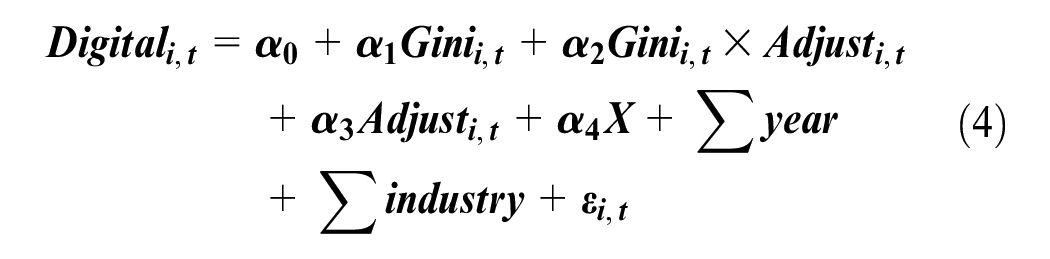
To reduce the impact of sample extremes on the regressions, using the Winsorize method to reduce the number of tails for 1% and 99% of the continuous variables.
Result
Descriptive Statistics
Table 2 shows the results of descriptive statistics of relevant variables. The mean and median of Digital are 0.909 and 0.411, respectively, with a minimum value of 0 and a maximum value of 9.480, indicating that there are significant differences in the digital transformation of listed manufacturing companies in China. The mean and median of Gini are 0.3 and 0.286, respectively, with a minimum value of 0.056 and a maximum value of 0.636, indicating significant differences in the digital transformation of listed manufacturing companies in China. In addition, the mean value of Chair is 0.188, indicating that about 18.8% of chairmen are at the top of board informal hierarchy, and the mean value of CEO is 0.363, indicating that about 36.3% of CEOs are at the top of board informal hierarchy.
Descriptive Statistics.

Correlation Coefficient Matrix
Table 3 shows the correlation coefficient matrix of the variables. The Pearson correlation coefficient between Gini and Digital is .074, which is significantly positive at the 1% level. This result tentatively verifies hypothesis H1. the Pearson correlation coefficient between Chair and Digital is .027, which is also significantly positive at the 1% level. This result tentatively verifies hypothesis H2a. The Pearson correlation coefficient between CEO and Digital is not statistically significant, which needs to be further tested. The vast majority of variables are correlated below .5, indicating no severe multicollinearity between the variables.
Correlation Coefficient Matrix.
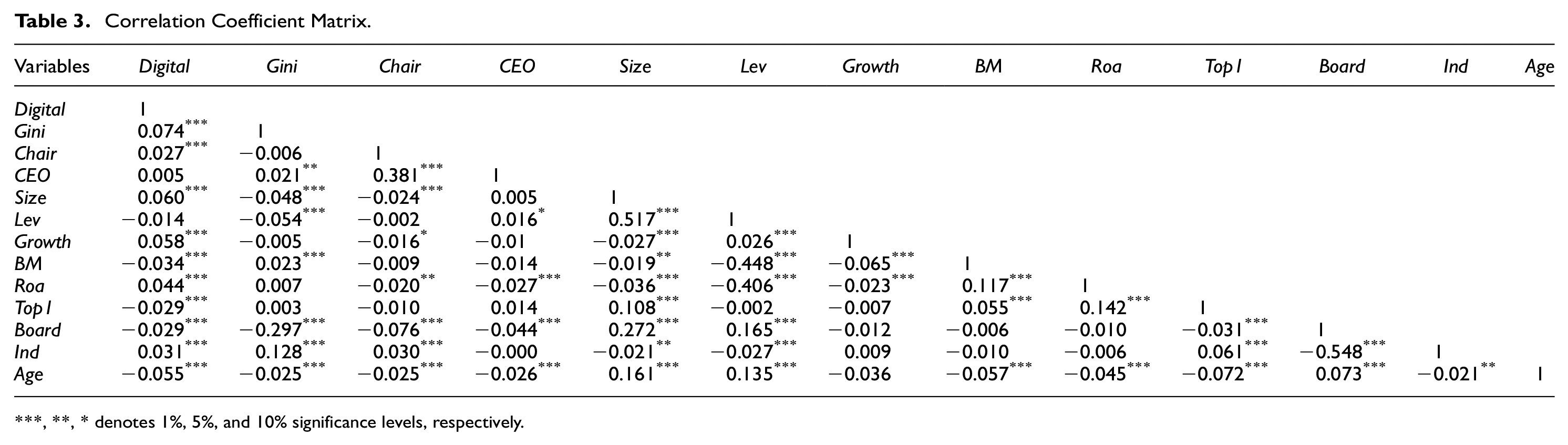
***, **, * denotes 1%, 5%, and 10% significance levels, respectively.
Baseline Results
Table 4 shows the regression results of the relevant hypotheses. Model 1 is a benchmark model containing only control variables, and it is found that Size, Growth, Roa are significantly and positively related to Digital, indicating that firms with larger size, higher risk-taking level, and good operating revenue are more motivated to undergo digital transformation (Hirsch-Kreinsen, 2015). Lev, BM, Top1, and Age are significantly and negatively correlated with digital transformation Digital, indicating that companies with good capital structure, high growth potential, low constraint of large shareholders, and younger are more likely to undergo digital transformation (Kollmann et al., 2019; Ohlert et al., 2022). Model 2 introduces Gini into the benchmark model and finds that the regression coefficient of Gini and Digital is 0.635, which is significantly positively correlated at the 1% level. This regression result proves hypothesis H1 that the board informal hierarchy has a positive impact on corporate digital transformation. Model 3 introduces Chair into Model 2 and finds that the coefficient of Gini×Chair is significantly positive at the 10% level, indicating that Chairman at the top strengthens the positive effect of informal board hierarchy on digital transformation, supporting Hypothesis H2a. To show this result more visually, we plot the interaction effect of Chair in Figure 2. Model 4 introduces CEO into Model 2 and finds that the coefficient of Gini×CEO is significantly negative at the 5% level, indicating that the CEO at the top attenuates the impact of the informal board hierarchy on digital transformation, proving hypothesis H3b. And we plot the results in Figure 3. Model 5 introduces both Chair and CEO into Model 2 and finds that the Gini×Chair is significantly positive at the 1% level and the Gini×CEO is significantly negative at the 1% level, which verifies the robustness of Hypotheses H2a and H3b.
Regression Analysis.

***, **, * denotes 1%, 5%, and 10% significance levels, respectively.

Moderating effect of Chairman Rank.

Moderating effect of CEO Rank.
Robustness Test
Replacement Variable
We use the variable, defined by whether the firm undergoes digital transformation, as a proxy for the dependent variable. The correlation regression results are presented in column 1 of Table 5. The result shows the Gini coefficient is 0.732, showing a significant positive correlation of 1%. We also construct Gini2 coefficients that only includes the number of part-time directors outside the company (excluding political affiliation) and the regression results are presented in Column 2 of Table 5. The result shows the Gini2 coefficient is 0.590, which is significantly positively correlated at the 1% level. Then, the internal part-time positions of directors are related to the directors’ knowledge and perception of various departments and links of the company, which also affects the generation and effect of the informal hierarchy of the board. We choose the number of internal part-time positions of directors to reconstruct the informal hierarchy indicator Gini-inside. The relevant results are presented in column 3 of Table 5, and we find that the regression coefficient of Gini-inside is also significantly positive at the 1% level. The above regression results indicate that the findings of this paper still hold after replacing the relevant variables.
Replacement Variables.
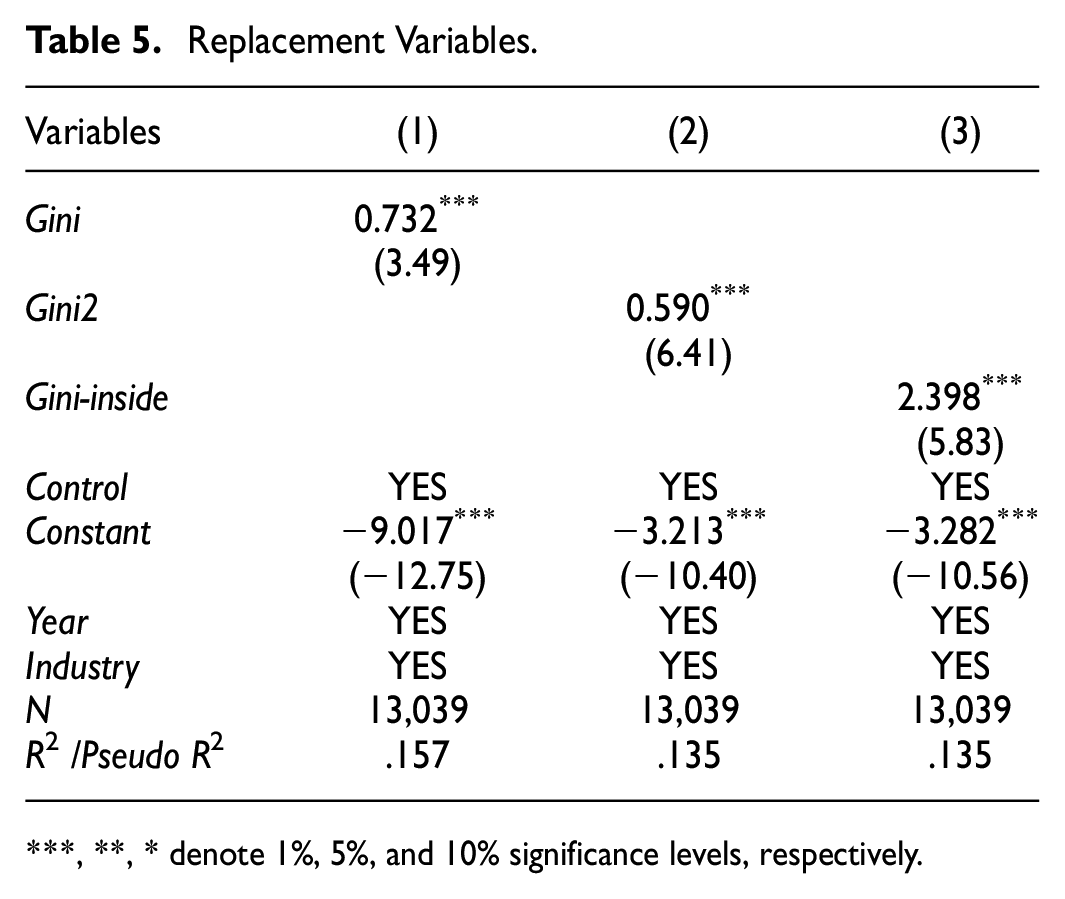
***, **, * denote 1%, 5%, and 10% significance levels, respectively.
Change Sample Statistical Interval
During the 2020–2022 global covid-19 epidemic, on the one hand, digital technology represented by big data, artificial intelligence, cloud computing, and mobile internet plays an important role in epidemic prevention and control, which forces more and more enterprises to accelerate digital transformation. On the other hand, the epidemic has dealt a severe blow to the production operations of manufacturing enterprises. Numerous enterprises are facing serious challenges such as disruptions in their supply chains, declining market demand, lower profits and even losses, which have led them to start breaking up their original production organization structure and exploring new management models. This can also have an impact on the informal hierarchy within the organization. Overall, the epidemic has changed the production and lives of individuals and businesses in every way. This part further incorporates 3 years of the epidemic into the regression analysis which is used as a robustness test for this paper. As can be seen in the column 1 of Table 6, the pace of digital transformation of enterprises has accelerated significantly. This indicates that the impact of the epidemic on the digital transformation of enterprises is significant. This also supports to some extent the reasonableness of the sample interval in the main regression analysis. As shown in column 2 of Table 6, the Gini coefficient remains significantly positive with the expanded sample period, providing further indication of the robustness of the findings.
Change Sample Statistical Interval.

***, **, * denote 1%, 5%, and 10% significance levels, respectively.
Quantile Regression
To reflect the full picture of the conditional distribution of digital more comprehensively, we establish a quantile regression model to estimate the different quartiles point (0.25–0.75). The results are presented in Table 7. the Gini coefficient is 0.107 at the 25% quantile, 0.252 at the 50% quantile, and 0.556 at the 75% quantile, all of which are significantly positive at the 1% level. The coefficients gradually increase as the quantile rises, indicating that the board informal hierarchy is indeed beneficial to the digital transformation of enterprises. Therefore, we are able to confirm the stability of our findings even if we use quantile regression.
Quantile Regression.

***, **, * denote 1%, 5%, and 10% significance levels, respectively.
Endogeneity Test
We use the propensity score matching method (PSM) to address possible sample selection bias. The specific operation steps are as follows. First, we divided the sample into a high, and low clarity group based on the annual industry means at the board informal hierarchy. Second, 10,767 samples were obtained by 1:1 no-release nearest neighbor matching with the control variable as the characteristic variable. The post-matching test results are shown in column 1 of Table 8, and the Gini coefficient is 0.707, which is significantly positive at the 1% level. It further proves the robustness of this paper’s study.
Endogeneity Test.

***, **, * denote 1%, 5%, and 10% significance levels, respectively.
Following previous studies (Jayaraman & Milbourn, 2012), we use the one-period lagged Gini coefficient (L.Gini) as an instrumental variable to further treat endogeneity. The board composition is generally relatively stable, and the current Gini is closely correlated with the lagged Gini. In contrast, the current degree of digital transformation can hardly affect the lagged Gini. The Kleibergen-Paap rk LM statistic in the instrumental variables test is significant at the 1% level, and the Cragg-Donald Wald F statistic is much larger than 10. The instrumental variables pass the unidentifiable test, and the weak identification test and meet the selection criteria of instrumental variables. The regression results for the instrumental variables are shown in columns 2 and 3 of Table 8. As can be seen from the table, L.Gini and Gini are significantly positively correlated at the 1% level in the first stage, and the regression coefficient between Gini and Digital is 1.102 in the second stage, showing a positive correlation at the 1% level. It suggests that the conclusions of this paper still hold after controlling for endogeneity.
Mediating Test
According to the previous theoretical logic, board decision-making efficiency, managerial myopia, and board information communication may be the three channels through which the informal level of the board influences the digital transformation of the firm. In order to verify the existence of the above action channels, the following mediating effect model is constructed.


M is the mediating variable, including (1) board decision-making efficiency (Effect). Drawing on existing research (Y. Liu, 2006), we use weighting model to measure the efficiency of board decisions. We establish a standardized multiple regression model of firm performance with board size, percentage of independent directors, number of board meetings, and director shareholding ratio. Then we use the model to calculate the weights for each indicator. Finally, each indicator is weighted to determine the board decision-making efficiency indicator. The larger the indicator is, the more efficient the board of directors’ decision-making is. (2) Managerial myopia (MM). Drawing on Yu et al. (2018), the stock turnover rate is selected as a proxy variable for management myopia. The larger this indicator is, the more severe management myopia is. (3) Board information communication (Information). The DIB Internal Control Disclosure Index is selected as a proxy variable for information communication, and the larger this indicator is, the more open the corporate information communication channel is.
The stepwise regression method was used to test for mediating effects, and the results are shown in Table 9. Model 6 and model 7 are tests of mediating effects of board decision-making efficiency, model 8 and model 9 are tests of mediating effects of managerial myopia, and model 10 and model 11 are tests of mediating effects of board information communication. Model 6 and Model 7 show that the informal hierarchy significantly increases the efficiency of board decision-making, and the increase in board decision-making efficiency accelerates the digital transformation of the company, indicating that the partial mediating effect of board decision-making efficiency is significant. Model 8 and Model 9 show that informal hierarchy mitigates management myopia, and the reduction of management myopia facilitates digital transformation, indicating a significant partial mediating effect of management myopia. Model 10 and Model 11 show that informal hierarchy facilitates internal board communication, and the openness of information communication channels facilitates digital transformation, indicating that the partial mediating effect of board communication is significant. In summary, all three channels through which the informal hierarchy affects the digital transformation of the firm are verified. Board decision-making efficiency, management myopia, and board information communication play a partially mediating role between the board informal hierarchy and the digital transformation of the firm.
Mechanism Test.

***, **, * denote 1%, 5%, and 10% significance levels, respectively.
Discussion
With the deepening of corporate governance research, the study of board governance capacity has shifted from the early structuralist perspective, which focused on the analysis of the superficial and explicit formal structure, to the study of the deeper informal hierarchical influence effects formed by the behavior of individual directors and the interaction among members. However, most of the research in this category focuses on the relationship between informal hierarchies and performance, and the impact of informal hierarchy on enterprise decision-making still needs to be conclusive. Here, we choose one of the most important strategic activities of manufacturing companies in recent years - digital transformation - to examine how informal hierarchy can influence the strategic decisions of the board. The research evidence in this paper complements recent findings in the board governance and digital transformation literature. These findings emphasize: (a) clear informal hierarchical relationships can optimize the decision-making process of the board and facilitate the digital transformation of the enterprise. (b) Differences in interests and conflicting perceptions of executives can affect the implementation of digital transformation. The power gap between the chairman and the CEO is an important factor affecting the efficiency of corporate governance and decision-making. This finding is consistent with the prevailing view in the field of corporate governance (Wang et al., 2021). What distinguishes us from the previous literature is that we extend and complement the existing literature by introducing board informal characteristics into corporate digital transformation decisions. Second, on the basis of He and Huang (2011), we further contrast the distinction impact of the informal hierarchical differences between the chairman and the CEO. Finally, we also reveal the intrinsic mechanisms by which the informal hierarchy influences the digital transformation of the enterprise, clarifying the vein of action.
Conclusion and Outlook
Conclusion
This paper examines the intrinsic association between the board informal hierarchy of and the digital transformation of manufacturing enterprises, providing both theoretical insights and empirical evidence in support of the hypothesis that differences in the informal hierarchy of directors are important determinants of corporate strategic decision-making choices. We find that informal hierarchy positively contributes to corporate digital transformation. Differences in the informal status of chairman and CEO influence the implementation of digital transformation in firms, considering the differences in the interest groups they represent. We also find that board decision-making efficiency, management myopia, and information communication are three important channels through which the informal hierarchy influences corporate digital transformation. The study reveals the specific role that the internal operating mechanisms of the board act in corporate transformation decisions. The study findings provide useful insights for board governance and corporate digital transformation.
Implication and Insight
This paper appeals to firms, both in China and elsewhere, to pay more attention to the informal hierarchical structure within their boardrooms. As an implicit order within the boardroom, its members can translate their strengths into influence over others, suppress dissent, and influence decision-making choices. This influence varies from person to person, with both positive and negative impacts on the business development of the enterprise. This means that we need to fully utilize the positive effects of informal hierarchies while taking into account internal differences.
In summary, we gained the following insights. First, it is important to fully understand the huge role played by the board informal hierarchy and to pay attention to the potential impact of the informal hierarchy on digital transformation. For a board of directors with a flat power structure, the existence of an informal hierarchy allows the board to combine the advantages of “democracy” and “centralization.” It ensures equal rights for each director and effectively enhances the efficiency of the board’s decision-making. Therefore, the company should build a reasonable and efficient structure of the board from the perspective of long-term corporate development. Second, it is necessary to pay attention to the position that the chairman and CEO occupy in the informal hierarchy. The independence of the board is ensured through the establishment of effective supervisory and advisory mechanisms to curb the principal-agent problem. Third, enterprises should establish digital transformation strategies that fit their own development needs, so as to reduce ineffective board issues, improve the board decision-making efficiency, and promote the digital transformation.
Limitations and Future Research
The study in this paper also has some limitations. First, the sample data in this study are derived from listed companies, thus lacking in sufficient attention to SMEs. SMEs play a unique role in meeting customer needs and technological innovation. However, SMEs often cannot compete with large enterprises using their resources and capabilities alone due to resource and capacity constraints, and they cannot achieve digital transformation without the support of external parties. Therefore, the factors influencing the digital transformation of SMEs are more complex. At the same time, it is not mandatory for SMEs to have a board of directors, and the vague decision-making management structure makes it difficult to measure the effect of the informal hierarchy effectively. It is expected that subsequent scholars will address the issue through extensive social surveys and research interviews. Second, the study is based on the social context of China, and future research can be extended to other countries and economies. As we all know, under the influence of the traditional Chinese culture of “order of seniority,” the board informal hierarchy naturally meets the management needs of local Chinese enterprises. Future research could extend single-country studies by testing our theoretical hypotheses with evidence from other countries. Third, exploring the informal hierarchy of independent directors also presents a direction for future research. As a constituent member of the board, the independent director, on the one hand, carries out the supervision of managers on behalf of the shareholders and, on the other hand, undertakes the function of consulting on the business activities of the enterprise. The role they play needs to be further verified.
Footnotes
Acknowledgements
We are grateful to all those who contributed to this article.
Declaration of Conflicting Interests
The author(s) declared no potential conflicts of interest with respect to the research, authorship, and/or publication of this article.
Funding
The author(s) disclosed receipt of the following financial support for the research, authorship, and/or publication of this article: This work was supported by the natural science foundation of Shandong Province (grant No. ZR2022MG065).
Ethics Statement
Not applicable.

Data Availability Statement
Data sharing not applicable to this article as no datasets were generated or analyzed during the current study.