




Abstract
This study constructs a theoretical model to examine the relationship between digital transformation and carbon performance of manufacturing enterprises, with a focus on the roles of green innovation capability, environmental decentralization, and slack resource. Using the data of Chinese manufacturing enterprises listed in Shanghai and Shenzhen A-shares from 2011 to 2020, this study employs the Feasible Generalized Least Squares (FGLS) method to conduct analyses. The results show that digital transformation can significantly improve carbon performance, and the robustness tests support the result. Green innovation capability plays a partial mediating effect in the impact of digital transformation on carbon performance. Environmental decentralization plays a moderating effect in the impact of digital transformation on carbon performance, and this moderating effect is partly achieved through the mediating effect of green innovation capability. Different types of slack resource play different moderating effects in the impact of digital transformation on carbon performance. Specifically, absorbed slack resource plays a negative moderating effect, while unabsorbed slack resource plays a positive moderating effect. The findings expand the theoretical research on the impact factors of carbon performance and provide new insights and decision-making frameworks for manufacturing enterprises to improve carbon performance.
Keywords
Introduction
As global attention intensifies on climate change driven by greenhouse gas emissions, carbon dioxide (CO2), the most significant greenhouse gas, has received considerable focus (Y. Zhou & Liu, 2016). As a major responsible country, China has set strategic goals of “carbon peak and carbon neutrality” and implemented various low-carbon policies, including low-carbon pilot cities (Q. Song et al., 2021), carbon emission trading markets (H. Zhang et al., 2023) and so on. Manufacturing enterprises are major sources of greenhouse gas emissions (Tanha et al., 2019), so their carbon performance is pivotal for improving environmental quality (Meng et al., 2022). Concurrently, digital transformation, driven by technologies such as Big Data and Internet of Things, has emerged as a crucial pathway for promoting low-carbon development of enterprises. By integrating information technologies into production and management processes, digital transformation reduces operational costs and carbon emissions, thereby facilitating low-carbon development (L. Wang et al., 2022). Therefore, examining the relationship between digital transformation and carbon performance of manufacturing enterprises is of great practical significance.
However, existing literature inadequately explores the relationship between digital transformation and carbon performance. Most studies focus on the impact of digital transformation on environmental benefits, such as carbon emissions (Y. Shang et al., 2023; C. Zhang et al., 2024; D. Zheng et al., 2024; J. Zhou & Liu, 2024), carbon emission intensity (Y. Huang et al., 2023), or environmental performance (Deng et al., 2024; Y. Song et al., 2024; Xie et al., 2023; Xu et al., 2023; W. Zhang & Zhao, 2023). Some studies also examine the impact of digital transformation on economic benefits, such as operational efficiency (Tsou & Chen, 2023), total factor productivity (Cheng et al., 2023; Su et al., 2023), supply chain performance (Jing & Fan, 2024), and financial performance (Zareie et al., 2024). However, these studies examine environmental or economic benefits in isolation, lacking a comprehensive analysis that integrates both aspects, particularly in the context of manufacturing enterprises. Carbon performance emphasizes the reduction of carbon emission and the maintenance of economic benefits (Yu et al., 2021), highlighting the balance of environmental and economic benefits of enterprises. To fill this gap, this study focuses on the following key questions: Can digital transformation effectively improve carbon performance of manufacturing enterprises? If so, what mechanism is involved?
Compared to existing studies, this study makes three main contributions. Firstly, within the digital era, the relationship between digital transformation and enterprise environmental benefits has been extensively explored (P. Chen & Hao, 2022; Xie et al., 2023). However, the impact of digital transformation on carbon performance that encapsulates both economic and environmental benefits remains under explored. This study examines the relationship between digital transformation and carbon performance from an integrated perspective, thus enriching the literature on the economic consequences of digital transformation. Secondly, the combination of digital technology and manufacturing processes provides opportunity for the improvement of green innovation capability, which can meet the demand for green consumption (Khan et al., 2022). Therefore, green innovation capability plays a key role in the process of digital transformation affecting carbon performance. This study integrates green innovation capability into the analysis framework, which can clarify the path of digital transformation affecting carbon performance. Thirdly, environmental decentralization enhances the autonomy of local governments in environmental governance (D’Amato & Valentini, 2011), and provides policy support for digital transformation to improve carbon performance. Additionally, the resource is the foundation for gaining competitive advantage (Sirmon et al., 2010), and different types of slack resource can provide resource guarantees for digital transformation to improve carbon performance. This study examines the moderating effects of environmental decentralization and slack resource in the process of digital transformation affecting carbon performance, thus extending the boundary conditions of digital transformation affecting carbon performance.
The structure of this study is organized as follows: Section 2 presents a literature review; Section 3 develops the research hypotheses; Section 4 presents the research design, including variable measurements and data sources; Section 5 presents the process of empirical analyses; and Section 6 provides conclusions, implications, limitations and future research.
Literature Review
Digital Transformation
Digital transformation has promoted industry evolution and enterprise restructuring (Tang and Li, 2022), drawing increasing academic attention (Yuan et al., 2021). In the process of organizational change, digital transformation has become more crucial in achieving sustainable development goals (Palos-Sánchez et al., 2023). Gilch and Sieweke (2020) defined digital transformation as the use of digital technologies to improve information processing, integrate resources, optimize production, and stimulate innovation. In this context, digital transformation allows enterprises to develop intelligent information systems, enhance data analysis efficiency, and implement predictive management of production processes (X. Zheng & Bu, 2024). Concurrently, technologies such as cloud computing, and big data can optimize production, consumption, exchange, and distribution processes, enhancing factor utilization efficiency (Gong & Ribiere, 2021; Matarazzo et al., 2021). Additionally, digital technologies can foster product and service innovation, enhance operational efficiency and organizational performance, and ultimately strengthen enterprise competitiveness (Nambisan et al., 2017).
Existing literature categorizes the research on digital transformation at the economic level into three main aspects: The first aspect examines the impact of digital transformation on enterprise economic benefits, including operational efficiency (Tsou & Chen, 2023), total factor productivity (Cheng et al., 2023; Su et al., 2023), supply chain performance (Jing & Fan, 2024), and financial performance (Zareie et al., 2024); The second aspect explores the impact of digital transformation on enterprise innovation development, including knowledge exchange (Gaglio et al., 2022), and supply chain innovation (Lai et al., 2015); The third aspect focuses on the impact of digital transformation on enterprise green development, including energy technology (Du et al., 2023), green innovation (Lin & Yi, 2022), carbon emissions (Y. Shang et al., 2023), ESG performance (J. Wang et al., 2023), environmental performance (P. Chen & Hao, 2022; Xie et al., 2023), low-carbon transformation (Yu et al., 2021), and sustainable development (Safi et al., 2024). However, most studies separate the impact of digital transformation on economic performance from its impact on environmental performance, overlooking the comprehensive impact of digital transformation on economic and environmental performance.
Carbon Performance
With the emergence of low-carbon concepts, enterprise carbon performance has drawn increasing attention. Carbon performance, rooted in the context of green development, reflects the integration of enterprise social and economic responsibilities. Existing literature defines carbon performance from both behavioral processes and outcomes. At the process level, Kolk and Pinkse (2005) argued that it reflected how enterprises reduced carbon emissions by improving processes and developing products. At the outcome level, Liu et al. (2024) argued that it reflected the results of enterprises in reducing carbon emissions. This study focuses on carbon performance from outcome level, which is defined as the relationship between greenhouse gas emissions and economic output. Faced with increasing market competition and environmental challenges, enterprises should integrate both economic and environmental benefits for a comprehensive evaluation.
Existing literature shows that enterprise carbon performance is positively correlated with financial indicators such as return on equity, return on sales, return on assets, and enterprise value (Haque & Ntim, 2020). Additionally, enterprise carbon performance is affected by multiple factors, which can be categorized as: Enterprise governance aspects, such as board independence (Haque, 2017) and board size (Goud, 2022); Low-carbon behavioral aspects, including carbon disclosure (Qian & Schaltegger, 2017) and executives’ low-carbon awareness (Jiang et al., 2022); Enterprise growth aspects, such as profitability and growth capability (Z. Chen et al., 2020). However, despite the increasing research on enterprise carbon performance, literature approaching this topic from the perspective of digital transformation remains sparse. The most closely related studies (P. Chen and Hao, 2022; Xie et al., 2023) focus on the relationship between digital transformation and enterprise environmental performance, with limited attention to carbon performance.
Evidently, there is insufficient focus on the integrated impact of digital transformation on both economic and environmental benefits (Dong et al., 2022). The carbon performance combines environmental and economic benefits, aiming to reduce carbon emissions while maintaining stable economic performance (Yu et al., 2021). To narrow the research gap, this study further explores the relationship between digital transformation and carbon performance of manufacturing enterprises, providing a new theoretical perspective for the research of carbon performance.
Research Hypotheses
Digital Transformation and Carbon Performance of Manufacturing Enterprises
Digital transformation integrates digital technologies with operational management (L. Wang et al., 2022). It refers to the reform process that enterprises replace traditional technologies with advanced digital technologies to reduce repetitive labor (Ebert & Duarte, 2018). In the digital economy, the data has become a valuable asset. Digital transformation can enhance the ability to leverage data (S. Li, Gao, et al., 2023), improve information processing and resource allocation efficiency, reduce management and production costs, and create opportunities to lower carbon emissions and improve carbon performance.
Firstly, digital transformation helps manufacturing enterprises analyze the needs of users (Aljohani et al., 2022), identify targeted users, achieve flexible production, and improve energy efficiency and carbon performance. Secondly, the application of 5G and Industrial Internet platform accelerates data flow and fosters collaborative innovation. Moreover, digital transformation enhances enterprises’ ability to process market information, promotes green product development (Lopes et al., 2018), and ultimately improves carbon performance. Thirdly, technological progress is crucial for energy conservation and emission reduction (Gu et al., 2019), which acts as a key driver to improve carbon performance (Lin & Yi, 2022). By connecting devices and data, manufacturing enterprises can perform dynamic analysis and make data-driven decisions. Real-time monitoring and visualization technologies allow manufacturing enterprises to optimize production processes and reduce energy consumption (Gobbo et al., 2018). Based on the above analysis, this study proposes the following hypothesis:
Hypothesis 1: Digital transformation helps to improve carbon performance of manufacturing enterprises.
The Mediating Effect of Green Innovation Capability
Green technology, the new technological paradigm, can achieve the recycling of raw materials (Barbieri et al., 2020). Digital technologies enable enterprises to implement data-driven strategies (W. Li et al., 2023), and empower green innovation. On the one hand, the new technological paradigm triggered by digital transformation strengthens the ability to recognize innovation opportunities. Effective use of digital technologies reduces green innovation costs, minimizes governance risks, and encourages engagement in green innovation. On the other hand, combining digital technologies with manufacturing processes creates a flexible product model, offering opportunities for green innovation (Mubarak et al., 2021). Meanwhile, digital technologies broaden the scope of innovation resource allocation, foster open innovation, and enhance the green innovation capability.
Green technology innovation is an effective approach of achieving clean production (Hu et al., 2022). The improvement of green innovation capability can meet green consumption demands (Khan et al., 2022), reduce energy consumption (W. Li et al., 2023), and improve carbon performance of manufacturing enterprises. On the one hand, green technology can promote the development of green products, and optimize product structure. On the other hand, manufacturing enterprises can use energy-saving technology to optimize production processes, reduce energy consumption, and thus improving carbon performance. Based on the above analysis, this study proposes the following hypothesis:
Hypothesis 2: Green innovation capability plays a mediating effect in the impact of digital transformation on carbon performance of manufacturing enterprises.
The Moderating Effect of Environmental Decentralization
According to legitimacy theory, the society provides essential resources, such as natural resources, infrastructure, and human capital, for enterprises to produce products. Thus, enterprises must adhere to social rules and fulfill social responsibility of energy conservation and emission reduction (Milne & Patten, 2002). The Porter hypothesis argues that stringent environmental regulations drive enterprises to enhance resource efficiency and foster low-carbon innovation. By improving carbon performance, enterprises can reduce penalties and comply with environmental regulations. Environmental decentralization involves the allocation of environmental protection rights and responsibilities across different levels of government, and emphasizes the autonomy in environmental management (Wu et al., 2020). Environmental decentralization delineates environmental protection responsibilities and directs digital transformation efforts toward low-carbon development. Thus, environmental decentralization is pivotal in shaping the relationship between digital transformation and carbon performance of manufacturing enterprises.
On the one hand, environmental decentralization allows local governments to account for economic, financial, and environmental conditions when devising policies (Ran et al., 2020), generating a “policy pull”. Environmental decentralization has motivated local governments to control pollution sources and encouraged low-carbon production by increasing financial subsidies for green technology (Feng et al., 2020). To obtain policy support, manufacturing enterprises will strengthen the digital application of green technology and reduce energy consumption. According to Neoclassical Economic Theory, environmental decentralization reduces local governments’ regulatory costs and fosters the development of environmental protection technology (Porter & Linde, 1995; Wu et al., 2020). On the other hand, environmental decentralization empowers local governments to implement more open and stringent environmental protection systems (Goel et al., 2017), generating a “policy push”. To achieve legitimacy, enterprises are compelled to pursue green transformation (J. Zhang et al., 2025) and enhance the application of digital technology in clean production, thereby enhancing the positive impact of digital transformation on carbon performance. Based on the above analysis, this study proposes the following hypothesis:
Hypothesis 3: Environmental decentralization plays a positive moderating effect in the impact of digital transformation on carbon performance of manufacturing enterprises.
Under varying levels of environmental decentralization, local governments adjust the environmental protection efforts (G. Li et al., 2021). This shift affects the focus of manufacturing enterprises on green innovation during digital transformation activities. At high level of environmental decentralization, manufacturing enterprises tend to apply digital technologies for green innovation, thereby reducing carbon emissions in production, warehousing and transportation. At low level of environmental decentralization, manufacturing enterprises’ digital transformation activities face fewer environmental policy constraints, resulting in insufficient emphasis on green innovation. Based on the above analysis, this study proposes the following hypothesis:
Hypothesis 4: The moderating effect of environmental decentralization in the relationship between digital transformation and carbon performance of manufacturing enterprises is partially mediated by green innovation capability.
The Moderating Effect of Slack Resource
Slack resource can help enterprises to make strategic adjustments (He et al., 2022). Organizational Theory posits that slack resource acts as a buffer, enabling enterprises to manage risks (Dan & Geiger, 2015). Sharfman et al. (1988) classified slack resource into absorbed slack resource (low flexibility) and unabsorbed slack resource (high flexibility) according to the flexibility. Based on the different characteristics of slack resource, this study aims to investigate whether the relationship between digital transformation and carbon performance of manufacturing enterprises varies with different slack resource.
The Moderating Effect of Absorbed Slack Resource
Absorbed slack resource, designated for specific purposes, such as management costs, work-in-progress, is challenging to allocate flexibly (L. Shang et al., 2023; Ying et al., 2023). Excessive absorbed slack resource squeezes the resource allocation of digital transformation, hindering the research and application of digital technology. On the one hand, excessive absorbed slack resource will disrupt the funding chain (Mao et al., 2023), making it difficult to secure resource for digital transformation. On the other hand, absorbed slack resource increases opportunity costs, as manufacturing enterprises incur significant conversion costs when reallocating absorbed slack resource from specific purposes to digital transformation (Mao et al., 2023). Excessive absorbed slack resource limits the scope of resource allocation for digital transformation, and negatively affects the relationship between digital transformation and manufacturing enterprises carbon performance. Based on the above analysis, this study proposes the following hypothesis:
Hypothesis 5: Absorbed slack resource plays a negative moderating effect in the impact of digital transformation on carbon performance of manufacturing enterprises.
The Moderating Effect of Unabsorbed Slack Resource
Unabsorbed slack resource, such as cash, cash equivalent, credit line, is unlimited to specific technological fields (Mao et al., 2023). The diverse application fields of digital transformation challenge the resource allocation capability of enterprises. Due to the flexibility, unabsorbed slack resource helps enterprises implement strategies such as new product development, and digital transformation. On the one hand, unabsorbed slack resource enhances resource allocation efficiency, alleviates resource competition among projects, and mitigates risks associated with digital transformation. On the other hand, unabsorbed slack resource can be utilized across various digital transformation scenarios, easing resource constraints, facilitating enterprise transformation (Suzuki, 2018), and achieving strategic goals (Mao et al., 2023). Thus, manufacturing enterprises with unabsorbed slack resource are willing to engage in digital transformation activities, leveraging digital technology to improve carbon performance. Based on the above analysis, this study proposes the following hypothesis:
Hypothesis 6: Unabsorbed slack resource plays a positive moderating effect in the impact of digital transformation on carbon performance of manufacturing enterprises.
Research Design
Variable Measurements
Digital Transformation
The data of digital transformation (DT) can be obtained from the Research Report on the Evaluation of Digital Transformation Index of Chinese Listed Enterprises published by Guangdong University of Finance. The report analyzed 37249 annual reports of 4019 enterprises listed in Shanghai and Shenzhen A-shares from 2007 to 2020, extracted keywords related to digital transformation, and compiled them into a digital transformation index. The index is divided into five dimensions, AI technology, big data technology, cloud computing technology, blockchain technology, and the application of digital technology. The first four dimensions assess the level of digital technology development, while the fifth dimension assesses the application of digital technology in enterprises.
Carbon Performance of Manufacturing Enterprises
Clarkson et al. (2011) proposed using the inverse of carbon emissions per million dollars of sales as a proxy for carbon performance. Thus, this study uses the ratio of revenue to carbon emissions of manufacturing enterprises to measure carbon performance (CP). A higher value indicates better carbon performance. Since the data on carbon emissions from manufacturing enterprises is unavailable, this study follows the approach of Yan et al. (2020), and estimates carbon emissions based on operating costs and industry carbon emissions. The estimation method of carbon performance is shown in Formula (1):

Mediating Variable
The number of green patent authorizations reflects the enterprise’s innovative achievements in green technologies, directly indicating the green innovation capability. Based on the approach of Xiang et al. (2022), this study uses the number of green patent authorizations to measure green innovation capability (GIC) of manufacturing enterprises.
Moderating Variables
Referring to the approach of Latham and Braun (2008), the ratio of management expenses to operating income is used to measure absorbed slack resource (ASR). Management expenses are typically allocated to specific management activities, limiting the conversion and utilization of absorbed slack resource.
Referring to the approach of Tabesh et al. (2019), the ratio of current assets to current liabilities is used to measure unabsorbed slack resource (USR). The ratio reflects the ability of enterprises to utilize current assets to repay debts.
Wu et al., (2020) used the distribution of personnel in central and local government environmental protection departments to measure environmental decentralization (ED). However, due to the stable size of government personnel, the above indicator cannot effectively capture the dynamic changes in environmental decentralization (Feng et al., 2022). Investment in environmental pollution control reflects changes in environmental management power (Feng et al., 2022). Based on the approaches of scholars (Feng et al., 2022; Ran et al., 2020), this study uses the distribution of environmental pollution control investment of government environmental protection departments to measure environmental decentralization. The specific calculation method is shown in Formula (2):

Where, i and t represent province and year, PEIit, PPit, and GDPit represent environmental pollution control investment, population size, and gross domestic product. CEIt, TPt, and GDPt represent the national investment amount, total population size, and gross domestic product. [1−GDPit/GDPt] is the scaling factor of economic scale. This study uses the scaling factor of economic scale to adjust environmental decentralization indicator and reduce endogenous interference.
Control Variables
This study controls a series of factors affecting carbon performance of manufacturing enterprises, including enterprise size, enterprise age, operating profit ratio, leverage ratio, and market competitive position. The measurement methods are as follows:
Enterprise Size (Size). Enterprises with abundant cash are better equipped to implement digital transformation due to the capital advantages, which contributes to improve carbon performance. This study uses total assets at the end of the year to measure the size of manufacturing enterprises.
Enterprise Age (Age). Newly established enterprises often struggle to adapt to policy directions and have limited awareness of digital transformation. In contrast, long-established enterprises tend to focus more on digital transformation and carbon performance. This study measures enterprise age based on the duration of establishment.
Operating Profit Ratio (Profit). A high operating profit ratio reflects strong profitability, enabling enterprises to allocate sufficient funds for digital transformation activities. This study uses the ratio of operating profit to operating revenue to measure operating profit ratio.
Leverage Ratio (Leverage). A high leverage ratio indicates that enterprises may struggle to secure adequate funds for digital transformation, which in turn affects carbon performance. This study uses the ratio of total liabilities to total assets to measure leverage ratio.
Market Competitive Position (Position). Enterprises with a competitive advantage in the market are more likely to prioritize strategic initiatives, such as digital transformation, which can enhance carbon performance. This study measures market competitive position using the ratio of enterprise revenue to industry revenue.
Data Sources
This study conducts an empirical analysis using sample data from Chinese manufacturing enterprises listed in Shanghai and Shenzhen A-shares from 2011 to 2020. Data on digital transformation can be obtained from the Research Report on Evaluation of Digital Transformation Index of Chinese Listed Enterprise. Data on carbon performance can be obtained from the China Energy Statistical Yearbook (2012–2021), carbon emission trading website (www.tanpaifang.com) and the CSMAR database. Data on environmental decentralization can be obtained from the China Statistical Yearbook of Environment (2012–2021). Data on green innovation capability, slack resource, enterprise size, enterprise age, operating profit ratio, leverage ratio, and market competitive position can be obtained from the CSMAR database.
The data is filtered as follows: Firstly, enterprises with special financial conditions, such as ST and *ST, are excluded. Secondly, enterprises lacking key variable data are excluded. This process yields a sample of 1,749 manufacturing enterprises, comprising 7,752 observations from 2011 to 2020. Logarithmic treatment is applied to variables such as digital transformation, carbon performance, green innovation capability, and enterprise size to eliminate the heteroscedasticity caused by differences in scale.
Empirical Analyses
Model Selection
To examine the impact of digital transformation on carbon performance of manufacturing enterprises, this study constructs a direct effect model. All control variables are included in the model, as shown in Formula (3). Next, digital transformation is added to Formula (3) to form Formula (4).


Where, CPit represents carbon performance of manufacturing enterprises; Cit represents the control variables; DTit represents digital transformation of manufacturing enterprises; α0 – α1 are constant terms; ϵ it is the residual term.
Generally, when analyzing panel data, the F-test, LM-test, and Hausman-test need to be used to judge which model should be selected for regression analysis among the fixed effects model, random effects model and mixed effects model. In this study, an F-test is first conducted, and the result shows that F (65,997) = 847.150, Prob > F = 0.000, which means that the null hypothesis is rejected, indicating that the fixed effects model is more suitable than the mixed effects model. Next, the LM-test result shows that Prob > chi2 = 0.000, which means that the null hypothesis is rejected, indicating that the random effects model is more suitable than the mixed effects model. Finally, the Hausman-test result shows that chi2(6) = 1,497.790, Prob > chi2 = 0.000, which means that the null hypothesis is rejected, indicating that the fixed effects model is more suitable than the random effects model. In conclusion, this study selects the fixed effects model for regression analysis.
Additionally, this study conducts heteroscedasticity and serial correlation tests on panel data. The results show that P values are less than 0.01, which means that the null hypotheses are rejected, indicating the existence of heteroscedasticity and serial correlation. This study refers to the approach of Thoa et al. (2020) and uses the FGLS method to correct for heteroscedasticity and serial correlation.
Descriptive Statistical Analysis
This study uses Stata 16.0 to conduct descriptive statistical analysis on carbon performance, digital transformation, green innovation capability, environmental decentralization, absorbed slack resource, unabsorbed slack resource and other variables. The results are shown in Table 1.
Results of Descriptive Statistics Analysis.

Correlation Analysis
This study conducts Pearson correlation coefficient analyses, as shown in Table 2. All correlation coefficients are below 0.5, indicating weak multicollinearity, which suggests that the model is suitable for regression analysis. Additionally, digital transformation is significantly positively correlated with carbon performance of manufacturing enterprises (r = .447, p < .01), partially supporting the hypothesis.
Results of Correlation Analysis.
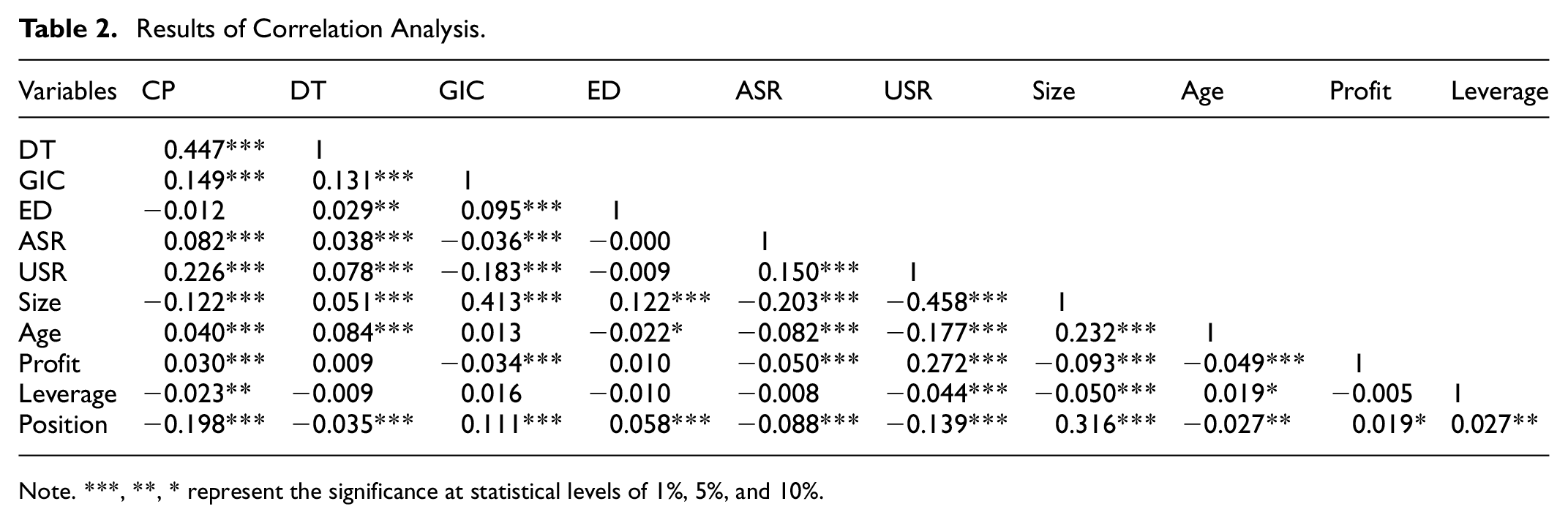
Note. ***, **, * represent the significance at statistical levels of 1%, 5%, and 10%.
Test of Direct Effect
Benchmark Regression Analysis
This study uses the FGLS method to examine the relationship between digital transformation and carbon performance of manufacturing enterprises. The regression results are shown in Table 3.
Test Results of Benchmark Regression.

Note. Standard error is shown in parentheses. ***, **, * represent significance at statistical levels of 1%, 5%, and 10%.
According to Model 1–2, there is a positive relationship between digital transformation and carbon performance of manufacturing enterprises (β = .746, p < .01). Hypothesis 1 is confirmed, indicating that digital transformation promotes the carbon performance of manufacturing enterprises.
Robustness Tests
This study employs two methods for robustness tests. The first method is lag phase model (LP). To address the endogeneity issue caused by the reverse causal relationship between digital transformation and carbon performance of manufacturing enterprises, one-period lagged digital transformation is added to the regression model. The second method is winsorization. In order to weaken the impact of outliers, variables are winsorized at the quantiles 1% and 99%. Results of robustness test are shown in Table 4.
Results of Robustness Test.

Note. Standard error is shown in parentheses. ***, **, *represent significance at statistical levels of 1%, 5%, and 10%.
Model 2–1 shows that there is a positive relationship between one-period lagged digital transformation and carbon performance of manufacturing enterprises (β = .744, p < .01). Model 2–2 shows that digital transformation improves carbon performance of manufacturing enterprises after winsorization (β = .739, p < .01).
Test of Mediating Effect of Green Innovation Capability
To test mediating effect of green innovation capability, this study constructs a mediating effect model. Green innovation capability is taken as a dependent variable to form Formula (5), which is based on Formula (4). Additionally, green innovation capability is incorporated into Formula (5) to form Formula (6).


Where, GIC it represents the green innovation capability of manufacturing enterprises; α2−α3 are constant terms; ϵ it is the residual term. The regression results are shown in Table 5.
Test Results of Mediating Effect of Green Innovation Capability.
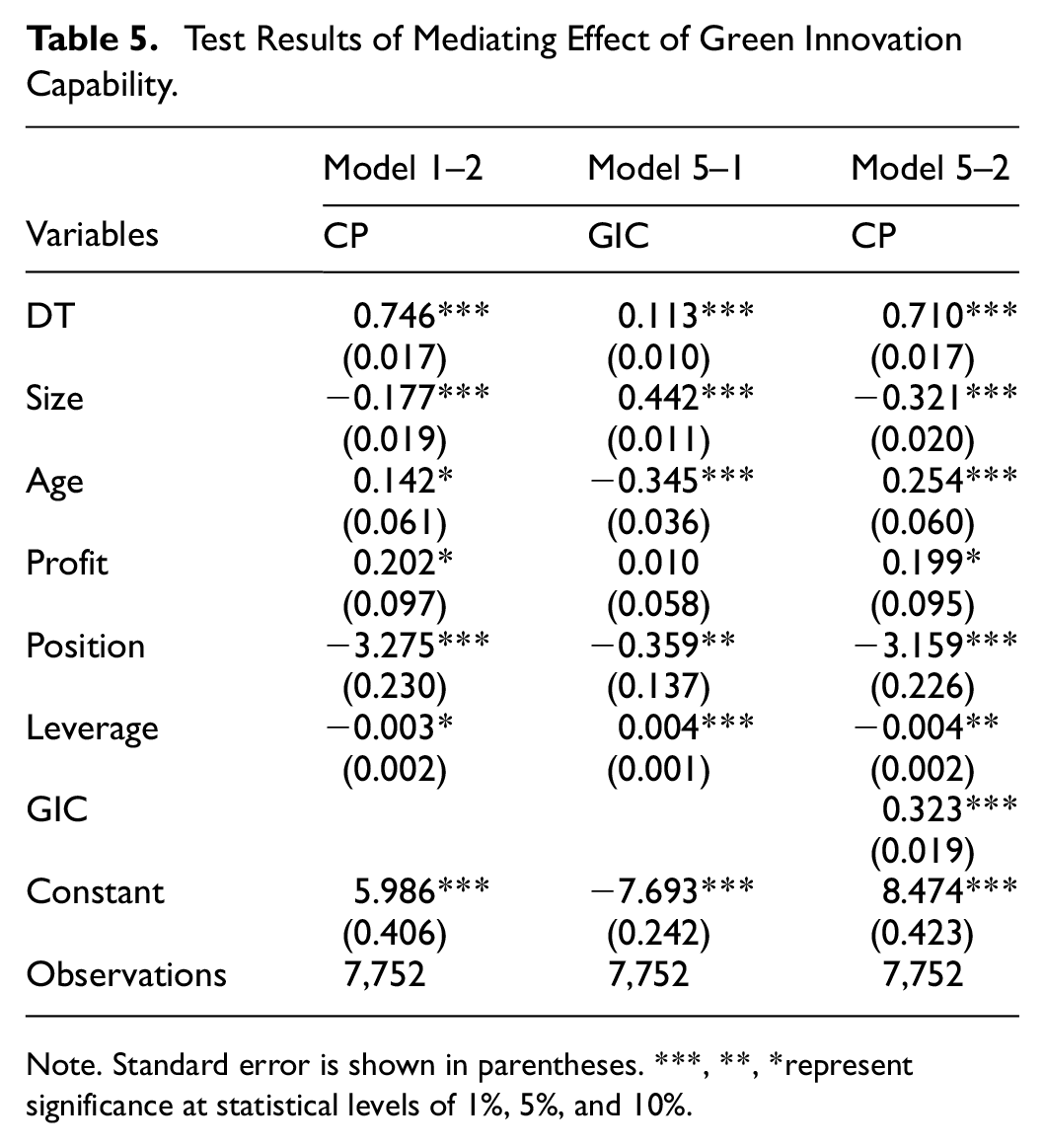
Note. Standard error is shown in parentheses. ***, **, *represent significance at statistical levels of 1%, 5%, and 10%.
Model 5–1 shows there is a positive relationship between digital transformation and green innovation capability (β = .113, p < .01). Model 5–2 shows that digital transformation positively affects carbon performance (β = .710, p < .01), and green innovation capability positively affects carbon performance (β = .323, p < .01). These results indicate that green innovation capability plays a partial mediating effect in the relationship between digital transformation and carbon performance of manufacturing enterprises. Hypothesis 2 is confirmed.
To further verify the mediating effect of green innovation capability, a total of 5,000 bootstrap tests are performed, and a summary of the results is shown in Table 6. According to Table 6, the 95% bootstrap confidence interval is [0.029, 0.044], excluding 0, which indicates that the mediating effect of green innovation capability is significant.
Bootstrap Test Results of Mediating Effect of Green Innovation Capability.

Test of Moderating Effect of Environmental Decentralization
Following the approach of Ye and Wen (2013), this study constructs a mediated moderating effect model to examine the moderating effect of environmental decentralization on the relationship between digital transformation and carbon performance of manufacturing enterprises. Firstly, digital transformation and environmental decentralization are centralized. Digital transformation, environmental decentralization, and the interaction term between digital transformation and environmental decentralization are put into the Formula (7). Secondly, based on Formula (7), green innovation capability is taken as the dependent variable to form Formula (8). Finally, green innovation capability is centralized, and green innovation capability along with the interaction term between green innovation capability and environmental decentralization are put into Formula (7) to form Formula (9).



Where, EDit represents environmental decentralization; α4−α6 are constant terms; ϵ it is the residual term. The regression results are shown in Table 7.
Test Results of Moderating Effect of Environmental Decentralization.
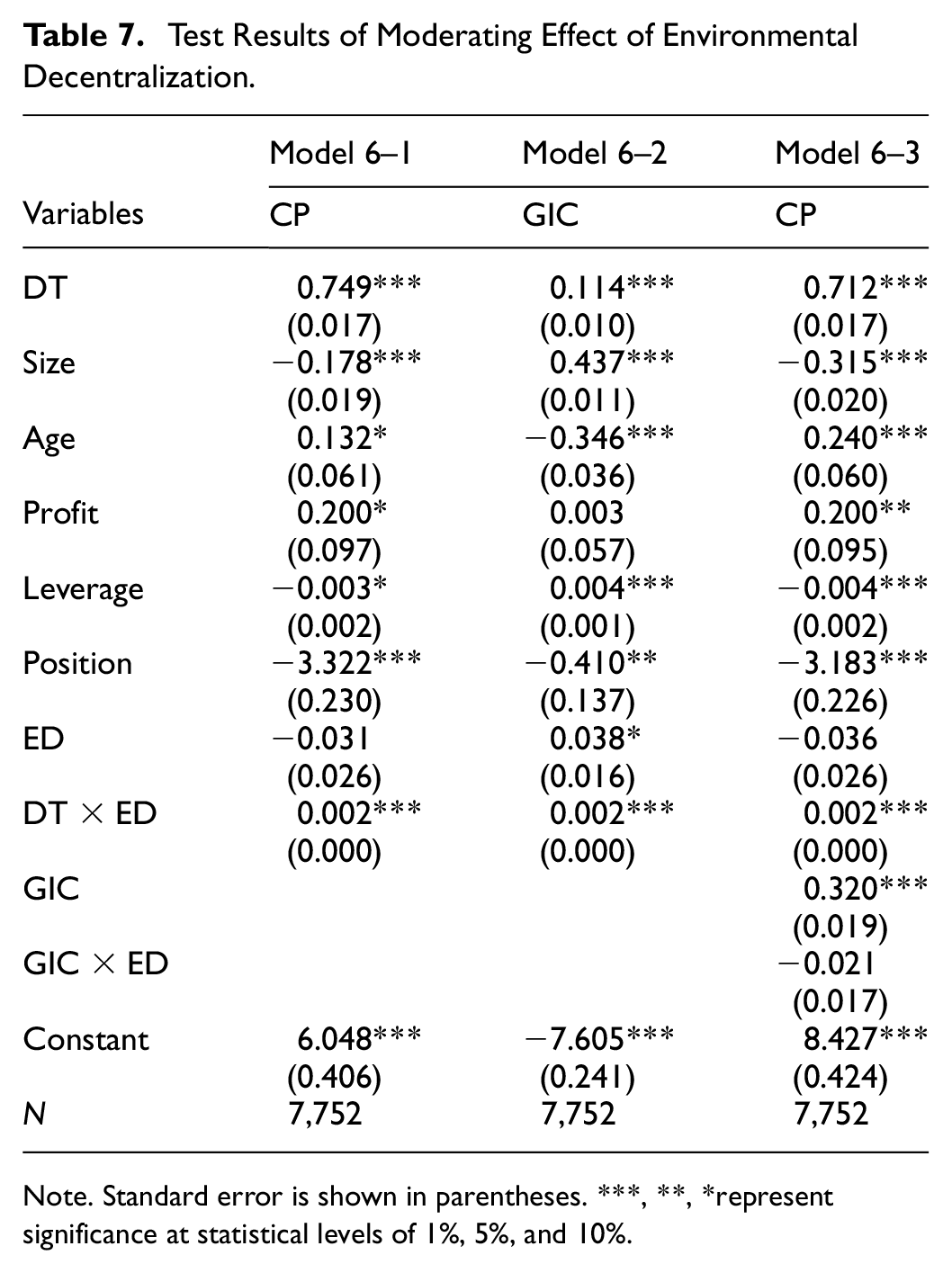
Note. Standard error is shown in parentheses. ***, **, *represent significance at statistical levels of 1%, 5%, and 10%.
Model 6–1 shows that the regression coefficient of the interaction term between digital transformation and environmental decentralization is significant (β = .002, p < .01), indicating that environmental decentralization plays a positive moderating effect in the relationship between digital transformation and carbon performance of manufacturing enterprises. Hypothesis 3 is confirmed. Model 6–2 shows that the regression coefficient of the interaction term between digital transformation and environmental decentralization is significant (β = .002, p < .01), indicating that environmental decentralization plays a positive moderating effect in the relationship between digital transformation and green innovation capability. Models 6–3 shows that the regression coefficient of green innovation capability is significant (β = .320, p < .01). The interaction term between green innovation capability and environmental decentralization is not significant (β = −0.021, p > .1), while the interaction term between digital transformation and environmental decentralization is significant (β = .002, p < .01). The above results show that the moderating effect of environmental decentralization is partly mediated through green innovation capability, and hypothesis 4 is confirmed.
In addition, Figure 1 presents a moderating effect diagram of environmental decentralization in the process of digital transformation affecting green innovation capability, and Figure 2 presents a moderating effect diagram of environmental decentralization in the process of digital transformation affecting carbon performance. As shown in Figure 1, under different levels of environmental decentralization, the linear slope of digital transformation affecting green innovation capability is positive, and under high environmental decentralization, the linear slope is larger than under low environmental decentralization. Digital transformation has a stronger impact on green innovation capability when environmental decentralization is higher, that is, environmental decentralization enhances the positive impact of digital transformation on green innovation capability. As shown in Figure 2, under different levels of environmental decentralization, the linear slope of digital transformation affecting carbon performance is positive, and under high environmental decentralization, the linear slope is larger than under low environmental decentralization. Digital transformation has a stronger impact on carbon performance when environmental decentralization is higher, that is, environmental decentralization enhances the positive impact of digital transformation on carbon performance. The above results indicate that digital transformation has a stronger impact on green innovation capability when environmental decentralization is higher, thereby improving carbon performance.
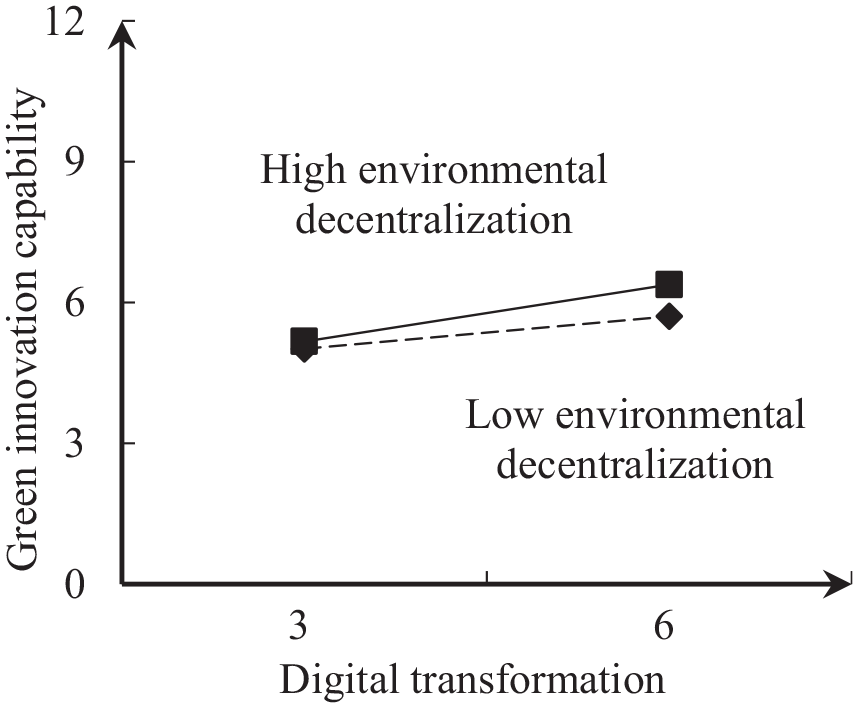
Moderating effect of environmental decentralization on the relationship between digital transformation and green innovation capability.
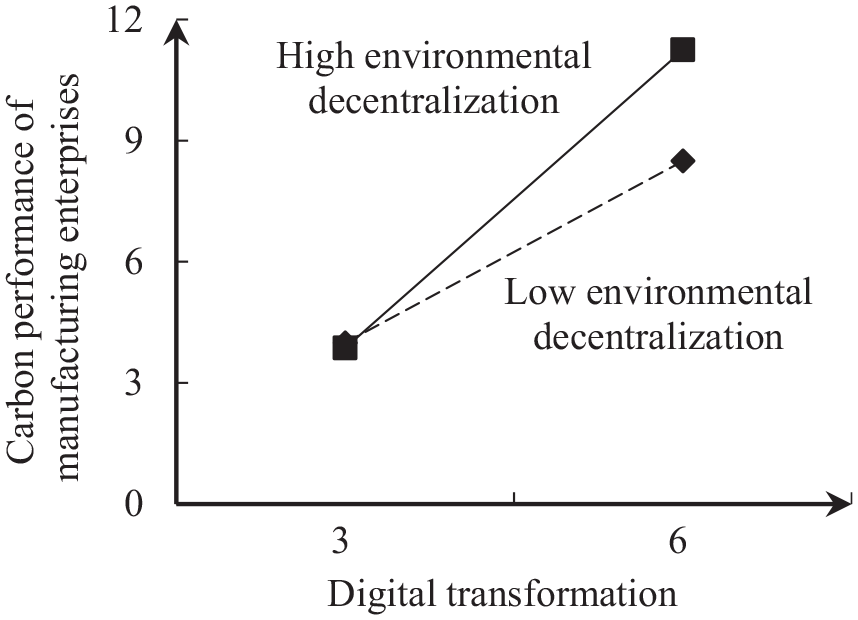
Moderating effect of environmental decentralization on the relationship between digital transformation and carbon performance of manufacturing enterprises.
Test of Moderating Effects of Slack Resource
To examine moderating effects of different types of slack resource, this study constructs moderating effect models. Absorbed slack resource and unabsorbed slack resource are put into Formula (4) to form Formula (10) and (12). Additionally, digital transformation and slack resource are centralized, and the interaction term between slack resource and digital transformation is put into Formula (10) and (12) to form Formula (11) and (13).




Where, ASR it and USR it represent absorbed slack resource and unabsorbed slack resource; α7−α10 are constant terms; ϵ it is the residual term. The regression results are shown in Table 8.
Test Results of Moderating Effects of Slack Resource.

Note. Standard error is shown in parentheses. ***, **, *represent significance at statistical levels of 1%, 5%, and 10%.
Model 7–2 shows that the regression coefficient of the interaction term between digital transformation and absorbed slack resource is significant (β = −1.874, p < .01). This result indicates that absorbed slack resource can weaken the impact of digital transformation on carbon performance, that is, hypothesis 5 is confirmed. Model 7–4 shows that the regression coefficient of the interaction term between digital transformation and unabsorbed slack resource is significant (β = .014, p < .1). This result indicates that unabsorbed slack resource can enhance the impact of digital transformation on carbon performance, that is, hypothesis 6 is confirmed.
In addition, Figure 3 and 4 present moderating effect diagrams of absorbed slack resource and unabsorbed slack resource in the process of digital transformation affecting carbon performance. As shown in Figure 3, under different levels of absorbed slack resource, the linear slope of digital transformation affecting carbon performance is negative, and under high absorbed slack resource, the linear slope is smaller than under low absorbed slack resource. Digital transformation has a weaker impact on carbon performance when absorbed slack resource is higher. As shown in Figure 4, under different levels of unabsorbed slack resource, the linear slope of digital transformation affecting carbon performance is positive, and under high unabsorbed slack resource, the linear slope is larger than under low unabsorbed slack resource. Digital transformation has a stronger impact on carbon performance when unabsorbed slack resource is higher.

Moderating effect of absorbed slack resource on the relationship between digital transformation and carbon performance of manufacturing enterprises.

Moderating effect of unabsorbed slack resource on the relationship between digital transformation and carbon performance of manufacturing enterprises.
Conclusions and Implications
Conclusions
Based on data of Chinese manufacturing enterprises listed in Shanghai and Shenzhen A-shares from 2011 to 2020, this study explores the relationship between digital transformation and carbon performance of manufacturing enterprises, and examines the effects of green innovation capability, environmental decentralization and slack resource in this relationship. The research conclusions are as follows:
Firstly, digital transformation significantly improves carbon performance of manufacturing enterprises, and robustness tests support this conclusion. Digital transformation boosts the energy conservation and emission reduction of enterprises (An & Shi, 2023). Digital technologies have a positive impact on carbon emissions through structural and technological effects (Lange et al., 2020). Under the structural effect, digital transformation helps manufacturing enterprises reduce the production scale of highly polluting products, leading to a significant decrease in carbon emissions (Wen et al., 2021). Under the technological effect, digital transformation promotes the upgrading of production technology, drives product innovation, and enhances total factor productivity. Through the adoption of clean production technology, manufacturing enterprises can significantly improve energy efficiency (Y. Huang et al., 2023). These studies indirectly reflect the important significance of digital transformation in improving carbon performance of manufacturing enterprises.
Secondly, green innovation capability plays a partial mediating effect in the impact of digital transformation on carbon performance of manufacturing enterprises. This indicates that green innovation capability acts as an important “bridge” through which digital transformation enhances carbon performance. This finding aligns with the study of Xu et al. (2023) and Xie et al. (2023). Digital technologies foster the sharing of green technologies, enabling enterprises to engage in collaborative innovation. Zhao and Qian (2024) argued that digital transformation was of great significance for the development of green technologies, as it enhanced the dynamic capabilities of manufacturing enterprises to identify innovation opportunities, expanded the scope of green innovation resource allocation, and stimulated the motivation to pursue green innovation. Furthermore, J. W. Huang and Li (2017) found that green innovation capability significantly promoted green product and green process innovations, which was instrumental in carbon emission reduction. The results of existing literature support the conclusion that green innovation capability plays a partial mediating effect in the impact of digital transformation on carbon performance of manufacturing enterprises.
Thirdly, environmental decentralization plays a positive moderating effect in the impact of digital transformation on carbon performance of manufacturing enterprises. This moderating effect is partially mediated through green innovation capability. W. Zhang and Li (2022) argued that reforms in environmental management systems were crucial for improving environmental pollution control and fostering green technology innovation. The goal of environmental decentralization is to grant local governments independent environmental management authority, thereby encouraging green technology innovation and improving the efficiency of environmental pollution treatment (Feng et al., 2020). Environmental decentralization enables local governments to tailor policies to regional conditions (Ran et al., 2020) and develop stringent environmental protection regulations (Goel et al., 2017). The improvement of local governments’ autonomy in environmental governance can guide manufacturing enterprises to focus on the enhancement of green innovation capability through digital transformation, thereby improving carbon performance.
Fourthly, slack resource plays the moderating effect in the impact of digital transformation on carbon performance of manufacturing enterprises. Specifically, absorbed slack resource weakens this impact, while unabsorbed slack resource strengthens it. These findings align with the study of Bakcolu-Peynirci and Morgan (2022). The different effects of slack resource can be explained by the “flexibility-efficiency” framework. Absorbed slack resource allocated for specific purposes cannot be reallocated for digital transformation, thus reducing resource allocation efficiency. In contrast, unabsorbed slack resource, which are not committed to particular uses, can be more efficiently applied to support digital transformation. The flexibility of unabsorbed slack resource reduces the risks associated with digital transformation, thus positively affecting the relationship between digital transformation and carbon performance.
Implications
Firstly, manufacturing enterprises should actively implement digital transformation activities to improve carbon performance. It is necessary to create favorable conditions for digital transformation activities, apply digital technology to build intelligent decision-making system, digitize production, warehousing and logistics, reduce production costs, improve energy efficiency and ultimately enhance carbon performance.
Secondly, green innovation capability should be empowered and its pathway impact between digital transformation and carbon performance should be fully utilized. On the one hand, digital technology should be employed to support the development of green technology and optimize the design of environmentally friendly products. On the other hand, manufacturing enterprises should increase investment of green production lines and adopt sustainable practices to reduce carbon emissions, thus enhancing the development of green innovation capabiity and improving carbon performance.
Thirdly, the reform of the environmental decentralization system should be further deepened, and a guarantee for digital transformation to improve carbon performance should be provided. The central government should appropriately allocate the governance power of carbon emissions to local governments and improve the enthusiasm of environmental governance of local governments. At the same time, local governments should formulate a strict environmental protection system to guide manufacturing enterprises to increase the application of digital technology in the field of green innovation, and use the means of digital transformation to improve green innovation capability, thereby improving carbon performance.
Fourthly, the impact of slack resource should be fully utilized and a good resource foundation for digital transformation to improve carbon performance should be established. On the one hand, manufacturing enterprises should make rational use of absorbed slack resource, carry out digital transformation of workshops, equipment, etc., and unleash the potential of digital transformation to improve carbon performance. On the other hand, manufacturing enterprises should actively reserve unabsorbed slack resource, enhance the efficiency of resource allocation, and meet the resource requirements for digital transformation to improve carbon performance.
Limitations and Future Research
Firstly, this study does not consider digital transformation in different dimensions. In the future, the impact of different dimensions of digital transformation on carbon performance can be further explored. Secondly, this study fails to fully explain the complex relationship between conditions. In the future, the configurational impact of multiple conditions on carbon performance can be explored. Thirdly, this study uses secondary data for empirical analysis. In the future, typical enterprises can be selected for case study to arrive at more targeted implications.
Footnotes
Acknowledgements
We were thankful for the suggestions and efforts from the reviewers and editors.
Declaration of Conflicting Interests
The author(s) declared no potential conflicts of interest with respect to the research, authorship, and/or publication of this article.
Funding
The author(s) disclosed receipt of the following financial support for the research, authorship, and/or publication of this article: This study was supported by the Special Program of Science and Technology Strategic Research of Shanxi Province “Study on the Impact Path and Countermeasures of Digital Transformation on the Green Competitiveness of Manufacturing Enterprises of Shanxi Province” (Grant No. 202304031401047); This study was supported by the Planning Program of Philosophy and Social Science of Shanxi Province “Study on the Mechanism of Artificial Intelligence Promoting New Industrialization of Shanxi Province” (Grant No. 2024YB018); This study was supported by the Fundamental Research Program of Shanxi Province “Study on the Action Mechanism and Dynamic Evolution of Artificial Intelligence on Manufacturing Industrial Chain Resilience” (Grant No. 202403021211097).

Data Availability Statement
Data sharing was not applicable to this article as no datasets were generated or analyzed during the current study.