




Abstract
Within the context of low-carbon development and drawing on the resource-based and dynamic capability theories, this paper provides a conceptual model of the relationship between external knowledge acquisition, green dynamic capability and corporate green innovation. Then, using 416 samples of firms in China collected from January 2018 to September 2018, the model was tested using the hierarchical regression analyses. The empirical results show that external technical knowledge acquisition and market knowledge acquisition have a positive influence on corporate green innovation. Additionally, the results show that green integration capability and green dynamic configuration capability positively moderate the relationship between technical knowledge acquisition and green innovation. The results also show that green learning capability, green integration capability and green dynamic configuration capability positively moderate the relationship between market knowledge acquisition and green innovation. This study supports the resource-based view, enriches the application of external knowledge acquisition in sustainable development, and extends the theory of green dynamic capability from causal prediction to situational factors. This paper provides theoretical support and practical guidance for firms seeking to effectively conduct open innovation, implement green innovation, and realize low-carbon development.
Keywords
Introduction
With the rapid development of the global economy, environmental and energy issues have become increasingly prominent and low-carbon development has gradually become a global consensus (Mohsin et al., 2022). Countries around the world have devoted many resources to promote green development to mitigate these issues (Nieto et al., 2020; Ullah et al., 2022). As firms are the basic unit of the economic system, their productive and operational activities have a far-reaching influence on the natural environment (Yu et al., 2022). Firms should pay great attention to social and environmental issues, incorporate green and low-carbon objectives into their strategic decisions (Dowell & Muthulingam, 2017; Stucki, 2019) and fulfill their social responsibilities to reduce their carbon emissions (S. Wang et al., 2022). Green innovation is widely recognized as an important approach to deal with environmental problems (Guo & Wang, 2022), A number of studies confirm that green innovation is the solution for achieving a “win-win” result of economic growth and sustainable development (Bossle et al., 2016; Guo et al., 2020a). As a type of innovation aimed at reducing pollution, saving resources and improving the environment (Song et al., 2019), green innovation (GIN) lays a foundation for the balance between economic benefits and the responsibility to reduce carbon emissions (Przychodzen et al., 2019) and realizes the coordinated development of the economy, society and the environment (Mohsin et al., 2022). Hence, GIN, which includes the two developmental concepts of innovation drive and green transformation, has become an important strategy for firms seeking to meet their carbon reduction responsibilities (Du & Li, 2019; Owen et al., 2018).
Scholars have focused on the driving factors behind GIN. Some have used economic theory to conduct this research while others have used organizational and sociological theory. As external driving factors of GIN, scholars have investigated, among others, environmental legislation (Y. Chen et al., 2012), regulatory pressure (Berrone et al., 2013), social expectation (J. W. Lee et al., 2018), competitor pressure (Cainelli et al., 2012) and customer demand (Kesidou & Demirel, 2012). Regarding the internal driving factors of GIN, scholars have investigated factors such as R&D activities (Laursen & Salter, 2006), technical cooperation (De Marchi, 2012), equipment upgrades (Horbach et al., 2012; Kesidou & Demirel, 2012), market share expansion (Horbach, 2008) and image improvement (Arnold & Hockerts, 2011). Although these studies have discussed the driving factors that cause firms to adopt GIN, few have investigated the implementation process for and development of GIN, let alone the information and knowledge issues related to GIN activities (Horbach et al., 2013).
External knowledge acquisition (EKA) is an important component of open innovation and is closely related to GIN. The essence of open innovation is the full use of external sources of knowledge (Papa et al., 2020). Research has pointed out that the first pillar of the open innovation model is that firms seek external knowledge in innovative ways (Ghisetti et al., 2015). The open innovation literature argues that “valuable ideas can come from within or outside the firm.” (Almodóvar & Nguyen, 2022), firms can and should acquire decentralized knowledge from external actors in order to combine it with knowledge developed internally and owned by firm employees (Chesbrough, 2006). As the openness of innovation continues to increase, enterprises are witnessing the transformation from the “closed innovation” model to the “open innovation” model (Radnejad et al., 2017). It is no longer possible for a single enterprise to undertake technical activities in all relevant areas, and the acquisition of knowledge from the outside becomes an important factor in driving technological development (Ganotakis et al., 2021; Laursen & Salter, 2006). Studies have shown that domestic firms need external knowledge to compete with foreign TNC affiliates (Almodóvar & Nguyen, 2022), external knowledge is important for enterprise product innovation (Zahra & George, 2002). However, few studies have focused on how EKA affects GIN from the perspective of environmental innovation.
GIN, in essence, is the integration of organizational, market, and technical issues and it boasts interdisciplinary characteristics. Compared with traditional innovation, GIN requires broader external resources and more knowledge investments (Liao, 2016). Studies have found that the adoption of external knowledge is beneficial to corporate green innovation (J. Zhang et al., 2020), and French small and medium-sized enterprises (SMEs) promote corporate green innovation through a combination of internal and external knowledge sharing (Arfi et al., 2018). However, there remains a big gap between the literature on knowledge acquisition and that on GIN (Greco et al., 2015; McKelvie & Brattstro, 2018) and there has been no in-depth research to date on the relationship between different types of EKA and GIN. This provides the basis for extending the orientation of our research.
Given the inherent unpredictability of GIN (Dangelico et al., 2017; Y. Zhou et al., 2018), it is necessary to investigate the contingent factor of how EKA influences GIN from the perspective of dynamic capability. As the appeal to low-carbon development gains broader acceptance (Kong et al., 2020), the element of green dynamic capability (GDC), which is related to the concept of environmental management, is increasingly important (Daddi et al., 2021; Jiang et al., 2018). GDC is the comprehensive capability of firms to discover environmentally friendly opportunities, configure environmentally friendly resources and optimize their organizational structures. It encourages firms to consider external environmentally friendly knowledge resources in a timely manner (Qiu et al., 2020; J. Zhang et al., 2020) and make rapid responses to meet the needs of stakeholders on environmental issues, thus improving the efficiency of EKA toward GIN. Firms in China, which are at a crucial stage of economic transformation, may encounter many uncertainties and risks in the practice of GIN (Abbas & Sağsan 2019; Sun et al., 2019). For example, some corporate green innovation projects in China have been suspended due to lack of sustainable credit support, which caused by the uncertainty of capital market financing. These environmental issues and market changes have a more pronounced impact on firms. The SME owners and other decision makers should grasp ability to quickly adopt required changes related to environmental management and use available resources to develop new skills. Thus, the contingent influence of firms’ GDC on GIN practice more prominent. However, few studies have clarified the boundary effect of GDC in the process of practising GIN. To fill this gap, it is necessary to explore whether GDC have moderating effects on the development process of GIN. In this sense, our research extends the theory and application of GDC from a causal prediction to situational factors, enriching the field of research on GDC.
Therefore, the main purpose of this study is to explore the impact of firms’ EKA on GIN in Chinese firms and its boundary conditions from the perspective of GDC. Specifically, this research focuses on the following research questions:
(a) Does EKA boost GIN? What are the differences between the roles played by technical knowledge acquisition (TKA) and market knowledge acquisition (MKA) in GIN?
(b) Does GDC have a moderating effect on the relationship between EKA and GIN?
(c) Is there any difference between the contingent factors of green learning capability (GLC), green integration capability (GIC) and green dynamic configuration capability (GCC)?
The structure of the paper is as follows. Section 2 reviews relevant theories and literature. Section 3 draws research hypotheses on this basis, the research methodology is outlined in section 4. Data analysis and results are presented in section 5. Section 6 discusses the research results, concludes with the study’s limitations and indicates the potential for future research. Finally, the paper presents the originality and theoretical contributions of this research.
Theoretical Foundation and Literature Review
Resource-Based View
The resource-based view (RBV) theory originates with Penrose (1959). Wernerfelt (1984) was the first to explicitly propose the RBV, indicating that academics should pay attention to the resources within an enterprise rather than to the enterprise’s product. Barney (1991) would further popularize and expand this theory, proposing the core ideas of the RBV theory, the definition of resources and the characteristics of heterogeneous resources that can bring sustainable competitive advantages to enterprises. Since then, the RBV theory has been gradually receiving widespread attention from scholars (Zahra & George, 2002). According to the RBV theory, a company generates competitiveness from the unique resources it possesses (Peteraf, 1993; Wernerfelt, 1984). Specifically, these “resources” can be divided into tangible (such as human, physical, organizational) and intangible (such as knowledge, information, capacity, innovation) resources (Barney, 1991).
Especially in the era of the knowledge economy, knowledge has become an important factor for enterprises seeking to innovate and maintain a competitive advantage. Grant (1996) considered knowledge to be an enterprise’s most important strategic resource and emphasized that an enterprise is a collection of heterogeneous knowledge. Some scholars have indicated that companies can acquire external knowledge through alliances, the flow of developers and horizontal acquisitions (Grant, 1996; Xie et al., 2018), and that modern organizations have begun to encourage the externalization of work. More scholars are now paying attention to the tools and methods of human-centered knowledge management (Z. Yang & Wei, 2019) and their focus is no longer on the definition, measurement and storage of existing knowledge resources in an organization (Molina-Morales et al., 2014) but on the generation of new knowledge resources and the sharing of external knowledge. In the context of sustainable development, EKA can provide the knowledge base and necessary skills for GIN (Grant, 1996; Marvel, 2012), making firms more autonomous in the selection and implementation of environmentally friendly projects and supporting the successful implementation of GIN. Therefore, the RBV provides a theoretical basis for this study to analyze the impact of EKA on GIN.
According to Mitchell (2006), EKA requires the collection, recognition and location of new knowledge resources through different external channels before these resources are integrated into an existing knowledge stock. Xie et al. (2018) indicated that inter-organizational knowledge acquisition is the interactive process through which firms obtain new technologies and specialized knowledge from partners and other external sources. Some scholars hold that EKA is a mechanism for firms to purposefully integrate new external technologies, ideas and specialized knowledge into their existing knowledge bases (Ortiz et al., 2017). Schroeder et al. (2010) indicate that EKA is the cooperation between enterprises and related external institutions (such as suppliers, customers, competitors and other collaborators) to jointly solve problems and conduct business. Z. Yang and Wei (2019) argue that access to external knowledge is one of the key pillars of the open innovation paradigm, a strategy for companies to gain knowledge from external institutions, and that companies should improve their own technologies by absorbing external ideas.
Drawing on Mitchell’s (2006) definition, this study defines EKA as the process by which an enterprise collects knowledge through different external channels and incorporates it into its existing knowledge stock. Moreover, in our study, EKA is divided into two dimensions (TKA and MKA) for two reasons. First, as it is very difficult to design and produce environmentally friendly products (Borghesi et al., 2015), GIN entails higher uncertainty and difficulty than traditional innovation (Abbas & Sağsan 2019; Sun et al., 2019), which sets higher requirements for the technical knowledge bases of firms (Liao, 2016). Second, the transitional market environment is characterized by unpredictability and informational asymmetry (Y. Li & Tang, 2021; Tran, 2019). Market knowledge helps firms to obtain important information on green products and services in a timely manner while understanding the environmental issues and demands of consumers (T. Li & Calantone, 1998; K. Z. Zhou & Li, 2012). Therefore, the external knowledge required by GIN is mostly embodied in two aspects: technical knowledge and market knowledge.
Regarding TKA, firms mainly obtain this from the engineering, manufacturing and production processes gained from advanced equipment imports (Sullivan & Marvel, 2011), technical outsourcing, invitations from technicians and R&D outsourcing (Cassiman & Veugelers, 2006). Regarding MKA, firms mainly obtain this from customer demands, trends amongst market competitors and through cooperation with stakeholders such as customers, suppliers and governmental agencies (Liao, 2018; K. Z. Zhou & Li, 2012).
Dynamic Capability Theory
Dynamic capability theory originates from Schumpeter’s innovation-based view of competition, which emphasizes that dynamic capabilities help firms cope with the challenges posed by the changing external environment (Teece, 2007; Teece et al., 1997). Compared with the RBV, which emphasizes the selection and combination of resources, dynamic capability theory emphasizes the renewal and reorganization of resources, that is, the reallocation of resources into a new combination of operational capabilities (Pavlou & Sawy, 2011). Research has suggested that steady-state organizational capabilities are not enough for firms (Y. S. Chen & Chang, 2013) and that it is necessary for firms to continue to improve their ability to adapt to and take advantage of dynamic environments (Zacca & Dayan, 2018). In other words, firms compete not only in terms of existing resources and organizational capabilities but also in terms of updating and developing their organizational capabilities to adapt to uncertain circumstances (Teece et al., 1997). Thus, from the perspective of dynamic capabilities, the “static” resources accumulated by firms are insufficient to ensure the success of GIN in the constantly changing environment (Teece, 2007; Teece et al., 1997). Different levels of GDC may explain the differences in corporate GIN given equal levels of EKA.
In the context of low-carbon development, more firms are considering environmental issues in their operational and management structures. Academic discussions on dynamic capability should consider incorporating environmental issues and green concepts. This leads to the concept of GDC, which includes the idea of environmental management. Y. S. Chen and Chang (2013) defined GDC as a firm’s capability to update and develop its green organizational capability within its existing knowledge base to respond to the dynamic market. Y. H. Lin and Chen (2017) indicate that GDC is the ability to design and produce green products by integrating and reconstructing resources to adapt to the complex and ever-changing market; however, the research in this area remains lacking (Qiu et al., 2020). Based on the existing research (Daddi et al., 2021; Qiu et al., 2020), we define GDC as the comprehensive ability of firms to implement organizational learning, integrate internal and external resources and dynamically allocate resources in terms of environmental management to cope with changes in the environmental protection market.
Regarding the dimensions of GDC, we follow the classification methods of Teece et al. (1997) and Teece (2007) in terms of dynamic capability. The integration and configuration dimensions of dynamic capability have been recognized by most scholars while the perceptual dimension is still controversial in strategic management research (J. Zhang et al., 2020). As our research mainly investigates the role of GDC in the EKA transformation process, we hold that the ability to learn, which can make a corporate operation more effective and efficient through repeated inspection (Y. Lin & Wu, 2014), plays a more important role in our conceptual model than the perceptual capability. Therefore, we divide GDC into three dimensions: GLC, GIC, and GCC. GLC emphasizes a firm’s recognition of, extraction of and ability to share green knowledge. GIC emphasizes a firm’s ability to absorb and internalize green knowledge. GCC emphasizes a firm’s ability to dynamically configure its green resources by scanning and predicting the environment to develop environmentally friendly practices (Y. Zhou et al., 2018).
Green Innovation
With the deterioration of the environment and the growing of the demand for sustainable development, environmental issues are attracting more attention from society. At the beginning of the 19th century, academics began to introduce sustainable development issues such as economic, social and environmental win-win outcomes into the field of innovation based on various perspectives. In this context, concepts such as “sustainable innovation,”“environmental innovation,”“ecological innovation,” and “green innovation” have emerged. From the perspective of the motivation to innovate, the development of sustainable innovation aims to achieve social, economic and ecological gains, whereas environmental innovation, ecological innovation and GIN only focus on the economic and ecological dimensions (Franceschini et al., 2016).
This study uses the term GIN, which has been defined by many scholars. Y. S. Chen et al. (2006) defined GIN as green product innovation or product-related hardware or software innovation including energy saving, pollution prevention, waste recycling, green product design and other forms of technological or corporate environmental management innovation. Carrillo-Hermosilla et al. (2010) broadly indicated that all innovations that can reduce environmental damage and improve a firm’s environmental performance are GIN. Aboelmaged and Hashem (2019) regarded GIN as the development of new processes, equipment, systems, practices, products and methods that minimize a firm’s negative effect on the environment while promoting its sustainable development goals to increase its business value. Singh et al. (2020) argued that GIN is defined by an enterprise’s reduction of pollution emissions and raw material consumption by using environmentally friendly raw materials, consuming fewer raw materials or choosing eco-design principles when designing products. Based on previous studies, this study adopts the definition by Carrillo-Hermosilla et al. (2010), which states that all innovations that can reduce a firm’s environmental damage and improve its environmental performance are GIN.
Research Hypotheses
External Knowledge Acquisition and Green Innovation
We suggest that a firm’s TKA can positively influence its GIN in three ways. First, TKA can provide an abundant knowledge basis for GIN (Ganguly et al., 2019; Pérez-Luño et al., 2019). As it is difficult for a single firm to independently develop the knowledge required by GIN, firms must obtain this technical knowledge from channels such as customers, suppliers, universities and research institutions (Abbas & Sağsan, 2019; Mothe et al., 2018; H. Zhang et al., 2010) to diversify their knowledge reserves (Liao, 2018) and provide a strong support system for GIN. Second, TKA may help firms seize GIN opportunities. Research shows that TKA is closely related to a firm’s innovation of products and services (Sullivan & Marvel, 2011). A firm’s external TKA may help expand the application scope of existing knowledge resources while optimizing its product/service processes, costs and functions (Wiklund & Shepherd, 2003), thus helping it to better recognize and use GIN opportunities. Third, TKA may help firms to improve their GIN capability. TKA may promote the transfer of knowledge resources to a firm and the proliferation of these within it, which are required conditions for GIN (Qasrawi et al., 2017; J. Yang, 2010). Technical breakthroughs may occur during these processes (Shane, 2000), and provide favorable technical conditions for corporate GIN. From the literature, it is evident that researchers are paying more attention to how technical knowledge may help them to attain GIN. Hence, the following hypothesis is proposed:
H1-1: TKA has a positive influence on GIN.
We also expect that a firm with higher MKA is better able to carry out GIN. First, MKA may help firms exert the first-mover advantage in the green market. According to Liao (2018), the latest market trend information helps firms make rapid responses according to the changes in market demands. To conduct GIN, firms need to track the industry market situation in a timely manner (V. H. Lee et al., 2013) and recognize and seize market opportunities promptly (Mothe et al., 2018), thus forming a first-mover advantage in the green market. Second, MKA helps firms to evaluate and develop opportunities for GIN. A study by Roy and Thérin (2008) suggested that firms access knowledge from multiple sources and that receiving more information or developing an effective knowledge network can help them make high-level environmental commitments. Timely and effective market knowledge can encourage firms to focus on customer demands (Darroch, 2005) such as green and low-carbon issues, which may become important prerequisites for seizing GIN opportunities. Third, a firm’s external MKA helps it to assess the exact market demands (Albort-Morant et al., 2018; H. Lin, 2007), consequently reducing uncertainty over the production of new green products (Liao, 2018), which is crucial for green R&D activities and GIN. Based on these factors, it is apparent that the association between MKA and innovation is well established; however, the exact relationship between MKA and GIN is deserving of further study. Therefore, the following hypothesis is proposed:
H1-2: MKA has a positive influence on GIN.
The Moderating Role of Green Dynamic Capability
We suggest that a firm’s GLC can positively influence its GIN. GIN is technologically complex and costly (Arfi et al., 2018) and requires more environmental knowledge than traditional forms of innovation. According to Liao (2018), the external technical knowledge obtained by a firm may strengthen the diversity of its knowledge reserve. The stronger a firm’s GLC, the more able it will be to recognize and extract valuable green technical knowledge. Thus, GLC is an important impetus for firms to promote GIN through technical knowledge. Moreover, learning capability emphasizes a firm’s sharing of knowledge (Attia & Salama, 2018; Ganguly et al., 2019) and stronger GLC means that a firm is more proficient at publicizing, teaching and popularizing knowledge on environmentally friendly practices within its organization: this may help it to break the constraints of convention (Eckstein et al., 2015; Smith, 2007) and change its traditional business scope (Ganguly et al., 2009; Irfan et al., 2019; Kale et al., 2019) to cope with challenges related to GIN more flexibly. Therefore, the following hypothesis is proposed:
H2-1: GLC positively moderates the relationship between TKA and GIN.
MKA provides firms with knowledge and information from different sources (Mothe et al., 2018; Smith, 2007). Firms with a stronger learning capability are more proficient at recognizing and extracting effective market knowledge from multiple sources of information (V. H. Lee et al., 2013; Mothe et al., 2018). Accordingly, GLC helps firms to understand customers’ green preferences and consumption demands. Furthermore, various studies have demonstrated knowledge sharing to be an essential factor for a firm’s ability to influence innovation (Abbas & Sağsan, 2019; Ode & Ayavoo, 2020; Shahzad et al., 2020). GLC can help firms share green market knowledge and further explore more green market opportunities, thus boosting their effective transformation from MKA to GIN. Therefore, the following hypothesis is proposed:
H2-2: GLC positively moderates the relationship between MKA and GIN.
Knowledge integration capability is a firm’s ability to integrate valuable knowledge within and beyond its organization (Mitchell, 2006; Xu et al., 2013). Firms with stronger GIC can absorb external green technical knowledge, match it with their original internal knowledge and internalize it into a new environmentally friendly knowledge system. First, the organic integration of external knowledge on environmentally friendly practices and a firm’s existing internal knowledge promotes the transfer and proliferation of professional knowledge and skills (Mitchell, 2006), which helps firms develop more green products and/or processes while boosting external knowledge that may be effectively transformed into GIN. Second, the absorption and internalization of external knowledge can keep firms from becoming dependent on their existing technical knowledge (Zahra et al., 2020), which can be further conducive to the timely update and adjustment of their technology and production processes (Guo et al., 2021), thus promoting their effective implementation of GIN. Hence, the following hypothesis is proposed:
H3-1: GIC positively moderates the relationship between TKA and GIN.
Knowledge integration capability is a significant source of competitive advantage, and this significance depends on the efficiency, scope and flexibility of a firm’s knowledge integration (Grant, 1996). GIC is a firm’s ability to promote its absorption and internalization of environmentally friendly knowledge, which constantly enriches its knowledge repository (Zahra et al., 2020) and enables it to make more accurate judgments regarding market and customer information related to environmental protection. Knowledge integration capability allows a firm to be constantly aware of changes to the business environment, offering it a greater chance to identify potential innovative opportunities (Guo et al., 2021). Therefore, GIC is not only an important source of green innovation products/services, but it also helps firms promote these green products to the market and reduce their risk of failure in the practice of GIN. Hence, the following hypothesis is proposed:
H3-2: GIC positively moderates the relationship between MKA and GIN.
We suggest that a firm’s GCC may strengthen the influence of TKA on GIN. Only by converting the latest available technologies into products that are available on the market can a firm win in the context of fierce competition (Eyring et al., 2014). GCC can help firms apply green technologies and resources to their production processes to effectively carry out green practices and adopt GIN. In addition, innovators must compare the advantages and disadvantages of various schemes to reduce their risks of failure as much as possible (Guo et al., 2020b). GCC helps firms to continuously improve their existing resource pools based on new external knowledge while maintaining the dynamic optimization of their resource repository in a complex and ever-changing environment. GCC can help firms reduce the possible problems in the process of GIN such as limited resources, low levels of knowledge and technological shortcomings (Arfi et al., 2018), thus ensuring the successful implementation of GIN. Hence, the following hypothesis is proposed:
H4-1: GCC positively moderates the relationship between TKA and GIN.
We also expect that GCC will facilitate the effect that MKA has on GIN. The rapidly changing business environment requires that firms continually upgrade their competencies and make their capabilities flexible to remain competitive (Karna et al., 2016). Although MKA can help firms understand changing consumer demands and competitors’ actions (K. Z. Zhou & Wu, 2010), whether they can effectively re-configure their resources and create new opportunities depends on their GCC. Firms’ abilities to re-configure their collective knowledge and resources can help them react to environmental issues (J. W. Huang & Li, 2017), resist newly emerging threats, seize new opportunities, further overcome uncertainty in the GIN process and successfully implement GIN. Thus, the following hypothesis is proposed:
H4-2: GCC positively moderates the relationship between MKA and GIN.
The conceptual framework of this paper is shown in Figure 1.

Conceptual framework.
Methodology
Sampling and Data Collection
From January 2018 to September 2018, this research collects the survey data of firms in provinces and municipalities directly under the central government, such as Shaanxi, Tianjin, Shanghai and Guangdong. These cities represent the western China, Circum-Bohai Sea Region, Yangtze River Delta and Pearl River Delta, which may reflect China’s geographical, economic, and demographic diversity (Zhao et al., 2011). According to the definition and application of firms in some authoritative literature (Guo H.et al., 500; Lu & Beamish, 2001), our research objects are firms with less than 500 employees. This investigation obtained the random sample database based on the random sampling process of scale and industry-stratified. In order to ensure the recovery of questionnaires, questionnaires were distributed through university resources and social relationships of our research group. Two approaches were adopted. First, we entrusted students of MBA/EMBA class in universities to fill in and help contact their firms’ senior directors to conduct semi-structured interview, and further fill out the questionnaire. Second, we entrusted classmates and friends to send the questionnaire to firms’ managers through on-site interview, email and network, and further finish the questionnaire. This research distributed 784 questionnaires, among which 480 were recycled, with the questionnaire recovery of 61.2%. After deleting 39 incomplete questionnaires and 25 questionnaires with mistakes, we finally obtained 416 valid questionnaires. Related statistical information of sampled firms is shown in Table 1.
Demographic Profile of Sampled Firm and Respondents.

In order to evaluate non-response bias (whether there is any difference between respondents and non-respondents), according to the research of Armstrong and Overton (1977), we conducted t-test to data (216 data) collected earlier and data (200 data) collected later. The result shows that the basic information of firm age, firm size and industry had no significant statistical difference in the level of p ≤ .05, which indicates that there was basically no difference between respondents and non-respondents in this investigation.
In order to test common method variance (CMV), we adopted the single factor method of Harman, and conducted factor analysis to the data for all scales through SPSS 22.0. We added 25 question items and conducted non-rotated principle component analysis. The result indicates that the maximum variance interpretation rate is 21.228%, less than half of the total variance interpretation rate, showing that the individual factors have no obvious interpretation of the entire questionnaire. Therefore, the influence of CMV on this research is not severe, so subsequent analysis may be done.
Questionnaire Design
We constructed a questionnaire with the following five sections: firms’ descriptive data (e.g., industry sector, number of employees and time of establishment), technical knowledge acquisition (TKA), market knowledge acquisition (MKA), green innovation (GIN) and green dynamic capabilities (GDC). The design of the questionnaire consists of three steps. First, on the basis of clarifying the variable definition, we designed the primary questionnaire by referring to the mature scale of authoritative literature. Second, we interviewed firm managers face to face and modified the questionnaire accordingly. Finally, the questionnaire was properly improved through expert interviews and pre-surveys. On the basis of analyzing the reliability and validity of the questionnaire, some questions were modified or deleted, developing into the final questionnaire. The question items of all variables are evaluated through the 7-point Likert scale: “1” represents “strongly disagree” and “7” represents “strongly agree.”
This research measures EKA from two dimensions, namely TKA and MKA. For the measurement of TKA, this research measured TKA through four items adopted from the research of Cassiman and Veugelers (2006); for the measurement of MKA, a three-item instrument derived from K. Z. Zhou and Li (2012) was used to assess MKA. The final scale is seen in Table 2.
Measures of Constructs.
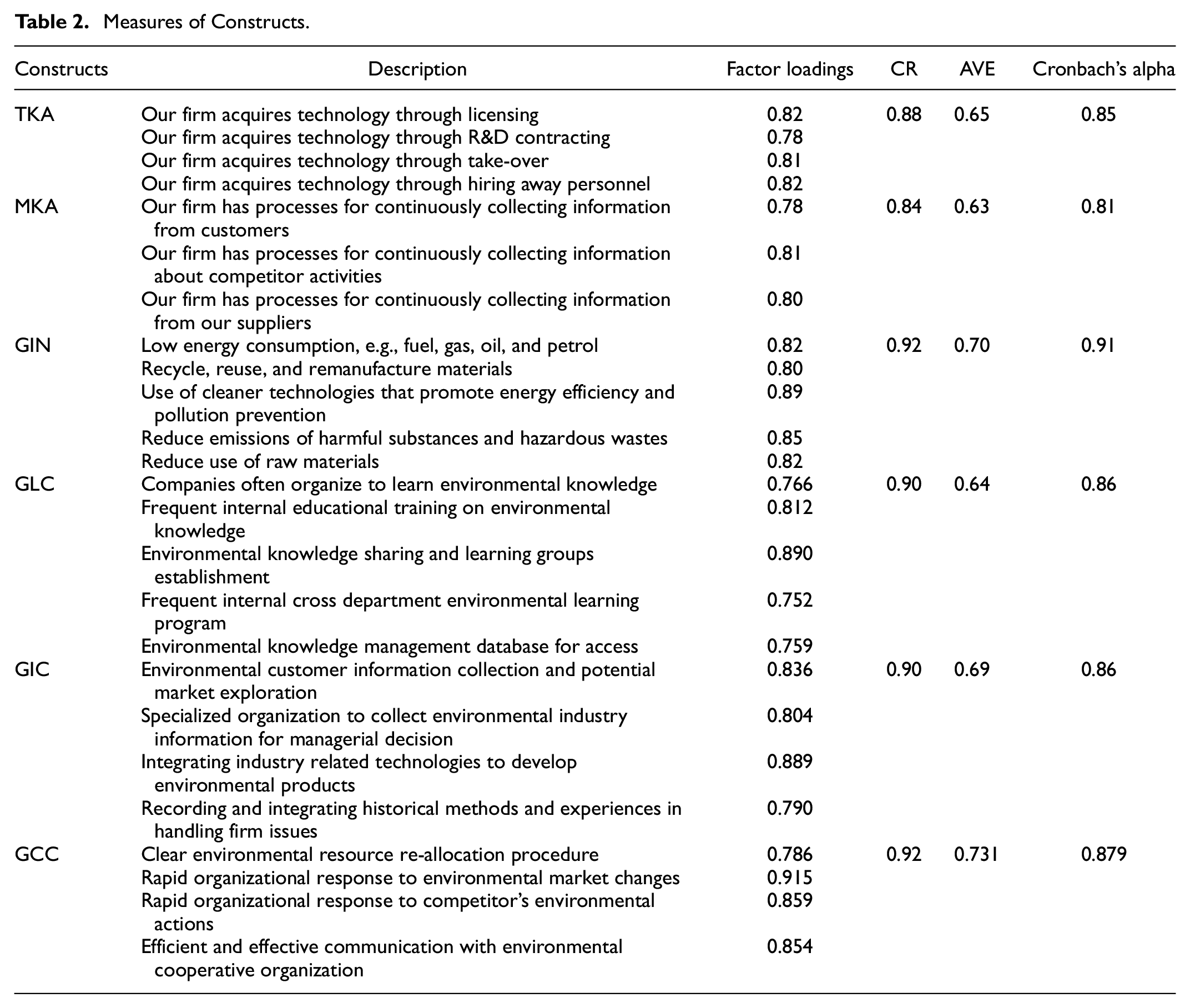
Green innovation (GIN) scale was adopted from the research of Chang (2011), De Marchi (2012) and Cai and Li (2018). The final scale is seen in Table 2. There are 5 items for the measurement of GIN.
In order to measure GDC, this research measures three dimensions respectively, namely GLC, GIC, and GCC. The items were adapted from the scale used in the research of Y. Lin and Wu (2014) and Y. Zhou et al. (2018); the final scale is seen in Table 2. Among them, there are 5 items for the measurement of GLC, 4 for GIC, and 4 for GCC.
To improve the reliability and validity of the questionnaire, the control variable is added, thus removing the disturbance of alternative explanation to the correlation of research variables. Since firms’ GIN may be influenced by firm age, firm size and industry (Dai et al., 2015; Liao, 2016), we control firm age, firm size and industry in the regression. Firm age is evaluated by the establishment time of firms(Liao, 2016), which is divided into four levels; firm size is measured according to the number of employees(Dibrell et al., 2011; Liao, 2016), which is divided into five levels. In addition, according to the research of Horbach (2008) and Y. Huang et al. (2016), firm industry is represented by the virtual variable: 1 represents the manufacturing industry and 0 represents the service industry.
Reliability and Validity
To assess construct validity, we assessed the reliability of the constructs using Cronbach’s alpha. As illustrated in Table 2, the results show that the Cronbach’s alpha values of all variables in this research were above the standard .7, indicating an acceptable level of reliability. TKA, MKA, GIN, GLC, GIC and green reconfiguration capability is 0.853, 0.814, 0.912, 0.856, 0.858, 0.879 respectively, all variables of the research are internally consistent.
We tested discriminant validity by conducting Exploratory Factor Analysis (EFA). we used the principal component analysis method (orthogonal rotation is adopted for factor rotation) for EFA using SPSS22.0 software. The common factors are extracted and the potential variables of EKA, GIN, and GDC, are analyzed for discriminant validity, just as shown in Table 3. Six principal component factors with certain differences are extracted from the 25 question items in the questionnaire; they correspond to GIN, GLC, GCC, TKA, GIC, and MKA respectively. According to the above analysis, the variables in this research have a good discriminant validity. The six-factor solution of the 25 items accounted for 71.3% of the total variance.
Results of Exploratory Factor Analysis.

Note. Extraction method: principal component analysis. Rotation method: Varimax with Kaiser normalization. The data in boldface indicates the highest loading. a Rotation converged in 6 iterations.
In addition, the normalized factor loads of each variable measurement items are all above 0.7, as is shown in Table 2. The Combined Reliability (CR) and the Average Variance Extracted (AVE) of the variables are calculated, as is shown in Table 2. CR of every construct is at least 0.838; AVE is at least 0.633. Therefore, each variable has a good convergent validity.
Table 4 indicates the Pearson correlations, means and standard deviation (SD) of variables. The diagonal element in bold indicates the square root of AVE; the square root of AVE in every dimension is higher than the correlation coefficient of the paired variable, further proving good discriminant validity among variables.
Means, SDs, and Pearson Correlations.

Note. the diagonal element in boldface is the square root of variance of mean; the off-diagonal element refers to the correlation among variables.
indicates that p < .05; **indicates that p < .01.
Estimation Method
In this study, hierarchical regression method (Cohen & Cohen, 1983) is employed for specifying regression models. We follow variance partitioning procedures outlined by methodologists (Cohen & Cohen, 1983; Jaccard et al., 1990) and employed in prior empirical management research (Boyer et al., 1997; Tatikonda & Rosenthal, 2000). The analysis is conducted in steps (see Table 5). To avoid potential threats of multicollinearity, the independent variables (TKA and MKA) and three potential moderating variables (GLC, GIC and GCC) were centrally processed before constructing their product terms (Jaccard et al., 1990). All variance inflation factors (VIF) are close to 1.00, well below the 10 benchmark (cf. Jaccard et al., 1990), indicating that multicollinearity should not be a problem in the data.
Moderating Effects of GDC.

Note.*p < .05. **p < .01. ***p < .001.
In the first step, control variable (firm age, firm size and industry) were entered into the regression (model 1). In the second step, two independent variables (TKA and MKA) were entered in the regression, followed by an evaluation of the direct effects of EKA on GIN (model 2). In the third step, the potential moderating variable (one of GDC) was introduced in the regression to test its main effect (model 3, model 5 and model 7). Finally, interaction variables of the potential moderating variable (one of GDC) and two independent variables (TKA and MKA) were entered as a block (model 4, model 6 and model 8), and the significant moderating effects were examined using F-test (Dean & Snell, 1991).
Results
Results of Main Effects
H1-1 is accepted. H1-1 propose that TKA positively influence GIN. The results of Model 2 in Table 6 show that TKA is significantly and positively associated with GIN (β = .22, p < .001). This finding verifies that TKA can significantly prompt GIN. Thus, H1-1 is supported.
Regression Analysis Results of the Main Effects (N = 416).

Note. **p < .01; ***p < .001.
H1-1 is accepted. H1-2 propose that MKA positively influence GIN. The results of Model 2 in Table 6 show that MKA is significantly and positively associated with GIN (β = .36, p < .001). This finding verifies that MKA can significantly prompt GIN. Thus, H1-2 is supported.
Results on Moderating Effects
H2-1 is rejected. H2-1 proposes that GLC positively moderates the relationship between TKA and GIN. The results of Model 4 in Table 5 show that the relationship between the interaction term “TKA × GLC” and GIN is positive but not significant (β = .07, p > .05). This finding fails to conclude that GLC has a positive moderating effect on the relationship between TKA and GIN. Thus, H2-1 fails to obtain support.
H2-2 is accepted. H2-2 proposes that GLC positively moderates the relationship between MKA and GIN. The results of Model 4 in Table 5 show that the relationship between the interaction term “MKA × GLC” and GIN is positive and significant (β = .11, p < .05). This finding verifies that GLC positively moderates the relationship between MKA and GIN. Thus, H2-2 is supported.
One standard deviation above the average value and one standard deviation below the average value of GLC are selected for regression respectively; the moderating effect of GLC is painted. From Figure 2, when GLC is higher, the positive relationship between MKA and GIN is more obvious; when GLC is lower, the positive relationship between MKA and GIN is milder, indicating that the relationship between MKA and GIN is stronger when GLC is higher.
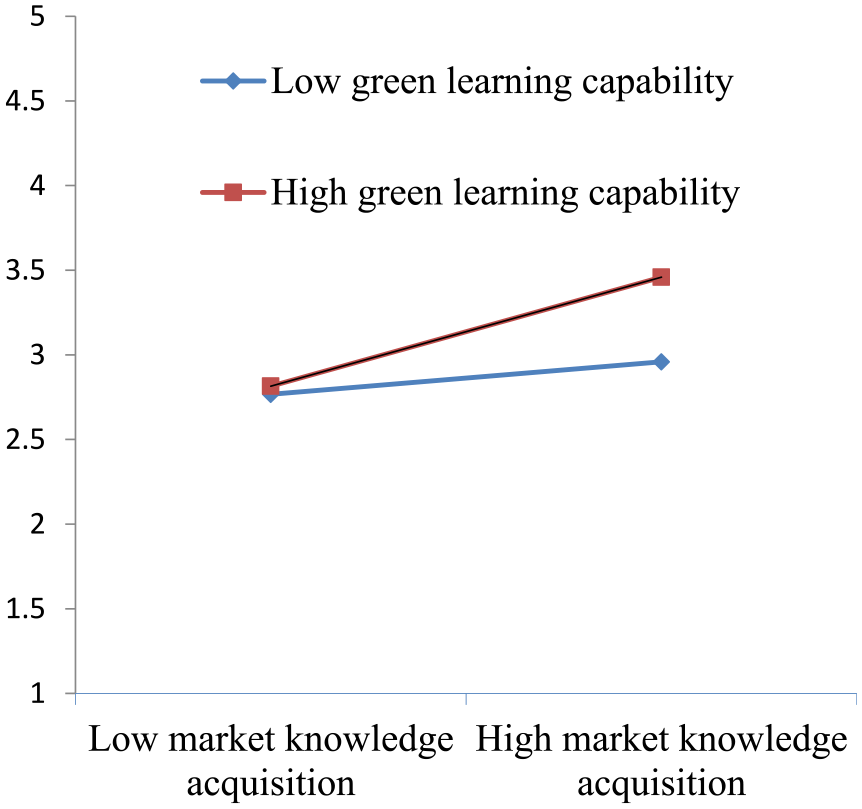
Moderating effect of GLC in the relationship between MKA and GIN.
H3-1 is accepted. H3-1 proposes that GIC positively moderates the relationship between TKA and GIN. The results of Model 6 in Table 5 show that the relationship between the interaction term “TKA × GLC” and GIN is positive and significant (β = .12, p < .05). This finding verifies that GIC positively moderates the relationship between TKA and GIN. Thus, H3-1 is supported.
H3-2 is accepted. H3-2 proposes that GIC positively moderates the relationship between MKA and GIN. The results of Model 6 in Table 5 show that the relationship between the interaction term “MKA × GLC” and GIN is positive and significant (β = .12, p < .05). This finding verifies that GIC positively moderates the relationship between MKA and GIN. Thus, H3-2 is supported.
One standard deviation above the average value and one standard deviation below the average value of GIC are selected for regression respectively; the moderating effect of GIC is painted. From Figure 3A, when GIC is higher, the positive relationship between TKA and GIN is more obvious; when GIC is lower, the positive relationship between TKA and GIN is milder, indicating that the relationship between TKA and GIN is stronger when GIC is higher. From Figure 3B, when GIC is higher, the positive relationship between MKA and GIN is more obvious; when GIC is lower, the positive relationship between MKA and GIN is milder, indicating that the relationship between MKA and GIN is stronger when GIC is higher.

Moderating effect of GIC in the relationship between EKA and GIN: (A) moderating effect of GIC in the relationship between TKA and GIN and (B) moderating effect of GIC in the relationship between MKA and GIN.
H4-1 is accepted. H4-1 proposes that GCC positively moderates the relationship between TKA and GIN. The results of Model 8 in Table 5 show that the relationship between the interaction term “TKA × GLC” and GIN is positive and significant (β = .11, p < .05). This finding verifies that GCC positively moderates the relationship between TKA and GIN. Thus, H4-1 is supported.
H4-2 is accepted. H4-2 proposes that GCC positively moderates the relationship between MKA and GIN. The results of Model 8 in Table 5 show that the relationship between the interaction term “MKA × GCC” and GIN is positive and significant (β = .11, p < .05). This finding verifies that GCC positively moderates the relationship between MKA and GIN. Thus, H4-2 is supported.
One standard deviation above the average value and one standard deviation below the average value of GCC are selected for regression respectively; the moderating effect of GCC is painted. From Figure 4A, when GCC is higher, the positive relationship between TKA and GIN is more obvious; when GCC is lower, the positive relationship between TKA and GIN is milder, indicating that the relationship between TKA and GIN is stronger when GCC is higher. From Figure 4B, when GCC is higher, the positive relationship between MKA and GIN is more obvious; when GCC is lower, the positive relationship between MKA and GIN is milder, indicating that the relationship between MKA and GIN is stronger when GCC is higher.

Moderating effect of GCC in the relationship between EKA and GIN: (A) moderating effect of GCC in the relationship between TKA and GIN and (B) moderating effect of GCC in the relationship between MKA and GIN.
Discussion
In the context of low-carbon development, this research constructs a theoretical model of the relationship between EKA, GDC and GIN. This theoretical model has been tested by distributing questionnaires to firms in China and conducting a regression analysis. Based on the empirical results, excluding H2-1 (which is not supported), the remaining seven hypotheses are supported by the data and thus provide great theoretical support and practical guidance for the hypothesis that EKA can effectively boost GIN and realize low-carbon development.
This research fails to find a positive moderating effect of GLC on the relationship between TKA and GIN, for which we suggest two possible reasons. The first relates to the type of green learning. Different learning types may play different roles in the process of transforming firms’ TKA into GIN. As some studies indicate, a firm’s explorative learning is conducive to innovation while an excessive focus on exploitative learning cannot promote innovation and may even have a negative impact on innovation (C. L. Wang et al., 2015). Given that GIN spans multiple technical fields, firms must integrate technical knowledge from various sources to conduct rapid and continuous development and innovation. If firms pay excessive attention to exploitative learning but neglect explorative learning in the process of improving GLC, they may be trapped in “inertia,” making it difficult for them to effectively achieve GIN. The second suggested reason relates to the breadth and depth of technical knowledge. Studies have shown that organizational innovation is influenced by the depth and breadth of technical knowledge (Greco et al., 2015; Zahra & George, 2002). If a firm’s technical knowledge is too broad, it may cause too many ideas to be fully integrated and utilized; if the depth of technical knowledge is too deep, it may cause gaps in understanding of some specific areas (Jin & Chen, 2015). Therefore, the role of GLC may be affected by the breadth and depth of external technical knowledge acquired by enterprises, making it difficult for them to promote their effective transformation of TKA into GIN.
This research confirms the positive relationship between EKA and GIN. The results are consistent with the research of Xie et al. (2018) and Laursen et al. (2012), who showed that inter-organizational knowledge acquisition is an important strategy for enterprises in the acquisition of key technical knowledge and the development of innovation. The results also show that GLC plays a positive moderating role in the influence of MKA on GIN. As Teece (2007) emphasizes, firms can improve their existing operational capabilities by learning new knowledge and skills. Moreover, we find that GIC plays a positive moderating role in influencing the effects of TKA and MKA on GIN, which confirms the views of King and Tucci (2002) and Deeds et al. (2000), who affirmed the positive outcomes for firms that integrate market and technical knowledge. Moreover, GCC plays a positive moderating role in the influences of both TKA and MKA on GIN. This conclusion is consistent with Newbert (2005) and Lavie (2006), whose research clarified the important role that firms have on their ability to configure technological change and renewal.
Managerial Implications
This study offers some practical implications for managers. First, the results suggest that, as a strategic resource, EKA is an important way for firms to reserve GIN knowledge and that it has a positive effect on GIN. To improve their GIN, firms must attach importance to EKA strategies, apply them to existing cross-organizational boundaries and create an open learning environment to gain valuable knowledge and experience from other institutions. This will allow them to seek green technical/market knowledge from external sources so that the breadth and depth of their original knowledge will be broadened and their green capability development will be facilitated.
Second, the results indicate that GLC, GIC, and GCC can strengthen a firm’s transformation of EKA into GIN. This is especially the case in the complex and changeable market environment. Compared with firms that focus on static resources, firms with higher levels of GDC can more effectively transform their EKA into GIN and realize low-carbon economic development. Therefore, managers should focus on improving their firms’ GDC and consciously incorporate it into their long-term environmental strategies. For example, managers can improve their firms’ GLC by improving their learning of knowledge of environmentally friendly practices. Managers can also improve their firms’ GIC by integrating environmentally relevant knowledge and resources into a collective system and improve their GCC by monitoring the latest market and technological trends.
Third, this study takes Chinese firms as the object of research and provides practical guidance for achieving sustainable economic development in two aspects. On the one hand, despite being important pillars of national economic development (J. Li et al., 2019), most Chinese firms have problems that include weak technical foundations, limited knowledge accumulation, low efficiency in the use of energy and other resources, and prominent environmental pollution (Kashif et al., 2019; Scozzi et al., 2005; Tang & Hull, 2012): these have greatly restricted their development and survival. Therefore, firms must urgently turn to a low-carbon developmental direction to achieve high-quality economic development (Andrés et al., 2020) and our research on how firms can achieve GIN has important practical value. And on the other hand,, with China being the world’s largest energy consumer and carbon emitter, the Chinese government attaches great importance to environmental issues and has put forth the goal of “dual-carbon” development (Ma et al., 2020). Some of China’s key developmental paths and models can also provide valuable lessons for developing countries. Therefore, the green development model of this study, which targets Chinese firms, can make an important contribution to the low-carbon and sustainable development of enterprises in other Asian countries.
Limitations
There are also some limitations and issues that warrant further study in this research. First, our research only examines the contingent roles of GLC, GIC, and GCC. In the future, researchers can also study how other external environmental factors directly or indirectly influence EKA and GIN, further contributing to the existing literature. Second, this paper uses a theoretical model of cross-sectional data testing and thus our conclusions only reflect the relationship between the variables studied over a specific time period and cannot be used to examine long-term effects. Future studies can track the differences in related variables within different time periods using simulation or time series data, further testing the causal relationships embedded in our theoretical framework, which will be of great significance to subsequent research. Finally, our research is limited to the analysis of data from Chinese firms and future research could explore companies in other developing countries and emerging markets. Despite these limitations, our research enriches the literature of this field and provides important practical guidance for firm managers and policy formulators.
Conclusions
This research contributes to unveiling the impact of green dynamic capabilities for Chinese companies. First, we propose a conceptual framework for GIN based on the RBV, which reveals the impact of EKA on GIN and clarifies the boundary role of GDC. This framework advances the current understanding of how different types of EKA impact GIN with the contingency effects of GDC. From a theoretical perspective, GIN is currently a hot area of research; however, there remains a lack of study of the relationship between the two different types of EKA and GIN and the moderating role of each dimension of GDC in this relationship (C. J. Chen et al., 2020; Papa et al., 2020). This study attempts to close these research gaps by empirically examining the importance of the two types of EKA in the improvement of GIN while further studying the role played by GDC and its various dimensions, which provides support to the RBV.
Second, this study clarifies the links between EKA and GIN. It integrates TKA and MKA into the same research framework for comprehensive consideration and transcends previous research that only focused on technical or market knowledge (Erkut, 2018; McKelvie & Brattstro, 2018; Parida et al., 2012; K. Z. Zhou & Li, 2012). This study not only enriches the application of EKA in enterprises’ responses to sustainable development demands but also refines the research in the field of knowledge acquisition.
Third, although the body of research on dynamic ability is rich, the research on GDC is still in its infancy. At present, the definition of GDC is not fixed, the division of its dimensions has not yet formed a unified standard, and the current literature is unclear as to how GDC plays an effective role within a given context. Combined with the research questions set out in the Introduction, our research divides GDC into three dimensions—GLC, GIC, and GCC—and identifies the regulatory effect of GDC across them. Our research not only provides fundamental support for subsequent empirical research, but also extends the theory and application of GDC from a causal prediction to situational factors, enriching the field of research on GDC.
Footnotes
Acknowledgements
We are very grateful to editors and anonymous reviewers for their constructive comments.
Declaration of Conflicting Interests
The author declared no potential conflicts of interest with respect to the research, authorship, and/or publication of this article.
Funding
The author disclosed receipt of the following financial support for the research, authorship, and/or publication of this article: This work was supported by the “Yanta Scholars” Program of Xi’an University of Finance and Economics. This research was supported by the National Social Science Foundation of China (grant 20XGL008)
