




Abstract
The digital transformation of small and medium-sized manufacturing enterprises is influenced by various factors, and the relationship between them is not yet clear. Studying the factors that affect the digital transformation of small and medium-sized enterprises can promote the digital transformation process of small and medium-sized manufacturing enterprises. On the basis of summarizing literature and expert recommendations, this study identified the influencing factors in the digital transformation process of small and medium-sized manufacturing enterprises, and analyzed the key influencing factors using a combined method of DEMATEL-ISM-MICMAC (Decision-Making Test and Evaluation Laboratory-Interpretive Structural Model-Matrices Impacts Croises-Multiplication Appliance Classement). Research has found that digital policies, market demand, business model innovation, third-party data-driven services, and the digital foundation of enterprises are key factors in the process of digital transformation. In addition, the causal factors in the DEMATEL method, the essential factors in the ISM method analysis, and the independent factors in the MICMAC technique analysis can mutually support and complement each other. This study enriches the methodology for studying the factors of digital transformation and provides reference for the digital transformation of small and medium-sized manufacturing enterprises and government policy formulation.
Keywords
Introduction
In recent years, with the development of digital technology and its penetration in various application scenarios, digitalization has become an important driving force for enterprise development. New technologies such as artificial intelligence, blockchain, and the Internet of Things are fundamentally changing the business processes of enterprises and the results of digital transformation. The efficiency brought about by improving quality and saving time through automation and even intelligence has reached unprecedented heights (A.K., 2022). In fact, in order to cope with the increasingly complex modern products and systems, most enterprises are adopting more digital business methods to improve their manufacturing, marketing and relationship maintenance with business partners (Eller et al., 2020). For small businesses, artificial intelligence tools can help reduce administrative time, use AI to connect with customers can improve business flexibility and responsiveness, and obtain more market and competitor information (Eddy, 2020). It can also help businesses and products conduct precise experiments in various business environments, and it is necessary to use data-driven prediction in business decision-making (Hoßfeld, 2017). Digital transformation can fundamentally change the process, product or service form of enterprise business activities, improve enterprise operation efficiency and enterprise performance, and even change the link and trade mode between enterprises (Bharadwaj et al., 2013; Verhoef et al., 2021; Vial, 2021). Digital transformation (DT) has become a new method for many enterprises to gain competitive advantage in fierce and dynamic market competition (Chen et al., 2021).
Although digital transformation can bring many benefits to enterprises, it fundamentally changes the internal organizational structure and external business processes of enterprises (Bharadwaj et al., 2013). This is a complex system engineering that is inevitably influenced by many factors during implementation. In recent years, academic literature has also paid attention to the research on the factors influencing digital transformation. For example, the digital transformation of enterprises will be influenced by different factors at different stages (Kane et al., 2015), and also by different types of factors from inside and outside the enterprise (Tarutė et al., 2018). External environmental factors play an important role in the process of digital transformation of enterprises, which may affect the consciousness of enterprise leaders and the orientation of enterprise market (Dörr et al., 2023; Tarutė et al., 2018; Zhang et al., 2022). From the perspective of the environment faced by enterprises, the digital transformation of small and medium-sized enterprises will be affected by environmental factors, technical factors, organizational factors, employee skills and other factors (Dörr et al., 2023; Kane et al., 2015; Zhang et al., 2022). In addition, the digital transformation of enterprises will also be affected by the partners of enterprises and the digital ecological environment, which will affect whether enterprises choose to transform to match the needs of cooperative enterprises (Zhang et al., 2022). Small and medium-sized enterprises can leverage technological advantages such as developing comprehensive digital strategies, making quick decisions, and being customer-centric to implement digital transformation (A.K., 2022). However, due to obstacles such as lack of financial support, shortage of technical talents, lack of corporate confidence, uncertain transformation benefits, and unclear transformation paths, one may also fall into transformation difficulties and be unable to smoothly transform (Dörr et al., 2023).
It has been found from existing literature research that in recent years, there have been many studies on the influencing factors of digital transformation in enterprises. However, research on the influencing factors of digital transformation in small and medium-sized manufacturing enterprises still needs to be explored in existing literature. In addition, existing research has only identified or summarized the types of influencing factors, without in-depth and systematic research on the interactions or driving relationships between various factors, exploring which factors are key factors, and without reflecting the specific requirements and challenges of digital transformation for small and medium-sized manufacturing enterprises. Given that digital transformation is essentially multidisciplinary, as it involves changes in strategy, organization, information technology, supply chain, and marketing, it requires a discussion of various influencing factors. The digital transformation of enterprises will be influenced by multiple stakeholders both internally and externally. By involving different stakeholders, digital knowledge can be effectively implemented, and the information prosperity of the entire business can achieve continuity (Gupta et al., 2023). The digitization of the supply chain has significantly improved supply chain performance, and it is a transformative process that considers various aspects of the digital age to tap into its full potential (Deepu & Ravi, 2023). The government has four roles in supporting the digital transformation of small service enterprises: establishing digital platforms for small service enterprises, promoting mobile/digital payments, providing digital training, and building a digital collaboration ecosystem (Chen et al., 2021). Therefore, in order to provide guidance for the digital transformation of small and medium-sized manufacturing enterprises, we must organize the factors that different stakeholders affect the digital transformation of enterprises, discuss the interaction of these influencing factors and the impact mechanism on the digital transformation of enterprises, contribute to the current implementation of digital transformation of small and medium-sized manufacturing enterprises, and stimulate future research on this important topic in multiple fields.
This study aims to understand the influencing factors in the digital transformation process of small and medium-sized manufacturing enterprises in Guangdong Province, China. These factors are sourced from literature reviews and are classified in appropriate order in this article, which will help researchers better understand this field. The specific research objectives are as follows:
Determine the factors that affect the digital transformation of small and medium-sized manufacturing enterprises from different dimensions.
Clarify the interrelationships between the influencing factors of digital transformation in small and medium-sized manufacturing enterprises.
By calculating the dependencies between driving forces and factors to reflect the attributes of factors, key factors that have a significant impact on the system can be determined.
This article is organized in the following order. Firstly, starting from the introduction section, including the research background and significance. The second section is a literature review and a summary of influencing factors. The third section introduces the research methods, including DEMATEL, ISM, and MICMAC technologies, as well as the combination of methods. The fourth section of the empirical analysis includes the background of the case, implementation steps, and the results obtained after the implementation of the research methodology. The fifth section analyzes and discusses the results. The sixth section includes the conclusions and recommendations drawn from the study, as well as the limitations of the study and the next steps of research.
Literature Review
In today’s information network era, continuously promoting and deepening digital transformation will be the future development trend of enterprises. This section summarizes the requirements of early digital transformation development and the latest literature review, with a focus on the influencing factors of digital transformation in small and medium-sized manufacturing enterprises. In recent years, due to the continuous development of technology, there has been an increasing amount of research related to this topic. We demonstrate the necessity of studying key factors in digital transformation by reviewing and summarizing literature on the current status and methods of digital transformation in small and medium-sized enterprises. Therefore, this study will help identify new research streams, research gaps, and future research directions.
Digital Transformation
The concept of digital transformation has many definitions. According to Bharadwaj et al. (2013), an organization’s DT is defined as “the activity that an enterprise fundamentally changes its business strategy.” Business processes, enterprise capabilities, products and services and key inter-enterprise relationships in the “digital triggered” extended business network (A.K., 2022). Digital transformation not only means that enterprises have and use appropriate technologies, but also can solve problems such as human resources, business process reengineering and operational efficiency (Verhoef et al., 2021). Verina and Titko (2019) believe that the concept of digital transformation includes three categories: technology, management, and people. Among them, technologies include data, cloud computing, mobile devices, media technology, artificial intelligence, Internet, etc. Management includes business model, operation model, organizational structure, strategy, products and new services; People include customers, employees, managers, partners, suppliers and competitors (Verina & Titko, 2019). In the process of digital transformation in enterprises, artificial intelligence can effectively support the existing business of the enterprise. Its implementation framework is defined as data, intelligence, foundation, integration, teamwork, flexibility, and leadership (Brock & Von Wangenheim, 2019). CRM with added AI functionality can help you maximize potential customer activity, gain insights from the market, and even gain insights from sales data (Eddy, 2020). Big data and business analysis ecosystems can assist enterprise development through digital transformation and sustainable development models (Pappas et al., 2018).
However, digital transformation has been going on, because it is a changing state (Osmundsen et al., 2018). New technologies will continue to emerge. Enterprises need to constantly change and innovate their business models to adapt to the new technological environment and ensure that they will not be eliminated by the market soon.
Digital Transformation of SMEs
Digital transformation is an important technological revolution, and in recent years, the digital transformation of small and medium-sized enterprises has been valued and gradually implemented by multiple countries (Reischauer, 2018). The academic community has also conducted various studies on small and medium-sized enterprises in different countries, regions, and industries to explore ways to adapt to the digital transformation of small and medium-sized enterprises. Stich et al. (2020) developed a digital roadmap for small and medium-sized enterprises through Industry 4.0 maturity assessment, including four aspects: resources, information systems, culture, and organizational structure. Garzoni et al. (2020) and Battistoni et al. (2023) proposed four levels of digital transformation steps for Italian small and medium-sized manufacturing enterprises, including digital awareness, digital requirement, digital collaboration, and digital transformation, as well as four levels of digital technology application paths for sensors, integration, intelligence, and response. Kane (2019) described the stages of implementing DT, including the exploration of DT, the development of digital plans, digital maturity, and digital organization. Dutta et al. (2020) used survey and statistical research methods to evaluate the maturity of digital transformation of Indian small and medium-sized enterprises in India’s small and medium discrete manufacturing practices (SMME), and determined how Indian small and medium-sized enterprises prioritize the digital elements of Industry 4.0 and its relationship with various transformation measures. Won and Park (2020) focused on smart factories and constructed an input-output model for Korean enterprises to adopt smart factories by studying the demand factors for their establishment. Regression analysis was used to summarize the key factors determining whether Korean enterprises will undergo digital transformation. At the level of digital transformation technology, Kraft et al. (2022) analyzed the actual use cases of digital tools in the digital transformation of Swiss small and medium-sized enterprises, and discussed their role in the transformation process of small and medium-sized enterprises.
Influencing Factors of Digital Transformation
The digital transformation of small and medium-sized enterprises will be constrained by various factors and will also face certain challenges. Dörr et al. (2023) searched and analyzed the articles related to the digital transformation of small and medium-sized enterprises published from January 2021 to January 2022, and found that there are at least 17 factors affecting the digital transformation of small and medium-sized enterprises, including senior management, strategy, employees, culture, skills, knowledge, finance, risk management, digital tools, market, ecosystem and so on. Generally speaking, the main factors affecting the digital transformation of small and medium-sized enterprises include limited financial channels (Rao et al., 2023), limited human capital (Owalla et al., 2022), and limited management capabilities for business model expansion and innovation (Galli-Debicella, 2021).
From the perspective of the digital transformation stage, digitization can be divided into early stages, development stages, and maturity stages, and each stage faces different digital obstacles. The digital transformation of enterprises will be influenced by factors such as lake of strategy, too many priorities, lake of management understanding, independent technology skills, and security concerns (Kane et al., 2015). From the perspective of internal and external factors, the digital transformation of small and medium-sized enterprises will be influenced by internal factors, including IT integration into operations, internal collaboration, reconstruction ability, resource fit, and changes in the business model, as well as external factors, including collaborative customization, strategic alternatives, embedded trust, government supervision, and industry maturity and demand (Tarutė et al., 2018). The quality of cooperation between low digital level enterprises or small-scale enterprises plays an important role in improving enterprise performance, which is also a factor that manufacturing enterprises need to consider when accelerating digital transformation (Gao et al., 2023). From the perspective of the environment faced by enterprises, the digital transformation of small and medium-sized enterprises will be influenced by environmental factors (government support and partners), technological factors (IT facilities and IT management capabilities), organizational factors (digital strategy and senior management), and employee skills (Zhang et al., 2022). During digital transformation, executives may lose their rational decision-making methods. Therefore, executives of enterprises must understand new technologies and how they affect markets, distribution channels, products, and services (Davenport & Westerman, 2018). CEOs of enterprises often overlook their misconceptions about digital investment returns, as investing enough money in it does not necessarily mean that they can achieve short-term benefits. And under the background of technological change, employees’ digital cognition and digital thinking mode may affect employees’ participation (or withdrawal) in the digital transformation plan (Solberg et al., 2020).
Obviously, the decisive factors of digital transformation have been widely studied, but there is currently no consensus (Gao et al., 2023). Under the guidance of government policies, the integration of new generation digital technology and manufacturing has promoted the rapid development of industrial internet platforms globally, which has a significant impact on the production organization and business models of the manufacturing industry (Yan, 2019). Government policies (A1) will affect the strategic planning of enterprises and determine their development direction. Small and medium-sized manufacturing enterprises will use digitalization to cope with competitive pressures in market operations, despite facing multiple constraints (Saleh & Manjunath, 2021). The use of digital tools can enable small and medium-sized enterprises to promptly and quickly receive customer feedback and requirements, and take this information into account in business processes and product production and design (Ramírez-Durán et al., 2021; Soluk & Kammerlander, 2021). Therefore, the market and customer needs (A2) will to some extent affect the digital transformation of enterprises.
The efficiency of digital investment (A4) is the focus of attention for small and medium-sized manufacturing enterprises; Due to limited resources and poor risk resistance, small and medium-sized manufacturing enterprises tend to prefer short-term and relatively stable investments (Garzoni et al., 2020). However, the benefits and investment recovery time brought by transformation to enterprises are not clear, which is also a concern for enterprises. In addition, companies with strong risk management capabilities (A6) are more willing to take risks in digital transformation, as the advantages that digital transformation will bring in the future are certain (Dörr et al., 2023). Employees (A5) are an important resource for small and medium-sized enterprises, and their attitude towards digitization can affect the digital transformation of the enterprise (Nwaiwu et al., 2020). Because employees first need to understand and accept the concept of digitalization, and overcome resistance to new technologies and tools (Pamuła, 2020). The positive attitude of employees towards digitalization has a strong impact on promoting the digital transformation of enterprises (Reyes-Mercado & Barajas-Portas, 2020).
The impact of Internet technology on enterprises is not aimed at a single company, but an ecosystem composed of different types of companies or all enterprises in a supply chain (A7) (Martinelli et al., 2021). If the supplier upstream of the enterprise is an important part of the system, the supplier may require the enterprise to have the equipment and ability of digital communication or digital communication. On the contrary, the digitalization of the enterprise will also affect the customer experience and feedback downstream (Benitez et al., 2020; Ghobakhloo & Iranmanesh, 2021). In addition, some suppliers (A8) can provide professional technical services, such as consulting services and technical equipment supply services, in order to promote enterprise exchanges between different businesses (X. Liu et al., 2023). Different types of enterprises have different digital foundations (A9), and a solid infrastructure allows business competition and service opportunities in the digital age, which is also a problem that the government needs to consider when formulating policies (Verhoef et al., 2021).
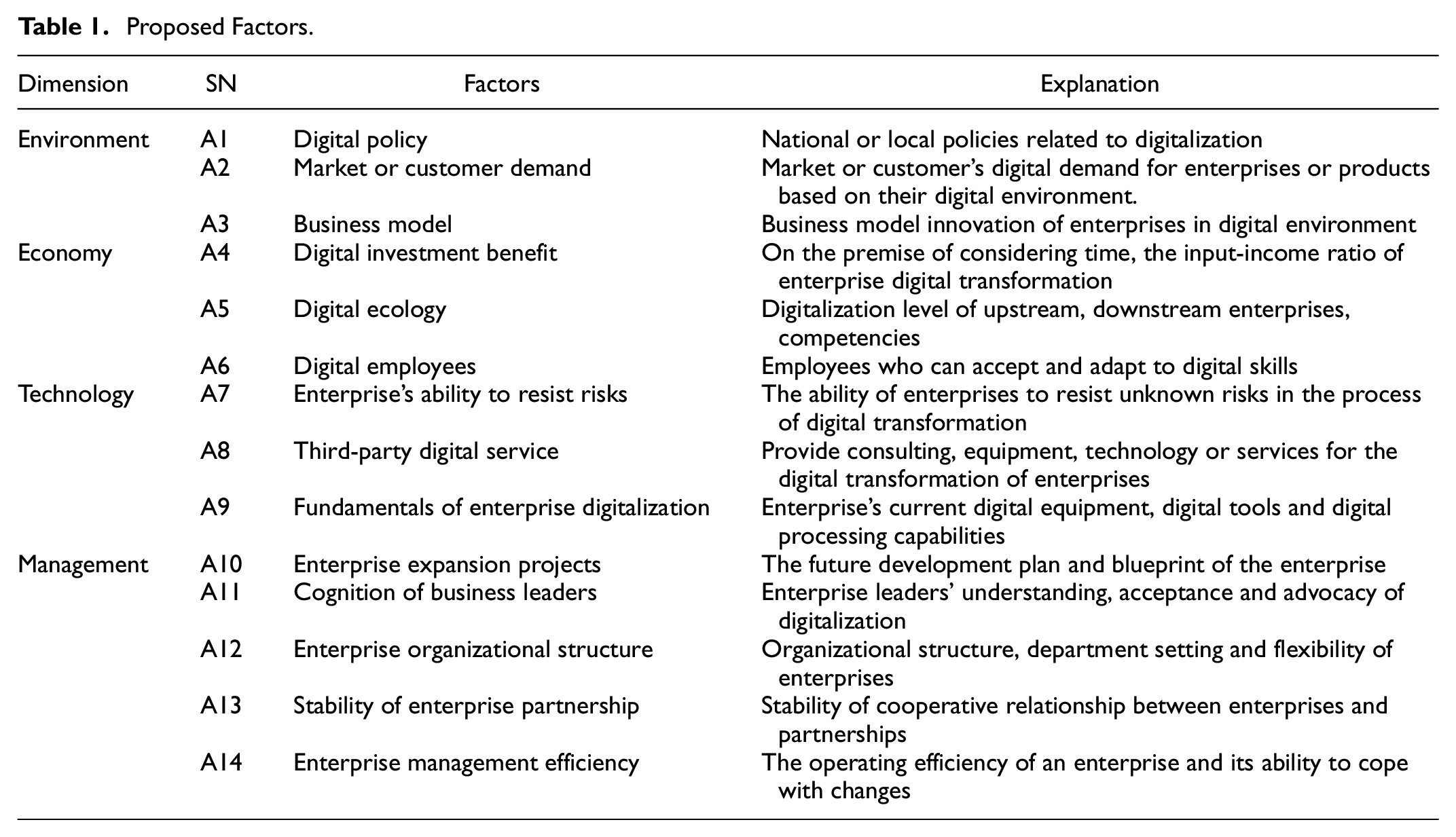
In addition, the innovation mechanism of business model (A3) mainly includes revenue generating business model and orchestration business model. The synergy of the two drives digital transformation, which is the core condition for promoting the digital transformation of manufacturing enterprises (S. H. Liu et al., 2023). Leadership style (A11) and promoting organizational agility (A12) will enhance the digital transformation of enterprises (AlNuaimi et al., 2022). As far as the internal management of enterprises is concerned, the leader of small and medium-sized manufacturing enterprises (A11) has a very important sense of digital transformation. Because the management of most small enterprises will be led by leaders, the development plan (A10) of enterprises also fully reflects the value orientation of enterprise leaders (Fachrunnisa et al., 2020). Digital transformation involves the production, management and marketing of all departments of the enterprise, and the correlation between departments will affect the operational efficiency of the enterprise (A14), thus affecting the digital transformation process of the enterprise (Verhoef et al., 2021). Small and medium-sized enterprises have the characteristics of relatively simple organizational structure and simplified management process, but they still need to establish ecosystem partnership (A13) and strategic alliance, and strengthen their digital marketing strategies and capabilities to attract customers (Mostaghel et al., 2022). Digital transformation has always been closely related to industries, so digital technology must also play an important role in industrial transformation. After a detailed literature review and expert consultation, we have identified 14 main factors that affect the transformation of small and medium-sized manufacturing enterprises. After consulting experts from small and medium-sized manufacturing enterprises repeatedly, the study divided these factors into four dimensions: external environment, economy, technology, and management. As shown in Table 1 below.
Proposed Factors.
Methodology Review
In the input-output model of smart factories, regression analysis is used to determine the key factors that determine whether Korean companies will undergo digital transformation (Won & Park, 2020). The structural equation model was used to analyze data from 180 small and medium-sized enterprises in China, and to study the success factors and influencing mechanisms of digital transformation of small and medium-sized enterprises. It has been identified that technology and environmental factors have a positive impact on the organizational capacity of small and medium-sized enterprises, and organizational capacity plays a mediating role in the impact of technology and environmental factors on digital transformation (Zhang et al., 2022). The survey of digital transformation literature and the collection of object-oriented quantitative data, as well as the PLS-SEM (Present Partial Least Squares-Structural equation modeling) method processing, were used to study and discuss the success of digital transformation in Hungarian enterprises (Ko et al., 2022). Multiple qualitative interviews and the IS success model based on DeLone and McLean were used to derive the key factors that trigger the success of DT in manufacturing enterprises, including technology, organization, and environment (Vogelsang et al., 2018). When exploring the factors influencing the digital transformation of Thailand’s logistics service provider sector, quantitative empirical research was conducted using online questionnaire tools and structural equation modeling techniques were used to test the proposed model. At the same time, this study divides the relevant influencing factors into driving factors, goals, influencing factors, and success factors (Singhdong et al., 2021). The systematic literature review on factors affecting digital transformation and internationalization of enterprises summarizes that regression analysis is currently the most widely used statistical method, such as ordinary least squares (OLS) regression, partial least squares (PLS) regression, simple linear regression, or multiple regression (Feliciano-Cestero et al., 2023).
H. Li et al. (2022) used DEMATEL-ANP to build a digital comprehensive evaluation system for the construction industry, and discussed the key factors that affected the digital transformation of the construction industry. Vitsentzatou et al. (2022) adopted the method of combining DEMATEL and grey system theory to determine the key success factors of digital transformation of catering service supply chain. Singhal et al. (2022) used DEMATEL method to determine and analyze the factors of successful technology implementation in Indian banking. Erkan (2021) conducted a research based on the practical experience of Industry 4.0 process by using the fuzzy DEMATEL method for enterprise digitalization. Zhong et al. (2022) used the method of DEMATEL-ISM to analyze the influencing factors of the coal industry’s urgent need to seize the coal transformation. Liang et al. (2022) uses the method of DEMATEL-ISM to identify and analyze the factors that affect the economic and social benefits of the formed electric vehicle charging station. Feng et al. (2024) based on the three-stage mixed DEMATEL-ISM-MICMAC method, an effective and reliable hierarchical framework for identifying key factors of digital innovation in manufacturing enterprises is constructed. Yong et al. (2023) used decision-making test and evaluation laboratory, interpretive structural model and matrix influence cross-reference multiplication applied to classification to analyze the interaction between obstacles in the development of energy storage sharing and identify major obstacles.
As can be seen from the above literature, utilizing emerging technologies for digital transformation will bring many benefits to small and medium-sized enterprises. Currently, many researchers are also paying attention to the digital transformation of small and medium-sized enterprises, searching for and organizing the influencing factors of their transformation, and attempting to suggest ways for small and medium-sized enterprises to undergo transformation. However, the transformation process of most small and medium-sized enterprises is still slow, and they are in a complex digital transformation system, unable to determine what is most critical. So far, only a small amount of literature has identified which influencing factors are key in the process of digital transformation. However, there is limited literature on identifying key factors for small and medium-sized manufacturing enterprises.
A wide range of research literature has used statistical methods to address the issue of factor identification, but no research has found a combination of DEMATEL, ISM, and MICMAC methods to identify key influencing factors in digital transformation. Statistical methods cover a wide range of methods and techniques, with a certain degree of flexibility, but they require assumptions about variables and have certain limitations in explaining variables. The digital transformation of enterprises is a complex systematic process, which is influenced by many factors. The use of systems engineering methods can relatively comprehensively consider the various factors involved in digital transformation. Especially when dealing with complex system problems, it has high applicability, especially in situations involving multiple factors, multi-level structures, and mutual influence between factors, which is more effective.
This study makes significant contributions to the research on digital transformation in the field of small and medium-sized manufacturing enterprises. The research results will bring some benefits to enterprises. By identifying key influencing factors, enterprises can mitigate unforeseeable risks in the process of digital transformation, optimize resource allocation, and promote digital transformation to sustain their business.
Methodology
In this paper, the method of DEMATEL-ISM-MICMAC is adopted. The DEMATEL method represents the importance of each factor in the system and the causal properties of each factor through a scatter plot. This method has been used by academic scholars to solve the problem of influencing factor analysis or comprehensive evaluation. ISM can clearly explain how factors in complex systems are interrelated and affect each other, and display the interdependence between factors through a hierarchical structure diagram to identify which factors are essential factors in the system (Davenport & Westerman, 2018). The application of MICMAC cross influence matrix multiplication in classification is a quantitative method that applies the principle of matrix multiplication to achieve a stable state of the influence matrix and reflect the interaction between factors. This relationship reflects the attributes of factors by calculating the dependencies between driving forces and factors, thereby determining the key factors that have a significant impact on the system (Vitsentzatou et al., 2022). The implementation of ISM and MICMAC relies on the analysis results of DEMATEL methods. The combination of the three methods can effectively avoid the shortcomings of various methods, and can support and verify each other from three aspects: identifying factors, sorting out factors, and analyzing factors, providing more accurate analysis for research problems (Alqershy & Shi, 2023). Figure 1 shows the process of the research framework and three methods combined with the article.

Research framework and factor analysis procedure.
DEMATEL
Step 1: Determine direct impact matrix
Set the influence relationship among the factors with Likert scale, and use 0–4 to represent the magnitude of the influence. Among them, 4 represents an extraordinary impact, 3 represents a significant impact, 2 represents a general impact, 1 represents a weak impact, and 0 represents no impact.

Where,
Step 2: Calculate the comprehensive impact matrix
Normalize the direct influence matrix


Where,
Step 3: Calculate the influence degree, affected degree, centrality and cause degree of each factor
Calculate the influence degree


Calculate the centrality


Step 4: Take centrality as the horizontal axis and cause degree as the vertical axis, and draw a scatter diagram according to centrality and cause degree of each factor.
ISM
Step 1: Constructing adjacency matrix A. In order to avoid repeated investigation and acquisition of data, based on the comprehensive impact matrix T, the threshold value is introduced to process the comprehensive matrix to obtain the relationship matrix A.

In the formula,
Step 2: Calculate reachable matrix

Suppose
If
Then

Step 3: According to formula (11) and reachable matrix

Step 4: Calculate skeleton matrix
Shrink the reachable matrix
Step 5: According to the reachable matrix
MICMAC
Step 1: Calculate the driving force value and dependence value of each factor through the reachable matrix R.


Step 2: According to the average value of driving force and dependence, risk factors are divided into four categories: autonomy, dependence, correlation, and independence.
Step 3: Divide the factors into different quadrants according to their driving force and dependence, and analyze the attributes of quadrants and factors.
Empirical Research
Case Background
Dongguan City, Guangdong Province is located in an important position in the Bay Area of Guangdong, Hong Kong and Macao, and has always been famous for its developed manufacturing industry. As a world-renowned “world factory,” Dongguan has 200,000 industrial enterprises, with more than 12,000 industrial enterprises above designated size, forming a relatively complete manufacturing system involving 36 industries and more than 60,000 products. It can be seen that small and medium-sized manufacturing enterprises in Dongguan have the characteristics of large number, rapid development and wide coverage, which are mainly distributed in electronics, clothing, toys, plastics, food, precision instruments and other manufacturing industries. Compared with small and medium-sized manufacturing enterprises in other parts of China, Dongguan’s small and medium-sized manufacturing enterprises have a large number and a wide range, and have a certain development history. Currently, it is enterprises that are exploring digitalization. In 2022, China’s Ministry of Industry and Information Technology and 19 departments jointly issued the “14th Five-Year Plan for Promoting the Development of Small and Medium-sized Enterprises,” which clearly put forward the implementation of the digital promotion project for small and medium-sized enterprises, and strived to guide small and medium-sized enterprises to apply advanced technologies and processes to accelerate the pace of digital transformation by 2025 by promoting the digital transformation of small and medium-sized enterprises, developing digital industrialization and consolidating the digital service foundation. It can be seen that the digital transformation of small and medium-sized enterprises is the general trend of the digital economy era.
The digital transformation of enterprises is considered as an activity of fundamentally changing business strategy. It is triggered by digital technology, and will be extended to business processes, enterprise capabilities, products and services, and inter-enterprise relationships (Eller et al., 2020). Therefore, the digital transformation of enterprises will be affected by multiple factors. Although the national or local governments have continuously introduced policies to promote and stimulate the digital transformation of enterprises, small and medium-sized manufacturing enterprises still encounter many obstacles in the process of digital transformation. This paper takes small and medium-sized manufacturing enterprises in Dongguan as the research object. By analyzing the complex internal and external environment faced by enterprises, the key factors that hinder the digital transformation of small and medium-sized manufacturing enterprises are identified by the method of DEMATEL-ISM-MICMAC, and the interaction and logical relationship among the factors are displayed by the method of confrontation hierarchy diagram, and the attributes of the factors are analyzed to reveal the dependence and decisive relationship among the factors. This will help to show the obstacles in the process of digital transformation of small and medium-sized manufacturing enterprises in Dongguan, and provide a basis for promoting the digital transformation of enterprises and formulating relevant policies.
Identification of Key Influencing Factors
This study designed an interview outline, a scoring table for influencing factors, and an evaluation questionnaire for influencing factors for small and medium-sized manufacturing enterprises in Dongguan City, Guangdong Province. By visiting the general managers or information department managers of different types of small and medium-sized manufacturing enterprises in Dongguan, Dongguan Small and Medium sized Enterprise Service Association, Dongguan Industry and Trade Association, and other units, 36 experts were interviewed multiple times, and their fields basically covered typical types of small and medium-sized manufacturing enterprises in Dongguan. Experts first evaluated and screened 14 influencing factors for the digital transformation of small and medium-sized manufacturing enterprises. Secondly, a matrix scale was used to evaluate the impact of 14 factors. We will average the obtained data to form the original matrix data, and use DEMATEL, ISM, and MICMAC methods to calculate and analyze the data.
Analyzing the Causality and Centrality of Factors Through DEMATEL
Step 1: Determine the direct influence matrix O and the comprehensive impact matrix
For 14 influencing factors, an evaluation matrix scale is used to evaluate the interrelationships between the factors. The evaluation scale is designed from 0 to 4, where 0 represents no influence, 1 represents weak influence, 2 represents general influence, 3 represents significant influence, and 4 represents strong influence. After averaging the original data, the direct impact matrix can be obtained. According to formulas (2) and (3), the comprehensive impact matrix can be calculated, as shown in Table 2.
Comprehensive Impact Matrix T.

Step 2: Use DEMATEL to calculate the importance and cause of factors
Based on the comprehensive influence matrix T, the influence degree, affected degree, centrality and cause degree of each factor are calculated by the formulas (4) to (7). The calculation results are shown in Table 3.
Causality and Centrality of Factors Calculated by DEMATEL.

Step 3: Draw DEMATEL scatter plot
Construct a scatter plot of centrality causality with centrality as the horizontal axis and causality as the vertical axis, as shown in Figure 2. The factors are distributed in the coordinates. From a horizontal perspective, the more factors move to the right, the stronger their importance, and vice versa, the weaker their importance. From a vertical perspective, if the factor distribution is above 0, it is the cause factor, and if the factor distribution is below 0, it is the result factor. Therefore, the factors distributed in the first quadrant have relatively high relative importance and causal degree. A1 (Digital Policy), A3 (Business Model), and A8 (Reliability and Security of Third-Party Digital Services) are key factors for the digital transformation of small and medium-sized manufacturing enterprises. The reasons for A2 (market or customer demand) and A9 (enterprise digital foundation) are the highest, indicating that they have a strong impact on digital transformation.

Causality and centrality scatter plot.
Analyzing the Hierarchical Relationship of Factors Through ISM
Step 1: According to the comprehensive influence matrix, the threshold value μ is introduced by formula (8) . Among them,
The Reachable Matrix

Step 2: Calculate reachable set
The reachable set
Calculation Results of Reachable Set, Antecedent Set, and Common Set.

Step 3: Calculate the hierarchical division results and draw the hierarchical confrontation diagram.
According to the results of
Hierarchical Decomposition of Factors.
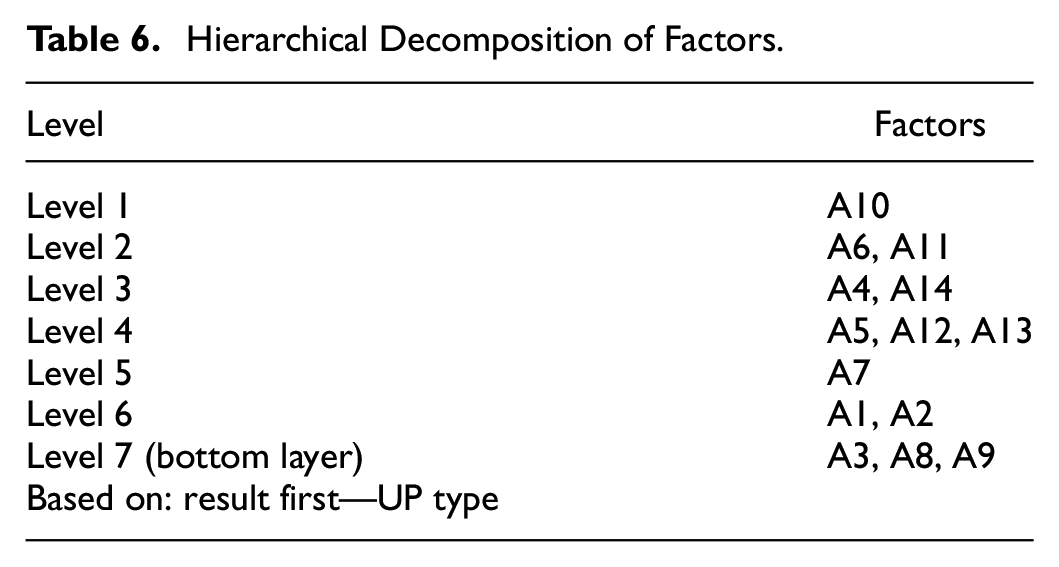

Hierarchical structure model of influencing factors.
Analyzing the Hierarchical Relationship of Factors Through ISM
Through the calculation of equations (12) and (13), the driving force and dependence of each factor in the system can be obtained. Based on these dependencies and driving force values, all factors are divided into four modules. Figure 4 below shows these factors in quadrant form I, I, II, III, and IV. According to the driving force value and dependence value of each factor, it is divided into linkage, independent, autonomous, dependent factors.

MICMAC analysis chart.
Among them, the factors in the first quadrant are highly dependent and highly driven, including A1, A5, A7, and A13, which are consistent with the results of ISM model analysis, and they all belong to the transitional cause class in the frame diagram. The factors in the second quadrant have low dependence and high driving force, so they mainly affect other factors. These factors mainly include A2, A3, A8, and A9. This is also the result of supporting the calculation of DEMATEL and ISM methods, because they are all factors belonging to the essential causal hierarchy in the structure diagram. The third quadrant is an independent factor with low driving force and low dependence, that is, its importance in the system is relatively low. A12 and A14 belong to this quadrant. The fourth quadrant is a factor with high dependence and low drive, including A4, A6, A10, and A11. These factors are mainly influenced by other factors and have little influence on other factors. This is also consistent with the results of DEMATEL and ISM.
Discussion
This study used literature review and expert consultation methods to determine the factors that affect the digital transformation of small and medium-sized manufacturing enterprises from different dimensions. This work takes small and medium-sized manufacturing enterprises in Guangdong Province as an example, invites experts to evaluate the interaction of 14 influencing factors, and uses a combination of DEMATEL, ISM, and MICMAC methods to identify key influencing factors and their relationships in the transformation of small and medium-sized manufacturing enterprises, clarify the importance, reasons, and driving forces of each factor, and display the attributes of these factors in the form of visual charts, The key influencing factors for the digital transformation of small and medium-sized manufacturing enterprises have been ultimately identified.
Results and Findings
In this work, Demeter ism Micmac was used to analyze the influencing factors of small and medium-sized manufacturing enterprises. The DEMATEL method determines the causal and outcome factors, and the importance of these factors is determined by their centrality. As a result, A1, A3, and A8 are important factors in the digital transformation of small and medium-sized manufacturing enterprises, as they have the highest degree of causality and centrality. At the same time, A2 and A9 are factors with higher degree of causality in the system. ISM technology divides all factors into seven levels, with the seventh level being the underlying factors, including A3, A8, and A9, followed by A1 and A2, which belong to the essential reason category for digital transformation of small and medium-sized manufacturing enterprises. These factors mainly affect other factors, but are not affected by other factors in the system. Adjacent factors include A4 (digital investment benefits), A6 (digital talent), A10 (enterprise development planning), and A11 (enterprise leader cognition), which are mainly influenced by other factors in the system, but they are direct factors affecting the digital transformation of small and medium-sized manufacturing enterprises. Then, the MICMAC method is used for analysis, and the results can be divided into four quadrants: autonomous, dependent, connected, and independent elements. Among them, autonomous elements with high drive and low dependency are key elements of the system. The results indicate that A2, A3, A8, and A9 are autonomous elements, which is consistent with the results in the structural diagram calculated by the ISM method. These elements are the underlying elements in ISM technology. In addition, there is a certain difference between the calculation results and the DEMATEL method results, but A3 and A8 are consistent because these factors are important factors in the system.
The results show that the three methods have verified from different perspectives that A3 (business model) and A8 (third-party digital services) are key factors affecting the digital transformation of small and medium-sized manufacturing enterprises. Most previous literature has emphasized the impact of digital technology on enterprise business models, while few have focused on the impact of business models on digital transformation. For example, the innovation mechanism of business models mainly drives the digital transformation of enterprises through the synergy of revenue generating business models and orchestration business models (S. H. Liu et al., 2023). The “third platform” is built on the basis of cloud computing, mobile commerce, social and big data technologies, etc. It will achieve crucial digital transformation, evolution, and expansion in every industry in the future (Lei et al., 2024). Digital platforms can drive the digital transformation of participant enterprises in their surrounding business ecosystems through resource empowerment, psychological empowerment, and structural empowerment (L. Li et al., 2023).
However, considering the calculation results of the three methods comprehensively, A1 has relatively high intrinsic and centrality in the system, while A2 and A9 have relatively high intrinsic centrality in the system; A1, A2, and A9 belong to the essential cause layer in the system, while A2 and A9 have strong driving force in the system and belong to autonomous factors. Therefore, A1 (digital policy), A2 (market or customer demand), and A9 (enterprise digital foundation) were also identified as key influencing factors in the digital transformation process of small and medium-sized manufacturing enterprises in this study. Among them, in promoting the digital transformation of small and medium-sized manufacturing enterprises, the government should actively play a policy guiding role, actively use advanced technology, continuously innovate business models, and improve the production environment of enterprises. Strict and sound laws and regulations are seen as powerful factors affecting digitalization (Bollweg et al., 2020), and the government can encourage and promote the digital transformation process of small and medium-sized enterprises by promoting cooperation between different enterprises and providing subsidies to support the original funding for digital transformation (Benitez et al., 2020). Due to the market’s tendency towards digitalization, the market orientation has led customers to pursue digitalization (Bollweg et al., 2020). Technology is considered one of the key factors that trigger the success of DT in manufacturing enterprises (Vogelsang et al., 2018). However, the pace of technological development is accelerating, so companies may not have time to embrace all technologies. Therefore, the correct application of technology will promote the development of enterprises, but it may also threaten their digital transformation (Benitez et al., 2020).
Theoretical Implications
Firstly, in this work, the DEMATEL-ISM-MICMAC method was used to analyze the influencing factors of small and medium-sized manufacturing enterprises, and to re-examine the complex process of digital transformation from a systematic perspective. It is an innovation in research methods in this field and broadens the research methods and technologies in the field of enterprise digital transformation. The integration of the three methods can analyze the attributes and relationships of influencing factors from different perspectives, and can also verify the results with each other. This cannot be achieved by using any of these methods alone, and can provide a more comprehensive and in-depth study of the influencing factors of digital transformation in small and medium-sized manufacturing enterprises.
Secondly, business models and third-party digital services have been identified as key factors affecting the digital transformation of small and medium-sized manufacturing enterprises in all three methods of this study, which is an important supplement to the research theory of digital transformation for this type of enterprise.
In addition, this work also presented the attributes and interaction relationships of various factors through visualized hierarchical and coordinate diagrams. It was found that A1 had the highest importance among all factors, and A2 and A9 would affect multiple other digital transformation factors, but were basically not affected by other factors. Compared with previous literature, this result further clarifies the theoretical research on the influencing factors of digital transformation in small and medium-sized manufacturing enterprises.
Managerial Implications
Based on the results of this study, it is recommended that small and medium-sized manufacturing enterprises who are unsure how to implement digital transformation can start from key factors, diagnose their own problems based on visual charts, and implement digital transformation. Small and medium-sized enterprises have limited resources and energy, making it impossible to focus on all influencing factors. Therefore, only by paying maximum attention to these key factors and making every effort to improve and perfect their beneficial impact on the enterprise, can we promote the digital transformation of the enterprise. Firstly, government policies will to some extent affect the digital transformation process of enterprises, but policy formulation needs to be tailored to local conditions. The government should formulate digital transformation policies that enterprises can implement based on the digital foundation and environment they face. Secondly, the transformation path of large enterprises is not suitable for small enterprises, and third-party digital service enterprises with strong applicability should be introduced to support enterprise digitization. It can provide small, lightweight, and fast digital solutions for small and medium-sized manufacturing enterprises, and accurately solve practical problems. In addition, enterprises can try to check whether they have the foundation for digital transformation based on the research results of ISM, and identify the shortcomings of the enterprise on the path of digital transformation, thereby eliminating the shortcomings of the enterprise in implementing the digital process. For example, the digital transformation of small and medium-sized manufacturing enterprises needs to consider the investment benefits and risk resistance of the enterprise’s digital transformation. Investment returns will be influenced by many other factors. If we want to increase digital investment returns, we can fully utilize the advantages of government policies, improve employee digital technology, and stabilize relationships among partners.
Conclusion
This study explores the relevant fields of digital transformation and development in enterprises. This study identified a series of factors influencing digital transformation in enterprises from the latest reports and literature reviews, and obtained 14 main influencing factors for small and medium-sized manufacturing enterprises through expert consultation. Taking small and medium-sized manufacturing enterprises in Guangdong Province as an example, based on the current digital transformation status of enterprises, experts are invited to evaluate the interaction of 14 influencing factors. A technology for identifying key factors has been applied in the digital transformation process of small and medium-sized manufacturing enterprises in Guangdong Province by integrating DEMATEL, ISM, and MICMAC methods. It was found that A1 (digital policy), A2 (market or customer demand), A3 (business model), A8 (reliability and security of third-party digital services), and A9 (enterprise digital foundation) are key factors affecting the digital transformation of small and medium-sized manufacturing enterprises. In addition, this study further clarified the impact of various factors on the digital transformation process, providing ideas for the digital transformation of small and medium-sized manufacturing enterprises.
This study still has some limitations. The mutual influence of factors influencing the digital transformation of small and medium-sized manufacturing enterprises in this article is mainly evaluated by experts, and the original data is subjective and biased. And the number of evaluation subjects is limited, which may not fully reflect the actual situation of all small and medium-sized enterprises. The next step of this article is to expand the scope of surveyed enterprises, compare the current situation of digital transformation of small and medium-sized manufacturing enterprises in different regions, and use more technical methods to better understand and compare the influencing factors of digital transformation willingness of small and medium-sized manufacturing enterprises in different regions, providing reference for promoting the comprehensive digital transformation of small and medium-sized manufacturing enterprises.
Supplemental Material
sj-xlsx-1-sgo-10.1177_21582440241279693 – Supplemental material for Identification and Analysis of Key Factors Affecting Digital Transformation of Small and Medium-Sized Manufacturing Enterprises
Supplemental material, sj-xlsx-1-sgo-10.1177_21582440241279693 for Identification and Analysis of Key Factors Affecting Digital Transformation of Small and Medium-Sized Manufacturing Enterprises by Qingmei Chen, Xiaoyong Lyu and Jingjing Chen in SAGE Open
Footnotes
Acknowledgements
The authors wish to acknowledge the association experts and business leaders who participated in data investigation and data collection during the research of the thesis.
Declaration of Conflicting Interests
The author(s) declared no potential conflicts of interest with respect to the research, authorship, and/or publication of this article.
Funding
The author(s) disclosed receipt of the following financial support for the research, authorship, and/or publication of this article: This study was funded by the 2020 characteristic innovation and young innovative talents scientific research project of Guangdong Provincial Department of education, “Research on the current situation and maturity of digital transformation of small and medium-sized manufacturing enterprises in Dongguan,” project number: 2020WQNCX077. And the doctoral research startup fund project of Guangdong University of Science and Technology - Research on the high-quality development opportunity path driven by digital transformation from a configuration perspective. Project Number: GKY-2024BSQDW-15.
Ethical Approval
This work does not involve human or animal subjects, nor does it involve minors or disabled people. All survey data are collected from relevant experts through the network. Therefore, the article does not apply to the ethical statement of research.

Data Availability Statement
Data sharing not applicable to this article as no datasets were generated or analyzed during the current study.
Supplemental Material
Supplemental material for this article is available online.
References
Supplementary Material
Please find the following supplemental material available below.
For Open Access articles published under a Creative Commons License, all supplemental material carries the same license as the article it is associated with.
For non-Open Access articles published, all supplemental material carries a non-exclusive license, and permission requests for re-use of supplemental material or any part of supplemental material shall be sent directly to the copyright owner as specified in the copyright notice associated with the article.
